Creating Educational Change
A Research Project Submitted to
The Graduate Studies Office
Notre Dame College
In Partial Fulfillment of the Requirements
For the Degree of
Master of Education
By
Diana Betts
2013
ABSTRACT
The purpose of this study was to determine the impact of creating a new professional
collaborative culture that better utilizes the strengths and talents of the current staff. The
collaborative culture measured in this action research project involved the teachers creating and
implementing a writing rubric that would align the student’s developmental and academic
abilities to the common core standards. It also involved the formation of a professional learning
community (PLC), implementation of peer observation, and use of bi- monthly staff meetings for
professional development. Results were achieved in the development of a PLC and of a rubric
for writing across grade levels and across the curriculum. Limitations of this research included
not having enough time for the implementation of the rubric and managing the sustainability of
the PLC. In addition, measuring the impact of the PLC on teacher professional growth, student
achievement, and the continued development of our school are areas for further study.
Table of Contents
Chapter 1: Introduction 1
Chapter 2: Review of Literature 13
Chapter 3: Methodology 23
Chapter 4: Results 34
Chapter 5: Conclusions and Implications 42
References 45
Appendix A: Teacher Surveys 47
1
Chapter 1
INTRODUCTION
The teachers at Eastside Montessori School (EMS) and I, as principal, created a writing
rubric for students from kindergarten through eighth grade. The rubric built upon skills learned
previously and added new skills that were developmentally and age appropriate. The rubric was
aligned with the common core, ODE academic content standards for language arts, and the
Montessori standards for writing across the curriculum. The teachers needed to collaborate in
order to create the rubric, creating the need for significant educational change. Previously the
teachers worked in their own particular classrooms; they were seen as independent entities.
Through creating this rubric the teachers understood that they were parts of a whole and needed
to collaborate in order for us to move our school forward in developing and implementing a
seamless plan for writing instruction from classroom to classroom and grade to grade. The result
of collaboration was a joint development and implementation of a rubric that aligned the
children’s developmental and academic abilities to the common core standards.
This rubric was a living document, under review to maintain its viability with our
students. The value of the rubric was verified using both written and verbal documentation. In
addition, the development and use of the rubric as a common assessment tool will provide
opportunities for continuous professional development as my staff matures in its understanding
of writing viable prompts, scoring writing samples, scaffolding writing experiences, peer editing,
drafting, and publishing.
2
Relevance
There were several problems that arose from our past methods of having independent
classrooms. The first was that the expectations of students entering the next level were different
from the previous teachers. This caused teachers to communicate their disappointment with their
new student’s abilities, causing the previous teachers to change their instructional strategies. The
current teachers would focus on the skills that were lacking and modify their teaching practices,
but this was not sustainable. The result was negative feelings among teachers because they felt
their abilities were in question. As an example, the Lower Elementary teacher commented to
the Children’s House teacher that she was surprised that her new first grade students were unable
to connect their letters when writing in cursive. Instead of having a conversation about the
developmental level of students and why it was not corrected in kindergarten, the teacher made it
her focus for the new kindergarten class. This focus on connecting letters diminished the
children’s abilities to form their thoughts during the writing process. Thus, the focus of writing
in kindergarten became connecting letters rather than the content. Additionally, this one
comment also eliminated future opportunities for collaboration. The Children’s House teacher
did not want to meet with the Lower Elementary teacher to discuss any questions or possibilities
for improvement.
Another problem was that the editing skills of students school wide were not strong.
They were able to write creatively, and write for content but were unable to catch simple spelling
and grammatical errors. This was supported by reviewing their IOWA test scores, Ohio Off
grade Writing Proficiency test scores, and writing samples across the curriculum and grade
levels. The IOWA test scores from 2009 through 2011 showed our students were at the 80th
percentile or lower, in spelling, writing conventions, punctuation, and capitalization, when
compared to the national average. The scores also showed a decline in ability from 2009 to
3
2011. This data was consistent with the writing proficiency scores showing that only 50% or
fewer of our students were proficient in writing conventions, language, organization, and
spelling.
This review of standardized testing was done because every six years EMS begins an
accreditation process through the Diocese of Cleveland and The Ohio Department of Education.
Due to the results of the IOWA scores and the Off Grade Writing Proficiency testing the staff
identified writing conventions across the curriculum as an area of need for our students. A
solution was to create a rubric. This process identified the first strategy to alleviate the problem.
I needed to have the teachers collaborate. I needed to evaluate the school and its stakeholders in
order to create a system of collaboration and building relationships among teachers, parents, and
students. I needed to become a “system thinker”, as Fullan (2005) states:
If more and more leaders become system thinkers, they will gravitate
toward strategies that alter people’s system-related experiences: that is,
they will alter people’s mental awareness of the system as a whole,
thereby contributing to altering the system itself. (p. 40)
Instead of viewing collaboration as a problem of “when will we have time to collaborate?” I
had to engage teachers in changing our current system. The teachers needed to be energized to
implement collaboration as a part of our school’s culture. Fullan (2007) has defined three phases
that are needed to implement change:
1. Phase I-variously labeled initiation, mobilization, or adoption—consists of the process
that leads up to and includes the decision to adopt or proceed with change.
2. Phase II—implementation or initial use (usually the first 2 to 3 years of use)—involves
the first experiences of attempting to put an idea or reform into practice.
4
3. Phase III—called continuation, incorporation, routinization, or institutionalization—
refers to whether the change gets built in as an ongoing part of the system or disappears
by way of a decision to discard or through attrition (p. 65)
The three phases that Fullan (2007) described above helped the teachers and I organize the
process of creating a rubric and a professional learning community (PLC). We had already
completed Phase I of the process by reviewing previous test scores and developing a plan to
create a rubric. We began Phase II in 2012, by meeting as a staff and attending professional
development seminars on language in the Montessori curriculum, creating the rubric, and uses of
rubric. The teachers were also observing in each other’s classrooms. Through observation the
teachers learned from their peers, which is how Montessori felt children learned best.
Montessori (1967) spoke of allowing students to explore and develop their potential by
observing and learning from their peers. The students “actually show an eagerness when
observing another child and learning from them” (p. 14). In a Montessori classroom we observe
every day the value of peer mentoring. We needed to employ peer mentoring among our teachers.
Moreover, Hargreaves and Fullan (2012) stated that “teachers should evaluate their own strengths
and weaknesses as a professional; seek best practices among their peers to apply to their own
professional development. They should engage in peer observation and inquiry. Teachers should
share examples of student work and discuss how they would evaluate them” (p.157).
The goal of this collaborative process was to create a writing rubric for our students. Our
students needed to be accountable for their writing. We needed to teach them that it was not
only important to write their thoughts, but in order to truly communicate their thoughts to others,
writing conventions should be followed. Saddler and Andrade (2004) stated that “when the
student uses a rubric it promotes self-regulation, and gives them the responsibility for the
5
assessment of the written work instead of the teacher taking on that responsibility” (p.51); this
coincides with the Montessori principle that the students are motivated to take responsibility for
their own learning. The teachers collaboratively created a developmentally appropriate rubric,
taking into consideration best practices and writing conventions across the curriculum and
maintained its validity by comparing teacher evaluations of student writing samples.
The other factors I considered were teacher motivation and time within the school day to
accomplish this collaborative task. I collected qualitative data from teachers on the process of
creating the rubric. This data helped me to determine if the teachers were motivated and
believed that the extra time they put into creating the rubric would result in students’ improved
writing across the curriculum.
The Setting
I have been teaching at Eastside Montessori School for 12 years. The school had four multi-
aged classrooms and the children ranged in age from 2.5 to 14 years old. Each classroom had
two teachers. The teachers were assigned 20 to 30 students. The classrooms were full inclusion
with approximately 25% of the students having some type of learning disability and IEP. The
students were with their teachers 95% of the time. They had gym and music outside of the
classroom, and art was taught within the classroom. The previous administration treated each
class like a separate entity, and even though the staff was very caring and helpful with each other
there was not any collaboration or mentoring incorporated into the culture of the school. I was
previously co-teaching in the 3 to 6 (Children’s House) classroom and was recently promoted to
principal. Writing was taught using the Montessori approach at each level, but the individual
teacher chose her own method of evaluation and student aids. The school was accredited by the
Ohio Department of Education and accountable to meet Ohio Standards. We are currently
matching our Montessori lessons to the Common Core Standards.
6
Eastside Montessori School (EMS) was a private school governed by a board of directors and
accredited by the Ohio Department of Education through the Diocese of Cleveland. EMS was
located in Kirtland, Ohio a northeastern suburb of Cleveland. EMS was a small school with 71
students enrolled in pre-school through eighth grade. The population was not widely diverse
with 98% Caucasian upper middle class, 1% low income and 1% other races. Montessori
curriculum was designed to meet the individual needs of the child, and teaching to the whole
child. The classrooms typically had 25% of their students on IEP’s. Because of the
individualized approach and the multiage classrooms the students’ academic and emotional
needs were met at every level.
The Children’s House classroom contained 24 students; eight of them kindergarteners.
There were two teachers and a part time aid in the classroom. The classroom was designed to
help students work independently; new lessons were given as mastery was observed. The
shelves were designed from left to right, concrete to abstract, and kinesthetic learning materials
were provided throughout the curriculum. Writing was encouraged for all students; the students
who did not have the ability to write used the movable alphabet to share their thoughts and ideas.
The grammar materials helped the children to identify parts of speech and capitalization as well
as punctuation.
The Lower Elementary classroom had 22 students who ranged in age from 6 to 9 years old.
The classroom was designed from concrete to abstract and kinesthetic learning continued. The
language materials became increasingly difficult and abstract as the students mastered each skill.
Writing was done on a daily basis in all content areas, informally in journal writing and formally
in research and creative writing projects.
7
The Upper Elementary room had fewer concrete materials. There were two teachers and 13
students ranging in age from 10 to 12 years. The students journaled and wrote daily in all
content areas. They were taught editing skills but a rubric was rarely used.
The Middle School classrooms had few or no concrete materials; the students journaled and
were assigned research and creative writing assignments. There were two teachers and 13
students who range in age from 12 to 14 years. They often received a rubric for the research
assignments, but they rarely contained writing conventions or editing.
Participants and Data Collection
The implementation of systematic change in writing instruction required the support of the
administration and teachers. All impacted the research, the content, and the execution of the
rubric. The way skills were taught and the use of the rubric supported evaluations at every level.
The teachers were all experienced and although they wanted to always learn and improve, it was
hard for them to change some of their teaching practices.
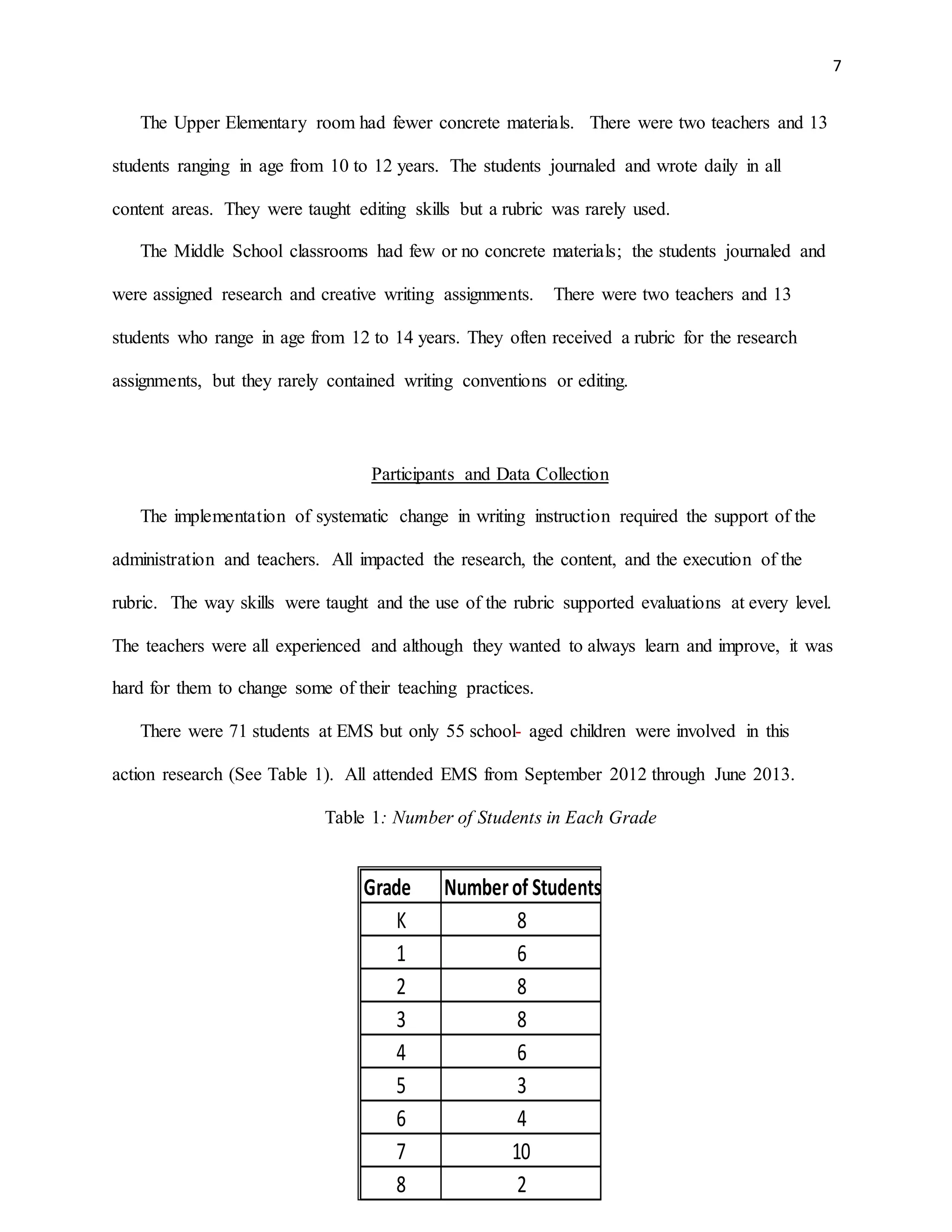
There were 71 students at EMS but only 55 school- aged children were involved in this
action research (See Table 1). All attended EMS from September 2012 through June 2013.
Table 1: Number of Students in Each Grade
Grade Numberof Students
K 8
1 6
2 8
3 8
4 6
5 3
6 4
7 10
8 2
8
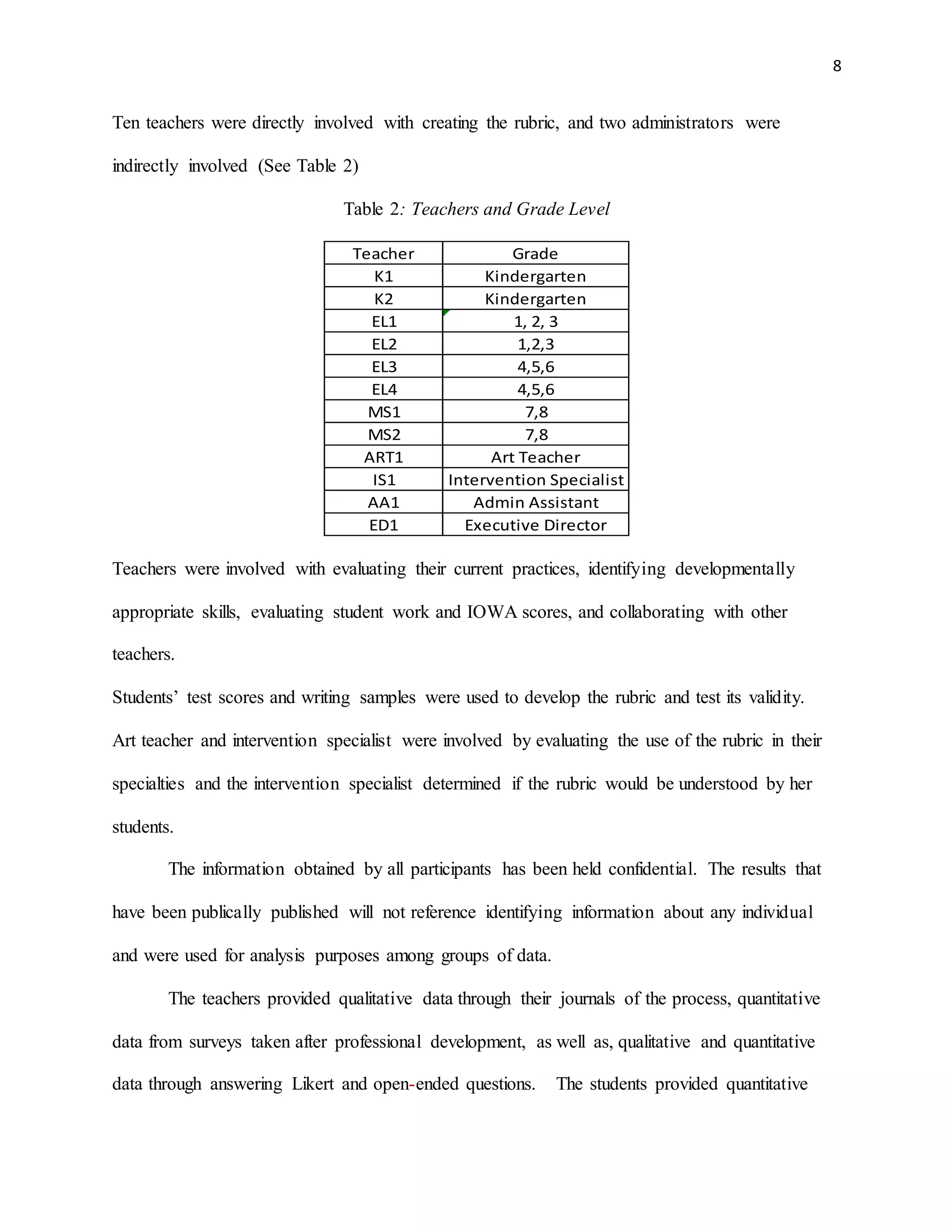
Ten teachers were directly involved with creating the rubric, and two administrators were
indirectly involved (See Table 2)
Table 2: Teachers and Grade Level
Teacher Grade
K1 Kindergarten
K2 Kindergarten
EL1 1, 2, 3
EL2 1,2,3
EL3 4,5,6
EL4 4,5,6
MS1 7,8
MS2 7,8
ART1 Art Teacher
IS1 Intervention Specialist
AA1 Admin Assistant
ED1 Executive Director
Teachers were involved with evaluating their current practices, identifying developmentally
appropriate skills, evaluating student work and IOWA scores, and collaborating with other
teachers.
Students’ test scores and writing samples were used to develop the rubric and test its validity.
Art teacher and intervention specialist were involved by evaluating the use of the rubric in their
specialties and the intervention specialist determined if the rubric would be understood by her
students.
The information obtained by all participants has been held confidential. The results that
have been publically published will not reference identifying information about any individual
and were used for analysis purposes among groups of data.
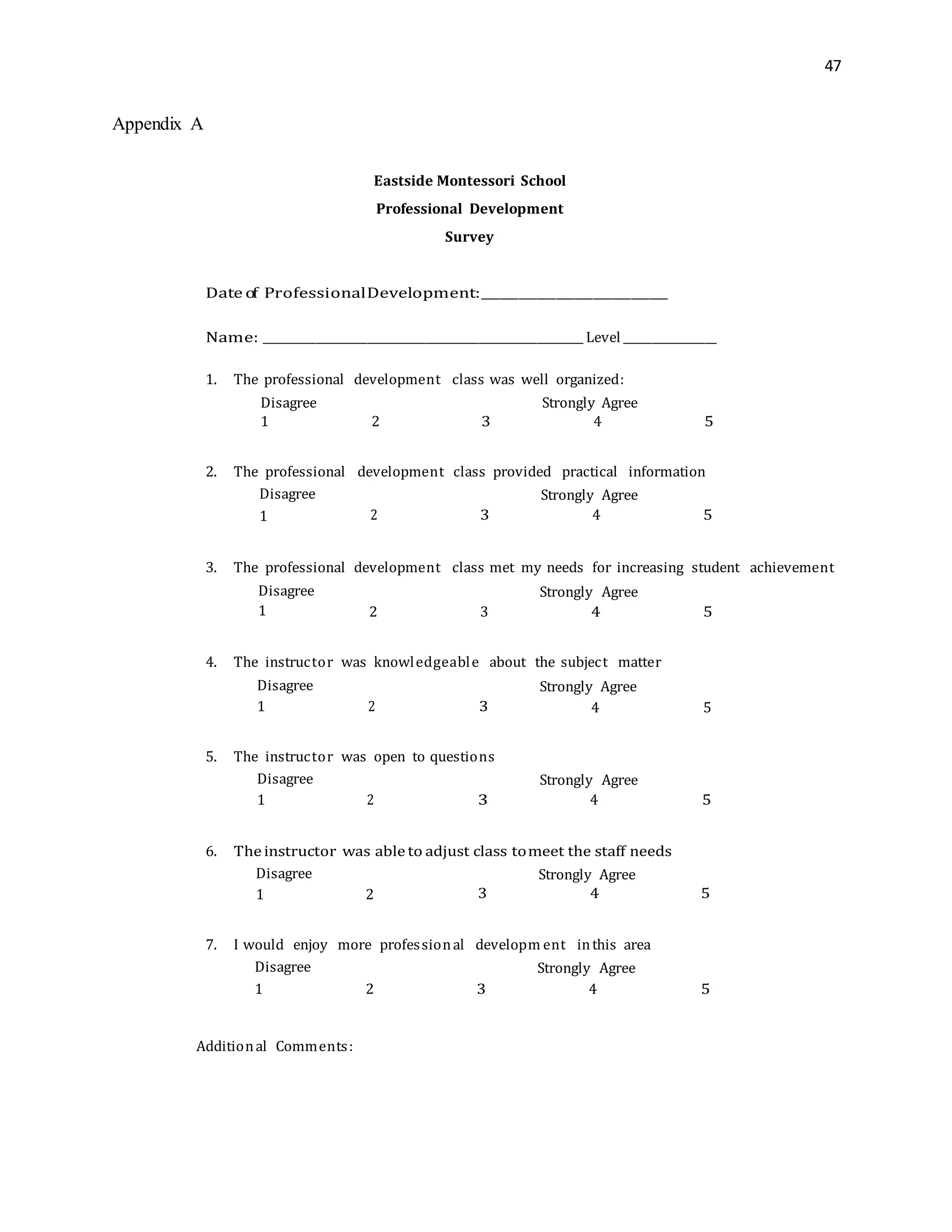
The teachers provided qualitative data through their journals of the process, quantitative
data from surveys taken after professional development, as well as, qualitative and quantitative
data through answering Likert and open-ended questions. The students provided quantitative
9
data trough their individual IOWA scores (there will be no IOWA data for kindergarten and first
grade); the students have also provided qualitative data through writing samples.
Questions to Answered by Action Research
1. What is the impact of collaboration among teachers as measured by creating a rubric for
writing skills?
2. What is the impact of collaboration on teachers’ motivation or engagement as measured
by the teachers’ reflective journals and pre and post self evaluation surveys?
3. What is the impact of evaluating the rubric for validity on teacher collaboration as
measured by teacher journals before and after evaluating the rubric?
4. What is the impact of this project on my leadership practices as measured by self
reflection in journals?
Overview of Methodology for Action Research
My action research goal was to take our current teaching staff and culture of the school
and create a new professional collaborative culture that better utilized the strengths and talents of
the Eastside Montessori School staff. I used quantitative data, (Likert scale surveys, IOWA
scores, and writing examples) and qualitative data, (teacher and student surveys, teachers journal,
and my personal journal). First, I reviewed the previous IOWA scores and compared written
work from students to create a baseline for comparison. More important, I created professional
development opportunities for the teaching staff, and created time for them to collaborate. Then
I developed a plan for implementation of the rubric once it was designed.
The implementation of this project occurred from October 2012 through May 2013. The
phases were divided as follows:
 October through December: professional development for teachers
10
 January through March: developed rubric and collaborated on the flow and content of the
rubric
 April through May: checked validity of the rubric across grade levels and content areas
The first professional development session reviewed the Montessori language curriculum.
A Montessori trainer led a workshop for the teachers reviewing the Montessori lessons and
principles of language for the pre-school through eighth grade child. The workshop included a
review of editing practices as well as spelling and conventions. Time was set aside for questions
specific to a teacher. There was time set aside for additional professional development in this
area, either for the group or for the individual teacher as needed. Additional professional
development opportunities in terms of collaborative cultures were completed throughout the
school year during staff meetings.
Formative assessments were done in November and March and summative assessment
completed in May. The formative assessment in November was a pre-survey assessing the
teachers’ knowledge of collaborative cultures in schools and if they consider EMS a
collaborative school. The formative assessment in March was a survey taken by the teachers on
how they felt the process of creating the rubric and collaboration was going. The final
assessment, completed in May, was a survey and a review of the teacher journals about the rubric
and the collaborative process.
Definition of Terms
Professional Learning Community- Educators work in groups where they are committed
to be collectively responsible for the common educational purpose; they are committed to
improve their professional practice, build relationships based upon mutual respect, and
improving student well-being and achievement (Hargreaves & Fullan, 2012, p.128).
11
“The Montessori Method- is a child-centered educational approach that views the child as
naturally driven to gain knowledge and capable of initiating learning in a supportive,
thoughtfully prepared environment. This approach values the human spirit and the development
of the whole child—physical, emotional, social and cognitive.” (Retrieved from
https://amshq.org/Montessori education/Introduction-To-Montessori.aspy)
“Professional development is defined as the increase of knowledge and skill, through
certified and consistent education, and its purpose is to increase a person’s level of competency
and open avenues of unlimited growth for individuals and the institutions in which they are
involved” (Retrieved from http://Ezinearticles.com/410654).
Collaboration is defined as the process of working with other individuals to develop
education programs and services for the fundamental aim of improving the educational,
emotional and physical wellbeing of children (Retrieved from
http://www.education.com/definition/collaboration/) and teacher collaboration is defined as an
interactive process that enables teachers with diverse expertise to work together as equals and
engage in shared decision making toward mutually defined goals. (Retrieved from
http://www.education.com/definition/collaboration/)
Motivation is defined as “the process that initiates, guides and maintains goal-oriented
behaviors.” Motivation activates our behavior by involving the biological, emotional, social and
cognitive forces in our brain (Retrieved from
http//:psychology.about.com/od/mindex/g/motivation-definition.htm?p=1).
A rubric is defined as a document that articulates the expectations for an assignment by
listing the criteria, or what counts and describing levels of quality from excellent to poor
(Goodrich and Andrade, 2001). Lovorn and Rezaei (2011) defined rubrics as scoring tools that
lay out the specific expectations for assignments.
12
In summary, the success of this study involved creating a rubric that would assist students
in improving their writing, and my staff created an interactive, supportive, and collaborative
culture that enabled us to problem solve quickly and efficiently. My hope was that the
collaborative process would not be cumbersome for our teachers and would ultimately become
an integral part of our school’s culture. Certainly fertile seeds have been sown.
13
Chapter 2
REVIEW OF LITERATURE
Introduction
The purpose of this chapter was to explore the research on educational change and the
effectiveness of teacher collaboration on the development of a rubric for writing across the
curriculum and grade levels. Creating a collaborative professional culture is a journey and an
exploration of best practices, professional growth, and personal satisfaction that one can attain
through his or her teaching career (Fullan, 2007). I needed to continually see our staff as
growing and learning along with their students and it is only through this growth that they would
obtain a sense of satisfaction with their life’s work. Evans (2012) eloquently described what a
professional community should be:
It’s not about reaching a fixed status and staying put, it’s about growth and
development, about enriching relationships and enhancing competence. Teachers
who embark on this journey have a real chance to learn new ways of looking at
themselves and their work and to broaden their view and deepen their craft—and,
thus enrich not only the quality of their teaching and of their students’ learning
but of their lives together. (p. 107)
The cultures of schools in general have not been created for teachers to collaborate, mentor, or
develop their profession. As Hargreaves and Fullan (2012) stated:
…getting good teaching for all learners requires teachers to be highly
committed, thoroughly prepared, continuously developed, properly paid, well
14
networked with each other to maximize their own improvement, and able to make
effective judgments using all their capabilities and experience (p. 3).
Even though collaboration will not result in improvement, it is a beginning for teachers to
enhance their strengths and develop their weaknesses. When the teachers are asked about
collaborating they say that there is no time during the school day. That is why professional
learning communities (PLC) have to become part of the schools culture. Once PLC’s are
established, teachers become central to meaningful change (Hargreaves & Fullan, 2012).
Goddard, Goddard and Tschannen-Moran (2007) proposed that the more teachers collaborate
and discuss best practices, theories, and methods the more they impact student learning.
Professional development was a critical tool to use in helping to change the culture of our
school. It is through increased knowledge that we become more confident of our abilities.
Motivation of teachers is important for developing collaboration within the school. It is through
professional development, motivation, and collaboration combined with respect for teachers as
professionals, that true professional learning communities can be established. The following
research questions drove the study of the effects of collaboration and professional development
on creating a writing rubric: 1) What was the impact of collaboration among teachers as
measured by creating a rubric for writing skills? 2) What was the impact of collaboration on
teachers’ motivation or engagement as measured by the teachers’ reflective journals and pre- and
post- self evaluation surveys? 3) What was the impact of the validity study on teacher
collaboration as measured by teacher journals before and after evaluating the rubric? 4) What
was the impact of this project on my leadership skills as measured by self reflection journal?
The major thematic strands related to my research goals were professional development,
motivation, collaboration, and the creation of the writing rubric.
15
Professional Development
Professional development is essential for every individual and is vital for every
organization in order to increase the knowledge and skills of their employees. It is defined as the
increase of knowledge and skill, through certified and consistent education, and its purpose is to
increase a person’s level of competency and open avenues of unlimited growth for individuals
and the institutions in which they are involved (Retrieved from http://Ezinearticles.com/410654).
In order to change a school’s culture, professional development opportunities need to be created
for teachers. It would be great if I could say “we are now creating a professional learning
community….Ready, Set, Go!” This is unrealistic, but in the outside world many believe that
educational leaders simply make it a law and a way we will evaluate teachers and it is done.
Fullan (2007) quoted Ball and Cohen (1999) as observing that “Although a good deal of money
is spent on staff development in the United States, most is spent on superficial, disconnected
from deep issues of curriculum and learning fragmented and noncumulative….teacher learning is
usually seen as either something that just happens as a matter of course from experience or as the
product of training in particular methods or curricula” (p. 4). In addition, Fullan (2007) stated
that in order for professional learning communities to work they need to be focused and
sustained. Teachers have to be able to connect assessment of their work as an opportunity to
engage in deeper questioning and sustained learning. Moreover, Goddard, Goddard and
Tschannen-Moran (2007) noted that Melnick and Witmer (1999) contended that teachers need to
be actively involved in their own professional development. Their involvement promoted
teachers learning from colleagues and brought about systematic reform. This is the key to
improving instruction and student learning as well as maintaining teacher morale and self
efficacy.
16
Equally important, the principal needs to create professional development opportunities
that are valuable to her teachers. The more information teachers have the more effective they
can be at creating vibrant learning environments for their students and themselves. The
professional development cannot be determined from the top down; the plans need to be a
collaborative decision between teachers and administration (Fullan, 2007; Evans, 2012).
Motivation
Motivation is defined as “the process that initiates, guides and maintains goal-oriented
behaviors.” Motivation activates our behavior by involving the biological, emotional, social, and
cognitive forces in our brain (Retrieved from
http//:psychology.about.com/od/mindex/g/motivation-definition.htm?p=1).
In order for change to occur, the participants should be motivated to change. The
realization that change is a process not an event, (Fullan, 2007) will help all stakeholders become
motivated to implement the steps needed to improve what we do on a daily basis. The teachers
must be empowered to discuss and agree upon adaptations to their work. They want to feel
respected and valued in order to be motivated to change. Fullan (2007) discussed that providing
professional learning communities for teachers offer a forum in which they can discuss and
collaborate on the “ethical and moral dimensions of their work and behavior” (p. 50). The
teachers should be shown empathy for their situation and learn in a neutral setting how to
improve their own practices for the betterment of their individual classroom and school as a
whole. This, in turn, increases their motivation to continue with the change process because they
are a part of the design, not just given the process to implement. The more the stake holders are
involved in the process, the more the change becomes ingrained in the culture of the school
(Hargreaves & Fullan, 2012).
17
Meaning also fuels motivation. Fullan (2007) stated that “finding moral or intellectual
meaning is not just to make teachers feel better. It is fundamentally related to whether teachers
are likely to find the considerable energy required to change the status quo” (p. 39). The
meaning behind change needs to be explained to teachers in terms of what they need to
understand and how the change will positively affect their students and student learning. We
also need to promote intrinsic motivation for our teachers. Montessori (1964) stated that for
“children to learn complex things they need to be intrinsically motivated and have the freedom to
explore and develop their intellect and experience” (p. 184). Just as this is valuable for student
learning, teachers must be given the freedom to explore their interests and develop mastery. It is
not about competition but about personal development for the betterment of the community at
large (Hargreaves and Fullan, 2012). Furthermore, Montessori (1964) established that children
were not motivated by external rewards, but that they had an internal drive to continue with a
task until mastery. Given the opportunity, teachers are also motivated intrinsically to improve
their craft and share what they have learned for the betterment of the community and their
students (Montessori, 1964). If teachers receive personal satisfaction of success with a new
approach, this satisfaction is likely to be transmitted to their students by excitement with
teaching and excitement with learning (Hargreaves & Fullan, 2012).
The principal is responsible for maintaining her teachers’ motivation. She has to stay
focused on the mission and give support to the teachers as needed. The teachers must feel like
they have been heard and that their ideas are being implemented and discussed. The principal is
also responsible for involving all the stake holders to support the mission and the teachers
(Fullan, 2007).
18
Collaboration
Collaboration is defined as the process of working with other individuals to develop
education programs and services for the fundamental aim of improving the educational,
emotional and physical wellbeing of children (Retrieved from
http://www.education.com/definition/collaboration/) and teacher collaboration is defined as an
interactive process that enables teachers with diverse expertise to work together as equals and
engage in shared decision making toward mutually defined goals. (Retrieved from
http://www.education.com/definition/collaboration/)
Although the above definitions seem straight forward and easy to implement, it is
actually much harder than it appears. Teachers are natural conflict avoiders with adults. We
often spend much of our time talking about a problem rather than directly dealing with the
problem (Evans, 2012). Evans (2012) asserted that schools were like villages; they cannot
survive total candor and resolve problems by talking about the person or the problem to others
rather than to the person, or persons involved. Fullan (2007) stated that the most effective
systems are direct when dealing with specific situations. When “something goes wrong, people
face the hard facts, learn what happened and why…” (p. 122); then they can move on to solve
the problem. Evans (2012) additionally stated “efforts at collaboration and collegiality are ever
fragile—hard to start, hard to sustain” (p.100). In order to sustain a truly collaborative collegial
environment for teachers, the faculty has to face deeply embedded structural and personal
changes. One of the personal obstacles to overcome is the necessity of collaboration. Many
teachers would rather spend their “spare time” with students than with other teachers; they have
to be instructed that collaboration is for the improvement of student learning not only creating a
19
professional environment for teachers. They often view working with colleagues, administrators,
or parents as an intrusion into their primary source of work satisfaction (Evans, 2012).
Kohn and Nance (2009) noted that collaborative cultures accelerate the teachers’ ability
to improve instruction, and “their energy, creative thinking, efficiency, and goodwill
increase…cynicism and defensiveness decrease” (p. 1). It needs to be assumed in teaching that
“improvement is a collective process rather than an individual’s expertise promoting change.
Analysis, evaluation and experimentation in collaboration with peers are ideal conditions for
teachers to improve” (Fullan, 2007, p. 140). The problem lies in the fact that there is little time
set aside for teachers to “engage in continuous and sustained learning about their practice in the
settings where they actually work, observing and being observed by their colleagues in their own
classroom settings and classrooms of others” (Fullan, 2012, p. 153). When we make shared
learning a part of our schools culture the students are impacted positively in terms of their
educational experience.
The principal can make or break the collaborative process within a school. Fullan (2007)
noted a study done by McLaughlin and Talbert (2006) which showed that principals were in a
strategic position to promote the development and sustainability of PLC’s in their schools. The
successful principals lead by “leveraging teacher commitment and support for collaboration,
broker and developing learning resources for teacher communities, and support transitions
between stages of community development” (p. 162). Principals are also responsible for
developing leaders within their school; these leaders will help facilitate collaboration and
maintain the sustainability of the PLC (Fullan, 2007).
20
Creating the Rubric
A rubric is defined as a document that articulates the expectations for an assignment by
listing the criteria, or what counts, and describing levels of quality from excellent to poor
(Andrade, 2001). Lovorn and Rezaei (2011) defined rubrics as scoring tools that lay out the
specific expectations for assignments. The research shows that if used correctly rubrics do
increase the quality of student writing. Andrade (2001) concluded that students’ writing quality
will increase if teachers simply hand them a rubric and explain to them how to use it. But in
order to sustain improvement the students need to be involved in writing the criteria for the
rubric. This is done by critiquing samples of writing and teaching students self assessment.
Lovorn and Rezaei (2011) indicated that rubrics benefit teachers and students in various ways.
Teachers are able to provide more meaningful feedback, evaluations are more equitable, and they
encourage self reflection. Lovorn and Rezaei (2011) cited various authors who offered
expectations of the use of rubrics. They noted that (Engbers, 2009; Gallavan & Kottler, 2009;
Gustafson & Bochner, 2009; Jonsson & Svingby, 2007; Spandel, 2006, p. 1) “rubrics have been
shown to reduce stakeholders’ confusion about evaluative expectations, help teachers refine
teaching skills, encourage students critical thinking, help students to use detailed feedback to
improve writing, and facilitate student communication with peers and teachers”
Lovorn and Rezaei (2011) quoted Wilson’s (2007) conclusion that some untrained
teachers use rubrics in ways that compartmentalize and bias their evaluations of students reading
and writing skills. These teachers are less consistent than those teachers who receive training on
rubric use and creation. Lovorn and Rezaei (2011) cited various authors who offered that high
quality and intensive teacher training on rubric use improves their reliability of assessment
(Dunbar, Brooks & Kubika-Miller, 2006; Hitt & Helms, 2009; Maxwell, 2010). Lovorn and
Rezaei (2011) concluded that high quality teacher training on the use and creation of rubrics
21
positively impacts students by creating timely feedback, prepares students to use feedback,
encourages critical thinking and self evaluation and facilitates communication with peers and
their teachers (p.8). Antrade, Wang, Du, and Akawi (2009) concluded that the use of rubrics
increases students’ self efficacy; an individual’s belief in his or her capability to achieve a
specific goal, throughout the writing process (p. 295). Antrade, Du, and Wang (2008) noted that
Stiggens states that when rubrics are used as a formative student- centered approach, they have
the potential to help students develop understanding, skill, and ability to self assess their own
work. Antrade, Du, and Wang (2008) concluded that “having students use model papers to
generate criteria for writing assignments and using a rubric to self assess first drafts is positively
related to the quality of their writing” (p. 8). This positive relationship demonstrates the
significance of using a rubric for students self assessment and their mastery of the writing
process (Antrade, Du & Wang, 2008)
Antrade and Du (2005) stated that students in their study endorsed the use of rubrics and
said that they used them in a purposeful way to improve their work and their grades. The
students noted that they used the rubrics throughout the process to self assess and revise their
work. They would also reflect on the feedback they received from their peers. Antrade and Du
stated that their findings validate the process of formative assessment described by Black and
William (1998) : “……1) recognize the goal, 2) consider the evidence and 3) have an
understanding of a way to close the gap between the two” (p. 6).
Conclusion
After reviewing the research I developed a plan to implement educational change at our
school. The culture of the school needed to change. We considered it necessary to create a
professional learning community at our school. Although the teachers were very supportive of
one another, they rarely took time to teach and learn from each other. As a direct result of the
22
empirical and theoretical data found in the preceding review of the literature, we used best
practices from current research-based models that provided us with formulas to increase
communication, collaboration, and motivation. Professional development was provided for
Montessori Language Arts, collaboration, and rubric creation. During our bi-monthly staff
meetings, the teachers participated in professional development. Time was set for the teachers to
observe in each other’s classrooms, share what was observed, and to collaborate on creating the
rubric. The teachers played an active role in designing the professional development, the rubric,
and creating a professional learning community.
23
Chapter 3
METHODOLOGY
Introduction
The purpose of this chapter is to discuss the methodology used to gather data on the
implementation of creating educational change at Eastside Montessori School. After careful
review of the current research on educational change and Eastside Montessori School’s (EMS)
need for a professional learning community, a restructure of the EMS teaching staff included a
few key elements that were monitored, measured, and reviewed. The areas of change included
implementation of professional development opportunities and bi-monthly meetings between the
teachers and administration to improve collaboration and communication. Also, the addition of
monthly opportunities for teachers to observe and be observed by their peers in order to provide
professional feedback on best practices, classroom management, incorporation of Montessori
principles, and individual student interventions, helped create and sustain our professional
learning community. The rubric encompassed kindergarten through eighth grade and would be
used across the curriculum.
These changes would occur in the following three Phases. Phase I began with an in-
depth review of our current practices, collaborative processes, identifying students’
developmentally appropriate skills, and evaluating student work. Phase II involved the creation
of the research-based writing rubric and implementation of the professional learning community.
Phase III focused on the continuation of collaboration by checking the validity of the rubric.
The above three phases answered the following research questions: 1) What was the
impact of collaboration among teachers as measured by creating a rubric for writing skills? 2)
What was the impact of collaboration on teachers’ motivation or engagement as measured by the
24
teachers’ reflective journals and pre- and post- self evaluation surveys? 3) What was the impact
of the validity study on teacher collaboration as measured by teacher journals before and after
evaluating the rubric? 4) What was the impact of this project on my leadership skills as
measured by self reflection journal? The major thematic strands related to my research goals
were professional development, motivation, collaboration and creating the writing rubric.
Context and Participants
Eastside Montessori School had four multi-aged classrooms and the children ranged in age
from 2.5 to 14 years old. Each classroom had two teachers. The teachers were assigned 20 to 30
students. The classrooms were full inclusion with approximately 25% of the students having
some type of learning disability and IEP. The students were with their teachers 95% of the time.
They had gym and music outside of the classroom, and art was taught within the classroom.
Writing was taught using the Montessori approach at each level, but the individual teachers
choose their own method of evaluation and student aids. The school was accredited by the Ohio
Department of Education and accountable to meet Ohio Standards. We were matching our
Montessori lessons to the Common Core Standards.
Eastside Montessori School (EMS) was a private school governed by a board of directors and
accredited by the Ohio Department of Education through the Diocese of Cleveland. EMS was
located in Kirtland, Ohio a northeastern suburb of Cleveland. EMS was a small school with 71
students enrolled in pre-school through eighth grade. The population was not widely diverse
with 98% Caucasian upper middle class, 1% low income and 1% other races.
The Children’s House classroom contained 24 students: eight were kindergarteners. There
were two teachers and a part time aid in the classroom. The classroom was designed to help
students work independently; new lessons were given as mastery was observed. The shelves
were designed from left to right, concrete to abstract; and kinesthetic learning materials were
25
provided throughout the curriculum. Writing was encouraged for all students; the students who
did not have the ability to write used the movable alphabet to share their thoughts and ideas. The
grammar materials helped the children to identify parts of speech and capitalization as well as
punctuation.
The Lower Elementary classroom had 22 students ranging in age from 6 to 9 years old. The
classroom was designed from concrete to abstract and kinesthetic learning continued. The
language materials became increasingly difficult and abstract as the students mastered each skill.
Writing was done on a daily basis in all content areas, informally in journal writing and formally
in research and creative writing projects.
The Upper Elementary room had fewer concrete materials. There were two teachers and 13
students ranging in age from 10 to 12. The students journaled and wrote daily in all content
areas. They were taught editing skills but a rubric was rarely used.
The Middle School classrooms had few or no concrete materials; the students journaled and
were assigned research and creative writing assignments. There were two teachers and 13
students who ranged in age from 12 to 14. They often received a rubric for the research
assignments, but they rarely contained writing conventions or editing.
Phase I: Defining the Current Model
The individual teachers at Eastside Montessori School (EMS) were responsible for
implementing all curriculum, strategies, and interventions for their students. Each of the four
multi- age classroom had 20 to 30 children. My role as principal had given me an opportunity to
observe and review the inner life of the school’s culture. I had observed that the teachers,
although they were a helpful and kind community of teachers, did not engage in discussions of
best practices, observation, and constructive feedback of peers. I believed that our staff’s’ skills
26
and potential were under utilized by not having a collaborative process in place. I had fully
supported the change in the culture and the staff had taken on the challenge of developing a
professional learning community.
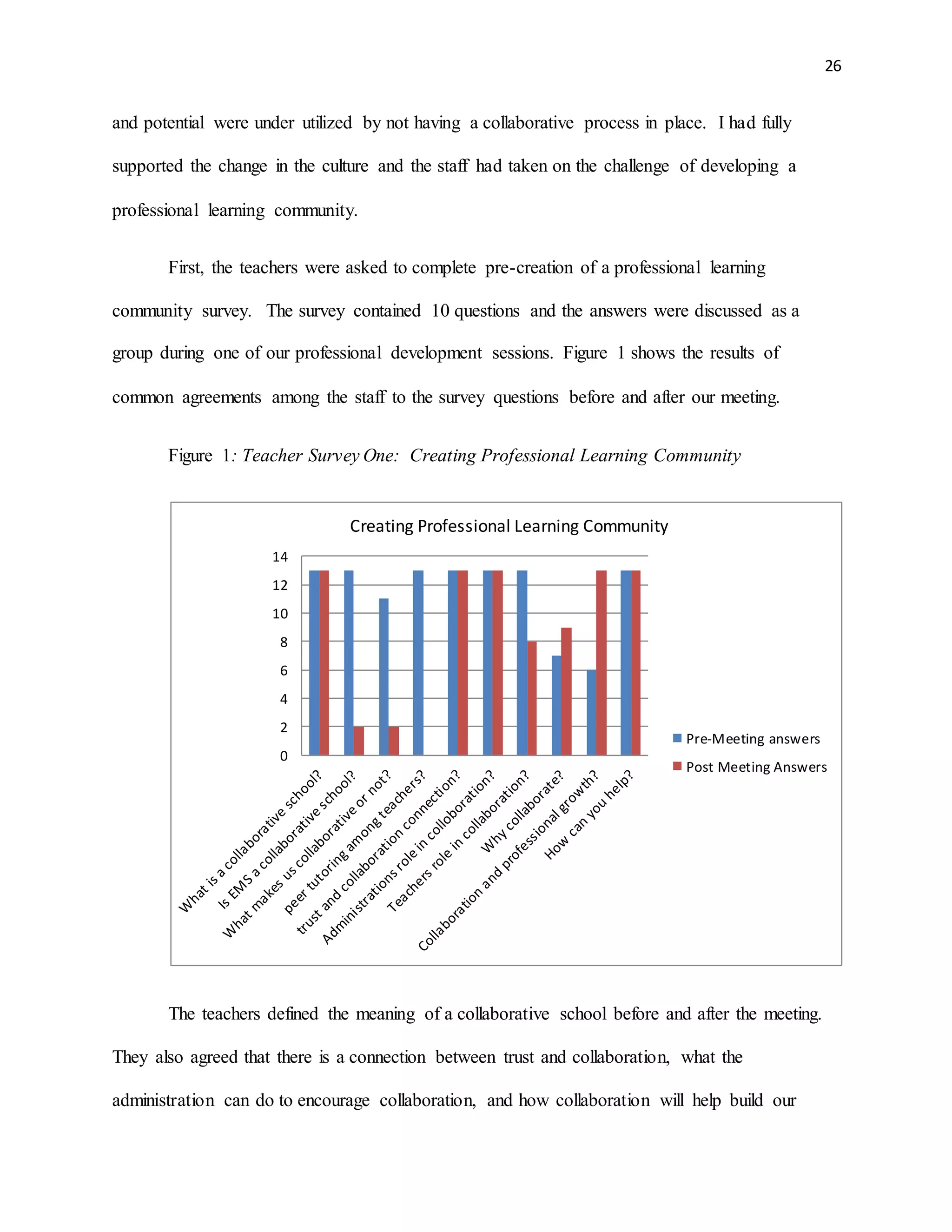
First, the teachers were asked to complete pre-creation of a professional learning
community survey. The survey contained 10 questions and the answers were discussed as a
group during one of our professional development sessions. Figure 1 shows the results of
common agreements among the staff to the survey questions before and after our meeting.
Figure 1: Teacher Survey One: Creating Professional Learning Community
The teachers defined the meaning of a collaborative school before and after the meeting.
They also agreed that there is a connection between trust and collaboration, what the
administration can do to encourage collaboration, and how collaboration will help build our
0
2
4
6
8
10
12
14
Creating Professional Learning Community
Pre-Meeting answers
Post Meeting Answers
27
school. The differences before and after the meeting identified that EMS was not a collaborative
school, what it meant for teachers to be teaching each other, and what needed to be taught. They
also saw the importance of collaboration in helping with professional growth.
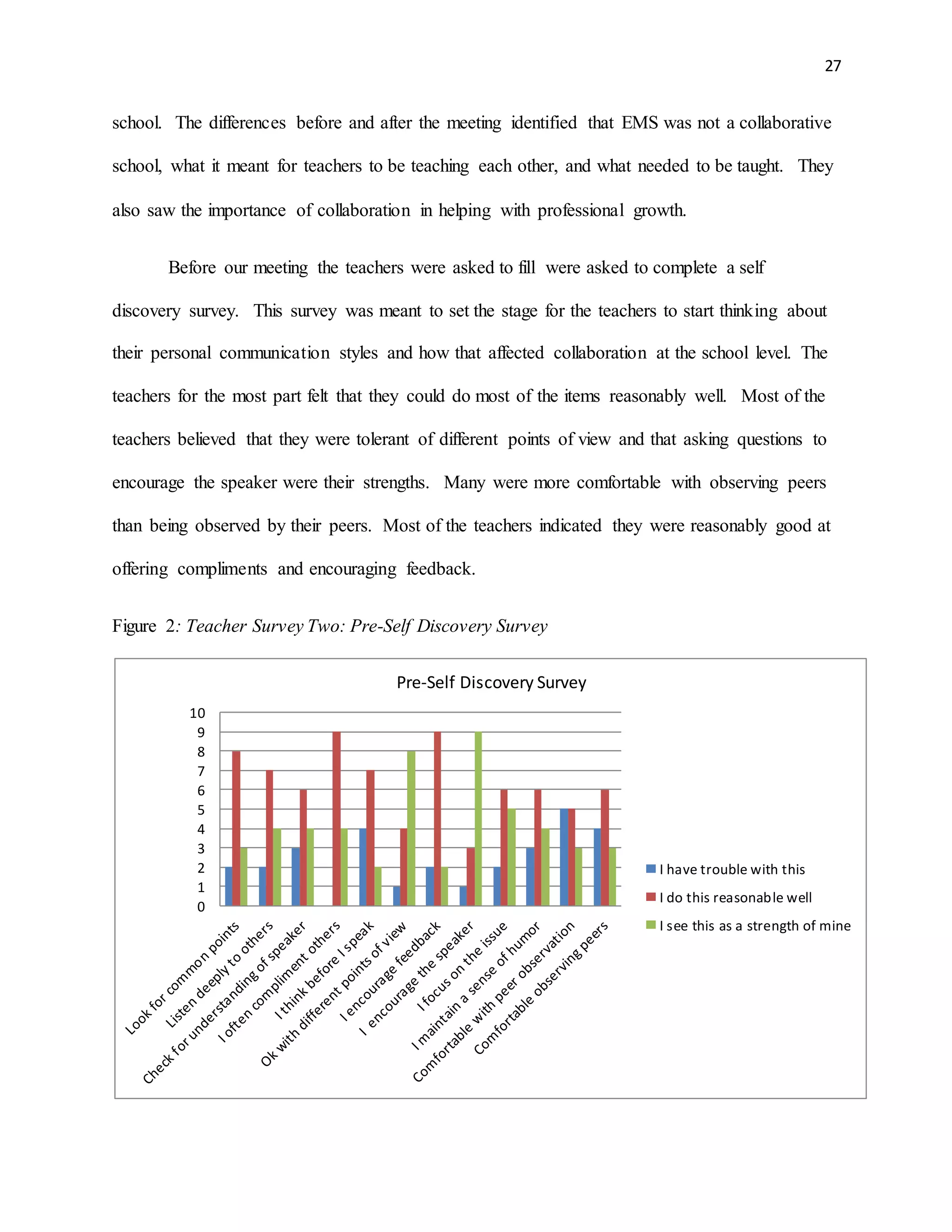
Before our meeting the teachers were asked to fill were asked to complete a self
discovery survey. This survey was meant to set the stage for the teachers to start thinking about
their personal communication styles and how that affected collaboration at the school level. The
teachers for the most part felt that they could do most of the items reasonably well. Most of the
teachers believed that they were tolerant of different points of view and that asking questions to
encourage the speaker were their strengths. Many were more comfortable with observing peers
than being observed by their peers. Most of the teachers indicated they were reasonably good at
offering compliments and encouraging feedback.
Figure 2: Teacher Survey Two: Pre-Self Discovery Survey
0
1
2
3
4
5
6
7
8
9
10
Pre-Self Discovery Survey
I have trouble with this
I do this reasonable well
I see this as a strength of mine
28
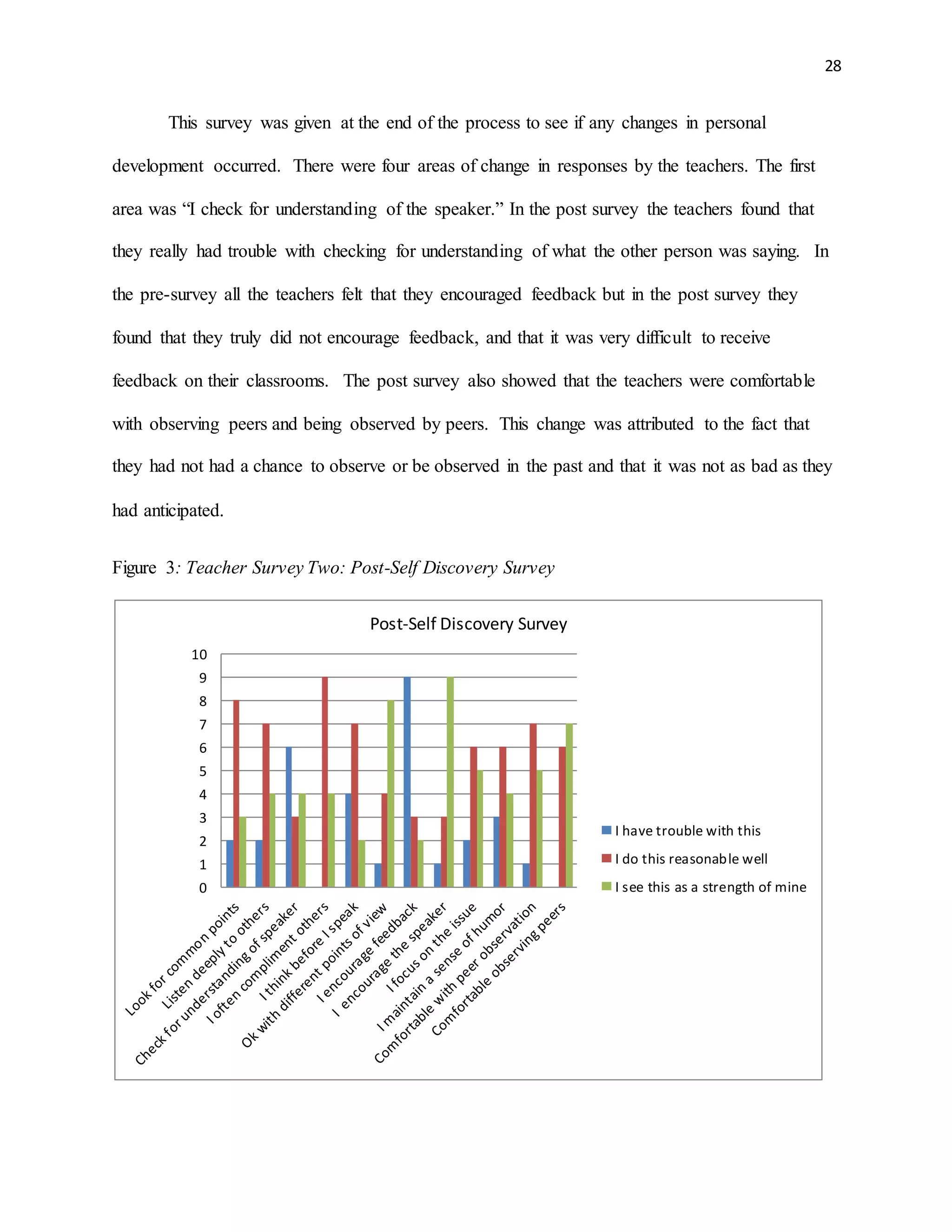
This survey was given at the end of the process to see if any changes in personal
development occurred. There were four areas of change in responses by the teachers. The first
area was “I check for understanding of the speaker.” In the post survey the teachers found that
they really had trouble with checking for understanding of what the other person was saying. In
the pre-survey all the teachers felt that they encouraged feedback but in the post survey they
found that they truly did not encourage feedback, and that it was very difficult to receive
feedback on their classrooms. The post survey also showed that the teachers were comfortable
with observing peers and being observed by peers. This change was attributed to the fact that
they had not had a chance to observe or be observed in the past and that it was not as bad as they
had anticipated.
Figure 3: Teacher Survey Two: Post-Self Discovery Survey
0
1
2
3
4
5
6
7
8
9
10
Post-Self Discovery Survey
I have trouble with this
I do this reasonable well
I see this as a strength of mine
29
In 2009/2010 school year Eastside Montessori School began its accreditation process
with the Diocese of Cleveland and the Ohio Department of Education. Through this process, it
was determined that there was a need for more instruction and intervention in the area of writing.
Our students were unable to recognize simple grammatical and spelling errors in their work, and
in standardized tests. We decided that a rubric would help students understand what was
expected of them and helped them with their editing process. Montessori philosophy supports
the use of a rubric and using students’ authentic work to teach grammar and spelling. Even
though we had agreed that a rubric for writing would be valuable for our students’ learning,
many of the teachers were concerned that they would not have time to write, introduce, and
maintain the rubric. Per the qualitative survey given to teachers on October 30, 2012, the results
showed that only three of the 13 teachers completing the survey could define a rubric. Ten of the
13 teachers felt that a rubric would only be used for a long term project, and all of the teachers
felt that rubrics were self explanatory and students did not need to be taught how to use them.
At the time, rubrics were only used at the middle school level. They were used for long-
term projects and the students were often not taught how to use them. In the qualitative survey
given to the 12 middle school students, only two of them could define a rubric (eighth grade) and
said that they were used to help organize long term projects, the other 10 students (seventh
grade) could not define a rubric and did not understand why they were given rubrics. They felt
the rubric gave them additional work for their projects. The students needed to be taught what a
rubric was and how it could be used by them to organize and complete not only their writing
assignments but all of their long-term projects.
In summary, the results of the surveys were used by the researcher/principal to create
professional development opportunities for the teachers. The first was to have professional
30
development on learning how to use a rubric, what they were used for, and how to teach students
to use a rubric. The training the teachers received helped with the implementation of the
subsequent stage. The staff realized that it would be hard to create a rubric if there was not a
consensus of what a rubric was to EMS. The pre and post-self discovery surveys facilitated to
staff’s understanding of its communication style and to take note on how they communicated
with their peers and with the administration.
Phase II: Creation of the Research-Based Writing Rubric and Implementation of the
Professional Learning Community
A professional learning community was created by implementing bi-monthly staff
meetings, one to be held during lunch time with core teachers and one to be held after school
with all teaching staff. During these meetings, the staff developed a timeline to create the
writing rubric and a calendar for peer observations. The meeting times were used to create the
rubric and for professional collaboration and development. Additional time was set aside for
further professional development at the school, the Montessori Training Center, and the Diocese
of Cleveland. These opportunities for learning were for the whole staff or for individuals who
felt they needed additional training in specific areas. The pre and post surveys evaluated the
perceived value of the professional learning community and the professional growth of the
teachers.
The teachers were given a pre and post-survey about rubrics. They were also asked to
journal about the process. At first, the teachers felt that creating a rubric would be an easy task,
but when they began the process they found that they needed some additional training. The
teachers were presented with exemplars and additional training on the use and creation of
rubrics. The journals showed that the rubric creation was a relatively easy process for the
31
teachers. They were able to create the rubric for their level and collaborated with the previous
and subsequent levels to insure there were no gaps. The only problem they encountered was
finding the time to collaborate. Consequently, the administration set aside time during each staff
meeting for the teachers to work on the rubric.
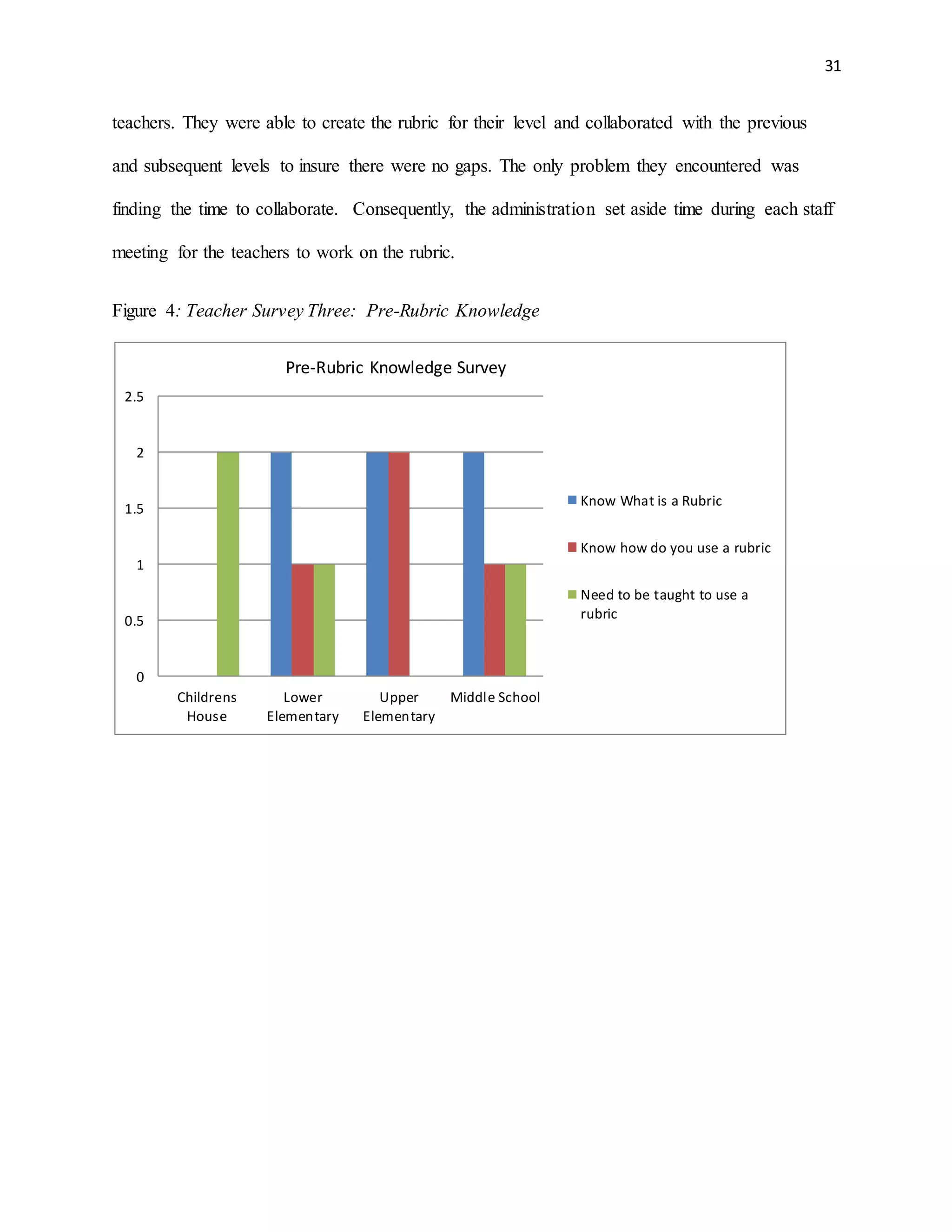
Figure 4: Teacher Survey Three: Pre-Rubric Knowledge
0
0.5
1
1.5
2
2.5
Childrens
House
Lower
Elementary
Upper
Elementary
Middle School
Pre-Rubric Knowledge Survey
Know What is a Rubric
Know how do you use a rubric
Need to be taught to use a
rubric
32
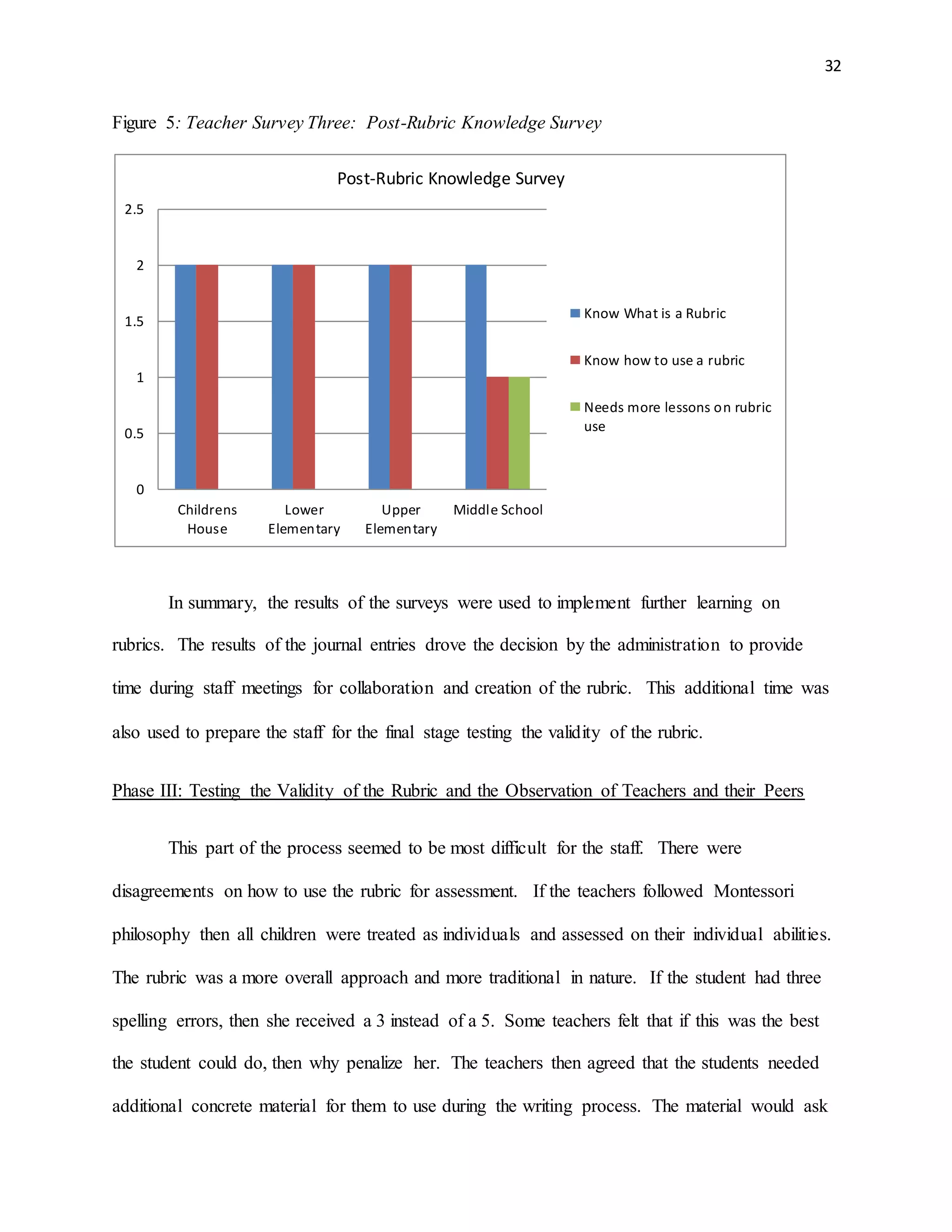
Figure 5: Teacher Survey Three: Post-Rubric Knowledge Survey
In summary, the results of the surveys were used to implement further learning on
rubrics. The results of the journal entries drove the decision by the administration to provide
time during staff meetings for collaboration and creation of the rubric. This additional time was
also used to prepare the staff for the final stage testing the validity of the rubric.
Phase III: Testing the Validity of the Rubric and the Observation of Teachers and their Peers
This part of the process seemed to be most difficult for the staff. There were
disagreements on how to use the rubric for assessment. If the teachers followed Montessori
philosophy then all children were treated as individuals and assessed on their individual abilities.
The rubric was a more overall approach and more traditional in nature. If the student had three
spelling errors, then she received a 3 instead of a 5. Some teachers felt that if this was the best
the student could do, then why penalize her. The teachers then agreed that the students needed
additional concrete material for them to use during the writing process. The material would ask
0
0.5
1
1.5
2
2.5
Childrens
House
Lower
Elementary
Upper
Elementary
Middle School
Post-Rubric Knowledge Survey
Know What is a Rubric
Know how to use a rubric
Needs more lessons on rubric
use
33
questions such as “Have I checked my work for capitals at the beginning of the sentence and
punctuation at the end of the sentence?” After the question there would be an example of a
sentence with the beginning word and the ending punctuation highlighted. They also agreed that
the rubric would look different for the diverse developmental levels of the students. The teachers
still found that they wanted to evaluate the students based upon who they were as individuals,
but when they thought about the rubric as a teaching tool they were able to move forward. The
teachers agreed that the students needed to understand that writing conventions had to be
followed.
Throughout this process the teachers also observed each other. After their observation
they would talk about the observation. The teachers were excited at first to have time set aside to
observe their friends. The problem was what their “friends” had to say about their classroom and
professional practices. It was hard to hear that there was room for improvement. The teachers
who made suggestions were also upset when the suggestion was not carried out by the other
teacher. The teacher journals showed their frustration with the process. Time was set aside
during staff meeting for the staff to discuss their frustrations. This open discussion helped the
teachers to take the observations less personally.
Conclusion
The result of this process was to create a collaborative professional learning community
among the teachers and an increased awareness and understanding of the writing process for our
students, teachers, and parents. It is only when we were all working consistently toward the
same goal that we accomplished the creation of an innovative learning environment for all of our
stakeholders. Sustaining the collaboration and professional learning community will be the
challenge.
34
Chapter 4
Data Analysis
Introduction
The educational change that was set forth by my project has continued to evolve. Change
is a process that should have specific goals, but it needs to be understood that change requires
time. During this project I found that many of my conceptions about the staff were actually
misconceptions. Despite this, results were found in the development of a professional learning
community and of a rubric for writing across the curriculum. The implementation of peer
observations helped in the development of our PLC, but often the time set aside for observation
and sharing was not always used by the staff. A new culture for these teachers was starting to
take hold. Their fear of being observed was replaced by openness to shared learning.
Introduction of bi-monthly staff meetings created time for the teachers to collaborate on
development of the writing rubric. Some gains were made but to create a sustainable PLC more
work needed to be done.
The purpose of this chapter is to analyze the data gathered to answer the following
research questions: 1.What is the impact of collaboration among teachers as measured by
creating a rubric for writing skills? 2. What is the impact of collaboration on teachers’ motivation
or engagement as measured by the teachers’ reflective journals and pre and post self evaluation
surveys? 3. What is the impact of evaluating the rubric for validity on teacher collaboration as
measured by teacher journals before and after evaluating the rubric? 4. What is the impact of this
project on my leadership practices as measured by self reflection in journals?
35
Analysis of Data for Research Question #1:
What is the impact of collaboration among teachers as measured by creating a rubric for writing
skills?
The pre-Rubric knowledge survey indicated that I needed to create a professional
development opportunity on the creation and implementation of rubrics. As indicated in figure 7
there was still one teacher that needed additional training on rubrics; this was provided
individually. The teachers’ reflective journals indicated that they needed more guidance from
me and more time to collaborate. As a result of the feedback received from the reflective
journals, bi-monthly staff meetings were established. This allotted time for collaboration and
creation of the writing rubric.
Figure 6: Teacher Survey Five: Post- Rubric Knowledge
Figures 7 and 8 are samples of the elementary and middle school rubrics respectively.
The rubrics are the result of the collaborative process developed. This was indicated through my
reflective journal and observation of the bi-monthly meeting with teachers. During the
0
0.5
1
1.5
2
2.5
Post Rubric Knowledge
Know What is a Rubric
Know how to use a
rubric
Needs more lessons
on rubric use
36
collaboration process the teachers agreed that we should not put a numerical score on any of the
rubrics except for middle school. The rubric was designed for the students to be responsible for
checking their own work and for teacher student interaction after the writing assignment was
completed.
Figure 7: SampleElementary Rubric
Figure 8: Sample Middle School Rubric
Sample Elementary Rubric
WritingFocus
Punctuation:
Doeseach sentence endwithapunctuationmark?
Student_______ Teacher_________
Are apostrophesinplace toshowpossessionortomark
contractions?
Student________ Teacher_________
Sample Middle School Rubric
Based upon 100%
Grammar, Spelling
and Punctuation
(15%)
15%
Writingis free of
all errors in
grammar, spelling
and punctuation
10%
Writingcontains
no more than two
errors in grammar,
spellingand
punctuation
5%
Writingcontains
no more than
three errors in
grammar, spelling
and punctuation
0%
Writingcontains
more than four
errors in grammar,
spellingand
punctuation
37
Analysis of Data for Research Question #2
What was the impact of collaboration on teachers’ motivation or engagement as
measured by the teachers’ reflective journals and pre and post self evaluation surveys?
The results of the qualitative data retrieved from teachers’ journals reflected their
frustration with the observation process and the development of the writing rubric. The results
from my personal journal indicated the level of frustration by the complaints I received by
faculty about each other. This indicated to me that time needed to be set aside during staff
meetings to discuss their frustration with peer observations and with the process of developing a
rubric. The data retrieved from the journals after being given professional development time at
staff meetings reflected that the teachers were highly motivated to complete the rubric. The
qualitative data further indicated that the incentive for peer observations to continue was that
they would be able to increase the quality of instruction they provide for their students. Once
they were able to look at peer observation as a way to grow professionally, suggestions from
peers were more readily received. The time was also used to share ideas, develop curriculum,
and create opportunities for further investigation into best practices.
The Self-Discovery survey was given at the beginning and the end of the process of
creating the writing rubric to see if any changes in professional development occurred. There
were four areas of change in responses by the teachers. In the post- survey the teachers
discovered that they really did have trouble with checking for understanding of what their
observer was saying. In the pre- survey all the teachers felt that they encouraged feedback, but
in the post- survey they found that they really did not encourage feedback, and that it was very
difficult to receive feedback about their classrooms. The post- survey also indicated that all but
one of the teachers were more comfortable with observing peers and with being observed by
38
peers. This change was attributed to the fact that they had not had a chance to observe or be
observed in the past, and it was not as difficult as they had anticipated.
The results showed that in order for the teachers to be able to create the rubric they had to
collaborate and gain an understanding of what each teacher’s responsibility was and the students
they served. They needed to gain an understanding of each developmental level from pre-school
through adolescents. More importantly they discovered the teachers needed to understand their
own communication style and make changes to themselves before true collaboration could occur.
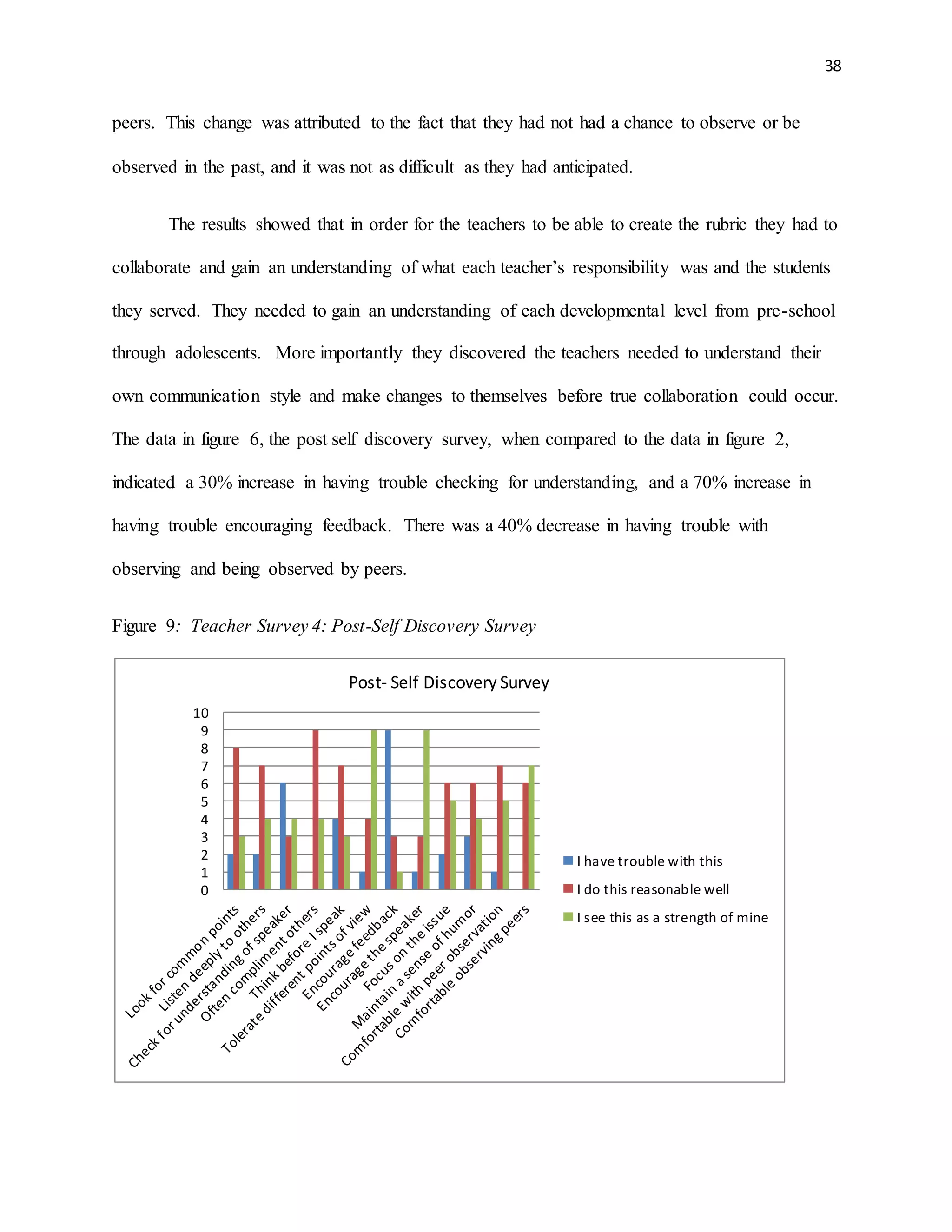
The data in figure 6, the post self discovery survey, when compared to the data in figure 2,
indicated a 30% increase in having trouble checking for understanding, and a 70% increase in
having trouble encouraging feedback. There was a 40% decrease in having trouble with
observing and being observed by peers.
Figure 9: Teacher Survey 4: Post-Self Discovery Survey
0
1
2
3
4
5
6
7
8
9
10
Post- Self Discovery Survey
I have trouble with this
I do this reasonable well
I see this as a strength of mine
39
Figure 9 above represents teacher self evaluation of communication style after
participating in development of the writing rubric.
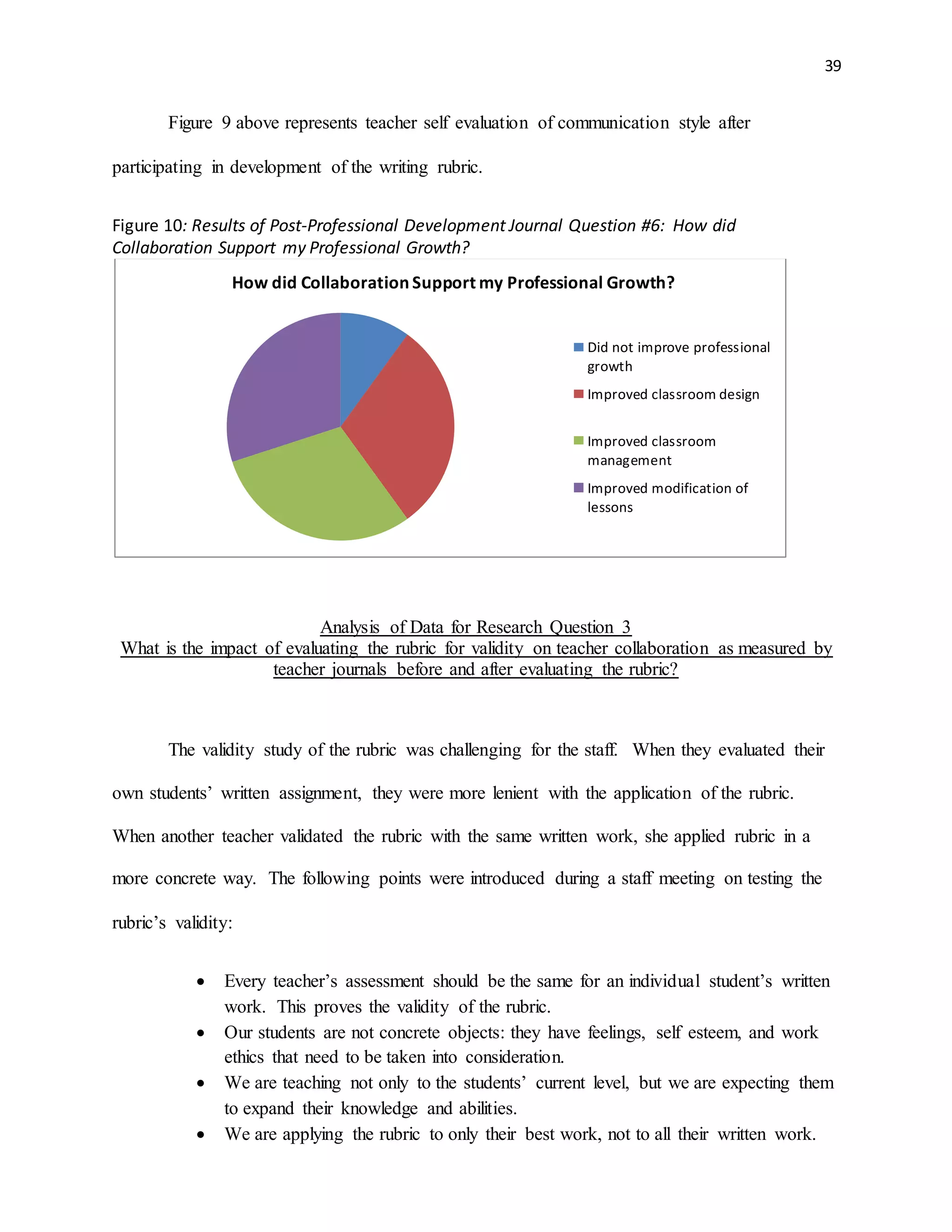
Figure 10: Results of Post-Professional Development Journal Question #6: How did
Collaboration Support my Professional Growth?
Analysis of Data for Research Question 3
What is the impact of evaluating the rubric for validity on teacher collaboration as measured by
teacher journals before and after evaluating the rubric?
The validity study of the rubric was challenging for the staff. When they evaluated their
own students’ written assignment, they were more lenient with the application of the rubric.
When another teacher validated the rubric with the same written work, she applied rubric in a
more concrete way. The following points were introduced during a staff meeting on testing the
rubric’s validity:
 Every teacher’s assessment should be the same for an individual student’s written
work. This proves the validity of the rubric.
 Our students are not concrete objects: they have feelings, self esteem, and work
ethics that need to be taken into consideration.
 We are teaching not only to the students’ current level, but we are expecting them
to expand their knowledge and abilities.
 We are applying the rubric to only their best work, not to all their written work.
How did Collaboration Support my Professional Growth?
Did not improve professional
growth
Improved classroom design
Improved classroom
management
Improved modification of
lessons
40
 Discover ways in which the rubric enhances student learning.
Throughout this discussion the collaborative process was experienced by the entire faculty. The
qualitative data retrieved from journal reflections noted that having time at staff meetings to
discuss differences of opinion and to be able to come to a consensus supported collaboration and
improved the integrity of our school.
Summary
This project posed four questions: 1.What is the impact of collaboration among
teachers as measured by creating a rubric for writing skills? 2. What is the impact of
collaboration on teachers’ motivation or engagement as measured by the teachers’ reflective
journals and pre and post self evaluation surveys? 3. What is the impact of evaluating the rubric
for validity on teacher collaboration as measured by teacher journals before and after evaluating
the rubric? 4. What is the impact of this project on my leadership practices as measured by self
reflection in journals? Data analysis revealed that the teachers increased their comfort level with
observing and being observed by their peers by 40%. This increased their ability to collaborate
and gain understanding of their peers’ experiences. Their overall rubric knowledge and
understanding was initially 50%; it was increased to 90% during this research. Teachers were
motivated to learn, and collaborated more efficiently as demonstrated by the creation of the
writing rubric. The creation of the PLC was valued by the teachers as indicated by the results
shown in figure 9. As a result of their participation in the creation of the writing rubric process
there was an increase in collaboration, engagement, and motivation among the teachers. The
process of problem solving has been streamlined as indicated by their reflective journals and
post-self discovery survey. The teachers’ reflective journals demonstrated a 50% increase in
41
positive references to the collaboration process as compared to journal entries reviewed at the
beginning of the action research process.
42
Chapter 5
Conclusion
The Effect on my Leadership Practices
At the start of my Action Research Project I believed that implementing educational
change by creating the PLC and the rubric would be relatively easy for my staff. They were a
group of professionals that were driven by improving their work and its impact on students. I
felt my role would simply be that of organizing professional development opportunities and
scheduling peer observation times. As the educational change process began I used a reflection
journal to monitor my feelings, successes, and areas of improvement, as well as change that
needed to be made and the progress that was achieved. The impact on my leadership skills was
profound.
Prior to beginning my action research project I was promoted to Principal of Catholic
Montessori School. Thus, the first challenge I had was changing my approach to the staff from
staff member to leader. They looked to me for support, guidance, and strength. As the project
began to unfold I found myself feeling frustrated by the teachers’ inability to resolve
disagreements on their own. In Montessori education we pride ourselves on teaching students
problem solving skills, both with academic and social situations. When one of our students has a
disagreement with another student we encourage them to discuss the problem and hopefully
come to a consensus. We only intervene when a consensus cannot be met. The staff, on the
other hand, expected me to be the middleman for them. I arranged a time for the two teachers
involved, discussed what has been brought to my attention and then left the room to give them
time to resolve their differences. Staff meetings were another opportunity for professional
development and collaboration. Observing in every classroom, every day, built my integrity
43
with the teaching staff. I found myself doing research, joining blogs, and seeking assistance
from veteran principals in order to improve my leadership skills. The more confident I became as
a leader, the easier the educational change became for my staff.
Creating educational change is a process that needs to be continually reviewed to
determine if the original goals are still realistic. The factors involved in the change process are
the students, faculty, parents, the administration of the school, and the time required. This
research project has made gains in the development of a PLC and writing rubric, but additional
time was needed to implement the student use of the rubric and parent education opportunities. A
major factor that impacted this research was the limited availability of time. Time will
continually impact the sustainability of the PLC and the implementation of student use of the
rubric.
The development of the PLC increased the staff’s ability to solve problems and improve
communication across grade levels. Through the use of time during staff meetings for
professional development, the staff was able to gain understanding of the need for collaboration
and observation of and by peers. They found that their classrooms and students were positively
impacted by the sharing of ideas and information with their fellow teachers. Another gain from
forming the PLC was better professional development. The teachers were able to come to a
consensus about the type of professional development they wanted and needed, and I was able to
create a network of mentors to help the staff, and me, improve both professionally and
personally.
The creation of the rubric made our curriculum congruent and closed gaps between
levels. The staff gained an understanding of the use of rubrics and how they can impact student
44
learning. They are looking forward to implementing student use of the rubric in the 2013/2014
school year.
Moving Forward – Ideas for Continued Improvement
The immediate action plan is to implement the use of the rubric by the students in the fall
of 2013. Continuation of the bi-monthly staff meetings will facilitate the continued growth of
the PLC, and the staff’s problem solving skills. The continual use of surveys will enable the
teachers and me to maintain the integrity of the PLC. Parent education opportunities will be
developed by the staff and the administration, beginning fall of 2013 and continuing through the
future. The use of surveys will be used to help design the format of the parent meetings.
The Eastside Montessori School staff, administration, and Board of Trustees were all
cooperative in this research project, which showed that they were receptive to educational
change and the implementation of new ideas. The need for continual improvement is vital to our
school’s growth. Opportunities for parent education and for student use of the rubric are areas of
improvement that will need to occur in the beginning of the new school year. As we grow as a
staff we have to be mindful of the effectiveness of our PLC. It is only through active listening to
new ideas and the use of creativity, teamwork, and continued discussions of how to best serve
our students, that we will be able to continue to grow both professionally and personally. The
sustainability of our school will be based upon our ability to continually evolve as an educational
institution for the 21st century student.
45
References
Andrade, H., & Du, Y. (2005). Student perspectives on rubrics-referenced assessment. Practical
Assessment, Research & Evaluation, 10(3), 1-20.
Andrade, H. L., Du, Y., & Wang, X. (2008). Putting rubrics to the test: the effect of a model,
criteria generation, and rubric referenced self-assessment in elementary school students’
writing. Educational Measurement: Issues and Practices, Summer(2008), 3-13.
Andrade, H.L., Wang, X. Du, Y., & Akawi, R. (2009). Rubric-referenced self-assessment and
self-efficacy for writing. The Journal of Educational Research, 102(4), 287-301.
Dictionary.com. (n.d.). Dictionary.com. Retrieved October12,2012, from http://www.dictionary-
reference.browse.com/motivation
Dictionary.com. (n.d.). Dictionary.com. Retrieved October12,2012, from http://www.dictionary-
reference.browse.com/collaboration
Education.com. (n.d.). Education.com. Retrieved October 12,2012, from
http://www.education.com/definitions/ collaboration
Education.com. (n.d.). Education.com. Retrieved October 12,2012, from
http://www.education.com/definitions/teacher-collaborationErwin, B., Wash, P.D., &
Evans, R. Getting to no: building true collegiality in schools. School Matters, Winter(2012), 99-
107.
Fullan, M. (2005). Leadership & sustainability: system thinkers in action. Thousand Oaks,
California: Corwin Press.
Fullan, M. (2007). The new meaning of educational change (4th ed.). New York City, NY:
Teachers College Press.
46
Goddard, Y.l., Goddard, R. D., & Tschannen-Moran, M. (2007). Atheoretical and empirical
investigation of teacher collaboration for school improvement and student achievement in
public elementary schools. Teacher College Record. 109(4), 877-896.
Goodrich, H. (2001, April 17). The effects of instructional rubrics on learning to write. Current
issues in Education [On-line], 4(4). Retrieved from
http://cle.ed.asu.edu/volume4/number4/.
Hargreaves, A. & Fullan, M. (2012). Professional capital: transforming teaching in every
school. New York City, NY: Teachers College Press.
Kohm, B., & Nance, B. (2009). Creating collaborative cultures. Educational Leadership. 67(2),
1-6.
Lovorn, M.G. & Rexaei, A.R. (2011). Assessing the assessment: rubrics training for pre-service
and new in-service teachers. Practical Assessment, Research & Evaluation, 16(16), 1-18.
Merriam-Webster (n.d.). Merriam-webster dictionary. Retrieved 10/24/2012, from
http://merrian-webster.com/dictionary/collegialty
Montessori, M. (1964). The montessori method. New York City, NY: Schocken Books.
Montessori, M. (1967). The discovery of the child (M. Costelloe, Trans.). New York:
Ballantine Books. (Original work published 1948)
Saddler, B., & Andrade, H. (2004). The writing rubric instructional rubrics can help students
become self-regulated writers. Educational Leadership, October(2004), 48-52.
47
Appendix A
Eastside Montessori School
Professional Development
Survey
Date of ProfessionalDevelopment:__________
Name: _______________________________________________________ Level ________________
1. The professional development class was well organized:
Disagree Strongly Agree
1 2 3 4 5
2. The professional development class provided practical information
Disagree Strongly Agree
1 2 3 4 5
3. The professional development class met my needs for increasing student achievement
Disagree Strongly Agree
1 2 3 4 5
4. The instructor was knowledgeable about the subject matter
Disagree Strongly Agree
1 2 3 4 5
5. The instructor was open to questions
Disagree Strongly Agree
1 2 3 4 5
6. Theinstructor was ableto adjust class tomeet the staff needs
Disagree Strongly Agree
1 2 3 4 5
7. I would enjoy more professional developm ent inthis area
Disagree Strongly Agree
1 2 3 4 5
Additional Comments:
48
Eastside Montessori School
Teacher Survey One
Creating Professional Learning Environments
Please answer the following questions. We will discuss them at our next staff meeting.
1. What is a collaborative school?
2. Is Catholic Montessori School a collaborative school?
3. If yes, then what makes us collaborative, if not, then why are we not
collaborative?
4. What does it mean to have teachers teaching each other? What needs to be
taught?
5. What is the connection between trust and collaboration?
6. What can this administration do to encourage collaboration?
7. What can you do to increase collaboration?
8. Why collaborate? What are the benefits of collaboration for teachers? For
students? For parents?
9. How do you see collaboration helping in your professional growth?
10. How do you see collaboration helping us grow the school?
49
During this process I am asking you to journal. While you journal I want you to consider
the following questions:
1. How do I feel about this process?
2. What prevented me from accomplishing collaboration?
3. What do I need in order to be prepared for my collaborative meeting?
4. What do I need from the principal in order to achieve our goal of creating a
rubric?
5. How does my work climate support collaboration?
6. How does collaboration support my professional growth?
Below you will find a simple self discovery survey. We will use this as we begin the process
of creating a collaborative environment for creating a writing rubric. We will also take this
survey at the end of the process.
1= I have trouble with this
2= I do this reasonably well
3= I see this as a strength of mine
1. I look for common points of agreement 1 2 3
2. I listen deeply to others 1 2 3
3. I often check to see if I understand the speaker 1 2 3
4. I often compliment others 1 2 3
5. I think before I speak 1 2 3
6. I am ok with different point of view 1 2 3
7. I encourage feedback 1 2 3
8. I ask questions to encourage the speaker 1 2 3
9. I focus on the issue 1 2 3
10. I maintain a sense of humor, even when the going gets tough 1 2 3
11. I am comfortable with peers observing me 1 2 3
12. I am comfortable with observing peers 1 2 3
50
Please answer the following questions
Pre-survey
1. What is a rubric?
2. When would you use a rubric?
3. Do you need to be taught how to use a rubric?

Diana Betts_Creating Educational Change_ Final as of 3-28-2014_Duplicate this version.

  • 1.
    Creating Educational Change AResearch Project Submitted to The Graduate Studies Office Notre Dame College In Partial Fulfillment of the Requirements For the Degree of Master of Education By Diana Betts 2013
  • 2.
    ABSTRACT The purpose ofthis study was to determine the impact of creating a new professional collaborative culture that better utilizes the strengths and talents of the current staff. The collaborative culture measured in this action research project involved the teachers creating and implementing a writing rubric that would align the student’s developmental and academic abilities to the common core standards. It also involved the formation of a professional learning community (PLC), implementation of peer observation, and use of bi- monthly staff meetings for professional development. Results were achieved in the development of a PLC and of a rubric for writing across grade levels and across the curriculum. Limitations of this research included not having enough time for the implementation of the rubric and managing the sustainability of the PLC. In addition, measuring the impact of the PLC on teacher professional growth, student achievement, and the continued development of our school are areas for further study.
  • 3.
    Table of Contents Chapter1: Introduction 1 Chapter 2: Review of Literature 13 Chapter 3: Methodology 23 Chapter 4: Results 34 Chapter 5: Conclusions and Implications 42 References 45 Appendix A: Teacher Surveys 47
  • 4.
    1 Chapter 1 INTRODUCTION The teachersat Eastside Montessori School (EMS) and I, as principal, created a writing rubric for students from kindergarten through eighth grade. The rubric built upon skills learned previously and added new skills that were developmentally and age appropriate. The rubric was aligned with the common core, ODE academic content standards for language arts, and the Montessori standards for writing across the curriculum. The teachers needed to collaborate in order to create the rubric, creating the need for significant educational change. Previously the teachers worked in their own particular classrooms; they were seen as independent entities. Through creating this rubric the teachers understood that they were parts of a whole and needed to collaborate in order for us to move our school forward in developing and implementing a seamless plan for writing instruction from classroom to classroom and grade to grade. The result of collaboration was a joint development and implementation of a rubric that aligned the children’s developmental and academic abilities to the common core standards. This rubric was a living document, under review to maintain its viability with our students. The value of the rubric was verified using both written and verbal documentation. In addition, the development and use of the rubric as a common assessment tool will provide opportunities for continuous professional development as my staff matures in its understanding of writing viable prompts, scoring writing samples, scaffolding writing experiences, peer editing, drafting, and publishing.
  • 5.
    2 Relevance There were severalproblems that arose from our past methods of having independent classrooms. The first was that the expectations of students entering the next level were different from the previous teachers. This caused teachers to communicate their disappointment with their new student’s abilities, causing the previous teachers to change their instructional strategies. The current teachers would focus on the skills that were lacking and modify their teaching practices, but this was not sustainable. The result was negative feelings among teachers because they felt their abilities were in question. As an example, the Lower Elementary teacher commented to the Children’s House teacher that she was surprised that her new first grade students were unable to connect their letters when writing in cursive. Instead of having a conversation about the developmental level of students and why it was not corrected in kindergarten, the teacher made it her focus for the new kindergarten class. This focus on connecting letters diminished the children’s abilities to form their thoughts during the writing process. Thus, the focus of writing in kindergarten became connecting letters rather than the content. Additionally, this one comment also eliminated future opportunities for collaboration. The Children’s House teacher did not want to meet with the Lower Elementary teacher to discuss any questions or possibilities for improvement. Another problem was that the editing skills of students school wide were not strong. They were able to write creatively, and write for content but were unable to catch simple spelling and grammatical errors. This was supported by reviewing their IOWA test scores, Ohio Off grade Writing Proficiency test scores, and writing samples across the curriculum and grade levels. The IOWA test scores from 2009 through 2011 showed our students were at the 80th percentile or lower, in spelling, writing conventions, punctuation, and capitalization, when compared to the national average. The scores also showed a decline in ability from 2009 to
  • 6.
    3 2011. This datawas consistent with the writing proficiency scores showing that only 50% or fewer of our students were proficient in writing conventions, language, organization, and spelling. This review of standardized testing was done because every six years EMS begins an accreditation process through the Diocese of Cleveland and The Ohio Department of Education. Due to the results of the IOWA scores and the Off Grade Writing Proficiency testing the staff identified writing conventions across the curriculum as an area of need for our students. A solution was to create a rubric. This process identified the first strategy to alleviate the problem. I needed to have the teachers collaborate. I needed to evaluate the school and its stakeholders in order to create a system of collaboration and building relationships among teachers, parents, and students. I needed to become a “system thinker”, as Fullan (2005) states: If more and more leaders become system thinkers, they will gravitate toward strategies that alter people’s system-related experiences: that is, they will alter people’s mental awareness of the system as a whole, thereby contributing to altering the system itself. (p. 40) Instead of viewing collaboration as a problem of “when will we have time to collaborate?” I had to engage teachers in changing our current system. The teachers needed to be energized to implement collaboration as a part of our school’s culture. Fullan (2007) has defined three phases that are needed to implement change: 1. Phase I-variously labeled initiation, mobilization, or adoption—consists of the process that leads up to and includes the decision to adopt or proceed with change. 2. Phase II—implementation or initial use (usually the first 2 to 3 years of use)—involves the first experiences of attempting to put an idea or reform into practice.
  • 7.
    4 3. Phase III—calledcontinuation, incorporation, routinization, or institutionalization— refers to whether the change gets built in as an ongoing part of the system or disappears by way of a decision to discard or through attrition (p. 65) The three phases that Fullan (2007) described above helped the teachers and I organize the process of creating a rubric and a professional learning community (PLC). We had already completed Phase I of the process by reviewing previous test scores and developing a plan to create a rubric. We began Phase II in 2012, by meeting as a staff and attending professional development seminars on language in the Montessori curriculum, creating the rubric, and uses of rubric. The teachers were also observing in each other’s classrooms. Through observation the teachers learned from their peers, which is how Montessori felt children learned best. Montessori (1967) spoke of allowing students to explore and develop their potential by observing and learning from their peers. The students “actually show an eagerness when observing another child and learning from them” (p. 14). In a Montessori classroom we observe every day the value of peer mentoring. We needed to employ peer mentoring among our teachers. Moreover, Hargreaves and Fullan (2012) stated that “teachers should evaluate their own strengths and weaknesses as a professional; seek best practices among their peers to apply to their own professional development. They should engage in peer observation and inquiry. Teachers should share examples of student work and discuss how they would evaluate them” (p.157). The goal of this collaborative process was to create a writing rubric for our students. Our students needed to be accountable for their writing. We needed to teach them that it was not only important to write their thoughts, but in order to truly communicate their thoughts to others, writing conventions should be followed. Saddler and Andrade (2004) stated that “when the student uses a rubric it promotes self-regulation, and gives them the responsibility for the
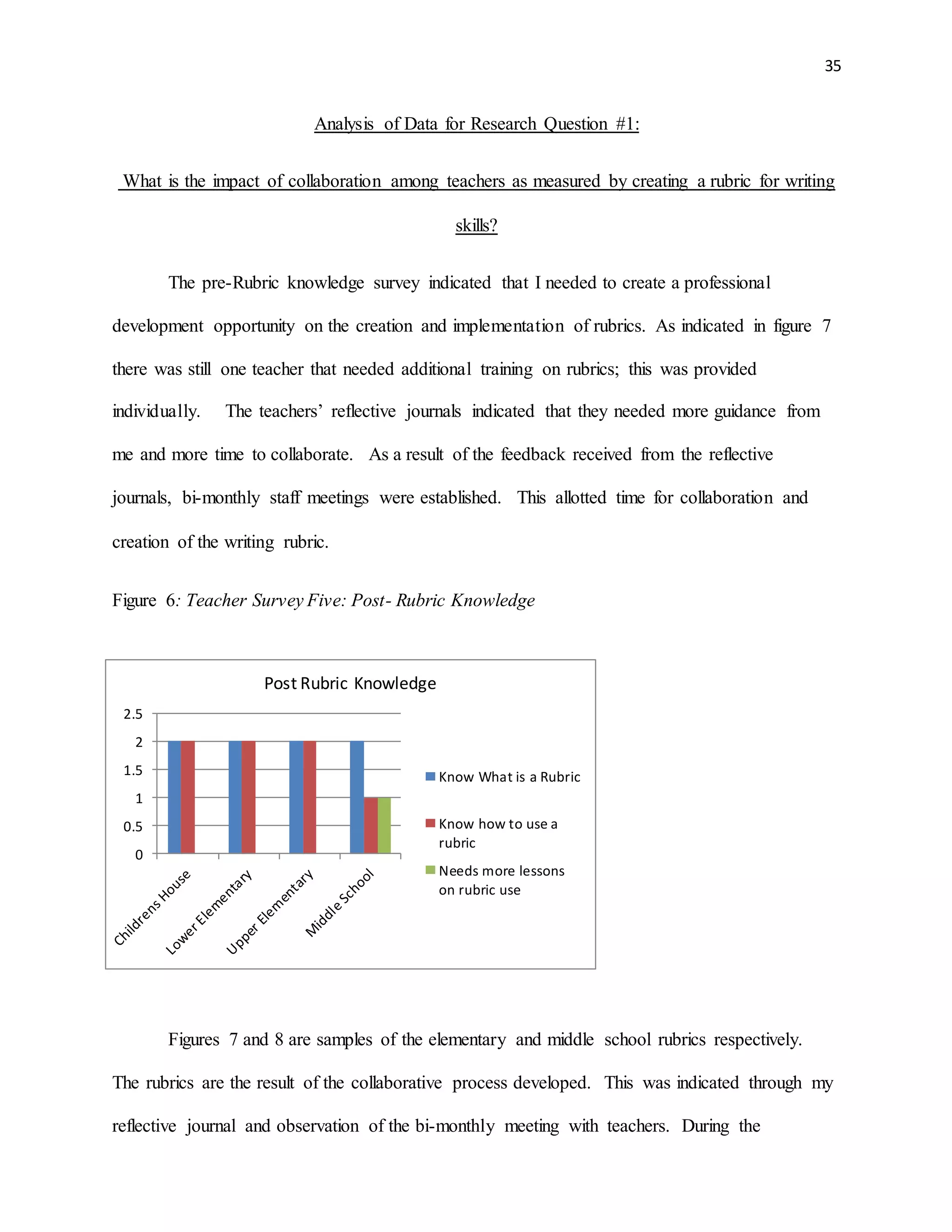
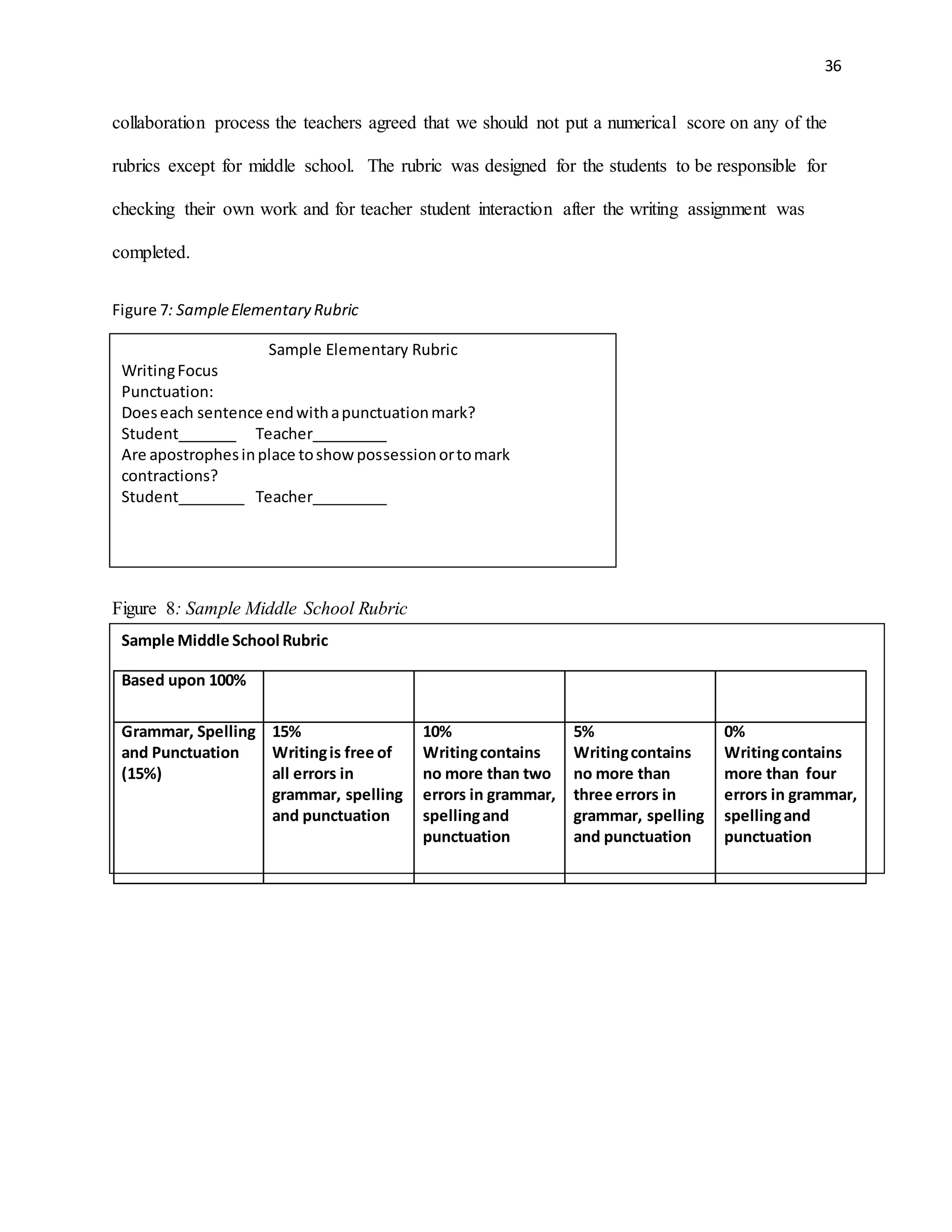
  • 8.
    5 assessment of thewritten work instead of the teacher taking on that responsibility” (p.51); this coincides with the Montessori principle that the students are motivated to take responsibility for their own learning. The teachers collaboratively created a developmentally appropriate rubric, taking into consideration best practices and writing conventions across the curriculum and maintained its validity by comparing teacher evaluations of student writing samples. The other factors I considered were teacher motivation and time within the school day to accomplish this collaborative task. I collected qualitative data from teachers on the process of creating the rubric. This data helped me to determine if the teachers were motivated and believed that the extra time they put into creating the rubric would result in students’ improved writing across the curriculum. The Setting I have been teaching at Eastside Montessori School for 12 years. The school had four multi- aged classrooms and the children ranged in age from 2.5 to 14 years old. Each classroom had two teachers. The teachers were assigned 20 to 30 students. The classrooms were full inclusion with approximately 25% of the students having some type of learning disability and IEP. The students were with their teachers 95% of the time. They had gym and music outside of the classroom, and art was taught within the classroom. The previous administration treated each class like a separate entity, and even though the staff was very caring and helpful with each other there was not any collaboration or mentoring incorporated into the culture of the school. I was previously co-teaching in the 3 to 6 (Children’s House) classroom and was recently promoted to principal. Writing was taught using the Montessori approach at each level, but the individual teacher chose her own method of evaluation and student aids. The school was accredited by the Ohio Department of Education and accountable to meet Ohio Standards. We are currently matching our Montessori lessons to the Common Core Standards.
  • 9.
    6 Eastside Montessori School(EMS) was a private school governed by a board of directors and accredited by the Ohio Department of Education through the Diocese of Cleveland. EMS was located in Kirtland, Ohio a northeastern suburb of Cleveland. EMS was a small school with 71 students enrolled in pre-school through eighth grade. The population was not widely diverse with 98% Caucasian upper middle class, 1% low income and 1% other races. Montessori curriculum was designed to meet the individual needs of the child, and teaching to the whole child. The classrooms typically had 25% of their students on IEP’s. Because of the individualized approach and the multiage classrooms the students’ academic and emotional needs were met at every level. The Children’s House classroom contained 24 students; eight of them kindergarteners. There were two teachers and a part time aid in the classroom. The classroom was designed to help students work independently; new lessons were given as mastery was observed. The shelves were designed from left to right, concrete to abstract, and kinesthetic learning materials were provided throughout the curriculum. Writing was encouraged for all students; the students who did not have the ability to write used the movable alphabet to share their thoughts and ideas. The grammar materials helped the children to identify parts of speech and capitalization as well as punctuation. The Lower Elementary classroom had 22 students who ranged in age from 6 to 9 years old. The classroom was designed from concrete to abstract and kinesthetic learning continued. The language materials became increasingly difficult and abstract as the students mastered each skill. Writing was done on a daily basis in all content areas, informally in journal writing and formally in research and creative writing projects.
  • 10.
    7 The Upper Elementaryroom had fewer concrete materials. There were two teachers and 13 students ranging in age from 10 to 12 years. The students journaled and wrote daily in all content areas. They were taught editing skills but a rubric was rarely used. The Middle School classrooms had few or no concrete materials; the students journaled and were assigned research and creative writing assignments. There were two teachers and 13 students who range in age from 12 to 14 years. They often received a rubric for the research assignments, but they rarely contained writing conventions or editing. Participants and Data Collection The implementation of systematic change in writing instruction required the support of the administration and teachers. All impacted the research, the content, and the execution of the rubric. The way skills were taught and the use of the rubric supported evaluations at every level. The teachers were all experienced and although they wanted to always learn and improve, it was hard for them to change some of their teaching practices. There were 71 students at EMS but only 55 school- aged children were involved in this action research (See Table 1). All attended EMS from September 2012 through June 2013. Table 1: Number of Students in Each Grade Grade Numberof Students K 8 1 6 2 8 3 8 4 6 5 3 6 4 7 10 8 2
  • 11.
    8 Ten teachers weredirectly involved with creating the rubric, and two administrators were indirectly involved (See Table 2) Table 2: Teachers and Grade Level Teacher Grade K1 Kindergarten K2 Kindergarten EL1 1, 2, 3 EL2 1,2,3 EL3 4,5,6 EL4 4,5,6 MS1 7,8 MS2 7,8 ART1 Art Teacher IS1 Intervention Specialist AA1 Admin Assistant ED1 Executive Director Teachers were involved with evaluating their current practices, identifying developmentally appropriate skills, evaluating student work and IOWA scores, and collaborating with other teachers. Students’ test scores and writing samples were used to develop the rubric and test its validity. Art teacher and intervention specialist were involved by evaluating the use of the rubric in their specialties and the intervention specialist determined if the rubric would be understood by her students. The information obtained by all participants has been held confidential. The results that have been publically published will not reference identifying information about any individual and were used for analysis purposes among groups of data. The teachers provided qualitative data through their journals of the process, quantitative data from surveys taken after professional development, as well as, qualitative and quantitative data through answering Likert and open-ended questions. The students provided quantitative
  • 12.
    9 data trough theirindividual IOWA scores (there will be no IOWA data for kindergarten and first grade); the students have also provided qualitative data through writing samples. Questions to Answered by Action Research 1. What is the impact of collaboration among teachers as measured by creating a rubric for writing skills? 2. What is the impact of collaboration on teachers’ motivation or engagement as measured by the teachers’ reflective journals and pre and post self evaluation surveys? 3. What is the impact of evaluating the rubric for validity on teacher collaboration as measured by teacher journals before and after evaluating the rubric? 4. What is the impact of this project on my leadership practices as measured by self reflection in journals? Overview of Methodology for Action Research My action research goal was to take our current teaching staff and culture of the school and create a new professional collaborative culture that better utilized the strengths and talents of the Eastside Montessori School staff. I used quantitative data, (Likert scale surveys, IOWA scores, and writing examples) and qualitative data, (teacher and student surveys, teachers journal, and my personal journal). First, I reviewed the previous IOWA scores and compared written work from students to create a baseline for comparison. More important, I created professional development opportunities for the teaching staff, and created time for them to collaborate. Then I developed a plan for implementation of the rubric once it was designed. The implementation of this project occurred from October 2012 through May 2013. The phases were divided as follows:  October through December: professional development for teachers
  • 13.
    10  January throughMarch: developed rubric and collaborated on the flow and content of the rubric  April through May: checked validity of the rubric across grade levels and content areas The first professional development session reviewed the Montessori language curriculum. A Montessori trainer led a workshop for the teachers reviewing the Montessori lessons and principles of language for the pre-school through eighth grade child. The workshop included a review of editing practices as well as spelling and conventions. Time was set aside for questions specific to a teacher. There was time set aside for additional professional development in this area, either for the group or for the individual teacher as needed. Additional professional development opportunities in terms of collaborative cultures were completed throughout the school year during staff meetings. Formative assessments were done in November and March and summative assessment completed in May. The formative assessment in November was a pre-survey assessing the teachers’ knowledge of collaborative cultures in schools and if they consider EMS a collaborative school. The formative assessment in March was a survey taken by the teachers on how they felt the process of creating the rubric and collaboration was going. The final assessment, completed in May, was a survey and a review of the teacher journals about the rubric and the collaborative process. Definition of Terms Professional Learning Community- Educators work in groups where they are committed to be collectively responsible for the common educational purpose; they are committed to improve their professional practice, build relationships based upon mutual respect, and improving student well-being and achievement (Hargreaves & Fullan, 2012, p.128).
  • 14.
    11 “The Montessori Method-is a child-centered educational approach that views the child as naturally driven to gain knowledge and capable of initiating learning in a supportive, thoughtfully prepared environment. This approach values the human spirit and the development of the whole child—physical, emotional, social and cognitive.” (Retrieved from https://amshq.org/Montessori education/Introduction-To-Montessori.aspy) “Professional development is defined as the increase of knowledge and skill, through certified and consistent education, and its purpose is to increase a person’s level of competency and open avenues of unlimited growth for individuals and the institutions in which they are involved” (Retrieved from http://Ezinearticles.com/410654). Collaboration is defined as the process of working with other individuals to develop education programs and services for the fundamental aim of improving the educational, emotional and physical wellbeing of children (Retrieved from http://www.education.com/definition/collaboration/) and teacher collaboration is defined as an interactive process that enables teachers with diverse expertise to work together as equals and engage in shared decision making toward mutually defined goals. (Retrieved from http://www.education.com/definition/collaboration/) Motivation is defined as “the process that initiates, guides and maintains goal-oriented behaviors.” Motivation activates our behavior by involving the biological, emotional, social and cognitive forces in our brain (Retrieved from http//:psychology.about.com/od/mindex/g/motivation-definition.htm?p=1). A rubric is defined as a document that articulates the expectations for an assignment by listing the criteria, or what counts and describing levels of quality from excellent to poor (Goodrich and Andrade, 2001). Lovorn and Rezaei (2011) defined rubrics as scoring tools that lay out the specific expectations for assignments.
  • 15.
    12 In summary, thesuccess of this study involved creating a rubric that would assist students in improving their writing, and my staff created an interactive, supportive, and collaborative culture that enabled us to problem solve quickly and efficiently. My hope was that the collaborative process would not be cumbersome for our teachers and would ultimately become an integral part of our school’s culture. Certainly fertile seeds have been sown.
  • 16.
    13 Chapter 2 REVIEW OFLITERATURE Introduction The purpose of this chapter was to explore the research on educational change and the effectiveness of teacher collaboration on the development of a rubric for writing across the curriculum and grade levels. Creating a collaborative professional culture is a journey and an exploration of best practices, professional growth, and personal satisfaction that one can attain through his or her teaching career (Fullan, 2007). I needed to continually see our staff as growing and learning along with their students and it is only through this growth that they would obtain a sense of satisfaction with their life’s work. Evans (2012) eloquently described what a professional community should be: It’s not about reaching a fixed status and staying put, it’s about growth and development, about enriching relationships and enhancing competence. Teachers who embark on this journey have a real chance to learn new ways of looking at themselves and their work and to broaden their view and deepen their craft—and, thus enrich not only the quality of their teaching and of their students’ learning but of their lives together. (p. 107) The cultures of schools in general have not been created for teachers to collaborate, mentor, or develop their profession. As Hargreaves and Fullan (2012) stated: …getting good teaching for all learners requires teachers to be highly committed, thoroughly prepared, continuously developed, properly paid, well
  • 17.
    14 networked with eachother to maximize their own improvement, and able to make effective judgments using all their capabilities and experience (p. 3). Even though collaboration will not result in improvement, it is a beginning for teachers to enhance their strengths and develop their weaknesses. When the teachers are asked about collaborating they say that there is no time during the school day. That is why professional learning communities (PLC) have to become part of the schools culture. Once PLC’s are established, teachers become central to meaningful change (Hargreaves & Fullan, 2012). Goddard, Goddard and Tschannen-Moran (2007) proposed that the more teachers collaborate and discuss best practices, theories, and methods the more they impact student learning. Professional development was a critical tool to use in helping to change the culture of our school. It is through increased knowledge that we become more confident of our abilities. Motivation of teachers is important for developing collaboration within the school. It is through professional development, motivation, and collaboration combined with respect for teachers as professionals, that true professional learning communities can be established. The following research questions drove the study of the effects of collaboration and professional development on creating a writing rubric: 1) What was the impact of collaboration among teachers as measured by creating a rubric for writing skills? 2) What was the impact of collaboration on teachers’ motivation or engagement as measured by the teachers’ reflective journals and pre- and post- self evaluation surveys? 3) What was the impact of the validity study on teacher collaboration as measured by teacher journals before and after evaluating the rubric? 4) What was the impact of this project on my leadership skills as measured by self reflection journal? The major thematic strands related to my research goals were professional development, motivation, collaboration, and the creation of the writing rubric.
  • 18.
    15 Professional Development Professional developmentis essential for every individual and is vital for every organization in order to increase the knowledge and skills of their employees. It is defined as the increase of knowledge and skill, through certified and consistent education, and its purpose is to increase a person’s level of competency and open avenues of unlimited growth for individuals and the institutions in which they are involved (Retrieved from http://Ezinearticles.com/410654). In order to change a school’s culture, professional development opportunities need to be created for teachers. It would be great if I could say “we are now creating a professional learning community….Ready, Set, Go!” This is unrealistic, but in the outside world many believe that educational leaders simply make it a law and a way we will evaluate teachers and it is done. Fullan (2007) quoted Ball and Cohen (1999) as observing that “Although a good deal of money is spent on staff development in the United States, most is spent on superficial, disconnected from deep issues of curriculum and learning fragmented and noncumulative….teacher learning is usually seen as either something that just happens as a matter of course from experience or as the product of training in particular methods or curricula” (p. 4). In addition, Fullan (2007) stated that in order for professional learning communities to work they need to be focused and sustained. Teachers have to be able to connect assessment of their work as an opportunity to engage in deeper questioning and sustained learning. Moreover, Goddard, Goddard and Tschannen-Moran (2007) noted that Melnick and Witmer (1999) contended that teachers need to be actively involved in their own professional development. Their involvement promoted teachers learning from colleagues and brought about systematic reform. This is the key to improving instruction and student learning as well as maintaining teacher morale and self efficacy.
  • 19.
    16 Equally important, theprincipal needs to create professional development opportunities that are valuable to her teachers. The more information teachers have the more effective they can be at creating vibrant learning environments for their students and themselves. The professional development cannot be determined from the top down; the plans need to be a collaborative decision between teachers and administration (Fullan, 2007; Evans, 2012). Motivation Motivation is defined as “the process that initiates, guides and maintains goal-oriented behaviors.” Motivation activates our behavior by involving the biological, emotional, social, and cognitive forces in our brain (Retrieved from http//:psychology.about.com/od/mindex/g/motivation-definition.htm?p=1). In order for change to occur, the participants should be motivated to change. The realization that change is a process not an event, (Fullan, 2007) will help all stakeholders become motivated to implement the steps needed to improve what we do on a daily basis. The teachers must be empowered to discuss and agree upon adaptations to their work. They want to feel respected and valued in order to be motivated to change. Fullan (2007) discussed that providing professional learning communities for teachers offer a forum in which they can discuss and collaborate on the “ethical and moral dimensions of their work and behavior” (p. 50). The teachers should be shown empathy for their situation and learn in a neutral setting how to improve their own practices for the betterment of their individual classroom and school as a whole. This, in turn, increases their motivation to continue with the change process because they are a part of the design, not just given the process to implement. The more the stake holders are involved in the process, the more the change becomes ingrained in the culture of the school (Hargreaves & Fullan, 2012).
  • 20.
    17 Meaning also fuelsmotivation. Fullan (2007) stated that “finding moral or intellectual meaning is not just to make teachers feel better. It is fundamentally related to whether teachers are likely to find the considerable energy required to change the status quo” (p. 39). The meaning behind change needs to be explained to teachers in terms of what they need to understand and how the change will positively affect their students and student learning. We also need to promote intrinsic motivation for our teachers. Montessori (1964) stated that for “children to learn complex things they need to be intrinsically motivated and have the freedom to explore and develop their intellect and experience” (p. 184). Just as this is valuable for student learning, teachers must be given the freedom to explore their interests and develop mastery. It is not about competition but about personal development for the betterment of the community at large (Hargreaves and Fullan, 2012). Furthermore, Montessori (1964) established that children were not motivated by external rewards, but that they had an internal drive to continue with a task until mastery. Given the opportunity, teachers are also motivated intrinsically to improve their craft and share what they have learned for the betterment of the community and their students (Montessori, 1964). If teachers receive personal satisfaction of success with a new approach, this satisfaction is likely to be transmitted to their students by excitement with teaching and excitement with learning (Hargreaves & Fullan, 2012). The principal is responsible for maintaining her teachers’ motivation. She has to stay focused on the mission and give support to the teachers as needed. The teachers must feel like they have been heard and that their ideas are being implemented and discussed. The principal is also responsible for involving all the stake holders to support the mission and the teachers (Fullan, 2007).
  • 21.
    18 Collaboration Collaboration is definedas the process of working with other individuals to develop education programs and services for the fundamental aim of improving the educational, emotional and physical wellbeing of children (Retrieved from http://www.education.com/definition/collaboration/) and teacher collaboration is defined as an interactive process that enables teachers with diverse expertise to work together as equals and engage in shared decision making toward mutually defined goals. (Retrieved from http://www.education.com/definition/collaboration/) Although the above definitions seem straight forward and easy to implement, it is actually much harder than it appears. Teachers are natural conflict avoiders with adults. We often spend much of our time talking about a problem rather than directly dealing with the problem (Evans, 2012). Evans (2012) asserted that schools were like villages; they cannot survive total candor and resolve problems by talking about the person or the problem to others rather than to the person, or persons involved. Fullan (2007) stated that the most effective systems are direct when dealing with specific situations. When “something goes wrong, people face the hard facts, learn what happened and why…” (p. 122); then they can move on to solve the problem. Evans (2012) additionally stated “efforts at collaboration and collegiality are ever fragile—hard to start, hard to sustain” (p.100). In order to sustain a truly collaborative collegial environment for teachers, the faculty has to face deeply embedded structural and personal changes. One of the personal obstacles to overcome is the necessity of collaboration. Many teachers would rather spend their “spare time” with students than with other teachers; they have to be instructed that collaboration is for the improvement of student learning not only creating a
  • 22.
    19 professional environment forteachers. They often view working with colleagues, administrators, or parents as an intrusion into their primary source of work satisfaction (Evans, 2012). Kohn and Nance (2009) noted that collaborative cultures accelerate the teachers’ ability to improve instruction, and “their energy, creative thinking, efficiency, and goodwill increase…cynicism and defensiveness decrease” (p. 1). It needs to be assumed in teaching that “improvement is a collective process rather than an individual’s expertise promoting change. Analysis, evaluation and experimentation in collaboration with peers are ideal conditions for teachers to improve” (Fullan, 2007, p. 140). The problem lies in the fact that there is little time set aside for teachers to “engage in continuous and sustained learning about their practice in the settings where they actually work, observing and being observed by their colleagues in their own classroom settings and classrooms of others” (Fullan, 2012, p. 153). When we make shared learning a part of our schools culture the students are impacted positively in terms of their educational experience. The principal can make or break the collaborative process within a school. Fullan (2007) noted a study done by McLaughlin and Talbert (2006) which showed that principals were in a strategic position to promote the development and sustainability of PLC’s in their schools. The successful principals lead by “leveraging teacher commitment and support for collaboration, broker and developing learning resources for teacher communities, and support transitions between stages of community development” (p. 162). Principals are also responsible for developing leaders within their school; these leaders will help facilitate collaboration and maintain the sustainability of the PLC (Fullan, 2007).
  • 23.
    20 Creating the Rubric Arubric is defined as a document that articulates the expectations for an assignment by listing the criteria, or what counts, and describing levels of quality from excellent to poor (Andrade, 2001). Lovorn and Rezaei (2011) defined rubrics as scoring tools that lay out the specific expectations for assignments. The research shows that if used correctly rubrics do increase the quality of student writing. Andrade (2001) concluded that students’ writing quality will increase if teachers simply hand them a rubric and explain to them how to use it. But in order to sustain improvement the students need to be involved in writing the criteria for the rubric. This is done by critiquing samples of writing and teaching students self assessment. Lovorn and Rezaei (2011) indicated that rubrics benefit teachers and students in various ways. Teachers are able to provide more meaningful feedback, evaluations are more equitable, and they encourage self reflection. Lovorn and Rezaei (2011) cited various authors who offered expectations of the use of rubrics. They noted that (Engbers, 2009; Gallavan & Kottler, 2009; Gustafson & Bochner, 2009; Jonsson & Svingby, 2007; Spandel, 2006, p. 1) “rubrics have been shown to reduce stakeholders’ confusion about evaluative expectations, help teachers refine teaching skills, encourage students critical thinking, help students to use detailed feedback to improve writing, and facilitate student communication with peers and teachers” Lovorn and Rezaei (2011) quoted Wilson’s (2007) conclusion that some untrained teachers use rubrics in ways that compartmentalize and bias their evaluations of students reading and writing skills. These teachers are less consistent than those teachers who receive training on rubric use and creation. Lovorn and Rezaei (2011) cited various authors who offered that high quality and intensive teacher training on rubric use improves their reliability of assessment (Dunbar, Brooks & Kubika-Miller, 2006; Hitt & Helms, 2009; Maxwell, 2010). Lovorn and Rezaei (2011) concluded that high quality teacher training on the use and creation of rubrics
  • 24.
    21 positively impacts studentsby creating timely feedback, prepares students to use feedback, encourages critical thinking and self evaluation and facilitates communication with peers and their teachers (p.8). Antrade, Wang, Du, and Akawi (2009) concluded that the use of rubrics increases students’ self efficacy; an individual’s belief in his or her capability to achieve a specific goal, throughout the writing process (p. 295). Antrade, Du, and Wang (2008) noted that Stiggens states that when rubrics are used as a formative student- centered approach, they have the potential to help students develop understanding, skill, and ability to self assess their own work. Antrade, Du, and Wang (2008) concluded that “having students use model papers to generate criteria for writing assignments and using a rubric to self assess first drafts is positively related to the quality of their writing” (p. 8). This positive relationship demonstrates the significance of using a rubric for students self assessment and their mastery of the writing process (Antrade, Du & Wang, 2008) Antrade and Du (2005) stated that students in their study endorsed the use of rubrics and said that they used them in a purposeful way to improve their work and their grades. The students noted that they used the rubrics throughout the process to self assess and revise their work. They would also reflect on the feedback they received from their peers. Antrade and Du stated that their findings validate the process of formative assessment described by Black and William (1998) : “……1) recognize the goal, 2) consider the evidence and 3) have an understanding of a way to close the gap between the two” (p. 6). Conclusion After reviewing the research I developed a plan to implement educational change at our school. The culture of the school needed to change. We considered it necessary to create a professional learning community at our school. Although the teachers were very supportive of one another, they rarely took time to teach and learn from each other. As a direct result of the
  • 25.
    22 empirical and theoreticaldata found in the preceding review of the literature, we used best practices from current research-based models that provided us with formulas to increase communication, collaboration, and motivation. Professional development was provided for Montessori Language Arts, collaboration, and rubric creation. During our bi-monthly staff meetings, the teachers participated in professional development. Time was set for the teachers to observe in each other’s classrooms, share what was observed, and to collaborate on creating the rubric. The teachers played an active role in designing the professional development, the rubric, and creating a professional learning community.
  • 26.
    23 Chapter 3 METHODOLOGY Introduction The purposeof this chapter is to discuss the methodology used to gather data on the implementation of creating educational change at Eastside Montessori School. After careful review of the current research on educational change and Eastside Montessori School’s (EMS) need for a professional learning community, a restructure of the EMS teaching staff included a few key elements that were monitored, measured, and reviewed. The areas of change included implementation of professional development opportunities and bi-monthly meetings between the teachers and administration to improve collaboration and communication. Also, the addition of monthly opportunities for teachers to observe and be observed by their peers in order to provide professional feedback on best practices, classroom management, incorporation of Montessori principles, and individual student interventions, helped create and sustain our professional learning community. The rubric encompassed kindergarten through eighth grade and would be used across the curriculum. These changes would occur in the following three Phases. Phase I began with an in- depth review of our current practices, collaborative processes, identifying students’ developmentally appropriate skills, and evaluating student work. Phase II involved the creation of the research-based writing rubric and implementation of the professional learning community. Phase III focused on the continuation of collaboration by checking the validity of the rubric. The above three phases answered the following research questions: 1) What was the impact of collaboration among teachers as measured by creating a rubric for writing skills? 2) What was the impact of collaboration on teachers’ motivation or engagement as measured by the
  • 27.
    24 teachers’ reflective journalsand pre- and post- self evaluation surveys? 3) What was the impact of the validity study on teacher collaboration as measured by teacher journals before and after evaluating the rubric? 4) What was the impact of this project on my leadership skills as measured by self reflection journal? The major thematic strands related to my research goals were professional development, motivation, collaboration and creating the writing rubric. Context and Participants Eastside Montessori School had four multi-aged classrooms and the children ranged in age from 2.5 to 14 years old. Each classroom had two teachers. The teachers were assigned 20 to 30 students. The classrooms were full inclusion with approximately 25% of the students having some type of learning disability and IEP. The students were with their teachers 95% of the time. They had gym and music outside of the classroom, and art was taught within the classroom. Writing was taught using the Montessori approach at each level, but the individual teachers choose their own method of evaluation and student aids. The school was accredited by the Ohio Department of Education and accountable to meet Ohio Standards. We were matching our Montessori lessons to the Common Core Standards. Eastside Montessori School (EMS) was a private school governed by a board of directors and accredited by the Ohio Department of Education through the Diocese of Cleveland. EMS was located in Kirtland, Ohio a northeastern suburb of Cleveland. EMS was a small school with 71 students enrolled in pre-school through eighth grade. The population was not widely diverse with 98% Caucasian upper middle class, 1% low income and 1% other races. The Children’s House classroom contained 24 students: eight were kindergarteners. There were two teachers and a part time aid in the classroom. The classroom was designed to help students work independently; new lessons were given as mastery was observed. The shelves were designed from left to right, concrete to abstract; and kinesthetic learning materials were
  • 28.
    25 provided throughout thecurriculum. Writing was encouraged for all students; the students who did not have the ability to write used the movable alphabet to share their thoughts and ideas. The grammar materials helped the children to identify parts of speech and capitalization as well as punctuation. The Lower Elementary classroom had 22 students ranging in age from 6 to 9 years old. The classroom was designed from concrete to abstract and kinesthetic learning continued. The language materials became increasingly difficult and abstract as the students mastered each skill. Writing was done on a daily basis in all content areas, informally in journal writing and formally in research and creative writing projects. The Upper Elementary room had fewer concrete materials. There were two teachers and 13 students ranging in age from 10 to 12. The students journaled and wrote daily in all content areas. They were taught editing skills but a rubric was rarely used. The Middle School classrooms had few or no concrete materials; the students journaled and were assigned research and creative writing assignments. There were two teachers and 13 students who ranged in age from 12 to 14. They often received a rubric for the research assignments, but they rarely contained writing conventions or editing. Phase I: Defining the Current Model The individual teachers at Eastside Montessori School (EMS) were responsible for implementing all curriculum, strategies, and interventions for their students. Each of the four multi- age classroom had 20 to 30 children. My role as principal had given me an opportunity to observe and review the inner life of the school’s culture. I had observed that the teachers, although they were a helpful and kind community of teachers, did not engage in discussions of best practices, observation, and constructive feedback of peers. I believed that our staff’s’ skills
  • 29.
    26 and potential wereunder utilized by not having a collaborative process in place. I had fully supported the change in the culture and the staff had taken on the challenge of developing a professional learning community. First, the teachers were asked to complete pre-creation of a professional learning community survey. The survey contained 10 questions and the answers were discussed as a group during one of our professional development sessions. Figure 1 shows the results of common agreements among the staff to the survey questions before and after our meeting. Figure 1: Teacher Survey One: Creating Professional Learning Community The teachers defined the meaning of a collaborative school before and after the meeting. They also agreed that there is a connection between trust and collaboration, what the administration can do to encourage collaboration, and how collaboration will help build our 0 2 4 6 8 10 12 14 Creating Professional Learning Community Pre-Meeting answers Post Meeting Answers
  • 30.
    27 school. The differencesbefore and after the meeting identified that EMS was not a collaborative school, what it meant for teachers to be teaching each other, and what needed to be taught. They also saw the importance of collaboration in helping with professional growth. Before our meeting the teachers were asked to fill were asked to complete a self discovery survey. This survey was meant to set the stage for the teachers to start thinking about their personal communication styles and how that affected collaboration at the school level. The teachers for the most part felt that they could do most of the items reasonably well. Most of the teachers believed that they were tolerant of different points of view and that asking questions to encourage the speaker were their strengths. Many were more comfortable with observing peers than being observed by their peers. Most of the teachers indicated they were reasonably good at offering compliments and encouraging feedback. Figure 2: Teacher Survey Two: Pre-Self Discovery Survey 0 1 2 3 4 5 6 7 8 9 10 Pre-Self Discovery Survey I have trouble with this I do this reasonable well I see this as a strength of mine
  • 31.
    28 This survey wasgiven at the end of the process to see if any changes in personal development occurred. There were four areas of change in responses by the teachers. The first area was “I check for understanding of the speaker.” In the post survey the teachers found that they really had trouble with checking for understanding of what the other person was saying. In the pre-survey all the teachers felt that they encouraged feedback but in the post survey they found that they truly did not encourage feedback, and that it was very difficult to receive feedback on their classrooms. The post survey also showed that the teachers were comfortable with observing peers and being observed by peers. This change was attributed to the fact that they had not had a chance to observe or be observed in the past and that it was not as bad as they had anticipated. Figure 3: Teacher Survey Two: Post-Self Discovery Survey 0 1 2 3 4 5 6 7 8 9 10 Post-Self Discovery Survey I have trouble with this I do this reasonable well I see this as a strength of mine
  • 32.
    29 In 2009/2010 schoolyear Eastside Montessori School began its accreditation process with the Diocese of Cleveland and the Ohio Department of Education. Through this process, it was determined that there was a need for more instruction and intervention in the area of writing. Our students were unable to recognize simple grammatical and spelling errors in their work, and in standardized tests. We decided that a rubric would help students understand what was expected of them and helped them with their editing process. Montessori philosophy supports the use of a rubric and using students’ authentic work to teach grammar and spelling. Even though we had agreed that a rubric for writing would be valuable for our students’ learning, many of the teachers were concerned that they would not have time to write, introduce, and maintain the rubric. Per the qualitative survey given to teachers on October 30, 2012, the results showed that only three of the 13 teachers completing the survey could define a rubric. Ten of the 13 teachers felt that a rubric would only be used for a long term project, and all of the teachers felt that rubrics were self explanatory and students did not need to be taught how to use them. At the time, rubrics were only used at the middle school level. They were used for long- term projects and the students were often not taught how to use them. In the qualitative survey given to the 12 middle school students, only two of them could define a rubric (eighth grade) and said that they were used to help organize long term projects, the other 10 students (seventh grade) could not define a rubric and did not understand why they were given rubrics. They felt the rubric gave them additional work for their projects. The students needed to be taught what a rubric was and how it could be used by them to organize and complete not only their writing assignments but all of their long-term projects. In summary, the results of the surveys were used by the researcher/principal to create professional development opportunities for the teachers. The first was to have professional
  • 33.
    30 development on learninghow to use a rubric, what they were used for, and how to teach students to use a rubric. The training the teachers received helped with the implementation of the subsequent stage. The staff realized that it would be hard to create a rubric if there was not a consensus of what a rubric was to EMS. The pre and post-self discovery surveys facilitated to staff’s understanding of its communication style and to take note on how they communicated with their peers and with the administration. Phase II: Creation of the Research-Based Writing Rubric and Implementation of the Professional Learning Community A professional learning community was created by implementing bi-monthly staff meetings, one to be held during lunch time with core teachers and one to be held after school with all teaching staff. During these meetings, the staff developed a timeline to create the writing rubric and a calendar for peer observations. The meeting times were used to create the rubric and for professional collaboration and development. Additional time was set aside for further professional development at the school, the Montessori Training Center, and the Diocese of Cleveland. These opportunities for learning were for the whole staff or for individuals who felt they needed additional training in specific areas. The pre and post surveys evaluated the perceived value of the professional learning community and the professional growth of the teachers. The teachers were given a pre and post-survey about rubrics. They were also asked to journal about the process. At first, the teachers felt that creating a rubric would be an easy task, but when they began the process they found that they needed some additional training. The teachers were presented with exemplars and additional training on the use and creation of rubrics. The journals showed that the rubric creation was a relatively easy process for the
  • 34.
    31 teachers. They wereable to create the rubric for their level and collaborated with the previous and subsequent levels to insure there were no gaps. The only problem they encountered was finding the time to collaborate. Consequently, the administration set aside time during each staff meeting for the teachers to work on the rubric. Figure 4: Teacher Survey Three: Pre-Rubric Knowledge 0 0.5 1 1.5 2 2.5 Childrens House Lower Elementary Upper Elementary Middle School Pre-Rubric Knowledge Survey Know What is a Rubric Know how do you use a rubric Need to be taught to use a rubric
  • 35.
    32 Figure 5: TeacherSurvey Three: Post-Rubric Knowledge Survey In summary, the results of the surveys were used to implement further learning on rubrics. The results of the journal entries drove the decision by the administration to provide time during staff meetings for collaboration and creation of the rubric. This additional time was also used to prepare the staff for the final stage testing the validity of the rubric. Phase III: Testing the Validity of the Rubric and the Observation of Teachers and their Peers This part of the process seemed to be most difficult for the staff. There were disagreements on how to use the rubric for assessment. If the teachers followed Montessori philosophy then all children were treated as individuals and assessed on their individual abilities. The rubric was a more overall approach and more traditional in nature. If the student had three spelling errors, then she received a 3 instead of a 5. Some teachers felt that if this was the best the student could do, then why penalize her. The teachers then agreed that the students needed additional concrete material for them to use during the writing process. The material would ask 0 0.5 1 1.5 2 2.5 Childrens House Lower Elementary Upper Elementary Middle School Post-Rubric Knowledge Survey Know What is a Rubric Know how to use a rubric Needs more lessons on rubric use
  • 36.
    33 questions such as“Have I checked my work for capitals at the beginning of the sentence and punctuation at the end of the sentence?” After the question there would be an example of a sentence with the beginning word and the ending punctuation highlighted. They also agreed that the rubric would look different for the diverse developmental levels of the students. The teachers still found that they wanted to evaluate the students based upon who they were as individuals, but when they thought about the rubric as a teaching tool they were able to move forward. The teachers agreed that the students needed to understand that writing conventions had to be followed. Throughout this process the teachers also observed each other. After their observation they would talk about the observation. The teachers were excited at first to have time set aside to observe their friends. The problem was what their “friends” had to say about their classroom and professional practices. It was hard to hear that there was room for improvement. The teachers who made suggestions were also upset when the suggestion was not carried out by the other teacher. The teacher journals showed their frustration with the process. Time was set aside during staff meeting for the staff to discuss their frustrations. This open discussion helped the teachers to take the observations less personally. Conclusion The result of this process was to create a collaborative professional learning community among the teachers and an increased awareness and understanding of the writing process for our students, teachers, and parents. It is only when we were all working consistently toward the same goal that we accomplished the creation of an innovative learning environment for all of our stakeholders. Sustaining the collaboration and professional learning community will be the challenge.
  • 37.
    34 Chapter 4 Data Analysis Introduction Theeducational change that was set forth by my project has continued to evolve. Change is a process that should have specific goals, but it needs to be understood that change requires time. During this project I found that many of my conceptions about the staff were actually misconceptions. Despite this, results were found in the development of a professional learning community and of a rubric for writing across the curriculum. The implementation of peer observations helped in the development of our PLC, but often the time set aside for observation and sharing was not always used by the staff. A new culture for these teachers was starting to take hold. Their fear of being observed was replaced by openness to shared learning. Introduction of bi-monthly staff meetings created time for the teachers to collaborate on development of the writing rubric. Some gains were made but to create a sustainable PLC more work needed to be done. The purpose of this chapter is to analyze the data gathered to answer the following research questions: 1.What is the impact of collaboration among teachers as measured by creating a rubric for writing skills? 2. What is the impact of collaboration on teachers’ motivation or engagement as measured by the teachers’ reflective journals and pre and post self evaluation surveys? 3. What is the impact of evaluating the rubric for validity on teacher collaboration as measured by teacher journals before and after evaluating the rubric? 4. What is the impact of this project on my leadership practices as measured by self reflection in journals?
  • 38.
    35 Analysis of Datafor Research Question #1: What is the impact of collaboration among teachers as measured by creating a rubric for writing skills? The pre-Rubric knowledge survey indicated that I needed to create a professional development opportunity on the creation and implementation of rubrics. As indicated in figure 7 there was still one teacher that needed additional training on rubrics; this was provided individually. The teachers’ reflective journals indicated that they needed more guidance from me and more time to collaborate. As a result of the feedback received from the reflective journals, bi-monthly staff meetings were established. This allotted time for collaboration and creation of the writing rubric. Figure 6: Teacher Survey Five: Post- Rubric Knowledge Figures 7 and 8 are samples of the elementary and middle school rubrics respectively. The rubrics are the result of the collaborative process developed. This was indicated through my reflective journal and observation of the bi-monthly meeting with teachers. During the 0 0.5 1 1.5 2 2.5 Post Rubric Knowledge Know What is a Rubric Know how to use a rubric Needs more lessons on rubric use
  • 39.
    36 collaboration process theteachers agreed that we should not put a numerical score on any of the rubrics except for middle school. The rubric was designed for the students to be responsible for checking their own work and for teacher student interaction after the writing assignment was completed. Figure 7: SampleElementary Rubric Figure 8: Sample Middle School Rubric Sample Elementary Rubric WritingFocus Punctuation: Doeseach sentence endwithapunctuationmark? Student_______ Teacher_________ Are apostrophesinplace toshowpossessionortomark contractions? Student________ Teacher_________ Sample Middle School Rubric Based upon 100% Grammar, Spelling and Punctuation (15%) 15% Writingis free of all errors in grammar, spelling and punctuation 10% Writingcontains no more than two errors in grammar, spellingand punctuation 5% Writingcontains no more than three errors in grammar, spelling and punctuation 0% Writingcontains more than four errors in grammar, spellingand punctuation
  • 40.
    37 Analysis of Datafor Research Question #2 What was the impact of collaboration on teachers’ motivation or engagement as measured by the teachers’ reflective journals and pre and post self evaluation surveys? The results of the qualitative data retrieved from teachers’ journals reflected their frustration with the observation process and the development of the writing rubric. The results from my personal journal indicated the level of frustration by the complaints I received by faculty about each other. This indicated to me that time needed to be set aside during staff meetings to discuss their frustration with peer observations and with the process of developing a rubric. The data retrieved from the journals after being given professional development time at staff meetings reflected that the teachers were highly motivated to complete the rubric. The qualitative data further indicated that the incentive for peer observations to continue was that they would be able to increase the quality of instruction they provide for their students. Once they were able to look at peer observation as a way to grow professionally, suggestions from peers were more readily received. The time was also used to share ideas, develop curriculum, and create opportunities for further investigation into best practices. The Self-Discovery survey was given at the beginning and the end of the process of creating the writing rubric to see if any changes in professional development occurred. There were four areas of change in responses by the teachers. In the post- survey the teachers discovered that they really did have trouble with checking for understanding of what their observer was saying. In the pre- survey all the teachers felt that they encouraged feedback, but in the post- survey they found that they really did not encourage feedback, and that it was very difficult to receive feedback about their classrooms. The post- survey also indicated that all but one of the teachers were more comfortable with observing peers and with being observed by
  • 41.
    38 peers. This changewas attributed to the fact that they had not had a chance to observe or be observed in the past, and it was not as difficult as they had anticipated. The results showed that in order for the teachers to be able to create the rubric they had to collaborate and gain an understanding of what each teacher’s responsibility was and the students they served. They needed to gain an understanding of each developmental level from pre-school through adolescents. More importantly they discovered the teachers needed to understand their own communication style and make changes to themselves before true collaboration could occur. The data in figure 6, the post self discovery survey, when compared to the data in figure 2, indicated a 30% increase in having trouble checking for understanding, and a 70% increase in having trouble encouraging feedback. There was a 40% decrease in having trouble with observing and being observed by peers. Figure 9: Teacher Survey 4: Post-Self Discovery Survey 0 1 2 3 4 5 6 7 8 9 10 Post- Self Discovery Survey I have trouble with this I do this reasonable well I see this as a strength of mine
  • 42.
    39 Figure 9 aboverepresents teacher self evaluation of communication style after participating in development of the writing rubric. Figure 10: Results of Post-Professional Development Journal Question #6: How did Collaboration Support my Professional Growth? Analysis of Data for Research Question 3 What is the impact of evaluating the rubric for validity on teacher collaboration as measured by teacher journals before and after evaluating the rubric? The validity study of the rubric was challenging for the staff. When they evaluated their own students’ written assignment, they were more lenient with the application of the rubric. When another teacher validated the rubric with the same written work, she applied rubric in a more concrete way. The following points were introduced during a staff meeting on testing the rubric’s validity:  Every teacher’s assessment should be the same for an individual student’s written work. This proves the validity of the rubric.  Our students are not concrete objects: they have feelings, self esteem, and work ethics that need to be taken into consideration.  We are teaching not only to the students’ current level, but we are expecting them to expand their knowledge and abilities.  We are applying the rubric to only their best work, not to all their written work. How did Collaboration Support my Professional Growth? Did not improve professional growth Improved classroom design Improved classroom management Improved modification of lessons
  • 43.
    40  Discover waysin which the rubric enhances student learning. Throughout this discussion the collaborative process was experienced by the entire faculty. The qualitative data retrieved from journal reflections noted that having time at staff meetings to discuss differences of opinion and to be able to come to a consensus supported collaboration and improved the integrity of our school. Summary This project posed four questions: 1.What is the impact of collaboration among teachers as measured by creating a rubric for writing skills? 2. What is the impact of collaboration on teachers’ motivation or engagement as measured by the teachers’ reflective journals and pre and post self evaluation surveys? 3. What is the impact of evaluating the rubric for validity on teacher collaboration as measured by teacher journals before and after evaluating the rubric? 4. What is the impact of this project on my leadership practices as measured by self reflection in journals? Data analysis revealed that the teachers increased their comfort level with observing and being observed by their peers by 40%. This increased their ability to collaborate and gain understanding of their peers’ experiences. Their overall rubric knowledge and understanding was initially 50%; it was increased to 90% during this research. Teachers were motivated to learn, and collaborated more efficiently as demonstrated by the creation of the writing rubric. The creation of the PLC was valued by the teachers as indicated by the results shown in figure 9. As a result of their participation in the creation of the writing rubric process there was an increase in collaboration, engagement, and motivation among the teachers. The process of problem solving has been streamlined as indicated by their reflective journals and post-self discovery survey. The teachers’ reflective journals demonstrated a 50% increase in
  • 44.
    41 positive references tothe collaboration process as compared to journal entries reviewed at the beginning of the action research process.
  • 45.
    42 Chapter 5 Conclusion The Effecton my Leadership Practices At the start of my Action Research Project I believed that implementing educational change by creating the PLC and the rubric would be relatively easy for my staff. They were a group of professionals that were driven by improving their work and its impact on students. I felt my role would simply be that of organizing professional development opportunities and scheduling peer observation times. As the educational change process began I used a reflection journal to monitor my feelings, successes, and areas of improvement, as well as change that needed to be made and the progress that was achieved. The impact on my leadership skills was profound. Prior to beginning my action research project I was promoted to Principal of Catholic Montessori School. Thus, the first challenge I had was changing my approach to the staff from staff member to leader. They looked to me for support, guidance, and strength. As the project began to unfold I found myself feeling frustrated by the teachers’ inability to resolve disagreements on their own. In Montessori education we pride ourselves on teaching students problem solving skills, both with academic and social situations. When one of our students has a disagreement with another student we encourage them to discuss the problem and hopefully come to a consensus. We only intervene when a consensus cannot be met. The staff, on the other hand, expected me to be the middleman for them. I arranged a time for the two teachers involved, discussed what has been brought to my attention and then left the room to give them time to resolve their differences. Staff meetings were another opportunity for professional development and collaboration. Observing in every classroom, every day, built my integrity
  • 46.
    43 with the teachingstaff. I found myself doing research, joining blogs, and seeking assistance from veteran principals in order to improve my leadership skills. The more confident I became as a leader, the easier the educational change became for my staff. Creating educational change is a process that needs to be continually reviewed to determine if the original goals are still realistic. The factors involved in the change process are the students, faculty, parents, the administration of the school, and the time required. This research project has made gains in the development of a PLC and writing rubric, but additional time was needed to implement the student use of the rubric and parent education opportunities. A major factor that impacted this research was the limited availability of time. Time will continually impact the sustainability of the PLC and the implementation of student use of the rubric. The development of the PLC increased the staff’s ability to solve problems and improve communication across grade levels. Through the use of time during staff meetings for professional development, the staff was able to gain understanding of the need for collaboration and observation of and by peers. They found that their classrooms and students were positively impacted by the sharing of ideas and information with their fellow teachers. Another gain from forming the PLC was better professional development. The teachers were able to come to a consensus about the type of professional development they wanted and needed, and I was able to create a network of mentors to help the staff, and me, improve both professionally and personally. The creation of the rubric made our curriculum congruent and closed gaps between levels. The staff gained an understanding of the use of rubrics and how they can impact student
  • 47.
    44 learning. They arelooking forward to implementing student use of the rubric in the 2013/2014 school year. Moving Forward – Ideas for Continued Improvement The immediate action plan is to implement the use of the rubric by the students in the fall of 2013. Continuation of the bi-monthly staff meetings will facilitate the continued growth of the PLC, and the staff’s problem solving skills. The continual use of surveys will enable the teachers and me to maintain the integrity of the PLC. Parent education opportunities will be developed by the staff and the administration, beginning fall of 2013 and continuing through the future. The use of surveys will be used to help design the format of the parent meetings. The Eastside Montessori School staff, administration, and Board of Trustees were all cooperative in this research project, which showed that they were receptive to educational change and the implementation of new ideas. The need for continual improvement is vital to our school’s growth. Opportunities for parent education and for student use of the rubric are areas of improvement that will need to occur in the beginning of the new school year. As we grow as a staff we have to be mindful of the effectiveness of our PLC. It is only through active listening to new ideas and the use of creativity, teamwork, and continued discussions of how to best serve our students, that we will be able to continue to grow both professionally and personally. The sustainability of our school will be based upon our ability to continually evolve as an educational institution for the 21st century student.
  • 48.
    45 References Andrade, H., &Du, Y. (2005). Student perspectives on rubrics-referenced assessment. Practical Assessment, Research & Evaluation, 10(3), 1-20. Andrade, H. L., Du, Y., & Wang, X. (2008). Putting rubrics to the test: the effect of a model, criteria generation, and rubric referenced self-assessment in elementary school students’ writing. Educational Measurement: Issues and Practices, Summer(2008), 3-13. Andrade, H.L., Wang, X. Du, Y., & Akawi, R. (2009). Rubric-referenced self-assessment and self-efficacy for writing. The Journal of Educational Research, 102(4), 287-301. Dictionary.com. (n.d.). Dictionary.com. Retrieved October12,2012, from http://www.dictionary- reference.browse.com/motivation Dictionary.com. (n.d.). Dictionary.com. Retrieved October12,2012, from http://www.dictionary- reference.browse.com/collaboration Education.com. (n.d.). Education.com. Retrieved October 12,2012, from http://www.education.com/definitions/ collaboration Education.com. (n.d.). Education.com. Retrieved October 12,2012, from http://www.education.com/definitions/teacher-collaborationErwin, B., Wash, P.D., & Evans, R. Getting to no: building true collegiality in schools. School Matters, Winter(2012), 99- 107. Fullan, M. (2005). Leadership & sustainability: system thinkers in action. Thousand Oaks, California: Corwin Press. Fullan, M. (2007). The new meaning of educational change (4th ed.). New York City, NY: Teachers College Press.
  • 49.
    46 Goddard, Y.l., Goddard,R. D., & Tschannen-Moran, M. (2007). Atheoretical and empirical investigation of teacher collaboration for school improvement and student achievement in public elementary schools. Teacher College Record. 109(4), 877-896. Goodrich, H. (2001, April 17). The effects of instructional rubrics on learning to write. Current issues in Education [On-line], 4(4). Retrieved from http://cle.ed.asu.edu/volume4/number4/. Hargreaves, A. & Fullan, M. (2012). Professional capital: transforming teaching in every school. New York City, NY: Teachers College Press. Kohm, B., & Nance, B. (2009). Creating collaborative cultures. Educational Leadership. 67(2), 1-6. Lovorn, M.G. & Rexaei, A.R. (2011). Assessing the assessment: rubrics training for pre-service and new in-service teachers. Practical Assessment, Research & Evaluation, 16(16), 1-18. Merriam-Webster (n.d.). Merriam-webster dictionary. Retrieved 10/24/2012, from http://merrian-webster.com/dictionary/collegialty Montessori, M. (1964). The montessori method. New York City, NY: Schocken Books. Montessori, M. (1967). The discovery of the child (M. Costelloe, Trans.). New York: Ballantine Books. (Original work published 1948) Saddler, B., & Andrade, H. (2004). The writing rubric instructional rubrics can help students become self-regulated writers. Educational Leadership, October(2004), 48-52.
  • 50.
    47 Appendix A Eastside MontessoriSchool Professional Development Survey Date of ProfessionalDevelopment:__________ Name: _______________________________________________________ Level ________________ 1. The professional development class was well organized: Disagree Strongly Agree 1 2 3 4 5 2. The professional development class provided practical information Disagree Strongly Agree 1 2 3 4 5 3. The professional development class met my needs for increasing student achievement Disagree Strongly Agree 1 2 3 4 5 4. The instructor was knowledgeable about the subject matter Disagree Strongly Agree 1 2 3 4 5 5. The instructor was open to questions Disagree Strongly Agree 1 2 3 4 5 6. Theinstructor was ableto adjust class tomeet the staff needs Disagree Strongly Agree 1 2 3 4 5 7. I would enjoy more professional developm ent inthis area Disagree Strongly Agree 1 2 3 4 5 Additional Comments:
  • 51.
    48 Eastside Montessori School TeacherSurvey One Creating Professional Learning Environments Please answer the following questions. We will discuss them at our next staff meeting. 1. What is a collaborative school? 2. Is Catholic Montessori School a collaborative school? 3. If yes, then what makes us collaborative, if not, then why are we not collaborative? 4. What does it mean to have teachers teaching each other? What needs to be taught? 5. What is the connection between trust and collaboration? 6. What can this administration do to encourage collaboration? 7. What can you do to increase collaboration? 8. Why collaborate? What are the benefits of collaboration for teachers? For students? For parents? 9. How do you see collaboration helping in your professional growth? 10. How do you see collaboration helping us grow the school?
  • 52.
    49 During this processI am asking you to journal. While you journal I want you to consider the following questions: 1. How do I feel about this process? 2. What prevented me from accomplishing collaboration? 3. What do I need in order to be prepared for my collaborative meeting? 4. What do I need from the principal in order to achieve our goal of creating a rubric? 5. How does my work climate support collaboration? 6. How does collaboration support my professional growth? Below you will find a simple self discovery survey. We will use this as we begin the process of creating a collaborative environment for creating a writing rubric. We will also take this survey at the end of the process. 1= I have trouble with this 2= I do this reasonably well 3= I see this as a strength of mine 1. I look for common points of agreement 1 2 3 2. I listen deeply to others 1 2 3 3. I often check to see if I understand the speaker 1 2 3 4. I often compliment others 1 2 3 5. I think before I speak 1 2 3 6. I am ok with different point of view 1 2 3 7. I encourage feedback 1 2 3 8. I ask questions to encourage the speaker 1 2 3 9. I focus on the issue 1 2 3 10. I maintain a sense of humor, even when the going gets tough 1 2 3 11. I am comfortable with peers observing me 1 2 3 12. I am comfortable with observing peers 1 2 3
  • 53.
    50 Please answer thefollowing questions Pre-survey 1. What is a rubric? 2. When would you use a rubric? 3. Do you need to be taught how to use a rubric?