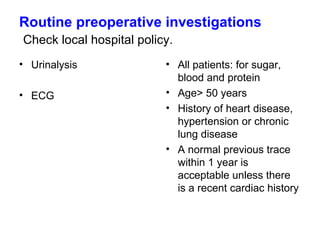
Routine preoperative investigations   Check local hospital policy. Urinalysis ECG  All patients: for sugar, blood and protein  Age> 50 years History of heart disease, hypertension or chronic lung disease A normal previous trace within 1 year is acceptable unless there is a recent cardiac history
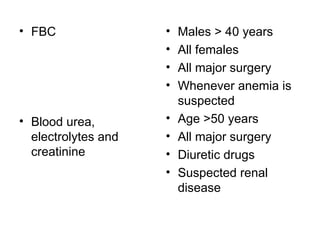
FBC Blood urea, electrolytes and creatinine  Males > 40 years  All females All major surgery Whenever anemia is suspected  Age >50 years  All major surgery Diuretic drugs  Suspected renal disease
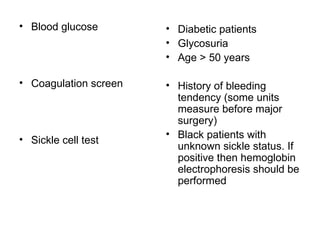
Blood glucose Coagulation screen  Sickle cell test  Diabetic patients Glycosuria Age > 50 years History of bleeding tendency (some units measure before major surgery) Black patients with unknown sickle status. If positive then hemoglobin electrophoresis should be performed
Pregnancy test Chest radiograph  whenever there is any chance of pregnancy Not routine Acute cardiac of chest disease Chronic cardiac or chest disease that has worsened in the last year  Risk of pulmonary TB (recent arrival from the developing world or immunocompromis) Malignant diseases
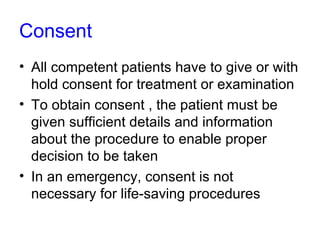
Consent All competent patients have to give or with hold consent for treatment or examination To obtain consent , the patient must be given sufficient details and information about the procedure to enable proper decision to be taken In an emergency, consent is not necessary for life-saving procedures
Risk   In order to appreciate risk the patient needs to be told of the likelihood of the complication occurring and this should be put into context by using an analogy from everyday life
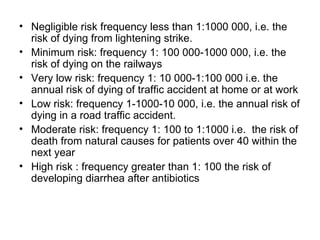
Negligible risk frequency less than 1:1000 000, i.e. the risk of dying from lightening strike. Minimum risk: frequency 1: 100 000-1000 000, i.e. the risk of dying on the railways Very low risk: frequency 1: 10 000-1:100 000 i.e. the annual risk of dying of traffic accident at home or at work Low risk: frequency 1-1000-10 000, i.e. the annual risk of dying in a road traffic accident. Moderate risk: frequency 1: 100 to 1:1000 i.e.  the risk of death from natural causes for patients over 40 within the next year High risk : frequency greater than 1: 100 the risk of developing diarrhea after antibiotics
In addition to the frequency of the risk, the seriousness must be considered
Competence   Adult patients who are able to make decision on their own about their treatment are considered competent. This means that they must be capable of understanding and remembering the information given about the procedure, and be able to weigh up the risks and benefits to arrive at a balanced choice. For competent patients, no other person can consent or refuse treatment on their behalf
Restricted consent   Some patients may consent to treatment in general, but refuse consent for certain aspects of the treatment, e.g. Jehovah's Witness patients who refuse blood transfusion  The patient's wishes must be respected
Research All clinical research requires Research Ethics Committee approval Teaching Students must not take part in clinical procedures without the patients consent Documentation The anesthetic plan discussed and agreed with the patient should be documented including the risks which have been explained
Physical status classification of the American Society of Anesthesiologists (ASA) Physical Status  Classification  PS-1  Description a normal healthy patient
PS-2  A patient with mild systemic disease that results in no functional limitation Examples: Hypertension. Diabetes mellitus, chronic bronchitis. Morbid obesity, extremes of age
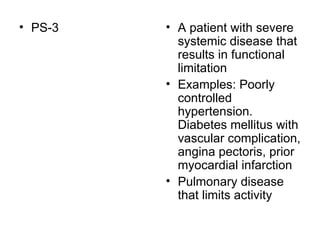
PS-3  A patient with severe systemic disease that results in functional limitation  Examples: Poorly controlled hypertension. Diabetes mellitus with vascular complication, angina pectoris, prior myocardial infarction Pulmonary disease that limits activity
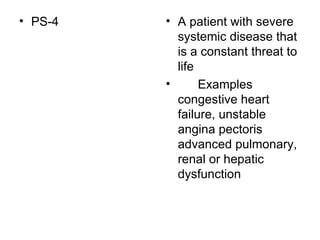
PS-4  A patient with severe systemic disease that is a constant threat to life  Examples congestive heart failure, unstable angina pectoris advanced pulmonary, renal or hepatic dysfunction
PS-5  A moribund patient who is not expected to survive without the operation Examples: Ruptured abdominal aneurysm, pulmonary embolus, head injury with increased intracranial pressure
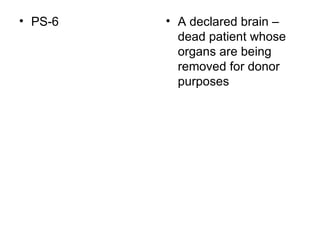
PS-6  A declared brain –dead patient whose organs are being removed for donor purposes
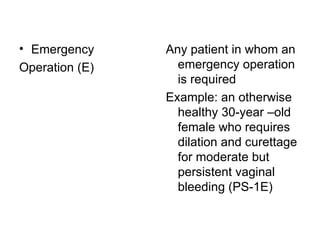
Emergency Operation (E)  Any patient in whom an emergency operation is required  Example: an otherwise healthy 30-year –old female who requires dilation and curettage for moderate but persistent vaginal bleeding (PS-1E)
Thank you

Anesthesia Lecture 2

  • 1.
    Routine preoperative investigations Check local hospital policy. Urinalysis ECG All patients: for sugar, blood and protein Age> 50 years History of heart disease, hypertension or chronic lung disease A normal previous trace within 1 year is acceptable unless there is a recent cardiac history
  • 2.
    FBC Blood urea,electrolytes and creatinine Males > 40 years All females All major surgery Whenever anemia is suspected Age >50 years All major surgery Diuretic drugs Suspected renal disease
  • 3.
    Blood glucose Coagulationscreen Sickle cell test Diabetic patients Glycosuria Age > 50 years History of bleeding tendency (some units measure before major surgery) Black patients with unknown sickle status. If positive then hemoglobin electrophoresis should be performed
  • 4.
    Pregnancy test Chestradiograph whenever there is any chance of pregnancy Not routine Acute cardiac of chest disease Chronic cardiac or chest disease that has worsened in the last year Risk of pulmonary TB (recent arrival from the developing world or immunocompromis) Malignant diseases
  • 5.
    Consent All competentpatients have to give or with hold consent for treatment or examination To obtain consent , the patient must be given sufficient details and information about the procedure to enable proper decision to be taken In an emergency, consent is not necessary for life-saving procedures
  • 6.
    Risk In order to appreciate risk the patient needs to be told of the likelihood of the complication occurring and this should be put into context by using an analogy from everyday life
  • 7.
    Negligible risk frequencyless than 1:1000 000, i.e. the risk of dying from lightening strike. Minimum risk: frequency 1: 100 000-1000 000, i.e. the risk of dying on the railways Very low risk: frequency 1: 10 000-1:100 000 i.e. the annual risk of dying of traffic accident at home or at work Low risk: frequency 1-1000-10 000, i.e. the annual risk of dying in a road traffic accident. Moderate risk: frequency 1: 100 to 1:1000 i.e. the risk of death from natural causes for patients over 40 within the next year High risk : frequency greater than 1: 100 the risk of developing diarrhea after antibiotics
  • 8.
    In addition tothe frequency of the risk, the seriousness must be considered
  • 9.
    Competence Adult patients who are able to make decision on their own about their treatment are considered competent. This means that they must be capable of understanding and remembering the information given about the procedure, and be able to weigh up the risks and benefits to arrive at a balanced choice. For competent patients, no other person can consent or refuse treatment on their behalf
  • 10.
    Restricted consent Some patients may consent to treatment in general, but refuse consent for certain aspects of the treatment, e.g. Jehovah's Witness patients who refuse blood transfusion The patient's wishes must be respected
  • 11.
    Research All clinicalresearch requires Research Ethics Committee approval Teaching Students must not take part in clinical procedures without the patients consent Documentation The anesthetic plan discussed and agreed with the patient should be documented including the risks which have been explained
  • 12.
    Physical status classificationof the American Society of Anesthesiologists (ASA) Physical Status Classification PS-1 Description a normal healthy patient
  • 13.
    PS-2 Apatient with mild systemic disease that results in no functional limitation Examples: Hypertension. Diabetes mellitus, chronic bronchitis. Morbid obesity, extremes of age
  • 14.
    PS-3 Apatient with severe systemic disease that results in functional limitation Examples: Poorly controlled hypertension. Diabetes mellitus with vascular complication, angina pectoris, prior myocardial infarction Pulmonary disease that limits activity
  • 15.
    PS-4 Apatient with severe systemic disease that is a constant threat to life Examples congestive heart failure, unstable angina pectoris advanced pulmonary, renal or hepatic dysfunction
  • 16.
    PS-5 Amoribund patient who is not expected to survive without the operation Examples: Ruptured abdominal aneurysm, pulmonary embolus, head injury with increased intracranial pressure
  • 17.
    PS-6 Adeclared brain –dead patient whose organs are being removed for donor purposes
  • 18.
    Emergency Operation (E) Any patient in whom an emergency operation is required Example: an otherwise healthy 30-year –old female who requires dilation and curettage for moderate but persistent vaginal bleeding (PS-1E)
  • 19.