ANDROID SCRIPTING
 A Java-less approach to building apps

              Juan Gomez
          Android Dev @ Handmark, Inc
             Co-founder PythonKC
AGENDA

•   Android 101
•   Scripting Layer for Android (SL4A)
•   Basic tasks (WiFi, GPS, camera, SMS) and basic UI
•   Using WebViews and Javascript for better UIs
•   Advanced Scripts (Twisted, PyBluez)
•   Packaging your scripts on an APK
•   Q&A
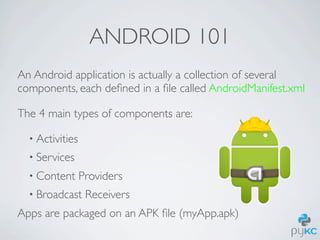
ANDROID 101
An Android application is actually a collection of several
components, each dened in a le called AndroidManifest.xml

The 4 main types of components are:

  • Activities
  • Services
  • Content      Providers
  • Broadcast     Receivers
Apps are packaged on an APK le (myApp.apk)
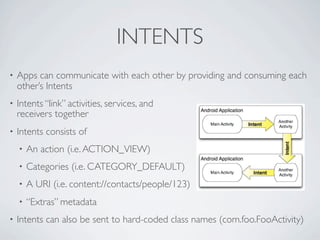
INTENTS
•   Apps can communicate with each other by providing and consuming each
    other’s Intents
•   Intents “link” activities, services, and
    receivers together
•   Intents consists of
    •   An action (i.e. ACTION_VIEW)
    •   Categories (i.e. CATEGORY_DEFAULT)
    •   A URI (i.e. content://contacts/people/123)
    •   “Extras” metadata
•   Intents can also be sent to hard-coded class names (com.foo.FooActivity)
HOW DO I GET STARTED?

• Download       the Android SDK: http://developer.android.com/sdk

• Add Android      platforms and other packages to your SDK

• Install   the ADT plug-in for Eclipse (optional)

• Enable     app side-loading on your phone:

  •   Settings > Application > Unknown Sources
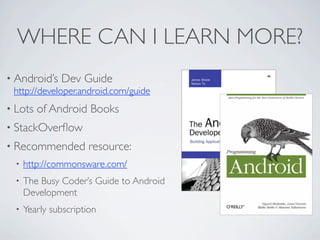
WHERE CAN I LEARN MORE?
• Android’s Dev Guide
  http://developer.android.com/guide
• Lots   of Android Books
• StackOverflow
• Recommended          resource:
  •   http://commonsware.com/
  •   The Busy Coder’s Guide to Android
      Development
  •   Yearly subscription
SCRIPTING LAYER FOR
              ANDROID (SL4A)
• Brings    scripting languages to Android
• Allows you to edit and execute scripts and interactive
 interpreters directly on the Android device.
• Scripts
       have access to many of the APIs available to full-
 fledged Android apps.
• Supported  languages include: Python, Perl, JRuby, Lua, BeanShell,
 JavaScript and Tcl
• There’s    limited support for PHP and Shell scripts
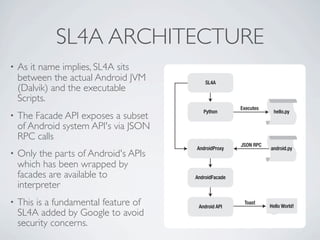
SL4A ARCHITECTURE
•   As it name implies, SL4A sits
    between the actual Android JVM
    (Dalvik) and the executable
    Scripts.
•   The Facade API exposes a subset
    of Android system API's via JSON
    RPC calls
•   Only the parts of Android's APIs
    which has been wrapped by
    facades are available to
    interpreter
•   This is a fundamental feature of
    SL4A added by Google to avoid
    security concerns.
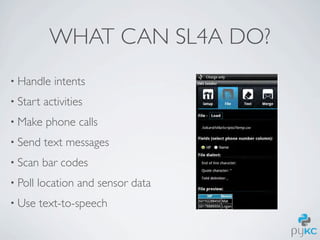
WHAT CAN SL4A DO?
• Handle    intents
• Start   activities
• Make    phone calls
• Send    text messages
• Scan    bar codes
• Poll   location and sensor data
• Use    text-to-speech
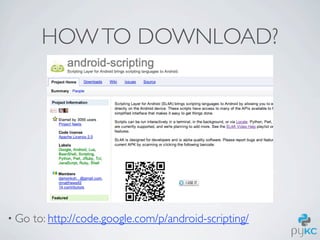
HOW TO DOWNLOAD?


• Go   to: http://code.google.com/p/android-scripting/
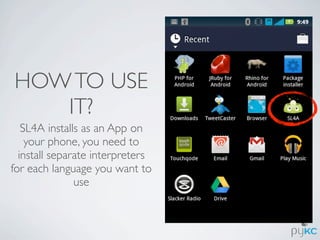
HOW TO USE
   IT?
   SL4A installs as an App on
    your phone, you need to
  install separate interpreters
for each language you want to
               use
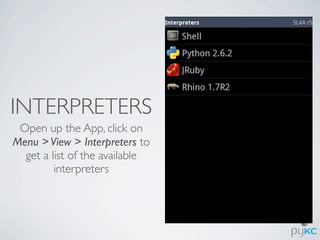
INTERPRETERS
 Open up the App, click on
Menu > View > Interpreters to
  get a list of the available
         interpreters
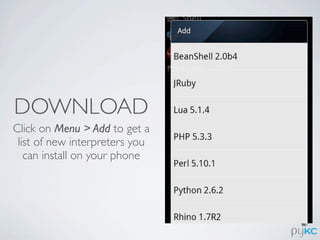
DOWNLOAD
Click on Menu > Add to get a
 list of new interpreters you
   can install on your phone
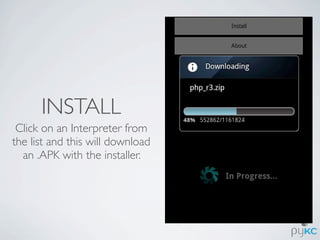
INSTALL
 Click on an Interpreter from
the list and this will download
  an .APK with the installer.
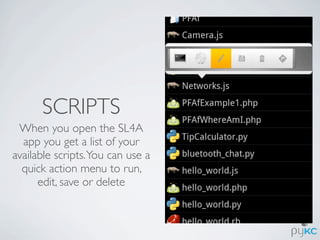
SCRIPTS
 When you open the SL4A
  app you get a list of your
available scripts. You can use a
  quick action menu to run,
      edit, save or delete
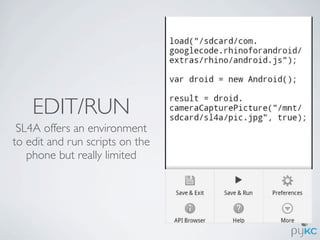
EDIT/RUN
 SL4A offers an environment
to edit and run scripts on the
   phone but really limited
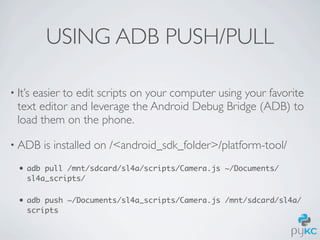
USING ADB PUSH/PULL

• It’s
     easier to edit scripts on your computer using your favorite
  text editor and leverage the Android Debug Bridge (ADB) to
  load them on the phone.

• ADB    is installed on /<android_sdk_folder>/platform-tool/
  •   adb pull /mnt/sdcard/sl4a/scripts/Camera.js ~/Documents/
      sl4a_scripts/

  •   adb push ~/Documents/sl4a_scripts/Camera.js /mnt/sdcard/sl4a/
      scripts
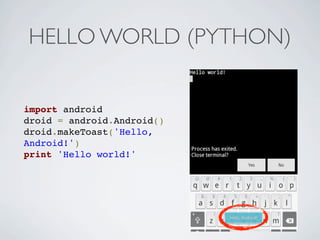
HELLO WORLD (PYTHON)


import android
droid = android.Android()
droid.makeToast('Hello,
Android!')
print 'Hello world!'
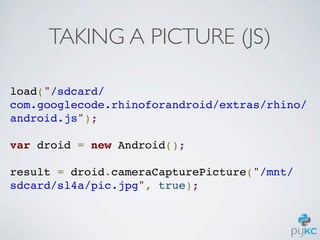
TAKING A PICTURE (JS)

load("/sdcard/
com.googlecode.rhinoforandroid/extras/rhino/
android.js");

var droid = new Android();

result = droid.cameraCapturePicture("/mnt/
sdcard/sl4a/pic.jpg", true);
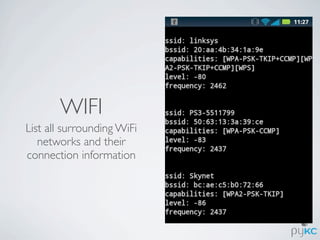
WIFI
List all surrounding WiFi
   networks and their
connection information
LISTING WIFI NETWORKS (JS)
load("/sdcard/com.googlecode.rhinoforandroid/extras/rhino/
android.js");
var droid = new Android();
wifi_on = droid.checkWifiState();
if (wifi_on) {
    success = droid.wifiStartScan();
    if (success) {
         list_of_networks = droid.wifiGetScanResults();
         for (var i = 0; i < list_of_networks.length; i++) {
             for (attr in list_of_networks[i]) {
                 print(attr + ": " + list_of_networks[i][attr]);
             }
             print("n");
         }
    }
    droid.makeToast("Done obtaining list of WiFi networks!");
} else {
    droid.makeToast("WiFi radio is off");
}
USING GPS AND SMS (RUBY)
require "android";
def get_location(droid)
    droid.startLocating()
    droid.eventWaitFor("location")
    raw_location = droid.readLocation()
    droid.stopLocating()
    return raw_location["result"]["network"]
end

def format_address(loc_info)
    return loc_info["feature_name"] + " " + loc_info["thoroughfare"] + " " +
        loc_info["locality"] + ", " + loc_info["admin_area"] + " " +
        loc_info["postal_code"]
end

def get_address(droid, location)
    loc_info= droid.geocode(location["latitude"], location["longitude"])
    return format_address(loc_info["result"][0])
end

droid = Android.new
location = get_location droid
address = get_address droid, location
phone = droid.pickPhone
droid.smsSend phone["result"], "Greetings from SL4A, I'm at " + address
puts "done sending SMS with location"
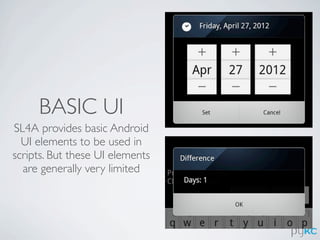
BASIC UI
SL4A provides basic Android
  UI elements to be used in
scripts. But these UI elements
  are generally very limited
USING NATIVE TYPES AND
        LIBRARIES
import android
from datetime import date

droid = android.Android()
today = date.today()
droid.dialogCreateDatePicker(today.year, today.month, today.day)
droid.dialogShow()
selectedDate = droid.dialogGetResponse().result
first_date = date(selectedDate['year'], selectedDate['month'], selectedDate['day'])

droid.dialogCreateDatePicker(today.year, today.month, today.day)
droid.dialogShow()
selectedDate = droid.dialogGetResponse().result
second_date = date(selectedDate['year'], selectedDate['month'], selectedDate['day'])
timediff = abs(first_date - second_date)

droid.dialogCreateAlert("Difference", "Days: " + str(timediff.days))
droid.dialogSetPositiveButtonText('OK')
droid.dialogShow()
SIMPLE TWITTER CLIENT
                (RUBY)
require 'android'
require 'net/http'

droid = Android.new
url = URI.parse("http://twitter.com/statuses/update.xml")
req = Net::HTTP::Post.new(url.path)

req.basic_auth('user', 'password')
status = droid.getInput 'Twitter Update', "What's going on?"
req.set_form_data({'status' => status["result"],
                   'source' => 'Android'})

response = Net::HTTP.new(url.host, url.port).start do |http|
    http.request(req)
end

if response.code == "200"
  droid.makeToast "Your toot was successfully sent."
end
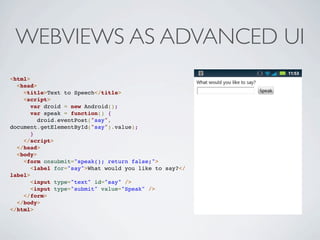
WEBVIEWS AS ADVANCED UI
<html>
  <head>
    <title>Text to Speech</title>
    <script>
       var droid = new Android();
       var speak = function() {
         droid.eventPost("say",
document.getElementById("say").value);
       }
    </script>
  </head>
  <body>
    <form onsubmit="speak(); return false;">
       <label for="say">What would you like to say?</
label>
       <input type="text" id="say" />
       <input type="submit" value="Speak" />
    </form>
  </body>
</html>
BACKGROUND SERVICE
You can create a background service that acts as a controller in
you favorite language to support your Web UI

 import android

 droid = android.Android()
 droid.webViewShow('file:///sdcard/sl4a/scripts/
 text_to_speech.html')
 while True:
     result = droid.eventWaitFor('say').result
     if result is not None:
         droid.ttsSpeak(result['data'])
ADVANCED SCRIPTS
• Python   is by far the most
  complete language on SL4A
• You can import more advanced
  libraries that are not part of the
  Python Standard Library.
• Like PyBluez for Bluetooth
• Or Twisted
  •   Twisted is an extremely powerful event-
      driven networking engine written in
      Python.
  •   Projects like BitTorrent and Launchpad
      use twisted as their networking engine.
PACKAGING YOU APP FOR
      THE GOOGLE PLAY STORE
•   For this step you will need Eclipse :(
•   Download the skeleton Android project from here:
    http://android-scripting.googlecode.com/hg/android/
    script_for_android_template.zip
•   Follow these instructions to configure the project:
    http://code.google.com/p/android-scripting/wiki/SharingScripts
•   Make sure you can generate an APK and do a test install.
•   Follow these instructions to sign your APK:
    http://developer.android.com/guide/publishing/app-signing.html
•   Viola! you can upload your APK to the Play Store
THAT’S IT FOR ME!
Thanks
To Our Sponsors
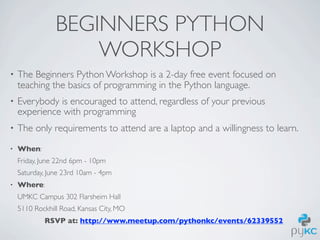
BEGINNERS PYTHON
                    WORKSHOP
•   The Beginners Python Workshop is a 2-day free event focused on
    teaching the basics of programming in the Python language.
•   Everybody is encouraged to attend, regardless of your previous
    experience with programming
•   The only requirements to attend are a laptop and a willingness to learn.
•   When:
    Friday, June 22nd 6pm - 10pm
    Saturday, June 23rd 10am - 4pm
•   Where:
    UMKC Campus 302 Flarsheim Hall
    5110 Rockhill Road, Kansas City, MO
            RSVP at: http://www.meetup.com/pythonkc/events/62339552
@_JUANDG
http://speakerdeck.com/u/juandg/p/androidscripting_kcdc2012#

Android Scripting

  • 1.
    ANDROID SCRIPTING AJava-less approach to building apps Juan Gomez Android Dev @ Handmark, Inc Co-founder PythonKC
  • 2.
    AGENDA • Android 101 • Scripting Layer for Android (SL4A) • Basic tasks (WiFi, GPS, camera, SMS) and basic UI • Using WebViews and Javascript for better UIs • Advanced Scripts (Twisted, PyBluez) • Packaging your scripts on an APK • Q&A
  • 3.
    ANDROID 101 An Androidapplication is actually a collection of several components, each defined in a file called AndroidManifest.xml The 4 main types of components are: • Activities • Services • Content Providers • Broadcast Receivers Apps are packaged on an APK file (myApp.apk)
  • 4.
    INTENTS • Apps can communicate with each other by providing and consuming each other’s Intents • Intents “link” activities, services, and receivers together • Intents consists of • An action (i.e. ACTION_VIEW) • Categories (i.e. CATEGORY_DEFAULT) • A URI (i.e. content://contacts/people/123) • “Extras” metadata • Intents can also be sent to hard-coded class names (com.foo.FooActivity)
  • 5.
    HOW DO IGET STARTED? • Download the Android SDK: http://developer.android.com/sdk • Add Android platforms and other packages to your SDK • Install the ADT plug-in for Eclipse (optional) • Enable app side-loading on your phone: • Settings > Application > Unknown Sources
  • 6.
    WHERE CAN ILEARN MORE? • Android’s Dev Guide http://developer.android.com/guide • Lots of Android Books • StackOverflow • Recommended resource: • http://commonsware.com/ • The Busy Coder’s Guide to Android Development • Yearly subscription
  • 7.
    SCRIPTING LAYER FOR ANDROID (SL4A) • Brings scripting languages to Android • Allows you to edit and execute scripts and interactive interpreters directly on the Android device. • Scripts have access to many of the APIs available to full- fledged Android apps. • Supported languages include: Python, Perl, JRuby, Lua, BeanShell, JavaScript and Tcl • There’s limited support for PHP and Shell scripts
  • 8.
    SL4A ARCHITECTURE • As it name implies, SL4A sits between the actual Android JVM (Dalvik) and the executable Scripts. • The Facade API exposes a subset of Android system API's via JSON RPC calls • Only the parts of Android's APIs which has been wrapped by facades are available to interpreter • This is a fundamental feature of SL4A added by Google to avoid security concerns.
  • 9.
    WHAT CAN SL4ADO? • Handle intents • Start activities • Make phone calls • Send text messages • Scan bar codes • Poll location and sensor data • Use text-to-speech
  • 10.
    HOW TO DOWNLOAD? •Go to: http://code.google.com/p/android-scripting/
  • 11.
    HOW TO USE IT? SL4A installs as an App on your phone, you need to install separate interpreters for each language you want to use
  • 12.
    INTERPRETERS Open upthe App, click on Menu > View > Interpreters to get a list of the available interpreters
  • 13.
    DOWNLOAD Click on Menu> Add to get a list of new interpreters you can install on your phone
  • 14.
    INSTALL Click onan Interpreter from the list and this will download an .APK with the installer.
  • 15.
    SCRIPTS When youopen the SL4A app you get a list of your available scripts. You can use a quick action menu to run, edit, save or delete
  • 16.
    EDIT/RUN SL4A offersan environment to edit and run scripts on the phone but really limited
  • 17.
    USING ADB PUSH/PULL •It’s easier to edit scripts on your computer using your favorite text editor and leverage the Android Debug Bridge (ADB) to load them on the phone. • ADB is installed on /<android_sdk_folder>/platform-tool/ • adb pull /mnt/sdcard/sl4a/scripts/Camera.js ~/Documents/ sl4a_scripts/ • adb push ~/Documents/sl4a_scripts/Camera.js /mnt/sdcard/sl4a/ scripts
  • 19.
    HELLO WORLD (PYTHON) importandroid droid = android.Android() droid.makeToast('Hello, Android!') print 'Hello world!'
  • 20.
    TAKING A PICTURE(JS) load("/sdcard/ com.googlecode.rhinoforandroid/extras/rhino/ android.js"); var droid = new Android(); result = droid.cameraCapturePicture("/mnt/ sdcard/sl4a/pic.jpg", true);
  • 21.
    WIFI List all surroundingWiFi networks and their connection information
  • 22.
    LISTING WIFI NETWORKS(JS) load("/sdcard/com.googlecode.rhinoforandroid/extras/rhino/ android.js"); var droid = new Android(); wifi_on = droid.checkWifiState(); if (wifi_on) { success = droid.wifiStartScan(); if (success) { list_of_networks = droid.wifiGetScanResults(); for (var i = 0; i < list_of_networks.length; i++) { for (attr in list_of_networks[i]) { print(attr + ": " + list_of_networks[i][attr]); } print("n"); } } droid.makeToast("Done obtaining list of WiFi networks!"); } else { droid.makeToast("WiFi radio is off"); }
  • 23.
    USING GPS ANDSMS (RUBY) require "android"; def get_location(droid) droid.startLocating() droid.eventWaitFor("location") raw_location = droid.readLocation() droid.stopLocating() return raw_location["result"]["network"] end def format_address(loc_info) return loc_info["feature_name"] + " " + loc_info["thoroughfare"] + " " + loc_info["locality"] + ", " + loc_info["admin_area"] + " " + loc_info["postal_code"] end def get_address(droid, location) loc_info= droid.geocode(location["latitude"], location["longitude"]) return format_address(loc_info["result"][0]) end droid = Android.new location = get_location droid address = get_address droid, location phone = droid.pickPhone droid.smsSend phone["result"], "Greetings from SL4A, I'm at " + address puts "done sending SMS with location"
  • 24.
    BASIC UI SL4A providesbasic Android UI elements to be used in scripts. But these UI elements are generally very limited
  • 25.
    USING NATIVE TYPESAND LIBRARIES import android from datetime import date droid = android.Android() today = date.today() droid.dialogCreateDatePicker(today.year, today.month, today.day) droid.dialogShow() selectedDate = droid.dialogGetResponse().result first_date = date(selectedDate['year'], selectedDate['month'], selectedDate['day']) droid.dialogCreateDatePicker(today.year, today.month, today.day) droid.dialogShow() selectedDate = droid.dialogGetResponse().result second_date = date(selectedDate['year'], selectedDate['month'], selectedDate['day']) timediff = abs(first_date - second_date) droid.dialogCreateAlert("Difference", "Days: " + str(timediff.days)) droid.dialogSetPositiveButtonText('OK') droid.dialogShow()
  • 26.
    SIMPLE TWITTER CLIENT (RUBY) require 'android' require 'net/http' droid = Android.new url = URI.parse("http://twitter.com/statuses/update.xml") req = Net::HTTP::Post.new(url.path) req.basic_auth('user', 'password') status = droid.getInput 'Twitter Update', "What's going on?" req.set_form_data({'status' => status["result"], 'source' => 'Android'}) response = Net::HTTP.new(url.host, url.port).start do |http| http.request(req) end if response.code == "200" droid.makeToast "Your toot was successfully sent." end
  • 27.
    WEBVIEWS AS ADVANCEDUI <html> <head> <title>Text to Speech</title> <script> var droid = new Android(); var speak = function() { droid.eventPost("say", document.getElementById("say").value); } </script> </head> <body> <form onsubmit="speak(); return false;"> <label for="say">What would you like to say?</ label> <input type="text" id="say" /> <input type="submit" value="Speak" /> </form> </body> </html>
  • 28.
    BACKGROUND SERVICE You cancreate a background service that acts as a controller in you favorite language to support your Web UI import android droid = android.Android() droid.webViewShow('file:///sdcard/sl4a/scripts/ text_to_speech.html') while True: result = droid.eventWaitFor('say').result if result is not None: droid.ttsSpeak(result['data'])
  • 29.
    ADVANCED SCRIPTS • Python is by far the most complete language on SL4A • You can import more advanced libraries that are not part of the Python Standard Library. • Like PyBluez for Bluetooth • Or Twisted • Twisted is an extremely powerful event- driven networking engine written in Python. • Projects like BitTorrent and Launchpad use twisted as their networking engine.
  • 30.
    PACKAGING YOU APPFOR THE GOOGLE PLAY STORE • For this step you will need Eclipse :( • Download the skeleton Android project from here: http://android-scripting.googlecode.com/hg/android/ script_for_android_template.zip • Follow these instructions to configure the project: http://code.google.com/p/android-scripting/wiki/SharingScripts • Make sure you can generate an APK and do a test install. • Follow these instructions to sign your APK: http://developer.android.com/guide/publishing/app-signing.html • Viola! you can upload your APK to the Play Store
  • 31.
  • 32.
  • 33.
    BEGINNERS PYTHON WORKSHOP • The Beginners Python Workshop is a 2-day free event focused on teaching the basics of programming in the Python language. • Everybody is encouraged to attend, regardless of your previous experience with programming • The only requirements to attend are a laptop and a willingness to learn. • When: Friday, June 22nd 6pm - 10pm Saturday, June 23rd 10am - 4pm • Where: UMKC Campus 302 Flarsheim Hall 5110 Rockhill Road, Kansas City, MO RSVP at: http://www.meetup.com/pythonkc/events/62339552
  • 34.