Android Power Management:
Current and Future Trends
Soumya Kanti Datta
Research Engineer
EURECOM
France
Projet : « Smart 4G Tablet»
LPCIM : Laboratoire de Physique des
Interfaces et des Couches Minces
Contents
• Introduction
• Android power management architecture
• Present research on power consumption &
management
• Survey on power saving Android apps
• Future directions
• Privacy & security concerns
• Conclusion
18/06/2012 ETSIoT 2012, Seoul 3
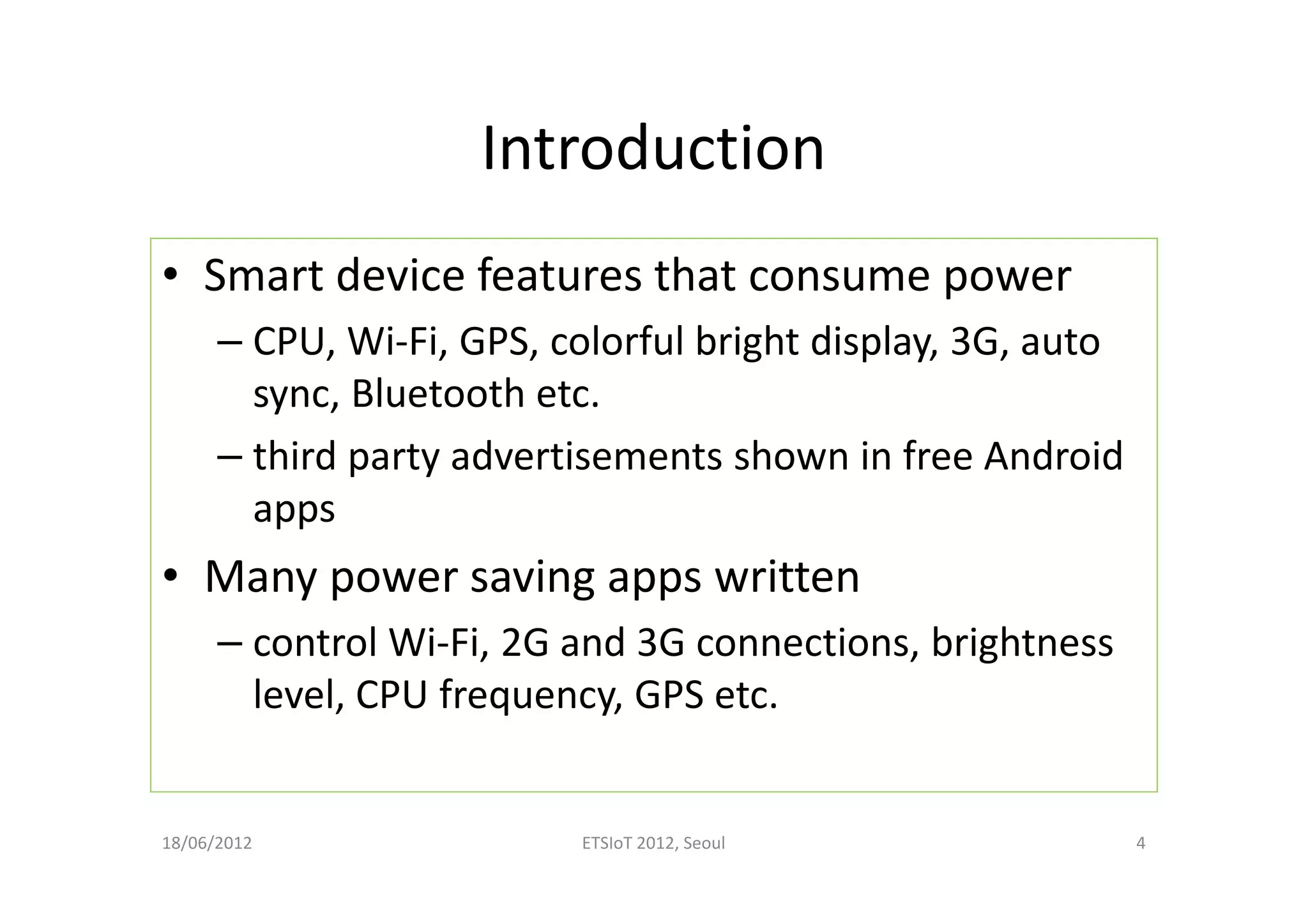
Introduction
• Smart device features that consume power
– CPU, Wi-Fi, GPS, colorful bright display, 3G, auto
sync, Bluetooth etc.
– third party advertisements shown in free Android
apps
• Many power saving apps written
– control Wi-Fi, 2G and 3G connections, brightness
level, CPU frequency, GPS etc.
18/06/2012 ETSIoT 2012, Seoul 4
Contents
• Introduction
• Android power management architecture
• Present research on power consumption &
management
• Survey on power saving Android apps
• Future directions
• Privacy & security concerns
• Conclusion
18/06/2012 ETSIoT 2012, Seoul 5
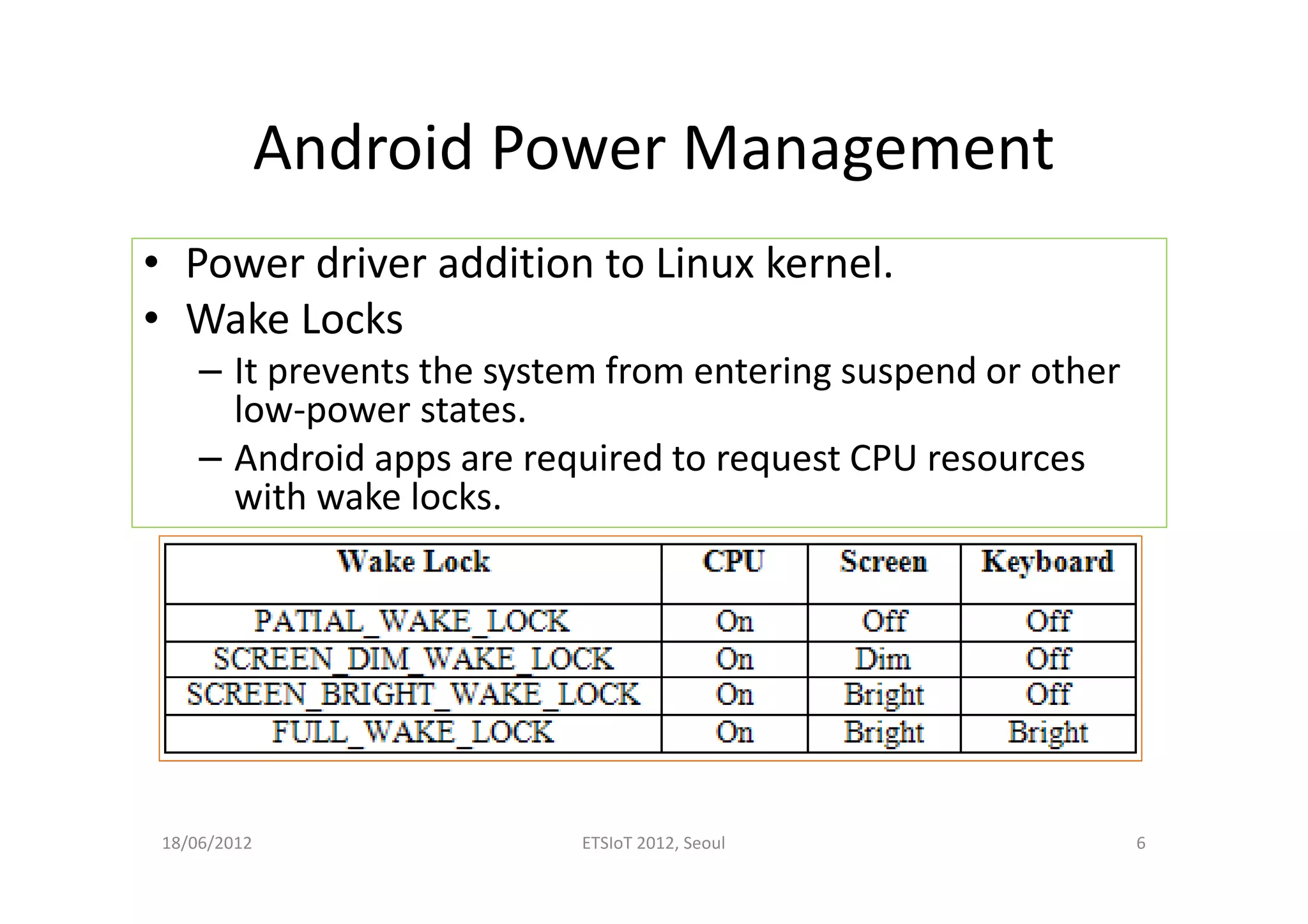
Android Power Management
• Power driver addition to Linux kernel.
• Wake Locks
– It prevents the system from entering suspend or other
low-power states.
– Android apps are required to request CPU resources
with wake locks.
18/06/2012 ETSIoT 2012, Seoul 6
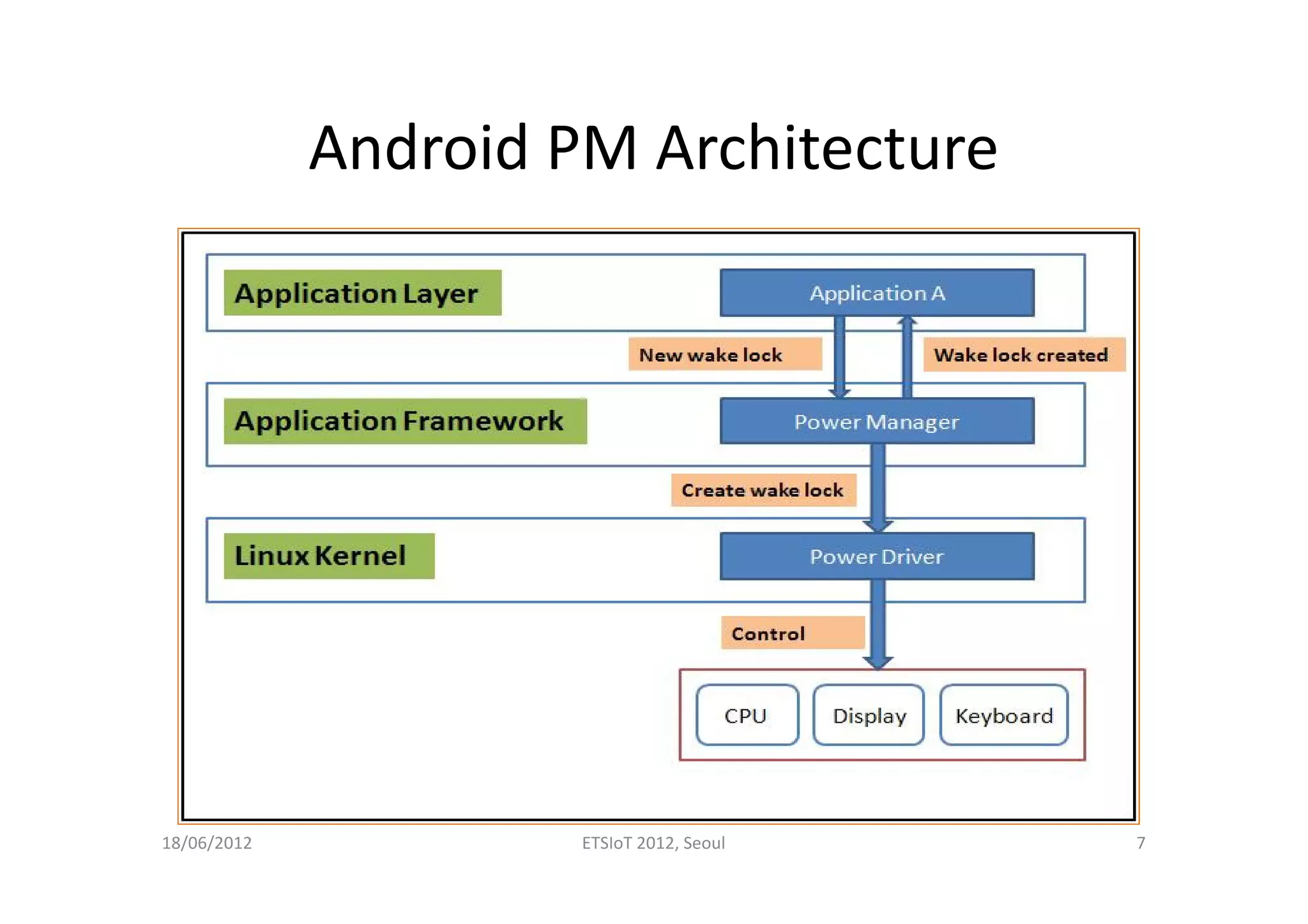
Android PM Architecture
18/06/2012 ETSIoT 2012, Seoul 7
Contents
• Introduction
• Android power management architecture
• Present research on power consumption &
management
• Survey on power saving Android apps
• Future directions
• Privacy & security concerns
• Conclusion
18/06/2012 ETSIoT 2012, Seoul 8
Power consumption of connectivity
features
• Reducing power dissipation in Wi-Fi, 3G/4G,
GPS
• Location Based Apps (LBA)
– Social networking, weather, traffic, ad etc.
– Adaptive location sensing framework
18/06/2012 ETSIoT 2012, Seoul 9
Context Aware PM
• Employs several monitoring system to extract
contexts (CABMAN)
– Location
– Battery
– Process
– Call
• Can predict the next charging opportunity
18/06/2012 ETSIoT 2012, Seoul 10
Power Model Generation
• PowerBooter technique & PowerTutor app is
introduced in [].
• Monitoring & recording battery consumption.
• Each hardware element has several states and
power consumption depends on the states.
• Power consumption is correlated with the
hardware elements of the smartphones.
18/06/2012 ETSIoT 2012, Seoul 11
Other Approaches on PM
• Analysis using smartphone usage pattern
– An Android app ‘battery logger’ is used to collect
usage pattern and send it to a server.
• Internal energy consumption of apps
• Human Battery Interaction
18/06/2012 ETSIoT 2012, Seoul 12
Contents
• Introduction
• Android power management architecture
• Present research on power consumption &
management
• Survey on power saving Android apps
• Future directions
• Privacy & security concerns
• Conclusion
18/06/2012 ETSIoT 2012, Seoul 13
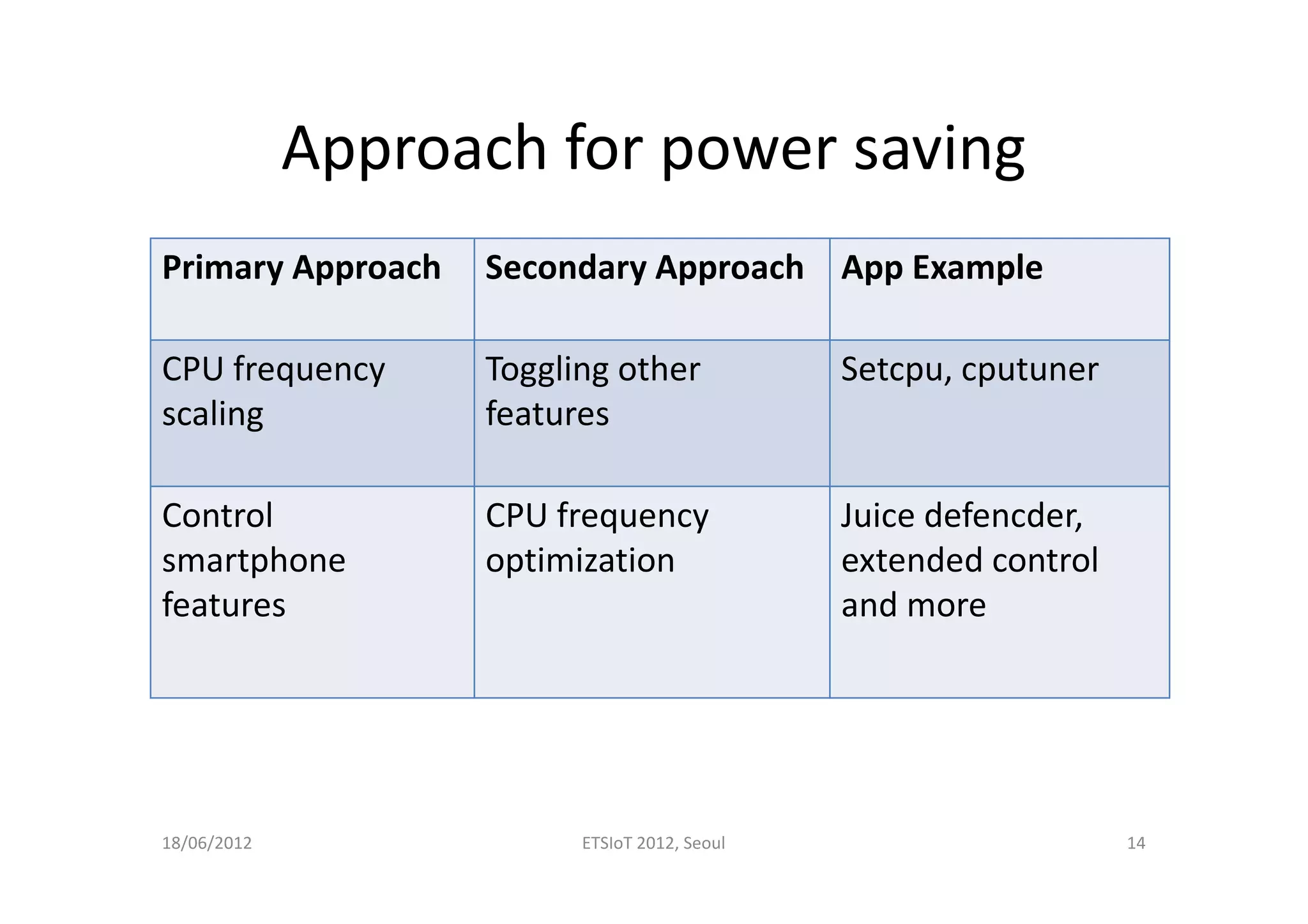
Approach for power saving
Primary Approach Secondary Approach App Example
CPU frequency
scaling
Toggling other
features
Setcpu, cputuner
Control
smartphone
features
CPU frequency
optimization
Juice defencder,
extended control
and more
18/06/2012 ETSIoT 2012, Seoul 14
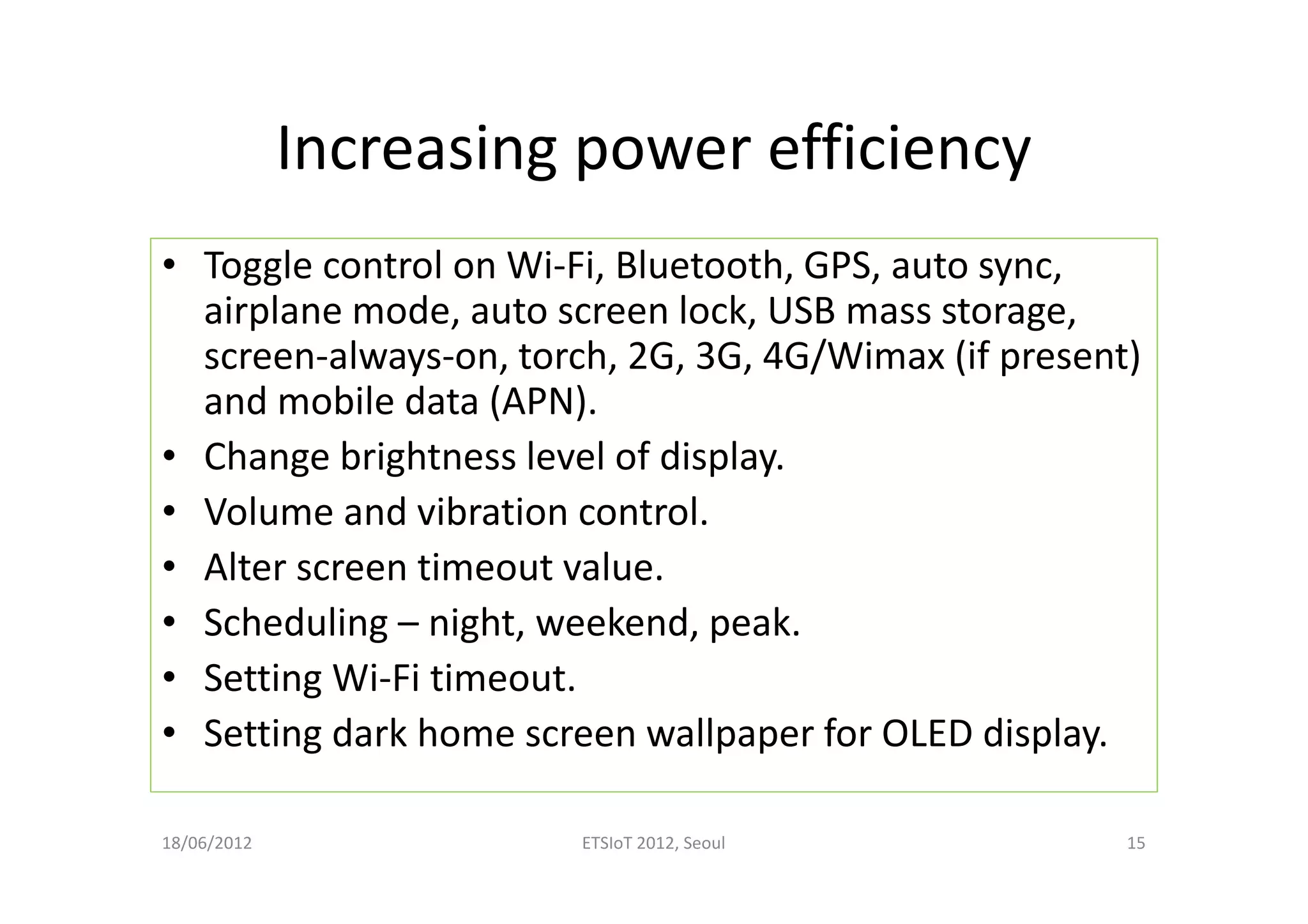
Increasing power efficiency
• Toggle control on Wi-Fi, Bluetooth, GPS, auto sync,
airplane mode, auto screen lock, USB mass storage,
screen-always-on, torch, 2G, 3G, 4G/Wimax (if present)
and mobile data (APN).
• Change brightness level of display.
• Volume and vibration control.
• Alter screen timeout value.
• Scheduling – night, weekend, peak.
• Setting Wi-Fi timeout.
• Setting dark home screen wallpaper for OLED display.
18/06/2012 ETSIoT 2012, Seoul 15
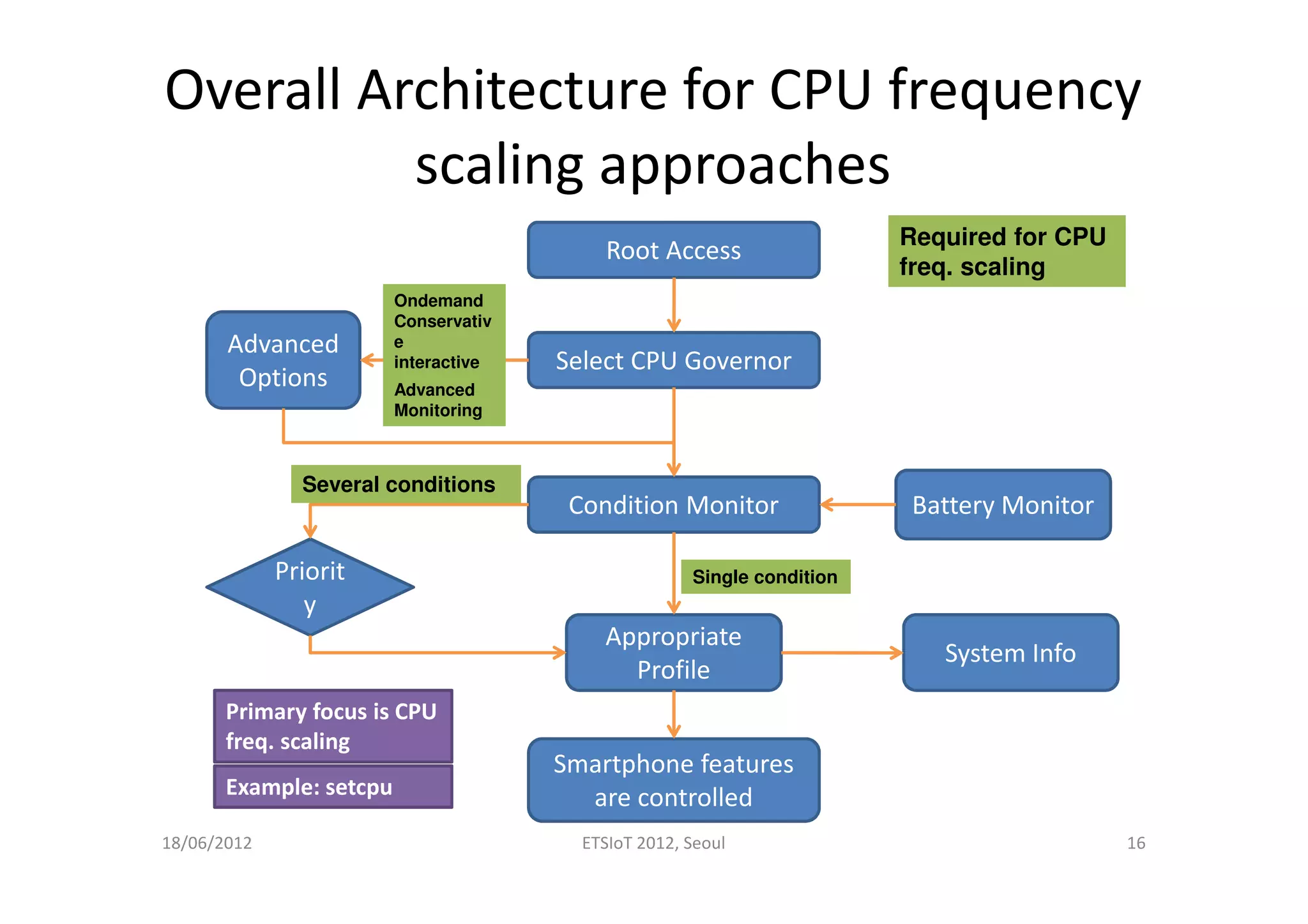
Root Access
Select CPU Governor
Advanced
Options
Condition Monitor
Appropriate
Profile
System Info
Battery Monitor
Priorit
y
Smartphone features
are controlled
Required for CPU
freq. scaling
Ondemand
Conservativ
e
interactive
Advanced
Monitoring
Single condition
Several conditions
Primary focus is CPU
freq. scaling
Example: setcpu
Overall Architecture for CPU frequency
scaling approaches
18/06/2012 ETSIoT 2012, Seoul 16
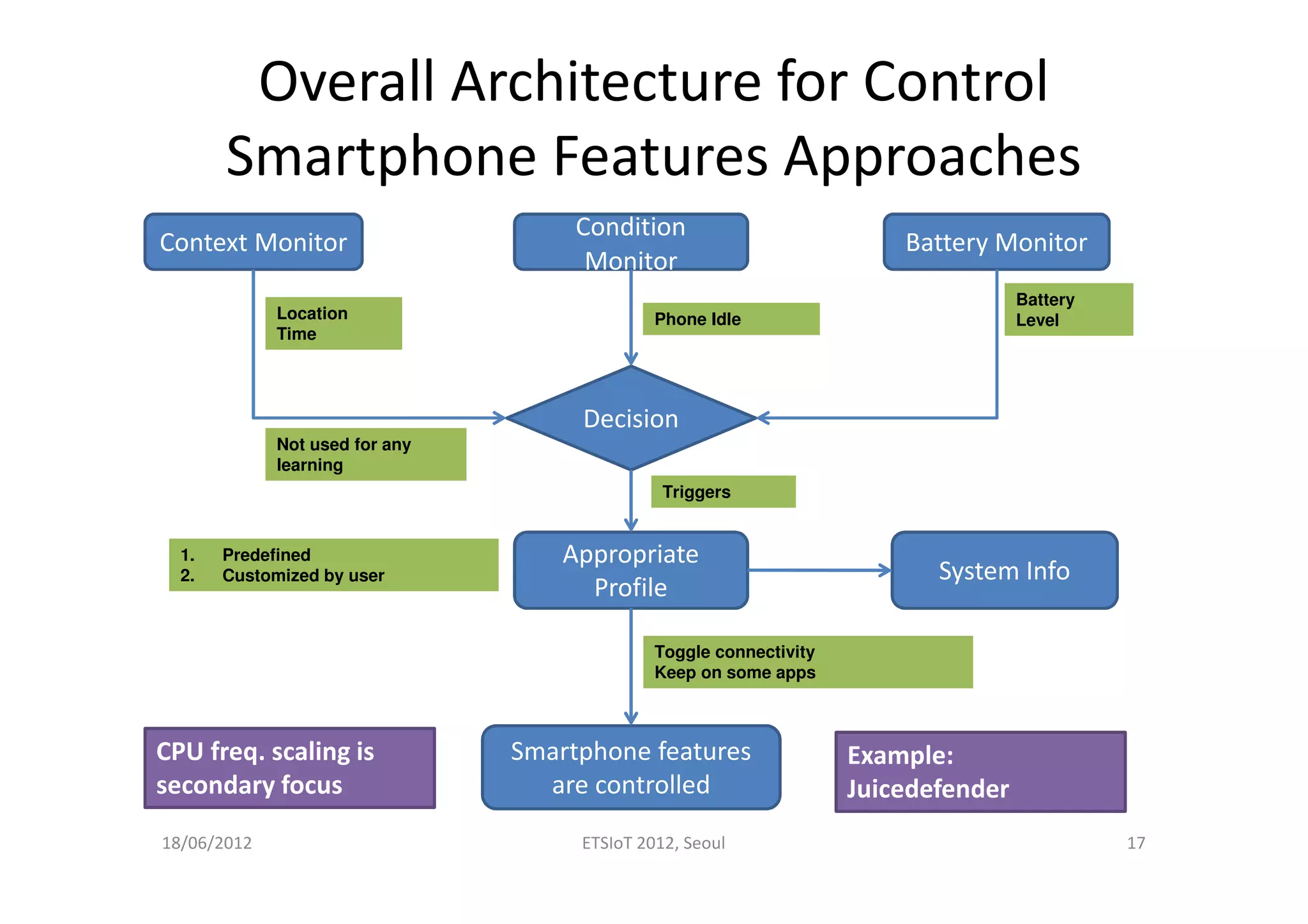
Condition
Monitor
Appropriate
Profile
System Info
Battery Monitor
Smartphone features
are controlled
Context Monitor
Decision
Location
Time
Battery
LevelPhone Idle
Triggers
1. Predefined
2. Customized by user
Toggle connectivity
Keep on some apps
CPU freq. scaling is
secondary focus
Example:
Juicedefender
Not used for any
learning
Overall Architecture for Control
Smartphone Features Approaches
18/06/2012 ETSIoT 2012, Seoul 17
Limitations of studied apps
• Static profiling (one customizable profile)
– Not customized for specific user
• “Controlling” – not intelligent
• Requirement for root access
– For CPU freq. scaling
• No focus on power consumption pattern (except power
tutor)
• Context information is not used for any learning purpose
• Do not focus on learning the power consumption pattern of
users.
• In-app advertising: waste of energy
18/06/2012 ETSIoT 2012, Seoul 18
Contents
• Introduction
• Android power management architecture
• Present research on power consumption &
management
• Survey on power saving Android apps
• Future directions
• Privacy & security concerns
• Conclusion
18/06/2012 ETSIoT 2012, Seoul 19
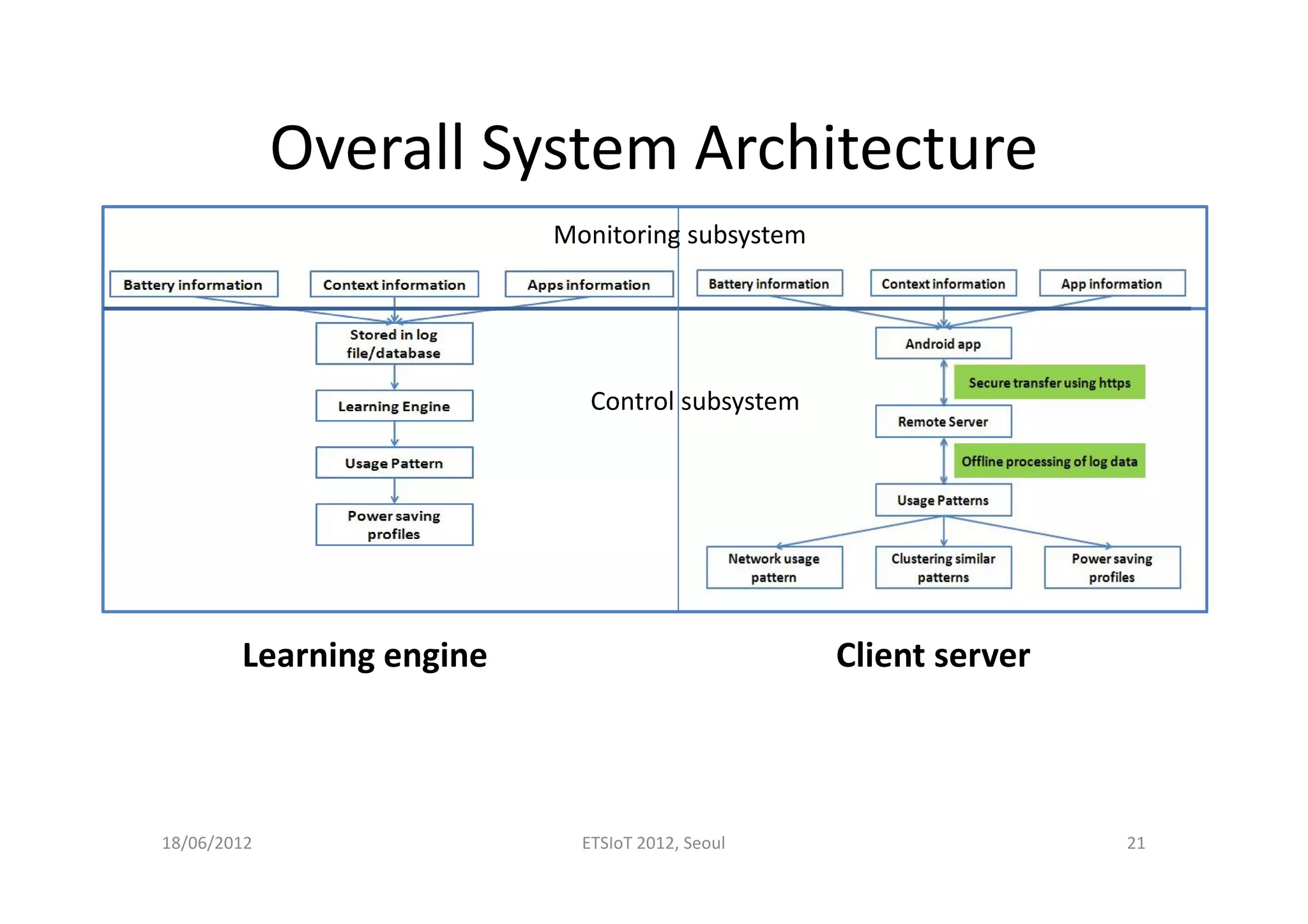
Apps for Power Management
• Monitoring subsystem
– Extracts several
information like
location, date & time,
battery discharge
behavior, apps running
[usage pattern]
• Controlling subsystem
– Control
smartphone/tablet
features based on
usage pattern
18/06/2012 ETSIoT 2012, Seoul 20
• Two types of
architectures
• Client server
• Learning engine
Overall System Architecture
18/06/2012 ETSIoT 2012, Seoul 21
Learning engine Client server
Monitoring subsystem
Control subsystem
Advantages of Client Server
Architecture
• Generation of smartphone usage pattern
• The context in which most power is spent
• Clustering similar usage pattern at the server
– Derive power saving profiles based on clusters
• Evolution of clusters
• Network usage pattern
– Useful for service providers
• But threat to privacy
18/06/2012 ETSIoT 2012, Seoul 22
Advantages of Learning Engine
• Intelligent learning engine
• Usage pattern and power saving profile are
generated locally
• No threat on private data
• But network usage pattern could not be
known
18/06/2012 ETSIoT 2012, Seoul 23
Other Avenues
• Adding a photovoltaic cell to generate
additional power
– WYSIPS has introduced this
• Adaptive display
– Shorten the display screen when battery level falls
below a predefined threshold
18/06/2012 ETSIoT 2012, Seoul 24
Contents
• Introduction
• Android power management architecture
• Present research on power consumption &
management
• Survey on power saving Android apps
• Future directions
• Privacy & security concerns
• Conclusion
18/06/2012 ETSIoT 2012, Seoul 25
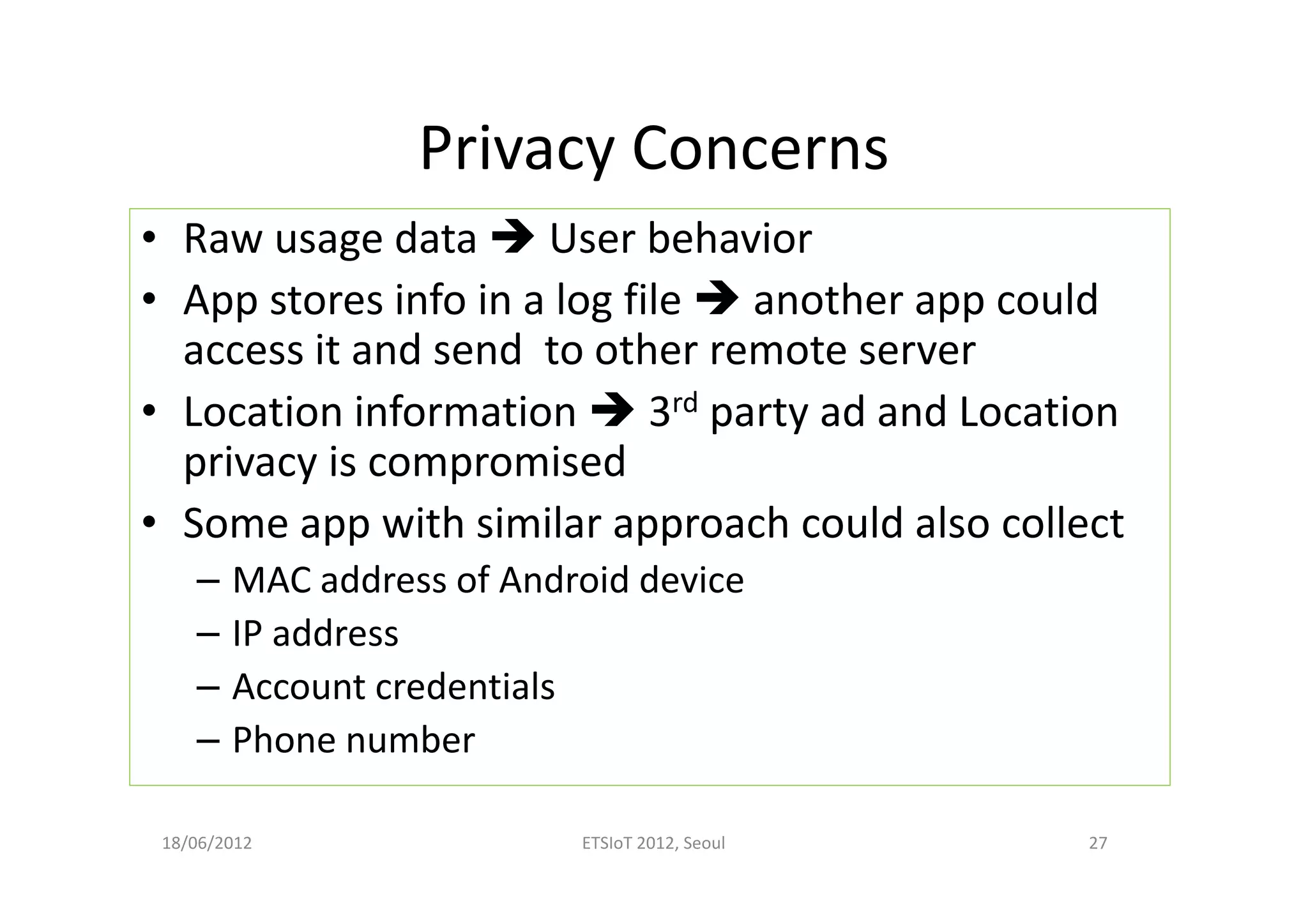
Privacy Concerns
• Today’s smart devices contain user sensitive
information.
• Usage pattern is mutually exclusive.
• Collecting usage logs to interpret usage pattern
raises the issue of privacy.
• Generation of usage pattern must be privacy
aware
18/06/2012 ETSIoT 2012, Seoul 26
Privacy Concerns
• Raw usage data User behavior
• App stores info in a log file another app could
access it and send to other remote server
• Location information 3rd party ad and Location
privacy is compromised
• Some app with similar approach could also collect
– MAC address of Android device
– IP address
– Account credentials
– Phone number
18/06/2012 ETSIoT 2012, Seoul 27
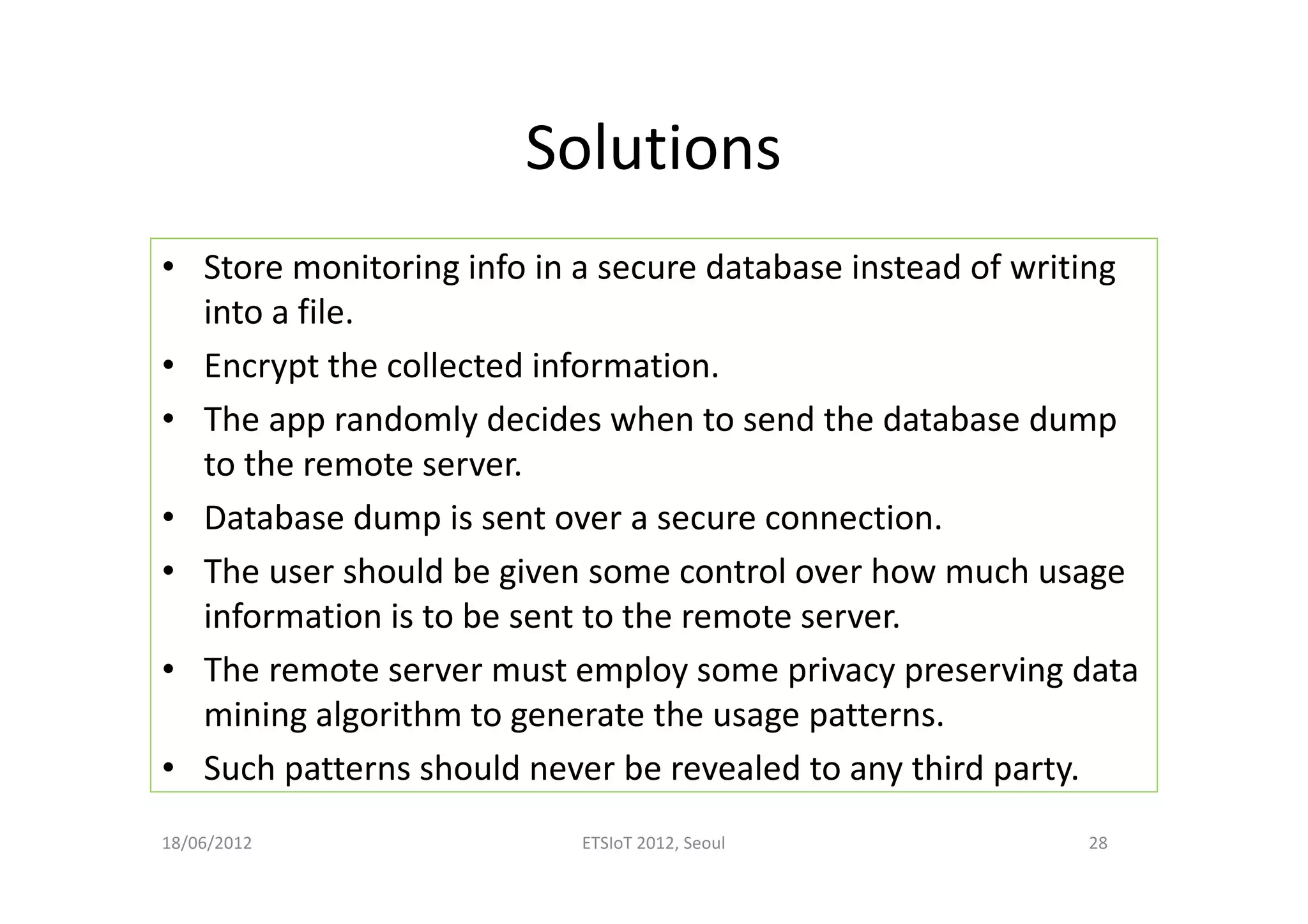
Solutions
• Store monitoring info in a secure database instead of writing
into a file.
• Encrypt the collected information.
• The app randomly decides when to send the database dump
to the remote server.
• Database dump is sent over a secure connection.
• The user should be given some control over how much usage
information is to be sent to the remote server.
• The remote server must employ some privacy preserving data
mining algorithm to generate the usage patterns.
• Such patterns should never be revealed to any third party.
18/06/2012 ETSIoT 2012, Seoul 28
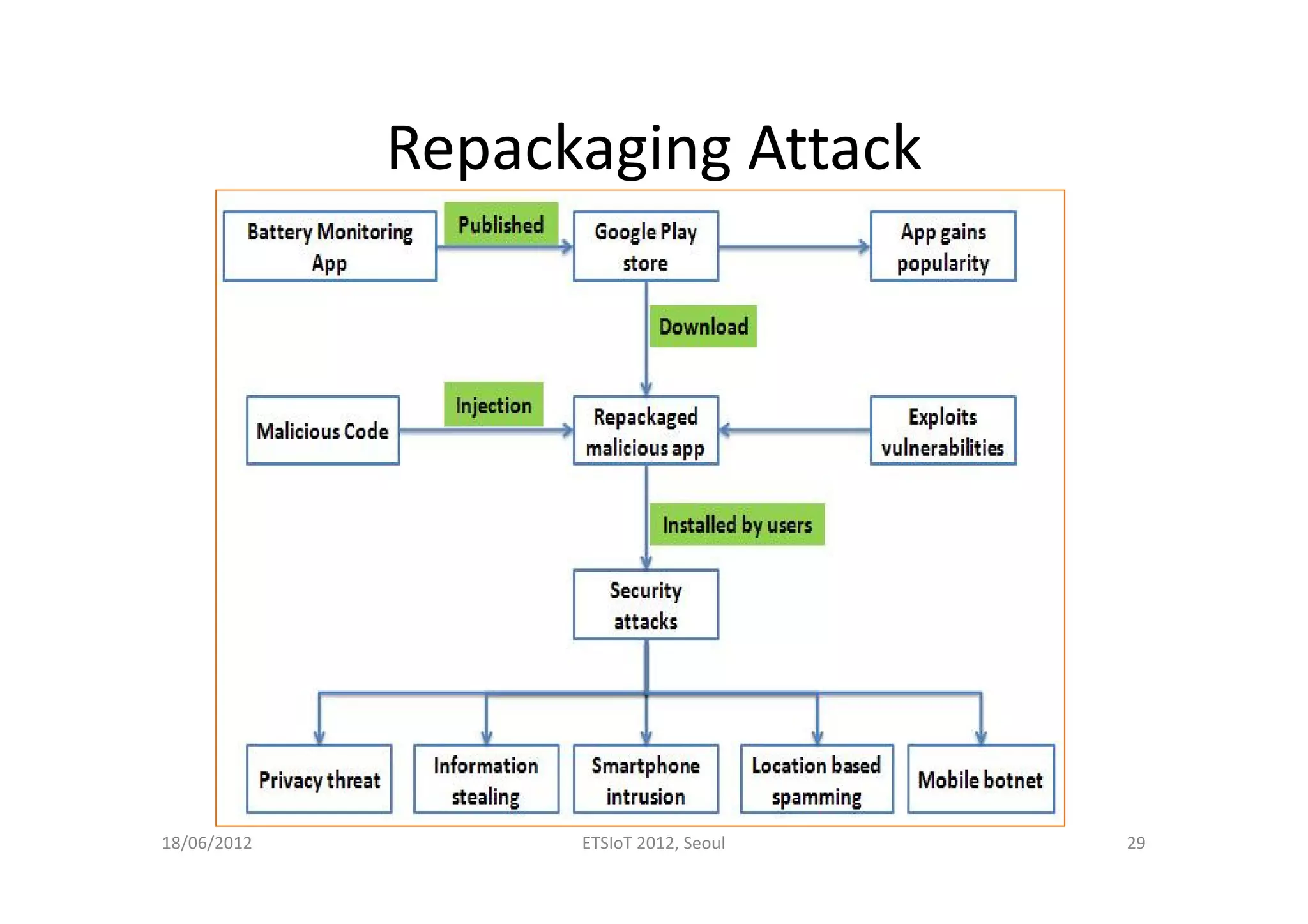
Repackaging Attack
18/06/2012 ETSIoT 2012, Seoul 29
Contents
• Introduction
• Android power management architecture
• Present research on power consumption &
management
• Survey on power saving Android apps
• Future directions
• Privacy & security concerns
• Conclusion
18/06/2012 ETSIoT 2012, Seoul 30
Conclusions
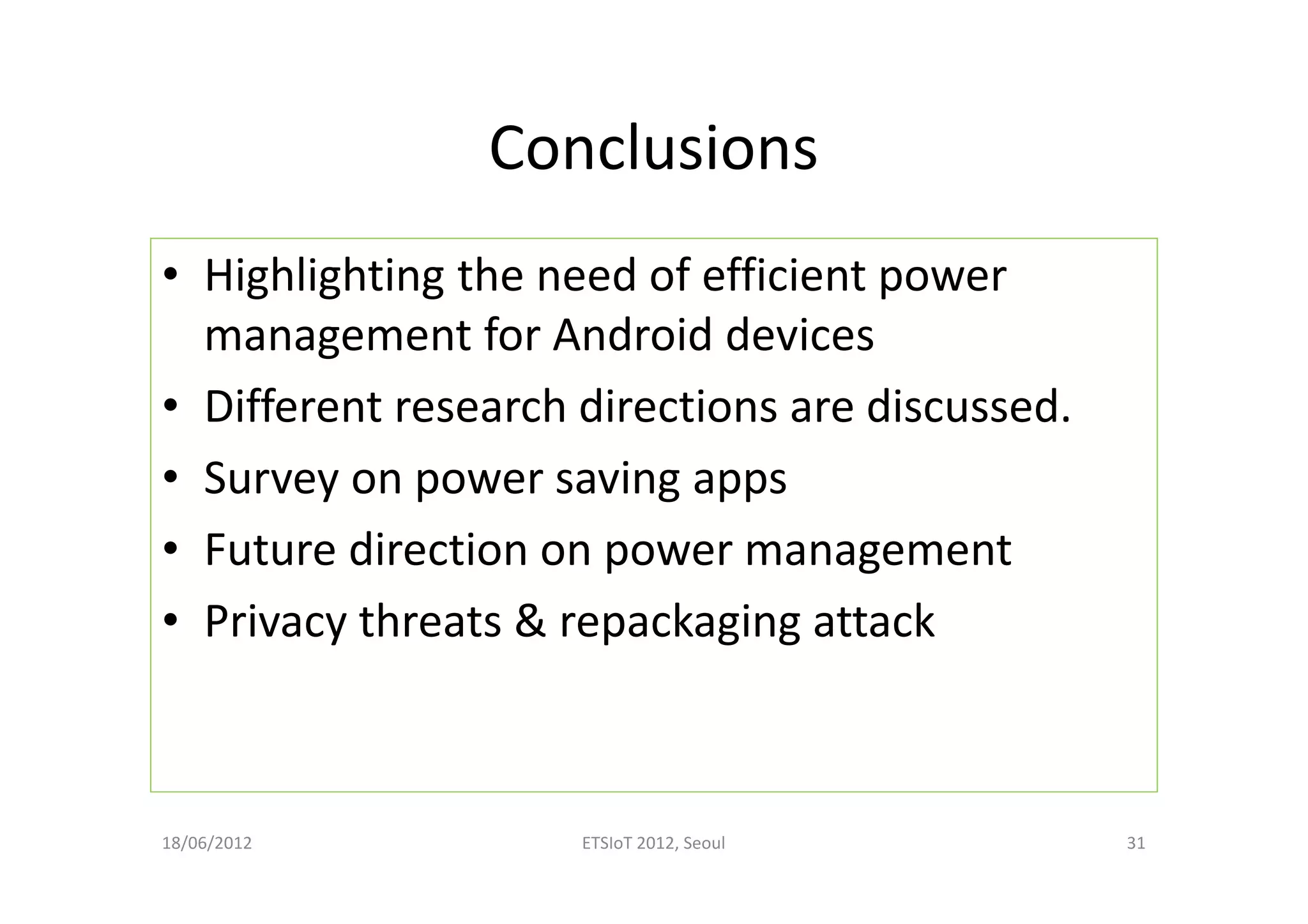
• Highlighting the need of efficient power
management for Android devices
• Different research directions are discussed.
• Survey on power saving apps
• Future direction on power management
• Privacy threats & repackaging attack
18/06/2012 ETSIoT 2012, Seoul 31
Thank you
18/06/2012 ETSIoT 2012, Seoul 32

Android power management, current and future trends

  • 1.
    Android Power Management: Currentand Future Trends Soumya Kanti Datta Research Engineer EURECOM France
  • 2.
    Projet : «Smart 4G Tablet» LPCIM : Laboratoire de Physique des Interfaces et des Couches Minces
  • 3.
    Contents • Introduction • Androidpower management architecture • Present research on power consumption & management • Survey on power saving Android apps • Future directions • Privacy & security concerns • Conclusion 18/06/2012 ETSIoT 2012, Seoul 3
  • 4.
    Introduction • Smart devicefeatures that consume power – CPU, Wi-Fi, GPS, colorful bright display, 3G, auto sync, Bluetooth etc. – third party advertisements shown in free Android apps • Many power saving apps written – control Wi-Fi, 2G and 3G connections, brightness level, CPU frequency, GPS etc. 18/06/2012 ETSIoT 2012, Seoul 4
  • 5.
    Contents • Introduction • Androidpower management architecture • Present research on power consumption & management • Survey on power saving Android apps • Future directions • Privacy & security concerns • Conclusion 18/06/2012 ETSIoT 2012, Seoul 5
  • 6.
    Android Power Management •Power driver addition to Linux kernel. • Wake Locks – It prevents the system from entering suspend or other low-power states. – Android apps are required to request CPU resources with wake locks. 18/06/2012 ETSIoT 2012, Seoul 6
  • 7.
  • 8.
    Contents • Introduction • Androidpower management architecture • Present research on power consumption & management • Survey on power saving Android apps • Future directions • Privacy & security concerns • Conclusion 18/06/2012 ETSIoT 2012, Seoul 8
  • 9.
    Power consumption ofconnectivity features • Reducing power dissipation in Wi-Fi, 3G/4G, GPS • Location Based Apps (LBA) – Social networking, weather, traffic, ad etc. – Adaptive location sensing framework 18/06/2012 ETSIoT 2012, Seoul 9
  • 10.
    Context Aware PM •Employs several monitoring system to extract contexts (CABMAN) – Location – Battery – Process – Call • Can predict the next charging opportunity 18/06/2012 ETSIoT 2012, Seoul 10
  • 11.
    Power Model Generation •PowerBooter technique & PowerTutor app is introduced in []. • Monitoring & recording battery consumption. • Each hardware element has several states and power consumption depends on the states. • Power consumption is correlated with the hardware elements of the smartphones. 18/06/2012 ETSIoT 2012, Seoul 11
  • 12.
    Other Approaches onPM • Analysis using smartphone usage pattern – An Android app ‘battery logger’ is used to collect usage pattern and send it to a server. • Internal energy consumption of apps • Human Battery Interaction 18/06/2012 ETSIoT 2012, Seoul 12
  • 13.
    Contents • Introduction • Androidpower management architecture • Present research on power consumption & management • Survey on power saving Android apps • Future directions • Privacy & security concerns • Conclusion 18/06/2012 ETSIoT 2012, Seoul 13
  • 14.
    Approach for powersaving Primary Approach Secondary Approach App Example CPU frequency scaling Toggling other features Setcpu, cputuner Control smartphone features CPU frequency optimization Juice defencder, extended control and more 18/06/2012 ETSIoT 2012, Seoul 14
  • 15.
    Increasing power efficiency •Toggle control on Wi-Fi, Bluetooth, GPS, auto sync, airplane mode, auto screen lock, USB mass storage, screen-always-on, torch, 2G, 3G, 4G/Wimax (if present) and mobile data (APN). • Change brightness level of display. • Volume and vibration control. • Alter screen timeout value. • Scheduling – night, weekend, peak. • Setting Wi-Fi timeout. • Setting dark home screen wallpaper for OLED display. 18/06/2012 ETSIoT 2012, Seoul 15
  • 16.
    Root Access Select CPUGovernor Advanced Options Condition Monitor Appropriate Profile System Info Battery Monitor Priorit y Smartphone features are controlled Required for CPU freq. scaling Ondemand Conservativ e interactive Advanced Monitoring Single condition Several conditions Primary focus is CPU freq. scaling Example: setcpu Overall Architecture for CPU frequency scaling approaches 18/06/2012 ETSIoT 2012, Seoul 16
  • 17.
    Condition Monitor Appropriate Profile System Info Battery Monitor Smartphonefeatures are controlled Context Monitor Decision Location Time Battery LevelPhone Idle Triggers 1. Predefined 2. Customized by user Toggle connectivity Keep on some apps CPU freq. scaling is secondary focus Example: Juicedefender Not used for any learning Overall Architecture for Control Smartphone Features Approaches 18/06/2012 ETSIoT 2012, Seoul 17
  • 18.
    Limitations of studiedapps • Static profiling (one customizable profile) – Not customized for specific user • “Controlling” – not intelligent • Requirement for root access – For CPU freq. scaling • No focus on power consumption pattern (except power tutor) • Context information is not used for any learning purpose • Do not focus on learning the power consumption pattern of users. • In-app advertising: waste of energy 18/06/2012 ETSIoT 2012, Seoul 18
  • 19.
    Contents • Introduction • Androidpower management architecture • Present research on power consumption & management • Survey on power saving Android apps • Future directions • Privacy & security concerns • Conclusion 18/06/2012 ETSIoT 2012, Seoul 19
  • 20.
    Apps for PowerManagement • Monitoring subsystem – Extracts several information like location, date & time, battery discharge behavior, apps running [usage pattern] • Controlling subsystem – Control smartphone/tablet features based on usage pattern 18/06/2012 ETSIoT 2012, Seoul 20 • Two types of architectures • Client server • Learning engine
  • 21.
    Overall System Architecture 18/06/2012ETSIoT 2012, Seoul 21 Learning engine Client server Monitoring subsystem Control subsystem
  • 22.
    Advantages of ClientServer Architecture • Generation of smartphone usage pattern • The context in which most power is spent • Clustering similar usage pattern at the server – Derive power saving profiles based on clusters • Evolution of clusters • Network usage pattern – Useful for service providers • But threat to privacy 18/06/2012 ETSIoT 2012, Seoul 22
  • 23.
    Advantages of LearningEngine • Intelligent learning engine • Usage pattern and power saving profile are generated locally • No threat on private data • But network usage pattern could not be known 18/06/2012 ETSIoT 2012, Seoul 23
  • 24.
    Other Avenues • Addinga photovoltaic cell to generate additional power – WYSIPS has introduced this • Adaptive display – Shorten the display screen when battery level falls below a predefined threshold 18/06/2012 ETSIoT 2012, Seoul 24
  • 25.
    Contents • Introduction • Androidpower management architecture • Present research on power consumption & management • Survey on power saving Android apps • Future directions • Privacy & security concerns • Conclusion 18/06/2012 ETSIoT 2012, Seoul 25
  • 26.
    Privacy Concerns • Today’ssmart devices contain user sensitive information. • Usage pattern is mutually exclusive. • Collecting usage logs to interpret usage pattern raises the issue of privacy. • Generation of usage pattern must be privacy aware 18/06/2012 ETSIoT 2012, Seoul 26
  • 27.
    Privacy Concerns • Rawusage data User behavior • App stores info in a log file another app could access it and send to other remote server • Location information 3rd party ad and Location privacy is compromised • Some app with similar approach could also collect – MAC address of Android device – IP address – Account credentials – Phone number 18/06/2012 ETSIoT 2012, Seoul 27
  • 28.
    Solutions • Store monitoringinfo in a secure database instead of writing into a file. • Encrypt the collected information. • The app randomly decides when to send the database dump to the remote server. • Database dump is sent over a secure connection. • The user should be given some control over how much usage information is to be sent to the remote server. • The remote server must employ some privacy preserving data mining algorithm to generate the usage patterns. • Such patterns should never be revealed to any third party. 18/06/2012 ETSIoT 2012, Seoul 28
  • 29.
  • 30.
    Contents • Introduction • Androidpower management architecture • Present research on power consumption & management • Survey on power saving Android apps • Future directions • Privacy & security concerns • Conclusion 18/06/2012 ETSIoT 2012, Seoul 30
  • 31.
    Conclusions • Highlighting theneed of efficient power management for Android devices • Different research directions are discussed. • Survey on power saving apps • Future direction on power management • Privacy threats & repackaging attack 18/06/2012 ETSIoT 2012, Seoul 31
  • 32.