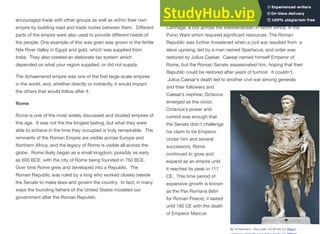
Ancient
World
History
Thomas Hinken, David Soderquist, Amy Striegle, Lisa
Voss, Eric Wrzesinski, Steve Zigray
MI OPEN BOOK PROJECT
i
Attribution-NonCommercial-ShareAlike CC BY-NC-SA
This is version 1.1.4 of this resource, released in August 2018.
Information on the latest version and updates are available on the
project homepage: http://textbooks.wmisd.org/dashboard.html
The text of this book is licensed under a Creative Commons
NonCommercial-ShareAlike (CC-BY-NC-SA) license as part of
Michigan’s participation in the national #GoOpen movement.
The Michigan Open Book
Project
Project Manager: Dave Johnson,
Wexford-Missaukee Intermediate School
District
7th Grade Team Editor - David Klemm,
Muskegon Area Intermediate School Dis-
trict
Authors
Tom Hinken, Montague Area Public
Schools
David Soderquist, Three Rivers Public
Schools
Amy Striegle, Hamilton Community
Schools
Lisa Voss, Holland Public Schools
Eric Wrzesinski, Pewamo-Westphalia
About the Authors - Ancient World History
David Soderquist
Three Rivers Public Schools
Three Rivers Middle School
For the Past 11 years David has taught 6-8 grade Social Studies for Three Rivers
Middle School. He serves as Department Head, School Improvement Member and
Social Studies Rep for his area. Over the past few years he has completed his Mas-
ters Degree in Curriculum and Instruction and become a state recognized Instruc-
tional Coach.
Tom Hinken
Montague Area Public Schools
Nellie B Chisholm Middle School
Tom teaches world geography and history at NBC Middle School in Montague. A graduate
of the Defense Language Institute, Tom served as an Arabic Linguist in the U.S Air Force be-
fore receiving both bachelors and masters degrees from Grand Valley State University. He is
currently pursuing Masters in Education Technolofy from MSU. Along with teaching Tom is
also the advisor for the NBC Robotic club and the student leadership organization. When
away from school Tom and his wife Kristin love to travel and spend time outdoors; biking, hik-
Amy Striegle
Hamilton Community Schools
Hamilton Middle School
Amy has been teaching 7th grade Social Studies and Economics at Hamilton Middle
School for 17 years. She has a BA in Geography/ Social Studies and a Masters Degree in
Middle School Education both from Western Michigan University. She is also a PASST as-
sessment participant and the Social Studies Department Chair. When not in the class-
room she enjoys traveling with her husband Dan.
Lisa Voss
Holland Public Schools
East K-7
Lisa Voss has been teaching at Holland’s East K-7 since 1993 working with students in
grades 5-8. She enjoys teaching adolescents to be global thinkers in her geography and
world studies classes. Teaching in Holland has been fulfilling and challenging in so many
ways for Mrs. Voss. She studied education and trained at Michigan State University and
then earned her masters degree at Grand Valley State University. She starting teaching
elementary social studies content and methods to aspiring teachers for Hope College’s
Education Department in 2010. Lisa and her husband Jon have four sons and they live in
Zeeland.
Eric Wrzesinski
Pewamo-Westphalia Community Schools
Pewamo-Westphalia Middle/High School
Eric is a social studies teacher at Pewamo-Westphalia Middle/High School where he
teaches 7th grade world history, 8th grade U.S. history, and AP U.S. History. He also
serves as social studies department head, was a TRIG coach, worked on the schools stra-
tegic plan, and is a member of the school improvement team. He graduated with an un-
dergraduate degree from Central Michigan University and grew up near Lansing, MI. He
currently resides in Portland, MI with his beautiful wife who he enjoys travelling and spend-
ing time with.
Steve Zigray
Concord Community Schools
Concord Middle School
Steve Zigray is a 6th grade teacher. He holds a Bachelor’s Degree from Central
Michigan University and a Masters Degree in K-12 Administration from Eastern
Michigan University. Honors Steve has been awarded are the 2001 Junior Achieve-
ment Educator of the Year and he was nominated for Jackson Magazine’s, Educa-
tor of the year in 2014. He has also coached high school and middle school
sports, worked on various school improvement committees, wrote the 6th grade
Common Assessment tests for Jackson County ISD and is an active member in
the community as well as the PTO. He lives in southeast Jackson County with his
The Michigan Open Book Project
Team would like to thank the
following individuals for their help
in reviewing some content in the
book and guiding the development
process.
Eric Hemenway - Director of
Repatriation, Archives and
Records, Little Traverse Bay Bands
of Odawa Indians
Jim Cameron, Michigan
Department of Education
David Klemm
Editor
Muskegon Area Intermediate School District
David Klemm is the Social Studies and Special Projects Consultant for the Muskegon Area Interme-
diate School District (MAISD), serving 12 local school districts and numerous charters and private
schools. While spending most of his time with the Social Sciences, he also works with Art, Music,
World Language and Physical Education teachers. He has successfully directed two Teaching
American History grants, coordinated We the People and Project Citizen programs, developed com-
panion materials for the award-winning film documenting African-American migration to the Muske-
gon area, “Up from the Bottoms: The Search for the American Dream,” worked with community
development partners including the Michigan Humanities Council’s Prime Time Family Reading Pro-
gram, made numerous state and national presentations and worked with individual schools and
teachers on curriculum, instruction and assessment. Mr. Klemm is a charter member of the Board
of Directors of the Muskegon Center for Holocaust and Genocide Studies and currently serves on
the National Council for the Social Studies Board of Directors. Prior to his current position at the
Muskegon Area ISD, Mr. Klemm taught high school U. S. History for 15 years and served 3 years as
David A. Johnson
Project Manager
Michigan Open Book Project
Dave began his career teaching 8th grade United States History in Mesick, Michigan. After
almost a decade in the classroom, he took a job at Wexford-Missaukee Intermediate School
District (WMISD) as an Instructional Consultant for Social Studies. He is shared across 11
ISDs in Northern Michigan that form the Northern Michigan Learning Consortium. He com-
pleted his Masters in Educational Leadership through Central Michigan University in 2011
and is Co-Project Director of the Performance Assessments of Social Studies Thinking
(PASST) Project in addition to his duties as the Project Manager for MI Open Book.
Chapter 1
Why do we study
history?
1. How do we learn about the past?
2. How would you describe temporal thinking? Provide a
scenario or specific event to illustrate.
3. What steps and tools do historians use to do their job?
4. How do historians know and construct theories,
perspectives, theories, hypotheses, and accounts about the past?
5. ….and use it to support their claims?
6. How do historians collect and analyze evidence?
7. How and why are these historical claims controversial?
Section 1
Using A Digital SS Textbook
QUESTIONS TO GUIDE INQUIRY
1. How do we learn about the past?
2. How would you describe temporal
thinking? Provide a scenario or specific
event to illustrate.
3. What steps and tools do historians use to
do their job?
4. How do historians know and construct
theories, perspectives, theories,
hypotheses, and accounts about the past?
5. ….and use it to support their claims?
6. How do historians collect and analyze
evidence?
7. How and why are these historical claims
controversial?
TERMS, PLACES, PEOPLE
widget
The Michigan Open Book Project began in 2014 as part of a grant from the
Michigan Department of Education. Many classrooms were beginning to go
digital, and, in Social Studies in particular, a dusty book on the shelf was the
only resource available.
This book was designed by teachers like your own. People who have taught this
class for years and felt that there was a need for both a digital tool and for
something that was specific to the great state of Michigan! Because of that, this
“book” is different in many different ways:
• It is digital. You may be using this book on a Chrome Book, an iPad, a
Windows computer, your phone...the list of possibilities are endless.
• It is kept current. When our teams finished putting things together, some of the
places we take you may have disappeared. As soon as we discover this, we
take steps to fix it!
• Your teacher can edit it. This represents a resource that a small team of
educators envisioned. Your teacher may want to add things to it, rearrange the
order, or split things up. They’re free to do all of these things.
6
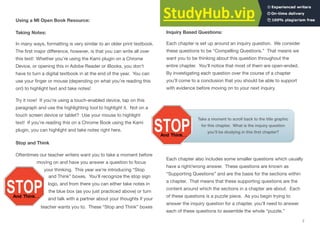
Take a moment to scroll back to the title graphic
for this chapter. What is the inquiry question
you’ll be studying in this first chapter?
Using a MI Open Book Resource:
Taking Notes:
In many ways, formatting is very similar to an older print textbook.
The first major difference, however, is that you can write all over
this text! Whether you’re using the Kami plugin on a Chrome
Device, or opening this in Adobe Reader or iBooks, you don’t
have to turn a digital textbook in at the end of the year. You can
use your finger or mouse (depending on what you’re reading this
on!) to highlight text and take notes!
Try it now! If you’re using a touch-enabled device, tap on this
paragraph and use the highlighting tool to highlight it. Not on a
touch screen device or tablet? Use your mouse to highlight
text! If you’re reading this on a Chrome Book using the Kami
plugin, you can highlight and take notes right here.
Stop and Think
Oftentimes our teacher writers want you to take a moment before
moving on and have you answer a question to focus
teacher wants you to. These “Stop and Think” boxes
your thinking. This year we’re introducing “Stop
and Think” boxes. You’ll recognize the stop sign
logo, and from there you can either take notes in
the blue box (as you just practiced above) or turn
and talk with a partner about your thoughts if your
will appear all throughout the text.
Inquiry Based Questions:
Each chapter is set up around an inquiry question. We consider
these questions to be “Compelling Questions.” That means we
want you to be thinking about this question throughout the
entire chapter. You’ll notice that most of them are open-ended.
By investigating each question over the course of a chapter
you’ll come to a conclusion that you should be able to support
with evidence before moving on to your next inquiry.
Each chapter also includes some smaller questions which usually
have a right/wrong answer. These questions are known as
“Supporting Questions” and are the basis for the sections within
a chapter. That means that these supporting questions are the
content around which the sections in a chapter are about. Each
of these questions is a puzzle piece. As you begin trying to
answer the inquiry question for a chapter, you’ll need to answer
each of these questions to assemble the whole “puzzle.”
7
Terms, Places, and People
Underneath the “Questions to Guide Inquiry” box at the start of
each section is a smaller section called “Terms, Places, and
People.” These are the important vocabulary terms to know, as
well as important places and people who may factor into the
section. This portion of the book is a way for you to keep track of
the words, locations, and people who will make up your study of
a chapter.
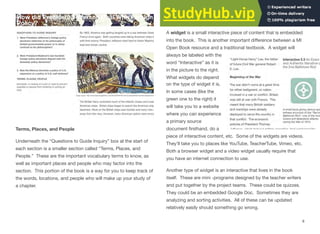
Widgets
A widget is a small interactive piece of content that is embedded
into the book. This is another important difference between a MI
Open Book resource and a traditional textbook. A widget will
always be labeled with the
word “Interactive” as it is
in the picture to the right.
What widgets do depend
on the type of widget it is.
In some cases (like the
green one to the right) it
will take you to a website
where you can experience
a primary source
document firsthand, do a
piece of interactive content, etc. Some of the widgets are videos.
They’ll take you to places like YouTube, TeacherTube, Vimeo, etc.
Both a browser widget and a video widget usually require that
you have an internet connection to use.
Another type of widget is an interactive that lives in the book
itself. These are mini -programs designed by the teacher writers
and put together by the project teams. These could be quizzes.
They could be an embedded Google Doc. Sometimes they are
analyzing and sorting activities. All of these can be updated
relatively easily should something go wrong.
8
Reporting a Problem
We do have a small team working regularly to update content, but
it is probably a given that at some point you’ll come across a
browser widget that has “gone dead.” We have a stockpile of
additional sites available for many of these, and all you have to do
(if you’re on a Chrome or Windows device) is click on the “Page
not working? Broken link?” link at the bottom of a widget page to
report the problem. In iBooks you can use the same form by
returning here and clicking on the widget below. We’ll get things
fixed as quickly as possible.
Interactive 1.1 Bug Report
There are lots of great features in
your MI Open Book - have fun
exploring them all!
If you’re on an Apple device and
come across a problem, have your
teacher return here and report it!
We’ll get it fixed as quickly as
possible!
9
Why Do We Have To Study Social Studies?
Maybe you are the skeptical student who does not enjoy social studies, so you’ve
probably asked, “Why do we have to study it?” Life is full of questions like this
and many students before you have asked this question (and many more after
you will probably, too!). Let’s see if breaking things down to the simple 5W
questions -- “who, what, when, where, and why” can help us understand why we
study this subject in school..
What is Social Studies? Here’s the most common definition: social studies is
Section 2
What Is Social Studies?
…the integrated study of the social sciences and humanities to promote civic
competence. Within the school program, social studies provides coordinated,
systematic study drawing upon such disciplines as anthropology, archaeology,
economics, geography, history, law, philosophy, political science, psychology,
religion, and sociology, as well as appropriate content from the humanities,
mathematics, and natural sciences. The primary purpose of social studies is to help
young people make informed and reasoned decisions for the public good as citizens
of a culturally diverse, democratic society in an interdependent world.
QUESTIONS TO GUIDE INQUIRY
1. How do we learn about the past?
2. How would you describe temporal
thinking? Provide a scenario or specific
event to illustrate.
3. What steps and tools do historians use to
do their job?
4. How do historians know and construct
theories, perspectives, theories,
hypotheses, and accounts about the past?
5. ….and use it to support their claims?
6. How do historians collect and analyze
evidence?
7. How and why are these historical claims
controversial?
TERMS, PLACES, PEOPLE
Social studies
10
So what does that all mean? In a sense, it means social studies
is a collection of disciplines! Notice the definition talks about
studying other things like geography, and history. Integrated
means separate things combined together. That’s what we do in
Social Studies.
• In Michigan, Social Studies is defined as the integrated
study of just four of all of those subjects in our official definition
above: civics (which includes law and political science),
economics, geography, and history. Those are the four we
spend the most time on, though you will see in this book other
topics like religion and archeology are talked about as well.
• This is a World History resource. That means our primary focus
will be history, but it’s not social studies until you integrate those
other subjects. Your teacher will guide you along the way, but in
the end, how you think of the
Interactive 1.2 Why Do We
Study What We Do In
world -- your view of things --
will be up to you. Social Studies?
You can read more about the
topics you have studied and will
study in social studies here.
Social Studies in Michigan
Where does Social Studies take place? This question looks
simple enough, but it has two parts. Where does not just apply to
geography, but it impacts something that social scientists like to
call “Expanding Horizons.” Here is how we define that in
Michigan. You may recall some of those big topics you learned in
past grades.
This concept puts you, the student, in the center as the “me,”
then radiates out to include my school, my neighborhood, my
community, my city, my county, my state, my region, my country,
my continent, my world. How might this look if you drew it in
concentric circles?
11
Of course, geography is a “huge” part of our social studies
classes. Geography is about locations and places, so let’s think
about it like professional geographer Dr. Phil Gersmehl does
when he writes,
“Geography is about understanding the place where we are.
Students (present and future citizens, workers, business leaders,
voters, and elected officials) should learn how people can choose
locations and designs for buildings, roads, parks, workplaces,
election districts, and other things in ways that are appropriate in
their environment, fair to neighbors, safe for children, and
satisfying in other ways that matter to them.”
Geography helps us to organize our thinking about the place we
are, and it helps us to understand other places. Few subjects
taught in schools can be truly understood without some
understanding of geography. Think about the setting of a book,
the effects of a storm, or the potential for a snow day in your area.
All of these topics are better understood with geography.
As we study the history of the world, we will need a more global
understanding of “conditions in other places and our connections
with those places. Students (present and future citizens of the
world) should learn about the land, climate, economy, politics,
and culture of other places. That knowledge will help them deal
with an increasingly interconnected and often highly competitive
world.” What better way to be prepared for the challenges you’ll
face than to be armed with logical information and facts.
Social Studies class is also about getting students like you to
think big, to care about the common good, and participate in
public life. You have probably been told that before and thought
about it in terms of your school or community or even your state.
You are a global citizen, too. Our lives have challenges. Some of
them are ours alone, but others are held in common with other
people around the world. Solving these problems will help us and
also our diverse nation and interdependent world.
Who is Social Studies about? There are two answers to that
question, and the most important one is you, the learner. “Who” is
also the people that lived through and were impacted by the
event. The choices people made in the past have an impact on
your life, even if you don’t know it. That impact might not be
completely determined. You can’t change the past, but you often
have choices about how it impacts your life. Getting to know the
people of the past can often help you with decisions. Sometimes
you might feel a real connection with someone from the past; you
“get” them. Other times, you might greatly differ from the people
that you are studying. They all determined the world you live in
today and the choices you will have to make. Understanding this
connection makes things clearer.
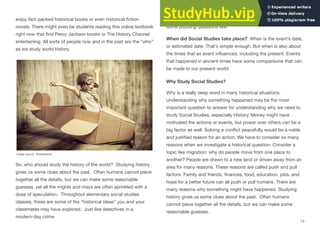
And some people find it fun! The “who” can also be people like
the archaeologists, historians, researchers, and curious kids that
12
enjoy fact-packed historical books or even historical fiction
novels. There might even be students reading this online textbook
right now that find Percy Jackson books or The History Channel
entertaining. All sorts of people now and in the past are the ”who”
as we study world history.
Image source: Shutterstock
So, who should study the history of the world? Studying history
gives us some clues about the past. Often humans cannot piece
together all the details, but we can make some reasonable
guesses, yet all the mights and mays are often sprinkled with a
dose of speculation. Throughout elementary social studies
classes, these are some of the “historical ideas” you and your
classmates may have explored. Just like detectives in a
modern-day crime
investigation, we can piece together evidence and try to answer
some puzzling questions like:
When did Social Studies take place? When is the event’s date,
or estimated date. That’s simple enough. But when is also about
the times that an event influenced, including the present. Events
that happened in ancient times have some comparisons that can
be made to our present world.
Why Study Social Studies?
Why is a really deep word in many historical situations.
Understanding why something happened may be the most
important question to answer for understanding why we need to
study Social Studies, especially History. Money might have
motivated the actions or events, but power over others can be a
big factor as well. Solving a conflict peacefully would be a noble
and justified reason for an action. We have to consider so many
reasons when we investigate a historical question. Consider a
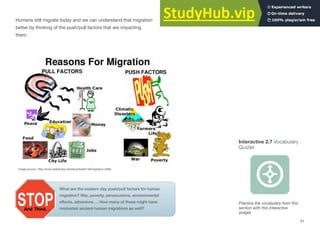
topic like migration: why do people move from one place to
another? People are drawn to a new land or driven away from an
area for many reasons. These reasons are called push and pull
factors. Family and friends, finances, food, education, jobs, and
hope for a better future can all push or pull humans. There are
many reasons why something might have happened. Studying
history gives us some clues about the past. Often humans
cannot piece together all the details, but we can make some
reasonable guesses.
13
Why Study World History?
Why study world history? We know much about the “now,” or
time that we currently live in, but how did things get to be the way
they are? What ideas led us to here? These are why questions
about ourselves and our own lives that history can help us
answer. Throughout elementary social studies classes, these are
some of the “historical ideas” you and your classmates may have
explored. We can speculate about the past. And in doing so,
we learn about ourselves.
In all of our thinking about the “W” questions, “Who, What,
Where, When, and Why” you saw a connection between
ourselves and social studies and the people and events of the
past. It impacts our lives. You saw that we will have to make
some sense out of it and some choices about it. So what do you
think? How might understanding social studies help you
understand and make choices in your own life?
14
Section 3
Studying History
QUESTIONS TO GUIDE INQUIRY
1. How do we learn about the past?
2. How would you describe temporal
thinking? Provide a scenario or specific
event to illustrate.
3. What steps and tools do historians use to
do their job?
4. How do historians know and construct
theories, perspectives, theories,
hypotheses, and accounts about the past?
5. ….and use it to support their claims?
6. How do historians collect and analyze
evidence?
7. How and why are these historical claims
controversial?
TERMS, PLACES, PEOPLE
primary source
secondary source
Let’s look at a different “why” question. This social Interactive 1.3 The History
of the World in 7 Minutes.
studies book is specifically about World History and
the key question about events in the past is, why:
Why did this happen?
As you watch this video what
questions surface?
What questions do you come up with as you watch the
embedded video “The History of the World in 7
Minutes?”
Ultimately, why something happened in the past is the question that history is all
about. And here’s the fun part (or the hard part!). It’s up to you to answer the why
question. You will read about many things that happened in the past and some
reasons why people think they happened. People who look at the same facts
sometimes come to different conclusions. Answering the other “W” questions will
15
help you answer the question, why: Why did this happen?
Answering Why -- that’s what thinking like a historian is about.
Here is a chart that might help someone make sense of some
social studies questions that may have been asked throughout
your many years of schooling.
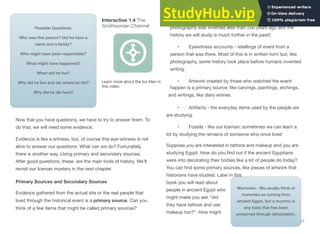
What questions might you ask to solve the mystery
of the Iceman Mummy?
Let’s put some of what we’ve learned about asking good
questions and historical thinking to work. Look at this photo of a
man found preserved in a glacier -- huge piece of ice -- on the
border between Italy and Austria in the mountains. This mummy
was discovered in 1991, but he lived long ago. We’ve answered
one question: “where was he found?” But there are other where
questions such as “where was he going” and “where did he
come from?”
16
17
Interactive 1.4 The
Smithsonian Channel
Possible Questions:
Who was this person? Did he have a
name and a family?
Who might have been responsible?
What might have happened?
When did he live?
Why did he live and die where he did?
Why did he die here?
Learn more about the Ice Man in
this video.
Now that you have questions, we have to try to answer them. To
do that, we will need some evidence.
Evidence is like a witness, but, of course this eye-witness is not
alive to answer our questions. What can we do? Fortunately,
there is another way. Using primary and secondary sources.
After good questions, these are the main tools of history. We’ll
revisit our Iceman mystery in the next chapter.
Primary Sources and Secondary Sources
Evidence gathered from the actual site or the real people that
lived through the historical event is a primary source. Can you
think of a few items that might be called primary sources?
• Photographs (they won’t be much help for us because
photography was invented less than 200 years ago and the
history we will study is much further in the past!)
• Eyewitness accounts - retellings of event from a
person that was there. Most of this is in written form but, like
photography, some history took place before humans invented
writing.
• Artwork created by those who watched the event
happen is a primary source; like carvings, paintings, etchings,
and writings, like diary entries.
• Artifacts - the everyday items used by the people we
are studying.
• Fossils - like our Iceman; sometimes we can learn a
lot by studying the remains of someone who once lived
Suppose you are interested in tattoos and makeup and you are
studying Egypt. How do you find out if the ancient Egyptians
were into decorating their bodies like a lot of people do today?
You can find some primary sources, like pieces of artwork that
historians have studied. Later in this
book you will read about
Mummies - We usually think of
mummies as coming from
ancient Egypt, but a mummy is
any body that has been
people in ancient Egypt who
might make you ask “did
they have tattoos and use
makeup too?” How might preserved through dehydration.
you find out if ancient Egyptians were into decorating their
bodies like a lot of people do today?
This is the kind of detective work that can make history fun!
Historians have been detectives for generations. They help us to
understand the mysteries of history. Like detectives at a crime
scene, historians can bring differing opinions and perspectives to
their theories. Data and evidence can lead historians to other
ideas that they can consider. They can then test these ideas out
with other information that has been collected about an event, a
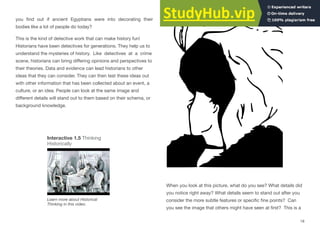
culture, or an idea. People can look at the same image and
different details will stand out to them based on their schema, or
background knowledge.
Interactive 1.5 Thinking
Historically
Learn more about Historical
Thinking in this video.
When you look at this picture, what do you see? What details did
you notice right away? What details seem to stand out after you
consider the more subtle features or specific fine points? Can
you see the image that others might have seen at first? This is a
18
simple optical illusion, but it can help us understand that history is
more than finding the right answer. Because of perspective,
different historians often come to different conclusions even
though they are looking at the same evidence.
Secondary sources are details recorded after an event occurs,
and these documents are recorded by someone who was not
actually at the event. An article written by a newspaper reporter is
a secondary source. A retelling of a story is a secondhand
account, so that also makes that retelling a secondary source. In
terms of world history, artifacts and written records from the
people being studied are primary sources but the interpretation of
them are secondary sources. That includes this resource you are
using.
Interactive 1.6 Primary/
Secondary Source Quiz
Sort each light orange piece into
the proper category (indicating
whether it is a primary or
secondary source).
19
Section 4
How to Think Like a Historian
QUESTIONS TO GUIDE INQUIRY
1. How do we learn about the past?
2. How would you describe temporal
thinking? Provide a scenario or specific
event to illustrate.
3. What steps and tools do historians use to
do their job?
4. How do historians know and construct
theories, perspectives, theories,
hypotheses, and accounts about the past?
5. ….and use it to support their claims?
6. How do historians collect and analyze
evidence?
7. How and why are these historical claims
controversial?
TERMS, PLACES, PEOPLE
historical thinking
Studying history, especially ancient history, will often require making decisions
based on limited evidence. You would like to have more; you might not get it so
you have to make your argument about what happened in the past based on what
you have. Then, new evidence is discovered. Sometimes that will help you fill in a
few details about your picture of the past; other times, the new evidence will
make you rethink your original picture of the past and start over.
Interactive 1.7 Puzzling Pieces of the Past
This activity is part of an in-class activity where your teacher will break you into one of five
groups. Each group will follow the same set of instructions but hold different puzzle pieces.
20
Imagine you have a puzzle. It’s over 100 pieces, but you only
have ten of the pieces. Based on those ten, you have to describe
what the entire picture made by the puzzle looks like -- in detail!
Of course, you and a classmate doing the same thing might have
come to a different conclusion about what that picture looks like.
This is what studying ancient history is like. We have limited
pieces to the puzzle and different people are going to come to
different conclusions about what happened and why it happened.
You need to be able to explain why you think the picture looks the
way it does based on the limited evidence you have.
Now, imagine you find ten more pieces to the puzzle. What might
happen? Some of the new pieces might confirm some of your
original ideas and help you add more detail. Some pieces might
make you change your mind. You thought the whole picture was
one thing, but new puzzle pieces show that your first idea was
wrong and needs to be changed or modified. You had to change
your original idea because it just didn’t work with new evidence.
This is what historians do all the time. Historians build an
argument based on the evidence they have. New evidence
discovered later, however, may force them to change their
original argument. History requires you to be flexible because
new evidence might change your original understanding of the
past.
How to Read/Research/Investigate Like an Historian?
To build the most accurate picture of the past based on the
evidence you have requires thinking like a historian and asking
good questions about the pieces of evidence you have.
Some of the questions to ask about artifacts -- unwritten
information-- are:
• When was it made?
• Who made it?
• What was it used for?
• Does this confirm, modify or force me to change my
current understanding of the past?
Some of the questions to ask of a document -- a written
source-- are:
• Who is the author?
• What is this author’s background?
• What is the purpose of this document?
• What might be going on that I am not seeing from this
source?
21
• What questions do I have for this author or artist?
What do I still want to know?
• What is happening in society at this time from an
economic/social/political perspective?
• Are there other documents from different perspectives
that I should consider?
• Does this confirm, modify, or force me to change my
current understanding of the past?
There are tools used by a historian: questions, argument building
based on evidence, and a willingness to change based on new
evidence. Multiple sources bring about many different
perspectives.
Watch this video to understand historical thinking and how to use
primary sources better.
Interactive 1.8 Think
Historically
Watch this video to understand
historical thinking and how to use
primary sources better.
22
Section 5
Setting the Stage For World History
QUESTIONS TO GUIDE INQUIRY
1. How do we learn about the past?
2. How would you describe temporal
thinking? Provide a scenario or specific
event to illustrate.
3. What steps and tools do historians use to
do their job?
4. How do historians know and construct
theories, perspectives, theories,
hypotheses, and accounts about the past?
5. ….and use it to support their claims?
6. How do historians collect and analyze
evidence?
7. How and why are these historical claims
controversial?
TERMS, PLACES, PEOPLE
GeoHistogram
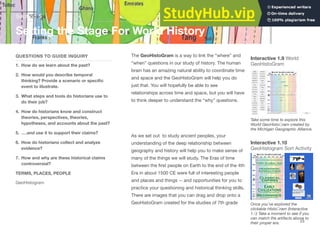
The GeoHistoGram is a way to link the “where” and
“when” questions in our study of history. The human
brain has an amazing natural ability to coordinate time
and space and the GeoHistoGram will help you do
just that. You will hopefully be able to see
relationships across time and space, but you will have
to think deeper to understand the “why” questions.
As we set out to study ancient peoples, your
understanding of the deep relationship between
geography and history will help you to make sense of
many of the things we will study. The Eras of time
between the first people on Earth to the end of the 4th
Era in about 1500 CE were full of interesting people
and places and things -- and opportunities for you to
practice your questioning and historical thinking skills.
There are images that you can drag and drop onto a
GeoHistoGram created for the studies of 7th grade
Interactive 1.9 World
GeoHistoGram
Take some time to explore this
World GeoHistoGram created by
the Michigan Geographic Alliance.
Interactive 1.10
GeoHistogram Sort Activity
Once you’ve explored the
clickable HistoGram (Interactive
1.9) Take a moment to see if you
can match the artifacts above to
23
their proper era.
Ancient World History. Use your questioning and historical
thinking skills to locate where and when each image belongs on
the diagram. Don’t worry if you get some of them wrong -- you’re
just getting started!
Another resource you could explore is the site GeaCron. It is a
world history atlas with timelines since 3000 BCE.
You’ll become familiar with the GeoHistoGram and other
websites like GeaCron as you begin your study of the ancient
world in the next chapter.
Now that you’ve finished this chapter, take a stab at
answering the chapter inquiry question: Why do we
study history?
Interactive 1.11 GeaCron
Before beginning the next chapter,
spend some time exploring the
GeaCron website.
24
Chapter 2
What Factors and
Conditions Are Most
Significant for Creating
Times of Innovation and
Growth?
1. Why might humans want to move from an area?
2. What might attract people to a new place?
3. Why did humans start migrating out of Africa about 100,000
years ago?
4. What is meant by Paleolithic and Neolithic ways of life?
5. How have Paleolithic and Neolithic patterns of life differed
between the people of Africa Western Europe, Asia, and North
America?
6. What benefits did early human farmers gain over hunter/
gatherers?
7. How did the natural environment affect the places early human
farmers chose to live?
8. What was the relationship between stable food supplies and the
development of settlements?
Section 1
Early Migrations
QUESTIONS TO GUIDE INQUIRY
1. Why might humans want to move from an area?
2. What might attract people to a new place?
3. Why did humans start migrating out of Africa about
100,000 years ago?
4. What is meant by Paleolithic and Neolithic ways of life?
5. How have Paleolithic and Neolithic patterns of life
differed between the people of Africa Western Europe,
Asia, and North America?
6. What benefits did early human farmers gain over hunter/
gatherers?
7. How did the natural environment affect the places early
human farmers chose to live?
8. What was the relationship between stable food supplies
and the development of settlements?
TERMS, PLACES, PEOPLE:
timeline
prehistory
fossils
migration
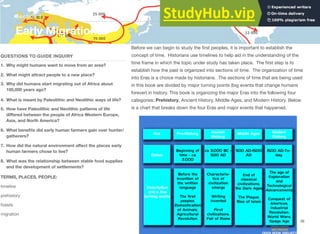
Before we can begin to study the first peoples, it is important to establish the
concept of time. Historians use timelines to help aid in the understanding of the
time frame in which the topic under study has taken place. The first step is to
establish how the past is organized into sections of time. The organization of time
into Eras is a choice made by historians. The sections of time that are being used
in this book are divided by major turning points (big events that change humans
forever) in history. This book is organizing the major Eras into the following four
categories: Prehistory, Ancient History, Middle Ages, and Modern History. Below
is a chart that breaks down the four Eras and major events that happened.
26
We use timelines to help keep things in chronological order.
Timelines are a visual to help us "see" history so we can figure
out how long ago an event happened, make connections
between events, and make comparisons between events.
Remember, how we organize time is a choice and even our
calendar reflects a choice; one made nearly 450 years ago. The
Gregorian calendar is used in much of the Western world and is
based on the Christian religion. In other places around the world,
calendars are written and time is measured differently.
It is important for you to know that the labels used on our
timelines are based on the Western Calendar.
Interactive 2.1 A Variety of Interactive 2.2 Interactive
Calendars Timeline
You can read much more about
different calendars here: http://
www.webexhibits.org/calendars/
calendar.html
Use the pieces on this chart to
create a timeline. Note: This
calendar has no year Zero and,
though that non-existant year
represents the turning point in our
timeline, it is not in the middle;
there were many more years of
history before it, than after it (so
far!)
Remember, history is like solving a mystery; and when you
learn new information, you need to make changes to your
thinking. That has happened with the calendar, too. More
recent investigation would indicate that the
Interactive 2.3 Calendar
birth of Christ actually took place
Miscalculation
several years earlier than our calendar
would indicate. Even the leading
Christian scholars think the Christian
calendar is slightly off. Don’t worry; no
one will be changing the timeline. If
they did, you would have to change
your birthdate!
How do we know?
Now that you have a handle on how to
read time the era this unit is going to
examine is Prehistory. This is a time of no written records which
makes it really difficult to determine exactly what life was like
then. The evidence that is used by scientists,
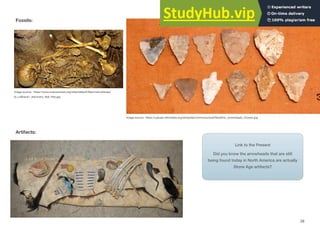
anthropologists, and historians are fossils and artifacts that have
been discovered throughout the world. As you may recall from
chapter 1, fossils are the remains of living things (plants, animals,
people). Artifacts are the remains of things that were made, not
the remains of living things. The weapons and tools left behind
by a human are considered artifacts, while the bones of that
human would be considered fossils.
Read more here: http://
abcnews.go.com/blogs/headlines/
2012/11/pope-says-christian-
calendar-based-on-
miscalculation/
27
Fossils:
Image source: https://www.sciencenews.org/sites/default/files/main/articles/
ts_LaBrana1_discovery_feat_free.jpg
Image source: https://upload.wikimedia.org/wikipedia/commons/a/a5/Neolithic_arrowheads_Chariez.jpg
Artifacts:
Link to the Present
Did you know the arrowheads that are still
being found today in North America are actually
Stone Age artifacts?
28
Prehistory is popularly referred to as the Stone Age because early
humans used stone tools. Evidence suggests that these first
humans hunted and gathered their food, lived in small groups,
lived in shelters, and used materials found in the environment.
The oldest human fossils have been found in East Africa
suggesting that this is where the first humans lived. Why did
these first humans leave Africa?
Prehistoric and Ancient Migration
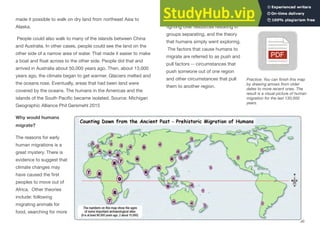
Using geological evidence, fossils, and artifacts, many scientists
believe that the earliest humans lived in Africa. From there
humans eventually started moving out or migrating. Human
migration is the movement by people from one place to another
with the intentions of settling temporarily or permanently in the
new location. About a hundred thousand years ago, humans
started to move from Africa to other parts of the world. It did not
take long to go from East Africa to nearby places like West Africa
or Southwest Asia (see map on the next page) From there, they
could go on to Southern Europe or Central Asia. It took longer to
get to Northern Europe, East Asia, and Australia. It took the
longest time to get to South America. People first had to cross
from Asia to Alaska. Then they had to travel south through the
entire length of both North and South America.
These are long distances, and it took a thousands of years and
many generations of people. Migration was relatively easy in
some places and hard in others. For example, moving through
grasslands or open forests is fairly easy. Travel is slower through
dense forests. High mountains are hard to climb and can be very
cold. Large deserts and oceans would be an even bigger
problem. It is possible to walk from
Africa all the way across Asia.
Unfortunately, Asia is separated from
Australia and the Americas by huge
bodies of water. Here, the story of
human migration was aided by another
fact -- climate change.
Today, the earth is fairly warm. There
are only two large sheets of ice. One of
these is on Greenland. The other is on
Antarctica. Hundreds of high
mountains have small glaciers on
them. These do not add up to even a
small fraction of the Greenland or
Antarctic icecaps. Thousands of years
ago, the climate was much colder. Ice
sheets covered large parts of North
America and Eurasia. The earth has a
limited amount of water and with much
more of it in the form of huge ice
sheets, there was less in the ocean.
As a result, the water level was
hundreds of feet lower than today. This
Interactive 2.4 Ice Sheets
For more information on Ice
Sheets visit: http://whyfiles.org/
2014/melting-antarctic-ice-rising-
seas-what-can-we-expect/
Interactive 2.5 Land Bridge
Theory
Watch this short video to see this
in action: https://
www.youtube.com/watch?
v=Ziw_SmFKf_g
29
made it possible to walk on dry land from northeast Asia to
Alaska.
People could also walk to many of the islands between China
and Australia. In other cases, people could see the land on the
other side of a narrow area of water. That made it easier to make
a boat and float across to the other side. People did that and
arrived in Australia about 50,000 years ago. Then, about 13,000
years ago, the climate began to get warmer. Glaciers melted and
the oceans rose. Eventually, areas that had been land were
covered by the oceans. The humans in the Americas and the
islands of the South Pacific became isolated. Source: Michigan
Geographic Alliance Phil Gersmehl 2015
Why would humans
migrate?
The reasons for early
human migrations is a
great mystery. There is
evidence to suggest that
climate changes may
have caused the first
peoples to move out of
Africa. Other theories
include: following
migrating animals for
food, searching for more
Interactive 2.6
resources (food, water, shelter),
fighting over resources resulting in
groups separating, and the theory
that humans simply went exploring.
The factors that cause humans to
migrate are referred to as push and
pull factors -- circumstances that
push someone out of one region
and other circumstances that pull
them to another region.
Practice: You can finish this map
by drawing arrows from older
dates to more recent ones. The
result is a visual picture of human
migration for the last 130,000
years.
30
Humans still migrate today and we can understand that migration
better by thinking of the push/pull factors that are impacting
them.
Interactive 2.7 Vocabulary
Quizlet
Image source: http://www.slideshare.net/stevenheath148/migration-2008
Practice the vocabulary from this
section with this interactive
widget.
What are the modern day push/pull factors for human
migration? War, poverty, persecutions, environmental
effects, adventure…. How many of these might have
motivated ancient human migrations as well?
31
Section 2
What Do Archaeologists Know and How do they
Know It?
QUESTIONS TO GUIDE INQUIRY
1. Why might humans want to move from an
area?
2. What might attract people to a new place?
3. Why did humans start migrating out of
Africa about 100,000 years ago?
4. What is meant by Paleolithic and Neolithic
ways of life?
5. How have Paleolithic and Neolithic patterns
of life differed between the people of Africa
Western Europe, Asia, and North America?
6. What benefits did early human farmers gain
over hunter/gatherers?
7. How did the natural environment affect the
places early human farmers chose to live?
8. What was the relationship between stable
food supplies and the development of
settlements?
TERMS, PLACES, PEOPLE:
artifacts
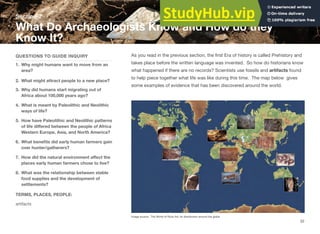
As you read in the previous section, the first Era of history is called Prehistory and
takes place before the written language was invented. So how do historians know
what happened if there are no records? Scientists use fossils and artifacts found
to help piece together what life was like during this time. The map below gives
some examples of evidence that has been discovered around the world.
Image source: The World of Rock Art: its distribution around the globe
32
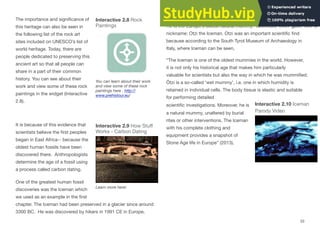
The importance and significance of
this heritage can also be seen in
the following list of the rock art
sites included on UNESCO’s list of
world heritage. Today, there are
people dedicated to preserving this
ancient art so that all people can
share in a part of their common
history. You can see about their
work and view some of these rock
paintings in the widget (Interactive
2.8).
It is because of this evidence that
scientists believe the first peoples
began in East Africa-- because the
oldest human fossils have been
discovered there. Anthropologists
determine the age of a fossil using
a process called carbon dating.
One of the greatest human fossil
discoveries was the Iceman which
we used as an example in the first
Interactive 2.8 Rock
Paintings
You can learn about their work
and view some of these rock
paintings here . http://
www.prehistour.eu/
Interactive 2.9 How Stuff
Works - Carbon Dating
Learn more here!
chapter. The Iceman had been preserved in a glacier since around
3300 BC. He was discovered by hikers in 1991 CE in Europe,
high in the mountains along the border between Austria and Italy.
He is the Europe’s oldest natural mummy. Scientists even gave him a
nickname: Otzi the Iceman. Otzi was an important scientific find
because according to the South Tyrol Museum of Archaeology in
Italy, where Iceman can be seen,
“The Iceman is one of the oldest mummies in the world. However,
it is not only his historical age that makes him particularly
valuable for scientists but also the way in which he was mummified.
Ötzi is a so-called 'wet mummy', i.e. one in which humidity is
retained in individual cells. The body tissue is elastic and suitable
for performing detailed
scientific investigations. Moreover, he is Interactive 2.10 Iceman
Parody Video
a natural mummy, unaltered by burial
rites or other interventions. The Iceman
with his complete clothing and
equipment provides a snapshot of
Stone Age life in Europe” (2013).
33
Other great clues to prehistory are
in the form of art. Artifacts found
are often sculptures, jewelry,
masks, and drawings. Go to this
site (Interactive 2.11) and see how
well you can analyze the mask
artifact. What questions might you
ask that will help you?
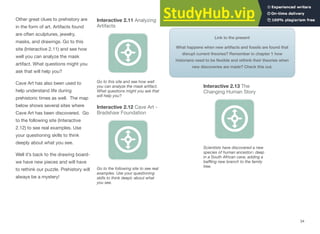
Cave Art has also been used to
help understand life during
prehistoric times as well. The map
below shows several sites where
Cave Art has been discovered. Go
to the following site (Interactive
2.12) to see real examples. Use
your questioning skills to think
deeply about what you see.
Well it’s back to the drawing board-
we have new pieces and will have
to rethink our puzzle. Prehistory will
always be a mystery!
Interactive 2.11 Analyzing
Artifacts
Go to this site and see how well
you can analyze the mask artifact.
What questions might you ask that
will help you?
Interactive 2.12 Cave Art -
Bradshaw Foundation
Link to the present
What happens when new artifacts and fossils are found that
disrupt current theories? Remember in chapter 1 how
historians need to be flexible and rethink their theories when
new discoveries are made? Check this out.
Interactive 2.13 The
Changing Human Story
Scientists have discovered a new
species of human ancestors deep
in a South African cave, adding a
baffling new branch to the family
tree.
Go to the following site to see real
examples. Use your questioning
skills to think deeply about what
you see.
34
Section 3
Environmental Effects on First Humans
QUESTIONS TO GUIDE INQUIRY
1. Why might humans want to move from an
area?
2. What might attract people to a new place?
3. Why did humans start migrating out of
Africa about 100,000 years ago?
4. What is meant by Paleolithic and Neolithic
ways of life?
5. How have Paleolithic and Neolithic patterns
of life differed between the people of Africa
Western Europe, Asia, and North America?
6. What benefits did early human farmers gain
over hunter/gatherers?
7. How did the natural environment affect the
places early human farmers chose to live?
8. What was the relationship between stable
food supplies and the development of
settlements?
TERMS, PLACES, PEOPLE:
ice age
During the Prehistoric Era there were multiple climate changes. One type of
change is called the Ice Age which is a period of extreme cold. Scientists believe
that there were five great Ice Ages with the most recent one ending around 10,000
years ago. During this particular Ice Age, the northern polar icecap moved so far
south that most of North America was covered by ice, including all of Michigan.
About 30 percent of the earth was covered in ice! Naturally, hunting and gathering
was difficult during the Ice Ages. The first people had
Interactive 2.14 What is an
Ice Age
to adapt to their surroundings. Therefore these
hunters and gatherers had very different
environmental conditions to deal with. Life in the cold
climates would have hunters and gatherers using
animal hides to keep warm and hunting animals that
were more suitable to live in cold climates, such as
the Woolly Mammoth. This video will give you a little
more explanation about why ice ages happen.
Learn more about an Ice Age in
this video.
35
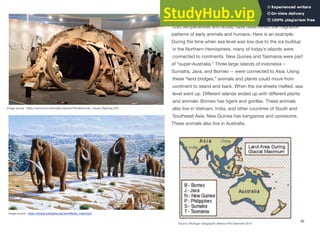
Image source: https://commons.wikimedia.org/wiki/File:Mammoth_House_(Replica).JPG
Image source: https://simple.wikipedia.org/wiki/Woolly_mammoth
Areas that were not covered in ice were still affected by the
cold temperatures and would have determined the migration
patterns of early animals and humans. Here is an example:
During the time when sea level was low due to the ice buildup
in the Northern Hemisphere, many of today’s islands were
connected to continents. New Guinea and Tasmania were part
of “super-Australia.” Three large islands of Indonesia –
Sumatra, Java, and Borneo -- were connected to Asia. Using
these “land bridges,” animals and plants could move from
continent to island and back. When the ice sheets melted, sea
level went up. Different islands ended up with different plants
and animals: Borneo has tigers and gorillas. These animals
also live in Vietnam, India, and other countries of South and
Southeast Asia. New Guinea has kangaroos and opossums.
These animals also live in Australia.
Source: Michigan Geographic Alliance Phil Gersmehl 2015
36
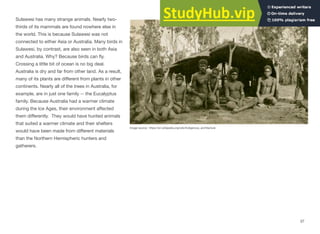
Sulawesi has many strange animals. Nearly two-
thirds of its mammals are found nowhere else in
the world. This is because Sulawesi was not
connected to either Asia or Australia. Many birds in
Sulawesi, by contrast, are also seen in both Asia
and Australia. Why? Because birds can fly.
Crossing a little bit of ocean is no big deal.
Australia is dry and far from other land. As a result,
many of its plants are different from plants in other
continents. Nearly all of the trees in Australia, for
example, are in just one family -- the Eucalyptus
family. Because Australia had a warmer climate
during the Ice Ages, their environment affected
them differently. They would have hunted animals
that suited a warmer climate and their shelters
would have been made from different materials
than the Northern Hemispheric hunters and
gatherers.
Image source: https://en.wikipedia.org/wiki/Indigenous_architecture
37
Section 4
Who Were The First Peoples?
QUESTIONS TO GUIDE INQUIRY
1. Why might humans want to move from an
area?
2. What might attract people to a new place?
3. Why did humans start migrating out of
Africa about 100,000 years ago?
4. What is meant by Paleolithic and Neolithic
ways of life?
5. How have Paleolithic and Neolithic patterns
of life differed between the people of Africa
Western Europe, Asia, and North America?
6. What benefits did early human farmers gain
over hunter/gatherers?
7. How did the natural environment affect the
places early human farmers chose to live?
8. What was the relationship between stable
food supplies and the development of
settlements?
TERMS, PLACES, PEOPLE:
Paleolithic
Neolithic
Nomadic
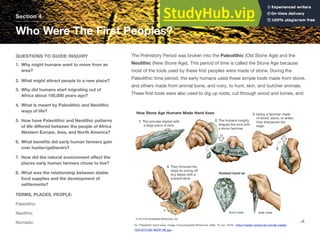
The Prehistory Period was broken into the Paleolithic (Old Stone Age) and the
Neolithic (New Stone Age). This period of time is called the Stone Age because
most of the tools used by these first peoples were made of stone. During the
Paleolithic time period, the early humans used these simple tools made from stone,
and others made from animal bone, and ivory, to hunt, skin, and butcher animals.
These first tools were also used to dig up roots, cut through wood and bones, and
38
Ax: Paleolithic hand axes. Image. Encyclopædia Britannica. Web. 15 Jun. 2016. <http://media1.school.eb.com/eb-media/
73/91873-050-4B23F18E.jpg>.
as weapons. These tools have been found all over the world, but
the oldest have been found in East Africa. It is important to note
that this time period has different starting points because regions
around the world started the technology of making tools at
different times. This shouldn’t be surprising; we have already seen
how animal and plant life developed differently in different places.
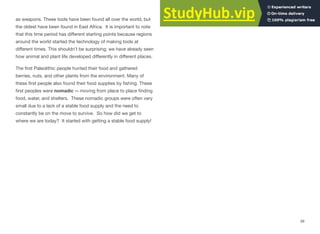
The first Paleolithic people hunted their food and gathered
berries, nuts, and other plants from the environment. Many of
these first people also found their food supplies by fishing. These
first peoples were nomadic -- moving from place to place finding
food, water, and shelters. These nomadic groups were often very
small due to a lack of a stable food supply and the need to
constantly be on the move to survive. So how did we get to
where we are today? It started with getting a stable food supply!
39
Section 5
The First Farmers and Agricultural Revolution
QUESTIONS TO GUIDE INQUIRY
1. Why might humans want to move from an
area?
2. What might attract people to a new place?
3. Why did humans start migrating out of
Africa about 100,000 years ago?
4. What is meant by Paleolithic and Neolithic
ways of life?
5. How have Paleolithic and Neolithic patterns
of life differed between the people of Africa
Western Europe, Asia, and North America?
6. What benefits did early human farmers gain
over hunter/gatherers?
7. How did the natural environment affect the
places early human farmers chose to live?
8. What was the relationship between stable
food supplies and the development of
settlements?
TERMS, PLACES, PEOPLE:
agriculture
domesticate
irrigation
The Paleolithic Era ended when humans invented farming. Again, like the
development of tools, this happened at different times in different places. Up to
this point humans would hunt and gather their food. So why did some humans
stop? Why would our ancestors decide to settle in
one place and invent farming? Many scientists believe Interactive 2.15 From
that the climate began to warm up and this change in Hunters and Gatherers to
climate made the discovery of growing plants simple.
Farmers
With this climate change, plants began to flourish.
People no longer needed to wander for food. With
this invention of farming, humans could now start to
settle in one place and stop needing their nomadic
lifestyle. They had, as the following video states,
“everything they needed in one place.”
The process of planting seed and harvesting crops
is called agriculture. This turning point in History is
called the Agricultural Revolution and begins the
Neolithic or New Stone Age.
The switch from hunting and gathering to farming did
not happen all at once in all areas of the world, so some historians will refer to this
transition period as the Mesolithic or Middle Stone Age. During the Agricultural
With this invention of farming
humans could now start to settle
in one place and stop needed
their nomadic lifestyle. They had,
as the following video state,
“everything they needed in one
place.”
40
Image source: https://c2.staticflickr.com/6/5100/5512116621_c14bc2762c_b.jpg
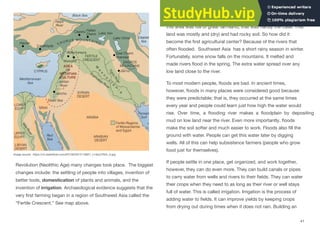
Revolution (Neolithic Age) many changes took place. The biggest
changes include: the settling of people into villages, invention of
better tools, domestication of plants and animals, and the
invention of irrigation. Archaeological evidence suggests that the
very first farming began in a region of Southwest Asia called the
“Fertile Crescent.” See map above.
It is important to note that even though the word fertile infers that
this area was full of great farmland, that was hardly the case. This
land was mostly arid (dry) and had rocky soil. So how did it
become the first agricultural center? Because of the rivers that
often flooded. Southwest Asia has a short rainy season in winter.
Fortunately, some snow falls on the mountains. It melted and
made rivers flood in the spring. The extra water spread over any
low land close to the river.
To most modern people, floods are bad. In ancient times,
however, floods in many places were considered good because
they were predictable; that is, they occurred at the same times
every year and people could learn just how high the water would
rise. Over time, a flooding river makes a floodplain by depositing
mud on low land near the river. Even more importantly, floods
make the soil softer and much easier to work. Floods also fill the
ground with water. People can get this water later by digging
wells. All of this can help subsistence farmers (people who grow
food just for themselves).
If people settle in one place, get organized, and work together,
however, they can do even more. They can build canals or pipes
to carry water from wells and rivers to their fields. They can water
their crops when they need to as long as their river or well stays
full of water. This is called irrigation. Irrigation is the process of
adding water to fields. It can improve yields by keeping crops
from drying out during times when it does not rain. Building an
41
Interactive 2.16 World
GeoHistogram
irrigation system takes a lot of skill and effort. People have to be
organized. The payoff, however, is huge -- irrigation can greatly
increase food production. You might even be able to grow more
than you need.
This fact is the reason why some people say that irrigation was
the foundation for the first human civilizations and the most
important factor in its development. What do you think? One
geographic fact is clear : Many early civilizations started near
rivers. The rivers provide a steady supply of water, fertile soil
from predictable flooding, and attracted animals. The
surrounding area might be desert but near the river
you had everything you needed. Why
go anywhere else?
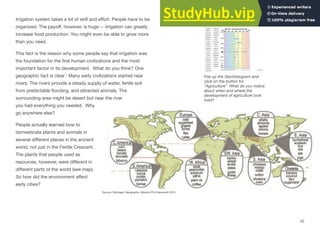
People actually learned how to
domesticate plants and animals in
several different places in the ancient
world, not just in the Fertile Crescent.
The plants that people used as
resources, however, were different in
different parts of the world (see map).
So how did the environment affect
early cities?
Fire up the GeoHistogram and
click on the button for
“Agriculture” What do you notice
about when and where the
development of agriculture took
hold?
Source: Michigan Geographic Alliance Phil Gersmehl 2015
42
Section 6
The First Towns
QUESTIONS TO GUIDE INQUIRY
1. Why might humans want to move from an
area?
2. What might attract people to a new place?
3. Why did humans start migrating out of
Africa about 100,000 years ago?
4. What is meant by Paleolithic and Neolithic
ways of life?
5. How have Paleolithic and Neolithic
patterns of life differed between the
people of Africa Western Europe, Asia,
and North America?
6. What benefits did early human farmers
gain over hunter/gatherers?
7. How did the natural environment affect
the places early human farmers chose to
live?
8. What was the relationship between stable
food supplies and the development of
settlements?
During the Neolithic Age, people were now settling into larger groups. Because
they no longer needed to hunt and gather food but could raise livestock and grow
crops, they started to have a surplus of food which led to larger populations. One
of these early village communities is called Catal Huyuk (Çatalhöyük).
Interactive 2.17 Catal
Huyuk
Click on the link to learn more
about the excavation of this first
village community. http://
www.smm.org/catal/
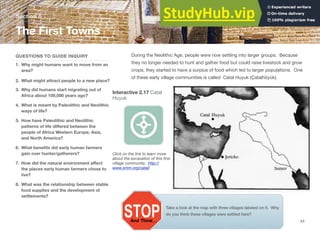
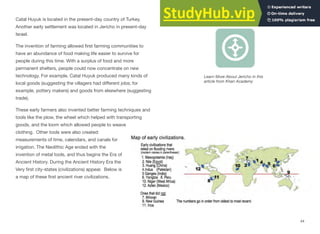
Take a look at the map with three villages labeled on it. Why
do you think these villages were settled here?
43
Catal Huyuk is located in the present-day country of Turkey.
Another early settlement was located in Jericho in present-day
Israel.
The invention of farming allowed first farming communities to
have an abundance of food making life easier to survive for
people during this time. With a surplus of food and more
permanent shelters, people could now concentrate on new
technology. For example, Catal Huyuk produced many kinds of
local goods (suggesting the villagers had different jobs; for
example, pottery makers) and goods from elsewhere (suggesting
trade).
These early farmers also invented better farming techniques and
tools like the plow, the wheel which helped with transporting
goods, and the loom which allowed people to weave
clothing. Other tools were also created:
measurements of time, calendars, and canals for
irrigation. The Neolithic Age ended with the
invention of metal tools, and thus begins the Era of
Ancient History. During the Ancient History Era the
Very first city-states (civilizations) appear. Below is
a map of these first ancient river civilizations.
Interactive 2.18 Jericho
Learn More About Jericho in this
article from Khan Academy
44
Section 7
Pastoralism
QUESTIONS TO GUIDE INQUIRY Not all people decided to settle into village communities and farm but instead
chose to continue to hunt and gather. Some of their descendants are still
hunting and gathering today.
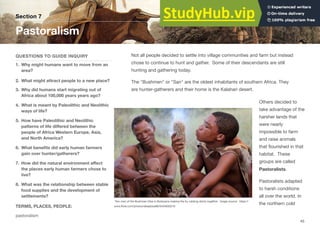
The "Bushmen" or "San" are the oldest inhabitants of southern Africa. They
are hunter-gatherers and their home is the Kalahari desert.
Others decided to
take advantage of the
harsher lands that
were nearly
impossible to farm
and raise animals
that flourished in that
habitat. These
groups are called
Pastoralists.
Pastoralists adapted
to harsh conditions
1. Why might humans want to move from an
area?
2. What might attract people to a new place?
3. Why did humans start migrating out of
Africa about 100,000 years years ago?
4. What is meant by Paleolithic and Neolithic
ways of life?
5. How have Paleolithic and Neolithic
patterns of life differed between the
people of Africa Western Europe, Asia,
and North America?
6. What benefits did early human farmers
gain over hunter/gatherers?
7. How did the natural environment affect
the places early human farmers chose to
live?
8. What was the relationship between stable
food supplies and the development of
settlements? all over the world. In
the northern cold
TERMS, PLACES, PEOPLE:
pastoralism
Two men of the Bushmen tribe in Botswana making fire by rubbing sticks together. Image source: https://
www.flickr.com/photos/deepblue66/5434630216
45
tundra where reindeer flourish, humans adapted to the cold using
the reindeer for food, transportation, and warmth. In the dry
deserts of Africa and Asia, humans could use camels to help
them survive. Dry grasslands that were poor for farming made
great pastures for cattle, sheep, and horses.
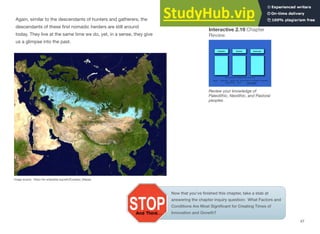
Probably the most famous pastoralists in history were the
nomadic herders of the Eurasian steppes (prairies). Generally
termed ‘horse peoples’, these nomadic pastoralists, often
appear in history as invaders of Europe, the Middle East and
China. The generic title encompasses the ethnic groups
inhabiting the steppes of Central Asia, Mongolia, and what is now
Russia. They domesticated the horse, and their economy and
culture emphasized horse breeding, horse riding and a pastoral
economy in general.
Read this quote that describes the pastoralists of Central Asia.
“The culture of the central Asian nomads is summed up in one word:
HORSE. They were the first people in the world to climb on the back
of a horse and learn to ride. Estimates of when they achieved this
feat range from 4200 BC to 900 BC. From that moment, there was no
looking back. They lived in the saddle. They had no buildings, no
houses, no farms, no towns—they had no home and they did not
want one. They were nomads. They spent their lives on their horses,
roaming wild and free over the endless steppe. They put their
children astride horses when they could barely even walk to start
learning to ride. They put little bows and arrows in their children's
hands as soon as they could grip something. Writers in the civilized
cultures who observed the nomads stressed that these people did
everything on horseback, to include performing bodily functions.
The nomads obtained their food by hunting and from their livestock.
They had great herds of cattle, sheep, goats, camels, and, of course,
extra horses. They subsisted on meat and dairy products and had
the physiques to prove it. At times of crisis, which were frequent on
the unforgiving steppe, they would make a small incision in a vein in
their horse's neck and slurp a little of its blood while it obediently
stood there.”
Stephen W. Richey. The Nomadic Horse People of Central Asia
http://www.horsenomads.info/introduction.html
46
Interactive 2.19 Chapter
Review
Again, similar to the descendants of hunters and gatherers, the
descendants of these first nomadic herders are still around
today. They live at the same time we do, yet, in a sense, they give
us a glimpse into the past.
Review your knowledge of
Paleolithic, Neolithic, and Pastoral
peoples
Image source: https://en.wikipedia.org/wiki/Eurasian_Steppe
47
Now that you’ve finished this chapter, take a stab at
answering the chapter inquiry question: What Factors and
Conditions Are Most Significant for Creating Times of
Innovation and Growth?
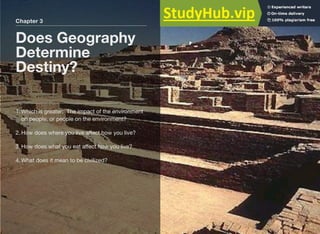
Chapter 3
Does Geography
Determine
Destiny?
1. Which is greater: The impact of the environment
on people, or people on the environment?
2. How does where you live affect how you live?
3. How does what you eat affect how you live?
4. What does it mean to be civilized?
Location, location, location. You may have heard this phrase before. It is used by
realtors to explain that the most important thing in selling a house is its location.
With the civilizations you are about to study, location might be the most important
thing that determined the success of those civilizations. The big question you
should consider is this:
Does Geography Determine Destiny?
Let’s break that down a little bit by looking at some smaller questions:
• Did the geography of the areas that civilizations chose to live in make
them either more or less successful?
• Did the environment of the areas have a huge impact on the way those
people lived?
As you read on, try to think about these questions with the various civilizations you
will study. One thing you will notice is that huge civilizations nearly always started
near water. Think about all the good things water does for you: it can irrigate your
crops, provide clean drinking water, and be used for trade.
Section 1
QUESTIONS TO GUIDE INQUIRY
1. Which is greater: The impact of the
environment on people or people on the
environment?
2. How does where you live affect how you
live?
3. How does what you eat affect how you
live?
4. What does it mean to be civilized?
TERMS, PLACES, PEOPLE
social system
complex technologies
culture
specialization
Introduction
49
Another thing to look for is whether the civilizations were located
in areas that were accessible. For instance, Egypt and China
were pretty isolated. This protected them from wars but also
made trade more difficult. Groups in Mesopotamia were much
more likely to trade, but they were also sometimes attacked.
What Makes a Civilization a Civilization?
In this chapter you will explore the rise of civilizations, which is a
much more advanced type of society than we have studied so far.
Early civilizations began in Mesopotamia around 3,500 B.C.E.
Before civilizations could really begin they needed a stable food
supply. One of the highest priorities for people was feeding
themselves. Once groups of people were assured that they could
regularly produce enough food to feed themselves, it allowed
people to do other things, like create art and build cities. As you
will see in this chapter, there are seven characteristics of
civilizations and all of them are very interconnected.
The development of cities is one of the characteristics of all
civilizations. Before people had a stable food supply, large
groups of people could not live together in one place because
they did not have enough food. Once farming and irrigation were
advanced enough to provide a stable food supply, large groups of
people began to live together in settled areas. This was a positive
advancement because it allowed people to specialize in areas
other than producing food. People became priests, soldiers,
artists, and blacksmiths. They were able to create great
advancements in the areas they specialized in.
Cities were a positive advancement, but so many people in one
place led to new problems. How do that many people live
together without fighting? How can that many people be fed?
What do we do with all of the human waste and garbage? To
solve these and other questions, civilizations gradually developed
a set of laws and government , which were meant to help people
behave in a manner that benefited the society as a whole.
Written language is another characteristic of civilizations that
helped people live together. Writing was probably first developed
to keep records of items bought and sold. It also allowed people
to write down the laws of the society. Each of the civilizations
you will study in this chapter also had what we call a social
system or structure. This means that there were different classes
of people: some wealthy, some poor; some leaders, some
followers.
As these civilizations developed they encountered many
problems. This led to the introduction of complex technologies,
or, new ways to do things. Today’s complex technologies are
things like computers and 3D printers. They allow us to solve
problems in new ways. In ancient civilizations, their complex
technologies might have been things like wells, plows, and a new
method for building arches. As you read about these civilizations
50
look for what complex technologies they invented or used to
make life better.
Each civilization also had its own distinct culture, or way of life,
which included organized religion. Each group developed art and
language and their own stories. These things are what tied these
groups of people together and helped to create their identity.
As you learn about the different cultures in this chapter, try to
identify these seven characteristics of civilizations.
The Characteristics of Civilization
• Cities
• Government and Law
• System of Writing
• Specialization
• Social System
• Complex Technology
• Organized Religion
51
As cities developed, what had a greater impact: the
environment on the people or the people on the
environment? How did the region impact the way
people lived? In this section we will discover how
civilization developed in Mesopotamia, what effect
that development had on the people, and how the
geography of the region impacted the people living
there.
As early people began farming the Fertile Crescent,
small villages began to form. With the further
development of farming, many of these small communities began to grow into
large, complex cities.
Located in present day Iraq, the Fertile Crescent is a “half moon” shaped area that
lies between two rivers. Also called Mesopotamia, a Greek word meaning the
“land between two rivers,” the Fertile Crescent surrounds the Tigris and Euphrates
rivers. Cities first began appearing in the southern part of this land, eventually
developing in areas all around Mesopotamia.
Settlements began developing in the Fertile Crescent around 3500 BCE. These
were smaller cities and, for the sake of comparison, would be much more like
Section 2
QUESTIONS TO GUIDE INQUIRY
1. Which is greater: The impact of the
environment on people or people on the
environment?
2. How does where you live affect how you
live?
3. How does what you eat affect how you
live?
4. What does it mean to be civilized?
TERMS, PLACES, PEOPLE
Mesopotamia
Ziggurat
city-states
Theocracy
aqueduct
Mesopotamia
52
Interactive 3.1 Ancient
Mesopotamia Song
Overview
independent countries today. Each had a ruler to lead and
farmland to provide food. Taking a tour of the area, you would see
a walled inner city surrounded by vast farmland. The city walls
would be built from bricks that were baked in the sun. People
living in these early villages lived very different lives from the
hunter-gatherers that came before them.
Because they had a stable food supply and permanent shelters,
they were able to form larger communities. This led to the
development of better tools, clothing, farming methods, and
systems of government. Living in a community allowed for goods
and ideas to be bartered or traded back and forth and people
could get the items they lacked.
Cradle of Civilization
Ancient Mesopotamia is considered by many to be the cradle of
civilization. This is due to the development of many things that
still impact our lives today. Agriculture, cities, religion,
government, and written language are just a few of the things that
were first developed in Mesopotamia. Unlike the many
civilizations that would follow, Mesopotamia was unique in that
the people who were in these various cities were bound together
through culture. The social laws, written language, and religion
are what historians use to classify the people of Mesopotamia. As
a result, Mesopotamia is more of a region occupied by various
civilizations rather than a single civilization. However, the people
of the region are grouped together due to two developments: (1)
the rise of cities and (2) the invention of written language.
City-States
When studying the ancient world, a city refers to an area of large
population. These cities are also the center of commerce and
government. In Ancient Mesopotamia, the cities were not only
large urban centers but also had a very distinct pattern to their
setup. Each was usually surrounded by a massive wall. In the
center of the city would be a large temple or ziggurat. Due to their
size and the way they were governed, many are often referred to
as city-states. A city-state is a city that is like a small
independent country, due to having its own laws and government.
53
Image source: https://en.wikipedia.org/wiki/Early_Dynastic_Period_(Mesopotamia)#/media/
File:Karte_Mesopotamien.png
The Sumerian people were the first to begin building cities along
the rivers of lower Mesopotamia. They specialized, cooperated,
and made many advancements in technology, all prompted by
the needs that were presented by living together. The wheel,
plow, and system of writing are some examples of their
achievements. Among the many Sumerian cities were Ur, Uruk,
Nippur, and Kish. These cities established economic and political
control over the surrounding countryside. These became the
foundation for the development of civilization.
Challenge: Build a Ziggurat
The land of Mesopotamia was fertile near the two rivers. Outside
of that, however, the land was much too dry to grow many crops.
As a result this area became home to many herders. Since
agriculture is only possible near the rivers, due to the dry climate
of Mesopotamia, people had to develop a system of irrigation to
keep their farmland productive. This need had a major impact on
the locations of the city-states of Ancient Mesopotamia.
Another result of the dry climate was the region had very few
trees. As a result, wood couldn't be used as a building material.
There was, however, plenty of mud.
The Sumerians used this for building
purposes including the building of
ziggurats. Bricks made out of mud
were easy to shape and could be left
out in the sun to bake or become
hard. Nearly every building and the
walls that protected the city was
made from these bricks.
54
Interactive 3.2 The
Wonders of Ancient
Mesopotamia
This animation, created for the
Melbourne Museum captures the
look and feel of the ancient city of
Ur. Many weeks of research with
expert archaeologists meant that
the accuracy of this video is based
on the available knowledge of the
area at the time.
Image source: https://en.wikipedia.org/wiki/Ziggurat#/media/
File:Ancient_ziggurat_at_Ali_Air_Base_Iraq_2005.jpg
Government and Law
The Sumerian people believed that
their cities were the possessions of
the gods and goddesses. This belief
had a large impact on the setup of
the city-states and on the
governments that ruled over them.
Politically, each city was independent
from one another. Warfare between
them was frequent. The ziggurat,
found at the center of every city, was
a symbol of how important the patron
god or goddess was. The god or
goddess of the city was thought to be present in all stages of life,
from the planning and building of the city to the functioning of the
government.
This belief that the gods ruled the cities brought about the
concept of theocracy, a government by divine authority. In the
early history of the city-states, the temple was the center of life,
both political and religious. Priests were in charge of the matters
for both the belief system and the government. As part of the
system, people brought what they grew to the temple and these
resources would be redistributed by the priests. The government
and religious systems operated hand in hand.
As cities grew and developed, this system changed and often
become more complex. There was too much work for a single
person as priest and king. The work might be divided between
religious and political responsibilities. Priests-rulers gave way to
kings. The change established a slight division between the two
systems. How this change came about is unknown, but one can
hypothesize that the constant war that was gripping the city-
states during this time might have forced the change. In any
event, the need for someone to handle the political needs of a
city-state separate from the religious needs took control. The
belief system was still deeply rooted in the political system; the
Sumerians believed that the king was chosen by the gods. The
king was seen as the earthly representative of the god of the city-
55
Image source: https://en.wikipedia.org/wiki/Sumer#/media/File:Ur_mosaic.jpg
state. He was seen as a
sacred being. To go
against the king was to
go against god. The king
was responsible for
leading the military,
providing justice and
order, making laws, and
guiding the people.
Of all the advancements
made by the people of
Mesopotamia, one of the
most important is the
development of a written
code of laws. The most
famous of these is the
Code of Hammurabi.
Hammurabi was a ruler
of Babylon, one of the
empires to follow the Sumerians. Hammurabi used his code of
laws to unify his empire and to preserve order. The laws were
based on both his authority as king and the word of the gods. The
code was written on clay tablets so they could be displayed in
public.
The code was detailed, covering many situations like trade,
money exchange, marriage, and divorce. The code spelled out
both laws and punishments, many of which may seem harsh to
us today. For example, if a person were to build a home and that
house were to collapse, killing a family member, then the builders
own family member would be put to death. The laws did not treat
people of all social levels equally, but it was the first to be written
down and apply to everyone.
System of Writing
Of course, laws or anything else could not be written down until
the system of spoken language
developed into a written one.
Around 2500 BCE, early forms of
script began to take shape and
develop into a written language.
Sumerian cuneiform, or wedge
shaped writing, was a major
change in the technology of the
time. The Sumerians used a wedge
shaped stylus (sharp, pointed tool)
to etch the writing into soft clay
tablets. It was used to record
information about trade, create
administrative documents, literature, letters, prayers and other
religious works, as well as all forms of economic transactions.
56
Image source: https://en.wikipedia.org/wiki/Code_of_Hammurabi#/
media/File:Code-de-Hammurabi-1.jpg
Interactive 3.3 Writing in
Ancient Mesopotamia
Learn more about the systems of
writing that developed in the
ancient world.
Cuneiform was based on an early form of writing known as
pictograph. This simpler form of writing used symbols to stand for
real objects, such as a house or water. As the language
developed, these pictures became less detailed and eventually a
series of lines and wedges remained. At the beginning, there may
have been upwards of 2,000 symbols.
Social Systems
All civilizations have a complex organization known as a social
structure (system). The social structure is made up of the different
jobs and social levels found in a given civilization. Higher levels
enjoy a greater status than those in the lower levels.
Several classes have made up the various structures found in
different Mesopotamian city-states. Even with the differences
between them, there were some common levels to all the
structures. At the top level were the priests, kings, landowners,
and government officials. They would own the largest homes and
live near the center of the city. The middle level consisted of the
merchants and artisans, farmers and fishers. Artisans were skilled
craftsman who made swords and arrows for the army as well as
tools like plows for farmers. Many would craft jewelry and other
luxury items for the upper class. Merchants bought and sold
goods or offered services. In times of war, many people living in
the middle levels were forced to serve in the army. The bottom
level were slaves; they lived in the smallest homes and owned
very little property.
Organized Religion
Religion is one of the defining factors of being a civilization. The
religious system found in Mesopotamia had a very deep influence
on everyday life. The people of Mesopotamia tried to please their
57
gods, from tilling fields to serving in government. Religion bound
the people together in a way that nothing else would.
The center for all religious expressions was temples and religious
towers, ziggurats, that were built in the center of all city-states.
Ziggurats were the largest building; some could be seen for many
miles away. The people believed that the god of their city-state
lived in the ziggurat.
The Mesopotamian culture believed in over 1,000 gods and
goddesses in their faith. They believed that the beginning of the
world was a victory of the gods over evil spirits. Through daily
rituals, funeral practices, civic duty, and many other aspects of
everyday life, people felt that they could help control the balance
of good over evil. In conjunction with daily rituals, the people held
great honor for elders and were to treat people with respect.
Doing this and honoring the gods was the primary way to show
and keep their faith.
Early Mesopotamian Empires: Unifying the Region with Force
The Sumerians flourished between 3500 and 2300 BCE, but the
city-states were never able to unify under a single empire. They
often fought for land and water rights. This lack of unity would
ultimately lead to their downfall, as their
lack of unity left them open to attacks.
Akkadians
Around 2300 BCE a group of people, the
Akkadians, came from northern
Mesopotamia into the land of the
Sumerian city-states. The Akkadians
found the city-states lacking unity and
were able to conquer the land. The were
led by an ambitious king named Sargon.
Sargon would become the first ruler of the
Akkadian Empire. Sargon was a strong
king and a skilled military leader. His army
used effective military strategies such as
tight formations, using shields and spears.
Sargon was also a brilliant political leader.
Once he established himself as king, he
58
Image Source: https://upload.wikimedia.org/wikipedia/commons/f/f0/Khashkhamer_seal_moon_worship.jpg
Image source: https://en.wikipedia.org/
wiki/Akkadian_Empire#/media/
File:Empire_akkad.svg
replaced the governors of the city-states with his own officials. He
also made the Akkadian language the official language of
business. He tore down the walls of many cities to make it harder
for those city-states to rebel. After his death, many fought for
control of the empire.
The Akkadian empire still had many Sumerian cultural influences.
Farmers used the Sumerian irrigation techniques. They adopted
the system of cuneiform for writing and even began worshipping
their gods. Over time, the Akkadian and Sumerian cultures
blended.
After 200 years, the empire began to lose strength. Naram-
Sin, Sargon’s grandson, would be the last great king. Soon
invaders from northern Mesopotamia invaded and brought
the first real empire in history to an end.
Babylonian
With the fall of the Akkadian Empire, Sumer once again was a
collection of independent city-states. The next empire to
come to power would be the Babylonians around 1750 BCE.
King Hammurabi, famous for his written code of laws, would
unite all of Mesopotamia under the Babylonian Empire.
Babylonia thrived under Hammurabi’s leadership. Trade and
agriculture boomed unlike ever before. The empire set up a
regular way to carefully maintain the irrigation systems so that
land remained fertile and would grow plenty of food. Trading
in grain and other products grown in the land, the empire took
advantage of the two rivers for more than just the fertile farm
land.
What stands out above the economic advancements is that
Babylonian society was oddly fair for this time period. Laws
treated the classes differently, but even the lowest level, slaves,
had rights. They were able to work outside of their owners’ home
59
Image source: https://en.wikipedia.org/wiki/Akkadian_Empire#/media/File:Empire_akkad.svg
and could keep their wages. They were able to own property and
could even save money to eventually purchase their freedom.
Following Hammurabi’s death, mass revolts created unrest in the
empire. Over time, portions of the vast empire began to break off,
either gaining independence or being conquered. Around 1595
BCE, the empire finally fell to the Hittites when they sacked
Babylon and removed the standing king.
Assyrian
The next major empire to take control of Mesopotamia was the
warlike people known as the Assyrians. The Assyrians had lived in
Mesopotamia for centuries when Hammurabi conquered the
people, making them part of the Babylonian Empire. Around 900
BCE a line of rulers began training up an army with the goal of
preparing for war. Soon the army began to expand the Assyrian
territory.
The Assyrians were feared for their cruelty and military might.
They used strong iron weapons and became skilled horseman.
They also became highly effective at siege warfare. This
technique had soldiers camp outside the city for many days
repeatedly attacking until the defenses fell. The used battering
rams to destroy walls and tall movable towers that could be rolled
up to the walls and gates allowing soldiers to climb over the
walls.
The empire was ruled by a series of powerful kings. The Assyrians
used many of the same techniques of irrigation and farming to
keep the region fertile and producing food. They also were the
first in the region to begin using aqueducts. An aqueduct is a
system of pipes or channels used to carry water into cities. The
aqueduct system brought drinking water into the city of Nineveh
from over 30 miles away.
60
Image source: https://en.wikipedia.org/wiki/Babylonia#/media/File:Hammurabi%27s_Babylonia_1.svg
The Assyrian empire lasted for almost 300 years. At its height, the
empire extended from Mesopotamia to the area surrounding the
Nile River in Egypt and to the Taurus Mountains in the north.
Controlling such a large region became its weakness, stretching
its army too thin. This issue left the Assyrians exposed and they
found it difficult to fight off invading neighbors. In the early 600s
BCE, Nineveh was plundered and the Assyrian empire was over.
Further Study: Visit the following sites for more information and
activities on Ancient Mesopotamia
History of Mesopotamia- University of Chicago
Mesopotamia- The British Museum
61
Interactive 3.4 Palace
without Rival
Task: Follow the link to complete
the online scavenger hunt or test
your knowledge.
Interactive 3.6 Crash
Course - Ancient
Mesopotamia
Interested in learning even more?
Watch this video from John
Green’s “Crash Course”
Reflection: Looking back on all the information in this
previous section, which is greater: the impact of the
environment on people or the people on the environment?
Interactive 3.5 World
GeoHistoGram
Fire up the World GeoHistoGram
and click on the button
“Mesopotamia” - What do you
notice about the length of this
empire?
Geography is rarely described as glamorous, yet, without geography of the area
where Egyptian civilization developed, Egypt may not have become what it did.
The fertile river valley along the Nile River allowed the Egyptian farmers to avoid
famine. They could produce a surplus of food with a modest number of workers.
They could use the remaining workforce to craft amazing feats of architecture. The
Nile was also a provider of fish. There were many plants that grew in the riverbeds.
These marshy lands were home to lots of mammals, reptiles, amphibians, and
birds. The water for irrigating the fields carried mineral-rich silt that was scattered
by the annual floods. This made the Nile the lifeline of the pharaoh’s people.
Section 3
QUESTIONS TO GUIDE INQUIRY
1. Which is greater: The impact of the
environment on people or people on the
environment?
2. How does where you live affect how you
live?
3. How does what you eat affect how you
live?
4. What does it mean to be civilized?
TERMS, PLACES, PEOPLE
fertile
pharaoh
Egypt
63
Interactive 3.7 What did
Ancient Egyptians Eat?
What did Ancient Egyptians eat
and how do we know? Click here
for more!
The Nile River with its predictable
floods and the surrounding desert:
these were the geographic features
which dominated Ancient Egypt. As
you read about their historical
development, always consider how
the geography of the region might
have impacted that development.
Early Technology: Harnessing the
Nile River
Long before the rise of great civilizations in the Nile Valley, about
6000 BCE, irrigation began in Ancient Egypt. Irrigation gave life to
the Egyptian Empire. Annually, as the flood season began every
summer, ancient Egyptians sang a hymn to honor the river that
gave them fertile land and nourishing food. They looked forward
to these floods which they managed with great technology.
Teamwork had to be in place for the Egyptians to control the flow
of the water. They worked together to construct dikes which held
back the water. The irrigation ditches that they dug diverted, or
channeled, the rising waters. Collaboration was also the key as
they created basins, also known as reservoirs, to hold great
amounts of water to be used later during the dry season. The land
left behind by the flood waters was fertile - good for producing
crops. The river’s current had picked up bits of black soil, clay
particles, and the flood’s fertilizer called silt.
Thanks to advancements in irrigation, the Egyptians were able to
lessen their hunts for elephants, hippopotamus, and wild fowl.
Their choice of foods started to vary. They continued to fish in the
Nile River and later started to rely on meat from animals they
raised like long-horned cattle, geese, sheep, and goats.
Vegetables they grew were onions, leeks, garlic, beans, lettuce,
lentils, cabbages, radishes, and turnips. They ate fruit mainly as a
dessert. Their fruits were melons, plums, figs, grapes, and dates.
They also grew grains like wheat, barley, and flax. They made
bread and brewed beer from the grain. They spun the flax into
linen, which they sewed into garments to wear, and other helpful
cloth.
Government and Law
Before 3100 BCE, Egypt was two separate kingdoms with a huge
desert between them. Deserts can be like a fence or wall
protecting people from invasion. Joining forces with your
neighbor builds an even bigger advantage: larger population,
more land, additional resources, and the sharing of traditions and
talents. Upper Egypt, in the south, had a ruler who wore a white
crown while the ruler of the northern kingdom called Lower Egypt
wore a red crown. A double crown was created with the
combination of these two kingdoms.
64
Interactive 3.8 Ancient
Egypt
Why do we know so much about
Ancient Egypt? Click here for
more!
King Menes united the two main regions
of Egypt and founded its first capital, a
headquarters for government, at Memphis
in about 3100 BCE.
”He became the first pharaoh, the
Egyptian name for the ultimate ruler, and
he wore the pschent, a crown that symbolized
the union of the two regions of Egypt,” According to authors Sara
Pendergast, Tom Pendergast, Drew D. Johnson, and Julie
L. Carnagie.
Menes ruled Upper Egypt in the south, yet he saw the great
trade potential in Lower Egypt, which was located to the
north at the fertile delta region. The highway of the Nile
connected not only the trade routes, but it allowed
transport for their military and travel for all. The Nile’s
waters allowed much of Egypt to venture down their
treasured river to the Mediterranean Sea.
Historians divide the years of Egyptian rule into three
periods: the Old Kingdom from about 2700-2000 BCE, the
Middle Kingdom which lasted from about 2000-1500 BCE,
and the New Kingdom from 1500-750 BCE.
The Old Kingdom came first and formed the strong central
government. The leaders of this period organized resources
to allow for irrigation, extensive food storage, and great
growth of the empire. They supervised the construction of
the first great monuments of Egyptian architecture, the
Great Pyramids. These marvels are located at Giza, which is
on the west bank of the Nile near Egypt’s current capital of
Cairo. During the Old Kingdom Egyptians had followed the
Sun King, Ra, and invented an accurate solar calendar. It is
similar to the Gregorian calendar that we use today.
Egyptians of the Old Kingdom also made great advancements in
art and culture.
65
Upper and Lower Egypt:
Are you confused about Upper
and Lower Egypt? Then, think
like an Egyptian. We usually
print our maps with north at
the top and, because of that,
tend to think "up" wen we
think north. We even say, "up
North" in Michigan. But for
ancient Egyptians, the Nile
River defined how they saw
the world. There was
upstream, or towards the
source of the river, and
downstream, or towards the
mouth of the river. For the Nile,
the mouth was in the North at
the Mediterranean Sea. The
source was in the South. For
Egyptians, Upper Egypt was
upstream in the South. Lower
Egypt was downstream in the
North.
Image source: shutterstock
Achievements were made in literature and culture during the
Middle Kingdom, yet this was a time of political unrest for Egypt.
There were many contacts made between the Egyptians and the
surrounding cultures in greater Arabia, Africa, and the Middle
East. Egyptians borrowed customs from these other cultures and
added them into their lives. Evidence of this cultural mosaic can
be found in the artwork and writings from the time period. The
Nubians from the south ruled for a short time. Next, the Semitic
people from Levant, which is modern-day Syria and Lebanon,
took control with their bronze weapons and compound bows until
another shift of power came with the Hyksos. Egyptian culture
remained prevalent until the Egyptians finally prevailed at the end
of the Middle Kingdom.
During the New Kingdom, Egypt truly became an empire. After
conquering neighbors to the south, Egypt expanded to other
parts of Africa. Egypt gained great wealth during the New
Kingdom, and wealthy Egyptians showed off their riches with
lavish temples and they wore more highly decorated clothes.
Egyptian society began to weaken as the Kushites from the south
gained prominence and then Egypt started to break down further
after about 1000 BCE Eventually Egypt was conquered by
Macedonian leader Alexander the Great, whom you will read
more about in the next chapter, in 332 BCE The culture of Ancient
Egypt slowly disappeared after Alexander’s influence.
The New Kingdom saw the emergence of something somewhat
unusual in Ancient Egypt or anywhere in the ancient world: female
rulers. 1504-1482 BCE were the reigning years of Queen
Hatshepsut, sometimes considered the world’s first female leader.
Pharaoh was a male term (like the word king) but Hatshepsut was

referred to as pharaoh. She ruled as a regent for her young
husband who was also her half-brother. A regent is appointed to
rule because the monarch is a minor, or too young. Marriages
were often political arrangements when they involved members of
a ruling family and were often more about consolidating power by
being associated with the right people than they were about
marriage or love. The politics were complicated, but Hatshepsut,
by all accounts, was an effective leader whom we know about in
66
Image source: Egyptian limestone statue, about 1485 BCE
part, because of the record of her accomplishments preserved
with her tomb; the same way we know about the
accomplishments of other pharaohs.
Another strong female leader that ruled ancient Egypt as co-
regent and as the pharaoh was Nefertiti. Historians have
described her as one of the most significant of all Egyptian
women. She and her husband, the pharaoh Akhenaton, started a
new form of religion in their kingdom. It was a sort of revolution of
faith changing the whole structure of their ancient culture. They
moved the capital to from the original capital at Thebes to
Amarna. The high priests had much less power under this new
religious structure, and the main god was shifted to Aten, the sun
god. Using evidence like hieroglyphics and wall paintings, it is
clear that she played a large role in court. She carried out duties
of the pharaoh, and she drove her own chariot. The artwork
proves that she was powerful and independent. Women were not
on the forefront of politics at this time. It is possible that her
strong role during the reign of her husband upset the social
hierarchy and caused conflict among government officials and
high priests.
Writings about Nefertiti seem to just stop, yet the imagined details
used to complete the mysterious missing information are quite
intriguing. We do know that she was married to the pharaoh
Akhenaten who reigned from 1353-1356 BCE. Some Egyptians
believed that she had great divine power and was a daughter of
the gods.
Nefertiti’s story is being told with new uncovered evidence
described in a powerful historical documentary. In the Valley of
Kings, which is 400 miles south of Cairo, her mummy may have
finally been identified. In the first few hundred years after her
funeral, the royal tomb was found by grave robbers and her
remains were mutilated. All the proof of rank had been torn away
from her wrapped and preserved remains. The linen shroud and
sacred wrappings were missing until recently. Two other
mummies were in the same tomb and they were not harmed by
67
Image source: Shutterstock
the ancient criminals. Jewels and amulets have been found
separate from the body and these trinkets have been confirmed
as Nefertiti’s. Researchers could not positively confirm the identify
the mummy until an English egyptologist named Joann Fletcher,
(who specializes in ancient hair, its styling, and the wigs worn by
people of ancient times) helped to make the connection between
a wig that was likely Nefertiti’s and the mummy’s identity. Dr.
Fletcher can confirm with forensic evidence that the wig is from
1400-1300 BCE and that it was created in Nubia for person of
royalty.
The damage to the mummy thought to be Nefertiti’s was likely
inflicted by grave robbers because it
is similar to how all the carved and
painted images of her were damaged
after her death. This vandalism is
connected to the damage found in
her royal tomb. As a woman that had
gained a high level of authority, she
may have offended certain people so
much that they wanted to hurt her in
the afterlife. Her mouth had the most
damage, and that is important
because the damage would not allow
her to speak her name to the gods
and enter into the afterlife.
The Development of Cities
As you have already learned, King Menes founded the first capital
of Egypt in Memphis, and, like so many other locations in ancient
Egypt, being surrounded by so many deserts protected them
from invasion and takeover. Water is the most basic of human
needs, no matter what year you live in. Let’s think about water
and the quality of that water in today’s world. We have more
pollutants in our water, but, for Americans living in Michigan,
access to the water of the Great Lakes is such a huge advantage.
Access to water has to be reliable for the growth of a civilization.
A huge group like the Ancient Egyptians could not build a capital
without water. Without the Nile River, there would not have been
the Egyptian Empire.
In ancient times, designing a good way to transport enough fresh
water was a difficult challenge. For example, to keep an army
hydrated during battles, leaders had many difficulties. The cities
of Egypt were strategic in their design; these cities were rarely
invaded due to their location. Power and protection go together!
The cities were situated to support the travel, trade,
transportation, and safety. These four factors were paramount in
the location of their busy centers of Egyptian life.
Another major city of Egyptian civilization was Thebes. Thebes
was the capital for hundreds of years during the reign of several
pharaohs. The location was both strategic and hospitable to life in
the Nile River Valley. It is over 400 miles south of Egypt’s modern
68
Interactive 3.9 Female
Rulers in the Ancient World
Female rulers were unusual in the
ancient world, but have things
changed that much? Think about
these questions.
capital, Cairo. On the east side of the river was the city for the
living and on the west bank of the river was home to all the tombs
and those involved in burial like the priests, embalmers, and
workers. During the Middle Kingdom, a time period from about
2000 BCE to 1700 BCE, Thebes was where you’d find the
Sphinxes and great temples. Thebes was ruled by Egyptians, but
it was also taken over for time spans by the Hyksos, invaders
from Asia, by the Assyrians, the Persians, and finally the Greeks.
The Greeks had such a strong influence that the name Thebes is
Greek. Today, Thebes is a small village in Egypt visited by tourists
that come to visit the ruins. King Tutankhamen’s tomb was
discovered here in Thebes in 1922, less than 100 years ago. King
Tut had quite a complicated family tree and the city of Thebes has
a notable history, too.
Sometimes periods of change and unrest in a civilization can lead
to the development of new cities. As you have already learned,
the pharaoh Amenhotep IV and his queen Nefertiti created a
new set of traditions based on the worship of the one god whom
they called Aten. No one knows for certain why or to what extent
this religious change from polytheism to monotheism, the worship
of only one god, took place. But it was sincere enough, or an
attempt to consolidate his power enough to cause Amenhotep IV
to change his name to Akhenaten in honor of the one god of his
monotheism efforts. He also began the building of the the city of
Amarna to honor the god Aten, not Amon-Re. This city was also
called Tell el-Amarna and is believed to have been one of the first
planned settlements
in all of human
history; a fitting tribute
to what is considered
to be the earliest
documentation of
monotheistic religious
beliefs in human
history.
Akhenaten and
Nefertiti paid for the
new city’s
construction with the
riches from the
temples of Karnak.
Karnak was the home
to temples dedicated
to other gods, but
they were closed for
17 years during the
rule of Akhenaten. The change to a new religious system had an
economic impact, too.
Change often produces unrest and that was certainly the case
here. This team of rulers, Akhenaten and Nefertiri, brought about
a time of crisis and social disorder. With all this change the rulers
69
image source: Shutterstock
were forced to seek out protection from those who did not like
their ideas. Armana was surrounded by cliffs on three sides and
the Nile on the fourth. The city was a fortress, or citadel.
Upon Ahkenaten’s death, Nefertiti returned to the previous capital
of Thebes and ruled there for a year. Priests to the previous gods
were still in Thebes when Nefertiti returned with the body of her
husband, and her return may have signaled a return to previous
religious practice. Akhenaton’s son Tutankhamen, whom we
would come to know as King Tut, would eventually consolidate
his own power and rule from Thebes.
Hieroglyphics - Ancient Egypt’s System of Writing
Texting, emails, tweets, and even handwritten notes share the
thoughts of today, yet hieroglyphics told the tales of the
Egyptians long ago. Hieroglyphics date back to the the time of
Upper Egypt during the reign of King Menes. Their writing system
was a combination of symbols and pictures like animals, plants,
and people. These detailed pictures were a way of describing
their lives for more than thirty centuries. These hieroglyphs were
found on tomb walls, in temples, on papyrus - a type of paper
made from the reed, and most importantly in ornate burial
chambers of the pharaohs. Can you imagine what the Egyptians
would have done with emojis?
For centuries, the Egyptians also had a written language that was
a mysterious series of pictures and symbols. The clues to their
meaning did not come until the discovery of a stone near Rosetta
helped to "crack the code" and translate the ancient language.
The social scientists that pieced together the meanings of
hieroglyphics must have been thrilled, and today we know so
much more now that we can read the writings on papyrus scrolls,
tomb walls, and any other artwork that contains Egyptian
hieroglyphics.
Papyrus may have been the world’s first paper. Papyrus was a
woven pattern of reeds that grew along the Nile’s riverbanks.
These peelings of the plant’s layers were then dried in the sun to
allow for a crisp surface with which to write. Papyrus was also
used to make rope, mat rugs, and sandals. Papyrus and wheat
were the best exports for Egypt.
Specialization and Social Systems
Ancient Egyptian civilization developed with many areas of
specialization much like other civilizations. When you have
specialization of labor, or a variety jobs that are critical to the
function of the civilization, different societies treat these talented
artisans in their own ways. The rank or level of these specialists
led to social hierarchies throughout the ancient world. A social
hierarchy is sometimes referred to as a social pyramid. This is
because it has just a few people on the top but many people at
its foundation.
70
The social pyramid was a complex way of keeping order in
Ancient Egypt. These classes of people were integral in both the
government and faith of the civilization. The place of each person
in the pyramid was largely determined by birth. Very few
Egyptians moved up to a higher level in the social pyramid; a
unique specialization, or skill was needed to be elevated from the
level of their family. The viziers assisted the pharaohs and
coordinated the collection of taxes and managed the work crews.
The high priests had an amazing amount of power because the
Egyptian people lived by just one faith. Officials, merchants, and
scribes had unique talents that provided many of the needs and
wants of their culture. The craftsmen created the products which
were bought and sold and lended their skills to the massive
decorative crafts like jewelry making and architectural design. Of
course, the bottom of the pyramid had the greatest number of
people, and these Egyptians worked hard throughout their lives
with little freedoms and privileges. This lowest level workers
farmed the fields and completed all the building projects for the
pharaohs.
Architectural Achievements - The Pyramids
Pyramids held the most sacred treasures and were the most
complex buildings of their times. Pyramids were the tombs, or
burial spaces, for the body of their king, and these tombs served
as a storage vault for the possessions they wished to have with
them in the next world. These royal tombs had to be a fortress of
protection from grave robbers. There were mazes and false entry
points, traps, and dangers set to snag a thief if they were brave
enough to disrupt the eternal resting place of the godlike rulers.
Originally just a pit in the dry sandy soil, later the Egyptians made
buildings of brick and stone in which they buried their sacred
rulers.
Pyramid building was an amazing feat of ancient architecture and
remains mysterious in many ways. The complex rank of the
Egyptian culture created a workforce that was loyal to the
leaders. These massive building projects were completed by
thousands of lower ranking Egyptians and any outsiders that
71
The Pyramids at Giza in Egypt are one of the Seven Wonders of the World. © SCULPIES/SHUTTERSTOCK.COM.
the camels give great perspective and scale, although camels are not native to Egypt.
were taken as prisoners. These buildings had religious
significance as they served as burial chambers for their rulers as
they ascended into the next world, or the afterlife. Ramps, both
internal and external, may have helped with the building of the
pyramids. There are many different theories as to the exact
technology used.
Another amazing achievement of Ancient Egypt is the Great
Sphinx. The Great Sphinx was carved in the an area of the
pyramids known as the Valley of Kings. No one knows the exact
reasons for this statue, and there is even some debate about
when it was created. Nothing has been found in any of the
ancient Egyptian hieroglyphic writings about its creation, but
many believe it was carved by ancient Egyptians to be a guardian
of the tombs there.
Giza became a small town when it became the desert home to
the Great Pyramids and the Sphinx, but it wasn’t like the cities of
our times. It was more of a construction site with mini-camps for
the different levels of slaves, workers, artisans, and managers of
the projects.
Organized Religion
Much of the pyramid building was tied to ancient Egyptian beliefs
about religion and the afterlife. Egyptians believed that their rulers
were also gods. This belief in many gods is known as polytheism.
The Egyptians believed that they needed to please the gods.
Many ceremonies and tributes were made to honor these gods.
Many details about their beliefs are seen on sacred scrolls,
artwork, and sculpture. As you have read, Egyptians believed that
after they died a new life for them began, and this gave them a
way to live forever. They traveled to another world in the afterlife
and lived with the gods and goddesses of the dead. The
mummification process is cleverly drawn and explained together
with many facts about the Egyptian belief system and its
pantheon of gods led by Ra, the sun god and the god of creation.
He was called AmenRa during the Middle Kingdom. Osiris, Isis,
Horus, Thoth, and Anubis are lesser gods, yet they all are
involved in the lives of the Egyptians.
Mummification & preservation
Humans have many beliefs about life and what happens after
death. To live forever in the afterlife, or next world, Egyptians
believed that their soul had a number of parts. The ba and ka are
two parts of the soul, and they had to be able to recognize their
body; so they preserved, or mummified their bodies. The body of
a pharaoh was treated with extra care as they thought that the
ruler was a god. After a pharaoh died, organs were removed and
stored in special containers called canopic jars. Then the body
was dried out, rubbed with oils, and wrapped with long, narrow
pieces of linen cloth. Mixed in the wrappings were jewels and
special gifts. The name of the person was written on the cloth in
hieroglyphics and a mask with a likeness was used to cover the
72
head. While the embalmers worked for seventy days to preserve
the body, there were priests that held rituals throughout the
process. There were also skilled craftsmen like carpenters,
sculptors, and painters that created a series of coffins for the
body. The outermost coffin is called a sarcophagus. An elaborate
funeral was held and the body was placed in a tomb with all the
furniture, belongings, and food that might be needed in the
afterlife. Pets and servants remains have been found alongside
the rulers. The entrance to the tombs were concealed for
protection, and the tombs needed an air shaft for the daily visits
of the spiritual ba and ka. The religious beliefs of the Egyptians
certainly made death an important part of life.
73
Interactive 3.10 World
GeoHistoGram
Fire up the GeoHistoGram again
and this time click on both the
Mesopotamia and Egypt buttons.
What do you notice?
The Indus River Valley was
home to one of the four river
valley civilizations. Of all of
these civilizations we know
the least about the people
who lived in the Indus River
Valley. While there is much
archeological evidence at
this point in history, we have
been unable to decipher any
of their written language.
Therefore, we are forced to
gather as much information
as we can from the
archeological evidence that
exists.
There is evidence of farming
and people settling in the
Indus River Valley as far
back as 4000 BCE. There is
Section 4
QUESTIONS TO GUIDE INQUIRY
1. Which is greater: The impact of the
environment on people or people on the
environment?
2. How does where you live affect how you
live?
3. How does what you eat affect how you
live?
4. What does it mean to be civilized?
TERMS, PLACES, PEOPLE
India
74
Image source: https://commons.wikimedia.org/wiki/File:Civilt%C3%A0ValleIndoMappa.png
also evidence that these people may have developed trade
with the neighboring Mesopotamian civilization around this
time. There is further evidence that the people in this region
then developed into a civilization around the year 2500 BCE
which lasted until around 1700 BCE. Very little evidence was
uncovered about these ancient people until the 1920s when
two cities were discovered in modern day Pakistan. Who
built these cities and what were they all about? We will seek
to answer these questions in this section.
The city of Harappa was uncovered in 1921 and the city of
Mohenjo-Daro was discovered a year later in 1922. These
are believed to have been two major cities in this early
civilization. It is unclear what the status of the cities were.
Were they individual city-states or part of a larger kingdom?
Each city was approximately one square mile in size and
showed a very high level of planning and organization. The
cities had well-organized perpendicular streets and buildings
constructed out of uniform-sized bricks. They also consisted of
drainage and sewage systems that would carry dirty water away
from the city.
It is clear that there had to be some sort of government and law
that organized and ran the cities, though again, there is no
specific or clear written evidence to support this. So how do we
know? It seems incredibly unlikely that cities as highly organized
as Harappa and Mohenjo-Daro would have been able to be
constructed without some sort of governing organization to plan
and then construct them. Without knowing their language,
however, we are stuck at merely guessing what the government
and law may have been like.
The evidence of written language is found across the Indus Valley.
Stone seals and tablets, pottery, jewelry, and even copper
weights all bear the same language. The problem is that no one
has been able to crack the code and solve the mystery of this
ancient language. It is clear that there was a uniform writing
75
Image source: https://commons.wikimedia.org/wiki/File:Civilt%C3%A0ValleIndoMappa.png
system across the Indus Valley, but until it is deciphered,
it remains a constant mystery for historians studying the
Indus River Valley. We have evidence of extensive trade
with Mesopotamia which can help us to make sense of
this civilization.
Stone seals from the Indus Valley were found across
Mesopotamia and Mesopotamian reports indicate that
they traded with “people to the east.” There is also
evidence of copper and other metals appearing in the
Indus Valley. All of this can lead us to believe that the
people of the Indus Valley were trading with the people of
Mesopotamia and perhaps even beyond. This means
that not only must the people of the Indus River Valley
have had enough surplus goods to trade, but, they must
also have had specialization which allowed them to trade.
The fact that there is a writing system, pottery, and the
elaborate urban layout also lends support to the argument that
they must have had specialization of labor.
It is impossible to know what life was like for people of the
ancient Indus civilization but the archeological clues may reveal
some interesting things. Nearly all homes, despite differing in
size, had access to wells and drainage systems. We can imply
from this that, despite status in society, access to water and
cleanliness was important to these people. This is further
reinforced by the fact that the largest public building in the city of
Mohenjo-Daro was a public bath. There is also significant
evidence that the people of this time lived in relative peace with
each other. There have been very few weapons found in all of the
excavations, human skeletons do not show signs of violence, and
the buildings themselves do not appear as though they were
involved in any great battles or sieges. This leads us to believe
that the people living in the Indus Valley lived a relatively peaceful
life.
76
Image source: https://commons.wikimedia.org/w/index.php?curid=2560364
Whether or not the Indus people practiced any sort of an
organized religion is a question that is as mysterious as the
civilization itself. It is likely that they practiced some form of
organized religion, but it may have been very different from the
evidence found in the other River Valley civilizations. While the
Egyptians built grand pyramids to their god-kings and the
Mesopotamians constructed statues of their leaders and
Ziggurats to serve as the houses of their gods, there is none of
that in the Indus civilization. There are no statutes or depictions
of any rulers or any types of gods. Some of the most interesting
pieces come from the small stone seals found throughout the
Indus Valley and even in Mesopotamia. Some feature depictions
of typical animals while others portray imaginary animal
mashups. Is it possible that these have something to with a
religion or belief? We may speculate about this more in a later
chapter when we examine one of the world’s major religions that
eventually developed in this region.
So what happened to the people of the Indus River Valley?
Historians have come with several possible answers to explain
the disappearance of these people. It is possible that one, or all,
of these was responsible for the decline. Many historians
believe that there was some sort of natural disaster that drove
the people from this land. Some believe it was a great flood or
possibly even an earthquake as both happen regularly in this
region. Other historians believe that they were invaded,
conquered, or driven out by a group from the north known as the
Aryans. Later Hindu texts, written in a language we can decipher,
describe how indigenous people were driven out of the land; it is
possible that they mean the people of the Indus River Valley. The
last possible reason is a collapse in their agricultural system.
Whether they over-farmed the land or suffered from natural
disasters, it is possible that their food supply collapsed thus
bringing about their end.
The Indus River Valley civilization is one of the most interesting
and curious of all of the early River Valley civilizations. While
archaeological evidence points to the fact that they were highly
sophisticated and organized, our lack of understanding of their
written language prevents us to gain a full understanding of this
77
Image source: https://commons.wikimedia.org/w/index.php?curid=268919
civilization. Hopefully, in time, historians can uncover more
evidence and attempt to answer the questions surrounding this
great civilization
78
Interactive 3.11 World
GeoHistoGram
Once again, fire up the World
GeoHistoGram and click on the
buttons for Mesopotamia, Egypt,
and the Indus Valley. What do you
notice now about the three
different civilizations?
The region that came to be known as China is filled with geographic extremes. In
the south of the country, along the coast, a great deal of rain comes from monsoon
season. This allows crops to thrive in the warmer months. The eastern side the
country is surrounded by water - the Yellow Sea and the Pacific Ocean to be
exact. Two major river systems run through China. In the North you’ll find the
Yellow River, and in the south, the Yangtze. In the western portion of the country
are mountain ranges separating it from countries like India. In the north, the Gobi
Desert stretches across much of the territory. The geographic features of this area
allowed China to remain relatively isolated from the other ancient civilizations that
sprang up during this era of world history. It also provided many challenges for the
people who would eventually come to settle areas of the country. You’ll learn
about some of those challenges in this section.
Section 5
QUESTIONS TO GUIDE INQUIRY
1. Which is greater: The impact of the
environment on people or people on the
environment?
2. How does where you live affect how you
live?
3. How does what you eat affect how you
live?
4. What does it mean to be civilized?
TERMS, PLACES, PEOPLE
dynasty
ancestor
feudalism
China
79
Stop and Think: How might isolation help a civilization
develop? How might it hurt a civilization from developing?
While little is known about ancient Chinese history, it is believed
that people began to settle and build villages in the Huang He
River Valley around 5000 BCE. By 2000 BCE some of the
settlements there grew into the first cities in China.
These cities needed formal leadership to keep them together, and
as such, the first dynasty is said to have begun, known as the Xia.
Much of what is known about this early dynasty is passed down
in stories and legends, and there is less evidence in the form of
archaeological records to point us toward what really happened
during this time. Still, stories passed down from generation to
generation can contain valuable information to help us answer the
question “what happened?”
Much of what we think happened to found the Xia dynasty comes
from the Legend of Yu. Settlements sprang up around the Yellow
River, and it often flooded. This wasn’t a problem native to China,
as you’ve learned in other sections of this book. Still, one of the
early leaders, King Yao, gave a man named Gun the task of
finding a way to control the flood waters. Gun failed many times
at this task, seeking to build dams to trap the water. This did not
stop the flooding from happening, and it wasn’t Gun who ended
up solving the problem. It was his son, Yu. Yu was able to
carefully study the river systems and learn from his father’s
mistakes. Yu is credited as having created a system of irrigation
canals which brought the flood waters into fields over the period
of approximately thirteen years. Yu would eventually become
80
https://upload.wikimedia.org/wikipedia/commons/4/41/China_edcp_relief_location_map.jpg
Stop and Think: Having read a description of the
geographic features of China and using the map
above, where might the earliest civilizations in
China have appeared?
ruler and the Xia dynasty
continued for several hundred
years.
It is with the start of the Shang dynasty that we have a lot of
historical evidence that helps us figure out what happened in this
area during this time. The Shang rose to power in Northern China
and are said to have eventually conquered the Xia. During the
Shang dynasty, China was ruled by a monarch who would
appoint governors to rule small sections of the kingdom overall. It
is also during the Shang dynasty that the Chinese began working
with the metal bronze.
81
Interactive 3.12 Yu the
Great
Learn more about Yu the Great at
this website:
https://upload.wikimedia.org/wikipedia/commons/thumb/8/80/Shang_dynasty.svg/2000px-Shang_dynasty.svg.png
https://upload.wikimedia.org/wikipedia/commons/0/04/
CMOC_Treasures_of_Ancient_China_exhibit_-_bronze_battle_axe.jpg
The people of the Shang dynasty continued to live off the land
settled earlier and continued to guard against flooding by further
developing complex irrigation and flood control methods. Social
classes rose to prominence during this era - with the king at the
top and warrior nobles near the top with him. At the bottom of
this social pyramid were the peasants and farmers who lived in
the many villages around the territory.
Family was central in early Chinese society. You’ll learn more
about religions and philosophies in the fifth chapter of this book.
Eventually Buddhism, Taoism, and Confucianism would take hold
in the country, but during this era ancestor worship was
important to the people of the dynasty. The Shang Chinese
believed that the spirits of their ancestors were always watching
them and would favor them with rewards or bring disaster
depending on whether they were happy with them or not.
Written language is thought to have begun prior to the Shang
Dynasty (and wouldn’t become standardized until the Qin
Dynasty) but development of it continued during this era. You’re
reading this book in English, where we have an alphabet
containing 26 letters, all of which can be put together to make
words, phrases, and sentences. The Chinese, however, have a
pictographic language which has thousands of characters to be
learned. This written language has developed over time, but in
the beginning it was made up of symbols that had looked
somewhat like the thing being described. Take for example this
picture of a tree:
Now consider the Chinese character that represents the word
“tree.”
82
Can you see the similarities between
the two? Many of the Chinese
characters in their language were
created based on the object it was
trying to describe. Unfortunately,
however, this is relatively easy to do
for something like a tree but much
more difficult for many other words.
How would you represent the word
“yellow”?
The Shang dynasty, like the one rumored to have come before it
and the ones that would come after eventually declined.
Eventually it was replaced by the Zhou dynasty which was the
first to introduce the idea that those in charge ruled by a mandate
of heaven. This practice would be followed in all successive
dynasties, with the main belief being that the ruler ruled with the
blessing of heaven. If a ruler lost the blessing, natural disasters
would occur, the royal family would be overthrown, and a new
house would rule. This dynasty was never able to fully unify the
entire territory and this gave rise to city-states.
Territories were governed by members of the royal family and a
system very similar to one that developed much later in Europe
developed here. This system is called feudalism. Under
feudalism, nobles are granted use of lands that belong to the king
in return for service to the empire. The nobles then divided the
land further into farms for extended families. Feudalism here and
in Europe both share some of these characteristics.
There were some very important developments technologically
during this time period, however. Roads and canals were built to
help with trade and farming. This also helped with the growth of
cities. Money in the form of coins were created out of bronze.
This also helped with the development of trade. The Zhou also
learned how to work with iron. Population
grew and farming techniques improved.
This dynasty came to an end during a
period known as the Period of Warring
States, when the armies of the Qin
captured the heart of the empire. You’ll
learn more about China later in this
resource as well as in high school World
History.
83
Interactive 3.13 Ancient
Scripts - Chinese
You can learn more about the
Chinese writing system here:
http://www.ancientscripts.com/
chinese.html
Interactive 3.14 World
GeoHistoGram
Fire up the GeoHistoGram again
and add Mesopotamia, Egypt,
Indus Valley, and China layers.
What do you notice about all four
of these empires? What do you
notice about the Chinese Empire
specifically?
You have now read about four different ancient
civilizations. Take a stab at answering the chapter inquiry
question “Is Geography Destiny?”
Chapter 4
What Led to the
Emergence and
Collapse of
Large Scale
Empires?
What are the shared characteristics of the classical civilizations?
What are the defining characteristics of city states, civilizations, and empires?
How did legal codes, belief systems, and written language aid in the development
of large regional empires?
How did governmental authority, military power, taxation, coerced labor, and
slavery help in the building and maintenance of empires?
What role did geography play in the development of empires?
How did new trade routes develop and how did that economically impact all
groups?
How did cooperation and conflict impact the growth and spread of empires?
What new economic systems were created during this era?
What is an empire? How did they grow? What did they do? How did they work?
Why do they decline and fall? These are some of the questions that historians
have studied and tried to figure out for centuries. In this chapter you will learn
about the difference between a civilization and an empire, the characteristics of
empires, the impact of geography on civilizations and empires, how trade
developed, and how empires were governed. Finally you will look at some
examples of empires
from this age.
In the previous unit
you learned about
the early river valley
civilizations and the
development of a
new way of living for
humans.
Civilizations and
empires had many
similarities which
can make it hard to
tell the difference
Section 1
QUESTIONS TO GUIDE INQUIRY
1. What are the shared characteristics of the
classical civilizations?
2. What are the defining characteristics of
city- states, civilizations, and empires?
Terms, places, and people:
Civilizations
Empires
How are Civilizations and Empires Similar and
Different?
85
between the two. This is because at their very basic level
empires exist as a subset of civilizations. By that, we mean some
civilizations develop into empires as they progress, however, not
all civilizations develop into empires. There are differences that
can be looked for to help clarify and sort out which one is which
and when a group of people has transitioned into being an
empire.
The seven characteristics of civilizations, discussed earlier in the
book, are: cities, government and law, system of writing,
specialization, social systems, complex technology, and culture,
including organized religion. Empires have all of these things as
well making the two appear, on the surface at least, to be very
similar. The most important difference
between empires and civilizations lies with
three main points: size, how they are
governed, and growth.
We have already discussed that empires are
characterized by their large size, something
that is not a characteristic of much smaller
civilizations. In fact, most empires are a
collection of civilizations brought under one
ruler. These civilizations are brought into
the empires and governed by force, as
opposed to civilizations, which developed
their own forms of leadership over time
Finally, empires typically grow and collapse much more quickly
than civilizations. Empires tended to be much less stable,
growing quickly into massive sizes only to collapse in on
themselves and disappear in a very short time.
Ultimately, like many things in history, there is no perfect definition
of exactly what is a civilization and what is an empire. There are
places and people that fit some but not all, and a constant debate
for historians is how do we define and classify these places.
86
Empires were one of the most important forces of Era 3. Empires changed and
shaped the world and began to draw people more closely together. But, what are
the characteristics of an empire? How do we know when an empire has
developed? These are just two of the questions to explore when studying world
history.
One of the first characteristics of empires is their
large size. Humans began living closely along
the banks of rivers and the coasts of oceans, but
by this era empires spanned thousands, and
sometimes more than a million, square miles. At
its peak, the Roman Empire covered a territory of
approximately 1.69 million square miles and the
Achaemenid Empire covered an area of
approximately 3.29 million square miles. By
comparison, the state of Michigan is
approximately 96,716 square miles. As these
empires began to stretch out and cover large
territory they began to grow in terms of
populations as well.
Section 2
QUESTIONS TO GUIDE INQUIRY
1. What are the shared characteristics of the
classical civilizations?
2. What are the defining characteristics of
city- states, civilizations, and empires?
What are the Characteristics of an Empire?
87
A second important characteristic of empires is their large
populations. The old river valley civilizations and city-states
contained many people, but these new empires had incredibly
large amounts of people living in them. Estimates put the
population of Rome between 50 million and 100 million people at
its peak and the Han dynasty of China is estimated to have had
around 57 million people. While it is difficult to determine exact
totals due to unreliable data, that is still a lot of people! As these
populations rose and borders expanded, empires began to pull
more and more people into their territory and under their control.
A third characteristic of empires is the fact that they rule over
regions and people who live far away from where power and the
government are centered, known as the core of the empire. This
is an important change; people living in city-states usually were
under the local control of their individual leaders. As the empires
of this age expanded and developed they began to pull new
people and places under their control.
Some empires forced these new subjects
to adapt and change while others allowed
them to continue their lives as normal. We
will see examples of these later in this
chapter.
Finally, the empires of this age were
characterized by monarchy and oligarchy
government systems. The majority of these
empires were controlled by a single ruler
(called a king or emperor) or a group of
rulers called oligarchs. In either case, the
ruler or rulers held total and absolute power
over their territory and attempted to control
all aspects of the lives of the people living
within their borders. Whatever belief
system the emperors held so did those of
88
Interactive 4.1 How Many Michigan Lower Peninsulas?
the people they ruled. The famous example of this is when
Constantine converted not only himself, but the entire Roman
Empire, to Catholicism before his death. You will read more about
this in a later chapter. These absolute rulers used legal codes
and communication as the means by which they ruled their
empires. Language and forms of communication were useful in
tying together groups of people within the empire who may have
little else in common. Systems of law provided people of all
different backgrounds with a set of rules and expectations that
would be accepted and universal across the empire.
89
As mentioned in previous sections of this book, geography plays an important role
in history and how things change and develop. This is also the case when it
comes to empires. Many empires started geographically in places where city-
states and civilizations already existed, which helps support the idea that empires
were in fact subsets of civilizations. We have already discussed how these places
had good climates, access to a steady food supply, and access to resources. But
how else did geography impact and influence human life and development?
Geography greatly impacted empires in a number of different ways. In some
cases empires were aided and protected by geography and in other cases empires
were limited and hindered by their geography. Why were the Persians able to
construct one of the largest empires in the world? When you examine geography
the answer becomes clearer: there are very few geographical barriers in that region
of the world which allowed them to expand and grow into a massive empire.
Geographical barriers could also act as a source of protection for empires. As
you learned in the previous chapter, the Chinese Empire enjoyed protection on
three sides with natural barriers to potential invaders. They decided to build a wall
where natural barriers didn’t exist.
Section 3
QUESTIONS TO GUIDE INQUIRY
1. What are the shared characteristics of the
classical civilizations?
2. What are the defining characteristics of
city- states, civilizations, and empires?
Terms, places, and people:
Persians
The Impact of Geography on Empires
90
By contrast, some regions were limited and constrained by the
geographic barriers surrounding them. The Indian Empires were
limited by the fact that they were a peninsula closed on their
northern edge by the world’s tallest mountains. The Roman
Empire was also unable to expand further into Africa due to the
massive Sahara Desert.
Geographic barriers greatly impacted the stability of many
empires in this time as well. The Middle East, which we know
had few geographic barriers, saw the most turmoil and conflict
during this time. Empires rapidly grew, shrank, and competed
with one another over this large
and ever changing space. By
comparison the Indian and
Chinese Empires, sheltered by
mountains and highlands, enjoyed
more stability and faced fewer
external threats. This is one
reason why China maintained its
empire for hundreds of years.
Geographical barriers were
significant but not insurmountable.
We will see how they were
sometimes overcome in later
sections of this unit.
Let’s explore some maps and see
if we can uncover how geography affects empires. Each of the
maps below shows not only the empire, but also the “core” area
of the empire, which is represented by the shape inside the
empire.
After examining these maps how do you think geography aided
each of these individual empires? How do you think it could have
limited these empires? Use specific geographic examples from
each map to explain your thinking in this interactive where you
will explain how geography both aided and hindered empires.
91
Gallery 4.1 Empire Maps
Trade became an economic pillar and was incredibly important for the creation
and survival of empires. Trade provided these large-scale empires with the
resources and goods that they needed to survive and could not make for
themselves, or did not have access to. Trade also gave them access to faraway
markets and places to sell the things they produced. This is supply and demand
economics at its very basic level. For this reason trade routes became the veins
Section 4
QUESTIONS TO GUIDE INQUIRY
1. What are the shared characteristics of the
classical civilizations?
2. What are the defining characteristics of
city- states, civilizations, and empires?
Terms, places, and people:
trade
Silk Road
cultural diffusion
The Development and Impact of Trade Networks
92
By Whole_world_-_land_and_oceans_12000.jpg: NASA/Goddard Space Flight Centerderivative work: Splette (talk) - Whole_world_-
_land_and_oceans_12000.jpg, Public Domain, https://commons.wikimedia.org/w/index.php?curid=10449197
and arteries that fed the hearts of the empires. By the end of Era
3, nearly all of the empires were connected and interacted along
these increasingly important trade routes marking the first real
move toward what we refer to today as globalization.
The most famous of these trade routes was the Silk Road. The
Silk Road was a massive connection of trade routes linking China
and the Roman Empire. Romans had acquired a love for silk
fabrics, and the only people in the world who knew the secret to
producing that silk were the Chinese. Traders would begin
travelling along the Silk Road like runners in a relay, passing the
silk from traveler to traveler along the route until they eventually
reached their destination. Travel could be dangerous, but the
rewards were great for those who traveled along the Silk Road.
Goods were not the only things that traveled along the Silk Road.
As traders went from place to place they shared language,
stories, ideas, technology, and even religion. Just as goods
moved from one empire to another so did these other equally
important products. They helped to develop an increasingly
connected world in which ideas were more freely shared among
all of humanity. This process is known as cultural diffusion and
it was not unique to this era of history. It happened in previous
eras and still happens to this day.
Empires usually found it mutually beneficial to exchange goods
along these trade routes. But there were times when the empires
could come in conflict. At these times, a secondary impact of
these roads and trade routes was that they provided a ready-
made access point to invade the
empire.
It would be impossible to talk about
trade routes and the Silk Road
without mentioning the humble
camel. Often overlooked, the camel
was vitally important to the success
of trade routes. Like trucks on the
roadways today, camels were the
main method of transport and travel
along these trade routes. Camels
could traverse the variety of terrains
93
By Kuebi = Armin Kübelbeck (Own work) [CC BY-SA 3.0 (http://creativecommons.org/licenses/by-sa/
3.0)], via Wikimedia Commons
By Jjron - Own work, CC BY-SA 3.0, https://
commons.wikimedia.org/w/index.php?
curid=2831408
that existed along the Silk Road and other trade routes. From
high mountain passes to burning desert sands, the camel's ability
to carry heavy loads while needing little water made it an
indispensible creature that was vital to the success of trading.
Finally, it is important to examine the success of trade routes over
water as well. One of the most powerful groups of traders at the
beginning of this era were the Phoenicians. The Phoenicians
were expert ship builders who used this knowledge and their
location to become incredibly rich. The Phoenicians traded with
the Egyptians, the Mesopotamians, and places across Africa by
sailing around the Mediterranean Sea. The Phoenicians used
these overwater trade routes to achieve great success for several
hundred years. As the Greek city-states grew more powerful they
challenged and ultimately defeated the Phoenicians taking over
their trade routes and building wealth of their own. Later, the
Roman Empire, as we saw on an earlier map, would control all of
the trade routes in the Mediterranean and the surrounding land,
completely controlling the region.
94
By Yom (talk · contribs) - Own work based on: ar:File:Ph routes.jpgTransferred from en.wikipedia to
Commons by Akigka., CC BY-SA 3.0, https://commons.wikimedia.org/w/index.php?curid=1074993
By Elie plus at English Wikipedia, CC BY-SA 3.0, https://commons.wikimedia.org/w/index.php?curid=6074645
With their complex size, empires required more developed systems of managing
all of the people living within its boundaries. While a king easily ruled over a city-
state or civilization, the rulers of empires needed more complex ways to control
and manage the population. One of the most obvious ways was through the
establishment of social hierarchies. Hierarchies had already existed prior to
empire building, but empires developed much more elaborate social hierarchies
and organizations for their societies.
In the previous chapter, you may have noticed that a common feature of all of
these hierarchies and empires was an all-powerful ruler at the top who was
responsible for controlling and ruling the empire. The majority of these rulers
created an autocracy, a government in which they were the sole ruler, or an
oligarchy, where the empire was ruled by a small group of people. Many empires
passed power down through family lines in what is known as a dynasty. These
rulers families often made up the next level of the social hierarchy and had great
power and wealth.
The middle of the social hierarchies tended to be made up of skilled workers and
craftsmen. These workers were responsible for the “day-to-day” work of the
empire. They were the sculptors, carpenters, traders, and merchants who helped
empires to run smoothly. These people could be viewed as your average everyday
citizens of the empire. Despite the relatively little power granted to these people,
Section 5
QUESTIONS TO GUIDE INQUIRY
1. What are the shared characteristics of the
classical civilizations?
2. What are the defining characteristics of
city- states, civilizations, and empires?
Terms, places, and people:
social hierarchies
How Are Empires Governed?
95
they held an important role in the empires. Women did not hold a
place on many of the hierarchies of the ancient world. Unlike
earlier time periods when women often held equal roles as men,
women in Era 3 began to see their status decline. In many cases
they were not allowed to read and write, they were not involved in
the running of empires, and they were very rarely mentioned in
many of the histories of the day.
Another common feature of these hierarchies were the people
located at the bottom. Practically all empires practiced some
form of slavery or forced servitude. Slaves could come from
many different places; they could be prisoners of war, people who
owed debts, or criminals. In some empires slave status was
passed on to the next generation meaning people could be born
into slavery. In some there were opportunities for slaves to work
their way out of slavery. Treatment of the slaves tended to be
harsh and they oftentimes worked the worst jobs within the
empire. Some slaves were able to
attain freedom, but the few that
did rarely achieved a higher social
status.
It is impossible to overlook the
contributions made by slaves
within the empires. In many
cases, slaves literally built and
maintained the physical structure
of the empire by constructing and maintaining homes, roads,
aqueducts, palaces, theaters, and other important buildings and
structures - the very things thousands of years later are often
admired as an empire’s great achievements. Though the way it
was practiced varied from place to place, one thing is certain:
slavery was a part of the society and culture of nearly every
empire during this era.
In many empires, belief systems and language were the glue that
helped to connect and hold empires together, regardless of who
was in charge or what internal struggles developed. You will be
learning much more about religion in the next chapter. Religion
provided explanations for many things in the world that people
could not otherwise explain and helped to connect people who
may have little else in common. Languages, like religion, helped
to stitch together groups of people spread over large areas and
allowed governing officials to easily communicate amongst
themselves and to the people that they were in charge of
governing.
Militaries became an important and pivotal group within empires.
While most were typically from lower ranks in the social
hierarchies, military leadership could often be from some of the
upper ranks. These leaders had some ability to control and sway
the way that empires ran. Militaries were one of the most
important tools that an emperor would use to govern their empire.
They could be used to expand the empire, protect the empire,
96
Interactive 4.2 Social
Hierarchies
Can you place these three groups
in the proper order?
and to enforce the rules of the emperor. Militaries filled their
ranks with conscripts and volunteers who oftentimes had few
other options within the hierarchy that existed in their empire.
Like any tool, if the emperor used it incorrectly or unsafely it
could be dangerous to them. A ruler without control of the
military would be unable to protect their empire or enforce their
rules. In some cases the military itself was responsible for the
overthrow of, and replacement of, emperors.
Money was the final, and in some ways, most crucial piece of
governing an empire. Empires required massive amounts of
money to keep themselves stable and working. This money
came primarily from two places: conquest and taxes. The
business of conquering new areas was expensive but resulted in
big rewards for emperors. Prisoners of war and conquered
people could be used as slaves within the empires, and the
access to new resources could create vast sources of new
wealth. Emperors could also impose tax systems that would
require citizens to pay taxes that would help the government's
wealth grow.
97
By Unknown - Jastrow (2006), Public Domain, https://commons.wikimedia.org/w/index.php?curid=1350228
By Classical Numismatic Group, Inc. http://www.cngcoins.com,
CC BY-SA 3.0, https://commons.wikimedia.org/w/index.php?
curid=343373
By CZDK at English Wikipedia, CC BY-SA 3.0, https://
commons.wikimedia.org/w/index.php?curid=32927535
Conquest and raising taxes, while supporting empires, could also
prove to be a disaster. If things did not go well and a conquest
failed there is no reward for the risk taken by the leader, making it
an unpopular and costly decision. Taxes, if too high or seen as
unfair by the people, could lead to internal instability that could
cause the empire to collapse. The most successful leaders had
to be good at balancing the risk and reward that came along with
building and growing their empires, while also ensuring financial
peace and stability within the empire.
98
The Greeks and Alexander the Great
Whether the Greeks truly represented an empire before
the rise of Alexander the Great (who you will learn about
shortly) is a question that historians will likely continue
to explore for many years to come. They certainly fit the
criteria for civilization. However, the Greeks are often
seen as the forerunner to many of the empires and to
much of Western Civilization. It is important that they
are mentioned here. The Greek Civilization was a loose
collection of city-states controlled by different types of
governing systems ranging from the Kings of Sparta to
the Athenian form of Democracy. Greek city-states
would often battle each other over who would control
and manage the peninsula, as Athens and Sparta did
during the Peloponnesian Wars. Those same Greek city-
states would also form allegiances and alliances to fight
against common enemies when their homelands were
threatened, as they did against the Persians. The
Greeks have left many legacies which still resound with
us in the world today, which are further discussed in a
Section 6
QUESTIONS TO GUIDE INQUIRY
1. What are the shared characteristics of the
classical civilizations?
2. What are the defining characteristics of
city- states, civilizations, and empires?
Terms, places, and people:
Alexander the Great
Democracy
Exploring Major Empires of Era 3
99
Interactive 4.3 Leonidas
Learn more about Leonidas and
the 300 in this video from the
History Channel.
Interactive 4.4 Olympics
Learn about the origin of the
Olympics in this video.
later chapter.
Greek Democracy would inspire countless future governments,
Greek historians and poets would write tales that would last until
modern times, and they would create architectural structures that
would be copied for thousands of years. We can even thank them
for the Olympic games! But who were they and where did they
come from? Humans have been living in and around the Greek
Peninsula since the Neolithic era. The first “Greeks” were the
Minoans and Mycenaeans that appeared during the Bronze Age.
The disappearance of these groups began a period of little
development and activity in Greek history. Around 700 BCE
Greek populations began to grow and city-states began to rapidly
form and develop. Two of the most famous and easily recognized
groups of the “classical period” in Greece are Athens and Sparta.
The Athenians were one
of the two most powerful
city-states on the Greek
peninsula. The Athenians
were some of the first to
practice true direct
democracy. Athens was
a center of education,
learning, culture, and art.
Some of the most
famous poets, historians,
and artists called Athens
home. These are people
and ideas that have
survived through the
ages and impact us to
this day. Students still
learn about Aristotle and
Socrates and still read
the works of Homer.
100
By Pitichinaccio - Own work, Public Domain, https://commons.wikimedia.org/w/index.php?curid=3831600
By Marie-Lan Nguyen (2009), CC BY 3.0, https://commons.wikimedia.org/
w/index.php?curid=9057273
Many of the principles of democracy practiced today can be
traced back to Greece.
The Spartans were in many ways the opposite of Athenians.
They had an incredibly strict society ruled over by two kings, not
the people. Sparta focused on discipline and military tactics,
crafting one of the best militaries the world had ever seen. These
two city-states were in a constant struggle over who would
control the Greek peninsula. The Spartans and Athenians joined
together on several occasions to battle the Persians and to
protect Greece from invaders. But the two groups also engaged
in decades of bloody war, called the Peloponnesian War, that
would ultimately lead to the decline of both.
In the wake of the Peloponnesian War, Athens and Sparta
declined, leaving Greece without any leading city-state. The city-
state of Macedonia rose to power in this environment and their
leader Philipp II worked to control more territory. His
assassination led to one of the most significant Greeks in all of
history taking control, Alexander the Great. Alexander embodied
the significance and importance of strong leaders. He quickly
took control of and conquered the Greek mainland and began to
invade into Asia. Alexander the Great was a fantastic warrior and
a superb leader who boldly expanded his control and began to
absorb more and more territory and people under his control. He
integrated and added new people into his ranks and spread
Greek culture across the areas that he conquered.
Alexander’s empire collapsed shortly after his death, lasting only
as long as he was alive, but the impacts of this newly created
empire lasted far beyond his death. Hellenistic (Greek) culture
went from being locked into the Greek peninsula to spreading
around the Mediterranean Sea and into Asia. Greek thinking,
language, and ideas spread far and wide, greatly impacting not
101
By Marsyas - Own work, CC BY-SA 3.0, https://commons.wikimedia.org/w/index.php?curid=46729
only the people in the area but the empires that would grow out of
the remnants of Alexander's massive, but short lived, empire.
102
By Unknown - The Guardian (DEA/G Nimatallah/De Agostini/Getty Images), Public Domain, https://
commons.wikimedia.org/w/index.php?curid=35067658
By Generic Mapping Tools - created by user, CC BY-SA 3.0, https://commons.wikimedia.org/w/index.php?curid=656066
Interactive 4.5 Sparta
Learn more about Sparta in this
video!
Persia (Achaemenid Empire)
The rise of the Persian (Achaemenid) Empire began around 550
BCE when a group of nomadic tribes were united by a leader
named Cyrus. Cyrus was able to conquer older empires which
laid the groundwork for the creation of his own. Cyrus went on to
add neighboring city-states and kingdoms to grow his empire into
the largest of this time period. Cyrus faced the simple, yet
important, issue discussed earlier in this chapter: “How do you
manage and govern people with such diverse backgrounds and
cultures?”
Cyrus developed a system that was different than some of the
other empires discussed within this unit. The regions controlled
by Cyrus were allowed to keep their religions, their practices, their
culture, and in some cases their rulers. The only thing Cyrus
required was the conquered subjects pay taxes to the empire.
Initially, this was widely popular and allowed the Achaemenid
Empire to easily absorb other groups into its control. As the
Persians grew, however, this system lacked the stability and
control that was required and the empire faced internal pressures.
Cyrus’s son Cambyses II was able to expand and grow by
conquering Egypt, but while he was away a group of priests
attempted to steal the throne and take control of the empire.
Cambyses died and his successor Darius I was able to restore
order to the empire and even expand further into the Indus Valley.
Darius also reorganized the government to make it run more
efficiently; he divided the empire into 20 regions known as
satraps with appointed governors to rule and govern over each
one. Darius also worked to connect these regions further through
a series of roads and a postal service that allowed information,
people, and goods to travel freely and easily throughout the
Achaemenid Empire.
103
By Truth Seeker - http://blogtext.org/TruthSeeker/, CC BY-SA 3.0, https://commons.wikimedia.org/w/
index.php?curid=14482534
Beginning around 500 BCE
revolts and uprisings began by
Greeks in the city-state of Ionia.
Darius was able to stop the
rebellion but wanted to punish
the Greeks by attacking Athens
and raising taxes because they
had supported the uprisings.
Darius was defeated by the
Athenians at the Battle of
Marathon, and other regions
began to rebel in response to
the higher taxes. Rule fell to
Xerxes I, the son of Darius, who
sought to restore peace and
order to the empire. Xerxes
lacked the understanding of
how government and politics
worked as well as not knowing
about the different cultures that
made up the people that he
ruled like Cyrus and Darius had when they ruled.
Xerxes attempted to avenge his father by attacking the Greeks
but was defeated after several massive land and sea battles.
Xerxes returned back to his empire and withdrew from controlling
the empire. He spent his wealth and power while neglecting the
empire he had attempted to build. Over the years the
emperors continued to withdraw and lost support of the
satraps and their citizens. The empire began to fall apart
and was finally conquered by Alexander the Great in 334
BCE.
The Achaemenid rulers accomplished many things, most of
which helped them to govern over their large empire. They
created silver and gold coins that had the same value no
matter where you traveled within their territory. They also
104
By Άγνωστος - Εθνικό Ιστορικό Μουσείο, Αθήνα, Public Domain, https://
commons.wikimedia.org/w/index.php?curid=5507148
By Flickr user dynamosquito - Cropped from Flickr version:
https://www.flickr.com/photos/dynamosquito/4614878357/, CC
BY-SA 2.0, https://commons.wikimedia.org/w/index.php?
curid=42297867
encouraged trade with other groups as well as within their own
empire by building road and trade routes between them. Different
parts of the empire were also used to provide different needs of
the people. One example of this was grain was grown in the fertile
Nile River Valley in Egypt and gold, which was supplied from
India. They also created an elaborate tax system which
depended on what your region supplied, or did not supply.
The Achaemenid empire was one of the first large-scale empires
in the world, and, whether directly or indirectly, it would impact
the others that would follow after it.
Rome
Rome is one of the most widely discussed and studied empires of
this age. It was not the the longest lasting, but what they were
able to achieve in the time they occupied is truly remarkable. The
remnants of the Roman Empire are visible across Europe and
Northern Africa, and the legacy of Rome is visible all across the
globe. Rome likely began as a small kingdom, possibly as early
as 600 BCE, with the city of Rome being founded in 750 BCE.
Over time Rome grew and developed into a Republic. The
Roman Republic was ruled by a king who worked closely beside
the Senate to make laws and govern the country. In fact, in many
ways the founding fathers of the United States modeled our
government after the Roman Republic.
The Roman Republic began to face pressure after battling
Carthage, a city across the Mediterranean in North Africa, in the
Punic Wars which required significant resources. The Roman
Republic was further threatened when a civil war resulted from a
slave uprising, led by a man named Spartacus, and order was
restored by Julius Caesar. Caesar named himself Emperor of
Rome, but the Roman Senate assassinated him, hoping that their
Republic could be restored after years of turmoil. It couldn’t.
Julius Caesar’s death led to another civil war among generals
and their followers and
Caesar’s nephew, Octavius
emerged as the victor.
Octavius’s power and
control was enough that
the Senate didn’t challenge
his claim to be Emperor.
Under him and several
successors, Rome
continued to grow and
expand as an empire until
it reached its peak in 117
CE. This time period of
expansive growth is known
as the Pax Romana (latin
for Roman Peace); it lasted
until 180 CE with the death
of Emperor Marcus
105
By Till Niermann - Own work, CC BY-SA 3.0, https://
Aurelius.
As Rome grew it began to face pressure and conflict from within
and without. Rome faced conflict at its borders that forced the
Romans to build and maintain massive armies to protect itself.
Germanic tribes from central Europe were constantly putting
pressure on the Roman borders, and the Huns from Asia also
fought with and attacked at the borders of the Roman Empire.
Rome struggled to feed and manage the people within the
empire and constantly faced internal pressures and divisions.
The growth of Christianity and the persecution of Christians also
created great strife within the empire.
Rome would eventually divide into two empires: the Western
Roman Empire and the Eastern Byzantine Empire. The goal was
to make the management of Rome easier by having two
emperors who would work together to manage the massive land,
resources, and people. The Western Roman Empire fell apart and
the city of Rome was sacked by Visigoths and Vandals and the
last Roman Emperor was removed from power in 476 CE. The
Byzantine Empire would survive for another 1,000 years, but
would struggle to match the success of the full Roman Empire.
What was life like in the capital city of Rome? What did they do
for work and what did they do for fun? We will seek to discover
some of these answers as we learn more about the Romans.
How Romans lived was impacted by their economic and social
status. Wealthy Romans lived in large houses located on the
outskirts of the city that were taken care of by slaves and
servants. These wealthy Romans had access to delicious food
and nearly any luxury they could want. Poor Romans, on the
other hand, tended to live within the city itself in small houses or
apartment-style complexes. These houses were dangerous and
food could be scarce, but these Romans wielded a lot of power.
The “mob” as they were called had to be kept happy and
controlled.
Romans, regardless of wealth, enjoyed many of the same social
activities. A favorite of the rich and poor alike were the
gladiatorial games. Romans would gather and watch executions,
animal hunts, and gladiators battle each other to the death.
Gladiators
were like the
rock stars of
Rome, gaining
fame and
recognition,
despite often
times being
slaves.
Romans also
visited the
public baths
practically
every single
106
By Emanuele - Flickr: Pont du Gard, CC BY-SA 2.0, https://commons.wikimedia.org/w/
index.php?curid=18375492
day. Here Romans would gather
to wash themselves and to
socialize with one another. The
public baths were just one of
many amazing innovations that
the Romans created. Follow this
link to learn more about it!
China (Han Dynasty)
The Han Dynasty in China was
one of the largest in China and
is responsible for developing
some of the most important
and lasting technologies of the
age. The Han Dynasty began in
206 BCE and ended a
tumultuous time in Chinese
history. While the Qin Dynasty
before it was the first true
empire in Chinese history, it
was marked by social, political,
and religious upheavals. The
Han Dynasty was the first
cultural “Golden Age” in
Chinese history that saw a durable and stable government,
economic growth, extensive record keeping, and historically
important innovations.
The government in Han China was organized similar to the Qin
Empire that came before it. It was organized into centralized
areas like states with appointed government officials. These
government officials were well educated, given an official salary,
and were given raises and promotions based on how well they
worked. The Han Dynasty also based their governing principles
on the ideas of Confucius. This helped them to create a system of
governing that was able to manage society while keeping people
unaware of the
authoritarian
governing style.
The Han Chinese
were a very literate
society and were
known as some of
the greatest record
keepers of the
ancient world. They
wrote everything
down and compiled
massive histories,
the most famous of
107
Interactive 4.6 Roman
Innovation
Top 10 Roman Innovations page
and video
By White whirlwind - Own work, Public Domain, https://
commons.wikimedia.org/w/index.php?curid=48110895
By ZazaPress - http://diq.wikipedia.org/wiki/
Image:Sima_Qian_%28painted_portrait%29.jpg, Public Domain, https://
commons.wikimedia.org/w/index.php?curid=4109447
which was written by a historian named Sima Qian. The history is
known as the “Records of the Grand Historian” and is one of the
most complete histories of China. It not only included a history of
the Chinese people but it also included information about the
people they interacted with, especially the Romans.
The rulers of Han China worked to open up trade routes to the
West by helping to establish the Silk Roads. As mentioned earlier
in this chapter, the Silk Roads were crucial in not only connecting
the people of this era, but also in the trade of resources, goods,
and ideas. The Chinese secret to making silk, combined with a
craze for it in Rome, led to a lucrative trade between Han China
and the Romans.
As the Chinese
continued to
gain more and
more wealth
from trade they
continued to
advance and
develop their
empire.
The Han Chinese
are also
responsible for
creating many
inventions, which, in
some form or another,
are still in use across
the world today. Paper
was invented in Han
China, but they did not
use it for record
keeping; they primarily
wrote on wood and
bamboo slips. The Han
also worked to develop
advanced crossbows
and other military
technology. They also
created a working
compass which used
a magnetic spoon to
point South as well as
creating one of the
world’s first seismographs to detect earthquakes. The Chinese
were also known for their high-quality lacquered pottery and
their ability to mass produce iron through smelting.
108
By Editor at Large - Own work, CC BY-SA 2.5, https://commons.wikimedia.org/w/
index.php?curid=4221953
By Rosemania - Own work, CC BY 2.0, https://
commons.wikimedia.org/w/index.php?curid=5912991
India (Mauryan)
The Mauryan Empire was created in the wake of Alexander the
Great’s empire collapsing. The first leader of the Mauryan
Empire, Chandragupta, worked to control an area that covered
nearly the entire Indian subcontinent. Chandragupta passed rule
to his son Bindusara who continued to expand the empire farther
South into the Indian subcontinent. Ashoka was one of one of the
most famous emperors in all of Indian history.
Ashoka took control of India around 250 CE and began to expand
and bring new territories under his control. In taking control over
a neighboring kingdom, Ashoka and his army not only inflicted
but also suffered huge losses. Some estimates have stated that
as many as 100,000 soldiers and civilians were killed or wounded
in the conflict. Ashoka was so affected by the losses that he
decided to never use
armed conflict again.
He learned about
Buddhism and made
the decision to
convert to the faith.
You will learn more
about Buddhism in
the next chapter.
Ashoka’s most
important
contribution to the Mauryan Empire was his conversion to and his
support of Buddhism within his empire. Instead of spreading his
empire through military conquest, he decided to create an empire
of the spirit. Ashoka sent religious envoys to places as far away
as Egypt and Macedonia because he was more concerned with
expanding religion than his own empire. Ashoka also constructed
monumental stone pillars that were placed all across the empires.
These stone pillars contained edicts that described the various
years of his reign and provided insight into the things he was
thinking and doing.
109
By Avantiputra7 - Own work, CC BY-SA 3.0, https://commons.wikimedia.org/w/index.php?
curid=33726301
https://c1.staticflickr.com/9/8162/7342466968_5233ea5f9c_z.jpg
These edicts provided much of the information that we have
today about the Mauryan Empire. These edicts have also given
us clues as to who the Mauryans may have interacted with and
how they were able to be so successful. Several edicts were
found to be written in Greek indicating that not only were Greek
people living in the Mauryan Empire but it is very likely that the
Mauryans traded and interacted with different Greek city-states.
The Mauryan empire began to
collapse and shrink after the death of
Ashoka as many empires do after the
loss of a strong leader. Invading
groups picked away at their borders
while they suffered through internal
strife and turmoil. The Mauryan
empire officially ended in 185 BCE
with the death of their last leader.
110
By PHGCOM - Own work, CC BY-SA 3.0, https://
commons.wikimedia.org/w/index.php?curid=2254206
Public Domain, https://commons.wikimedia.org/w/index.php?curid=418237
Interactive 4.7 World
GeoHistoGram
Fire up the World GeoHistoGram
once again and add all of the
civilizations and empires you have
studied so far. (Mesopotamia,
Egypt, Indus Valley, China,
Mauryan, Persia, Greece, and
Rome) How many of these
civilizations overlapped?
Throughout the course of this chapter we have looked at the different ways that
empires were created, governed, expanded, and succeeded. None of these
empires lasted forever and it is important to understand the ways in which they
collapsed. No two empires collapsed the same way, just as no two empires grew
the same way. Some collapsed quickly in a matter of years, for others the end
came slowly over time, with the reasons being subtle and difficult to pick apart.
But in the end all of them fell. This section will look at some of the reasons why.
There is much debate among historians as to why these empires collapsed and for
what reasons. It is safe to say, however, that we can organize potential causes
into different categories to help make sense of everything. The simplest way to
break this down is to decide if the causes were internal or external. Internal
causes were things that happened within the empire to cause it to splinter and
fracture. This could be things like unfair taxes, tension within social hierarchies,
poor leadership, religious beliefs, or bad laws. External causes were things that
happened to an empire from outside forces. This could be things like being
attacked by an outside group, natural disasters, diseases, and having extensive
borders. Most empires fell due to a combination of both internal and external
problems.
Section 7
QUESTIONS TO GUIDE INQUIRY
1. What are the shared characteristics of the
classical civilizations?
2. What are the defining characteristics of
city- states, civilizations, and empires?
Terms, places, and people:
internal causes
external causes
Why do Empires Collapse?
111
To fully understand this concept we can look at two different
empires from this time period and how they collapsed. The Han
Dynasty began to slowly weaken around 100 CE when they had a
number of emperors die without having an heir. This meant that
many young children were made emperor and the true power was
in the hands of other officials. These officials were very corrupt
and unfairly taxed the people. After a number of natural disasters
the people believed it was a sign that the dynasty needed to be
changed. A group of peasants attempted to overthrow the
dynasty but failed. All of the internal struggles led to a weakened
empire that was able to be attacked and invaded by neighboring
tribes and states. By the year 220 CE the Han Dynasty was over.
The collapse of the Roman Empire was a much more complicated
process. Most historians will point to the fact that Rome had
expanded to have massive borders that required protection and
patrolling. Rome required huge numbers of soldiers to control
their very large borders which was very expensive and very
difficult. Over time Rome was required to hire people from
neighboring areas to help patrol and defend their borders, many
of whom would later help to invade Rome. There was also a lot
of instability inside the Empire as well. Roman citizens were
suffering through poverty and disease, and, instead of helping,
the ruling classes began to keep more and more money for
themselves. There was also a lot of tension within the Roman
Empire regarding a new religion called Christianity. Emperors
had persecuted the Christians, thinking they were the reason
the empire was struggling. Later the Emperor Constantine
would convert to Christianity and so would the whole empire
along with him.
The most significant event in the fall of the Roman Empire was
the decision to split Rome into an eastern and western half in
the year 330 CE. By splitting the empire in half it made it easier
to rule and manage, with a capital at Rome and
Constantinople. Over time, however, the two sides became
less and less alike. They spoke different languages, practiced
different religions, and even began to develop different cultures.
All of this weakened Rome to the point that Germanic tribes
began attacking and invading. Rome was first invaded in 410
112
By Unknown - http://reijiyamashina.sakura.ne.jp/lolan/lolange.htm, Public Domain, https://commons.wikimedia.org/w/
index.php?curid=30380169
CE by the Visigoths and the Roman Empire officially ended in 476
CE. The Eastern Roman (Byzantine) Empire would survive, but
never be as powerful as the Roman Empire had been.
Tying it all together
Task
1. Create a timeline for Era 3 focusing on when empires
began and when they ended.
2. Create a map for Era 3 showing the major empires and
what parts of the world they controlled at their greatest extent.
3. On the same map, draw the important trade routes
that stretched between the empires.
113
CC BY-SA 3.0, https://commons.wikimedia.org/w/index.php?curid=1458288
Interactive 4.8 Fall of
Empires
Identify whether each marker is an
internal or external factor in the
fall of empires in this era.
How were the collapses of these two empires
similar? How were they different? Is it possible to
save an empire once it starts to decline?
Using the information from this text and your task
above, explain what led to the emergence and collapse
of large scale empires.
Chapter 5
What Role Do Religious
Beliefs and Practices
Have on the
Development of History,
Culture, and Society?
1. What are the various beliefs of the five major
world religions?
2. How does geography play a role in the
development and spread of religion?
3. What effect does religion have on economic,
political and social institutions?
4. What effect does religion have on art, language
and literature?
In this chapter you will learn about religion. What is religion? Simply put, religion is
the belief in a god or set of gods. Unfortunately, the study of religion is not simply
put. Religion is very complex; it is one of the most interesting parts of human
existence. Religion is a belief in a god or set of gods and so much more. It is part
of a cultural system that includes practice, world views, ethics, and a social
organization that connects humans to each other and to a source of existence. A
religious belief system is also a way of explaining the mysteries of life:
Section 1
QUESTIONS TO GUIDE INQUIRY
1. What are the various beliefs of the five
major world religions?
2. How does geography play a role in the
development and spread of religion?
3. What effect does religion have on
economic, political, and social institutions
4. What effect does religion have on art,
language, and literature?
TERMS, PLACES, PEOPLE
Polytheism
Monotheism
Religion
What is Religion?
115
• how the world was created
• why it was created
• why there is life and death
• what happens when people die
• why there is suffering
Among the many belief systems of the world, it is estimated that
about 84% of the world’s population is connected to one of the
five largest religions. These are are: Judaism, Christianity, Islam,
Hinduism, and Buddhism. All five fall under one of two categories:
monotheism or polytheism. In this chapter, we will deal with the
monotheistic religions first in the order they developed. Then we
will learn about the two major polytheistic religions.
Monotheism vs Polytheism
Most people in the ancient times believed in many gods. This
belief is called polytheism. The ancient Sumerians, Egyptians,
and Persians all had strong religious beliefs that included
following many gods. Today, the largest polytheistic religions are
Buddhism and Hinduism. Those belief systems that believe there
is a single God are known as monotheistic. Of the five major
beliefs, Judaism, Islam, and Christianity are all monotheistic.
Why Study Religion
Religion has had a major impact on the way human civilization
has developed. Religion has always been with us. As historians
study the past, there is evidence all the way back to the dawn of
existence that religious beliefs have been a part of human
thinking. Religion helps to bring answers to some of the deepest
questions humans can ask. It also takes a central place in the
lives of all civilizations and cultures.
When we study religion we are able to deepen our understanding
of others and ourselves. Along with this general understanding,
religion offers great detail about how different aspects of a
person's culture impact who they are. Religion has shaped the
culture of people all over the world. Knowing what those beliefs
are help us to understand many of the cultural differences that
exist in our world.
Along with understanding history and culture, the study of religion
also gives people global insight.
You may have heard people say,
“The world is getting smaller.”
What that really means is that
people from around the globe are
more connected with each other
today than in the past. We no
longer need to travel across the
world to meet someone from Asia
116
or Europe. You can probably meet people from all over the world
online. And you can find people in your own community from
places all over the world. With our society becoming more global
it is important to understand the differences we have and the
things we hold in common. Religious beliefs include some of
both.
117
In this section you will learn about the religion of Judaism. You will discover what
the central teachings of Judaism are and how the faith has continued today.
Judaism is described as a religion, a culture, and a nation. All these descriptions
have some validity to them depending on the context you are speaking of. In truth,
the Jewish people, those who follow Judaism, are best described as an extended
family.
Section 2
QUESTIONS TO GUIDE INQUIRY
1. What are the various beliefs of the five
major world religions?
2. How does geography play a role in the
development and spread of religion?
3. What effect does religion have on
economic, political, and social institutions
4. What effect does religion have on art,
language, and literature?
TERMS, PLACES, PEOPLE
Torah
Judaism
Exodus
Rabbi
Sabbath
What is Judaism?
118
https://commons.wikimedia.org/wiki/File:Western_wall_jerusalem_night.jpg
It has been said that an estimated one-third of Western
Civilization has been influenced in one way by Jewish ancestry.
The evidence is found in the names we choose for our children.
For example: Adam, Noah, David, Isaac, Rebecca, and Sarah are
all names with their roots in the ancient texts of Judaism. Some of
our laws today have roots in Jewish law from thousands of years
ago. The influence of Judaism also extends far beyond our
western cultures; both Christianity and Islam find their belief
systems holding strong ties to the extended history of Judaism.
History of the Israelites
The history of Judaism is the history of the Jewish people. Jewish
civilization developed over time, beginning around 1950 BCE and
continuing on today. This group, sometimes referred to as
Israelites in ancient texts and as Hebrews in others, originally
lived in Mesopotamia. Around 1950 BCE they migrated to
Canaan, a strip of land that runs along the eastern coast of the
Mediterranean Sea.
Much of the information
historians have on the origins
of Judaism and the history of
the Jewish people comes from
many artifacts and writings.
The Torah is an example of one
such source. The Torah is
Judaism’s most sacred text,
consisting of the first five books of the Jewish Bible. The Torah
tells the history of the Jewish people and outlines the laws and
guidelines for their society. According to the Torah, a man by the
name of Abraham lived in Mesopotamia. In 1950 BCE, Abraham
moved his family to Canaan, there the Israelites began to herd
cattle, primarily sheep and goats.
Around 1800 BCE the Jewish people were forced from Canaan
due to a famine. In hopes of surviving, they were forced to settle
in Egypt. For a time, they found success in Egypt, but eventually
were seen as a threat and enslaved by the Egyptian pharaoh.
Eventually, the Jewish people were led to freedom by one of their
most influential leaders, Moses. The Torah refers to this as the
119
Interactive 5.1 Religions of
the World - Judaism
https://commons.wikimedia.org/wiki/File:Open_Torah,_the_Jewish_Holy_Book.jpg
exodus. The exodus is the event that marked the escape of the
Jewish people from slavery in Egypt.
The Torah says for the next 40 years the Jewish people traveled
in the Sinai Peninsula, until they were able to once again settle in
Canaan. After a period of living mostly as separate city-states and
smaller political groups, the Jewish people were able to establish
their own kingdom of Israel in their homeland of Canaan around
1000 BCE. The kingdom of Israel was ruled by many kings, most
notable are King David and his son King Solomon. With the
passing of King Solomon, the kingdom divided into two
kingdoms, Judah in the south and Israel in the north
Important Jewish Leaders (Abraham, Moses, David)
The history of Judaism reaches far back into ancient times. With
so much history, you can see there are many important leaders in
Jewish history. It is important, however, to identify three who
stand out as most significant for our understanding of Judaism.
They are Abraham, Moses, and David.
Abraham- According to the Torah, God spoke to Abraham first,
telling him to take his family and move to the land of Canaan, an
area referred to as Palestine today. God promised Abraham that,
if he followed his directions, he would become the father of great
nations and that they would be blessed. Abraham took his family
and moved out of Mesopotamia and into Canaan. This is the
reason Abraham is called the Father of the Jewish people.
At this time, most people followed religious beliefs that worshiped
many gods and goddesses. According to the Torah, Abraham
introduced the belief in a single God to the region. The belief in
only one God, monotheism, is a central idea in Judaism.
Moses- Moses is widely believed to be the greatest leader in the
history of the Jewish people. According to the Torah, Moses was
born into slavery in Egypt but would eventually rise to a position
of power and lead the Jewish people out of slavery and out of
Egypt. Moses told the people that God had sent him to lead them
back to Canaan, the “promised land” where Abraham had lived
centuries earlier. God directed Moses that if, the Hebrews
faithfully followed and showed obedience, they would be given
this “promised land.” Once they were able to escape from Egypt,
they lived in the Sinai Peninsula for decades before finally
returning to Canaan.
Moses not only serves as a great leader, the person who
confronted the Egyptian pharaoh and led the Jewish people out
of slavery, but he was one who had the largest influence on the
fundamental teachings of the religion. According to the Torah,
God gave Moses the Ten Commandments or laws that the people
were to follow. These teachings became the foundation of
Judaism.
David- Once the Jewish people were able to move back into
Canaan, they established a single united kingdom known as Israel
after a long period of instability. Once united, Israel’s first King,
120
Saul, was appointed. While he
brought some stability and unity
to the Jewish people living in
Canaan, his rule proved to be
unpopular and a new King, David,
was appointed during a period of
civil war and attacks from
surrounding city-states. David
became King approximately 1000
BCE.
King David brought structure to
Israel. David’s reign is often
looked back on as a golden era in
the history of the Jewish people.
He established Jerusalem as the
capital of Israel as well as a holy
city. A temple would be built there
by David’s successor that was
seen as the center of the Jewish
faith and the Jewish people.
David established a strong central government with a strong
army, courts, and officials. As King, David defeated many
enemies of Israel and brought a measure of security to the Jewish
state. Because of the leadership of David, Jerusalem is still seen
as the most holy city to the Jews, as well as a symbol of their
faith.
Exile and Rule by Foreign Powers
During the time of Diaspora, the Jewish people would be under
the rule of a number of different nations. While in Babylon, the
Babylonian empire held many Jewish people captive. In 539
BCE the Persians overthrew the Babylonians. At this point, the
Persian king ended the exile and allowed some Jewish people
to return to Judah and rebuild their temple. From that point on,
the Jewish people would be mostly ruled by the conquering
empires you read about in the previous chapter. Following the
Persians, the Greeks took control and ruled over the Jewish
people for many years. Finally around 170 BCE the Jewish
people were able to force the Greeks from Jerusalem. At this
time they reclaimed their temple. Today Jewish People
celebrate Hanukkah to honor this victory.
The Jewish people in Palestine were able to live as an
independent nation for almost 80 years after the war with the
Greeks. Then in 63 BCE the Roman Empire took control of the
area they called Judea (Judah). Under Roman rule, the Jewish
people were treated harshly in an attempt to prevent any acts of
rebellion. For about 200 years, the Jewish people were under
Roman control. After many attempts to gain their independence,
a final Jewish revolt was put down in 135 CE. The Romans took
control of Jerusalem and banned all Jewish people from entering.
121
https://en.wikipedia.org/wiki/David#/media/
File:David_SM_Maggiore.jpg
Although many were able to remain, most were spread
throughout the world. They did, however, adapt and keep many
cultural traditions and core religious beliefs alive. Many continued
to look at Jerusalem as the center of their religious life. It won't be
until 1948 CE that the Jewish state of Israel will be created and
the Jewish people are able to return to their ancient homeland.
Central Teachings
The most important Jewish text
is the Torah. This instructs the
Jewish people how to lead a
moral life. The Torah is how
God teaches morality (a
standard of right and wrong) to
Jewish followers. Many of
these laws and teachings are
found in the ten
Commandments, some of the
oldest laws and teachings in
Judaism. According to the
Torah, the ten Commandments
were given to Moses on the top
of Mount Sinai in the transition
period between slavery in
Egypt and conquering the land
of Canaan. Some of these
commandments list the duties that the Jewish people have
towards God. “You shall have no other God” is an example of
these duties, reminding them that they are only to worship one
God and practice monotheism. Other commandments list out the
moral teachings (concepts of right and wrong) for interacting with
others. For example, “You shall not commit murder.” Other
commandments speak of how to treat others and
forbid stealing and lying.
In addition to the ten commandments found in the
Torah and the other teachings of the Torah, the
Talmud is very important to Jewish life. The
Talmud is a collection of written text versions of
the Jewish oral law and commentaries of that law.
The Talmud originates from the 2nd century CE.
This holy book guides Jewish believers in the
interpretation of the laws and teaching found in the
Torah and other sacred writings.
Worship
The Jewish place of worship is called a synagogue
and there were many established all over the world
as Jewish communities survived and grew in the
various places they settled after the Diaspora. The
synagogue is a place of worship and study. Many
times it also serves as a community center. The
religious leader in the Jewish faith is known as a
122
https://commons.wikimedia.org/wiki/File:Philippe_de_Champaigne_-
_Moses_with_the_Ten_Commandments_-_WGA04717.jpg
Rabbi. The rabbi is not a priest. They are simply a teacher, a
person who is educated in Jewish law and tradition. They are
charged with instructing the community and to answer questions.
Rabbi have also taken over the spiritual leadership within the
Jewish community. In Judaism, any adult who is sufficiently
educated can lead a religious service. It is not unusual for a
service to be conducted without a rabbi or for other members of
the community to lead the service even when a rabbi is there.
Services are mostly conducted in Hebrew, however, some will mix
Hebrew with the local language, including English. Songs are
sung without music added, many times in Hebrew as well.
Everyone, with the exception of unmarried women, wear a type of
“hat” in the synagogue in order to show reverence to God. The
most common “hat” is called a yarmulke (yamaka). Many times
adult men will often wear a Tallit, or prayer shawl, as well.
Holidays and Celebrations
Along with many holidays and celebrations, Jewish people also
keep a holy day each week. This day is called the Sabbath or
Shabbat. The Sabbath occurs on Saturday. It is a holy day where
work is forbidden. The Sabbath begins at nightfall on Friday and
lasts until nightfall on Saturday. God commanded the Jewish
people to observe the Sabbath and to keep it holy as the fourth of
the Ten Commandments. The Sabbath is part of the Covenant, or
binding agreement, between God and the Jewish people. The
Covenant is a central part of Judaism, and according to the Torah
was first made with Abraham. God promised to love and protect
Abraham and his descendants. In return Abraham promised that
he and his people would
always devote themselves
to God. The Sabbath is a
reminder of this covenant,
and most Jewish people
see the Sabbath as a day
set aside to devote to God.
Judaism has a number of
holidays and celebrations
throughout the year. The
main Jewish holidays
include Rosh Hashanah,
Yom Kippur, Passover, and
Hanukkah. Rosh Hashanah
is the Jewish New Year.
During this time Jews
celebrate the hope of a new
year. Yom Kippur, the Day of
Atonement, a sacred and
solemn occasion where
Jews look back on their life over the past year and look to
improve on it. It is a day of fasting, reflection, and worship.
123
https://en.wikipedia.org/wiki/Great_Synagogue_(Plze%C5%88)#/
media/File:Synagogue_Plzen_087.JPG
The Passover holiday falls in the spring time; this is one of the
most important Jewish festivals. During Passover, the Jewish
people remember the events that led to the liberation from slavery
in Egypt. There are blessings, songs, and events that symbolize
the event. During the eight days of Hanukkah, Jews celebrate the
recapturing of Jerusalem from the Syrian Greeks in 164 BCE.
Jews say prayers, feast on fried foods, light a menorah (seven
branch candlestick) and exchange gifts.
Summary
Judaism is one of the oldest faiths in the world. Like we will see
with other religions, not everyone who calls themselves a member
of this religion acts the same way or believes exactly the same
thing. Religions often have many different interpretations of their
core beliefs reflecting the culture or the time period, but it is their
core beliefs that defines them. As we look at more religions,
consider what are the core beliefs that define that religion.
124
Introduction
“Of all the great religions, Christianity is the most widespread and has the largest
number of adherents. The figure is probably inflated, but some estimates suggest
almost one out of every three persons today as Christian, bringing the number into
the neighborhood of 2.2 billion.” (Huston Smith, The World’s Religions)
Section 3
QUESTIONS TO GUIDE INQUIRY
1. What are the various beliefs of the five
major world religions?
2. How does geography play a role in the
development and spread of religion?
3. What effect does religion have on
economic, political, and social institutions
4. What effect does religion have on art,
language, and literature?
TERMS, PLACES, PEOPLE
Christianity
Jesus
salvation
messiah
disciples
Trinity
What is Christianity?
125
https://pixabay.com/en/jesus-the-good-shepherd-1167493/
Christianity was founded by Jesus, and “Christianity is referred to
as a historical religion, meaning that it is not founded on just
abstract principles, but on concrete events, actual historical
happenings.” (Huston Smith, The World’s Religions) Who is Jesus
and how did he become the central figure in the world’s largest
religion? How do the teachings of one person become the basis
for a religion that lasts for over two thousand years and spreads
worldwide?
Judaism connection
To understand Christianity we need to understand the connection
it has with Judaism. Christianity is rooted in Judaism; however,
the two religions begin to take separate paths in the first century
of the common era. Christianity focuses on an understanding of a
New Covenant which is rooted in
the writings of a number of Jesus’
followers. This collection of letters
and records of the events of
Jesus’ life along with other
writings came to be known as the
New Testament, a part of the
Christian Bible. Judaism places
emphasis on the Mosaic
Covenant, (the covenant made
with Moses) as recorded in the
Torah and discussed above, other
writings of ancient Judaism and the Talmud. The primary
difference here is twofold: the purpose of Judaism is to carry out
what it holds to be the only covenant or agreement between God
and the Jewish people. Jews believe in an individual and
collective relationship with God through prayers, tradition, rituals
and actions. Christians believe that there is a path to salvation
through the faith in a savior or Messiah.
Origins/History
How did Christianity begin? As mentioned, Christianity has a
deep connection with Judaism. The Old Testament of the
Christian Bible is essentially recognized by Judaism as well. As
you might expect, there are many things the two religions hold in
common including monotheism. However, this monotheistic
religion is based on the life and teachings of Jesus of Nazareth, a
small village in Palestine, later known as Jesus Christ.
Jesus (Life and Death)
According to the gospels, a part of the Christian New Testament,
Jesus of Nazareth was born into a small Jewish family. His
mother, Mary, was a young woman when he was born. Christians
believe that his father is the Holy Spirit, making Jesus both fully
human and fully divine. The celebration of Christmas in the
Christian faith is the celebration of the birth of Jesus. Very little is
known about Jesus’ early life. By piecing together accounts from
the gospels and other historical records, Christians believe Jesus
126
Interactive 5.2 Christianity
- from Judaism to
Constantine
Learn more in this Crash Course
World History video.
was born around 4 CE in Bethlehem.
Very little else is recorded in the
gospels of his childhood; the only
other parts of his life that are recorded
is about three years of his adult life
where he preached and eventually was
executed by crucifixion.
According to the gospels, during his
preaching, Jesus traveled around the
region healing the sick, teaching in parables, short stories that
use analogies to teach religious truths, and preaching sermons
that taught what God wanted people to do. The focus of those
teachings was to love God and love your neighbor as yourself,
something often referred to today as the golden rule. Jesus’
teachings focused on love and the need for forgiveness. This is
still the central idea of the Christian belief today.
Jesus’ teaching challenged the religious authorities of that region
and time and, not surprisingly, made many enemies among the
religious and political leaders.These powerful leaders believed
that Jesus was looking to lead a revolution against the Roman
Empire. Eventually, they would attempt to find a way to get rid of
him and would use the authority of the Roman Empire to do it.
Becoming convinced that Jesus and his growing following might
be a threat to Roman control and stability in the region of
Palestine, the Roman governor sentenced Jesus to death and
had him crucified, a
common penalty of the
time used to punish
revolutionaries and
criminals. To be crucified
meant the punished
would be nailed to a
wooden cross and left to
publicly die.
During his three year
period of teaching and
preaching, Jesus built up
a very loyal following, led
by his twelve disciples,
or followers. Though
Jesus’ execution was
meant to stop his
following from growing,
the opposite took place.
According to the Gospels, Jesus’ rose from the dead three days
after his execution. The gospels describe how Jesus appeared to
many of his followers and eventually ascended into heaven with a
promise of returning.
The Resurrection is considered the central event of Christianity
and offers everyone the opportunity for eternal life or living forever
127
Did you know that one of the
most well-known religious
names is not really a name?
Christ is actually a title. It
comes from the Latin and
Greek words which mean,
anointed, a rough translation
of the Hebrew word, Messiah.
https://en.wikipedia.org/wiki/Jesus_(name)#/media/
File:Christ,_by_Heinrich_Hofmann.jpg
after their own resurrection if they too become a follower of
Jesus. Christians believe that the painful sacrifice of Jesus’ life on
the cross shows how much God loves his people and offers them
forgiveness from what they have done wrong. The Resurrection is
the sign of God’s salvation offered to all people, a hope for eternal
life.
Development of the Religion and the Spread of Christianity
Early on, Christians were not popular with both the Jews and
Romans and both attempted to stop the spread of the religion.
The early religion was spread by many of Jesus’ disciples, now
often referred to as Apostles because of their role in spreading
the teachings of Jesus and other followers. This was a very small,
often persecuted group. Many Apostles and early believers were
executed by the Romans. These early Christians often met in
secret in small groups at individual homes.
The early religion wouldn't have gone far without the work a few
key individuals in the history of the religion. Two people who were
significant in the spread of Christianity were Paul and
Constantine.
Paul
The spread of the
Christian faith would not
have made any lasting
impact on the world
were it not for the
missionary work of Paul.
Paul converted to
Christianity and devoted
his life to spreading the
teachings of Jesus.
Before his conversion,
Paul was opposed to the
Christian faith, helping to
persecute Christians.
According to the New
Testament, Paul
experienced a dramatic
conversion while
traveling to Damascus in present day Syria. After his conversion,
he dedicated his life to teaching and preaching the message of
Jesus.
Paul was an educated man who held a privileged position as a
Roman citizen and spoke Greek, the common language used for
writing in the Eastern portion of the Roman Empire. This made
128
https://en.wikipedia.org/wiki/Paul_the_Apostle#/media/
File:Saint_Paul,_Rembrandt_van_Rijn_(and_Workshop%3F),_c._165
7.jpg
Paul an extremely effective missionary to the non-Jewish people
sometimes referred to as Gentiles. Paul’s journeys took him
through much of the Roman empire. Paul stressed the need for
people to believe in Jesus as the Son of God. It was his teaching
which was essential for the development and success of the early
church. Many of the letters he wrote to new churches throughout
that portion of the Roman Empire are contained in the New
Testament and considered by Christians to be sacred writings. If
it were not for Paul’s influence and teaching, Christianity might
have remained nothing more than another Jewish sect limited to
the small area around Palestine where Jesus lived and taught.
But Paul was instrumental in spreading it through much of the
Roman Empire.
Constantine
Paul established Christian churches all throughout the Roman
Empire, but these churches remained small and often secretive
due to the persecution of the early church by Roman emperors.
Nero (54 CE - 68 CE) and Domitian (81 CE-96 CE) were examples
of tyrannical Roman emperors who persecuted many Christians.
For hundreds of years, under Roman rule, many Christian
believers died for their faith. These people are often referred to as
martyrs. Even under duress, Christianity grew. By 300 CE there
were as many as 30 million Christians living in the Roman lands in
Europe, North Africa, and western Asia. Then, in 312 CE, the
emperor Constantine won a decisive victory over a rival in battle.
He credited the success to the “Christian God” and proclaimed
himself a follower of the Christian faith. Christianity, the Roman
Empire, and the world would be dramatically changed forever.
One year later, In 313 CE, Emperor Constantine announced the
Edict of Milan. The edict, or order, gave all Christians the freedom
to practice their religion openly. This opened the door for future
emperors to accept the new faith and then, by 380 CE,
Christianity was the official religion of the Roman Empire. Now
129
https://commons.wikimedia.org/wiki/
File:Constantine_the_Great_Statue_in_York,_commissioned_in_1998_and_sculptured_by_Philip_Jackson,_Ebora
cum,_York,_England_(7643906080).jpg
instead of small secretive groups, Christianity grew rapidly
throughout the Roman Empire and became one of the unifying
factors of the Roman Empire.
Important Historical events
Throughout history there have been many events that have
shaped the Christian faith to create the religion we know today.
As you might imagine, many different Christian groups see
different ones as important, but two stand out with great
significance in creating the different branches of Christianity we
know today. Even though they occur much later, they help explain
the major branches of Christianity today.
• The Great Schism- In 1054 differences between Eastern and
Western Christianity culminated in an event where the two were
unable to resolve their differences. The differences led to the
split and the creating of the Orthodox church in the east and the
Roman Catholic church in the west.
• The Reformation-Another conflict took place in 1517, when a
German priest named Martin Luther called for a series of
reforms in the Roman Catholic church. Those who followed the
reforms became known as the Protestants. Other reformers
followed Luther’s lead. Today many different denominations
exist under the Protestant branch of Christianity.
Central Teachings
Today, there are many different divisions and denominations (or
religious groups) in Christianity. Although many different
interpretations exist, most Christians accept a set of central
beliefs about God and his relationship with humans. Christians
are bound in their belief in the teachings of Jesus, found in the
New Testament of the Christian Bible. The New Testament tells
how Jesus brought a message of love, as displayed by his life
and words.
Main Beliefs
First, most Christians believe that Jesus Christ was the son of
God, fully human and fully divine. Christians also believe that
Jesus died willingly for humanity, that God raised him from the
dead, an event known as the Resurrection, and that this event
saves or provides salvation from a spiritual death for those who
believe in it. After the Resurrection, Christians believe that Jesus
appeared to his disciples and then joined his father in heaven.
Christians believe that they can look forward to their own
resurrection and a life after death as well. After the end of this
life, Christians believe each person will face judgement. God will
then decide who should be saved from sin and evil and enjoy
eternal life in heaven. This belief, that God will save people from
sin and grant them an everlasting life, is known as salvation.
Christians believe that salvation is a gift from God, that this gift is
130
open to anyone who has faith in Jesus and asks God to forgive
them.
Christianity is a monotheistic religion, though, as you can see in
the above references to a Father and a Son, there is sometimes
some confusion about this. Christians interpret the different
references to God in their Bible as being three beings in one; the
Father, Son, and Holy Spirit. This union of the three-in-one God is
known as the Trinity.
Each part of the Trinity has a different role. God the Father is the
creator of the universe and everything in the world reveals his
power and love. The son is Jesus, the Son of God who Christians
believe that he was both divine and human, living and dieing like
a human. The Holy Spirit is God’s power at work in the world
today.
Worship
The Christian place of worship is referred to as a church. For
most Christians, going to church and worshiping with others is a
big part of practicing their faith. Churches around the world vary
in size - from simple homes to massive cathedrals. Some are
highly decorated with stained glass and paintings while others are
kept very plain as not to distract worshippers from focusing on
God. Most churches hold their worship services on Sunday. This
is because it is believed that Sunday is the day Jesus rose from
the dead. Sunday services combine hymns and other music with
readings from the Bible and a teaching, or sermon, from the
church leader. Spiritual leaders are called priests or ministers.
Wherever Christians live, sacred rituals called sacraments are part
of the way they worship.The number of sacraments vary among
different Christian groups or denominations, a term which means
a specific religious groups, but all believe in the two sacraments
of Baptism and Holy Communion. Both of these rituals can be
celebrated differently depending on the denomination, but they
remain the two most widely practiced sacraments.
Baptism involves the use of water to symbolize a new phase in a
person's life. The sacrament marks a person's entry into the
Christian faith. Churches differ on when they baptize their
members. Some will baptize children when they are infants;
131
https://pixabay.com/en/sanctuary-church-worship-519617/
others wait until the person is old enough to choose to be
baptized. Churches also differ on how they carry out this ritual.
Some sprinkle water on the person's head; others immerse the
person completely in water. Regardless of how it is performed,
Christians see this as a central to their identity as a follower of
Christianity.
Holy Communion is the also central to Christian worship. The
New Testament tells that Jesus began this sacrament on the night
before he was executed, an event known as the Last Supper. As
he served the bread to his disciples, he said, “This is my body,”
then as he poured the wine, saying “This is my blood.” He told
them to practice this in remembrance of him. Most churches
celebrate Holy Communion in some way. Generally, it involves
sharing bread and wine or grape juice. Christian churches
perform this sacrament differently and at different times
depending on the denomination.
Holidays and Celebrations
The Christian year is marked by events in the life of Jesus and by
events important to the faith. Christmas and Easter are by far the
most widely celebrated holidays. There are many other important
moments in the Christian year, but these vary once again based
on the denomination. However, Christmas and Easter are held in
common by most Christians, though the date of celebration may
vary.
Christmas is the holiday that
celebrates the birth of Jesus. The
story of Jesus’ birth is told in the
Gospels of Luke and Matthew.
Christians celebrate by getting
together with family and attending
church services to sing songs and
rejoice in the birth of Jesus. They
strive to let the peace and goodwill
shine during this holiday season.
Easter is the most important holiday
in Christianity. This day celebrates the Resurrection of Jesus.
Easter is celebrated in the springtime. Leading up to Easter, many
observe a season called Lent. Lent is the 40 days leading up to
Easter. This remembers the 40 days that Jesus spent in the
wilderness before he began preaching. During this time Jesus
went without food, or fasted. In honor, many Christians observe
Lent by giving up something that means a lot to them. The week
prior to Easter marks the Holy week, starting with Palm Sunday
and ending with Good Friday. Palm Sunday recalls the arrival of
Jesus to Jerusalem to celebrate the Jewish holiday of Passover.
Good Friday marks the day that Jesus was crucified. This is a
solem day of remembrance. In contrast the following Sunday,
Easter, is a day of celebration: death has been overcome once
and for all.
132
Interactive 5.3 Christian
Calendar
What are some of the important
upcoming dates? See here on
this website!
With over 1 billion followers, Islam is the second
largest religion in the world. Islam is a monotheistic
faith. The Arabic word Islam means submission.
This definition reflects the faith’s central belief in
submitting to the will of God. Followers of Islam are
called Muslims, or those who submit. The religion
began about 600 years after Christianity with a man
named Muhammad who was born in 570 CE. The
Muslim faith tracks its start all the way with the
“beginning.” “In the beginning was God...” according
to the book of Genesis, found in both the Torah and Christian Bible. The Qur’an
agrees, and in this we can see a connection with Abraham of the Jewish and
Christian faiths.
Origins
According to the Jewish, Christian, and Islamic faiths, God created the world and
all humans. According to the holy books of all three, the first human was Adam. All
three also refer to a great flood which was survived by Noah and his three sons.
One of those sons, Shem settled and repopulated the region we now refer to as
the Middle East, the region where all three of the major monotheistic religions
would develop. According to these beliefs held in common, one of the
Section 4
QUESTIONS TO GUIDE INQUIRY
1. What are the various beliefs of the five
major world religions?
2. How does geography play a role in the
development and spread of religion?
3. What effect does religion have on
economic, political, and social institutions
4. What effect does religion have on art,
language, and literature?
TERMS, PLACES, PEOPLE
Islam
Muhammad
Qur’an
Hajj
Caliph
Ottoman Empire
Ramadan
What is Islam?
133
Interactive 5.4 Crash
Course - Islam
descendants of Shem many generations later, Abraham, would
have two sons, leading to the people from which Judaism and
Islam would develop.
Abraham is called Ibrahim by Muslims. There’s no difference here
other than the sacred
texts being written in
different languages.
He is believed to be
the father of the Arab
people as well as the
Jewish people.
Abraham is promised
that God will make a
great nation through
his lineage. The first
divergence between
the people from
whom the two faiths
would spring happens
when Abraham
banishes his son
Ishmael in favor of
another son, Isaac.
According to the
Qur’an, Ishmael
settled in the place where Mecca would rise. His descendants
flourished in the Arabian Peninsula where Mecca is located, the
area where Islam would be born many hundreds of years later.
Abraham’s son Isaac, would remain in the region of Canaan and
his descendants would become the Jewish people.
Development of Islam
“The tradition of God testing Abraham’s
devotion to him by sacrificing his son is at
the heart of the Abrahamic tradition that all
three faiths are built on. This test showed
submission to God. Since the time of
Abraham, Muslims believe, there have
been many prophets and messengers.
Abraham was the first Prophet, being
asked for the ultimate sacrifice to show
submission to God. Moses and Jesus are
others to be designated as well. Finally, it is
the Prophet Muhammad through whom
Muslims believe Islam reached its final and
definitive form. He is seen as the
culmination of all prophets prior to him,
because of this he is referred to as “The
‘Seal of the Prophets’, meaning no valid
prophets will follow him.” (Huston Smith,
The World’s Religions).
134
https://en.wikipedia.org/wiki/Abraham#/media/
File:Moln%C3%A1r_%C3%81brah%C3%A1m_kik%C3%B6lt%C3%B6z%C3%A9se_1850.jpg
History
Muhammad was born into the leading
tribe of Mecca in approximately 570
CE. During his childhood years, he
experienced a number of tragedies.
His father died just before he was
born, his mother passed away when
he was six and his grandfather, who
cared for him after his mother passed
away when he was eight. At this point
in his life, Muhammad was adopted
into his uncle's home, where he spent
much of his time as a pastoralist,
tending the family's flocks.
Eventually, Muhammad would take up
the caravan business, and around the
age of 25, he began working in the
service of a wealthy widow named
Khadija. As time passed, the two
would become more than business associates, eventually
marrying. Muhammad was a deeply spiritual man, and he often
spent time meditating in the outskirts of Mecca in an area known
as Mount Hira. During this time he would investigate the
mysteries of good and evil. According to the Qur’an, Muhammad
was meditating in his cave when visited by an angel in 610 CE,
instructing him to recite, or proclaim. Over time,
Muhammad would receive further revelations,
which would eventually be written down to form
the Qur’an. The key message was one of
monotheism: there was only one God and
Muhammad was his prophet.
At this time, polytheism was practiced in much of
the region. Religion was not focused on morality,
rather on earthly life. Blood feuds, violence, and
general immorality abounded during Muhammad's
life. He would return to Mecca and begin sharing
his experience with others, his wife becoming his
first convert. The voice of God returned repeatedly
to Muhammad and each time the command was
always the same, proclaim. Muhammad never
claimed to be anything more than a “preacher of
God’s words”, the one to deliver God’s message
to mankind. From this time on, he would preach
with unwavering purpose in the face of relentless
persecution, insult, and outrage by the people of
the region for the next twenty-three years.
The reaction to his message by the people of Mecca was hostile.
The people were deeply entrenched in polytheistic beliefs, but
Muhammad’s moral teachings demanded an end to the immoral
actions of the day and challenged the social hierarchy of the day.
135
https://en.wikipedia.org/wiki/Muhammad_Ali_of_Egypt#/media/
File:ModernEgypt,_Muhammad_Ali_by_Auguste_Couder,_BAP_1799
6.jpg
Over time, the leaders of Mecca became more determined to
destroy this message that went against the current society.
Gradually, some people began to follow the message, and by the
end of a decade, converts numbered several hundred. Finally, in
622 CE, a group from the nearby city of Medina approached
Muhammad. His teachings had won over many in that city. The
city was in need of a strong leader from outside and they hoped
that Muhammad would be the man. The group pledged that they
would all worship one God, referred to by the Arabic word for
God, Allah, and would observe Muhammad’s teachings.
Muhammad saw this as a sign from God to accept the position
and left for Medina. This event is seen as a turning point in world
history by Muslims and marks the date that begins their calendar.
(Huston Smith, World Religions.)
Over the next ten years, Muhammad would take on a different
role, one more of an administrator. “According to Muslim
Tradition, his administrations was an ideal blend of justice and
mercy” (Huston Smith, World Religions). Eventually he would
gained so many followers that he was able to return and conquer
Mecca. Muhammad continued to lead his followers, both
spiritually and politically, until his death in 632 CE.
Expansion of Islam
Under Muhammad's leadership, the Islamic world spread through
the Arabian Peninsula. When the Prophet died, he left behind the
religion of Islam as well as a community of over one hundred
thousand Muslims who were unified
religiously and politically. The question
of who should succeed the Prophet
and lead created a large divide. The
new leader would not only lead the
faith, but be the controlling head of
state.
To make matters worse, the Prophet
had not left a clear plan as to who
should lead or how to choose a leader.
This created a divide within the Islamic faith. The larger group of
Muslims chose Abu Bakr, a close companion of Muhammad's, to
be the political and social leader. Known as a Caliph, he would be
the new political leader, but not the spiritual leader. A smaller
group believed that the Prophet’s son-in-law, Ali, should be
Caliph. They believed that he had been appointed by Muhammad
prior to death to succeed him in both political and spiritual terms.
In the end, Abu Bakr was appointed First Caliph. This separation
would create a division in the Islamic faith that developed further
and still exists today.
Over the next century, the followers of Muhammad would
conquer areas in Armenia, Persia, Syria, Palestine, Iraq, North
Africa and Spain. Islamic Spain (711-1492) was a multicultural mix
of the three monotheistic religions. The three groups managed to
get along well, and to some extent benefit from one another. The
136
Interactive 5.5 The
Expansion of Islam
Learn more in this teacher created
video.
Muslim period is often described as a “golden age” of learning
and of religious/ethnic tolerance in Spain for the age.
The Ottoman Empire (1301-1922) is one of the largest empires in
world history. The empire was inspired and built on the Islamic
faith and Islamic institutions. In 1301, Uthman, leader of the
Ottoman clan, proclaimed himself Sultan. At the beginning, the
rule of the Sultans was insecure. To help bring the empire
together, the Sultans consolidated their fighting force and created
groups of fanatical fighters, known as the Janissaries. This
specialized fighting force was made up of slaves and converts to
Islam. Soon the Ottomans were able to inflict a series of
defeats on the declining Byzantine Empire and quickly
expanded west.
In 1453 Ottoman Sultan Mehmet II overthrew the city of
Constantinople making it the capital of the Ottoman Empire.
Mehmet renamed the city Istanbul, the “City of Islam,” and
soon it would be the political, cultural and economic capital
of the Ottoman Empire. The empire reached its peak of
power during the rule of Suleiman the Magnificent and his
grandson Selim II (1520-1574). At this time, the empire
included so much of the territory where Islam was practiced
and so many of the Islamic holy places, that the sultans
were seen as both political and religious leaders. The power
of the empire began to decline in 1683 with the failed
conquest of Europe. The empire officially came to an end on
November 1st 1922 when Turkey was declared a republic.
Central Teachings
Like Judaism and Christianity, Islam teaches that there is one
God, making it a monotheistic religion. Islam has a number of
standard beliefs about God, the universe, and humanity. The
Qur’an is the sacred text of Islam. It is believed to be the spoken
word of God to Muhammad. Muslims have a few main beliefs.
Most importantly, there is one God (referred to with the Arabic
137
https://pixabay.com/en/ottomam-empire-map-42644/
word, Allah). Muslims also believe in prophets, or people who
are messengers of God. They believe that a number of
prophets have come, including Ibrahim (Abraham), Moses,
and Jesus. Muhammad is the Final Prophet. Muhammad is
not divine in any way. He is seen as “the Seal of the
Prophets”, making him the last and greatest of the
messengers of God. Other main beliefs include the existence
of the soul and a physical existence after death in an afterlife.
Beyond the core belief in one God and Muhammad being his
Prophet, Muslim doctrine is summarized in Five Pillars of
Islam; many believe that you must follow these articles to
considered a Muslim.
The Qur’an
The Qur’an is used to teach the Islamic beliefs, values, and
practices. It is also an important historical document, telling
the story of the origins of the Islamic Faith. The Qur’an is the
most sacred text and is believed to be the literal word of God.
This word was revealed to Muhammad by the angel Gabriel. The
text is made up of 114 chapters and is written in Arabic. The
Qur’an has been translated into various languages; however,
most Muslims are taught to read and recited it in Arabic even if it
is not their native language.
Five Pillars of Islam
The Five Pillars are the most important practices in the Muslim
faith. The are five obligations, or tasks that every Muslim must do
in order to live a good, responsible life according to their belief.
The Five Pillars are:
• Shahadah: sincerely reciting the Muslim profession of faith
• Salat: performing ritual prayers in the proper way five
times each day
138
https://commons.wikimedia.org/wiki/File:Quran,_Tunisia.JPG
• Zakat: paying an alms (or charity) tax to benefit the poor
and the needy
• Sawm: fasting during the month of Ramadan
• Hajj: pilgrimage to Mecca
These practices provide a framework for Muslims to carry out
their daily lives, in combination with their religious beliefs, creating
a continuous form of religious devotion. Followers of Islam see it
as essential to put faith into action and practice. Carrying out the
Five Pillars demonstrates that believers are putting their faith first
and are not trying to just fit it in around everything else.
Holidays
When compared to other major religions, Islam has fewer
holidays. This makes the few holidays and festivals that they have
very important to Muslims. When holidays are observed, it is not
uncommon for daily routines, such as work and other events, to
stop temporarily in order to show respect for the person or event
that is being remembered. Traditionally, there are two major
festivals, the Eld Ul Fitr (festival of breaking the fast) and the Eld
ul Adha (festival of Sacrifice) celebrated by all Muslims.
Muslims also celebrate the month of Ramadan and the popular
festival of Milad an-Nabi, which commemorates the birth of
Muhammad. Islamic holidays do not always fall in the same
season. They follow the Islamic calendar, which, like the Jewish
calendar, is lunar and has no way to correctly align with the more
traditional solar (western) calendar.
Ramadan is not a holy day but a full month long celebration. In
the ninth month of the Muslim year Muslims fast during daylight
hours. Ramadan is considered important because it was when
the Qur’an was first revealed to Muhammad. Fasting, going
without food for a period of time, is seen as a way to:
• Obey God
139
https://en.wikipedia.org/wiki/Five_Pillars_of_Islam#/media/File:Five_pillars_of_Islam.svg
• Learn self-discipline
• Become spiritually stronger
• Appreciate God’s gifts
• Share in the sufferings of the poor
Muslims who are physically or mentally unwell may be excused,
as well as those who are pregnant, very old, and under the age of
twelve. Fasting is only done during the daylight hours, so many
Muslims will eat a large meal just before dawn and then will enjoy
evening meals after dark. The evening meal is a time for family
and the community to get together and celebrate throughout the
month.
Eld ul Fitr marks the close of Ramadan. It is one of the two major
festivals in Islam. Muslims not only celebrate the end of fasting,
but take this time to thank Allah (God) for the strength he gave
them throughout the month. The celebration is marked by special
services at mosques, a special meal eaten during daytime, and
various other forms of celebrations. This is also seen as a time for
forgiveness and making amends.
Eld ul Adha is also known as the Festival of the Sacrifice. This is
the second of the major festivals in the Islamic faith. This festival
takes place at the end of the Hajj. The Hajj is annual pilgrimage to
Mecca, as well as one of the five pillars of Islam. Once a year,
Muslims from every ethnic group, social status and culture gather
together in Mecca and stand before the Kaaba to praise God
together. Eld Ul Adha is celebrated during the final four days of
the Hajj, not only in Mecca but around the world. The festival
remembers the prophet Ibrahim‘s (Abraham) willingness to
sacrifice his son when God ordered him to. This obedience to the
will of God is celebrated by Muslims reminding themselves of
their own submission to God and their willingness to sacrifice
everything to God.
Another important date in the Muslim calendar is Milad un Nabi,
the Birthday of the Prophet. This holiday marks the birthday of the
Prophet Muhammad. On this day, Muslim parents will tell stories
of Muhammad’s life to their children. Not all Muslims
commemorate the birth of the Prophet, but those who do
celebrate joyfully.
Islamic Sects
The religion of Islam is divided into two main sects. This division
between the two groups, the Sunni and Shia, is deeply rooted in
Islamic history. The division revolves around a key historical figure
and important core beliefs which have a significant effect on the
way Muslims live in the world today. As a Muslim, religion is a part
of every aspect of life, and understanding the difference between
Sunni and Shia helps to understand the modern Muslim world.
140
Both groups agree on the fundamentals of Islam and both agree
that the Qur’an is the holy book. The differences come from their
historical, political and, social differences. The differences began
with the death of the Prophet Muhammad. At this time there was
no chosen person to lead the Muslim community. At this point in
history, the religion of Islam was also a Muslim state of more than
one hundred thousand people. Both groups have evidence to
support their claim to who should succeed the Prophet. Sunnis
argue that Muhammad chose Abu Bakr as the next leader. The
Shia claim that on his return from his last hajj, Muhammad stood
in front of his companions and proclaimed that Ali would be his
successor. It is important to note that neither group believed the
successor would be Prophet, as all Muslims
believe that Muhammad was the final
prophet. This is the beginning of the
widening of the two groups. Over time,
other social and political events would
create the divide we see today. These two
major sects are not an equal division at all.
Today almost 90% of Muslims are Sunnis,
allowing the division to have a smaller
effect when compared to the
denominational differences of all other
religions. You can read more about those
differences here.
141
https://en.wikipedia.org/wiki/Shia_Islam#/media/File:Islam_by_country.svg
Interactive 5.6 Sunni and
Shia Differences
Learn more in this article from the
New York Times: http://
www.nytimes.com/2016/01/04/
world/middleeast/q-and-a-how-
do-sunni-and-shia-islam-
differ.html
“Happiness is when what you think,
what you say, and what you do are in
harmony.” Mahatma Gandhi
Who was Mahatma Gandhi? What
influenced this person so much that he
was able to change the path of history
for one country and arguably the world?
Gandhi was the leader of the
independence movement from British-
rule in India. He lived from 1858-1947
CE. Gandhi led a spiritual life focused on
nonviolence, morality, and simplicity. His
major spiritual influence would come
from the many texts of Hinduism.
Hinduism, the world's third largest
religion (following Christianity and Islam),
is a polytheistic religion. As noted earlier,
polytheistic religions believe in more
than one god. In Hinduism, the belief about God or gods is not considered
essential, so this separates it from the monotheistic beliefs. Hinduism includes
Section 5
QUESTIONS TO GUIDE INQUIRY
1. What are the various beliefs of the five major world
religions?
2. How does geography play a role in the development
and spread of religion?
3. What effect does religion have on economic,
political, and social institutions
4. What effect does religion have on art, language, and
literature?
TERMS, PLACES, PEOPLE
Hinduism
Reincarnation
Karma
Dharma
Caste System
What is Hinduism?
142
Interactive 5.7 Crash
Course - Hinduism
https://en.wikipedia.org/wiki/Mahatma_Gandhi#/media/
File:Portrait_Gandhi.jpg
numerous traditions; however, these do not create a unified set of
beliefs or practices. The extensive texts and the long rich history
of the religion shape what we see today.
Hinduism is considered the oldest living religion in the world.
Elements that lie within the religion stretch back thousands of
years. Even with all this rich history and wide array of information,
the religion cannot be easily defined as it also is closely
associated with concepts and histories of the Indian religions of
Jainism, Buddhism, and Sikhism. To complicate things further,
Hinduism has no founder or date of origin. Most of the sacred
texts, authors, and dates are unknown. Many scholars describe
Hinduism as a religion that has developed in India for nearly four
thousand years. With all this in mind, what is Hinduism?
Hinduism is the religion of the majority of the people living in India
and Nepal. There are also significant populations living in many
countries all over the world, estimated to be over 900 million
followers worldwide. The term “Hinduism” is relatively new when
naming the religion. The term itself has only been used since the
early part of the 20th century within the context of British
colonialism. The goal here was to distinguish between the
Muslims in portions of British controlled India and the followers of
other traditions. Those followers would be called Hindus. During
this period of time, Hinduism was a
cultural, political, and geographical term.
Today, the term is widely accepted,
although the broad definition is still a
subject of debate.
Origins/History
It is difficult to track the history of Hinduism
for a number of reasons. First, Hinduism
doesn’t recognize a single founder.
Second, Hinduism is not a single religion,
but it embraces many traditions. Thirdly,
the religion has no definite starting point.
The traditions which flow into the religion
date back thousands of years, with some
143
https://en.wikipedia.org/wiki/Hinduism#/media/File:Hinduism_percent_population_in_each_nation_World_Map_Hindu_data_by_Pew_Research.svg
claiming that the Hindu revelation is eternal.
With the early history difficult to track, a rough chronology can be
followed:
• Before 2000 BCE: The Indus Valley Civilization
• 1500–500 BCE: The Vedic Period
• 500 BCE–500 CE: The Epic, Puranic, and Classical
Age
• 500 CE–1500 CE: Medieval Period
• 1500–1757 CE: Pre-Modern Period
• 1757–1947 CE: British Period
• 1947 CE–the present: Independent India
Central Teachings
With so many traditions and a rich history, how can one define the
beliefs of Hinduism? There are some primary beliefs and
traditions held by the majority of Hindu believers. The
fundamental Hindu beliefs include the recognition that the Vedas
are the authoritative text; the existence of supreme spirit
(Brahman); the existence of an enduring soul that can move from
one body to another at death (reincarnation); and the law of
karma, which determines one’s destiny in both this life and the
next.
Many Hindus are devoted to following the gods Shiva or Vishnu,
while others look toward an inward divine Self referred to with the
word Atman. Most also recognize the existence of a supreme
reality or unifying principle, Brahman, that is a one supreme spirit.
Hindus believe that God is in all things in the world and that all
144
https://en.wikipedia.org/wiki/Hinduism#/media/File:Shiva_Bangalore.jpg
make up Brahman. Brahman does
not just exist; it IS existence. With
this in mind, all other “gods”, such as
Vishnu and Shiva, are Brahman in
different forms.
What is Hinduism’s scripture? The
sacred text of Hinduism are a
collection of works developed over
the life of the religion. The Vedas are
the fundamental collection of these
texts. They came to be in their present form between 1200-200
BCE and were brought to India by the Aryans, a group of
migrants which came to the Indian subcontinent from areas to the
north and west. Hindus believe that the texts were spoken to
scholars directly from God. For hundreds of years, the Vedas
were never written down- they were only spoken or sang.
Eventually the Vedas would be brought together and written
down. The Upanishads are another collection of holy writings.
These were written 500-1000 years after the Vedas and contain
ideas about Hinduism and how to practice the religion.
Basic Beliefs/Concepts
A major difference between Hinduism and the monotheistic
religions of Judaism, Christianity and Islam is the view on life and
death. Most Hindus believe in reincarnation. This is the belief in
the rebirth of the soul, when the body dies the spirit is
reincarnated or reborn into a new form. The soul is not limited to
being reborn in one way. It can be reborn in many forms such as
another human, an insect or animal. In that sense, Hindus
believe that all life
contains a soul.
Karma is a Sanskrit (the
primary sacred
language of Hinduism)
word that literally means
“action”. In Hindu
beliefs, this term refers
to the idea that every
action has an equal
reaction, either now or at
some point in the future.
Good actions will have a
good reactions or
responses and bad
actions will have the
opposite effect. In
Hinduism, karma has an
effect not only in this
lifetime but across
lifetimes, therefore it affects reincarnation.
145
https://simple.wikipedia.org/wiki/Hindu_gods#/media/File:Gods_AS.jpg
Interactive 5.8 Hindu Gods
and Goddesses
Learn more here!
Hindus believe this process of reincarnation is called samsara, a
continuous cycle of birth, death, and rebirth. Hindus believe that
when one dies the soul is then reborn into a new body. The
ultimate goal (moksha) is to break free from this cycle. Moksha is
“oneness” with god. Once a Hindu is reborn as a Brahman and
they live a life of perfection, they will end their cycle of birth,
death and rebirth, becoming part of the spirit of Brahman.
Moksha is also sometimes referred to as, Nirvana. That term will
have a similar meaning in the other polytheistic religion we will
examine, Buddhism, later in this chapter.
A very important part of the Hindu belief, Dharma is “duty”,
“virtue”, or “morality” of a Hindu believer. Dharma is the power
that keeps society together; it makes us moral people. This idea
is not the same for everyone; different people have different
duties according to their age, gender, or social position.
An important aspect of Dharma is the caste system that exists in
India. The caste system is a model of social order in society. A
person's place in the caste system is dependant on the level
where they were born. The four classes in the caste system are:
• Brahmans or Brahmins - the intellectuals and the
priestly class who perform religious rituals
• Kshatriya (nobles or warriors) - who traditionally had
power
• Vaishyas
(commoners or
merchants) - ordinary
people who produce,
farm, trade, and earn a
living
• Shudras
(workers) - who
traditionally served the
higher classes,
including labourers,
artists, musicians, and
clerks
As you can see, castes
are normally linked to a certain job. Another group has existed at
the bottom of the system, the Dalits or “untouchables”. This
group is looked at as being so low they are outside the caste
system. Hindus believe if their karma was good they will move up
in the caste system when they were reincarnated. They also
believe that bad karma would be punished by people being
reborn in lower castes or as an untouchable.
Religion Today
Today the Hindu religion has become well established throughout
the world socially, economically, and academically. Even with
146
https://commons.wikimedia.org/wiki/
File:Pyramid_of_Caste_system_in_India.png
many spread throughout many countries, about 95% of believers
live in India. Today Hinduism has faced change brought on by
youth who look for a rational basis for the practices that have
been passed down by family custom. There are changes being
made to many of the traditional views of the caste system (now
illegal in India), societal views on women, and intermarriage
between social levels.
Holidays and Festivals
It has been said that the Hindus could have a holiday for every
day of the year. It has also been noted that this could be an
understatement. It is not known for sure exactly how many
festivals are celebrated, but in general most festivals are intended
to purify, advert malicious influences, and renew society. Holi and
Diwali are two of the more famous festivals. Holi is an annual
festival celebrated in early March. It celebrates spring, offering
followers to disregard many social norms and indulge in general
“merrymaking”. Diwali is the festival of lights, which last for five
days. This celebration is also New Year for many Hindus.
147
Introduction
“What are you?” A question not normally asked of
people. “Who are you?” is a much more common
approach to get to know someone's name, origin,
ancestry, but never “What are you?” Buddha was
asked this question, and his answer gives us a look at
his identity and therefore the identity of an entire
religion: “I am awake.”
Section 6
QUESTIONS TO GUIDE INQUIRY
1. What are the various beliefs of the five
major world religions?
2. How does geography play a role in the
development and spread of religion?
3. What effect does religion have on
economic, political, and social institutions
4. What effect does religion have on art,
language, and literature?
TERMS, PLACES, PEOPLE
Siddhartha Gautama
Buddha
Buddhism
Enlightenment
Nirvana
Middle Way
Four Noble Truths
Eightfold Path
Bodhi
Karma
Meditation
What is Buddhism?
148
Interactive 5.9 Crash
Course - Buddhism
https://pixabay.com/en/buddha-peace-meditation-buddhism-1015552/
How can a religion not be based on an idea of a god or gods? If a
religion follows more a way of life or philosophy is it still a
“religion”? Many have asked these same questions about the
religion of Buddhism. Buddhism is not based on the following or
idea of a god-it is a way of life. Buddhism focuses on the
teachings of Siddhartha Gautama. Buddhism is the 4th largest
religion in the world, having about 376 million followers
worldwide.
Origins/History
Buddhism is the dominant world religion in
the Eastern part of the world. The religion
began in India about 2,500 years ago.
Buddhism is based on the teachings of
Siddhartha Gautama who was born around
563 BCE in what is now Nepal, close to the
Indian border. Siddhartha Gautama of the
Sakyas was born into a wealthy family. His
father was a king; as a result Siddharthas
upbringing was luxurious. At the age of 29,
the prince left his royal life in search of
spiritual truth. As he journeyed, he believed
he learned great truths that would ultimately
change his life. These truths would be shared
with others and become the foundation for
the religion of Buddhism.
Prince Siddhartha was born about 566 BCE in the village of
Lumbini, located in present-day Nepal. King Suddhodana and
Queen Maya were devout Hindu followers. According to Buddhist
tradition, just prior to the prince’s birth, his mother had a dream.
In the queen’s dream, she saw a huge white elephant come into a
room carrying a lotus flower. The elephant trumpeted, walked
around her and pierced her right side with one of its tusks.
The king and queen asked the Hindu priests
to explain the dream. The priests declared
that the king and queen would give birth to a
great and noble son. The child would have
two paths to choose from. As prince, he
could be a good and powerful ruler. But if he
left the royal life to see the suffering of the
world, he would become one who is
enlightened.
The prince’s father wanted his son to grow up
and be a great and powerful ruler, not a holy
man. This led to the decision to keep his son
protected from the world. The prince enjoyed
a life filled with all the lavishes of being
royalty. Eventually he grew up, married, and
had a son of his own. At this point in his life,
the king felt that it was time to give
Siddhartha more freedom. The prince was
149
https://an.wikipedia.org/wiki/Siddhartha_Gautama#/media/
File:Buddha_meditating.jpg
now able to travel outside the royal palaces.
One day, according to traditions, Siddhartha decided to travel
outside the protection of the royal enclosure. It was during these
travels that he first discovered what he would call the three forms
of suffering. First he encountered an older man walking with the
aid of a stick. Next he came upon a sick man lying on the ground,
crying out in pain. Finally, the prince encountered a group of
people walking down the road. They carried with them a man
wrapped in a white cloth. It was Siddhartha’s first experience with
death. All of this suffering greatly disturbed him. Siddhartha came
to believe he had learned a great truth: sickness, age, and death
were the inevitable fate of all human beings, something no one
could avoid.
On his travels, Siddhartha also encountered a Hindu monk. He
decided that this was a sign for him to leave the royal life and
pursue the life of a holy man. He began to search for a way to
escape suffering. Siddhartha later would encounter an Indian
ascetic who encouraged him to follow a life of extreme self-denial
and discipline. For six years he followed this way, but it didn't
satisfy him, he still could not escape from the suffering of the
world.
Finally, he abandoned the lifestyle of self-denial, however, he did
not return to the pampered life of royalty. He instead followed the
Middle Way; a life of neither luxury nor poverty. Around his 35th
birthday, Siddhartha had a strong feeling that he would soon gain
enlightenment. As the day wore on, he walked until reaching a
tree that would become known as the Bodhi tree, or tree of
awakening. Siddhartha sat beneath the tree and fell into a deep
meditation. He reflected on all his life experiences and was
determined to find the truth.
Buddhist tradition tells that Siddhartha was then tempted by a
wicked god named Mara. Her three daughters -Discontent,
Delight, and Desire all tried to tempt Siddhartha, but he resisted
150
https://en.wikipedia.org/wiki/Four_sights#/media/File:Four_Heavenly_Messengers.jpg
them all. At this point, the Buddha continued to meditate through
the night about the nature of reality and a way to reach nirvana, or
true happiness and peace. He saw the past lives he lived and the
importance of karma. Eventually , he saw the way to gain freedom
from the cycle of rebirth, ending all suffering. Here he finally
achieved enlightenment, a state of spiritual insight and became
the Buddha. He would have been happy to dwell in the state of
enlightenment. But Brahma, the king of the gods (Hinduism),
asked him to share his understanding with others.
The truths that the prince discovered under the Bodhi tree would
become the founding principles of Buddhism. They are often
referred to as the Four Noble Truths. The Buddha would spend
the remainder of his life sharing these teachings with the rest of
the world.
Central Teachings
Buddhism is more a way of life than the typical “religion”. This is
not to mean that Buddhism isn’t a religion and religious beliefs
aren’t important to all Buddhists. Depending on the sect, beliefs
may include gods, ancestors, and the afterlife. However, the most
important of the Buddhist beliefs are about suffering and how to
escape it. After becoming enlightened, the Buddha taught that
the way to escape suffering begins with an understanding of the
true nature of the world. He urged his followers to focus on the
Four Noble Truths; by following this path they can free themselves
from suffering.
Four Noble Truths
The Four Noble Truths are the essence of the Buddha’s
teachings. These four principles are what he came to understand
while gaining enlightenment under the Bodhi tree. The Buddha
would spend the rest of his life sharing the truths with people all
over India.
1. The truth of suffering (Dukkha)
2. The truth of the origin of suffering (Samudāya)
3. The truth of the cessation of suffering (Nirodha)
4. The truth of the path to the cessation of suffering
(Magga)
The essence of the Four Noble Truths is the idea that things
change. To change the pattern of suffering, a Buddhist should
travel the Eightfold Path. This path follows the “middle way”, the
way to achieve a release from suffering.
Eightfold Path The Fourth Noble Truth, the path to cessation of
suffering, is the set of principles called the Eightfold Path. This
“middle way” avoids both indulgence and extreme self-denial.
The eight “paths” are not to be done in order or to be considered
a list, but rather support and reinforce each other. As a
connection to the basis of Hinduism, the wheel of Dharma is
seen as a symbol of the Eightfold path
151
1. Right Understanding- Accepting the Buddhist
teachings, followers are to develop a deep understanding of the
Four Noble Truths.
2. Right Intention- Living a life of selflessness, love, and
nonviolence. It is a commitment to having a right attitude.
3. Right Speech- Speaking truthfully, avoiding things like
slander, gossip, and abusive speech.
4. Right Action- Be honest, behave peacefully and refrain
from stealing, killing, lying, or overindulgence in sensual pleasure.
5. Right Livelihood- Do no work at a job that causes harm
to people or other living beings.
6. Right Effort- Promote good actions and prevent evil
actions
7. Right Mindfulness- Be aware of your emotions,
thoughts, and feelings. Avoid attachments to these things.
8. Right Concentration- through meditation, developing
the mental focus necessary to follow the path.
Other Beliefs
Karma is a concept that is seen in several Eastern religions, not
exclusive to Buddhism. As in Hinduism, karma in Buddhism
explains that our past actions will affect us in either a positive or
negative way. For Buddhists, the effects of good and bad
decisions can have implications beyond this life. Bad actions will
cause bad effects on a person in their next life, as good actions
will have good effects on the next life. Even after receiving
enlightenment, one is not exempt from the effects of past karma.
Karma will also determine where a person will be reborn and their
status in the next life.
Meditation
Meditation plays a large role in virtually all religions, although
many don't use the word “meditation” to describe their
152
http://www.publicdomainpictures.net/view-image.php?image=78367&picture=
contemplative practice. Meditation is the process of spending
quiet time in deep thought or contemplation. The goal of Buddhist
meditation is not to reach a hypnotic state or in creating a
connection with a supernatural entity. The Buddhist goal is to
separate the body and the mind. Meditation is a way of making
the mind peaceful and focused. This way the person meditating
can become more aware of themselves and the world around
them. This practice is used to stop the mind from rushing around
in aimless thoughts. The goal it that a person can begin to reach
the truths of enlightenment through meditation.
Nirvana
When someone gains the undertaking of the world’s reality, they
have received enlightenment and all of his or her suffering will
end. If a person has gained this enlightenment, they will reach
Nirvana. Nirvana is the end of all desire, ignorance, and sorrow; it
is the end of all suffering. There, the spirit is free and there is the
realization that the desires of all humans are pointless. This is also
the end of the cycle of reincarnation.
Buddhism Today
Buddhism consists of many different types depending on the why
it is practiced and the country that it exists in. Today, two main
subdivisions dominate; they are Theravada and Mahayana
Buddhism. The more traditional of the two, Theravada is
strongest in Sri Lanka, Cambodia, Thailand, Laos, and Burma
(Myanmar). This school of thought believes that it has remained
the closest to the first teachings of the Buddha and that those
teachings are more a set of tools to help people find truth. They
follow the primary beliefs of a Buddhist while accepting fewer
historical people as Buddhas and having less adapting views.
Mahayana Buddhism is found in many countries; however, it
carries the strongest presence in Tibet, China, Taiwan, Japan,
Korea and Mongolia. Mahayana, in fact, is not just one single
group but a collection of many different traditions. These include
Zen Buddhism, Pure Land Buddhism, and Tibetan Buddhism .
Both Theravada and Mahayana Buddhism are rooted in the same
basic teachings. Followers of both wish to achieve the end of
suffering (Nirvana).
Holidays and Festivals
Most holidays and festivals in Buddhism celebrate important
events in the life of the Buddha. Holidays are joyful occasions.
Many begin with visits to a local temple where food will be offered
to the monks. The Buddhists will then stay to listen to a talk on
various topics, such as Dharma. The remaining time will consist
of giving food to the poor, visiting temples, participating in chants,
and singing and meditation. The dates of the holidays are based
on a lunar calendar and will often be different depending on the
country and tradition of the follower.
153
Some of the holidays and festivals are:
Buddha Day- Also known as Vesak, this day is the most
important festival in Buddhism. This is the celebration of the
birthday of the Buddha. Celebrated on the first full moon day in
May, followers celebrate the birth, death, and enlightenment of
the Buddha.
Buddhist New Year- Depending on the location, the new year is
celebrated on different days. In Theravadin countries, the new
year falls three days from the first full moon in April. In Mahayana
countries, the celebration starts with the first full moon in January
and for Tibetan Buddhists it is celebrated in March.
With many different traditions encompassing the religion, there
are many different festivals depending on which tradition is
followed and where the Buddhist lives. More information can be
found at Religion Facts and the BBC’s Religions page
154
Interactive 5.11 Buddhism
Calendar
Learn more about important dates
here!
Interactive 5.10
Comparing Religions
Use the graphic organizer located
here to do a quick compare and
contrast between two of the five
religions presented above. Then
use the information to complete
the writing frame.
Religion is one of the most interesting and complex part of the human experience.
As described, religion is a collection of cultural systems, beliefs, world views, and
moral values. Giving a straight definition to religion is hard and one can define
religion very differently from another. This makes it difficult to account for all of the
religions that exist worldwide.
Section 7
QUESTIONS TO GUIDE INQUIRY
1. What are the various beliefs of the five
major world religions?
2. How does geography play a role in the
development and spread of religion?
3. What effect does religion have on
economic, political, and social institutions
4. What effect does religion have on art,
language, and literature?
TERMS, PLACES, PEOPLE
Taoism
Doctrine
How Did Religion Spread?
155
https://commons.wikimedia.org/wiki/File:How_did_the_religions_spread.JPG
Religion and “faith” are terms that are many times used
interchangeably; however, when we look at the basic difference
between the private belief (faith) and the public definition (religion)
we can begin to identify differences between the two, and in turn,
“count” the number of religions. With that in mind, the purpose of
the unit was to cover the basics of five of the major world
religions. It is not intended to be an advanced religious study, but
an overview with links to gain more depth. Below you will find a
short description and a link to a few more religions that have
important connections to the five we covered with more depth. A
basic familiarity with each will help us understand many things in
history and our current world much better.
Taoism (Daoism)
Taoism (or Daoism)is deeply rooted in
the Chinese customs and worldviews.
Taoism is a set of ancient traditions
and philosophies of how to live.
The focus is on the Tao or “the
way”; the Tao is seen as a universal
principle, where all things are united
or connected. The following details
are courtesy of the BBC Religions
webpage:
• Taoism originated in China 2000 years ago
• It is a religion of unity and opposites; Yin and Yang.
The principle of Yin and Yang sees the world as filled with
complementary forces - action and non-action, light and dark, hot
and cold, and so on
• The Tao is not God and is not worshipped. Taoism
includes many deities that are worshipped in Taoist temples. They
are part of the universe and depend, like everything, on the Tao
• Taoism promotes:
• achieving harmony or union with nature
• the pursuit of spiritual immortality
• being 'virtuous' (but not ostentatiously so)
• self-development
• Taoist practices include:
• meditation
• feng shui
• fortune telling
• reading and chanting of scriptures
156
Shinto
Shinto is the Japanese devotion to the spiritual beings and
powers called kami. This devotion is displayed in various
rituals that are performed at shrines. The focus is performing
the rituals that allow humans to communicate with kami.
Kami is not a God or gods, they are spirits. They are
interested in our well being and want us to be happy. If the
spirits are treated correctly, they will intervene in people's
lives in a manner that benefits them. The practice of Shinto is
very localized. Many followers are more likely to focus on
their local shrine and not be as concerned with the religion as
a whole. Among the Japanese people, Shinto is not seen as a
religion, rather an aspect of life. The following details are
courtesy of the BBC Religions webpage:
• The name Shinto comes from Chinese characters
for Shen(“divine being”), and Tao (“way”) and means “Way of
the Spirits”.
• Shrine visiting and taking part in festivals play a great
part in binding local communities together.
• Shrine visiting at New Year is the most popular shared
national event in Japan.
• Because Shinto is focused on the land of Japan, it is
clearly an ethnic religion. Therefore, Shinto is little interested in
missionary work, and rarely practiced outside its country of origin.
• Shinto sees human beings as basically good and has
no concept of original sin, or of humanity as “fallen”.
• Everything, including the spiritual, is experienced as
part of this world. Shinto has no place for any transcendental
other world.
• Shinto has no canonical scriptures.
• Shinto teaches important ethical principles but has no
commandments.
157
https://en.wikipedia.org/wiki/Itsukushima_Shrine#/media/File:Itsukushima_Gate.jpg
• Shinto has no founder.
• Shinto has no God.
• Shinto does not require adherents to follow it as their
only religion.
Sikhism
Sikhism was founded in
Punjab, an area that is now
parts of India and Pakistan.
The faith was founded in
the 1400s by Guru Nanak
and is based on his
teachings as well as the
teachings of the nine gurus
who followed. According to
BBC Religions webpage:
• Sikhism is a monotheistic religion
• Sikhism stresses the importance of doing good actions
rather than merely carrying out rituals
• Sikhs believe that the way to lead a good life is to:
◦ keep God in their heart and mind at all times
◦ live honestly and work hard
◦ treat everyone equally
◦ be generous to the less fortunate
◦ serve others
• The Sikh place of worship is called a Gurdwara
• The Sikh scripture is the Guru Granth Sahib, a book
that Sikhs consider a living Guru
The Spread of Religion
All major world religions rely on their “message” to be spread. For
centuries, missionaries, pilgrims, and converts of all religions
have served as carriers of a message. That message has been
transmitted across the world many times over. Regardless of the
faith, people of all types have spread their faith to others. As
those religions moved they also changed. Some of this change
happened when religious leaders interpreted the doctrine, a belief
or set of beliefs, differently due to the new context. Change has
also occurred due to the influence of other religions For example,
Buddhist beliefs began to spread into China. There they combine
with the cultural aspects of China and were changed slightly after
being shaped by local Taoist beliefs.
158
https://simple.wikipedia.org/wiki/Sikhism#/media/File:Khanda.svg
All of the five major world religions have spread far from their
origins. This process is one of world history’s most important
events. The spread of religion has helped to establish
connections between many societies. These interactions have
influenced economics, politics, social structures, as well as
created cultural and intellectual developments around the world.
Take a Closer Look
Visit the British Library Website online for an interactive activity
that presents stories from six world religions: Judaism,
Christianity, Islam, Hinduism, Sikhism, and Buddhism.
Task
Use the following resources to study the spread of religion. As
you study each religion keep these questions in mind:
1. How did the religion spread across the world?
2. How might the religion change and adapt to the culture
of the new areas?
3. Why did the religion successfully spread to some areas
and not to others?
Impact of Geography and development of religion
Keeping all the information in mind, please answer some of the
questions below.
What are the various beliefs of the five major world religions?
How does geography play a role in the development and spread
of religion?
What effect does religion have on economic, political, and social
institutions
If you wish to go further into the
development of religion, please
consider using the Spread of World
Religions activity found here
159
Interactive 5.12 World
GeoHistoGram
Add religion and the spread of
religion to the GeoHistoGram.
What do you notice about where
religions were practiced and how
they spread over time?
Chapter 6
How do
Cultures
Interact?
Type to enter text
1. How did American Indian civilizations interact?
2. How does religion spread and what role does it play in
society?
3. How were the Mayans, Aztecs, Inca’s, Pueblo, and the
Eastern Woodland peoples similar and different?
4. How were these societies structured?
5. What did people trade and what were the barriers to
trade?
6. Where did people live and why did they move?
7. What was their impact on Earth?
8. How did information move?
This chapter will
be available later
in the 2016-17
school year.
Chapter 6
What are the Most
Important Lasting
Impacts of Early
Civilizations?
1.How do modern civilizations compare to ancient
civilizations?
2.Why were the founders of the United States so
deeply influenced by ancient Greece and Rome?
3.What has been the lasting impact of Christianity
from the ancient Roman civilization on the modern
world?
4.What happened to the ancient civilizations after
they were famous?
5. How do the trade routes of today compare to the
trade routes of yesterday?
Section 1
Introduction
QUESTIONS TO GUIDE INQUIRY
1. How do inventions from all over the ancient
world still make our lives better?
2. What principles from Greece and Rome
played a part in the founding of the United
States?
3. Why are the teachings of Confucius are so
important to the people of East Asia?
4. How have ideas changed and moved
around the world?
Places, Terms, People
legacy
Think back to elementary school. You can probably identify a time when your
teacher had you vote for something. Maybe your favorite food or what movie to
watch. The thing that got the most votes won. Those who voted for whatever
came in second had to go along with the rest of the class. In a way, they lost.
When everybody gets to vote on something it’s a lot like the direct democracy type
of government which was born in Greece many, many years ago. There are some
great things about a direct democracy - all citizens get the vote. There are,
however, some negatives too - what do we do about the rights of the people who
lose the vote?
Now think about your student council at your middle school. Students probably
got signatures, gave speeches, and ran for office. Y
ou elected a president, a vice
president, and representatives. This idea, where people are elected to make
decisions on your behalf, began in Rome.
Have you ever passed a note to a friend (and not gotten caught?) Y
ou can thank
ancient China for the paper. The whole idea of writing came from Sumeria. So you
can thank ancient Sumerians for creating the ideas that allowed you to write a
note to pass. It sure doesn’t look like our writing, but that is where it all started. Do
you love fireworks? That’s from China. Have you had surgery before? The first
surgical tools came from Egypt. Finally, are you a chocolate fan? That was first
invented by the Aztecs nearly 3,000 years ago.
161
So, while you may feel little connection with the ancient
civilizations, our current civilization owes much to them. In fact,
you could say it is built upon them. In this chapter we will
investigate the legacies of the ancient world. Your legacy is what
you leave behind. It continues making an impact long after you
are gone. So, the question of this chapter will be: What are the
legacies of these great civilizations you have read about? We
challenge you to think about these questions, too:
• What kind of a legacy are you leaving?
• What will be the legacy of our American civilization?
This chapter will try to help you understand some of the impact
the ancient world has on today’s world. It will be broken down
into two sections: inventions and ideas. The inventions section
will show you some of the most important inventions of the
ancient world and will allow you to choose an invention and trace
its history. The ideas section will focus on some of the ideas
from ancient Greece, Rome, and China that are still important in
our world today. We will also briefly revisit religions to better
understand their impact on our world currently.
What you will learn
• How inventions from all over the ancient world still
make our lives better.
• Why the government of the United States is founded
on principals from Rome and Greece.
• Why the teachings of Confucius are so important to
the people of East Asia.
• How ideas have changed and moved around the
world.
162
Section 2
How do we Measure Which Inventions Make the
Biggest Difference?
QUESTIONS TO GUIDE INQUIRY
1. How do inventions from all over the ancient
world still make our lives better?
2. What principles from Greece and Rome
played a part in the founding of the United
States?
3. Why are the teachings of Confucius are so
important to the people of East Asia?
4. How have ideas changed and moved
around the world?
Places, Terms, People
There have been millions of inventions over time. How do we decide which are
important? To judge the importance of an invention or a new idea, try to answer
these questions:
• How unique was the idea?
• How many people did it impact at the time?
• How much did it change the world?
• Has it stood the test of time?
Interactive 6.1 Innovations
of the Ancient World
Use this interactive map to click
on hotspots and learn more about
inventions from various parts of
the world.
163
Ancient Mesopotamia
Ancient Mesopotamian inventions were some of the most
important to have ever been created. They were the first group
to invent large scale agriculture. Think about what a difference
that made. People no longer had to travel from place to place
Source: Marie-Lan Nguyen (2009)
Bill of sale of a male slave and a building in Shuruppak. Sumerian tablet.
https://en.wikipedia.org/wiki/Sumer#/media/File:Bill_of_sale_Louvre_AO3765.jpg
hunting for and gathering food. They could now settle in one
spot and build another Sumerian invention: cities. That’s right.
The first cities that we would recognize as cities were created in
ancient Sumeria.
Another truly important invention of the Sumerians was writing.
They developed cuneiform, the world’s first system of writing.
Before the Sumerians invented cuneiform, people wrote in
symbols called pictographs. Each symbol represented an object.
In cuneiform, writers could now express abstract ideas like
sadness, happiness, love, or anger instead of just objects.
While agriculture, cities, and writing were the biggest inventions
of Sumeria, they made many other contributions. They invented
the wheel and the plow. They also created a calendar that was
based on 12 months. Because they were the “first” major
civilization and they were located in such an ideal spot, as they
traded with neighbors much of their culture and many of their
inventions spread to other cultures.
164
Egypt
Ancient Egypt is a fascinating place to study, probably because
so much of their civilization was preserved over time. The
massive pyramids have inspired mathematicians, architects, and
artists since they were discovered. Egyptians were the first
civilization to create a 365-day calendar with each day divided
into 24 hours. This calendar is the basis for the calendar we still
use today. Egyptians also had very advanced medicine for their
time and were the first to use surgical tools. The Greeks and
Romans used Egyptian methods long after the Egyptian
civilization had ceased to exist.
Ancient India
Of all the ancient civilizations, India has, perhaps, the most direct
impact on the area of the world where it began. The most
obvious legacy of India are the religions of Buddhism and
Hinduism. Today, there are approximately 350 million Buddhists
and 950 million Hindus in the world. Both of these religions
originated in ancient India. Buddhism has moved mostly to East
Asia, while most Hindus still live in India. There are followers of
both of these religions, though, spread throughout the world.
These religions have both taught the importance of non-violence
and non-harm to living beings and have influenced many great
leaders, including Mahatma Ghandi (Hindu), and the Dalai Lama
(Buddhist.)
Ancient India is also responsible for great achievements in
mathematics. The numbers we use today are often called Arabic
numerals, but they were created in India and brought to the west
by Arab traders. Indians also created the decimal system based
on tens and the number zero.
China
When we think of China, we often think of the Silk Road. The Silk
Road that was a very important contribution to the world because
it encouraged trade and cultural diffusion, the spreading of
ideas. China also created silk, which really was the engine that
drove the trade over the Silk Road. Other important inventions of
China include better plows, the maritime compass, and
gunpowder. Paper was undoubtedly one of the most important
Chinese inventions. Before paper, everything was written on silk,
which was very expensive. The invention of paper made writing
much more popular and available to the average person rather
than just the wealthy.
One of the most important ideas to come out of China was
Confucianism. Confucius was a great thinker and teacher in
ancient China. During his lifetime, China was a chaotic place with
a lot of fighting between groups trying to control the country.
Confucius’ teachings were centered on making society more
peaceful.
165
Rome
The ancient Romans were great builders. They built impressive
buildings, aqueducts, roads, and, eventually an incredible empire.
It makes sense, then, that some of their most lasting legacies
come from the building field. The Romans, for instance, created
a type of concrete - the same material we use today for building.
They built roads that are still in existence today and learned how
to use arches to make buildings and bridges stronger. They also
created domes for the tops of buildings. These have been in use
ever since and can be seen in places like the Capitol in
Washington D.C.
Rome also introduced or spread ideas that had great impact on
the world. Their language, known as Latin, has turned into what
we call the Romance languages - Spanish, French, Italian,
Portuguese and Romanian. After Emperor Constantine embraced
Christianity, the Romans spread this religion around their empire.
Also, as you saw in a previous section, the Roman government
has had a huge impact on our own government in the United
States.
Greece
Greece is probably most famous for the idea of democracy, and
we will talk about that in-depth later in this chapter. The Greek
legacy is actually much larger than just democracy, though.
Drama, the idea of a written play with actors acting out the
script, came from Greece, as that was the most important leisure
activity in Greece. Also important was the idea of philosophy.
Socrates, Plato, and Aristotle were the most important of the
philosophers. They encouraged people to use values to make
decisions, to question long-held beliefs, and to use logic when
thinking about matters of science. Many high schools still have
students read the teachings of these three, and most of the
people we consider “great thinkers” have been influenced by
these philosophers. It may even impact you in school if your
teacher uses what we term the Socratic Method, or uses an app
called “Socratic.”
Greek scientists and mathematicians also made many discoveries
that helped shape how we understand the world. Scientists and
doctors tried to create a scientific theory to explain why people
were sick. They felt that a sick person had too much, or too little,
blood, yellow bile, black bile, or phlegm. They were, of course,
wrong, but it was probably the first time people started trying to
use a scientific way to explain illness. The most famous medical
mind of ancient Greece is Hippocrates, and modern medicine is,
in many ways, built upon his teachings. Even today, medical
166
students typically take an oath before becoming doctors that is
based upon a code of ethics outlined by the Hippocrates.
Mayans
The Mayans were responsible for perhaps the tastiest invention
ever: chocolate! They drank theirs and it probably didn’t taste as
good as the chocolate you eat because they didn’t have sugar.
Cacao beans, used to make chocolate, were actually used as a
form of money. Mayans are also famous for telling time by using
a system of two complex calendars. They were the only group in
Mesoamerica that had a complete written language and made
many discoveries about astronomy. They had complex math
skills and probably invented rubber. Today, synthetic rubber
similar to what the Mayans probably developed is what is used
on the tires of your bus and the soles of your shoes. Pretty useful
stuff.
Aztecs
The Aztecs were a very advanced civilization as well. They had a
huge city, Tenochtitlan, that had more than 100,000 inhabitants.
To care for this many people, they needed food and fresh water.
To handle the food, they created floating gardens that were
actually rafts sitting in the marshy water. They also created
aqueducts to carry fresh water. These were not quite as
impressive as the Romans, but they worked very well. The
Aztecs also have been credited with the idea of mandatory
education for everyone. Finally, the Aztecs didn’t invent
chocolate or popcorn, but they were the group that shared those
with the Spanish.
Which legacy is the most important?
Earlier we said that we could measure legacies by asking these
questions:
How unique was the idea?
How many people did it impact at the time?
How much did it change the world?
Has it stood the test of time?
Take some time here to analyze some of the legacies, or impacts,
we mentioned above. Which do you think has made the biggest
difference in the world?
167
Section 3
Ideas: From Athens and Rome to Washington D.C.
QUESTIONS TO GUIDE INQUIRY
1. How do inventions from all over the ancient
world still make our lives better?
2. What principles from Greece and Rome
played a part in the founding of the United
States?
3. Why are the teachings of Confucius are so
important to the people of East Asia?
4. How have ideas changed and moved
around the world?
Places, Terms, People
Confucianism
To understand why our government is based on lessons from Rome and Greece
we need to travel back in time to Colonial America of the 1700s. To be well
educated at that time meant to study Latin, the language of Rome, and Greek, the
language of ancient Greece. In fact, young students in colonial schools studied
those languages just like students today study Spanish or French. They also
studied Greek and Roman history and philosophy, and read great stories written
by Greek and Roman authors.
College was very different then as well. Rather than studying for a specific career
the way we often think of education after high school today, college was designed
to make you think deeply about many things and prepare you for leadership.
There were no electives or specialty classes. Also, as opposed to today, very few
students went to college. In order to even apply to the best colleges students had
to be able to speak and read Latin and Greek. Once they did get into college,
about half of their time was spent studying the languages, history, and philosophy
of Greece and Rome.
The vast majority of our founding fathers were graduates of these colleges. They
had learned about the republic of Rome and democracy from ancient Greece.
They wanted to keep the best of these systems while avoiding the mistakes that
led to the downfall of each empire. They used the experience of Rome in
168
Our heroes had heroes too.
particular as a guide. For instance, Patrick Henry was talking
about what he learned from studying ancient Rome when he
said:
I have but one lamp by which my feet are guided,
and that is the lamp of experience. I know of no
way of judging of the future but by the past.
Patrick Henry. March 23, 1775.
source: https://commons.wikimedia.org/wiki/ https://upload.wikimedia.org/wikipedia/commons/1/17/
File:George_Washington_Greenough_statue.jpg#metadata Zeus_Hermitage_St._Petersburg_20021009.jpg
Do you see the similarities in these two sculptures?
Why do you think someone would sculpt George
Washington to look like an image of a Greek God from
2000 years ago?
169
It may be strange to think about, but the Founding Fathers of our
country had heroes just like we do. They looked up to great
Roman leaders and philosophers who fought to protect Rome
from destruction. These Roman leaders were people like Brutus,
Cato, and Cicero, who was perhaps their favorite. John Adams,
our second president, said this of Cicero: “All of the ages of the
world have not produced a greater statesman and philosopher
united than Cicero…”
Cicero discovering the tomb of Archimedes source: https://commons.wikimedia.org/wiki/
File:Martin_KnollerCiceroKnollerLarge.jpg
So, now that we understand why Rome and Greece were so
important to our Founding Fathers, let’s take a look at how they
influenced the way our government still runs today.
We think of the United States as being a democracy, and that is
true because all citizens can vote. The technical name for our
government, though, is a Federal Constitutional Republic. A
federal government is one in which power is broken up between a
national government and smaller governments. In our case, the
states. A constitutional government is one that has to follow
certain rules that are usually written down. Finally, a republic is a
government where people vote for elected officials to represent
them.
Rome and Greece impacted each of these decisions. First, one
of the reasons we are a federal system, where the federal and
state governments share power, is because our Founding Fathers
had learned from Rome that when you have one person, the
executive, with too much power, they sometimes make decisions
that are bad for the country and there is no way to control them.
The constitution, or rules our government and people must
follow, is also a way to protect our country from mismanagement.
The republic idea also comes from Rome. They elected leaders
to represent the people in the senate, just like we do today.
170
The final idea behind the way our government works actually was
influenced by ancient Greece. Ancient Greece was a democracy.
Though citizenship at that time was much more limited than
today, all citizens were able to vote on issues that were important
to them. America is also a democracy in that we believe the
power of the government comes from the citizens. Early in our
history, we followed the Greek tradition of allowing only male
property owners to vote. But as our country has grown we have
changed so now any adult citizen can vote.
Our democracy looks very different than that created in ancient
Greece. Then, each citizen could vote on each decision. Today,
we vote for leaders who then vote on decisions for us. This is
the Republic part of our government we talked about earlier.
Why the change? Mostly it is a matter of size and complexity.
The city states of ancient Greece were much smaller than
countries today. For instance, in ancient Athens, the birthplace of
democracy, there were only 30,000 citizens eligible to vote. In the
United States there were 235 million eligible voters in 2012. They
had fewer people which meant fewer decisions and fewer laws.
Trying to allow everybody to vote on every decision in today’s
world wouldn’t work. First, it would take an incredibly long time.
Also, it is really hard for our citizens to be experts on every
decision.
Architecture:
Compare these two buildings. One is in Rome and one
is in Washington D.C.
Can you tell which is where? The one on the left is the Jefferson
Memorial in Washington D.C. The one on the right is the
Parthenon, a building from ancient Rome. The U.S. buildings that
look like this are part of neoclassical architecture. Basically that
means they were built to resemble old classical buildings from
Rome and Greece. The basic features are arches, pillars and
domed ceilings.
171
Who was Confucius?
This is a drawing of Confucius. He lived in China from 551 BCE
to 479 BCE, and is known as a great teacher and philosopher. In
China he was known as Master Kong or Konzi. The name
Confucius was actually given to him by Jesuit priests who came
from Europe to study his teachings.
What did he teach?
Confucius lived in a time of great conflict, unrest, and violence in
Chinese civilization,
and his main goal was
to restore peace and
prosperity to China.
His teachings
centered on one really
big idea: If everybody
acts with virtue, or
good morals, the whole
world will be at peace.
On the other hand, if
people act in greedy,
selfish, or immoral
ways the world would
be full of poverty,
violence, and unrest.
Picture source: https://en.wikipedia.org/wiki/Confucianism#/
media/File:Konfuzius-1770.jpg
Confucius has actually had more impact since his death than
when he was alive. His work and ideas were spread through a
collection of writings known as the Analects. These were the
written accounts of discussions between Confucius and his
followers. Confucius’ teachings included a lot about
relationships. For instance, how should a leader treat his
followers? How should a parent treat a child? Or a child treat his
parent? Confucius believed that Filial Piety - respect for parents,
elders, and ancestors- was the foundation of a peaceful and
prosperous society.
Interactive 6.2 Filial Piety
Source: Public Domain, https://commons.wikimedia.org/w/
index.php?curid=1426026
For a sample of stories that show
what filial piety was like, click this
link
172
Is Confucianism a Religion?
Confucianism has quite a bit in common with many of the
world’s religions, but it is not a religion. There are no temples or
churches. There is not a group of followers who call themselves
“Confucianists,” nor are there any clergy. And, Confucius never
claimed to be a god or to be inspired by a god. Finally, the
teachings of Confucius focused on making the world a better
place and did not talk about ways to find a reward in the afterlife.
So Why is Confucianism Important Today?
Over 1.6 billion people live in the countries of China, Japan, North
Korea, and South Korea, and all of these societies are heavily
influenced by Confucius. That’s more than one in five people on
the planet! Confucius’ teachings impact all of the relationships in
these East Asian countries. They tell how governments should
treat their people, bosses should treat their employees, and
teachers should treat their students. It also goes the other way.
Students should respect their teachers, and employees and
citizens should be respectful to their bosses and leaders.
Confucius has been credited with helping create societies that
are successful because he taught that thrift, devotion, and hard
work are important. He also taught that service to others was
important and that learning as much as you can is a duty. That is
one of the motivators for many students in South Korea, Japan,
and China to work so hard at school.
Some people claim that Confucian teachings have led to some
problems. For instance, they claim that since Confucius talked so
much about the importance of fathers and sons, that women are
sometimes seen as less important in some East Asian societies.
Also, Confucius believed in what he called the Mandate of
Heaven. This meant that rulers have a divine right to rule. Their
power comes from a divine power and they only lose that right if
they are cruel or incompetent. Many people believe that this
slowed down the rise of democratic governments in East Asia.
How does this impact you?
People keep saying the world is getting smaller. While it is not
actually shrinking, what they are trying to say is that with the
growth of population, trade between countries, and technology
that lets us talk to anyone anywhere, we are really becoming
much more connected. You are more likely than your parents to
meet someone from the areas of the world that follow
Confucianist teachings. Maybe you will go to school with
someone from China. Maybe you will work in a business that
sells items to South Korea. At any rate, understanding
Confucianism will help you understand the people you meet.
173
Interactive 6.3 10 Lessons
from Confucius We Should
All Follow
Watch this video: 10 Life Lessons
From Confucius We Should All
Follow.
Pick one of the life lessons to investigate.
Find a picture that relates to the lesson.
Write one paragraph explaining how the picture and
lesson relate to your life.
America’s Legacy
We’ve spent a lot of time talking about the legacies of the ancient
world. Now, imagine for a moment, that we are 2,000 years in the
future. What will historians say about us? What will be the
legacy that America leaves behind? Could our most important
invention be the light bulb? The telephone? Maybe television?
The World Wide Web is also another possibility. As for American
ideas that will have an impact, we could look at the idea of
revolution where America began. Or we could consider ideas like
the protecting the rights of the individuals, our constitution, or
equality. These are all American ideas that impact the world.
Check out the web sites listed
Interactive 6.4 Websites
below and use them to do some
for Exploration
research. Then create an
advertisement for the “American
Legacy.” Include pictures
showing the most important
American invention and the most
important American idea. Also
include a written justification for
why you chose those ideas.
174
Chapter 7
What Legacy of the
Ancient World Has
the Greatest Impact
on Modern life?
1. How can you Identify public policy issues related to global
topics and issues studied?
2. How can you clearly state the issue as a question of public
policy orally or in written form?
3. What inquiry methods do you need to acquire content
knowledge and appropriate data about the issue?
4. Can you identify the causes and consequences and analyze the
impact, both positive and negative?
5. How can you share and discuss findings of research and issue
analysis in group discussions and debates?
6. How can you persuade with an essay justifying the position with
a reasoned argument?
7. How can you Develop an action plan to address or inform
others about the issue at the local to global scales?
Section 1
Introduction to Public Discourse
QUESTIONS TO GUIDE INQUIRY
1. How can you identify public policy issues
related to global topics and issues studied?
2. How can you clearly state the issue as a
question of public policy orally or in written
form?
3. What inquiry methods do you need to
acquire content knowledge and appropriate
data about the issue?
4. Can you identify the causes and
consequences and analyze the impact,
both positive and negative?
5. How can you share and discuss findings of
research and issue analysis in group
discussions and debates?
6. How can you persuade with an essay
justifying the position with a reasoned
argument?
7. How can you develop an action plan to
address or inform others about the issue at
the local to global scales?
Get Prepared
Before you begin the journey of making a difference, there are a few vocabulary
words that you need to understand. Click on the link below to see the words with
the definition and click on the vocabulary game to practice them.
Interactive 7.1 Vocabulary
Google Sheet (With Quizlet)
Click on the link to see the words
with the definition and click on the
vocabulary game to practice
them.
176
Get Inspired
War, poverty, environmental Interactive 7.2 Get Inspired
disasters, lack of resources, the
struggle for power, and the
quest for freedom and rights
have been the common threads
throughout history. These
issues are still the core of the
modern world’s agenda in
hopes of improving the lives of
all humans. In this unit you are
going to identify a significant
issue that is still plaguing the world today, research the issue,
write a persuasive essay that presents your solution to the
problem you investigated, and, finally create a campaign to put
your solution into action. Basically, you are going to witness what
a positive difference you can make in the world!
Get inspired by watching what a
few others have done:
Get Started
Step 1- Identifying the problem
What enduring issue(s) from Ancient History are still significant
today?
1. How can you identify public policy issues related to global
topics and issues studied?
2. How can you clearly state the issue as a question of
public policy orally or in written form?
The first step in solving a problem is to clearly identify it using
accurate evidence to back up your claim(s). It also helps that you
pick an issue you feel passionate about solving.
Image source: Shutterstock
177
When people identify problems in their neighborhoods, cities,
states, nation, and even the world that they can’t solve by
themselves, they write proposals that present solutions. These
solutions can be enacted by citizen groups, lawmakers, officials,
and government employees. Proposals can also suggest a
change in an existing rule or law that is ineffective. Writing a
proposal to solve a problem involves defining the problem,
including its causes and effects, as well as explaining the
potential solution and why this solution is feasible. But before
you can write a proposal, you have to prove there is truly a
problem by gathering evidence of it.
Brainstorming problems and ideas to investigate - Use the
following widgets to help you identify your problem for study!
Interactive 7.4
Interactive 7.3 Build Africa Brainstorming Activity
(Google Doc)
Learn more in this video.
War, poverty, environmental problems, lack
of resources, the struggle for power, and the
quest for freedom and rights have been the
common threads throughout history. These
issues are still the core of the modern
world’s agenda in hopes of improving the
lives of all humans.
Interactive 7.5 Students as
Problem Solvers
State the problem you would like
to research and solve. Possible
problems that existed in Ancient
History that are still relevant today:
Sustainable Agriculture, Lack of
Clean Water, Poverty, Conflicts,
Lack of Rights (Discrimination).
178
Section 2
Sourcing
QUESTIONS TO GUIDE INQUIRY
1. How can you identify public policy issues
related to global topics and issues studied?
2. How can you clearly state the issue as a
question of public policy orally or in written
form?
3. What inquiry methods do you need to
acquire content knowledge and appropriate
data about the issue?
4. Can you identify the causes and
consequences and analyze the impact,
both positive and negative?
5. How can you share and discuss findings of
research and issue analysis in group
discussions and debates?
6. How can you persuade with an essay
justifying the position with a reasoned
argument?
7. How can you develop an action plan to
address or inform others about the issue at
the local to global scales?
Your next step is to begin finding the research necessary to conduct your
investigation. The Google Document below is designed to help walk you through
this important step!
Interactive 7.6 Sourcing
Image source: Shutterstock
179
Section 3
How to Paraphrase And Take Notes From Sources
QUESTIONS TO GUIDE INQUIRY
1. How can you identify public policy issues
related to global topics and issues studied?
2. How can you clearly state the issue as a
question of public policy orally or in written
form?
3. What inquiry methods do you need to
acquire content knowledge and appropriate
data about the issue?
4. Can you identify the causes and
consequences and analyze the impact,
both positive and negative?
5. How can you share and discuss findings of
research and issue analysis in group
discussions and debates?
6. How can you persuade with an essay
justifying the position with a reasoned
argument?
7. How can you develop an action plan to
address or inform others about the issue at
the local to global scales?
Once you have determined that your sources are reliable, you can begin
paraphrasing and quoting the important information. Follow the 7 steps below as
you practice paraphrasing.
7 Steps to Effective Paraphrasing Interactive 7.7
Paraphrasing Activity
(adapted from Purdue University’s OWL site)
1. Reread the original quotation until you
understand its full meaning.
2. Set aside the original quotation.
3. Write your paraphrase on a note card.
- change the order of ideas
- change the structure of sentences
- use synonyms for keywords
4. Label your note card with keywords or phrases to indicate the subject,
purpose, and importance of your paraphrase.
180
5. Check your version against the original quotation to
make sure that your version accurately expresses all the
important information.
6. Use quotation marks to identify any terms or phrases
you have borrowed exactly from the source.
7. Record the source on your note card so you can easily
credit it if you decide to use it in your writing piece.
181
Section 4
What is Your Solution?
QUESTIONS TO GUIDE INQUIRY
1. How can you identify public policy issues
related to global topics and issues studied?
2. How can you clearly state the issue as a
question of public policy orally or in written
form?
3. What inquiry methods do you need to
acquire content knowledge and appropriate
data about the issue?
4. Can you identify the causes and
consequences and analyze the impact,
both positive and negative?
5. How can you share and discuss findings of
research and issue analysis in group
discussions and debates?
6. How can you persuade with an essay
justifying the position with a reasoned
argument?
7. How can you develop an action plan to
address or inform others about the issue at
the local to global scales?
The next step is to create a feasible solution or a solution that can be
accomplished by you or with your help. Remember your solution does not have to
involve money! When you work on your solution, research solutions that are
already working that you could help with.
Writing a Problem Solving Essay
Interactive 7.8 What is
Your Solution?
Problem-Solution Essay Outline
Paragraph 1: Introduction
1. Attention Getter – could be a startling statistic/
fact, an anecdote, quote, rhetorical question
2. Explanation of attention getter
3. Thesis statement- (last sentence- explains what
the entire paper will be about) A thesis has three parts: a statement of the problem,
consequence(s) of the problem, and solution(s) for the problem.
Paragraph 2: The Problem
1. Topic Sentence – Define problem
182
1. Describe
2. Examples
3. Who affected
1. Topic Sentence – Causes/history of the problem
• Where/how it originated
• Causes
2. Topic Sentence – Seriousness/Consequences
• Negative effects
• How serious
• Consequences
Transition sentence to lead into the solution.
Paragraph 3: The Solution
1. Overview of Solution
• Details
• Evidence that your solution will work
Paragraph 4: Conclusion
1. Summary statement
2. Relate to the world today or future
3. Call to action/final thought
Interactive 7.9 Outlining Interactive 7.10 WriteFix
and Problem Solving Example
183
Section 5
How to Debate and Pitch Your Solution
QUESTIONS TO GUIDE INQUIRY
1. How can you identify public policy issues
related to global topics and issues studied?
2. How can you clearly state the issue as a
question of public policy orally or in written
form?
3. What inquiry methods do you need to
acquire content knowledge and appropriate
data about the issue?
4. Can you identify the causes and
consequences and analyze the impact,
both positive and negative?
5. How can you share and discuss findings of
research and issue analysis in group
discussions and debates?
6. How can you persuade with an essay
justifying the position with a reasoned
argument?
7. How can you develop an action plan to
address or inform others about the issue at
the local to global scales?
You now will be pitching your idea to your classmates, teacher, and possibly other
adults. After everyone has done their presentation, your class will vote for one
proposal to be put into action. When you pitch your idea, you are now taking your
written proposal and from it creating a verbal proposal. This is not always an easy
thing to do for most people, but being prepared and practicing will help with your
proposal pitch. Here is a guide on how to make the perfect presentation.
Interactive 7.11 Guide to Interactive 7.13 Planning
Pitching your Pitch (Google Doc)
184
Section 6
Create an Action Plan
QUESTIONS TO GUIDE INQUIRY
1. How can you identify public policy issues
related to global topics and issues studied?
2. How can you clearly state the issue as a
question of public policy orally or in written
form?
3. What inquiry methods do you need to
acquire content knowledge and appropriate
data about the issue?
4. Can you identify the causes and
consequences and analyze the impact,
both positive and negative?
5. How can you share and discuss findings of
research and issue analysis in group
discussions and debates?
6. How can you persuade with an essay
justifying the position with a reasoned
argument?
7. How can you develop an action plan to
address or inform others about the issue at
the local to global scales?
The next step is to create an action plan. The Google Doc below will be very
useful in this regard.
Interactive 7.14 Create an
Action Plan
185
Section 7
Student Examples and Additional Resources
QUESTIONS TO GUIDE INQUIRY
1. How can you identify public policy issues
related to global topics and issues studied?
2. How can you clearly state the issue as a
question of public policy orally or in written
form?
3. What inquiry methods do you need to
acquire content knowledge and appropriate
data about the issue?
4. Can you identify the causes and
consequences and analyze the impact,
both positive and negative?
5. How can you share and discuss findings of
research and issue analysis in group
discussions and debates?
6. How can you persuade with an essay
justifying the position with a reasoned
argument?
7. How can you develop an action plan to
address or inform others about the issue at
the local to global scales?
Included are some examples of projects completed by students undertaking this
same project.
Interactive 7.15 Make a
Difference
See how one of the author’s
student teams completed their
legacy project.
186
Students invited a state trooper to give advice to teenagers about
impaired and distracted driving.
Students donated food to a local agency that helps feed 7500
area children sack suppers each night.
187
Additional Resources
How to make a difference? Here are more resources for public
service projects, local government agencies, and major relief
organizations.
Interactive 7.16 Additional
Resources
Students volunteered their time to help out children and families
at a local festival.
188

Ancient World History.pdf

  • 1.
    Ancient World History Thomas Hinken, DavidSoderquist, Amy Striegle, Lisa Voss, Eric Wrzesinski, Steve Zigray MI OPEN BOOK PROJECT
  • 2.
    i Attribution-NonCommercial-ShareAlike CC BY-NC-SA Thisis version 1.1.4 of this resource, released in August 2018. Information on the latest version and updates are available on the project homepage: http://textbooks.wmisd.org/dashboard.html The text of this book is licensed under a Creative Commons NonCommercial-ShareAlike (CC-BY-NC-SA) license as part of Michigan’s participation in the national #GoOpen movement.
  • 3.
    The Michigan OpenBook Project Project Manager: Dave Johnson, Wexford-Missaukee Intermediate School District 7th Grade Team Editor - David Klemm, Muskegon Area Intermediate School Dis- trict Authors Tom Hinken, Montague Area Public Schools David Soderquist, Three Rivers Public Schools Amy Striegle, Hamilton Community Schools Lisa Voss, Holland Public Schools Eric Wrzesinski, Pewamo-Westphalia About the Authors - Ancient World History David Soderquist Three Rivers Public Schools Three Rivers Middle School For the Past 11 years David has taught 6-8 grade Social Studies for Three Rivers Middle School. He serves as Department Head, School Improvement Member and Social Studies Rep for his area. Over the past few years he has completed his Mas- ters Degree in Curriculum and Instruction and become a state recognized Instruc- tional Coach. Tom Hinken Montague Area Public Schools Nellie B Chisholm Middle School Tom teaches world geography and history at NBC Middle School in Montague. A graduate of the Defense Language Institute, Tom served as an Arabic Linguist in the U.S Air Force be- fore receiving both bachelors and masters degrees from Grand Valley State University. He is currently pursuing Masters in Education Technolofy from MSU. Along with teaching Tom is also the advisor for the NBC Robotic club and the student leadership organization. When away from school Tom and his wife Kristin love to travel and spend time outdoors; biking, hik- Amy Striegle Hamilton Community Schools Hamilton Middle School Amy has been teaching 7th grade Social Studies and Economics at Hamilton Middle School for 17 years. She has a BA in Geography/ Social Studies and a Masters Degree in Middle School Education both from Western Michigan University. She is also a PASST as- sessment participant and the Social Studies Department Chair. When not in the class- room she enjoys traveling with her husband Dan.
  • 4.
    Lisa Voss Holland PublicSchools East K-7 Lisa Voss has been teaching at Holland’s East K-7 since 1993 working with students in grades 5-8. She enjoys teaching adolescents to be global thinkers in her geography and world studies classes. Teaching in Holland has been fulfilling and challenging in so many ways for Mrs. Voss. She studied education and trained at Michigan State University and then earned her masters degree at Grand Valley State University. She starting teaching elementary social studies content and methods to aspiring teachers for Hope College’s Education Department in 2010. Lisa and her husband Jon have four sons and they live in Zeeland. Eric Wrzesinski Pewamo-Westphalia Community Schools Pewamo-Westphalia Middle/High School Eric is a social studies teacher at Pewamo-Westphalia Middle/High School where he teaches 7th grade world history, 8th grade U.S. history, and AP U.S. History. He also serves as social studies department head, was a TRIG coach, worked on the schools stra- tegic plan, and is a member of the school improvement team. He graduated with an un- dergraduate degree from Central Michigan University and grew up near Lansing, MI. He currently resides in Portland, MI with his beautiful wife who he enjoys travelling and spend- ing time with. Steve Zigray Concord Community Schools Concord Middle School Steve Zigray is a 6th grade teacher. He holds a Bachelor’s Degree from Central Michigan University and a Masters Degree in K-12 Administration from Eastern Michigan University. Honors Steve has been awarded are the 2001 Junior Achieve- ment Educator of the Year and he was nominated for Jackson Magazine’s, Educa- tor of the year in 2014. He has also coached high school and middle school sports, worked on various school improvement committees, wrote the 6th grade Common Assessment tests for Jackson County ISD and is an active member in the community as well as the PTO. He lives in southeast Jackson County with his The Michigan Open Book Project Team would like to thank the following individuals for their help in reviewing some content in the book and guiding the development process. Eric Hemenway - Director of Repatriation, Archives and Records, Little Traverse Bay Bands of Odawa Indians Jim Cameron, Michigan Department of Education
  • 5.
    David Klemm Editor Muskegon AreaIntermediate School District David Klemm is the Social Studies and Special Projects Consultant for the Muskegon Area Interme- diate School District (MAISD), serving 12 local school districts and numerous charters and private schools. While spending most of his time with the Social Sciences, he also works with Art, Music, World Language and Physical Education teachers. He has successfully directed two Teaching American History grants, coordinated We the People and Project Citizen programs, developed com- panion materials for the award-winning film documenting African-American migration to the Muske- gon area, “Up from the Bottoms: The Search for the American Dream,” worked with community development partners including the Michigan Humanities Council’s Prime Time Family Reading Pro- gram, made numerous state and national presentations and worked with individual schools and teachers on curriculum, instruction and assessment. Mr. Klemm is a charter member of the Board of Directors of the Muskegon Center for Holocaust and Genocide Studies and currently serves on the National Council for the Social Studies Board of Directors. Prior to his current position at the Muskegon Area ISD, Mr. Klemm taught high school U. S. History for 15 years and served 3 years as David A. Johnson Project Manager Michigan Open Book Project Dave began his career teaching 8th grade United States History in Mesick, Michigan. After almost a decade in the classroom, he took a job at Wexford-Missaukee Intermediate School District (WMISD) as an Instructional Consultant for Social Studies. He is shared across 11 ISDs in Northern Michigan that form the Northern Michigan Learning Consortium. He com- pleted his Masters in Educational Leadership through Central Michigan University in 2011 and is Co-Project Director of the Performance Assessments of Social Studies Thinking (PASST) Project in addition to his duties as the Project Manager for MI Open Book.
  • 6.
    Chapter 1 Why dowe study history? 1. How do we learn about the past? 2. How would you describe temporal thinking? Provide a scenario or specific event to illustrate. 3. What steps and tools do historians use to do their job? 4. How do historians know and construct theories, perspectives, theories, hypotheses, and accounts about the past? 5. ….and use it to support their claims? 6. How do historians collect and analyze evidence? 7. How and why are these historical claims controversial?
  • 7.
    Section 1 Using ADigital SS Textbook QUESTIONS TO GUIDE INQUIRY 1. How do we learn about the past? 2. How would you describe temporal thinking? Provide a scenario or specific event to illustrate. 3. What steps and tools do historians use to do their job? 4. How do historians know and construct theories, perspectives, theories, hypotheses, and accounts about the past? 5. ….and use it to support their claims? 6. How do historians collect and analyze evidence? 7. How and why are these historical claims controversial? TERMS, PLACES, PEOPLE widget The Michigan Open Book Project began in 2014 as part of a grant from the Michigan Department of Education. Many classrooms were beginning to go digital, and, in Social Studies in particular, a dusty book on the shelf was the only resource available. This book was designed by teachers like your own. People who have taught this class for years and felt that there was a need for both a digital tool and for something that was specific to the great state of Michigan! Because of that, this “book” is different in many different ways: • It is digital. You may be using this book on a Chrome Book, an iPad, a Windows computer, your phone...the list of possibilities are endless. • It is kept current. When our teams finished putting things together, some of the places we take you may have disappeared. As soon as we discover this, we take steps to fix it! • Your teacher can edit it. This represents a resource that a small team of educators envisioned. Your teacher may want to add things to it, rearrange the order, or split things up. They’re free to do all of these things. 6
  • 8.
    Take a momentto scroll back to the title graphic for this chapter. What is the inquiry question you’ll be studying in this first chapter? Using a MI Open Book Resource: Taking Notes: In many ways, formatting is very similar to an older print textbook. The first major difference, however, is that you can write all over this text! Whether you’re using the Kami plugin on a Chrome Device, or opening this in Adobe Reader or iBooks, you don’t have to turn a digital textbook in at the end of the year. You can use your finger or mouse (depending on what you’re reading this on!) to highlight text and take notes! Try it now! If you’re using a touch-enabled device, tap on this paragraph and use the highlighting tool to highlight it. Not on a touch screen device or tablet? Use your mouse to highlight text! If you’re reading this on a Chrome Book using the Kami plugin, you can highlight and take notes right here. Stop and Think Oftentimes our teacher writers want you to take a moment before moving on and have you answer a question to focus teacher wants you to. These “Stop and Think” boxes your thinking. This year we’re introducing “Stop and Think” boxes. You’ll recognize the stop sign logo, and from there you can either take notes in the blue box (as you just practiced above) or turn and talk with a partner about your thoughts if your will appear all throughout the text. Inquiry Based Questions: Each chapter is set up around an inquiry question. We consider these questions to be “Compelling Questions.” That means we want you to be thinking about this question throughout the entire chapter. You’ll notice that most of them are open-ended. By investigating each question over the course of a chapter you’ll come to a conclusion that you should be able to support with evidence before moving on to your next inquiry. Each chapter also includes some smaller questions which usually have a right/wrong answer. These questions are known as “Supporting Questions” and are the basis for the sections within a chapter. That means that these supporting questions are the content around which the sections in a chapter are about. Each of these questions is a puzzle piece. As you begin trying to answer the inquiry question for a chapter, you’ll need to answer each of these questions to assemble the whole “puzzle.” 7
  • 9.
    Terms, Places, andPeople Underneath the “Questions to Guide Inquiry” box at the start of each section is a smaller section called “Terms, Places, and People.” These are the important vocabulary terms to know, as well as important places and people who may factor into the section. This portion of the book is a way for you to keep track of the words, locations, and people who will make up your study of a chapter. Widgets A widget is a small interactive piece of content that is embedded into the book. This is another important difference between a MI Open Book resource and a traditional textbook. A widget will always be labeled with the word “Interactive” as it is in the picture to the right. What widgets do depend on the type of widget it is. In some cases (like the green one to the right) it will take you to a website where you can experience a primary source document firsthand, do a piece of interactive content, etc. Some of the widgets are videos. They’ll take you to places like YouTube, TeacherTube, Vimeo, etc. Both a browser widget and a video widget usually require that you have an internet connection to use. Another type of widget is an interactive that lives in the book itself. These are mini -programs designed by the teacher writers and put together by the project teams. These could be quizzes. They could be an embedded Google Doc. Sometimes they are analyzing and sorting activities. All of these can be updated relatively easily should something go wrong. 8
  • 10.
    Reporting a Problem Wedo have a small team working regularly to update content, but it is probably a given that at some point you’ll come across a browser widget that has “gone dead.” We have a stockpile of additional sites available for many of these, and all you have to do (if you’re on a Chrome or Windows device) is click on the “Page not working? Broken link?” link at the bottom of a widget page to report the problem. In iBooks you can use the same form by returning here and clicking on the widget below. We’ll get things fixed as quickly as possible. Interactive 1.1 Bug Report There are lots of great features in your MI Open Book - have fun exploring them all! If you’re on an Apple device and come across a problem, have your teacher return here and report it! We’ll get it fixed as quickly as possible! 9
  • 11.
    Why Do WeHave To Study Social Studies? Maybe you are the skeptical student who does not enjoy social studies, so you’ve probably asked, “Why do we have to study it?” Life is full of questions like this and many students before you have asked this question (and many more after you will probably, too!). Let’s see if breaking things down to the simple 5W questions -- “who, what, when, where, and why” can help us understand why we study this subject in school.. What is Social Studies? Here’s the most common definition: social studies is Section 2 What Is Social Studies? …the integrated study of the social sciences and humanities to promote civic competence. Within the school program, social studies provides coordinated, systematic study drawing upon such disciplines as anthropology, archaeology, economics, geography, history, law, philosophy, political science, psychology, religion, and sociology, as well as appropriate content from the humanities, mathematics, and natural sciences. The primary purpose of social studies is to help young people make informed and reasoned decisions for the public good as citizens of a culturally diverse, democratic society in an interdependent world. QUESTIONS TO GUIDE INQUIRY 1. How do we learn about the past? 2. How would you describe temporal thinking? Provide a scenario or specific event to illustrate. 3. What steps and tools do historians use to do their job? 4. How do historians know and construct theories, perspectives, theories, hypotheses, and accounts about the past? 5. ….and use it to support their claims? 6. How do historians collect and analyze evidence? 7. How and why are these historical claims controversial? TERMS, PLACES, PEOPLE Social studies 10
  • 12.
    So what doesthat all mean? In a sense, it means social studies is a collection of disciplines! Notice the definition talks about studying other things like geography, and history. Integrated means separate things combined together. That’s what we do in Social Studies. • In Michigan, Social Studies is defined as the integrated study of just four of all of those subjects in our official definition above: civics (which includes law and political science), economics, geography, and history. Those are the four we spend the most time on, though you will see in this book other topics like religion and archeology are talked about as well. • This is a World History resource. That means our primary focus will be history, but it’s not social studies until you integrate those other subjects. Your teacher will guide you along the way, but in the end, how you think of the Interactive 1.2 Why Do We Study What We Do In world -- your view of things -- will be up to you. Social Studies? You can read more about the topics you have studied and will study in social studies here. Social Studies in Michigan Where does Social Studies take place? This question looks simple enough, but it has two parts. Where does not just apply to geography, but it impacts something that social scientists like to call “Expanding Horizons.” Here is how we define that in Michigan. You may recall some of those big topics you learned in past grades. This concept puts you, the student, in the center as the “me,” then radiates out to include my school, my neighborhood, my community, my city, my county, my state, my region, my country, my continent, my world. How might this look if you drew it in concentric circles? 11
  • 13.
    Of course, geographyis a “huge” part of our social studies classes. Geography is about locations and places, so let’s think about it like professional geographer Dr. Phil Gersmehl does when he writes, “Geography is about understanding the place where we are. Students (present and future citizens, workers, business leaders, voters, and elected officials) should learn how people can choose locations and designs for buildings, roads, parks, workplaces, election districts, and other things in ways that are appropriate in their environment, fair to neighbors, safe for children, and satisfying in other ways that matter to them.” Geography helps us to organize our thinking about the place we are, and it helps us to understand other places. Few subjects taught in schools can be truly understood without some understanding of geography. Think about the setting of a book, the effects of a storm, or the potential for a snow day in your area. All of these topics are better understood with geography. As we study the history of the world, we will need a more global understanding of “conditions in other places and our connections with those places. Students (present and future citizens of the world) should learn about the land, climate, economy, politics, and culture of other places. That knowledge will help them deal with an increasingly interconnected and often highly competitive world.” What better way to be prepared for the challenges you’ll face than to be armed with logical information and facts. Social Studies class is also about getting students like you to think big, to care about the common good, and participate in public life. You have probably been told that before and thought about it in terms of your school or community or even your state. You are a global citizen, too. Our lives have challenges. Some of them are ours alone, but others are held in common with other people around the world. Solving these problems will help us and also our diverse nation and interdependent world. Who is Social Studies about? There are two answers to that question, and the most important one is you, the learner. “Who” is also the people that lived through and were impacted by the event. The choices people made in the past have an impact on your life, even if you don’t know it. That impact might not be completely determined. You can’t change the past, but you often have choices about how it impacts your life. Getting to know the people of the past can often help you with decisions. Sometimes you might feel a real connection with someone from the past; you “get” them. Other times, you might greatly differ from the people that you are studying. They all determined the world you live in today and the choices you will have to make. Understanding this connection makes things clearer. And some people find it fun! The “who” can also be people like the archaeologists, historians, researchers, and curious kids that 12
  • 14.
    enjoy fact-packed historicalbooks or even historical fiction novels. There might even be students reading this online textbook right now that find Percy Jackson books or The History Channel entertaining. All sorts of people now and in the past are the ”who” as we study world history. Image source: Shutterstock So, who should study the history of the world? Studying history gives us some clues about the past. Often humans cannot piece together all the details, but we can make some reasonable guesses, yet all the mights and mays are often sprinkled with a dose of speculation. Throughout elementary social studies classes, these are some of the “historical ideas” you and your classmates may have explored. Just like detectives in a modern-day crime investigation, we can piece together evidence and try to answer some puzzling questions like: When did Social Studies take place? When is the event’s date, or estimated date. That’s simple enough. But when is also about the times that an event influenced, including the present. Events that happened in ancient times have some comparisons that can be made to our present world. Why Study Social Studies? Why is a really deep word in many historical situations. Understanding why something happened may be the most important question to answer for understanding why we need to study Social Studies, especially History. Money might have motivated the actions or events, but power over others can be a big factor as well. Solving a conflict peacefully would be a noble and justified reason for an action. We have to consider so many reasons when we investigate a historical question. Consider a topic like migration: why do people move from one place to another? People are drawn to a new land or driven away from an area for many reasons. These reasons are called push and pull factors. Family and friends, finances, food, education, jobs, and hope for a better future can all push or pull humans. There are many reasons why something might have happened. Studying history gives us some clues about the past. Often humans cannot piece together all the details, but we can make some reasonable guesses. 13
  • 15.
    Why Study WorldHistory? Why study world history? We know much about the “now,” or time that we currently live in, but how did things get to be the way they are? What ideas led us to here? These are why questions about ourselves and our own lives that history can help us answer. Throughout elementary social studies classes, these are some of the “historical ideas” you and your classmates may have explored. We can speculate about the past. And in doing so, we learn about ourselves. In all of our thinking about the “W” questions, “Who, What, Where, When, and Why” you saw a connection between ourselves and social studies and the people and events of the past. It impacts our lives. You saw that we will have to make some sense out of it and some choices about it. So what do you think? How might understanding social studies help you understand and make choices in your own life? 14
  • 16.
    Section 3 Studying History QUESTIONSTO GUIDE INQUIRY 1. How do we learn about the past? 2. How would you describe temporal thinking? Provide a scenario or specific event to illustrate. 3. What steps and tools do historians use to do their job? 4. How do historians know and construct theories, perspectives, theories, hypotheses, and accounts about the past? 5. ….and use it to support their claims? 6. How do historians collect and analyze evidence? 7. How and why are these historical claims controversial? TERMS, PLACES, PEOPLE primary source secondary source Let’s look at a different “why” question. This social Interactive 1.3 The History of the World in 7 Minutes. studies book is specifically about World History and the key question about events in the past is, why: Why did this happen? As you watch this video what questions surface? What questions do you come up with as you watch the embedded video “The History of the World in 7 Minutes?” Ultimately, why something happened in the past is the question that history is all about. And here’s the fun part (or the hard part!). It’s up to you to answer the why question. You will read about many things that happened in the past and some reasons why people think they happened. People who look at the same facts sometimes come to different conclusions. Answering the other “W” questions will 15
  • 17.
    help you answerthe question, why: Why did this happen? Answering Why -- that’s what thinking like a historian is about. Here is a chart that might help someone make sense of some social studies questions that may have been asked throughout your many years of schooling. What questions might you ask to solve the mystery of the Iceman Mummy? Let’s put some of what we’ve learned about asking good questions and historical thinking to work. Look at this photo of a man found preserved in a glacier -- huge piece of ice -- on the border between Italy and Austria in the mountains. This mummy was discovered in 1991, but he lived long ago. We’ve answered one question: “where was he found?” But there are other where questions such as “where was he going” and “where did he come from?” 16
  • 18.
    17 Interactive 1.4 The SmithsonianChannel Possible Questions: Who was this person? Did he have a name and a family? Who might have been responsible? What might have happened? When did he live? Why did he live and die where he did? Why did he die here? Learn more about the Ice Man in this video. Now that you have questions, we have to try to answer them. To do that, we will need some evidence. Evidence is like a witness, but, of course this eye-witness is not alive to answer our questions. What can we do? Fortunately, there is another way. Using primary and secondary sources. After good questions, these are the main tools of history. We’ll revisit our Iceman mystery in the next chapter. Primary Sources and Secondary Sources Evidence gathered from the actual site or the real people that lived through the historical event is a primary source. Can you think of a few items that might be called primary sources? • Photographs (they won’t be much help for us because photography was invented less than 200 years ago and the history we will study is much further in the past!) • Eyewitness accounts - retellings of event from a person that was there. Most of this is in written form but, like photography, some history took place before humans invented writing. • Artwork created by those who watched the event happen is a primary source; like carvings, paintings, etchings, and writings, like diary entries. • Artifacts - the everyday items used by the people we are studying. • Fossils - like our Iceman; sometimes we can learn a lot by studying the remains of someone who once lived Suppose you are interested in tattoos and makeup and you are studying Egypt. How do you find out if the ancient Egyptians were into decorating their bodies like a lot of people do today? You can find some primary sources, like pieces of artwork that historians have studied. Later in this book you will read about Mummies - We usually think of mummies as coming from ancient Egypt, but a mummy is any body that has been people in ancient Egypt who might make you ask “did they have tattoos and use makeup too?” How might preserved through dehydration.
  • 19.
    you find outif ancient Egyptians were into decorating their bodies like a lot of people do today? This is the kind of detective work that can make history fun! Historians have been detectives for generations. They help us to understand the mysteries of history. Like detectives at a crime scene, historians can bring differing opinions and perspectives to their theories. Data and evidence can lead historians to other ideas that they can consider. They can then test these ideas out with other information that has been collected about an event, a culture, or an idea. People can look at the same image and different details will stand out to them based on their schema, or background knowledge. Interactive 1.5 Thinking Historically Learn more about Historical Thinking in this video. When you look at this picture, what do you see? What details did you notice right away? What details seem to stand out after you consider the more subtle features or specific fine points? Can you see the image that others might have seen at first? This is a 18
  • 20.
    simple optical illusion,but it can help us understand that history is more than finding the right answer. Because of perspective, different historians often come to different conclusions even though they are looking at the same evidence. Secondary sources are details recorded after an event occurs, and these documents are recorded by someone who was not actually at the event. An article written by a newspaper reporter is a secondary source. A retelling of a story is a secondhand account, so that also makes that retelling a secondary source. In terms of world history, artifacts and written records from the people being studied are primary sources but the interpretation of them are secondary sources. That includes this resource you are using. Interactive 1.6 Primary/ Secondary Source Quiz Sort each light orange piece into the proper category (indicating whether it is a primary or secondary source). 19
  • 21.
    Section 4 How toThink Like a Historian QUESTIONS TO GUIDE INQUIRY 1. How do we learn about the past? 2. How would you describe temporal thinking? Provide a scenario or specific event to illustrate. 3. What steps and tools do historians use to do their job? 4. How do historians know and construct theories, perspectives, theories, hypotheses, and accounts about the past? 5. ….and use it to support their claims? 6. How do historians collect and analyze evidence? 7. How and why are these historical claims controversial? TERMS, PLACES, PEOPLE historical thinking Studying history, especially ancient history, will often require making decisions based on limited evidence. You would like to have more; you might not get it so you have to make your argument about what happened in the past based on what you have. Then, new evidence is discovered. Sometimes that will help you fill in a few details about your picture of the past; other times, the new evidence will make you rethink your original picture of the past and start over. Interactive 1.7 Puzzling Pieces of the Past This activity is part of an in-class activity where your teacher will break you into one of five groups. Each group will follow the same set of instructions but hold different puzzle pieces. 20
  • 22.
    Imagine you havea puzzle. It’s over 100 pieces, but you only have ten of the pieces. Based on those ten, you have to describe what the entire picture made by the puzzle looks like -- in detail! Of course, you and a classmate doing the same thing might have come to a different conclusion about what that picture looks like. This is what studying ancient history is like. We have limited pieces to the puzzle and different people are going to come to different conclusions about what happened and why it happened. You need to be able to explain why you think the picture looks the way it does based on the limited evidence you have. Now, imagine you find ten more pieces to the puzzle. What might happen? Some of the new pieces might confirm some of your original ideas and help you add more detail. Some pieces might make you change your mind. You thought the whole picture was one thing, but new puzzle pieces show that your first idea was wrong and needs to be changed or modified. You had to change your original idea because it just didn’t work with new evidence. This is what historians do all the time. Historians build an argument based on the evidence they have. New evidence discovered later, however, may force them to change their original argument. History requires you to be flexible because new evidence might change your original understanding of the past. How to Read/Research/Investigate Like an Historian? To build the most accurate picture of the past based on the evidence you have requires thinking like a historian and asking good questions about the pieces of evidence you have. Some of the questions to ask about artifacts -- unwritten information-- are: • When was it made? • Who made it? • What was it used for? • Does this confirm, modify or force me to change my current understanding of the past? Some of the questions to ask of a document -- a written source-- are: • Who is the author? • What is this author’s background? • What is the purpose of this document? • What might be going on that I am not seeing from this source? 21
  • 23.
    • What questionsdo I have for this author or artist? What do I still want to know? • What is happening in society at this time from an economic/social/political perspective? • Are there other documents from different perspectives that I should consider? • Does this confirm, modify, or force me to change my current understanding of the past? There are tools used by a historian: questions, argument building based on evidence, and a willingness to change based on new evidence. Multiple sources bring about many different perspectives. Watch this video to understand historical thinking and how to use primary sources better. Interactive 1.8 Think Historically Watch this video to understand historical thinking and how to use primary sources better. 22
  • 24.
    Section 5 Setting theStage For World History QUESTIONS TO GUIDE INQUIRY 1. How do we learn about the past? 2. How would you describe temporal thinking? Provide a scenario or specific event to illustrate. 3. What steps and tools do historians use to do their job? 4. How do historians know and construct theories, perspectives, theories, hypotheses, and accounts about the past? 5. ….and use it to support their claims? 6. How do historians collect and analyze evidence? 7. How and why are these historical claims controversial? TERMS, PLACES, PEOPLE GeoHistogram The GeoHistoGram is a way to link the “where” and “when” questions in our study of history. The human brain has an amazing natural ability to coordinate time and space and the GeoHistoGram will help you do just that. You will hopefully be able to see relationships across time and space, but you will have to think deeper to understand the “why” questions. As we set out to study ancient peoples, your understanding of the deep relationship between geography and history will help you to make sense of many of the things we will study. The Eras of time between the first people on Earth to the end of the 4th Era in about 1500 CE were full of interesting people and places and things -- and opportunities for you to practice your questioning and historical thinking skills. There are images that you can drag and drop onto a GeoHistoGram created for the studies of 7th grade Interactive 1.9 World GeoHistoGram Take some time to explore this World GeoHistoGram created by the Michigan Geographic Alliance. Interactive 1.10 GeoHistogram Sort Activity Once you’ve explored the clickable HistoGram (Interactive 1.9) Take a moment to see if you can match the artifacts above to 23 their proper era.
  • 25.
    Ancient World History.Use your questioning and historical thinking skills to locate where and when each image belongs on the diagram. Don’t worry if you get some of them wrong -- you’re just getting started! Another resource you could explore is the site GeaCron. It is a world history atlas with timelines since 3000 BCE. You’ll become familiar with the GeoHistoGram and other websites like GeaCron as you begin your study of the ancient world in the next chapter. Now that you’ve finished this chapter, take a stab at answering the chapter inquiry question: Why do we study history? Interactive 1.11 GeaCron Before beginning the next chapter, spend some time exploring the GeaCron website. 24
  • 26.
    Chapter 2 What Factorsand Conditions Are Most Significant for Creating Times of Innovation and Growth? 1. Why might humans want to move from an area? 2. What might attract people to a new place? 3. Why did humans start migrating out of Africa about 100,000 years ago? 4. What is meant by Paleolithic and Neolithic ways of life? 5. How have Paleolithic and Neolithic patterns of life differed between the people of Africa Western Europe, Asia, and North America? 6. What benefits did early human farmers gain over hunter/ gatherers? 7. How did the natural environment affect the places early human farmers chose to live? 8. What was the relationship between stable food supplies and the development of settlements?
  • 27.
    Section 1 Early Migrations QUESTIONSTO GUIDE INQUIRY 1. Why might humans want to move from an area? 2. What might attract people to a new place? 3. Why did humans start migrating out of Africa about 100,000 years ago? 4. What is meant by Paleolithic and Neolithic ways of life? 5. How have Paleolithic and Neolithic patterns of life differed between the people of Africa Western Europe, Asia, and North America? 6. What benefits did early human farmers gain over hunter/ gatherers? 7. How did the natural environment affect the places early human farmers chose to live? 8. What was the relationship between stable food supplies and the development of settlements? TERMS, PLACES, PEOPLE: timeline prehistory fossils migration Before we can begin to study the first peoples, it is important to establish the concept of time. Historians use timelines to help aid in the understanding of the time frame in which the topic under study has taken place. The first step is to establish how the past is organized into sections of time. The organization of time into Eras is a choice made by historians. The sections of time that are being used in this book are divided by major turning points (big events that change humans forever) in history. This book is organizing the major Eras into the following four categories: Prehistory, Ancient History, Middle Ages, and Modern History. Below is a chart that breaks down the four Eras and major events that happened. 26
  • 28.
    We use timelinesto help keep things in chronological order. Timelines are a visual to help us "see" history so we can figure out how long ago an event happened, make connections between events, and make comparisons between events. Remember, how we organize time is a choice and even our calendar reflects a choice; one made nearly 450 years ago. The Gregorian calendar is used in much of the Western world and is based on the Christian religion. In other places around the world, calendars are written and time is measured differently. It is important for you to know that the labels used on our timelines are based on the Western Calendar. Interactive 2.1 A Variety of Interactive 2.2 Interactive Calendars Timeline You can read much more about different calendars here: http:// www.webexhibits.org/calendars/ calendar.html Use the pieces on this chart to create a timeline. Note: This calendar has no year Zero and, though that non-existant year represents the turning point in our timeline, it is not in the middle; there were many more years of history before it, than after it (so far!) Remember, history is like solving a mystery; and when you learn new information, you need to make changes to your thinking. That has happened with the calendar, too. More recent investigation would indicate that the Interactive 2.3 Calendar birth of Christ actually took place Miscalculation several years earlier than our calendar would indicate. Even the leading Christian scholars think the Christian calendar is slightly off. Don’t worry; no one will be changing the timeline. If they did, you would have to change your birthdate! How do we know? Now that you have a handle on how to read time the era this unit is going to examine is Prehistory. This is a time of no written records which makes it really difficult to determine exactly what life was like then. The evidence that is used by scientists, anthropologists, and historians are fossils and artifacts that have been discovered throughout the world. As you may recall from chapter 1, fossils are the remains of living things (plants, animals, people). Artifacts are the remains of things that were made, not the remains of living things. The weapons and tools left behind by a human are considered artifacts, while the bones of that human would be considered fossils. Read more here: http:// abcnews.go.com/blogs/headlines/ 2012/11/pope-says-christian- calendar-based-on- miscalculation/ 27
  • 29.
    Fossils: Image source: https://www.sciencenews.org/sites/default/files/main/articles/ ts_LaBrana1_discovery_feat_free.jpg Imagesource: https://upload.wikimedia.org/wikipedia/commons/a/a5/Neolithic_arrowheads_Chariez.jpg Artifacts: Link to the Present Did you know the arrowheads that are still being found today in North America are actually Stone Age artifacts? 28
  • 30.
    Prehistory is popularlyreferred to as the Stone Age because early humans used stone tools. Evidence suggests that these first humans hunted and gathered their food, lived in small groups, lived in shelters, and used materials found in the environment. The oldest human fossils have been found in East Africa suggesting that this is where the first humans lived. Why did these first humans leave Africa? Prehistoric and Ancient Migration Using geological evidence, fossils, and artifacts, many scientists believe that the earliest humans lived in Africa. From there humans eventually started moving out or migrating. Human migration is the movement by people from one place to another with the intentions of settling temporarily or permanently in the new location. About a hundred thousand years ago, humans started to move from Africa to other parts of the world. It did not take long to go from East Africa to nearby places like West Africa or Southwest Asia (see map on the next page) From there, they could go on to Southern Europe or Central Asia. It took longer to get to Northern Europe, East Asia, and Australia. It took the longest time to get to South America. People first had to cross from Asia to Alaska. Then they had to travel south through the entire length of both North and South America. These are long distances, and it took a thousands of years and many generations of people. Migration was relatively easy in some places and hard in others. For example, moving through grasslands or open forests is fairly easy. Travel is slower through dense forests. High mountains are hard to climb and can be very cold. Large deserts and oceans would be an even bigger problem. It is possible to walk from Africa all the way across Asia. Unfortunately, Asia is separated from Australia and the Americas by huge bodies of water. Here, the story of human migration was aided by another fact -- climate change. Today, the earth is fairly warm. There are only two large sheets of ice. One of these is on Greenland. The other is on Antarctica. Hundreds of high mountains have small glaciers on them. These do not add up to even a small fraction of the Greenland or Antarctic icecaps. Thousands of years ago, the climate was much colder. Ice sheets covered large parts of North America and Eurasia. The earth has a limited amount of water and with much more of it in the form of huge ice sheets, there was less in the ocean. As a result, the water level was hundreds of feet lower than today. This Interactive 2.4 Ice Sheets For more information on Ice Sheets visit: http://whyfiles.org/ 2014/melting-antarctic-ice-rising- seas-what-can-we-expect/ Interactive 2.5 Land Bridge Theory Watch this short video to see this in action: https:// www.youtube.com/watch? v=Ziw_SmFKf_g 29
  • 31.
    made it possibleto walk on dry land from northeast Asia to Alaska. People could also walk to many of the islands between China and Australia. In other cases, people could see the land on the other side of a narrow area of water. That made it easier to make a boat and float across to the other side. People did that and arrived in Australia about 50,000 years ago. Then, about 13,000 years ago, the climate began to get warmer. Glaciers melted and the oceans rose. Eventually, areas that had been land were covered by the oceans. The humans in the Americas and the islands of the South Pacific became isolated. Source: Michigan Geographic Alliance Phil Gersmehl 2015 Why would humans migrate? The reasons for early human migrations is a great mystery. There is evidence to suggest that climate changes may have caused the first peoples to move out of Africa. Other theories include: following migrating animals for food, searching for more Interactive 2.6 resources (food, water, shelter), fighting over resources resulting in groups separating, and the theory that humans simply went exploring. The factors that cause humans to migrate are referred to as push and pull factors -- circumstances that push someone out of one region and other circumstances that pull them to another region. Practice: You can finish this map by drawing arrows from older dates to more recent ones. The result is a visual picture of human migration for the last 130,000 years. 30
  • 32.
    Humans still migratetoday and we can understand that migration better by thinking of the push/pull factors that are impacting them. Interactive 2.7 Vocabulary Quizlet Image source: http://www.slideshare.net/stevenheath148/migration-2008 Practice the vocabulary from this section with this interactive widget. What are the modern day push/pull factors for human migration? War, poverty, persecutions, environmental effects, adventure…. How many of these might have motivated ancient human migrations as well? 31
  • 33.
    Section 2 What DoArchaeologists Know and How do they Know It? QUESTIONS TO GUIDE INQUIRY 1. Why might humans want to move from an area? 2. What might attract people to a new place? 3. Why did humans start migrating out of Africa about 100,000 years ago? 4. What is meant by Paleolithic and Neolithic ways of life? 5. How have Paleolithic and Neolithic patterns of life differed between the people of Africa Western Europe, Asia, and North America? 6. What benefits did early human farmers gain over hunter/gatherers? 7. How did the natural environment affect the places early human farmers chose to live? 8. What was the relationship between stable food supplies and the development of settlements? TERMS, PLACES, PEOPLE: artifacts As you read in the previous section, the first Era of history is called Prehistory and takes place before the written language was invented. So how do historians know what happened if there are no records? Scientists use fossils and artifacts found to help piece together what life was like during this time. The map below gives some examples of evidence that has been discovered around the world. Image source: The World of Rock Art: its distribution around the globe 32
  • 34.
    The importance andsignificance of this heritage can also be seen in the following list of the rock art sites included on UNESCO’s list of world heritage. Today, there are people dedicated to preserving this ancient art so that all people can share in a part of their common history. You can see about their work and view some of these rock paintings in the widget (Interactive 2.8). It is because of this evidence that scientists believe the first peoples began in East Africa-- because the oldest human fossils have been discovered there. Anthropologists determine the age of a fossil using a process called carbon dating. One of the greatest human fossil discoveries was the Iceman which we used as an example in the first Interactive 2.8 Rock Paintings You can learn about their work and view some of these rock paintings here . http:// www.prehistour.eu/ Interactive 2.9 How Stuff Works - Carbon Dating Learn more here! chapter. The Iceman had been preserved in a glacier since around 3300 BC. He was discovered by hikers in 1991 CE in Europe, high in the mountains along the border between Austria and Italy. He is the Europe’s oldest natural mummy. Scientists even gave him a nickname: Otzi the Iceman. Otzi was an important scientific find because according to the South Tyrol Museum of Archaeology in Italy, where Iceman can be seen, “The Iceman is one of the oldest mummies in the world. However, it is not only his historical age that makes him particularly valuable for scientists but also the way in which he was mummified. Ötzi is a so-called 'wet mummy', i.e. one in which humidity is retained in individual cells. The body tissue is elastic and suitable for performing detailed scientific investigations. Moreover, he is Interactive 2.10 Iceman Parody Video a natural mummy, unaltered by burial rites or other interventions. The Iceman with his complete clothing and equipment provides a snapshot of Stone Age life in Europe” (2013). 33
  • 35.
    Other great cluesto prehistory are in the form of art. Artifacts found are often sculptures, jewelry, masks, and drawings. Go to this site (Interactive 2.11) and see how well you can analyze the mask artifact. What questions might you ask that will help you? Cave Art has also been used to help understand life during prehistoric times as well. The map below shows several sites where Cave Art has been discovered. Go to the following site (Interactive 2.12) to see real examples. Use your questioning skills to think deeply about what you see. Well it’s back to the drawing board- we have new pieces and will have to rethink our puzzle. Prehistory will always be a mystery! Interactive 2.11 Analyzing Artifacts Go to this site and see how well you can analyze the mask artifact. What questions might you ask that will help you? Interactive 2.12 Cave Art - Bradshaw Foundation Link to the present What happens when new artifacts and fossils are found that disrupt current theories? Remember in chapter 1 how historians need to be flexible and rethink their theories when new discoveries are made? Check this out. Interactive 2.13 The Changing Human Story Scientists have discovered a new species of human ancestors deep in a South African cave, adding a baffling new branch to the family tree. Go to the following site to see real examples. Use your questioning skills to think deeply about what you see. 34
  • 36.
    Section 3 Environmental Effectson First Humans QUESTIONS TO GUIDE INQUIRY 1. Why might humans want to move from an area? 2. What might attract people to a new place? 3. Why did humans start migrating out of Africa about 100,000 years ago? 4. What is meant by Paleolithic and Neolithic ways of life? 5. How have Paleolithic and Neolithic patterns of life differed between the people of Africa Western Europe, Asia, and North America? 6. What benefits did early human farmers gain over hunter/gatherers? 7. How did the natural environment affect the places early human farmers chose to live? 8. What was the relationship between stable food supplies and the development of settlements? TERMS, PLACES, PEOPLE: ice age During the Prehistoric Era there were multiple climate changes. One type of change is called the Ice Age which is a period of extreme cold. Scientists believe that there were five great Ice Ages with the most recent one ending around 10,000 years ago. During this particular Ice Age, the northern polar icecap moved so far south that most of North America was covered by ice, including all of Michigan. About 30 percent of the earth was covered in ice! Naturally, hunting and gathering was difficult during the Ice Ages. The first people had Interactive 2.14 What is an Ice Age to adapt to their surroundings. Therefore these hunters and gatherers had very different environmental conditions to deal with. Life in the cold climates would have hunters and gatherers using animal hides to keep warm and hunting animals that were more suitable to live in cold climates, such as the Woolly Mammoth. This video will give you a little more explanation about why ice ages happen. Learn more about an Ice Age in this video. 35
  • 37.
    Image source: https://commons.wikimedia.org/wiki/File:Mammoth_House_(Replica).JPG Imagesource: https://simple.wikipedia.org/wiki/Woolly_mammoth Areas that were not covered in ice were still affected by the cold temperatures and would have determined the migration patterns of early animals and humans. Here is an example: During the time when sea level was low due to the ice buildup in the Northern Hemisphere, many of today’s islands were connected to continents. New Guinea and Tasmania were part of “super-Australia.” Three large islands of Indonesia – Sumatra, Java, and Borneo -- were connected to Asia. Using these “land bridges,” animals and plants could move from continent to island and back. When the ice sheets melted, sea level went up. Different islands ended up with different plants and animals: Borneo has tigers and gorillas. These animals also live in Vietnam, India, and other countries of South and Southeast Asia. New Guinea has kangaroos and opossums. These animals also live in Australia. Source: Michigan Geographic Alliance Phil Gersmehl 2015 36
  • 38.
    Sulawesi has manystrange animals. Nearly two- thirds of its mammals are found nowhere else in the world. This is because Sulawesi was not connected to either Asia or Australia. Many birds in Sulawesi, by contrast, are also seen in both Asia and Australia. Why? Because birds can fly. Crossing a little bit of ocean is no big deal. Australia is dry and far from other land. As a result, many of its plants are different from plants in other continents. Nearly all of the trees in Australia, for example, are in just one family -- the Eucalyptus family. Because Australia had a warmer climate during the Ice Ages, their environment affected them differently. They would have hunted animals that suited a warmer climate and their shelters would have been made from different materials than the Northern Hemispheric hunters and gatherers. Image source: https://en.wikipedia.org/wiki/Indigenous_architecture 37
  • 39.
    Section 4 Who WereThe First Peoples? QUESTIONS TO GUIDE INQUIRY 1. Why might humans want to move from an area? 2. What might attract people to a new place? 3. Why did humans start migrating out of Africa about 100,000 years ago? 4. What is meant by Paleolithic and Neolithic ways of life? 5. How have Paleolithic and Neolithic patterns of life differed between the people of Africa Western Europe, Asia, and North America? 6. What benefits did early human farmers gain over hunter/gatherers? 7. How did the natural environment affect the places early human farmers chose to live? 8. What was the relationship between stable food supplies and the development of settlements? TERMS, PLACES, PEOPLE: Paleolithic Neolithic Nomadic The Prehistory Period was broken into the Paleolithic (Old Stone Age) and the Neolithic (New Stone Age). This period of time is called the Stone Age because most of the tools used by these first peoples were made of stone. During the Paleolithic time period, the early humans used these simple tools made from stone, and others made from animal bone, and ivory, to hunt, skin, and butcher animals. These first tools were also used to dig up roots, cut through wood and bones, and 38 Ax: Paleolithic hand axes. Image. Encyclopædia Britannica. Web. 15 Jun. 2016. <http://media1.school.eb.com/eb-media/ 73/91873-050-4B23F18E.jpg>.
  • 40.
    as weapons. Thesetools have been found all over the world, but the oldest have been found in East Africa. It is important to note that this time period has different starting points because regions around the world started the technology of making tools at different times. This shouldn’t be surprising; we have already seen how animal and plant life developed differently in different places. The first Paleolithic people hunted their food and gathered berries, nuts, and other plants from the environment. Many of these first people also found their food supplies by fishing. These first peoples were nomadic -- moving from place to place finding food, water, and shelters. These nomadic groups were often very small due to a lack of a stable food supply and the need to constantly be on the move to survive. So how did we get to where we are today? It started with getting a stable food supply! 39
  • 41.
    Section 5 The FirstFarmers and Agricultural Revolution QUESTIONS TO GUIDE INQUIRY 1. Why might humans want to move from an area? 2. What might attract people to a new place? 3. Why did humans start migrating out of Africa about 100,000 years ago? 4. What is meant by Paleolithic and Neolithic ways of life? 5. How have Paleolithic and Neolithic patterns of life differed between the people of Africa Western Europe, Asia, and North America? 6. What benefits did early human farmers gain over hunter/gatherers? 7. How did the natural environment affect the places early human farmers chose to live? 8. What was the relationship between stable food supplies and the development of settlements? TERMS, PLACES, PEOPLE: agriculture domesticate irrigation The Paleolithic Era ended when humans invented farming. Again, like the development of tools, this happened at different times in different places. Up to this point humans would hunt and gather their food. So why did some humans stop? Why would our ancestors decide to settle in one place and invent farming? Many scientists believe Interactive 2.15 From that the climate began to warm up and this change in Hunters and Gatherers to climate made the discovery of growing plants simple. Farmers With this climate change, plants began to flourish. People no longer needed to wander for food. With this invention of farming, humans could now start to settle in one place and stop needing their nomadic lifestyle. They had, as the following video states, “everything they needed in one place.” The process of planting seed and harvesting crops is called agriculture. This turning point in History is called the Agricultural Revolution and begins the Neolithic or New Stone Age. The switch from hunting and gathering to farming did not happen all at once in all areas of the world, so some historians will refer to this transition period as the Mesolithic or Middle Stone Age. During the Agricultural With this invention of farming humans could now start to settle in one place and stop needed their nomadic lifestyle. They had, as the following video state, “everything they needed in one place.” 40
  • 42.
    Image source: https://c2.staticflickr.com/6/5100/5512116621_c14bc2762c_b.jpg Revolution(Neolithic Age) many changes took place. The biggest changes include: the settling of people into villages, invention of better tools, domestication of plants and animals, and the invention of irrigation. Archaeological evidence suggests that the very first farming began in a region of Southwest Asia called the “Fertile Crescent.” See map above. It is important to note that even though the word fertile infers that this area was full of great farmland, that was hardly the case. This land was mostly arid (dry) and had rocky soil. So how did it become the first agricultural center? Because of the rivers that often flooded. Southwest Asia has a short rainy season in winter. Fortunately, some snow falls on the mountains. It melted and made rivers flood in the spring. The extra water spread over any low land close to the river. To most modern people, floods are bad. In ancient times, however, floods in many places were considered good because they were predictable; that is, they occurred at the same times every year and people could learn just how high the water would rise. Over time, a flooding river makes a floodplain by depositing mud on low land near the river. Even more importantly, floods make the soil softer and much easier to work. Floods also fill the ground with water. People can get this water later by digging wells. All of this can help subsistence farmers (people who grow food just for themselves). If people settle in one place, get organized, and work together, however, they can do even more. They can build canals or pipes to carry water from wells and rivers to their fields. They can water their crops when they need to as long as their river or well stays full of water. This is called irrigation. Irrigation is the process of adding water to fields. It can improve yields by keeping crops from drying out during times when it does not rain. Building an 41
  • 43.
    Interactive 2.16 World GeoHistogram irrigationsystem takes a lot of skill and effort. People have to be organized. The payoff, however, is huge -- irrigation can greatly increase food production. You might even be able to grow more than you need. This fact is the reason why some people say that irrigation was the foundation for the first human civilizations and the most important factor in its development. What do you think? One geographic fact is clear : Many early civilizations started near rivers. The rivers provide a steady supply of water, fertile soil from predictable flooding, and attracted animals. The surrounding area might be desert but near the river you had everything you needed. Why go anywhere else? People actually learned how to domesticate plants and animals in several different places in the ancient world, not just in the Fertile Crescent. The plants that people used as resources, however, were different in different parts of the world (see map). So how did the environment affect early cities? Fire up the GeoHistogram and click on the button for “Agriculture” What do you notice about when and where the development of agriculture took hold? Source: Michigan Geographic Alliance Phil Gersmehl 2015 42
  • 44.
    Section 6 The FirstTowns QUESTIONS TO GUIDE INQUIRY 1. Why might humans want to move from an area? 2. What might attract people to a new place? 3. Why did humans start migrating out of Africa about 100,000 years ago? 4. What is meant by Paleolithic and Neolithic ways of life? 5. How have Paleolithic and Neolithic patterns of life differed between the people of Africa Western Europe, Asia, and North America? 6. What benefits did early human farmers gain over hunter/gatherers? 7. How did the natural environment affect the places early human farmers chose to live? 8. What was the relationship between stable food supplies and the development of settlements? During the Neolithic Age, people were now settling into larger groups. Because they no longer needed to hunt and gather food but could raise livestock and grow crops, they started to have a surplus of food which led to larger populations. One of these early village communities is called Catal Huyuk (Çatalhöyük). Interactive 2.17 Catal Huyuk Click on the link to learn more about the excavation of this first village community. http:// www.smm.org/catal/ Take a look at the map with three villages labeled on it. Why do you think these villages were settled here? 43
  • 45.
    Catal Huyuk islocated in the present-day country of Turkey. Another early settlement was located in Jericho in present-day Israel. The invention of farming allowed first farming communities to have an abundance of food making life easier to survive for people during this time. With a surplus of food and more permanent shelters, people could now concentrate on new technology. For example, Catal Huyuk produced many kinds of local goods (suggesting the villagers had different jobs; for example, pottery makers) and goods from elsewhere (suggesting trade). These early farmers also invented better farming techniques and tools like the plow, the wheel which helped with transporting goods, and the loom which allowed people to weave clothing. Other tools were also created: measurements of time, calendars, and canals for irrigation. The Neolithic Age ended with the invention of metal tools, and thus begins the Era of Ancient History. During the Ancient History Era the Very first city-states (civilizations) appear. Below is a map of these first ancient river civilizations. Interactive 2.18 Jericho Learn More About Jericho in this article from Khan Academy 44
  • 46.
    Section 7 Pastoralism QUESTIONS TOGUIDE INQUIRY Not all people decided to settle into village communities and farm but instead chose to continue to hunt and gather. Some of their descendants are still hunting and gathering today. The "Bushmen" or "San" are the oldest inhabitants of southern Africa. They are hunter-gatherers and their home is the Kalahari desert. Others decided to take advantage of the harsher lands that were nearly impossible to farm and raise animals that flourished in that habitat. These groups are called Pastoralists. Pastoralists adapted to harsh conditions 1. Why might humans want to move from an area? 2. What might attract people to a new place? 3. Why did humans start migrating out of Africa about 100,000 years years ago? 4. What is meant by Paleolithic and Neolithic ways of life? 5. How have Paleolithic and Neolithic patterns of life differed between the people of Africa Western Europe, Asia, and North America? 6. What benefits did early human farmers gain over hunter/gatherers? 7. How did the natural environment affect the places early human farmers chose to live? 8. What was the relationship between stable food supplies and the development of settlements? all over the world. In the northern cold TERMS, PLACES, PEOPLE: pastoralism Two men of the Bushmen tribe in Botswana making fire by rubbing sticks together. Image source: https:// www.flickr.com/photos/deepblue66/5434630216 45
  • 47.
    tundra where reindeerflourish, humans adapted to the cold using the reindeer for food, transportation, and warmth. In the dry deserts of Africa and Asia, humans could use camels to help them survive. Dry grasslands that were poor for farming made great pastures for cattle, sheep, and horses. Probably the most famous pastoralists in history were the nomadic herders of the Eurasian steppes (prairies). Generally termed ‘horse peoples’, these nomadic pastoralists, often appear in history as invaders of Europe, the Middle East and China. The generic title encompasses the ethnic groups inhabiting the steppes of Central Asia, Mongolia, and what is now Russia. They domesticated the horse, and their economy and culture emphasized horse breeding, horse riding and a pastoral economy in general. Read this quote that describes the pastoralists of Central Asia. “The culture of the central Asian nomads is summed up in one word: HORSE. They were the first people in the world to climb on the back of a horse and learn to ride. Estimates of when they achieved this feat range from 4200 BC to 900 BC. From that moment, there was no looking back. They lived in the saddle. They had no buildings, no houses, no farms, no towns—they had no home and they did not want one. They were nomads. They spent their lives on their horses, roaming wild and free over the endless steppe. They put their children astride horses when they could barely even walk to start learning to ride. They put little bows and arrows in their children's hands as soon as they could grip something. Writers in the civilized cultures who observed the nomads stressed that these people did everything on horseback, to include performing bodily functions. The nomads obtained their food by hunting and from their livestock. They had great herds of cattle, sheep, goats, camels, and, of course, extra horses. They subsisted on meat and dairy products and had the physiques to prove it. At times of crisis, which were frequent on the unforgiving steppe, they would make a small incision in a vein in their horse's neck and slurp a little of its blood while it obediently stood there.” Stephen W. Richey. The Nomadic Horse People of Central Asia http://www.horsenomads.info/introduction.html 46
  • 48.
    Interactive 2.19 Chapter Review Again,similar to the descendants of hunters and gatherers, the descendants of these first nomadic herders are still around today. They live at the same time we do, yet, in a sense, they give us a glimpse into the past. Review your knowledge of Paleolithic, Neolithic, and Pastoral peoples Image source: https://en.wikipedia.org/wiki/Eurasian_Steppe 47 Now that you’ve finished this chapter, take a stab at answering the chapter inquiry question: What Factors and Conditions Are Most Significant for Creating Times of Innovation and Growth?
  • 49.
    Chapter 3 Does Geography Determine Destiny? 1.Which is greater: The impact of the environment on people, or people on the environment? 2. How does where you live affect how you live? 3. How does what you eat affect how you live? 4. What does it mean to be civilized?
  • 50.
    Location, location, location.You may have heard this phrase before. It is used by realtors to explain that the most important thing in selling a house is its location. With the civilizations you are about to study, location might be the most important thing that determined the success of those civilizations. The big question you should consider is this: Does Geography Determine Destiny? Let’s break that down a little bit by looking at some smaller questions: • Did the geography of the areas that civilizations chose to live in make them either more or less successful? • Did the environment of the areas have a huge impact on the way those people lived? As you read on, try to think about these questions with the various civilizations you will study. One thing you will notice is that huge civilizations nearly always started near water. Think about all the good things water does for you: it can irrigate your crops, provide clean drinking water, and be used for trade. Section 1 QUESTIONS TO GUIDE INQUIRY 1. Which is greater: The impact of the environment on people or people on the environment? 2. How does where you live affect how you live? 3. How does what you eat affect how you live? 4. What does it mean to be civilized? TERMS, PLACES, PEOPLE social system complex technologies culture specialization Introduction 49
  • 51.
    Another thing tolook for is whether the civilizations were located in areas that were accessible. For instance, Egypt and China were pretty isolated. This protected them from wars but also made trade more difficult. Groups in Mesopotamia were much more likely to trade, but they were also sometimes attacked. What Makes a Civilization a Civilization? In this chapter you will explore the rise of civilizations, which is a much more advanced type of society than we have studied so far. Early civilizations began in Mesopotamia around 3,500 B.C.E. Before civilizations could really begin they needed a stable food supply. One of the highest priorities for people was feeding themselves. Once groups of people were assured that they could regularly produce enough food to feed themselves, it allowed people to do other things, like create art and build cities. As you will see in this chapter, there are seven characteristics of civilizations and all of them are very interconnected. The development of cities is one of the characteristics of all civilizations. Before people had a stable food supply, large groups of people could not live together in one place because they did not have enough food. Once farming and irrigation were advanced enough to provide a stable food supply, large groups of people began to live together in settled areas. This was a positive advancement because it allowed people to specialize in areas other than producing food. People became priests, soldiers, artists, and blacksmiths. They were able to create great advancements in the areas they specialized in. Cities were a positive advancement, but so many people in one place led to new problems. How do that many people live together without fighting? How can that many people be fed? What do we do with all of the human waste and garbage? To solve these and other questions, civilizations gradually developed a set of laws and government , which were meant to help people behave in a manner that benefited the society as a whole. Written language is another characteristic of civilizations that helped people live together. Writing was probably first developed to keep records of items bought and sold. It also allowed people to write down the laws of the society. Each of the civilizations you will study in this chapter also had what we call a social system or structure. This means that there were different classes of people: some wealthy, some poor; some leaders, some followers. As these civilizations developed they encountered many problems. This led to the introduction of complex technologies, or, new ways to do things. Today’s complex technologies are things like computers and 3D printers. They allow us to solve problems in new ways. In ancient civilizations, their complex technologies might have been things like wells, plows, and a new method for building arches. As you read about these civilizations 50
  • 52.
    look for whatcomplex technologies they invented or used to make life better. Each civilization also had its own distinct culture, or way of life, which included organized religion. Each group developed art and language and their own stories. These things are what tied these groups of people together and helped to create their identity. As you learn about the different cultures in this chapter, try to identify these seven characteristics of civilizations. The Characteristics of Civilization • Cities • Government and Law • System of Writing • Specialization • Social System • Complex Technology • Organized Religion 51
  • 53.
    As cities developed,what had a greater impact: the environment on the people or the people on the environment? How did the region impact the way people lived? In this section we will discover how civilization developed in Mesopotamia, what effect that development had on the people, and how the geography of the region impacted the people living there. As early people began farming the Fertile Crescent, small villages began to form. With the further development of farming, many of these small communities began to grow into large, complex cities. Located in present day Iraq, the Fertile Crescent is a “half moon” shaped area that lies between two rivers. Also called Mesopotamia, a Greek word meaning the “land between two rivers,” the Fertile Crescent surrounds the Tigris and Euphrates rivers. Cities first began appearing in the southern part of this land, eventually developing in areas all around Mesopotamia. Settlements began developing in the Fertile Crescent around 3500 BCE. These were smaller cities and, for the sake of comparison, would be much more like Section 2 QUESTIONS TO GUIDE INQUIRY 1. Which is greater: The impact of the environment on people or people on the environment? 2. How does where you live affect how you live? 3. How does what you eat affect how you live? 4. What does it mean to be civilized? TERMS, PLACES, PEOPLE Mesopotamia Ziggurat city-states Theocracy aqueduct Mesopotamia 52 Interactive 3.1 Ancient Mesopotamia Song Overview
  • 54.
    independent countries today.Each had a ruler to lead and farmland to provide food. Taking a tour of the area, you would see a walled inner city surrounded by vast farmland. The city walls would be built from bricks that were baked in the sun. People living in these early villages lived very different lives from the hunter-gatherers that came before them. Because they had a stable food supply and permanent shelters, they were able to form larger communities. This led to the development of better tools, clothing, farming methods, and systems of government. Living in a community allowed for goods and ideas to be bartered or traded back and forth and people could get the items they lacked. Cradle of Civilization Ancient Mesopotamia is considered by many to be the cradle of civilization. This is due to the development of many things that still impact our lives today. Agriculture, cities, religion, government, and written language are just a few of the things that were first developed in Mesopotamia. Unlike the many civilizations that would follow, Mesopotamia was unique in that the people who were in these various cities were bound together through culture. The social laws, written language, and religion are what historians use to classify the people of Mesopotamia. As a result, Mesopotamia is more of a region occupied by various civilizations rather than a single civilization. However, the people of the region are grouped together due to two developments: (1) the rise of cities and (2) the invention of written language. City-States When studying the ancient world, a city refers to an area of large population. These cities are also the center of commerce and government. In Ancient Mesopotamia, the cities were not only large urban centers but also had a very distinct pattern to their setup. Each was usually surrounded by a massive wall. In the center of the city would be a large temple or ziggurat. Due to their size and the way they were governed, many are often referred to as city-states. A city-state is a city that is like a small independent country, due to having its own laws and government. 53 Image source: https://en.wikipedia.org/wiki/Early_Dynastic_Period_(Mesopotamia)#/media/ File:Karte_Mesopotamien.png
  • 55.
    The Sumerian peoplewere the first to begin building cities along the rivers of lower Mesopotamia. They specialized, cooperated, and made many advancements in technology, all prompted by the needs that were presented by living together. The wheel, plow, and system of writing are some examples of their achievements. Among the many Sumerian cities were Ur, Uruk, Nippur, and Kish. These cities established economic and political control over the surrounding countryside. These became the foundation for the development of civilization. Challenge: Build a Ziggurat The land of Mesopotamia was fertile near the two rivers. Outside of that, however, the land was much too dry to grow many crops. As a result this area became home to many herders. Since agriculture is only possible near the rivers, due to the dry climate of Mesopotamia, people had to develop a system of irrigation to keep their farmland productive. This need had a major impact on the locations of the city-states of Ancient Mesopotamia. Another result of the dry climate was the region had very few trees. As a result, wood couldn't be used as a building material. There was, however, plenty of mud. The Sumerians used this for building purposes including the building of ziggurats. Bricks made out of mud were easy to shape and could be left out in the sun to bake or become hard. Nearly every building and the walls that protected the city was made from these bricks. 54 Interactive 3.2 The Wonders of Ancient Mesopotamia This animation, created for the Melbourne Museum captures the look and feel of the ancient city of Ur. Many weeks of research with expert archaeologists meant that the accuracy of this video is based on the available knowledge of the area at the time. Image source: https://en.wikipedia.org/wiki/Ziggurat#/media/ File:Ancient_ziggurat_at_Ali_Air_Base_Iraq_2005.jpg
  • 56.
    Government and Law TheSumerian people believed that their cities were the possessions of the gods and goddesses. This belief had a large impact on the setup of the city-states and on the governments that ruled over them. Politically, each city was independent from one another. Warfare between them was frequent. The ziggurat, found at the center of every city, was a symbol of how important the patron god or goddess was. The god or goddess of the city was thought to be present in all stages of life, from the planning and building of the city to the functioning of the government. This belief that the gods ruled the cities brought about the concept of theocracy, a government by divine authority. In the early history of the city-states, the temple was the center of life, both political and religious. Priests were in charge of the matters for both the belief system and the government. As part of the system, people brought what they grew to the temple and these resources would be redistributed by the priests. The government and religious systems operated hand in hand. As cities grew and developed, this system changed and often become more complex. There was too much work for a single person as priest and king. The work might be divided between religious and political responsibilities. Priests-rulers gave way to kings. The change established a slight division between the two systems. How this change came about is unknown, but one can hypothesize that the constant war that was gripping the city- states during this time might have forced the change. In any event, the need for someone to handle the political needs of a city-state separate from the religious needs took control. The belief system was still deeply rooted in the political system; the Sumerians believed that the king was chosen by the gods. The king was seen as the earthly representative of the god of the city- 55 Image source: https://en.wikipedia.org/wiki/Sumer#/media/File:Ur_mosaic.jpg
  • 57.
    state. He wasseen as a sacred being. To go against the king was to go against god. The king was responsible for leading the military, providing justice and order, making laws, and guiding the people. Of all the advancements made by the people of Mesopotamia, one of the most important is the development of a written code of laws. The most famous of these is the Code of Hammurabi. Hammurabi was a ruler of Babylon, one of the empires to follow the Sumerians. Hammurabi used his code of laws to unify his empire and to preserve order. The laws were based on both his authority as king and the word of the gods. The code was written on clay tablets so they could be displayed in public. The code was detailed, covering many situations like trade, money exchange, marriage, and divorce. The code spelled out both laws and punishments, many of which may seem harsh to us today. For example, if a person were to build a home and that house were to collapse, killing a family member, then the builders own family member would be put to death. The laws did not treat people of all social levels equally, but it was the first to be written down and apply to everyone. System of Writing Of course, laws or anything else could not be written down until the system of spoken language developed into a written one. Around 2500 BCE, early forms of script began to take shape and develop into a written language. Sumerian cuneiform, or wedge shaped writing, was a major change in the technology of the time. The Sumerians used a wedge shaped stylus (sharp, pointed tool) to etch the writing into soft clay tablets. It was used to record information about trade, create administrative documents, literature, letters, prayers and other religious works, as well as all forms of economic transactions. 56 Image source: https://en.wikipedia.org/wiki/Code_of_Hammurabi#/ media/File:Code-de-Hammurabi-1.jpg Interactive 3.3 Writing in Ancient Mesopotamia Learn more about the systems of writing that developed in the ancient world.
  • 58.
    Cuneiform was basedon an early form of writing known as pictograph. This simpler form of writing used symbols to stand for real objects, such as a house or water. As the language developed, these pictures became less detailed and eventually a series of lines and wedges remained. At the beginning, there may have been upwards of 2,000 symbols. Social Systems All civilizations have a complex organization known as a social structure (system). The social structure is made up of the different jobs and social levels found in a given civilization. Higher levels enjoy a greater status than those in the lower levels. Several classes have made up the various structures found in different Mesopotamian city-states. Even with the differences between them, there were some common levels to all the structures. At the top level were the priests, kings, landowners, and government officials. They would own the largest homes and live near the center of the city. The middle level consisted of the merchants and artisans, farmers and fishers. Artisans were skilled craftsman who made swords and arrows for the army as well as tools like plows for farmers. Many would craft jewelry and other luxury items for the upper class. Merchants bought and sold goods or offered services. In times of war, many people living in the middle levels were forced to serve in the army. The bottom level were slaves; they lived in the smallest homes and owned very little property. Organized Religion Religion is one of the defining factors of being a civilization. The religious system found in Mesopotamia had a very deep influence on everyday life. The people of Mesopotamia tried to please their 57
  • 59.
    gods, from tillingfields to serving in government. Religion bound the people together in a way that nothing else would. The center for all religious expressions was temples and religious towers, ziggurats, that were built in the center of all city-states. Ziggurats were the largest building; some could be seen for many miles away. The people believed that the god of their city-state lived in the ziggurat. The Mesopotamian culture believed in over 1,000 gods and goddesses in their faith. They believed that the beginning of the world was a victory of the gods over evil spirits. Through daily rituals, funeral practices, civic duty, and many other aspects of everyday life, people felt that they could help control the balance of good over evil. In conjunction with daily rituals, the people held great honor for elders and were to treat people with respect. Doing this and honoring the gods was the primary way to show and keep their faith. Early Mesopotamian Empires: Unifying the Region with Force The Sumerians flourished between 3500 and 2300 BCE, but the city-states were never able to unify under a single empire. They often fought for land and water rights. This lack of unity would ultimately lead to their downfall, as their lack of unity left them open to attacks. Akkadians Around 2300 BCE a group of people, the Akkadians, came from northern Mesopotamia into the land of the Sumerian city-states. The Akkadians found the city-states lacking unity and were able to conquer the land. The were led by an ambitious king named Sargon. Sargon would become the first ruler of the Akkadian Empire. Sargon was a strong king and a skilled military leader. His army used effective military strategies such as tight formations, using shields and spears. Sargon was also a brilliant political leader. Once he established himself as king, he 58 Image Source: https://upload.wikimedia.org/wikipedia/commons/f/f0/Khashkhamer_seal_moon_worship.jpg Image source: https://en.wikipedia.org/ wiki/Akkadian_Empire#/media/ File:Empire_akkad.svg
  • 60.
    replaced the governorsof the city-states with his own officials. He also made the Akkadian language the official language of business. He tore down the walls of many cities to make it harder for those city-states to rebel. After his death, many fought for control of the empire. The Akkadian empire still had many Sumerian cultural influences. Farmers used the Sumerian irrigation techniques. They adopted the system of cuneiform for writing and even began worshipping their gods. Over time, the Akkadian and Sumerian cultures blended. After 200 years, the empire began to lose strength. Naram- Sin, Sargon’s grandson, would be the last great king. Soon invaders from northern Mesopotamia invaded and brought the first real empire in history to an end. Babylonian With the fall of the Akkadian Empire, Sumer once again was a collection of independent city-states. The next empire to come to power would be the Babylonians around 1750 BCE. King Hammurabi, famous for his written code of laws, would unite all of Mesopotamia under the Babylonian Empire. Babylonia thrived under Hammurabi’s leadership. Trade and agriculture boomed unlike ever before. The empire set up a regular way to carefully maintain the irrigation systems so that land remained fertile and would grow plenty of food. Trading in grain and other products grown in the land, the empire took advantage of the two rivers for more than just the fertile farm land. What stands out above the economic advancements is that Babylonian society was oddly fair for this time period. Laws treated the classes differently, but even the lowest level, slaves, had rights. They were able to work outside of their owners’ home 59 Image source: https://en.wikipedia.org/wiki/Akkadian_Empire#/media/File:Empire_akkad.svg
  • 61.
    and could keeptheir wages. They were able to own property and could even save money to eventually purchase their freedom. Following Hammurabi’s death, mass revolts created unrest in the empire. Over time, portions of the vast empire began to break off, either gaining independence or being conquered. Around 1595 BCE, the empire finally fell to the Hittites when they sacked Babylon and removed the standing king. Assyrian The next major empire to take control of Mesopotamia was the warlike people known as the Assyrians. The Assyrians had lived in Mesopotamia for centuries when Hammurabi conquered the people, making them part of the Babylonian Empire. Around 900 BCE a line of rulers began training up an army with the goal of preparing for war. Soon the army began to expand the Assyrian territory. The Assyrians were feared for their cruelty and military might. They used strong iron weapons and became skilled horseman. They also became highly effective at siege warfare. This technique had soldiers camp outside the city for many days repeatedly attacking until the defenses fell. The used battering rams to destroy walls and tall movable towers that could be rolled up to the walls and gates allowing soldiers to climb over the walls. The empire was ruled by a series of powerful kings. The Assyrians used many of the same techniques of irrigation and farming to keep the region fertile and producing food. They also were the first in the region to begin using aqueducts. An aqueduct is a system of pipes or channels used to carry water into cities. The aqueduct system brought drinking water into the city of Nineveh from over 30 miles away. 60 Image source: https://en.wikipedia.org/wiki/Babylonia#/media/File:Hammurabi%27s_Babylonia_1.svg
  • 62.
    The Assyrian empirelasted for almost 300 years. At its height, the empire extended from Mesopotamia to the area surrounding the Nile River in Egypt and to the Taurus Mountains in the north. Controlling such a large region became its weakness, stretching its army too thin. This issue left the Assyrians exposed and they found it difficult to fight off invading neighbors. In the early 600s BCE, Nineveh was plundered and the Assyrian empire was over. Further Study: Visit the following sites for more information and activities on Ancient Mesopotamia History of Mesopotamia- University of Chicago Mesopotamia- The British Museum 61 Interactive 3.4 Palace without Rival Task: Follow the link to complete the online scavenger hunt or test your knowledge. Interactive 3.6 Crash Course - Ancient Mesopotamia Interested in learning even more? Watch this video from John Green’s “Crash Course” Reflection: Looking back on all the information in this previous section, which is greater: the impact of the environment on people or the people on the environment? Interactive 3.5 World GeoHistoGram Fire up the World GeoHistoGram and click on the button “Mesopotamia” - What do you notice about the length of this empire?
  • 63.
    Geography is rarelydescribed as glamorous, yet, without geography of the area where Egyptian civilization developed, Egypt may not have become what it did. The fertile river valley along the Nile River allowed the Egyptian farmers to avoid famine. They could produce a surplus of food with a modest number of workers. They could use the remaining workforce to craft amazing feats of architecture. The Nile was also a provider of fish. There were many plants that grew in the riverbeds. These marshy lands were home to lots of mammals, reptiles, amphibians, and birds. The water for irrigating the fields carried mineral-rich silt that was scattered by the annual floods. This made the Nile the lifeline of the pharaoh’s people. Section 3 QUESTIONS TO GUIDE INQUIRY 1. Which is greater: The impact of the environment on people or people on the environment? 2. How does where you live affect how you live? 3. How does what you eat affect how you live? 4. What does it mean to be civilized? TERMS, PLACES, PEOPLE fertile pharaoh Egypt 63 Interactive 3.7 What did Ancient Egyptians Eat? What did Ancient Egyptians eat and how do we know? Click here for more!
  • 64.
    The Nile Riverwith its predictable floods and the surrounding desert: these were the geographic features which dominated Ancient Egypt. As you read about their historical development, always consider how the geography of the region might have impacted that development. Early Technology: Harnessing the Nile River Long before the rise of great civilizations in the Nile Valley, about 6000 BCE, irrigation began in Ancient Egypt. Irrigation gave life to the Egyptian Empire. Annually, as the flood season began every summer, ancient Egyptians sang a hymn to honor the river that gave them fertile land and nourishing food. They looked forward to these floods which they managed with great technology. Teamwork had to be in place for the Egyptians to control the flow of the water. They worked together to construct dikes which held back the water. The irrigation ditches that they dug diverted, or channeled, the rising waters. Collaboration was also the key as they created basins, also known as reservoirs, to hold great amounts of water to be used later during the dry season. The land left behind by the flood waters was fertile - good for producing crops. The river’s current had picked up bits of black soil, clay particles, and the flood’s fertilizer called silt. Thanks to advancements in irrigation, the Egyptians were able to lessen their hunts for elephants, hippopotamus, and wild fowl. Their choice of foods started to vary. They continued to fish in the Nile River and later started to rely on meat from animals they raised like long-horned cattle, geese, sheep, and goats. Vegetables they grew were onions, leeks, garlic, beans, lettuce, lentils, cabbages, radishes, and turnips. They ate fruit mainly as a dessert. Their fruits were melons, plums, figs, grapes, and dates. They also grew grains like wheat, barley, and flax. They made bread and brewed beer from the grain. They spun the flax into linen, which they sewed into garments to wear, and other helpful cloth. Government and Law Before 3100 BCE, Egypt was two separate kingdoms with a huge desert between them. Deserts can be like a fence or wall protecting people from invasion. Joining forces with your neighbor builds an even bigger advantage: larger population, more land, additional resources, and the sharing of traditions and talents. Upper Egypt, in the south, had a ruler who wore a white crown while the ruler of the northern kingdom called Lower Egypt wore a red crown. A double crown was created with the combination of these two kingdoms. 64 Interactive 3.8 Ancient Egypt Why do we know so much about Ancient Egypt? Click here for more!
  • 65.
    King Menes unitedthe two main regions of Egypt and founded its first capital, a headquarters for government, at Memphis in about 3100 BCE. ”He became the first pharaoh, the Egyptian name for the ultimate ruler, and he wore the pschent, a crown that symbolized the union of the two regions of Egypt,” According to authors Sara Pendergast, Tom Pendergast, Drew D. Johnson, and Julie L. Carnagie. Menes ruled Upper Egypt in the south, yet he saw the great trade potential in Lower Egypt, which was located to the north at the fertile delta region. The highway of the Nile connected not only the trade routes, but it allowed transport for their military and travel for all. The Nile’s waters allowed much of Egypt to venture down their treasured river to the Mediterranean Sea. Historians divide the years of Egyptian rule into three periods: the Old Kingdom from about 2700-2000 BCE, the Middle Kingdom which lasted from about 2000-1500 BCE, and the New Kingdom from 1500-750 BCE. The Old Kingdom came first and formed the strong central government. The leaders of this period organized resources to allow for irrigation, extensive food storage, and great growth of the empire. They supervised the construction of the first great monuments of Egyptian architecture, the Great Pyramids. These marvels are located at Giza, which is on the west bank of the Nile near Egypt’s current capital of Cairo. During the Old Kingdom Egyptians had followed the Sun King, Ra, and invented an accurate solar calendar. It is similar to the Gregorian calendar that we use today. Egyptians of the Old Kingdom also made great advancements in art and culture. 65 Upper and Lower Egypt: Are you confused about Upper and Lower Egypt? Then, think like an Egyptian. We usually print our maps with north at the top and, because of that, tend to think "up" wen we think north. We even say, "up North" in Michigan. But for ancient Egyptians, the Nile River defined how they saw the world. There was upstream, or towards the source of the river, and downstream, or towards the mouth of the river. For the Nile, the mouth was in the North at the Mediterranean Sea. The source was in the South. For Egyptians, Upper Egypt was upstream in the South. Lower Egypt was downstream in the North. Image source: shutterstock
  • 66.
    Achievements were madein literature and culture during the Middle Kingdom, yet this was a time of political unrest for Egypt. There were many contacts made between the Egyptians and the surrounding cultures in greater Arabia, Africa, and the Middle East. Egyptians borrowed customs from these other cultures and added them into their lives. Evidence of this cultural mosaic can be found in the artwork and writings from the time period. The Nubians from the south ruled for a short time. Next, the Semitic people from Levant, which is modern-day Syria and Lebanon, took control with their bronze weapons and compound bows until another shift of power came with the Hyksos. Egyptian culture remained prevalent until the Egyptians finally prevailed at the end of the Middle Kingdom. During the New Kingdom, Egypt truly became an empire. After conquering neighbors to the south, Egypt expanded to other parts of Africa. Egypt gained great wealth during the New Kingdom, and wealthy Egyptians showed off their riches with lavish temples and they wore more highly decorated clothes. Egyptian society began to weaken as the Kushites from the south gained prominence and then Egypt started to break down further after about 1000 BCE Eventually Egypt was conquered by Macedonian leader Alexander the Great, whom you will read more about in the next chapter, in 332 BCE The culture of Ancient Egypt slowly disappeared after Alexander’s influence. The New Kingdom saw the emergence of something somewhat unusual in Ancient Egypt or anywhere in the ancient world: female rulers. 1504-1482 BCE were the reigning years of Queen Hatshepsut, sometimes considered the world’s first female leader. Pharaoh was a male term (like the word king) but Hatshepsut was referred to as pharaoh. She ruled as a regent for her young husband who was also her half-brother. A regent is appointed to rule because the monarch is a minor, or too young. Marriages were often political arrangements when they involved members of a ruling family and were often more about consolidating power by being associated with the right people than they were about marriage or love. The politics were complicated, but Hatshepsut, by all accounts, was an effective leader whom we know about in 66 Image source: Egyptian limestone statue, about 1485 BCE
  • 67.
    part, because ofthe record of her accomplishments preserved with her tomb; the same way we know about the accomplishments of other pharaohs. Another strong female leader that ruled ancient Egypt as co- regent and as the pharaoh was Nefertiti. Historians have described her as one of the most significant of all Egyptian women. She and her husband, the pharaoh Akhenaton, started a new form of religion in their kingdom. It was a sort of revolution of faith changing the whole structure of their ancient culture. They moved the capital to from the original capital at Thebes to Amarna. The high priests had much less power under this new religious structure, and the main god was shifted to Aten, the sun god. Using evidence like hieroglyphics and wall paintings, it is clear that she played a large role in court. She carried out duties of the pharaoh, and she drove her own chariot. The artwork proves that she was powerful and independent. Women were not on the forefront of politics at this time. It is possible that her strong role during the reign of her husband upset the social hierarchy and caused conflict among government officials and high priests. Writings about Nefertiti seem to just stop, yet the imagined details used to complete the mysterious missing information are quite intriguing. We do know that she was married to the pharaoh Akhenaten who reigned from 1353-1356 BCE. Some Egyptians believed that she had great divine power and was a daughter of the gods. Nefertiti’s story is being told with new uncovered evidence described in a powerful historical documentary. In the Valley of Kings, which is 400 miles south of Cairo, her mummy may have finally been identified. In the first few hundred years after her funeral, the royal tomb was found by grave robbers and her remains were mutilated. All the proof of rank had been torn away from her wrapped and preserved remains. The linen shroud and sacred wrappings were missing until recently. Two other mummies were in the same tomb and they were not harmed by 67 Image source: Shutterstock
  • 68.
    the ancient criminals.Jewels and amulets have been found separate from the body and these trinkets have been confirmed as Nefertiti’s. Researchers could not positively confirm the identify the mummy until an English egyptologist named Joann Fletcher, (who specializes in ancient hair, its styling, and the wigs worn by people of ancient times) helped to make the connection between a wig that was likely Nefertiti’s and the mummy’s identity. Dr. Fletcher can confirm with forensic evidence that the wig is from 1400-1300 BCE and that it was created in Nubia for person of royalty. The damage to the mummy thought to be Nefertiti’s was likely inflicted by grave robbers because it is similar to how all the carved and painted images of her were damaged after her death. This vandalism is connected to the damage found in her royal tomb. As a woman that had gained a high level of authority, she may have offended certain people so much that they wanted to hurt her in the afterlife. Her mouth had the most damage, and that is important because the damage would not allow her to speak her name to the gods and enter into the afterlife. The Development of Cities As you have already learned, King Menes founded the first capital of Egypt in Memphis, and, like so many other locations in ancient Egypt, being surrounded by so many deserts protected them from invasion and takeover. Water is the most basic of human needs, no matter what year you live in. Let’s think about water and the quality of that water in today’s world. We have more pollutants in our water, but, for Americans living in Michigan, access to the water of the Great Lakes is such a huge advantage. Access to water has to be reliable for the growth of a civilization. A huge group like the Ancient Egyptians could not build a capital without water. Without the Nile River, there would not have been the Egyptian Empire. In ancient times, designing a good way to transport enough fresh water was a difficult challenge. For example, to keep an army hydrated during battles, leaders had many difficulties. The cities of Egypt were strategic in their design; these cities were rarely invaded due to their location. Power and protection go together! The cities were situated to support the travel, trade, transportation, and safety. These four factors were paramount in the location of their busy centers of Egyptian life. Another major city of Egyptian civilization was Thebes. Thebes was the capital for hundreds of years during the reign of several pharaohs. The location was both strategic and hospitable to life in the Nile River Valley. It is over 400 miles south of Egypt’s modern 68 Interactive 3.9 Female Rulers in the Ancient World Female rulers were unusual in the ancient world, but have things changed that much? Think about these questions.
  • 69.
    capital, Cairo. Onthe east side of the river was the city for the living and on the west bank of the river was home to all the tombs and those involved in burial like the priests, embalmers, and workers. During the Middle Kingdom, a time period from about 2000 BCE to 1700 BCE, Thebes was where you’d find the Sphinxes and great temples. Thebes was ruled by Egyptians, but it was also taken over for time spans by the Hyksos, invaders from Asia, by the Assyrians, the Persians, and finally the Greeks. The Greeks had such a strong influence that the name Thebes is Greek. Today, Thebes is a small village in Egypt visited by tourists that come to visit the ruins. King Tutankhamen’s tomb was discovered here in Thebes in 1922, less than 100 years ago. King Tut had quite a complicated family tree and the city of Thebes has a notable history, too. Sometimes periods of change and unrest in a civilization can lead to the development of new cities. As you have already learned, the pharaoh Amenhotep IV and his queen Nefertiti created a new set of traditions based on the worship of the one god whom they called Aten. No one knows for certain why or to what extent this religious change from polytheism to monotheism, the worship of only one god, took place. But it was sincere enough, or an attempt to consolidate his power enough to cause Amenhotep IV to change his name to Akhenaten in honor of the one god of his monotheism efforts. He also began the building of the the city of Amarna to honor the god Aten, not Amon-Re. This city was also called Tell el-Amarna and is believed to have been one of the first planned settlements in all of human history; a fitting tribute to what is considered to be the earliest documentation of monotheistic religious beliefs in human history. Akhenaten and Nefertiti paid for the new city’s construction with the riches from the temples of Karnak. Karnak was the home to temples dedicated to other gods, but they were closed for 17 years during the rule of Akhenaten. The change to a new religious system had an economic impact, too. Change often produces unrest and that was certainly the case here. This team of rulers, Akhenaten and Nefertiri, brought about a time of crisis and social disorder. With all this change the rulers 69 image source: Shutterstock
  • 70.
    were forced toseek out protection from those who did not like their ideas. Armana was surrounded by cliffs on three sides and the Nile on the fourth. The city was a fortress, or citadel. Upon Ahkenaten’s death, Nefertiti returned to the previous capital of Thebes and ruled there for a year. Priests to the previous gods were still in Thebes when Nefertiti returned with the body of her husband, and her return may have signaled a return to previous religious practice. Akhenaton’s son Tutankhamen, whom we would come to know as King Tut, would eventually consolidate his own power and rule from Thebes. Hieroglyphics - Ancient Egypt’s System of Writing Texting, emails, tweets, and even handwritten notes share the thoughts of today, yet hieroglyphics told the tales of the Egyptians long ago. Hieroglyphics date back to the the time of Upper Egypt during the reign of King Menes. Their writing system was a combination of symbols and pictures like animals, plants, and people. These detailed pictures were a way of describing their lives for more than thirty centuries. These hieroglyphs were found on tomb walls, in temples, on papyrus - a type of paper made from the reed, and most importantly in ornate burial chambers of the pharaohs. Can you imagine what the Egyptians would have done with emojis? For centuries, the Egyptians also had a written language that was a mysterious series of pictures and symbols. The clues to their meaning did not come until the discovery of a stone near Rosetta helped to "crack the code" and translate the ancient language. The social scientists that pieced together the meanings of hieroglyphics must have been thrilled, and today we know so much more now that we can read the writings on papyrus scrolls, tomb walls, and any other artwork that contains Egyptian hieroglyphics. Papyrus may have been the world’s first paper. Papyrus was a woven pattern of reeds that grew along the Nile’s riverbanks. These peelings of the plant’s layers were then dried in the sun to allow for a crisp surface with which to write. Papyrus was also used to make rope, mat rugs, and sandals. Papyrus and wheat were the best exports for Egypt. Specialization and Social Systems Ancient Egyptian civilization developed with many areas of specialization much like other civilizations. When you have specialization of labor, or a variety jobs that are critical to the function of the civilization, different societies treat these talented artisans in their own ways. The rank or level of these specialists led to social hierarchies throughout the ancient world. A social hierarchy is sometimes referred to as a social pyramid. This is because it has just a few people on the top but many people at its foundation. 70
  • 71.
    The social pyramidwas a complex way of keeping order in Ancient Egypt. These classes of people were integral in both the government and faith of the civilization. The place of each person in the pyramid was largely determined by birth. Very few Egyptians moved up to a higher level in the social pyramid; a unique specialization, or skill was needed to be elevated from the level of their family. The viziers assisted the pharaohs and coordinated the collection of taxes and managed the work crews. The high priests had an amazing amount of power because the Egyptian people lived by just one faith. Officials, merchants, and scribes had unique talents that provided many of the needs and wants of their culture. The craftsmen created the products which were bought and sold and lended their skills to the massive decorative crafts like jewelry making and architectural design. Of course, the bottom of the pyramid had the greatest number of people, and these Egyptians worked hard throughout their lives with little freedoms and privileges. This lowest level workers farmed the fields and completed all the building projects for the pharaohs. Architectural Achievements - The Pyramids Pyramids held the most sacred treasures and were the most complex buildings of their times. Pyramids were the tombs, or burial spaces, for the body of their king, and these tombs served as a storage vault for the possessions they wished to have with them in the next world. These royal tombs had to be a fortress of protection from grave robbers. There were mazes and false entry points, traps, and dangers set to snag a thief if they were brave enough to disrupt the eternal resting place of the godlike rulers. Originally just a pit in the dry sandy soil, later the Egyptians made buildings of brick and stone in which they buried their sacred rulers. Pyramid building was an amazing feat of ancient architecture and remains mysterious in many ways. The complex rank of the Egyptian culture created a workforce that was loyal to the leaders. These massive building projects were completed by thousands of lower ranking Egyptians and any outsiders that 71 The Pyramids at Giza in Egypt are one of the Seven Wonders of the World. © SCULPIES/SHUTTERSTOCK.COM. the camels give great perspective and scale, although camels are not native to Egypt.
  • 72.
    were taken asprisoners. These buildings had religious significance as they served as burial chambers for their rulers as they ascended into the next world, or the afterlife. Ramps, both internal and external, may have helped with the building of the pyramids. There are many different theories as to the exact technology used. Another amazing achievement of Ancient Egypt is the Great Sphinx. The Great Sphinx was carved in the an area of the pyramids known as the Valley of Kings. No one knows the exact reasons for this statue, and there is even some debate about when it was created. Nothing has been found in any of the ancient Egyptian hieroglyphic writings about its creation, but many believe it was carved by ancient Egyptians to be a guardian of the tombs there. Giza became a small town when it became the desert home to the Great Pyramids and the Sphinx, but it wasn’t like the cities of our times. It was more of a construction site with mini-camps for the different levels of slaves, workers, artisans, and managers of the projects. Organized Religion Much of the pyramid building was tied to ancient Egyptian beliefs about religion and the afterlife. Egyptians believed that their rulers were also gods. This belief in many gods is known as polytheism. The Egyptians believed that they needed to please the gods. Many ceremonies and tributes were made to honor these gods. Many details about their beliefs are seen on sacred scrolls, artwork, and sculpture. As you have read, Egyptians believed that after they died a new life for them began, and this gave them a way to live forever. They traveled to another world in the afterlife and lived with the gods and goddesses of the dead. The mummification process is cleverly drawn and explained together with many facts about the Egyptian belief system and its pantheon of gods led by Ra, the sun god and the god of creation. He was called AmenRa during the Middle Kingdom. Osiris, Isis, Horus, Thoth, and Anubis are lesser gods, yet they all are involved in the lives of the Egyptians. Mummification & preservation Humans have many beliefs about life and what happens after death. To live forever in the afterlife, or next world, Egyptians believed that their soul had a number of parts. The ba and ka are two parts of the soul, and they had to be able to recognize their body; so they preserved, or mummified their bodies. The body of a pharaoh was treated with extra care as they thought that the ruler was a god. After a pharaoh died, organs were removed and stored in special containers called canopic jars. Then the body was dried out, rubbed with oils, and wrapped with long, narrow pieces of linen cloth. Mixed in the wrappings were jewels and special gifts. The name of the person was written on the cloth in hieroglyphics and a mask with a likeness was used to cover the 72
  • 73.
    head. While theembalmers worked for seventy days to preserve the body, there were priests that held rituals throughout the process. There were also skilled craftsmen like carpenters, sculptors, and painters that created a series of coffins for the body. The outermost coffin is called a sarcophagus. An elaborate funeral was held and the body was placed in a tomb with all the furniture, belongings, and food that might be needed in the afterlife. Pets and servants remains have been found alongside the rulers. The entrance to the tombs were concealed for protection, and the tombs needed an air shaft for the daily visits of the spiritual ba and ka. The religious beliefs of the Egyptians certainly made death an important part of life. 73 Interactive 3.10 World GeoHistoGram Fire up the GeoHistoGram again and this time click on both the Mesopotamia and Egypt buttons. What do you notice?
  • 74.
    The Indus RiverValley was home to one of the four river valley civilizations. Of all of these civilizations we know the least about the people who lived in the Indus River Valley. While there is much archeological evidence at this point in history, we have been unable to decipher any of their written language. Therefore, we are forced to gather as much information as we can from the archeological evidence that exists. There is evidence of farming and people settling in the Indus River Valley as far back as 4000 BCE. There is Section 4 QUESTIONS TO GUIDE INQUIRY 1. Which is greater: The impact of the environment on people or people on the environment? 2. How does where you live affect how you live? 3. How does what you eat affect how you live? 4. What does it mean to be civilized? TERMS, PLACES, PEOPLE India 74 Image source: https://commons.wikimedia.org/wiki/File:Civilt%C3%A0ValleIndoMappa.png
  • 75.
    also evidence thatthese people may have developed trade with the neighboring Mesopotamian civilization around this time. There is further evidence that the people in this region then developed into a civilization around the year 2500 BCE which lasted until around 1700 BCE. Very little evidence was uncovered about these ancient people until the 1920s when two cities were discovered in modern day Pakistan. Who built these cities and what were they all about? We will seek to answer these questions in this section. The city of Harappa was uncovered in 1921 and the city of Mohenjo-Daro was discovered a year later in 1922. These are believed to have been two major cities in this early civilization. It is unclear what the status of the cities were. Were they individual city-states or part of a larger kingdom? Each city was approximately one square mile in size and showed a very high level of planning and organization. The cities had well-organized perpendicular streets and buildings constructed out of uniform-sized bricks. They also consisted of drainage and sewage systems that would carry dirty water away from the city. It is clear that there had to be some sort of government and law that organized and ran the cities, though again, there is no specific or clear written evidence to support this. So how do we know? It seems incredibly unlikely that cities as highly organized as Harappa and Mohenjo-Daro would have been able to be constructed without some sort of governing organization to plan and then construct them. Without knowing their language, however, we are stuck at merely guessing what the government and law may have been like. The evidence of written language is found across the Indus Valley. Stone seals and tablets, pottery, jewelry, and even copper weights all bear the same language. The problem is that no one has been able to crack the code and solve the mystery of this ancient language. It is clear that there was a uniform writing 75 Image source: https://commons.wikimedia.org/wiki/File:Civilt%C3%A0ValleIndoMappa.png
  • 76.
    system across theIndus Valley, but until it is deciphered, it remains a constant mystery for historians studying the Indus River Valley. We have evidence of extensive trade with Mesopotamia which can help us to make sense of this civilization. Stone seals from the Indus Valley were found across Mesopotamia and Mesopotamian reports indicate that they traded with “people to the east.” There is also evidence of copper and other metals appearing in the Indus Valley. All of this can lead us to believe that the people of the Indus Valley were trading with the people of Mesopotamia and perhaps even beyond. This means that not only must the people of the Indus River Valley have had enough surplus goods to trade, but, they must also have had specialization which allowed them to trade. The fact that there is a writing system, pottery, and the elaborate urban layout also lends support to the argument that they must have had specialization of labor. It is impossible to know what life was like for people of the ancient Indus civilization but the archeological clues may reveal some interesting things. Nearly all homes, despite differing in size, had access to wells and drainage systems. We can imply from this that, despite status in society, access to water and cleanliness was important to these people. This is further reinforced by the fact that the largest public building in the city of Mohenjo-Daro was a public bath. There is also significant evidence that the people of this time lived in relative peace with each other. There have been very few weapons found in all of the excavations, human skeletons do not show signs of violence, and the buildings themselves do not appear as though they were involved in any great battles or sieges. This leads us to believe that the people living in the Indus Valley lived a relatively peaceful life. 76 Image source: https://commons.wikimedia.org/w/index.php?curid=2560364
  • 77.
    Whether or notthe Indus people practiced any sort of an organized religion is a question that is as mysterious as the civilization itself. It is likely that they practiced some form of organized religion, but it may have been very different from the evidence found in the other River Valley civilizations. While the Egyptians built grand pyramids to their god-kings and the Mesopotamians constructed statues of their leaders and Ziggurats to serve as the houses of their gods, there is none of that in the Indus civilization. There are no statutes or depictions of any rulers or any types of gods. Some of the most interesting pieces come from the small stone seals found throughout the Indus Valley and even in Mesopotamia. Some feature depictions of typical animals while others portray imaginary animal mashups. Is it possible that these have something to with a religion or belief? We may speculate about this more in a later chapter when we examine one of the world’s major religions that eventually developed in this region. So what happened to the people of the Indus River Valley? Historians have come with several possible answers to explain the disappearance of these people. It is possible that one, or all, of these was responsible for the decline. Many historians believe that there was some sort of natural disaster that drove the people from this land. Some believe it was a great flood or possibly even an earthquake as both happen regularly in this region. Other historians believe that they were invaded, conquered, or driven out by a group from the north known as the Aryans. Later Hindu texts, written in a language we can decipher, describe how indigenous people were driven out of the land; it is possible that they mean the people of the Indus River Valley. The last possible reason is a collapse in their agricultural system. Whether they over-farmed the land or suffered from natural disasters, it is possible that their food supply collapsed thus bringing about their end. The Indus River Valley civilization is one of the most interesting and curious of all of the early River Valley civilizations. While archaeological evidence points to the fact that they were highly sophisticated and organized, our lack of understanding of their written language prevents us to gain a full understanding of this 77 Image source: https://commons.wikimedia.org/w/index.php?curid=268919
  • 78.
    civilization. Hopefully, intime, historians can uncover more evidence and attempt to answer the questions surrounding this great civilization 78 Interactive 3.11 World GeoHistoGram Once again, fire up the World GeoHistoGram and click on the buttons for Mesopotamia, Egypt, and the Indus Valley. What do you notice now about the three different civilizations?
  • 79.
    The region thatcame to be known as China is filled with geographic extremes. In the south of the country, along the coast, a great deal of rain comes from monsoon season. This allows crops to thrive in the warmer months. The eastern side the country is surrounded by water - the Yellow Sea and the Pacific Ocean to be exact. Two major river systems run through China. In the North you’ll find the Yellow River, and in the south, the Yangtze. In the western portion of the country are mountain ranges separating it from countries like India. In the north, the Gobi Desert stretches across much of the territory. The geographic features of this area allowed China to remain relatively isolated from the other ancient civilizations that sprang up during this era of world history. It also provided many challenges for the people who would eventually come to settle areas of the country. You’ll learn about some of those challenges in this section. Section 5 QUESTIONS TO GUIDE INQUIRY 1. Which is greater: The impact of the environment on people or people on the environment? 2. How does where you live affect how you live? 3. How does what you eat affect how you live? 4. What does it mean to be civilized? TERMS, PLACES, PEOPLE dynasty ancestor feudalism China 79 Stop and Think: How might isolation help a civilization develop? How might it hurt a civilization from developing?
  • 80.
    While little isknown about ancient Chinese history, it is believed that people began to settle and build villages in the Huang He River Valley around 5000 BCE. By 2000 BCE some of the settlements there grew into the first cities in China. These cities needed formal leadership to keep them together, and as such, the first dynasty is said to have begun, known as the Xia. Much of what is known about this early dynasty is passed down in stories and legends, and there is less evidence in the form of archaeological records to point us toward what really happened during this time. Still, stories passed down from generation to generation can contain valuable information to help us answer the question “what happened?” Much of what we think happened to found the Xia dynasty comes from the Legend of Yu. Settlements sprang up around the Yellow River, and it often flooded. This wasn’t a problem native to China, as you’ve learned in other sections of this book. Still, one of the early leaders, King Yao, gave a man named Gun the task of finding a way to control the flood waters. Gun failed many times at this task, seeking to build dams to trap the water. This did not stop the flooding from happening, and it wasn’t Gun who ended up solving the problem. It was his son, Yu. Yu was able to carefully study the river systems and learn from his father’s mistakes. Yu is credited as having created a system of irrigation canals which brought the flood waters into fields over the period of approximately thirteen years. Yu would eventually become 80 https://upload.wikimedia.org/wikipedia/commons/4/41/China_edcp_relief_location_map.jpg Stop and Think: Having read a description of the geographic features of China and using the map above, where might the earliest civilizations in China have appeared?
  • 81.
    ruler and theXia dynasty continued for several hundred years. It is with the start of the Shang dynasty that we have a lot of historical evidence that helps us figure out what happened in this area during this time. The Shang rose to power in Northern China and are said to have eventually conquered the Xia. During the Shang dynasty, China was ruled by a monarch who would appoint governors to rule small sections of the kingdom overall. It is also during the Shang dynasty that the Chinese began working with the metal bronze. 81 Interactive 3.12 Yu the Great Learn more about Yu the Great at this website: https://upload.wikimedia.org/wikipedia/commons/thumb/8/80/Shang_dynasty.svg/2000px-Shang_dynasty.svg.png https://upload.wikimedia.org/wikipedia/commons/0/04/ CMOC_Treasures_of_Ancient_China_exhibit_-_bronze_battle_axe.jpg
  • 82.
    The people ofthe Shang dynasty continued to live off the land settled earlier and continued to guard against flooding by further developing complex irrigation and flood control methods. Social classes rose to prominence during this era - with the king at the top and warrior nobles near the top with him. At the bottom of this social pyramid were the peasants and farmers who lived in the many villages around the territory. Family was central in early Chinese society. You’ll learn more about religions and philosophies in the fifth chapter of this book. Eventually Buddhism, Taoism, and Confucianism would take hold in the country, but during this era ancestor worship was important to the people of the dynasty. The Shang Chinese believed that the spirits of their ancestors were always watching them and would favor them with rewards or bring disaster depending on whether they were happy with them or not. Written language is thought to have begun prior to the Shang Dynasty (and wouldn’t become standardized until the Qin Dynasty) but development of it continued during this era. You’re reading this book in English, where we have an alphabet containing 26 letters, all of which can be put together to make words, phrases, and sentences. The Chinese, however, have a pictographic language which has thousands of characters to be learned. This written language has developed over time, but in the beginning it was made up of symbols that had looked somewhat like the thing being described. Take for example this picture of a tree: Now consider the Chinese character that represents the word “tree.” 82
  • 83.
    Can you seethe similarities between the two? Many of the Chinese characters in their language were created based on the object it was trying to describe. Unfortunately, however, this is relatively easy to do for something like a tree but much more difficult for many other words. How would you represent the word “yellow”? The Shang dynasty, like the one rumored to have come before it and the ones that would come after eventually declined. Eventually it was replaced by the Zhou dynasty which was the first to introduce the idea that those in charge ruled by a mandate of heaven. This practice would be followed in all successive dynasties, with the main belief being that the ruler ruled with the blessing of heaven. If a ruler lost the blessing, natural disasters would occur, the royal family would be overthrown, and a new house would rule. This dynasty was never able to fully unify the entire territory and this gave rise to city-states. Territories were governed by members of the royal family and a system very similar to one that developed much later in Europe developed here. This system is called feudalism. Under feudalism, nobles are granted use of lands that belong to the king in return for service to the empire. The nobles then divided the land further into farms for extended families. Feudalism here and in Europe both share some of these characteristics. There were some very important developments technologically during this time period, however. Roads and canals were built to help with trade and farming. This also helped with the growth of cities. Money in the form of coins were created out of bronze. This also helped with the development of trade. The Zhou also learned how to work with iron. Population grew and farming techniques improved. This dynasty came to an end during a period known as the Period of Warring States, when the armies of the Qin captured the heart of the empire. You’ll learn more about China later in this resource as well as in high school World History. 83 Interactive 3.13 Ancient Scripts - Chinese You can learn more about the Chinese writing system here: http://www.ancientscripts.com/ chinese.html Interactive 3.14 World GeoHistoGram Fire up the GeoHistoGram again and add Mesopotamia, Egypt, Indus Valley, and China layers. What do you notice about all four of these empires? What do you notice about the Chinese Empire specifically? You have now read about four different ancient civilizations. Take a stab at answering the chapter inquiry question “Is Geography Destiny?”
  • 84.
    Chapter 4 What Ledto the Emergence and Collapse of Large Scale Empires? What are the shared characteristics of the classical civilizations? What are the defining characteristics of city states, civilizations, and empires? How did legal codes, belief systems, and written language aid in the development of large regional empires? How did governmental authority, military power, taxation, coerced labor, and slavery help in the building and maintenance of empires? What role did geography play in the development of empires? How did new trade routes develop and how did that economically impact all groups? How did cooperation and conflict impact the growth and spread of empires? What new economic systems were created during this era?
  • 85.
    What is anempire? How did they grow? What did they do? How did they work? Why do they decline and fall? These are some of the questions that historians have studied and tried to figure out for centuries. In this chapter you will learn about the difference between a civilization and an empire, the characteristics of empires, the impact of geography on civilizations and empires, how trade developed, and how empires were governed. Finally you will look at some examples of empires from this age. In the previous unit you learned about the early river valley civilizations and the development of a new way of living for humans. Civilizations and empires had many similarities which can make it hard to tell the difference Section 1 QUESTIONS TO GUIDE INQUIRY 1. What are the shared characteristics of the classical civilizations? 2. What are the defining characteristics of city- states, civilizations, and empires? Terms, places, and people: Civilizations Empires How are Civilizations and Empires Similar and Different? 85
  • 86.
    between the two.This is because at their very basic level empires exist as a subset of civilizations. By that, we mean some civilizations develop into empires as they progress, however, not all civilizations develop into empires. There are differences that can be looked for to help clarify and sort out which one is which and when a group of people has transitioned into being an empire. The seven characteristics of civilizations, discussed earlier in the book, are: cities, government and law, system of writing, specialization, social systems, complex technology, and culture, including organized religion. Empires have all of these things as well making the two appear, on the surface at least, to be very similar. The most important difference between empires and civilizations lies with three main points: size, how they are governed, and growth. We have already discussed that empires are characterized by their large size, something that is not a characteristic of much smaller civilizations. In fact, most empires are a collection of civilizations brought under one ruler. These civilizations are brought into the empires and governed by force, as opposed to civilizations, which developed their own forms of leadership over time Finally, empires typically grow and collapse much more quickly than civilizations. Empires tended to be much less stable, growing quickly into massive sizes only to collapse in on themselves and disappear in a very short time. Ultimately, like many things in history, there is no perfect definition of exactly what is a civilization and what is an empire. There are places and people that fit some but not all, and a constant debate for historians is how do we define and classify these places. 86
  • 87.
    Empires were oneof the most important forces of Era 3. Empires changed and shaped the world and began to draw people more closely together. But, what are the characteristics of an empire? How do we know when an empire has developed? These are just two of the questions to explore when studying world history. One of the first characteristics of empires is their large size. Humans began living closely along the banks of rivers and the coasts of oceans, but by this era empires spanned thousands, and sometimes more than a million, square miles. At its peak, the Roman Empire covered a territory of approximately 1.69 million square miles and the Achaemenid Empire covered an area of approximately 3.29 million square miles. By comparison, the state of Michigan is approximately 96,716 square miles. As these empires began to stretch out and cover large territory they began to grow in terms of populations as well. Section 2 QUESTIONS TO GUIDE INQUIRY 1. What are the shared characteristics of the classical civilizations? 2. What are the defining characteristics of city- states, civilizations, and empires? What are the Characteristics of an Empire? 87
  • 88.
    A second importantcharacteristic of empires is their large populations. The old river valley civilizations and city-states contained many people, but these new empires had incredibly large amounts of people living in them. Estimates put the population of Rome between 50 million and 100 million people at its peak and the Han dynasty of China is estimated to have had around 57 million people. While it is difficult to determine exact totals due to unreliable data, that is still a lot of people! As these populations rose and borders expanded, empires began to pull more and more people into their territory and under their control. A third characteristic of empires is the fact that they rule over regions and people who live far away from where power and the government are centered, known as the core of the empire. This is an important change; people living in city-states usually were under the local control of their individual leaders. As the empires of this age expanded and developed they began to pull new people and places under their control. Some empires forced these new subjects to adapt and change while others allowed them to continue their lives as normal. We will see examples of these later in this chapter. Finally, the empires of this age were characterized by monarchy and oligarchy government systems. The majority of these empires were controlled by a single ruler (called a king or emperor) or a group of rulers called oligarchs. In either case, the ruler or rulers held total and absolute power over their territory and attempted to control all aspects of the lives of the people living within their borders. Whatever belief system the emperors held so did those of 88 Interactive 4.1 How Many Michigan Lower Peninsulas?
  • 89.
    the people theyruled. The famous example of this is when Constantine converted not only himself, but the entire Roman Empire, to Catholicism before his death. You will read more about this in a later chapter. These absolute rulers used legal codes and communication as the means by which they ruled their empires. Language and forms of communication were useful in tying together groups of people within the empire who may have little else in common. Systems of law provided people of all different backgrounds with a set of rules and expectations that would be accepted and universal across the empire. 89
  • 90.
    As mentioned inprevious sections of this book, geography plays an important role in history and how things change and develop. This is also the case when it comes to empires. Many empires started geographically in places where city- states and civilizations already existed, which helps support the idea that empires were in fact subsets of civilizations. We have already discussed how these places had good climates, access to a steady food supply, and access to resources. But how else did geography impact and influence human life and development? Geography greatly impacted empires in a number of different ways. In some cases empires were aided and protected by geography and in other cases empires were limited and hindered by their geography. Why were the Persians able to construct one of the largest empires in the world? When you examine geography the answer becomes clearer: there are very few geographical barriers in that region of the world which allowed them to expand and grow into a massive empire. Geographical barriers could also act as a source of protection for empires. As you learned in the previous chapter, the Chinese Empire enjoyed protection on three sides with natural barriers to potential invaders. They decided to build a wall where natural barriers didn’t exist. Section 3 QUESTIONS TO GUIDE INQUIRY 1. What are the shared characteristics of the classical civilizations? 2. What are the defining characteristics of city- states, civilizations, and empires? Terms, places, and people: Persians The Impact of Geography on Empires 90
  • 91.
    By contrast, someregions were limited and constrained by the geographic barriers surrounding them. The Indian Empires were limited by the fact that they were a peninsula closed on their northern edge by the world’s tallest mountains. The Roman Empire was also unable to expand further into Africa due to the massive Sahara Desert. Geographic barriers greatly impacted the stability of many empires in this time as well. The Middle East, which we know had few geographic barriers, saw the most turmoil and conflict during this time. Empires rapidly grew, shrank, and competed with one another over this large and ever changing space. By comparison the Indian and Chinese Empires, sheltered by mountains and highlands, enjoyed more stability and faced fewer external threats. This is one reason why China maintained its empire for hundreds of years. Geographical barriers were significant but not insurmountable. We will see how they were sometimes overcome in later sections of this unit. Let’s explore some maps and see if we can uncover how geography affects empires. Each of the maps below shows not only the empire, but also the “core” area of the empire, which is represented by the shape inside the empire. After examining these maps how do you think geography aided each of these individual empires? How do you think it could have limited these empires? Use specific geographic examples from each map to explain your thinking in this interactive where you will explain how geography both aided and hindered empires. 91 Gallery 4.1 Empire Maps
  • 92.
    Trade became aneconomic pillar and was incredibly important for the creation and survival of empires. Trade provided these large-scale empires with the resources and goods that they needed to survive and could not make for themselves, or did not have access to. Trade also gave them access to faraway markets and places to sell the things they produced. This is supply and demand economics at its very basic level. For this reason trade routes became the veins Section 4 QUESTIONS TO GUIDE INQUIRY 1. What are the shared characteristics of the classical civilizations? 2. What are the defining characteristics of city- states, civilizations, and empires? Terms, places, and people: trade Silk Road cultural diffusion The Development and Impact of Trade Networks 92 By Whole_world_-_land_and_oceans_12000.jpg: NASA/Goddard Space Flight Centerderivative work: Splette (talk) - Whole_world_- _land_and_oceans_12000.jpg, Public Domain, https://commons.wikimedia.org/w/index.php?curid=10449197
  • 93.
    and arteries thatfed the hearts of the empires. By the end of Era 3, nearly all of the empires were connected and interacted along these increasingly important trade routes marking the first real move toward what we refer to today as globalization. The most famous of these trade routes was the Silk Road. The Silk Road was a massive connection of trade routes linking China and the Roman Empire. Romans had acquired a love for silk fabrics, and the only people in the world who knew the secret to producing that silk were the Chinese. Traders would begin travelling along the Silk Road like runners in a relay, passing the silk from traveler to traveler along the route until they eventually reached their destination. Travel could be dangerous, but the rewards were great for those who traveled along the Silk Road. Goods were not the only things that traveled along the Silk Road. As traders went from place to place they shared language, stories, ideas, technology, and even religion. Just as goods moved from one empire to another so did these other equally important products. They helped to develop an increasingly connected world in which ideas were more freely shared among all of humanity. This process is known as cultural diffusion and it was not unique to this era of history. It happened in previous eras and still happens to this day. Empires usually found it mutually beneficial to exchange goods along these trade routes. But there were times when the empires could come in conflict. At these times, a secondary impact of these roads and trade routes was that they provided a ready- made access point to invade the empire. It would be impossible to talk about trade routes and the Silk Road without mentioning the humble camel. Often overlooked, the camel was vitally important to the success of trade routes. Like trucks on the roadways today, camels were the main method of transport and travel along these trade routes. Camels could traverse the variety of terrains 93 By Kuebi = Armin Kübelbeck (Own work) [CC BY-SA 3.0 (http://creativecommons.org/licenses/by-sa/ 3.0)], via Wikimedia Commons By Jjron - Own work, CC BY-SA 3.0, https:// commons.wikimedia.org/w/index.php? curid=2831408
  • 94.
    that existed alongthe Silk Road and other trade routes. From high mountain passes to burning desert sands, the camel's ability to carry heavy loads while needing little water made it an indispensible creature that was vital to the success of trading. Finally, it is important to examine the success of trade routes over water as well. One of the most powerful groups of traders at the beginning of this era were the Phoenicians. The Phoenicians were expert ship builders who used this knowledge and their location to become incredibly rich. The Phoenicians traded with the Egyptians, the Mesopotamians, and places across Africa by sailing around the Mediterranean Sea. The Phoenicians used these overwater trade routes to achieve great success for several hundred years. As the Greek city-states grew more powerful they challenged and ultimately defeated the Phoenicians taking over their trade routes and building wealth of their own. Later, the Roman Empire, as we saw on an earlier map, would control all of the trade routes in the Mediterranean and the surrounding land, completely controlling the region. 94 By Yom (talk · contribs) - Own work based on: ar:File:Ph routes.jpgTransferred from en.wikipedia to Commons by Akigka., CC BY-SA 3.0, https://commons.wikimedia.org/w/index.php?curid=1074993 By Elie plus at English Wikipedia, CC BY-SA 3.0, https://commons.wikimedia.org/w/index.php?curid=6074645
  • 95.
    With their complexsize, empires required more developed systems of managing all of the people living within its boundaries. While a king easily ruled over a city- state or civilization, the rulers of empires needed more complex ways to control and manage the population. One of the most obvious ways was through the establishment of social hierarchies. Hierarchies had already existed prior to empire building, but empires developed much more elaborate social hierarchies and organizations for their societies. In the previous chapter, you may have noticed that a common feature of all of these hierarchies and empires was an all-powerful ruler at the top who was responsible for controlling and ruling the empire. The majority of these rulers created an autocracy, a government in which they were the sole ruler, or an oligarchy, where the empire was ruled by a small group of people. Many empires passed power down through family lines in what is known as a dynasty. These rulers families often made up the next level of the social hierarchy and had great power and wealth. The middle of the social hierarchies tended to be made up of skilled workers and craftsmen. These workers were responsible for the “day-to-day” work of the empire. They were the sculptors, carpenters, traders, and merchants who helped empires to run smoothly. These people could be viewed as your average everyday citizens of the empire. Despite the relatively little power granted to these people, Section 5 QUESTIONS TO GUIDE INQUIRY 1. What are the shared characteristics of the classical civilizations? 2. What are the defining characteristics of city- states, civilizations, and empires? Terms, places, and people: social hierarchies How Are Empires Governed? 95
  • 96.
    they held animportant role in the empires. Women did not hold a place on many of the hierarchies of the ancient world. Unlike earlier time periods when women often held equal roles as men, women in Era 3 began to see their status decline. In many cases they were not allowed to read and write, they were not involved in the running of empires, and they were very rarely mentioned in many of the histories of the day. Another common feature of these hierarchies were the people located at the bottom. Practically all empires practiced some form of slavery or forced servitude. Slaves could come from many different places; they could be prisoners of war, people who owed debts, or criminals. In some empires slave status was passed on to the next generation meaning people could be born into slavery. In some there were opportunities for slaves to work their way out of slavery. Treatment of the slaves tended to be harsh and they oftentimes worked the worst jobs within the empire. Some slaves were able to attain freedom, but the few that did rarely achieved a higher social status. It is impossible to overlook the contributions made by slaves within the empires. In many cases, slaves literally built and maintained the physical structure of the empire by constructing and maintaining homes, roads, aqueducts, palaces, theaters, and other important buildings and structures - the very things thousands of years later are often admired as an empire’s great achievements. Though the way it was practiced varied from place to place, one thing is certain: slavery was a part of the society and culture of nearly every empire during this era. In many empires, belief systems and language were the glue that helped to connect and hold empires together, regardless of who was in charge or what internal struggles developed. You will be learning much more about religion in the next chapter. Religion provided explanations for many things in the world that people could not otherwise explain and helped to connect people who may have little else in common. Languages, like religion, helped to stitch together groups of people spread over large areas and allowed governing officials to easily communicate amongst themselves and to the people that they were in charge of governing. Militaries became an important and pivotal group within empires. While most were typically from lower ranks in the social hierarchies, military leadership could often be from some of the upper ranks. These leaders had some ability to control and sway the way that empires ran. Militaries were one of the most important tools that an emperor would use to govern their empire. They could be used to expand the empire, protect the empire, 96 Interactive 4.2 Social Hierarchies Can you place these three groups in the proper order?
  • 97.
    and to enforcethe rules of the emperor. Militaries filled their ranks with conscripts and volunteers who oftentimes had few other options within the hierarchy that existed in their empire. Like any tool, if the emperor used it incorrectly or unsafely it could be dangerous to them. A ruler without control of the military would be unable to protect their empire or enforce their rules. In some cases the military itself was responsible for the overthrow of, and replacement of, emperors. Money was the final, and in some ways, most crucial piece of governing an empire. Empires required massive amounts of money to keep themselves stable and working. This money came primarily from two places: conquest and taxes. The business of conquering new areas was expensive but resulted in big rewards for emperors. Prisoners of war and conquered people could be used as slaves within the empires, and the access to new resources could create vast sources of new wealth. Emperors could also impose tax systems that would require citizens to pay taxes that would help the government's wealth grow. 97 By Unknown - Jastrow (2006), Public Domain, https://commons.wikimedia.org/w/index.php?curid=1350228 By Classical Numismatic Group, Inc. http://www.cngcoins.com, CC BY-SA 3.0, https://commons.wikimedia.org/w/index.php? curid=343373 By CZDK at English Wikipedia, CC BY-SA 3.0, https:// commons.wikimedia.org/w/index.php?curid=32927535
  • 98.
    Conquest and raisingtaxes, while supporting empires, could also prove to be a disaster. If things did not go well and a conquest failed there is no reward for the risk taken by the leader, making it an unpopular and costly decision. Taxes, if too high or seen as unfair by the people, could lead to internal instability that could cause the empire to collapse. The most successful leaders had to be good at balancing the risk and reward that came along with building and growing their empires, while also ensuring financial peace and stability within the empire. 98
  • 99.
    The Greeks andAlexander the Great Whether the Greeks truly represented an empire before the rise of Alexander the Great (who you will learn about shortly) is a question that historians will likely continue to explore for many years to come. They certainly fit the criteria for civilization. However, the Greeks are often seen as the forerunner to many of the empires and to much of Western Civilization. It is important that they are mentioned here. The Greek Civilization was a loose collection of city-states controlled by different types of governing systems ranging from the Kings of Sparta to the Athenian form of Democracy. Greek city-states would often battle each other over who would control and manage the peninsula, as Athens and Sparta did during the Peloponnesian Wars. Those same Greek city- states would also form allegiances and alliances to fight against common enemies when their homelands were threatened, as they did against the Persians. The Greeks have left many legacies which still resound with us in the world today, which are further discussed in a Section 6 QUESTIONS TO GUIDE INQUIRY 1. What are the shared characteristics of the classical civilizations? 2. What are the defining characteristics of city- states, civilizations, and empires? Terms, places, and people: Alexander the Great Democracy Exploring Major Empires of Era 3 99 Interactive 4.3 Leonidas Learn more about Leonidas and the 300 in this video from the History Channel. Interactive 4.4 Olympics Learn about the origin of the Olympics in this video.
  • 100.
    later chapter. Greek Democracywould inspire countless future governments, Greek historians and poets would write tales that would last until modern times, and they would create architectural structures that would be copied for thousands of years. We can even thank them for the Olympic games! But who were they and where did they come from? Humans have been living in and around the Greek Peninsula since the Neolithic era. The first “Greeks” were the Minoans and Mycenaeans that appeared during the Bronze Age. The disappearance of these groups began a period of little development and activity in Greek history. Around 700 BCE Greek populations began to grow and city-states began to rapidly form and develop. Two of the most famous and easily recognized groups of the “classical period” in Greece are Athens and Sparta. The Athenians were one of the two most powerful city-states on the Greek peninsula. The Athenians were some of the first to practice true direct democracy. Athens was a center of education, learning, culture, and art. Some of the most famous poets, historians, and artists called Athens home. These are people and ideas that have survived through the ages and impact us to this day. Students still learn about Aristotle and Socrates and still read the works of Homer. 100 By Pitichinaccio - Own work, Public Domain, https://commons.wikimedia.org/w/index.php?curid=3831600 By Marie-Lan Nguyen (2009), CC BY 3.0, https://commons.wikimedia.org/ w/index.php?curid=9057273
  • 101.
    Many of theprinciples of democracy practiced today can be traced back to Greece. The Spartans were in many ways the opposite of Athenians. They had an incredibly strict society ruled over by two kings, not the people. Sparta focused on discipline and military tactics, crafting one of the best militaries the world had ever seen. These two city-states were in a constant struggle over who would control the Greek peninsula. The Spartans and Athenians joined together on several occasions to battle the Persians and to protect Greece from invaders. But the two groups also engaged in decades of bloody war, called the Peloponnesian War, that would ultimately lead to the decline of both. In the wake of the Peloponnesian War, Athens and Sparta declined, leaving Greece without any leading city-state. The city- state of Macedonia rose to power in this environment and their leader Philipp II worked to control more territory. His assassination led to one of the most significant Greeks in all of history taking control, Alexander the Great. Alexander embodied the significance and importance of strong leaders. He quickly took control of and conquered the Greek mainland and began to invade into Asia. Alexander the Great was a fantastic warrior and a superb leader who boldly expanded his control and began to absorb more and more territory and people under his control. He integrated and added new people into his ranks and spread Greek culture across the areas that he conquered. Alexander’s empire collapsed shortly after his death, lasting only as long as he was alive, but the impacts of this newly created empire lasted far beyond his death. Hellenistic (Greek) culture went from being locked into the Greek peninsula to spreading around the Mediterranean Sea and into Asia. Greek thinking, language, and ideas spread far and wide, greatly impacting not 101 By Marsyas - Own work, CC BY-SA 3.0, https://commons.wikimedia.org/w/index.php?curid=46729
  • 102.
    only the peoplein the area but the empires that would grow out of the remnants of Alexander's massive, but short lived, empire. 102 By Unknown - The Guardian (DEA/G Nimatallah/De Agostini/Getty Images), Public Domain, https:// commons.wikimedia.org/w/index.php?curid=35067658 By Generic Mapping Tools - created by user, CC BY-SA 3.0, https://commons.wikimedia.org/w/index.php?curid=656066 Interactive 4.5 Sparta Learn more about Sparta in this video!
  • 103.
    Persia (Achaemenid Empire) Therise of the Persian (Achaemenid) Empire began around 550 BCE when a group of nomadic tribes were united by a leader named Cyrus. Cyrus was able to conquer older empires which laid the groundwork for the creation of his own. Cyrus went on to add neighboring city-states and kingdoms to grow his empire into the largest of this time period. Cyrus faced the simple, yet important, issue discussed earlier in this chapter: “How do you manage and govern people with such diverse backgrounds and cultures?” Cyrus developed a system that was different than some of the other empires discussed within this unit. The regions controlled by Cyrus were allowed to keep their religions, their practices, their culture, and in some cases their rulers. The only thing Cyrus required was the conquered subjects pay taxes to the empire. Initially, this was widely popular and allowed the Achaemenid Empire to easily absorb other groups into its control. As the Persians grew, however, this system lacked the stability and control that was required and the empire faced internal pressures. Cyrus’s son Cambyses II was able to expand and grow by conquering Egypt, but while he was away a group of priests attempted to steal the throne and take control of the empire. Cambyses died and his successor Darius I was able to restore order to the empire and even expand further into the Indus Valley. Darius also reorganized the government to make it run more efficiently; he divided the empire into 20 regions known as satraps with appointed governors to rule and govern over each one. Darius also worked to connect these regions further through a series of roads and a postal service that allowed information, people, and goods to travel freely and easily throughout the Achaemenid Empire. 103 By Truth Seeker - http://blogtext.org/TruthSeeker/, CC BY-SA 3.0, https://commons.wikimedia.org/w/ index.php?curid=14482534
  • 104.
    Beginning around 500BCE revolts and uprisings began by Greeks in the city-state of Ionia. Darius was able to stop the rebellion but wanted to punish the Greeks by attacking Athens and raising taxes because they had supported the uprisings. Darius was defeated by the Athenians at the Battle of Marathon, and other regions began to rebel in response to the higher taxes. Rule fell to Xerxes I, the son of Darius, who sought to restore peace and order to the empire. Xerxes lacked the understanding of how government and politics worked as well as not knowing about the different cultures that made up the people that he ruled like Cyrus and Darius had when they ruled. Xerxes attempted to avenge his father by attacking the Greeks but was defeated after several massive land and sea battles. Xerxes returned back to his empire and withdrew from controlling the empire. He spent his wealth and power while neglecting the empire he had attempted to build. Over the years the emperors continued to withdraw and lost support of the satraps and their citizens. The empire began to fall apart and was finally conquered by Alexander the Great in 334 BCE. The Achaemenid rulers accomplished many things, most of which helped them to govern over their large empire. They created silver and gold coins that had the same value no matter where you traveled within their territory. They also 104 By Άγνωστος - Εθνικό Ιστορικό Μουσείο, Αθήνα, Public Domain, https:// commons.wikimedia.org/w/index.php?curid=5507148 By Flickr user dynamosquito - Cropped from Flickr version: https://www.flickr.com/photos/dynamosquito/4614878357/, CC BY-SA 2.0, https://commons.wikimedia.org/w/index.php? curid=42297867
  • 105.
    encouraged trade withother groups as well as within their own empire by building road and trade routes between them. Different parts of the empire were also used to provide different needs of the people. One example of this was grain was grown in the fertile Nile River Valley in Egypt and gold, which was supplied from India. They also created an elaborate tax system which depended on what your region supplied, or did not supply. The Achaemenid empire was one of the first large-scale empires in the world, and, whether directly or indirectly, it would impact the others that would follow after it. Rome Rome is one of the most widely discussed and studied empires of this age. It was not the the longest lasting, but what they were able to achieve in the time they occupied is truly remarkable. The remnants of the Roman Empire are visible across Europe and Northern Africa, and the legacy of Rome is visible all across the globe. Rome likely began as a small kingdom, possibly as early as 600 BCE, with the city of Rome being founded in 750 BCE. Over time Rome grew and developed into a Republic. The Roman Republic was ruled by a king who worked closely beside the Senate to make laws and govern the country. In fact, in many ways the founding fathers of the United States modeled our government after the Roman Republic. The Roman Republic began to face pressure after battling Carthage, a city across the Mediterranean in North Africa, in the Punic Wars which required significant resources. The Roman Republic was further threatened when a civil war resulted from a slave uprising, led by a man named Spartacus, and order was restored by Julius Caesar. Caesar named himself Emperor of Rome, but the Roman Senate assassinated him, hoping that their Republic could be restored after years of turmoil. It couldn’t. Julius Caesar’s death led to another civil war among generals and their followers and Caesar’s nephew, Octavius emerged as the victor. Octavius’s power and control was enough that the Senate didn’t challenge his claim to be Emperor. Under him and several successors, Rome continued to grow and expand as an empire until it reached its peak in 117 CE. This time period of expansive growth is known as the Pax Romana (latin for Roman Peace); it lasted until 180 CE with the death of Emperor Marcus 105 By Till Niermann - Own work, CC BY-SA 3.0, https://
  • 106.
    Aurelius. As Rome grewit began to face pressure and conflict from within and without. Rome faced conflict at its borders that forced the Romans to build and maintain massive armies to protect itself. Germanic tribes from central Europe were constantly putting pressure on the Roman borders, and the Huns from Asia also fought with and attacked at the borders of the Roman Empire. Rome struggled to feed and manage the people within the empire and constantly faced internal pressures and divisions. The growth of Christianity and the persecution of Christians also created great strife within the empire. Rome would eventually divide into two empires: the Western Roman Empire and the Eastern Byzantine Empire. The goal was to make the management of Rome easier by having two emperors who would work together to manage the massive land, resources, and people. The Western Roman Empire fell apart and the city of Rome was sacked by Visigoths and Vandals and the last Roman Emperor was removed from power in 476 CE. The Byzantine Empire would survive for another 1,000 years, but would struggle to match the success of the full Roman Empire. What was life like in the capital city of Rome? What did they do for work and what did they do for fun? We will seek to discover some of these answers as we learn more about the Romans. How Romans lived was impacted by their economic and social status. Wealthy Romans lived in large houses located on the outskirts of the city that were taken care of by slaves and servants. These wealthy Romans had access to delicious food and nearly any luxury they could want. Poor Romans, on the other hand, tended to live within the city itself in small houses or apartment-style complexes. These houses were dangerous and food could be scarce, but these Romans wielded a lot of power. The “mob” as they were called had to be kept happy and controlled. Romans, regardless of wealth, enjoyed many of the same social activities. A favorite of the rich and poor alike were the gladiatorial games. Romans would gather and watch executions, animal hunts, and gladiators battle each other to the death. Gladiators were like the rock stars of Rome, gaining fame and recognition, despite often times being slaves. Romans also visited the public baths practically every single 106 By Emanuele - Flickr: Pont du Gard, CC BY-SA 2.0, https://commons.wikimedia.org/w/ index.php?curid=18375492
  • 107.
    day. Here Romanswould gather to wash themselves and to socialize with one another. The public baths were just one of many amazing innovations that the Romans created. Follow this link to learn more about it! China (Han Dynasty) The Han Dynasty in China was one of the largest in China and is responsible for developing some of the most important and lasting technologies of the age. The Han Dynasty began in 206 BCE and ended a tumultuous time in Chinese history. While the Qin Dynasty before it was the first true empire in Chinese history, it was marked by social, political, and religious upheavals. The Han Dynasty was the first cultural “Golden Age” in Chinese history that saw a durable and stable government, economic growth, extensive record keeping, and historically important innovations. The government in Han China was organized similar to the Qin Empire that came before it. It was organized into centralized areas like states with appointed government officials. These government officials were well educated, given an official salary, and were given raises and promotions based on how well they worked. The Han Dynasty also based their governing principles on the ideas of Confucius. This helped them to create a system of governing that was able to manage society while keeping people unaware of the authoritarian governing style. The Han Chinese were a very literate society and were known as some of the greatest record keepers of the ancient world. They wrote everything down and compiled massive histories, the most famous of 107 Interactive 4.6 Roman Innovation Top 10 Roman Innovations page and video By White whirlwind - Own work, Public Domain, https:// commons.wikimedia.org/w/index.php?curid=48110895 By ZazaPress - http://diq.wikipedia.org/wiki/ Image:Sima_Qian_%28painted_portrait%29.jpg, Public Domain, https:// commons.wikimedia.org/w/index.php?curid=4109447
  • 108.
    which was writtenby a historian named Sima Qian. The history is known as the “Records of the Grand Historian” and is one of the most complete histories of China. It not only included a history of the Chinese people but it also included information about the people they interacted with, especially the Romans. The rulers of Han China worked to open up trade routes to the West by helping to establish the Silk Roads. As mentioned earlier in this chapter, the Silk Roads were crucial in not only connecting the people of this era, but also in the trade of resources, goods, and ideas. The Chinese secret to making silk, combined with a craze for it in Rome, led to a lucrative trade between Han China and the Romans. As the Chinese continued to gain more and more wealth from trade they continued to advance and develop their empire. The Han Chinese are also responsible for creating many inventions, which, in some form or another, are still in use across the world today. Paper was invented in Han China, but they did not use it for record keeping; they primarily wrote on wood and bamboo slips. The Han also worked to develop advanced crossbows and other military technology. They also created a working compass which used a magnetic spoon to point South as well as creating one of the world’s first seismographs to detect earthquakes. The Chinese were also known for their high-quality lacquered pottery and their ability to mass produce iron through smelting. 108 By Editor at Large - Own work, CC BY-SA 2.5, https://commons.wikimedia.org/w/ index.php?curid=4221953 By Rosemania - Own work, CC BY 2.0, https:// commons.wikimedia.org/w/index.php?curid=5912991
  • 109.
    India (Mauryan) The MauryanEmpire was created in the wake of Alexander the Great’s empire collapsing. The first leader of the Mauryan Empire, Chandragupta, worked to control an area that covered nearly the entire Indian subcontinent. Chandragupta passed rule to his son Bindusara who continued to expand the empire farther South into the Indian subcontinent. Ashoka was one of one of the most famous emperors in all of Indian history. Ashoka took control of India around 250 CE and began to expand and bring new territories under his control. In taking control over a neighboring kingdom, Ashoka and his army not only inflicted but also suffered huge losses. Some estimates have stated that as many as 100,000 soldiers and civilians were killed or wounded in the conflict. Ashoka was so affected by the losses that he decided to never use armed conflict again. He learned about Buddhism and made the decision to convert to the faith. You will learn more about Buddhism in the next chapter. Ashoka’s most important contribution to the Mauryan Empire was his conversion to and his support of Buddhism within his empire. Instead of spreading his empire through military conquest, he decided to create an empire of the spirit. Ashoka sent religious envoys to places as far away as Egypt and Macedonia because he was more concerned with expanding religion than his own empire. Ashoka also constructed monumental stone pillars that were placed all across the empires. These stone pillars contained edicts that described the various years of his reign and provided insight into the things he was thinking and doing. 109 By Avantiputra7 - Own work, CC BY-SA 3.0, https://commons.wikimedia.org/w/index.php? curid=33726301 https://c1.staticflickr.com/9/8162/7342466968_5233ea5f9c_z.jpg
  • 110.
    These edicts providedmuch of the information that we have today about the Mauryan Empire. These edicts have also given us clues as to who the Mauryans may have interacted with and how they were able to be so successful. Several edicts were found to be written in Greek indicating that not only were Greek people living in the Mauryan Empire but it is very likely that the Mauryans traded and interacted with different Greek city-states. The Mauryan empire began to collapse and shrink after the death of Ashoka as many empires do after the loss of a strong leader. Invading groups picked away at their borders while they suffered through internal strife and turmoil. The Mauryan empire officially ended in 185 BCE with the death of their last leader. 110 By PHGCOM - Own work, CC BY-SA 3.0, https:// commons.wikimedia.org/w/index.php?curid=2254206 Public Domain, https://commons.wikimedia.org/w/index.php?curid=418237 Interactive 4.7 World GeoHistoGram Fire up the World GeoHistoGram once again and add all of the civilizations and empires you have studied so far. (Mesopotamia, Egypt, Indus Valley, China, Mauryan, Persia, Greece, and Rome) How many of these civilizations overlapped?
  • 111.
    Throughout the courseof this chapter we have looked at the different ways that empires were created, governed, expanded, and succeeded. None of these empires lasted forever and it is important to understand the ways in which they collapsed. No two empires collapsed the same way, just as no two empires grew the same way. Some collapsed quickly in a matter of years, for others the end came slowly over time, with the reasons being subtle and difficult to pick apart. But in the end all of them fell. This section will look at some of the reasons why. There is much debate among historians as to why these empires collapsed and for what reasons. It is safe to say, however, that we can organize potential causes into different categories to help make sense of everything. The simplest way to break this down is to decide if the causes were internal or external. Internal causes were things that happened within the empire to cause it to splinter and fracture. This could be things like unfair taxes, tension within social hierarchies, poor leadership, religious beliefs, or bad laws. External causes were things that happened to an empire from outside forces. This could be things like being attacked by an outside group, natural disasters, diseases, and having extensive borders. Most empires fell due to a combination of both internal and external problems. Section 7 QUESTIONS TO GUIDE INQUIRY 1. What are the shared characteristics of the classical civilizations? 2. What are the defining characteristics of city- states, civilizations, and empires? Terms, places, and people: internal causes external causes Why do Empires Collapse? 111
  • 112.
    To fully understandthis concept we can look at two different empires from this time period and how they collapsed. The Han Dynasty began to slowly weaken around 100 CE when they had a number of emperors die without having an heir. This meant that many young children were made emperor and the true power was in the hands of other officials. These officials were very corrupt and unfairly taxed the people. After a number of natural disasters the people believed it was a sign that the dynasty needed to be changed. A group of peasants attempted to overthrow the dynasty but failed. All of the internal struggles led to a weakened empire that was able to be attacked and invaded by neighboring tribes and states. By the year 220 CE the Han Dynasty was over. The collapse of the Roman Empire was a much more complicated process. Most historians will point to the fact that Rome had expanded to have massive borders that required protection and patrolling. Rome required huge numbers of soldiers to control their very large borders which was very expensive and very difficult. Over time Rome was required to hire people from neighboring areas to help patrol and defend their borders, many of whom would later help to invade Rome. There was also a lot of instability inside the Empire as well. Roman citizens were suffering through poverty and disease, and, instead of helping, the ruling classes began to keep more and more money for themselves. There was also a lot of tension within the Roman Empire regarding a new religion called Christianity. Emperors had persecuted the Christians, thinking they were the reason the empire was struggling. Later the Emperor Constantine would convert to Christianity and so would the whole empire along with him. The most significant event in the fall of the Roman Empire was the decision to split Rome into an eastern and western half in the year 330 CE. By splitting the empire in half it made it easier to rule and manage, with a capital at Rome and Constantinople. Over time, however, the two sides became less and less alike. They spoke different languages, practiced different religions, and even began to develop different cultures. All of this weakened Rome to the point that Germanic tribes began attacking and invading. Rome was first invaded in 410 112 By Unknown - http://reijiyamashina.sakura.ne.jp/lolan/lolange.htm, Public Domain, https://commons.wikimedia.org/w/ index.php?curid=30380169
  • 113.
    CE by theVisigoths and the Roman Empire officially ended in 476 CE. The Eastern Roman (Byzantine) Empire would survive, but never be as powerful as the Roman Empire had been. Tying it all together Task 1. Create a timeline for Era 3 focusing on when empires began and when they ended. 2. Create a map for Era 3 showing the major empires and what parts of the world they controlled at their greatest extent. 3. On the same map, draw the important trade routes that stretched between the empires. 113 CC BY-SA 3.0, https://commons.wikimedia.org/w/index.php?curid=1458288 Interactive 4.8 Fall of Empires Identify whether each marker is an internal or external factor in the fall of empires in this era. How were the collapses of these two empires similar? How were they different? Is it possible to save an empire once it starts to decline? Using the information from this text and your task above, explain what led to the emergence and collapse of large scale empires.
  • 114.
    Chapter 5 What RoleDo Religious Beliefs and Practices Have on the Development of History, Culture, and Society? 1. What are the various beliefs of the five major world religions? 2. How does geography play a role in the development and spread of religion? 3. What effect does religion have on economic, political and social institutions? 4. What effect does religion have on art, language and literature?
  • 115.
    In this chapteryou will learn about religion. What is religion? Simply put, religion is the belief in a god or set of gods. Unfortunately, the study of religion is not simply put. Religion is very complex; it is one of the most interesting parts of human existence. Religion is a belief in a god or set of gods and so much more. It is part of a cultural system that includes practice, world views, ethics, and a social organization that connects humans to each other and to a source of existence. A religious belief system is also a way of explaining the mysteries of life: Section 1 QUESTIONS TO GUIDE INQUIRY 1. What are the various beliefs of the five major world religions? 2. How does geography play a role in the development and spread of religion? 3. What effect does religion have on economic, political, and social institutions 4. What effect does religion have on art, language, and literature? TERMS, PLACES, PEOPLE Polytheism Monotheism Religion What is Religion? 115
  • 116.
    • how theworld was created • why it was created • why there is life and death • what happens when people die • why there is suffering Among the many belief systems of the world, it is estimated that about 84% of the world’s population is connected to one of the five largest religions. These are are: Judaism, Christianity, Islam, Hinduism, and Buddhism. All five fall under one of two categories: monotheism or polytheism. In this chapter, we will deal with the monotheistic religions first in the order they developed. Then we will learn about the two major polytheistic religions. Monotheism vs Polytheism Most people in the ancient times believed in many gods. This belief is called polytheism. The ancient Sumerians, Egyptians, and Persians all had strong religious beliefs that included following many gods. Today, the largest polytheistic religions are Buddhism and Hinduism. Those belief systems that believe there is a single God are known as monotheistic. Of the five major beliefs, Judaism, Islam, and Christianity are all monotheistic. Why Study Religion Religion has had a major impact on the way human civilization has developed. Religion has always been with us. As historians study the past, there is evidence all the way back to the dawn of existence that religious beliefs have been a part of human thinking. Religion helps to bring answers to some of the deepest questions humans can ask. It also takes a central place in the lives of all civilizations and cultures. When we study religion we are able to deepen our understanding of others and ourselves. Along with this general understanding, religion offers great detail about how different aspects of a person's culture impact who they are. Religion has shaped the culture of people all over the world. Knowing what those beliefs are help us to understand many of the cultural differences that exist in our world. Along with understanding history and culture, the study of religion also gives people global insight. You may have heard people say, “The world is getting smaller.” What that really means is that people from around the globe are more connected with each other today than in the past. We no longer need to travel across the world to meet someone from Asia 116
  • 117.
    or Europe. Youcan probably meet people from all over the world online. And you can find people in your own community from places all over the world. With our society becoming more global it is important to understand the differences we have and the things we hold in common. Religious beliefs include some of both. 117
  • 118.
    In this sectionyou will learn about the religion of Judaism. You will discover what the central teachings of Judaism are and how the faith has continued today. Judaism is described as a religion, a culture, and a nation. All these descriptions have some validity to them depending on the context you are speaking of. In truth, the Jewish people, those who follow Judaism, are best described as an extended family. Section 2 QUESTIONS TO GUIDE INQUIRY 1. What are the various beliefs of the five major world religions? 2. How does geography play a role in the development and spread of religion? 3. What effect does religion have on economic, political, and social institutions 4. What effect does religion have on art, language, and literature? TERMS, PLACES, PEOPLE Torah Judaism Exodus Rabbi Sabbath What is Judaism? 118 https://commons.wikimedia.org/wiki/File:Western_wall_jerusalem_night.jpg
  • 119.
    It has beensaid that an estimated one-third of Western Civilization has been influenced in one way by Jewish ancestry. The evidence is found in the names we choose for our children. For example: Adam, Noah, David, Isaac, Rebecca, and Sarah are all names with their roots in the ancient texts of Judaism. Some of our laws today have roots in Jewish law from thousands of years ago. The influence of Judaism also extends far beyond our western cultures; both Christianity and Islam find their belief systems holding strong ties to the extended history of Judaism. History of the Israelites The history of Judaism is the history of the Jewish people. Jewish civilization developed over time, beginning around 1950 BCE and continuing on today. This group, sometimes referred to as Israelites in ancient texts and as Hebrews in others, originally lived in Mesopotamia. Around 1950 BCE they migrated to Canaan, a strip of land that runs along the eastern coast of the Mediterranean Sea. Much of the information historians have on the origins of Judaism and the history of the Jewish people comes from many artifacts and writings. The Torah is an example of one such source. The Torah is Judaism’s most sacred text, consisting of the first five books of the Jewish Bible. The Torah tells the history of the Jewish people and outlines the laws and guidelines for their society. According to the Torah, a man by the name of Abraham lived in Mesopotamia. In 1950 BCE, Abraham moved his family to Canaan, there the Israelites began to herd cattle, primarily sheep and goats. Around 1800 BCE the Jewish people were forced from Canaan due to a famine. In hopes of surviving, they were forced to settle in Egypt. For a time, they found success in Egypt, but eventually were seen as a threat and enslaved by the Egyptian pharaoh. Eventually, the Jewish people were led to freedom by one of their most influential leaders, Moses. The Torah refers to this as the 119 Interactive 5.1 Religions of the World - Judaism https://commons.wikimedia.org/wiki/File:Open_Torah,_the_Jewish_Holy_Book.jpg
  • 120.
    exodus. The exodusis the event that marked the escape of the Jewish people from slavery in Egypt. The Torah says for the next 40 years the Jewish people traveled in the Sinai Peninsula, until they were able to once again settle in Canaan. After a period of living mostly as separate city-states and smaller political groups, the Jewish people were able to establish their own kingdom of Israel in their homeland of Canaan around 1000 BCE. The kingdom of Israel was ruled by many kings, most notable are King David and his son King Solomon. With the passing of King Solomon, the kingdom divided into two kingdoms, Judah in the south and Israel in the north Important Jewish Leaders (Abraham, Moses, David) The history of Judaism reaches far back into ancient times. With so much history, you can see there are many important leaders in Jewish history. It is important, however, to identify three who stand out as most significant for our understanding of Judaism. They are Abraham, Moses, and David. Abraham- According to the Torah, God spoke to Abraham first, telling him to take his family and move to the land of Canaan, an area referred to as Palestine today. God promised Abraham that, if he followed his directions, he would become the father of great nations and that they would be blessed. Abraham took his family and moved out of Mesopotamia and into Canaan. This is the reason Abraham is called the Father of the Jewish people. At this time, most people followed religious beliefs that worshiped many gods and goddesses. According to the Torah, Abraham introduced the belief in a single God to the region. The belief in only one God, monotheism, is a central idea in Judaism. Moses- Moses is widely believed to be the greatest leader in the history of the Jewish people. According to the Torah, Moses was born into slavery in Egypt but would eventually rise to a position of power and lead the Jewish people out of slavery and out of Egypt. Moses told the people that God had sent him to lead them back to Canaan, the “promised land” where Abraham had lived centuries earlier. God directed Moses that if, the Hebrews faithfully followed and showed obedience, they would be given this “promised land.” Once they were able to escape from Egypt, they lived in the Sinai Peninsula for decades before finally returning to Canaan. Moses not only serves as a great leader, the person who confronted the Egyptian pharaoh and led the Jewish people out of slavery, but he was one who had the largest influence on the fundamental teachings of the religion. According to the Torah, God gave Moses the Ten Commandments or laws that the people were to follow. These teachings became the foundation of Judaism. David- Once the Jewish people were able to move back into Canaan, they established a single united kingdom known as Israel after a long period of instability. Once united, Israel’s first King, 120
  • 121.
    Saul, was appointed.While he brought some stability and unity to the Jewish people living in Canaan, his rule proved to be unpopular and a new King, David, was appointed during a period of civil war and attacks from surrounding city-states. David became King approximately 1000 BCE. King David brought structure to Israel. David’s reign is often looked back on as a golden era in the history of the Jewish people. He established Jerusalem as the capital of Israel as well as a holy city. A temple would be built there by David’s successor that was seen as the center of the Jewish faith and the Jewish people. David established a strong central government with a strong army, courts, and officials. As King, David defeated many enemies of Israel and brought a measure of security to the Jewish state. Because of the leadership of David, Jerusalem is still seen as the most holy city to the Jews, as well as a symbol of their faith. Exile and Rule by Foreign Powers During the time of Diaspora, the Jewish people would be under the rule of a number of different nations. While in Babylon, the Babylonian empire held many Jewish people captive. In 539 BCE the Persians overthrew the Babylonians. At this point, the Persian king ended the exile and allowed some Jewish people to return to Judah and rebuild their temple. From that point on, the Jewish people would be mostly ruled by the conquering empires you read about in the previous chapter. Following the Persians, the Greeks took control and ruled over the Jewish people for many years. Finally around 170 BCE the Jewish people were able to force the Greeks from Jerusalem. At this time they reclaimed their temple. Today Jewish People celebrate Hanukkah to honor this victory. The Jewish people in Palestine were able to live as an independent nation for almost 80 years after the war with the Greeks. Then in 63 BCE the Roman Empire took control of the area they called Judea (Judah). Under Roman rule, the Jewish people were treated harshly in an attempt to prevent any acts of rebellion. For about 200 years, the Jewish people were under Roman control. After many attempts to gain their independence, a final Jewish revolt was put down in 135 CE. The Romans took control of Jerusalem and banned all Jewish people from entering. 121 https://en.wikipedia.org/wiki/David#/media/ File:David_SM_Maggiore.jpg
  • 122.
    Although many wereable to remain, most were spread throughout the world. They did, however, adapt and keep many cultural traditions and core religious beliefs alive. Many continued to look at Jerusalem as the center of their religious life. It won't be until 1948 CE that the Jewish state of Israel will be created and the Jewish people are able to return to their ancient homeland. Central Teachings The most important Jewish text is the Torah. This instructs the Jewish people how to lead a moral life. The Torah is how God teaches morality (a standard of right and wrong) to Jewish followers. Many of these laws and teachings are found in the ten Commandments, some of the oldest laws and teachings in Judaism. According to the Torah, the ten Commandments were given to Moses on the top of Mount Sinai in the transition period between slavery in Egypt and conquering the land of Canaan. Some of these commandments list the duties that the Jewish people have towards God. “You shall have no other God” is an example of these duties, reminding them that they are only to worship one God and practice monotheism. Other commandments list out the moral teachings (concepts of right and wrong) for interacting with others. For example, “You shall not commit murder.” Other commandments speak of how to treat others and forbid stealing and lying. In addition to the ten commandments found in the Torah and the other teachings of the Torah, the Talmud is very important to Jewish life. The Talmud is a collection of written text versions of the Jewish oral law and commentaries of that law. The Talmud originates from the 2nd century CE. This holy book guides Jewish believers in the interpretation of the laws and teaching found in the Torah and other sacred writings. Worship The Jewish place of worship is called a synagogue and there were many established all over the world as Jewish communities survived and grew in the various places they settled after the Diaspora. The synagogue is a place of worship and study. Many times it also serves as a community center. The religious leader in the Jewish faith is known as a 122 https://commons.wikimedia.org/wiki/File:Philippe_de_Champaigne_- _Moses_with_the_Ten_Commandments_-_WGA04717.jpg
  • 123.
    Rabbi. The rabbiis not a priest. They are simply a teacher, a person who is educated in Jewish law and tradition. They are charged with instructing the community and to answer questions. Rabbi have also taken over the spiritual leadership within the Jewish community. In Judaism, any adult who is sufficiently educated can lead a religious service. It is not unusual for a service to be conducted without a rabbi or for other members of the community to lead the service even when a rabbi is there. Services are mostly conducted in Hebrew, however, some will mix Hebrew with the local language, including English. Songs are sung without music added, many times in Hebrew as well. Everyone, with the exception of unmarried women, wear a type of “hat” in the synagogue in order to show reverence to God. The most common “hat” is called a yarmulke (yamaka). Many times adult men will often wear a Tallit, or prayer shawl, as well. Holidays and Celebrations Along with many holidays and celebrations, Jewish people also keep a holy day each week. This day is called the Sabbath or Shabbat. The Sabbath occurs on Saturday. It is a holy day where work is forbidden. The Sabbath begins at nightfall on Friday and lasts until nightfall on Saturday. God commanded the Jewish people to observe the Sabbath and to keep it holy as the fourth of the Ten Commandments. The Sabbath is part of the Covenant, or binding agreement, between God and the Jewish people. The Covenant is a central part of Judaism, and according to the Torah was first made with Abraham. God promised to love and protect Abraham and his descendants. In return Abraham promised that he and his people would always devote themselves to God. The Sabbath is a reminder of this covenant, and most Jewish people see the Sabbath as a day set aside to devote to God. Judaism has a number of holidays and celebrations throughout the year. The main Jewish holidays include Rosh Hashanah, Yom Kippur, Passover, and Hanukkah. Rosh Hashanah is the Jewish New Year. During this time Jews celebrate the hope of a new year. Yom Kippur, the Day of Atonement, a sacred and solemn occasion where Jews look back on their life over the past year and look to improve on it. It is a day of fasting, reflection, and worship. 123 https://en.wikipedia.org/wiki/Great_Synagogue_(Plze%C5%88)#/ media/File:Synagogue_Plzen_087.JPG
  • 124.
    The Passover holidayfalls in the spring time; this is one of the most important Jewish festivals. During Passover, the Jewish people remember the events that led to the liberation from slavery in Egypt. There are blessings, songs, and events that symbolize the event. During the eight days of Hanukkah, Jews celebrate the recapturing of Jerusalem from the Syrian Greeks in 164 BCE. Jews say prayers, feast on fried foods, light a menorah (seven branch candlestick) and exchange gifts. Summary Judaism is one of the oldest faiths in the world. Like we will see with other religions, not everyone who calls themselves a member of this religion acts the same way or believes exactly the same thing. Religions often have many different interpretations of their core beliefs reflecting the culture or the time period, but it is their core beliefs that defines them. As we look at more religions, consider what are the core beliefs that define that religion. 124
  • 125.
    Introduction “Of all thegreat religions, Christianity is the most widespread and has the largest number of adherents. The figure is probably inflated, but some estimates suggest almost one out of every three persons today as Christian, bringing the number into the neighborhood of 2.2 billion.” (Huston Smith, The World’s Religions) Section 3 QUESTIONS TO GUIDE INQUIRY 1. What are the various beliefs of the five major world religions? 2. How does geography play a role in the development and spread of religion? 3. What effect does religion have on economic, political, and social institutions 4. What effect does religion have on art, language, and literature? TERMS, PLACES, PEOPLE Christianity Jesus salvation messiah disciples Trinity What is Christianity? 125 https://pixabay.com/en/jesus-the-good-shepherd-1167493/
  • 126.
    Christianity was foundedby Jesus, and “Christianity is referred to as a historical religion, meaning that it is not founded on just abstract principles, but on concrete events, actual historical happenings.” (Huston Smith, The World’s Religions) Who is Jesus and how did he become the central figure in the world’s largest religion? How do the teachings of one person become the basis for a religion that lasts for over two thousand years and spreads worldwide? Judaism connection To understand Christianity we need to understand the connection it has with Judaism. Christianity is rooted in Judaism; however, the two religions begin to take separate paths in the first century of the common era. Christianity focuses on an understanding of a New Covenant which is rooted in the writings of a number of Jesus’ followers. This collection of letters and records of the events of Jesus’ life along with other writings came to be known as the New Testament, a part of the Christian Bible. Judaism places emphasis on the Mosaic Covenant, (the covenant made with Moses) as recorded in the Torah and discussed above, other writings of ancient Judaism and the Talmud. The primary difference here is twofold: the purpose of Judaism is to carry out what it holds to be the only covenant or agreement between God and the Jewish people. Jews believe in an individual and collective relationship with God through prayers, tradition, rituals and actions. Christians believe that there is a path to salvation through the faith in a savior or Messiah. Origins/History How did Christianity begin? As mentioned, Christianity has a deep connection with Judaism. The Old Testament of the Christian Bible is essentially recognized by Judaism as well. As you might expect, there are many things the two religions hold in common including monotheism. However, this monotheistic religion is based on the life and teachings of Jesus of Nazareth, a small village in Palestine, later known as Jesus Christ. Jesus (Life and Death) According to the gospels, a part of the Christian New Testament, Jesus of Nazareth was born into a small Jewish family. His mother, Mary, was a young woman when he was born. Christians believe that his father is the Holy Spirit, making Jesus both fully human and fully divine. The celebration of Christmas in the Christian faith is the celebration of the birth of Jesus. Very little is known about Jesus’ early life. By piecing together accounts from the gospels and other historical records, Christians believe Jesus 126 Interactive 5.2 Christianity - from Judaism to Constantine Learn more in this Crash Course World History video.
  • 127.
    was born around4 CE in Bethlehem. Very little else is recorded in the gospels of his childhood; the only other parts of his life that are recorded is about three years of his adult life where he preached and eventually was executed by crucifixion. According to the gospels, during his preaching, Jesus traveled around the region healing the sick, teaching in parables, short stories that use analogies to teach religious truths, and preaching sermons that taught what God wanted people to do. The focus of those teachings was to love God and love your neighbor as yourself, something often referred to today as the golden rule. Jesus’ teachings focused on love and the need for forgiveness. This is still the central idea of the Christian belief today. Jesus’ teaching challenged the religious authorities of that region and time and, not surprisingly, made many enemies among the religious and political leaders.These powerful leaders believed that Jesus was looking to lead a revolution against the Roman Empire. Eventually, they would attempt to find a way to get rid of him and would use the authority of the Roman Empire to do it. Becoming convinced that Jesus and his growing following might be a threat to Roman control and stability in the region of Palestine, the Roman governor sentenced Jesus to death and had him crucified, a common penalty of the time used to punish revolutionaries and criminals. To be crucified meant the punished would be nailed to a wooden cross and left to publicly die. During his three year period of teaching and preaching, Jesus built up a very loyal following, led by his twelve disciples, or followers. Though Jesus’ execution was meant to stop his following from growing, the opposite took place. According to the Gospels, Jesus’ rose from the dead three days after his execution. The gospels describe how Jesus appeared to many of his followers and eventually ascended into heaven with a promise of returning. The Resurrection is considered the central event of Christianity and offers everyone the opportunity for eternal life or living forever 127 Did you know that one of the most well-known religious names is not really a name? Christ is actually a title. It comes from the Latin and Greek words which mean, anointed, a rough translation of the Hebrew word, Messiah. https://en.wikipedia.org/wiki/Jesus_(name)#/media/ File:Christ,_by_Heinrich_Hofmann.jpg
  • 128.
    after their ownresurrection if they too become a follower of Jesus. Christians believe that the painful sacrifice of Jesus’ life on the cross shows how much God loves his people and offers them forgiveness from what they have done wrong. The Resurrection is the sign of God’s salvation offered to all people, a hope for eternal life. Development of the Religion and the Spread of Christianity Early on, Christians were not popular with both the Jews and Romans and both attempted to stop the spread of the religion. The early religion was spread by many of Jesus’ disciples, now often referred to as Apostles because of their role in spreading the teachings of Jesus and other followers. This was a very small, often persecuted group. Many Apostles and early believers were executed by the Romans. These early Christians often met in secret in small groups at individual homes. The early religion wouldn't have gone far without the work a few key individuals in the history of the religion. Two people who were significant in the spread of Christianity were Paul and Constantine. Paul The spread of the Christian faith would not have made any lasting impact on the world were it not for the missionary work of Paul. Paul converted to Christianity and devoted his life to spreading the teachings of Jesus. Before his conversion, Paul was opposed to the Christian faith, helping to persecute Christians. According to the New Testament, Paul experienced a dramatic conversion while traveling to Damascus in present day Syria. After his conversion, he dedicated his life to teaching and preaching the message of Jesus. Paul was an educated man who held a privileged position as a Roman citizen and spoke Greek, the common language used for writing in the Eastern portion of the Roman Empire. This made 128 https://en.wikipedia.org/wiki/Paul_the_Apostle#/media/ File:Saint_Paul,_Rembrandt_van_Rijn_(and_Workshop%3F),_c._165 7.jpg
  • 129.
    Paul an extremelyeffective missionary to the non-Jewish people sometimes referred to as Gentiles. Paul’s journeys took him through much of the Roman empire. Paul stressed the need for people to believe in Jesus as the Son of God. It was his teaching which was essential for the development and success of the early church. Many of the letters he wrote to new churches throughout that portion of the Roman Empire are contained in the New Testament and considered by Christians to be sacred writings. If it were not for Paul’s influence and teaching, Christianity might have remained nothing more than another Jewish sect limited to the small area around Palestine where Jesus lived and taught. But Paul was instrumental in spreading it through much of the Roman Empire. Constantine Paul established Christian churches all throughout the Roman Empire, but these churches remained small and often secretive due to the persecution of the early church by Roman emperors. Nero (54 CE - 68 CE) and Domitian (81 CE-96 CE) were examples of tyrannical Roman emperors who persecuted many Christians. For hundreds of years, under Roman rule, many Christian believers died for their faith. These people are often referred to as martyrs. Even under duress, Christianity grew. By 300 CE there were as many as 30 million Christians living in the Roman lands in Europe, North Africa, and western Asia. Then, in 312 CE, the emperor Constantine won a decisive victory over a rival in battle. He credited the success to the “Christian God” and proclaimed himself a follower of the Christian faith. Christianity, the Roman Empire, and the world would be dramatically changed forever. One year later, In 313 CE, Emperor Constantine announced the Edict of Milan. The edict, or order, gave all Christians the freedom to practice their religion openly. This opened the door for future emperors to accept the new faith and then, by 380 CE, Christianity was the official religion of the Roman Empire. Now 129 https://commons.wikimedia.org/wiki/ File:Constantine_the_Great_Statue_in_York,_commissioned_in_1998_and_sculptured_by_Philip_Jackson,_Ebora cum,_York,_England_(7643906080).jpg
  • 130.
    instead of smallsecretive groups, Christianity grew rapidly throughout the Roman Empire and became one of the unifying factors of the Roman Empire. Important Historical events Throughout history there have been many events that have shaped the Christian faith to create the religion we know today. As you might imagine, many different Christian groups see different ones as important, but two stand out with great significance in creating the different branches of Christianity we know today. Even though they occur much later, they help explain the major branches of Christianity today. • The Great Schism- In 1054 differences between Eastern and Western Christianity culminated in an event where the two were unable to resolve their differences. The differences led to the split and the creating of the Orthodox church in the east and the Roman Catholic church in the west. • The Reformation-Another conflict took place in 1517, when a German priest named Martin Luther called for a series of reforms in the Roman Catholic church. Those who followed the reforms became known as the Protestants. Other reformers followed Luther’s lead. Today many different denominations exist under the Protestant branch of Christianity. Central Teachings Today, there are many different divisions and denominations (or religious groups) in Christianity. Although many different interpretations exist, most Christians accept a set of central beliefs about God and his relationship with humans. Christians are bound in their belief in the teachings of Jesus, found in the New Testament of the Christian Bible. The New Testament tells how Jesus brought a message of love, as displayed by his life and words. Main Beliefs First, most Christians believe that Jesus Christ was the son of God, fully human and fully divine. Christians also believe that Jesus died willingly for humanity, that God raised him from the dead, an event known as the Resurrection, and that this event saves or provides salvation from a spiritual death for those who believe in it. After the Resurrection, Christians believe that Jesus appeared to his disciples and then joined his father in heaven. Christians believe that they can look forward to their own resurrection and a life after death as well. After the end of this life, Christians believe each person will face judgement. God will then decide who should be saved from sin and evil and enjoy eternal life in heaven. This belief, that God will save people from sin and grant them an everlasting life, is known as salvation. Christians believe that salvation is a gift from God, that this gift is 130
  • 131.
    open to anyonewho has faith in Jesus and asks God to forgive them. Christianity is a monotheistic religion, though, as you can see in the above references to a Father and a Son, there is sometimes some confusion about this. Christians interpret the different references to God in their Bible as being three beings in one; the Father, Son, and Holy Spirit. This union of the three-in-one God is known as the Trinity. Each part of the Trinity has a different role. God the Father is the creator of the universe and everything in the world reveals his power and love. The son is Jesus, the Son of God who Christians believe that he was both divine and human, living and dieing like a human. The Holy Spirit is God’s power at work in the world today. Worship The Christian place of worship is referred to as a church. For most Christians, going to church and worshiping with others is a big part of practicing their faith. Churches around the world vary in size - from simple homes to massive cathedrals. Some are highly decorated with stained glass and paintings while others are kept very plain as not to distract worshippers from focusing on God. Most churches hold their worship services on Sunday. This is because it is believed that Sunday is the day Jesus rose from the dead. Sunday services combine hymns and other music with readings from the Bible and a teaching, or sermon, from the church leader. Spiritual leaders are called priests or ministers. Wherever Christians live, sacred rituals called sacraments are part of the way they worship.The number of sacraments vary among different Christian groups or denominations, a term which means a specific religious groups, but all believe in the two sacraments of Baptism and Holy Communion. Both of these rituals can be celebrated differently depending on the denomination, but they remain the two most widely practiced sacraments. Baptism involves the use of water to symbolize a new phase in a person's life. The sacrament marks a person's entry into the Christian faith. Churches differ on when they baptize their members. Some will baptize children when they are infants; 131 https://pixabay.com/en/sanctuary-church-worship-519617/
  • 132.
    others wait untilthe person is old enough to choose to be baptized. Churches also differ on how they carry out this ritual. Some sprinkle water on the person's head; others immerse the person completely in water. Regardless of how it is performed, Christians see this as a central to their identity as a follower of Christianity. Holy Communion is the also central to Christian worship. The New Testament tells that Jesus began this sacrament on the night before he was executed, an event known as the Last Supper. As he served the bread to his disciples, he said, “This is my body,” then as he poured the wine, saying “This is my blood.” He told them to practice this in remembrance of him. Most churches celebrate Holy Communion in some way. Generally, it involves sharing bread and wine or grape juice. Christian churches perform this sacrament differently and at different times depending on the denomination. Holidays and Celebrations The Christian year is marked by events in the life of Jesus and by events important to the faith. Christmas and Easter are by far the most widely celebrated holidays. There are many other important moments in the Christian year, but these vary once again based on the denomination. However, Christmas and Easter are held in common by most Christians, though the date of celebration may vary. Christmas is the holiday that celebrates the birth of Jesus. The story of Jesus’ birth is told in the Gospels of Luke and Matthew. Christians celebrate by getting together with family and attending church services to sing songs and rejoice in the birth of Jesus. They strive to let the peace and goodwill shine during this holiday season. Easter is the most important holiday in Christianity. This day celebrates the Resurrection of Jesus. Easter is celebrated in the springtime. Leading up to Easter, many observe a season called Lent. Lent is the 40 days leading up to Easter. This remembers the 40 days that Jesus spent in the wilderness before he began preaching. During this time Jesus went without food, or fasted. In honor, many Christians observe Lent by giving up something that means a lot to them. The week prior to Easter marks the Holy week, starting with Palm Sunday and ending with Good Friday. Palm Sunday recalls the arrival of Jesus to Jerusalem to celebrate the Jewish holiday of Passover. Good Friday marks the day that Jesus was crucified. This is a solem day of remembrance. In contrast the following Sunday, Easter, is a day of celebration: death has been overcome once and for all. 132 Interactive 5.3 Christian Calendar What are some of the important upcoming dates? See here on this website!
  • 133.
    With over 1billion followers, Islam is the second largest religion in the world. Islam is a monotheistic faith. The Arabic word Islam means submission. This definition reflects the faith’s central belief in submitting to the will of God. Followers of Islam are called Muslims, or those who submit. The religion began about 600 years after Christianity with a man named Muhammad who was born in 570 CE. The Muslim faith tracks its start all the way with the “beginning.” “In the beginning was God...” according to the book of Genesis, found in both the Torah and Christian Bible. The Qur’an agrees, and in this we can see a connection with Abraham of the Jewish and Christian faiths. Origins According to the Jewish, Christian, and Islamic faiths, God created the world and all humans. According to the holy books of all three, the first human was Adam. All three also refer to a great flood which was survived by Noah and his three sons. One of those sons, Shem settled and repopulated the region we now refer to as the Middle East, the region where all three of the major monotheistic religions would develop. According to these beliefs held in common, one of the Section 4 QUESTIONS TO GUIDE INQUIRY 1. What are the various beliefs of the five major world religions? 2. How does geography play a role in the development and spread of religion? 3. What effect does religion have on economic, political, and social institutions 4. What effect does religion have on art, language, and literature? TERMS, PLACES, PEOPLE Islam Muhammad Qur’an Hajj Caliph Ottoman Empire Ramadan What is Islam? 133 Interactive 5.4 Crash Course - Islam
  • 134.
    descendants of Shemmany generations later, Abraham, would have two sons, leading to the people from which Judaism and Islam would develop. Abraham is called Ibrahim by Muslims. There’s no difference here other than the sacred texts being written in different languages. He is believed to be the father of the Arab people as well as the Jewish people. Abraham is promised that God will make a great nation through his lineage. The first divergence between the people from whom the two faiths would spring happens when Abraham banishes his son Ishmael in favor of another son, Isaac. According to the Qur’an, Ishmael settled in the place where Mecca would rise. His descendants flourished in the Arabian Peninsula where Mecca is located, the area where Islam would be born many hundreds of years later. Abraham’s son Isaac, would remain in the region of Canaan and his descendants would become the Jewish people. Development of Islam “The tradition of God testing Abraham’s devotion to him by sacrificing his son is at the heart of the Abrahamic tradition that all three faiths are built on. This test showed submission to God. Since the time of Abraham, Muslims believe, there have been many prophets and messengers. Abraham was the first Prophet, being asked for the ultimate sacrifice to show submission to God. Moses and Jesus are others to be designated as well. Finally, it is the Prophet Muhammad through whom Muslims believe Islam reached its final and definitive form. He is seen as the culmination of all prophets prior to him, because of this he is referred to as “The ‘Seal of the Prophets’, meaning no valid prophets will follow him.” (Huston Smith, The World’s Religions). 134 https://en.wikipedia.org/wiki/Abraham#/media/ File:Moln%C3%A1r_%C3%81brah%C3%A1m_kik%C3%B6lt%C3%B6z%C3%A9se_1850.jpg
  • 135.
    History Muhammad was borninto the leading tribe of Mecca in approximately 570 CE. During his childhood years, he experienced a number of tragedies. His father died just before he was born, his mother passed away when he was six and his grandfather, who cared for him after his mother passed away when he was eight. At this point in his life, Muhammad was adopted into his uncle's home, where he spent much of his time as a pastoralist, tending the family's flocks. Eventually, Muhammad would take up the caravan business, and around the age of 25, he began working in the service of a wealthy widow named Khadija. As time passed, the two would become more than business associates, eventually marrying. Muhammad was a deeply spiritual man, and he often spent time meditating in the outskirts of Mecca in an area known as Mount Hira. During this time he would investigate the mysteries of good and evil. According to the Qur’an, Muhammad was meditating in his cave when visited by an angel in 610 CE, instructing him to recite, or proclaim. Over time, Muhammad would receive further revelations, which would eventually be written down to form the Qur’an. The key message was one of monotheism: there was only one God and Muhammad was his prophet. At this time, polytheism was practiced in much of the region. Religion was not focused on morality, rather on earthly life. Blood feuds, violence, and general immorality abounded during Muhammad's life. He would return to Mecca and begin sharing his experience with others, his wife becoming his first convert. The voice of God returned repeatedly to Muhammad and each time the command was always the same, proclaim. Muhammad never claimed to be anything more than a “preacher of God’s words”, the one to deliver God’s message to mankind. From this time on, he would preach with unwavering purpose in the face of relentless persecution, insult, and outrage by the people of the region for the next twenty-three years. The reaction to his message by the people of Mecca was hostile. The people were deeply entrenched in polytheistic beliefs, but Muhammad’s moral teachings demanded an end to the immoral actions of the day and challenged the social hierarchy of the day. 135 https://en.wikipedia.org/wiki/Muhammad_Ali_of_Egypt#/media/ File:ModernEgypt,_Muhammad_Ali_by_Auguste_Couder,_BAP_1799 6.jpg
  • 136.
    Over time, theleaders of Mecca became more determined to destroy this message that went against the current society. Gradually, some people began to follow the message, and by the end of a decade, converts numbered several hundred. Finally, in 622 CE, a group from the nearby city of Medina approached Muhammad. His teachings had won over many in that city. The city was in need of a strong leader from outside and they hoped that Muhammad would be the man. The group pledged that they would all worship one God, referred to by the Arabic word for God, Allah, and would observe Muhammad’s teachings. Muhammad saw this as a sign from God to accept the position and left for Medina. This event is seen as a turning point in world history by Muslims and marks the date that begins their calendar. (Huston Smith, World Religions.) Over the next ten years, Muhammad would take on a different role, one more of an administrator. “According to Muslim Tradition, his administrations was an ideal blend of justice and mercy” (Huston Smith, World Religions). Eventually he would gained so many followers that he was able to return and conquer Mecca. Muhammad continued to lead his followers, both spiritually and politically, until his death in 632 CE. Expansion of Islam Under Muhammad's leadership, the Islamic world spread through the Arabian Peninsula. When the Prophet died, he left behind the religion of Islam as well as a community of over one hundred thousand Muslims who were unified religiously and politically. The question of who should succeed the Prophet and lead created a large divide. The new leader would not only lead the faith, but be the controlling head of state. To make matters worse, the Prophet had not left a clear plan as to who should lead or how to choose a leader. This created a divide within the Islamic faith. The larger group of Muslims chose Abu Bakr, a close companion of Muhammad's, to be the political and social leader. Known as a Caliph, he would be the new political leader, but not the spiritual leader. A smaller group believed that the Prophet’s son-in-law, Ali, should be Caliph. They believed that he had been appointed by Muhammad prior to death to succeed him in both political and spiritual terms. In the end, Abu Bakr was appointed First Caliph. This separation would create a division in the Islamic faith that developed further and still exists today. Over the next century, the followers of Muhammad would conquer areas in Armenia, Persia, Syria, Palestine, Iraq, North Africa and Spain. Islamic Spain (711-1492) was a multicultural mix of the three monotheistic religions. The three groups managed to get along well, and to some extent benefit from one another. The 136 Interactive 5.5 The Expansion of Islam Learn more in this teacher created video.
  • 137.
    Muslim period isoften described as a “golden age” of learning and of religious/ethnic tolerance in Spain for the age. The Ottoman Empire (1301-1922) is one of the largest empires in world history. The empire was inspired and built on the Islamic faith and Islamic institutions. In 1301, Uthman, leader of the Ottoman clan, proclaimed himself Sultan. At the beginning, the rule of the Sultans was insecure. To help bring the empire together, the Sultans consolidated their fighting force and created groups of fanatical fighters, known as the Janissaries. This specialized fighting force was made up of slaves and converts to Islam. Soon the Ottomans were able to inflict a series of defeats on the declining Byzantine Empire and quickly expanded west. In 1453 Ottoman Sultan Mehmet II overthrew the city of Constantinople making it the capital of the Ottoman Empire. Mehmet renamed the city Istanbul, the “City of Islam,” and soon it would be the political, cultural and economic capital of the Ottoman Empire. The empire reached its peak of power during the rule of Suleiman the Magnificent and his grandson Selim II (1520-1574). At this time, the empire included so much of the territory where Islam was practiced and so many of the Islamic holy places, that the sultans were seen as both political and religious leaders. The power of the empire began to decline in 1683 with the failed conquest of Europe. The empire officially came to an end on November 1st 1922 when Turkey was declared a republic. Central Teachings Like Judaism and Christianity, Islam teaches that there is one God, making it a monotheistic religion. Islam has a number of standard beliefs about God, the universe, and humanity. The Qur’an is the sacred text of Islam. It is believed to be the spoken word of God to Muhammad. Muslims have a few main beliefs. Most importantly, there is one God (referred to with the Arabic 137 https://pixabay.com/en/ottomam-empire-map-42644/
  • 138.
    word, Allah). Muslimsalso believe in prophets, or people who are messengers of God. They believe that a number of prophets have come, including Ibrahim (Abraham), Moses, and Jesus. Muhammad is the Final Prophet. Muhammad is not divine in any way. He is seen as “the Seal of the Prophets”, making him the last and greatest of the messengers of God. Other main beliefs include the existence of the soul and a physical existence after death in an afterlife. Beyond the core belief in one God and Muhammad being his Prophet, Muslim doctrine is summarized in Five Pillars of Islam; many believe that you must follow these articles to considered a Muslim. The Qur’an The Qur’an is used to teach the Islamic beliefs, values, and practices. It is also an important historical document, telling the story of the origins of the Islamic Faith. The Qur’an is the most sacred text and is believed to be the literal word of God. This word was revealed to Muhammad by the angel Gabriel. The text is made up of 114 chapters and is written in Arabic. The Qur’an has been translated into various languages; however, most Muslims are taught to read and recited it in Arabic even if it is not their native language. Five Pillars of Islam The Five Pillars are the most important practices in the Muslim faith. The are five obligations, or tasks that every Muslim must do in order to live a good, responsible life according to their belief. The Five Pillars are: • Shahadah: sincerely reciting the Muslim profession of faith • Salat: performing ritual prayers in the proper way five times each day 138 https://commons.wikimedia.org/wiki/File:Quran,_Tunisia.JPG
  • 139.
    • Zakat: payingan alms (or charity) tax to benefit the poor and the needy • Sawm: fasting during the month of Ramadan • Hajj: pilgrimage to Mecca These practices provide a framework for Muslims to carry out their daily lives, in combination with their religious beliefs, creating a continuous form of religious devotion. Followers of Islam see it as essential to put faith into action and practice. Carrying out the Five Pillars demonstrates that believers are putting their faith first and are not trying to just fit it in around everything else. Holidays When compared to other major religions, Islam has fewer holidays. This makes the few holidays and festivals that they have very important to Muslims. When holidays are observed, it is not uncommon for daily routines, such as work and other events, to stop temporarily in order to show respect for the person or event that is being remembered. Traditionally, there are two major festivals, the Eld Ul Fitr (festival of breaking the fast) and the Eld ul Adha (festival of Sacrifice) celebrated by all Muslims. Muslims also celebrate the month of Ramadan and the popular festival of Milad an-Nabi, which commemorates the birth of Muhammad. Islamic holidays do not always fall in the same season. They follow the Islamic calendar, which, like the Jewish calendar, is lunar and has no way to correctly align with the more traditional solar (western) calendar. Ramadan is not a holy day but a full month long celebration. In the ninth month of the Muslim year Muslims fast during daylight hours. Ramadan is considered important because it was when the Qur’an was first revealed to Muhammad. Fasting, going without food for a period of time, is seen as a way to: • Obey God 139 https://en.wikipedia.org/wiki/Five_Pillars_of_Islam#/media/File:Five_pillars_of_Islam.svg
  • 140.
    • Learn self-discipline •Become spiritually stronger • Appreciate God’s gifts • Share in the sufferings of the poor Muslims who are physically or mentally unwell may be excused, as well as those who are pregnant, very old, and under the age of twelve. Fasting is only done during the daylight hours, so many Muslims will eat a large meal just before dawn and then will enjoy evening meals after dark. The evening meal is a time for family and the community to get together and celebrate throughout the month. Eld ul Fitr marks the close of Ramadan. It is one of the two major festivals in Islam. Muslims not only celebrate the end of fasting, but take this time to thank Allah (God) for the strength he gave them throughout the month. The celebration is marked by special services at mosques, a special meal eaten during daytime, and various other forms of celebrations. This is also seen as a time for forgiveness and making amends. Eld ul Adha is also known as the Festival of the Sacrifice. This is the second of the major festivals in the Islamic faith. This festival takes place at the end of the Hajj. The Hajj is annual pilgrimage to Mecca, as well as one of the five pillars of Islam. Once a year, Muslims from every ethnic group, social status and culture gather together in Mecca and stand before the Kaaba to praise God together. Eld Ul Adha is celebrated during the final four days of the Hajj, not only in Mecca but around the world. The festival remembers the prophet Ibrahim‘s (Abraham) willingness to sacrifice his son when God ordered him to. This obedience to the will of God is celebrated by Muslims reminding themselves of their own submission to God and their willingness to sacrifice everything to God. Another important date in the Muslim calendar is Milad un Nabi, the Birthday of the Prophet. This holiday marks the birthday of the Prophet Muhammad. On this day, Muslim parents will tell stories of Muhammad’s life to their children. Not all Muslims commemorate the birth of the Prophet, but those who do celebrate joyfully. Islamic Sects The religion of Islam is divided into two main sects. This division between the two groups, the Sunni and Shia, is deeply rooted in Islamic history. The division revolves around a key historical figure and important core beliefs which have a significant effect on the way Muslims live in the world today. As a Muslim, religion is a part of every aspect of life, and understanding the difference between Sunni and Shia helps to understand the modern Muslim world. 140
  • 141.
    Both groups agreeon the fundamentals of Islam and both agree that the Qur’an is the holy book. The differences come from their historical, political and, social differences. The differences began with the death of the Prophet Muhammad. At this time there was no chosen person to lead the Muslim community. At this point in history, the religion of Islam was also a Muslim state of more than one hundred thousand people. Both groups have evidence to support their claim to who should succeed the Prophet. Sunnis argue that Muhammad chose Abu Bakr as the next leader. The Shia claim that on his return from his last hajj, Muhammad stood in front of his companions and proclaimed that Ali would be his successor. It is important to note that neither group believed the successor would be Prophet, as all Muslims believe that Muhammad was the final prophet. This is the beginning of the widening of the two groups. Over time, other social and political events would create the divide we see today. These two major sects are not an equal division at all. Today almost 90% of Muslims are Sunnis, allowing the division to have a smaller effect when compared to the denominational differences of all other religions. You can read more about those differences here. 141 https://en.wikipedia.org/wiki/Shia_Islam#/media/File:Islam_by_country.svg Interactive 5.6 Sunni and Shia Differences Learn more in this article from the New York Times: http:// www.nytimes.com/2016/01/04/ world/middleeast/q-and-a-how- do-sunni-and-shia-islam- differ.html
  • 142.
    “Happiness is whenwhat you think, what you say, and what you do are in harmony.” Mahatma Gandhi Who was Mahatma Gandhi? What influenced this person so much that he was able to change the path of history for one country and arguably the world? Gandhi was the leader of the independence movement from British- rule in India. He lived from 1858-1947 CE. Gandhi led a spiritual life focused on nonviolence, morality, and simplicity. His major spiritual influence would come from the many texts of Hinduism. Hinduism, the world's third largest religion (following Christianity and Islam), is a polytheistic religion. As noted earlier, polytheistic religions believe in more than one god. In Hinduism, the belief about God or gods is not considered essential, so this separates it from the monotheistic beliefs. Hinduism includes Section 5 QUESTIONS TO GUIDE INQUIRY 1. What are the various beliefs of the five major world religions? 2. How does geography play a role in the development and spread of religion? 3. What effect does religion have on economic, political, and social institutions 4. What effect does religion have on art, language, and literature? TERMS, PLACES, PEOPLE Hinduism Reincarnation Karma Dharma Caste System What is Hinduism? 142 Interactive 5.7 Crash Course - Hinduism https://en.wikipedia.org/wiki/Mahatma_Gandhi#/media/ File:Portrait_Gandhi.jpg
  • 143.
    numerous traditions; however,these do not create a unified set of beliefs or practices. The extensive texts and the long rich history of the religion shape what we see today. Hinduism is considered the oldest living religion in the world. Elements that lie within the religion stretch back thousands of years. Even with all this rich history and wide array of information, the religion cannot be easily defined as it also is closely associated with concepts and histories of the Indian religions of Jainism, Buddhism, and Sikhism. To complicate things further, Hinduism has no founder or date of origin. Most of the sacred texts, authors, and dates are unknown. Many scholars describe Hinduism as a religion that has developed in India for nearly four thousand years. With all this in mind, what is Hinduism? Hinduism is the religion of the majority of the people living in India and Nepal. There are also significant populations living in many countries all over the world, estimated to be over 900 million followers worldwide. The term “Hinduism” is relatively new when naming the religion. The term itself has only been used since the early part of the 20th century within the context of British colonialism. The goal here was to distinguish between the Muslims in portions of British controlled India and the followers of other traditions. Those followers would be called Hindus. During this period of time, Hinduism was a cultural, political, and geographical term. Today, the term is widely accepted, although the broad definition is still a subject of debate. Origins/History It is difficult to track the history of Hinduism for a number of reasons. First, Hinduism doesn’t recognize a single founder. Second, Hinduism is not a single religion, but it embraces many traditions. Thirdly, the religion has no definite starting point. The traditions which flow into the religion date back thousands of years, with some 143 https://en.wikipedia.org/wiki/Hinduism#/media/File:Hinduism_percent_population_in_each_nation_World_Map_Hindu_data_by_Pew_Research.svg
  • 144.
    claiming that theHindu revelation is eternal. With the early history difficult to track, a rough chronology can be followed: • Before 2000 BCE: The Indus Valley Civilization • 1500–500 BCE: The Vedic Period • 500 BCE–500 CE: The Epic, Puranic, and Classical Age • 500 CE–1500 CE: Medieval Period • 1500–1757 CE: Pre-Modern Period • 1757–1947 CE: British Period • 1947 CE–the present: Independent India Central Teachings With so many traditions and a rich history, how can one define the beliefs of Hinduism? There are some primary beliefs and traditions held by the majority of Hindu believers. The fundamental Hindu beliefs include the recognition that the Vedas are the authoritative text; the existence of supreme spirit (Brahman); the existence of an enduring soul that can move from one body to another at death (reincarnation); and the law of karma, which determines one’s destiny in both this life and the next. Many Hindus are devoted to following the gods Shiva or Vishnu, while others look toward an inward divine Self referred to with the word Atman. Most also recognize the existence of a supreme reality or unifying principle, Brahman, that is a one supreme spirit. Hindus believe that God is in all things in the world and that all 144 https://en.wikipedia.org/wiki/Hinduism#/media/File:Shiva_Bangalore.jpg
  • 145.
    make up Brahman.Brahman does not just exist; it IS existence. With this in mind, all other “gods”, such as Vishnu and Shiva, are Brahman in different forms. What is Hinduism’s scripture? The sacred text of Hinduism are a collection of works developed over the life of the religion. The Vedas are the fundamental collection of these texts. They came to be in their present form between 1200-200 BCE and were brought to India by the Aryans, a group of migrants which came to the Indian subcontinent from areas to the north and west. Hindus believe that the texts were spoken to scholars directly from God. For hundreds of years, the Vedas were never written down- they were only spoken or sang. Eventually the Vedas would be brought together and written down. The Upanishads are another collection of holy writings. These were written 500-1000 years after the Vedas and contain ideas about Hinduism and how to practice the religion. Basic Beliefs/Concepts A major difference between Hinduism and the monotheistic religions of Judaism, Christianity and Islam is the view on life and death. Most Hindus believe in reincarnation. This is the belief in the rebirth of the soul, when the body dies the spirit is reincarnated or reborn into a new form. The soul is not limited to being reborn in one way. It can be reborn in many forms such as another human, an insect or animal. In that sense, Hindus believe that all life contains a soul. Karma is a Sanskrit (the primary sacred language of Hinduism) word that literally means “action”. In Hindu beliefs, this term refers to the idea that every action has an equal reaction, either now or at some point in the future. Good actions will have a good reactions or responses and bad actions will have the opposite effect. In Hinduism, karma has an effect not only in this lifetime but across lifetimes, therefore it affects reincarnation. 145 https://simple.wikipedia.org/wiki/Hindu_gods#/media/File:Gods_AS.jpg Interactive 5.8 Hindu Gods and Goddesses Learn more here!
  • 146.
    Hindus believe thisprocess of reincarnation is called samsara, a continuous cycle of birth, death, and rebirth. Hindus believe that when one dies the soul is then reborn into a new body. The ultimate goal (moksha) is to break free from this cycle. Moksha is “oneness” with god. Once a Hindu is reborn as a Brahman and they live a life of perfection, they will end their cycle of birth, death and rebirth, becoming part of the spirit of Brahman. Moksha is also sometimes referred to as, Nirvana. That term will have a similar meaning in the other polytheistic religion we will examine, Buddhism, later in this chapter. A very important part of the Hindu belief, Dharma is “duty”, “virtue”, or “morality” of a Hindu believer. Dharma is the power that keeps society together; it makes us moral people. This idea is not the same for everyone; different people have different duties according to their age, gender, or social position. An important aspect of Dharma is the caste system that exists in India. The caste system is a model of social order in society. A person's place in the caste system is dependant on the level where they were born. The four classes in the caste system are: • Brahmans or Brahmins - the intellectuals and the priestly class who perform religious rituals • Kshatriya (nobles or warriors) - who traditionally had power • Vaishyas (commoners or merchants) - ordinary people who produce, farm, trade, and earn a living • Shudras (workers) - who traditionally served the higher classes, including labourers, artists, musicians, and clerks As you can see, castes are normally linked to a certain job. Another group has existed at the bottom of the system, the Dalits or “untouchables”. This group is looked at as being so low they are outside the caste system. Hindus believe if their karma was good they will move up in the caste system when they were reincarnated. They also believe that bad karma would be punished by people being reborn in lower castes or as an untouchable. Religion Today Today the Hindu religion has become well established throughout the world socially, economically, and academically. Even with 146 https://commons.wikimedia.org/wiki/ File:Pyramid_of_Caste_system_in_India.png
  • 147.
    many spread throughoutmany countries, about 95% of believers live in India. Today Hinduism has faced change brought on by youth who look for a rational basis for the practices that have been passed down by family custom. There are changes being made to many of the traditional views of the caste system (now illegal in India), societal views on women, and intermarriage between social levels. Holidays and Festivals It has been said that the Hindus could have a holiday for every day of the year. It has also been noted that this could be an understatement. It is not known for sure exactly how many festivals are celebrated, but in general most festivals are intended to purify, advert malicious influences, and renew society. Holi and Diwali are two of the more famous festivals. Holi is an annual festival celebrated in early March. It celebrates spring, offering followers to disregard many social norms and indulge in general “merrymaking”. Diwali is the festival of lights, which last for five days. This celebration is also New Year for many Hindus. 147
  • 148.
    Introduction “What are you?”A question not normally asked of people. “Who are you?” is a much more common approach to get to know someone's name, origin, ancestry, but never “What are you?” Buddha was asked this question, and his answer gives us a look at his identity and therefore the identity of an entire religion: “I am awake.” Section 6 QUESTIONS TO GUIDE INQUIRY 1. What are the various beliefs of the five major world religions? 2. How does geography play a role in the development and spread of religion? 3. What effect does religion have on economic, political, and social institutions 4. What effect does religion have on art, language, and literature? TERMS, PLACES, PEOPLE Siddhartha Gautama Buddha Buddhism Enlightenment Nirvana Middle Way Four Noble Truths Eightfold Path Bodhi Karma Meditation What is Buddhism? 148 Interactive 5.9 Crash Course - Buddhism https://pixabay.com/en/buddha-peace-meditation-buddhism-1015552/
  • 149.
    How can areligion not be based on an idea of a god or gods? If a religion follows more a way of life or philosophy is it still a “religion”? Many have asked these same questions about the religion of Buddhism. Buddhism is not based on the following or idea of a god-it is a way of life. Buddhism focuses on the teachings of Siddhartha Gautama. Buddhism is the 4th largest religion in the world, having about 376 million followers worldwide. Origins/History Buddhism is the dominant world religion in the Eastern part of the world. The religion began in India about 2,500 years ago. Buddhism is based on the teachings of Siddhartha Gautama who was born around 563 BCE in what is now Nepal, close to the Indian border. Siddhartha Gautama of the Sakyas was born into a wealthy family. His father was a king; as a result Siddharthas upbringing was luxurious. At the age of 29, the prince left his royal life in search of spiritual truth. As he journeyed, he believed he learned great truths that would ultimately change his life. These truths would be shared with others and become the foundation for the religion of Buddhism. Prince Siddhartha was born about 566 BCE in the village of Lumbini, located in present-day Nepal. King Suddhodana and Queen Maya were devout Hindu followers. According to Buddhist tradition, just prior to the prince’s birth, his mother had a dream. In the queen’s dream, she saw a huge white elephant come into a room carrying a lotus flower. The elephant trumpeted, walked around her and pierced her right side with one of its tusks. The king and queen asked the Hindu priests to explain the dream. The priests declared that the king and queen would give birth to a great and noble son. The child would have two paths to choose from. As prince, he could be a good and powerful ruler. But if he left the royal life to see the suffering of the world, he would become one who is enlightened. The prince’s father wanted his son to grow up and be a great and powerful ruler, not a holy man. This led to the decision to keep his son protected from the world. The prince enjoyed a life filled with all the lavishes of being royalty. Eventually he grew up, married, and had a son of his own. At this point in his life, the king felt that it was time to give Siddhartha more freedom. The prince was 149 https://an.wikipedia.org/wiki/Siddhartha_Gautama#/media/ File:Buddha_meditating.jpg
  • 150.
    now able totravel outside the royal palaces. One day, according to traditions, Siddhartha decided to travel outside the protection of the royal enclosure. It was during these travels that he first discovered what he would call the three forms of suffering. First he encountered an older man walking with the aid of a stick. Next he came upon a sick man lying on the ground, crying out in pain. Finally, the prince encountered a group of people walking down the road. They carried with them a man wrapped in a white cloth. It was Siddhartha’s first experience with death. All of this suffering greatly disturbed him. Siddhartha came to believe he had learned a great truth: sickness, age, and death were the inevitable fate of all human beings, something no one could avoid. On his travels, Siddhartha also encountered a Hindu monk. He decided that this was a sign for him to leave the royal life and pursue the life of a holy man. He began to search for a way to escape suffering. Siddhartha later would encounter an Indian ascetic who encouraged him to follow a life of extreme self-denial and discipline. For six years he followed this way, but it didn't satisfy him, he still could not escape from the suffering of the world. Finally, he abandoned the lifestyle of self-denial, however, he did not return to the pampered life of royalty. He instead followed the Middle Way; a life of neither luxury nor poverty. Around his 35th birthday, Siddhartha had a strong feeling that he would soon gain enlightenment. As the day wore on, he walked until reaching a tree that would become known as the Bodhi tree, or tree of awakening. Siddhartha sat beneath the tree and fell into a deep meditation. He reflected on all his life experiences and was determined to find the truth. Buddhist tradition tells that Siddhartha was then tempted by a wicked god named Mara. Her three daughters -Discontent, Delight, and Desire all tried to tempt Siddhartha, but he resisted 150 https://en.wikipedia.org/wiki/Four_sights#/media/File:Four_Heavenly_Messengers.jpg
  • 151.
    them all. Atthis point, the Buddha continued to meditate through the night about the nature of reality and a way to reach nirvana, or true happiness and peace. He saw the past lives he lived and the importance of karma. Eventually , he saw the way to gain freedom from the cycle of rebirth, ending all suffering. Here he finally achieved enlightenment, a state of spiritual insight and became the Buddha. He would have been happy to dwell in the state of enlightenment. But Brahma, the king of the gods (Hinduism), asked him to share his understanding with others. The truths that the prince discovered under the Bodhi tree would become the founding principles of Buddhism. They are often referred to as the Four Noble Truths. The Buddha would spend the remainder of his life sharing these teachings with the rest of the world. Central Teachings Buddhism is more a way of life than the typical “religion”. This is not to mean that Buddhism isn’t a religion and religious beliefs aren’t important to all Buddhists. Depending on the sect, beliefs may include gods, ancestors, and the afterlife. However, the most important of the Buddhist beliefs are about suffering and how to escape it. After becoming enlightened, the Buddha taught that the way to escape suffering begins with an understanding of the true nature of the world. He urged his followers to focus on the Four Noble Truths; by following this path they can free themselves from suffering. Four Noble Truths The Four Noble Truths are the essence of the Buddha’s teachings. These four principles are what he came to understand while gaining enlightenment under the Bodhi tree. The Buddha would spend the rest of his life sharing the truths with people all over India. 1. The truth of suffering (Dukkha) 2. The truth of the origin of suffering (Samudāya) 3. The truth of the cessation of suffering (Nirodha) 4. The truth of the path to the cessation of suffering (Magga) The essence of the Four Noble Truths is the idea that things change. To change the pattern of suffering, a Buddhist should travel the Eightfold Path. This path follows the “middle way”, the way to achieve a release from suffering. Eightfold Path The Fourth Noble Truth, the path to cessation of suffering, is the set of principles called the Eightfold Path. This “middle way” avoids both indulgence and extreme self-denial. The eight “paths” are not to be done in order or to be considered a list, but rather support and reinforce each other. As a connection to the basis of Hinduism, the wheel of Dharma is seen as a symbol of the Eightfold path 151
  • 152.
    1. Right Understanding-Accepting the Buddhist teachings, followers are to develop a deep understanding of the Four Noble Truths. 2. Right Intention- Living a life of selflessness, love, and nonviolence. It is a commitment to having a right attitude. 3. Right Speech- Speaking truthfully, avoiding things like slander, gossip, and abusive speech. 4. Right Action- Be honest, behave peacefully and refrain from stealing, killing, lying, or overindulgence in sensual pleasure. 5. Right Livelihood- Do no work at a job that causes harm to people or other living beings. 6. Right Effort- Promote good actions and prevent evil actions 7. Right Mindfulness- Be aware of your emotions, thoughts, and feelings. Avoid attachments to these things. 8. Right Concentration- through meditation, developing the mental focus necessary to follow the path. Other Beliefs Karma is a concept that is seen in several Eastern religions, not exclusive to Buddhism. As in Hinduism, karma in Buddhism explains that our past actions will affect us in either a positive or negative way. For Buddhists, the effects of good and bad decisions can have implications beyond this life. Bad actions will cause bad effects on a person in their next life, as good actions will have good effects on the next life. Even after receiving enlightenment, one is not exempt from the effects of past karma. Karma will also determine where a person will be reborn and their status in the next life. Meditation Meditation plays a large role in virtually all religions, although many don't use the word “meditation” to describe their 152 http://www.publicdomainpictures.net/view-image.php?image=78367&picture=
  • 153.
    contemplative practice. Meditationis the process of spending quiet time in deep thought or contemplation. The goal of Buddhist meditation is not to reach a hypnotic state or in creating a connection with a supernatural entity. The Buddhist goal is to separate the body and the mind. Meditation is a way of making the mind peaceful and focused. This way the person meditating can become more aware of themselves and the world around them. This practice is used to stop the mind from rushing around in aimless thoughts. The goal it that a person can begin to reach the truths of enlightenment through meditation. Nirvana When someone gains the undertaking of the world’s reality, they have received enlightenment and all of his or her suffering will end. If a person has gained this enlightenment, they will reach Nirvana. Nirvana is the end of all desire, ignorance, and sorrow; it is the end of all suffering. There, the spirit is free and there is the realization that the desires of all humans are pointless. This is also the end of the cycle of reincarnation. Buddhism Today Buddhism consists of many different types depending on the why it is practiced and the country that it exists in. Today, two main subdivisions dominate; they are Theravada and Mahayana Buddhism. The more traditional of the two, Theravada is strongest in Sri Lanka, Cambodia, Thailand, Laos, and Burma (Myanmar). This school of thought believes that it has remained the closest to the first teachings of the Buddha and that those teachings are more a set of tools to help people find truth. They follow the primary beliefs of a Buddhist while accepting fewer historical people as Buddhas and having less adapting views. Mahayana Buddhism is found in many countries; however, it carries the strongest presence in Tibet, China, Taiwan, Japan, Korea and Mongolia. Mahayana, in fact, is not just one single group but a collection of many different traditions. These include Zen Buddhism, Pure Land Buddhism, and Tibetan Buddhism . Both Theravada and Mahayana Buddhism are rooted in the same basic teachings. Followers of both wish to achieve the end of suffering (Nirvana). Holidays and Festivals Most holidays and festivals in Buddhism celebrate important events in the life of the Buddha. Holidays are joyful occasions. Many begin with visits to a local temple where food will be offered to the monks. The Buddhists will then stay to listen to a talk on various topics, such as Dharma. The remaining time will consist of giving food to the poor, visiting temples, participating in chants, and singing and meditation. The dates of the holidays are based on a lunar calendar and will often be different depending on the country and tradition of the follower. 153
  • 154.
    Some of theholidays and festivals are: Buddha Day- Also known as Vesak, this day is the most important festival in Buddhism. This is the celebration of the birthday of the Buddha. Celebrated on the first full moon day in May, followers celebrate the birth, death, and enlightenment of the Buddha. Buddhist New Year- Depending on the location, the new year is celebrated on different days. In Theravadin countries, the new year falls three days from the first full moon in April. In Mahayana countries, the celebration starts with the first full moon in January and for Tibetan Buddhists it is celebrated in March. With many different traditions encompassing the religion, there are many different festivals depending on which tradition is followed and where the Buddhist lives. More information can be found at Religion Facts and the BBC’s Religions page 154 Interactive 5.11 Buddhism Calendar Learn more about important dates here! Interactive 5.10 Comparing Religions Use the graphic organizer located here to do a quick compare and contrast between two of the five religions presented above. Then use the information to complete the writing frame.
  • 155.
    Religion is oneof the most interesting and complex part of the human experience. As described, religion is a collection of cultural systems, beliefs, world views, and moral values. Giving a straight definition to religion is hard and one can define religion very differently from another. This makes it difficult to account for all of the religions that exist worldwide. Section 7 QUESTIONS TO GUIDE INQUIRY 1. What are the various beliefs of the five major world religions? 2. How does geography play a role in the development and spread of religion? 3. What effect does religion have on economic, political, and social institutions 4. What effect does religion have on art, language, and literature? TERMS, PLACES, PEOPLE Taoism Doctrine How Did Religion Spread? 155 https://commons.wikimedia.org/wiki/File:How_did_the_religions_spread.JPG
  • 156.
    Religion and “faith”are terms that are many times used interchangeably; however, when we look at the basic difference between the private belief (faith) and the public definition (religion) we can begin to identify differences between the two, and in turn, “count” the number of religions. With that in mind, the purpose of the unit was to cover the basics of five of the major world religions. It is not intended to be an advanced religious study, but an overview with links to gain more depth. Below you will find a short description and a link to a few more religions that have important connections to the five we covered with more depth. A basic familiarity with each will help us understand many things in history and our current world much better. Taoism (Daoism) Taoism (or Daoism)is deeply rooted in the Chinese customs and worldviews. Taoism is a set of ancient traditions and philosophies of how to live. The focus is on the Tao or “the way”; the Tao is seen as a universal principle, where all things are united or connected. The following details are courtesy of the BBC Religions webpage: • Taoism originated in China 2000 years ago • It is a religion of unity and opposites; Yin and Yang. The principle of Yin and Yang sees the world as filled with complementary forces - action and non-action, light and dark, hot and cold, and so on • The Tao is not God and is not worshipped. Taoism includes many deities that are worshipped in Taoist temples. They are part of the universe and depend, like everything, on the Tao • Taoism promotes: • achieving harmony or union with nature • the pursuit of spiritual immortality • being 'virtuous' (but not ostentatiously so) • self-development • Taoist practices include: • meditation • feng shui • fortune telling • reading and chanting of scriptures 156
  • 157.
    Shinto Shinto is theJapanese devotion to the spiritual beings and powers called kami. This devotion is displayed in various rituals that are performed at shrines. The focus is performing the rituals that allow humans to communicate with kami. Kami is not a God or gods, they are spirits. They are interested in our well being and want us to be happy. If the spirits are treated correctly, they will intervene in people's lives in a manner that benefits them. The practice of Shinto is very localized. Many followers are more likely to focus on their local shrine and not be as concerned with the religion as a whole. Among the Japanese people, Shinto is not seen as a religion, rather an aspect of life. The following details are courtesy of the BBC Religions webpage: • The name Shinto comes from Chinese characters for Shen(“divine being”), and Tao (“way”) and means “Way of the Spirits”. • Shrine visiting and taking part in festivals play a great part in binding local communities together. • Shrine visiting at New Year is the most popular shared national event in Japan. • Because Shinto is focused on the land of Japan, it is clearly an ethnic religion. Therefore, Shinto is little interested in missionary work, and rarely practiced outside its country of origin. • Shinto sees human beings as basically good and has no concept of original sin, or of humanity as “fallen”. • Everything, including the spiritual, is experienced as part of this world. Shinto has no place for any transcendental other world. • Shinto has no canonical scriptures. • Shinto teaches important ethical principles but has no commandments. 157 https://en.wikipedia.org/wiki/Itsukushima_Shrine#/media/File:Itsukushima_Gate.jpg
  • 158.
    • Shinto hasno founder. • Shinto has no God. • Shinto does not require adherents to follow it as their only religion. Sikhism Sikhism was founded in Punjab, an area that is now parts of India and Pakistan. The faith was founded in the 1400s by Guru Nanak and is based on his teachings as well as the teachings of the nine gurus who followed. According to BBC Religions webpage: • Sikhism is a monotheistic religion • Sikhism stresses the importance of doing good actions rather than merely carrying out rituals • Sikhs believe that the way to lead a good life is to: ◦ keep God in their heart and mind at all times ◦ live honestly and work hard ◦ treat everyone equally ◦ be generous to the less fortunate ◦ serve others • The Sikh place of worship is called a Gurdwara • The Sikh scripture is the Guru Granth Sahib, a book that Sikhs consider a living Guru The Spread of Religion All major world religions rely on their “message” to be spread. For centuries, missionaries, pilgrims, and converts of all religions have served as carriers of a message. That message has been transmitted across the world many times over. Regardless of the faith, people of all types have spread their faith to others. As those religions moved they also changed. Some of this change happened when religious leaders interpreted the doctrine, a belief or set of beliefs, differently due to the new context. Change has also occurred due to the influence of other religions For example, Buddhist beliefs began to spread into China. There they combine with the cultural aspects of China and were changed slightly after being shaped by local Taoist beliefs. 158 https://simple.wikipedia.org/wiki/Sikhism#/media/File:Khanda.svg
  • 159.
    All of thefive major world religions have spread far from their origins. This process is one of world history’s most important events. The spread of religion has helped to establish connections between many societies. These interactions have influenced economics, politics, social structures, as well as created cultural and intellectual developments around the world. Take a Closer Look Visit the British Library Website online for an interactive activity that presents stories from six world religions: Judaism, Christianity, Islam, Hinduism, Sikhism, and Buddhism. Task Use the following resources to study the spread of religion. As you study each religion keep these questions in mind: 1. How did the religion spread across the world? 2. How might the religion change and adapt to the culture of the new areas? 3. Why did the religion successfully spread to some areas and not to others? Impact of Geography and development of religion Keeping all the information in mind, please answer some of the questions below. What are the various beliefs of the five major world religions? How does geography play a role in the development and spread of religion? What effect does religion have on economic, political, and social institutions If you wish to go further into the development of religion, please consider using the Spread of World Religions activity found here 159 Interactive 5.12 World GeoHistoGram Add religion and the spread of religion to the GeoHistoGram. What do you notice about where religions were practiced and how they spread over time?
  • 160.
    Chapter 6 How do Cultures Interact? Typeto enter text 1. How did American Indian civilizations interact? 2. How does religion spread and what role does it play in society? 3. How were the Mayans, Aztecs, Inca’s, Pueblo, and the Eastern Woodland peoples similar and different? 4. How were these societies structured? 5. What did people trade and what were the barriers to trade? 6. Where did people live and why did they move? 7. What was their impact on Earth? 8. How did information move? This chapter will be available later in the 2016-17 school year.
  • 161.
    Chapter 6 What arethe Most Important Lasting Impacts of Early Civilizations? 1.How do modern civilizations compare to ancient civilizations? 2.Why were the founders of the United States so deeply influenced by ancient Greece and Rome? 3.What has been the lasting impact of Christianity from the ancient Roman civilization on the modern world? 4.What happened to the ancient civilizations after they were famous? 5. How do the trade routes of today compare to the trade routes of yesterday?
  • 162.
    Section 1 Introduction QUESTIONS TOGUIDE INQUIRY 1. How do inventions from all over the ancient world still make our lives better? 2. What principles from Greece and Rome played a part in the founding of the United States? 3. Why are the teachings of Confucius are so important to the people of East Asia? 4. How have ideas changed and moved around the world? Places, Terms, People legacy Think back to elementary school. You can probably identify a time when your teacher had you vote for something. Maybe your favorite food or what movie to watch. The thing that got the most votes won. Those who voted for whatever came in second had to go along with the rest of the class. In a way, they lost. When everybody gets to vote on something it’s a lot like the direct democracy type of government which was born in Greece many, many years ago. There are some great things about a direct democracy - all citizens get the vote. There are, however, some negatives too - what do we do about the rights of the people who lose the vote? Now think about your student council at your middle school. Students probably got signatures, gave speeches, and ran for office. Y ou elected a president, a vice president, and representatives. This idea, where people are elected to make decisions on your behalf, began in Rome. Have you ever passed a note to a friend (and not gotten caught?) Y ou can thank ancient China for the paper. The whole idea of writing came from Sumeria. So you can thank ancient Sumerians for creating the ideas that allowed you to write a note to pass. It sure doesn’t look like our writing, but that is where it all started. Do you love fireworks? That’s from China. Have you had surgery before? The first surgical tools came from Egypt. Finally, are you a chocolate fan? That was first invented by the Aztecs nearly 3,000 years ago. 161
  • 163.
    So, while youmay feel little connection with the ancient civilizations, our current civilization owes much to them. In fact, you could say it is built upon them. In this chapter we will investigate the legacies of the ancient world. Your legacy is what you leave behind. It continues making an impact long after you are gone. So, the question of this chapter will be: What are the legacies of these great civilizations you have read about? We challenge you to think about these questions, too: • What kind of a legacy are you leaving? • What will be the legacy of our American civilization? This chapter will try to help you understand some of the impact the ancient world has on today’s world. It will be broken down into two sections: inventions and ideas. The inventions section will show you some of the most important inventions of the ancient world and will allow you to choose an invention and trace its history. The ideas section will focus on some of the ideas from ancient Greece, Rome, and China that are still important in our world today. We will also briefly revisit religions to better understand their impact on our world currently. What you will learn • How inventions from all over the ancient world still make our lives better. • Why the government of the United States is founded on principals from Rome and Greece. • Why the teachings of Confucius are so important to the people of East Asia. • How ideas have changed and moved around the world. 162
  • 164.
    Section 2 How dowe Measure Which Inventions Make the Biggest Difference? QUESTIONS TO GUIDE INQUIRY 1. How do inventions from all over the ancient world still make our lives better? 2. What principles from Greece and Rome played a part in the founding of the United States? 3. Why are the teachings of Confucius are so important to the people of East Asia? 4. How have ideas changed and moved around the world? Places, Terms, People There have been millions of inventions over time. How do we decide which are important? To judge the importance of an invention or a new idea, try to answer these questions: • How unique was the idea? • How many people did it impact at the time? • How much did it change the world? • Has it stood the test of time? Interactive 6.1 Innovations of the Ancient World Use this interactive map to click on hotspots and learn more about inventions from various parts of the world. 163
  • 165.
    Ancient Mesopotamia Ancient Mesopotamianinventions were some of the most important to have ever been created. They were the first group to invent large scale agriculture. Think about what a difference that made. People no longer had to travel from place to place Source: Marie-Lan Nguyen (2009) Bill of sale of a male slave and a building in Shuruppak. Sumerian tablet. https://en.wikipedia.org/wiki/Sumer#/media/File:Bill_of_sale_Louvre_AO3765.jpg hunting for and gathering food. They could now settle in one spot and build another Sumerian invention: cities. That’s right. The first cities that we would recognize as cities were created in ancient Sumeria. Another truly important invention of the Sumerians was writing. They developed cuneiform, the world’s first system of writing. Before the Sumerians invented cuneiform, people wrote in symbols called pictographs. Each symbol represented an object. In cuneiform, writers could now express abstract ideas like sadness, happiness, love, or anger instead of just objects. While agriculture, cities, and writing were the biggest inventions of Sumeria, they made many other contributions. They invented the wheel and the plow. They also created a calendar that was based on 12 months. Because they were the “first” major civilization and they were located in such an ideal spot, as they traded with neighbors much of their culture and many of their inventions spread to other cultures. 164
  • 166.
    Egypt Ancient Egypt isa fascinating place to study, probably because so much of their civilization was preserved over time. The massive pyramids have inspired mathematicians, architects, and artists since they were discovered. Egyptians were the first civilization to create a 365-day calendar with each day divided into 24 hours. This calendar is the basis for the calendar we still use today. Egyptians also had very advanced medicine for their time and were the first to use surgical tools. The Greeks and Romans used Egyptian methods long after the Egyptian civilization had ceased to exist. Ancient India Of all the ancient civilizations, India has, perhaps, the most direct impact on the area of the world where it began. The most obvious legacy of India are the religions of Buddhism and Hinduism. Today, there are approximately 350 million Buddhists and 950 million Hindus in the world. Both of these religions originated in ancient India. Buddhism has moved mostly to East Asia, while most Hindus still live in India. There are followers of both of these religions, though, spread throughout the world. These religions have both taught the importance of non-violence and non-harm to living beings and have influenced many great leaders, including Mahatma Ghandi (Hindu), and the Dalai Lama (Buddhist.) Ancient India is also responsible for great achievements in mathematics. The numbers we use today are often called Arabic numerals, but they were created in India and brought to the west by Arab traders. Indians also created the decimal system based on tens and the number zero. China When we think of China, we often think of the Silk Road. The Silk Road that was a very important contribution to the world because it encouraged trade and cultural diffusion, the spreading of ideas. China also created silk, which really was the engine that drove the trade over the Silk Road. Other important inventions of China include better plows, the maritime compass, and gunpowder. Paper was undoubtedly one of the most important Chinese inventions. Before paper, everything was written on silk, which was very expensive. The invention of paper made writing much more popular and available to the average person rather than just the wealthy. One of the most important ideas to come out of China was Confucianism. Confucius was a great thinker and teacher in ancient China. During his lifetime, China was a chaotic place with a lot of fighting between groups trying to control the country. Confucius’ teachings were centered on making society more peaceful. 165
  • 167.
    Rome The ancient Romanswere great builders. They built impressive buildings, aqueducts, roads, and, eventually an incredible empire. It makes sense, then, that some of their most lasting legacies come from the building field. The Romans, for instance, created a type of concrete - the same material we use today for building. They built roads that are still in existence today and learned how to use arches to make buildings and bridges stronger. They also created domes for the tops of buildings. These have been in use ever since and can be seen in places like the Capitol in Washington D.C. Rome also introduced or spread ideas that had great impact on the world. Their language, known as Latin, has turned into what we call the Romance languages - Spanish, French, Italian, Portuguese and Romanian. After Emperor Constantine embraced Christianity, the Romans spread this religion around their empire. Also, as you saw in a previous section, the Roman government has had a huge impact on our own government in the United States. Greece Greece is probably most famous for the idea of democracy, and we will talk about that in-depth later in this chapter. The Greek legacy is actually much larger than just democracy, though. Drama, the idea of a written play with actors acting out the script, came from Greece, as that was the most important leisure activity in Greece. Also important was the idea of philosophy. Socrates, Plato, and Aristotle were the most important of the philosophers. They encouraged people to use values to make decisions, to question long-held beliefs, and to use logic when thinking about matters of science. Many high schools still have students read the teachings of these three, and most of the people we consider “great thinkers” have been influenced by these philosophers. It may even impact you in school if your teacher uses what we term the Socratic Method, or uses an app called “Socratic.” Greek scientists and mathematicians also made many discoveries that helped shape how we understand the world. Scientists and doctors tried to create a scientific theory to explain why people were sick. They felt that a sick person had too much, or too little, blood, yellow bile, black bile, or phlegm. They were, of course, wrong, but it was probably the first time people started trying to use a scientific way to explain illness. The most famous medical mind of ancient Greece is Hippocrates, and modern medicine is, in many ways, built upon his teachings. Even today, medical 166
  • 168.
    students typically takean oath before becoming doctors that is based upon a code of ethics outlined by the Hippocrates. Mayans The Mayans were responsible for perhaps the tastiest invention ever: chocolate! They drank theirs and it probably didn’t taste as good as the chocolate you eat because they didn’t have sugar. Cacao beans, used to make chocolate, were actually used as a form of money. Mayans are also famous for telling time by using a system of two complex calendars. They were the only group in Mesoamerica that had a complete written language and made many discoveries about astronomy. They had complex math skills and probably invented rubber. Today, synthetic rubber similar to what the Mayans probably developed is what is used on the tires of your bus and the soles of your shoes. Pretty useful stuff. Aztecs The Aztecs were a very advanced civilization as well. They had a huge city, Tenochtitlan, that had more than 100,000 inhabitants. To care for this many people, they needed food and fresh water. To handle the food, they created floating gardens that were actually rafts sitting in the marshy water. They also created aqueducts to carry fresh water. These were not quite as impressive as the Romans, but they worked very well. The Aztecs also have been credited with the idea of mandatory education for everyone. Finally, the Aztecs didn’t invent chocolate or popcorn, but they were the group that shared those with the Spanish. Which legacy is the most important? Earlier we said that we could measure legacies by asking these questions: How unique was the idea? How many people did it impact at the time? How much did it change the world? Has it stood the test of time? Take some time here to analyze some of the legacies, or impacts, we mentioned above. Which do you think has made the biggest difference in the world? 167
  • 169.
    Section 3 Ideas: FromAthens and Rome to Washington D.C. QUESTIONS TO GUIDE INQUIRY 1. How do inventions from all over the ancient world still make our lives better? 2. What principles from Greece and Rome played a part in the founding of the United States? 3. Why are the teachings of Confucius are so important to the people of East Asia? 4. How have ideas changed and moved around the world? Places, Terms, People Confucianism To understand why our government is based on lessons from Rome and Greece we need to travel back in time to Colonial America of the 1700s. To be well educated at that time meant to study Latin, the language of Rome, and Greek, the language of ancient Greece. In fact, young students in colonial schools studied those languages just like students today study Spanish or French. They also studied Greek and Roman history and philosophy, and read great stories written by Greek and Roman authors. College was very different then as well. Rather than studying for a specific career the way we often think of education after high school today, college was designed to make you think deeply about many things and prepare you for leadership. There were no electives or specialty classes. Also, as opposed to today, very few students went to college. In order to even apply to the best colleges students had to be able to speak and read Latin and Greek. Once they did get into college, about half of their time was spent studying the languages, history, and philosophy of Greece and Rome. The vast majority of our founding fathers were graduates of these colleges. They had learned about the republic of Rome and democracy from ancient Greece. They wanted to keep the best of these systems while avoiding the mistakes that led to the downfall of each empire. They used the experience of Rome in 168
  • 170.
    Our heroes hadheroes too. particular as a guide. For instance, Patrick Henry was talking about what he learned from studying ancient Rome when he said: I have but one lamp by which my feet are guided, and that is the lamp of experience. I know of no way of judging of the future but by the past. Patrick Henry. March 23, 1775. source: https://commons.wikimedia.org/wiki/ https://upload.wikimedia.org/wikipedia/commons/1/17/ File:George_Washington_Greenough_statue.jpg#metadata Zeus_Hermitage_St._Petersburg_20021009.jpg Do you see the similarities in these two sculptures? Why do you think someone would sculpt George Washington to look like an image of a Greek God from 2000 years ago? 169
  • 171.
    It may bestrange to think about, but the Founding Fathers of our country had heroes just like we do. They looked up to great Roman leaders and philosophers who fought to protect Rome from destruction. These Roman leaders were people like Brutus, Cato, and Cicero, who was perhaps their favorite. John Adams, our second president, said this of Cicero: “All of the ages of the world have not produced a greater statesman and philosopher united than Cicero…” Cicero discovering the tomb of Archimedes source: https://commons.wikimedia.org/wiki/ File:Martin_KnollerCiceroKnollerLarge.jpg So, now that we understand why Rome and Greece were so important to our Founding Fathers, let’s take a look at how they influenced the way our government still runs today. We think of the United States as being a democracy, and that is true because all citizens can vote. The technical name for our government, though, is a Federal Constitutional Republic. A federal government is one in which power is broken up between a national government and smaller governments. In our case, the states. A constitutional government is one that has to follow certain rules that are usually written down. Finally, a republic is a government where people vote for elected officials to represent them. Rome and Greece impacted each of these decisions. First, one of the reasons we are a federal system, where the federal and state governments share power, is because our Founding Fathers had learned from Rome that when you have one person, the executive, with too much power, they sometimes make decisions that are bad for the country and there is no way to control them. The constitution, or rules our government and people must follow, is also a way to protect our country from mismanagement. The republic idea also comes from Rome. They elected leaders to represent the people in the senate, just like we do today. 170
  • 172.
    The final ideabehind the way our government works actually was influenced by ancient Greece. Ancient Greece was a democracy. Though citizenship at that time was much more limited than today, all citizens were able to vote on issues that were important to them. America is also a democracy in that we believe the power of the government comes from the citizens. Early in our history, we followed the Greek tradition of allowing only male property owners to vote. But as our country has grown we have changed so now any adult citizen can vote. Our democracy looks very different than that created in ancient Greece. Then, each citizen could vote on each decision. Today, we vote for leaders who then vote on decisions for us. This is the Republic part of our government we talked about earlier. Why the change? Mostly it is a matter of size and complexity. The city states of ancient Greece were much smaller than countries today. For instance, in ancient Athens, the birthplace of democracy, there were only 30,000 citizens eligible to vote. In the United States there were 235 million eligible voters in 2012. They had fewer people which meant fewer decisions and fewer laws. Trying to allow everybody to vote on every decision in today’s world wouldn’t work. First, it would take an incredibly long time. Also, it is really hard for our citizens to be experts on every decision. Architecture: Compare these two buildings. One is in Rome and one is in Washington D.C. Can you tell which is where? The one on the left is the Jefferson Memorial in Washington D.C. The one on the right is the Parthenon, a building from ancient Rome. The U.S. buildings that look like this are part of neoclassical architecture. Basically that means they were built to resemble old classical buildings from Rome and Greece. The basic features are arches, pillars and domed ceilings. 171
  • 173.
    Who was Confucius? Thisis a drawing of Confucius. He lived in China from 551 BCE to 479 BCE, and is known as a great teacher and philosopher. In China he was known as Master Kong or Konzi. The name Confucius was actually given to him by Jesuit priests who came from Europe to study his teachings. What did he teach? Confucius lived in a time of great conflict, unrest, and violence in Chinese civilization, and his main goal was to restore peace and prosperity to China. His teachings centered on one really big idea: If everybody acts with virtue, or good morals, the whole world will be at peace. On the other hand, if people act in greedy, selfish, or immoral ways the world would be full of poverty, violence, and unrest. Picture source: https://en.wikipedia.org/wiki/Confucianism#/ media/File:Konfuzius-1770.jpg Confucius has actually had more impact since his death than when he was alive. His work and ideas were spread through a collection of writings known as the Analects. These were the written accounts of discussions between Confucius and his followers. Confucius’ teachings included a lot about relationships. For instance, how should a leader treat his followers? How should a parent treat a child? Or a child treat his parent? Confucius believed that Filial Piety - respect for parents, elders, and ancestors- was the foundation of a peaceful and prosperous society. Interactive 6.2 Filial Piety Source: Public Domain, https://commons.wikimedia.org/w/ index.php?curid=1426026 For a sample of stories that show what filial piety was like, click this link 172
  • 174.
    Is Confucianism aReligion? Confucianism has quite a bit in common with many of the world’s religions, but it is not a religion. There are no temples or churches. There is not a group of followers who call themselves “Confucianists,” nor are there any clergy. And, Confucius never claimed to be a god or to be inspired by a god. Finally, the teachings of Confucius focused on making the world a better place and did not talk about ways to find a reward in the afterlife. So Why is Confucianism Important Today? Over 1.6 billion people live in the countries of China, Japan, North Korea, and South Korea, and all of these societies are heavily influenced by Confucius. That’s more than one in five people on the planet! Confucius’ teachings impact all of the relationships in these East Asian countries. They tell how governments should treat their people, bosses should treat their employees, and teachers should treat their students. It also goes the other way. Students should respect their teachers, and employees and citizens should be respectful to their bosses and leaders. Confucius has been credited with helping create societies that are successful because he taught that thrift, devotion, and hard work are important. He also taught that service to others was important and that learning as much as you can is a duty. That is one of the motivators for many students in South Korea, Japan, and China to work so hard at school. Some people claim that Confucian teachings have led to some problems. For instance, they claim that since Confucius talked so much about the importance of fathers and sons, that women are sometimes seen as less important in some East Asian societies. Also, Confucius believed in what he called the Mandate of Heaven. This meant that rulers have a divine right to rule. Their power comes from a divine power and they only lose that right if they are cruel or incompetent. Many people believe that this slowed down the rise of democratic governments in East Asia. How does this impact you? People keep saying the world is getting smaller. While it is not actually shrinking, what they are trying to say is that with the growth of population, trade between countries, and technology that lets us talk to anyone anywhere, we are really becoming much more connected. You are more likely than your parents to meet someone from the areas of the world that follow Confucianist teachings. Maybe you will go to school with someone from China. Maybe you will work in a business that sells items to South Korea. At any rate, understanding Confucianism will help you understand the people you meet. 173
  • 175.
    Interactive 6.3 10Lessons from Confucius We Should All Follow Watch this video: 10 Life Lessons From Confucius We Should All Follow. Pick one of the life lessons to investigate. Find a picture that relates to the lesson. Write one paragraph explaining how the picture and lesson relate to your life. America’s Legacy We’ve spent a lot of time talking about the legacies of the ancient world. Now, imagine for a moment, that we are 2,000 years in the future. What will historians say about us? What will be the legacy that America leaves behind? Could our most important invention be the light bulb? The telephone? Maybe television? The World Wide Web is also another possibility. As for American ideas that will have an impact, we could look at the idea of revolution where America began. Or we could consider ideas like the protecting the rights of the individuals, our constitution, or equality. These are all American ideas that impact the world. Check out the web sites listed Interactive 6.4 Websites below and use them to do some for Exploration research. Then create an advertisement for the “American Legacy.” Include pictures showing the most important American invention and the most important American idea. Also include a written justification for why you chose those ideas. 174
  • 176.
    Chapter 7 What Legacyof the Ancient World Has the Greatest Impact on Modern life? 1. How can you Identify public policy issues related to global topics and issues studied? 2. How can you clearly state the issue as a question of public policy orally or in written form? 3. What inquiry methods do you need to acquire content knowledge and appropriate data about the issue? 4. Can you identify the causes and consequences and analyze the impact, both positive and negative? 5. How can you share and discuss findings of research and issue analysis in group discussions and debates? 6. How can you persuade with an essay justifying the position with a reasoned argument? 7. How can you Develop an action plan to address or inform others about the issue at the local to global scales?
  • 177.
    Section 1 Introduction toPublic Discourse QUESTIONS TO GUIDE INQUIRY 1. How can you identify public policy issues related to global topics and issues studied? 2. How can you clearly state the issue as a question of public policy orally or in written form? 3. What inquiry methods do you need to acquire content knowledge and appropriate data about the issue? 4. Can you identify the causes and consequences and analyze the impact, both positive and negative? 5. How can you share and discuss findings of research and issue analysis in group discussions and debates? 6. How can you persuade with an essay justifying the position with a reasoned argument? 7. How can you develop an action plan to address or inform others about the issue at the local to global scales? Get Prepared Before you begin the journey of making a difference, there are a few vocabulary words that you need to understand. Click on the link below to see the words with the definition and click on the vocabulary game to practice them. Interactive 7.1 Vocabulary Google Sheet (With Quizlet) Click on the link to see the words with the definition and click on the vocabulary game to practice them. 176
  • 178.
    Get Inspired War, poverty,environmental Interactive 7.2 Get Inspired disasters, lack of resources, the struggle for power, and the quest for freedom and rights have been the common threads throughout history. These issues are still the core of the modern world’s agenda in hopes of improving the lives of all humans. In this unit you are going to identify a significant issue that is still plaguing the world today, research the issue, write a persuasive essay that presents your solution to the problem you investigated, and, finally create a campaign to put your solution into action. Basically, you are going to witness what a positive difference you can make in the world! Get inspired by watching what a few others have done: Get Started Step 1- Identifying the problem What enduring issue(s) from Ancient History are still significant today? 1. How can you identify public policy issues related to global topics and issues studied? 2. How can you clearly state the issue as a question of public policy orally or in written form? The first step in solving a problem is to clearly identify it using accurate evidence to back up your claim(s). It also helps that you pick an issue you feel passionate about solving. Image source: Shutterstock 177
  • 179.
    When people identifyproblems in their neighborhoods, cities, states, nation, and even the world that they can’t solve by themselves, they write proposals that present solutions. These solutions can be enacted by citizen groups, lawmakers, officials, and government employees. Proposals can also suggest a change in an existing rule or law that is ineffective. Writing a proposal to solve a problem involves defining the problem, including its causes and effects, as well as explaining the potential solution and why this solution is feasible. But before you can write a proposal, you have to prove there is truly a problem by gathering evidence of it. Brainstorming problems and ideas to investigate - Use the following widgets to help you identify your problem for study! Interactive 7.4 Interactive 7.3 Build Africa Brainstorming Activity (Google Doc) Learn more in this video. War, poverty, environmental problems, lack of resources, the struggle for power, and the quest for freedom and rights have been the common threads throughout history. These issues are still the core of the modern world’s agenda in hopes of improving the lives of all humans. Interactive 7.5 Students as Problem Solvers State the problem you would like to research and solve. Possible problems that existed in Ancient History that are still relevant today: Sustainable Agriculture, Lack of Clean Water, Poverty, Conflicts, Lack of Rights (Discrimination). 178
  • 180.
    Section 2 Sourcing QUESTIONS TOGUIDE INQUIRY 1. How can you identify public policy issues related to global topics and issues studied? 2. How can you clearly state the issue as a question of public policy orally or in written form? 3. What inquiry methods do you need to acquire content knowledge and appropriate data about the issue? 4. Can you identify the causes and consequences and analyze the impact, both positive and negative? 5. How can you share and discuss findings of research and issue analysis in group discussions and debates? 6. How can you persuade with an essay justifying the position with a reasoned argument? 7. How can you develop an action plan to address or inform others about the issue at the local to global scales? Your next step is to begin finding the research necessary to conduct your investigation. The Google Document below is designed to help walk you through this important step! Interactive 7.6 Sourcing Image source: Shutterstock 179
  • 181.
    Section 3 How toParaphrase And Take Notes From Sources QUESTIONS TO GUIDE INQUIRY 1. How can you identify public policy issues related to global topics and issues studied? 2. How can you clearly state the issue as a question of public policy orally or in written form? 3. What inquiry methods do you need to acquire content knowledge and appropriate data about the issue? 4. Can you identify the causes and consequences and analyze the impact, both positive and negative? 5. How can you share and discuss findings of research and issue analysis in group discussions and debates? 6. How can you persuade with an essay justifying the position with a reasoned argument? 7. How can you develop an action plan to address or inform others about the issue at the local to global scales? Once you have determined that your sources are reliable, you can begin paraphrasing and quoting the important information. Follow the 7 steps below as you practice paraphrasing. 7 Steps to Effective Paraphrasing Interactive 7.7 Paraphrasing Activity (adapted from Purdue University’s OWL site) 1. Reread the original quotation until you understand its full meaning. 2. Set aside the original quotation. 3. Write your paraphrase on a note card. - change the order of ideas - change the structure of sentences - use synonyms for keywords 4. Label your note card with keywords or phrases to indicate the subject, purpose, and importance of your paraphrase. 180
  • 182.
    5. Check yourversion against the original quotation to make sure that your version accurately expresses all the important information. 6. Use quotation marks to identify any terms or phrases you have borrowed exactly from the source. 7. Record the source on your note card so you can easily credit it if you decide to use it in your writing piece. 181
  • 183.
    Section 4 What isYour Solution? QUESTIONS TO GUIDE INQUIRY 1. How can you identify public policy issues related to global topics and issues studied? 2. How can you clearly state the issue as a question of public policy orally or in written form? 3. What inquiry methods do you need to acquire content knowledge and appropriate data about the issue? 4. Can you identify the causes and consequences and analyze the impact, both positive and negative? 5. How can you share and discuss findings of research and issue analysis in group discussions and debates? 6. How can you persuade with an essay justifying the position with a reasoned argument? 7. How can you develop an action plan to address or inform others about the issue at the local to global scales? The next step is to create a feasible solution or a solution that can be accomplished by you or with your help. Remember your solution does not have to involve money! When you work on your solution, research solutions that are already working that you could help with. Writing a Problem Solving Essay Interactive 7.8 What is Your Solution? Problem-Solution Essay Outline Paragraph 1: Introduction 1. Attention Getter – could be a startling statistic/ fact, an anecdote, quote, rhetorical question 2. Explanation of attention getter 3. Thesis statement- (last sentence- explains what the entire paper will be about) A thesis has three parts: a statement of the problem, consequence(s) of the problem, and solution(s) for the problem. Paragraph 2: The Problem 1. Topic Sentence – Define problem 182
  • 184.
    1. Describe 2. Examples 3.Who affected 1. Topic Sentence – Causes/history of the problem • Where/how it originated • Causes 2. Topic Sentence – Seriousness/Consequences • Negative effects • How serious • Consequences Transition sentence to lead into the solution. Paragraph 3: The Solution 1. Overview of Solution • Details • Evidence that your solution will work Paragraph 4: Conclusion 1. Summary statement 2. Relate to the world today or future 3. Call to action/final thought Interactive 7.9 Outlining Interactive 7.10 WriteFix and Problem Solving Example 183
  • 185.
    Section 5 How toDebate and Pitch Your Solution QUESTIONS TO GUIDE INQUIRY 1. How can you identify public policy issues related to global topics and issues studied? 2. How can you clearly state the issue as a question of public policy orally or in written form? 3. What inquiry methods do you need to acquire content knowledge and appropriate data about the issue? 4. Can you identify the causes and consequences and analyze the impact, both positive and negative? 5. How can you share and discuss findings of research and issue analysis in group discussions and debates? 6. How can you persuade with an essay justifying the position with a reasoned argument? 7. How can you develop an action plan to address or inform others about the issue at the local to global scales? You now will be pitching your idea to your classmates, teacher, and possibly other adults. After everyone has done their presentation, your class will vote for one proposal to be put into action. When you pitch your idea, you are now taking your written proposal and from it creating a verbal proposal. This is not always an easy thing to do for most people, but being prepared and practicing will help with your proposal pitch. Here is a guide on how to make the perfect presentation. Interactive 7.11 Guide to Interactive 7.13 Planning Pitching your Pitch (Google Doc) 184
  • 186.
    Section 6 Create anAction Plan QUESTIONS TO GUIDE INQUIRY 1. How can you identify public policy issues related to global topics and issues studied? 2. How can you clearly state the issue as a question of public policy orally or in written form? 3. What inquiry methods do you need to acquire content knowledge and appropriate data about the issue? 4. Can you identify the causes and consequences and analyze the impact, both positive and negative? 5. How can you share and discuss findings of research and issue analysis in group discussions and debates? 6. How can you persuade with an essay justifying the position with a reasoned argument? 7. How can you develop an action plan to address or inform others about the issue at the local to global scales? The next step is to create an action plan. The Google Doc below will be very useful in this regard. Interactive 7.14 Create an Action Plan 185
  • 187.
    Section 7 Student Examplesand Additional Resources QUESTIONS TO GUIDE INQUIRY 1. How can you identify public policy issues related to global topics and issues studied? 2. How can you clearly state the issue as a question of public policy orally or in written form? 3. What inquiry methods do you need to acquire content knowledge and appropriate data about the issue? 4. Can you identify the causes and consequences and analyze the impact, both positive and negative? 5. How can you share and discuss findings of research and issue analysis in group discussions and debates? 6. How can you persuade with an essay justifying the position with a reasoned argument? 7. How can you develop an action plan to address or inform others about the issue at the local to global scales? Included are some examples of projects completed by students undertaking this same project. Interactive 7.15 Make a Difference See how one of the author’s student teams completed their legacy project. 186
  • 188.
    Students invited astate trooper to give advice to teenagers about impaired and distracted driving. Students donated food to a local agency that helps feed 7500 area children sack suppers each night. 187
  • 189.
    Additional Resources How tomake a difference? Here are more resources for public service projects, local government agencies, and major relief organizations. Interactive 7.16 Additional Resources Students volunteered their time to help out children and families at a local festival. 188