THE Ancient vs. Modern
   OLYMPIC GAMES
The modern Olympic games take place
 every four years in a major city. This
 summer, they take place in London.
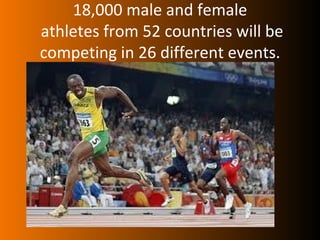
18,000 male and female
athletes from 52 countries will be
competing in 26 different events.
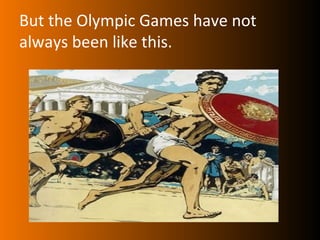
But the Olympic Games have not
always been like this.
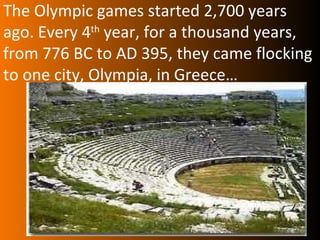
The Olympic games started 2,700 years
ago. Every 4th year, for a thousand years,
from 776 BC to AD 395, they came flocking
to one city, Olympia, in Greece…
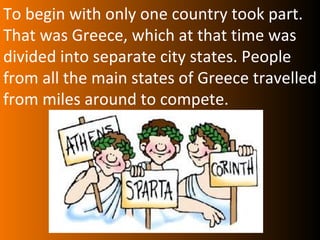
To begin with only one country took part.
That was Greece, which at that time was
divided into separate city states. People
from all the main states of Greece travelled
from miles around to compete.
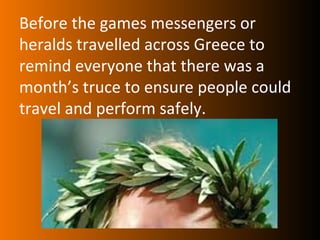
Before the games messengers or
heralds travelled across Greece to
remind everyone that there was a
month’s truce to ensure people could
travel and perform safely.
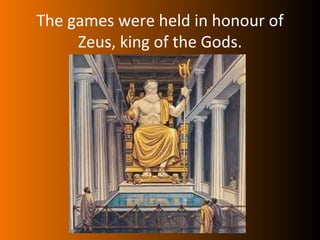
The games were held in honour of
     Zeus, king of the Gods.
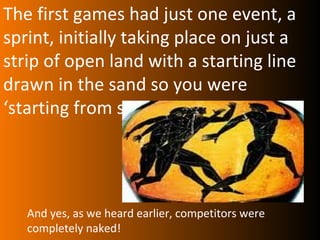
The first games had just one event, a
sprint, initially taking place on just a
strip of open land with a starting line
drawn in the sand so you were
‘starting from scratch’.


   And yes, as we heard earlier, competitors were
   completely naked!
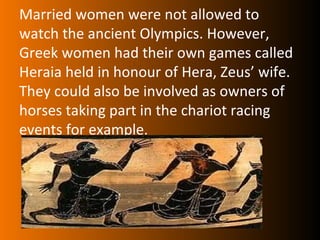
Married women were not allowed to
watch the ancient Olympics. However,
Greek women had their own games called
Heraia held in honour of Hera, Zeus’ wife.
They could also be involved as owners of
horses taking part in the chariot racing
events for example.
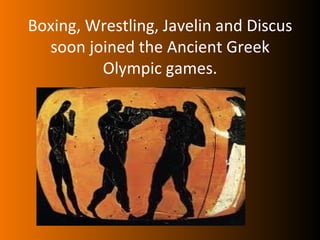
Boxing, Wrestling, Javelin and Discus
  soon joined the Ancient Greek
         Olympic games.
A winner received an olive wreath, he
might have been given free meals for life
when he returned home. He might have
had a statue put up in his name or an ode
written about him, married a rich woman
and had the best seats at the theatre.
About 50,000 people could camp and
sit in the stadium; it was very hot and
very crowded. Jugglers and acrobats
performed. The games ended with a
great feast.

Ancient versus modern olympic gamest

  • 1.
    THE Ancient vs.Modern OLYMPIC GAMES
  • 2.
    The modern Olympicgames take place every four years in a major city. This summer, they take place in London.
  • 3.
    18,000 male andfemale athletes from 52 countries will be competing in 26 different events.
  • 4.
    But the OlympicGames have not always been like this.
  • 5.
    The Olympic gamesstarted 2,700 years ago. Every 4th year, for a thousand years, from 776 BC to AD 395, they came flocking to one city, Olympia, in Greece…
  • 6.
    To begin withonly one country took part. That was Greece, which at that time was divided into separate city states. People from all the main states of Greece travelled from miles around to compete.
  • 7.
    Before the gamesmessengers or heralds travelled across Greece to remind everyone that there was a month’s truce to ensure people could travel and perform safely.
  • 8.
    The games wereheld in honour of Zeus, king of the Gods.
  • 9.
    The first gameshad just one event, a sprint, initially taking place on just a strip of open land with a starting line drawn in the sand so you were ‘starting from scratch’. And yes, as we heard earlier, competitors were completely naked!
  • 10.
    Married women werenot allowed to watch the ancient Olympics. However, Greek women had their own games called Heraia held in honour of Hera, Zeus’ wife. They could also be involved as owners of horses taking part in the chariot racing events for example.
  • 11.
    Boxing, Wrestling, Javelinand Discus soon joined the Ancient Greek Olympic games.
  • 12.
    A winner receivedan olive wreath, he might have been given free meals for life when he returned home. He might have had a statue put up in his name or an ode written about him, married a rich woman and had the best seats at the theatre.
  • 13.
    About 50,000 peoplecould camp and sit in the stadium; it was very hot and very crowded. Jugglers and acrobats performed. The games ended with a great feast.

Editor's Notes

  • #2 Introduce myself and the assembly. Schools across the country this summer having assemblies on the ancient origin of the modern Olympics. As we have a classics department I need only to summarise what I know you’ve already covered in your classics lessons. So what is different between the ancient and modern Olympics?
  • #5 Watch a clip from Horrible Histories as our starter.
  • #6 There were no winter olympics, no skiing down the slopes of Mount Olympus, after all that’s where they thought the gods lived, and certainly no paraolympics – about body perfection.
  • #7 Each year 7 form group worked on a presentation about a different country. By the end of the ancient games other countries and people such as the Romans took part.
  • #8 Difference with the modern games is that we had to stop them during the period of the world wars as it was unsafe for people to travel and compete against each other. But the country where the games take place today send publicity messages reminding locals of the games as we’ve seen on our televisions increasingly today. But it wasn’t an olympic torch that they carried but olive wreaths and sticks. The torch is just a symbol of the connection with the ancient games not because they used them.
  • #9 The image is an artist’s impression of the 13 metre high statue of Zeus made from gold and ivory which was built about 300 years after the start of the games and became one of the 7 wonders of the ancient world. So, people would come to the Olympic site as they would to a modern tourist attraction – a combination of Wembley stadium and Westminster Abbey.
  • #10 Ancient Greeks weren’t as bothered about nudity as we are as you all know from the images you’re shown in classics lessons from the time. Competing naked meant that the competitors could really show off their muscular bodies – the ancient olympics weren’t so much about winning for your country but for yourself as an individual. They were closed to women though it's said that a mother who wanted to see her son disguised herself as a male trainer (after this, all trainers and athletes had to enter the stadia in the buff). The finish line originally was close to the altar of Zeus.
  • #11 possibly thought only virgins were pure enough
  • #12 No beach volleyball, synchronised swimming, but also chariot racing.
  • #13 There were prizes only for the winners, coming second or third counted for nothing.
  • #14 How many of you will be going to the games in London? Estimates of 4 billion people going to watch this summer. If you’re one of those, enjoy them and remember to educate those around you with the classical origin of the games! Powerpoint in your Fronter room.