The Greek Olympics


Right from the start in 776 BC -
             2012
The Olympic games
                    A    ncient Greeks loved sport and most cities in Ancient Greece had public gymnasiums
                    where people gathered to train and relax. The Greeks believed that a healthy body was very
                    important. Most men and boys practiced sports every day because they enjoyed them and
                    wanted to keep fit. Sport was a good preparation for war too. The Greek armies had to be fit
                    enough to march long distances, carrying all their heavy equipment, and then begin the
                    fight with the enemy.


                     T      he Greeks had four national sports festivals, where athletes from different city

                    states competed against one another. The most important of the sports contests was the
                    Olympic Games. These were played at Olympia, every four years, in honor of Zeus. On the
                    first day of the Olympics, sacrifices of grain, wine, and lambs were made to Zeus.
                    Olympic Games
                    Greece is the home country of the Olympic Games. Olympia, a Greek city, was known to be
                    a very important center of athletics. The Olympic games, held there every four years, were
                    so important in Greek life that they were used as the basis for the Greek calendar.


                    The Olympic Games began over 2,700 years ago in Olympia, in southwest
                    Greece. The Games were part of a religious festival. The Greek Olympics,
                    thought to have begun in 776 BC, inspired the modern Olympic Games (begun in
                    1896) The Games were held in honour of Zeus, king of the gods, and were
                    staged every four years at Olympia, a valley near a city called Elis. People from
                    all over the Greek world came to watch and take part
Who were the ancient   The earliest Greek civilizations thrived nearly 4,000 years ago. The
                       Ancient Greeks lived in Greece and the countries that we now call
                       Bulgaria and Turkey.
                       The Ancient Greece empire spread over Europe as far as France in the
                       East. The Greek Empire was most powerful between    2000 BC and
                       146 BC
     Greeks?

                       The ancient Greeks developed new ideas for government, science,
                       philosophy, religion, and art.
                       Ancient Greece was split into many different states, each one was ruled
                       in its own way. Each state had its own laws, government and money but
                       they shared the same language and religion The two most important city
                       states were Athens and Sparta.
Where were the Olympic
Games held in Greece?The Olympics were held in Greece and
                     it was quite close to mount Olympus so
                     they decided to have it in a little village
                     called Olympia and that’s where they
                     light the Olympic torch relay from .
Why do we have an


                    The Olympics were part of a
                    religious event. They were
                    held in honour of Zeus, the
                    father of the gods and were
Olympics?


                    a big celebration.
Probably the pankration or all-in wrestling was the
               nastiest event. There were hardly any rules. Biting and
               poking people's eyes were officially banned, but some
               competitors did both! While it does not seem very
The nastiest
               sporting to us, all-in wrestling was very popular. Boxing
               was tough too. The fighters wore leather gloves and a
               boxer was allowed to go on hitting his opponent even
               after he'd knocked him to the ground!

               However, cheating was punished. Anyone caught
               cheating, trying to bribe an athlete for instance, had to
               pay for a bronze statue of Zeus, as a punishment.
event?
What was the sacred t
                         The city-states of Greece were often at
                        war. This made travel between them
                        dangerous. So messengers sent out
                        from Elis announced a 'sacred truce'
                        (peace) lasting one month before the
                        Games began. This meant people could
                        travel to Olympia in safety. The Olympic
                        Games were more important than wars
                        because they were a religious festival.
                        The messengers went all over the
                        Greek world, as the map shows.
At the first one-day Olympic Games, the only event was a short
Events at the game   sprint from one end of the stadium to the other. Gradually more
                     events were added to make four days of competitions. They
                     included
                     • wrestling,
                     • boxing,
                     • long jump,
                     • throwing the javelin and discus,
                     • and chariot racing.

                      In the pentathlon, there were five events:
                     • Running,
                     • wrestling,
                     • javelin,
                     • discus and long jump.

                     One of the toughest events was the race for hoplites, men
                     wearing armour and carrying shields.
                     Winners were given a wreath of leaves, and a hero's welcome
                     back home. Winners might marry rich women, enjoy free meals,
                     invitations to parties, and the best seats in the theatre.
                     The running track was much wider than a modern one. Twenty
                     people could run at once.
Women in Olympia
                   Only men, boys and unmarried girls were
                   allowed to attend the Olympic Games.
                   Married women were not allowed into the
                   Olympic Games. Any women caught
                   sneaking in were punished! Women could
                   own horses in the chariot race though.

                   Unmarried women had their own festival at
                   Olympia every four years. This was the
                   Heraia, held in honour of Hera, wife
                   of Zeus. Women could compete in running
                   races, though only unmarried girls took
                   part. Winners were awarded crowns of
                   sacred olive branches, the same as men.
                   As a rule Greek women did not go in for
                   sport, unless they were Spartans.
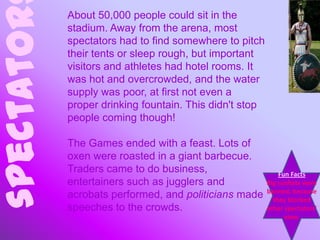
spectator   About 50,000 people could sit in the
            stadium. Away from the arena, most
            spectators had to find somewhere to pitch
            their tents or sleep rough, but important
            visitors and athletes had hotel rooms. It
            was hot and overcrowded, and the water
            supply was poor, at first not even a
            proper drinking fountain. This didn't stop
            people coming though!

            The Games ended with a feast. Lots of
            oxen were roasted in a giant barbecue.
            Traders came to do business,                     Fun Facts
            entertainers such as jugglers and            Big sunhats were
                                                         banned, because
            acrobats performed, and politicians made       they blocked
            speeches to the crowds.                      other spectators'
                                                               view.
Thank You For Watching !
I hope you learned lots
about the Ancient Greek
        Olympics.
  GO GREECE/GO GB!!!!!!!!!!


     By Lucy Leeds

The Greek olympics Lucy

  • 1.
    The Greek Olympics Rightfrom the start in 776 BC - 2012
  • 2.
    The Olympic games A ncient Greeks loved sport and most cities in Ancient Greece had public gymnasiums where people gathered to train and relax. The Greeks believed that a healthy body was very important. Most men and boys practiced sports every day because they enjoyed them and wanted to keep fit. Sport was a good preparation for war too. The Greek armies had to be fit enough to march long distances, carrying all their heavy equipment, and then begin the fight with the enemy. T he Greeks had four national sports festivals, where athletes from different city states competed against one another. The most important of the sports contests was the Olympic Games. These were played at Olympia, every four years, in honor of Zeus. On the first day of the Olympics, sacrifices of grain, wine, and lambs were made to Zeus. Olympic Games Greece is the home country of the Olympic Games. Olympia, a Greek city, was known to be a very important center of athletics. The Olympic games, held there every four years, were so important in Greek life that they were used as the basis for the Greek calendar. The Olympic Games began over 2,700 years ago in Olympia, in southwest Greece. The Games were part of a religious festival. The Greek Olympics, thought to have begun in 776 BC, inspired the modern Olympic Games (begun in 1896) The Games were held in honour of Zeus, king of the gods, and were staged every four years at Olympia, a valley near a city called Elis. People from all over the Greek world came to watch and take part
  • 3.
    Who were theancient The earliest Greek civilizations thrived nearly 4,000 years ago. The Ancient Greeks lived in Greece and the countries that we now call Bulgaria and Turkey. The Ancient Greece empire spread over Europe as far as France in the East. The Greek Empire was most powerful between 2000 BC and 146 BC Greeks? The ancient Greeks developed new ideas for government, science, philosophy, religion, and art. Ancient Greece was split into many different states, each one was ruled in its own way. Each state had its own laws, government and money but they shared the same language and religion The two most important city states were Athens and Sparta.
  • 4.
    Where were theOlympic Games held in Greece?The Olympics were held in Greece and it was quite close to mount Olympus so they decided to have it in a little village called Olympia and that’s where they light the Olympic torch relay from .
  • 5.
    Why do wehave an The Olympics were part of a religious event. They were held in honour of Zeus, the father of the gods and were Olympics? a big celebration.
  • 6.
    Probably the pankrationor all-in wrestling was the nastiest event. There were hardly any rules. Biting and poking people's eyes were officially banned, but some competitors did both! While it does not seem very The nastiest sporting to us, all-in wrestling was very popular. Boxing was tough too. The fighters wore leather gloves and a boxer was allowed to go on hitting his opponent even after he'd knocked him to the ground! However, cheating was punished. Anyone caught cheating, trying to bribe an athlete for instance, had to pay for a bronze statue of Zeus, as a punishment. event?
  • 7.
    What was thesacred t The city-states of Greece were often at war. This made travel between them dangerous. So messengers sent out from Elis announced a 'sacred truce' (peace) lasting one month before the Games began. This meant people could travel to Olympia in safety. The Olympic Games were more important than wars because they were a religious festival. The messengers went all over the Greek world, as the map shows.
  • 8.
    At the firstone-day Olympic Games, the only event was a short Events at the game sprint from one end of the stadium to the other. Gradually more events were added to make four days of competitions. They included • wrestling, • boxing, • long jump, • throwing the javelin and discus, • and chariot racing. In the pentathlon, there were five events: • Running, • wrestling, • javelin, • discus and long jump. One of the toughest events was the race for hoplites, men wearing armour and carrying shields. Winners were given a wreath of leaves, and a hero's welcome back home. Winners might marry rich women, enjoy free meals, invitations to parties, and the best seats in the theatre. The running track was much wider than a modern one. Twenty people could run at once.
  • 9.
    Women in Olympia Only men, boys and unmarried girls were allowed to attend the Olympic Games. Married women were not allowed into the Olympic Games. Any women caught sneaking in were punished! Women could own horses in the chariot race though. Unmarried women had their own festival at Olympia every four years. This was the Heraia, held in honour of Hera, wife of Zeus. Women could compete in running races, though only unmarried girls took part. Winners were awarded crowns of sacred olive branches, the same as men. As a rule Greek women did not go in for sport, unless they were Spartans.
  • 10.
    spectator About 50,000 people could sit in the stadium. Away from the arena, most spectators had to find somewhere to pitch their tents or sleep rough, but important visitors and athletes had hotel rooms. It was hot and overcrowded, and the water supply was poor, at first not even a proper drinking fountain. This didn't stop people coming though! The Games ended with a feast. Lots of oxen were roasted in a giant barbecue. Traders came to do business, Fun Facts entertainers such as jugglers and Big sunhats were banned, because acrobats performed, and politicians made they blocked speeches to the crowds. other spectators' view.
  • 11.
    Thank You ForWatching ! I hope you learned lots about the Ancient Greek Olympics. GO GREECE/GO GB!!!!!!!!!! By Lucy Leeds

Editor's Notes

  • #3 I wrote this by hand it took me ages to do it because it was hard and I put it in my own words!