An c ie n t G a m e s a n d
  Mo d e r n Ga m e s
The Ancient
    lym p ics
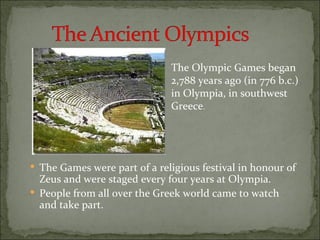
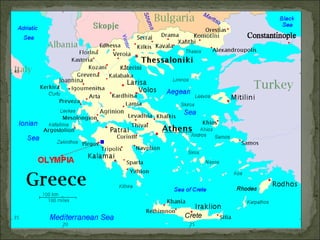
The Olympic Games began
                              2,788 years ago (in 776 b.c.)
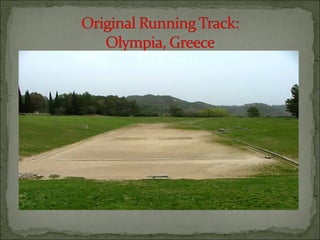
                              in Olympia, in southwest
                              Greece.


 The Games were part of a religious festival in honour of
  Zeus and were staged every four years at Olympia.
 People from all over the Greek world came to watch
  and take part.
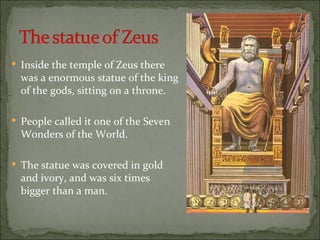
 Inside the temple of Zeus there
  was a enormous statue of the king
  of the gods, sitting on a throne.

 People called it one of the Seven
  Wonders of the World.

 The statue was covered in gold
  and ivory, and was six times
  bigger than a man.
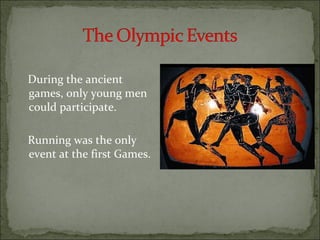
During the ancient
games, only young men
could participate.

Running was the only
event at the first Games.
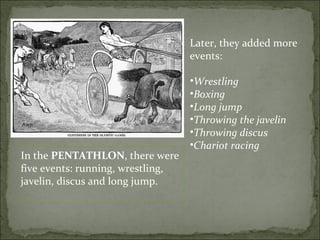
Later, they added more
                                   events:

                                   •Wrestling
                                   •Boxing
                                   •Long jump
                                   •Throwing the javelin
                                   •Throwing discus
                                   •Chariot racing
In the PENTATHLON, there were
five events: running, wrestling,
javelin, discus and long jump.
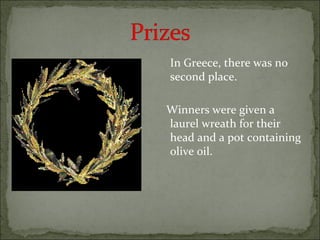
In Greece, there was no
second place.

Winners were given a
laurel wreath for their
head and a pot containing
olive oil.
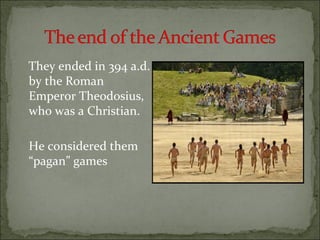
They ended in 394 a.d.
by the Roman
Emperor Theodosius,
who was a Christian.

He considered them
“pagan” games
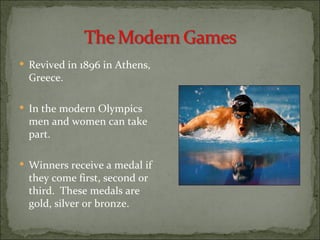
 Revived in 1896 in Athens,
  Greece.

 In the modern Olympics
  men and women can take
  part.

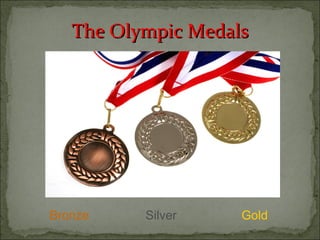
 Winners receive a medal if
  they come first, second or
  third. These medals are
  gold, silver or bronze.
The Olympic Medals


Bronze    Silver    Gold
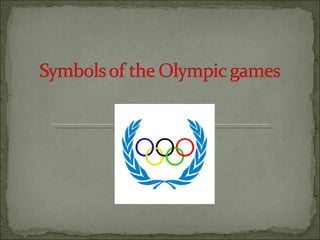
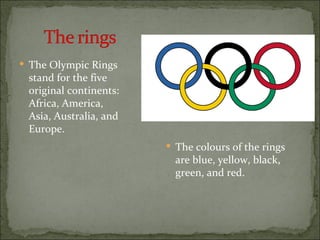
 The Olympic Rings
 stand for the five
 original continents:
 Africa, America,
 Asia, Australia, and
 Europe.
                         The colours of the rings
                          are blue, yellow, black,
                          green, and red.
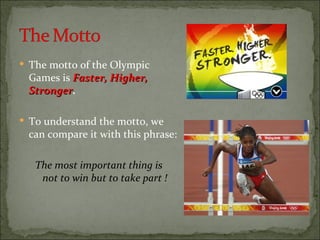
 The motto of the Olympic
 Games is Faster, Higher,
 Stronger.
 Stronger

 To understand the motto, we
 can compare it with this phrase:

   The most important thing is
    not to win but to take part !
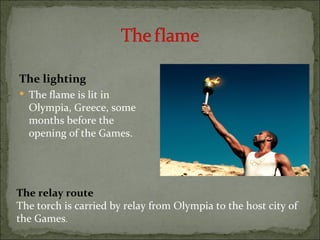
The lighting
 The flame is lit in
  Olympia, Greece, some
  months before the
  opening of the Games.


The relay route
The torch is carried by relay from Olympia to the host city of
the Games.
Arrival at the stadium

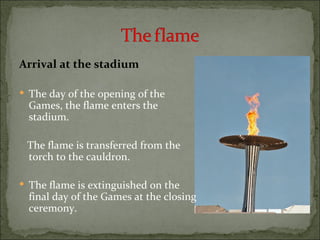
 The day of the opening of the
  Games, the flame enters the
  stadium.

 The flame is transferred from the
 torch to the cauldron.

 The flame is extinguished on the
  final day of the Games at the closing
  ceremony.
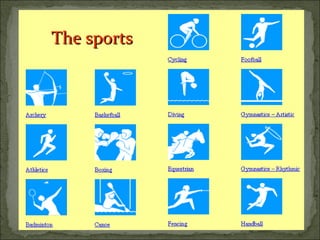
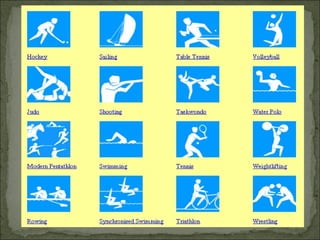
The sports
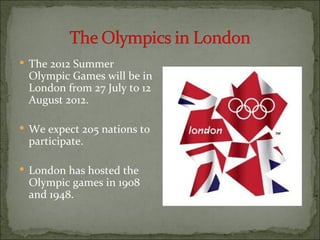
 The 2012 Summer
 Olympic Games will be in
 London from 27 July to 12
 August 2012.

 We expect 205 nations to
 participate.

 London has hosted the
 Olympic games in 1908
 and 1948.
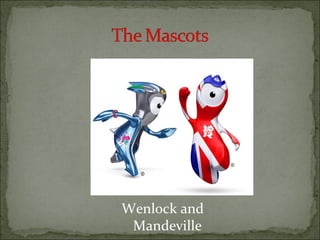
Wenlock and
 Mandeville

The Olympic Games

  • 1.
    An c ien t G a m e s a n d Mo d e r n Ga m e s
  • 2.
    The Ancient lym p ics
  • 3.
    The Olympic Gamesbegan 2,788 years ago (in 776 b.c.) in Olympia, in southwest Greece.  The Games were part of a religious festival in honour of Zeus and were staged every four years at Olympia.  People from all over the Greek world came to watch and take part.
  • 6.
     Inside thetemple of Zeus there was a enormous statue of the king of the gods, sitting on a throne.  People called it one of the Seven Wonders of the World.  The statue was covered in gold and ivory, and was six times bigger than a man.
  • 7.
    During the ancient games,only young men could participate. Running was the only event at the first Games.
  • 8.
    Later, they addedmore events: •Wrestling •Boxing •Long jump •Throwing the javelin •Throwing discus •Chariot racing In the PENTATHLON, there were five events: running, wrestling, javelin, discus and long jump.
  • 9.
    In Greece, therewas no second place. Winners were given a laurel wreath for their head and a pot containing olive oil.
  • 10.
    They ended in394 a.d. by the Roman Emperor Theodosius, who was a Christian. He considered them “pagan” games
  • 11.
     Revived in1896 in Athens, Greece.  In the modern Olympics men and women can take part.  Winners receive a medal if they come first, second or third. These medals are gold, silver or bronze.
  • 13.
  • 14.
     The OlympicRings stand for the five original continents: Africa, America, Asia, Australia, and Europe.  The colours of the rings are blue, yellow, black, green, and red.
  • 15.
     The mottoof the Olympic Games is Faster, Higher, Stronger. Stronger  To understand the motto, we can compare it with this phrase: The most important thing is not to win but to take part !
  • 16.
    The lighting  Theflame is lit in Olympia, Greece, some months before the opening of the Games. The relay route The torch is carried by relay from Olympia to the host city of the Games.
  • 17.
    Arrival at thestadium  The day of the opening of the Games, the flame enters the stadium. The flame is transferred from the torch to the cauldron.  The flame is extinguished on the final day of the Games at the closing ceremony.
  • 18.
  • 20.
     The 2012Summer Olympic Games will be in London from 27 July to 12 August 2012.  We expect 205 nations to participate.  London has hosted the Olympic games in 1908 and 1948.
  • 21.