








THE FAMILY IN
ANCIENT TIMES
    SPARTA
    ATHENS
     ROME
   The human family is an established bio-social unit (biolocial group) consisting
    of two adult heterosexual and non-blood relatives who are coupled and
    whose children make up a so-called "nuclear family ". The minimum
    functions of these core groups (in the broadest form) is to provide
    satisfaction and control needs of affection including sexual relations, and
    maintaining a "socio-cultural" situation (sociocultural situation) for a proper
    upbringing and socialization of their children.
   Each group as described above, who simultaneously perform the minimum
    functions mentioned is called a "family”. The structure of each family,
    typically related by kinship or property (see the role of slaves in ancient
    Greece and ancient Rome), has evolved to date and results in different
    “types" of families analyzed below.
   The Spartan family was quite different from that
    of other Ancient Greek city-states. The word
    "spartan” describes self-denial and simplicity.
    This is what Spartan life was all about. Children
    were “children of the state” more than of their
    parents. They were raised to be soldiers, loyal to
    the state, strong and self-disciplined.
   It began in infancy. When a Spartan baby was
    born, soldiers came to the house and examined
    it carefully to determine its strength.The baby
    was bathed in wine rather than water, to see its
    reaction. If a baby was weak, the Spartans left it
    on the hillside or sent it away to become a slave
    (helot). Infanticide was common in ancient
    cultures, but the Spartans were particularly picky
    about their children. It was not just a matter of
    the family, it was the city-state who decided the
    fate of the child. Nurses had the primary care of
    the baby.
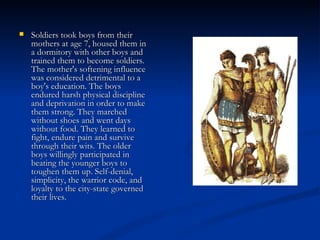
   Soldiers took boys from their
    mothers at age 7, housed them in
    a dormitory with other boys and
    trained them to become soldiers.
    The mother's softening influence
    was considered detrimental to a
    boy's education. The boys
    endured harsh physical discipline
    and deprivation in order to make
    them strong. They marched
    without shoes and went days
    without food. They learned to
    fight, endure pain and survive
    through their wits. The older
    boys willingly participated in
    beating the younger boys to
    toughen them up. Self-denial,
    simplicity, the warrior code, and
    loyalty to the city-state governed
    their lives.
   Spartan children were told
    stories of courage and
    fortitude. One favorite
    story was about a boy who
    followed the Spartan code.
    He captured a live fox and
    intended to eat it.
    Although boys were
    encouraged to scrounge
    for food, they were
    punished if caught. The
    boy noticed some Spartan
    soldiers coming, and hid
    the fox beneath his shirt.
    When the soldiers
    confronted him, he
    allowed the fox to chew
    into his stomach rather
    than confess, and showed
    no sign of pain in his body
    or face. This was the
    Spartan way.
   At the age of 20 or so, they had to pass a rigorous test
    to graduate and become full citizens. Only soldiers
    were given “aristocratic” citizenship. If they failed their
    tests they never became citizens, but instead, became
    perioeci, the middle class. So to some extent, class was
    based on merit rather than birth.
   If the young men passed their test, they continued to
    live in the barracks and train as soldiers but were
    required to marry in order to breed new, young
    Spartans. The state gave them a piece of land which
    was cultivated by slaves and which they themselves did
    nothing for. They were given a salary so they would
    remain full-time soldiers. At the age of 30 they were
    allowed to live with their families, but continued to
    train until the age of 60 when they retired from military
    service.
   Girls were also removed from their homes at the age of
    7 and sent to school. There, they learned wrestling,
    gymnastics, were taught to fight, and endured harsh
    physical training. Spartans believed that strong mothers
    produced strong children. Young women competed in
    athletic events and may have also competed in the nude
    as men did.
   If they passed their citizen tests, they were assigned to a
    husband. Because this did not happen until they were
    18-20, they were more emotionally mature when they
    married and closer to the age of their husbands.
    Marrying later than other Greek women, the Spartan
    women produced stronger children. To prepare for
    their wedding night, their hair was cut short and were
    dressed in male clothing. Afterwards, the manreturned
    to his all-male barracks.
   Men and women did not live together, but met occasionally for
    procreation. The wedding consisted of a ritualized physical
    struggle which resulted in the man slinging the woman over his
    shoulder and taking her off. By the end of the 4th century BCE,
    there were more women than men in Sparta and women often
    had more than one father for their children, as several men could
    share the same wife. Connubial love was discouraged by the city-
    state, but there is evidence that some husbands and wives loved
    each other very much. This fact would embarrass them if it were
    known, a shameful weakness, so such attachments were usually
    kept secret.
   Women enjoyed much greater freedom and independence in
    Sparta than in other Greek city-states. Because mothers had little
    responsibility for the care of their children, they were not as tied
    to the home as most Greek women were. They were allowed to
    walk in the city and transact their own affairs. They owned their
    own property, which was as much as a third of the property in
    Sparta. Their husbands were only a minor part of their lives, and
    apart from matters relating to the military, were generally
    independent.
   They were not as close to their children as other Greek
    women in some ways, but a mother had pride in her
    son's stature as a courageous and strong soldier. “Come
    home with your shield or upon it” was said to be the
    advice one woman gave her son as he went off to war.
    They shared the culture's shame of weakness.
   Although the Spartans did not have a family life as we
    think of it, there is evidence that in some cases at least
    Spartan men and women had close ties to their children
    as well as with each other. Their system certainly was
    well-ordered and avoided the "moral degeneration"
    which they despised in the Athenians who they saw as
    wallowing in luxuries. And their is no doubt that the
    system produced strong soldiers. The Spartan army was
    legendary in ancient Greece, and the legend continues
    to this day.
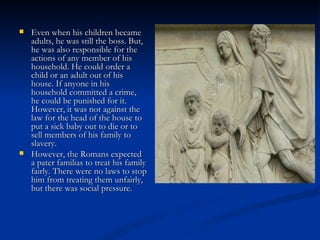
   Before the Imperial Age, in very early Roman times, a
    typical Roman family included unmarried children,
    married sons and their families, other relatives, and
    family slaves. 
   The ruler of the family was the oldest male. This
    could be the father, the grandfather, or perhaps even an
    uncle. His title was pater familias. The pater familias led
    religious ceremonies, taught his sons how to farm, and
    made all the important decisions. His word was law as
    far as his family was concerned. He owned the
    property, had total authority and the power of life and
    death over every member of his household. 
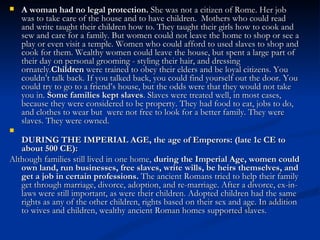
   Even when his children became
    adults, he was still the boss. But,
    he was also responsible for the
    actions of any member of his
    household. He could order a
    child or an adult out of his
    house. If anyone in his
    household committed a crime,
    he could be punished for it.
    However, it was not against the
    law for the head of the house to
    put a sick baby out to die or to
    sell members of his family to
    slavery.
   However, the Romans expected
    a pater familias to treat his family
    fairly. There were no laws to stop
    him from treating them unfairly,
    but there was social pressure.  
   A woman had no legal protection. She was not a citizen of Rome. Her job
    was to take care of the house and to have children.  Mothers who could read
    and write taught their children how to. They taught their girls how to cook and
    sew and care for a family. But women could not leave the home to shop or see a
    play or even visit a temple. Women who could afford to used slaves to shop and
    cook for them. Wealthy women could leave the house, but spent a large part of
    their day on personal grooming - styling their hair, and dressing
    ornately.Children were trained to obey their elders and be loyal citizens. You
    couldn’t talk back. If you talked back, you could find yourself out the door. You
    could try to go to a friend’s house, but the odds were that they would not take
    you in. Some families kept slaves. Slaves were treated well, in most cases,
    because they were considered to be property. They had food to eat, jobs to do,
    and clothes to wear but were not free to look for a better family. They were
    slaves. They were owned.

   DURING THE IMPERIAL AGE, the age of Emperors: (late 1c CE to
   about 500 CE):
Although families still lived in one home, during the Imperial Age, women could
   own land, run businesses, free slaves, write wills, be heirs themselves, and
   get a job in certain professions. The ancient Romans tried to help their family
   get through marriage, divorce, adoption, and re-marriage. After a divorce, ex-in-
   laws were still important, as were their children. Adopted children had the same
   rights as any of the other children, rights based on their sex and age. In addition
   to wives and children, wealthy ancient Roman homes supported slaves.
   Old Age: The ancient Romans greatly respected
    and cared for their elderly. When the older members
    of a family became too tired for other activities, they
    could always play with their grandchildren and great
    grandchildren, all of whom had been born under their
    roof, and would one day be honoring them at
    the Parentalia, the festival of the dead.
   Slaves: Wealthy ancient Romans had slaves. In
    some homes, slaves were treated like valued servants. In
    others, they were severely abused. Slaves kept the
    furnaces burning in the bath houses, cooked meals in
    smoking chimneys in the kitchens, cleaned, sewed, and
    did the household and garden labor for wealthy
    Romans. Intelligent and gifted slaves also tutored the
    kids (those kids who studied their subjects at home),
    kept the accounts, and sometimes ran vast farm estates
    or commercial departments of their masters' firms.
   Most Greeks, like most other people throughout history, lived in 
    families which consisted of a mother, a father and their
    children. Usually men got married when they were about twenty-
    five or thirty years old (as they do today), but women got married
    much younger, between the age of twelve and sixteen.
   Girls from rich families probably got married younger, and girls
    from poor families got married a little older. Because the girls
    were so young, they did not have much choice about who they
    were going to marry. Their fathers, uncles or brothers chose for
    them. Often girls had not even met the man they married before
    the wedding.
   There was no marriage ceremony as we know it today.
    The parents arranged it, and then there was a party,
    and the girl's parents paid a dowry to the man, and
    then the girl moved into the man's house. If they were
    both citizens, and she lived in his house, then they
    were legally married. If she moved out of his house,
    then they were divorced. 
    Usually there were other people living in the house as
    well. Sometimes his parents would be there, if they
    were still alive and if they weren't living with another
    brother. Many people had slaves living in the house
    with them too. Some people had their unmarried
    sisters or widowed sisters living with them. 
    Wealthy Greek women hardly ever went out of the
    house alone. Mostly when they went out it was to go
    to weddings and funerals and religious ceremonies,
    or to visit other women. Poor women, who didn't
    have slaves, went out to get water from the fountain,
    and sometimes to work in the fields or to sell 
    vegetables or flowers in the marketplace. 
    Divorce was pretty common in ancient Greece. If you
    got divorced, the man had to return the woman's
    dowry, so she would have some money to live off of.
    The children stayed with their father, learning to run
    the farm or business that they would later inherit.
Here are some videos…
The families in the ancience

The families in the ancience

  • 1.
    THE FAMILY IN ANCIENTTIMES SPARTA ATHENS ROME
  • 2.
    The human family is an established bio-social unit (biolocial group) consisting of two adult heterosexual and non-blood relatives who are coupled and whose children make up a so-called "nuclear family ". The minimum functions of these core groups (in the broadest form) is to provide satisfaction and control needs of affection including sexual relations, and maintaining a "socio-cultural" situation (sociocultural situation) for a proper upbringing and socialization of their children.  Each group as described above, who simultaneously perform the minimum functions mentioned is called a "family”. The structure of each family, typically related by kinship or property (see the role of slaves in ancient Greece and ancient Rome), has evolved to date and results in different “types" of families analyzed below.
  • 3.
    The Spartan family was quite different from that of other Ancient Greek city-states. The word "spartan” describes self-denial and simplicity. This is what Spartan life was all about. Children were “children of the state” more than of their parents. They were raised to be soldiers, loyal to the state, strong and self-disciplined.
  • 4.
    It began in infancy. When a Spartan baby was born, soldiers came to the house and examined it carefully to determine its strength.The baby was bathed in wine rather than water, to see its reaction. If a baby was weak, the Spartans left it on the hillside or sent it away to become a slave (helot). Infanticide was common in ancient cultures, but the Spartans were particularly picky about their children. It was not just a matter of the family, it was the city-state who decided the fate of the child. Nurses had the primary care of the baby.
  • 5.
    Soldiers took boys from their mothers at age 7, housed them in a dormitory with other boys and trained them to become soldiers. The mother's softening influence was considered detrimental to a boy's education. The boys endured harsh physical discipline and deprivation in order to make them strong. They marched without shoes and went days without food. They learned to fight, endure pain and survive through their wits. The older boys willingly participated in beating the younger boys to toughen them up. Self-denial, simplicity, the warrior code, and loyalty to the city-state governed their lives.
  • 6.
    Spartan children were told stories of courage and fortitude. One favorite story was about a boy who followed the Spartan code. He captured a live fox and intended to eat it. Although boys were encouraged to scrounge for food, they were punished if caught. The boy noticed some Spartan soldiers coming, and hid the fox beneath his shirt. When the soldiers confronted him, he allowed the fox to chew into his stomach rather than confess, and showed no sign of pain in his body or face. This was the Spartan way.
  • 7.
    At the age of 20 or so, they had to pass a rigorous test to graduate and become full citizens. Only soldiers were given “aristocratic” citizenship. If they failed their tests they never became citizens, but instead, became perioeci, the middle class. So to some extent, class was based on merit rather than birth.  If the young men passed their test, they continued to live in the barracks and train as soldiers but were required to marry in order to breed new, young Spartans. The state gave them a piece of land which was cultivated by slaves and which they themselves did nothing for. They were given a salary so they would remain full-time soldiers. At the age of 30 they were allowed to live with their families, but continued to train until the age of 60 when they retired from military service.
  • 8.
    Girls were also removed from their homes at the age of 7 and sent to school. There, they learned wrestling, gymnastics, were taught to fight, and endured harsh physical training. Spartans believed that strong mothers produced strong children. Young women competed in athletic events and may have also competed in the nude as men did.  If they passed their citizen tests, they were assigned to a husband. Because this did not happen until they were 18-20, they were more emotionally mature when they married and closer to the age of their husbands. Marrying later than other Greek women, the Spartan women produced stronger children. To prepare for their wedding night, their hair was cut short and were dressed in male clothing. Afterwards, the manreturned to his all-male barracks.
  • 9.
    Men and women did not live together, but met occasionally for procreation. The wedding consisted of a ritualized physical struggle which resulted in the man slinging the woman over his shoulder and taking her off. By the end of the 4th century BCE, there were more women than men in Sparta and women often had more than one father for their children, as several men could share the same wife. Connubial love was discouraged by the city- state, but there is evidence that some husbands and wives loved each other very much. This fact would embarrass them if it were known, a shameful weakness, so such attachments were usually kept secret.  Women enjoyed much greater freedom and independence in Sparta than in other Greek city-states. Because mothers had little responsibility for the care of their children, they were not as tied to the home as most Greek women were. They were allowed to walk in the city and transact their own affairs. They owned their own property, which was as much as a third of the property in Sparta. Their husbands were only a minor part of their lives, and apart from matters relating to the military, were generally independent.
  • 10.
    They were not as close to their children as other Greek women in some ways, but a mother had pride in her son's stature as a courageous and strong soldier. “Come home with your shield or upon it” was said to be the advice one woman gave her son as he went off to war. They shared the culture's shame of weakness.  Although the Spartans did not have a family life as we think of it, there is evidence that in some cases at least Spartan men and women had close ties to their children as well as with each other. Their system certainly was well-ordered and avoided the "moral degeneration" which they despised in the Athenians who they saw as wallowing in luxuries. And their is no doubt that the system produced strong soldiers. The Spartan army was legendary in ancient Greece, and the legend continues to this day.
  • 11.
    Before the Imperial Age, in very early Roman times, a typical Roman family included unmarried children, married sons and their families, other relatives, and family slaves.   The ruler of the family was the oldest male. This could be the father, the grandfather, or perhaps even an uncle. His title was pater familias. The pater familias led religious ceremonies, taught his sons how to farm, and made all the important decisions. His word was law as far as his family was concerned. He owned the property, had total authority and the power of life and death over every member of his household. 
  • 12.
    Even when his children became adults, he was still the boss. But, he was also responsible for the actions of any member of his household. He could order a child or an adult out of his house. If anyone in his household committed a crime, he could be punished for it. However, it was not against the law for the head of the house to put a sick baby out to die or to sell members of his family to slavery.  However, the Romans expected a pater familias to treat his family fairly. There were no laws to stop him from treating them unfairly, but there was social pressure.  
  • 13.
    A woman had no legal protection. She was not a citizen of Rome. Her job was to take care of the house and to have children.  Mothers who could read and write taught their children how to. They taught their girls how to cook and sew and care for a family. But women could not leave the home to shop or see a play or even visit a temple. Women who could afford to used slaves to shop and cook for them. Wealthy women could leave the house, but spent a large part of their day on personal grooming - styling their hair, and dressing ornately.Children were trained to obey their elders and be loyal citizens. You couldn’t talk back. If you talked back, you could find yourself out the door. You could try to go to a friend’s house, but the odds were that they would not take you in. Some families kept slaves. Slaves were treated well, in most cases, because they were considered to be property. They had food to eat, jobs to do, and clothes to wear but were not free to look for a better family. They were slaves. They were owned.  DURING THE IMPERIAL AGE, the age of Emperors: (late 1c CE to about 500 CE): Although families still lived in one home, during the Imperial Age, women could own land, run businesses, free slaves, write wills, be heirs themselves, and get a job in certain professions. The ancient Romans tried to help their family get through marriage, divorce, adoption, and re-marriage. After a divorce, ex-in- laws were still important, as were their children. Adopted children had the same rights as any of the other children, rights based on their sex and age. In addition to wives and children, wealthy ancient Roman homes supported slaves.
  • 14.
    Old Age: The ancient Romans greatly respected and cared for their elderly. When the older members of a family became too tired for other activities, they could always play with their grandchildren and great grandchildren, all of whom had been born under their roof, and would one day be honoring them at the Parentalia, the festival of the dead.  Slaves: Wealthy ancient Romans had slaves. In some homes, slaves were treated like valued servants. In others, they were severely abused. Slaves kept the furnaces burning in the bath houses, cooked meals in smoking chimneys in the kitchens, cleaned, sewed, and did the household and garden labor for wealthy Romans. Intelligent and gifted slaves also tutored the kids (those kids who studied their subjects at home), kept the accounts, and sometimes ran vast farm estates or commercial departments of their masters' firms.
  • 15.
    Most Greeks, like most other people throughout history, lived in  families which consisted of a mother, a father and their children. Usually men got married when they were about twenty- five or thirty years old (as they do today), but women got married much younger, between the age of twelve and sixteen.  Girls from rich families probably got married younger, and girls from poor families got married a little older. Because the girls were so young, they did not have much choice about who they were going to marry. Their fathers, uncles or brothers chose for them. Often girls had not even met the man they married before the wedding.
  • 16.
    There was no marriage ceremony as we know it today. The parents arranged it, and then there was a party, and the girl's parents paid a dowry to the man, and then the girl moved into the man's house. If they were both citizens, and she lived in his house, then they were legally married. If she moved out of his house, then they were divorced.  Usually there were other people living in the house as well. Sometimes his parents would be there, if they were still alive and if they weren't living with another brother. Many people had slaves living in the house with them too. Some people had their unmarried sisters or widowed sisters living with them.  Wealthy Greek women hardly ever went out of the house alone. Mostly when they went out it was to go to weddings and funerals and religious ceremonies, or to visit other women. Poor women, who didn't have slaves, went out to get water from the fountain, and sometimes to work in the fields or to sell  vegetables or flowers in the marketplace.  Divorce was pretty common in ancient Greece. If you got divorced, the man had to return the woman's dowry, so she would have some money to live off of. The children stayed with their father, learning to run the farm or business that they would later inherit.
  • 17.
    Here are somevideos…