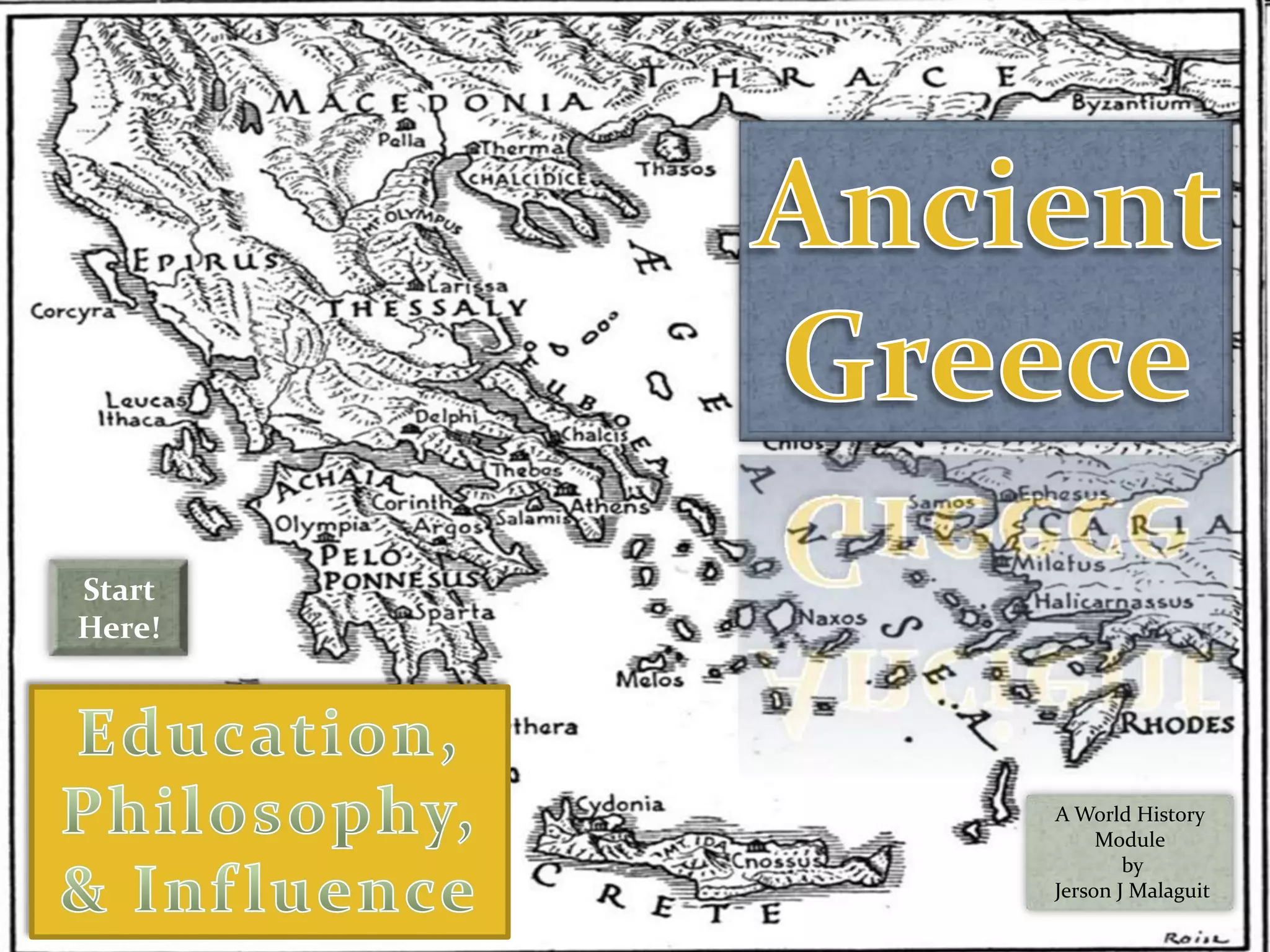
Ancient GreeceStart Here!Education, Philosophy, & InfluenceA World History Module byJerson J Malaguit
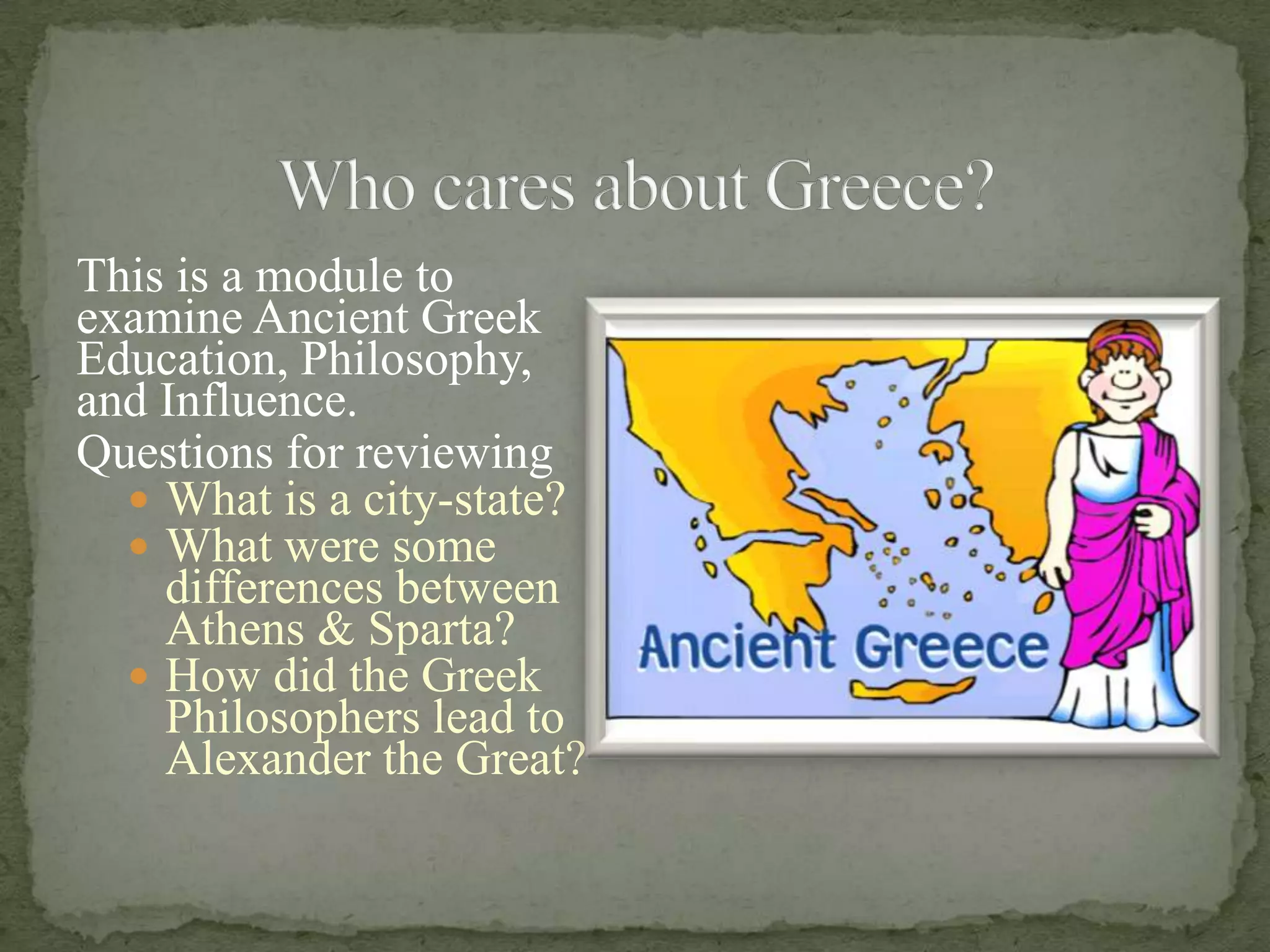
Who cares about Greece?This is a module to examine Ancient Greek Education, Philosophy, and Influence.Questions for reviewingWhat is a city-state?What were some differences between Athens & Sparta?How did the Greek Philosophers lead to Alexander the Great?
Athenian SchoolSpartan SchoolGreek PhilosophersAlexander the GreatMenu
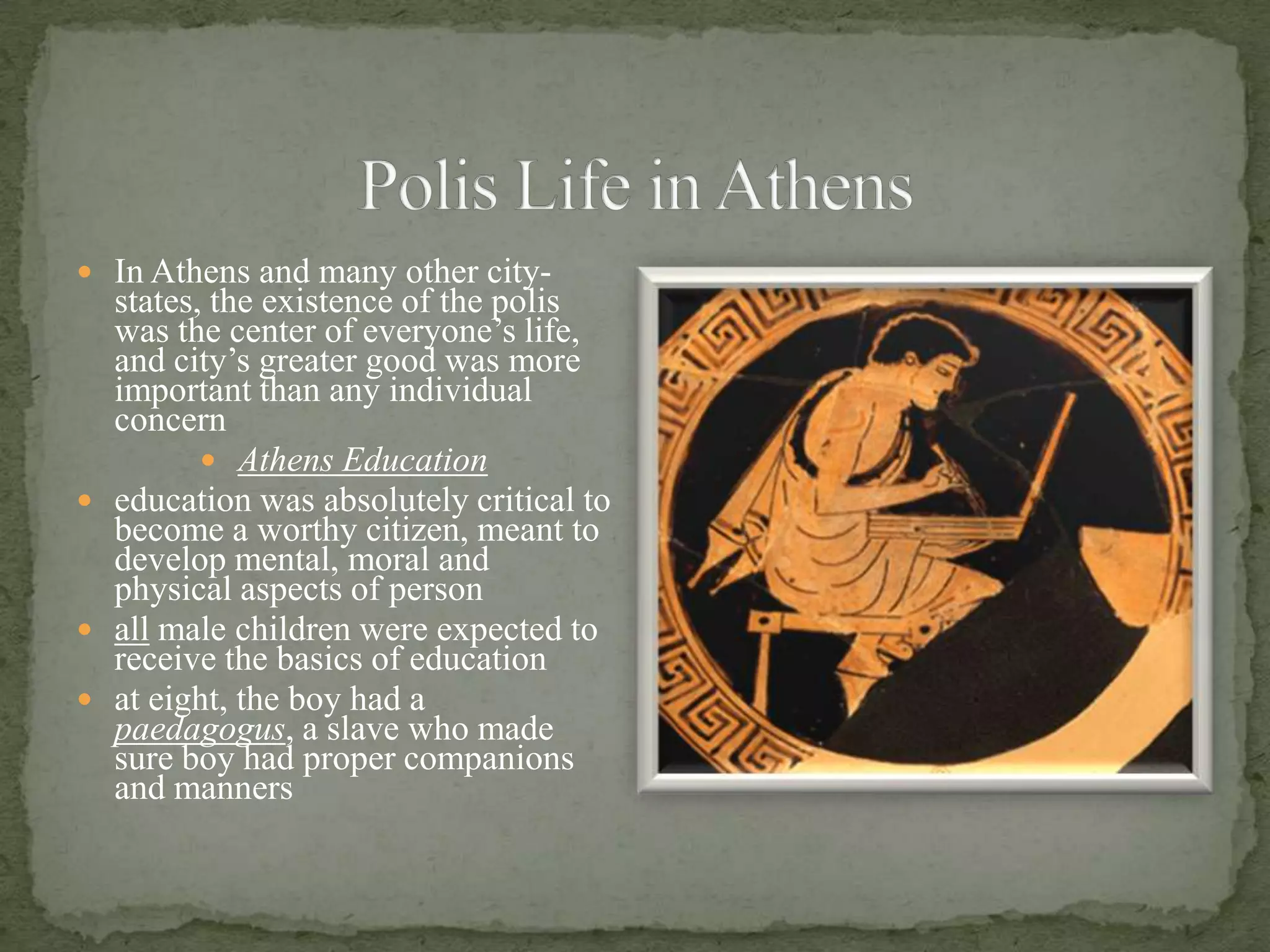
Polis Life in AthensIn Athens and many other city-states, the existence of the polis was the center of everyone’s life, and city’s greater good was more important than any individual concernAthens Educationeducation was absolutely critical to become a worthy citizen, meant to develop mental, moral and physical aspects of personall male children were expected to receive the basics of educationat eight, the boy had a paedagogus, a slave who made sure boy had proper companions and manners
Boys and Girls in AthensBoysreceived edu from age 8-18subjects were music, grammar and gymnasticsgymnastics included discus, javelin, running, wrestling, diving, etc.music taught to improve moral naturegrammar was learning how to write and reading national literature – Homer, Aesop’s fables, etc. at age 18, end of education, man takes Ephebic oath, where he swore to defend city and godsGirlsgiven very little formal educationtaught how to manage the house & slaves, how to care for children, how to weavegirls married between ages 14-16, the man her parents selectedafter marriage, female life was separate from husbanddid not leave house except for rare occasions such as special religious festival, and she was always accompaniedhusband even did the shopping!lived in separate wing of house, did not attend husband’s feasts or entertainmentsno legal or political rightsIf she divorced, her husband kept the childrenEphebic Oath
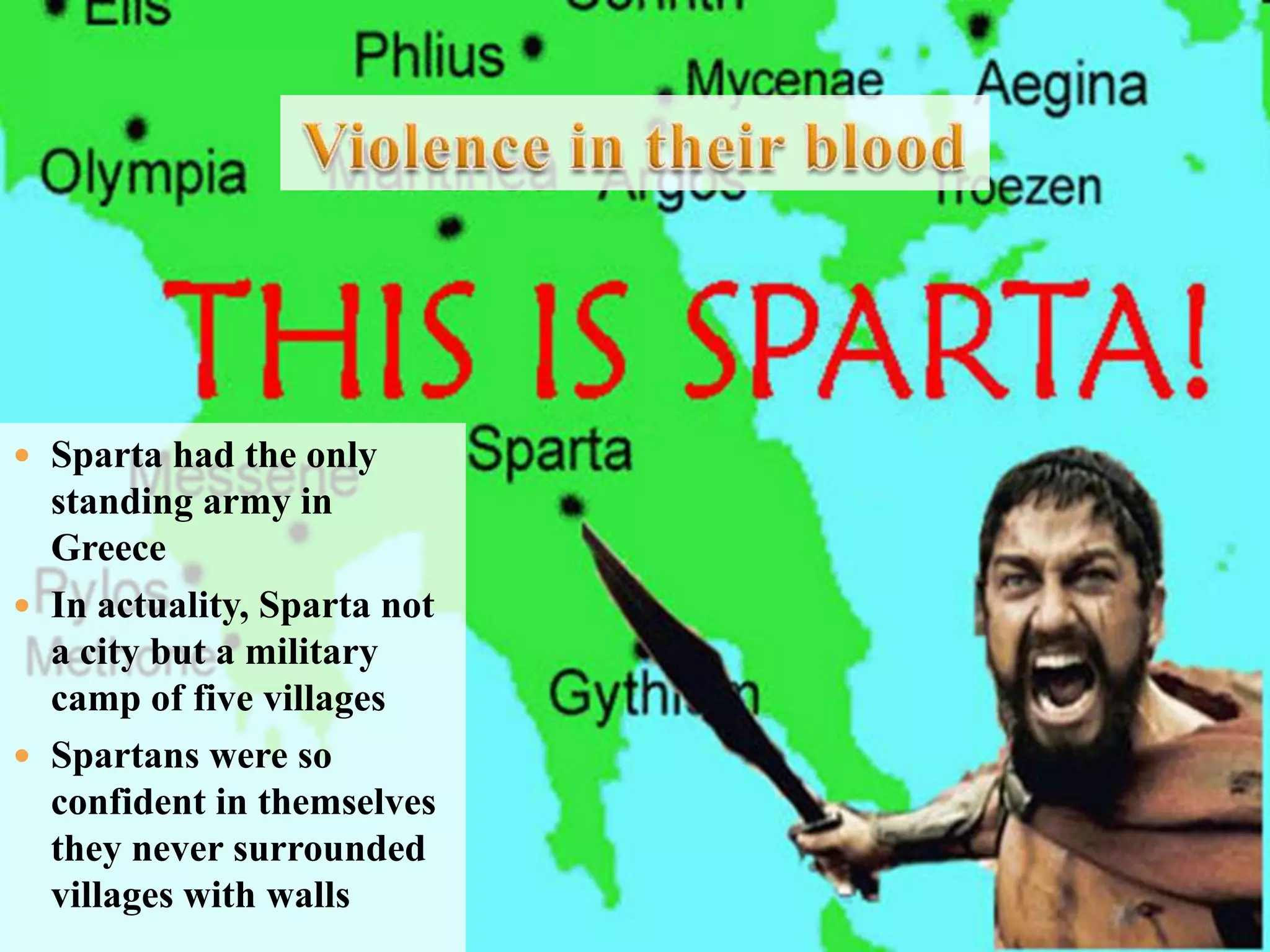
We will never bring disgrace on this our City by an act of dishonesty or cowardice.We will fight for the ideals and Sacred Things of the City both alone and with many.We will revere and obey the City's laws, and will do our best to incite a like reverence and respect in those above us who are prone to annul them or set them at naught.We will strive increasingly to quicken the public's sense of civic duty.Thus in all these ways we will transmit this City, not only not less, but greater and more beautiful than it was transmitted to us.The Ephebic Oath
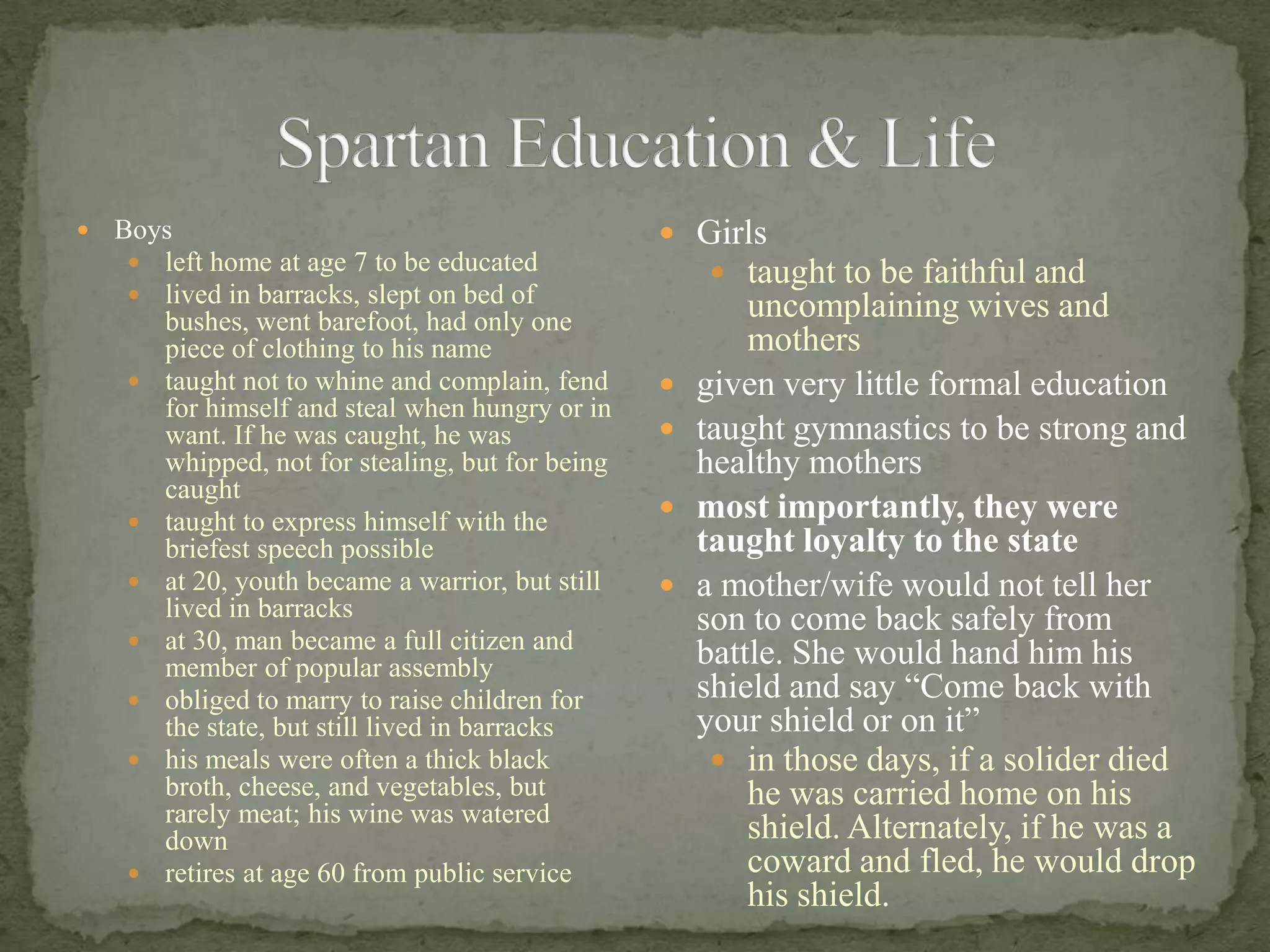
Violence in their bloodSparta had the only standing army in GreeceIn actuality, Sparta not a city but a military camp of five villagesSpartans were so confident in themselves they never surrounded villages with walls
Spartan Education & LifeBoysleft home at age 7 to be educatedlived in barracks, slept on bed of bushes, went barefoot, had only one piece of clothing to his nametaught not to whine and complain, fend for himself and steal when hungry or in want. If he was caught, he was whipped, not for stealing, but for being caughttaught to express himself with the briefest speech possibleat 20, youth became a warrior, but still lived in barracksat 30, man became a full citizen and member of popular assemblyobliged to marry to raise children for the state, but still lived in barrackshis meals were often a thick black broth, cheese, and vegetables, but rarely meat; his wine was watered downretires at age 60 from public service Girlstaught to be faithful and uncomplaining wives and mothersgiven very little formal educationtaught gymnastics to be strong and healthy mothersmost importantly, they were taught loyalty to the statea mother/wife would not tell her son to come back safely from battle. She would hand him his shield and say “Come back with your shield or on it”in those days, if a solider died he was carried home on his shield. Alternately, if he was a coward and fled, he would drop his shield.
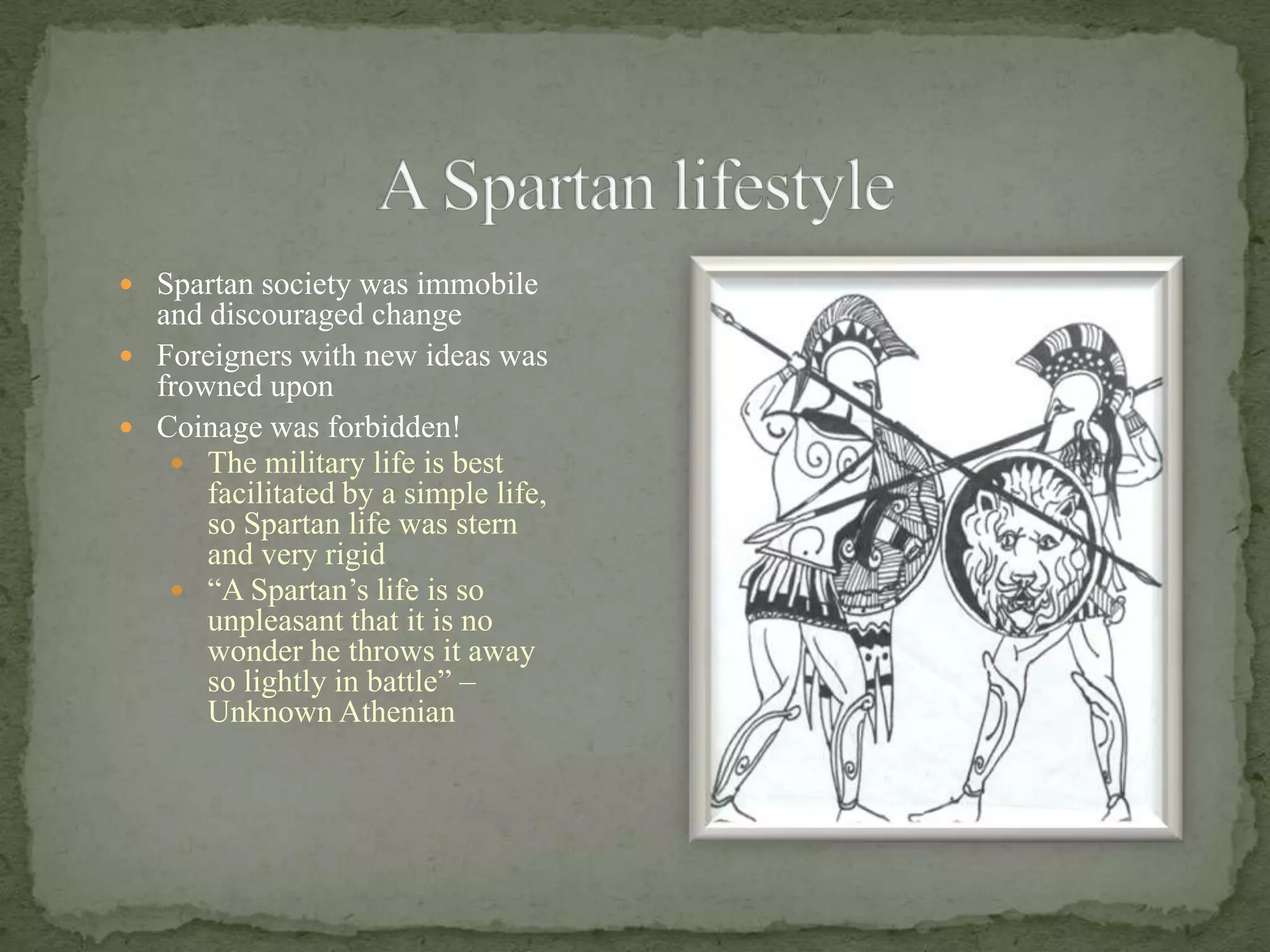
A Spartan lifestyleSpartan society was immobile and discouraged changeForeigners with new ideas was frowned uponCoinage was forbidden!The military life is best facilitated by a simple life, so Spartan life was stern and very rigid“A Spartan’s life is so unpleasant that it is no wonder he throws it away so lightly in battle” – Unknown Athenian
Tough LoveDespite its harshness, other Greeks admired Spartan  way of lifeGreeks valued organization and respected systems that succeed in molding and forming the individualSparta was very good at creating the best soldiers in GreeceMore importantly, Sparta had created an “ideal” of ultimate achievement to be a SpartanAll that hard work and torture created a status of prideEven though it was a harsh lifestyle that most people wouldn’t want to engage in, it created a high standard for human excellence
The Hellenic Philosophers(450-350)Socrates, Plato and Aristotle
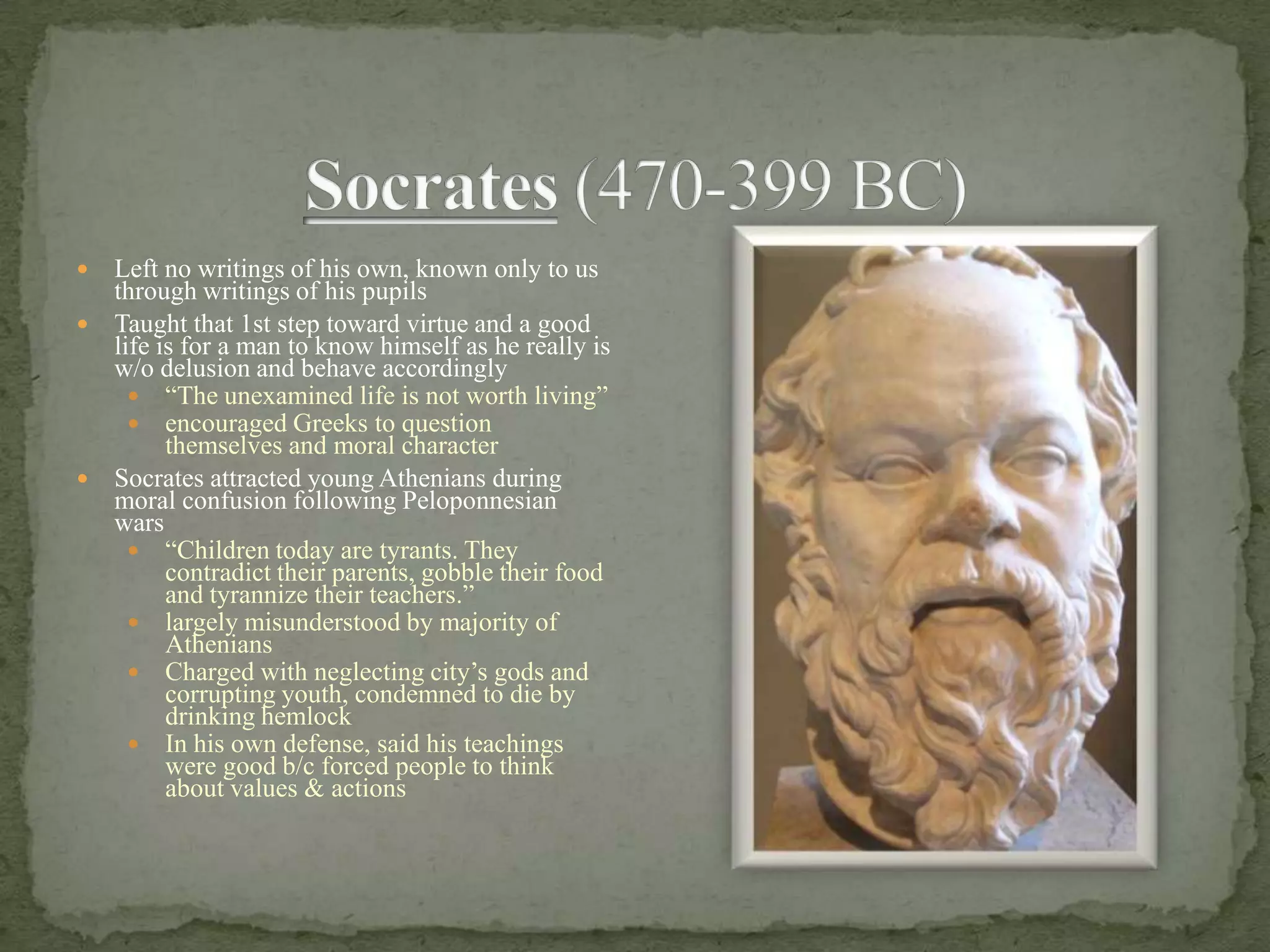
Socrates (470-399 BC)Left no writings of his own, known only to us through writings of his pupilsTaught that 1st step toward virtue and a good life is for a man to know himself as he really is w/o delusion and behave accordingly“The unexamined life is not worth living”encouraged Greeks to question themselves and moral characterSocrates attracted young Athenians during moral confusion following Peloponnesian wars“Children today are tyrants. They contradict their parents, gobble their food and tyrannize their teachers.”largely misunderstood by majority of AtheniansCharged with neglecting city’s gods and corrupting youth, condemned to die by drinking hemlockIn his own defense, said his teachings were good b/c forced people to think about values & actions
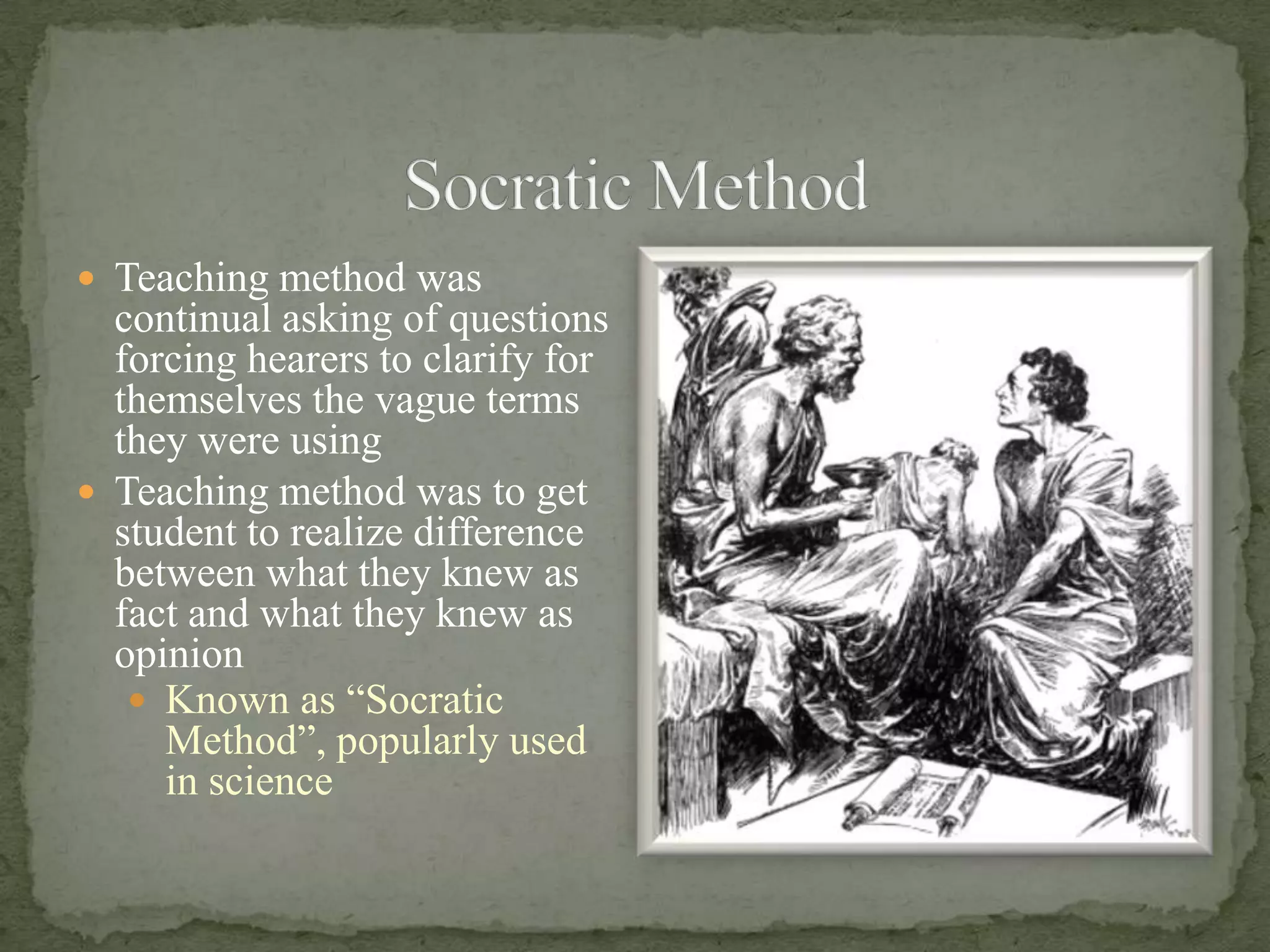
Socratic MethodTeaching method was continual asking of questions forcing hearers to clarify for themselves the vague terms they were usingTeaching method was to get student to realize difference between what they knew as fact and what they knew as opinionKnown as “Socratic Method”, popularly used in science
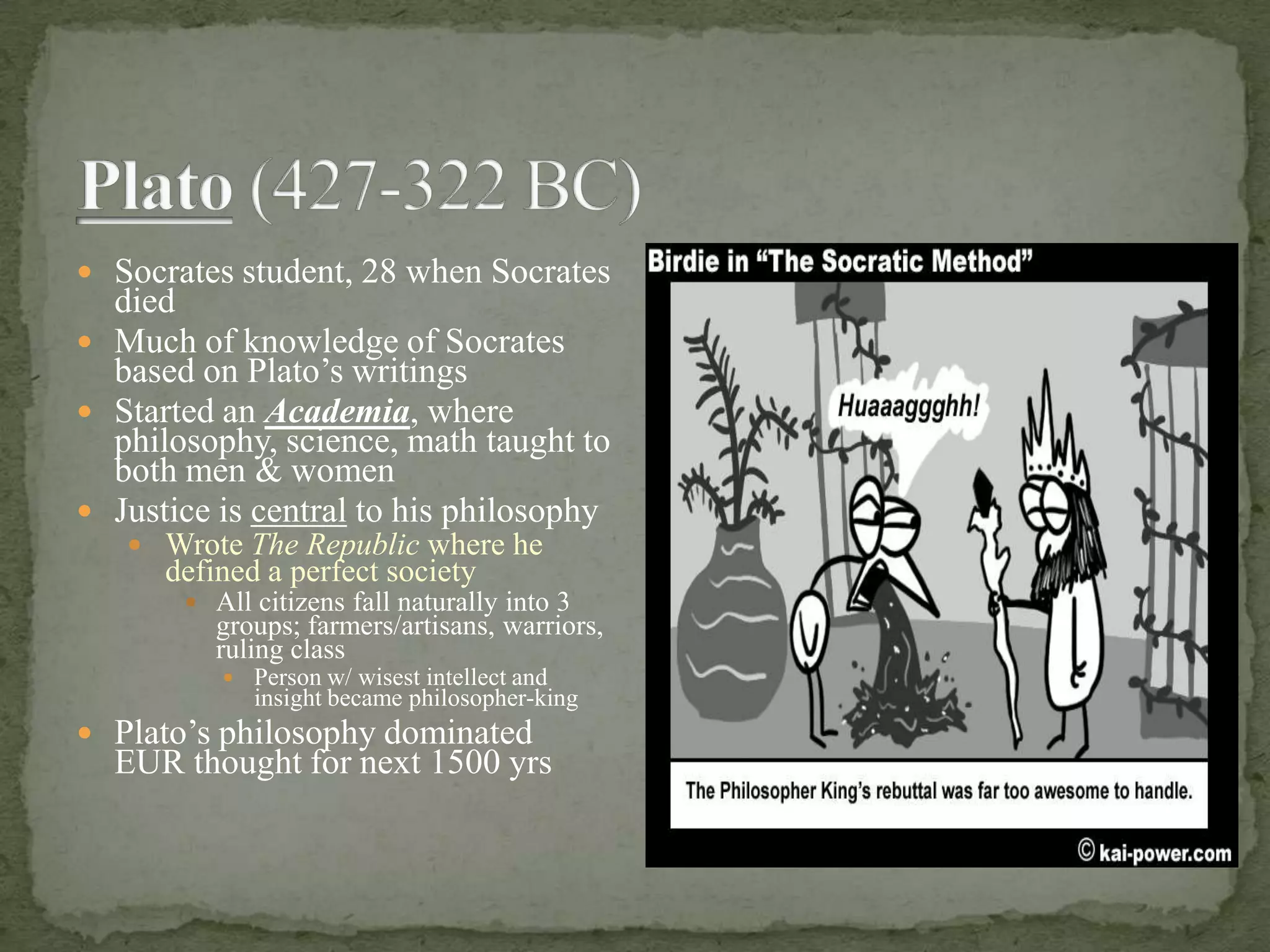
Plato (427-322 BC)Socrates student, 28 when Socrates diedMuch of knowledge of Socrates based on Plato’s writingsStarted an Academia, where philosophy, science, math taught to both men & womenJustice is central to his philosophyWrote The Republic where he defined a perfect societyAll citizens fall naturally into 3 groups; farmers/artisans, warriors, ruling classPerson w/ wisest intellect and insight became philosopher-kingPlato’s philosophy dominated EUR thought for next 1500 yrs
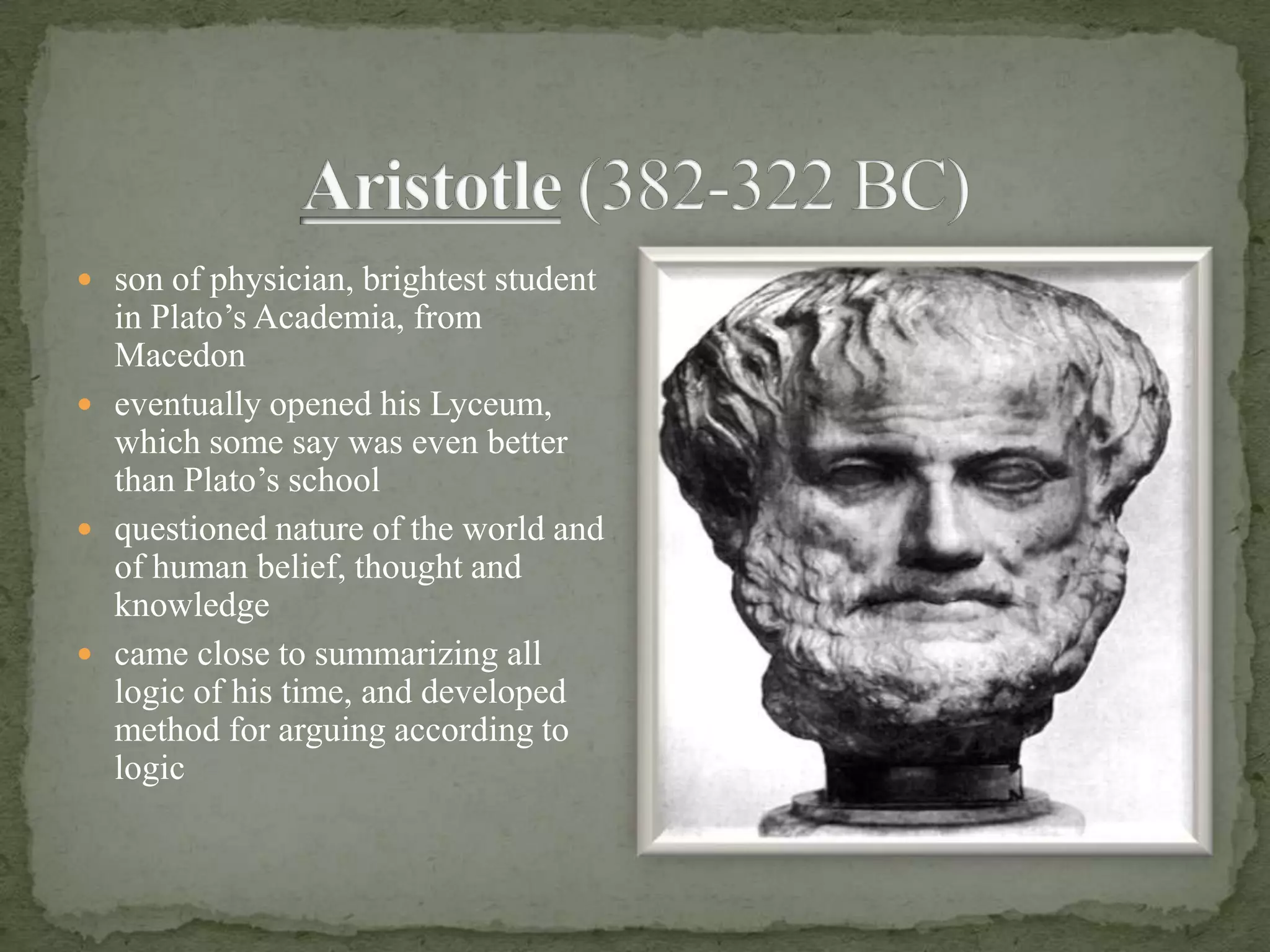
Aristotle (382-322 BC)son of physician, brightest student in Plato’s Academia, from Macedon eventually opened his Lyceum, which some say was even better than Plato’s schoolquestioned nature of the world and of human belief, thought and knowledgecame close to summarizing all logic of his time, and developed method for arguing according to logic
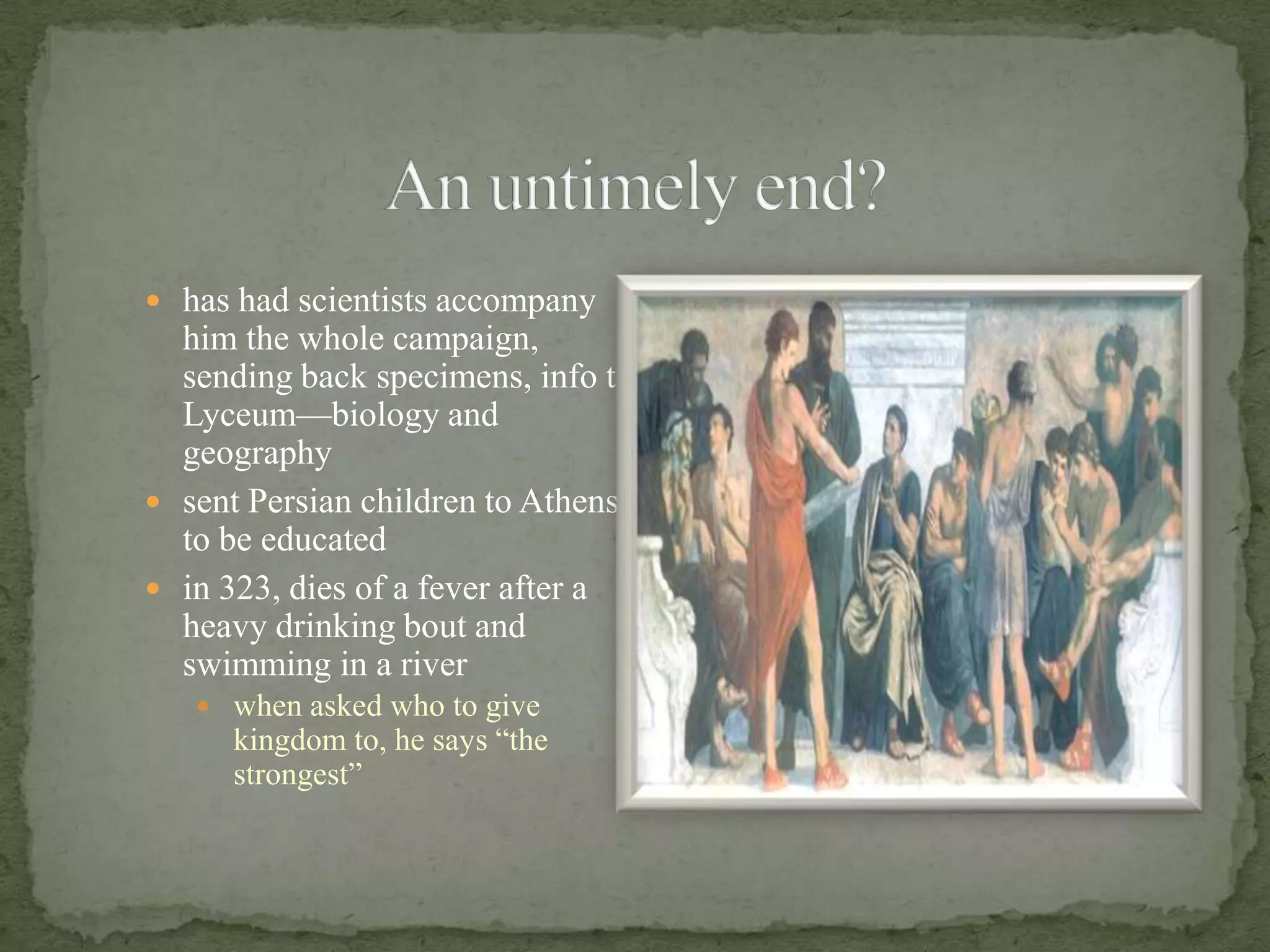
Aristotle’s InfluenceAristotle’s most famous student was Alexander the Great, 343 BCAlexander shows Aristotle favor by financing the Lyceum and providing scientific equipmentOrders experts in his army to collect and send specimens of plants/animals from conquered countries back to Aristotle for study“Highest human good is life of reason, attained through practice… [of] moderation in everything”Self-Control & Friendship based on Equality and Self-Reliance are marks of virtuous man
Alexander the GreatProphetic Grecian of Destiny
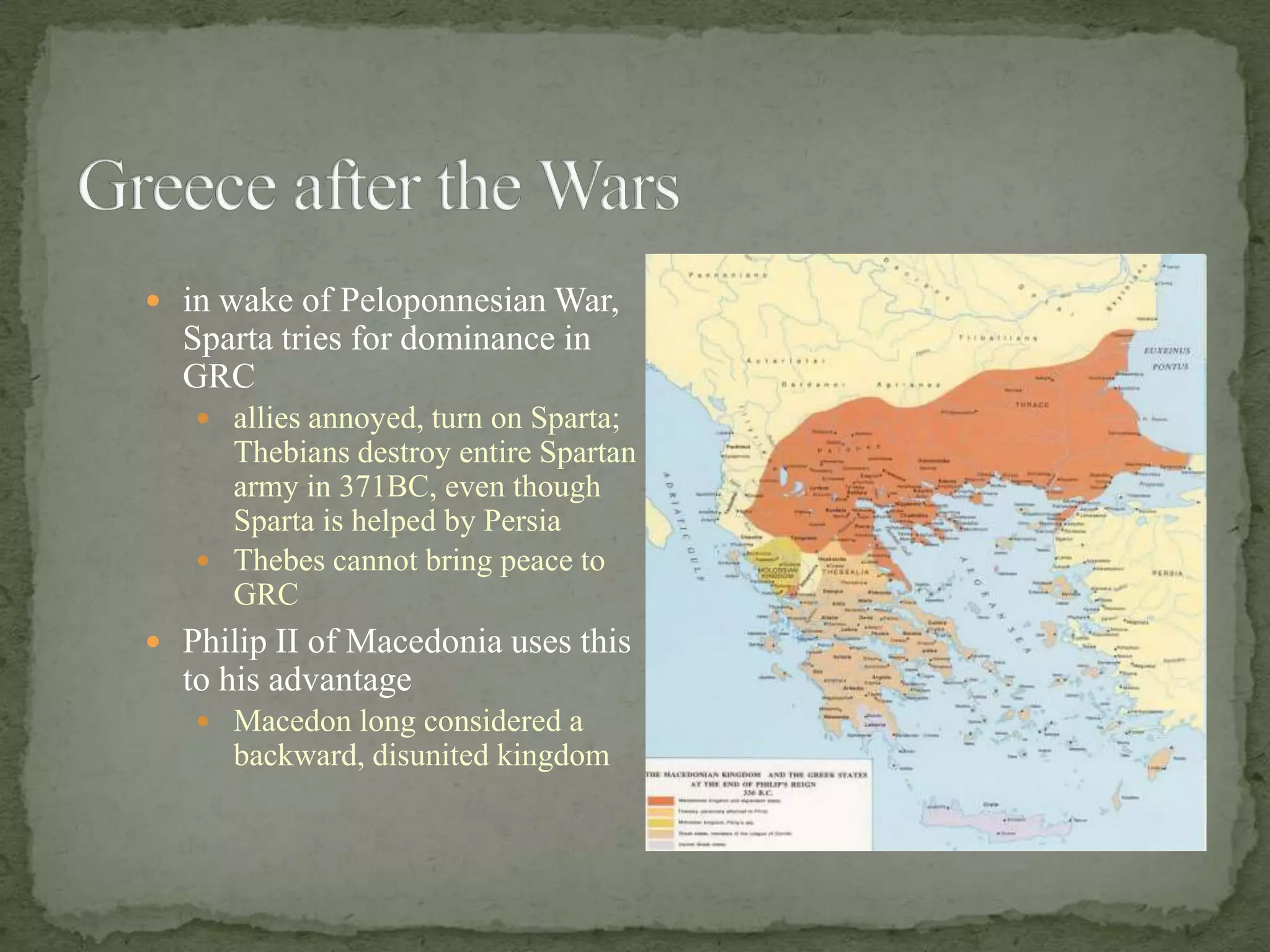
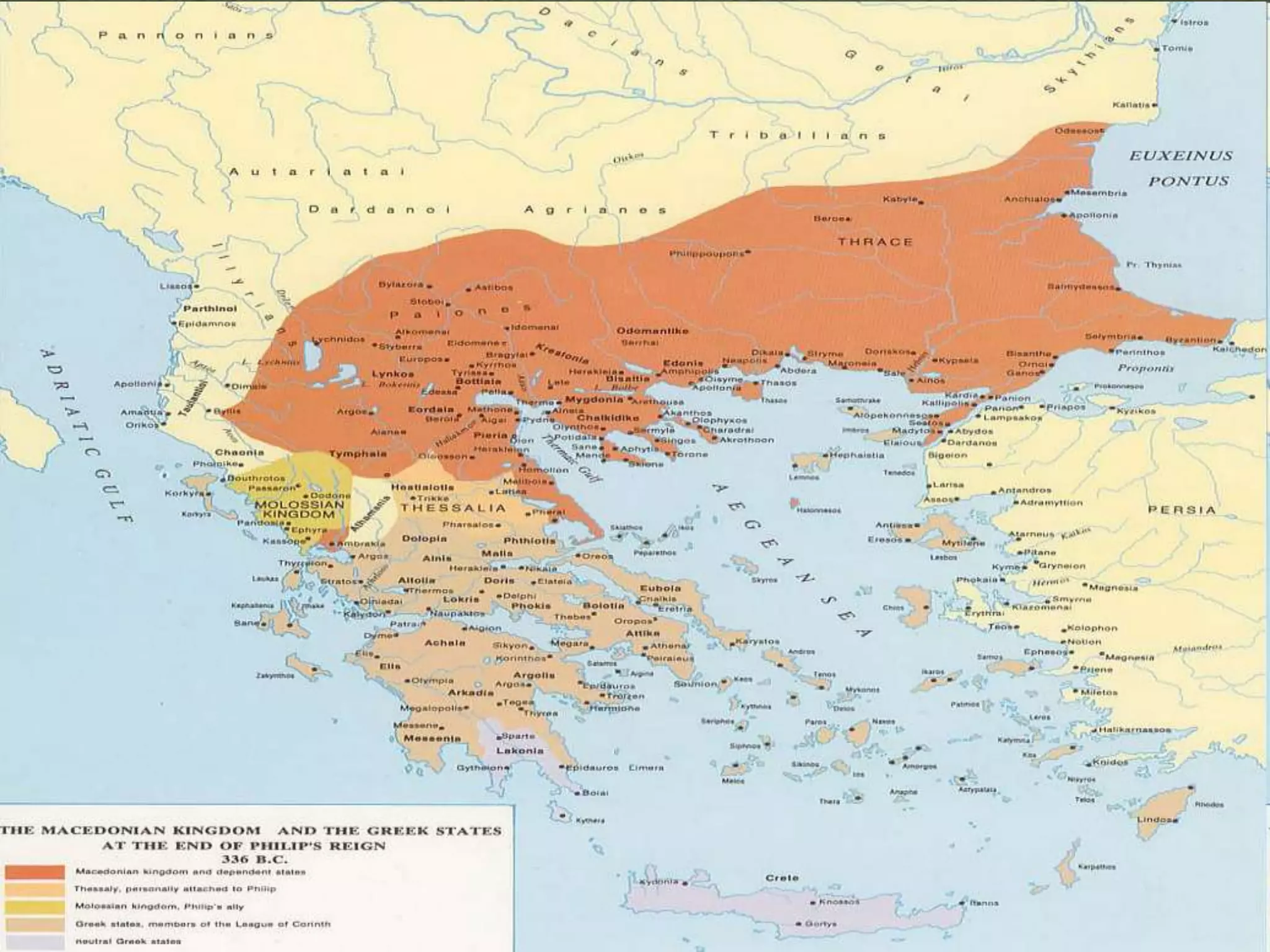
Greece after the Warsin wake of Peloponnesian War, Sparta tries for dominance in GRCallies annoyed, turn on Sparta; Thebians destroy entire Spartan army in 371BC, even though Sparta is helped by PersiaThebes cannot bring peace to GRCPhilip II of Macedonia uses this to his advantageMacedon long considered a backward, disunited kingdom
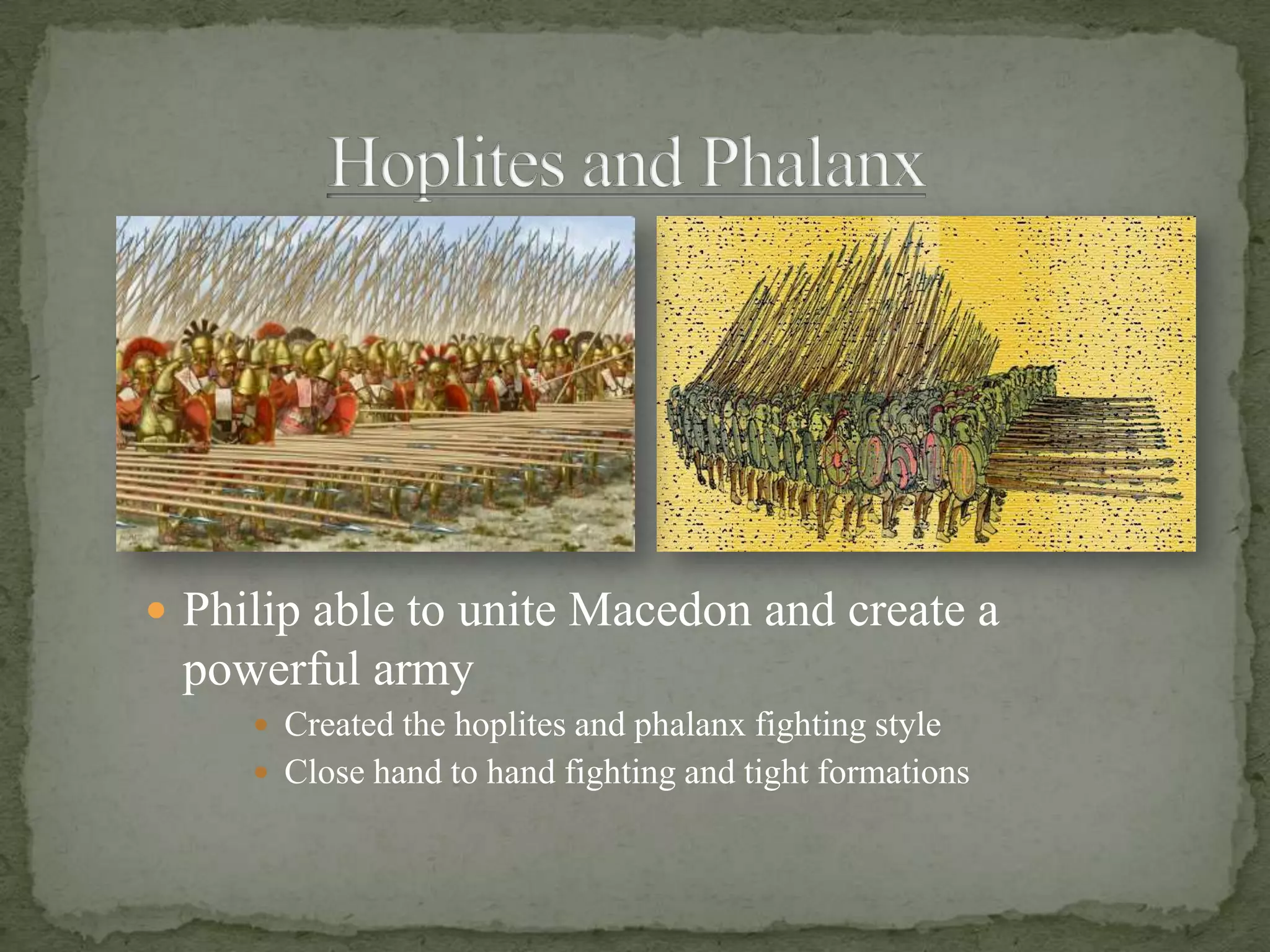
Hoplites and PhalanxPhilip able to unite Macedon and create a powerful armyCreated the hoplites and phalanx fighting styleClose hand to hand fighting and tight formations
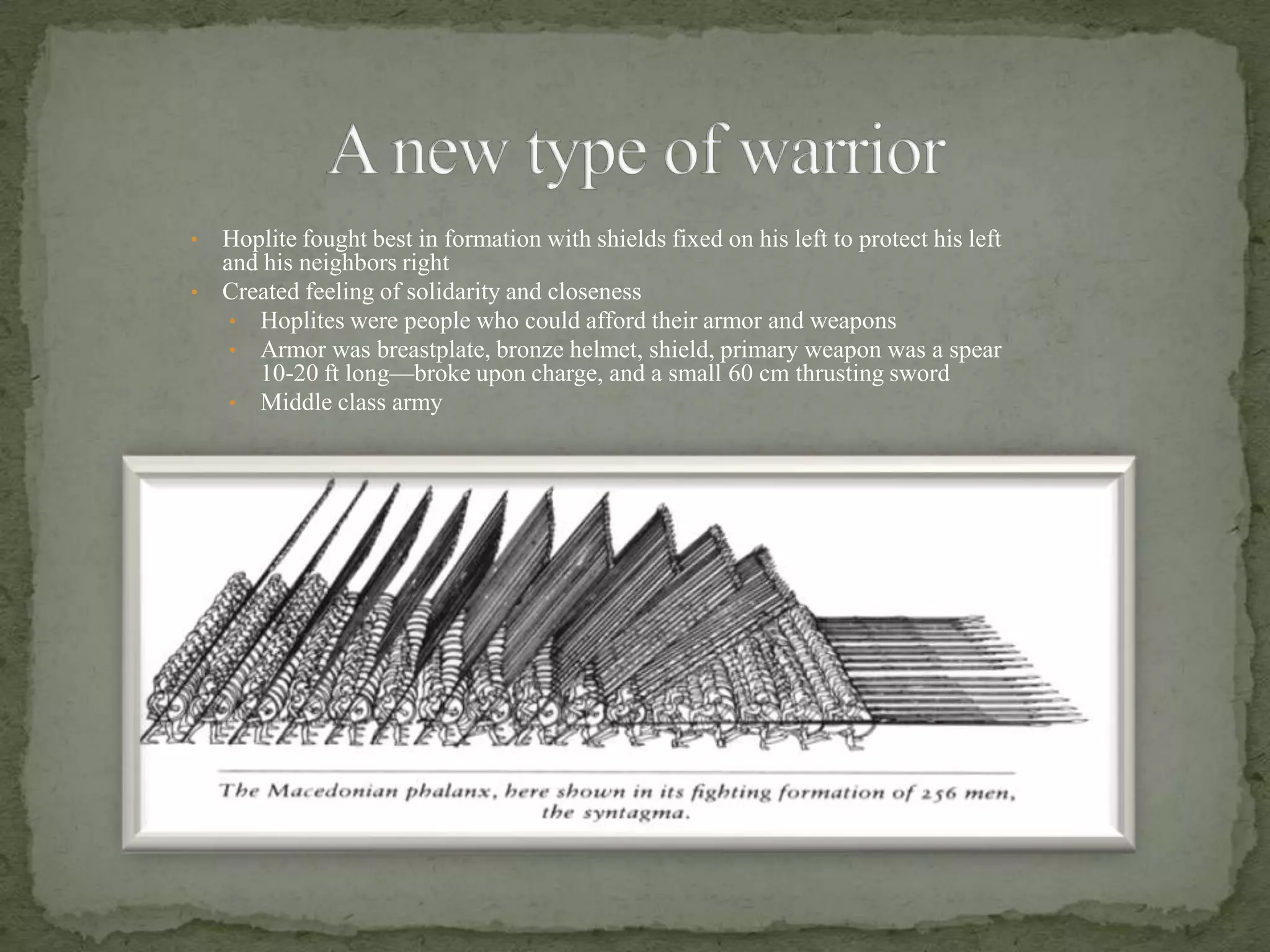
A new type of warriorHoplite fought best in formation with shields fixed on his left to protect his left and his neighbors right
Created feeling of solidarity and closeness
Hoplites were people who could afford their armor and weapons
Armor was breastplate, bronze helmet, shield, primary weapon was a spear 10-20 ft long—broke upon charge, and a small 60 cm thrusting sword
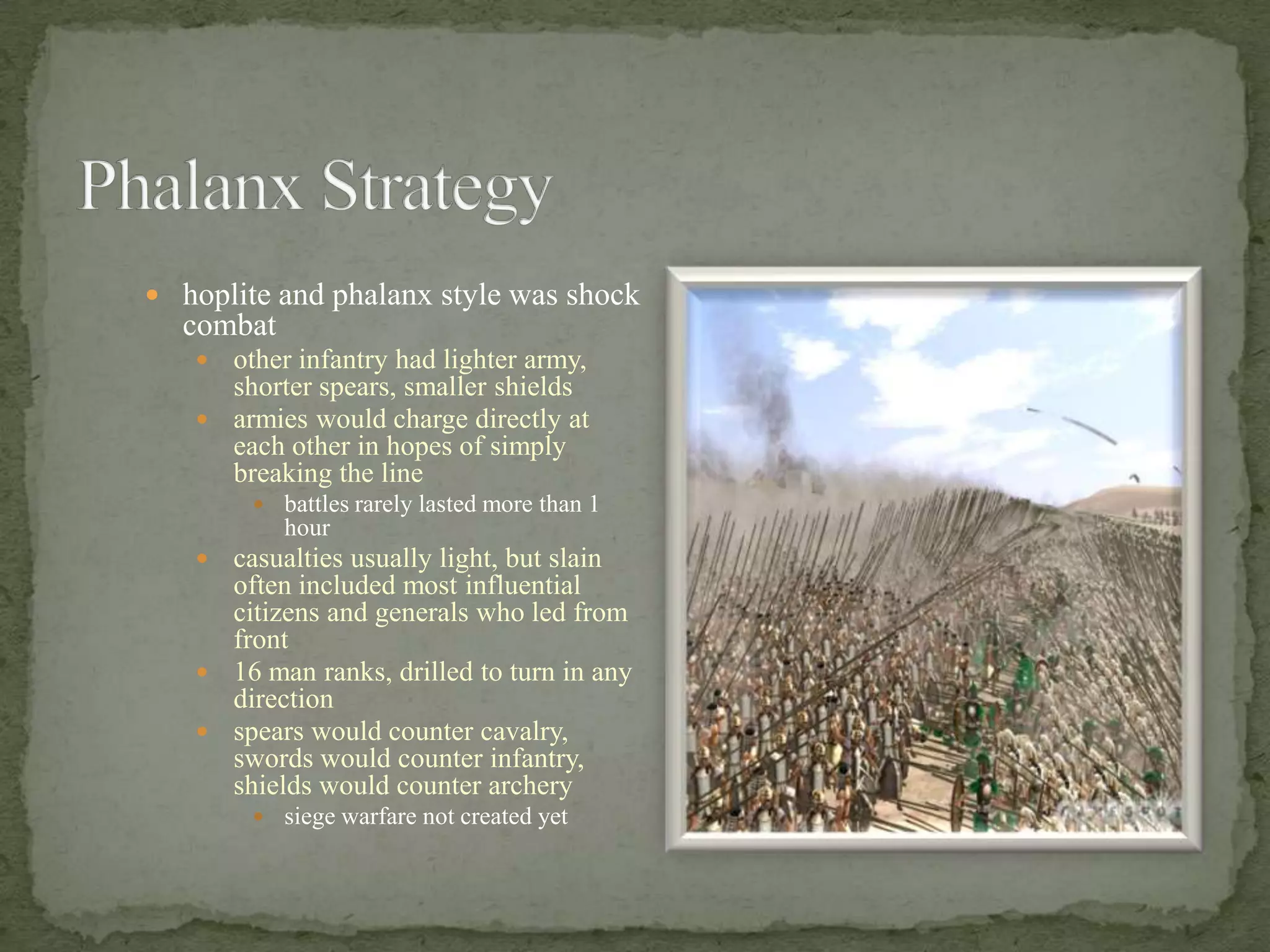
Middle class armyPhalanx Strategyhoplite and phalanx style was shock combatother infantry had lighter army, shorter spears, smaller shieldsarmies would charge directly at each other in hopes of simply breaking the linebattles rarely lasted more than 1 hourcasualties usually light, but slain often included most influential citizens and generals who led from front16 man ranks, drilled to turn in any directionspears would counter cavalry, swords would counter infantry, shields would counter archerysiege warfare not created yet
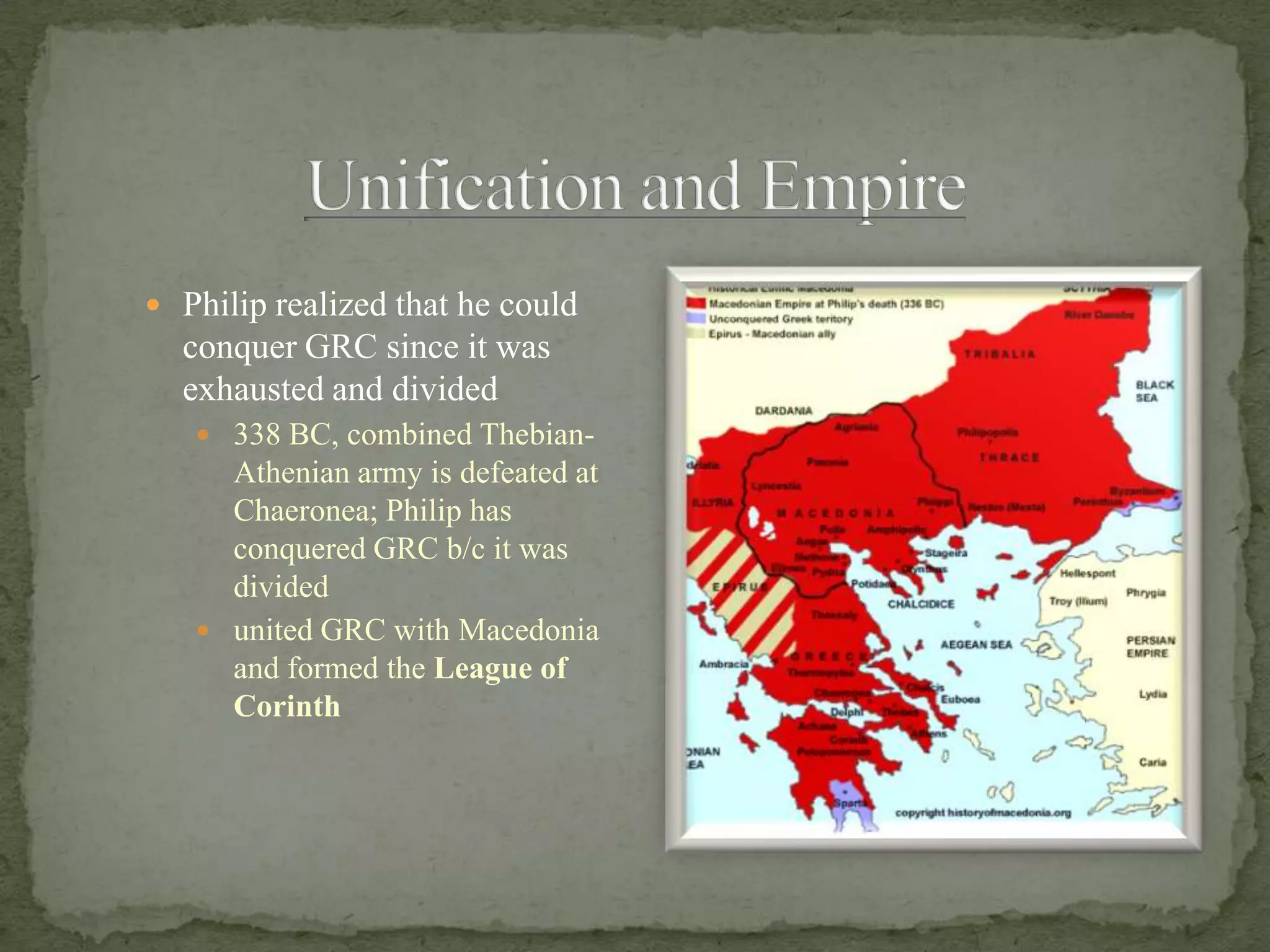
Unification and EmpirePhilip realized that he could conquer GRC since it was exhausted and divided338 BC, combined Thebian-Athenian army is defeated at Chaeronea; Philip has conquered GRC b/c it was dividedunited GRC with Macedonia and formed the League of Corinth
Philip the Great? Almost.attempted to bring unity and harmony between Greeks and Macedons for 1st time in historygoal of union was to liberate Greeks of Asia from Persian threatas he was preparing Greeks and Macedons for massive invasion of Persian Empire, he is assassinated in 336 BChas eliminated Greek threat and wants to eliminate Persian threat in east—arch enemies!!!
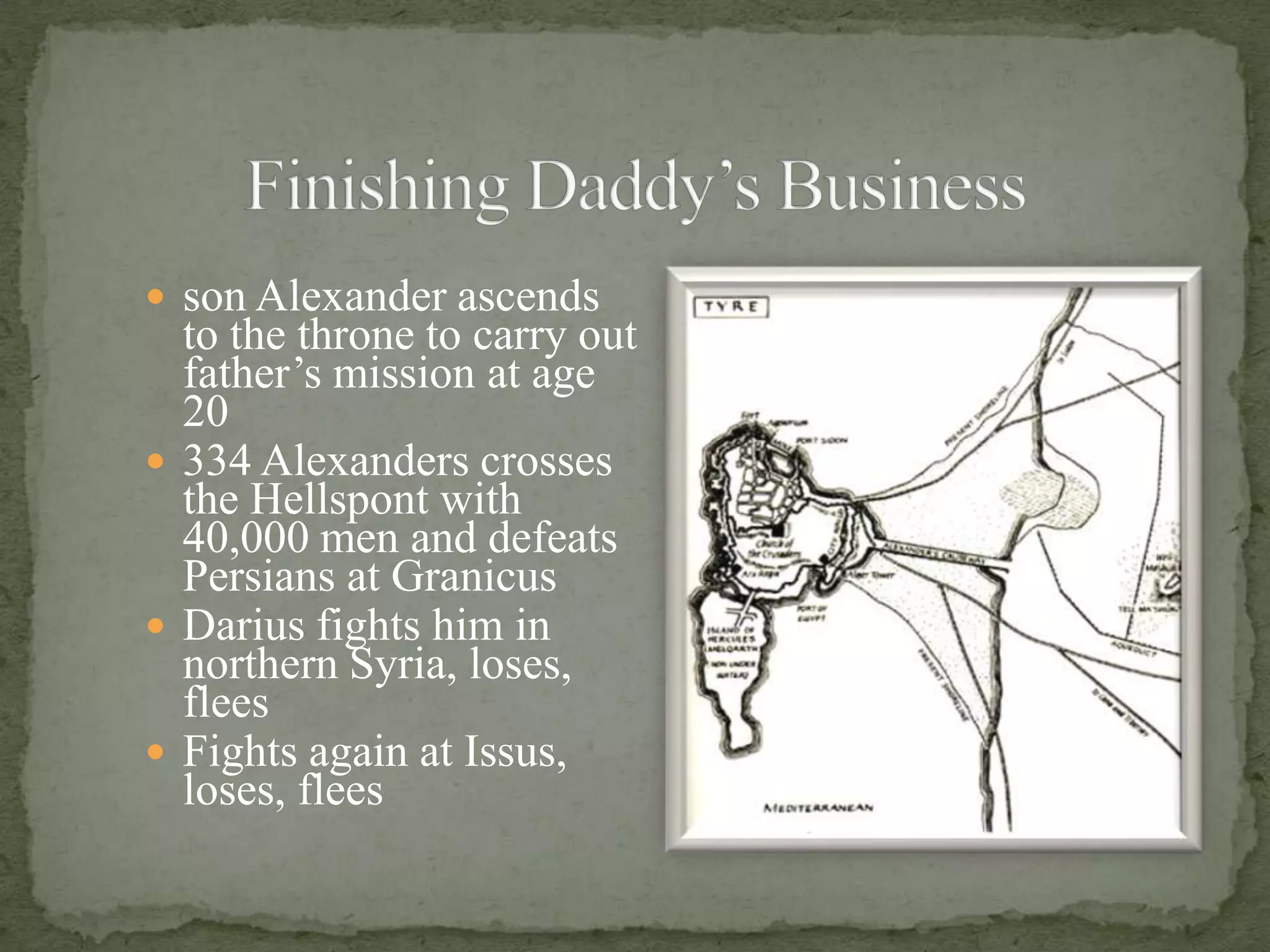
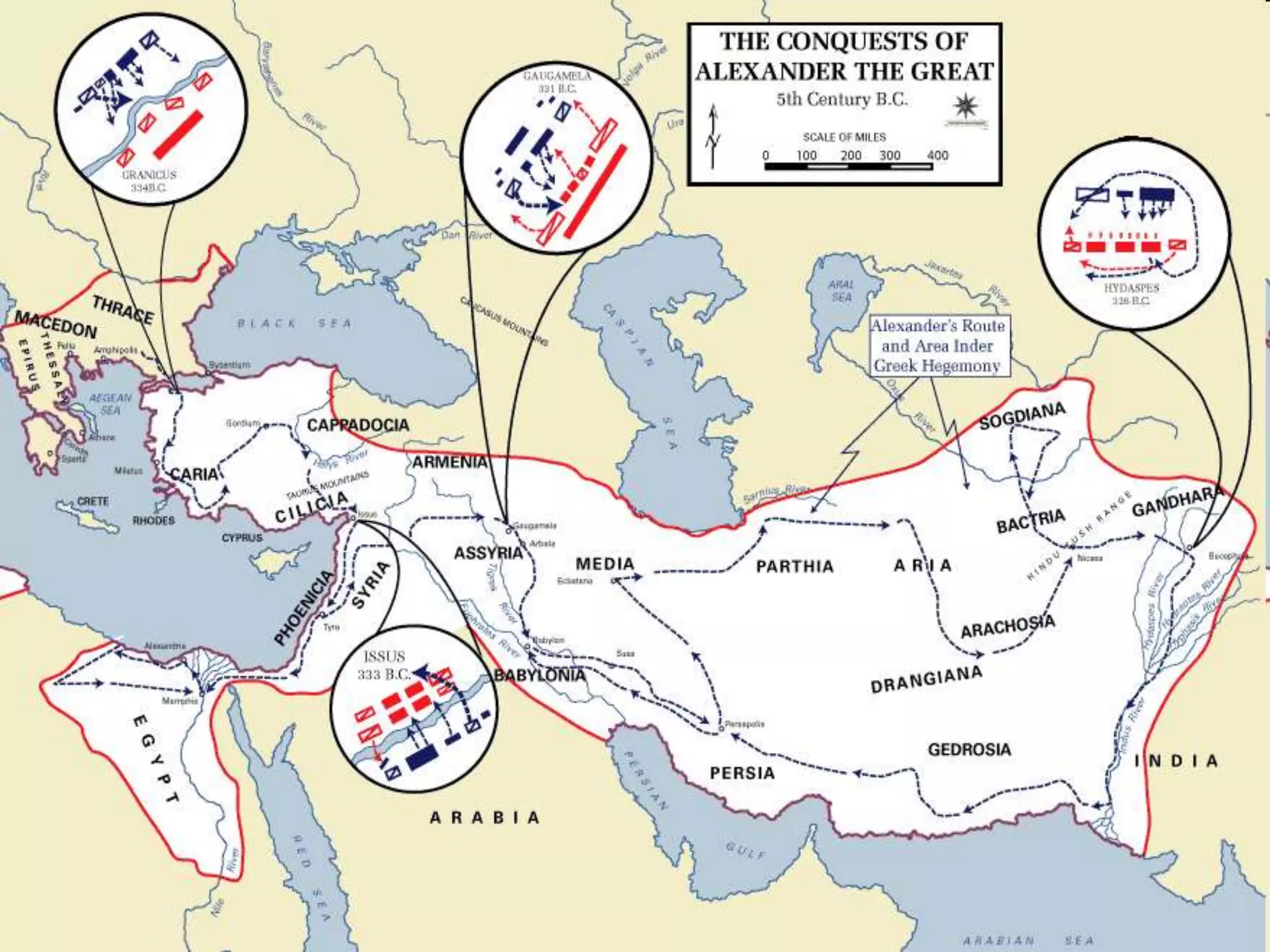
Finishing Daddy’s Businessson Alexander ascends to the throne to carry out father’s mission at age 20334 Alexanders crosses the Hellspont with 40,000 men and defeats Persians at GranicusDarius fights him in northern Syria, loses, fleesFights again at Issus, loses, flees
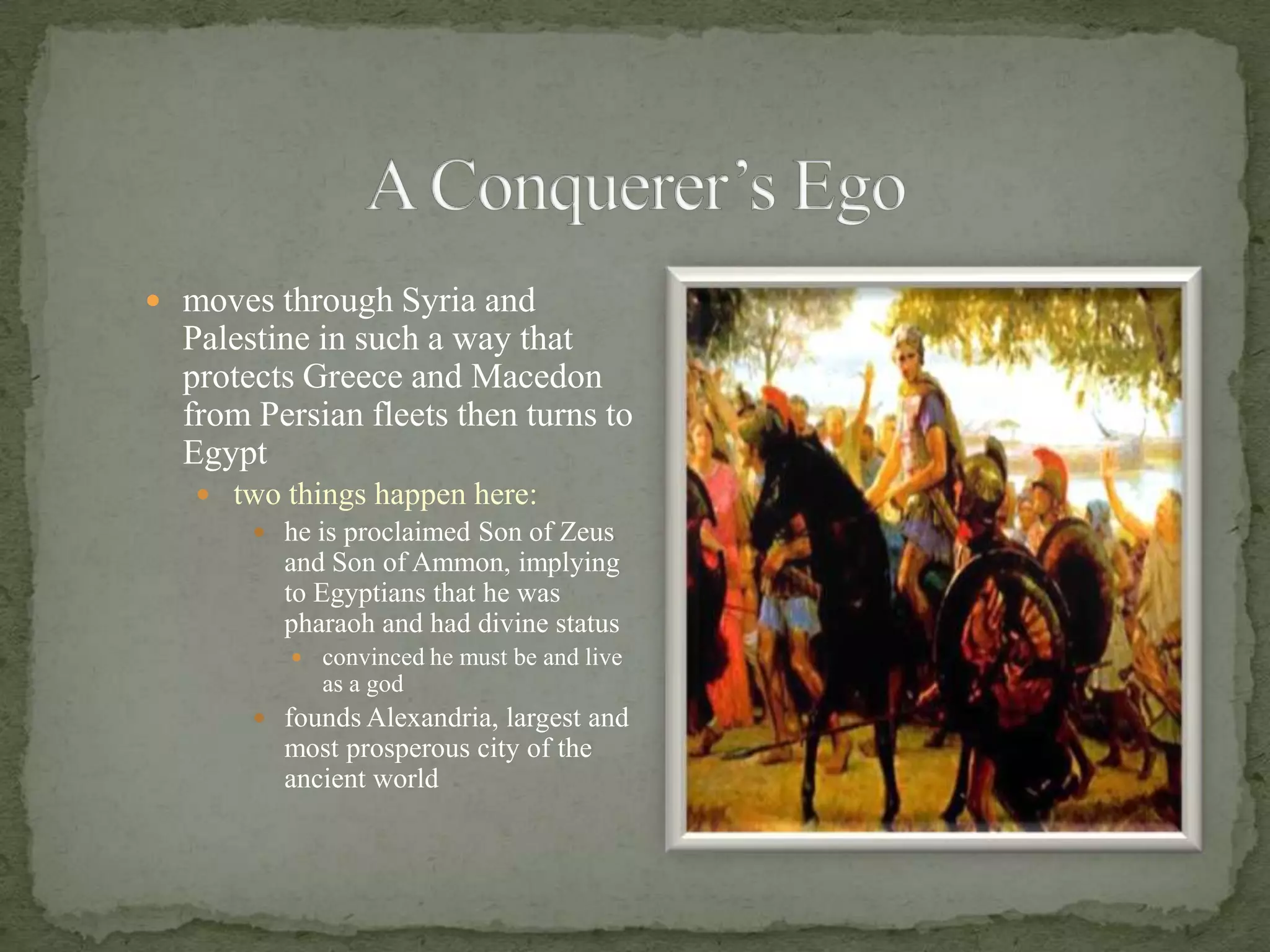
A Conquerer’s Egomoves through Syria and Palestine in such a way that protects Greece and Macedon from Persian fleets then turns to Egypttwo things happen here:he is proclaimed Son of Zeus and Son of Ammon, implying to Egyptians that he was pharaoh and had divine statusconvinced he must be and live as a godfounds Alexandria, largest and most prosperous city of the ancient world
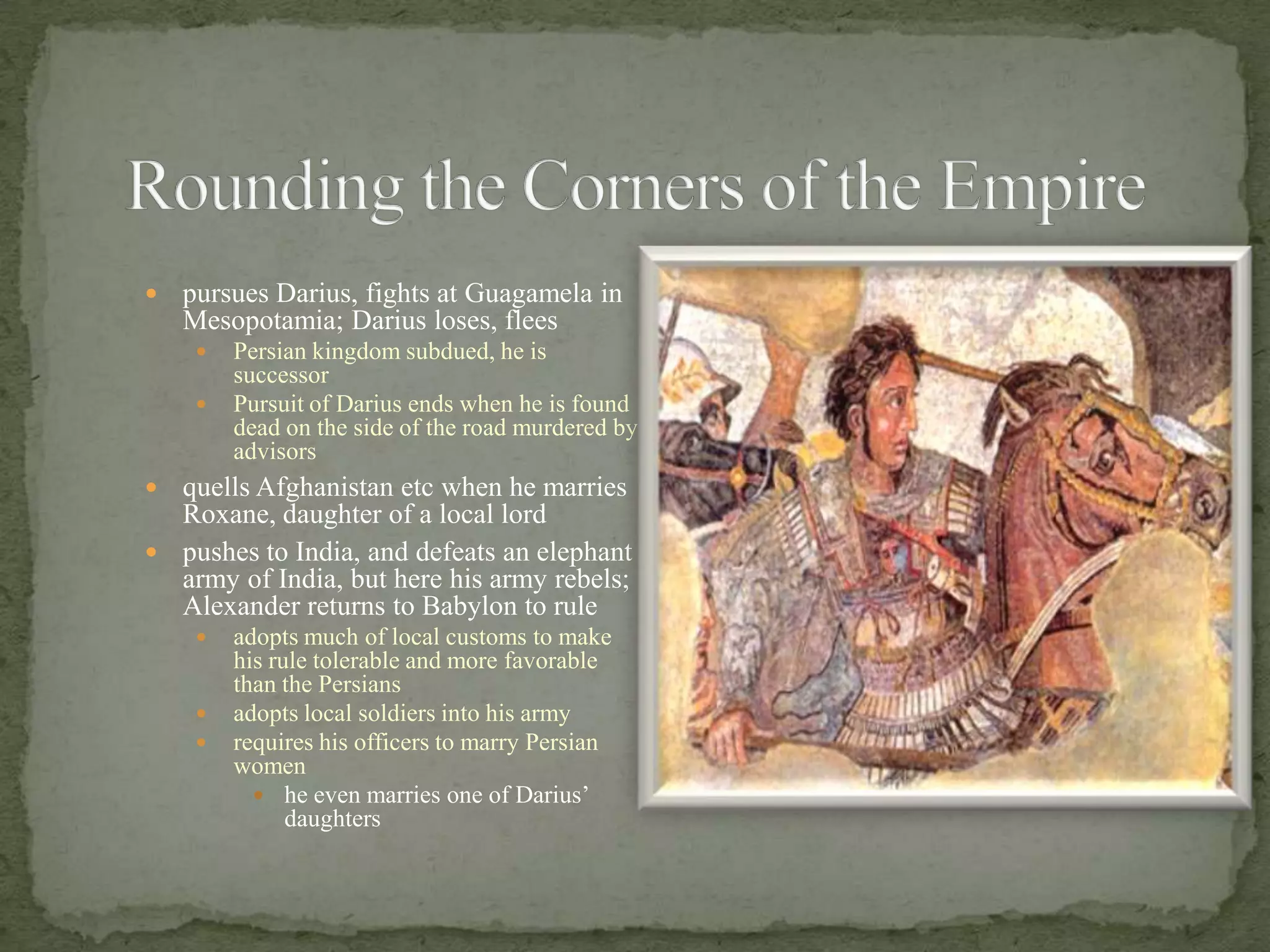
Rounding the Corners of the Empirepursues Darius, fights at Guagamela in Mesopotamia; Darius loses, fleesPersian kingdom subdued, he is successorPursuit of Darius ends when he is found dead on the side of the road murdered by advisorsquells Afghanistan etc when he marries Roxane, daughter of a local lordpushes to India, and defeats an elephant army of India, but here his army rebels; Alexander returns to Babylon to ruleadopts much of local customs to make his rule tolerable and more favorable than the Persiansadopts local soldiers into his armyrequires his officers to marry Persian womenhe even marries one of Darius’ daughters
An untimely end?has had scientists accompany him the whole campaign, sending back specimens, info to Lyceum—biology and geographysent Persian children to Athens to be educatedin 323, dies of a fever after a heavy drinking bout and swimming in a riverwhen asked who to give kingdom to, he says “the strongest”

Pwr point

  • 1.
    Ancient GreeceStart Here!Education,Philosophy, & InfluenceA World History Module byJerson J Malaguit
  • 2.
    Who cares aboutGreece?This is a module to examine Ancient Greek Education, Philosophy, and Influence.Questions for reviewingWhat is a city-state?What were some differences between Athens & Sparta?How did the Greek Philosophers lead to Alexander the Great?
  • 3.
    Athenian SchoolSpartan SchoolGreekPhilosophersAlexander the GreatMenu
  • 4.
    Polis Life inAthensIn Athens and many other city-states, the existence of the polis was the center of everyone’s life, and city’s greater good was more important than any individual concernAthens Educationeducation was absolutely critical to become a worthy citizen, meant to develop mental, moral and physical aspects of personall male children were expected to receive the basics of educationat eight, the boy had a paedagogus, a slave who made sure boy had proper companions and manners
  • 5.
    Boys and Girlsin AthensBoysreceived edu from age 8-18subjects were music, grammar and gymnasticsgymnastics included discus, javelin, running, wrestling, diving, etc.music taught to improve moral naturegrammar was learning how to write and reading national literature – Homer, Aesop’s fables, etc. at age 18, end of education, man takes Ephebic oath, where he swore to defend city and godsGirlsgiven very little formal educationtaught how to manage the house & slaves, how to care for children, how to weavegirls married between ages 14-16, the man her parents selectedafter marriage, female life was separate from husbanddid not leave house except for rare occasions such as special religious festival, and she was always accompaniedhusband even did the shopping!lived in separate wing of house, did not attend husband’s feasts or entertainmentsno legal or political rightsIf she divorced, her husband kept the childrenEphebic Oath
  • 6.
    We will neverbring disgrace on this our City by an act of dishonesty or cowardice.We will fight for the ideals and Sacred Things of the City both alone and with many.We will revere and obey the City's laws, and will do our best to incite a like reverence and respect in those above us who are prone to annul them or set them at naught.We will strive increasingly to quicken the public's sense of civic duty.Thus in all these ways we will transmit this City, not only not less, but greater and more beautiful than it was transmitted to us.The Ephebic Oath
  • 7.
    Violence in theirbloodSparta had the only standing army in GreeceIn actuality, Sparta not a city but a military camp of five villagesSpartans were so confident in themselves they never surrounded villages with walls
  • 8.
    Spartan Education &LifeBoysleft home at age 7 to be educatedlived in barracks, slept on bed of bushes, went barefoot, had only one piece of clothing to his nametaught not to whine and complain, fend for himself and steal when hungry or in want. If he was caught, he was whipped, not for stealing, but for being caughttaught to express himself with the briefest speech possibleat 20, youth became a warrior, but still lived in barracksat 30, man became a full citizen and member of popular assemblyobliged to marry to raise children for the state, but still lived in barrackshis meals were often a thick black broth, cheese, and vegetables, but rarely meat; his wine was watered downretires at age 60 from public service Girlstaught to be faithful and uncomplaining wives and mothersgiven very little formal educationtaught gymnastics to be strong and healthy mothersmost importantly, they were taught loyalty to the statea mother/wife would not tell her son to come back safely from battle. She would hand him his shield and say “Come back with your shield or on it”in those days, if a solider died he was carried home on his shield. Alternately, if he was a coward and fled, he would drop his shield.
  • 9.
    A Spartan lifestyleSpartansociety was immobile and discouraged changeForeigners with new ideas was frowned uponCoinage was forbidden!The military life is best facilitated by a simple life, so Spartan life was stern and very rigid“A Spartan’s life is so unpleasant that it is no wonder he throws it away so lightly in battle” – Unknown Athenian
  • 10.
    Tough LoveDespite itsharshness, other Greeks admired Spartan way of lifeGreeks valued organization and respected systems that succeed in molding and forming the individualSparta was very good at creating the best soldiers in GreeceMore importantly, Sparta had created an “ideal” of ultimate achievement to be a SpartanAll that hard work and torture created a status of prideEven though it was a harsh lifestyle that most people wouldn’t want to engage in, it created a high standard for human excellence
  • 12.
  • 13.
    Socrates (470-399 BC)Leftno writings of his own, known only to us through writings of his pupilsTaught that 1st step toward virtue and a good life is for a man to know himself as he really is w/o delusion and behave accordingly“The unexamined life is not worth living”encouraged Greeks to question themselves and moral characterSocrates attracted young Athenians during moral confusion following Peloponnesian wars“Children today are tyrants. They contradict their parents, gobble their food and tyrannize their teachers.”largely misunderstood by majority of AtheniansCharged with neglecting city’s gods and corrupting youth, condemned to die by drinking hemlockIn his own defense, said his teachings were good b/c forced people to think about values & actions
  • 14.
    Socratic MethodTeaching methodwas continual asking of questions forcing hearers to clarify for themselves the vague terms they were usingTeaching method was to get student to realize difference between what they knew as fact and what they knew as opinionKnown as “Socratic Method”, popularly used in science
  • 15.
    Plato (427-322 BC)Socratesstudent, 28 when Socrates diedMuch of knowledge of Socrates based on Plato’s writingsStarted an Academia, where philosophy, science, math taught to both men & womenJustice is central to his philosophyWrote The Republic where he defined a perfect societyAll citizens fall naturally into 3 groups; farmers/artisans, warriors, ruling classPerson w/ wisest intellect and insight became philosopher-kingPlato’s philosophy dominated EUR thought for next 1500 yrs
  • 16.
    Aristotle (382-322 BC)sonof physician, brightest student in Plato’s Academia, from Macedon eventually opened his Lyceum, which some say was even better than Plato’s schoolquestioned nature of the world and of human belief, thought and knowledgecame close to summarizing all logic of his time, and developed method for arguing according to logic
  • 17.
    Aristotle’s InfluenceAristotle’s mostfamous student was Alexander the Great, 343 BCAlexander shows Aristotle favor by financing the Lyceum and providing scientific equipmentOrders experts in his army to collect and send specimens of plants/animals from conquered countries back to Aristotle for study“Highest human good is life of reason, attained through practice… [of] moderation in everything”Self-Control & Friendship based on Equality and Self-Reliance are marks of virtuous man
  • 18.
  • 19.
    Greece after theWarsin wake of Peloponnesian War, Sparta tries for dominance in GRCallies annoyed, turn on Sparta; Thebians destroy entire Spartan army in 371BC, even though Sparta is helped by PersiaThebes cannot bring peace to GRCPhilip II of Macedonia uses this to his advantageMacedon long considered a backward, disunited kingdom
  • 21.
    Hoplites and PhalanxPhilipable to unite Macedon and create a powerful armyCreated the hoplites and phalanx fighting styleClose hand to hand fighting and tight formations
  • 22.
    A new typeof warriorHoplite fought best in formation with shields fixed on his left to protect his left and his neighbors right
  • 23.
    Created feeling ofsolidarity and closeness
  • 24.
    Hoplites were peoplewho could afford their armor and weapons
  • 25.
    Armor was breastplate,bronze helmet, shield, primary weapon was a spear 10-20 ft long—broke upon charge, and a small 60 cm thrusting sword
  • 26.
    Middle class armyPhalanxStrategyhoplite and phalanx style was shock combatother infantry had lighter army, shorter spears, smaller shieldsarmies would charge directly at each other in hopes of simply breaking the linebattles rarely lasted more than 1 hourcasualties usually light, but slain often included most influential citizens and generals who led from front16 man ranks, drilled to turn in any directionspears would counter cavalry, swords would counter infantry, shields would counter archerysiege warfare not created yet
  • 27.
    Unification and EmpirePhiliprealized that he could conquer GRC since it was exhausted and divided338 BC, combined Thebian-Athenian army is defeated at Chaeronea; Philip has conquered GRC b/c it was dividedunited GRC with Macedonia and formed the League of Corinth
  • 28.
    Philip the Great?Almost.attempted to bring unity and harmony between Greeks and Macedons for 1st time in historygoal of union was to liberate Greeks of Asia from Persian threatas he was preparing Greeks and Macedons for massive invasion of Persian Empire, he is assassinated in 336 BChas eliminated Greek threat and wants to eliminate Persian threat in east—arch enemies!!!
  • 29.
    Finishing Daddy’s BusinesssonAlexander ascends to the throne to carry out father’s mission at age 20334 Alexanders crosses the Hellspont with 40,000 men and defeats Persians at GranicusDarius fights him in northern Syria, loses, fleesFights again at Issus, loses, flees
  • 30.
    A Conquerer’s Egomovesthrough Syria and Palestine in such a way that protects Greece and Macedon from Persian fleets then turns to Egypttwo things happen here:he is proclaimed Son of Zeus and Son of Ammon, implying to Egyptians that he was pharaoh and had divine statusconvinced he must be and live as a godfounds Alexandria, largest and most prosperous city of the ancient world
  • 31.
    Rounding the Cornersof the Empirepursues Darius, fights at Guagamela in Mesopotamia; Darius loses, fleesPersian kingdom subdued, he is successorPursuit of Darius ends when he is found dead on the side of the road murdered by advisorsquells Afghanistan etc when he marries Roxane, daughter of a local lordpushes to India, and defeats an elephant army of India, but here his army rebels; Alexander returns to Babylon to ruleadopts much of local customs to make his rule tolerable and more favorable than the Persiansadopts local soldiers into his armyrequires his officers to marry Persian womenhe even marries one of Darius’ daughters
  • 33.
    An untimely end?hashad scientists accompany him the whole campaign, sending back specimens, info to Lyceum—biology and geographysent Persian children to Athens to be educatedin 323, dies of a fever after a heavy drinking bout and swimming in a riverwhen asked who to give kingdom to, he says “the strongest”
  • 35.
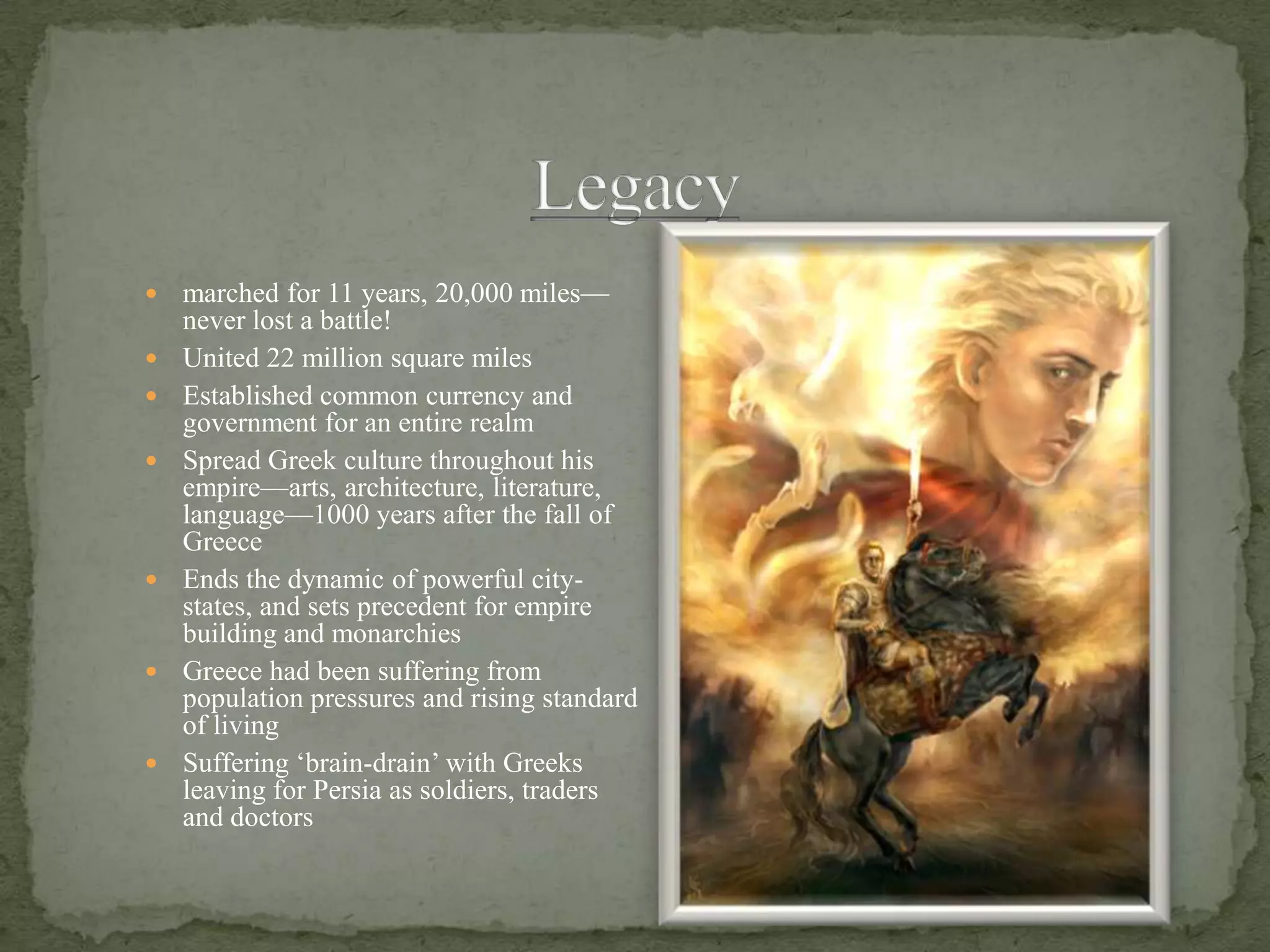
    Legacymarched for 11years, 20,000 miles—never lost a battle!United 22 million square milesEstablished common currency and government for an entire realmSpread Greek culture throughout his empire—arts, architecture, literature, language—1000 years after the fall of GreeceEnds the dynamic of powerful city-states, and sets precedent for empire building and monarchiesGreece had been suffering from population pressures and rising standard of livingSuffering ‘brain-drain’ with Greeks leaving for Persia as soldiers, traders and doctors
  • 36.
    http://www.stmaryschoolei.org/school/file.php/1/math_8A/Ancient_Greece_Map_Cartoon.gifhttp://www.socialstudiesforkids.com/graphics/greecepersiamaplarge.jpghttp://z.about.com/d/ancienthistory/1/0/u/P/Thermopyla.jpghttp://www.sikyon.com/athens/images/athens-recons.jpghttp://edsitement.neh.gov/PersiaGreeceWars01.asphttp://www.emersonkent.com/images/maps/battle_of_thermopylae.jpghttp://cd7.e2bn.net/e2bn/leas/c99/schools/cd7/website/images/Greek-battle-of-marathon-1.jpghttp://www.travelblog.org/pix/maps/europe.jpghttp://upload.wikimedia.org/wikipedia/commons/archive/4/42/20050713132352!Battle_of_Marathon_Initial_Situation.pnghttp://www.mlahanas.de/Greeks/Bios/LeonidasMonument2.jpghttp://www.thelatinlibrary.com/historians/maps/peloponnesianwar1.jpghttp://www.mlahanas.de/Greeks/Live/Education/Education2.jpghttp://z.about.com/d/atheism/1/0/Y/S/DemeterCeresHarvestFeast-l.jpghttp://encarta.msn.com/media_461530053_761571223_-1_1/Pisistratus.htmlAnnotated Bibliography
  • 37.