


INDIAN DENTAL ACADEMY
Leader in continuing dental education
www.indiandentalacademy.com

www.indiandentalacademy.com
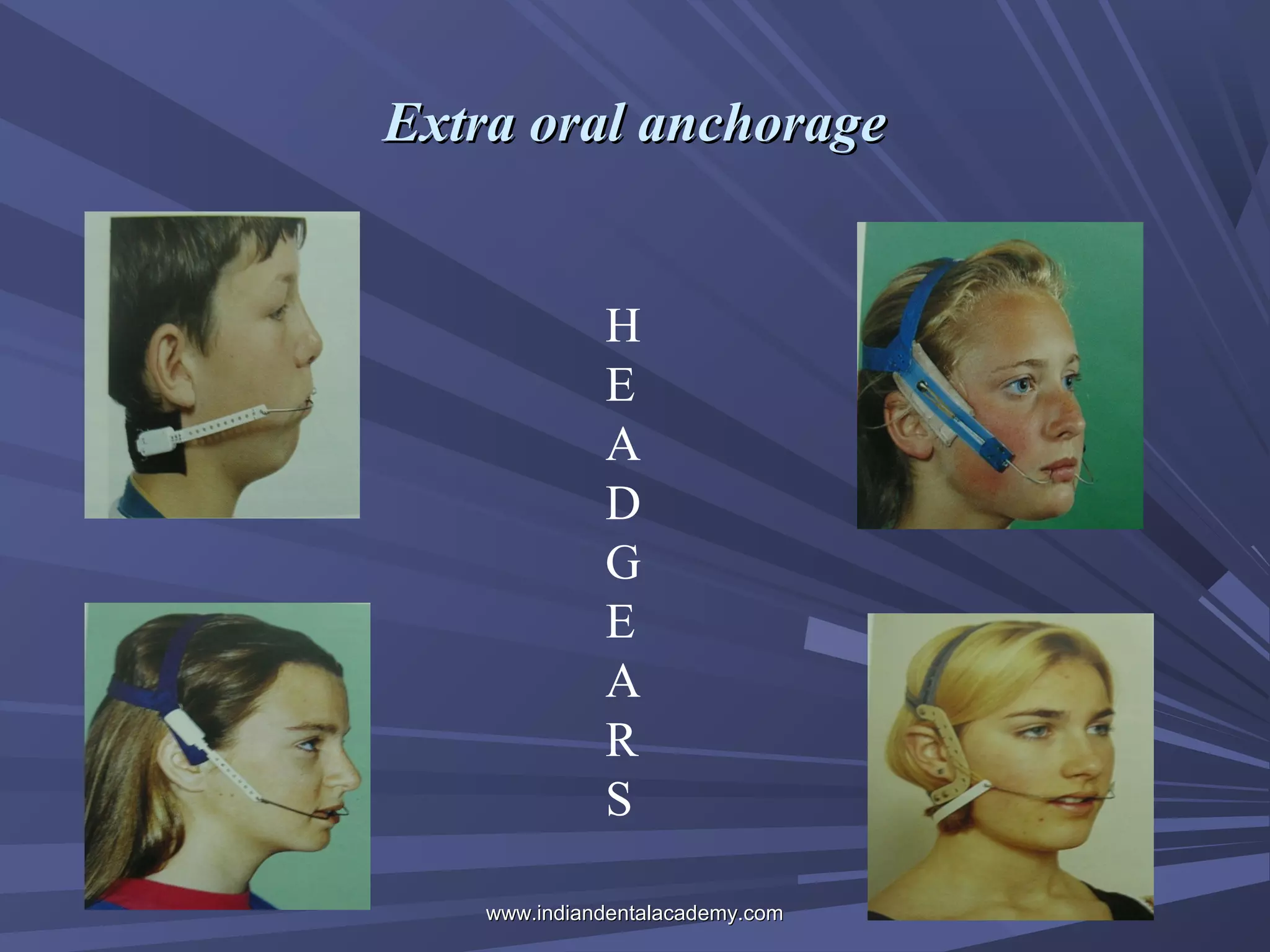
Extra oral anchorage

H
E
A
D
G
E
A
R
S
www.indiandentalacademy.com
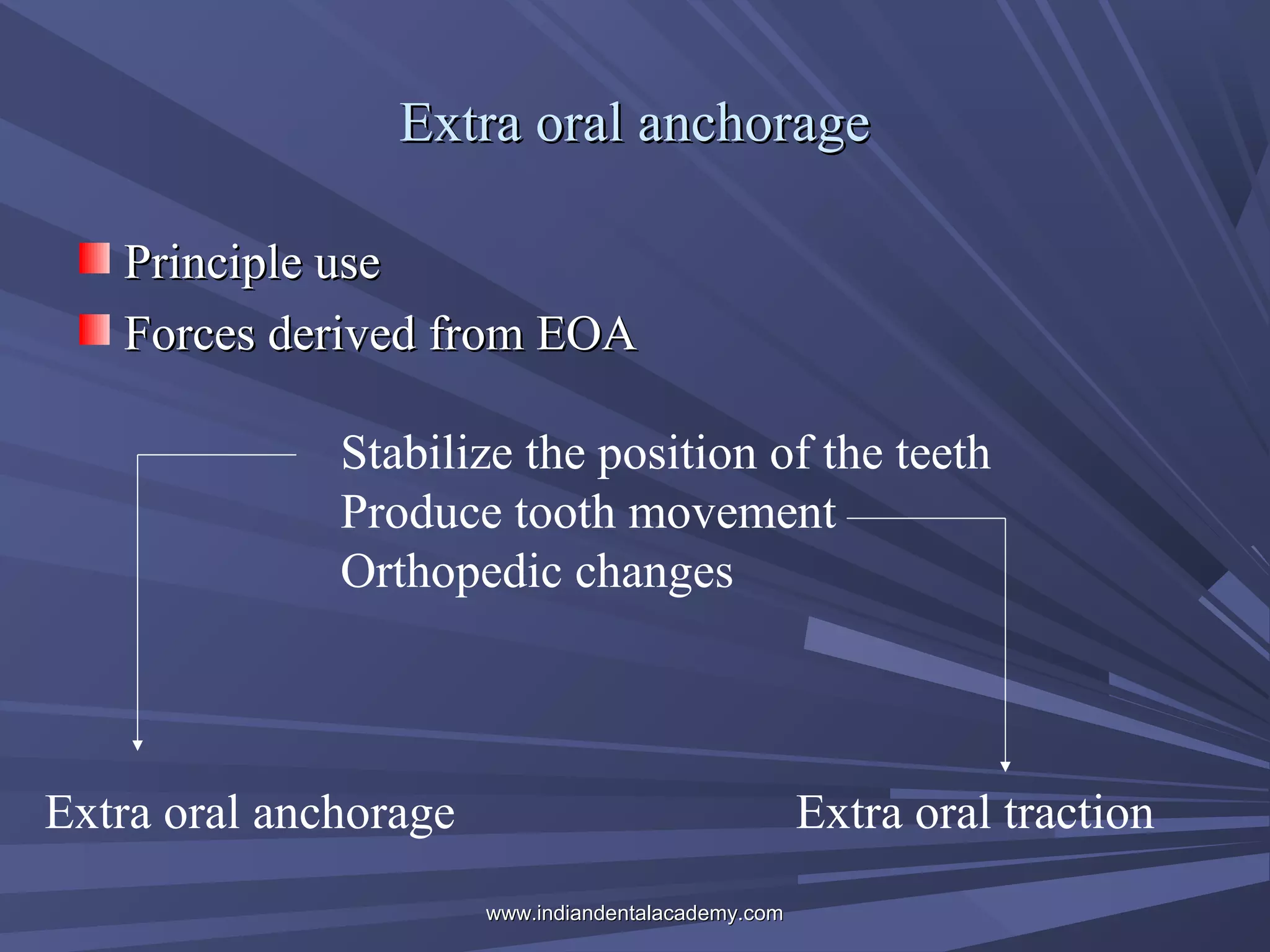
Extra oral anchorage
Principle use
Forces derived from EOA
Stabilize the position of the teeth
Produce tooth movement
Orthopedic changes

Extra oral anchorage

Extra oral traction
www.indiandentalacademy.com
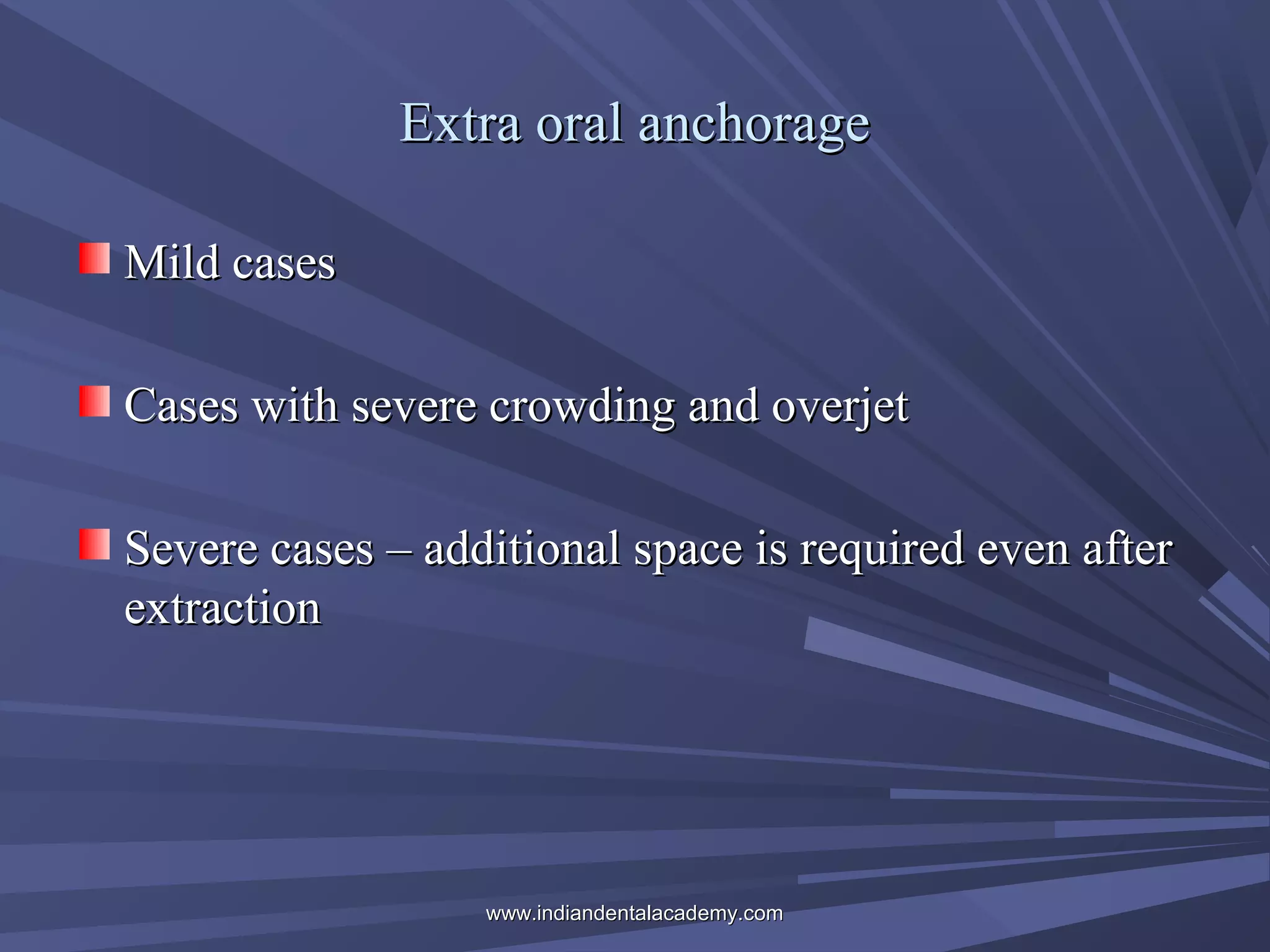
Extra oral anchorage
Mild cases
Cases with severe crowding and overjet
Severe cases – additional space is required even after
extraction

www.indiandentalacademy.com
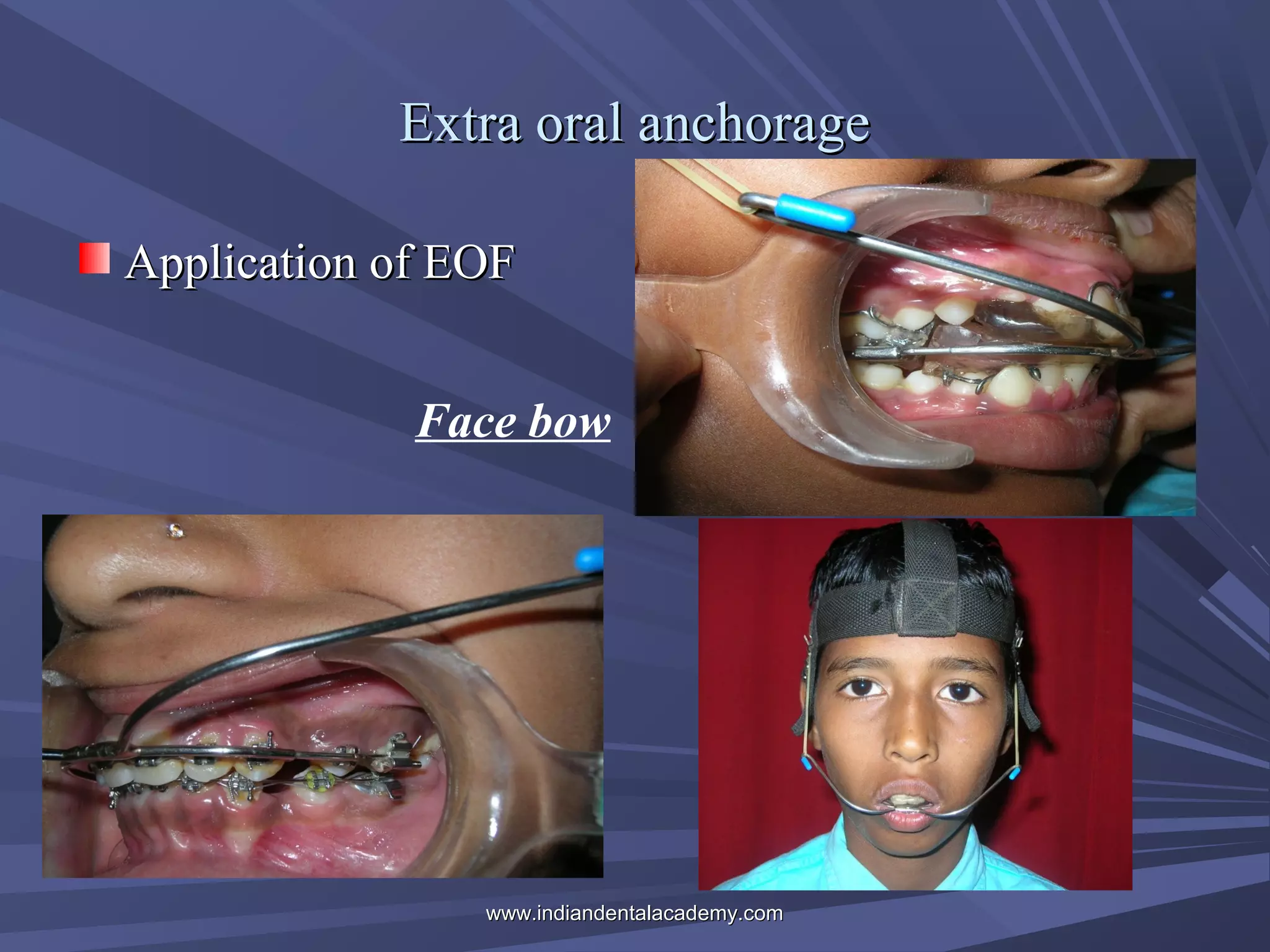
Extra oral anchorage
Application of EOF
Face bow

www.indiandentalacademy.com
Extra oral anchorage
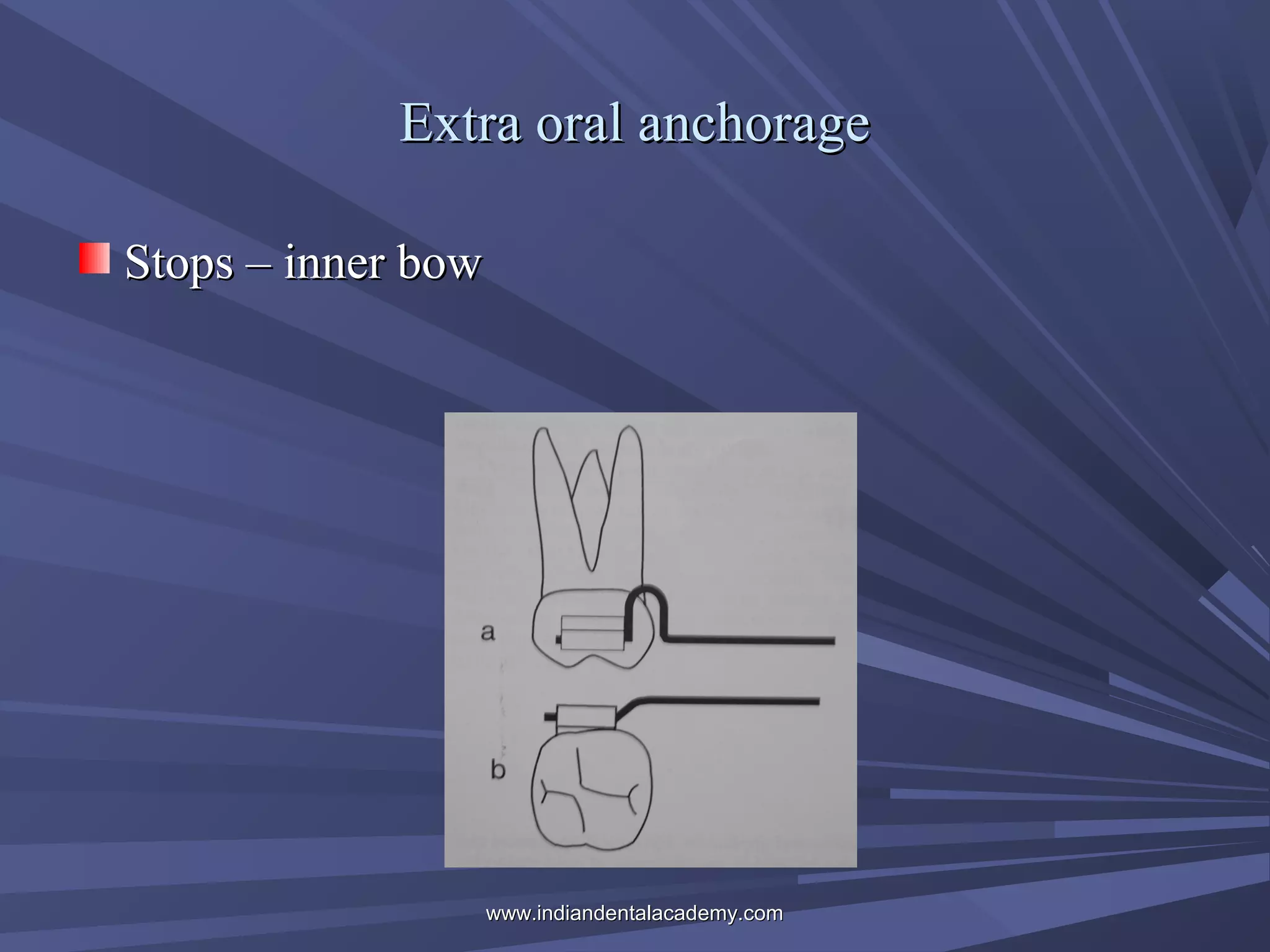
Stops – inner bow

www.indiandentalacademy.com
Extra oral anchorage
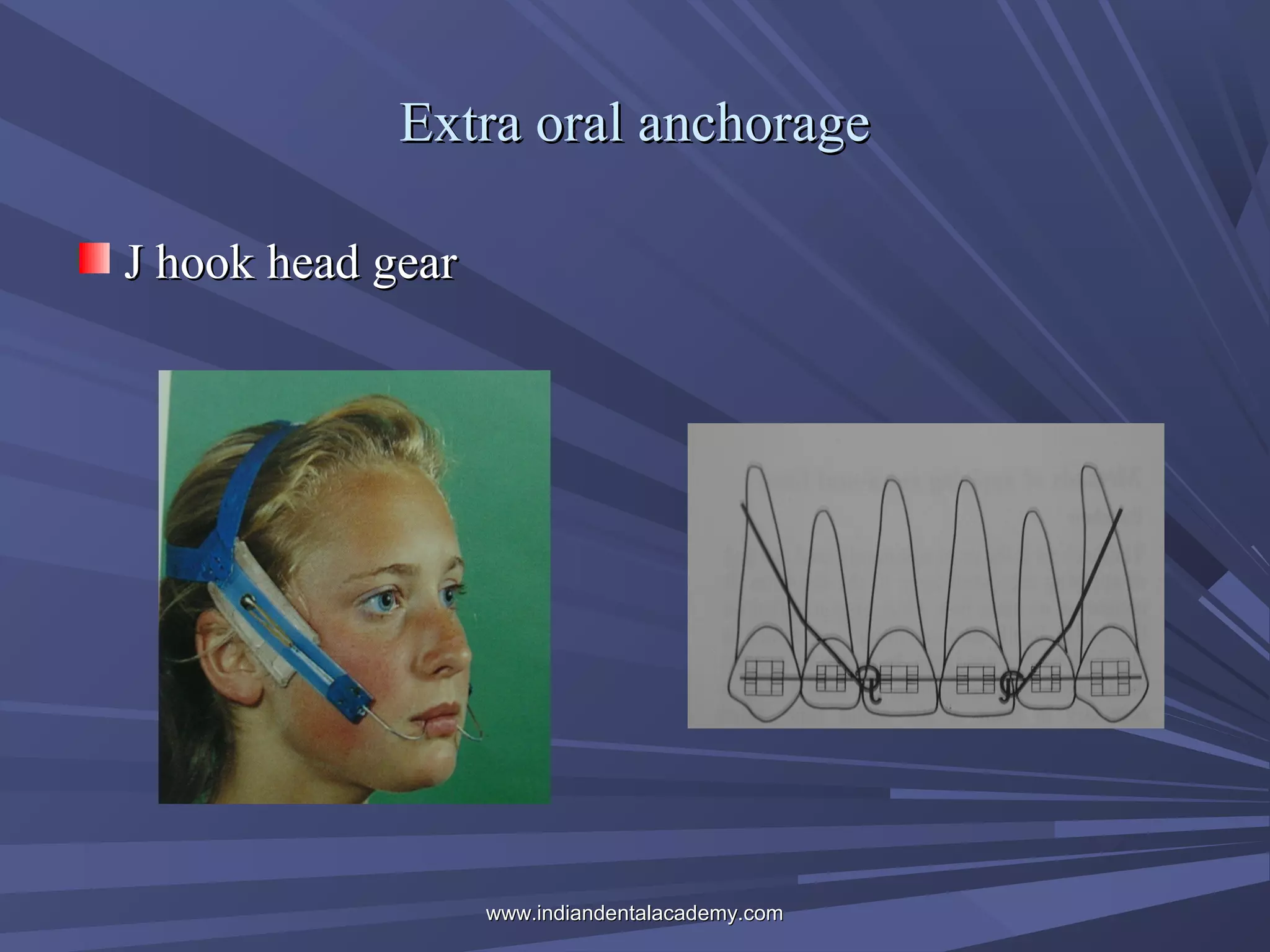
J hook head gear

www.indiandentalacademy.com
Extra oral anchorage
Directional control
Effects of EOF depends on

Duration
Direction
Magnitude
1 ounce – 28.35 gms
www.indiandentalacademy.com
Extra oral anchorage
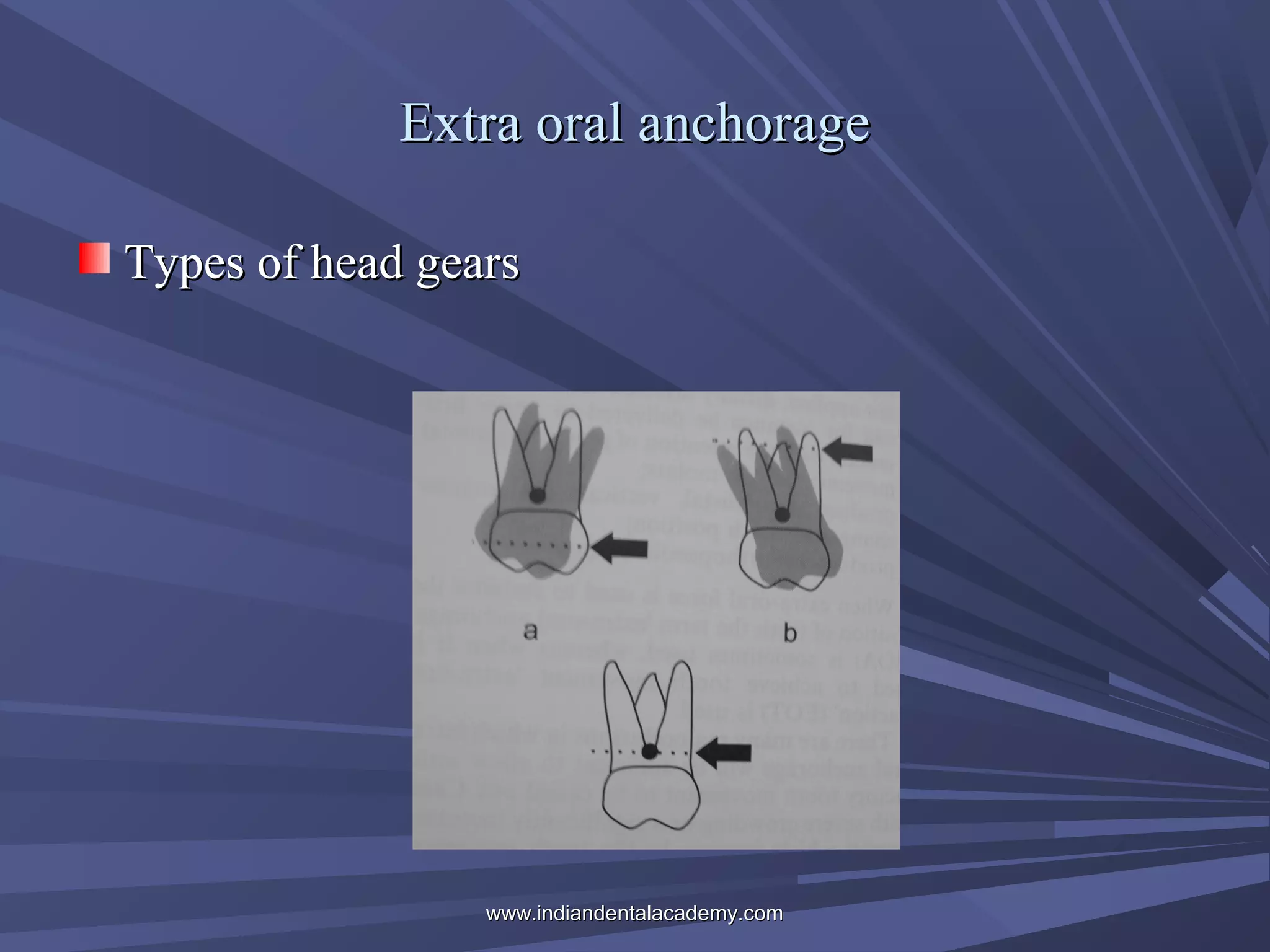
Types of head gears

www.indiandentalacademy.com
Extra oral anchorage

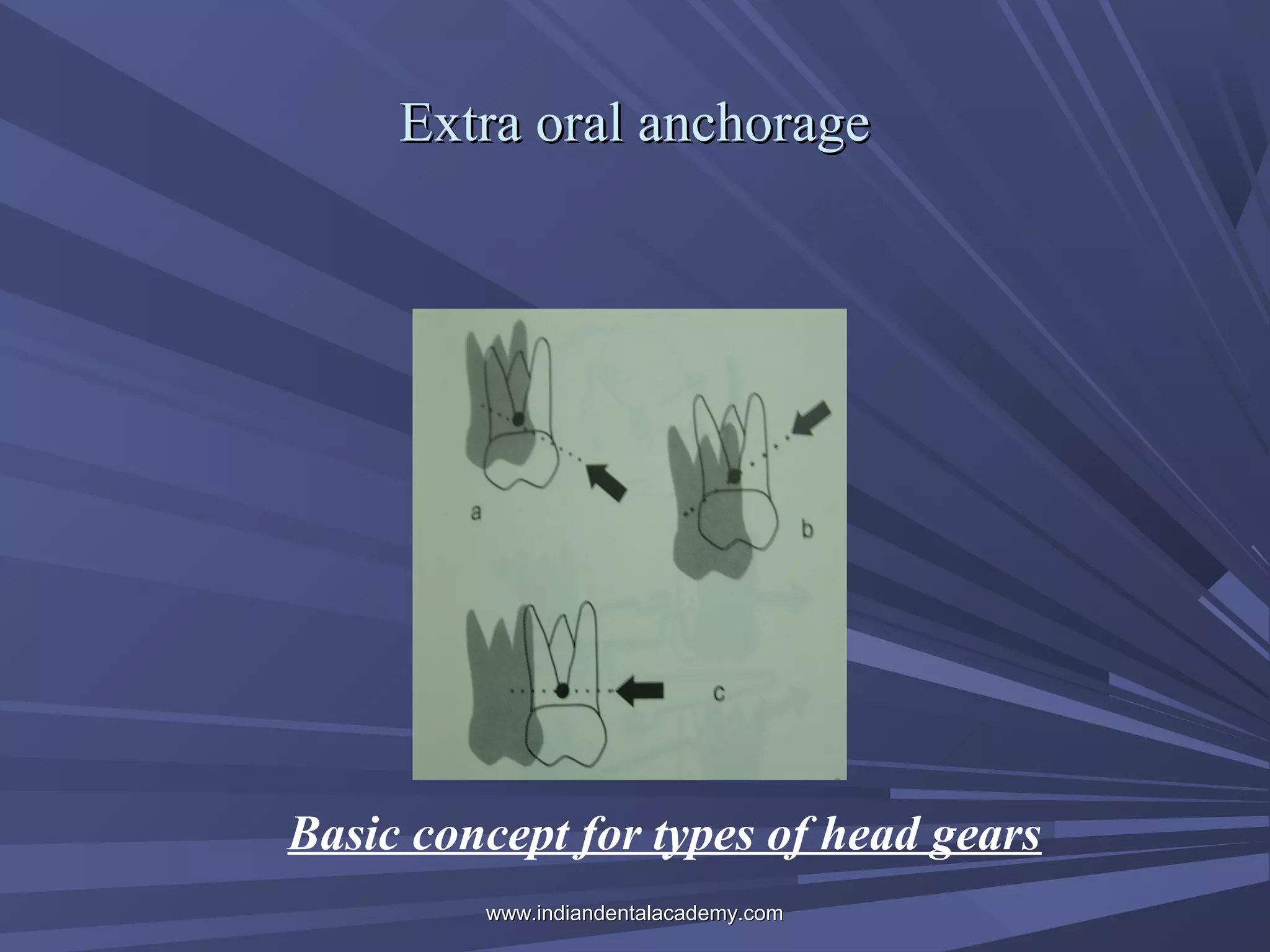
Basic concept for types of head gears
www.indiandentalacademy.com
Extra oral anchorage
Relationship to the occlusal plane

Low pull
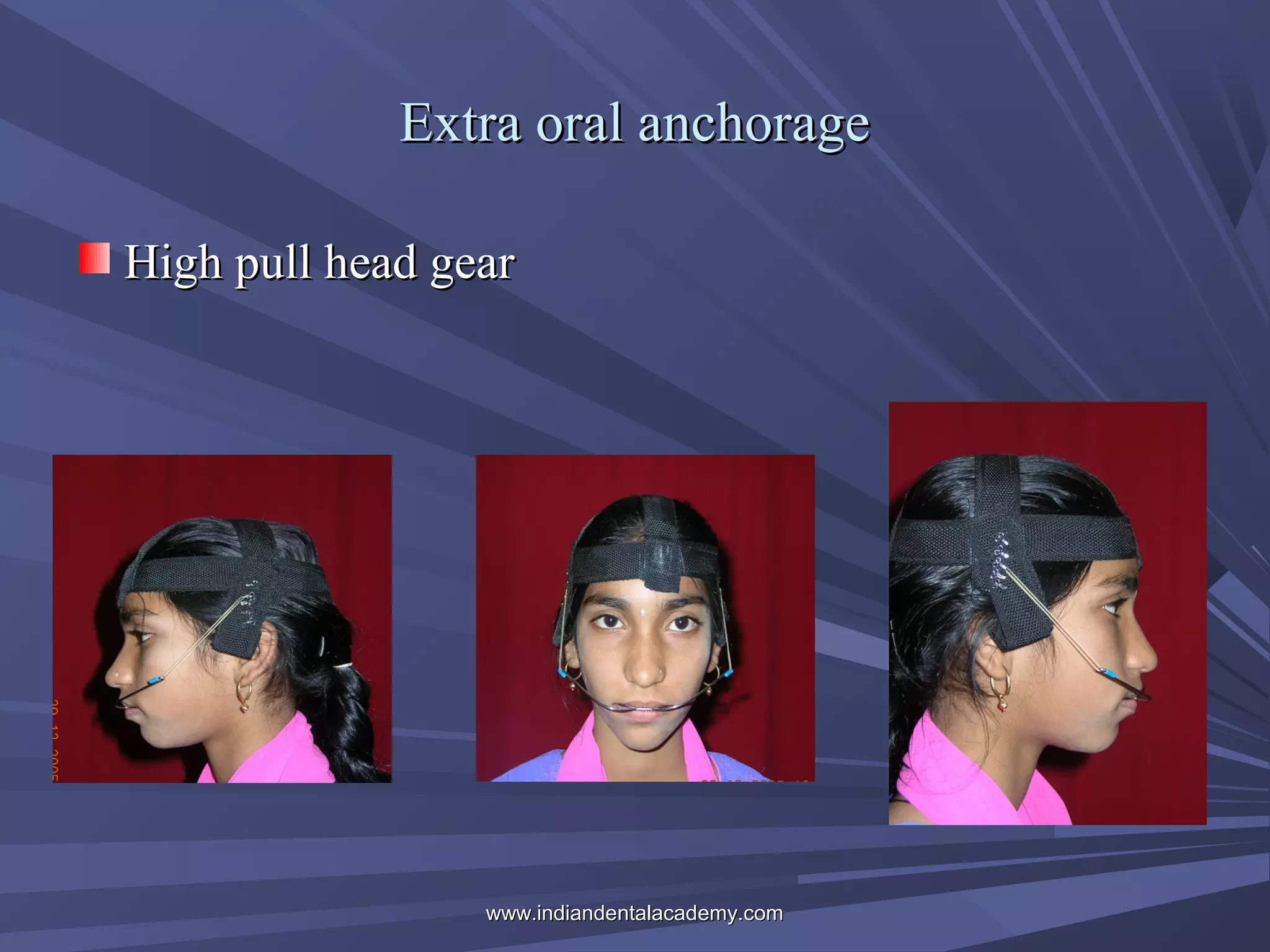
High pull
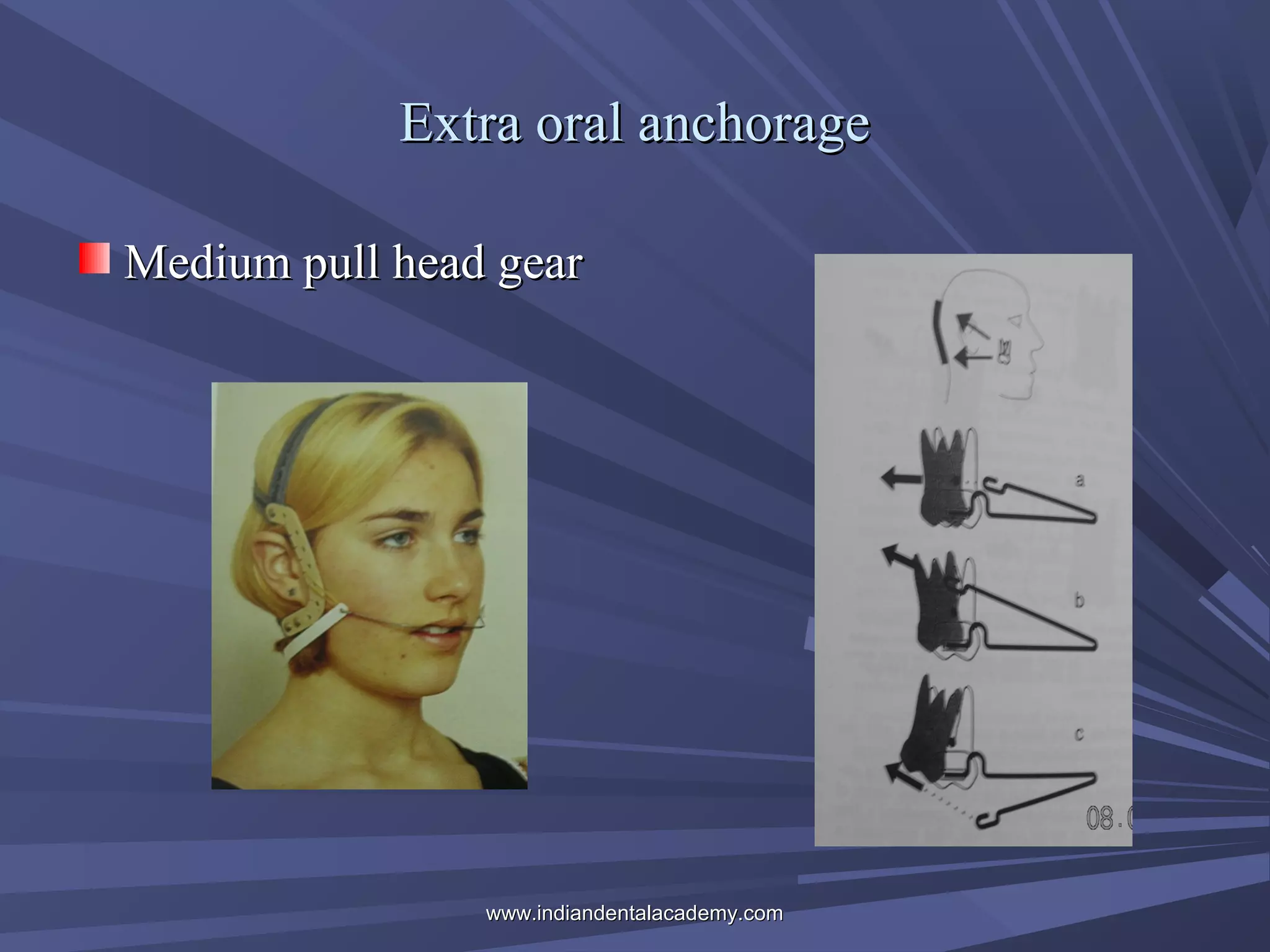
Medium pull

www.indiandentalacademy.com
Extra oral anchorage
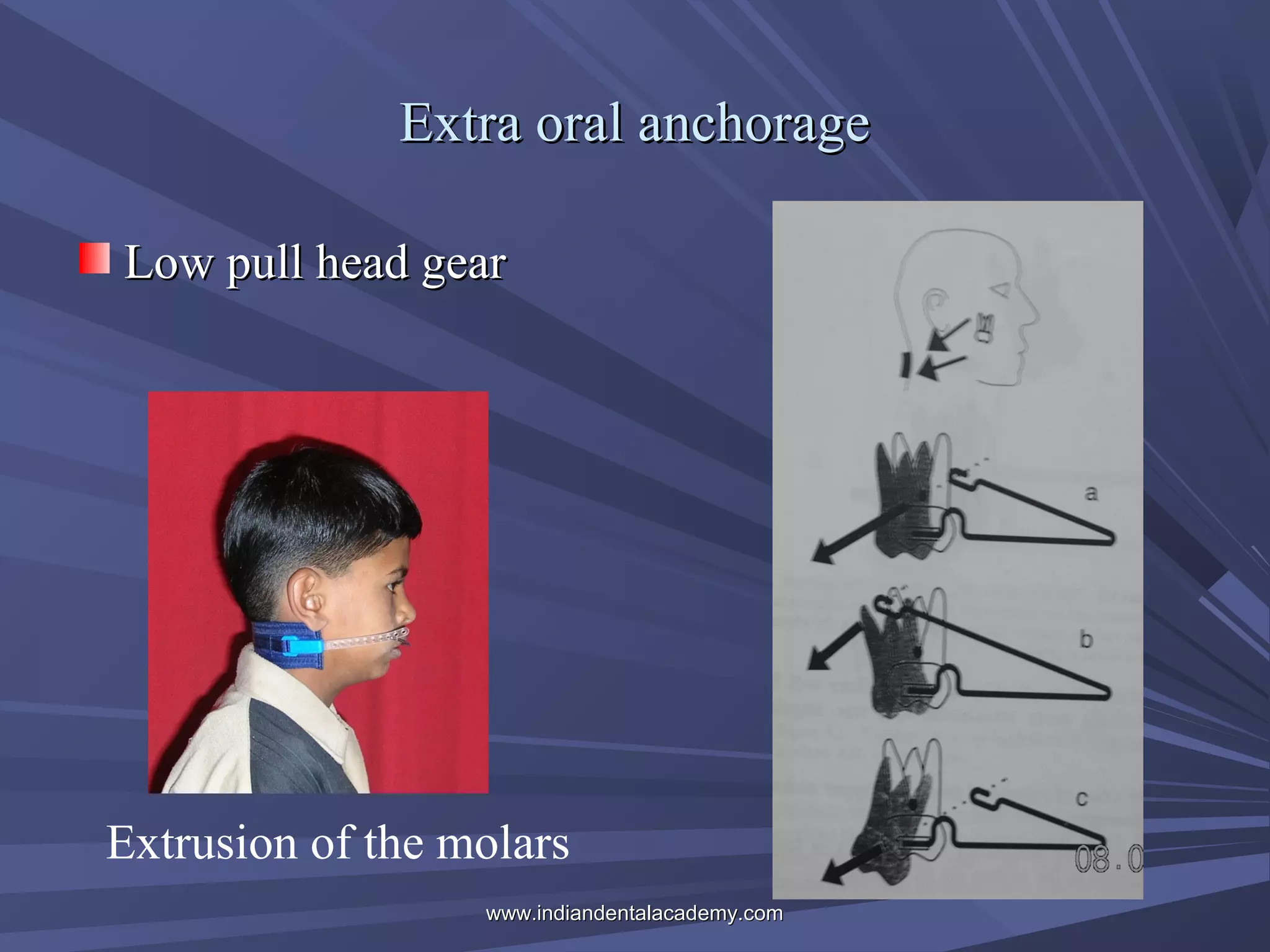
Low pull head gear

Extrusion of the molars
www.indiandentalacademy.com
Extra oral anchorage

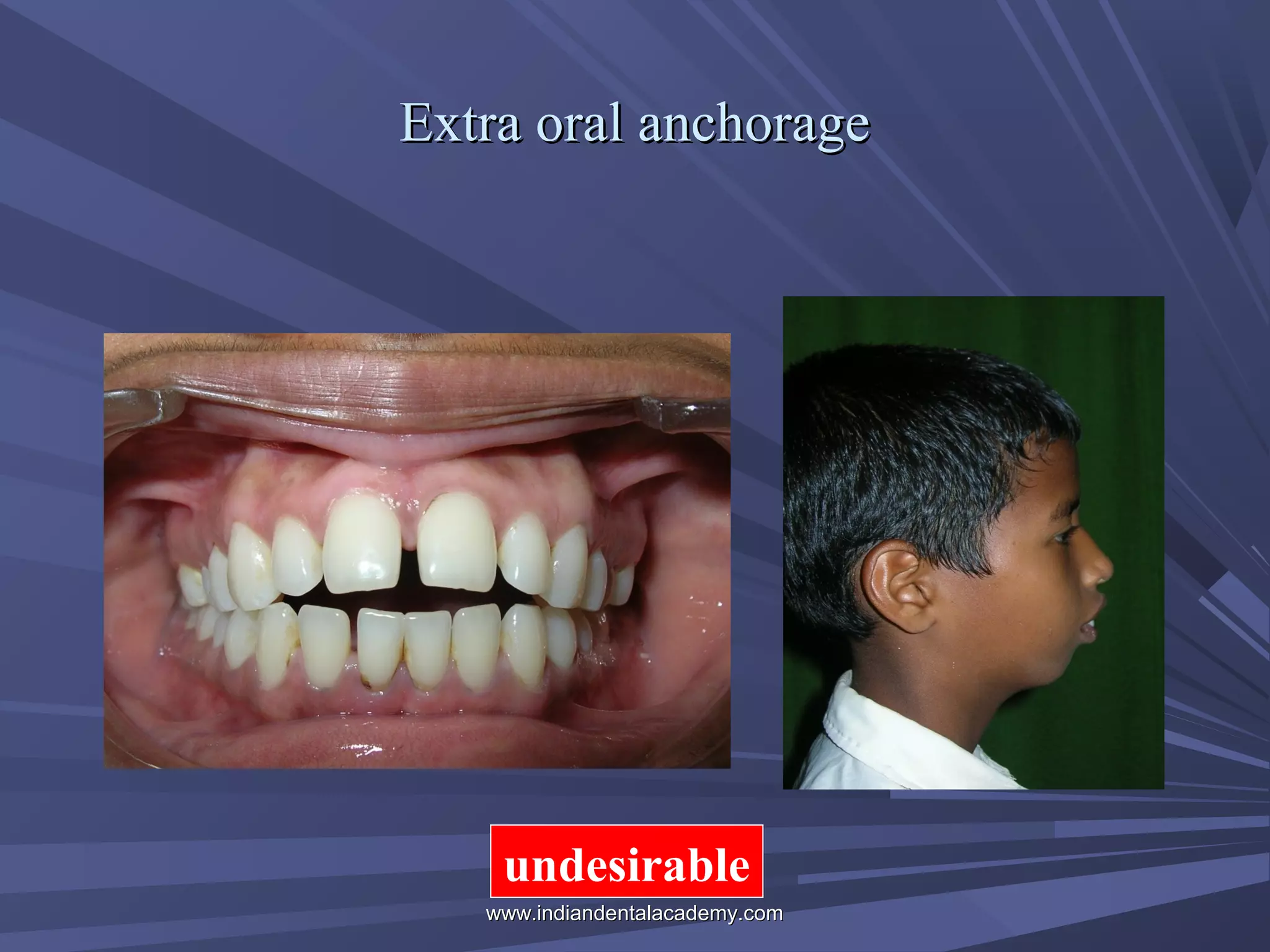
undesirable
www.indiandentalacademy.com
Extra oral anchorage
High pull head gear

www.indiandentalacademy.com
Extra oral anchorage

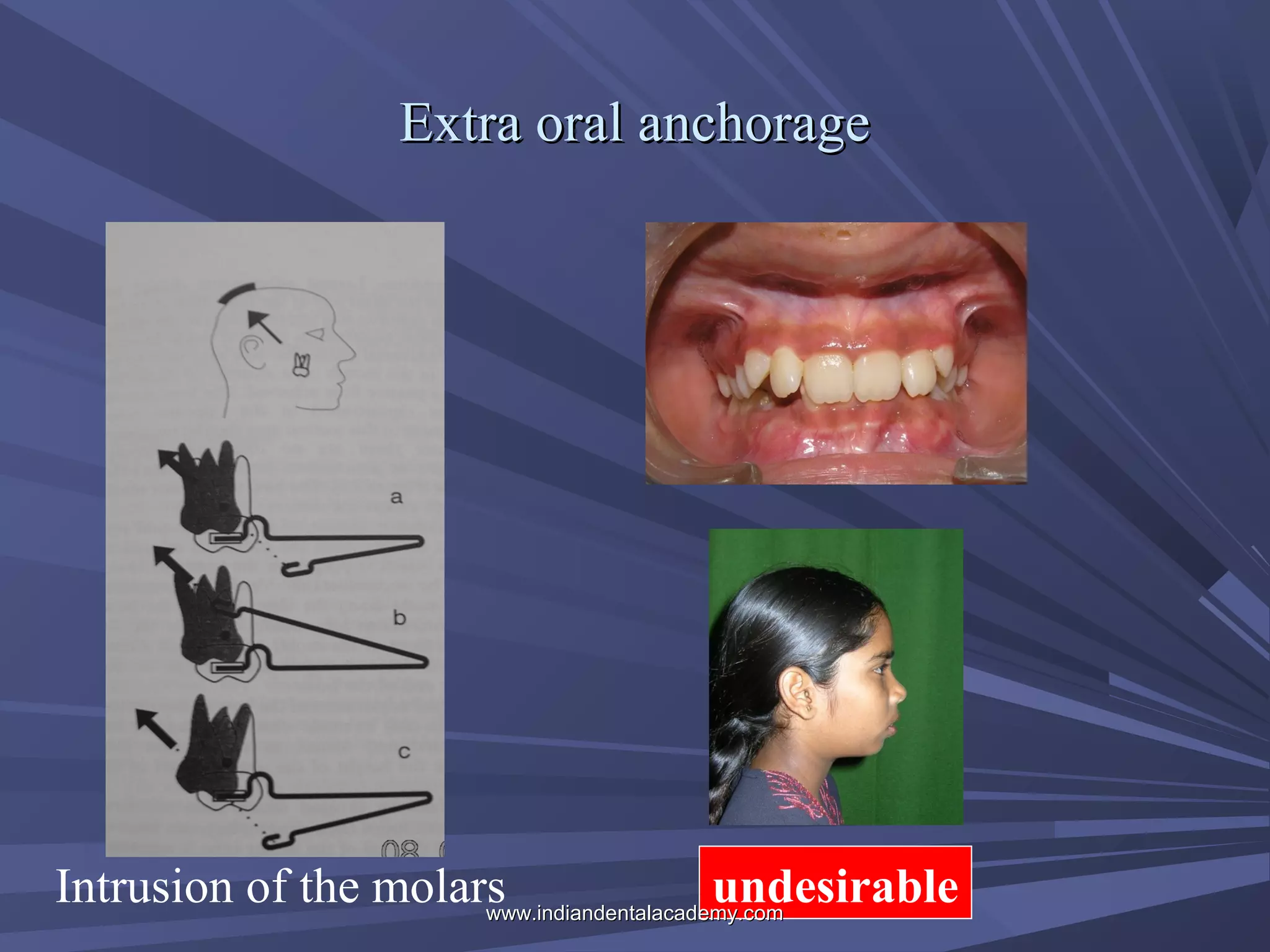
Intrusion of the molars
undesirable
www.indiandentalacademy.com
Extra oral anchorage
Medium pull head gear

www.indiandentalacademy.com
Extra oral anchorage



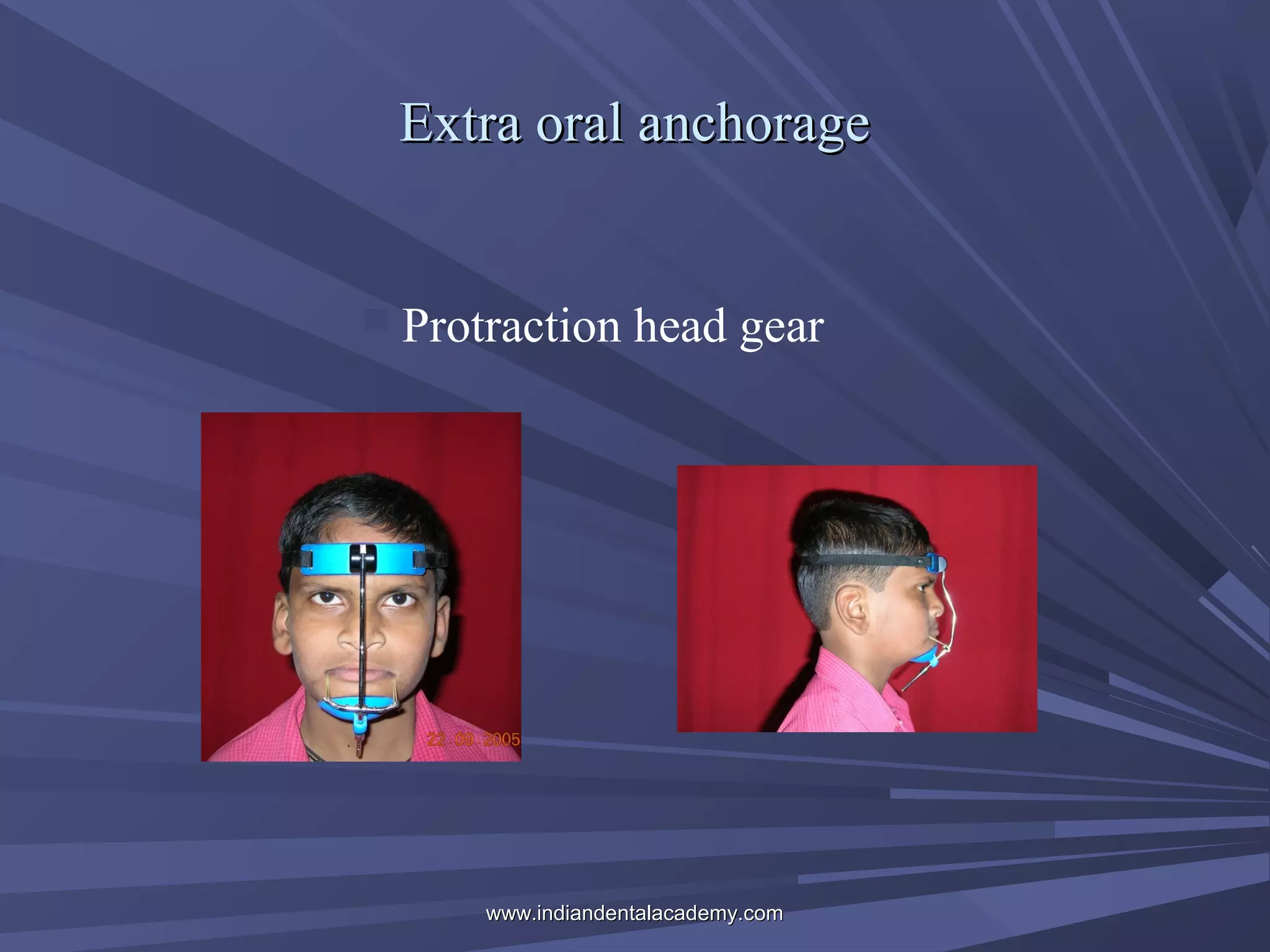
Protraction head gear

www.indiandentalacademy.com
Extra oral anchorage
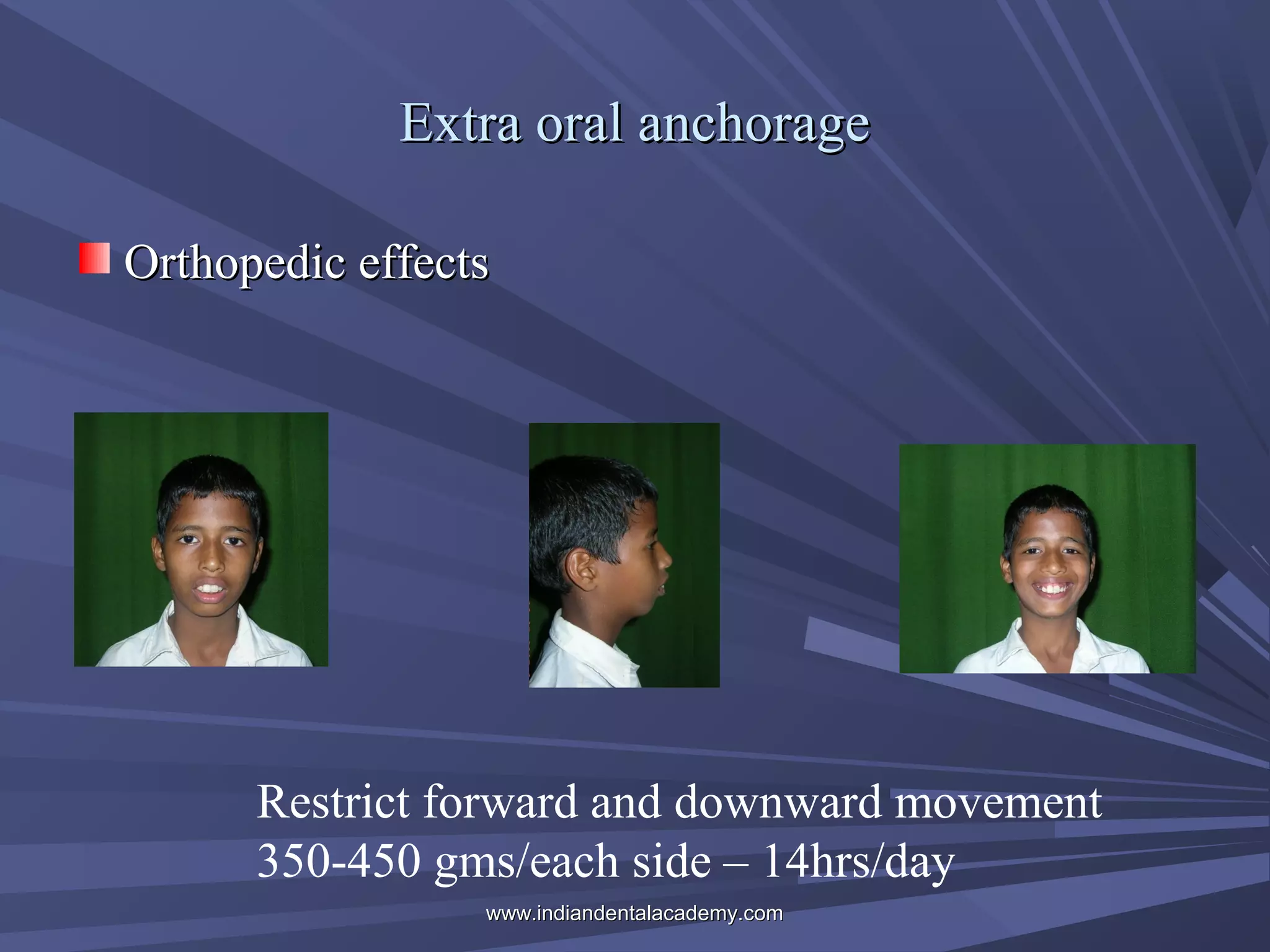
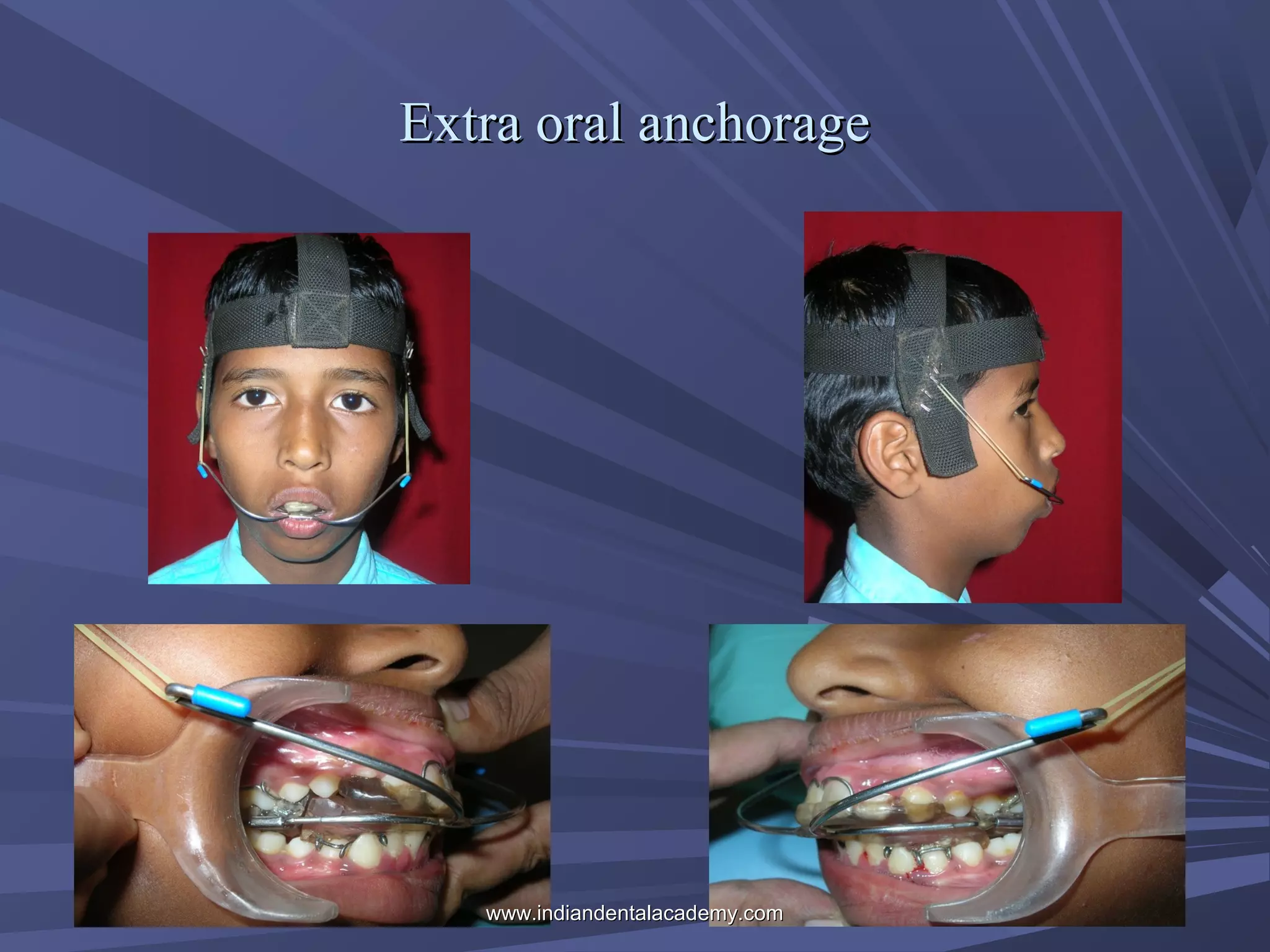
Orthopedic effects

Restrict forward and downward movement
350-450 gms/each side – 14hrs/day
www.indiandentalacademy.com
Extra oral anchorage

www.indiandentalacademy.com
Extra oral anchorage
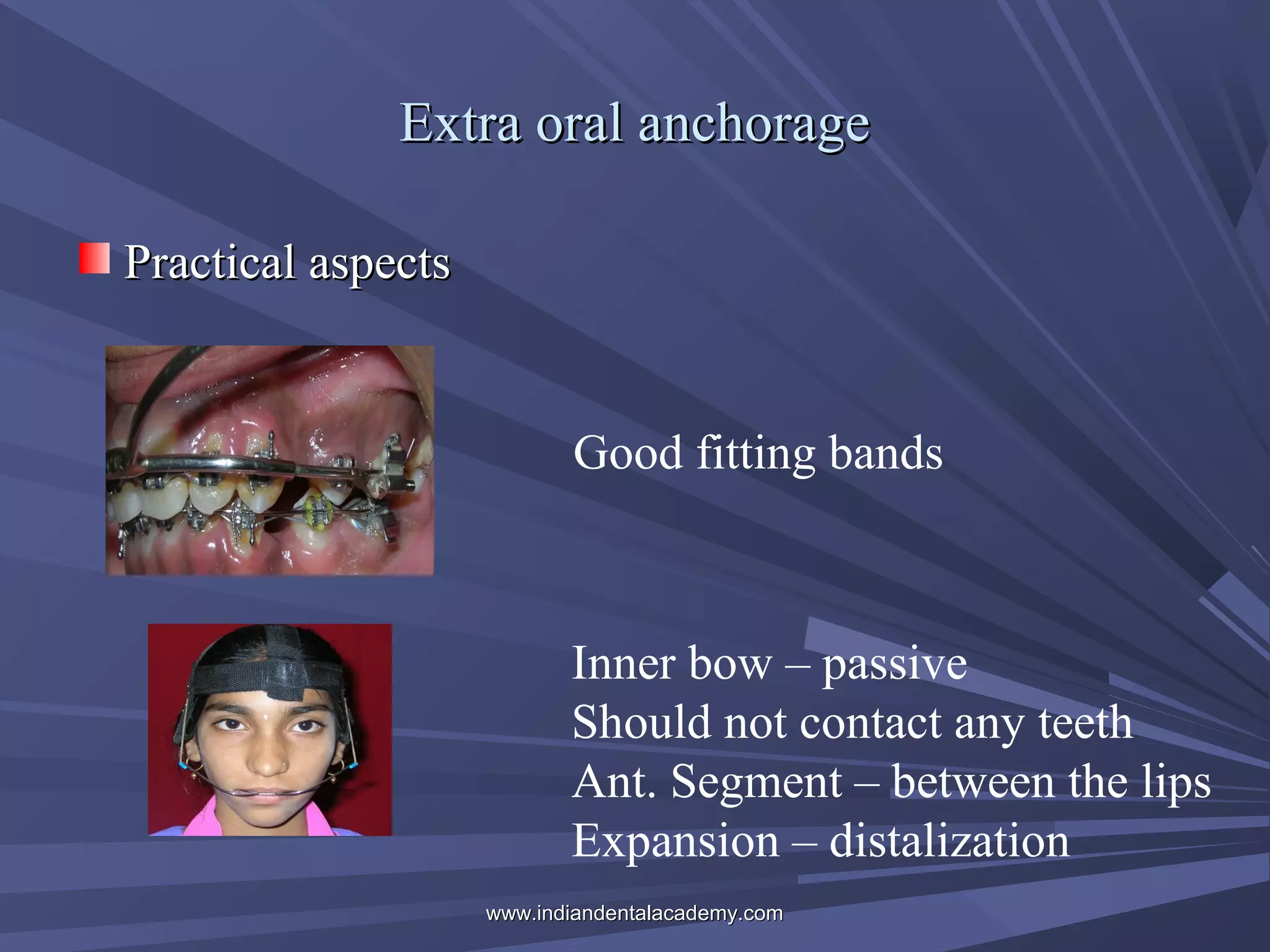
Practical aspects

Good fitting bands

Inner bow – passive
Should not contact any teeth
Ant. Segment – between the lips
Expansion – distalization
www.indiandentalacademy.com
Extra oral anchorage
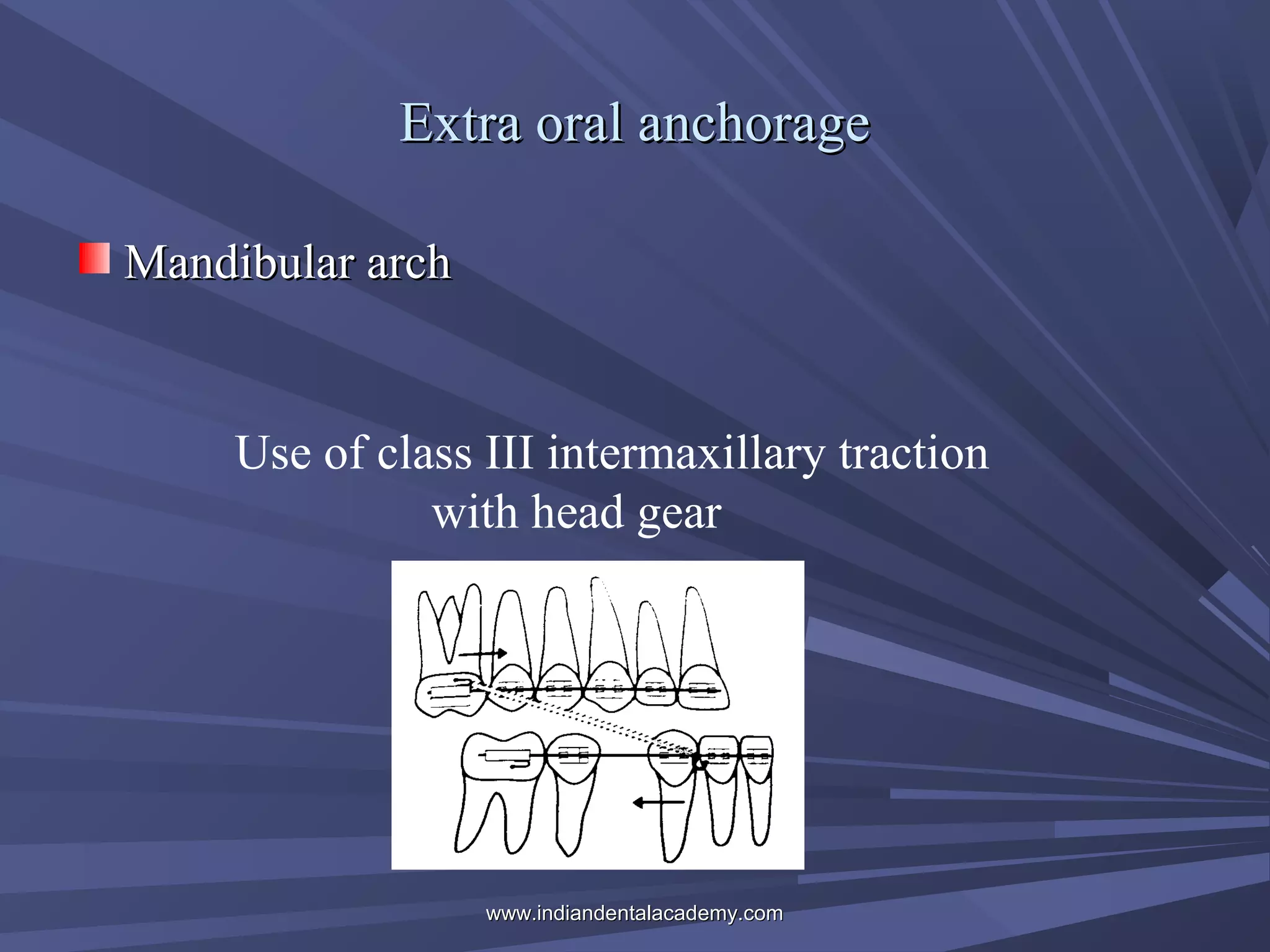
Mandibular arch

Use of class III intermaxillary traction
with head gear

www.indiandentalacademy.com
Mechanical aspect of anchorage
Sliding mechanics
Force is required for 2 purposes
Bone remodeling
Frictional resistance
Controlling and minimizing friction is an imp. Aspect
of anchorage control
www.indiandentalacademy.com
Mechanical aspect of anchorage
Friction ???
Frictional force

Nature of surface at the interface (rough or smooth,
chemically reactive or passive, modified by
lubricants)
Independent of the apparent area of contact
www.indiandentalacademy.com
Mechanical aspect of anchorage
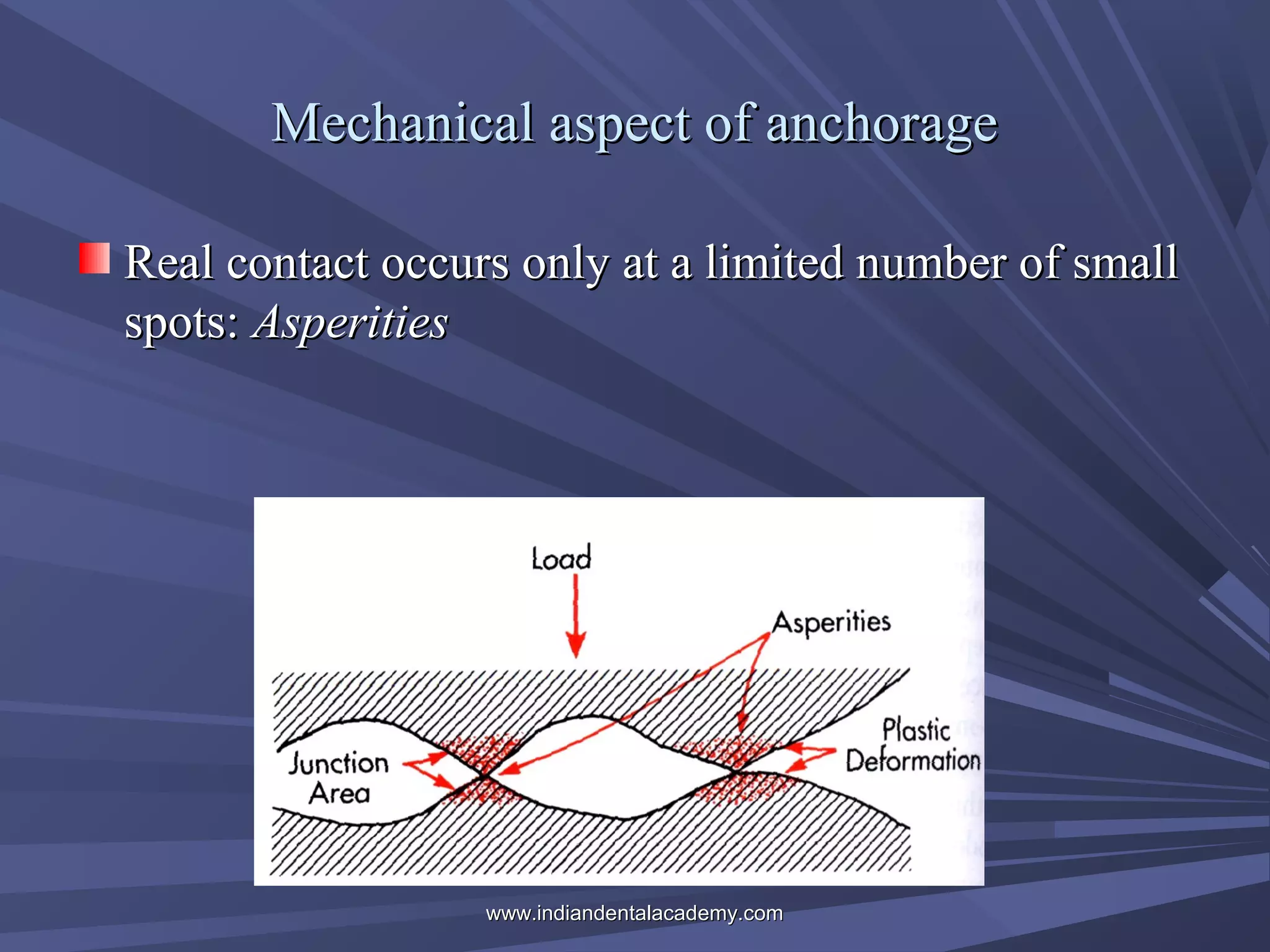
Real contact occurs only at a limited number of small
spots: Asperities

www.indiandentalacademy.com
Mechanical aspect of anchorage
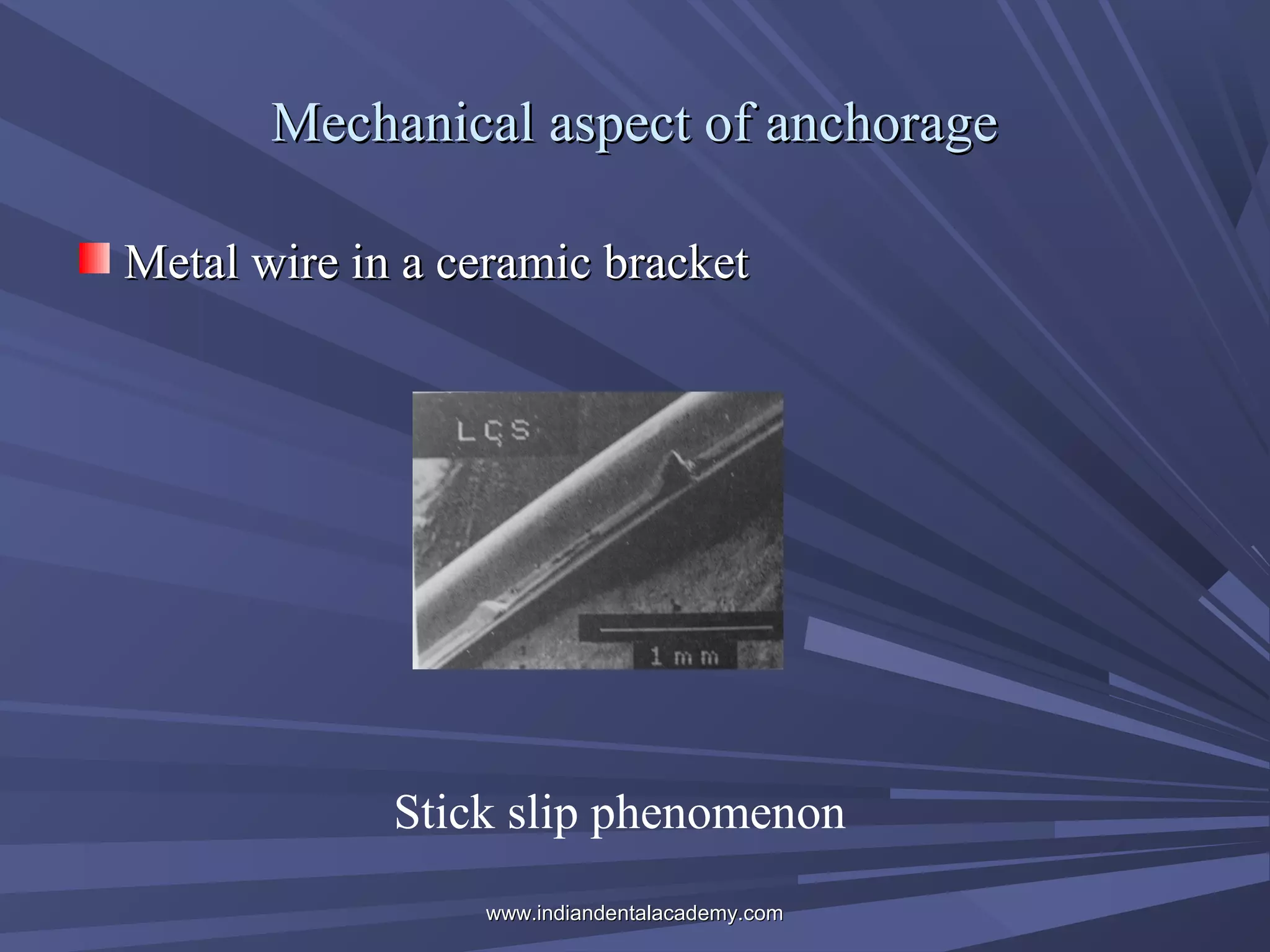
Metal wire in a ceramic bracket

Stick slip phenomenon
www.indiandentalacademy.com
Mechanical aspect of anchorage
2 other factors can affect the resistance to sliding
Interlocking of surface irregularities
Extent of plowing
In clinical practice friction is largely determined by
the shearing component

www.indiandentalacademy.com
Mechanical aspect of anchorage
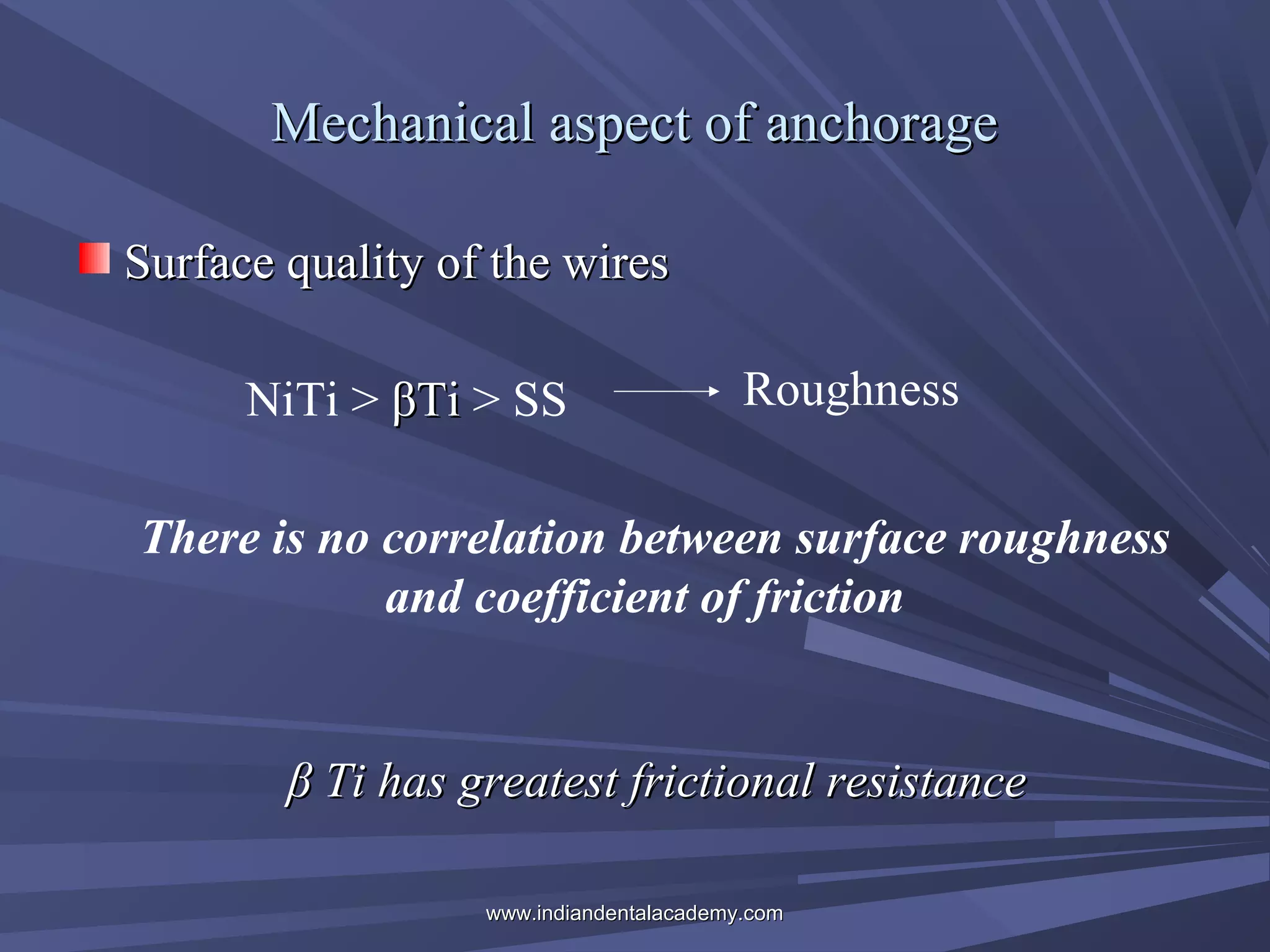
Surface quality of the wires
NiTi > βTi > SS

Roughness

There is no correlation between surface roughness
and coefficient of friction

β Ti has greatest frictional resistance
www.indiandentalacademy.com
Mechanical aspect of anchorage
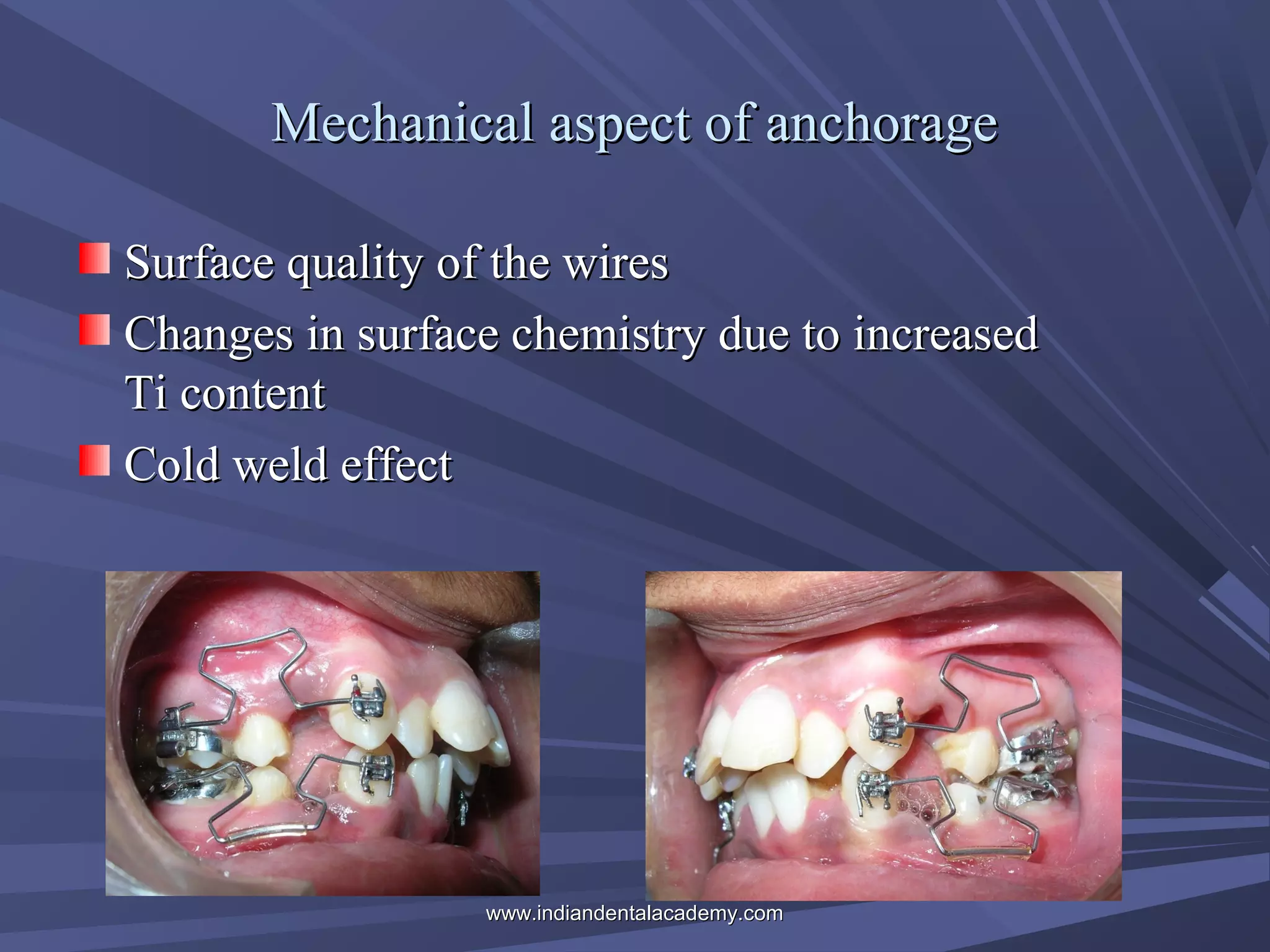
Surface quality of the wires
Changes in surface chemistry due to increased
Ti content
Cold weld effect

www.indiandentalacademy.com
Mechanical aspect of anchorage
Possible solution to this problem

Alteration of the surface of Ti wires

Among all, SS/SS couple is most effective for sliding
followed by CoCr/SS, NiTi/SS, βTi/SS
www.indiandentalacademy.com
Mechanical aspect of anchorage
Surface quality of the brackets
SS brackets
Ti brackets
Ceramic brackets
Ceramic brackets with metal slots
Composite brackets
Polycarbonate plastic brackets
www.indiandentalacademy.com
Mechanical aspect of anchorage
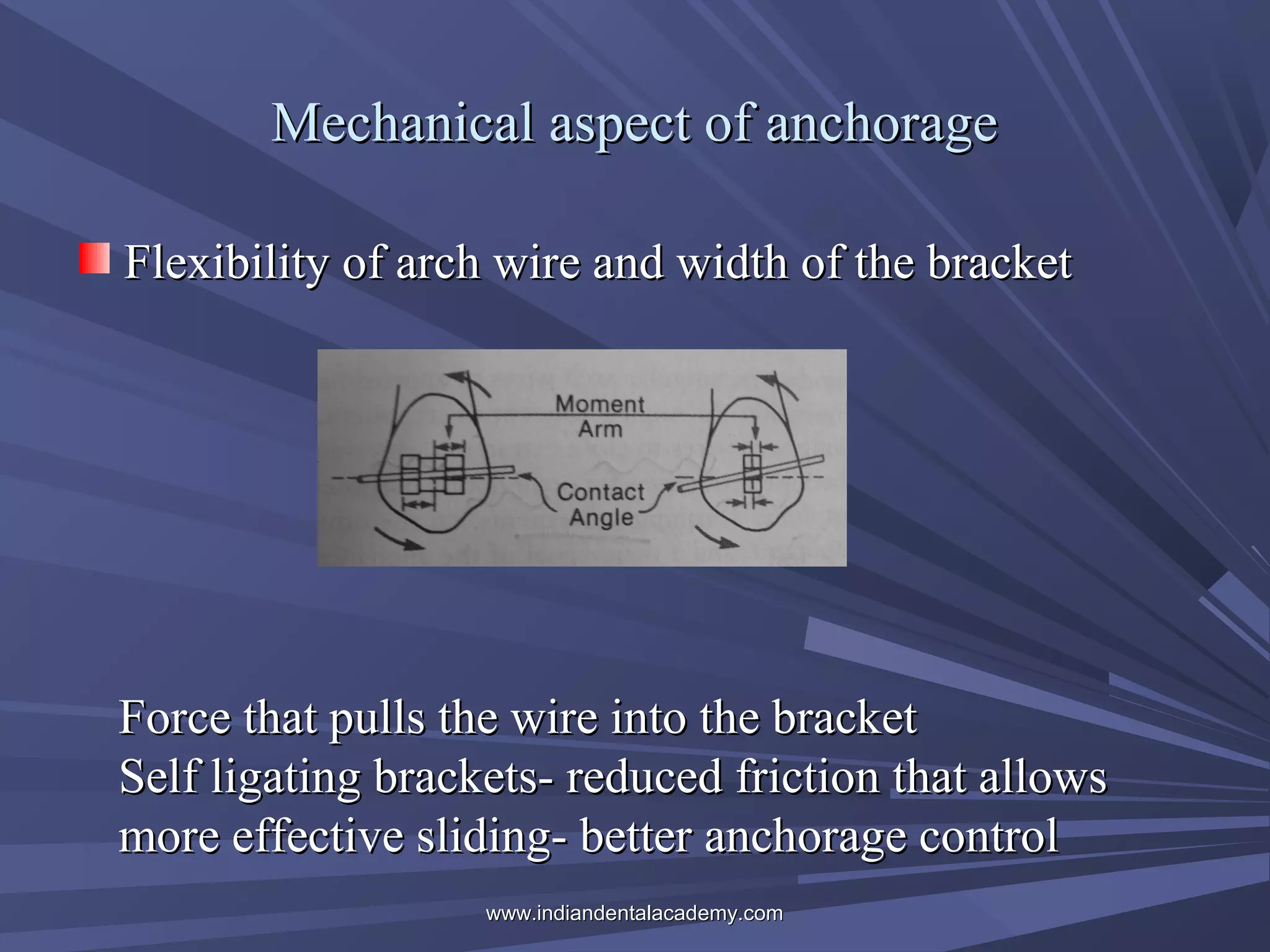
Flexibility of arch wire and width of the bracket

Force that pulls the wire into the bracket
Self ligating brackets- reduced friction that allows
more effective sliding- better anchorage control
www.indiandentalacademy.com
Mechanical aspect of anchorage
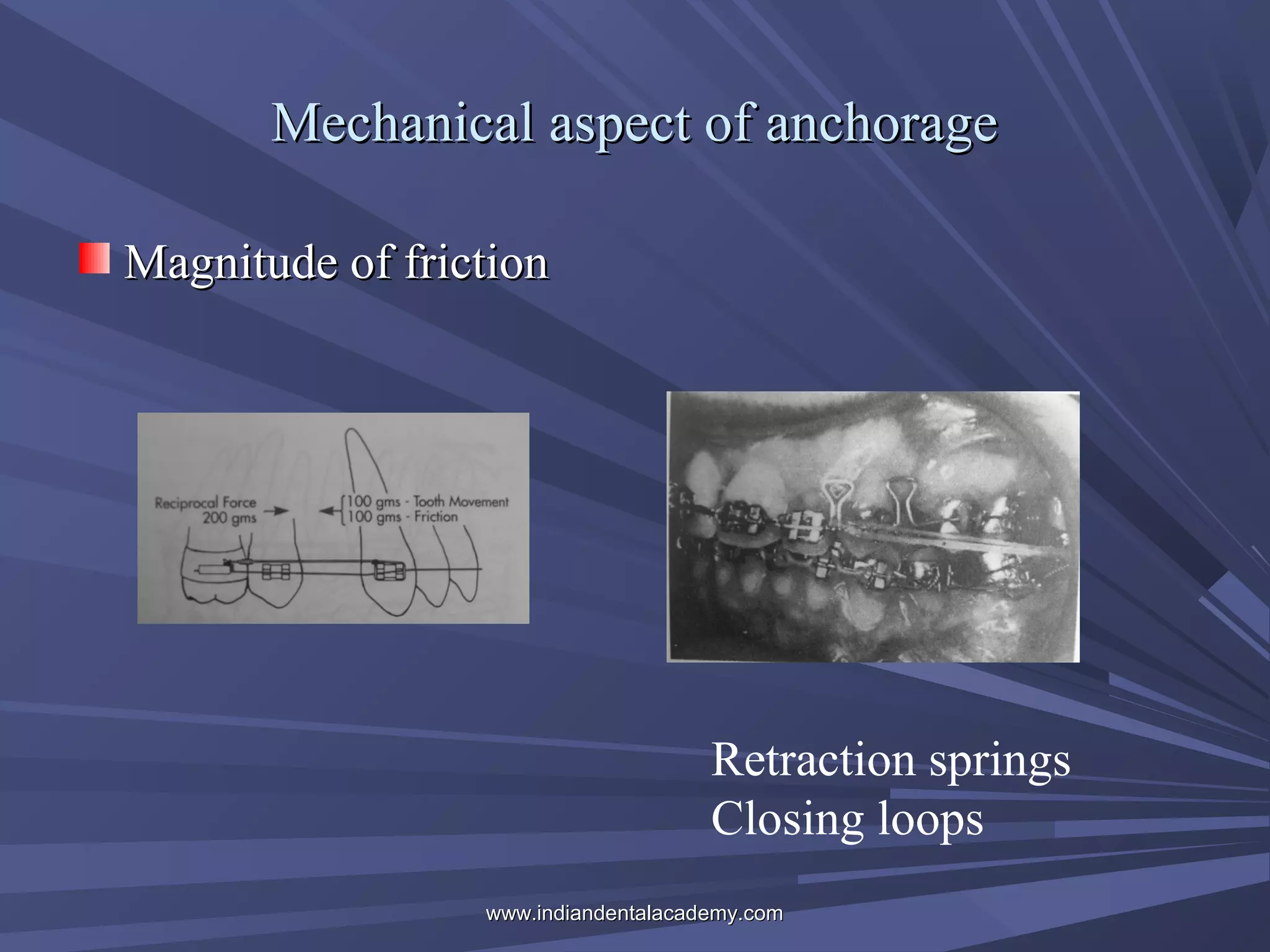
Magnitude of friction

Retraction springs
Closing loops
www.indiandentalacademy.com
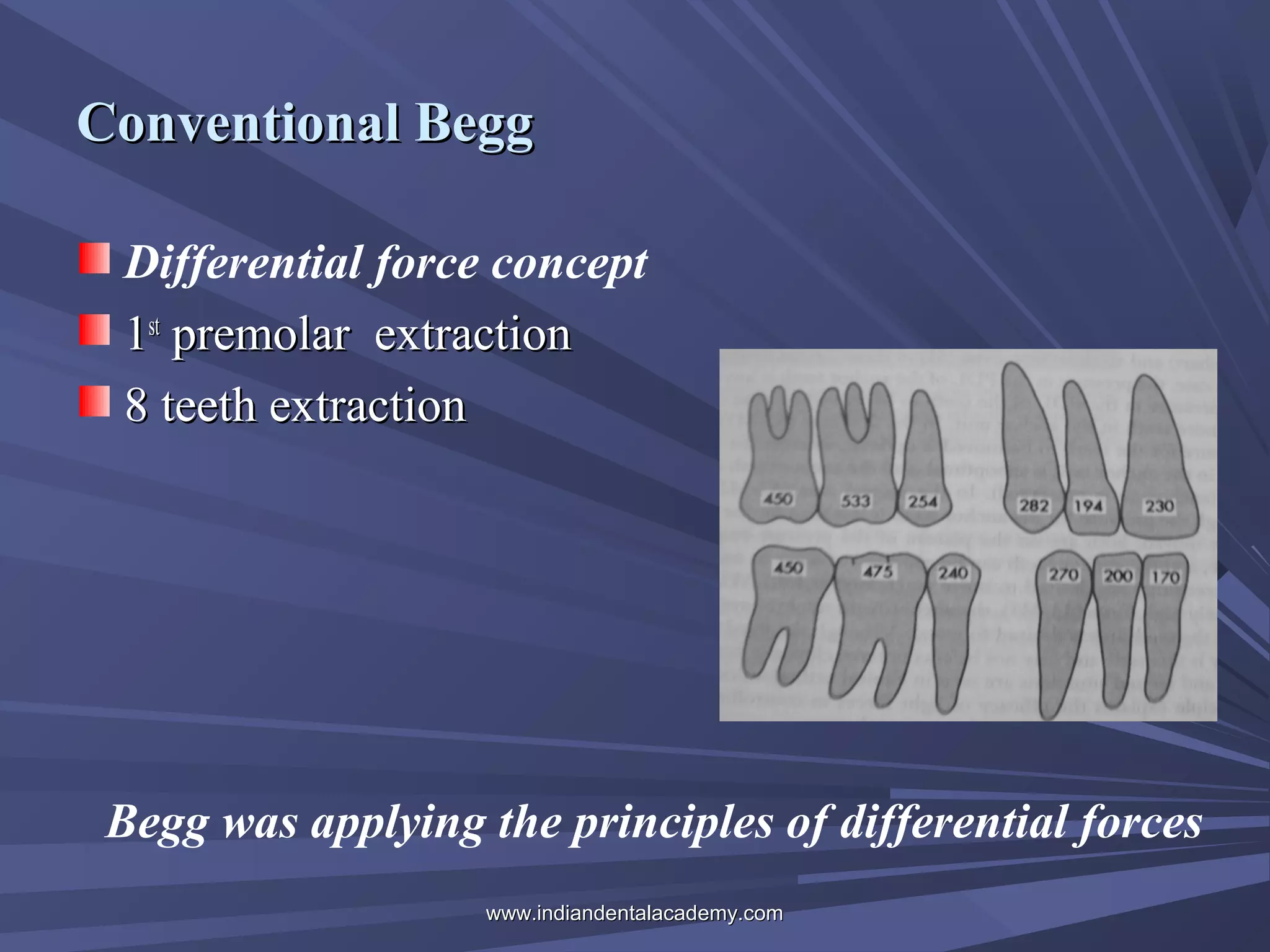
Conventional Begg
Differential force concept
1st premolar extraction
8 teeth extraction

Begg was applying the principles of differential forces
www.indiandentalacademy.com
Conventional Begg
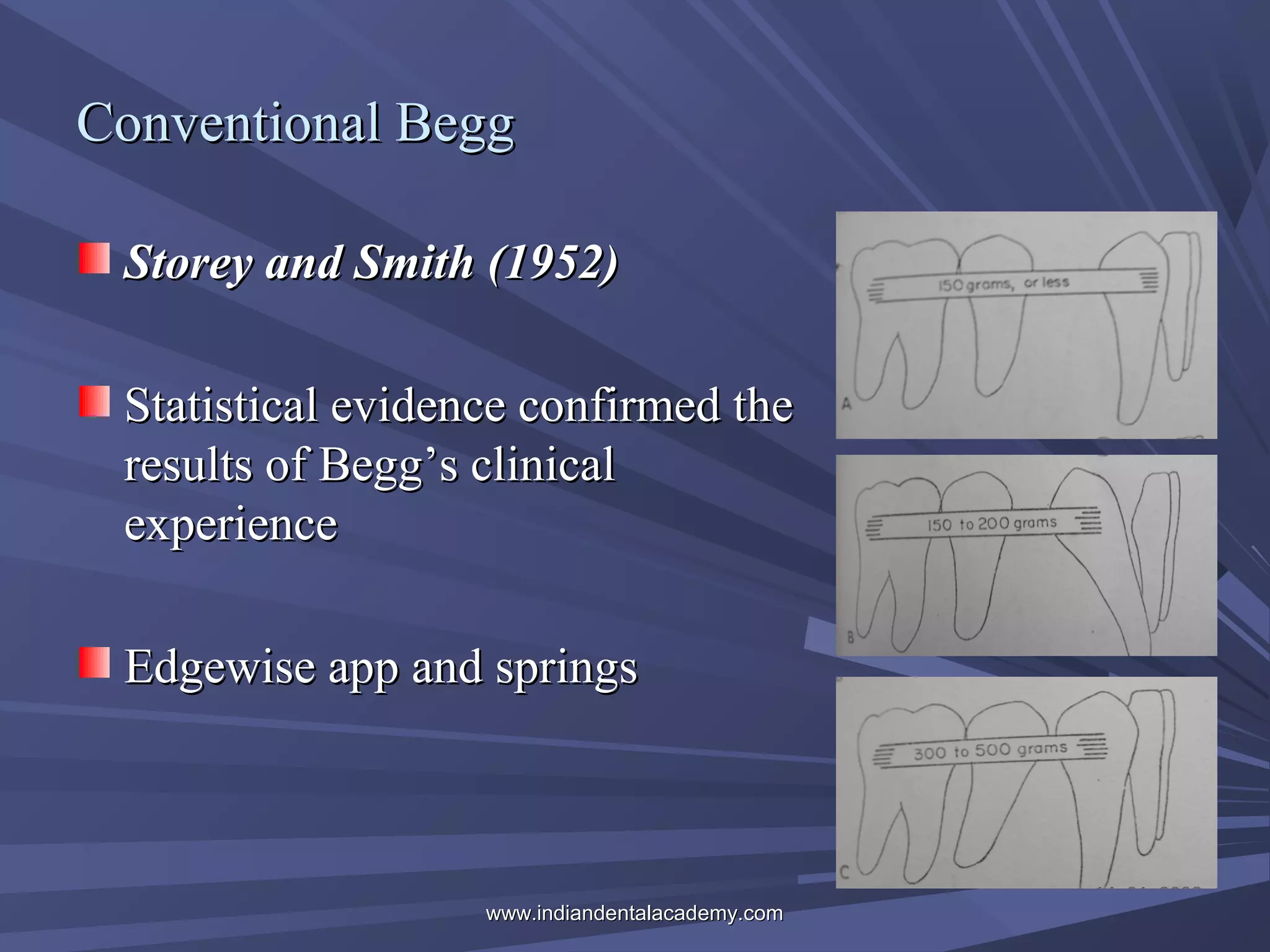
Storey and Smith (1952)
Statistical evidence confirmed the
results of Begg’s clinical
experience
Edgewise app and springs

www.indiandentalacademy.com
Conventional Begg
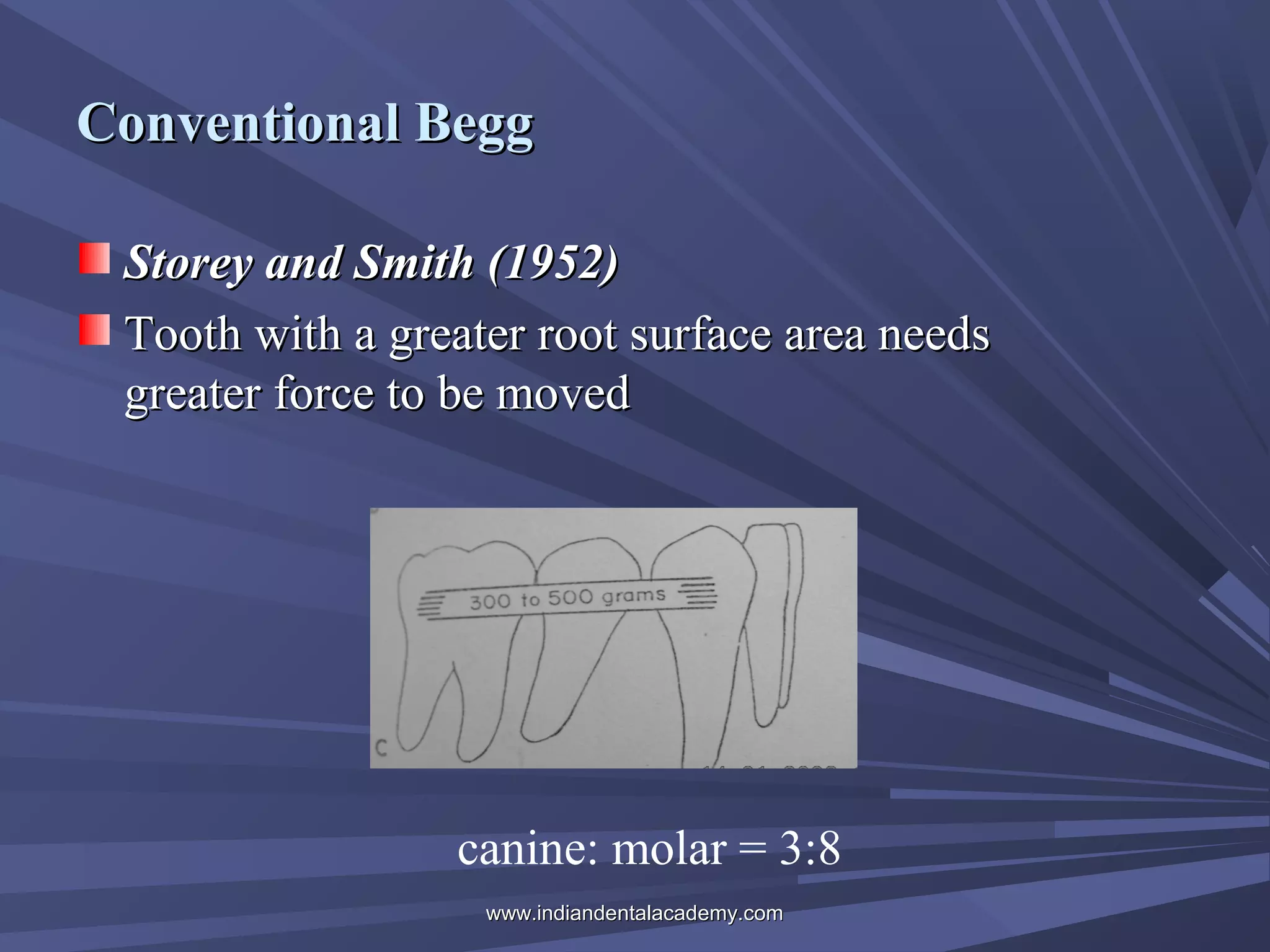
Storey and Smith (1952)
Tooth with a greater root surface area needs
greater force to be moved

canine: molar = 3:8
www.indiandentalacademy.com
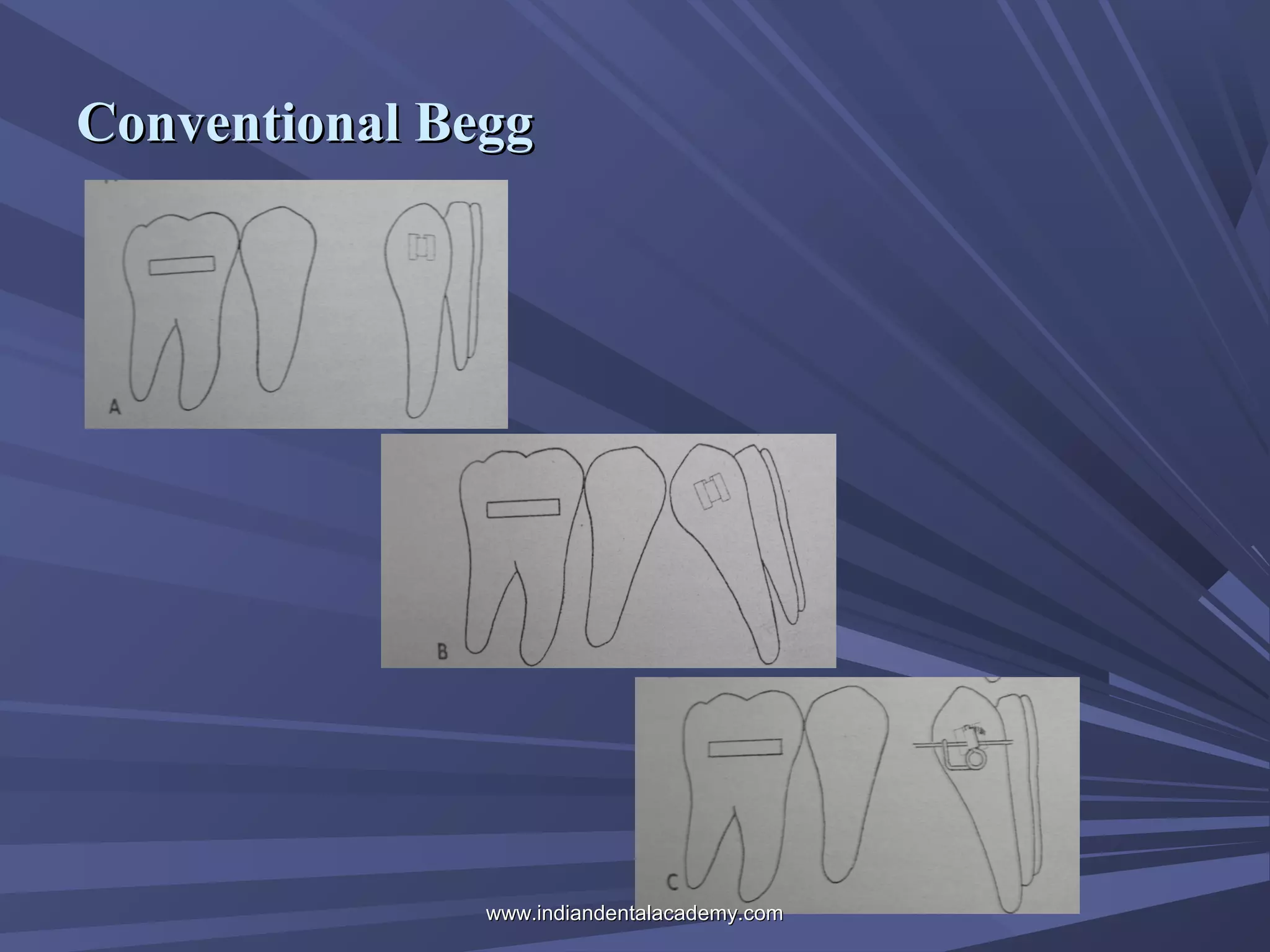
Conventional Begg

www.indiandentalacademy.com
Conventional Begg
Reason for different rates of movement of canines
Storey and Smith presented the concept of
undermining resorption
Sandstedt (1904)
Schwarz (1932)

www.indiandentalacademy.com
Conventional Begg
Storey and Smith (1952)
Teeth subjected to very high forces

Resorption of tooth investing tissues

Teeth are loosened within the sockets
www.indiandentalacademy.com
Conventional Begg
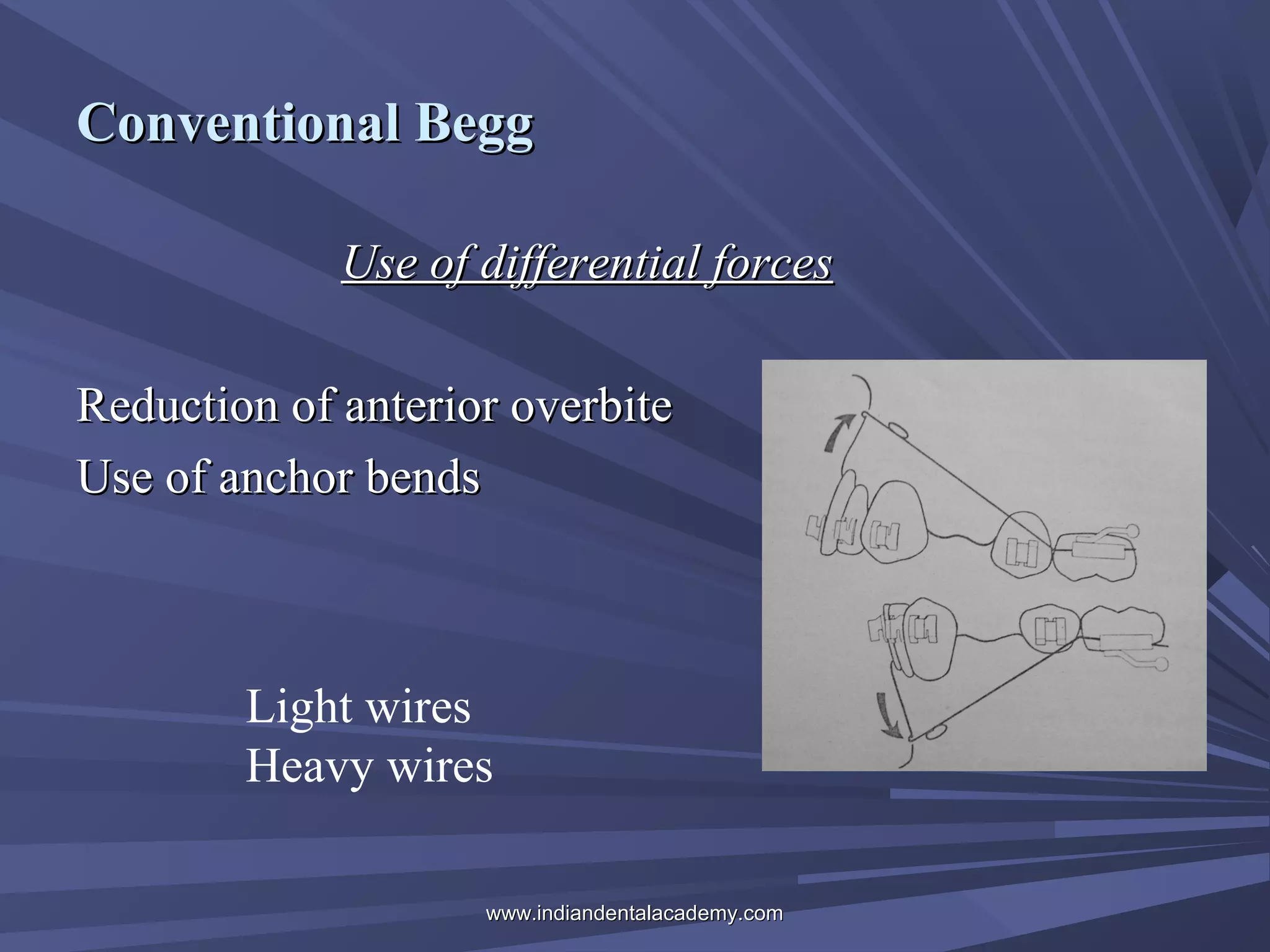
Use of differential forces
Reduction of anterior overbite
Use of anchor bends

Light wires
Heavy wires
www.indiandentalacademy.com
Conventional Begg
Use of differential forces
 Strang (1954) – Treatment problems, their origin

and elimination
 Edgewise app
 Closing extraction space requires more force
 Use of head gears - recommended

www.indiandentalacademy.com
Conventional Begg
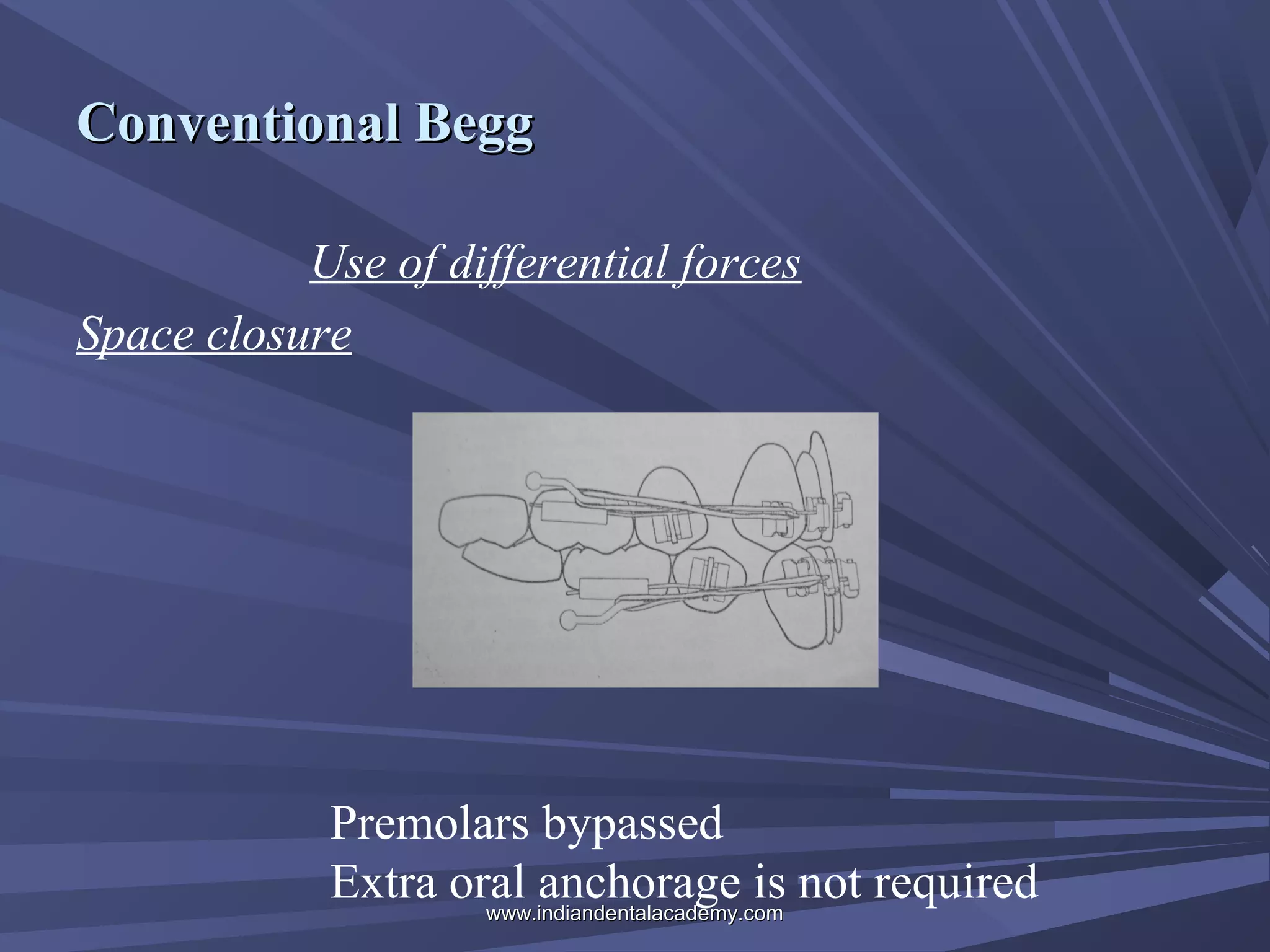
Use of differential forces
Space closure

Premolars bypassed
Extra oral anchorage is not required
www.indiandentalacademy.com
Conventional Begg
Means of preventing anchorage failure

Use of thin round steel wires
Anchor bends
Stationary anchorage
Premolars not bracketed
Light torquing forces in 3rd stage
Use of reverse torquing auxillaries
www.indiandentalacademy.com
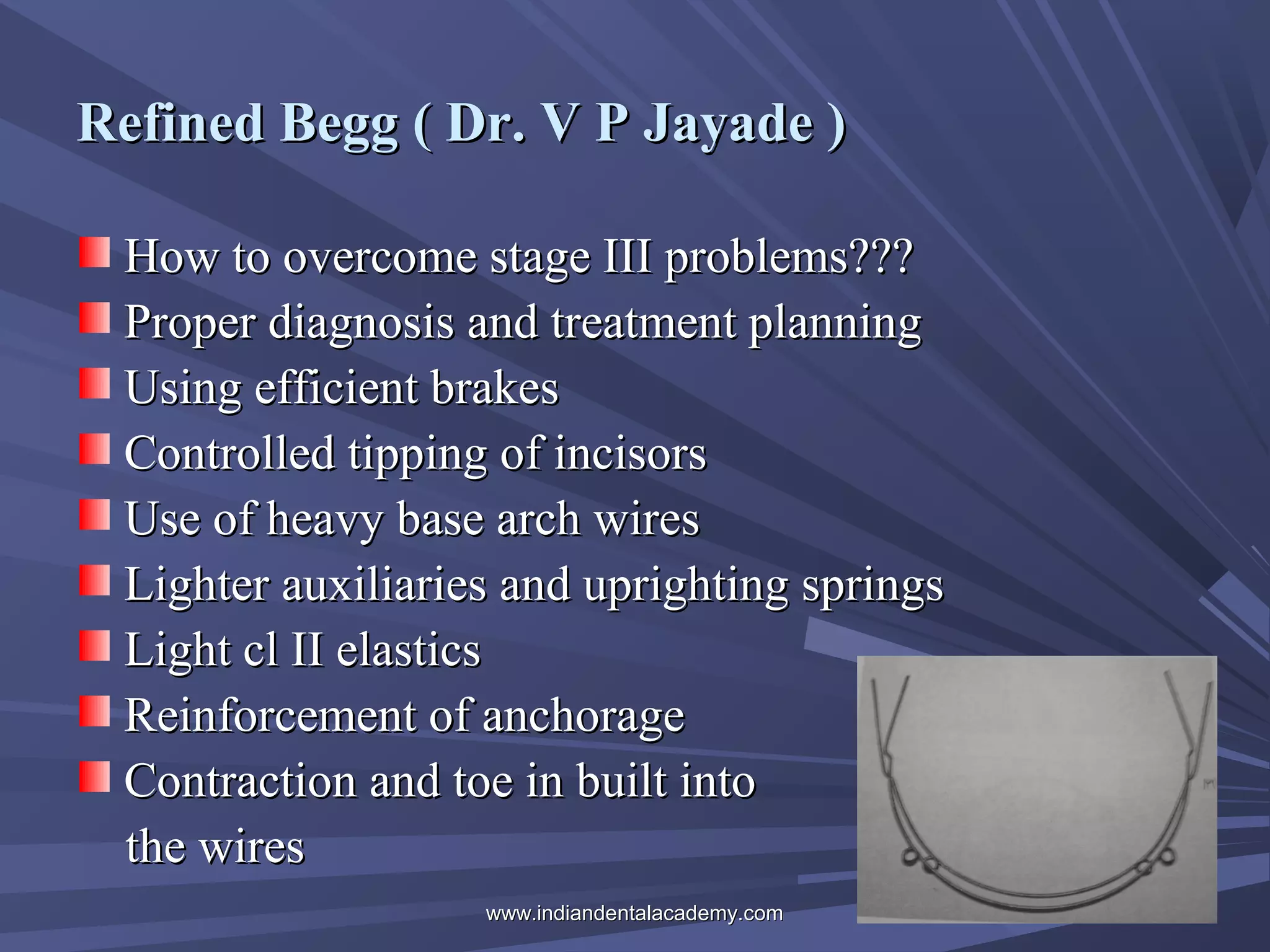
Refined Begg ( Dr. V P Jayade )
Differential force concept was misunderstood
Excessive retraction
Prevented in refined begg by applying efficient
brakes along with heavy differential forces

www.indiandentalacademy.com
Refined Begg ( Dr. V P Jayade )
Perfect example of stationary anchorage
Saggital
Vertical
transverse

www.indiandentalacademy.com
Refined Begg ( Dr. V P Jayade )
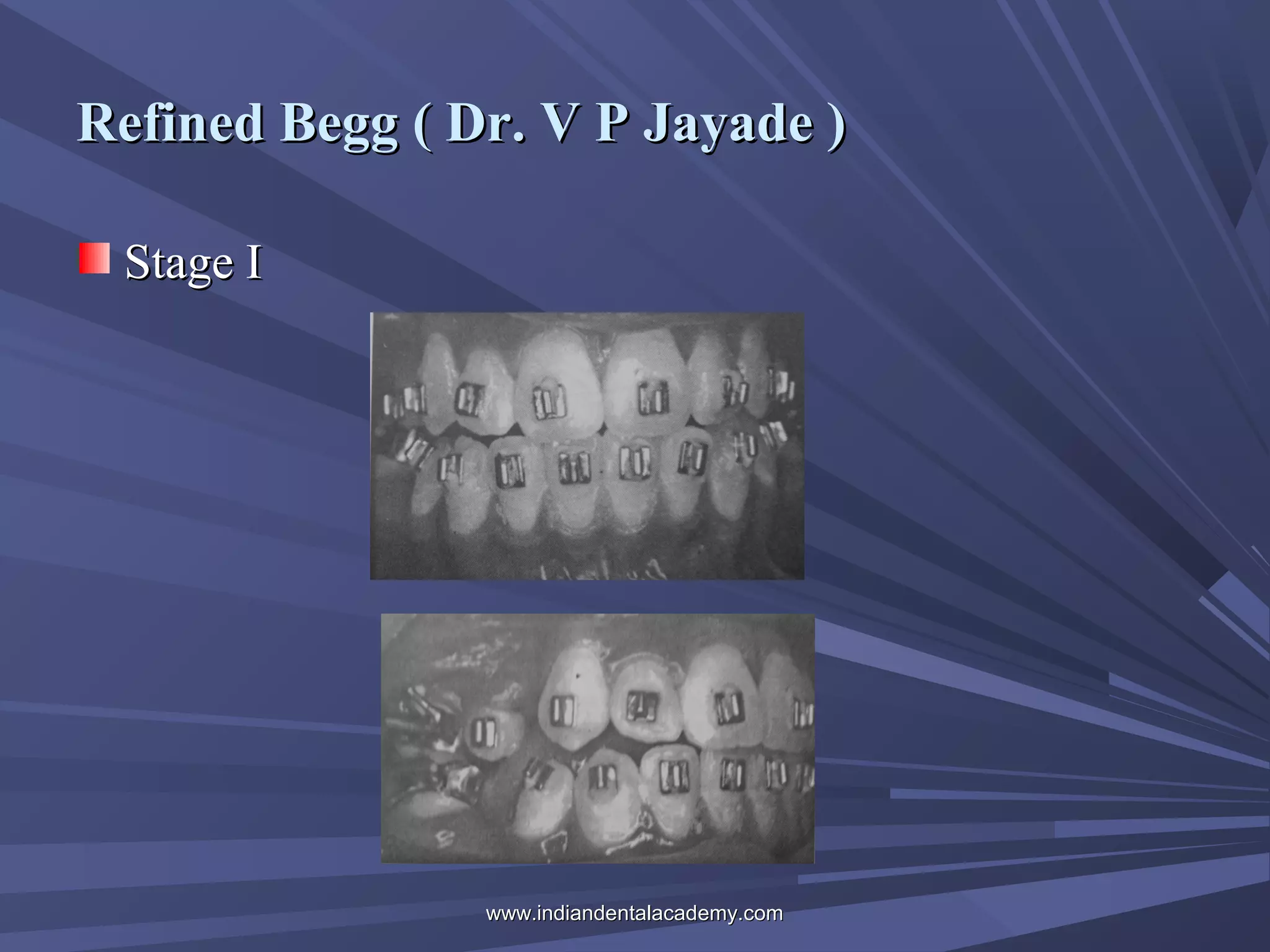
Stage I

www.indiandentalacademy.com
Refined Begg ( Dr. V P Jayade )
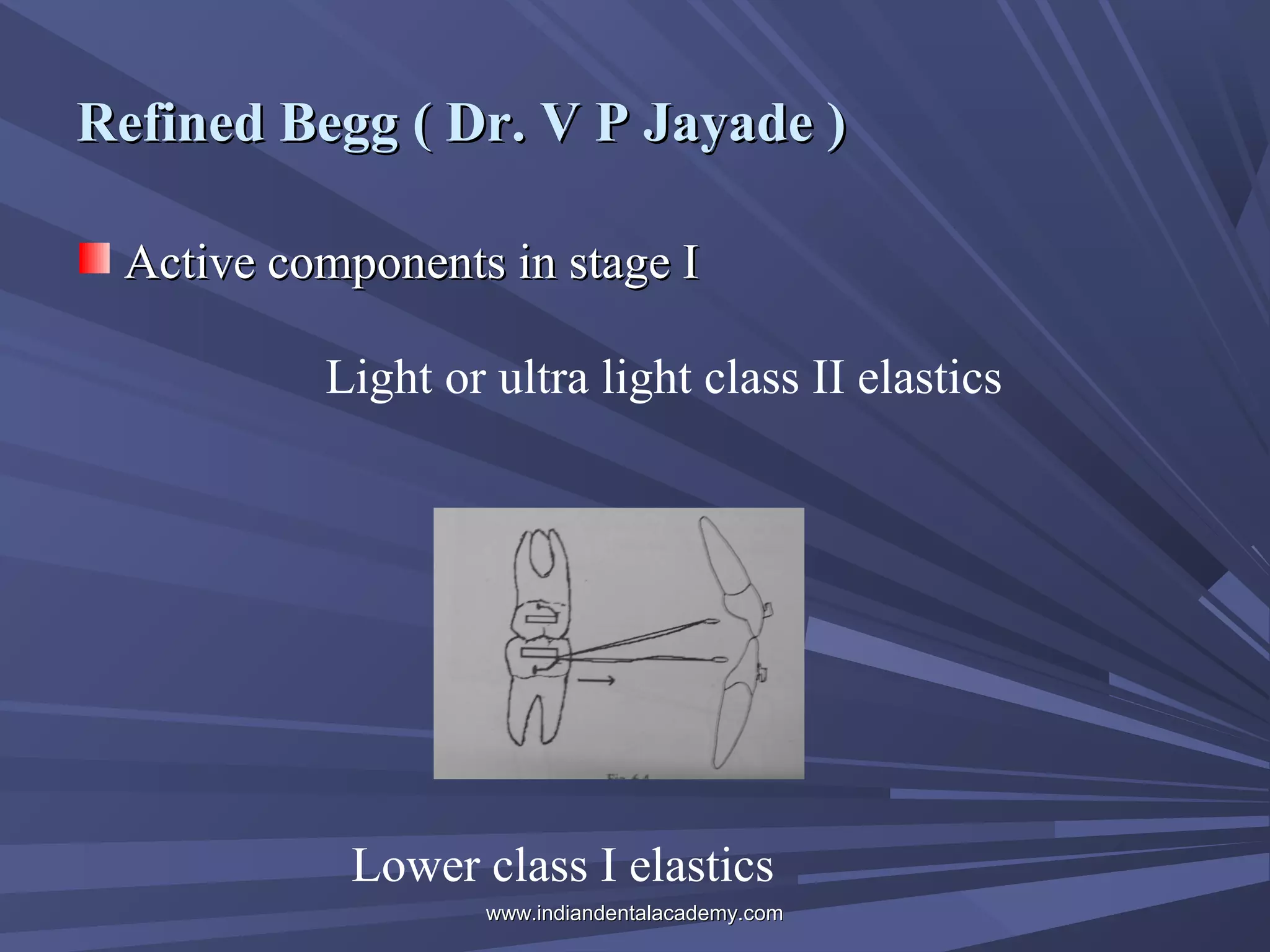
Active components in stage I
Light or ultra light class II elastics

Lower class I elastics
www.indiandentalacademy.com
Refined Begg ( Dr. V P Jayade )
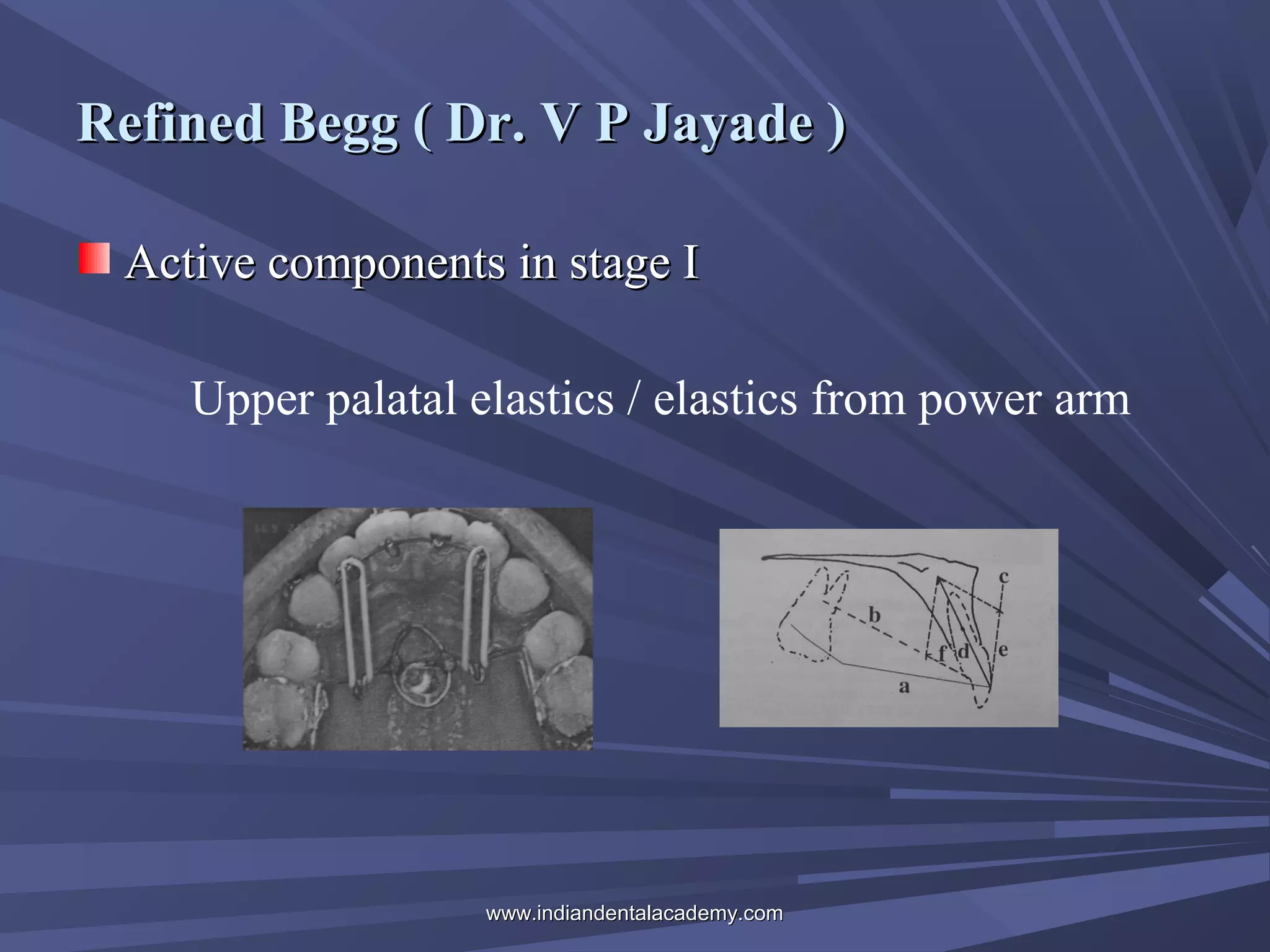
Active components in stage I
Upper palatal elastics / elastics from power arm

www.indiandentalacademy.com
Refined Begg ( Dr. V P Jayade )
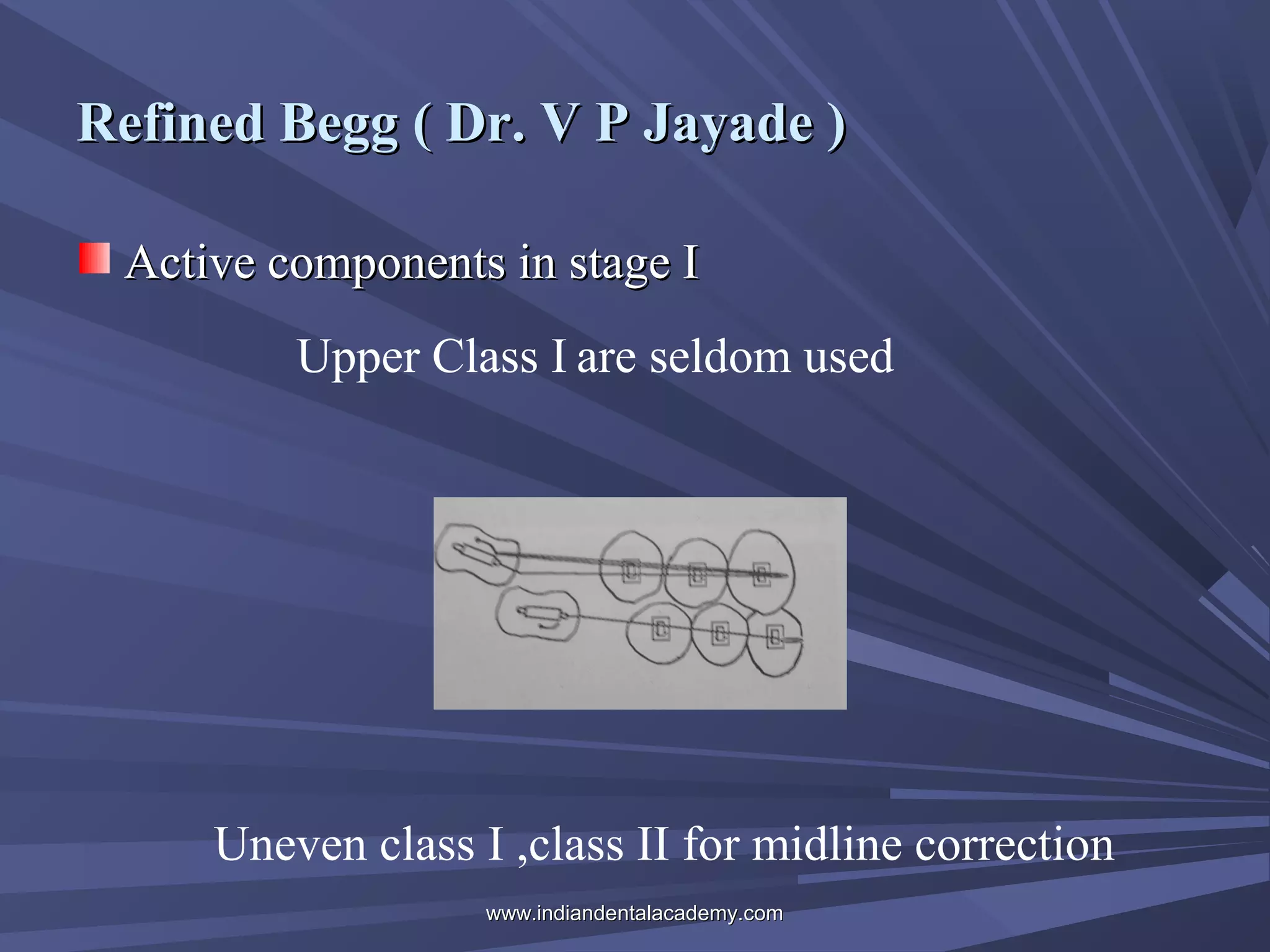
Active components in stage I
Upper Class I are seldom used

Uneven class I ,class II for midline correction
www.indiandentalacademy.com
Refined Begg ( Dr. V P Jayade )
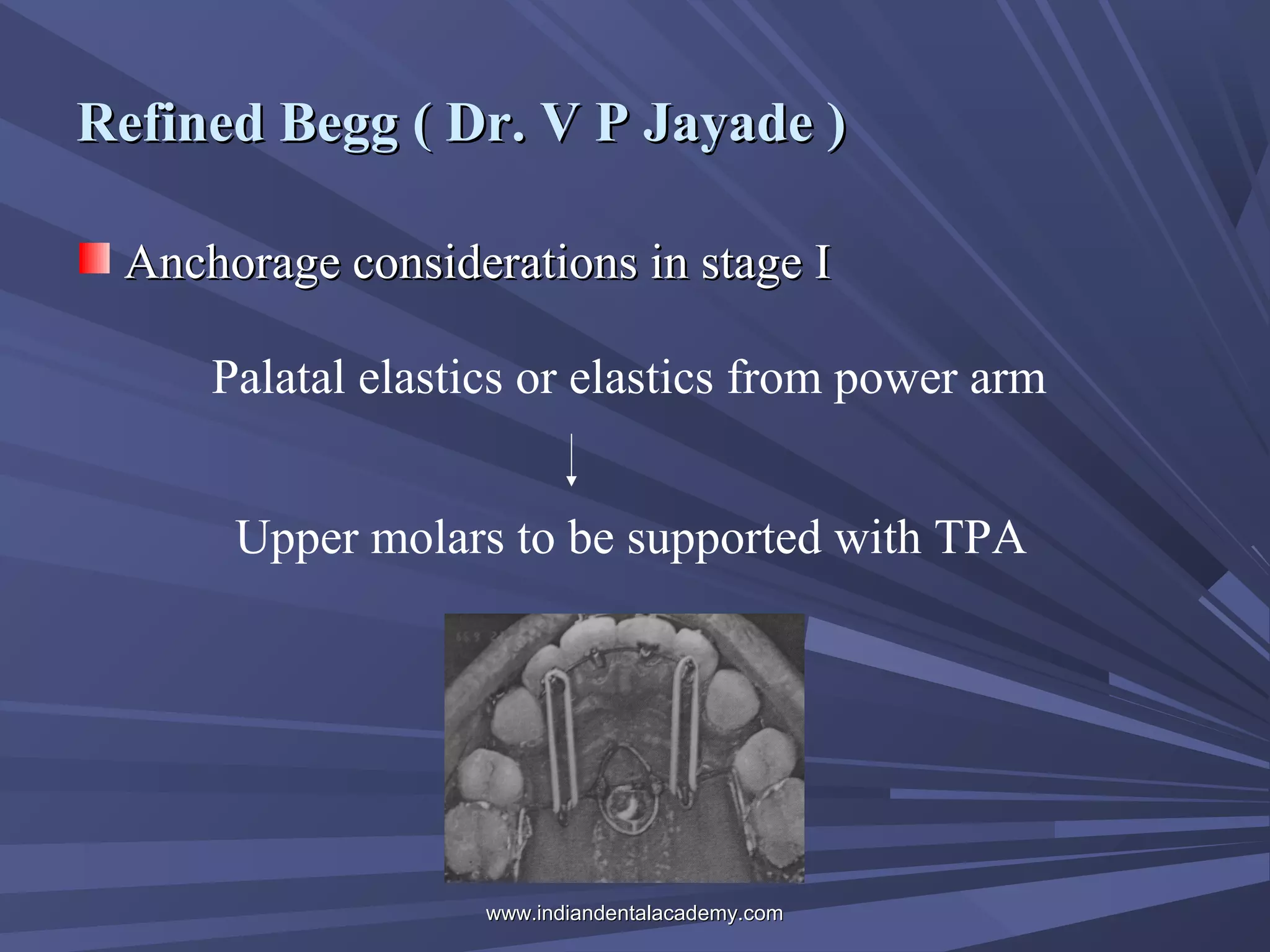
Anchorage considerations in stage I
Palatal elastics or elastics from power arm
Upper molars to be supported with TPA

www.indiandentalacademy.com
Refined Begg ( Dr. V P Jayade )
Anchorage considerations in stage I
Conserving lower molar anchorage
Stiffer wires
Light or ultra light elastics
Molar stops

www.indiandentalacademy.com
Refined Begg ( Dr. V P Jayade )
Anchorage considerations in stage I
High angle cases
Light anchor bends
Light elastics
TPA – away from the palate
High pull head gear

www.indiandentalacademy.com
Refined Begg ( Dr. V P Jayade )
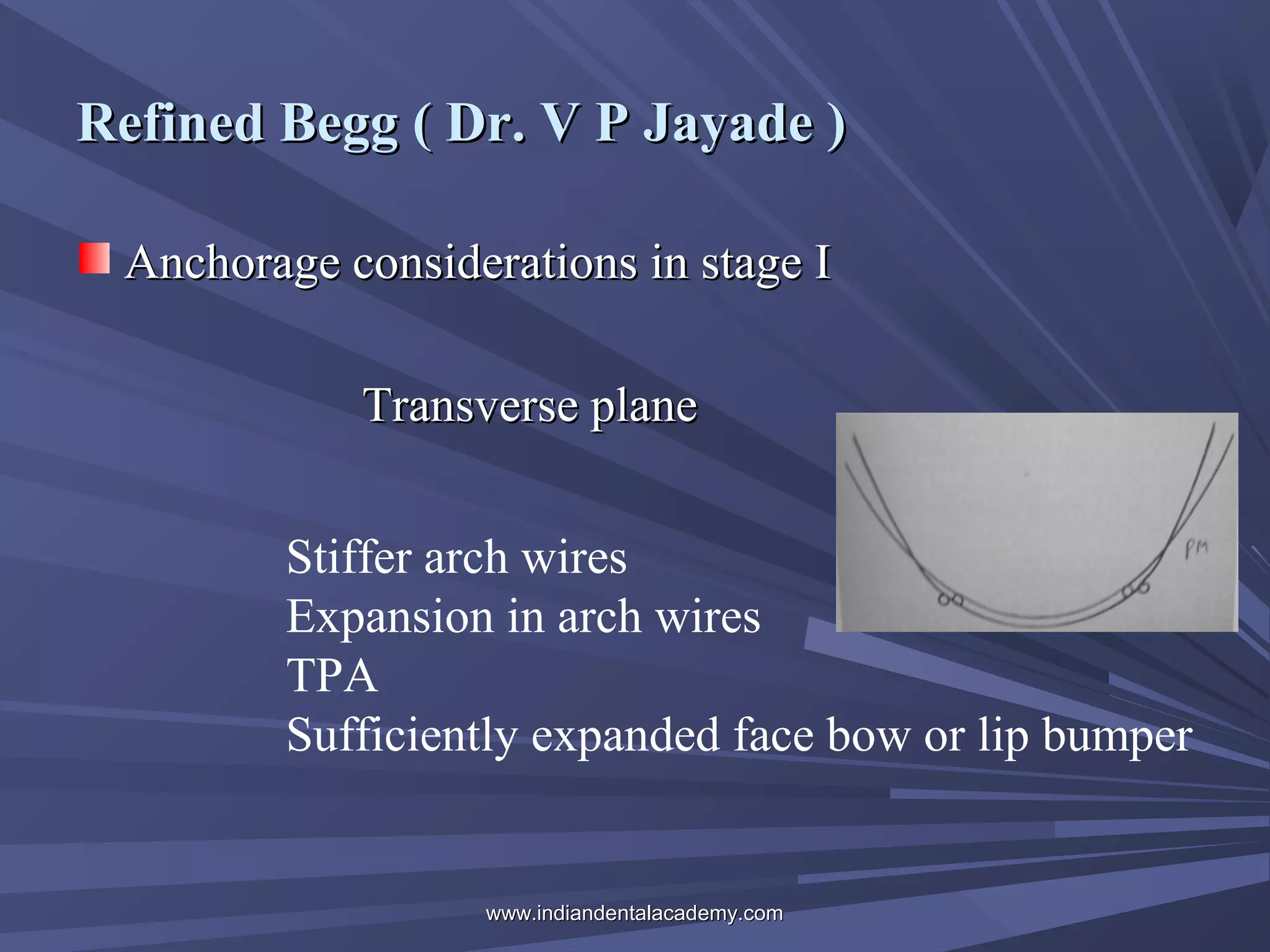
Anchorage considerations in stage I
Transverse plane
Stiffer arch wires
Expansion in arch wires
TPA
Sufficiently expanded face bow or lip bumper

www.indiandentalacademy.com
Refined Begg ( Dr. V P Jayade )
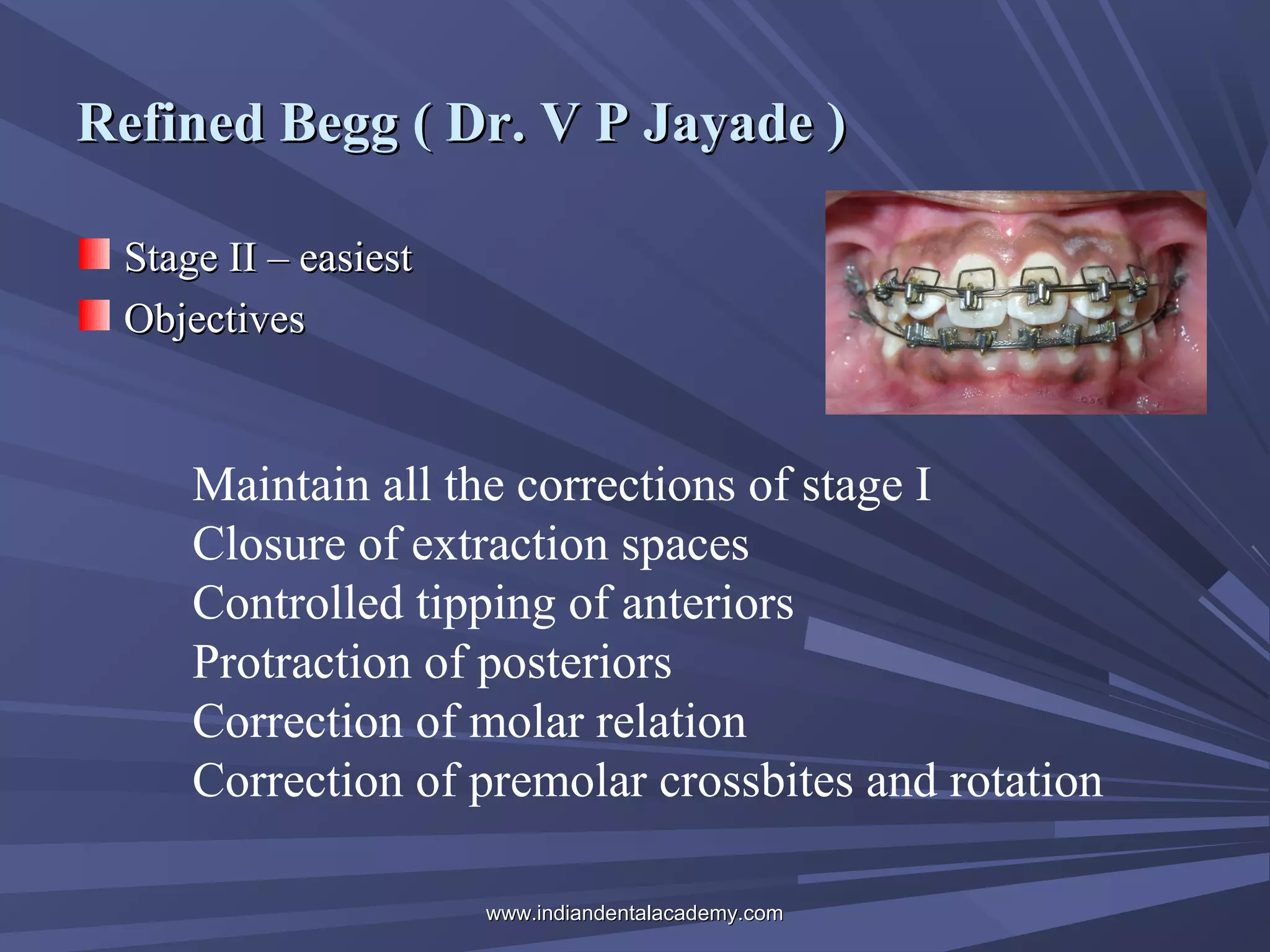
Stage II – easiest
Objectives

Maintain all the corrections of stage I
Closure of extraction spaces
Controlled tipping of anteriors
Protraction of posteriors
Correction of molar relation
Correction of premolar crossbites and rotation
www.indiandentalacademy.com
Refined Begg ( Dr. V P Jayade )
Stage II
Archwires used
Reduction in the anchor bend

www.indiandentalacademy.com
Refined Begg ( Dr. V P Jayade )
Braking mechanics
Reversal of anchorage
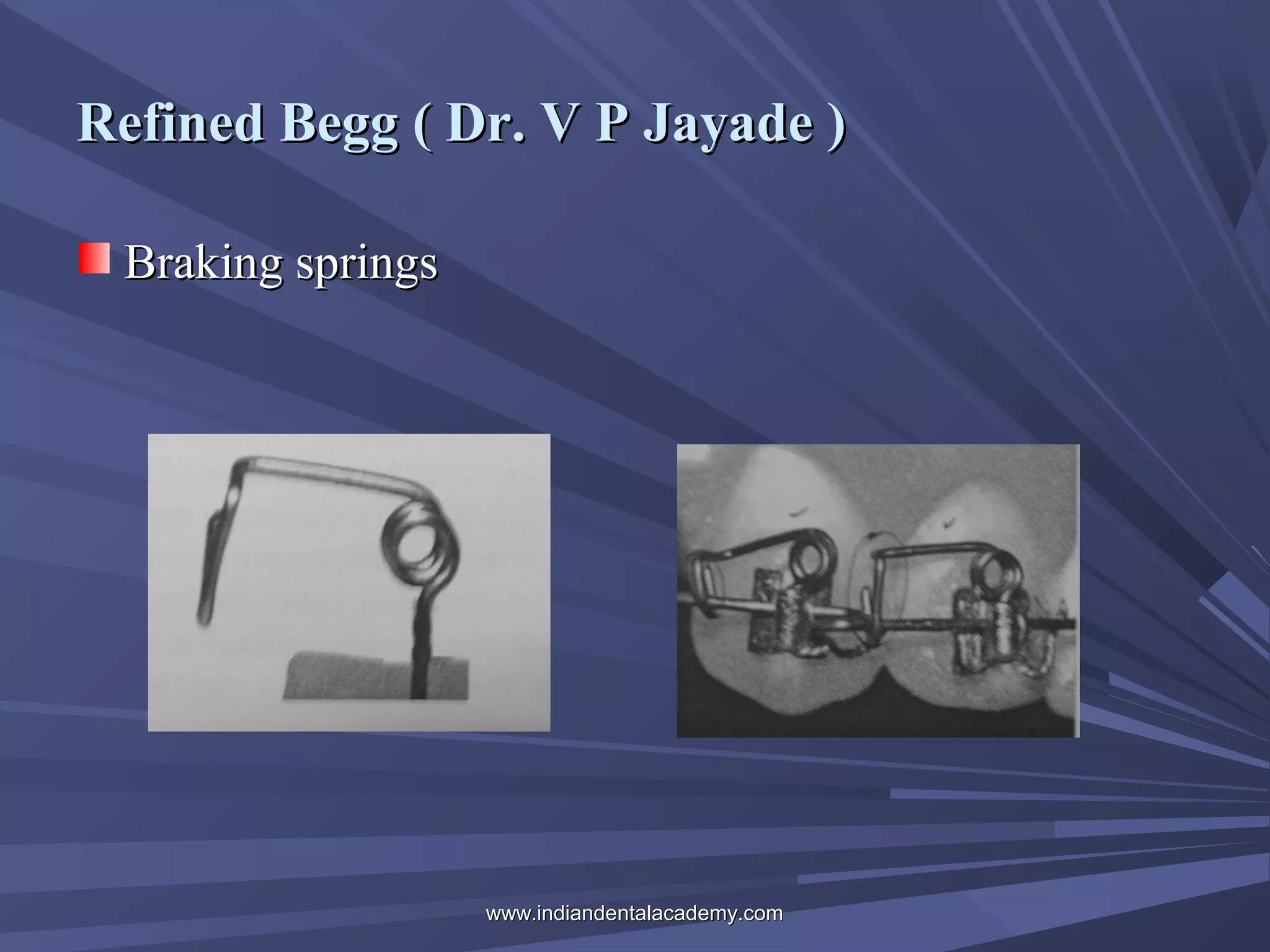
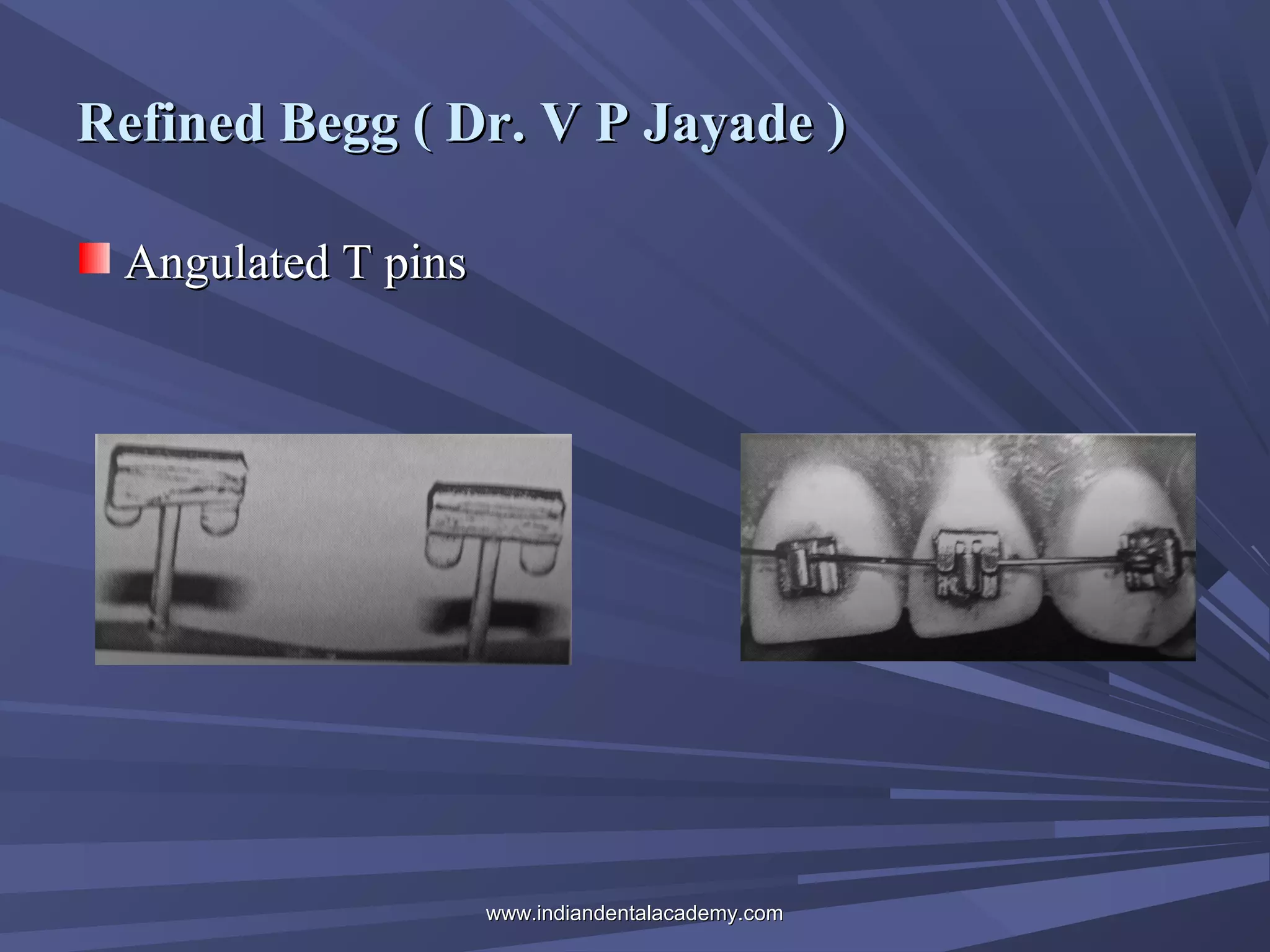
Def – the brakes reverses the anchorage site from
posterior to anterior segment by permitting only
bodily movement of the anterior teeth, instead of
allowing them freedom to tip
Braking springs/ T pins
Torquing components
www.indiandentalacademy.com
Refined Begg ( Dr. V P Jayade )
Braking springs

www.indiandentalacademy.com
Refined Begg ( Dr. V P Jayade )
Angulated T pins

www.indiandentalacademy.com
Refined Begg ( Dr. V P Jayade )
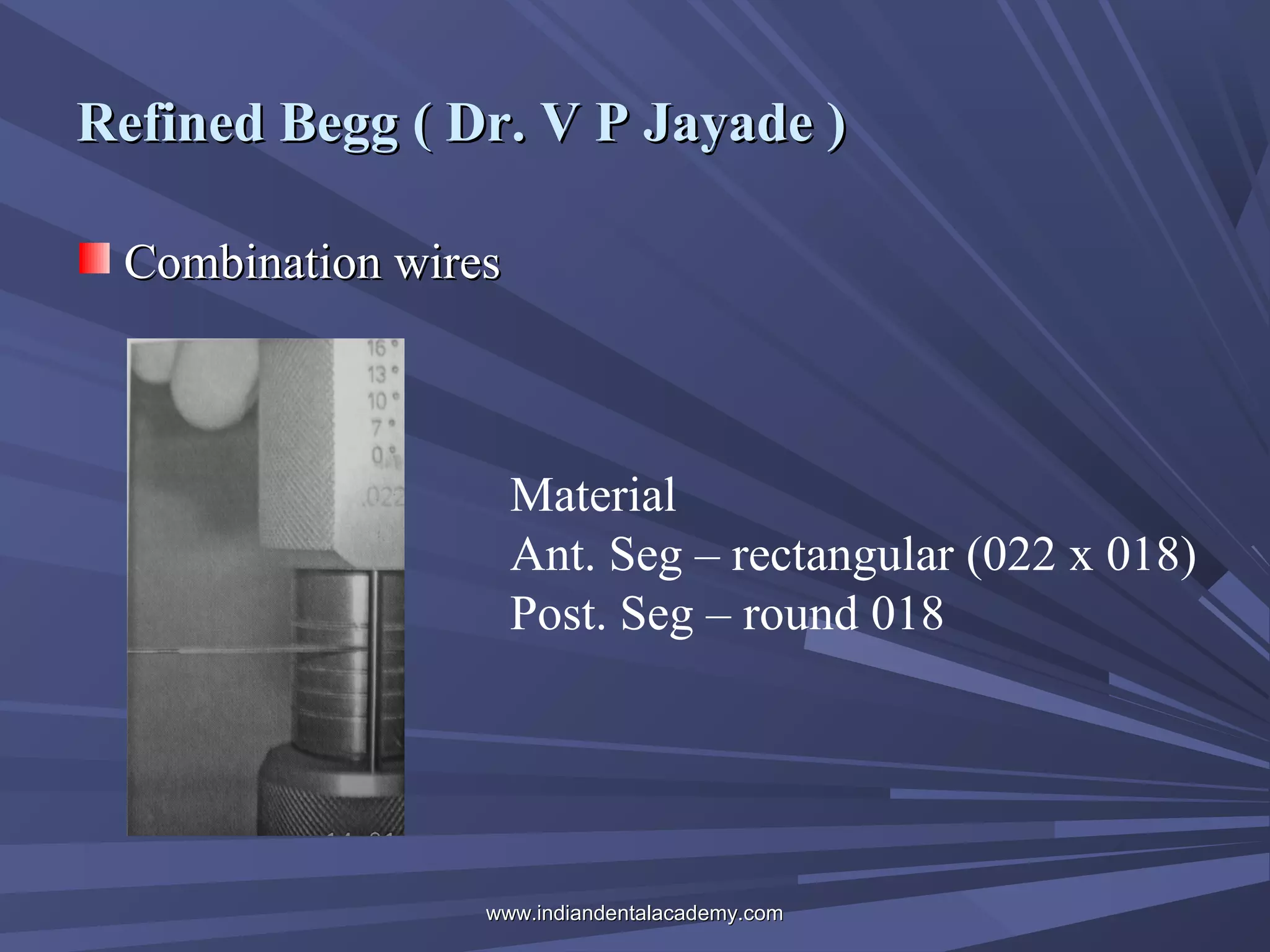
Combination wires

Material
Ant. Seg – rectangular (022 x 018)
Post. Seg – round 018

www.indiandentalacademy.com
Refined Begg ( Dr. V P Jayade )
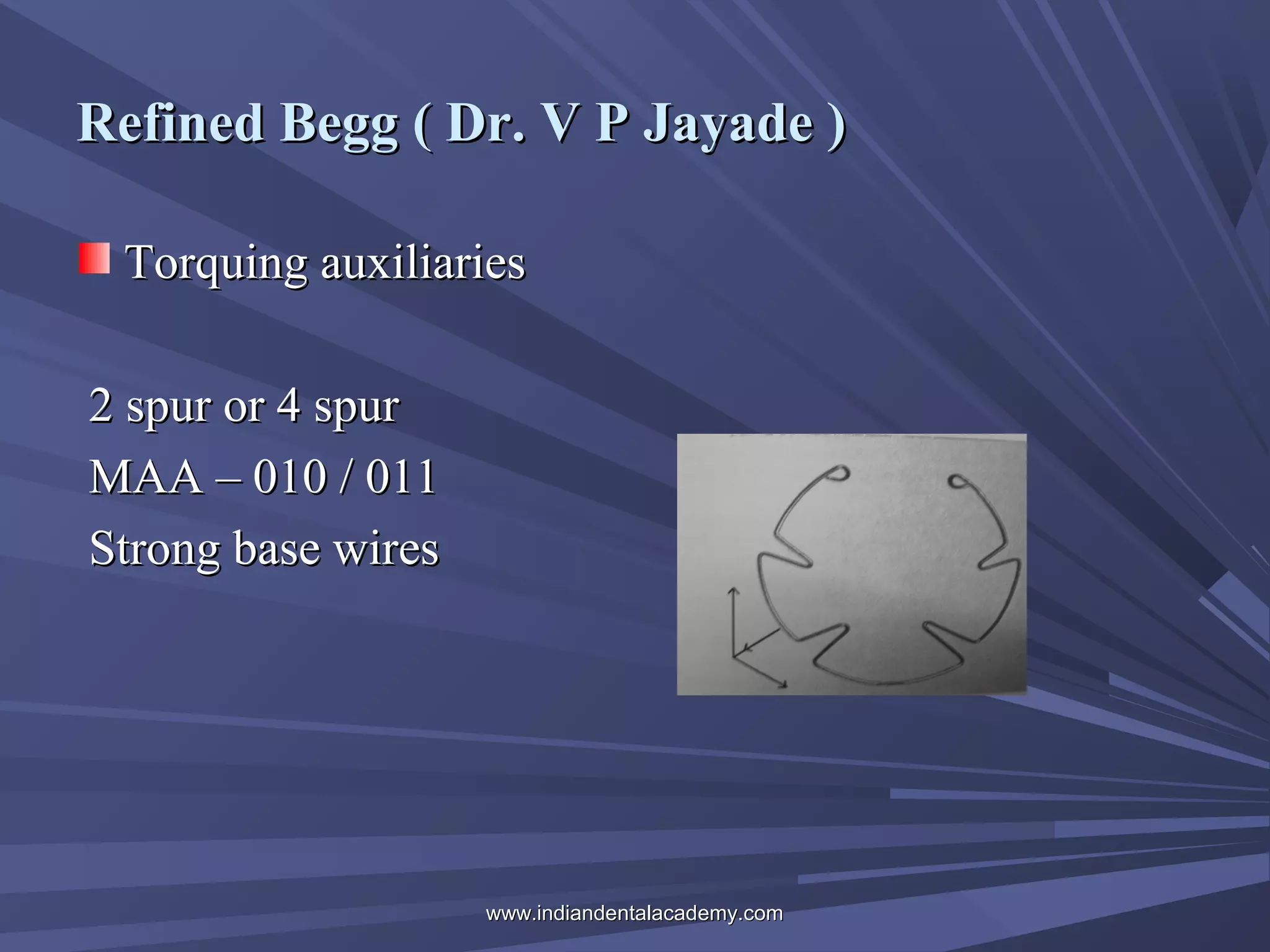
Torquing auxiliaries
2 spur or 4 spur
MAA – 010 / 011
Strong base wires

www.indiandentalacademy.com
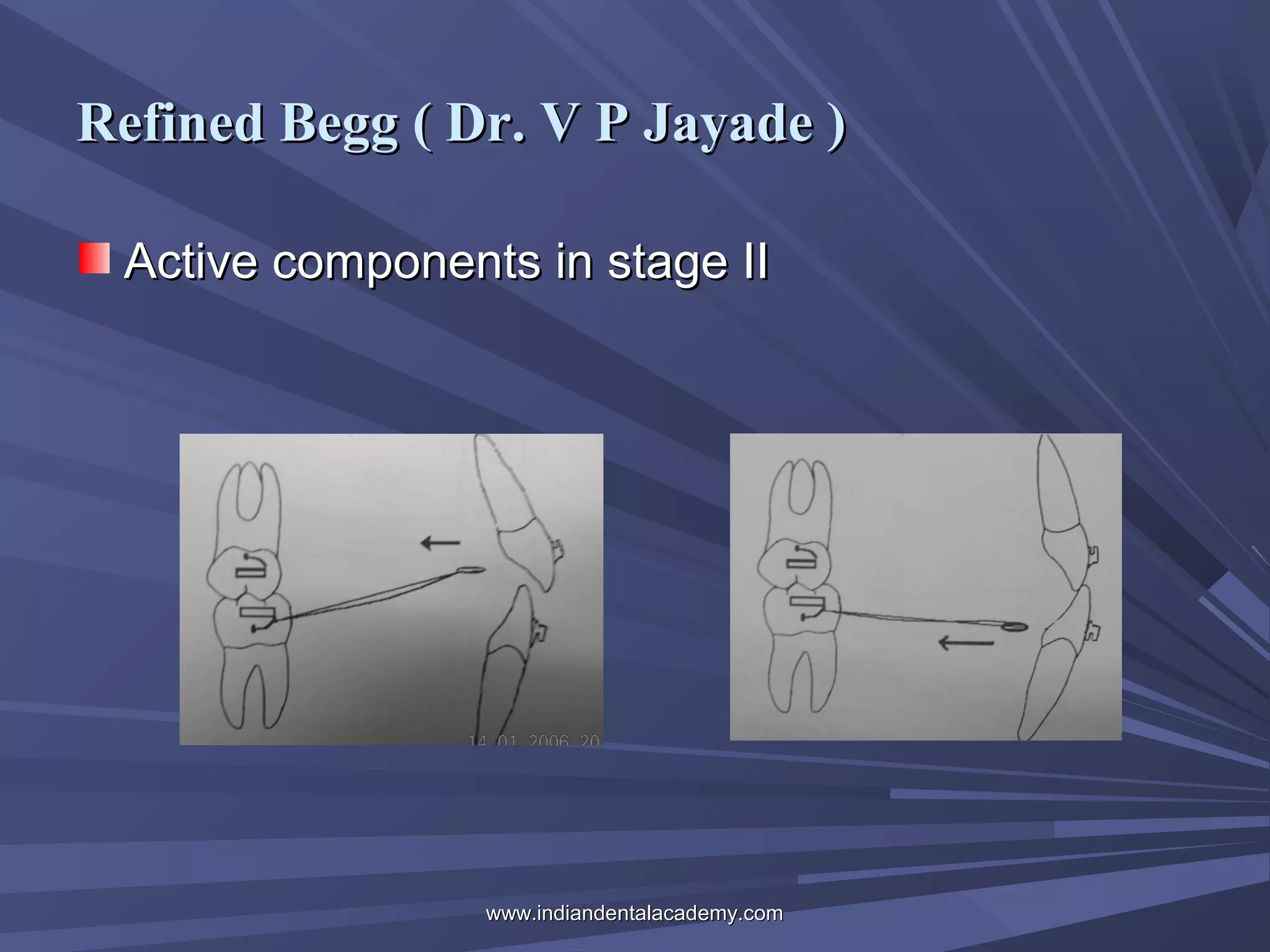
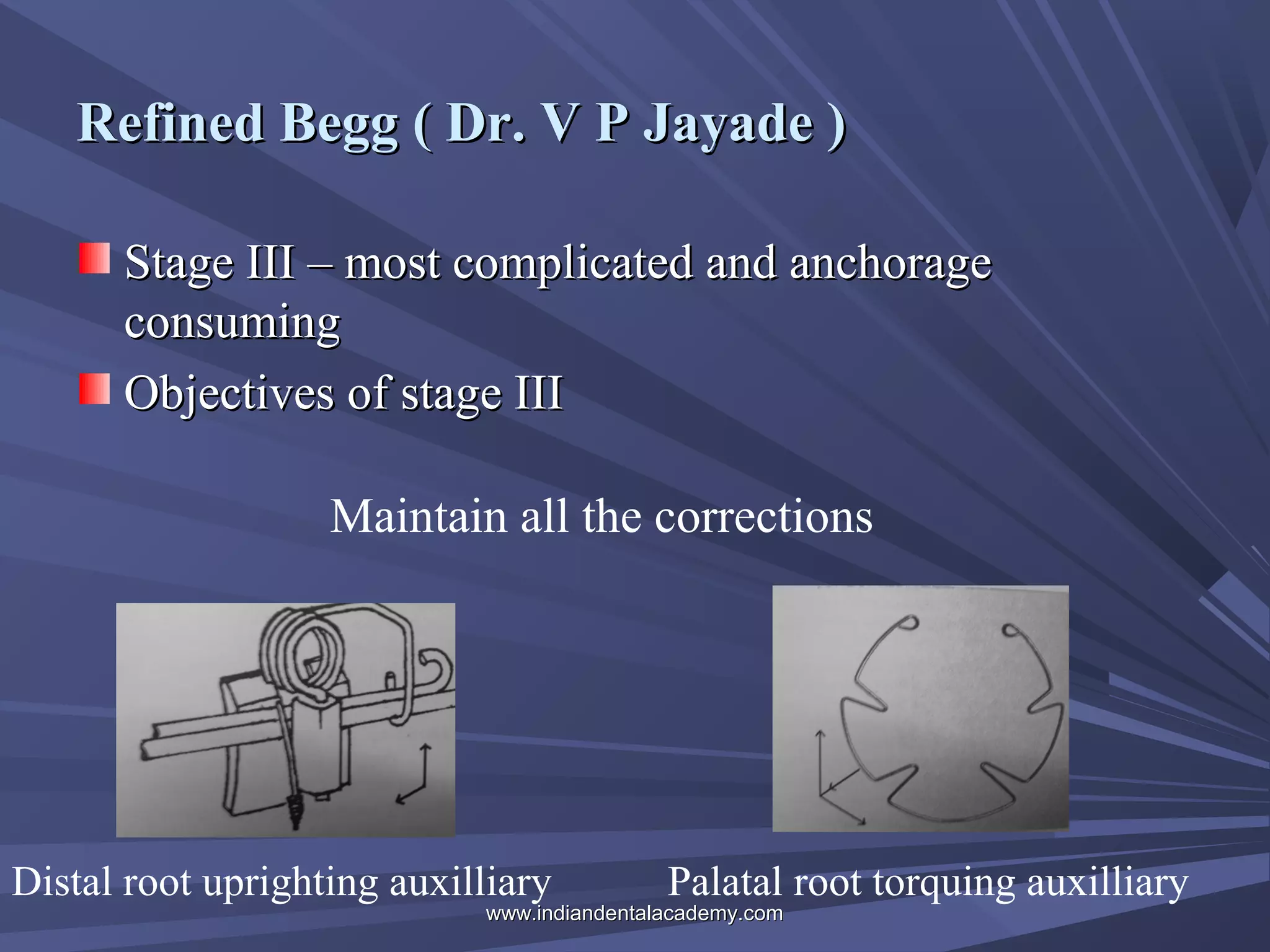
Refined Begg ( Dr. V P Jayade )
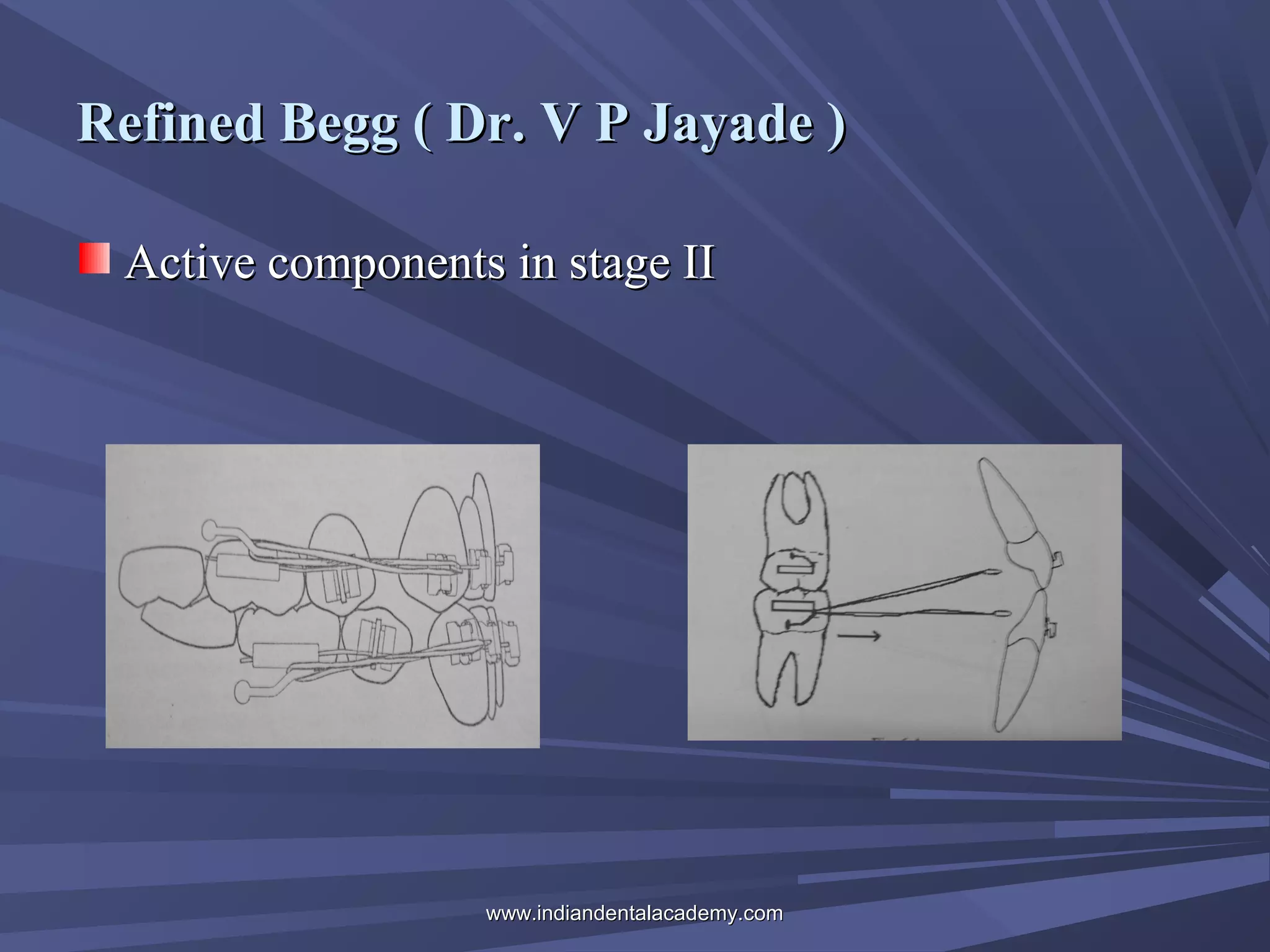
Active components in stage II

www.indiandentalacademy.com
Refined Begg ( Dr. V P Jayade )
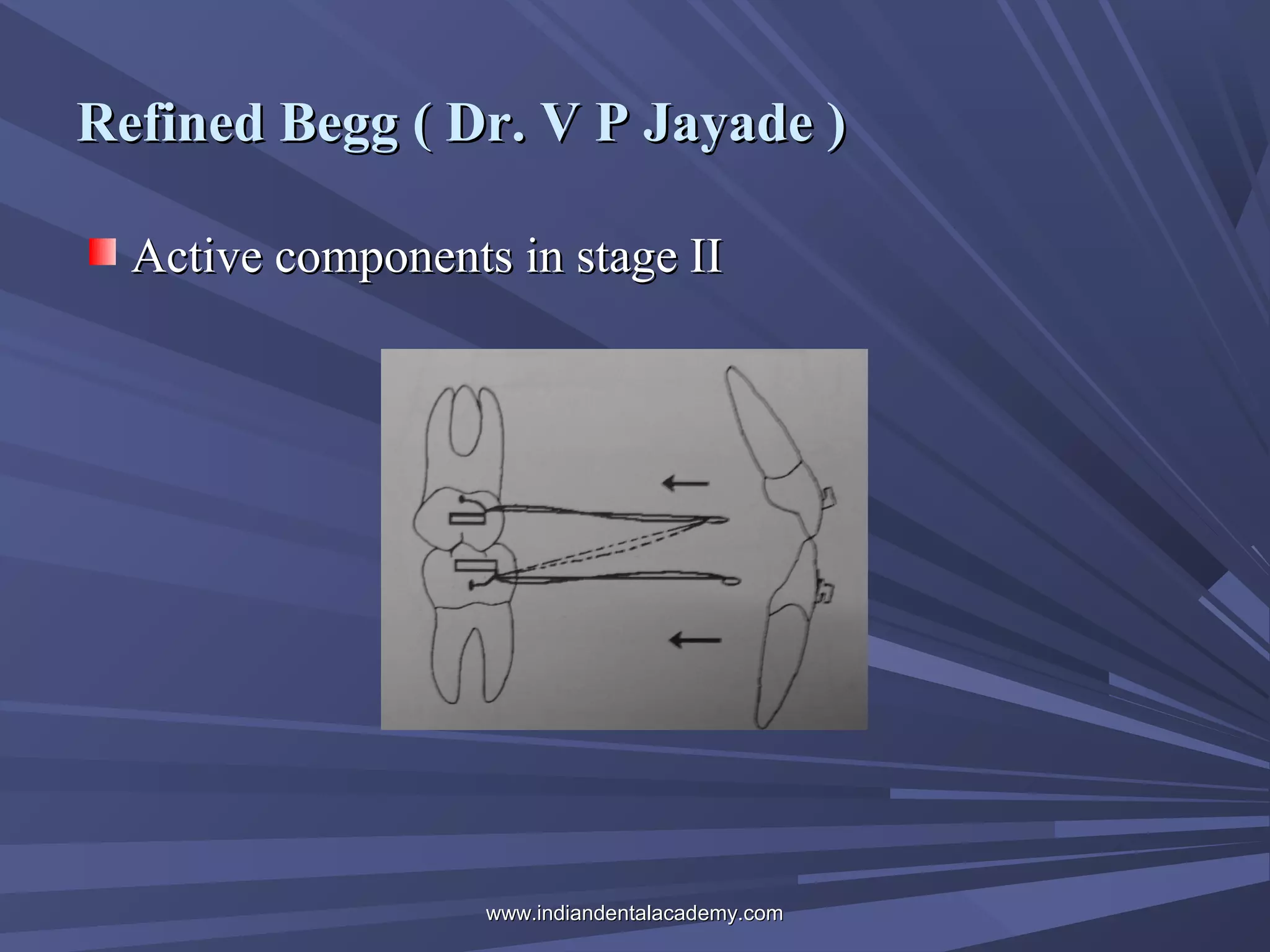
Active components in stage II

www.indiandentalacademy.com
Refined Begg ( Dr. V P Jayade )
Active components in stage II

www.indiandentalacademy.com
Refined Begg ( Dr. V P Jayade )
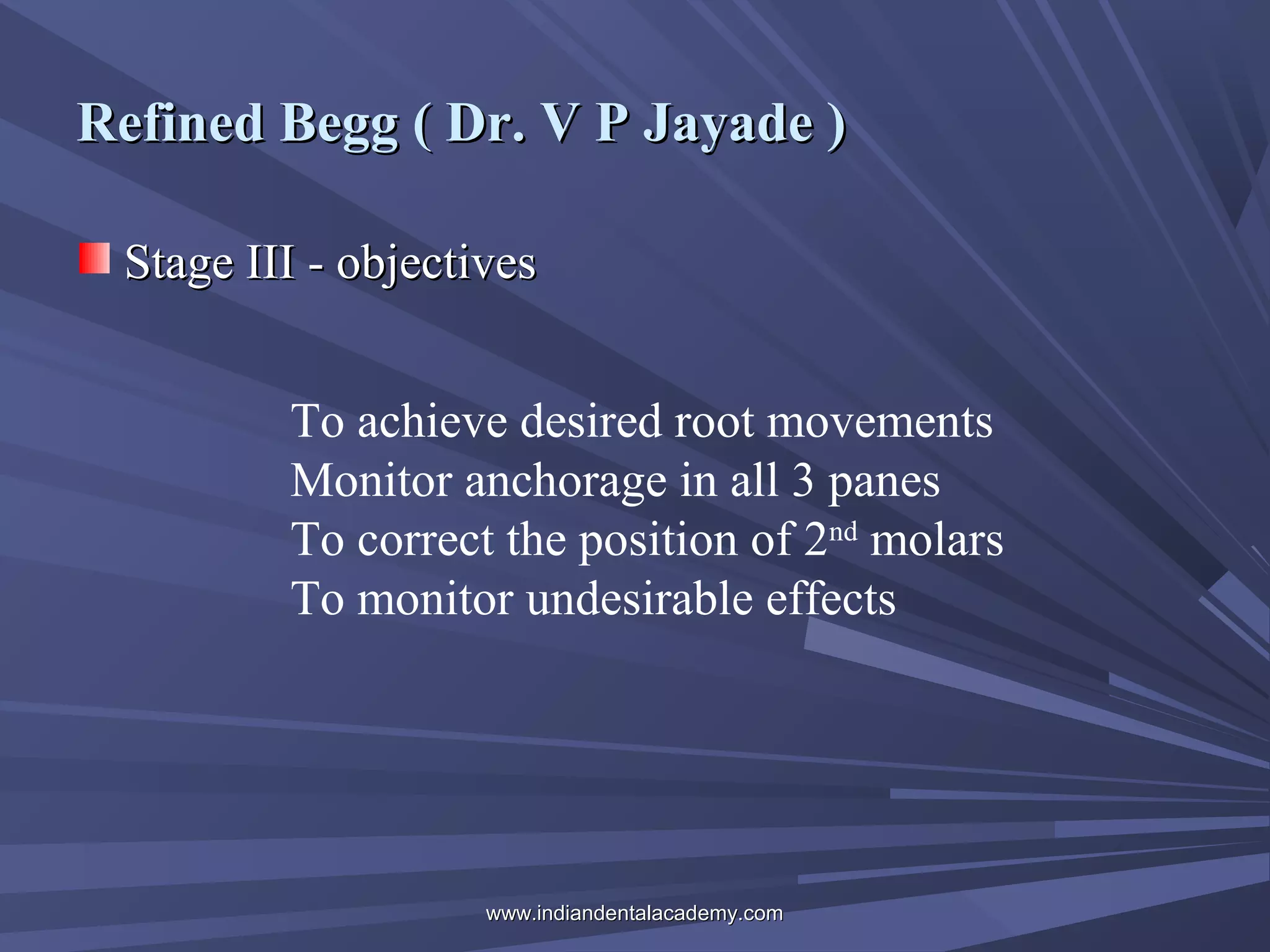
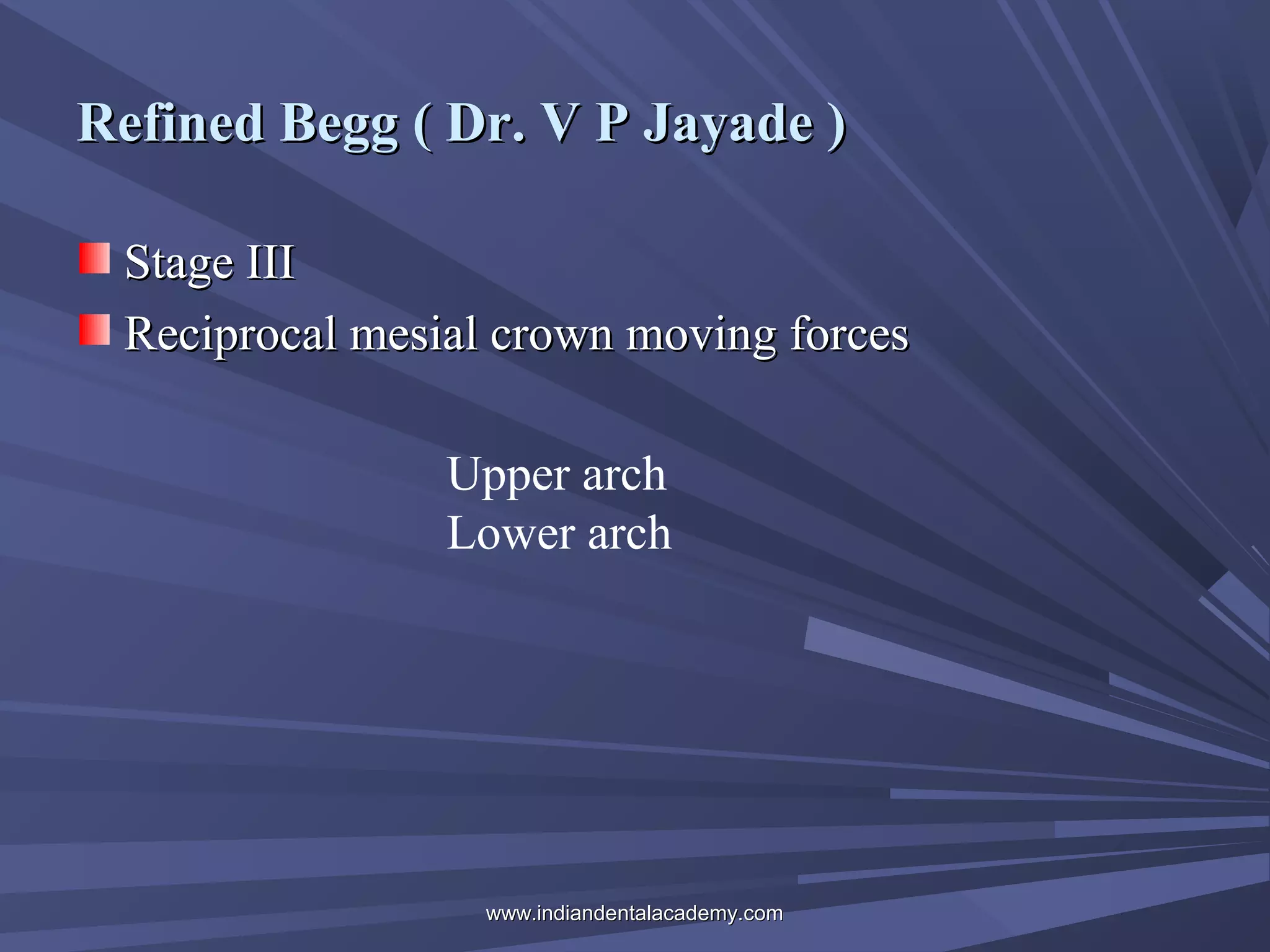
Stage III – most complicated and anchorage
consuming
Objectives of stage III
Maintain all the corrections

Distal root uprighting auxilliary

Palatal root torquing auxilliary

www.indiandentalacademy.com
Refined Begg ( Dr. V P Jayade )
Stage III - objectives
To achieve desired root movements
Monitor anchorage in all 3 panes
To correct the position of 2nd molars
To monitor undesirable effects

www.indiandentalacademy.com
Refined Begg ( Dr. V P Jayade )
Stage III
Reciprocal mesial crown moving forces
Upper arch
Lower arch

www.indiandentalacademy.com
Refined Begg ( Dr. V P Jayade )
How to overcome stage III problems???
Proper diagnosis and treatment planning
Using efficient brakes
Controlled tipping of incisors
Use of heavy base arch wires
Lighter auxiliaries and uprighting springs
Light cl II elastics
Reinforcement of anchorage
Contraction and toe in built into
the wires
www.indiandentalacademy.com
Tweed’s anchorage preparation
Tweed Merrifield appliance
Level Anchorage System
Vari Simplex Discipline
Rickett’s Bioprogressive Therapy
MBT appliance

www.indiandentalacademy.com
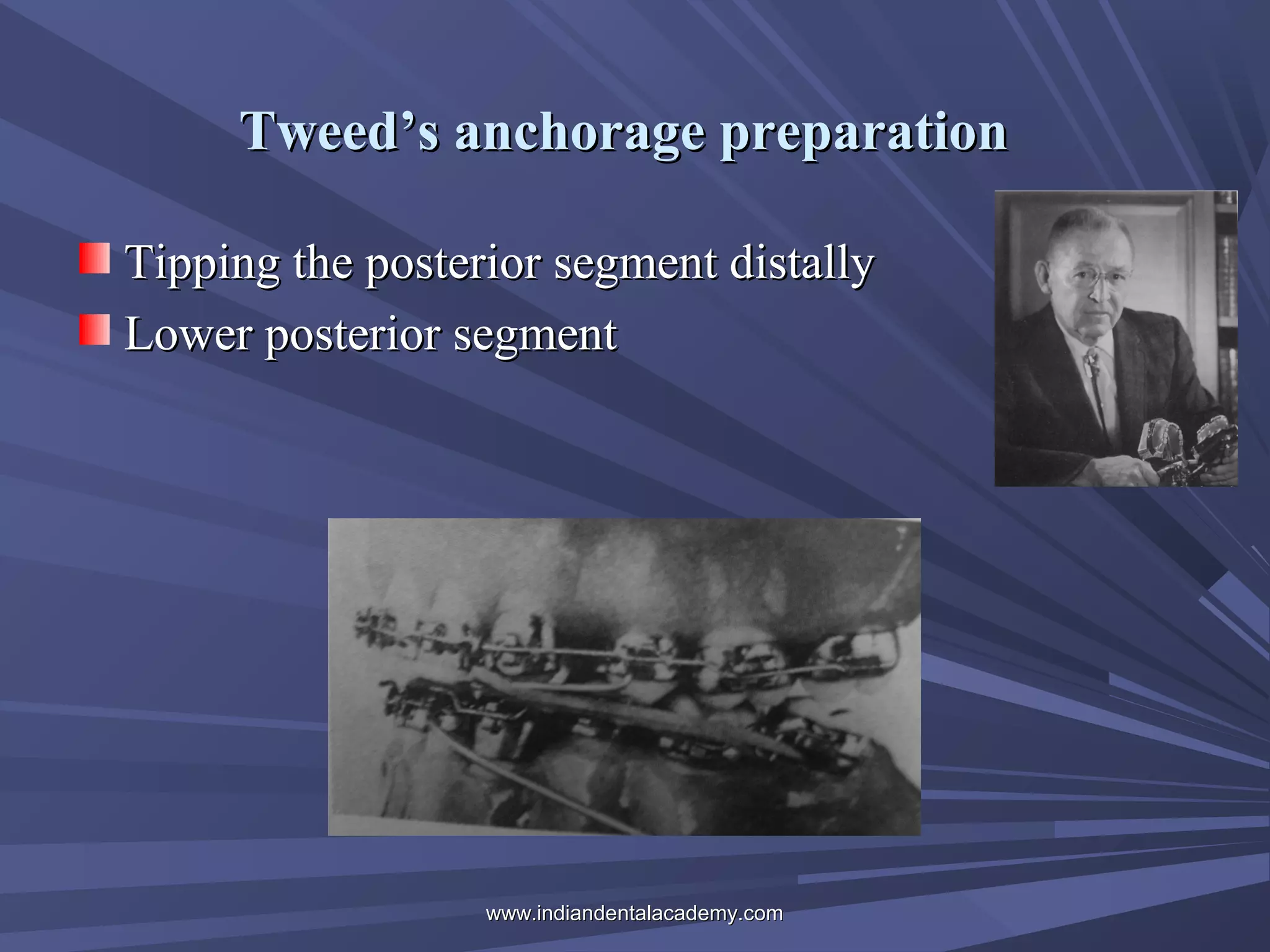
Tweed’s anchorage preparation
Tipping the posterior segment distally
Lower posterior segment

www.indiandentalacademy.com
Tweed’s anchorage preparation
When teeth are tipped distally as they are in
anchorage preparation, osteoid tissue appears to be
laid down adjacent to the mesial surface of the tooth
being moved distally.”

- Kaare Reitan

Such conclusions do not make the necessity of
anchorage preparation obselete
www.indiandentalacademy.com
Tweed’s anchorage preparation

Clinical orthodontist who routinely create excellent
facial changes are those who recognize the
importance of and prepare anchorage in their
practice

www.indiandentalacademy.com
Tweed’s anchorage preparation
Concept
Upright the mesially inclined lower posterior segment
Terminal molar to be tipped distally
Angle formed between the class II elastic and long
axis of terminal molar

Mandible will be much more stable and will resist
forward displacement
www.indiandentalacademy.com
Tweed’s anchorage preparation
After anchorage preparation, if movement does occur

Slow mesial bodily movement
Anchorage not prepared
Uprooting and elevation of the molars
www.indiandentalacademy.com
Tweed’s anchorage preparation
Tweed classified anchorage preparation
First degree
Second degree
Third degree

www.indiandentalacademy.com
Tweed’s anchorage preparation
First degree / minimal anchorage preparation
ANB 0º- 4º, facial esthetics are good
Discrepancy < 10 mm
Mandibular terminal molars must be uprighted
Direction of intermaxillary elastic pull
should not exceed 90º
www.indiandentalacademy.com
Tweed’s anchorage preparation
Second degree
ANB exceeds 4.5

Class II

Mandibular second molars should always be banded
Must be tipped distally so that their distal marginal
ridges are at gum level
Direction of pull of intermaxillary elastics should
always be > 90º
www.indiandentalacademy.com
Tweed’s anchorage preparation
Third Degree or Total Anchorage Preparation
ANB does not exceed 5º
Discrepancy – 14 -20 mm
All posterior teeth (second premolar to terminal molars)
are tipped distally
Distal marginal ridges of terminal molars are below
gum level
www.indiandentalacademy.com
Tweed’s anchorage preparation
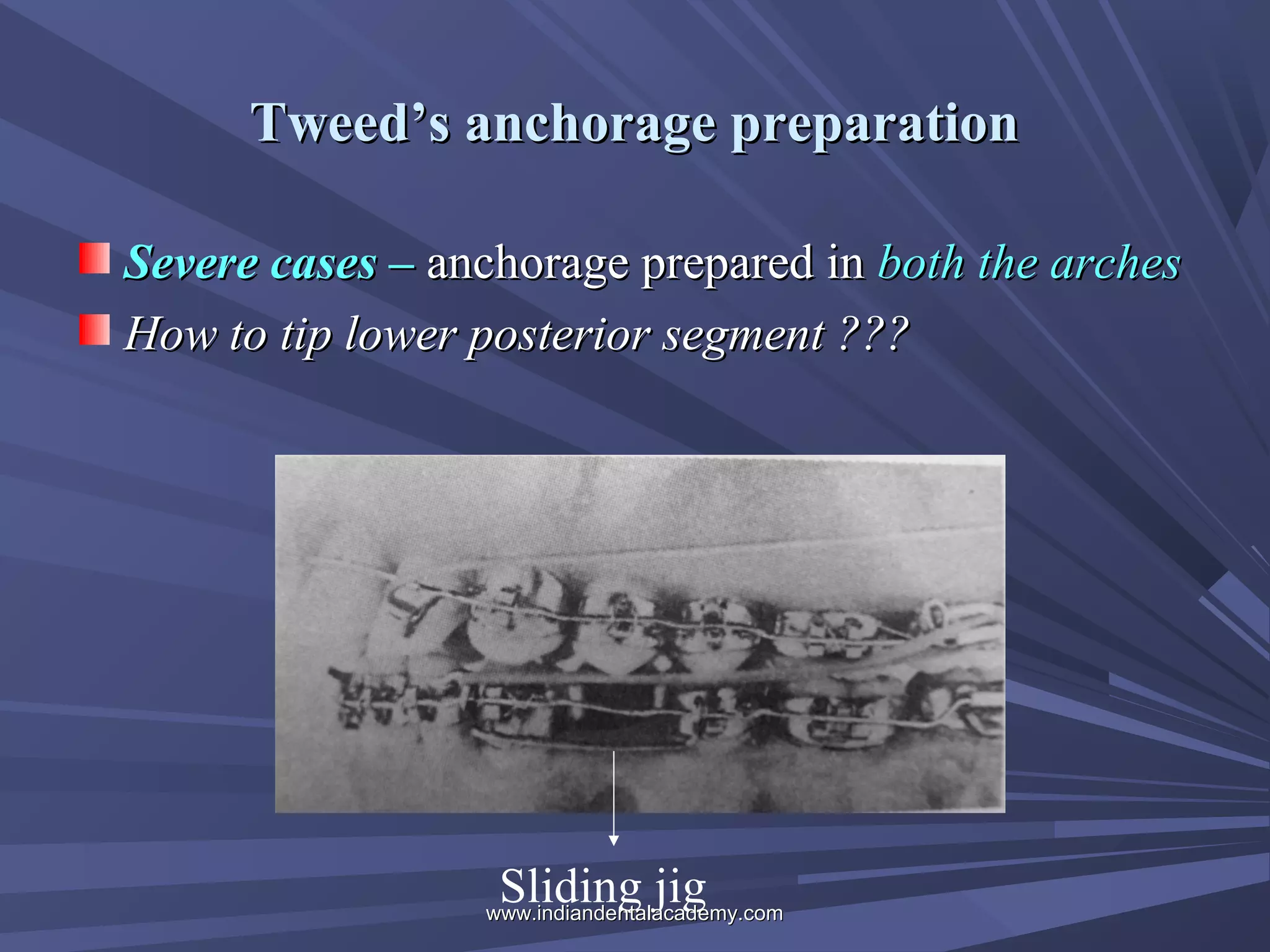
Severe cases – anchorage prepared in both the arches
How to tip lower posterior segment ???

Sliding jig

www.indiandentalacademy.com
Tweed’s anchorage preparation

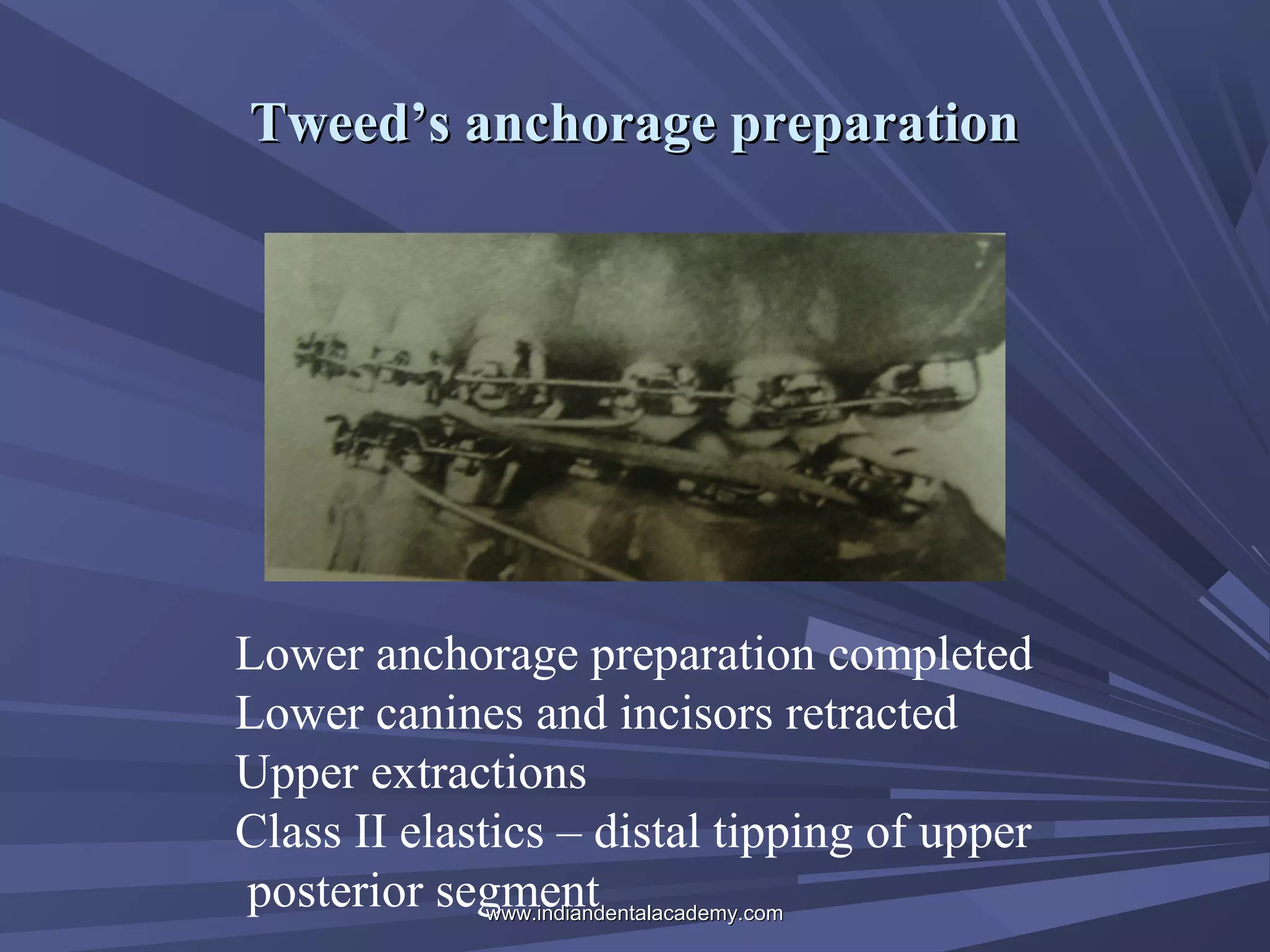
Lower anchorage preparation completed
Lower canines and incisors retracted
Upper extractions
Class II elastics – distal tipping of upper
posterior segment
www.indiandentalacademy.com
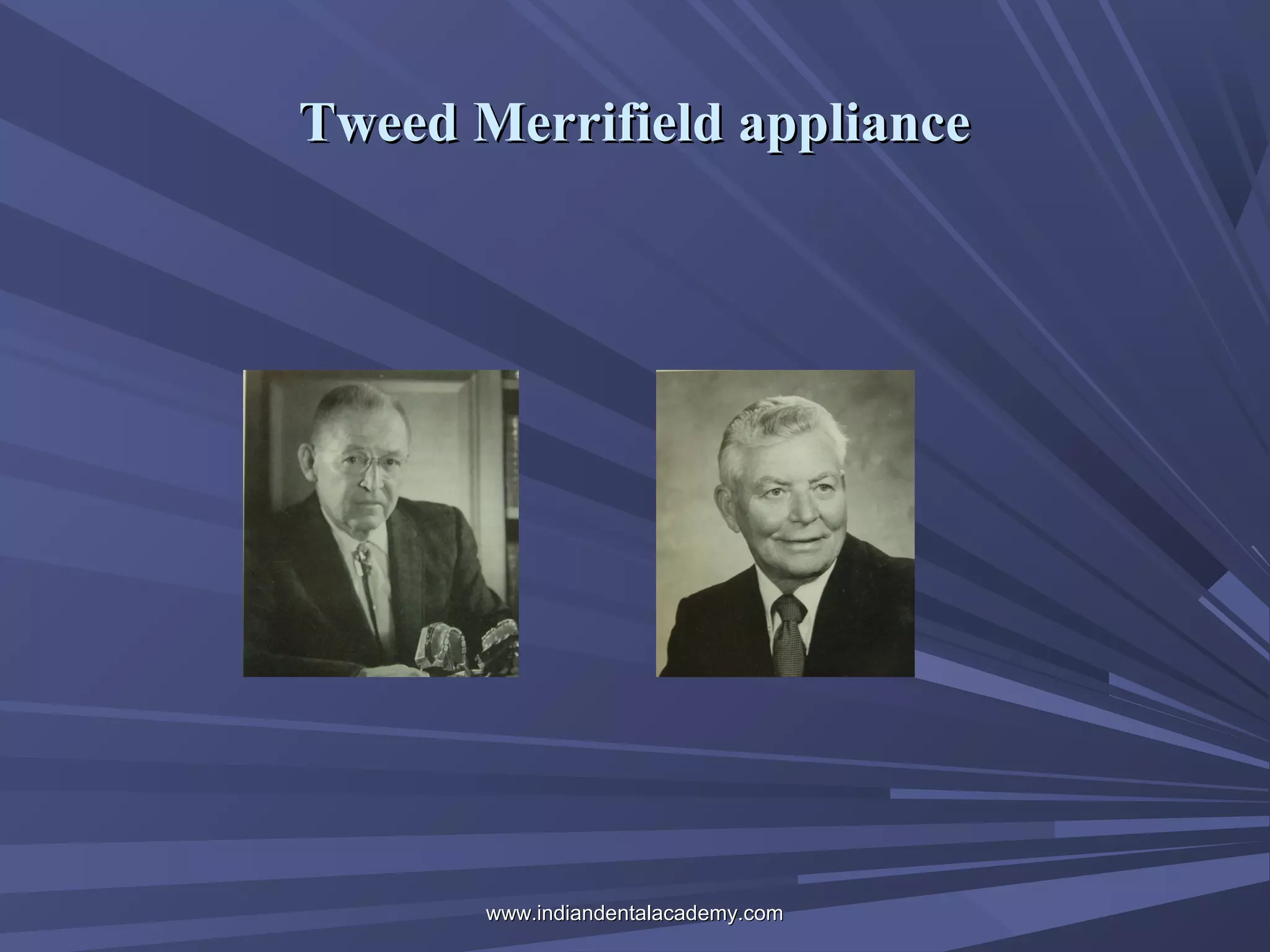
Tweed Merrifield appliance

www.indiandentalacademy.com
Tweed Merrifield appliance
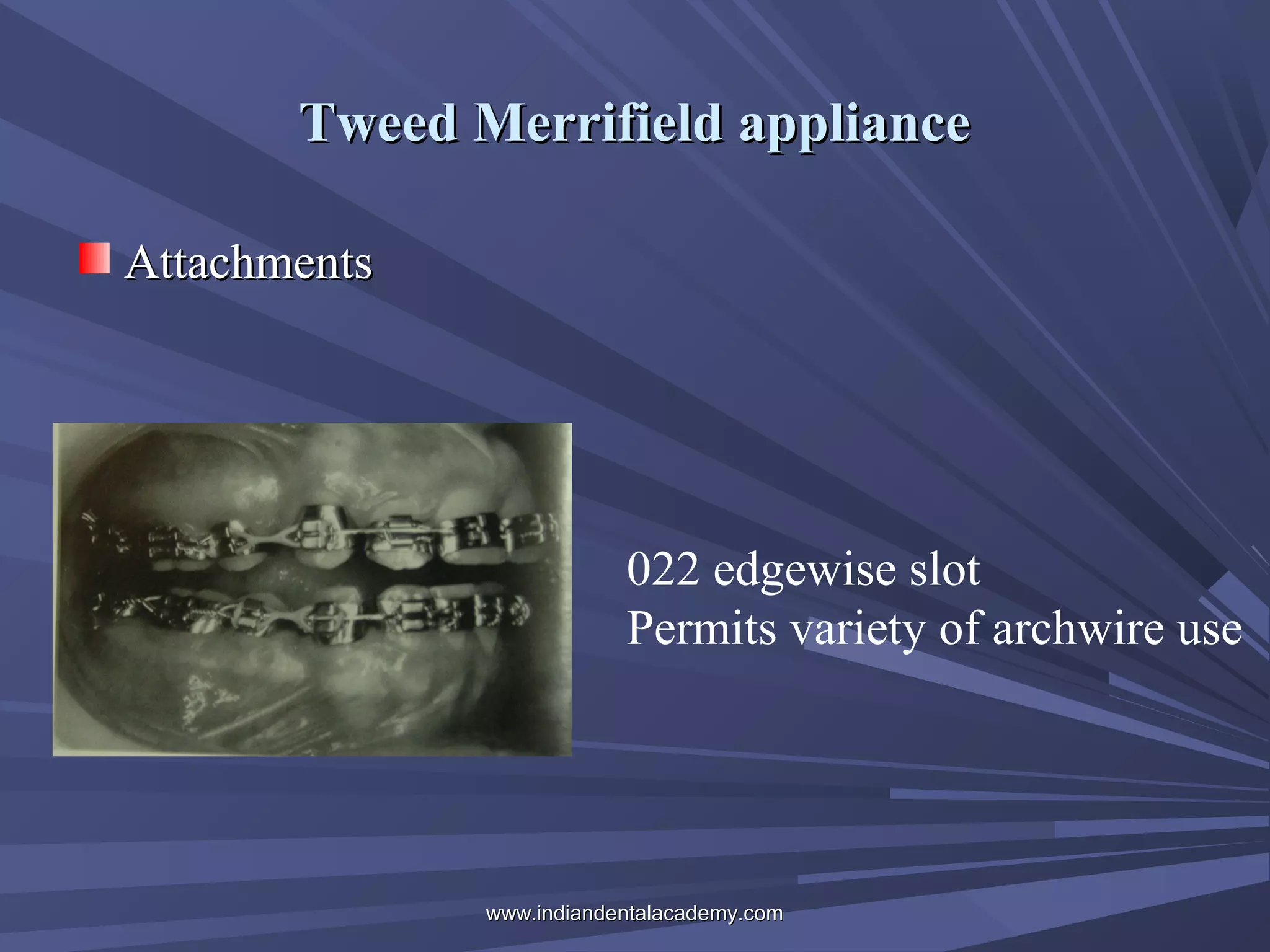
Attachments

022 edgewise slot
Permits variety of archwire use

www.indiandentalacademy.com
Tweed Merrifield appliance
Highlighting points – Anchorage preparation

Sequential banding and bonding
Sequential tooth movement
Sequential anchorage preparation
Directional force system

www.indiandentalacademy.com
Tweed Merrifield appliance
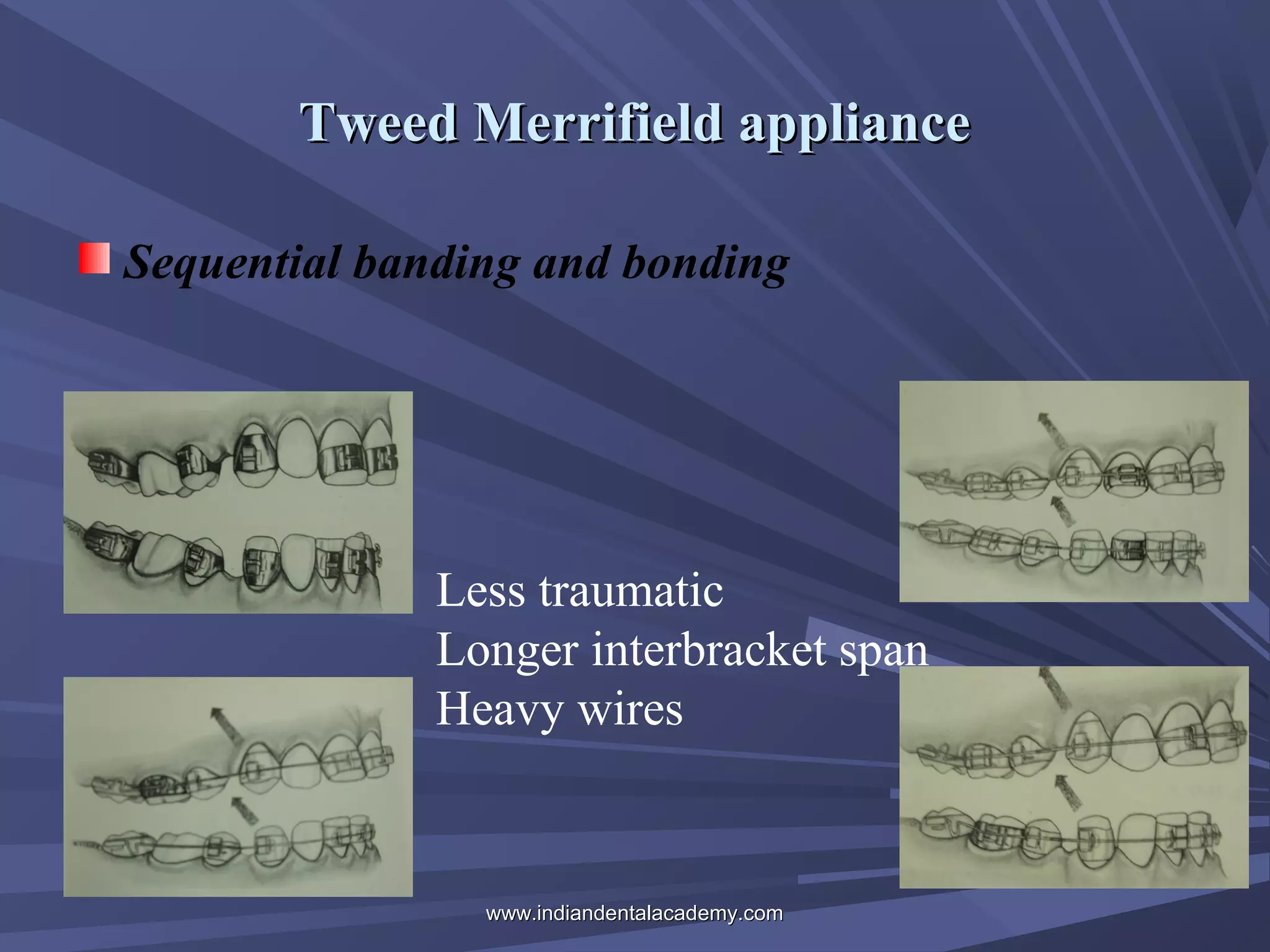
Sequential banding and bonding

Less traumatic
Longer interbracket span
Heavy wires

www.indiandentalacademy.com
Tweed Merrifield appliance
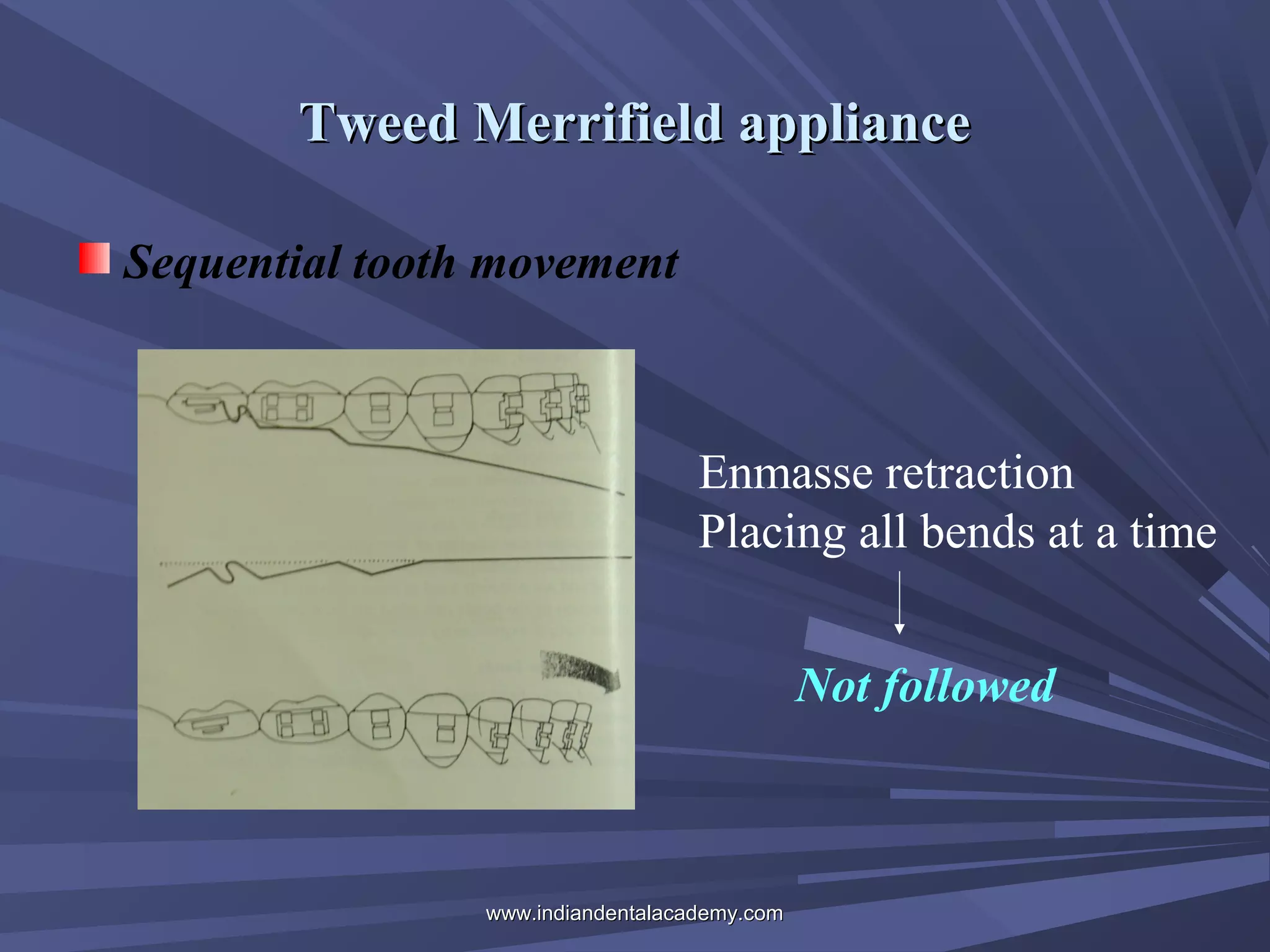
Sequential tooth movement

Enmasse retraction
Placing all bends at a time
Not followed

www.indiandentalacademy.com
Tweed Merrifield appliance
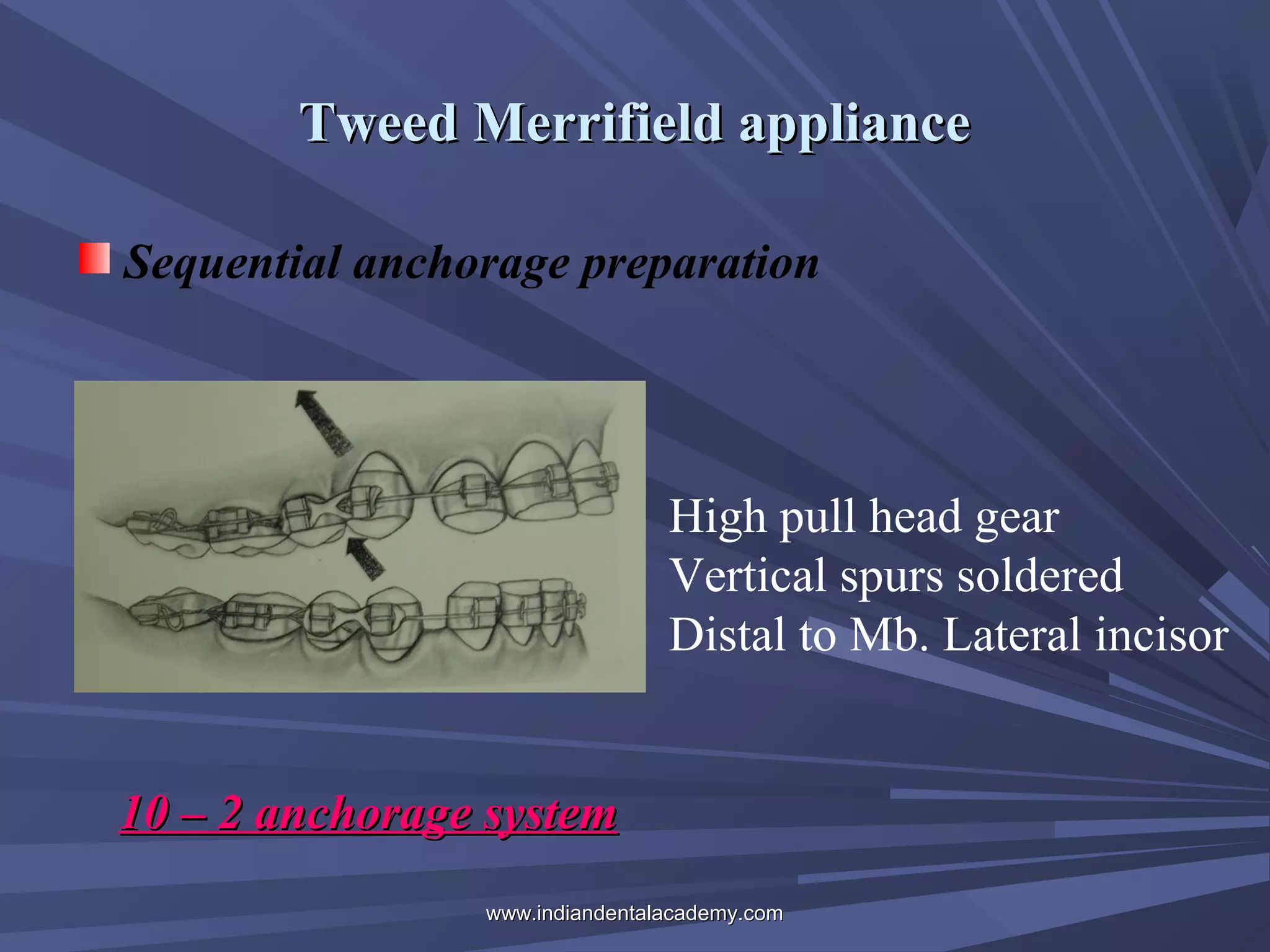
Sequential anchorage preparation

High pull head gear
Vertical spurs soldered
Distal to Mb. Lateral incisor
10 – 2 anchorage system
www.indiandentalacademy.com
Tweed Merrifield appliance
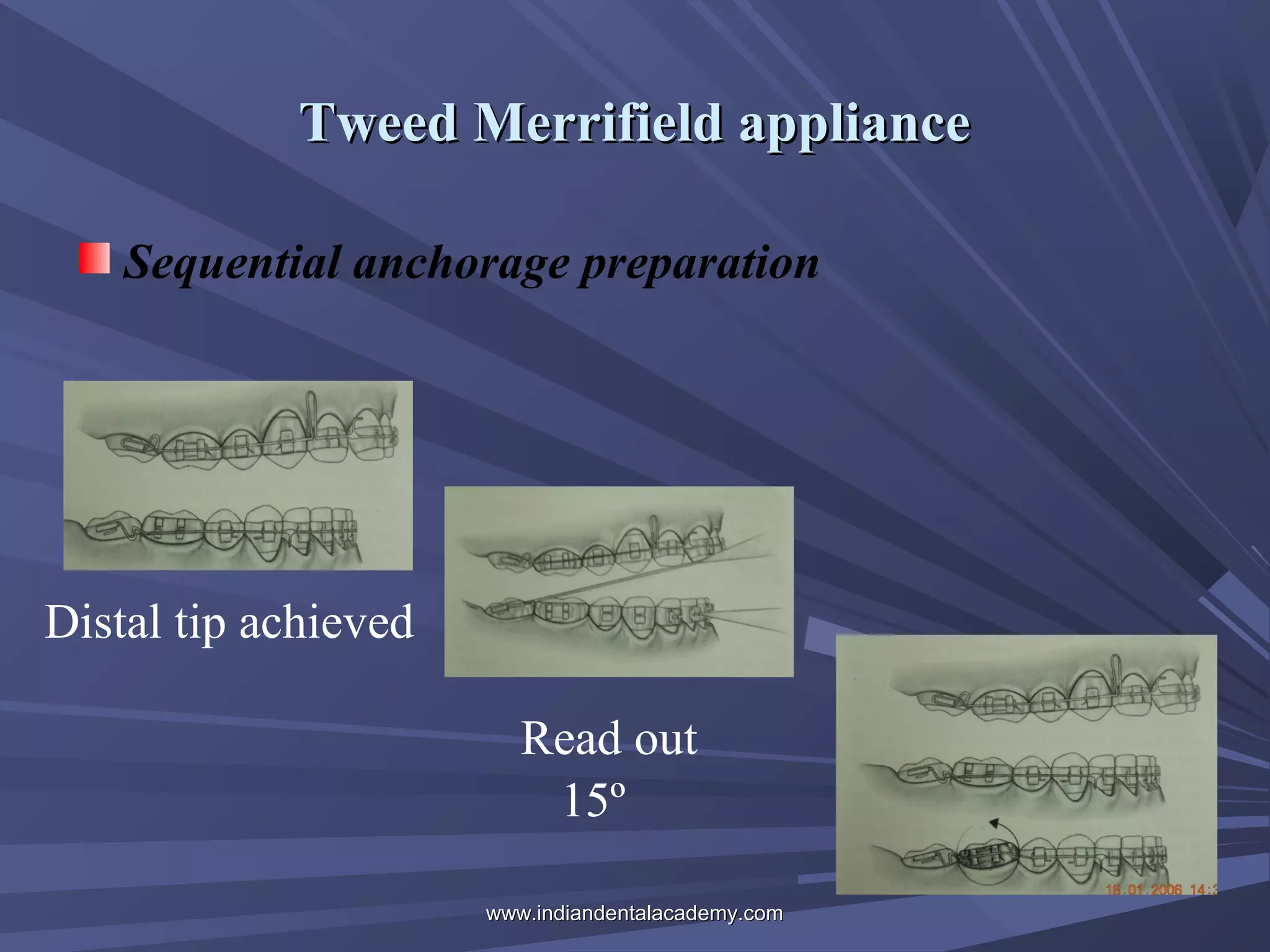
Sequential anchorage preparation

Distal tip achieved
Read out
15º
www.indiandentalacademy.com
Tweed Merrifield appliance
Sequential anchorage preparation

Before tipping premolars
Read out to be performed

Distal tip achieved
www.indiandentalacademy.com
Tweed Merrifield appliance
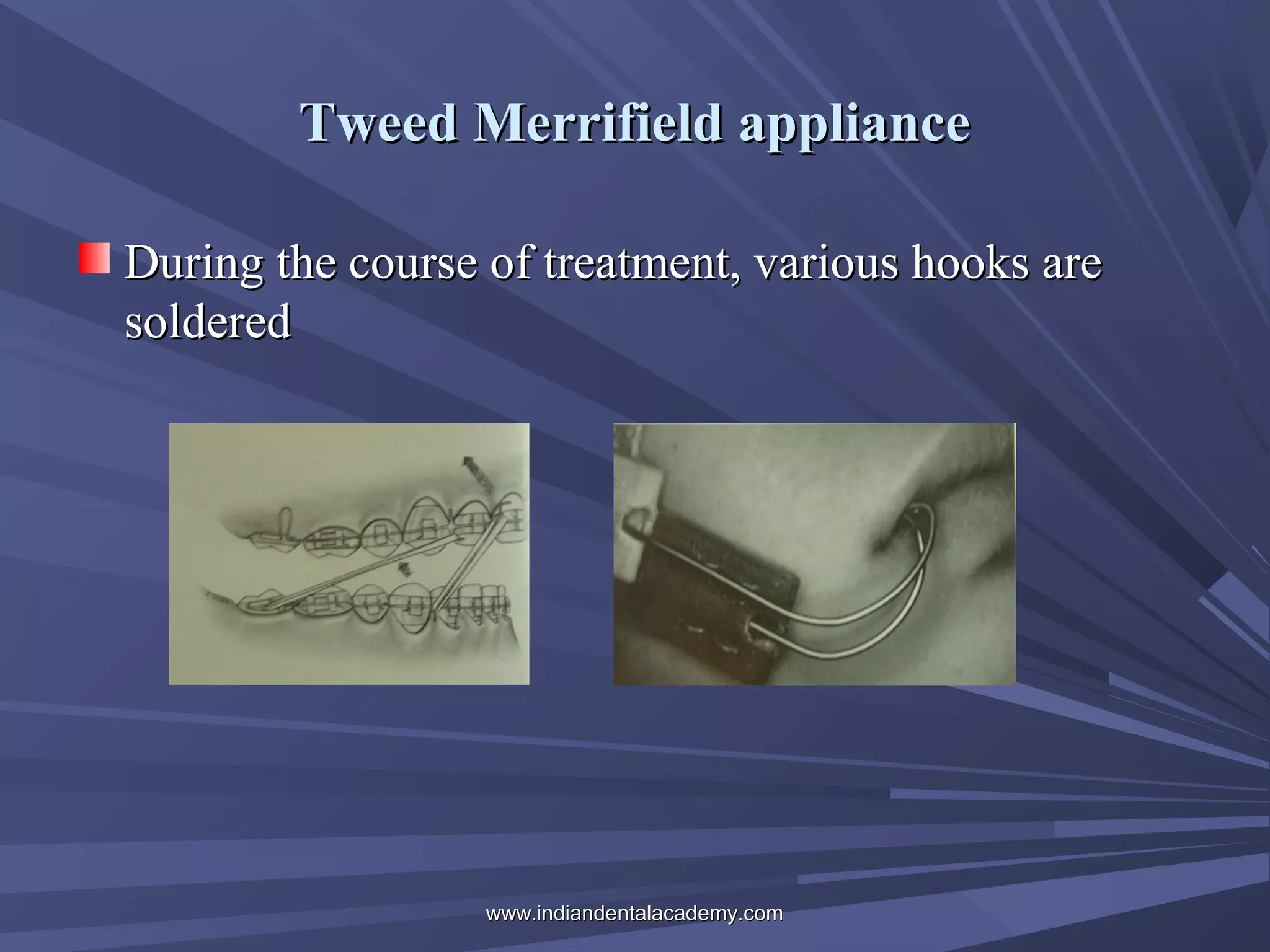
During the course of treatment, various hooks are
soldered

www.indiandentalacademy.com
Tweed Merrifield appliance
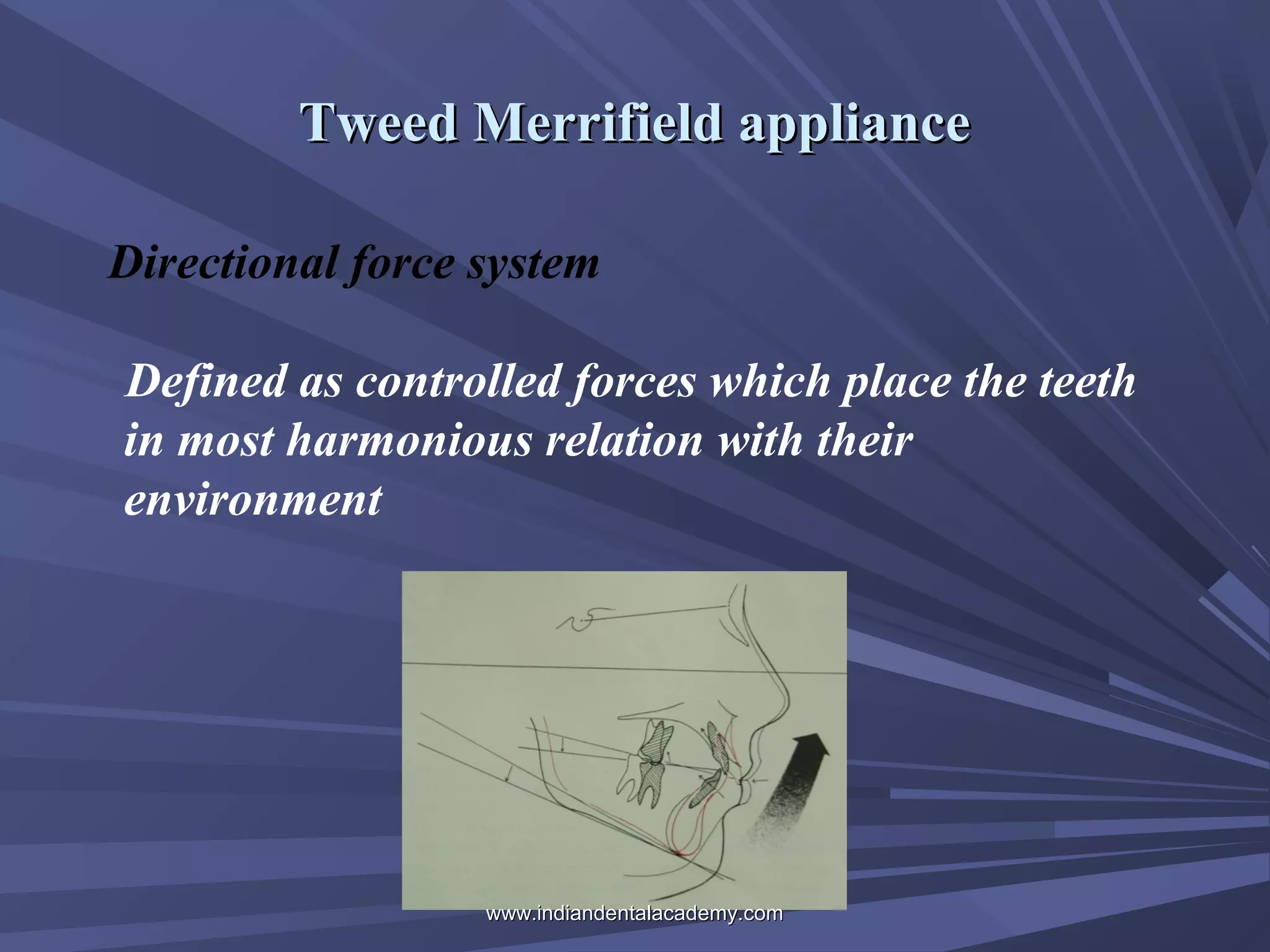
Directional force system
Defined as controlled forces which place the teeth
in most harmonious relation with their
environment

www.indiandentalacademy.com
Tweed Merrifield appliance

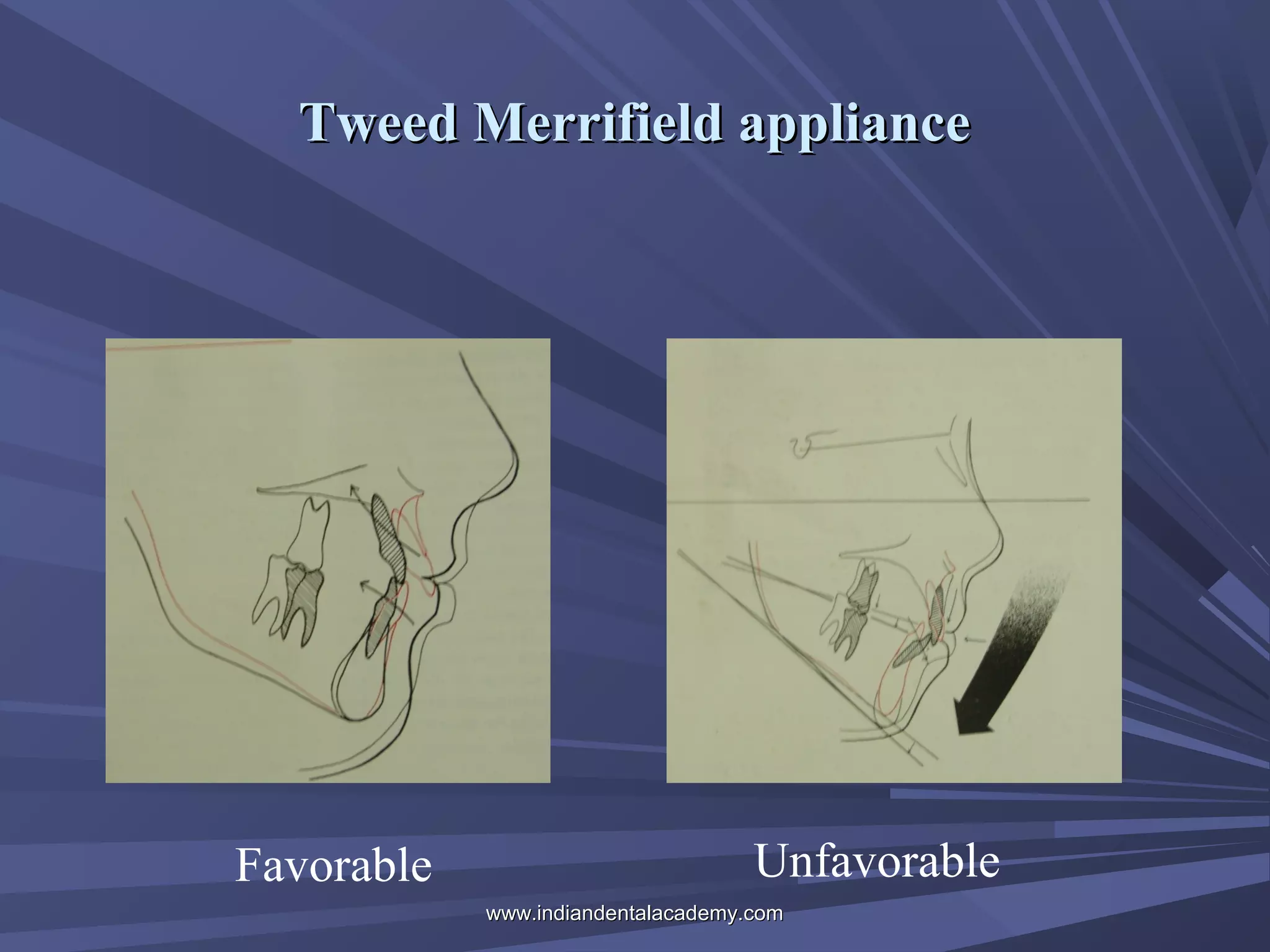
Favorable

Unfavorable
www.indiandentalacademy.com
Level anchorage system
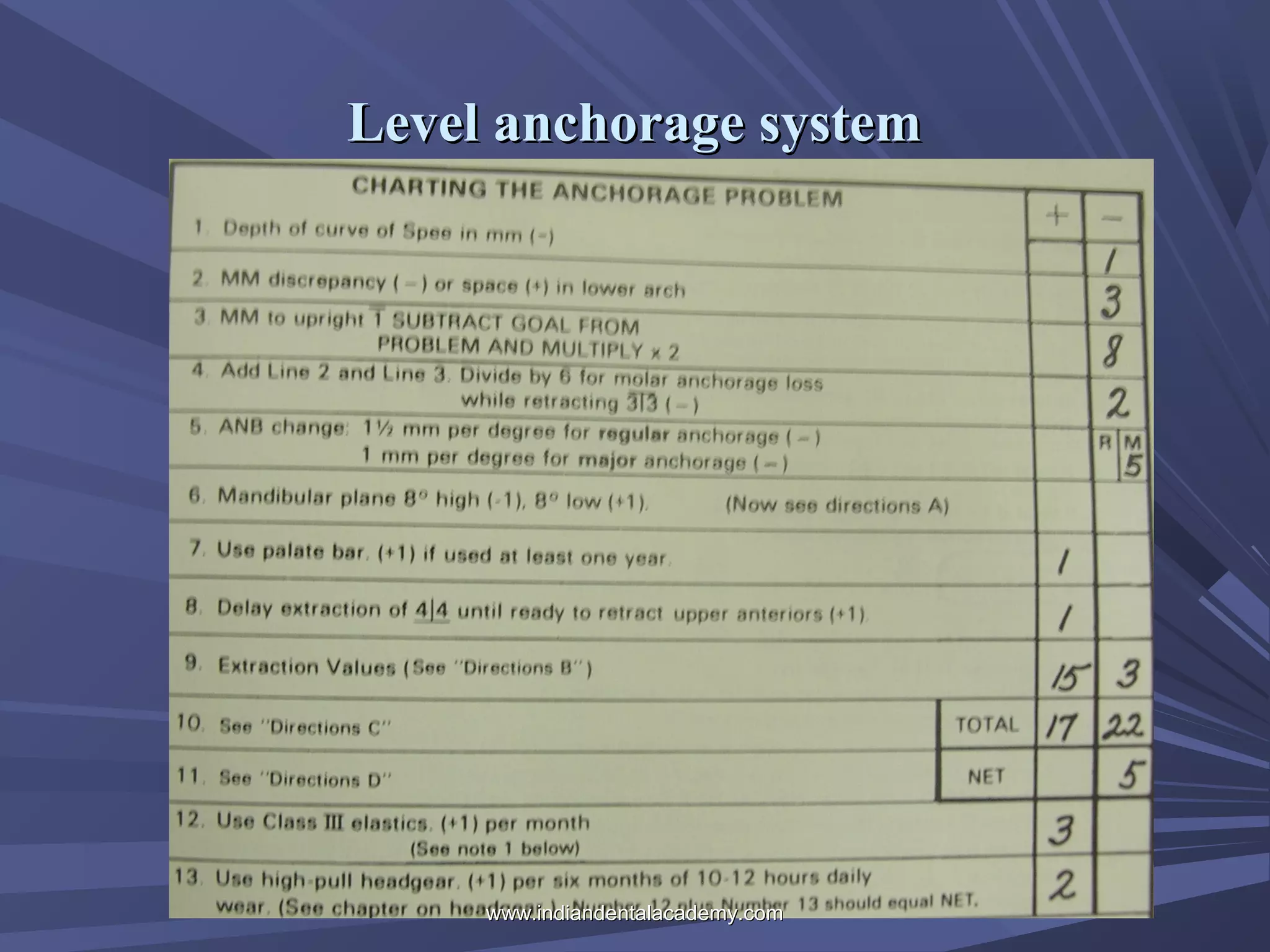
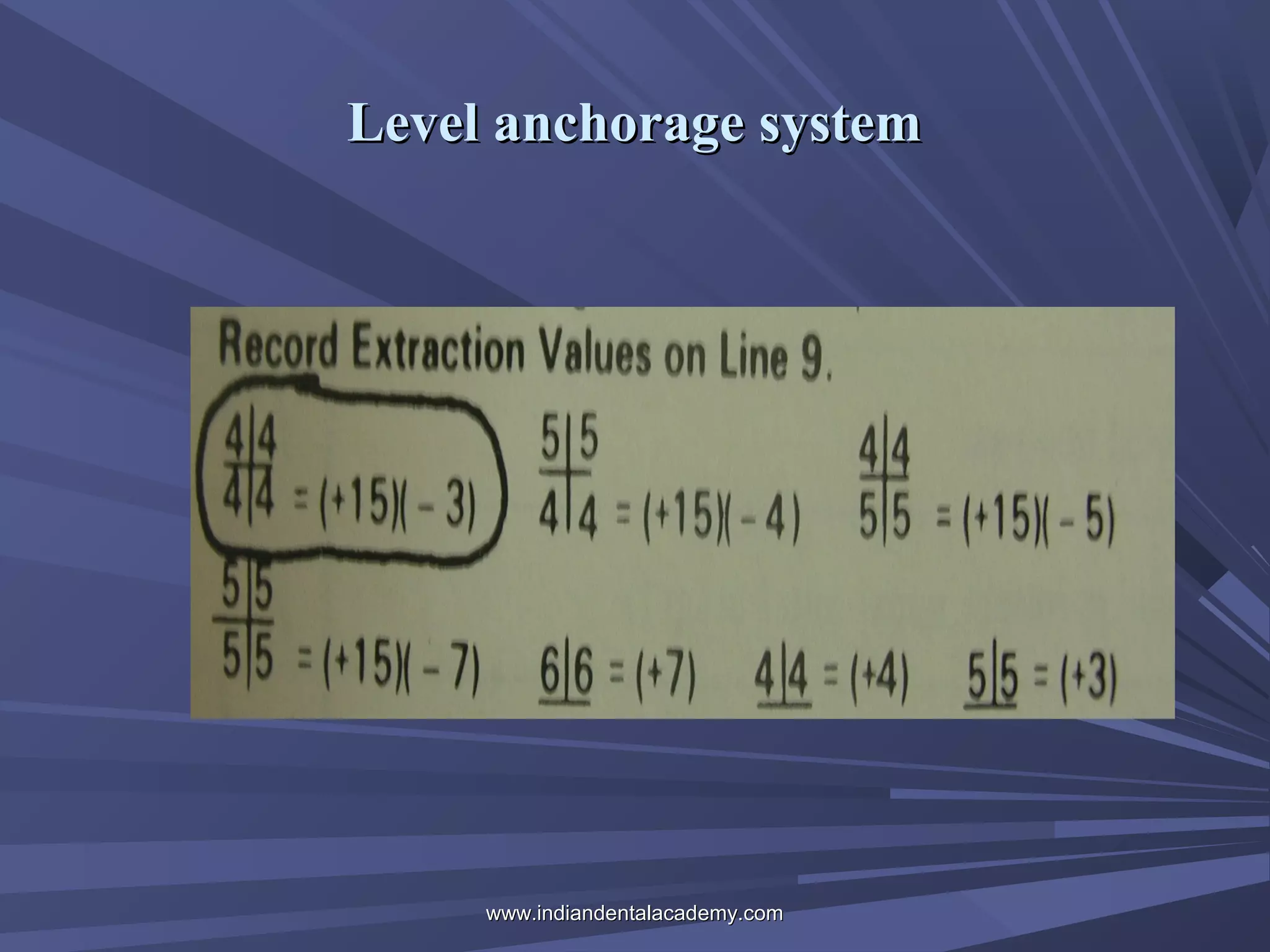
Terrell L. Root
Aim – quantify the anchorage requirement
018 edgewise slot
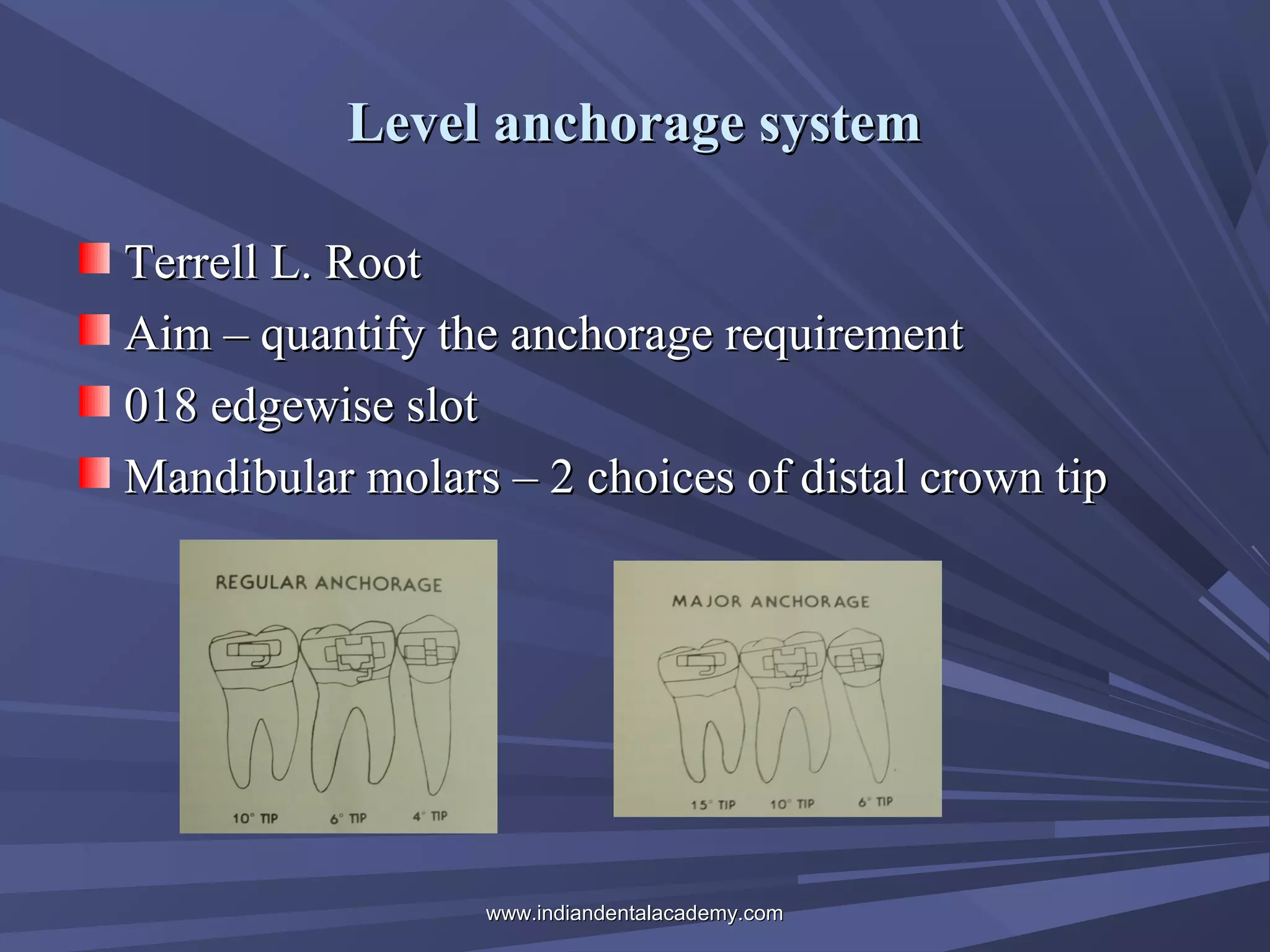
Mandibular molars – 2 choices of distal crown tip

www.indiandentalacademy.com
Level anchorage system
Anchorage – Resistance to movement
Distance to move
Anchorage savers
Those orthodontic adjunctive procedures that reduce
the amount of tooth anchorage necessary to correct
the malocclusion

www.indiandentalacademy.com
Level anchorage system
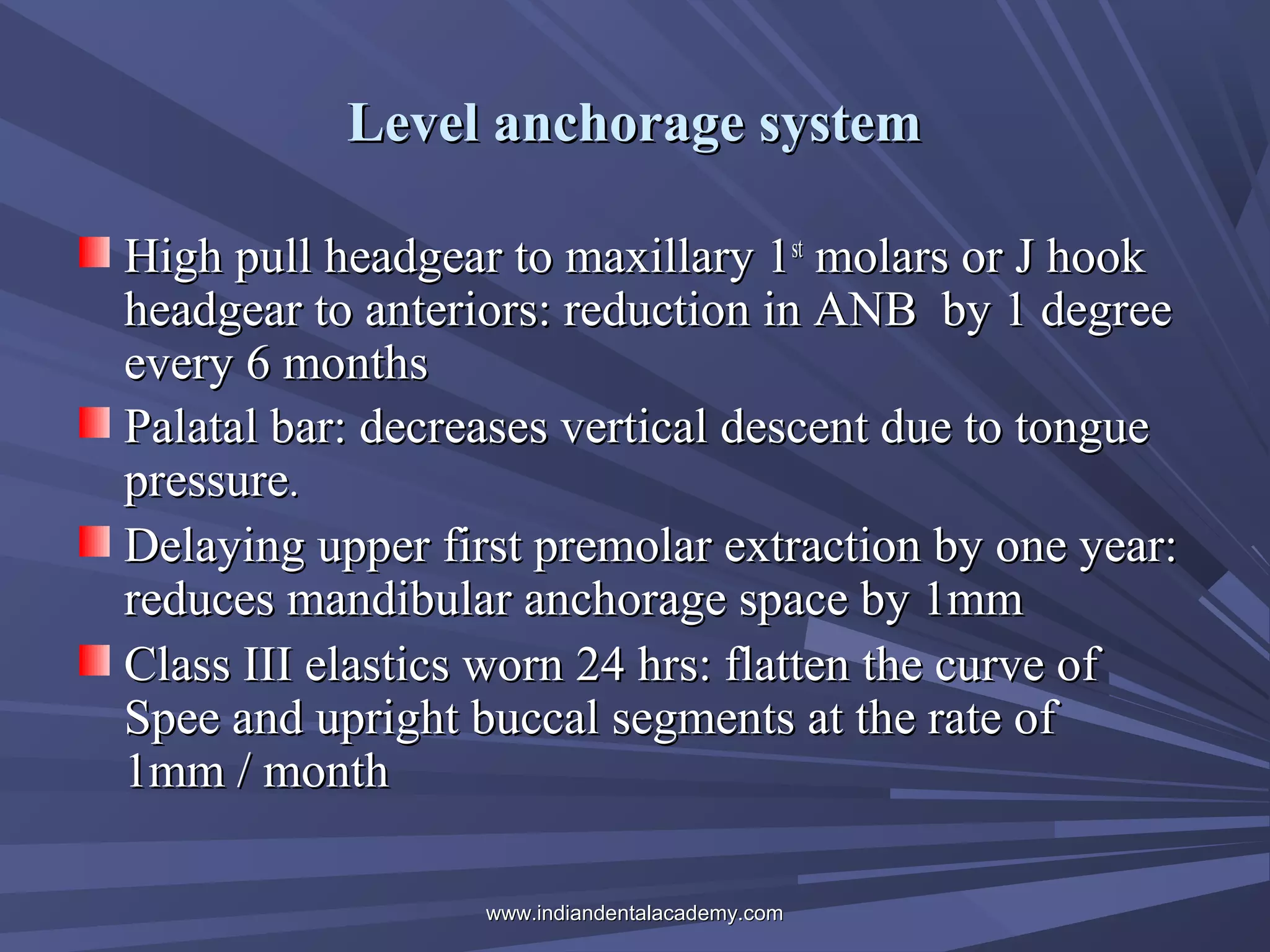
High pull headgear to maxillary 1st molars or J hook
headgear to anteriors: reduction in ANB by 1 degree
every 6 months
Palatal bar: decreases vertical descent due to tongue
pressure.
Delaying upper first premolar extraction by one year:
reduces mandibular anchorage space by 1mm
Class III elastics worn 24 hrs: flatten the curve of
Spee and upright buccal segments at the rate of
1mm / month
www.indiandentalacademy.com
Level anchorage system

www.indiandentalacademy.com
Level anchorage system

www.indiandentalacademy.com
Vari-simplex discipline-Alexander
Vari – variety of bracket used
Simplex – KISS principle
fewer archwire changes

1.
2.
3.

Treatment philosophy – Tweeds fundamentals
Anchorage preparation
Positioning Mb incisors over basal bone
Orthopedic alteration using head gear
www.indiandentalacademy.com
Vari-simplex discipline-Alexander
Key objective
Non extraction therapy as far as possible
Interproximal enamel reduction
Control of Mb incisor position with –ve torque

www.indiandentalacademy.com
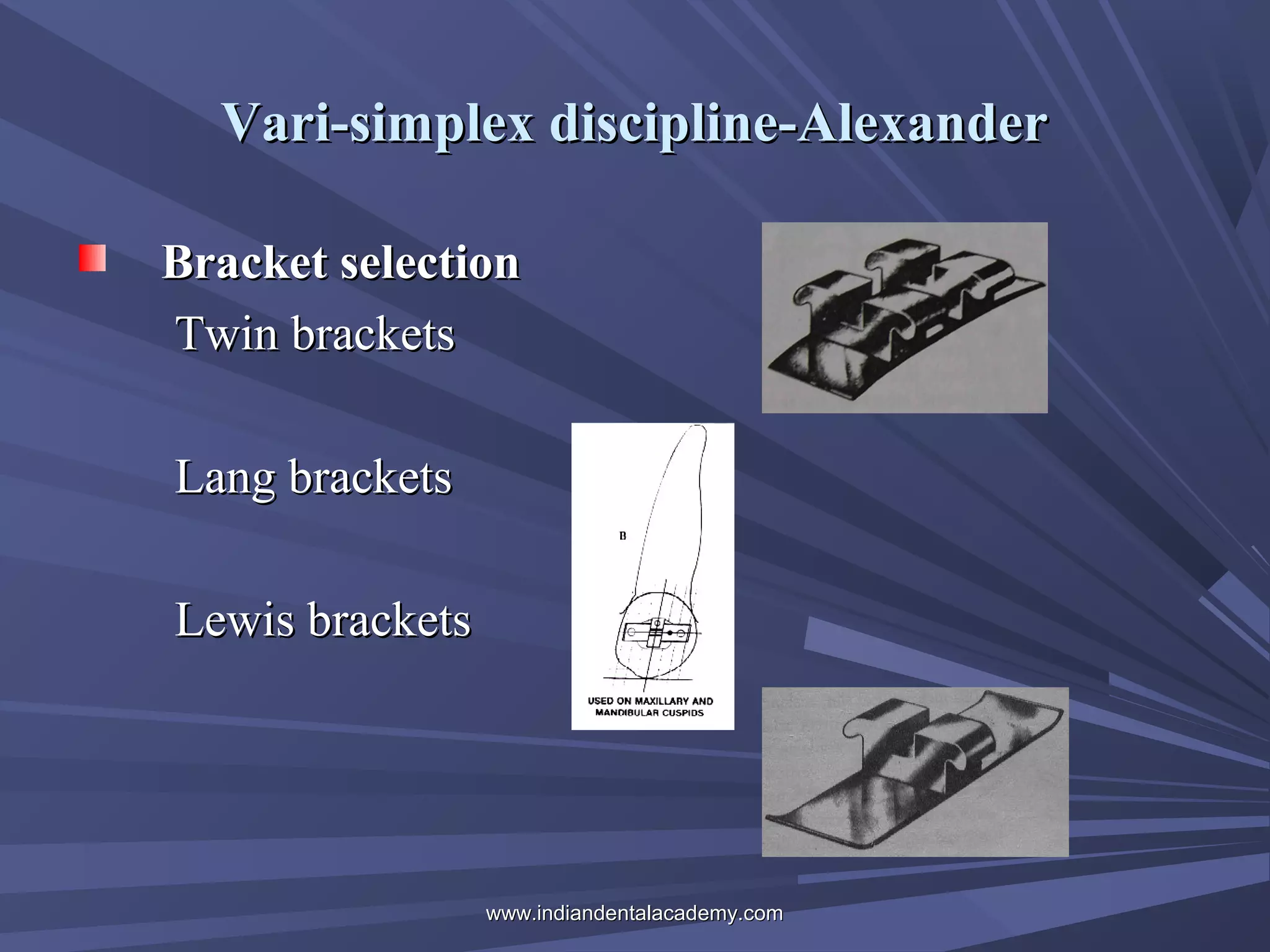
Vari-simplex discipline-Alexander
Bracket selection
Twin brackets
Lang brackets
Lewis brackets

www.indiandentalacademy.com
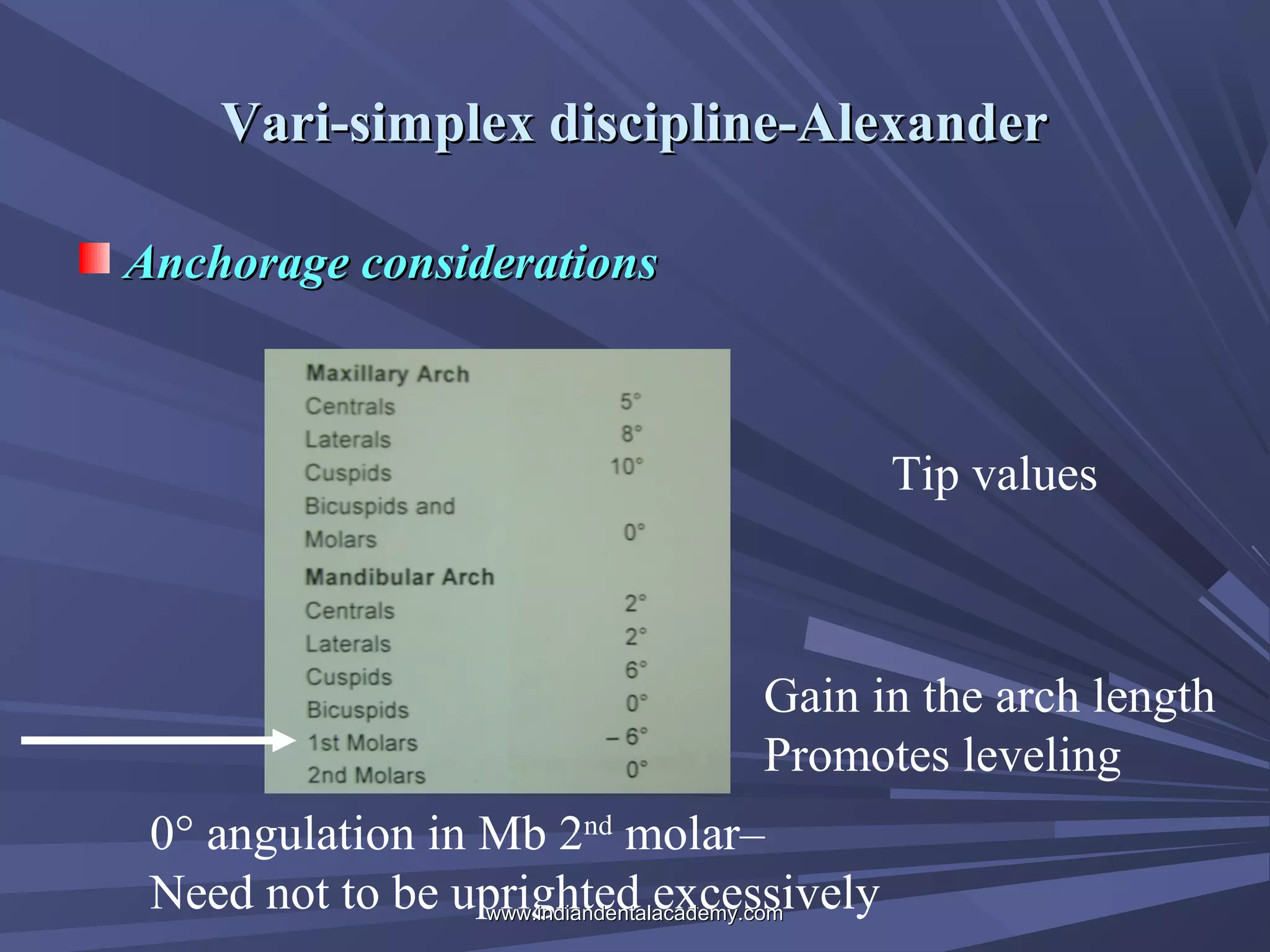
Vari-simplex discipline-Alexander
Anchorage considerations

Tip values

Gain in the arch length
Promotes leveling
0° angulation in Mb 2nd molar–
Need not to be uprighted excessively
www.indiandentalacademy.com
Vari-simplex discipline-Alexander
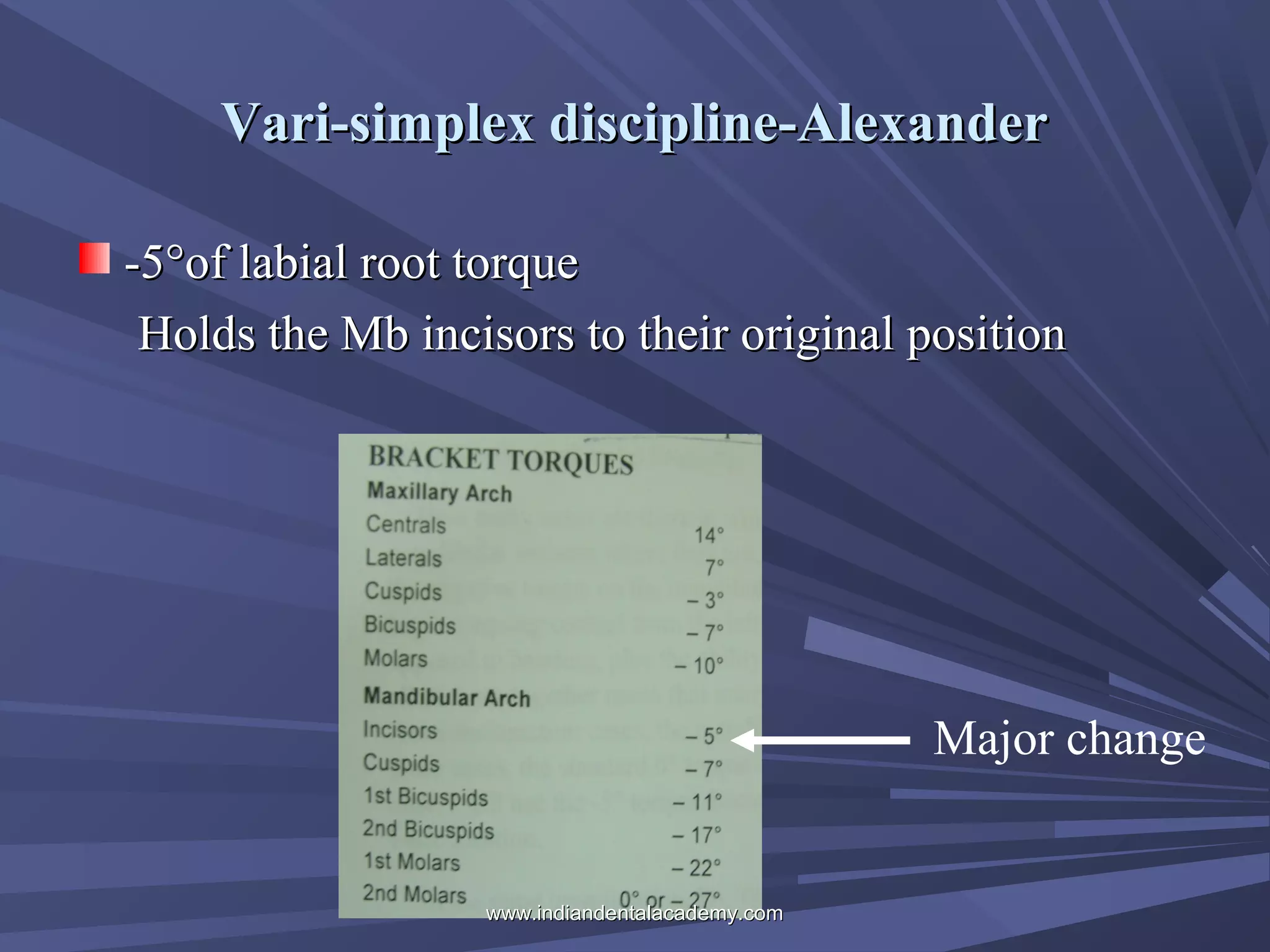
-5°of labial root torque
Holds the Mb incisors to their original position

Major change

www.indiandentalacademy.com
Vari-simplex discipline-Alexander
Head gears / Retractors
Retractors’ ( Dr. Fred Schudy)
Cervical, combination or high pull depending on
growth pattern and control needed

www.indiandentalacademy.com
Vari-simplex discipline-Alexander
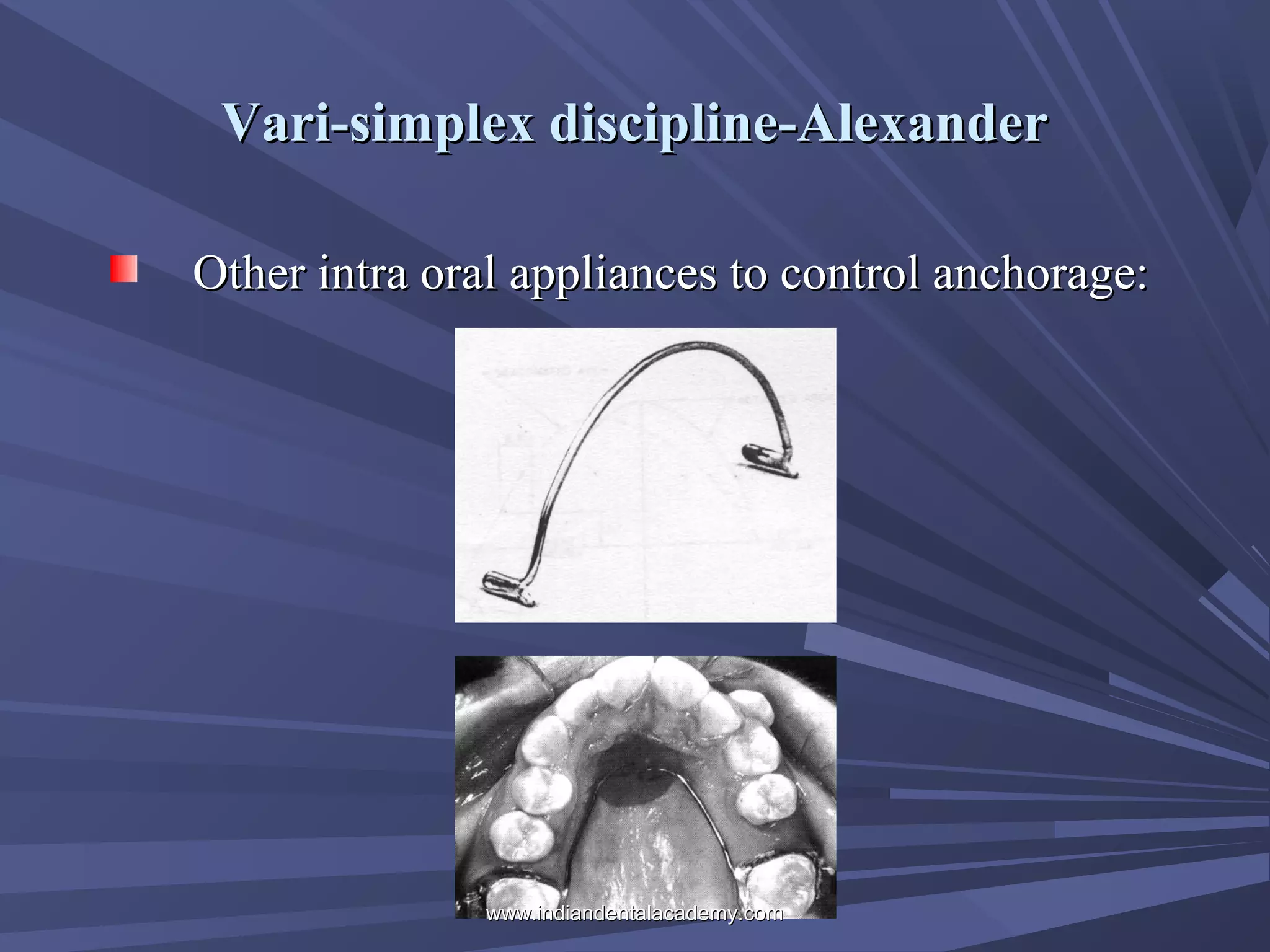
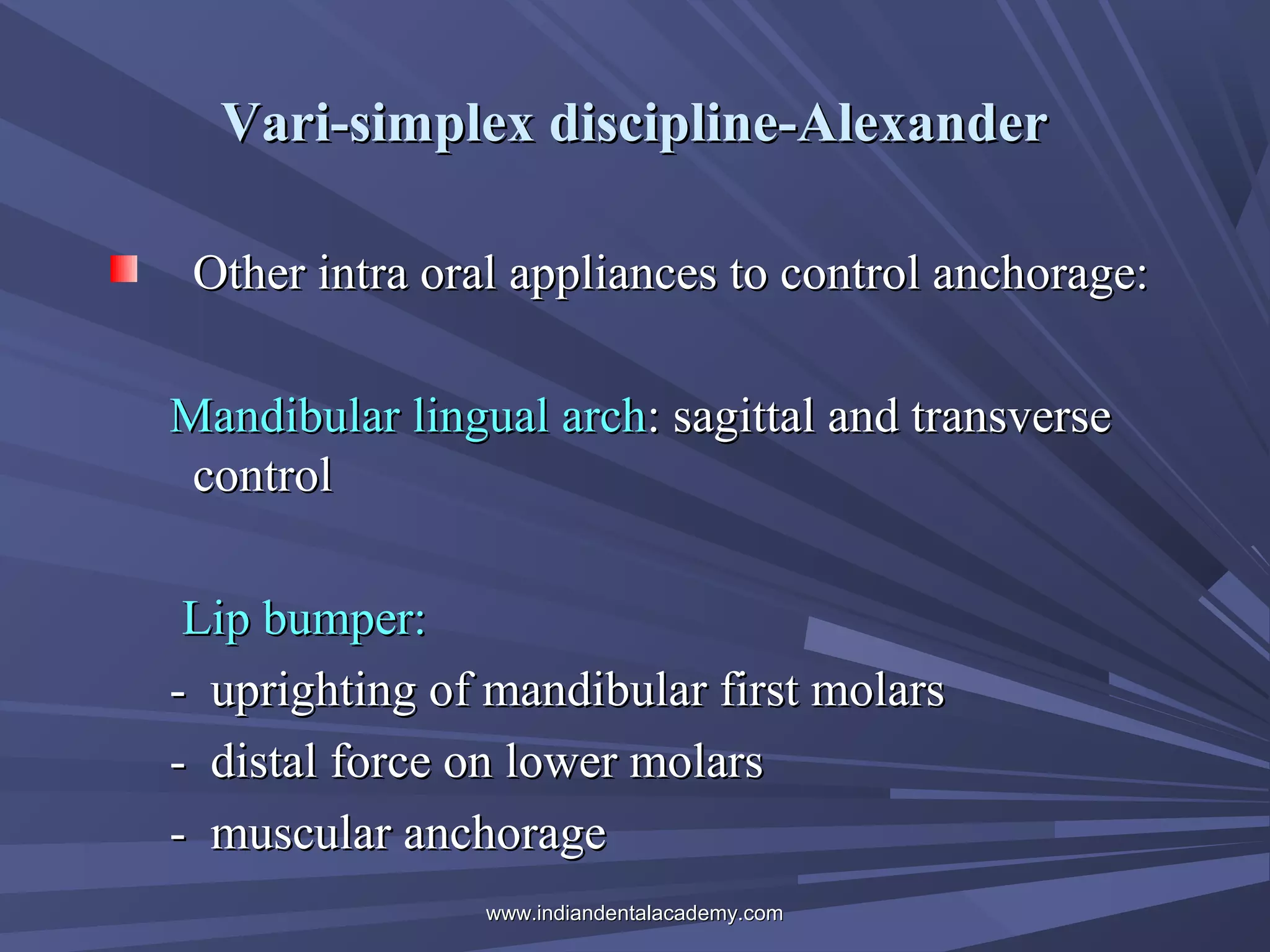
Other intra oral appliances to control anchorage:

www.indiandentalacademy.com
Vari-simplex discipline-Alexander
Other intra oral appliances to control anchorage:
Mandibular lingual arch: sagittal and transverse
control
Lip bumper:
- uprighting of mandibular first molars
- distal force on lower molars
- muscular anchorage
www.indiandentalacademy.com
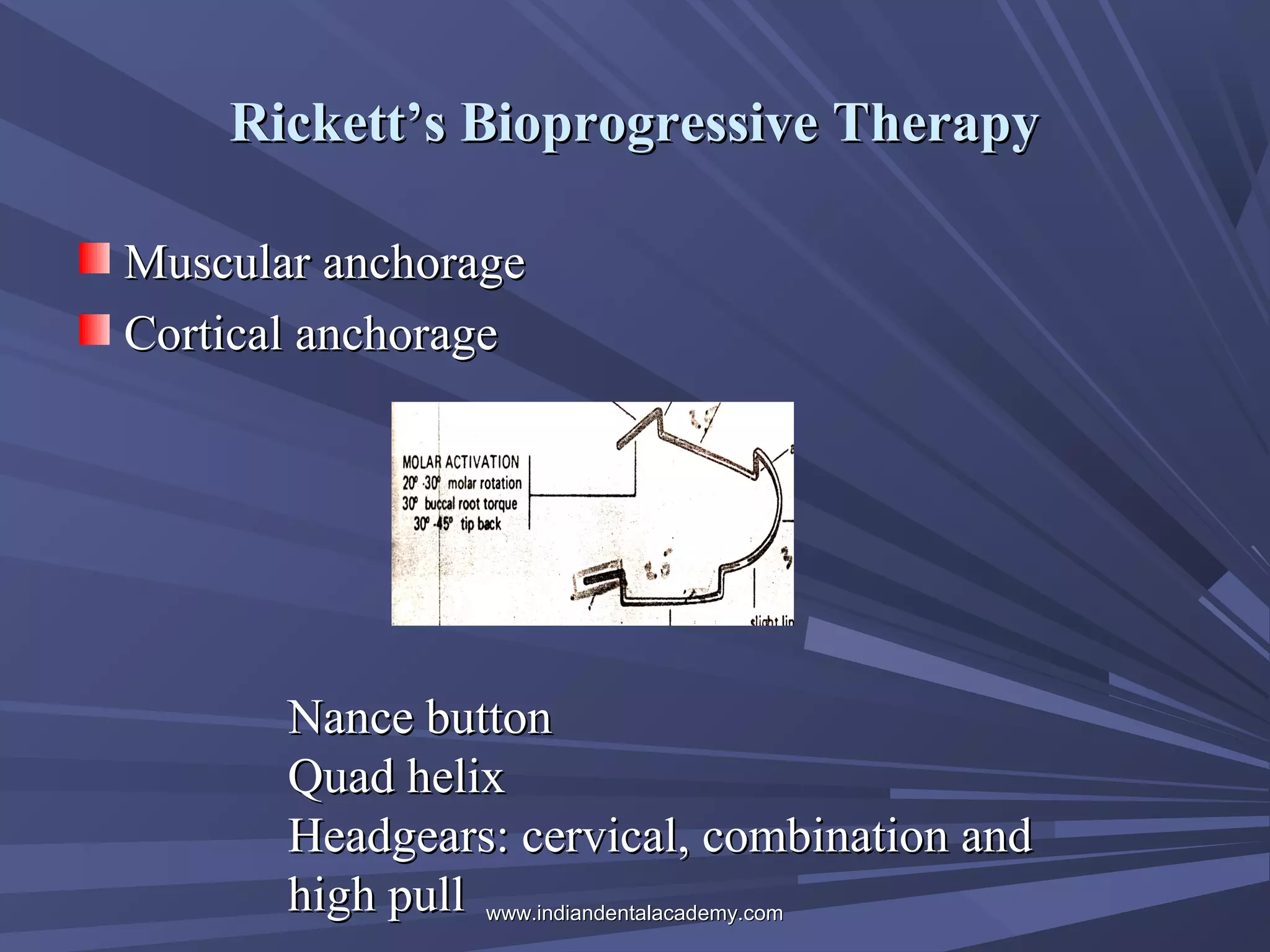
Rickett’s Bioprogressive Therapy
Muscular anchorage
Cortical anchorage

Nance button
Quad helix
Headgears: cervical, combination and
high pull www.indiandentalacademy.com
Anchorage control in MBT
2nd principle of orthodontic anchorage
Anchorage loss – maximum in the first stage
Def – Tooth movement needed to achieve passive
engagement of steel 19 x 25 wire of suitable arch
form into a correctly placed 022 preadjusted bracket
system

www.indiandentalacademy.com
Anchorage control in MBT
Major reason for anchorage loss ???
Mesial tip built into the bracket system
Anchorage control
The maneuvers used to restrict undesirable changes
during the opening phase of treatment, so that
leveling and aligning is achieved without key
features of the malocclusion becoming worse.’
www.indiandentalacademy.com
Anchorage control in MBT
1st step in anchorage control

Recognize the anchorage needs of the case

Diagnosis and treatment planning stage

www.indiandentalacademy.com
Anchorage control in MBT
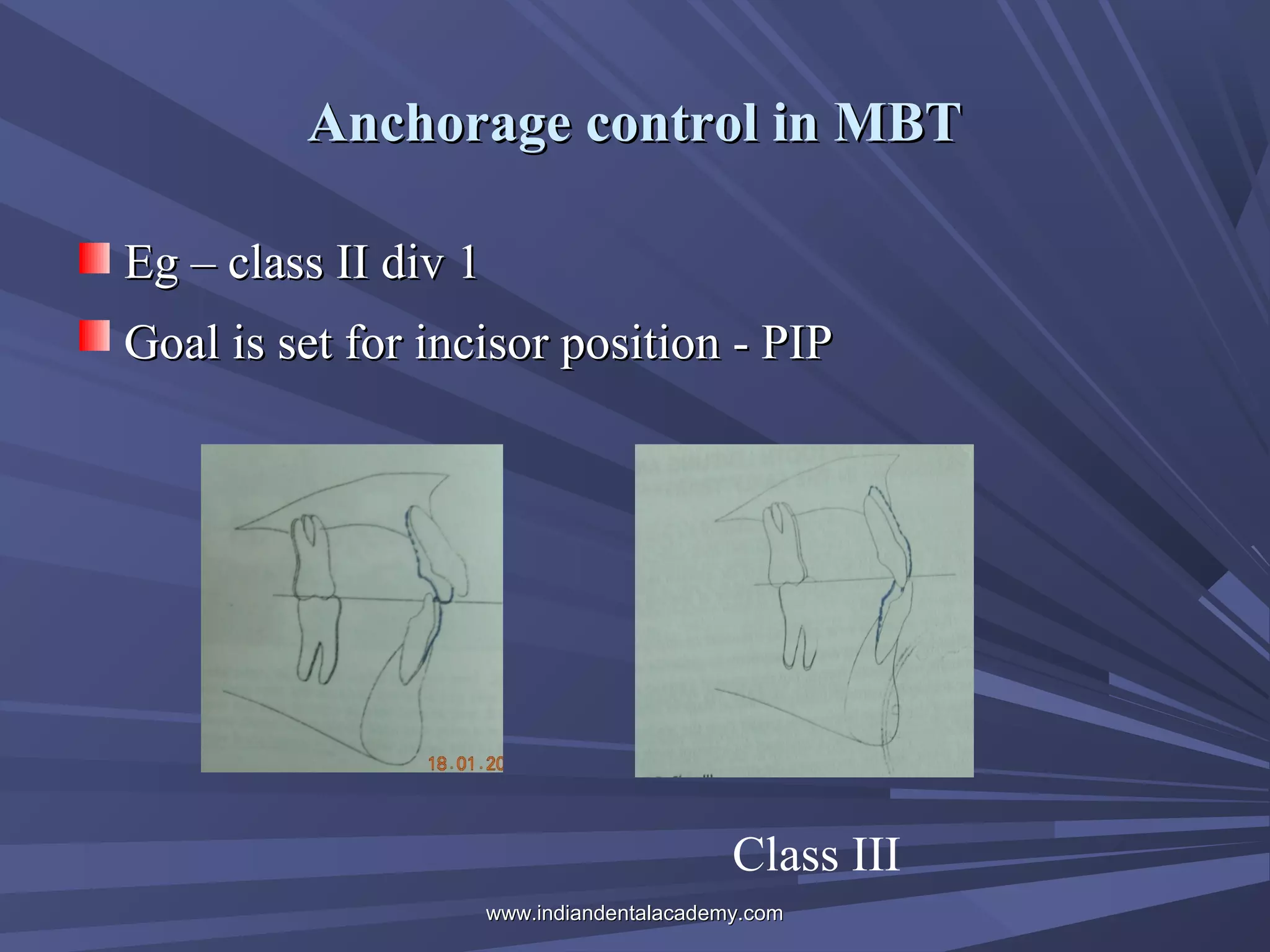
Eg – class II div 1
Goal is set for incisor position - PIP

Class III
www.indiandentalacademy.com
Anchorage control in MBT
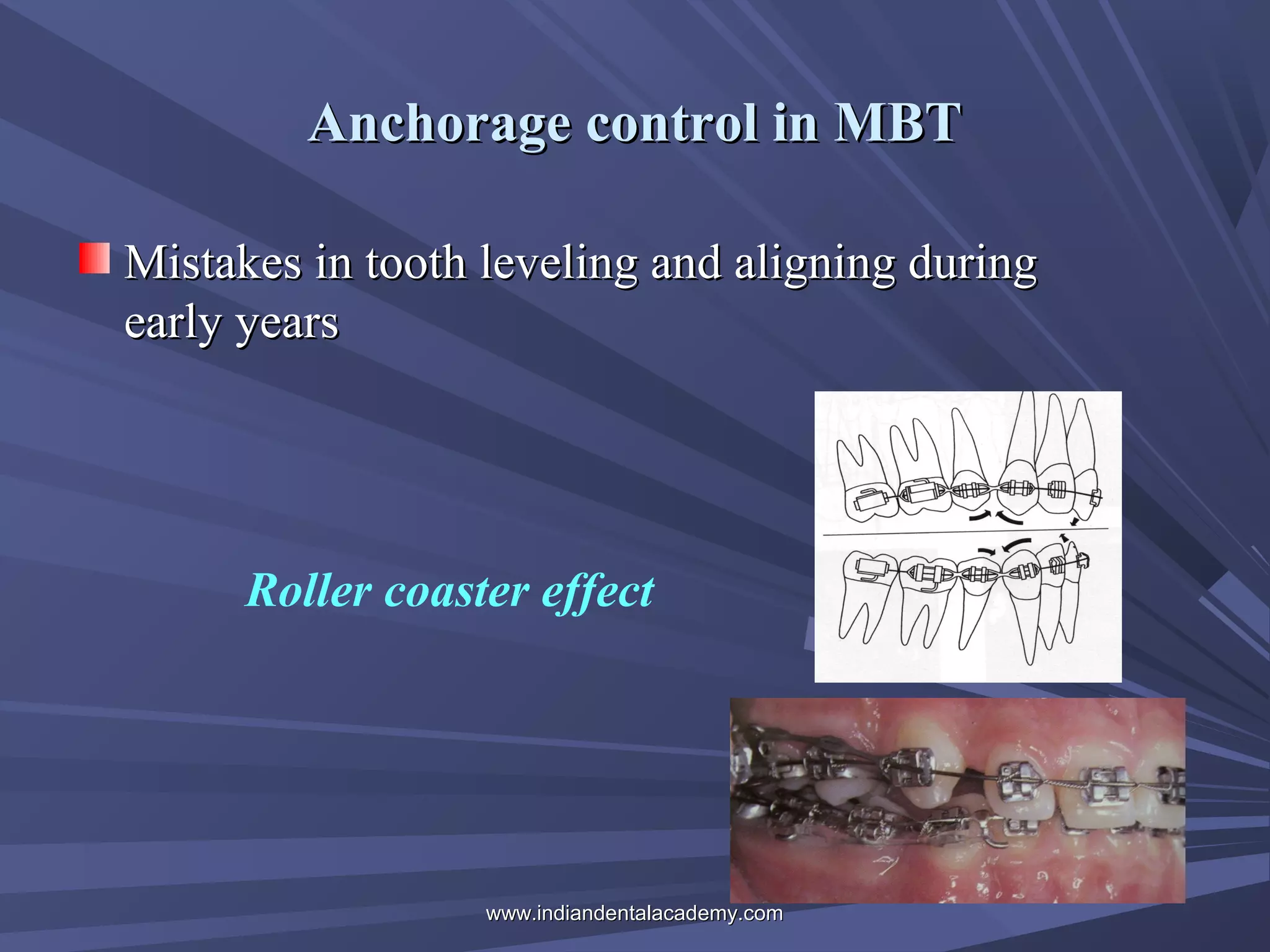
Mistakes in tooth leveling and aligning during
early years

Roller coaster effect

www.indiandentalacademy.com
Anchorage control in MBT
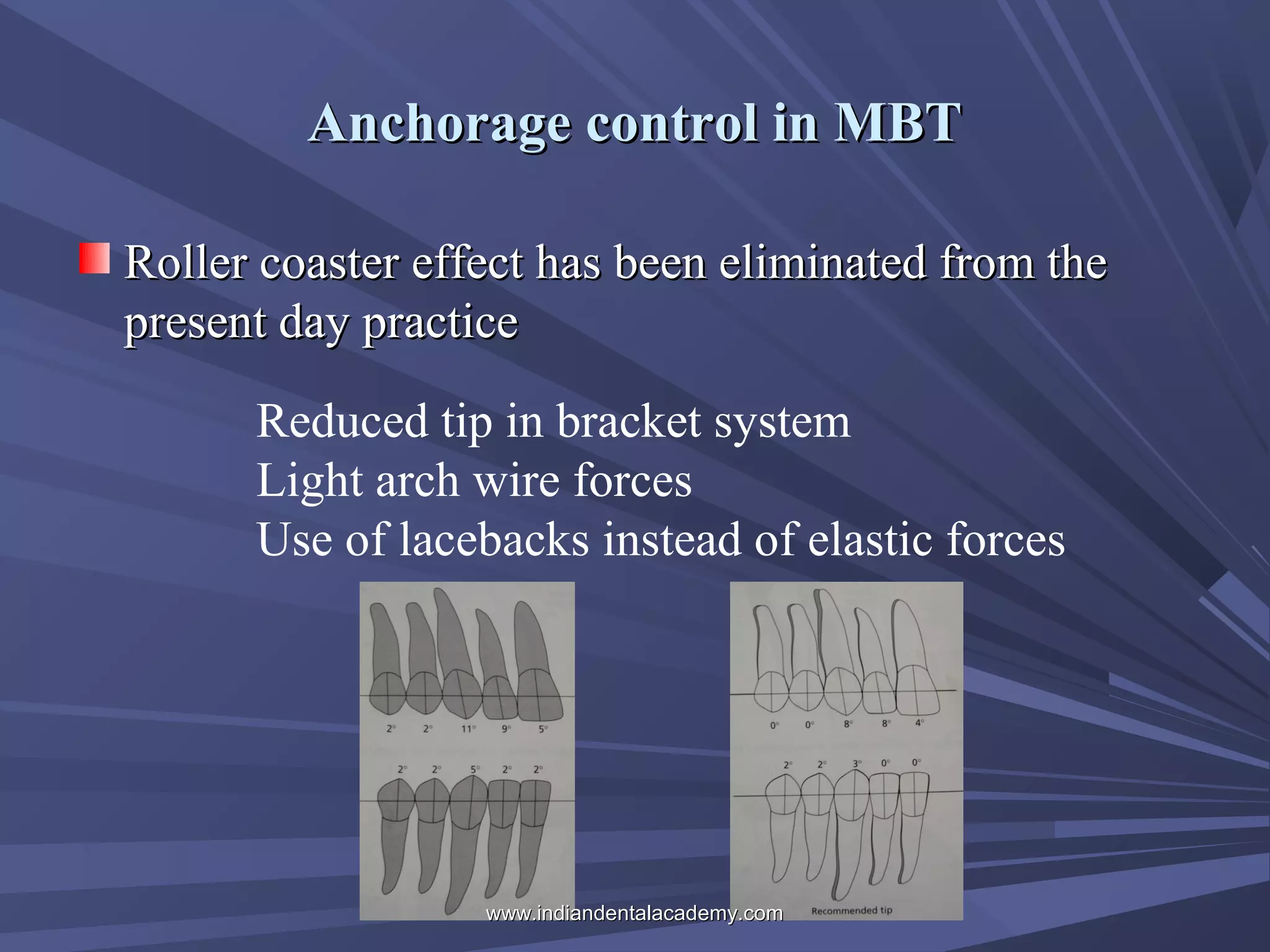
Roller coaster effect has been eliminated from the
present day practice
Reduced tip in bracket system
Light arch wire forces
Use of lacebacks instead of elastic forces

www.indiandentalacademy.com
Anchorage control in MBT
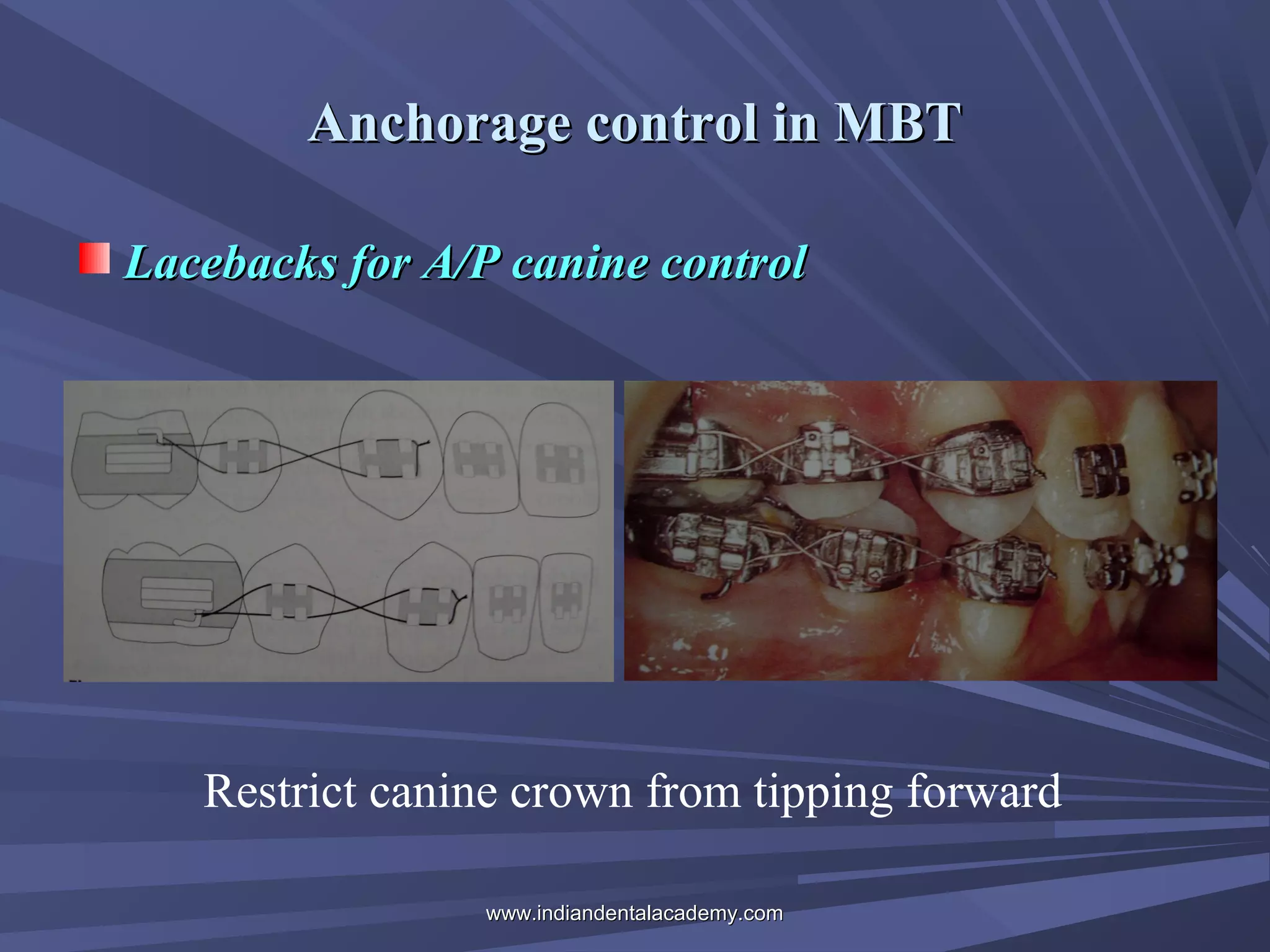
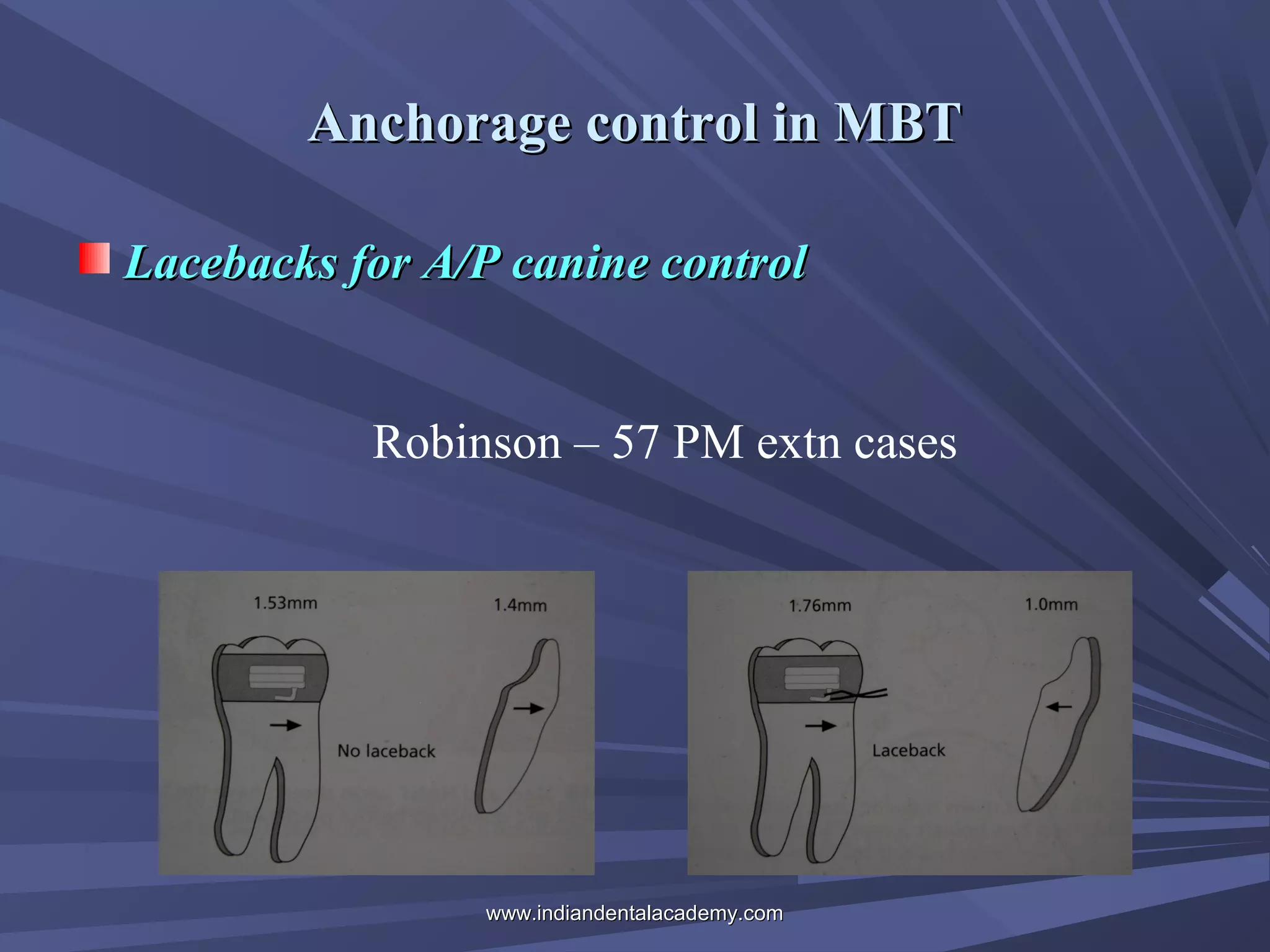
Lacebacks for A/P canine control

Restrict canine crown from tipping forward
www.indiandentalacademy.com
Anchorage control in MBT
Lacebacks for A/P canine control
Robinson – 57 PM extn cases

www.indiandentalacademy.com
Anchorage control in MBT
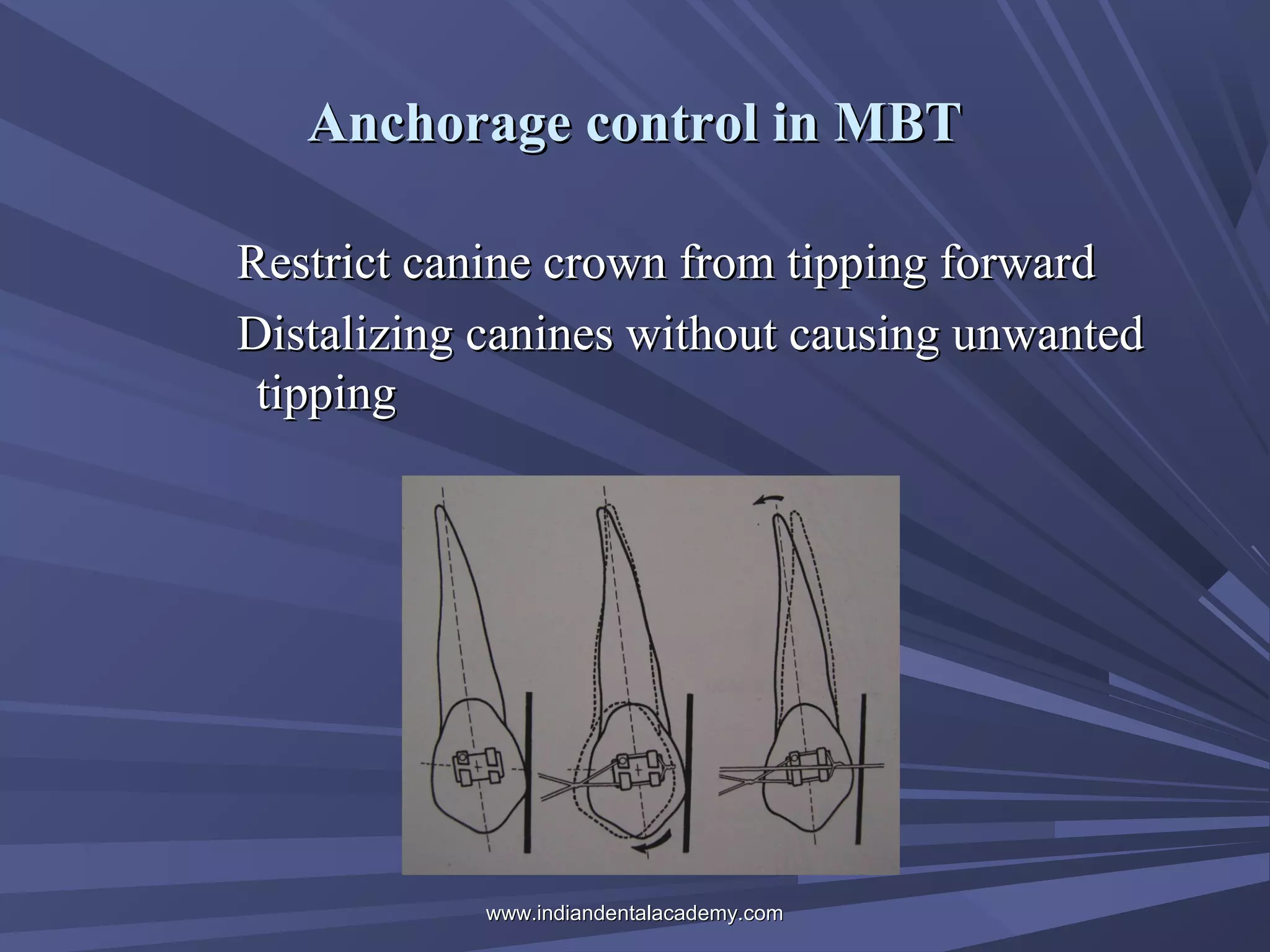
Restrict canine crown from tipping forward
Distalizing canines without causing unwanted
tipping

www.indiandentalacademy.com
Anchorage control in MBT
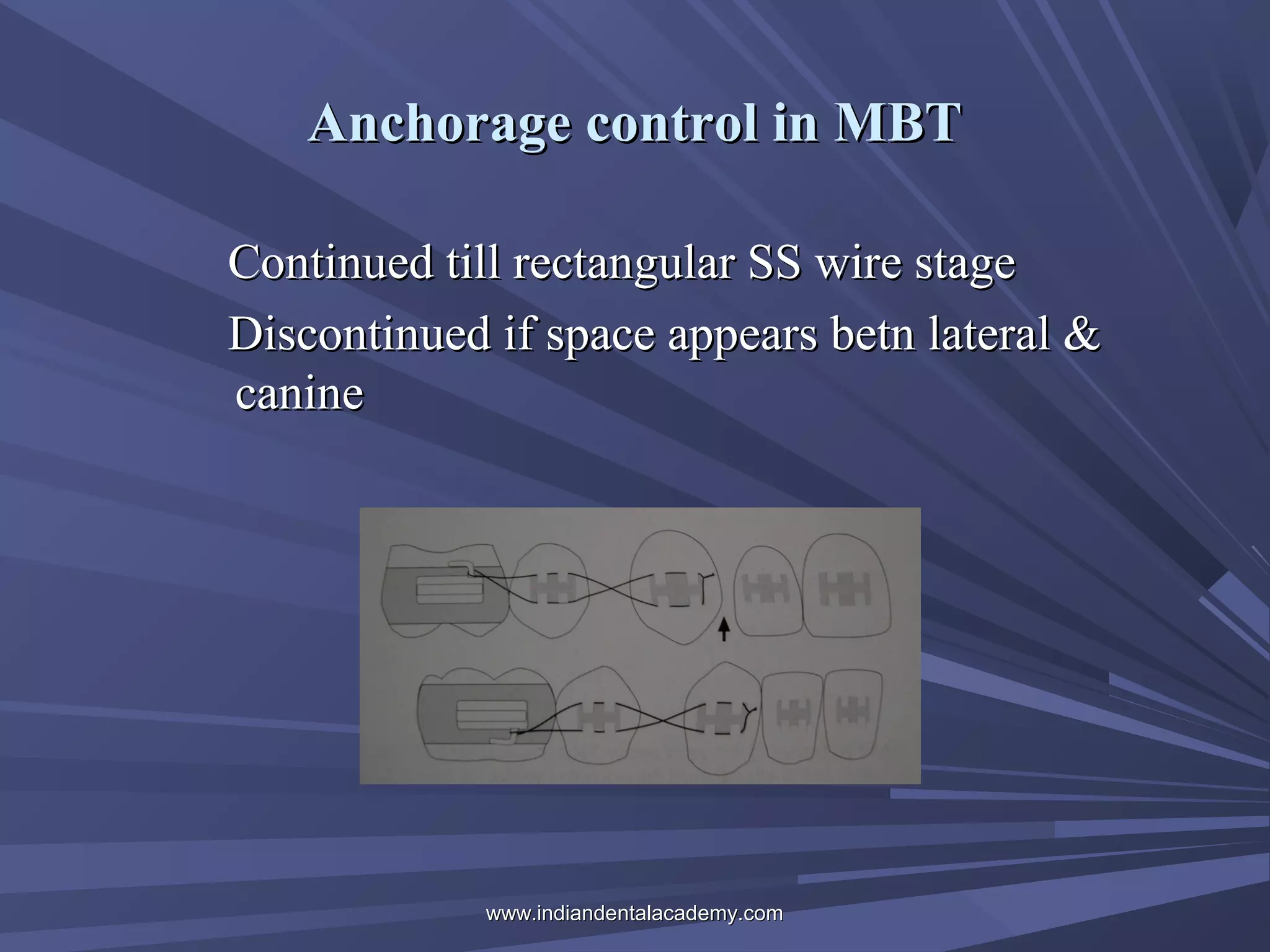
Continued till rectangular SS wire stage
Discontinued if space appears betn lateral &
canine

www.indiandentalacademy.com
Anchorage control in MBT
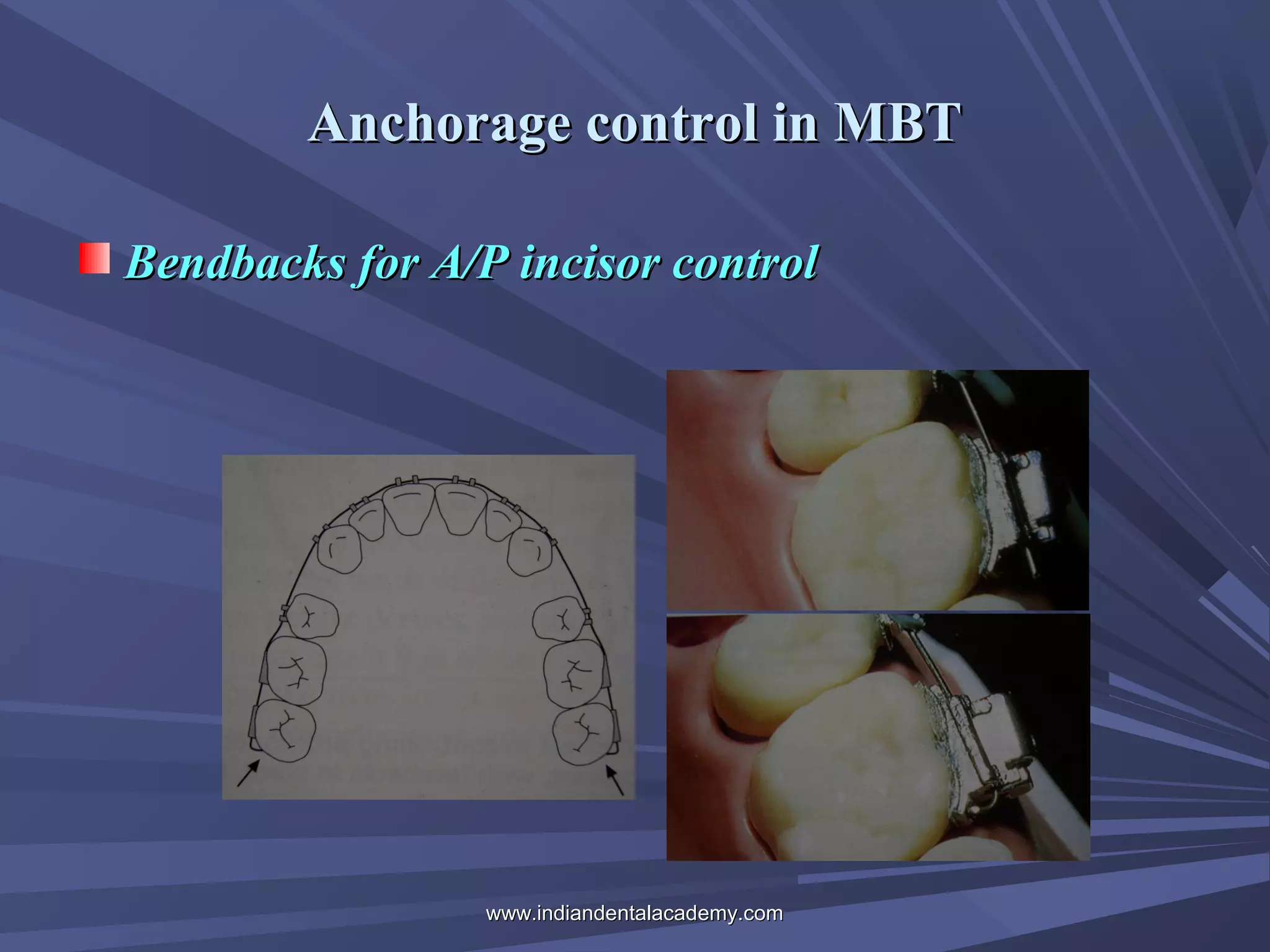
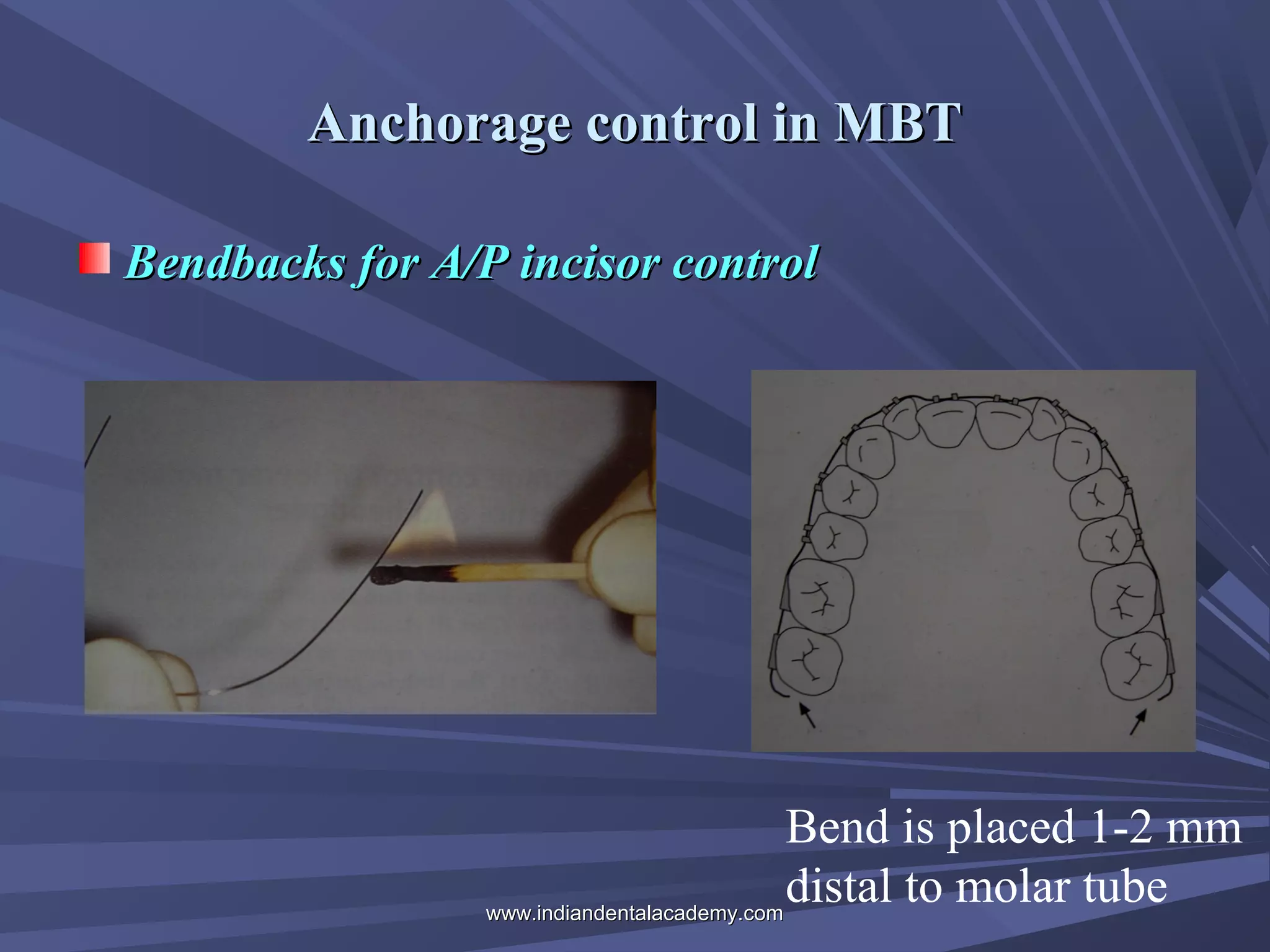
Bendbacks for A/P incisor control

www.indiandentalacademy.com
Anchorage control in MBT
Bendbacks for A/P incisor control

Bend is placed 1-2 mm
distal to molar tube
www.indiandentalacademy.com
Anchorage control in MBT
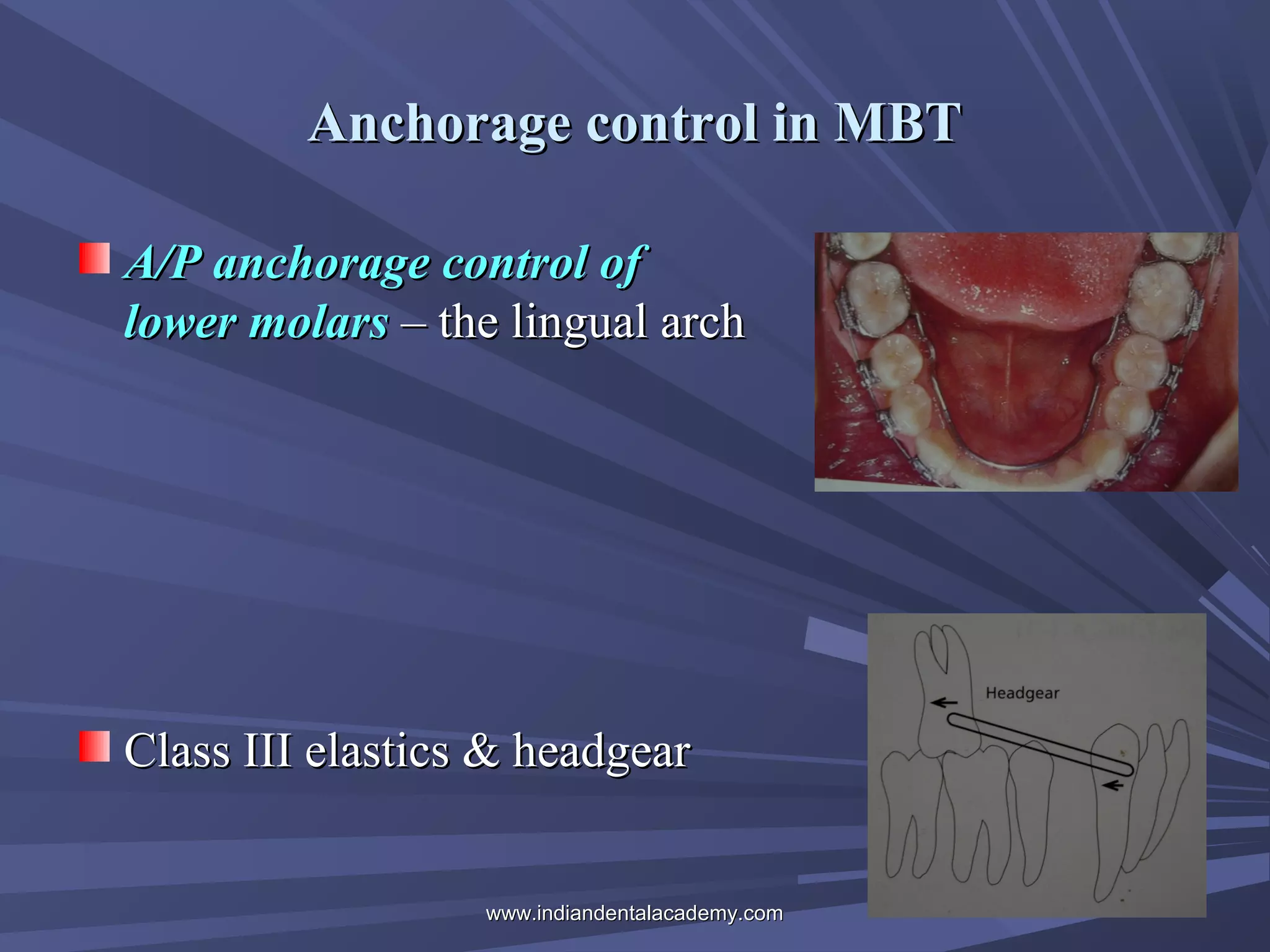
A/P anchorage control of
lower molars – the lingual arch

Class III elastics & headgear
www.indiandentalacademy.com
Anchorage control in MBT
A/P anchorage support & control for upper molars –
 The upper molars move mesially more easily
than lower molars
 Upp ant segment has larger teeth than low ant
 Upp ant brackets have more tip built
 Upp incisors require more torque control &
bodily movement
 More Class II type malocclusions than Class III
www.indiandentalacademy.com
Anchorage control in MBT
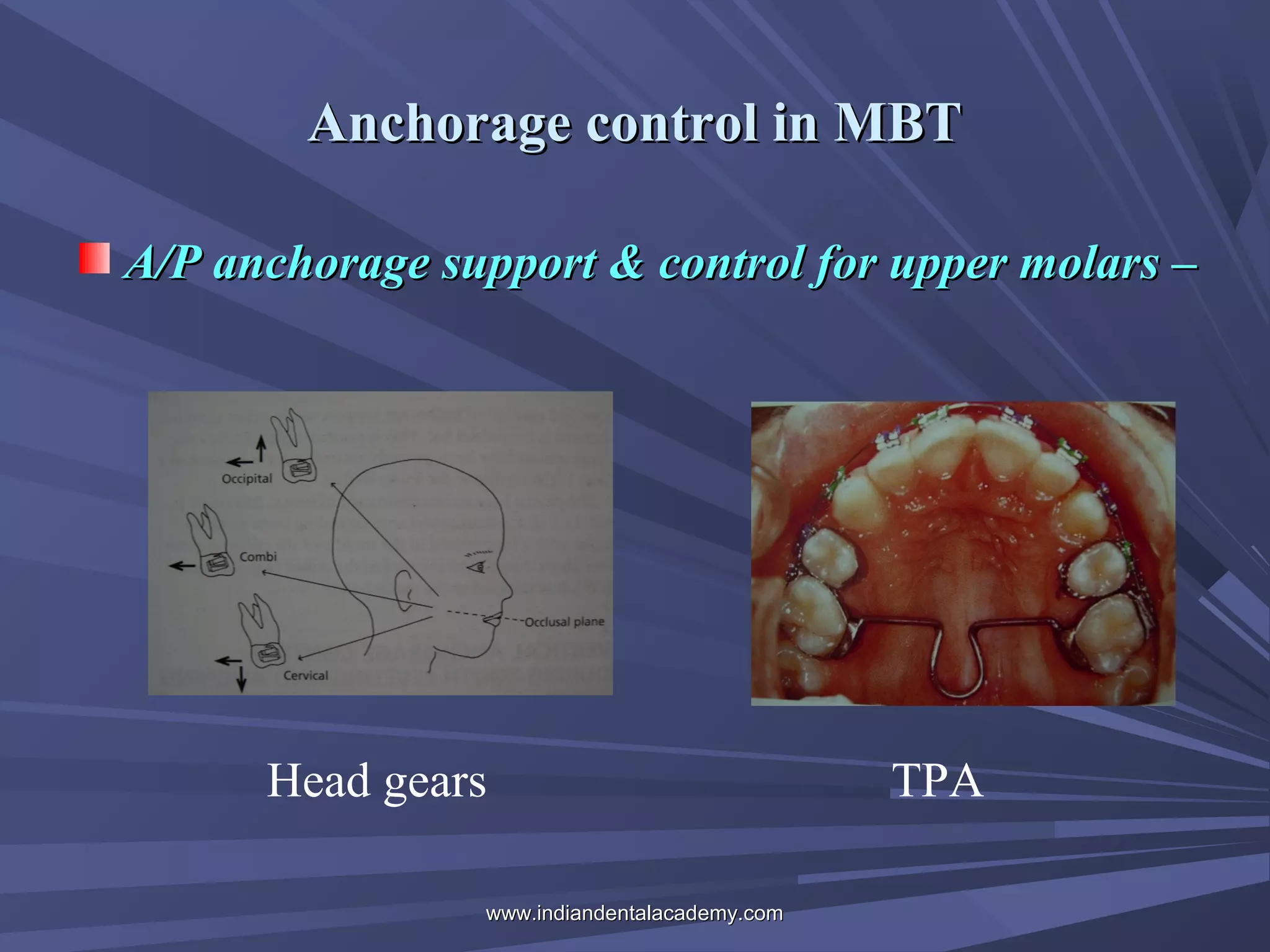
A/P anchorage support & control for upper molars –

Head gears
www.indiandentalacademy.com

TPA
Anchorage control in MBT
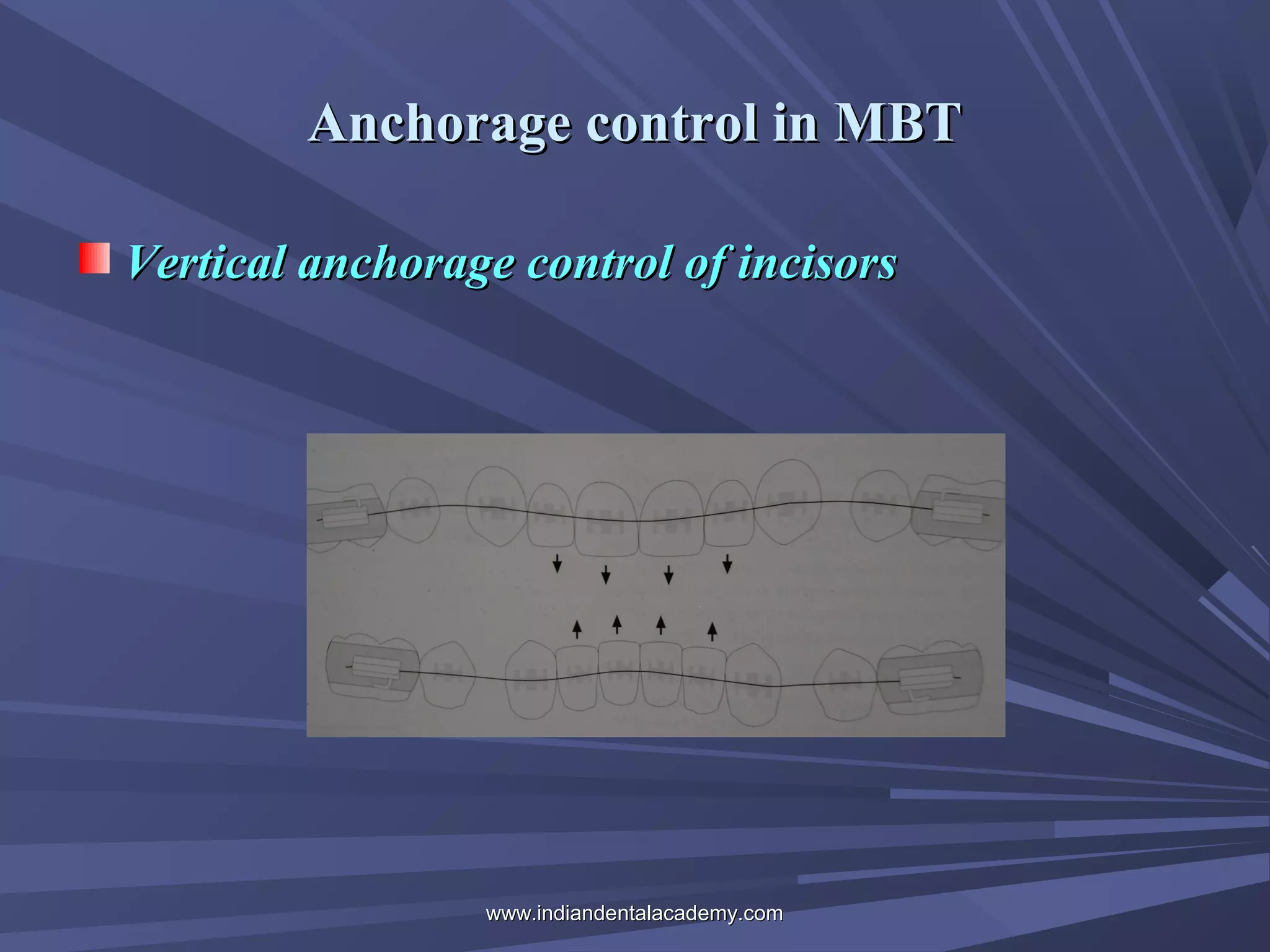
Vertical anchorage control of incisors

www.indiandentalacademy.com
Anchorage control in MBT
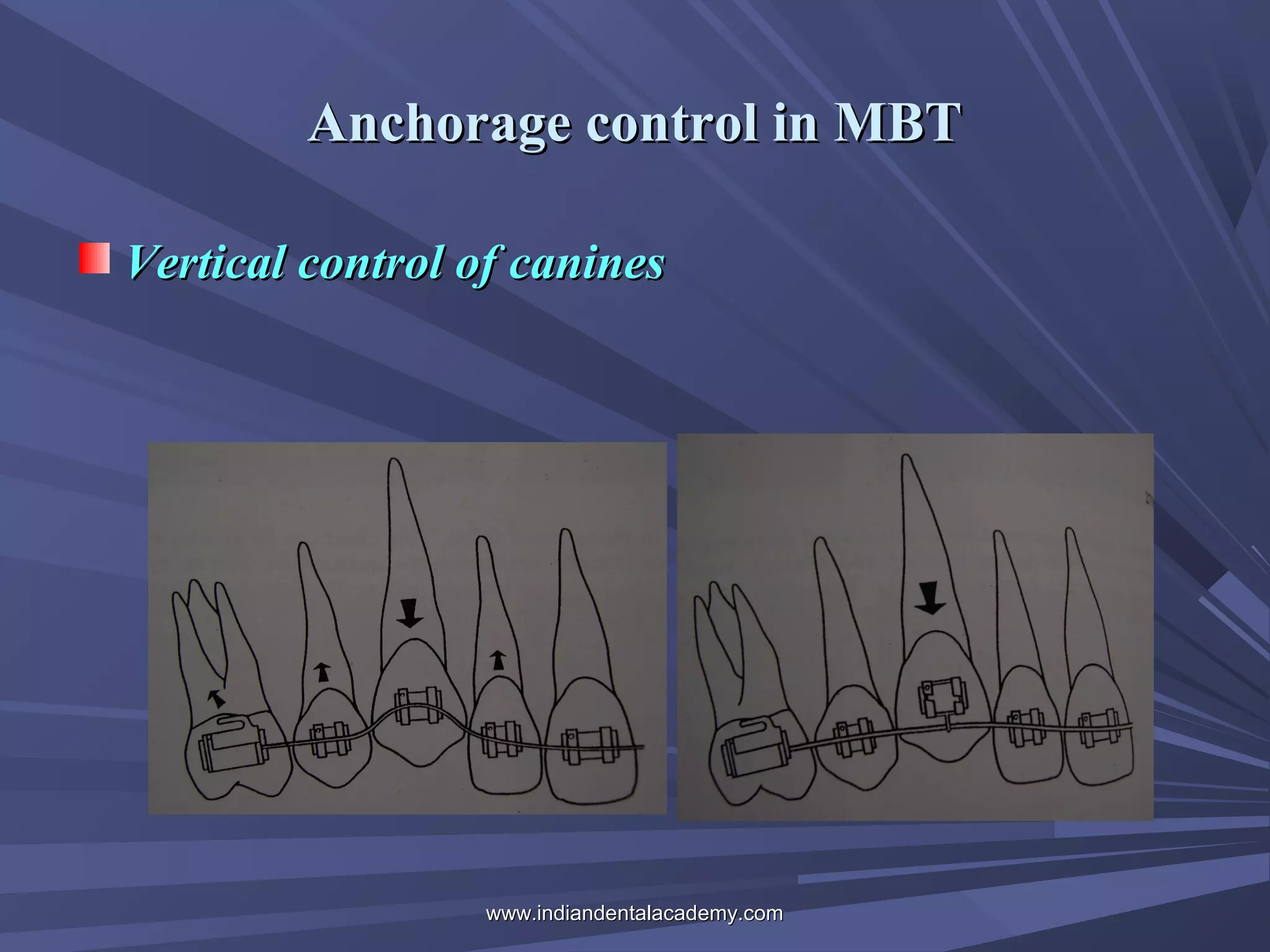
Vertical control of canines

www.indiandentalacademy.com
Anchorage control in MBT
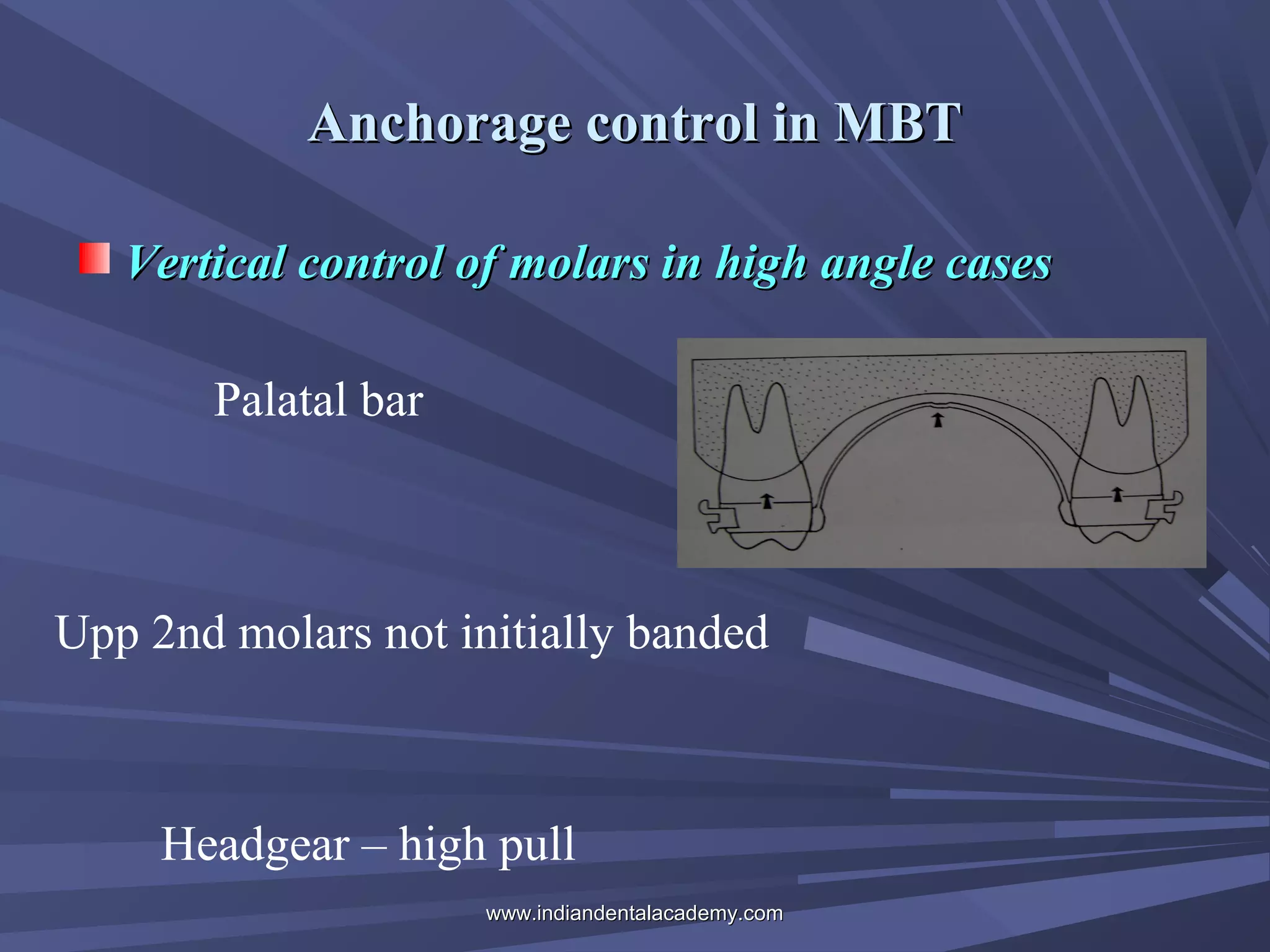
Vertical control of molars in high angle cases
Palatal bar

Upp 2nd molars not initially banded

Headgear – high pull
www.indiandentalacademy.com
Anchorage control in MBT
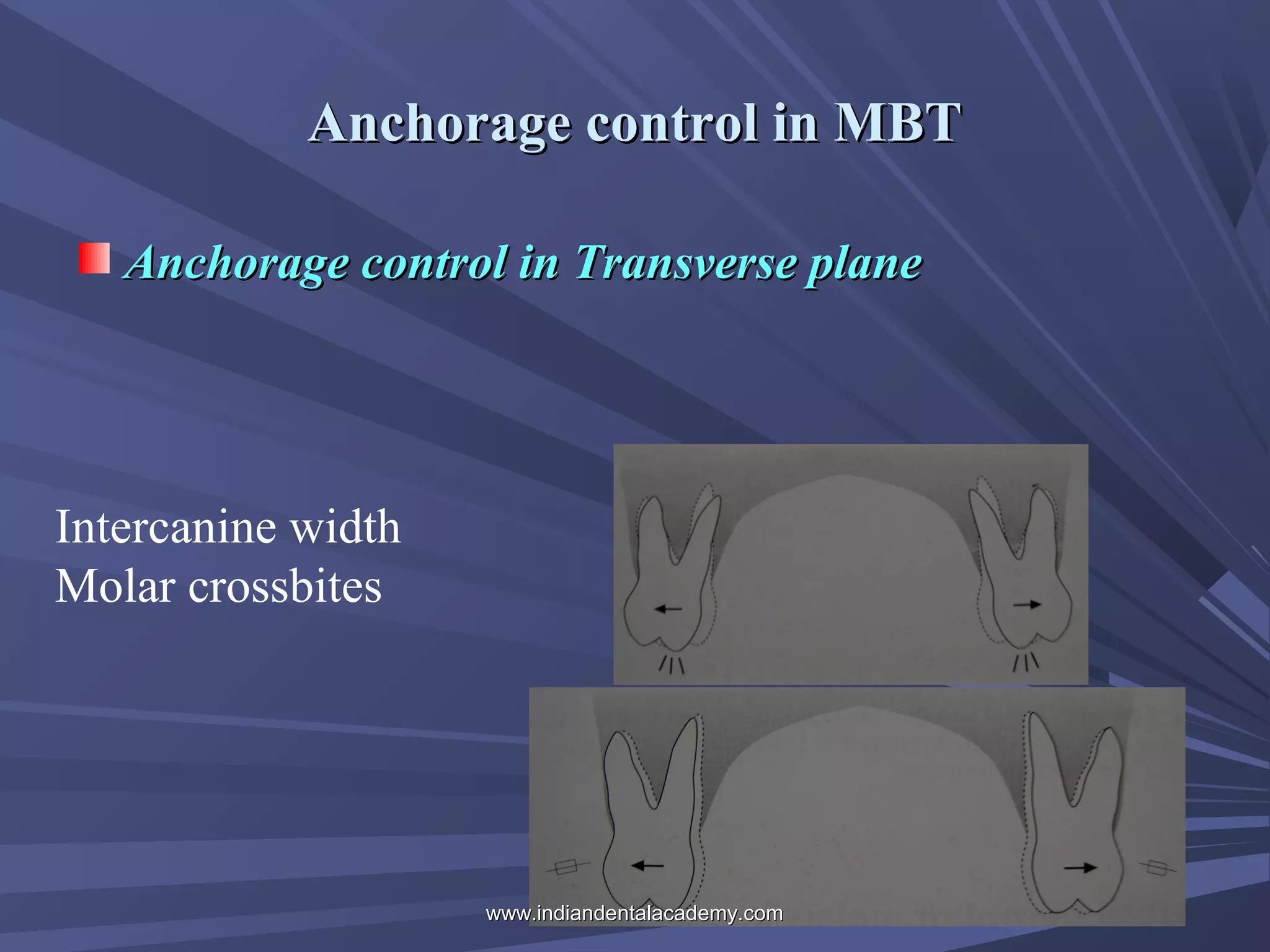
Anchorage control in Transverse plane

Intercanine width
Molar crossbites

www.indiandentalacademy.com
Thank you
For more details please visit
www.indiandentalacademy.com

www.indiandentalacademy.com

Anchorage in orthodontics 2 /certified fixed orthodontic courses by Indian dental academy

  • 1.
    INDIAN DENTAL ACADEMY Leaderin continuing dental education www.indiandentalacademy.com www.indiandentalacademy.com
  • 2.
  • 3.
    Extra oral anchorage Principleuse Forces derived from EOA Stabilize the position of the teeth Produce tooth movement Orthopedic changes Extra oral anchorage Extra oral traction www.indiandentalacademy.com
  • 4.
    Extra oral anchorage Mildcases Cases with severe crowding and overjet Severe cases – additional space is required even after extraction www.indiandentalacademy.com
  • 5.
    Extra oral anchorage Applicationof EOF Face bow www.indiandentalacademy.com
  • 6.
    Extra oral anchorage Stops– inner bow www.indiandentalacademy.com
  • 7.
    Extra oral anchorage Jhook head gear www.indiandentalacademy.com
  • 8.
    Extra oral anchorage Directionalcontrol Effects of EOF depends on Duration Direction Magnitude 1 ounce – 28.35 gms www.indiandentalacademy.com
  • 9.
    Extra oral anchorage Typesof head gears www.indiandentalacademy.com
  • 10.
    Extra oral anchorage Basicconcept for types of head gears www.indiandentalacademy.com
  • 11.
    Extra oral anchorage Relationshipto the occlusal plane Low pull High pull Medium pull www.indiandentalacademy.com
  • 12.
    Extra oral anchorage Lowpull head gear Extrusion of the molars www.indiandentalacademy.com
  • 13.
  • 14.
    Extra oral anchorage Highpull head gear www.indiandentalacademy.com
  • 15.
    Extra oral anchorage Intrusionof the molars undesirable www.indiandentalacademy.com
  • 16.
    Extra oral anchorage Mediumpull head gear www.indiandentalacademy.com
  • 17.
    Extra oral anchorage  Protractionhead gear www.indiandentalacademy.com
  • 18.
    Extra oral anchorage Orthopediceffects Restrict forward and downward movement 350-450 gms/each side – 14hrs/day www.indiandentalacademy.com
  • 19.
  • 20.
    Extra oral anchorage Practicalaspects Good fitting bands Inner bow – passive Should not contact any teeth Ant. Segment – between the lips Expansion – distalization www.indiandentalacademy.com
  • 21.
    Extra oral anchorage Mandibulararch Use of class III intermaxillary traction with head gear www.indiandentalacademy.com
  • 22.
    Mechanical aspect ofanchorage Sliding mechanics Force is required for 2 purposes Bone remodeling Frictional resistance Controlling and minimizing friction is an imp. Aspect of anchorage control www.indiandentalacademy.com
  • 23.
    Mechanical aspect ofanchorage Friction ??? Frictional force Nature of surface at the interface (rough or smooth, chemically reactive or passive, modified by lubricants) Independent of the apparent area of contact www.indiandentalacademy.com
  • 24.
    Mechanical aspect ofanchorage Real contact occurs only at a limited number of small spots: Asperities www.indiandentalacademy.com
  • 25.
    Mechanical aspect ofanchorage Metal wire in a ceramic bracket Stick slip phenomenon www.indiandentalacademy.com
  • 26.
    Mechanical aspect ofanchorage 2 other factors can affect the resistance to sliding Interlocking of surface irregularities Extent of plowing In clinical practice friction is largely determined by the shearing component www.indiandentalacademy.com
  • 27.
    Mechanical aspect ofanchorage Surface quality of the wires NiTi > βTi > SS Roughness There is no correlation between surface roughness and coefficient of friction β Ti has greatest frictional resistance www.indiandentalacademy.com
  • 28.
    Mechanical aspect ofanchorage Surface quality of the wires Changes in surface chemistry due to increased Ti content Cold weld effect www.indiandentalacademy.com
  • 29.
    Mechanical aspect ofanchorage Possible solution to this problem Alteration of the surface of Ti wires Among all, SS/SS couple is most effective for sliding followed by CoCr/SS, NiTi/SS, βTi/SS www.indiandentalacademy.com
  • 30.
    Mechanical aspect ofanchorage Surface quality of the brackets SS brackets Ti brackets Ceramic brackets Ceramic brackets with metal slots Composite brackets Polycarbonate plastic brackets www.indiandentalacademy.com
  • 31.
    Mechanical aspect ofanchorage Flexibility of arch wire and width of the bracket Force that pulls the wire into the bracket Self ligating brackets- reduced friction that allows more effective sliding- better anchorage control www.indiandentalacademy.com
  • 32.
    Mechanical aspect ofanchorage Magnitude of friction Retraction springs Closing loops www.indiandentalacademy.com
  • 33.
    Conventional Begg Differential forceconcept 1st premolar extraction 8 teeth extraction Begg was applying the principles of differential forces www.indiandentalacademy.com
  • 34.
    Conventional Begg Storey andSmith (1952) Statistical evidence confirmed the results of Begg’s clinical experience Edgewise app and springs www.indiandentalacademy.com
  • 35.
    Conventional Begg Storey andSmith (1952) Tooth with a greater root surface area needs greater force to be moved canine: molar = 3:8 www.indiandentalacademy.com
  • 36.
  • 37.
    Conventional Begg Reason fordifferent rates of movement of canines Storey and Smith presented the concept of undermining resorption Sandstedt (1904) Schwarz (1932) www.indiandentalacademy.com
  • 38.
    Conventional Begg Storey andSmith (1952) Teeth subjected to very high forces Resorption of tooth investing tissues Teeth are loosened within the sockets www.indiandentalacademy.com
  • 39.
    Conventional Begg Use ofdifferential forces Reduction of anterior overbite Use of anchor bends Light wires Heavy wires www.indiandentalacademy.com
  • 40.
    Conventional Begg Use ofdifferential forces  Strang (1954) – Treatment problems, their origin and elimination  Edgewise app  Closing extraction space requires more force  Use of head gears - recommended www.indiandentalacademy.com
  • 41.
    Conventional Begg Use ofdifferential forces Space closure Premolars bypassed Extra oral anchorage is not required www.indiandentalacademy.com
  • 42.
    Conventional Begg Means ofpreventing anchorage failure Use of thin round steel wires Anchor bends Stationary anchorage Premolars not bracketed Light torquing forces in 3rd stage Use of reverse torquing auxillaries www.indiandentalacademy.com
  • 43.
    Refined Begg (Dr. V P Jayade ) Differential force concept was misunderstood Excessive retraction Prevented in refined begg by applying efficient brakes along with heavy differential forces www.indiandentalacademy.com
  • 44.
    Refined Begg (Dr. V P Jayade ) Perfect example of stationary anchorage Saggital Vertical transverse www.indiandentalacademy.com
  • 45.
    Refined Begg (Dr. V P Jayade ) Stage I www.indiandentalacademy.com
  • 46.
    Refined Begg (Dr. V P Jayade ) Active components in stage I Light or ultra light class II elastics Lower class I elastics www.indiandentalacademy.com
  • 47.
    Refined Begg (Dr. V P Jayade ) Active components in stage I Upper palatal elastics / elastics from power arm www.indiandentalacademy.com
  • 48.
    Refined Begg (Dr. V P Jayade ) Active components in stage I Upper Class I are seldom used Uneven class I ,class II for midline correction www.indiandentalacademy.com
  • 49.
    Refined Begg (Dr. V P Jayade ) Anchorage considerations in stage I Palatal elastics or elastics from power arm Upper molars to be supported with TPA www.indiandentalacademy.com
  • 50.
    Refined Begg (Dr. V P Jayade ) Anchorage considerations in stage I Conserving lower molar anchorage Stiffer wires Light or ultra light elastics Molar stops www.indiandentalacademy.com
  • 51.
    Refined Begg (Dr. V P Jayade ) Anchorage considerations in stage I High angle cases Light anchor bends Light elastics TPA – away from the palate High pull head gear www.indiandentalacademy.com
  • 52.
    Refined Begg (Dr. V P Jayade ) Anchorage considerations in stage I Transverse plane Stiffer arch wires Expansion in arch wires TPA Sufficiently expanded face bow or lip bumper www.indiandentalacademy.com
  • 53.
    Refined Begg (Dr. V P Jayade ) Stage II – easiest Objectives Maintain all the corrections of stage I Closure of extraction spaces Controlled tipping of anteriors Protraction of posteriors Correction of molar relation Correction of premolar crossbites and rotation www.indiandentalacademy.com
  • 54.
    Refined Begg (Dr. V P Jayade ) Stage II Archwires used Reduction in the anchor bend www.indiandentalacademy.com
  • 55.
    Refined Begg (Dr. V P Jayade ) Braking mechanics Reversal of anchorage Def – the brakes reverses the anchorage site from posterior to anterior segment by permitting only bodily movement of the anterior teeth, instead of allowing them freedom to tip Braking springs/ T pins Torquing components www.indiandentalacademy.com
  • 56.
    Refined Begg (Dr. V P Jayade ) Braking springs www.indiandentalacademy.com
  • 57.
    Refined Begg (Dr. V P Jayade ) Angulated T pins www.indiandentalacademy.com
  • 58.
    Refined Begg (Dr. V P Jayade ) Combination wires Material Ant. Seg – rectangular (022 x 018) Post. Seg – round 018 www.indiandentalacademy.com
  • 59.
    Refined Begg (Dr. V P Jayade ) Torquing auxiliaries 2 spur or 4 spur MAA – 010 / 011 Strong base wires www.indiandentalacademy.com
  • 60.
    Refined Begg (Dr. V P Jayade ) Active components in stage II www.indiandentalacademy.com
  • 61.
    Refined Begg (Dr. V P Jayade ) Active components in stage II www.indiandentalacademy.com
  • 62.
    Refined Begg (Dr. V P Jayade ) Active components in stage II www.indiandentalacademy.com
  • 63.
    Refined Begg (Dr. V P Jayade ) Stage III – most complicated and anchorage consuming Objectives of stage III Maintain all the corrections Distal root uprighting auxilliary Palatal root torquing auxilliary www.indiandentalacademy.com
  • 64.
    Refined Begg (Dr. V P Jayade ) Stage III - objectives To achieve desired root movements Monitor anchorage in all 3 panes To correct the position of 2nd molars To monitor undesirable effects www.indiandentalacademy.com
  • 65.
    Refined Begg (Dr. V P Jayade ) Stage III Reciprocal mesial crown moving forces Upper arch Lower arch www.indiandentalacademy.com
  • 66.
    Refined Begg (Dr. V P Jayade ) How to overcome stage III problems??? Proper diagnosis and treatment planning Using efficient brakes Controlled tipping of incisors Use of heavy base arch wires Lighter auxiliaries and uprighting springs Light cl II elastics Reinforcement of anchorage Contraction and toe in built into the wires www.indiandentalacademy.com
  • 67.
  • 68.
    Tweed’s anchorage preparation TweedMerrifield appliance Level Anchorage System Vari Simplex Discipline Rickett’s Bioprogressive Therapy MBT appliance www.indiandentalacademy.com
  • 69.
    Tweed’s anchorage preparation Tippingthe posterior segment distally Lower posterior segment www.indiandentalacademy.com
  • 70.
    Tweed’s anchorage preparation Whenteeth are tipped distally as they are in anchorage preparation, osteoid tissue appears to be laid down adjacent to the mesial surface of the tooth being moved distally.” - Kaare Reitan Such conclusions do not make the necessity of anchorage preparation obselete www.indiandentalacademy.com
  • 71.
    Tweed’s anchorage preparation Clinicalorthodontist who routinely create excellent facial changes are those who recognize the importance of and prepare anchorage in their practice www.indiandentalacademy.com
  • 72.
    Tweed’s anchorage preparation Concept Uprightthe mesially inclined lower posterior segment Terminal molar to be tipped distally Angle formed between the class II elastic and long axis of terminal molar Mandible will be much more stable and will resist forward displacement www.indiandentalacademy.com
  • 73.
    Tweed’s anchorage preparation Afteranchorage preparation, if movement does occur Slow mesial bodily movement Anchorage not prepared Uprooting and elevation of the molars www.indiandentalacademy.com
  • 74.
    Tweed’s anchorage preparation Tweedclassified anchorage preparation First degree Second degree Third degree www.indiandentalacademy.com
  • 75.
    Tweed’s anchorage preparation Firstdegree / minimal anchorage preparation ANB 0º- 4º, facial esthetics are good Discrepancy < 10 mm Mandibular terminal molars must be uprighted Direction of intermaxillary elastic pull should not exceed 90º www.indiandentalacademy.com
  • 76.
    Tweed’s anchorage preparation Seconddegree ANB exceeds 4.5 Class II Mandibular second molars should always be banded Must be tipped distally so that their distal marginal ridges are at gum level Direction of pull of intermaxillary elastics should always be > 90º www.indiandentalacademy.com
  • 77.
    Tweed’s anchorage preparation ThirdDegree or Total Anchorage Preparation ANB does not exceed 5º Discrepancy – 14 -20 mm All posterior teeth (second premolar to terminal molars) are tipped distally Distal marginal ridges of terminal molars are below gum level www.indiandentalacademy.com
  • 78.
    Tweed’s anchorage preparation Severecases – anchorage prepared in both the arches How to tip lower posterior segment ??? Sliding jig www.indiandentalacademy.com
  • 79.
    Tweed’s anchorage preparation Loweranchorage preparation completed Lower canines and incisors retracted Upper extractions Class II elastics – distal tipping of upper posterior segment www.indiandentalacademy.com
  • 80.
  • 81.
    Tweed Merrifield appliance Attachments 022edgewise slot Permits variety of archwire use www.indiandentalacademy.com
  • 82.
    Tweed Merrifield appliance Highlightingpoints – Anchorage preparation Sequential banding and bonding Sequential tooth movement Sequential anchorage preparation Directional force system www.indiandentalacademy.com
  • 83.
    Tweed Merrifield appliance Sequentialbanding and bonding Less traumatic Longer interbracket span Heavy wires www.indiandentalacademy.com
  • 84.
    Tweed Merrifield appliance Sequentialtooth movement Enmasse retraction Placing all bends at a time Not followed www.indiandentalacademy.com
  • 85.
    Tweed Merrifield appliance Sequentialanchorage preparation High pull head gear Vertical spurs soldered Distal to Mb. Lateral incisor 10 – 2 anchorage system www.indiandentalacademy.com
  • 86.
    Tweed Merrifield appliance Sequentialanchorage preparation Distal tip achieved Read out 15º www.indiandentalacademy.com
  • 87.
    Tweed Merrifield appliance Sequentialanchorage preparation Before tipping premolars Read out to be performed Distal tip achieved www.indiandentalacademy.com
  • 88.
    Tweed Merrifield appliance Duringthe course of treatment, various hooks are soldered www.indiandentalacademy.com
  • 89.
    Tweed Merrifield appliance Directionalforce system Defined as controlled forces which place the teeth in most harmonious relation with their environment www.indiandentalacademy.com
  • 90.
  • 91.
    Level anchorage system TerrellL. Root Aim – quantify the anchorage requirement 018 edgewise slot Mandibular molars – 2 choices of distal crown tip www.indiandentalacademy.com
  • 92.
    Level anchorage system Anchorage– Resistance to movement Distance to move Anchorage savers Those orthodontic adjunctive procedures that reduce the amount of tooth anchorage necessary to correct the malocclusion www.indiandentalacademy.com
  • 93.
    Level anchorage system Highpull headgear to maxillary 1st molars or J hook headgear to anteriors: reduction in ANB by 1 degree every 6 months Palatal bar: decreases vertical descent due to tongue pressure. Delaying upper first premolar extraction by one year: reduces mandibular anchorage space by 1mm Class III elastics worn 24 hrs: flatten the curve of Spee and upright buccal segments at the rate of 1mm / month www.indiandentalacademy.com
  • 94.
  • 95.
  • 96.
    Vari-simplex discipline-Alexander Vari –variety of bracket used Simplex – KISS principle fewer archwire changes 1. 2. 3. Treatment philosophy – Tweeds fundamentals Anchorage preparation Positioning Mb incisors over basal bone Orthopedic alteration using head gear www.indiandentalacademy.com
  • 97.
    Vari-simplex discipline-Alexander Key objective Nonextraction therapy as far as possible Interproximal enamel reduction Control of Mb incisor position with –ve torque www.indiandentalacademy.com
  • 98.
    Vari-simplex discipline-Alexander Bracket selection Twinbrackets Lang brackets Lewis brackets www.indiandentalacademy.com
  • 99.
    Vari-simplex discipline-Alexander Anchorage considerations Tipvalues Gain in the arch length Promotes leveling 0° angulation in Mb 2nd molar– Need not to be uprighted excessively www.indiandentalacademy.com
  • 100.
    Vari-simplex discipline-Alexander -5°of labialroot torque Holds the Mb incisors to their original position Major change www.indiandentalacademy.com
  • 101.
    Vari-simplex discipline-Alexander Head gears/ Retractors Retractors’ ( Dr. Fred Schudy) Cervical, combination or high pull depending on growth pattern and control needed www.indiandentalacademy.com
  • 102.
    Vari-simplex discipline-Alexander Other intraoral appliances to control anchorage: www.indiandentalacademy.com
  • 103.
    Vari-simplex discipline-Alexander Other intraoral appliances to control anchorage: Mandibular lingual arch: sagittal and transverse control Lip bumper: - uprighting of mandibular first molars - distal force on lower molars - muscular anchorage www.indiandentalacademy.com
  • 104.
    Rickett’s Bioprogressive Therapy Muscularanchorage Cortical anchorage Nance button Quad helix Headgears: cervical, combination and high pull www.indiandentalacademy.com
  • 105.
    Anchorage control inMBT 2nd principle of orthodontic anchorage Anchorage loss – maximum in the first stage Def – Tooth movement needed to achieve passive engagement of steel 19 x 25 wire of suitable arch form into a correctly placed 022 preadjusted bracket system www.indiandentalacademy.com
  • 106.
    Anchorage control inMBT Major reason for anchorage loss ??? Mesial tip built into the bracket system Anchorage control The maneuvers used to restrict undesirable changes during the opening phase of treatment, so that leveling and aligning is achieved without key features of the malocclusion becoming worse.’ www.indiandentalacademy.com
  • 107.
    Anchorage control inMBT 1st step in anchorage control Recognize the anchorage needs of the case Diagnosis and treatment planning stage www.indiandentalacademy.com
  • 108.
    Anchorage control inMBT Eg – class II div 1 Goal is set for incisor position - PIP Class III www.indiandentalacademy.com
  • 109.
    Anchorage control inMBT Mistakes in tooth leveling and aligning during early years Roller coaster effect www.indiandentalacademy.com
  • 110.
    Anchorage control inMBT Roller coaster effect has been eliminated from the present day practice Reduced tip in bracket system Light arch wire forces Use of lacebacks instead of elastic forces www.indiandentalacademy.com
  • 111.
    Anchorage control inMBT Lacebacks for A/P canine control Restrict canine crown from tipping forward www.indiandentalacademy.com
  • 112.
    Anchorage control inMBT Lacebacks for A/P canine control Robinson – 57 PM extn cases www.indiandentalacademy.com
  • 113.
    Anchorage control inMBT Restrict canine crown from tipping forward Distalizing canines without causing unwanted tipping www.indiandentalacademy.com
  • 114.
    Anchorage control inMBT Continued till rectangular SS wire stage Discontinued if space appears betn lateral & canine www.indiandentalacademy.com
  • 115.
    Anchorage control inMBT Bendbacks for A/P incisor control www.indiandentalacademy.com
  • 116.
    Anchorage control inMBT Bendbacks for A/P incisor control Bend is placed 1-2 mm distal to molar tube www.indiandentalacademy.com
  • 117.
    Anchorage control inMBT A/P anchorage control of lower molars – the lingual arch Class III elastics & headgear www.indiandentalacademy.com
  • 118.
    Anchorage control inMBT A/P anchorage support & control for upper molars –  The upper molars move mesially more easily than lower molars  Upp ant segment has larger teeth than low ant  Upp ant brackets have more tip built  Upp incisors require more torque control & bodily movement  More Class II type malocclusions than Class III www.indiandentalacademy.com
  • 119.
    Anchorage control inMBT A/P anchorage support & control for upper molars – Head gears www.indiandentalacademy.com TPA
  • 120.
    Anchorage control inMBT Vertical anchorage control of incisors www.indiandentalacademy.com
  • 121.
    Anchorage control inMBT Vertical control of canines www.indiandentalacademy.com
  • 122.
    Anchorage control inMBT Vertical control of molars in high angle cases Palatal bar Upp 2nd molars not initially banded Headgear – high pull www.indiandentalacademy.com
  • 123.
    Anchorage control inMBT Anchorage control in Transverse plane Intercanine width Molar crossbites www.indiandentalacademy.com
  • 124.
    Thank you For moredetails please visit www.indiandentalacademy.com www.indiandentalacademy.com