


ROOT MOVEMENTROOT MOVEMENT
IN ORTHODONTICSIN ORTHODONTICS
……
www.indiandentalacademy.com
CONTENTS
• Introduction
• Need for axial corrections
• Torque
• Diagnosis & Evaluation for root correction
• Biomechanical considerations
• Root movement in Removable Appliances
• Root movement in Beggs
• Root movement in PEARoot movement in PEA
• Root movement in segmental arch technique
www.indiandentalacademy.com
• Root movement in Segmental SurgeryRoot movement in Segmental Surgery
• Cortical AnchorageCortical Anchorage
• ComplicationsComplications
• ConclusionConclusion
• BibliographyBibliography
www.indiandentalacademy.com
INTRODUCTIONINTRODUCTION
www.indiandentalacademy.com
 Control of theControl of the axial inclinationsaxial inclinations of teeth duringof teeth during
orthodontic therapy is critical for achieving excellentorthodontic therapy is critical for achieving excellent
results and ensuringresults and ensuring long term stabilitylong term stability afterafter
completion of treatment.completion of treatment.
 The careful evaluation of individual tooth axialThe careful evaluation of individual tooth axial
inclinations is often carried out as ainclinations is often carried out as a second stage ofsecond stage of
space closurespace closure in extraction therapy or beforein extraction therapy or before
completion of treatment in non-extraction therapy.completion of treatment in non-extraction therapy.
www.indiandentalacademy.com
Need For AxialNeed For Axial
CorrectionsCorrections
www.indiandentalacademy.com
 Good axial inclinations andGood axial inclinations and
adequateadequate root parallelismroot parallelism withwith
regular bone distributionregular bone distribution
between teeth helps to obtainbetween teeth helps to obtain
and maintain aand maintain a stablestable
treatment result.treatment result.
www.indiandentalacademy.com
Raleigh WilliamRaleigh William
 The lower incisor roots, rather than theirThe lower incisor roots, rather than their
crowns, should becrowns, should be divergentdivergent. If the roots. If the roots
are leftare left convergentconvergent, the crowns tend to, the crowns tend to
bunch together and causebunch together and cause relapse.relapse.
www.indiandentalacademy.com
STABLE UNSTABLE
www.indiandentalacademy.com
 The evaluation ofThe evaluation of root axial inclinationsroot axial inclinations
is also critical in patients withis also critical in patients with congenitallycongenitally
missing teethmissing teeth when the goal is to replacewhen the goal is to replace
these teeth with eitherthese teeth with either implantsimplants oror
bridges.bridges.
www.indiandentalacademy.com
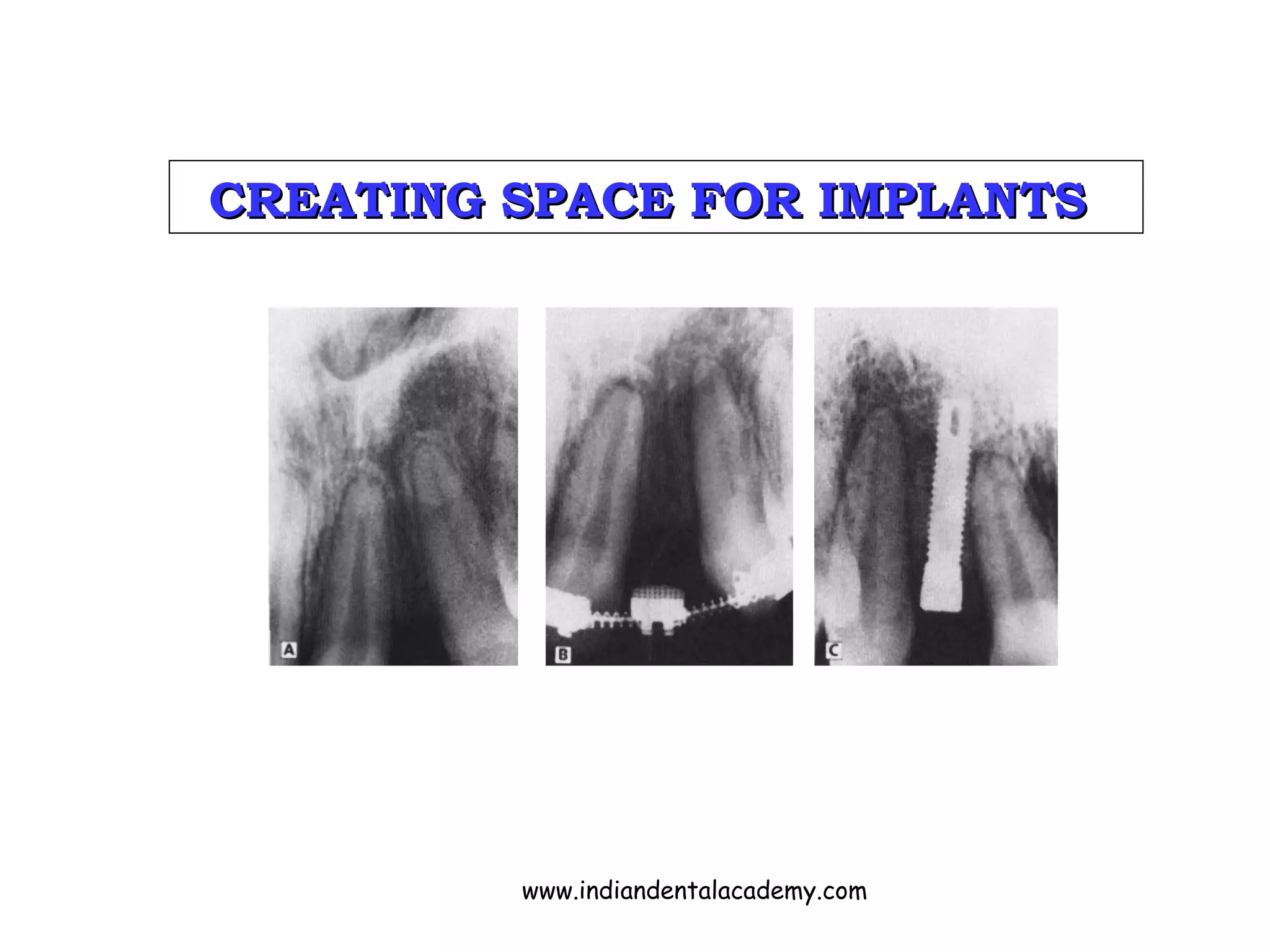
CREATING SPACE FOR IMPLANTSCREATING SPACE FOR IMPLANTS
www.indiandentalacademy.com
 Parallelism of theParallelism of the abutments rootsabutments roots as wells asas wells as
adequate bone distribution are important factors in theadequate bone distribution are important factors in the
prognosis and successful outcome of treatment.prognosis and successful outcome of treatment.
 Root correction, which may involve individual teeth orRoot correction, which may involve individual teeth or
groups of teeth is also instrumental ingroups of teeth is also instrumental in positioning teethpositioning teeth
over basal bone to achieve an ideal occlusalover basal bone to achieve an ideal occlusal
relationshiprelationship in the anterior and posterior portions of thein the anterior and posterior portions of the
dental arches.dental arches.
www.indiandentalacademy.com
Providing good PeriodontalProviding good Periodontal
EnvironmentEnvironment
 Gingiva folded and bunched upGingiva folded and bunched up
 Plaque harboring pseudoPlaque harboring pseudo
pocketpocket
www.indiandentalacademy.com
TORQUETORQUE
www.indiandentalacademy.com
 In terms ofIn terms of Engineering principlesEngineering principles, it is defined as a, it is defined as a
force causing twistforce causing twist in a structure, the resulting twistin a structure, the resulting twist
of the mechanical part is calledof the mechanical part is called TorsionTorsion..
 In terms ofIn terms of orthodonticsorthodontics it is defined as theit is defined as the
buccolingualbuccolingual oror labiolinguallabiolingual root tipping in whichroot tipping in which
the movement of the crown is minimized andthe movement of the crown is minimized and
movement of the root apex is maximized.movement of the root apex is maximized.
www.indiandentalacademy.com
 Torque can be effectively employed in removableTorque can be effectively employed in removable
appliance and in fixed appliances.appliance and in fixed appliances.
 Torquing mechanics are more effective and widelyTorquing mechanics are more effective and widely
used inused in fixed mechanotherapyfixed mechanotherapy than in removablethan in removable
appliances. In removable appliances springs areappliances. In removable appliances springs are
used for torquing the tooth.used for torquing the tooth.
www.indiandentalacademy.com
Torque in the fixed appliance can beTorque in the fixed appliance can be
employed in different ways.employed in different ways.
• By giving aBy giving a twisttwist in the arch wire commonlyin the arch wire commonly
used in Edgewise technique.used in Edgewise technique.
• Torque exerted by theTorque exerted by the bracketbracket itself e.g., PEAitself e.g., PEA
• By the use ofBy the use of Torquing auxiliariesTorquing auxiliaries widely usedwidely used
in Begg technique and Edgewise technique.in Begg technique and Edgewise technique.
www.indiandentalacademy.com
Diagnosis &Diagnosis &
Evaluation for RootEvaluation for Root
CorrectionCorrection
www.indiandentalacademy.com
 Root correction may be considered theRoot correction may be considered the second phasesecond phase
of space closureof space closure and most often completion of spaceand most often completion of space
closure is recommended before evaluating for theclosure is recommended before evaluating for the
potential need to correctpotential need to correct root axial inclinationsroot axial inclinations..
 Clinical assessment of root positionsClinical assessment of root positions during spaceduring space
closure is often very useful and may be done byclosure is often very useful and may be done by
monitoring the inclinations of the canine and anteriormonitoring the inclinations of the canine and anterior
brackets.brackets.
www.indiandentalacademy.com
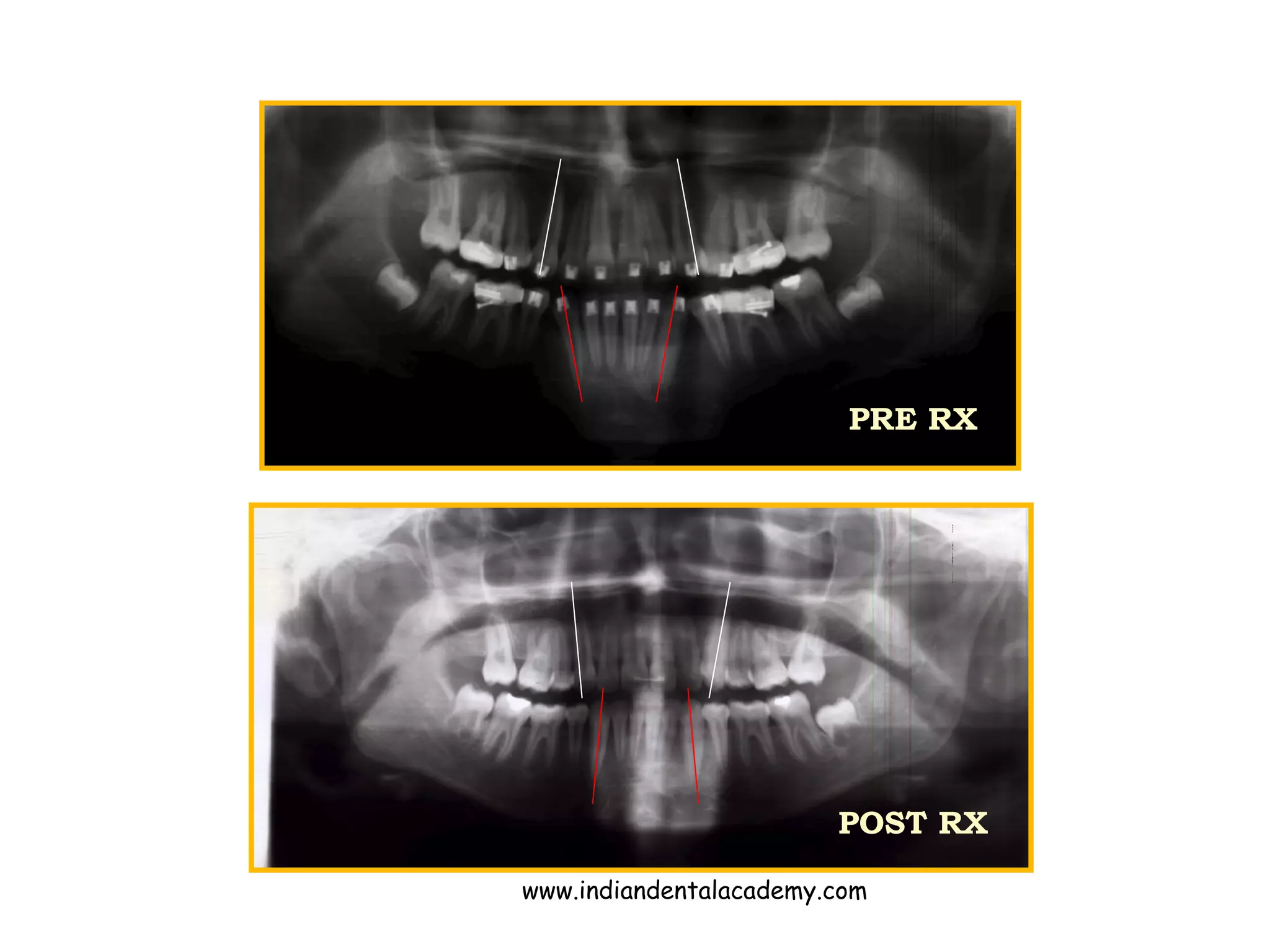
 Lateral cephalometricLateral cephalometric head films,head films, IOPAIOPA taken attaken at
454500
andand PanoramicPanoramic radiographs are commonlyradiographs are commonly
used to assess the need for not correction.used to assess the need for not correction.
 Lateral head films primarily assist in evaluatingLateral head films primarily assist in evaluating
thethe axial inclinations of the anterioraxial inclinations of the anterior teethteeth byby
comparing a film taken before initiation ofcomparing a film taken before initiation of
treatment and one taken after completion oftreatment and one taken after completion of
space closure.space closure.
www.indiandentalacademy.com
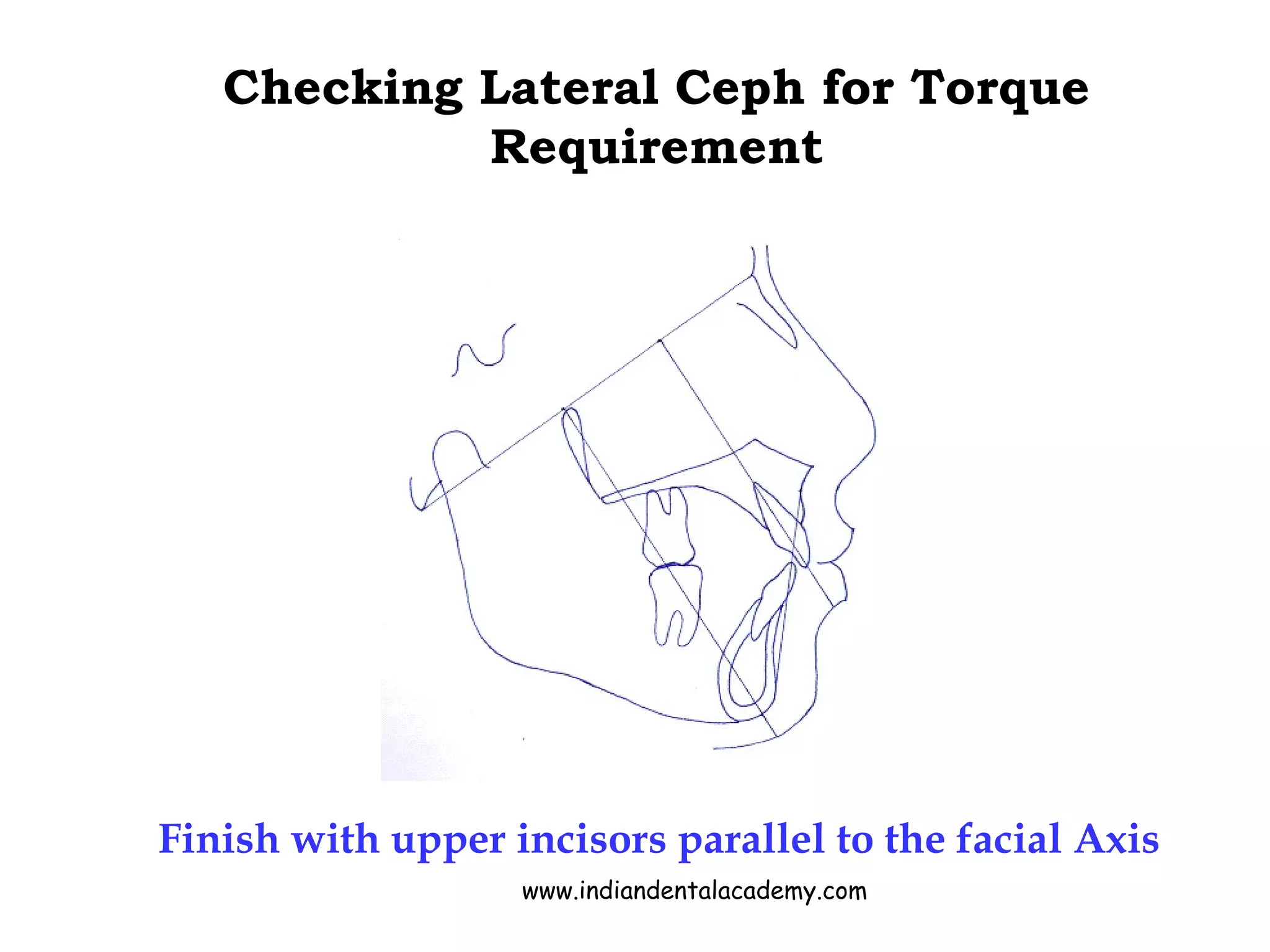
Checking Lateral Ceph for Torque
Requirement
Finish with upper incisors parallel to the facial Axis
www.indiandentalacademy.com
 Radiographs taken at 45Radiographs taken at 4500
indicate the axialindicate the axial
inclinations of canines, premolars, and molarsinclinations of canines, premolars, and molars
and are helpful forand are helpful for assessing proper rootassessing proper root
parallelism, adequate bone distribution andparallelism, adequate bone distribution and
bone levels.bone levels.
www.indiandentalacademy.com
 Despite the amount ofDespite the amount of deformationdeformation inherent ininherent in
panoramic radiographspanoramic radiographs routinely used to assessroutinely used to assess
the axial inclinations of the posterior teeth.the axial inclinations of the posterior teeth.
 This is primarily because panoramic radiographsThis is primarily because panoramic radiographs
are easily available and comparison with aare easily available and comparison with a
pretreatment panoramic radiograph is usuallypretreatment panoramic radiograph is usually
possible.possible.
www.indiandentalacademy.com
PRE RX
POST RX
www.indiandentalacademy.com
BIOMECHANICAL CONSIDERATIONS
www.indiandentalacademy.com
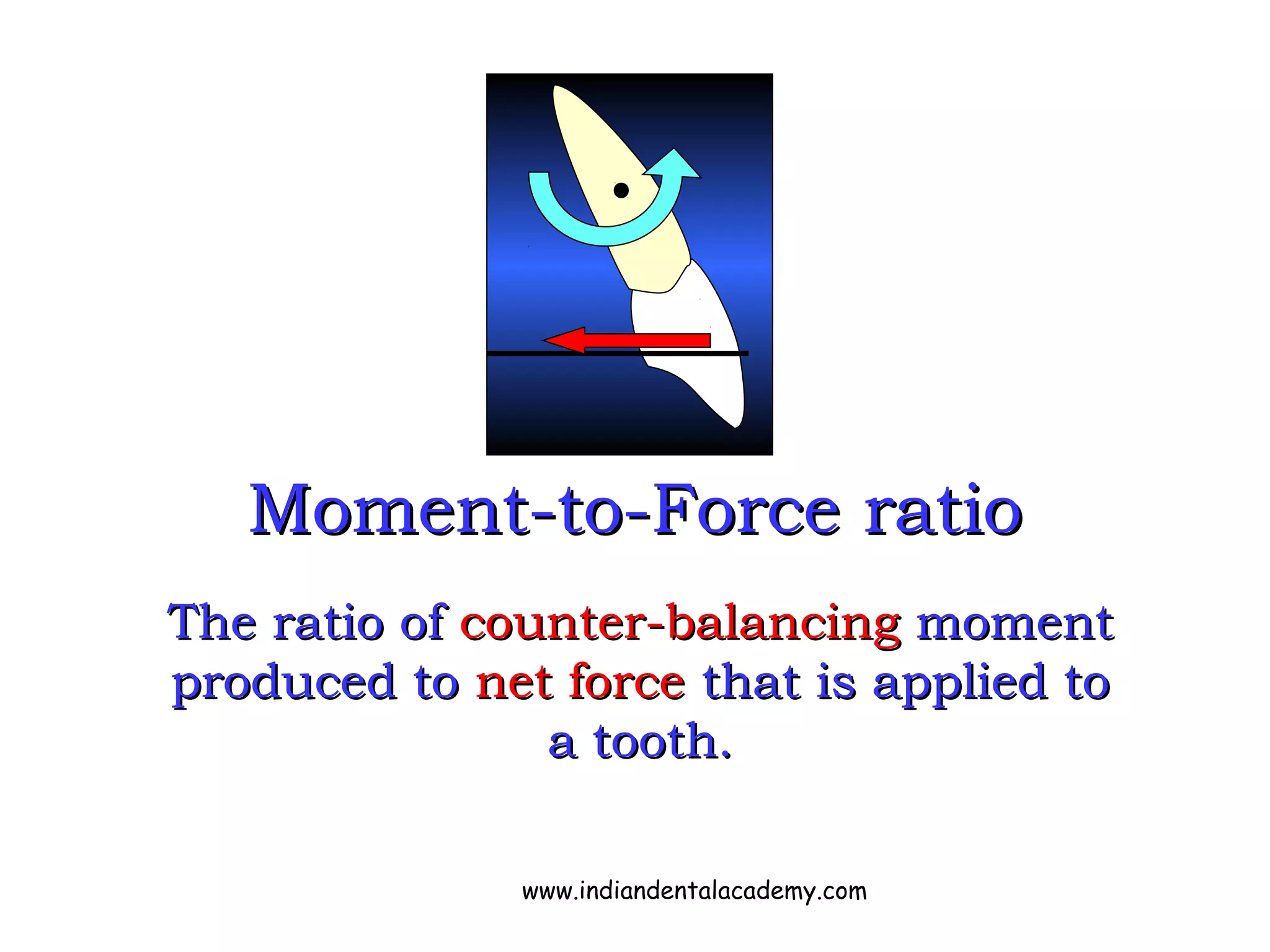
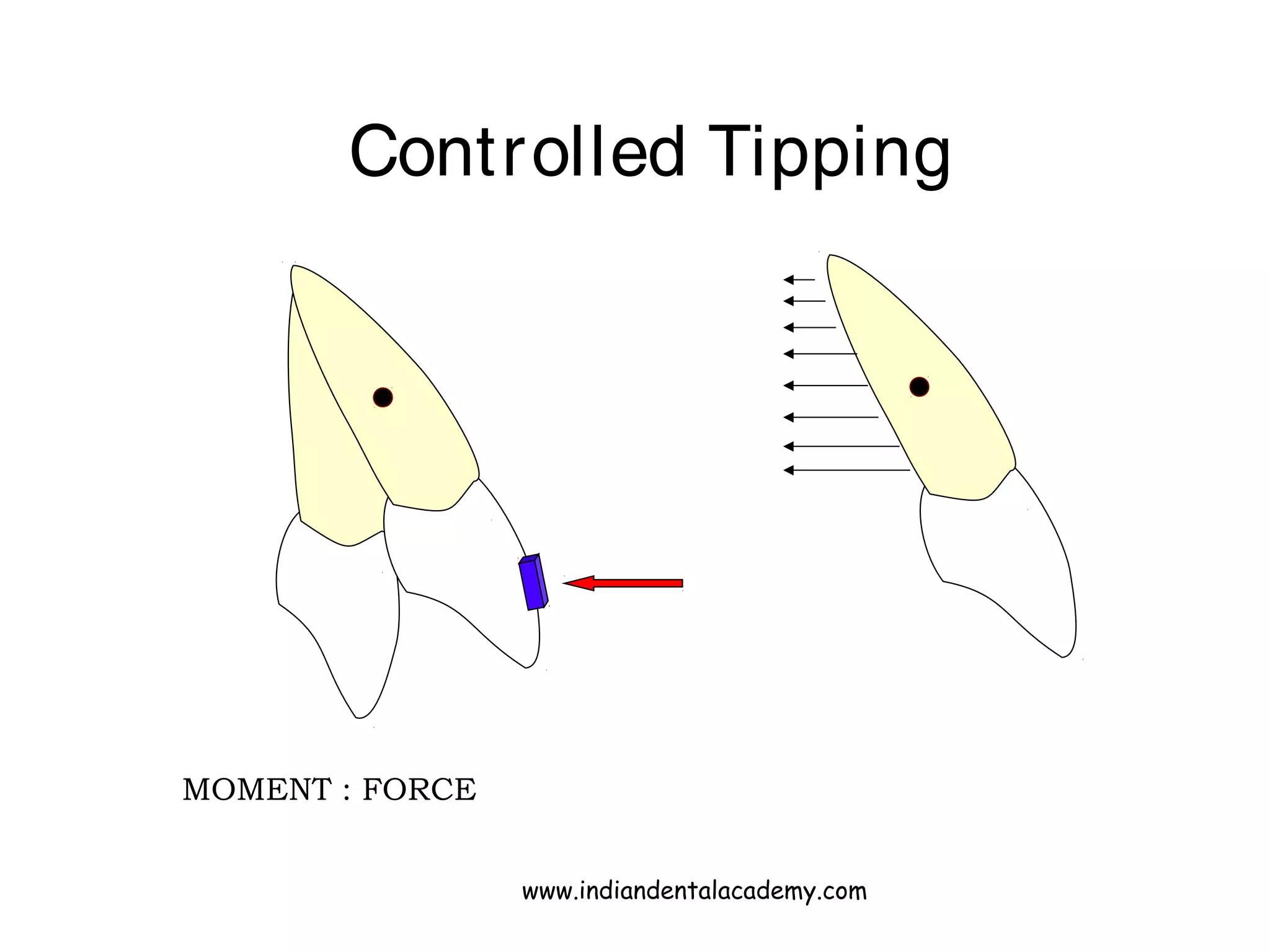
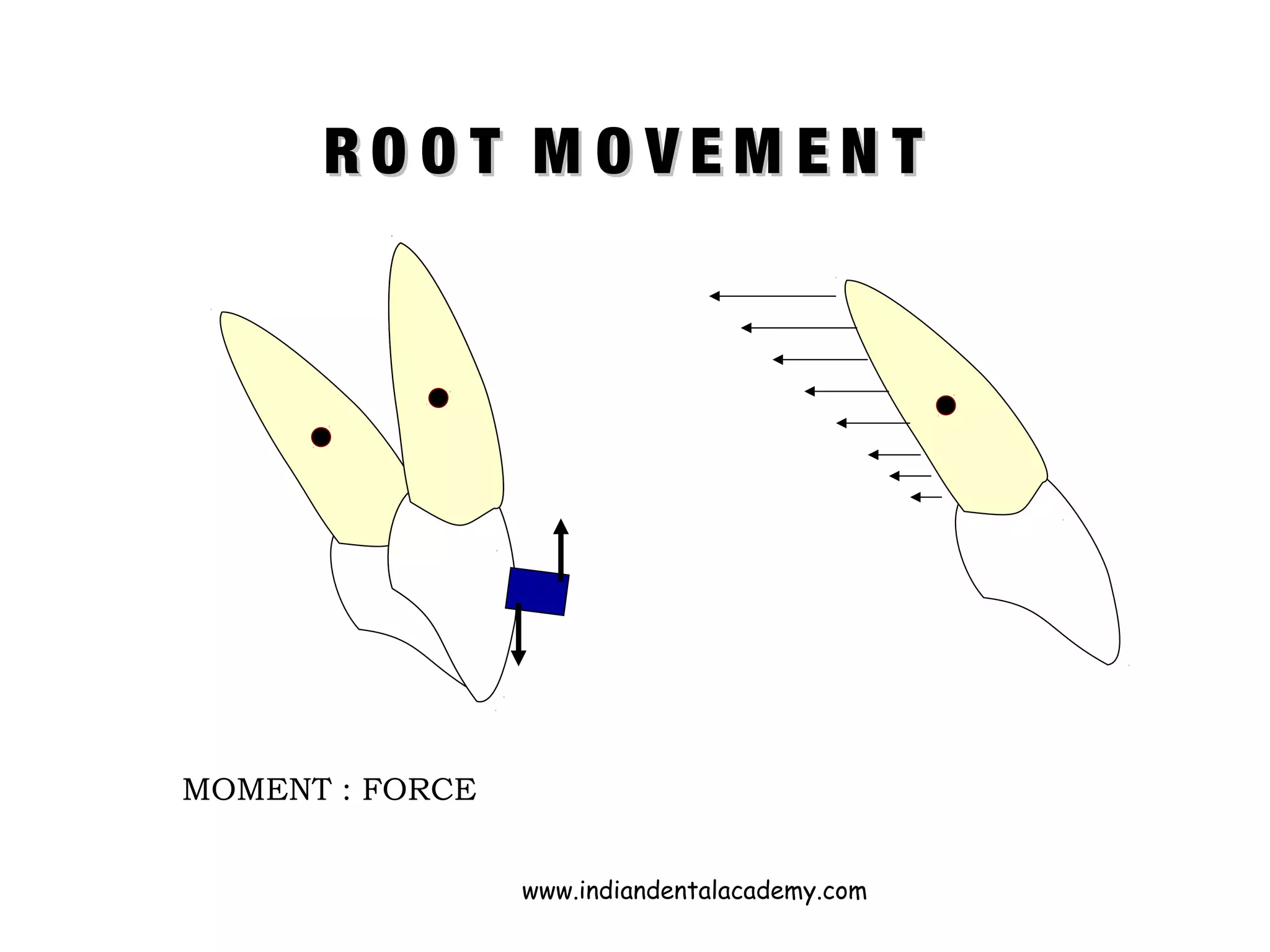
Moment-to-Force ratioMoment-to-Force ratio
The ratio ofThe ratio of counter-balancingcounter-balancing momentmoment
produced toproduced to net forcenet force that is applied tothat is applied to
a tooth.a tooth.
www.indiandentalacademy.com
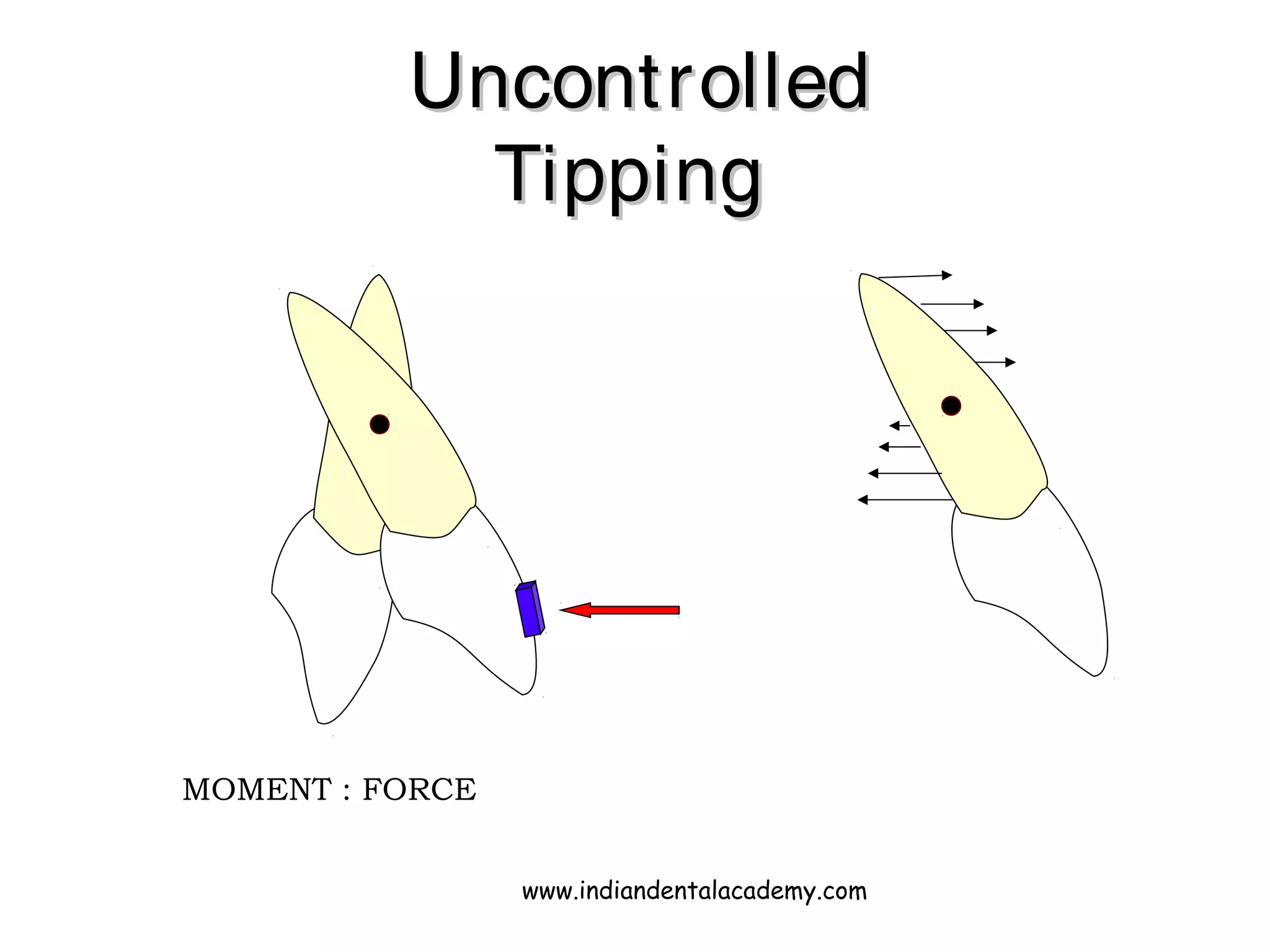
UncontrolledUncontrolled
TippingTipping
MOMENT : FORCE
www.indiandentalacademy.com
Controlled Tipping
MOMENT : FORCE
www.indiandentalacademy.com
T R AN SL AT I O NT R AN SL AT I O N
MOMENT : FORCE
www.indiandentalacademy.com
R O O T M O V E M E N TR O O T M O V E M E N T
MOMENT : FORCE
www.indiandentalacademy.com
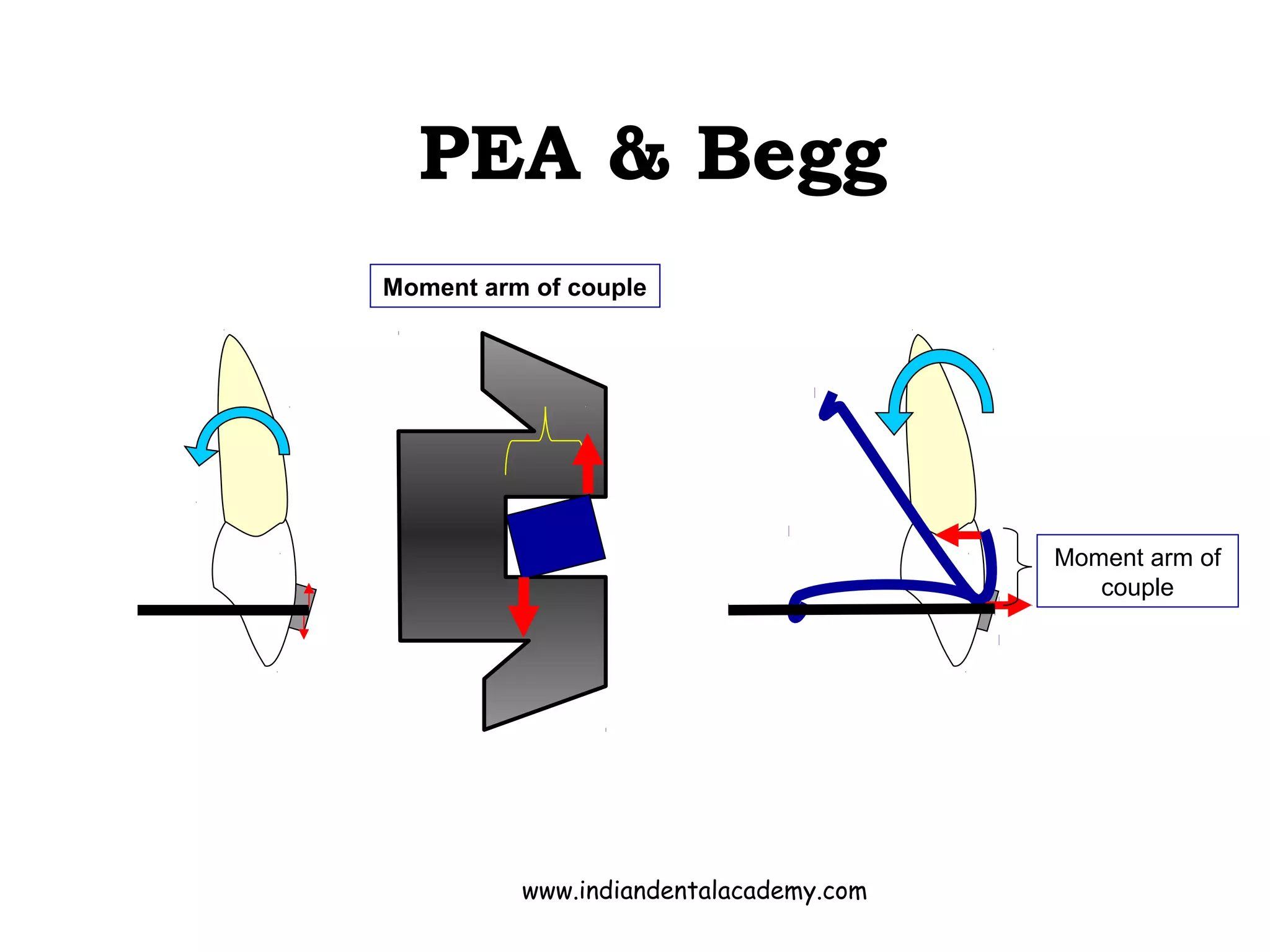
PEA & Begg
Moment arm of
couple
Moment arm of couple
www.indiandentalacademy.com
ROOT MOVEMENT INROOT MOVEMENT IN
REMOVABLE APPLIANCESREMOVABLE APPLIANCES
www.indiandentalacademy.com
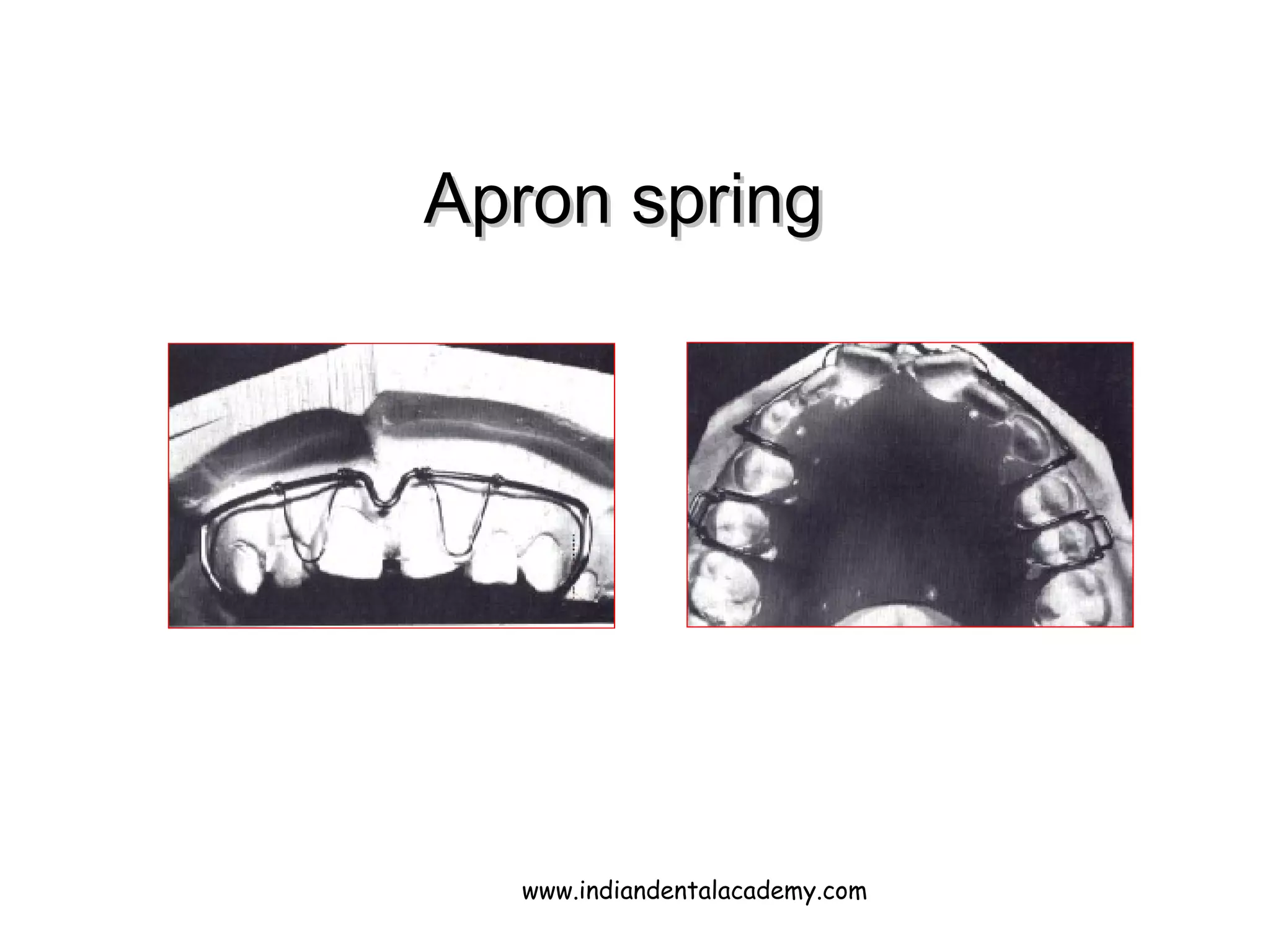
 Apron springApron spring derive their main flexibility fromderive their main flexibility from
the twisting of the section and the length of thethe twisting of the section and the length of the
torque bars.torque bars.
 These torque springs areThese torque springs are flexibleflexible,, easy toeasy to
construct, easilyconstruct, easily positioned and adjusted.positioned and adjusted.
www.indiandentalacademy.com
Apron springApron spring
www.indiandentalacademy.com
• VERTICAL PLANEVERTICAL PLANE
• SAGITAL PLANESAGITAL PLANE
• TRANSEVERSE PLANETRANSEVERSE PLANE
ROOT MOVEMENT IN BEGGSROOT MOVEMENT IN BEGGS
www.indiandentalacademy.com
VERTICAL PLANEVERTICAL PLANE
www.indiandentalacademy.com
SAGITAL PLANESAGITAL PLANE
• LABIO-LINGUAL ROOT MOVEMENTLABIO-LINGUAL ROOT MOVEMENT
• TORQUINGTORQUING
• UPRIGHTINGUPRIGHTING
www.indiandentalacademy.com
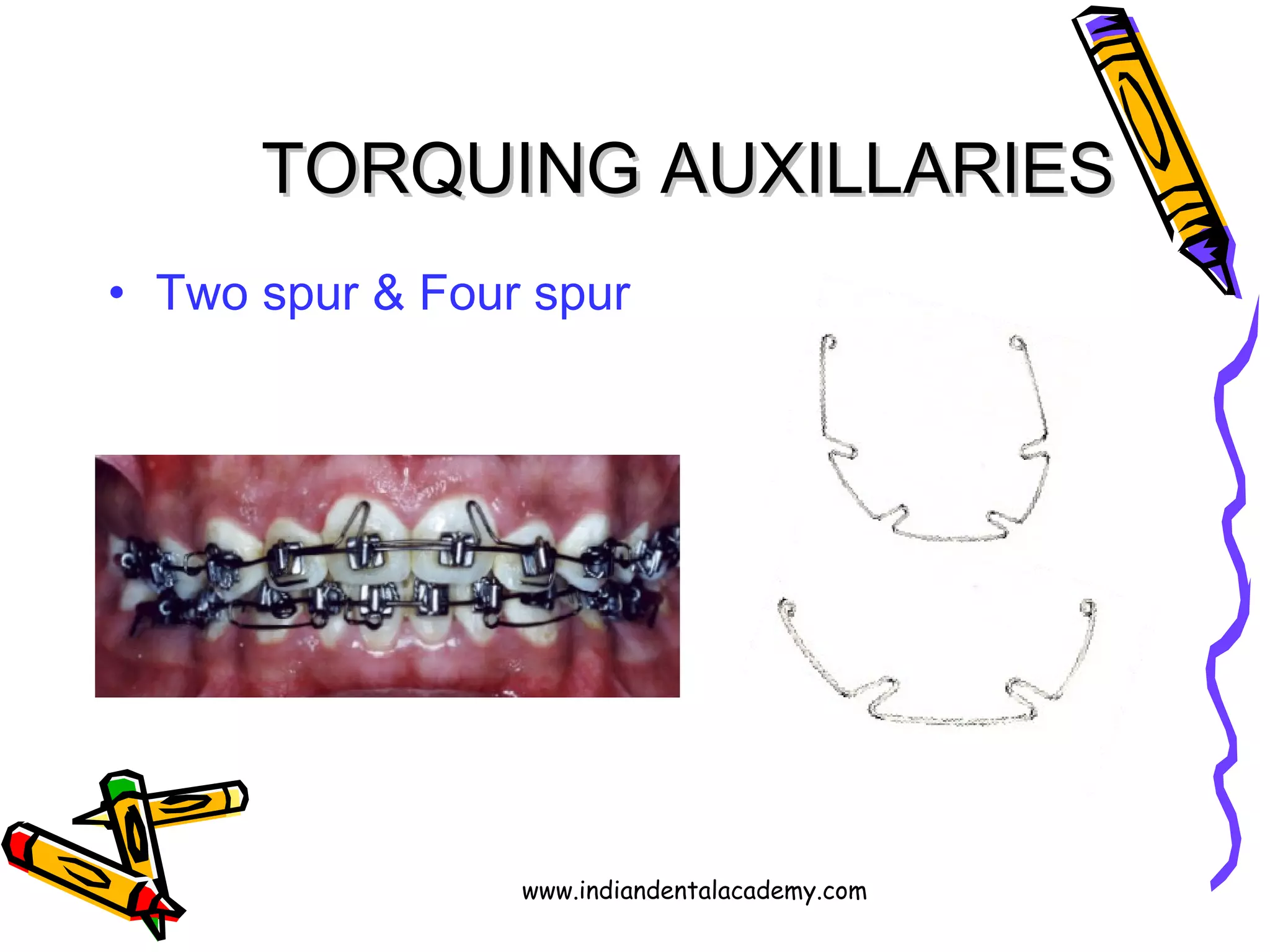
TORQUINGTORQUING AUXILLARIESAUXILLARIES
• Two spur & Four spur
www.indiandentalacademy.com
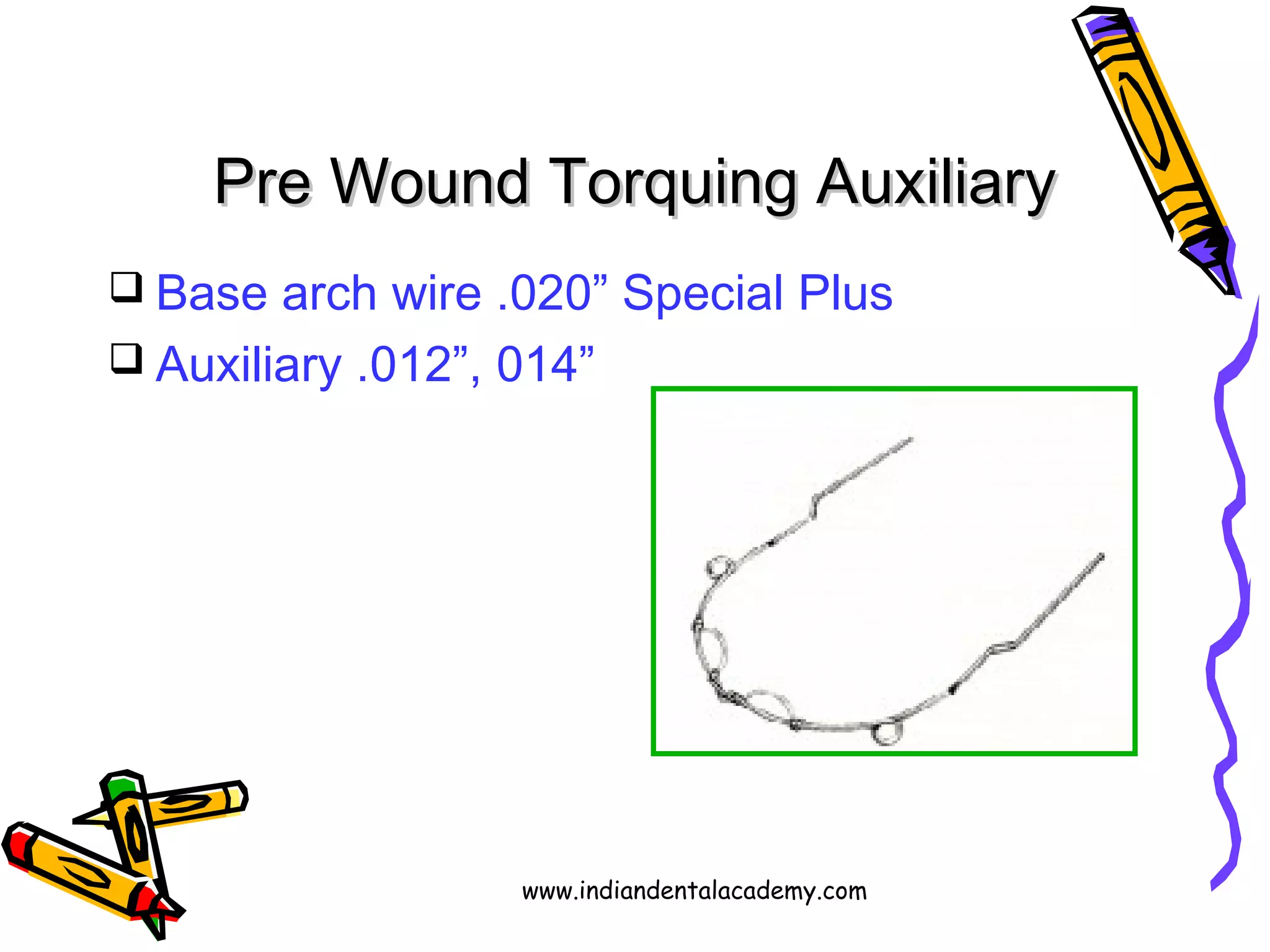
Pre Wound Torquing AuxiliaryPre Wound Torquing Auxiliary
 Base arch wire .020” Special Plus
 Auxiliary .012”, 014”
www.indiandentalacademy.com
KITCHTON AUXILIARYKITCHTON AUXILIARY
 .014” Special Plus
 Can be used with Beggs &
edgewise
www.indiandentalacademy.com
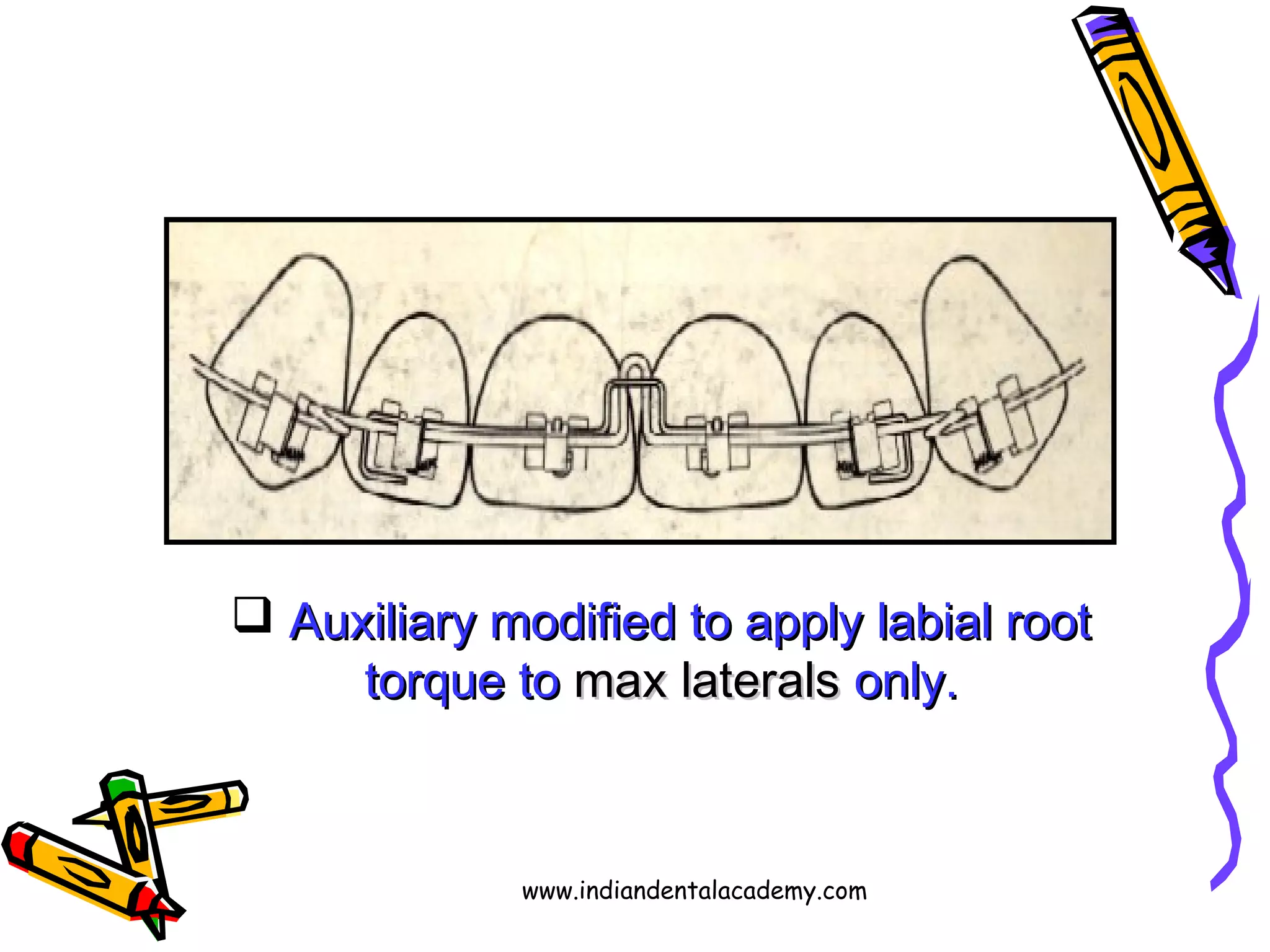
 Auxiliary modified to apply labial rootAuxiliary modified to apply labial root
torque totorque to max lateralsmax laterals only.only.
www.indiandentalacademy.com
Reciprocal lateral TorquingReciprocal lateral Torquing
AuxiliaryAuxiliary
 Situation where CentralSituation where Central
incisors require palatal rootincisors require palatal root
torque & Laterals requiretorque & Laterals require
labial root torque.labial root torque.
www.indiandentalacademy.com
Lower Reverse Torquing AuxiliaryLower Reverse Torquing Auxiliary
www.indiandentalacademy.com
MAA AuxiliaryMAA Auxiliary
www.indiandentalacademy.com
Uprighting springsUprighting springs
 Mini – 0.5 mm diameterMini – 0.5 mm diameter
 Midi – 0.9 mm diameterMidi – 0.9 mm diameter
 Maxi – 1.5 mm diameterMaxi – 1.5 mm diameter
www.indiandentalacademy.com
UprightingUprighting
www.indiandentalacademy.com
Reciprocal uprightingReciprocal uprighting
www.indiandentalacademy.com
Transverse planeTransverse plane
• Buccal root torque to molarsBuccal root torque to molars
www.indiandentalacademy.com
Root Movement In PEARoot Movement In PEA
 Lawrence AndrewLawrence Andrew developed the straightdeveloped the straight
wire appliance which became widelywire appliance which became widely
available in the mid 1970s.available in the mid 1970s.
 Six keys to normal occlusion.Six keys to normal occlusion.
www.indiandentalacademy.com
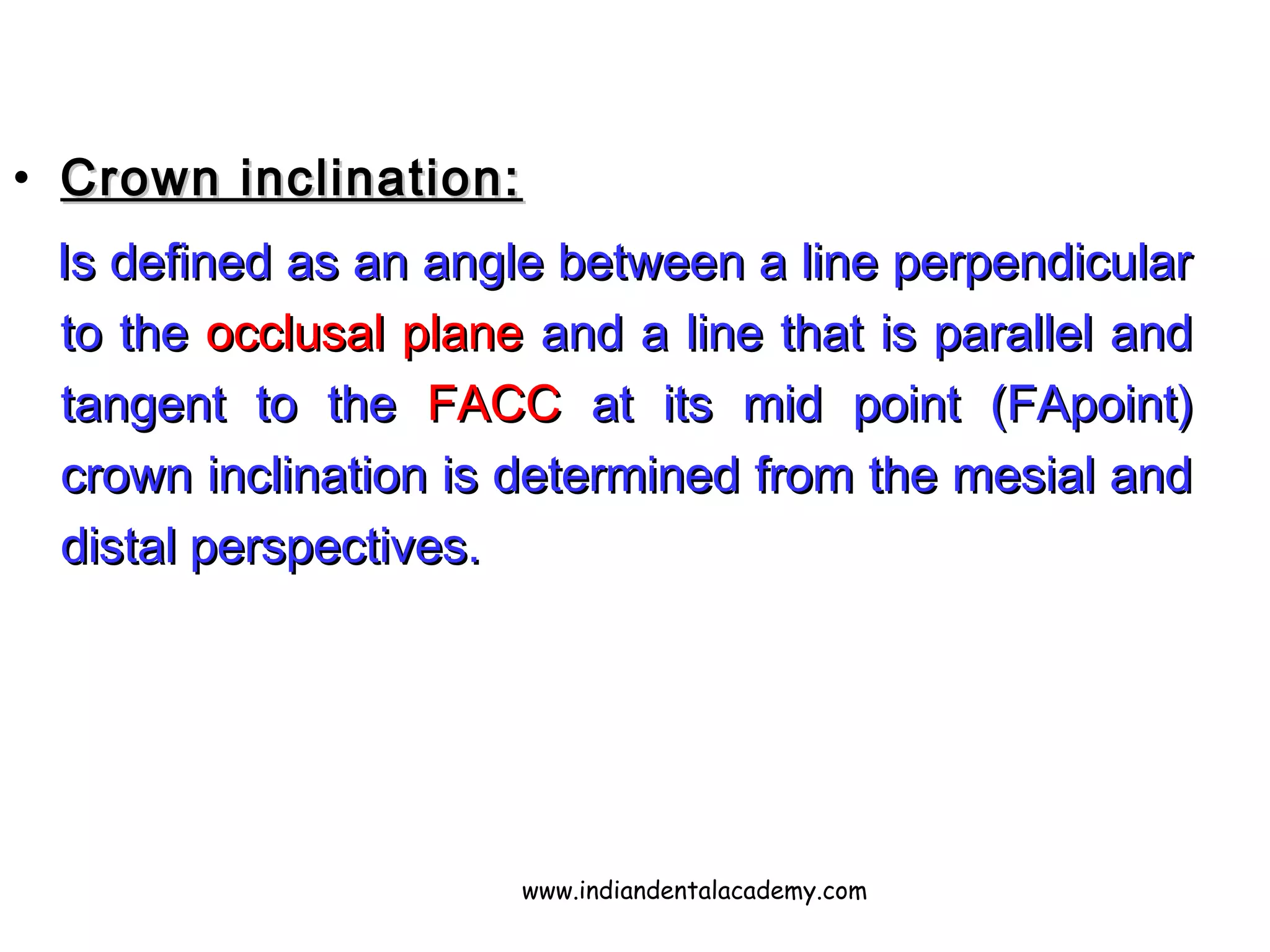
• Crown inclination:Crown inclination:
Is defined as an angle between a line perpendicularIs defined as an angle between a line perpendicular
to theto the occlusal planeocclusal plane and a line that is parallel andand a line that is parallel and
tangent to thetangent to the FACCFACC at its mid point (FApoint)at its mid point (FApoint)
crown inclination is determined from the mesial andcrown inclination is determined from the mesial and
distal perspectives.distal perspectives.
www.indiandentalacademy.com
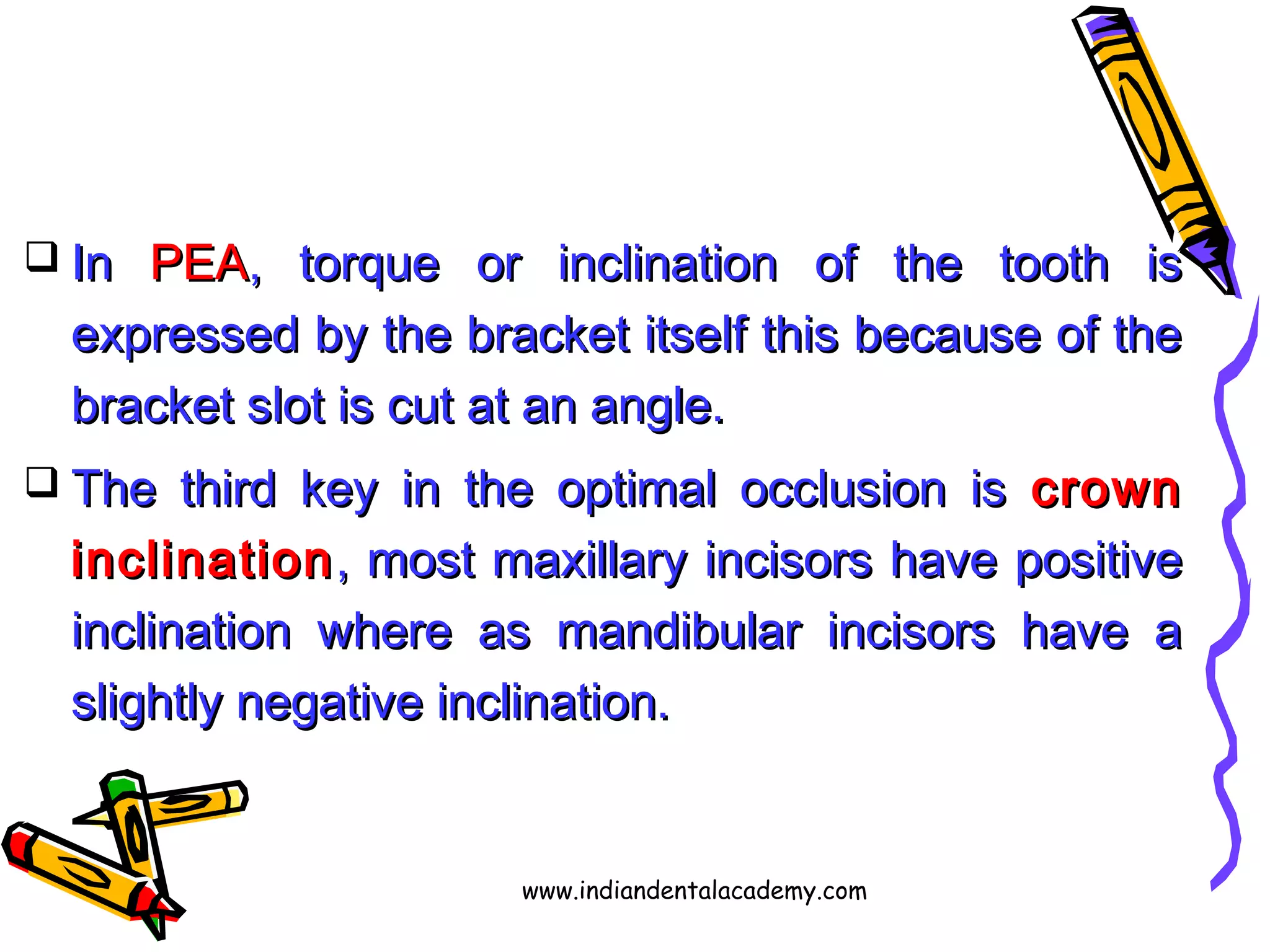
 InIn PEAPEA, torque or inclination of the tooth is, torque or inclination of the tooth is
expressed by the bracket itself this because of theexpressed by the bracket itself this because of the
bracket slot is cut at an angle.bracket slot is cut at an angle.
 The third key in the optimal occlusion isThe third key in the optimal occlusion is crowncrown
inclinationinclination, most maxillary incisors have positive, most maxillary incisors have positive
inclination where as mandibular incisors have ainclination where as mandibular incisors have a
slightly negative inclination.slightly negative inclination.
www.indiandentalacademy.com
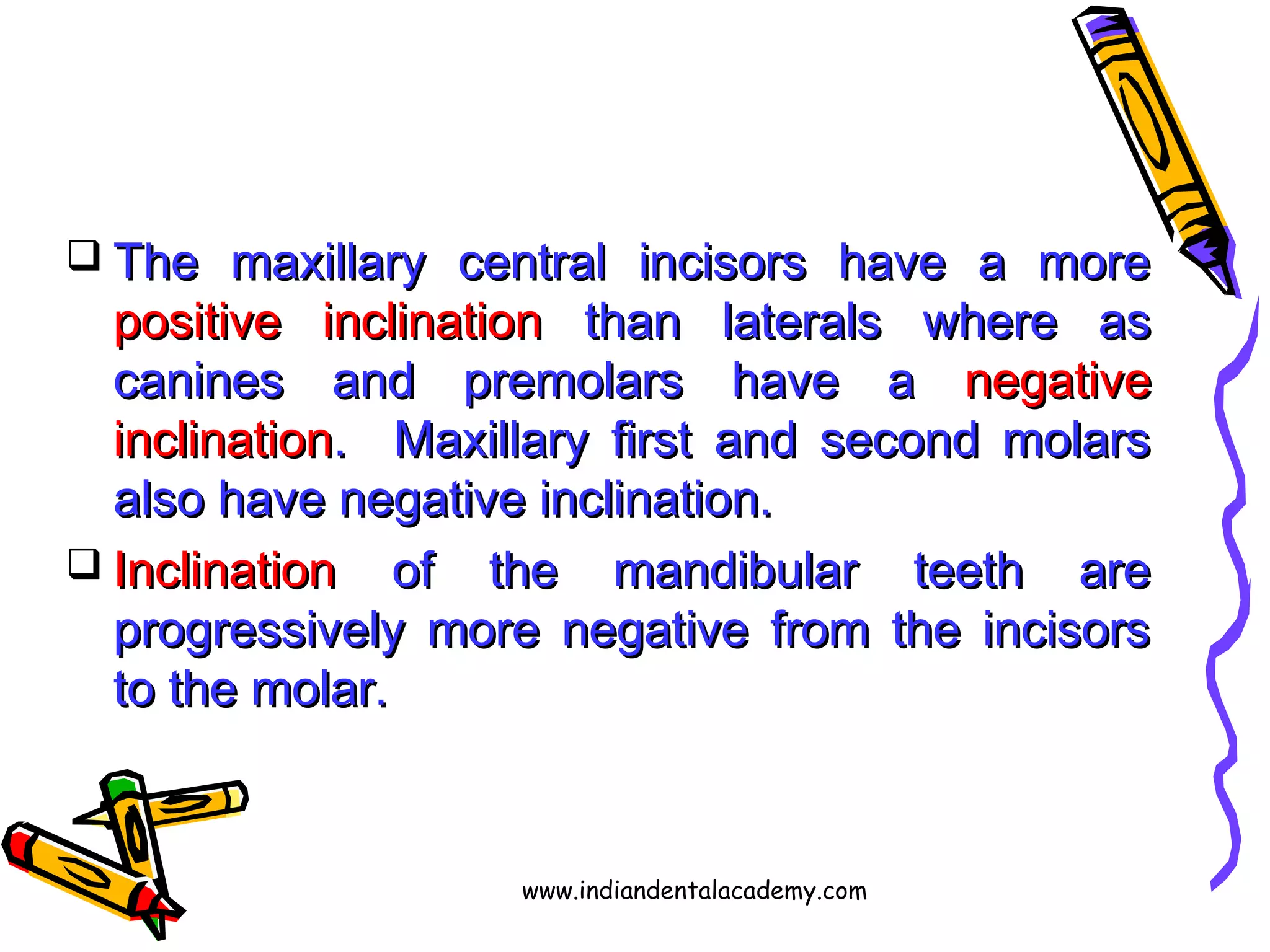
 The maxillary central incisors have a moreThe maxillary central incisors have a more
positive inclinationpositive inclination than laterals where asthan laterals where as
canines and premolars have acanines and premolars have a negativenegative
inclinationinclination. Maxillary first and second molars. Maxillary first and second molars
also have negative inclination.also have negative inclination.
 InclinationInclination of the mandibular teeth areof the mandibular teeth are
progressively more negative from the incisorsprogressively more negative from the incisors
to the molar.to the molar.
www.indiandentalacademy.com
 Normally inNormally in PEAPEA if we engage a full sized archif we engage a full sized arch
wire into the slot it will automatically express thewire into the slot it will automatically express the
torque which is incorporated in the bracket.torque which is incorporated in the bracket.
 But in some situations it we need torque in theBut in some situations it we need torque in the
individual or more number of teeth we have toindividual or more number of teeth we have to
twist the arch wiretwist the arch wire to express the desired torqueto express the desired torque
(third order bend).(third order bend).
www.indiandentalacademy.com
Torque in Face V/s Torque in
Base
Torque in FaceTorque in Face Torque in BaseTorque in Base
www.indiandentalacademy.com
First Generation Of PEA
Andrews appliance
5/7 9/3 11/-7 2/-7 2/-7 5/-9 5/-9
2/-1 2/-1 5/-11 2/-17 2/-22 2/-26 2/-35
UPPER
LOWER
Tip/torque in degrees
www.indiandentalacademy.com
Second Generation Of PEA
Roth appliance
5/12 9/8 13/-2 0/-7 0/-7 0/-14 0/-14
2/-1 2/-1 -1/-11 -1/-17 -1/-22 -1/-30 -1/-30
UPPER
LOWER
Tip/torque in degrees
www.indiandentalacademy.com
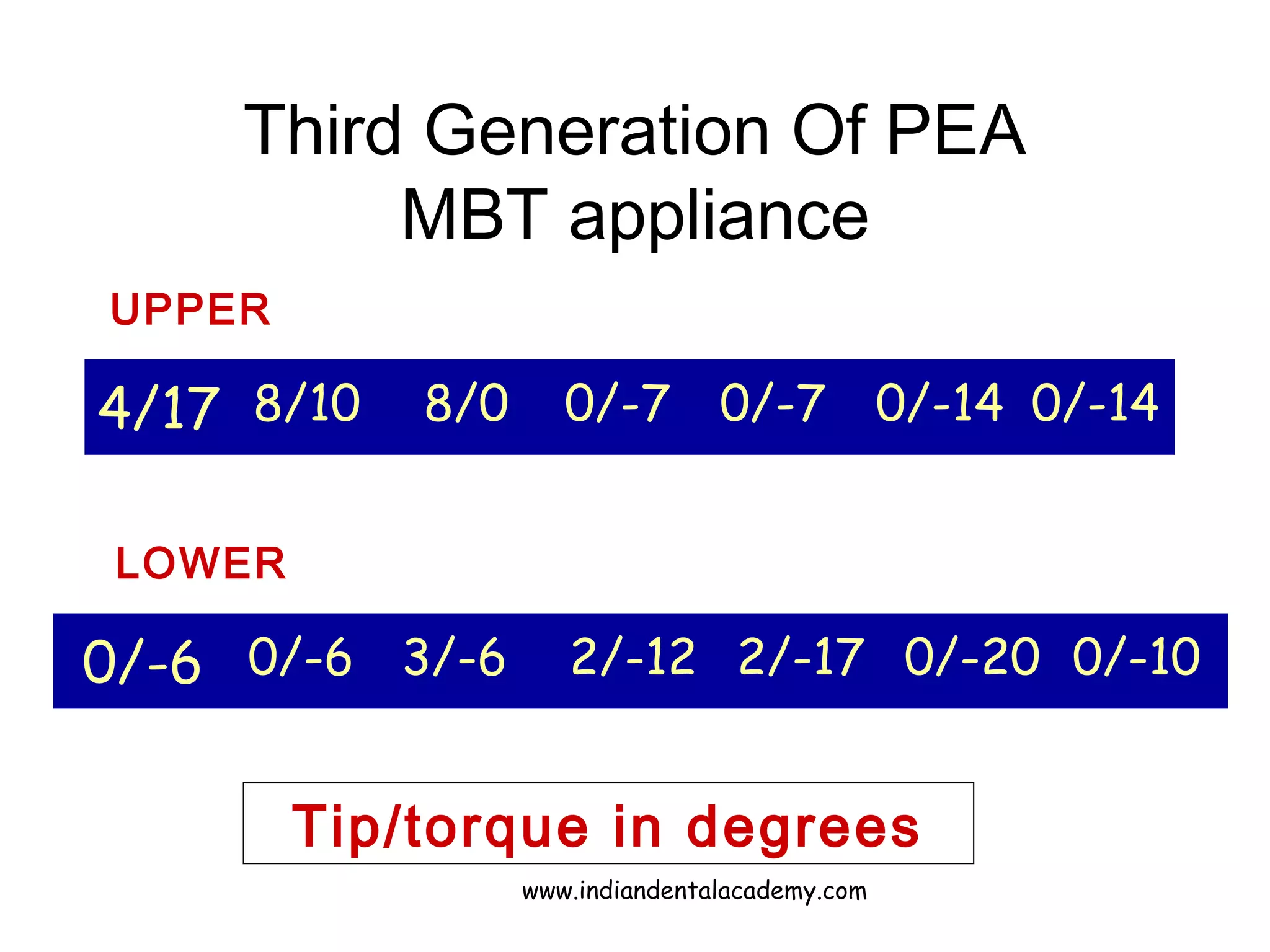
Third Generation Of PEA
MBT appliance
4/17 8/10 8/0 0/-7 0/-7 0/-14 0/-14
0/-6 0/-6 3/-6 2/-12 2/-17 0/-20 0/-10
UPPER
LOWER
Tip/torque in degrees
www.indiandentalacademy.com
EFFECT OF BUILT IN TIPEFFECT OF BUILT IN TIP
www.indiandentalacademy.com
BUCCAL ROOT TORQUEBUCCAL ROOT TORQUE
www.indiandentalacademy.com
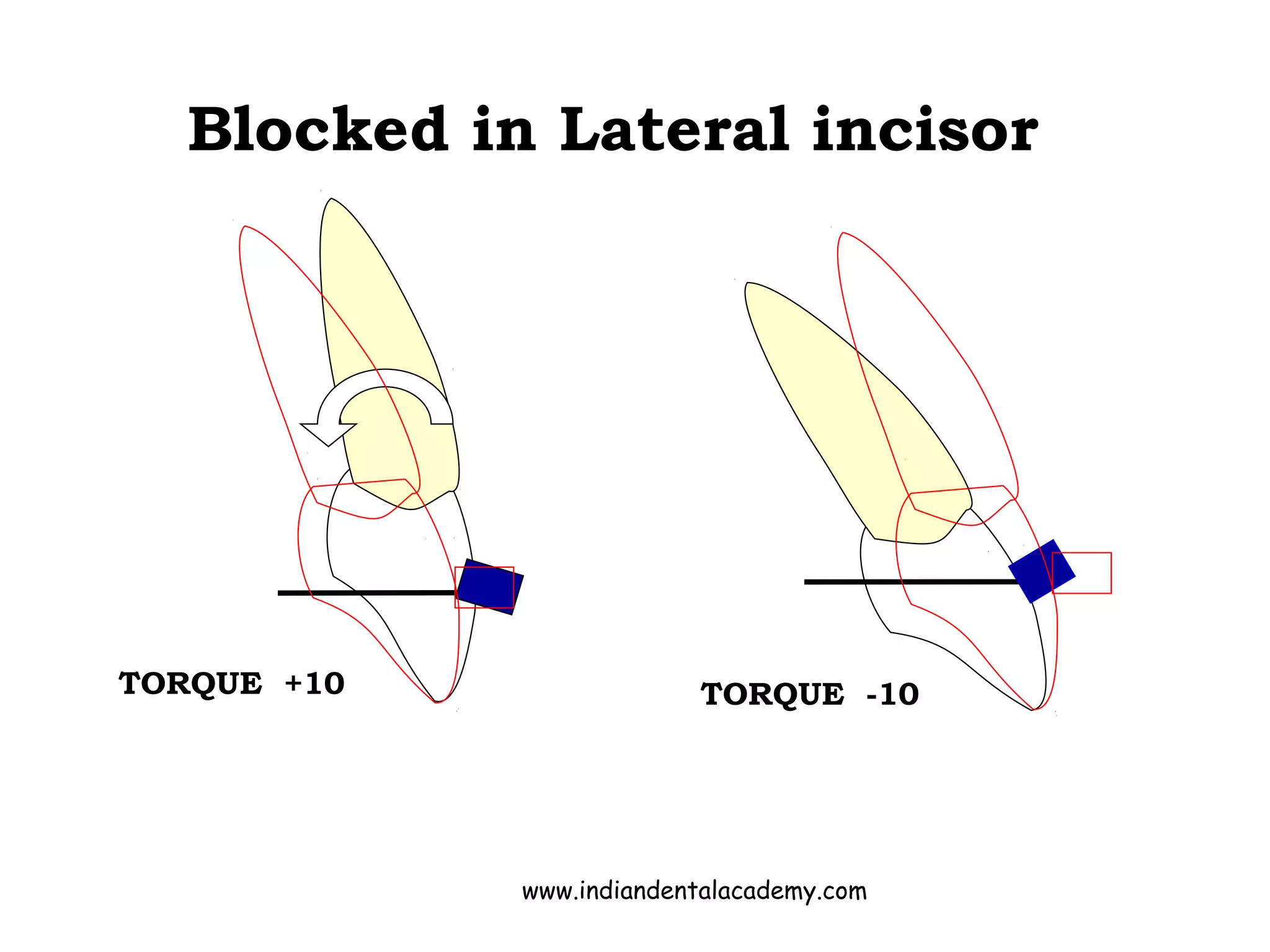
TORQUE +10 TORQUE -10
Blocked in Lateral incisor
www.indiandentalacademy.com
Root movement inRoot movement in
Segmental Arch TechniqueSegmental Arch Technique
www.indiandentalacademy.com
Root movement is generally divided intoRoot movement is generally divided into
two categories;two categories;
• En masse root movement &En masse root movement &
• Individual root movement (as separateIndividual root movement (as separate
canine root movement or separate incisorcanine root movement or separate incisor
root movement).root movement).
www.indiandentalacademy.com
 En masse root movementEn masse root movement is required when theis required when the
entire anterior segment must be moved as a unit,entire anterior segment must be moved as a unit,
commonly after en masse space retraction.commonly after en masse space retraction.
 If the anterior segment has been retractedIf the anterior segment has been retracted
through controlled tipping,through controlled tipping, all the roots areall the roots are
retracted as a unit.retracted as a unit.
www.indiandentalacademy.com
 Separate canine root movementSeparate canine root movement may be necessarymay be necessary
following separate canine retraction.following separate canine retraction.
 When an anterior segment with flared incisors isWhen an anterior segment with flared incisors is
retracted by controlled tipping, the incisors mayretracted by controlled tipping, the incisors may
assume normal axial inclinations while the canineassume normal axial inclinations while the canine
develops adevelops a distal axial inclinationdistal axial inclination, hence only the, hence only the
canines need separate root correction.canines need separate root correction.
www.indiandentalacademy.com
 En masseEn masse root movement, or root retractionroot movement, or root retraction
(rotation around a point on the crown of the(rotation around a point on the crown of the
tooth), forms a second phase of space closuretooth), forms a second phase of space closure
after tipping movement.after tipping movement.
 It is accomplished by using a mechanism thatIt is accomplished by using a mechanism that
places moments on the teeth with centers ofplaces moments on the teeth with centers of
rotation located at the level of the brackets.rotation located at the level of the brackets. TheThe
mechanism which delivers these moments ismechanism which delivers these moments is
known as a root spring.known as a root spring.
www.indiandentalacademy.com
HORIZONTAL PLANEHORIZONTAL PLANE
ANTERIOR ROOT SPRINGANTERIOR ROOT SPRING
www.indiandentalacademy.com
HELICAL SPRING FORHELICAL SPRING FOR
ENMASSE ROOT MOVEMENTENMASSE ROOT MOVEMENT
www.indiandentalacademy.com
Cantilever for En Masse RootCantilever for En Masse Root
CorrectionCorrection
www.indiandentalacademy.com
CANINE ROOT UPRIGHTINGCANINE ROOT UPRIGHTING
www.indiandentalacademy.com
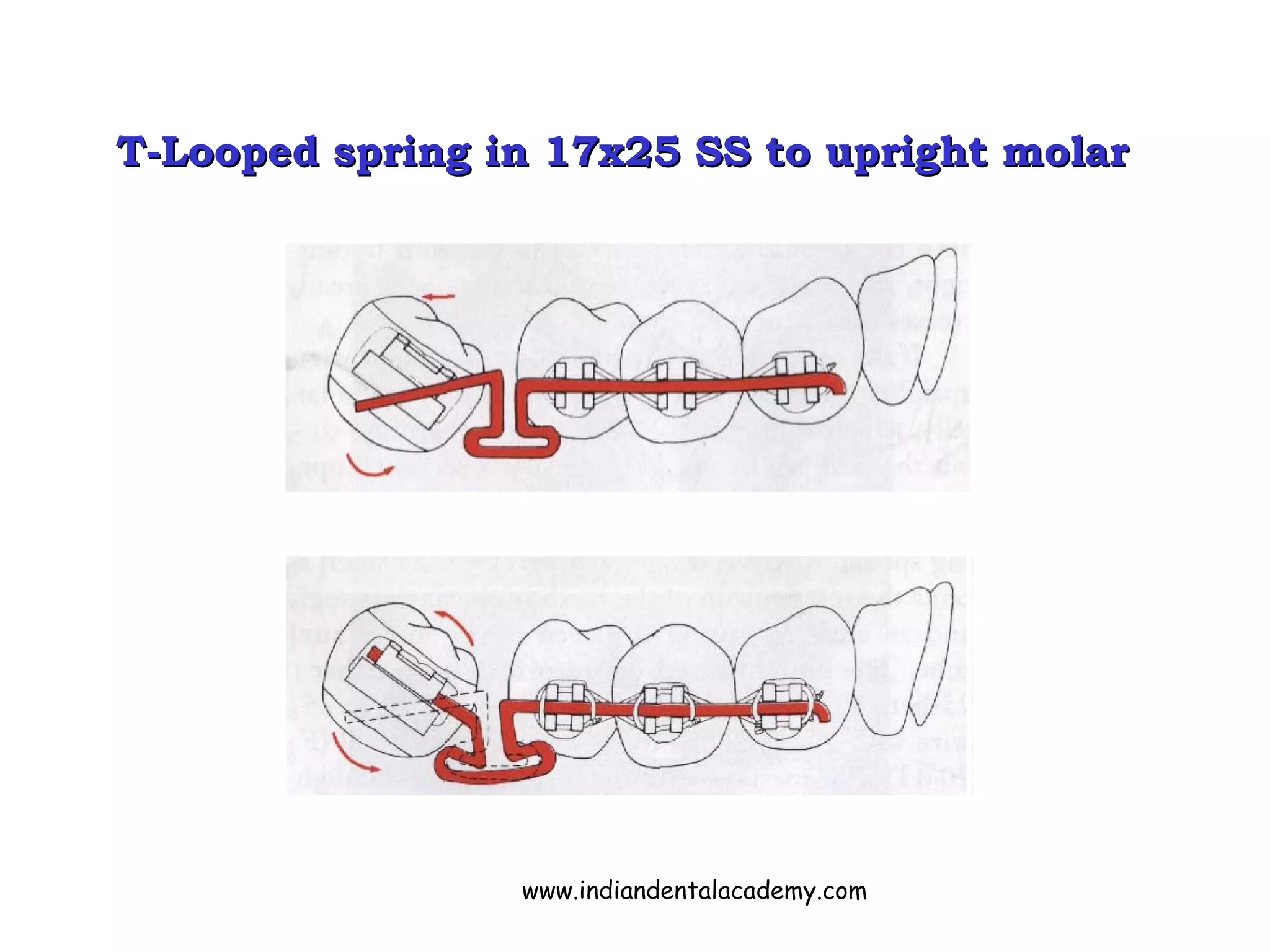
T-Looped spring in 17x25 SS to upright molarT-Looped spring in 17x25 SS to upright molar
www.indiandentalacademy.com
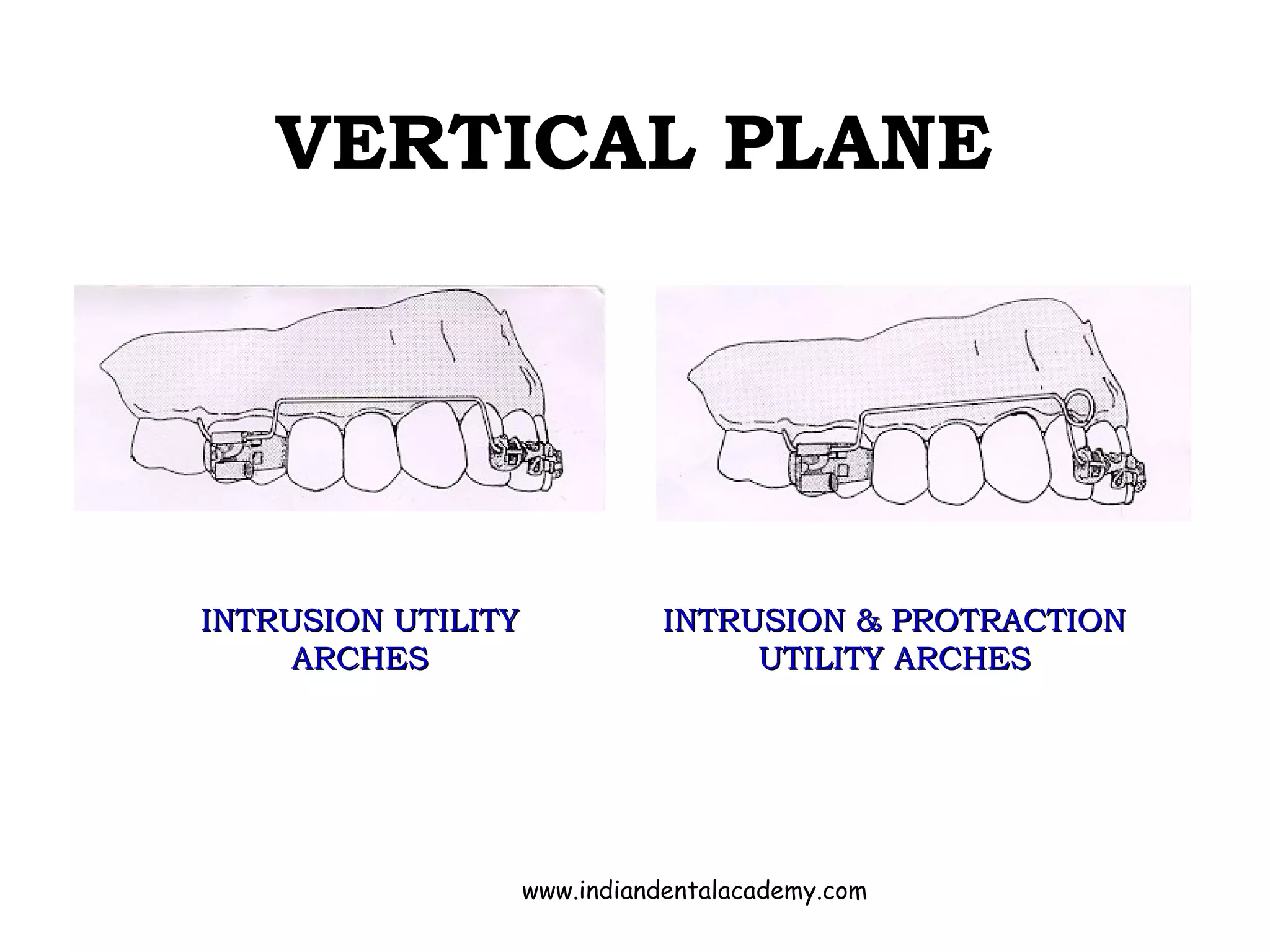
VERTICAL PLANE
INTRUSION UTILITYINTRUSION UTILITY
ARCHESARCHES
INTRUSION & PROTRACTIONINTRUSION & PROTRACTION
UTILITY ARCHESUTILITY ARCHES
www.indiandentalacademy.com
BURSTONE INTRUSIONBURSTONE INTRUSION
ARCHARCH
3 PIECE INTRUSION3 PIECE INTRUSION
ARCHARCH
www.indiandentalacademy.com
ROOT MOVEMENT IN SEGMENTAL SURGERYROOT MOVEMENT IN SEGMENTAL SURGERY
www.indiandentalacademy.com
CORTICALCORTICAL
ANCHORAGEANCHORAGE
www.indiandentalacademy.com
 TheThe cortical bonecortical bone is characterized by being moreis characterized by being more
dense and laminated, with a very limited blooddense and laminated, with a very limited blood
supply.supply.
 TheThe blood supply in the boneblood supply in the bone is the key factor inis the key factor in
tooth movement, since it carries the cellulartooth movement, since it carries the cellular
elements that resorb away bone and also theelements that resorb away bone and also the
cellular elements that build up new bone.cellular elements that build up new bone.
 In cortical bone, where theIn cortical bone, where the blood supply isblood supply is
limitedlimited, the physiological process is delayed and, the physiological process is delayed and
tooth movement is slower,tooth movement is slower,
www.indiandentalacademy.com
 Tooth movement can beTooth movement can be further delayedfurther delayed wherewhere
excess force against the cortical bone can pressexcess force against the cortical bone can press
out the blood supply and limit the physiology andout the blood supply and limit the physiology and
the tooth movement.the tooth movement.
 Bio-progressive TherapyBio-progressive Therapy applies this principle ofapplies this principle of
cortical bone anchorage in stabilizing the teethcortical bone anchorage in stabilizing the teeth
in those areas where it desires to limit theirin those areas where it desires to limit their
movement.movement.
www.indiandentalacademy.com
 Lower molar anchorageLower molar anchorage is enhanced byis enhanced by
expanding the molar roots into the dense corticalexpanding the molar roots into the dense cortical
bone on their buccal surface.bone on their buccal surface.
 ExcessiveExcessive buccal root torquebuccal root torque andand expansionexpansion isis
placed in the archwires to locate the roots into theplaced in the archwires to locate the roots into the
cortical bone.cortical bone.
www.indiandentalacademy.com
COMPLICATIONSCOMPLICATIONS
•ANCHOR LOSSANCHOR LOSS
•ROOT RESORPTIONROOT RESORPTION
www.indiandentalacademy.com
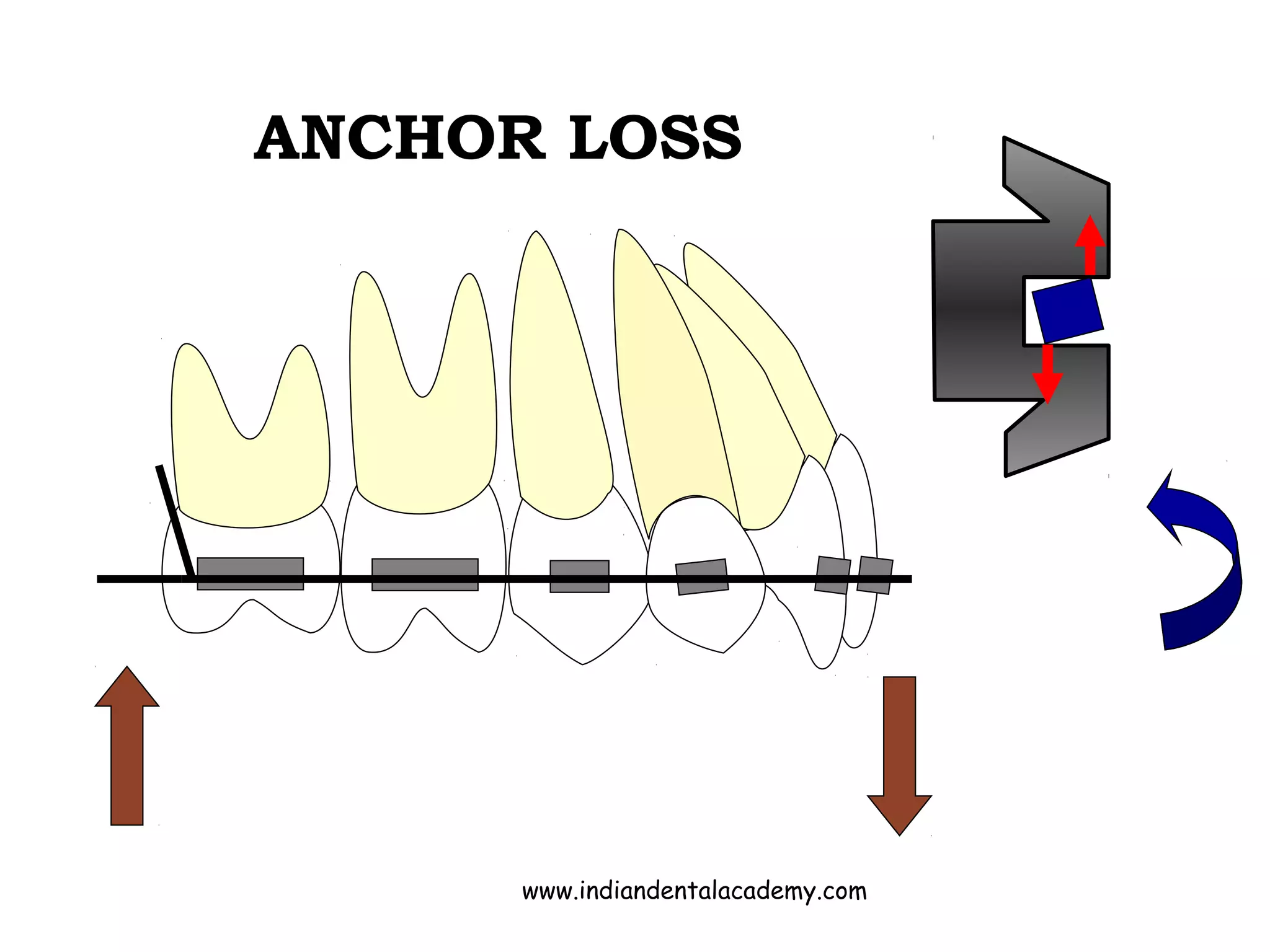
ANCHOR LOSS
www.indiandentalacademy.com
ROOT RESORPTIONROOT RESORPTION
• Fixed versus Removable:Fixed versus Removable: only one studyonly one study
compared root resorption resulting from fixedcompared root resorption resulting from fixed
and removable appliances, concluding that theand removable appliances, concluding that the
use of fixed appliances is more detrimental touse of fixed appliances is more detrimental to
the roots.the roots.
• KetchamKetcham claimed that normal function isclaimed that normal function is
disturbed by the splingting effect of orthodonticdisturbed by the splingting effect of orthodontic
fixed appliances over a long period that canfixed appliances over a long period that can
cause root resorption.cause root resorption.
www.indiandentalacademy.com
• Stuteville on the other hand, suggested
that the juggling forces caused by
removable appliances are more harmful
to the roots.
www.indiandentalacademy.com
It is often stated that the light wire Begg
technique causes less root resorption
than Edgewise, although maxillary
incisor root resorption during the Begg
third stage has been documented.
Begg versus Edgewise
www.indiandentalacademy.com
Intermaxillary elastics:Intermaxillary elastics:
• Lee & LangeLee & Lange found significantly more rootfound significantly more root
resorption on the side where elastics wereresorption on the side where elastics were
used and suggested that jiggling forcesused and suggested that jiggling forces
due to elastics are responsible for rootdue to elastics are responsible for root
resorption.resorption.
www.indiandentalacademy.com
Orthodontic Movement TypeOrthodontic Movement Type
 It seems that there isIt seems that there is no safeno safe toothtooth
movement.movement.
 IntrusionIntrusion is probably the mostis probably the most
detrimental to the roots involved, butdetrimental to the roots involved, but
tipping, torque, bodily movement, andtipping, torque, bodily movement, and
palatal expansion can also be implicated.palatal expansion can also be implicated.
www.indiandentalacademy.com
Orthodontic ForceOrthodontic Force
 They concluded that higher stressThey concluded that higher stress
causes more root resorptioncauses more root resorption..
 According toAccording to SchwartzSchwartz Applied forceApplied force
exceeding the optimal level of 20 to 25exceeding the optimal level of 20 to 25
gm/Sq.cm causes periodontal ischemia,gm/Sq.cm causes periodontal ischemia,
which can lead to root resorption.which can lead to root resorption.
www.indiandentalacademy.com
Continuous versus Intermittent Forces:Continuous versus Intermittent Forces:
 The pause in treatment with intermittent forcesThe pause in treatment with intermittent forces
allows the resorbed cementum to heal andallows the resorbed cementum to heal and
prevents further resorptionprevents further resorption..
Treatment Duration.Treatment Duration.
 Most studies report that the severity of rootMost studies report that the severity of root
resorption is directly related to treatmentresorption is directly related to treatment
duration.duration.
www.indiandentalacademy.com
ConclusionConclusion
……
www.indiandentalacademy.com
 Root correction is aRoot correction is a critical stepcritical step ofof
orthodontic treatment before finishing.orthodontic treatment before finishing.
 Proper root alignment and axialProper root alignment and axial
inclinations are key factors for theinclinations are key factors for the
attainment of aattainment of a functional, stable andfunctional, stable and
esthetically pleasing occlusion.esthetically pleasing occlusion.
www.indiandentalacademy.com
• AdequateAdequate root parallelismroot parallelism and boneand bone
distribution will also be beneficial to longdistribution will also be beneficial to long
term periodontal health and are thereforeterm periodontal health and are therefore
important to ensure aimportant to ensure a good prognosisgood prognosis forfor
treatment.treatment.
www.indiandentalacademy.com
BIBLIOGRAPHYBIBLIOGRAPHY
• The design construction and use of RemovableThe design construction and use of Removable
orthodontic Appliances By: Philip Adamsorthodontic Appliances By: Philip Adams
• Robert J. Nikolai Bio Engineering Analysis ofRobert J. Nikolai Bio Engineering Analysis of
orthodontic Mechanicsorthodontic Mechanics
• Orthodontic management of the Dentition with theOrthodontic management of the Dentition with the
pre adjustedpre adjusted
• Bennett & Richard P. Mclaughlin 2ndBennett & Richard P. Mclaughlin 2nd EditionEdition
• Edgewise Orthodontics By: Raymon C. ThurowEdgewise Orthodontics By: Raymon C. Thurow
• Contemporary Orthodontics By: William R. ProfitContemporary Orthodontics By: William R. Profit
• Roth RH Treatment mechanics for the straight wireRoth RH Treatment mechanics for the straight wire
Appliance ;Graber T.M & Vanarsadall R.RAppliance ;Graber T.M & Vanarsadall R.R
www.indiandentalacademy.com
• The straight wire Appliance 17 years later J.C.O VolThe straight wire Appliance 17 years later J.C.O Vol
21; 1987; 632-64221; 1987; 632-642
• Andrews six keys to normal occlusal Am J OrhodAndrews six keys to normal occlusal Am J Orhod
1972; vol 62: 296 – 3091972; vol 62: 296 – 309
• Begg Orthodontic Theory & Technique By: P.R.Begg Orthodontic Theory & Technique By: P.R.
Begg & KeslingBegg & Kesling
• The Begg Appliance & Technique By: G.G.T.The Begg Appliance & Technique By: G.G.T.
FletcherFletcher
• Barry Mollen hauer Aust Orthodontic J 11 Oct 1990Barry Mollen hauer Aust Orthodontic J 11 Oct 1990
• T.P Orthodontics catalougeT.P Orthodontics catalouge
www.indiandentalacademy.com

Root movement in orthodontics

  • 1.
    ROOT MOVEMENTROOT MOVEMENT INORTHODONTICSIN ORTHODONTICS …… www.indiandentalacademy.com
  • 2.
    CONTENTS • Introduction • Needfor axial corrections • Torque • Diagnosis & Evaluation for root correction • Biomechanical considerations • Root movement in Removable Appliances • Root movement in Beggs • Root movement in PEARoot movement in PEA • Root movement in segmental arch technique www.indiandentalacademy.com
  • 3.
    • Root movementin Segmental SurgeryRoot movement in Segmental Surgery • Cortical AnchorageCortical Anchorage • ComplicationsComplications • ConclusionConclusion • BibliographyBibliography www.indiandentalacademy.com
  • 4.
  • 5.
     Control oftheControl of the axial inclinationsaxial inclinations of teeth duringof teeth during orthodontic therapy is critical for achieving excellentorthodontic therapy is critical for achieving excellent results and ensuringresults and ensuring long term stabilitylong term stability afterafter completion of treatment.completion of treatment.  The careful evaluation of individual tooth axialThe careful evaluation of individual tooth axial inclinations is often carried out as ainclinations is often carried out as a second stage ofsecond stage of space closurespace closure in extraction therapy or beforein extraction therapy or before completion of treatment in non-extraction therapy.completion of treatment in non-extraction therapy. www.indiandentalacademy.com
  • 6.
    Need For AxialNeedFor Axial CorrectionsCorrections www.indiandentalacademy.com
  • 7.
     Good axialinclinations andGood axial inclinations and adequateadequate root parallelismroot parallelism withwith regular bone distributionregular bone distribution between teeth helps to obtainbetween teeth helps to obtain and maintain aand maintain a stablestable treatment result.treatment result. www.indiandentalacademy.com
  • 8.
    Raleigh WilliamRaleigh William The lower incisor roots, rather than theirThe lower incisor roots, rather than their crowns, should becrowns, should be divergentdivergent. If the roots. If the roots are leftare left convergentconvergent, the crowns tend to, the crowns tend to bunch together and causebunch together and cause relapse.relapse. www.indiandentalacademy.com
  • 9.
  • 10.
     The evaluationofThe evaluation of root axial inclinationsroot axial inclinations is also critical in patients withis also critical in patients with congenitallycongenitally missing teethmissing teeth when the goal is to replacewhen the goal is to replace these teeth with eitherthese teeth with either implantsimplants oror bridges.bridges. www.indiandentalacademy.com
  • 11.
    CREATING SPACE FORIMPLANTSCREATING SPACE FOR IMPLANTS www.indiandentalacademy.com
  • 12.
     Parallelism oftheParallelism of the abutments rootsabutments roots as wells asas wells as adequate bone distribution are important factors in theadequate bone distribution are important factors in the prognosis and successful outcome of treatment.prognosis and successful outcome of treatment.  Root correction, which may involve individual teeth orRoot correction, which may involve individual teeth or groups of teeth is also instrumental ingroups of teeth is also instrumental in positioning teethpositioning teeth over basal bone to achieve an ideal occlusalover basal bone to achieve an ideal occlusal relationshiprelationship in the anterior and posterior portions of thein the anterior and posterior portions of the dental arches.dental arches. www.indiandentalacademy.com
  • 13.
    Providing good PeriodontalProvidinggood Periodontal EnvironmentEnvironment  Gingiva folded and bunched upGingiva folded and bunched up  Plaque harboring pseudoPlaque harboring pseudo pocketpocket www.indiandentalacademy.com
  • 14.
  • 15.
     In termsofIn terms of Engineering principlesEngineering principles, it is defined as a, it is defined as a force causing twistforce causing twist in a structure, the resulting twistin a structure, the resulting twist of the mechanical part is calledof the mechanical part is called TorsionTorsion..  In terms ofIn terms of orthodonticsorthodontics it is defined as theit is defined as the buccolingualbuccolingual oror labiolinguallabiolingual root tipping in whichroot tipping in which the movement of the crown is minimized andthe movement of the crown is minimized and movement of the root apex is maximized.movement of the root apex is maximized. www.indiandentalacademy.com
  • 16.
     Torque canbe effectively employed in removableTorque can be effectively employed in removable appliance and in fixed appliances.appliance and in fixed appliances.  Torquing mechanics are more effective and widelyTorquing mechanics are more effective and widely used inused in fixed mechanotherapyfixed mechanotherapy than in removablethan in removable appliances. In removable appliances springs areappliances. In removable appliances springs are used for torquing the tooth.used for torquing the tooth. www.indiandentalacademy.com
  • 17.
    Torque in thefixed appliance can beTorque in the fixed appliance can be employed in different ways.employed in different ways. • By giving aBy giving a twisttwist in the arch wire commonlyin the arch wire commonly used in Edgewise technique.used in Edgewise technique. • Torque exerted by theTorque exerted by the bracketbracket itself e.g., PEAitself e.g., PEA • By the use ofBy the use of Torquing auxiliariesTorquing auxiliaries widely usedwidely used in Begg technique and Edgewise technique.in Begg technique and Edgewise technique. www.indiandentalacademy.com
  • 18.
    Diagnosis &Diagnosis & Evaluationfor RootEvaluation for Root CorrectionCorrection www.indiandentalacademy.com
  • 19.
     Root correctionmay be considered theRoot correction may be considered the second phasesecond phase of space closureof space closure and most often completion of spaceand most often completion of space closure is recommended before evaluating for theclosure is recommended before evaluating for the potential need to correctpotential need to correct root axial inclinationsroot axial inclinations..  Clinical assessment of root positionsClinical assessment of root positions during spaceduring space closure is often very useful and may be done byclosure is often very useful and may be done by monitoring the inclinations of the canine and anteriormonitoring the inclinations of the canine and anterior brackets.brackets. www.indiandentalacademy.com
  • 20.
     Lateral cephalometricLateralcephalometric head films,head films, IOPAIOPA taken attaken at 454500 andand PanoramicPanoramic radiographs are commonlyradiographs are commonly used to assess the need for not correction.used to assess the need for not correction.  Lateral head films primarily assist in evaluatingLateral head films primarily assist in evaluating thethe axial inclinations of the anterioraxial inclinations of the anterior teethteeth byby comparing a film taken before initiation ofcomparing a film taken before initiation of treatment and one taken after completion oftreatment and one taken after completion of space closure.space closure. www.indiandentalacademy.com
  • 21.
    Checking Lateral Cephfor Torque Requirement Finish with upper incisors parallel to the facial Axis www.indiandentalacademy.com
  • 22.
     Radiographs takenat 45Radiographs taken at 4500 indicate the axialindicate the axial inclinations of canines, premolars, and molarsinclinations of canines, premolars, and molars and are helpful forand are helpful for assessing proper rootassessing proper root parallelism, adequate bone distribution andparallelism, adequate bone distribution and bone levels.bone levels. www.indiandentalacademy.com
  • 23.
     Despite theamount ofDespite the amount of deformationdeformation inherent ininherent in panoramic radiographspanoramic radiographs routinely used to assessroutinely used to assess the axial inclinations of the posterior teeth.the axial inclinations of the posterior teeth.  This is primarily because panoramic radiographsThis is primarily because panoramic radiographs are easily available and comparison with aare easily available and comparison with a pretreatment panoramic radiograph is usuallypretreatment panoramic radiograph is usually possible.possible. www.indiandentalacademy.com
  • 24.
  • 25.
  • 26.
    Moment-to-Force ratioMoment-to-Force ratio Theratio ofThe ratio of counter-balancingcounter-balancing momentmoment produced toproduced to net forcenet force that is applied tothat is applied to a tooth.a tooth. www.indiandentalacademy.com
  • 27.
  • 28.
    Controlled Tipping MOMENT :FORCE www.indiandentalacademy.com
  • 29.
    T R ANSL AT I O NT R AN SL AT I O N MOMENT : FORCE www.indiandentalacademy.com
  • 30.
    R O OT M O V E M E N TR O O T M O V E M E N T MOMENT : FORCE www.indiandentalacademy.com
  • 31.
    PEA & Begg Momentarm of couple Moment arm of couple www.indiandentalacademy.com
  • 32.
    ROOT MOVEMENT INROOTMOVEMENT IN REMOVABLE APPLIANCESREMOVABLE APPLIANCES www.indiandentalacademy.com
  • 33.
     Apron springApronspring derive their main flexibility fromderive their main flexibility from the twisting of the section and the length of thethe twisting of the section and the length of the torque bars.torque bars.  These torque springs areThese torque springs are flexibleflexible,, easy toeasy to construct, easilyconstruct, easily positioned and adjusted.positioned and adjusted. www.indiandentalacademy.com
  • 34.
  • 35.
    • VERTICAL PLANEVERTICALPLANE • SAGITAL PLANESAGITAL PLANE • TRANSEVERSE PLANETRANSEVERSE PLANE ROOT MOVEMENT IN BEGGSROOT MOVEMENT IN BEGGS www.indiandentalacademy.com
  • 36.
  • 37.
    SAGITAL PLANESAGITAL PLANE •LABIO-LINGUAL ROOT MOVEMENTLABIO-LINGUAL ROOT MOVEMENT • TORQUINGTORQUING • UPRIGHTINGUPRIGHTING www.indiandentalacademy.com
  • 38.
    TORQUINGTORQUING AUXILLARIESAUXILLARIES • Twospur & Four spur www.indiandentalacademy.com
  • 39.
    Pre Wound TorquingAuxiliaryPre Wound Torquing Auxiliary  Base arch wire .020” Special Plus  Auxiliary .012”, 014” www.indiandentalacademy.com
  • 40.
    KITCHTON AUXILIARYKITCHTON AUXILIARY .014” Special Plus  Can be used with Beggs & edgewise www.indiandentalacademy.com
  • 41.
     Auxiliary modifiedto apply labial rootAuxiliary modified to apply labial root torque totorque to max lateralsmax laterals only.only. www.indiandentalacademy.com
  • 42.
    Reciprocal lateral TorquingReciprocallateral Torquing AuxiliaryAuxiliary  Situation where CentralSituation where Central incisors require palatal rootincisors require palatal root torque & Laterals requiretorque & Laterals require labial root torque.labial root torque. www.indiandentalacademy.com
  • 43.
    Lower Reverse TorquingAuxiliaryLower Reverse Torquing Auxiliary www.indiandentalacademy.com
  • 44.
  • 45.
    Uprighting springsUprighting springs Mini – 0.5 mm diameterMini – 0.5 mm diameter  Midi – 0.9 mm diameterMidi – 0.9 mm diameter  Maxi – 1.5 mm diameterMaxi – 1.5 mm diameter www.indiandentalacademy.com
  • 46.
  • 47.
  • 48.
  • 49.
    Transverse planeTransverse plane •Buccal root torque to molarsBuccal root torque to molars www.indiandentalacademy.com
  • 50.
    Root Movement InPEARoot Movement In PEA  Lawrence AndrewLawrence Andrew developed the straightdeveloped the straight wire appliance which became widelywire appliance which became widely available in the mid 1970s.available in the mid 1970s.  Six keys to normal occlusion.Six keys to normal occlusion. www.indiandentalacademy.com
  • 51.
    • Crown inclination:Crowninclination: Is defined as an angle between a line perpendicularIs defined as an angle between a line perpendicular to theto the occlusal planeocclusal plane and a line that is parallel andand a line that is parallel and tangent to thetangent to the FACCFACC at its mid point (FApoint)at its mid point (FApoint) crown inclination is determined from the mesial andcrown inclination is determined from the mesial and distal perspectives.distal perspectives. www.indiandentalacademy.com
  • 52.
     InIn PEAPEA,torque or inclination of the tooth is, torque or inclination of the tooth is expressed by the bracket itself this because of theexpressed by the bracket itself this because of the bracket slot is cut at an angle.bracket slot is cut at an angle.  The third key in the optimal occlusion isThe third key in the optimal occlusion is crowncrown inclinationinclination, most maxillary incisors have positive, most maxillary incisors have positive inclination where as mandibular incisors have ainclination where as mandibular incisors have a slightly negative inclination.slightly negative inclination. www.indiandentalacademy.com
  • 53.
     The maxillarycentral incisors have a moreThe maxillary central incisors have a more positive inclinationpositive inclination than laterals where asthan laterals where as canines and premolars have acanines and premolars have a negativenegative inclinationinclination. Maxillary first and second molars. Maxillary first and second molars also have negative inclination.also have negative inclination.  InclinationInclination of the mandibular teeth areof the mandibular teeth are progressively more negative from the incisorsprogressively more negative from the incisors to the molar.to the molar. www.indiandentalacademy.com
  • 54.
     Normally inNormallyin PEAPEA if we engage a full sized archif we engage a full sized arch wire into the slot it will automatically express thewire into the slot it will automatically express the torque which is incorporated in the bracket.torque which is incorporated in the bracket.  But in some situations it we need torque in theBut in some situations it we need torque in the individual or more number of teeth we have toindividual or more number of teeth we have to twist the arch wiretwist the arch wire to express the desired torqueto express the desired torque (third order bend).(third order bend). www.indiandentalacademy.com
  • 55.
    Torque in FaceV/s Torque in Base Torque in FaceTorque in Face Torque in BaseTorque in Base www.indiandentalacademy.com
  • 56.
    First Generation OfPEA Andrews appliance 5/7 9/3 11/-7 2/-7 2/-7 5/-9 5/-9 2/-1 2/-1 5/-11 2/-17 2/-22 2/-26 2/-35 UPPER LOWER Tip/torque in degrees www.indiandentalacademy.com
  • 57.
    Second Generation OfPEA Roth appliance 5/12 9/8 13/-2 0/-7 0/-7 0/-14 0/-14 2/-1 2/-1 -1/-11 -1/-17 -1/-22 -1/-30 -1/-30 UPPER LOWER Tip/torque in degrees www.indiandentalacademy.com
  • 58.
    Third Generation OfPEA MBT appliance 4/17 8/10 8/0 0/-7 0/-7 0/-14 0/-14 0/-6 0/-6 3/-6 2/-12 2/-17 0/-20 0/-10 UPPER LOWER Tip/torque in degrees www.indiandentalacademy.com
  • 59.
    EFFECT OF BUILTIN TIPEFFECT OF BUILT IN TIP www.indiandentalacademy.com
  • 60.
    BUCCAL ROOT TORQUEBUCCALROOT TORQUE www.indiandentalacademy.com
  • 61.
    TORQUE +10 TORQUE-10 Blocked in Lateral incisor www.indiandentalacademy.com
  • 62.
    Root movement inRootmovement in Segmental Arch TechniqueSegmental Arch Technique www.indiandentalacademy.com
  • 63.
    Root movement isgenerally divided intoRoot movement is generally divided into two categories;two categories; • En masse root movement &En masse root movement & • Individual root movement (as separateIndividual root movement (as separate canine root movement or separate incisorcanine root movement or separate incisor root movement).root movement). www.indiandentalacademy.com
  • 64.
     En masseroot movementEn masse root movement is required when theis required when the entire anterior segment must be moved as a unit,entire anterior segment must be moved as a unit, commonly after en masse space retraction.commonly after en masse space retraction.  If the anterior segment has been retractedIf the anterior segment has been retracted through controlled tipping,through controlled tipping, all the roots areall the roots are retracted as a unit.retracted as a unit. www.indiandentalacademy.com
  • 65.
     Separate canineroot movementSeparate canine root movement may be necessarymay be necessary following separate canine retraction.following separate canine retraction.  When an anterior segment with flared incisors isWhen an anterior segment with flared incisors is retracted by controlled tipping, the incisors mayretracted by controlled tipping, the incisors may assume normal axial inclinations while the canineassume normal axial inclinations while the canine develops adevelops a distal axial inclinationdistal axial inclination, hence only the, hence only the canines need separate root correction.canines need separate root correction. www.indiandentalacademy.com
  • 66.
     En masseEnmasse root movement, or root retractionroot movement, or root retraction (rotation around a point on the crown of the(rotation around a point on the crown of the tooth), forms a second phase of space closuretooth), forms a second phase of space closure after tipping movement.after tipping movement.  It is accomplished by using a mechanism thatIt is accomplished by using a mechanism that places moments on the teeth with centers ofplaces moments on the teeth with centers of rotation located at the level of the brackets.rotation located at the level of the brackets. TheThe mechanism which delivers these moments ismechanism which delivers these moments is known as a root spring.known as a root spring. www.indiandentalacademy.com
  • 67.
    HORIZONTAL PLANEHORIZONTAL PLANE ANTERIORROOT SPRINGANTERIOR ROOT SPRING www.indiandentalacademy.com
  • 68.
    HELICAL SPRING FORHELICALSPRING FOR ENMASSE ROOT MOVEMENTENMASSE ROOT MOVEMENT www.indiandentalacademy.com
  • 69.
    Cantilever for EnMasse RootCantilever for En Masse Root CorrectionCorrection www.indiandentalacademy.com
  • 70.
    CANINE ROOT UPRIGHTINGCANINEROOT UPRIGHTING www.indiandentalacademy.com
  • 71.
    T-Looped spring in17x25 SS to upright molarT-Looped spring in 17x25 SS to upright molar www.indiandentalacademy.com
  • 72.
    VERTICAL PLANE INTRUSION UTILITYINTRUSIONUTILITY ARCHESARCHES INTRUSION & PROTRACTIONINTRUSION & PROTRACTION UTILITY ARCHESUTILITY ARCHES www.indiandentalacademy.com
  • 73.
    BURSTONE INTRUSIONBURSTONE INTRUSION ARCHARCH 3PIECE INTRUSION3 PIECE INTRUSION ARCHARCH www.indiandentalacademy.com
  • 74.
    ROOT MOVEMENT INSEGMENTAL SURGERYROOT MOVEMENT IN SEGMENTAL SURGERY www.indiandentalacademy.com
  • 75.
  • 76.
     TheThe corticalbonecortical bone is characterized by being moreis characterized by being more dense and laminated, with a very limited blooddense and laminated, with a very limited blood supply.supply.  TheThe blood supply in the boneblood supply in the bone is the key factor inis the key factor in tooth movement, since it carries the cellulartooth movement, since it carries the cellular elements that resorb away bone and also theelements that resorb away bone and also the cellular elements that build up new bone.cellular elements that build up new bone.  In cortical bone, where theIn cortical bone, where the blood supply isblood supply is limitedlimited, the physiological process is delayed and, the physiological process is delayed and tooth movement is slower,tooth movement is slower, www.indiandentalacademy.com
  • 77.
     Tooth movementcan beTooth movement can be further delayedfurther delayed wherewhere excess force against the cortical bone can pressexcess force against the cortical bone can press out the blood supply and limit the physiology andout the blood supply and limit the physiology and the tooth movement.the tooth movement.  Bio-progressive TherapyBio-progressive Therapy applies this principle ofapplies this principle of cortical bone anchorage in stabilizing the teethcortical bone anchorage in stabilizing the teeth in those areas where it desires to limit theirin those areas where it desires to limit their movement.movement. www.indiandentalacademy.com
  • 78.
     Lower molaranchorageLower molar anchorage is enhanced byis enhanced by expanding the molar roots into the dense corticalexpanding the molar roots into the dense cortical bone on their buccal surface.bone on their buccal surface.  ExcessiveExcessive buccal root torquebuccal root torque andand expansionexpansion isis placed in the archwires to locate the roots into theplaced in the archwires to locate the roots into the cortical bone.cortical bone. www.indiandentalacademy.com
  • 79.
    COMPLICATIONSCOMPLICATIONS •ANCHOR LOSSANCHOR LOSS •ROOTRESORPTIONROOT RESORPTION www.indiandentalacademy.com
  • 80.
  • 81.
    ROOT RESORPTIONROOT RESORPTION •Fixed versus Removable:Fixed versus Removable: only one studyonly one study compared root resorption resulting from fixedcompared root resorption resulting from fixed and removable appliances, concluding that theand removable appliances, concluding that the use of fixed appliances is more detrimental touse of fixed appliances is more detrimental to the roots.the roots. • KetchamKetcham claimed that normal function isclaimed that normal function is disturbed by the splingting effect of orthodonticdisturbed by the splingting effect of orthodontic fixed appliances over a long period that canfixed appliances over a long period that can cause root resorption.cause root resorption. www.indiandentalacademy.com
  • 82.
    • Stuteville onthe other hand, suggested that the juggling forces caused by removable appliances are more harmful to the roots. www.indiandentalacademy.com
  • 83.
    It is oftenstated that the light wire Begg technique causes less root resorption than Edgewise, although maxillary incisor root resorption during the Begg third stage has been documented. Begg versus Edgewise www.indiandentalacademy.com
  • 84.
    Intermaxillary elastics:Intermaxillary elastics: •Lee & LangeLee & Lange found significantly more rootfound significantly more root resorption on the side where elastics wereresorption on the side where elastics were used and suggested that jiggling forcesused and suggested that jiggling forces due to elastics are responsible for rootdue to elastics are responsible for root resorption.resorption. www.indiandentalacademy.com
  • 85.
    Orthodontic Movement TypeOrthodonticMovement Type  It seems that there isIt seems that there is no safeno safe toothtooth movement.movement.  IntrusionIntrusion is probably the mostis probably the most detrimental to the roots involved, butdetrimental to the roots involved, but tipping, torque, bodily movement, andtipping, torque, bodily movement, and palatal expansion can also be implicated.palatal expansion can also be implicated. www.indiandentalacademy.com
  • 86.
    Orthodontic ForceOrthodontic Force They concluded that higher stressThey concluded that higher stress causes more root resorptioncauses more root resorption..  According toAccording to SchwartzSchwartz Applied forceApplied force exceeding the optimal level of 20 to 25exceeding the optimal level of 20 to 25 gm/Sq.cm causes periodontal ischemia,gm/Sq.cm causes periodontal ischemia, which can lead to root resorption.which can lead to root resorption. www.indiandentalacademy.com
  • 87.
    Continuous versus IntermittentForces:Continuous versus Intermittent Forces:  The pause in treatment with intermittent forcesThe pause in treatment with intermittent forces allows the resorbed cementum to heal andallows the resorbed cementum to heal and prevents further resorptionprevents further resorption.. Treatment Duration.Treatment Duration.  Most studies report that the severity of rootMost studies report that the severity of root resorption is directly related to treatmentresorption is directly related to treatment duration.duration. www.indiandentalacademy.com
  • 88.
  • 89.
     Root correctionis aRoot correction is a critical stepcritical step ofof orthodontic treatment before finishing.orthodontic treatment before finishing.  Proper root alignment and axialProper root alignment and axial inclinations are key factors for theinclinations are key factors for the attainment of aattainment of a functional, stable andfunctional, stable and esthetically pleasing occlusion.esthetically pleasing occlusion. www.indiandentalacademy.com
  • 90.
    • AdequateAdequate rootparallelismroot parallelism and boneand bone distribution will also be beneficial to longdistribution will also be beneficial to long term periodontal health and are thereforeterm periodontal health and are therefore important to ensure aimportant to ensure a good prognosisgood prognosis forfor treatment.treatment. www.indiandentalacademy.com
  • 91.
    BIBLIOGRAPHYBIBLIOGRAPHY • The designconstruction and use of RemovableThe design construction and use of Removable orthodontic Appliances By: Philip Adamsorthodontic Appliances By: Philip Adams • Robert J. Nikolai Bio Engineering Analysis ofRobert J. Nikolai Bio Engineering Analysis of orthodontic Mechanicsorthodontic Mechanics • Orthodontic management of the Dentition with theOrthodontic management of the Dentition with the pre adjustedpre adjusted • Bennett & Richard P. Mclaughlin 2ndBennett & Richard P. Mclaughlin 2nd EditionEdition • Edgewise Orthodontics By: Raymon C. ThurowEdgewise Orthodontics By: Raymon C. Thurow • Contemporary Orthodontics By: William R. ProfitContemporary Orthodontics By: William R. Profit • Roth RH Treatment mechanics for the straight wireRoth RH Treatment mechanics for the straight wire Appliance ;Graber T.M & Vanarsadall R.RAppliance ;Graber T.M & Vanarsadall R.R www.indiandentalacademy.com
  • 92.
    • The straightwire Appliance 17 years later J.C.O VolThe straight wire Appliance 17 years later J.C.O Vol 21; 1987; 632-64221; 1987; 632-642 • Andrews six keys to normal occlusal Am J OrhodAndrews six keys to normal occlusal Am J Orhod 1972; vol 62: 296 – 3091972; vol 62: 296 – 309 • Begg Orthodontic Theory & Technique By: P.R.Begg Orthodontic Theory & Technique By: P.R. Begg & KeslingBegg & Kesling • The Begg Appliance & Technique By: G.G.T.The Begg Appliance & Technique By: G.G.T. FletcherFletcher • Barry Mollen hauer Aust Orthodontic J 11 Oct 1990Barry Mollen hauer Aust Orthodontic J 11 Oct 1990 • T.P Orthodontics catalougeT.P Orthodontics catalouge www.indiandentalacademy.com