Anchor Activities
Content from Early Release October 2010
Anchor Activities and RigorAnchor Activities and Rigor
Pre-planned activities
Tied to current or past
units of study
Readily available
Anchor Activities and RigorAnchor Activities and Rigor
Not “busy work”
Meaningful
Extension, enrichment or
practice
Instructional Practices-AnchorInstructional Practices-Anchor
ActivitiesActivities
 Differentiated classroom = complete assignments at
different rates
 ‘Nothing to do’
 What to do when they complete assigned work.
 Stepping stone for flexible groups
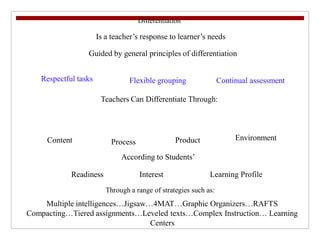
Differentiation
Is a teacher’s response to learner’s needs
Guided by general principles of differentiation
Respectful tasks Flexible grouping Continual assessment
Teachers Can Differentiate Through:
Content Process Product Environment
According to Students’
Readiness Interest Learning Profile
Through a range of strategies such as:
Multiple intelligences…Jigsaw…4MAT…Graphic Organizers…RAFTS
Compacting…Tiered assignments…Leveled texts…Complex Instruction… Learning
Centers
Instructional Practices-AnchorInstructional Practices-Anchor
ActivitiesActivities
“In this class we are never finished.  Learning is a
process that never ends.”
Carol Ann Tomlinson
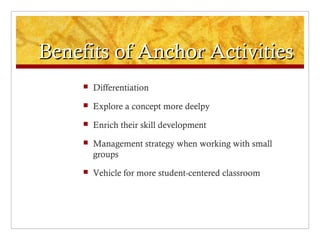
Benefits of Anchor ActivitiesBenefits of Anchor Activities
 Differentiation
 Explore a concept more deelpy
 Enrich their skill development
 Management strategy when working with small
groups
 Vehicle for more student-centered classroom
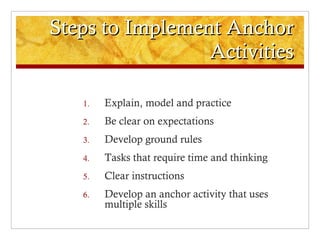
Steps to Implement AnchorSteps to Implement Anchor
ActivitiesActivities
1. Explain, model and practice
2. Be clear on expectations
3. Develop ground rules
4. Tasks that require time and thinking
5. Clear instructions
6. Develop an anchor activity that uses
multiple skills
ANCHOR ACTIVITIESANCHOR ACTIVITIES
Can be:
used in any subject
whole class assignments
small group or individual assignments
tiered to meet the needs of different
readiness levels
Interdisciplinary for use across content
areas or teams
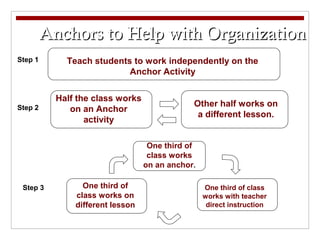
Anchors to Help with OrganizationAnchors to Help with Organization
Step 1 Teach students to work independently on the
Anchor Activity
Step 2
Step 3
Half the class works
on an Anchor
activity
Other half works on
a different lesson.
One third of
class works
on an anchor.
One third of
class works on
different lesson
One third of class
works with teacher
direct instruction
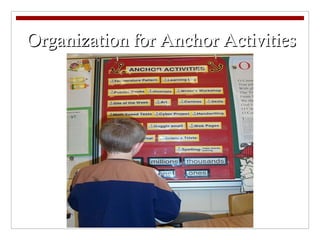
Organization for Anchor ActivitiesOrganization for Anchor Activities
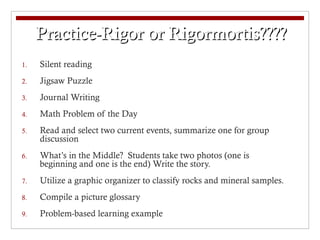
Practice-Rigor or Rigormortis????Practice-Rigor or Rigormortis????
1. Silent reading
2. Jigsaw Puzzle
3. Journal Writing
4. Math Problem of the Day
5. Read and select two current events, summarize one for group
discussion
6. What’s in the Middle? Students take two photos (one is
beginning and one is the end) Write the story.
7. Utilize a graphic organizer to classify rocks and mineral samples.
8. Compile a picture glossary
9. Problem-based learning example
Anchor Activities and RigorAnchor Activities and Rigor
Resources available on the
EIMS PD Wiki
www.eimspd.pbworks.com
Plus/Delta/Issue Bin

Anchor activities

  • 1.
    Anchor Activities Content fromEarly Release October 2010
  • 2.
    Anchor Activities andRigorAnchor Activities and Rigor Pre-planned activities Tied to current or past units of study Readily available
  • 3.
    Anchor Activities andRigorAnchor Activities and Rigor Not “busy work” Meaningful Extension, enrichment or practice
  • 4.
    Instructional Practices-AnchorInstructional Practices-Anchor ActivitiesActivities Differentiated classroom = complete assignments at different rates  ‘Nothing to do’  What to do when they complete assigned work.  Stepping stone for flexible groups
  • 5.
    Differentiation Is a teacher’sresponse to learner’s needs Guided by general principles of differentiation Respectful tasks Flexible grouping Continual assessment Teachers Can Differentiate Through: Content Process Product Environment According to Students’ Readiness Interest Learning Profile Through a range of strategies such as: Multiple intelligences…Jigsaw…4MAT…Graphic Organizers…RAFTS Compacting…Tiered assignments…Leveled texts…Complex Instruction… Learning Centers
  • 6.
    Instructional Practices-AnchorInstructional Practices-Anchor ActivitiesActivities “Inthis class we are never finished.  Learning is a process that never ends.” Carol Ann Tomlinson
  • 7.
    Benefits of AnchorActivitiesBenefits of Anchor Activities  Differentiation  Explore a concept more deelpy  Enrich their skill development  Management strategy when working with small groups  Vehicle for more student-centered classroom
  • 8.
    Steps to ImplementAnchorSteps to Implement Anchor ActivitiesActivities 1. Explain, model and practice 2. Be clear on expectations 3. Develop ground rules 4. Tasks that require time and thinking 5. Clear instructions 6. Develop an anchor activity that uses multiple skills
  • 9.
    ANCHOR ACTIVITIESANCHOR ACTIVITIES Canbe: used in any subject whole class assignments small group or individual assignments tiered to meet the needs of different readiness levels Interdisciplinary for use across content areas or teams
  • 10.
    Anchors to Helpwith OrganizationAnchors to Help with Organization Step 1 Teach students to work independently on the Anchor Activity Step 2 Step 3 Half the class works on an Anchor activity Other half works on a different lesson. One third of class works on an anchor. One third of class works on different lesson One third of class works with teacher direct instruction
  • 11.
    Organization for AnchorActivitiesOrganization for Anchor Activities
  • 12.
    Practice-Rigor or Rigormortis????Practice-Rigoror Rigormortis???? 1. Silent reading 2. Jigsaw Puzzle 3. Journal Writing 4. Math Problem of the Day 5. Read and select two current events, summarize one for group discussion 6. What’s in the Middle? Students take two photos (one is beginning and one is the end) Write the story. 7. Utilize a graphic organizer to classify rocks and mineral samples. 8. Compile a picture glossary 9. Problem-based learning example
  • 13.
    Anchor Activities andRigorAnchor Activities and Rigor Resources available on the EIMS PD Wiki www.eimspd.pbworks.com
  • 14.

Editor's Notes

  • #3 Anchor activities are pre-planned activities, tied to your current or past units of study, that teachers have readily available in the classroom for when students finish early, or for when teachers want to work with small groups of students and ensure that the others are occupied doing meaningful, purposeful work.
  • #4 Anchor activities should not be “busy work,” but meaningful activities that provide extension, enrichment, or practice of key course concepts and skills.
  • #5 In a differentiated classroom students will complete assignments at different rates. Students who complete their assigned work at an acceptable proficiency level should not interpret that there is "nothing to do“ now. Anchor activities are tasks that students know to work on when they complete their assigned work. Anchor activities can be a stepping stone for teachers to begin working with flexible groups.
  • #7 If a student is consistently finishing work early, it is possible that the student is finding the work too easy or is not completing work at acceptable levels of proficiency. It is at that point, the teacher must adjust the level of work or move to enable the student to work to potential at the current level.
  • #8 Can be used to differentiate activities on the basis of student readiness, interest, or learning profile Allow students time to work on independent research, to explore a concept more deeply, and to enrich their skill development Can be used as a management strategy when working with small groups of students Can be a vehicle for making the classroom more student-centered
  • #9 Explain each anchor activity, model and practice the procedure with the whole class. Be clear on expectations—establish clear policy for accountability, evaluation, and value. Develop ground rules with students. Only use tasks that require some time and thinking—it’s not worth the time of making the anchor activity to have the student be able to finish it easily and quickly. Provide clear instructions, materials, responsibilities, and expectations. Develop an anchor activity that has students using multiple skills and several content outcomes.
  • #13 School is having a problem with litter, which is attracting insects into the school and locker areas. What could you present to Student Council and school administration as a solution to this problem.
  • #14 Anchor activities are pre-planned activities, tied to your current or past units of study, that teachers have readily available in the classroom for when students finish early, or for when teachers want to work with small groups of students and ensure that the others are occupied doing meaningful, purposeful work. Anchor activities should not be “busy work,” but meaningful activities that provide extension, enrichment, or practice of key course concepts and skills.