Khaleel Alyahya, PhD, MEd
King Saud University
School of Medicine
@khaleelya
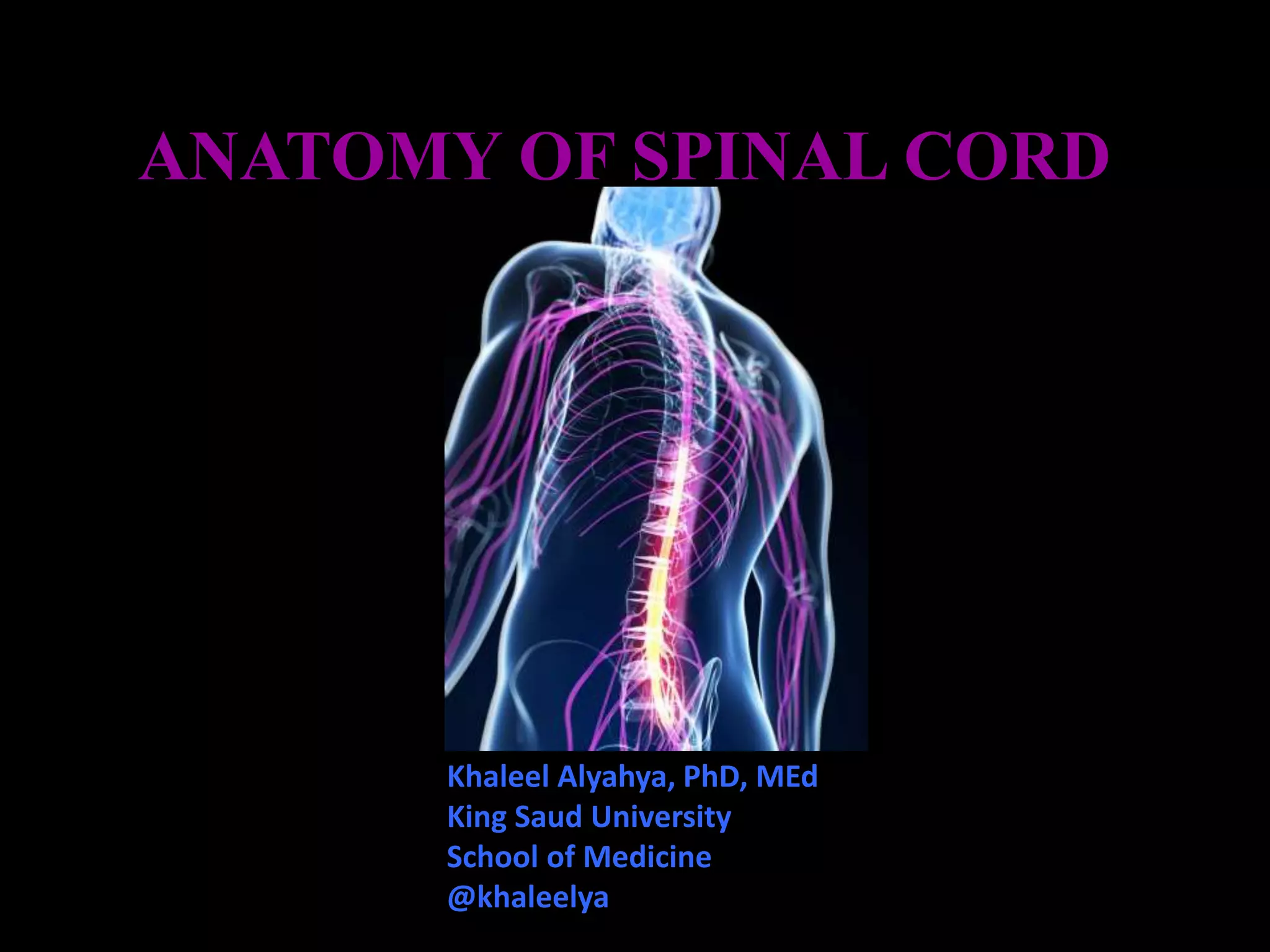
ANATOMY OF SPINAL CORD
Tweet of Today
Resources
Human Anatomy & Physiology
Elaine Marieb
Introduction to Human Body
Gerard Tortora
Human Brain
John Nolte
Google
OBJECTIVES
Attheendofthelecture,studentsshouldbeableto:
 Describetheexternalanatomy of thespinalcord.
 Describetheinternalanatomy of thespinal cord.
 Describethespinal nerves:formation, branchesanddistribution viaplexuses.
 Describe themeningesofthespinal cord.
 Defineareflexandreflexarc,anddescribethecomponents of thereflexarc.
REVIEW
FUNCTIONS
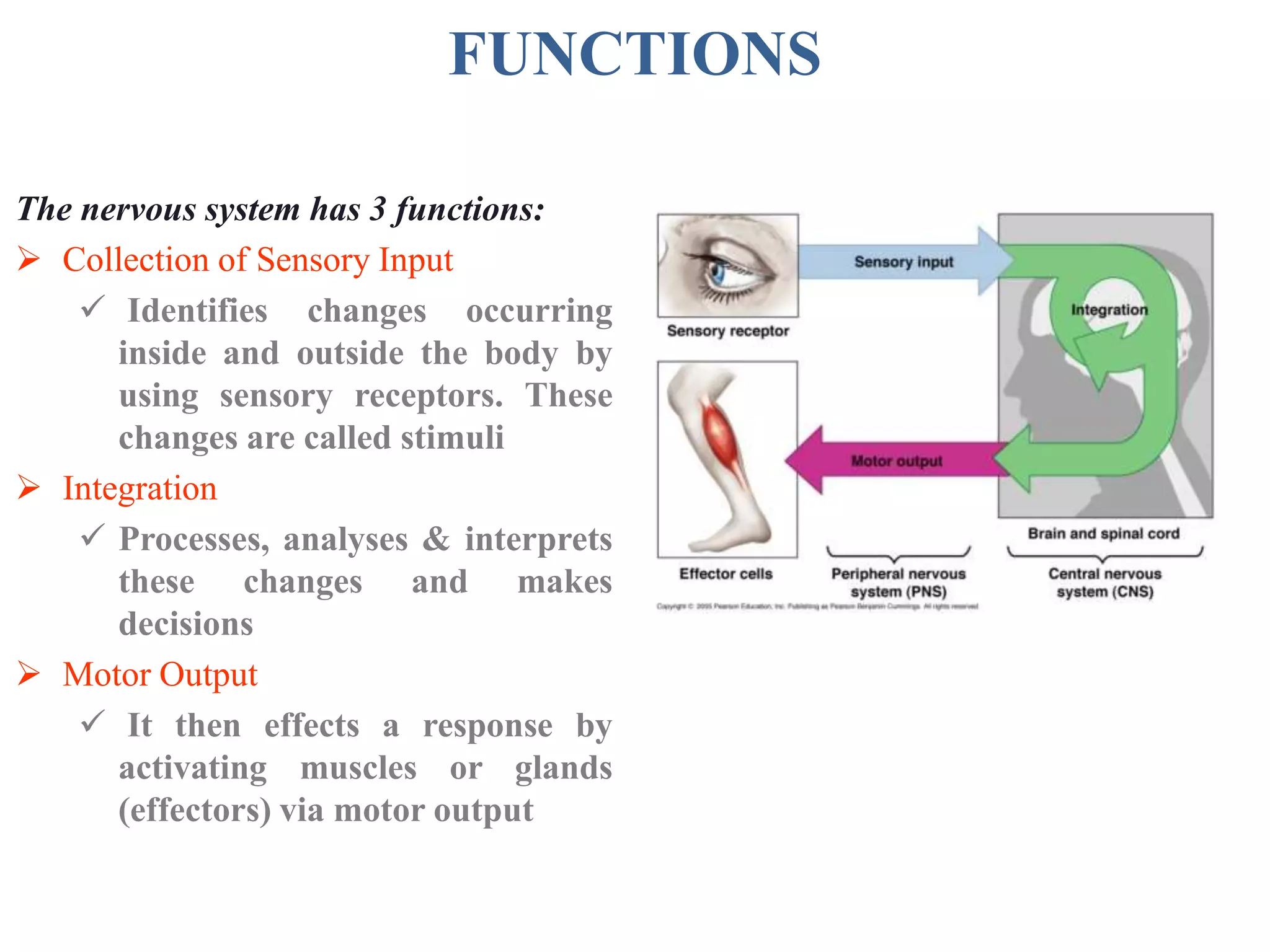
The nervous system has 3 functions:
 Collection of Sensory Input
 Identifies changes occurring
inside and outside the body by
using sensory receptors. These
changes are called stimuli
 Integration
 Processes, analyses & interprets
these changes and makes
decisions
 Motor Output
 It then effects a response by
activating muscles or glands
(effectors) via motor output
ORGANIZATION
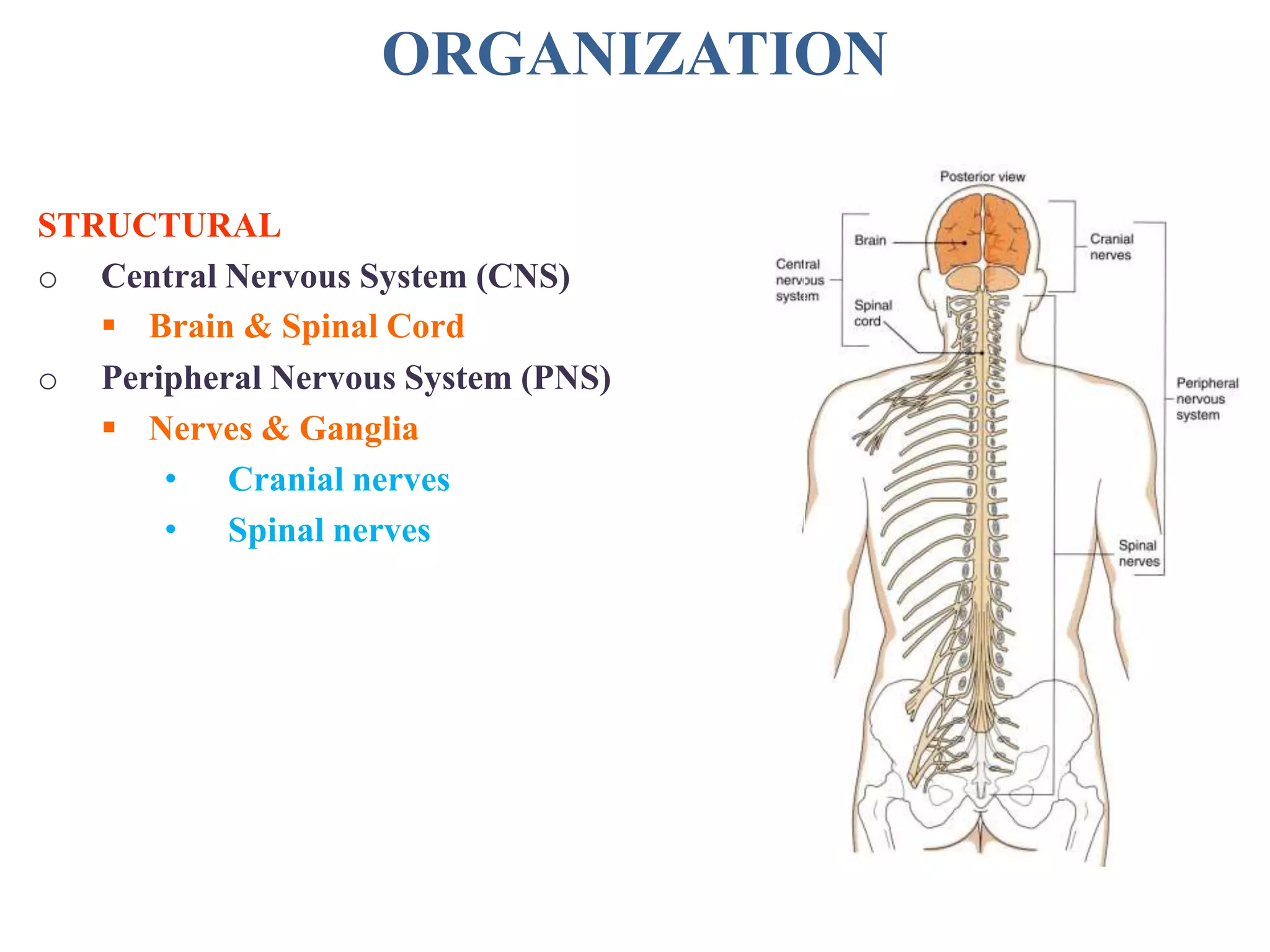
STRUCTURAL
o Central Nervous System (CNS)
 Brain & Spinal Cord
o Peripheral Nervous System (PNS)
 Nerves & Ganglia
• Cranial nerves
• Spinal nerves
ORGANIZATION
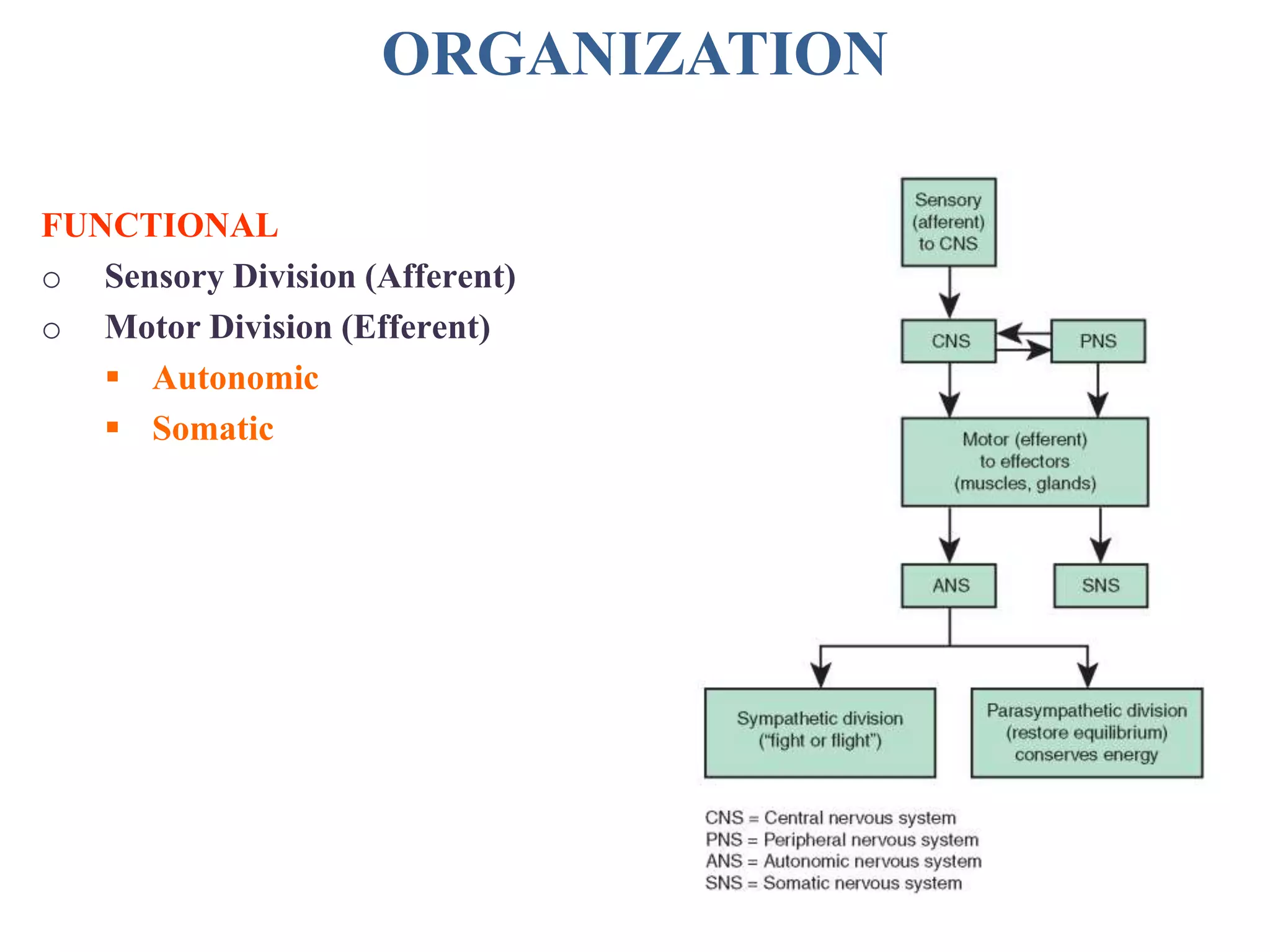
FUNCTIONAL
o Sensory Division (Afferent)
o Motor Division (Efferent)
 Autonomic
 Somatic
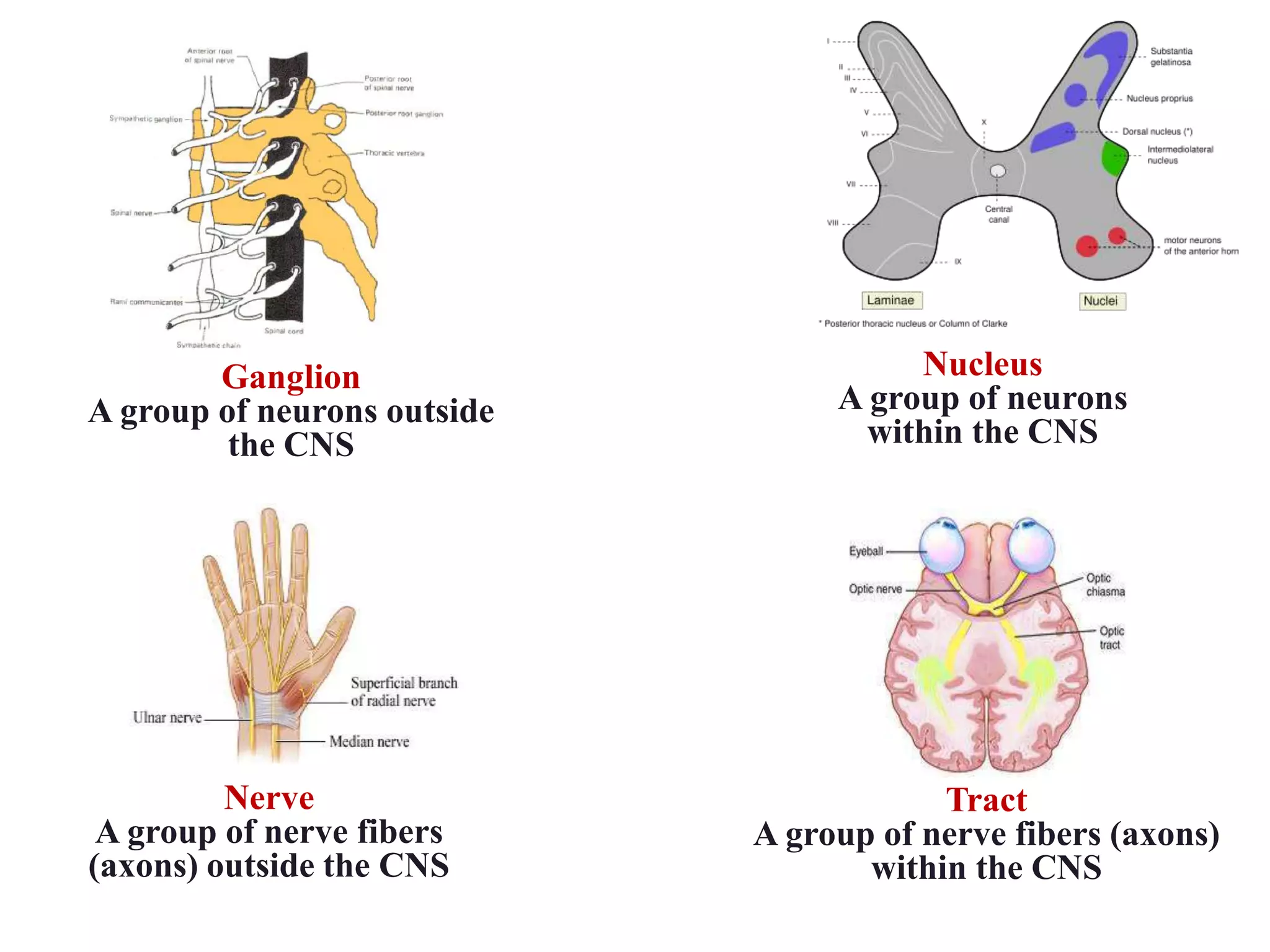
Nucleus
A group of neurons
within the CNS
Ganglion
A group of neurons outside
the CNS
Tract
A group of nerve fibers (axons)
within the CNS
Nerve
A group of nerve fibers
(axons) outside the CNS
SPINAL CORD
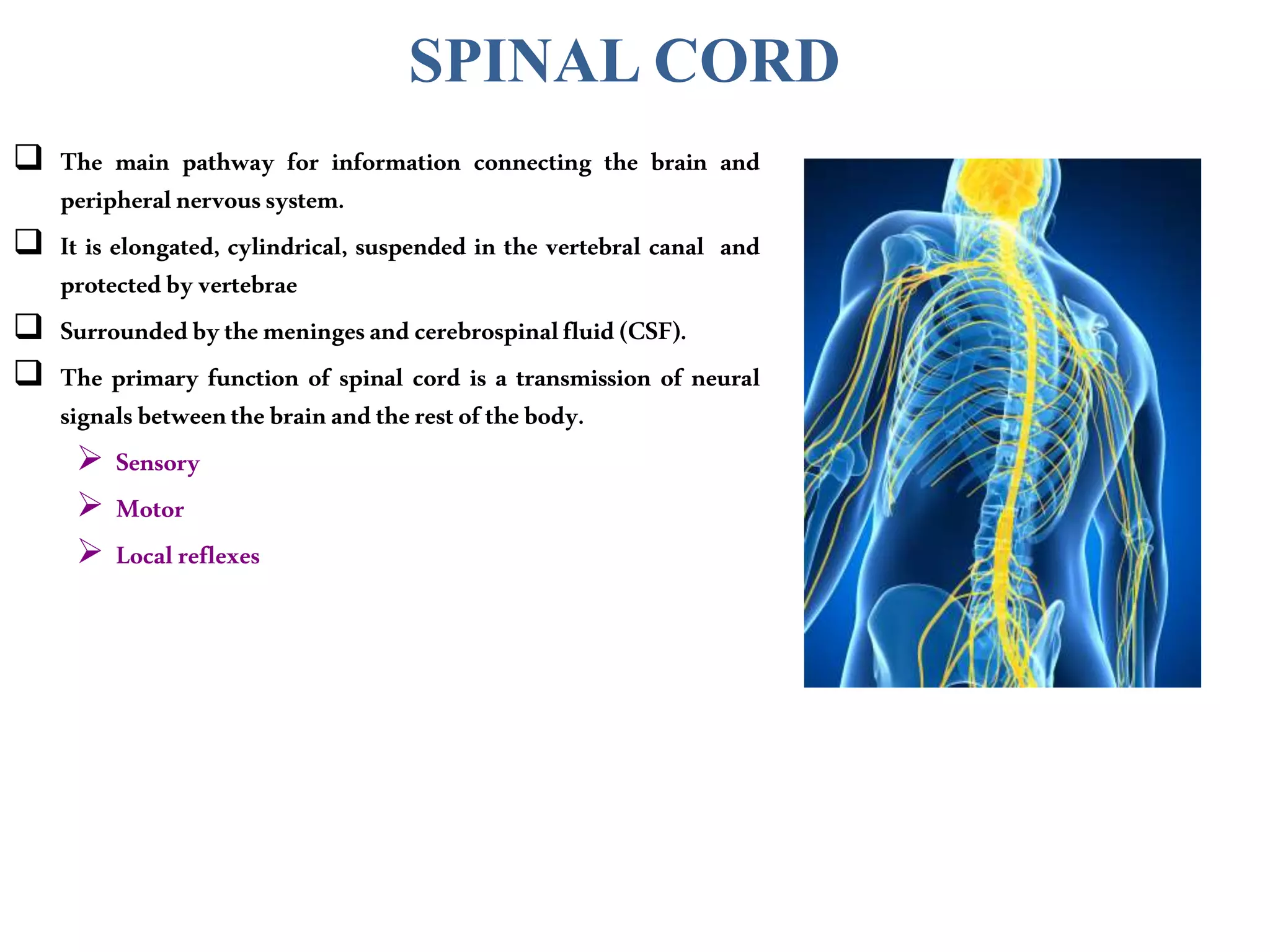
 The main pathway for information connecting the brain and
peripheralnervoussystem.
 It is elongated, cylindrical, suspended in the vertebral canal and
protectedbyvertebrae
 Surroundedbythemeningesandcerebrospinalfluid(CSF).
 The primary function of spinal cord is a transmission of neural
signalsbetweenthebrainandtherestofthebody.
 Sensory
 Motor
 Localreflexes
SPINAL CORD
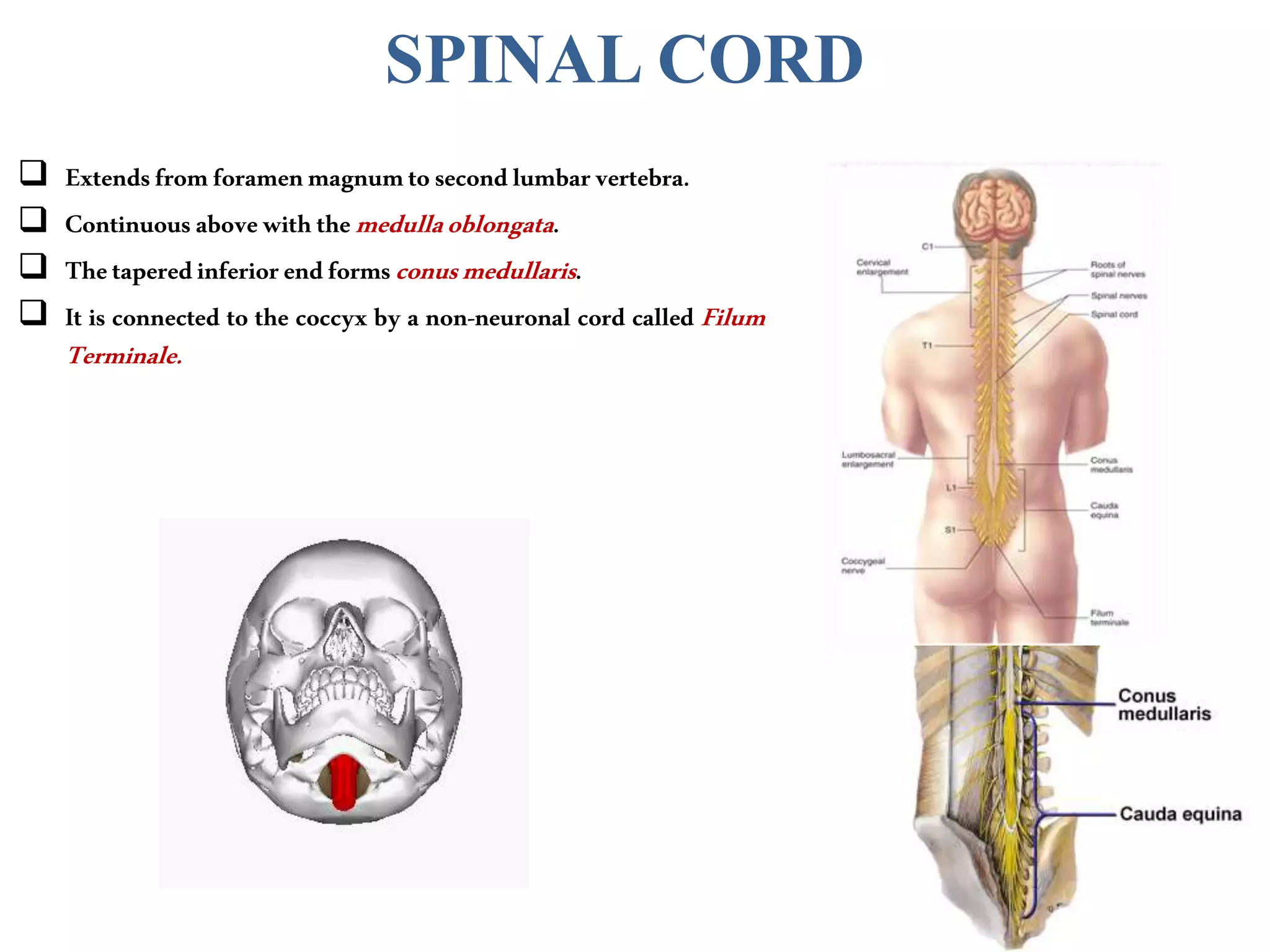
 Extendsfromforamenmagnumtosecondlumbarvertebra.
 Continuousabovewiththemedullaoblongata.
 Thetaperedinferiorendformsconusmedullaris.
 It is connected to the coccyx by a non-neuronal cord called Filum
Terminale.
SPINAL CORD
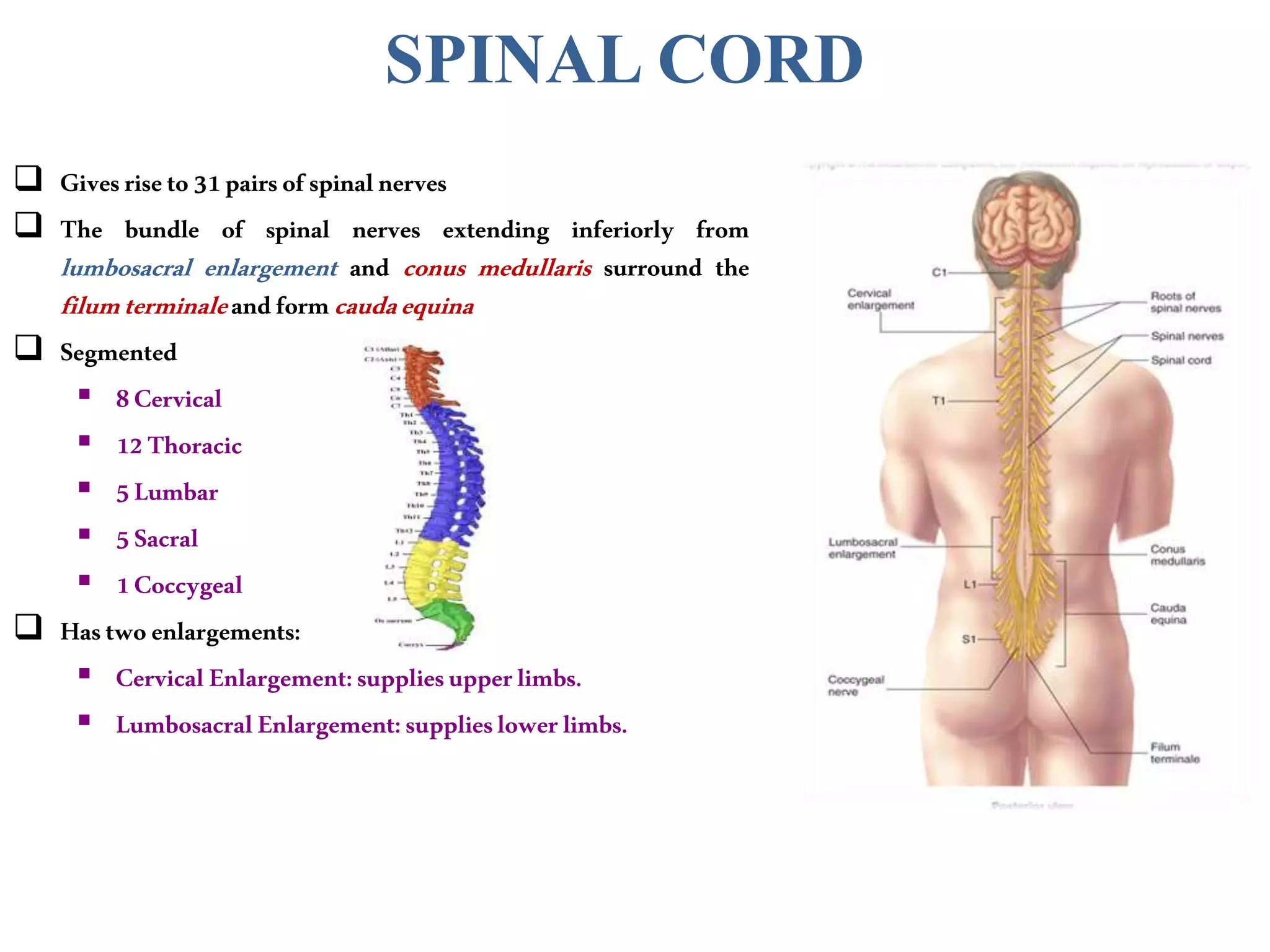
 Givesriseto31pairsofspinalnerves
 The bundle of spinal nerves extending inferiorly from
lumbosacral enlargement and conus medullaris surround the
filumterminaleandformcaudaequina
 Segmented
 8Cervical
 12Thoracic
 5Lumbar
 5Sacral
 1Coccygeal
 Hastwoenlargements:
 CervicalEnlargement:suppliesupperlimbs.
 LumbosacralEnlargement:supplieslowerlimbs.
CROSS SECTION OF SPINAL CORD
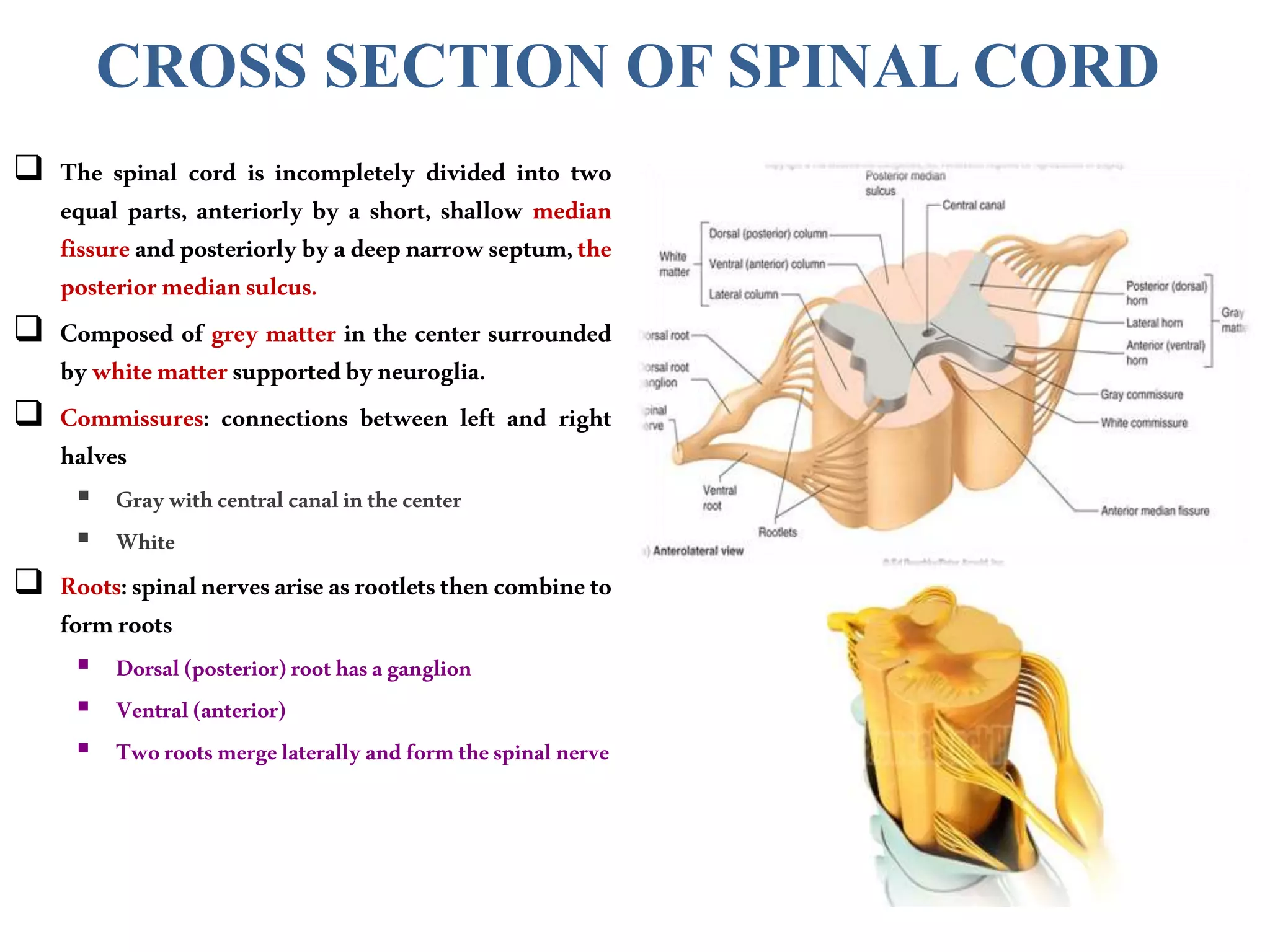
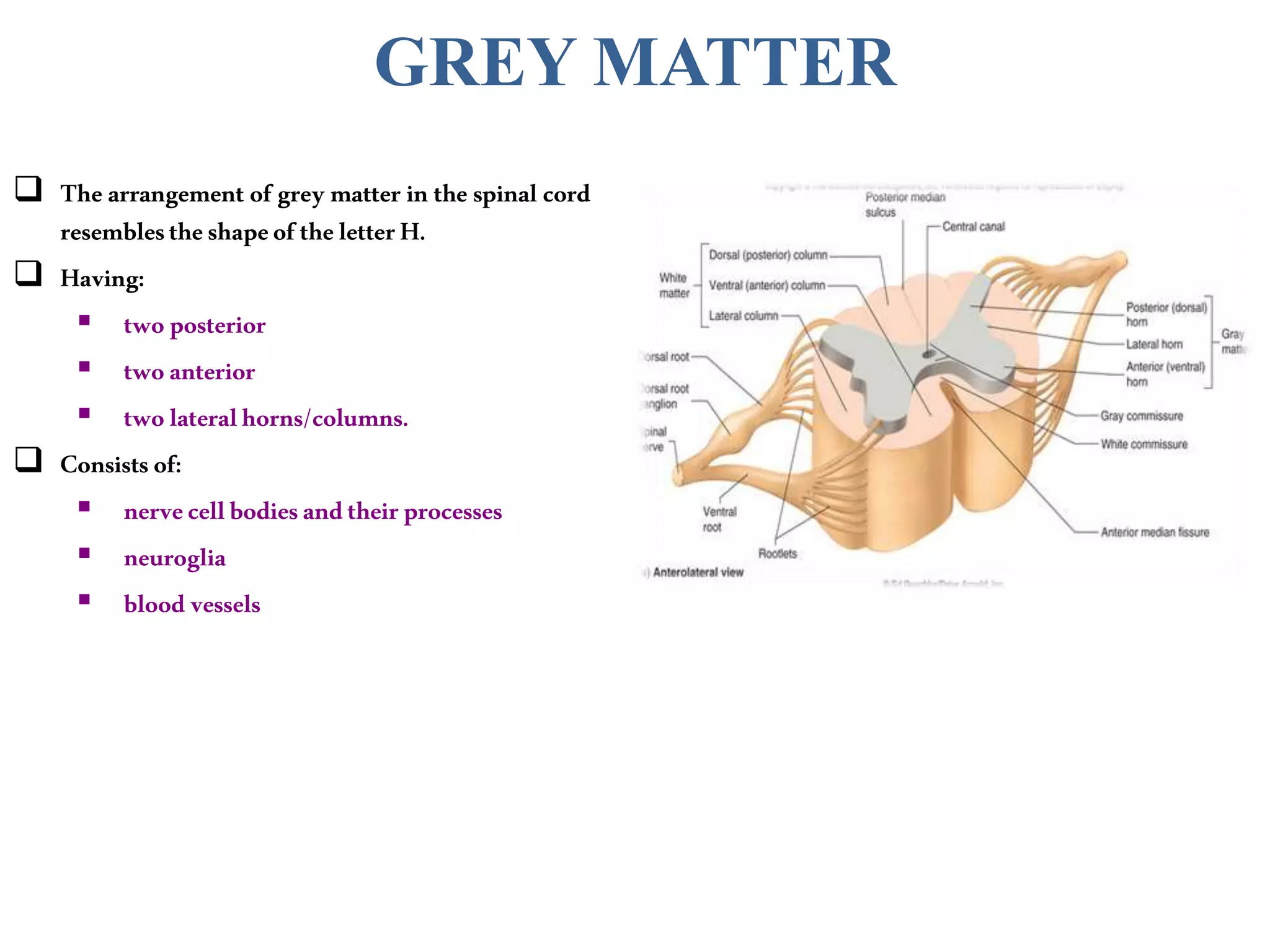
 The spinal cord is incompletely divided into two
equal parts, anteriorly by a short, shallow median
fissureandposteriorlybyadeepnarrowseptum,the
posteriormediansulcus.
 Composed of grey matter in the center surrounded
bywhitemattersupportedbyneuroglia.
 Commissures: connections between left and right
halves
 Graywithcentral canalin thecenter
 White
 Roots:spinalnervesariseasrootletsthencombineto
formroots
 Dorsal(posterior)root hasaganglion
 Ventral (anterior)
 Tworootsmergelaterallyand formthespinal nerve
 The arrangement of grey matter in the spinal cord
resemblestheshapeoftheletterH.
 Having:
 twoposterior
 twoanterior
 twolateralhorns/columns.
 Consistsof:
 nervecellbodiesandtheirprocesses
 neuroglia
 blood vessels
GREY MATTER
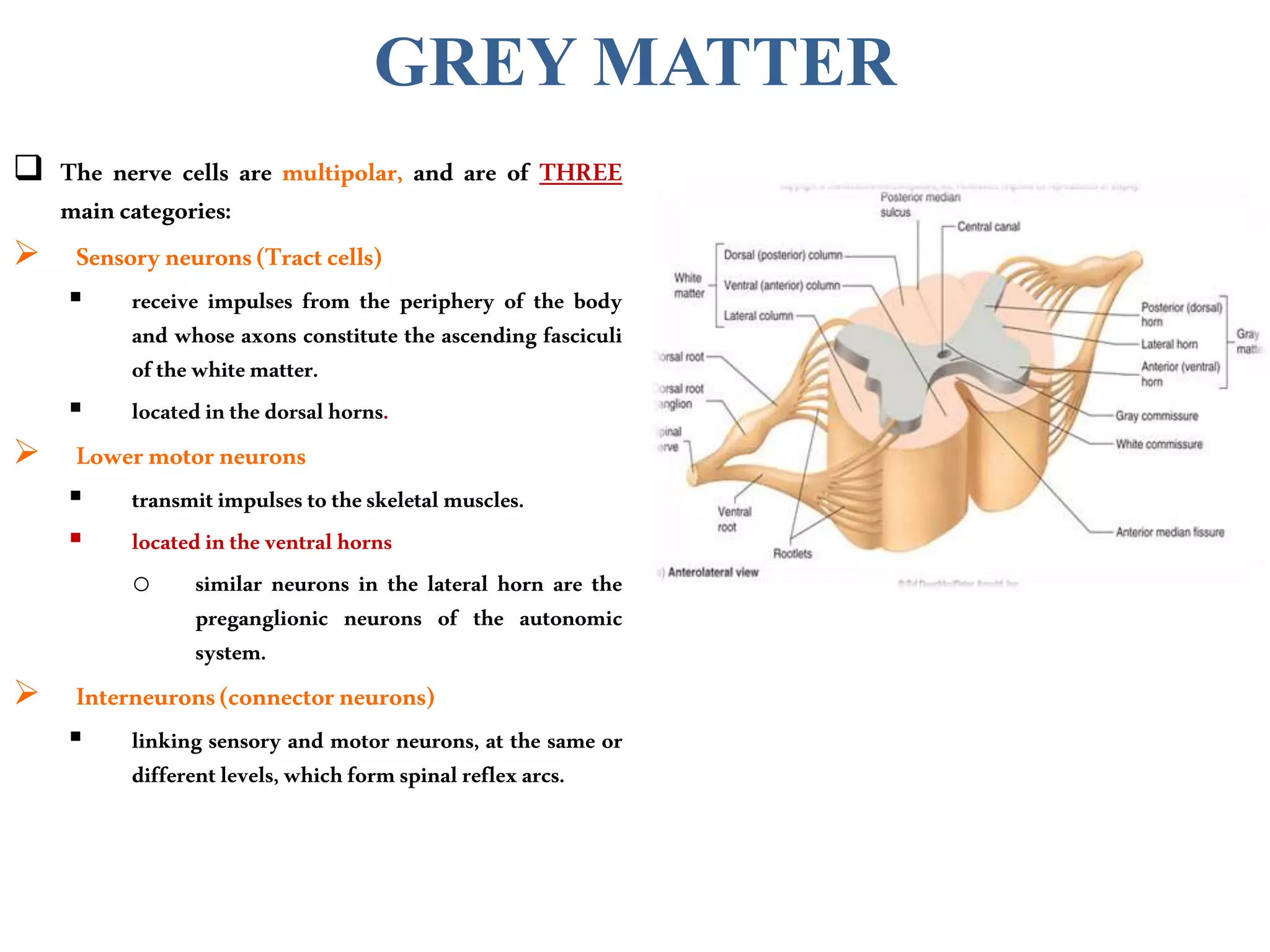
 The nerve cells are multipolar, and are of THREE
maincategories:
 Sensoryneurons(Tractcells)
 receive impulses from the periphery of the body
and whose axons constitute the ascending fasciculi
ofthewhitematter.
 locatedinthe dorsalhorns.
 Lowermotorneurons
 transmitimpulses to theskeletal muscles.
 locatedinthe ventral horns
o similar neurons in the lateral horn are the
preganglionic neurons of the autonomic
system.
 Interneurons(connectorneurons)
 linking sensory and motor neurons, at the same or
differentlevels,whichformspinal reflexarcs.
GREY MATTER
NEURONALARCHITECTURE OF
SPINAL GREY MATTER
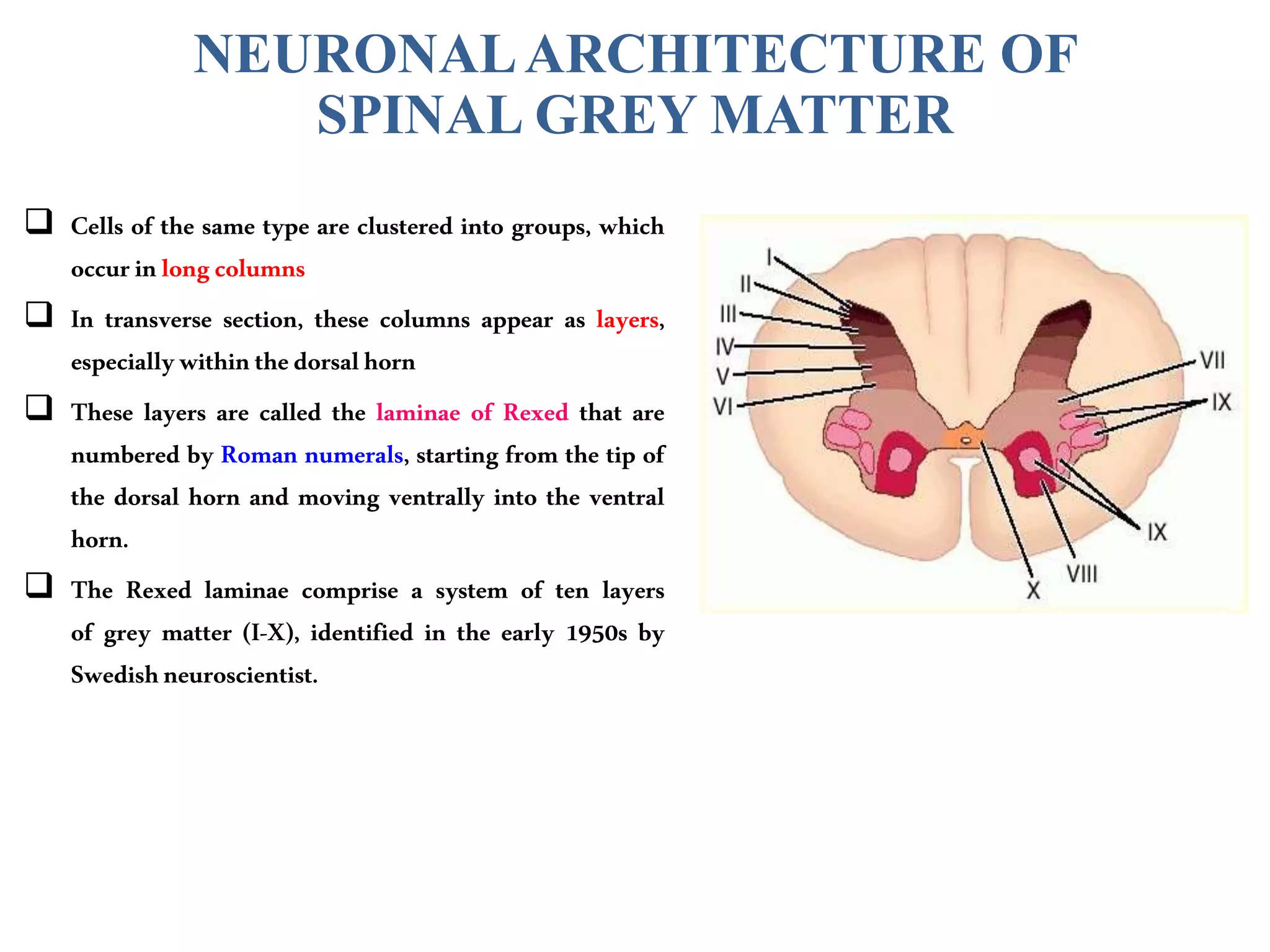
 Cells of the same type are clustered into groups, which
occurinlongcolumns
 In transverse section, these columns appear as layers,
especiallywithinthedorsalhorn
 These layers are called the laminae of Rexed that are
numbered by Roman numerals, starting from the tip of
the dorsal horn and moving ventrally into the ventral
horn.
 The Rexed laminae comprise a system of ten layers
of grey matter (I-X), identified in the early 1950s by
Swedishneuroscientist.
NERVE CELL GROUPS IN DORSAL HORN
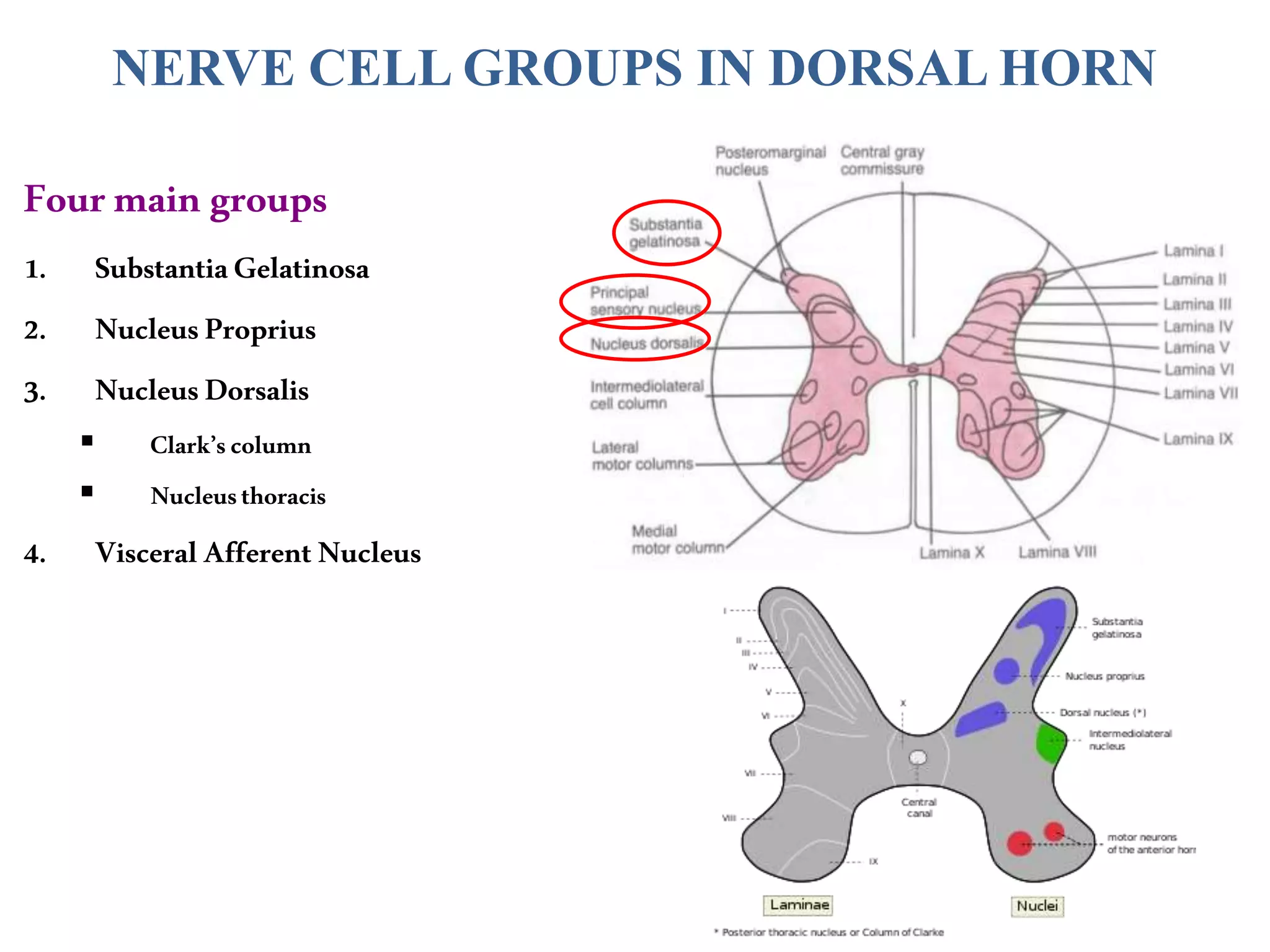
Fourmain groups
1. SubstantiaGelatinosa
2. NucleusProprius
3. NucleusDorsalis
 Clark’scolumn
 Nucleusthoracis
4. VisceralAfferentNucleus
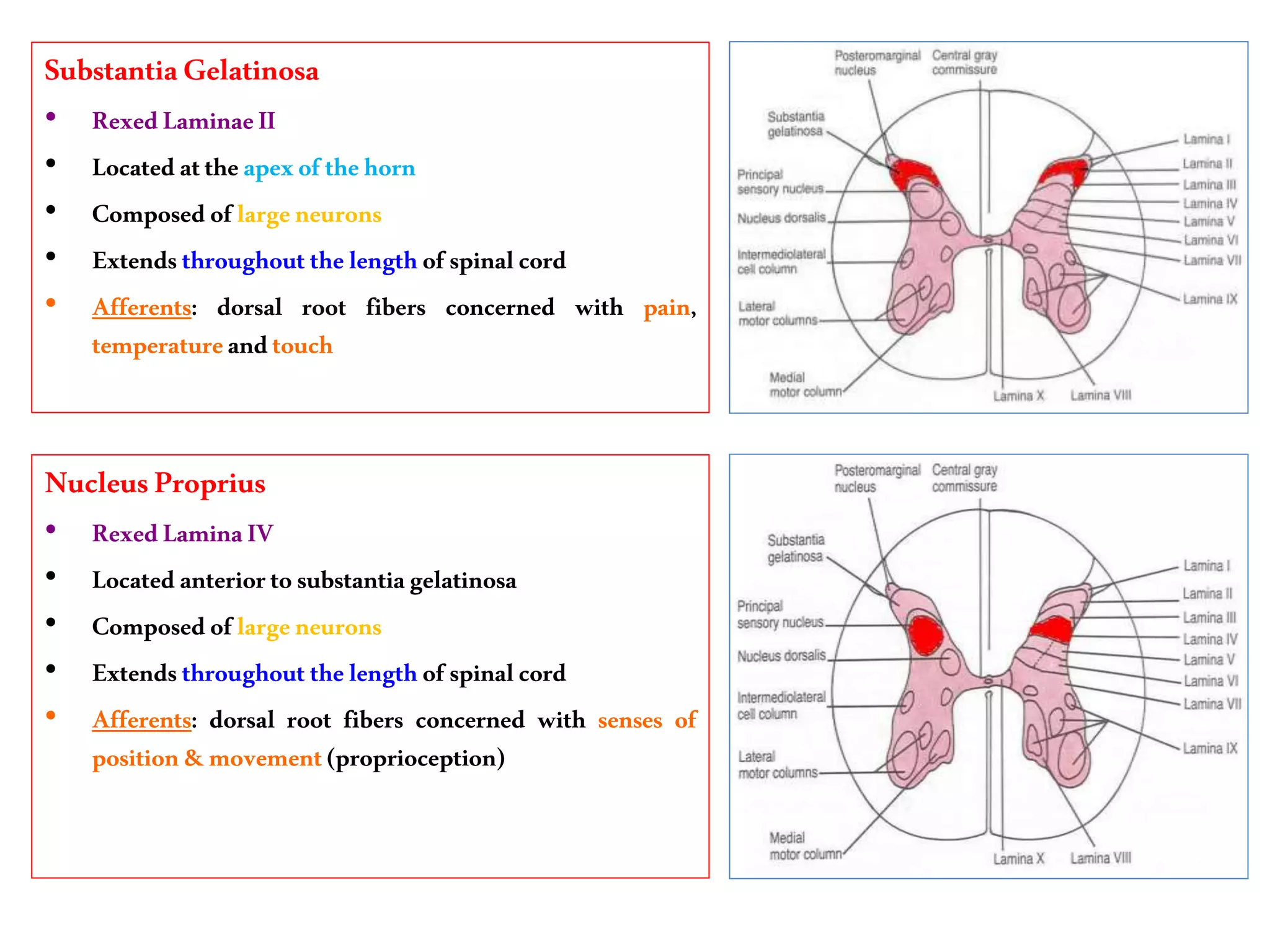
SubstantiaGelatinosa
• RexedLaminaeII
• Locatedattheapexofthehorn
• Composedoflargeneurons
• Extendsthroughoutthelengthof spinalcord
• Afferents: dorsal root fibers concerned with pain,
temperatureandtouch
NucleusProprius
• RexedLaminaIV
• Locatedanteriortosubstantiagelatinosa
• Composedoflargeneurons
• Extendsthroughoutthelengthof spinalcord
• Afferents: dorsal root fibers concerned with senses of
position&movement(proprioception)
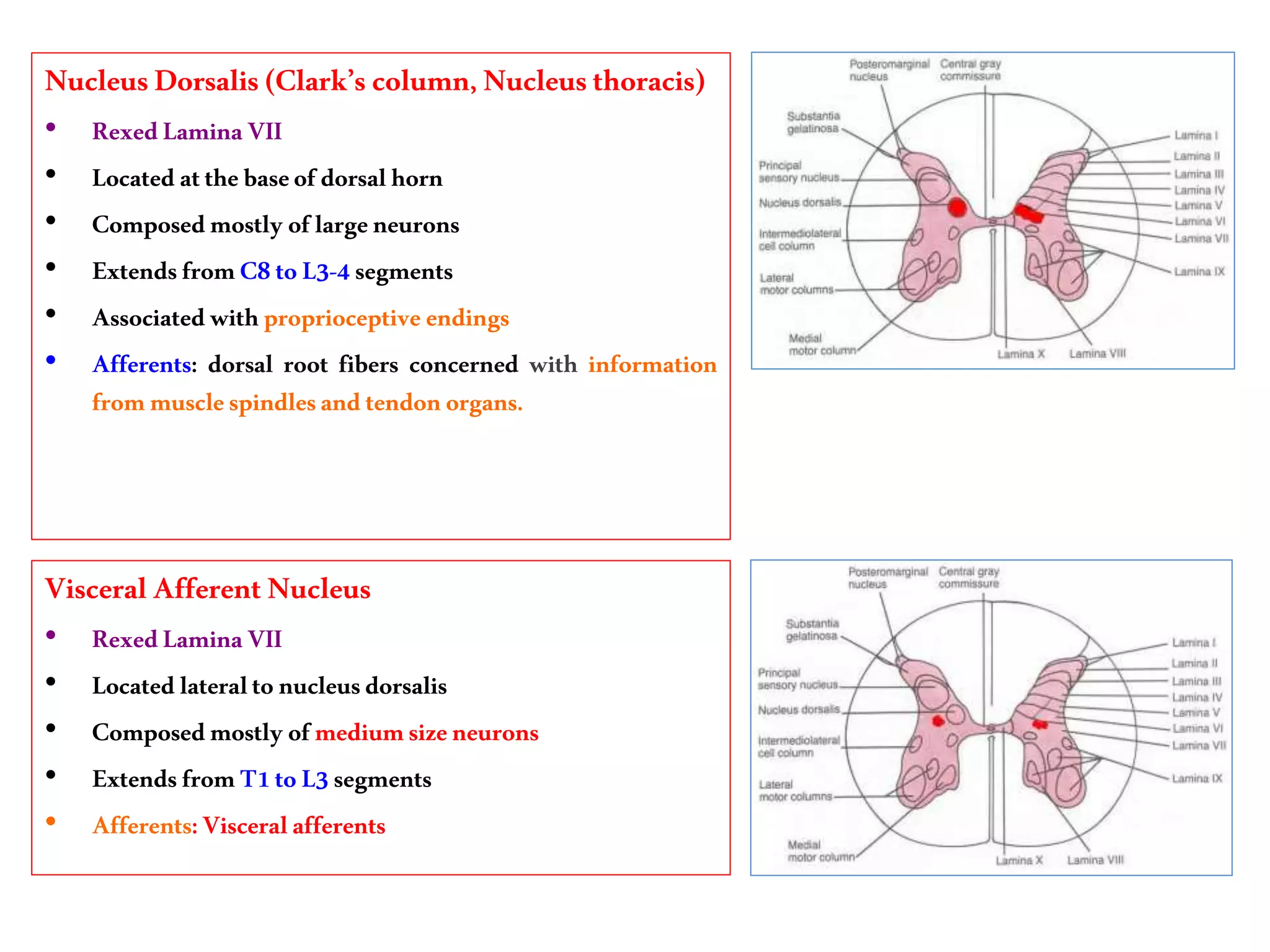
NucleusDorsalis (Clark’s column,Nucleusthoracis)
• RexedLaminaVII
• Locatedatthebaseofdorsalhorn
• Composedmostlyoflargeneurons
• ExtendsfromC8toL3-4segments
• Associatedwithproprioceptiveendings
• Afferents: dorsal root fibers concerned with information
frommusclespindlesandtendonorgans.
VisceralAfferentNucleus
• RexedLaminaVII
• Locatedlateraltonucleusdorsalis
• Composedmostlyofmediumsizeneurons
• ExtendsfromT1toL3segments
• Afferents:Visceralafferents
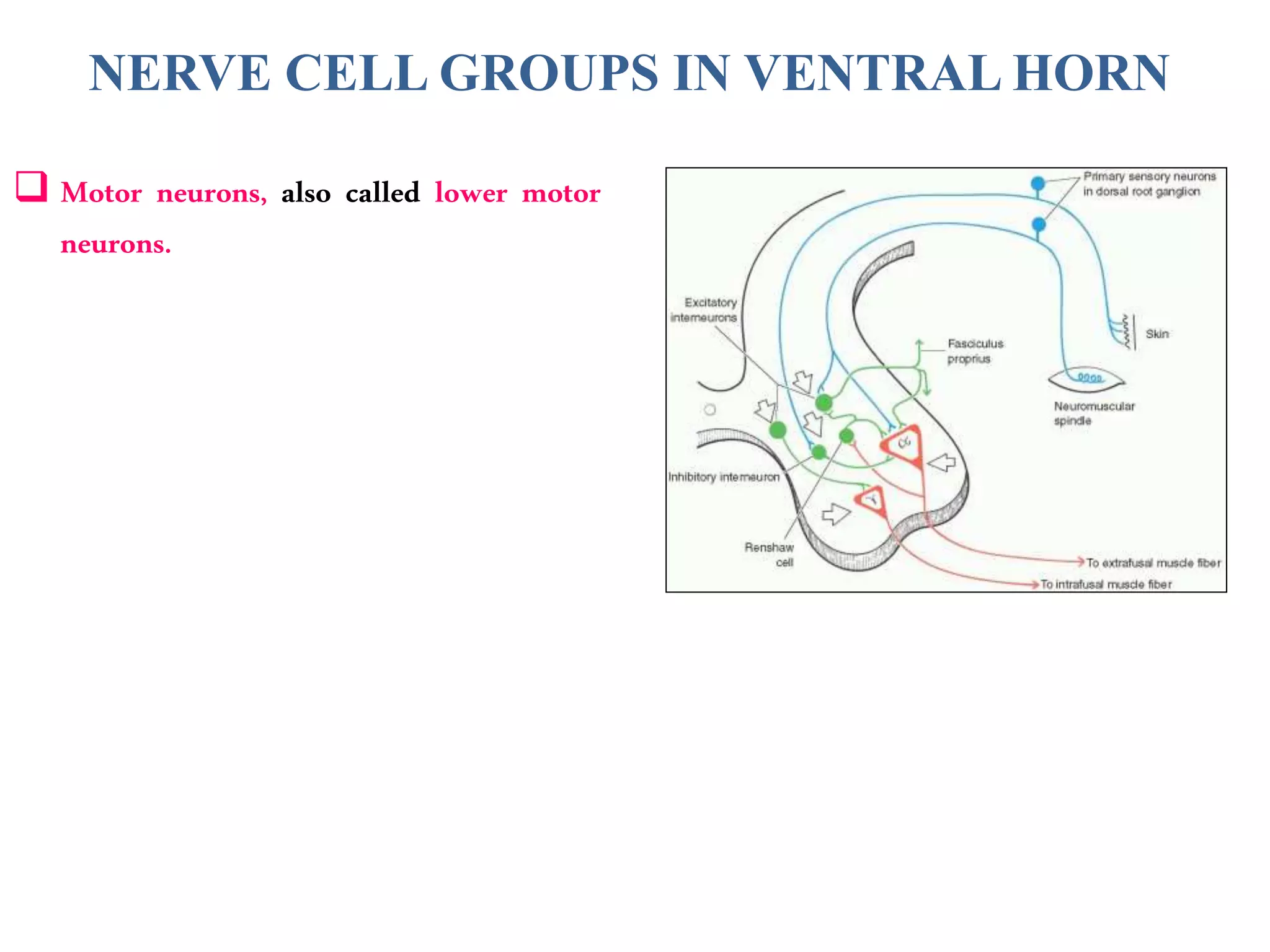
NERVE CELL GROUPS IN VENTRAL HORN
 Motor neurons, also called lower motor
neurons.
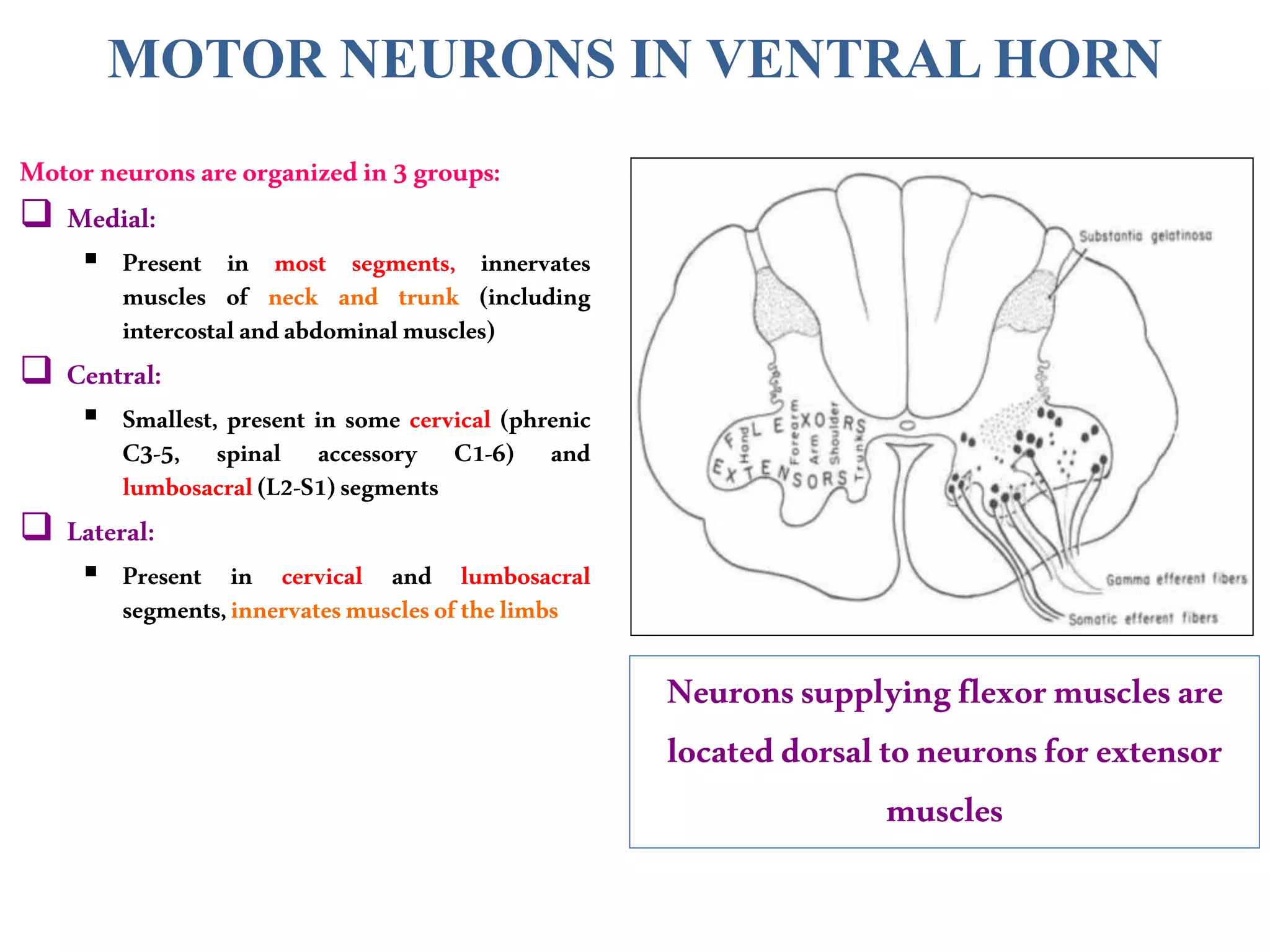
MOTOR NEURONS IN VENTRAL HORN
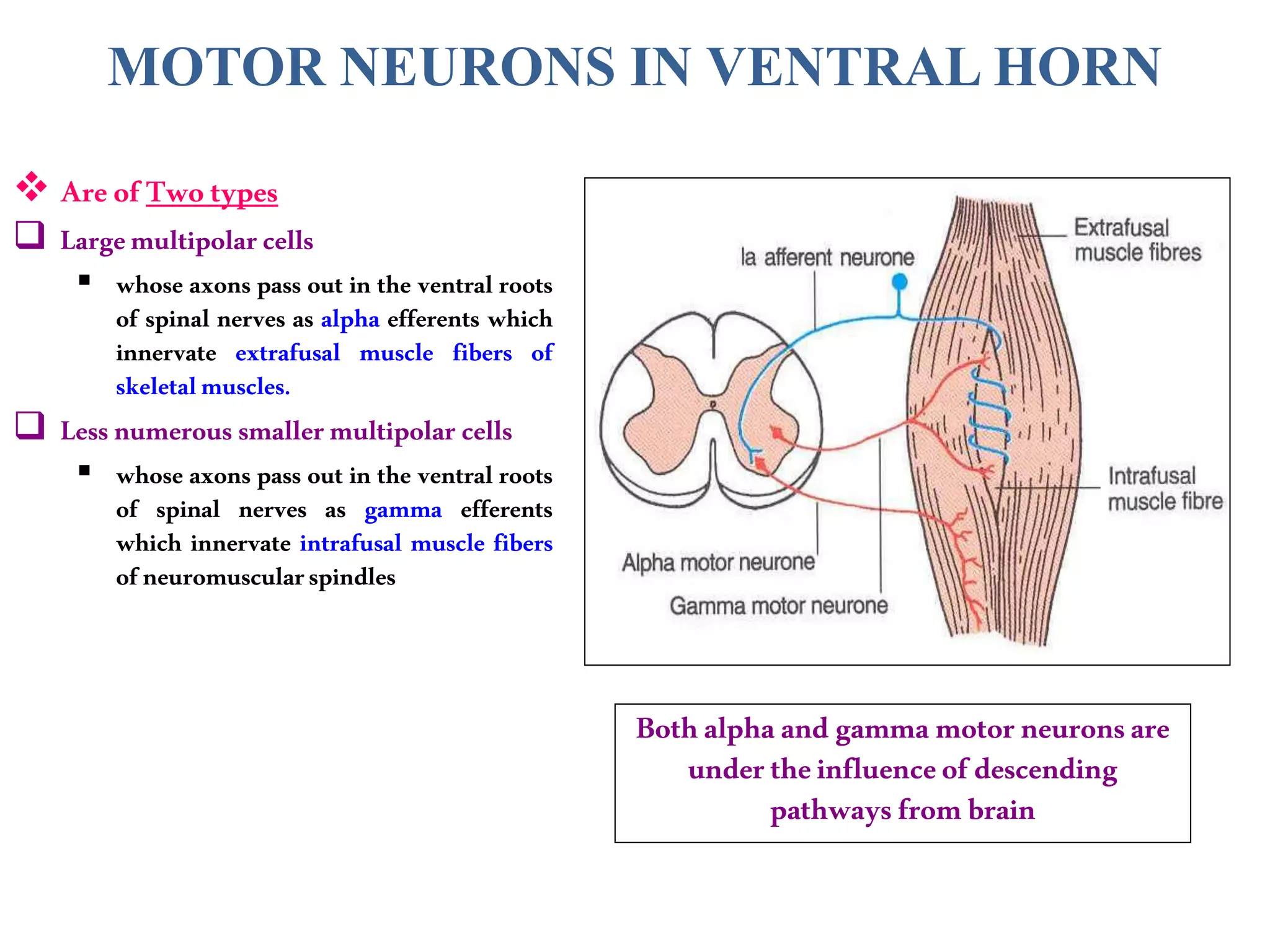
 AreofTwo types
 Largemultipolarcells
 whose axons pass out in the ventral roots
of spinal nerves as alpha efferents which
innervate extrafusal muscle fibers of
skeletalmuscles.
 Lessnumerous smallermultipolar cells
 whose axons pass out in the ventral roots
of spinal nerves as gamma efferents
which innervate intrafusal muscle fibers
ofneuromuscularspindles
Bothalphaand gamma motorneuronsare
undertheinfluenceofdescending
pathwaysfrombrain
Motor neurons areorganizedin3groups:
 Medial:
 Present in most segments, innervates
muscles of neck and trunk (including
intercostalandabdominalmuscles)
 Central:
 Smallest, present in some cervical (phrenic
C3-5, spinal accessory C1-6) and
lumbosacral(L2-S1)segments
 Lateral:
 Present in cervical and lumbosacral
segments,innervatesmusclesofthelimbs
Neuronssupplyingflexormusclesare
locateddorsaltoneuronsforextensor
muscles
MOTOR NEURONS IN VENTRAL HORN
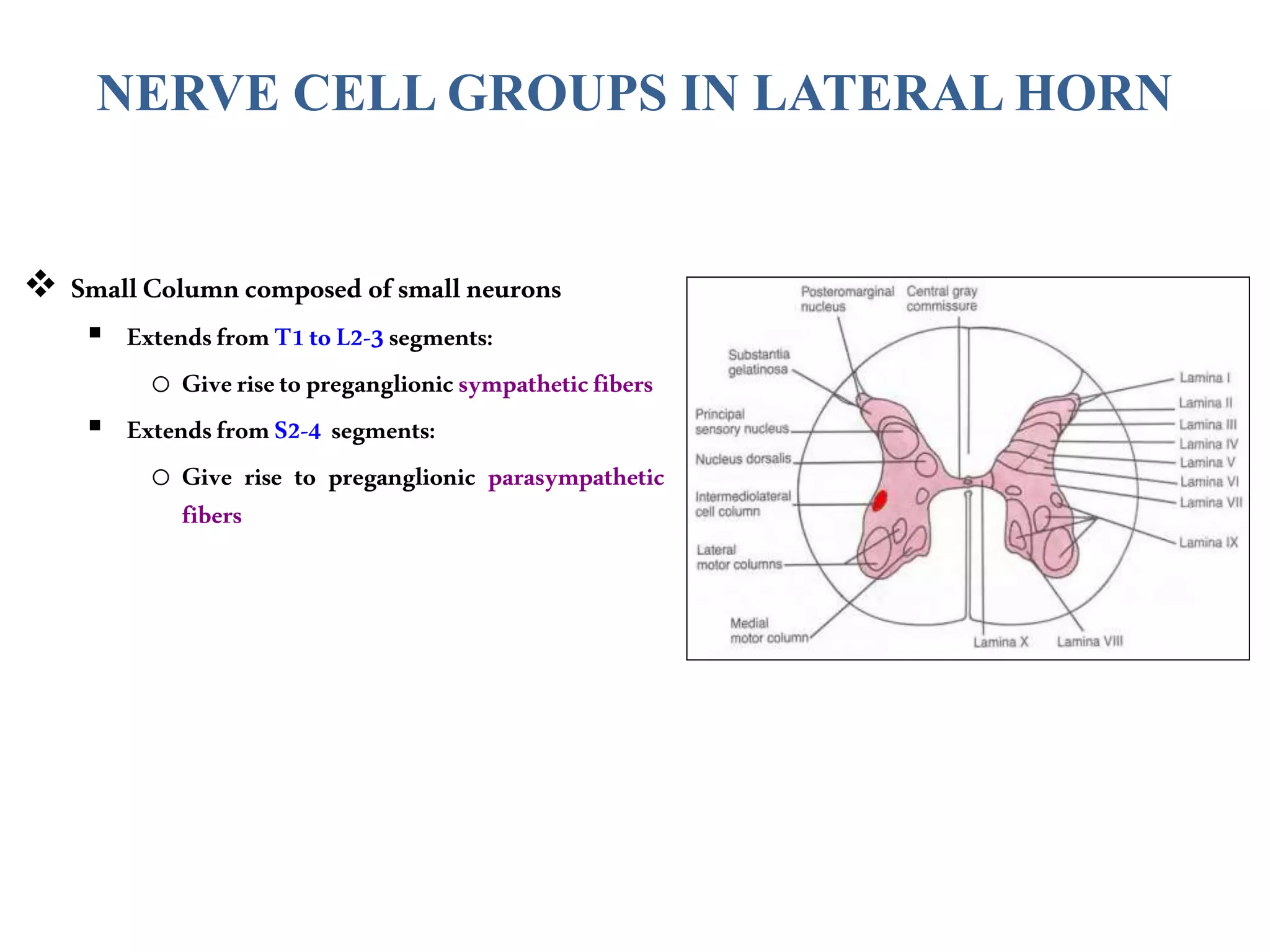
NERVE CELL GROUPS IN LATERAL HORN
 SmallColumncomposed of smallneurons
 ExtendsfromT1toL2-3segments:
o Giverisetopreganglionicsympatheticfibers
 ExtendsfromS2-4 segments:
o Give rise to preganglionic parasympathetic
fibers
WHITE MATTER
 Consists of mixture of nerve fibers, neuroglia and blood
vessels.
 White color is due to high proportion of myelinated
nervefibers
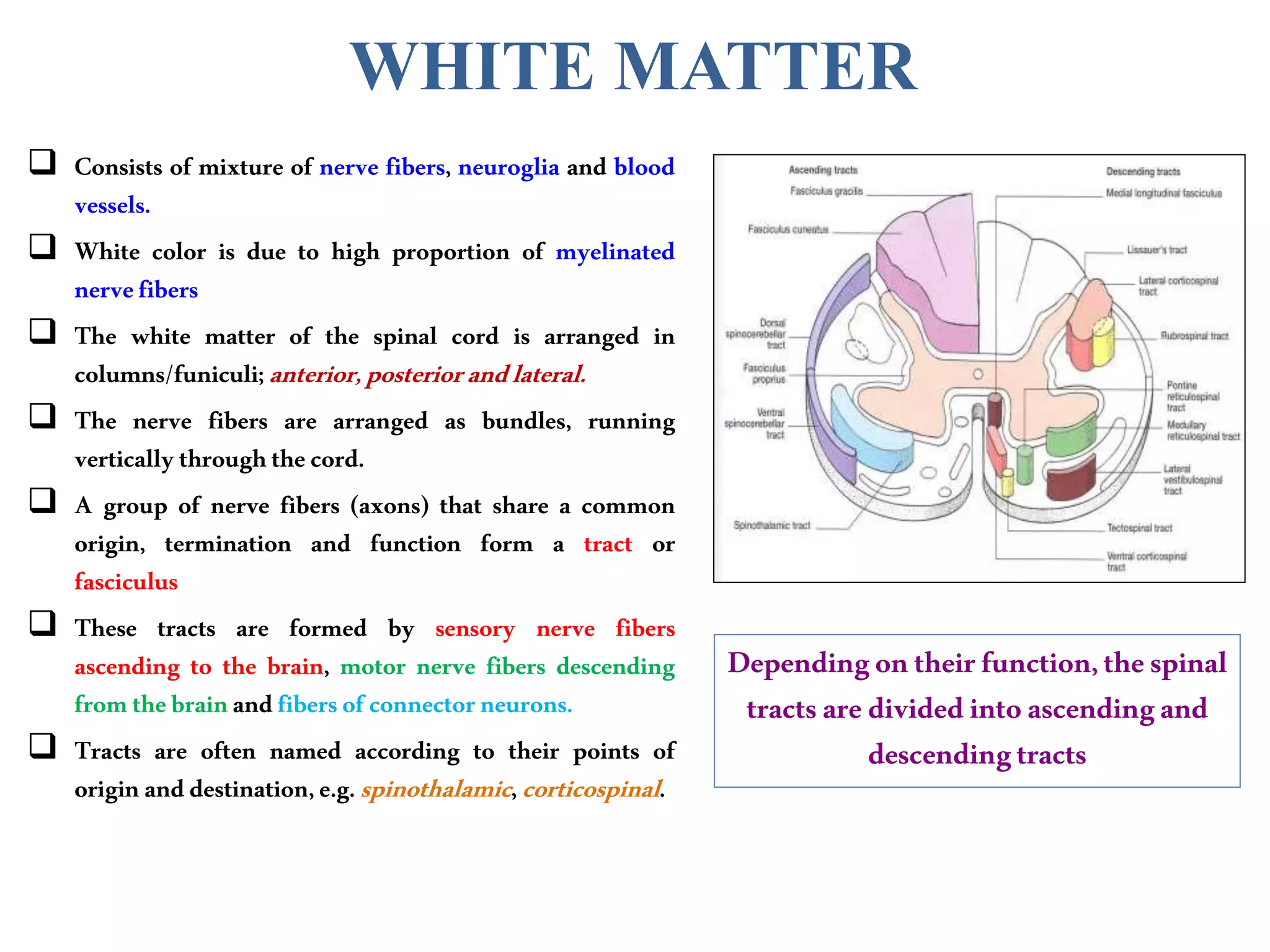
 The white matter of the spinal cord is arranged in
columns/funiculi;anterior,posteriorandlateral.
 The nerve fibers are arranged as bundles, running
verticallythroughthecord.
 A group of nerve fibers (axons) that share a common
origin, termination and function form a tract or
fasciculus
 These tracts are formed by sensory nerve fibers
ascending to the brain, motor nerve fibers descending
fromthebrainandfibersofconnectorneurons.
 Tracts are often named according to their points of
originanddestination,e.g.spinothalamic,corticospinal.
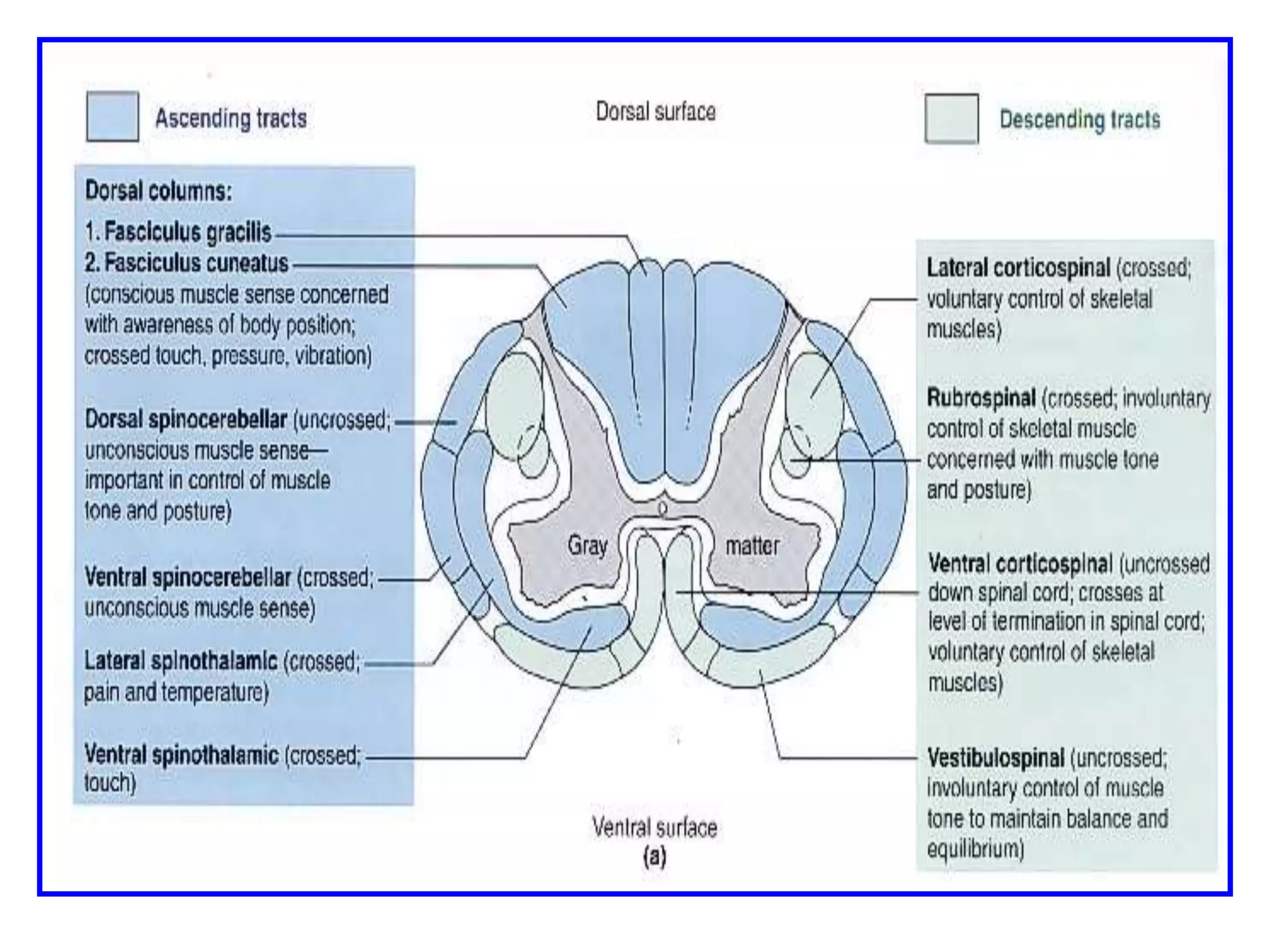
Dependingontheirfunction,thespinal
tractsaredividedintoascendingand
descendingtracts
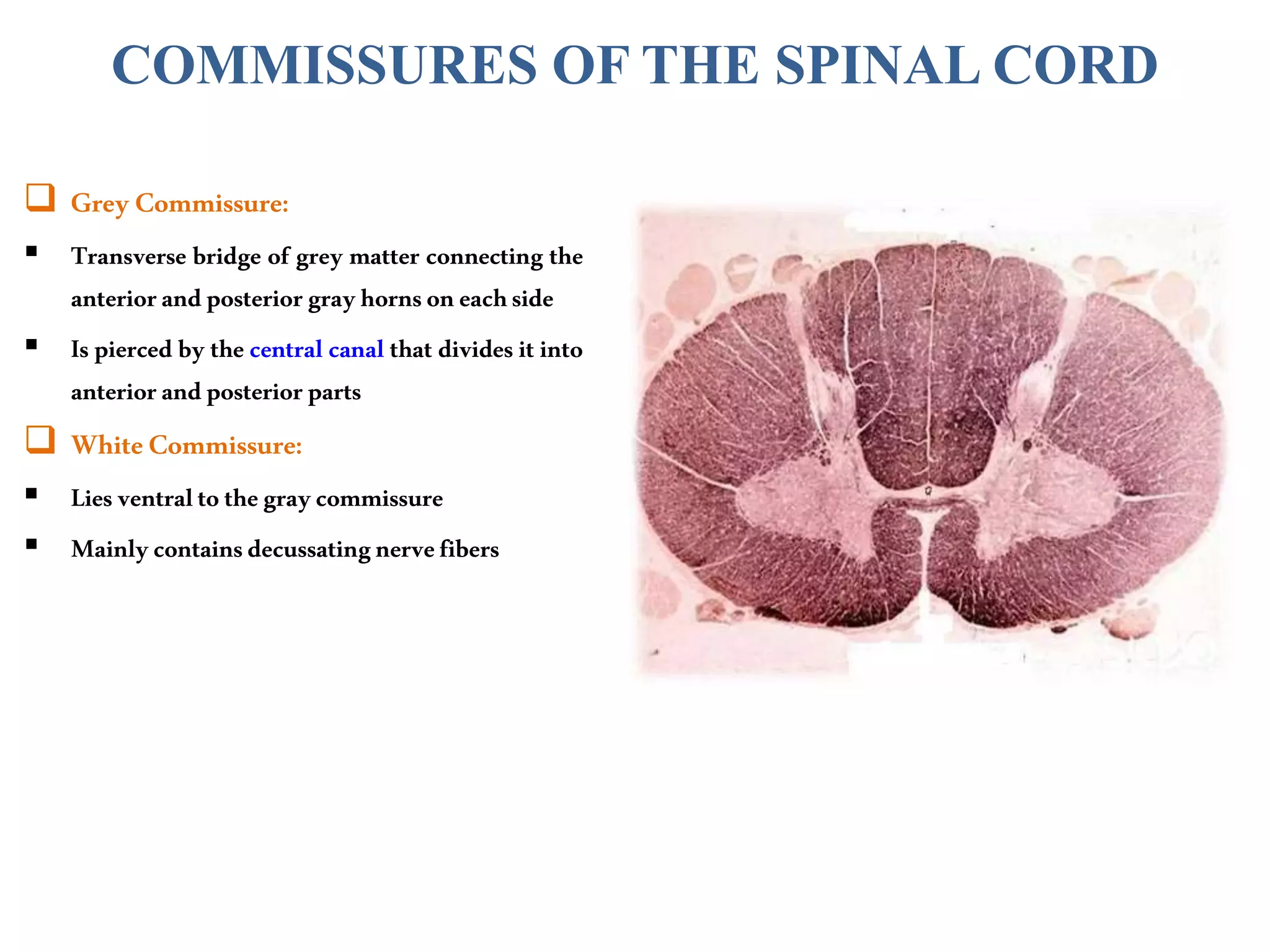
COMMISSURES OF THE SPINAL CORD
 Grey Commissure:
 Transverse bridge of grey matter connecting the
anteriorandposteriorgrayhornsoneachside
 Is pierced by the central canal that divides it into
anteriorandposteriorparts
 White Commissure:
 Liesventraltothegraycommissure
 Mainlycontainsdecussatingnervefibers
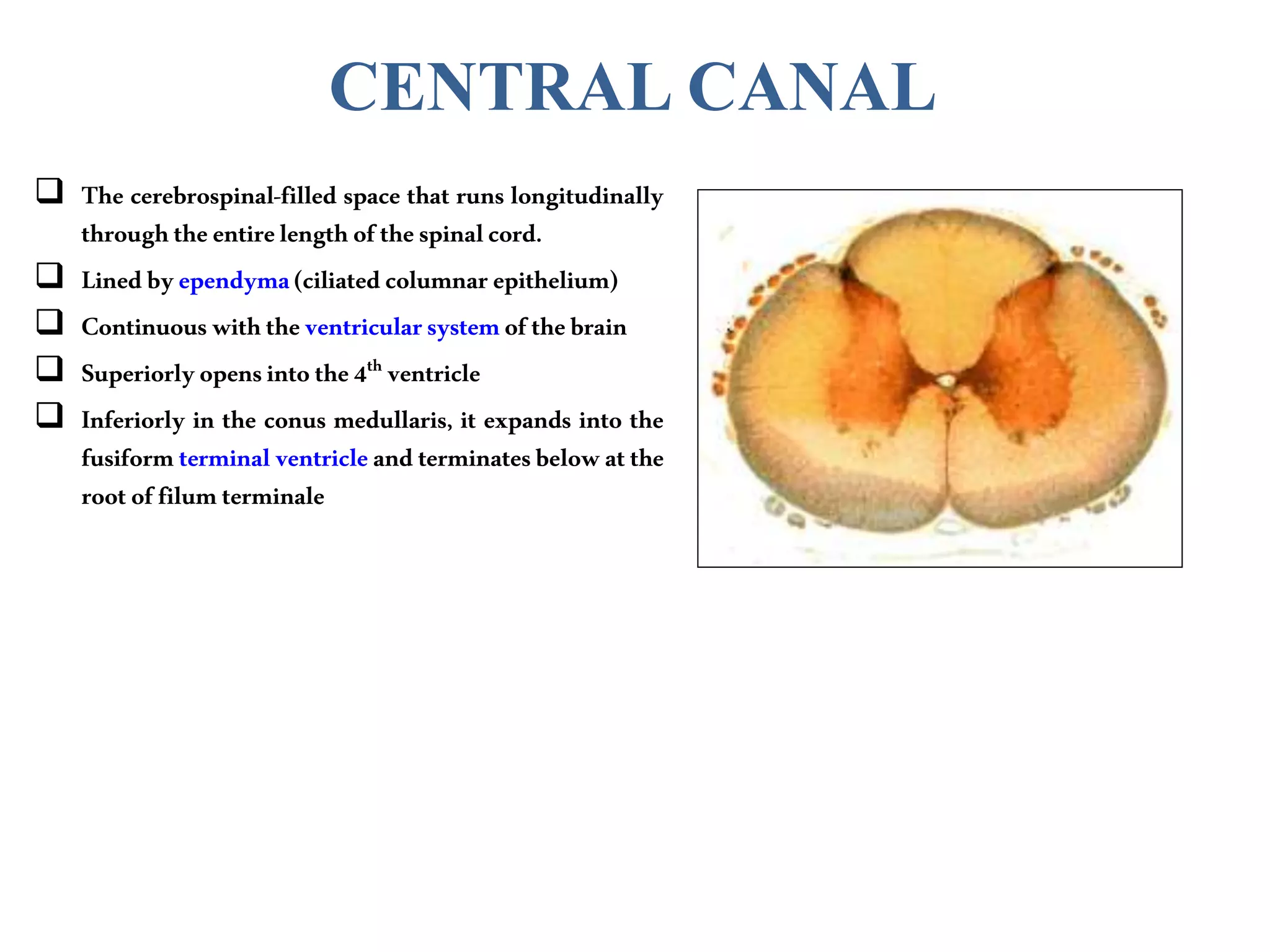
CENTRAL CANAL
 The cerebrospinal-filled space that runs longitudinally
throughtheentirelengthofthespinalcord.
 Linedbyependyma(ciliatedcolumnarepithelium)
 Continuouswiththeventricularsystemofthebrain
 Superiorlyopensintothe4th ventricle
 Inferiorly in the conus medullaris, it expands into the
fusiformterminalventricleand terminatesbelowatthe
rootoffilumterminale
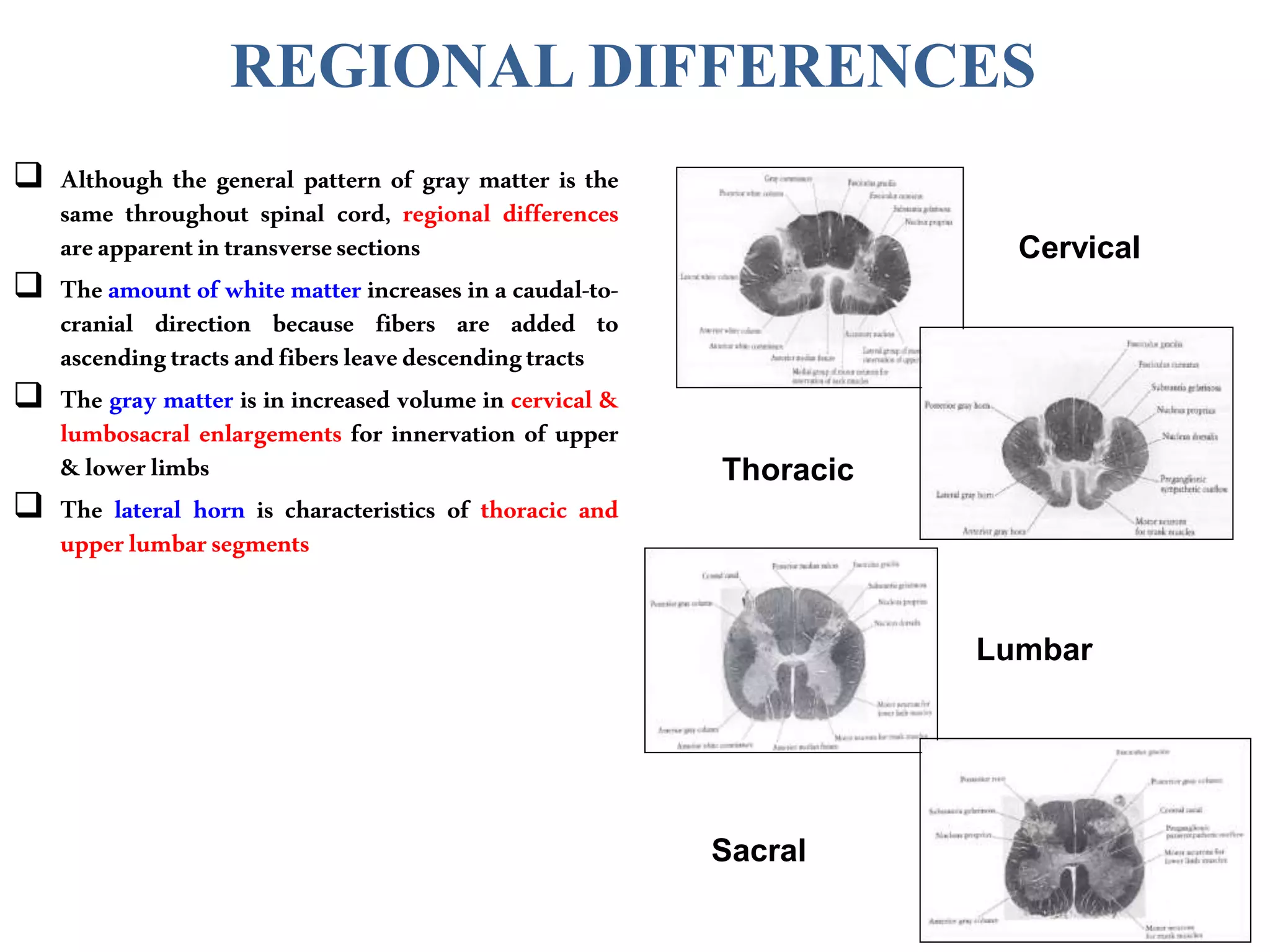
REGIONAL DIFFERENCES
 Although the general pattern of gray matter is the
same throughout spinal cord, regional differences
areapparentintransversesections
 The amount of white matter increases in a caudal-to-
cranial direction because fibers are added to
ascendingtractsandfibersleavedescendingtracts
 The gray matter is in increased volume in cervical &
lumbosacral enlargements for innervation of upper
&lowerlimbs
 The lateral horn is characteristics of thoracic and
upperlumbarsegments
Cervical
Thoracic
Lumbar
Sacral
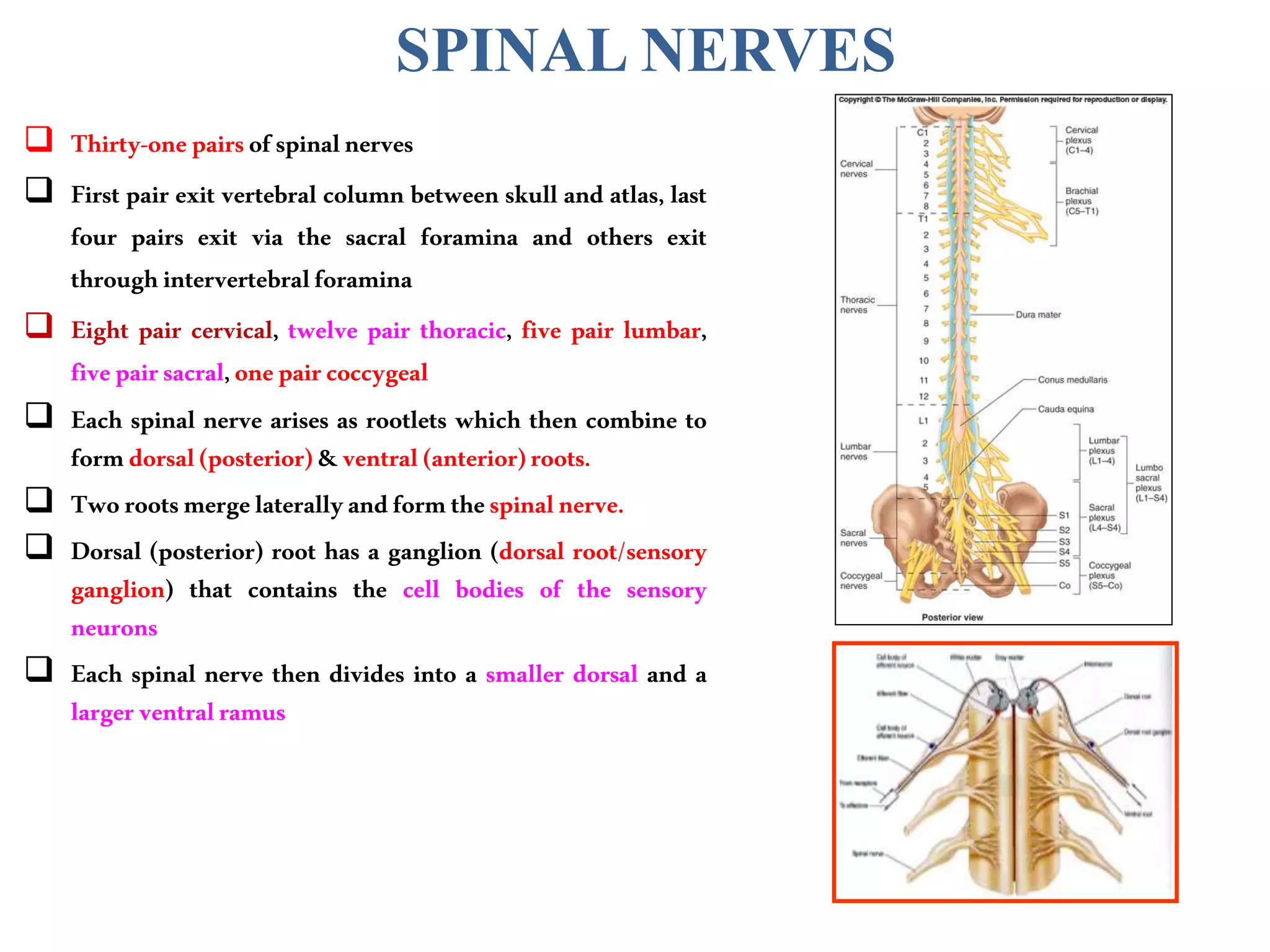
SPINAL NERVES
 Thirty-onepairsofspinalnerves
 First pair exit vertebral column between skull and atlas, last
four pairs exit via the sacral foramina and others exit
throughintervertebralforamina
 Eight pair cervical, twelve pair thoracic, five pair lumbar,
fivepairsacral,onepaircoccygeal
 Each spinal nerve arises as rootlets which then combine to
formdorsal(posterior)&ventral(anterior)roots.
 Tworootsmergelaterallyandformthespinalnerve.
 Dorsal (posterior) root has a ganglion (dorsal root/sensory
ganglion) that contains the cell bodies of the sensory
neurons
 Each spinal nerve then divides into a smaller dorsal and a
largerventralramus
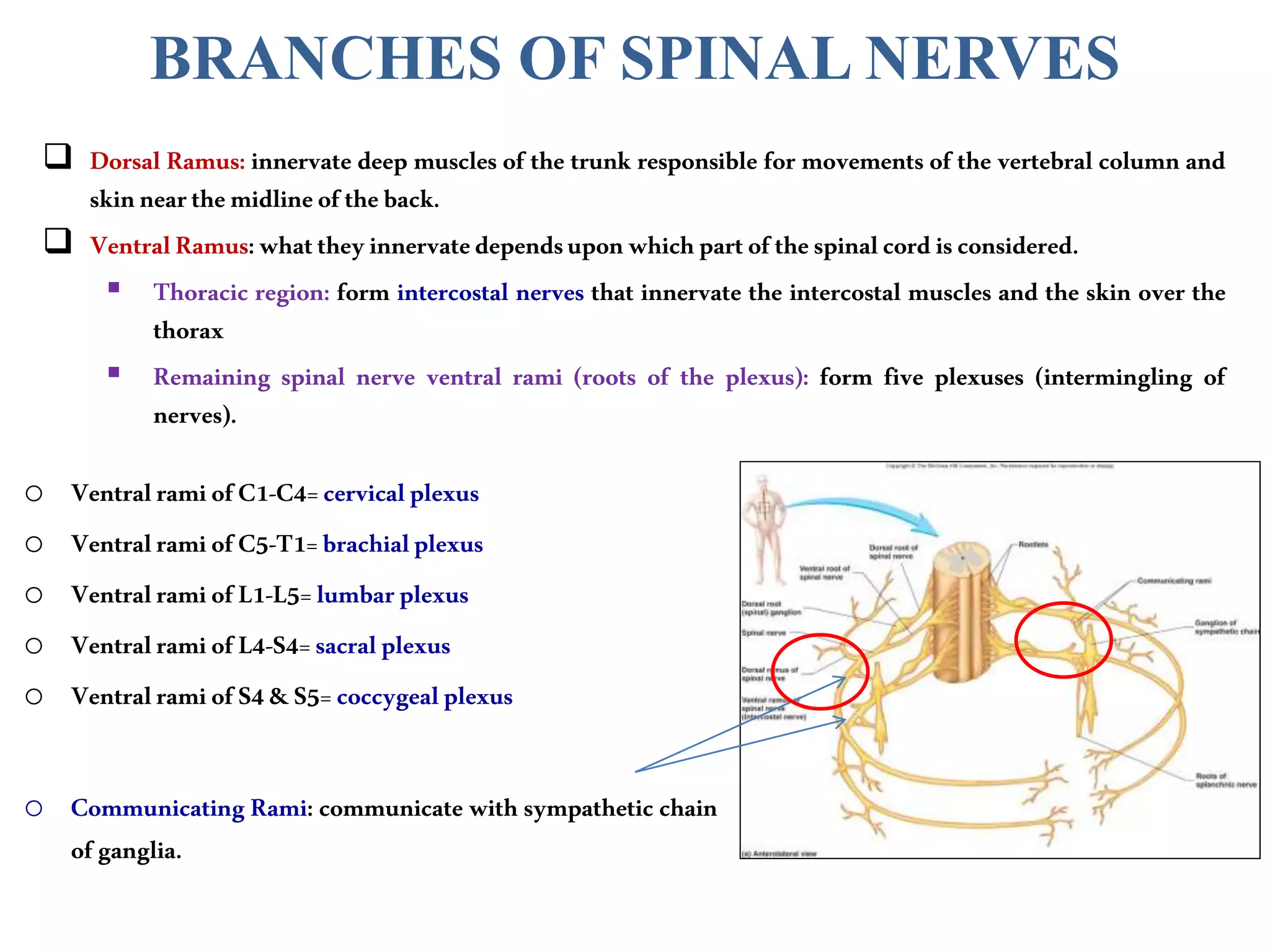
BRANCHES OF SPINAL NERVES
 Dorsal Ramus: innervate deep muscles of the trunk responsible for movements of the vertebral column and
skinnearthemidlineoftheback.
 VentralRamus:whattheyinnervatedependsuponwhichpartofthespinalcordisconsidered.
 Thoracic region: form intercostal nerves that innervate the intercostal muscles and the skin over the
thorax
 Remaining spinal nerve ventral rami (roots of the plexus): form five plexuses (intermingling of
nerves).
o VentralramiofC1-C4=cervicalplexus
o VentralramiofC5-T1=brachialplexus
o VentralramiofL1-L5=lumbarplexus
o VentralramiofL4-S4=sacralplexus
o VentralramiofS4&S5=coccygealplexus
o Communicating Rami: communicate with sympathetic chain
ofganglia.
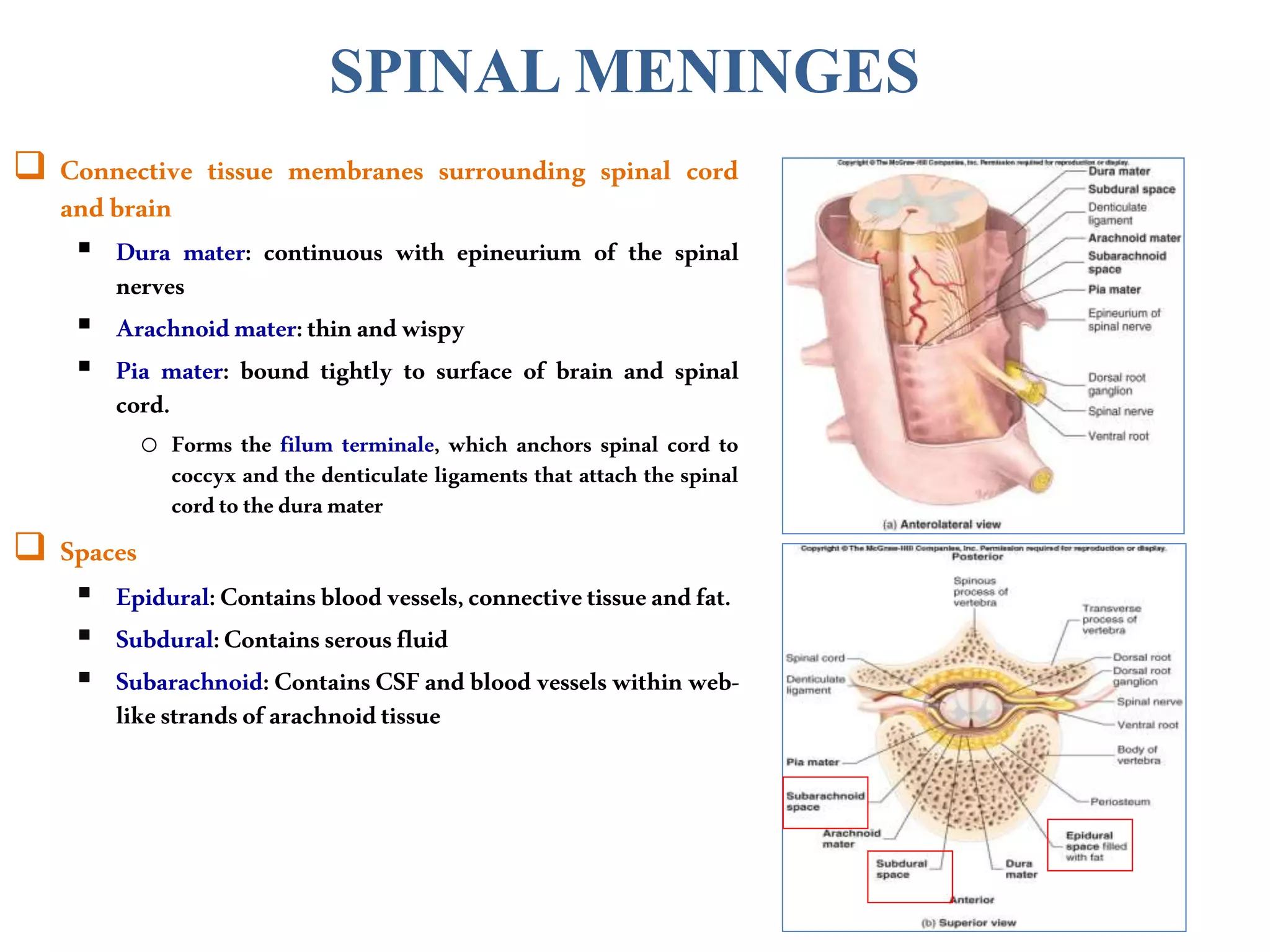
SPINAL MENINGES
 Connective tissue membranes surrounding spinal cord
andbrain
 Dura mater: continuous with epineurium of the spinal
nerves
 Arachnoidmater:thinandwispy
 Pia mater: bound tightly to surface of brain and spinal
cord.
o Forms the filum terminale, which anchors spinal cord to
coccyx and the denticulate ligaments that attach the spinal
cordto theduramater
 Spaces
 Epidural:Containsbloodvessels,connectivetissueandfat.
 Subdural:Containsserousfluid
 Subarachnoid: Contains CSFand blood vesselswithin web-
likestrandsofarachnoidtissue
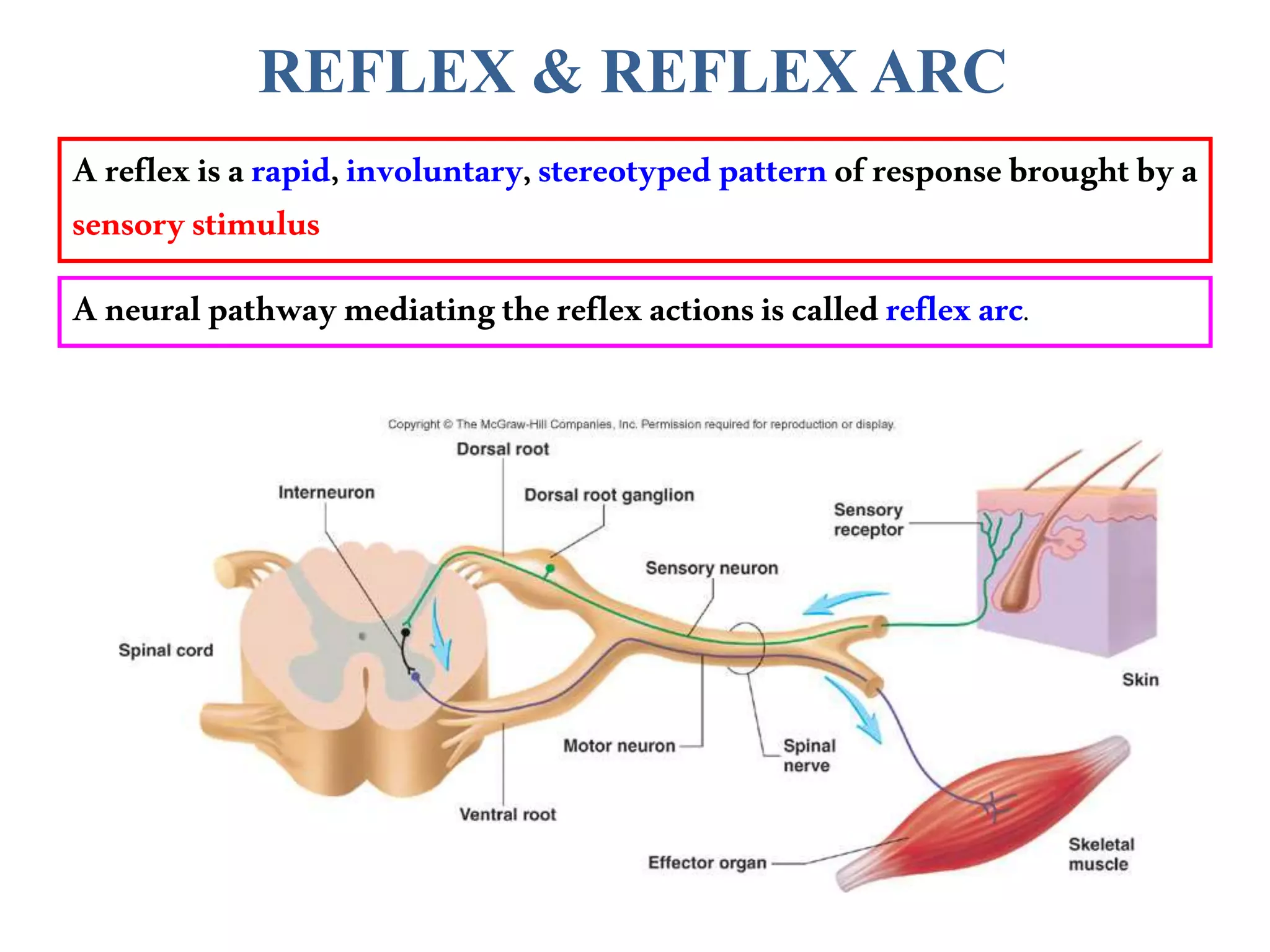
REFLEX & REFLEX ARC
Areflexisarapid,involuntary,stereotypedpatternof responsebroughtby a
sensorystimulus
Aneuralpathwaymediatingthereflexactionsiscalledreflexarc.
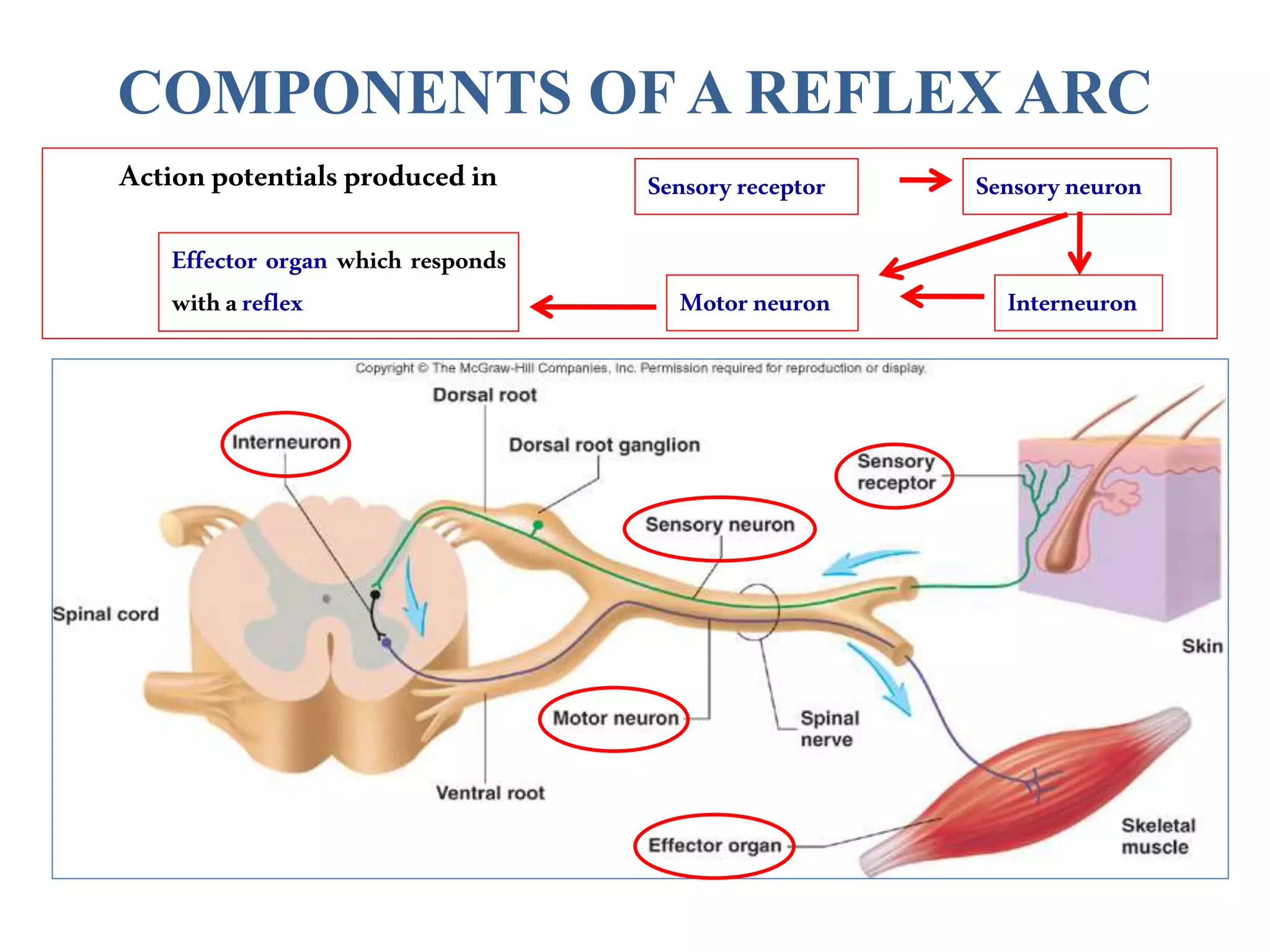
COMPONENTS OF A REFLEX ARC
Actionpotentialsproducedin Sensoryneuron
Sensoryreceptor
Interneuron
Motorneuron
Effector organ which responds
withareflex
QUESTIONS!

Anatomy of the Spinal Cord.ppt

  • 1.
    Khaleel Alyahya, PhD,MEd King Saud University School of Medicine @khaleelya ANATOMY OF SPINAL CORD
  • 2.
  • 3.
    Resources Human Anatomy &Physiology Elaine Marieb Introduction to Human Body Gerard Tortora Human Brain John Nolte Google
  • 4.
    OBJECTIVES Attheendofthelecture,studentsshouldbeableto:  Describetheexternalanatomy ofthespinalcord.  Describetheinternalanatomy of thespinal cord.  Describethespinal nerves:formation, branchesanddistribution viaplexuses.  Describe themeningesofthespinal cord.  Defineareflexandreflexarc,anddescribethecomponents of thereflexarc.
  • 5.
  • 6.
    FUNCTIONS The nervous systemhas 3 functions:  Collection of Sensory Input  Identifies changes occurring inside and outside the body by using sensory receptors. These changes are called stimuli  Integration  Processes, analyses & interprets these changes and makes decisions  Motor Output  It then effects a response by activating muscles or glands (effectors) via motor output
  • 7.
    ORGANIZATION STRUCTURAL o Central NervousSystem (CNS)  Brain & Spinal Cord o Peripheral Nervous System (PNS)  Nerves & Ganglia • Cranial nerves • Spinal nerves
  • 8.
    ORGANIZATION FUNCTIONAL o Sensory Division(Afferent) o Motor Division (Efferent)  Autonomic  Somatic
  • 9.
    Nucleus A group ofneurons within the CNS Ganglion A group of neurons outside the CNS Tract A group of nerve fibers (axons) within the CNS Nerve A group of nerve fibers (axons) outside the CNS
  • 10.
    SPINAL CORD  Themain pathway for information connecting the brain and peripheralnervoussystem.  It is elongated, cylindrical, suspended in the vertebral canal and protectedbyvertebrae  Surroundedbythemeningesandcerebrospinalfluid(CSF).  The primary function of spinal cord is a transmission of neural signalsbetweenthebrainandtherestofthebody.  Sensory  Motor  Localreflexes
  • 11.
    SPINAL CORD  Extendsfromforamenmagnumtosecondlumbarvertebra. Continuousabovewiththemedullaoblongata.  Thetaperedinferiorendformsconusmedullaris.  It is connected to the coccyx by a non-neuronal cord called Filum Terminale.
  • 12.
    SPINAL CORD  Givesriseto31pairsofspinalnerves The bundle of spinal nerves extending inferiorly from lumbosacral enlargement and conus medullaris surround the filumterminaleandformcaudaequina  Segmented  8Cervical  12Thoracic  5Lumbar  5Sacral  1Coccygeal  Hastwoenlargements:  CervicalEnlargement:suppliesupperlimbs.  LumbosacralEnlargement:supplieslowerlimbs.
  • 13.
    CROSS SECTION OFSPINAL CORD  The spinal cord is incompletely divided into two equal parts, anteriorly by a short, shallow median fissureandposteriorlybyadeepnarrowseptum,the posteriormediansulcus.  Composed of grey matter in the center surrounded bywhitemattersupportedbyneuroglia.  Commissures: connections between left and right halves  Graywithcentral canalin thecenter  White  Roots:spinalnervesariseasrootletsthencombineto formroots  Dorsal(posterior)root hasaganglion  Ventral (anterior)  Tworootsmergelaterallyand formthespinal nerve
  • 14.
     The arrangementof grey matter in the spinal cord resemblestheshapeoftheletterH.  Having:  twoposterior  twoanterior  twolateralhorns/columns.  Consistsof:  nervecellbodiesandtheirprocesses  neuroglia  blood vessels GREY MATTER
  • 15.
     The nervecells are multipolar, and are of THREE maincategories:  Sensoryneurons(Tractcells)  receive impulses from the periphery of the body and whose axons constitute the ascending fasciculi ofthewhitematter.  locatedinthe dorsalhorns.  Lowermotorneurons  transmitimpulses to theskeletal muscles.  locatedinthe ventral horns o similar neurons in the lateral horn are the preganglionic neurons of the autonomic system.  Interneurons(connectorneurons)  linking sensory and motor neurons, at the same or differentlevels,whichformspinal reflexarcs. GREY MATTER
  • 16.
    NEURONALARCHITECTURE OF SPINAL GREYMATTER  Cells of the same type are clustered into groups, which occurinlongcolumns  In transverse section, these columns appear as layers, especiallywithinthedorsalhorn  These layers are called the laminae of Rexed that are numbered by Roman numerals, starting from the tip of the dorsal horn and moving ventrally into the ventral horn.  The Rexed laminae comprise a system of ten layers of grey matter (I-X), identified in the early 1950s by Swedishneuroscientist.
  • 17.
    NERVE CELL GROUPSIN DORSAL HORN Fourmain groups 1. SubstantiaGelatinosa 2. NucleusProprius 3. NucleusDorsalis  Clark’scolumn  Nucleusthoracis 4. VisceralAfferentNucleus
  • 18.
    SubstantiaGelatinosa • RexedLaminaeII • Locatedattheapexofthehorn •Composedoflargeneurons • Extendsthroughoutthelengthof spinalcord • Afferents: dorsal root fibers concerned with pain, temperatureandtouch NucleusProprius • RexedLaminaIV • Locatedanteriortosubstantiagelatinosa • Composedoflargeneurons • Extendsthroughoutthelengthof spinalcord • Afferents: dorsal root fibers concerned with senses of position&movement(proprioception)
  • 19.
    NucleusDorsalis (Clark’s column,Nucleusthoracis) •RexedLaminaVII • Locatedatthebaseofdorsalhorn • Composedmostlyoflargeneurons • ExtendsfromC8toL3-4segments • Associatedwithproprioceptiveendings • Afferents: dorsal root fibers concerned with information frommusclespindlesandtendonorgans. VisceralAfferentNucleus • RexedLaminaVII • Locatedlateraltonucleusdorsalis • Composedmostlyofmediumsizeneurons • ExtendsfromT1toL3segments • Afferents:Visceralafferents
  • 20.
    NERVE CELL GROUPSIN VENTRAL HORN  Motor neurons, also called lower motor neurons.
  • 21.
    MOTOR NEURONS INVENTRAL HORN  AreofTwo types  Largemultipolarcells  whose axons pass out in the ventral roots of spinal nerves as alpha efferents which innervate extrafusal muscle fibers of skeletalmuscles.  Lessnumerous smallermultipolar cells  whose axons pass out in the ventral roots of spinal nerves as gamma efferents which innervate intrafusal muscle fibers ofneuromuscularspindles Bothalphaand gamma motorneuronsare undertheinfluenceofdescending pathwaysfrombrain
  • 22.
    Motor neurons areorganizedin3groups: Medial:  Present in most segments, innervates muscles of neck and trunk (including intercostalandabdominalmuscles)  Central:  Smallest, present in some cervical (phrenic C3-5, spinal accessory C1-6) and lumbosacral(L2-S1)segments  Lateral:  Present in cervical and lumbosacral segments,innervatesmusclesofthelimbs Neuronssupplyingflexormusclesare locateddorsaltoneuronsforextensor muscles MOTOR NEURONS IN VENTRAL HORN
  • 23.
    NERVE CELL GROUPSIN LATERAL HORN  SmallColumncomposed of smallneurons  ExtendsfromT1toL2-3segments: o Giverisetopreganglionicsympatheticfibers  ExtendsfromS2-4 segments: o Give rise to preganglionic parasympathetic fibers
  • 24.
    WHITE MATTER  Consistsof mixture of nerve fibers, neuroglia and blood vessels.  White color is due to high proportion of myelinated nervefibers  The white matter of the spinal cord is arranged in columns/funiculi;anterior,posteriorandlateral.  The nerve fibers are arranged as bundles, running verticallythroughthecord.  A group of nerve fibers (axons) that share a common origin, termination and function form a tract or fasciculus  These tracts are formed by sensory nerve fibers ascending to the brain, motor nerve fibers descending fromthebrainandfibersofconnectorneurons.  Tracts are often named according to their points of originanddestination,e.g.spinothalamic,corticospinal. Dependingontheirfunction,thespinal tractsaredividedintoascendingand descendingtracts
  • 26.
    COMMISSURES OF THESPINAL CORD  Grey Commissure:  Transverse bridge of grey matter connecting the anteriorandposteriorgrayhornsoneachside  Is pierced by the central canal that divides it into anteriorandposteriorparts  White Commissure:  Liesventraltothegraycommissure  Mainlycontainsdecussatingnervefibers
  • 27.
    CENTRAL CANAL  Thecerebrospinal-filled space that runs longitudinally throughtheentirelengthofthespinalcord.  Linedbyependyma(ciliatedcolumnarepithelium)  Continuouswiththeventricularsystemofthebrain  Superiorlyopensintothe4th ventricle  Inferiorly in the conus medullaris, it expands into the fusiformterminalventricleand terminatesbelowatthe rootoffilumterminale
  • 28.
    REGIONAL DIFFERENCES  Althoughthe general pattern of gray matter is the same throughout spinal cord, regional differences areapparentintransversesections  The amount of white matter increases in a caudal-to- cranial direction because fibers are added to ascendingtractsandfibersleavedescendingtracts  The gray matter is in increased volume in cervical & lumbosacral enlargements for innervation of upper &lowerlimbs  The lateral horn is characteristics of thoracic and upperlumbarsegments Cervical Thoracic Lumbar Sacral
  • 29.
    SPINAL NERVES  Thirty-onepairsofspinalnerves First pair exit vertebral column between skull and atlas, last four pairs exit via the sacral foramina and others exit throughintervertebralforamina  Eight pair cervical, twelve pair thoracic, five pair lumbar, fivepairsacral,onepaircoccygeal  Each spinal nerve arises as rootlets which then combine to formdorsal(posterior)&ventral(anterior)roots.  Tworootsmergelaterallyandformthespinalnerve.  Dorsal (posterior) root has a ganglion (dorsal root/sensory ganglion) that contains the cell bodies of the sensory neurons  Each spinal nerve then divides into a smaller dorsal and a largerventralramus
  • 30.
    BRANCHES OF SPINALNERVES  Dorsal Ramus: innervate deep muscles of the trunk responsible for movements of the vertebral column and skinnearthemidlineoftheback.  VentralRamus:whattheyinnervatedependsuponwhichpartofthespinalcordisconsidered.  Thoracic region: form intercostal nerves that innervate the intercostal muscles and the skin over the thorax  Remaining spinal nerve ventral rami (roots of the plexus): form five plexuses (intermingling of nerves). o VentralramiofC1-C4=cervicalplexus o VentralramiofC5-T1=brachialplexus o VentralramiofL1-L5=lumbarplexus o VentralramiofL4-S4=sacralplexus o VentralramiofS4&S5=coccygealplexus o Communicating Rami: communicate with sympathetic chain ofganglia.
  • 31.
    SPINAL MENINGES  Connectivetissue membranes surrounding spinal cord andbrain  Dura mater: continuous with epineurium of the spinal nerves  Arachnoidmater:thinandwispy  Pia mater: bound tightly to surface of brain and spinal cord. o Forms the filum terminale, which anchors spinal cord to coccyx and the denticulate ligaments that attach the spinal cordto theduramater  Spaces  Epidural:Containsbloodvessels,connectivetissueandfat.  Subdural:Containsserousfluid  Subarachnoid: Contains CSFand blood vesselswithin web- likestrandsofarachnoidtissue
  • 32.
    REFLEX & REFLEXARC Areflexisarapid,involuntary,stereotypedpatternof responsebroughtby a sensorystimulus Aneuralpathwaymediatingthereflexactionsiscalledreflexarc.
  • 33.
    COMPONENTS OF AREFLEX ARC Actionpotentialsproducedin Sensoryneuron Sensoryreceptor Interneuron Motorneuron Effector organ which responds withareflex
  • 34.