Analyzing Literature
Structure, Content & Style
Approaching Texts


 All texts share three common elements:
    Structure
    Content
    Style
Structure

 Structure is how a text is built


 Think of the structure of a text like the frame of a
 house

 Structure can include sections, chapters, order of
 ideas, line breaks (poetry), acts and scenes (drama)

 A text’s outline reveals its structure
Content

 Content is the ideas and information in the text


 Think of content as what is in the house (e.g.
 furniture)

 Content can include things like plot, character, main
 ideas, theme, dialogue

 A summary of the text reveals its content
Style

 Style is the unique way the author has presented the
 ideas in the text

 Think of style as how the contents of the house are
 decorated

 Style can include things like word choice, use of
 language, syntax, sentence structure, imagery

 Identifying what makes one author/text different
 from another reveals style
Structure, Content & Style


 Any text can be analyzed using these concepts –
 short stories, novels, plays, poems, essays, non-
 fiction texts, letters

 Structure, content, and style work together and often
 overlap
Critical Approaches to
      Literature
Critical Approaches to Literature

 The same text can be looked at through more than one
 “lens”

 These “lenses” are known as critical approaches


 Critical approaches to literature are developed by
 readers who look for different meanings in a text

 Critical approaches are created in different time
 periods and generally reflect cultural changes that are
 happening at that time
Common Critical Approaches


 Formalist Criticism
 Biographical Criticism
 Historical Criticism
 Psychological Criticism
 Mythological Criticism
 Cultural Criticism
 Reader Response Criticism
Formalist Criticism

 Literature is a form of knowledge with intrinsic elements –
  style, structure, imagery, tone, and genre

 What gives a literary work status as a great work of art is
  how all of its elements work together to create the reader's
  experience

 Appreciating a text requires close reading – a careful, step-
  by-step analysis and explication of the text

 Style and theme influence each other and can't be separated
  if meaning is to be retained
Formalist Criticism


 "Extracting" elements in isolation
  (theme, character, plot, setting, etc.) may destroy a reader's
  aesthetic experience of the whole

 Formalist critics don't deny the historical or political
  situation of a work, they just believe works of art have the
  power to transcend them

 Formalist criticism is evaluative in that it differentiates
  great works of art from poor works of art

 Formalist criticism is a "scientific" approach to literary
  analysis, focusing on "facts amenable to "verification"
  (evidence in the text)
Biographical Criticism


 Real life experience can help shape (either directly or
 indirectly) an author's work

 Understanding an author's life can help us better
 understand the work

 The focus is always on the literary work under
 investigation
Historical Criticism

 Investigates the social, cultural, and intellectual
 context that produced it

 This investigation includes the author's biography
 and their culture

 Seeks to understand the impact of a work in its day
 and how meanings change over time

 Explores how time and place of creation affect
 meaning in the work
Psychological Criticism


 Great literature truthfully reflects life and is a
  realistic representation of human motivation and
  behavior

 May choose to focus on the creative process of the
  artist, the artist's motivation or behavior, or analyze
  fictional characters' motivations and behaviors
Mythological Criticism

 Mythological criticism studies recurrent universal
 patterns underlying most literary works

 Combines a variety of academic disciplines –
 anthropology, psychology, history, comparative
 religion

 Demonstrates how the individual imagination shares a
 common humanity by identifying common
 symbols, images, plots, etc.

 Identifies "archetypes“ –
 symbols, characters, situations, or images evoking a
 universal response
Common Archetypes: Characters

 The hero - The courageous figure who runs in and saves the day

 The outcast - he or she has been cast out of society or has left it on a
  voluntary basis; the outcast figure can oftentimes also be considered
  as a Christ figure

 The scapegoat - gets blamed for everything, regardless of whether
  he or she is actually at fault

 The star-crossed lovers - the young couple joined by love but
  unexpectedly parted by fate

 The shrew - nagging, bothersome wife always battering her husband
  with verbal abuse
Common Archetypes: Situations/Symbols

 The task - a character, or group of characters, is driven to complete some
  duty of monstrous proportion

 The quest - the characters are searching for something, whether
  consciously or unconsciously; their actions, thoughts, and feelings
  center around the goal of completing this quest

 The loss of innocence - a loss of innocence through sexual
  experience, violence, or any other means

 The initiation - process by which a character is brought into another
  sphere of influence, frequently (in literature) into adulthood

 Water - a symbol of life, cleansing, and rebirth; it is a strong life force
  and is often depicted as a living, reasoning force
Cultural Criticism


 Examines literature in its cultural, economic, and political
  context

 Explores the relationship between the artist and the society


 Focuses on the social content of literary works
Reader-Response Criticism

 Attempts to describe the internal workings of the reader's mental
  processes

 Recognizes reading as a creative act or process

 No text is self-contained, independent of a reader's interpretive
  design

 The plurality of readings possible is all explored – critics study how
  different readers see the same text differently, and how
  religious, cultural, and social values affect readings

 Instead of focusing only on the values embedded in the text, this
  type of criticism studies the values embedded in the reader
The Literary Canon
The Literary Canon

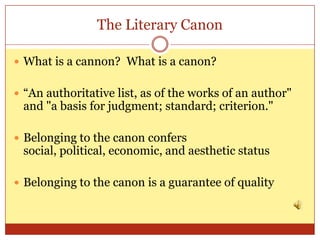
 What is a cannon? What is a canon?


 “An authoritative list, as of the works of an author"
 and "a basis for judgment; standard; criterion."

 Belonging to the canon confers
 social, political, economic, and aesthetic status

 Belonging to the canon is a guarantee of quality
The Literary Canon


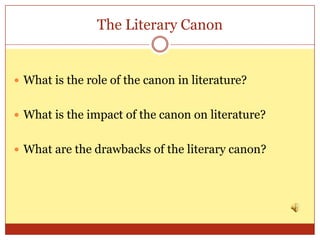
 What is the role of the canon in literature?


 What is the impact of the canon on literature?


 What are the drawbacks of the literary canon?
Questions?
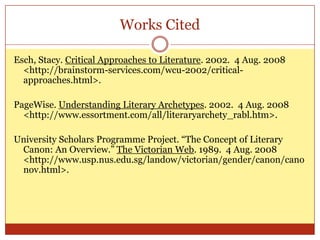
Works Cited

Esch, Stacy. Critical Approaches to Literature. 2002. 4 Aug. 2008
  <http://brainstorm-services.com/wcu-2002/critical-
  approaches.html>.

PageWise. Understanding Literary Archetypes. 2002. 4 Aug. 2008
  <http://www.essortment.com/all/literaryarchety_rabl.htm>.

University Scholars Programme Project. “The Concept of Literary
 Canon: An Overview.” The Victorian Web. 1989. 4 Aug. 2008
 <http://www.usp.nus.edu.sg/landow/victorian/gender/canon/cano
 nov.html>.

Analyzing literature 2012 with audio

  • 1.
  • 2.
  • 3.
    Approaching Texts  Alltexts share three common elements:  Structure  Content  Style
  • 4.
    Structure  Structure ishow a text is built  Think of the structure of a text like the frame of a house  Structure can include sections, chapters, order of ideas, line breaks (poetry), acts and scenes (drama)  A text’s outline reveals its structure
  • 5.
    Content  Content isthe ideas and information in the text  Think of content as what is in the house (e.g. furniture)  Content can include things like plot, character, main ideas, theme, dialogue  A summary of the text reveals its content
  • 6.
    Style  Style isthe unique way the author has presented the ideas in the text  Think of style as how the contents of the house are decorated  Style can include things like word choice, use of language, syntax, sentence structure, imagery  Identifying what makes one author/text different from another reveals style
  • 7.
    Structure, Content &Style  Any text can be analyzed using these concepts – short stories, novels, plays, poems, essays, non- fiction texts, letters  Structure, content, and style work together and often overlap
  • 8.
  • 9.
    Critical Approaches toLiterature  The same text can be looked at through more than one “lens”  These “lenses” are known as critical approaches  Critical approaches to literature are developed by readers who look for different meanings in a text  Critical approaches are created in different time periods and generally reflect cultural changes that are happening at that time
  • 10.
    Common Critical Approaches Formalist Criticism  Biographical Criticism  Historical Criticism  Psychological Criticism  Mythological Criticism  Cultural Criticism  Reader Response Criticism
  • 11.
    Formalist Criticism  Literatureis a form of knowledge with intrinsic elements – style, structure, imagery, tone, and genre  What gives a literary work status as a great work of art is how all of its elements work together to create the reader's experience  Appreciating a text requires close reading – a careful, step- by-step analysis and explication of the text  Style and theme influence each other and can't be separated if meaning is to be retained
  • 12.
    Formalist Criticism  "Extracting"elements in isolation (theme, character, plot, setting, etc.) may destroy a reader's aesthetic experience of the whole  Formalist critics don't deny the historical or political situation of a work, they just believe works of art have the power to transcend them  Formalist criticism is evaluative in that it differentiates great works of art from poor works of art  Formalist criticism is a "scientific" approach to literary analysis, focusing on "facts amenable to "verification" (evidence in the text)
  • 13.
    Biographical Criticism  Reallife experience can help shape (either directly or indirectly) an author's work  Understanding an author's life can help us better understand the work  The focus is always on the literary work under investigation
  • 14.
    Historical Criticism  Investigatesthe social, cultural, and intellectual context that produced it  This investigation includes the author's biography and their culture  Seeks to understand the impact of a work in its day and how meanings change over time  Explores how time and place of creation affect meaning in the work
  • 15.
    Psychological Criticism  Greatliterature truthfully reflects life and is a realistic representation of human motivation and behavior  May choose to focus on the creative process of the artist, the artist's motivation or behavior, or analyze fictional characters' motivations and behaviors
  • 16.
    Mythological Criticism  Mythologicalcriticism studies recurrent universal patterns underlying most literary works  Combines a variety of academic disciplines – anthropology, psychology, history, comparative religion  Demonstrates how the individual imagination shares a common humanity by identifying common symbols, images, plots, etc.  Identifies "archetypes“ – symbols, characters, situations, or images evoking a universal response
  • 17.
    Common Archetypes: Characters The hero - The courageous figure who runs in and saves the day  The outcast - he or she has been cast out of society or has left it on a voluntary basis; the outcast figure can oftentimes also be considered as a Christ figure  The scapegoat - gets blamed for everything, regardless of whether he or she is actually at fault  The star-crossed lovers - the young couple joined by love but unexpectedly parted by fate  The shrew - nagging, bothersome wife always battering her husband with verbal abuse
  • 18.
    Common Archetypes: Situations/Symbols The task - a character, or group of characters, is driven to complete some duty of monstrous proportion  The quest - the characters are searching for something, whether consciously or unconsciously; their actions, thoughts, and feelings center around the goal of completing this quest  The loss of innocence - a loss of innocence through sexual experience, violence, or any other means  The initiation - process by which a character is brought into another sphere of influence, frequently (in literature) into adulthood  Water - a symbol of life, cleansing, and rebirth; it is a strong life force and is often depicted as a living, reasoning force
  • 19.
    Cultural Criticism  Examinesliterature in its cultural, economic, and political context  Explores the relationship between the artist and the society  Focuses on the social content of literary works
  • 20.
    Reader-Response Criticism  Attemptsto describe the internal workings of the reader's mental processes  Recognizes reading as a creative act or process  No text is self-contained, independent of a reader's interpretive design  The plurality of readings possible is all explored – critics study how different readers see the same text differently, and how religious, cultural, and social values affect readings  Instead of focusing only on the values embedded in the text, this type of criticism studies the values embedded in the reader
  • 21.
  • 22.
    The Literary Canon What is a cannon? What is a canon?  “An authoritative list, as of the works of an author" and "a basis for judgment; standard; criterion."  Belonging to the canon confers social, political, economic, and aesthetic status  Belonging to the canon is a guarantee of quality
  • 23.
    The Literary Canon What is the role of the canon in literature?  What is the impact of the canon on literature?  What are the drawbacks of the literary canon?
  • 24.
  • 25.
    Works Cited Esch, Stacy.Critical Approaches to Literature. 2002. 4 Aug. 2008 <http://brainstorm-services.com/wcu-2002/critical- approaches.html>. PageWise. Understanding Literary Archetypes. 2002. 4 Aug. 2008 <http://www.essortment.com/all/literaryarchety_rabl.htm>. University Scholars Programme Project. “The Concept of Literary Canon: An Overview.” The Victorian Web. 1989. 4 Aug. 2008 <http://www.usp.nus.edu.sg/landow/victorian/gender/canon/cano nov.html>.