



Literary Analysis EssayStructureWriting the Essay
Independent Reading12/6/10READ YOUR BOOKAfter 15 minutes, there will be a prompt about quality.First, this has nothing to do with whether you like the book or think it’s “good.” Rate the quality of the book. Is it a quality book? Is it well-written?  Remember: not do you like it or is it “good?”DON’T FORGET:   Weekly Reading Logs DUE EVERY MONDAY.Pick up a new log from the MUC.Content: Literary Analysis
TodayLiterary Analysis Essay StructureIntroduction
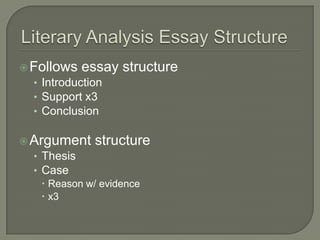
Literary Analysis Essay StructureFollows essay structureIntroductionSupport x3ConclusionArgument structureThesisCaseReason w/ evidencex3
What do you need?ThesisReasonsWhy thesis is trueNOT evidenceEvidenceProve the reason
IntroductionWe will use your thesis about RecitatifIs Twyla or Roberta white or black?
Independent Reading12/7/10READ YOUR BOOKAfter 15 minutes, there will be a prompt about character.Think about some of the decisions the main character has made or how he/she has acted. Is this character believable (realistic)? Does he/she make decisions/do things that a real person would?  Why or why not?  DON’T FORGET:   Weekly Reading Logs DUE EVERY MONDAY.Pick up a new log from the MUC.Content: Literary Analysis
TodayIntroductionsBegin talking about support
IntroductionsLet us continue…
THESIS MUST INCLUDETitle of textAuthor’s name
Independent Reading12/8/10READ YOUR BOOKAfter 15 minutes, there will be a prompt.Get out your Class Notes Notebook. Let’s continue learning about Lit Analysis Introductions. DON’T FORGET:   Weekly Reading Logs DUE EVERY MONDAY.Pick up a new log from the MUC.Content: Literary Analysis
The purpose of Toni Morrison’s “Recitatif” is to show how two friends learned that the value of friendship has nothing to do with race, but comes from the heart.Don’t judge people by their race.The purpose of Toni Morrison’s “Recitatif” is about how two girls have different lives not because of their race, but because of their different styles of mothers.
The purpose of Toni Morrison’s “Recitatif” is to show readers how people determine the race of others.The purpose of Toni Morrison’s “Recitatif” is to show you your prejudice and also prove that there is no difference in people due to race.
The purpose of Toni Morrison’s “Recitatif” is to show how two friends learned that the value of friendship has nothing to do with race, but comes from the heart.The purpose of Toni Morrison’s “Recitatif” is to show how the value of friendship has nothing to do with race, but comes from the heart.
Don’t judge people by their race.The purpose of Toni Morrison’s “Recitatif” is to show that people should not judge others based on their race.
The purpose of Toni Morrison’s “Recitatif” is about how two girls have different lives not because of their race, but because of their different styles of mothers.In the story “Recitatif” by Toni Morrison, the two main characters have different lives not because of their race, but because of their very different mothers.
The purpose of Toni Morrison’s “Recitatif” is to show readers how people determine the race of others.The purpose of Toni Morrison’s “Recitatif” is to use intentionally ambiguous descriptions of its characters to challenge how each reader views race.
The purpose of Toni Morrison’s “Recitatif” is to show you your prejudice and also prove that there is no difference in people due to race.The purpose of Toni Morrison’s “Recitatif” is to prove that their is no difference in people due to race.
Your IntroIN YOUR CLASS NOTESFix your thesisFinish steps 2-8 for your introduction
Independent Reading12/9/10READ YOUR BOOKAfter 15 minutes (or until Mr. Woock says so), there will be a prompt.Get out your Class Notes Notebook. Let’s continue learning about Lit Analysis Essays. DON’T FORGET:   Weekly Reading Logs DUE EVERY MONDAY.Content: Literary Analysis
TODAYFinish IntroductionsStart talking about support
Building your caseWe know this.Don’t write this as notes.You wrote this previously.Seriously, recognize stuff you’ve seen.(next, you’ll recognize stuff you haven’t seen)CASEaRGUMENT (x3REASONEVIDENCEExplanation
Analysis Essay SUPPORTGood literary analysis essays contain an explanation ofyour reasonsand evidence from the text (short story, poem, play) that supports those ideas. Textual evidence consists of summary, paraphrase, specific details, and direct quotations.
CASEEVERY PARAGRAPH NEEDSTOPIC SENTENCETOPIC SENTENCEIt’s about FOCUSIt’s like a THESIS for EVERY PARAGRAPH
Topic Statementstates one of the topics associated with your thesis, combined with some assertion about how the topic will support the central idea. The purpose of the topic sentence is twofold:1. To tie the details of the paragraph to your thesis statement.2. To tie the details of the paragraph together
The setting of John Updike’s story “A & P” is crucial to our understanding of Sammy’s decision to quit his job. Even though Sammy knows that his quitting will make life more difficult for him, he instinctively insists upon rejecting what the A & P represents in the story. When he rings up a “No Sale” and “saunter[s]” out of the store, Sammy leaves behind not only a job but the rigid state of mind associated with the A & P. Although Sammy is the central character in the story and we learn much about him, Updike seems to invest as much effort in describing the setting as he does Sammy. The title, after all, is not “Youthful Rebellion” or “Sammy Quits” but “A & P.” In fact, the setting is the antagonist of the story and plays a role that is as important as Sammy’s.
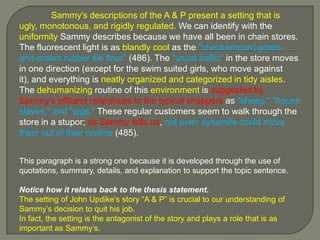
	Sammy's descriptions of the A & P present a setting that is ugly, monotonous, and rigidly regulated. We can identify with the uniformity Sammy describes because we have all been in chain stores. The fluorescent light is as blandly cool as the "checkerboard green-and-cream rubber tile floor" (486). The "usual traffic” in the store moves in one direction (except for the swim suited girls, who move against it), and everything is neatly organized and categorized in tidy aisles. The dehumanizing routine of this environment is suggested by Sammy's offhand references to the typical shoppers as "sheep,“ "house slaves," and "pigs." These regular customers seem to walk through the store in a stupor; as Sammy tells us, not even dynamite could move them out of their routine (485). This paragraph is a strong one because it is developed through the use of quotations, summary, details, and explanation to support the topic sentence. Notice how it relates back to the thesis statement.The setting of John Updike’s story “A & P” is crucial to our understanding of Sammy’s decision to quit his job. In fact, the setting is the antagonist of the story and plays a role that is as important as Sammy’s.
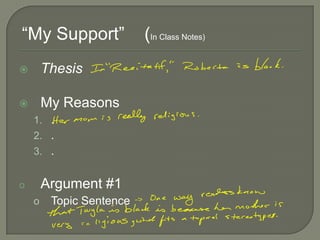
In Class NotesThesisMy Reasons...Argument #1
Topic SentenceIndependent Reading12/10/10READ YOUR BOOKAfter 15 minutes (or until Mr. Woock says so), there will be a prompt.Get out your Class Notes Notebook. Let’s continue learning about Lit Analysis Essays. DON’T FORGET:   Weekly Reading Logs DUE EVERY MONDAY.Content: Literary Analysis
TODAYAnalysis supportBY THE END OF CLASS YOU WILL HAVE:ThesisIntroduction3 supporting pointsEvidence for support
ThesisMy Reasons...Argument #1
Topic Sentence“My Support”    (In Class Notes)
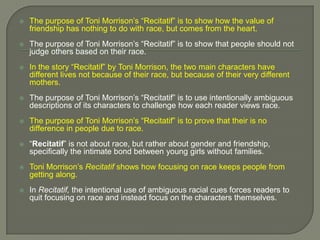
The purpose of Toni Morrison’s “Recitatif” is to show how the value of friendship has nothing to do with race, but comes from the heart.The purpose of Toni Morrison’s “Recitatif” is to show that people should not judge others based on their race.In the story “Recitatif” by Toni Morrison, the two main characters have different lives not because of their race, but because of their very different mothers. The purpose of Toni Morrison’s “Recitatif” is to use intentionally ambiguous descriptions of its characters to challenge how each reader views race.The purpose of Toni Morrison’s “Recitatif” is to prove that their is no difference in people due to race.“Recitatif” is not about race, but rather about gender and friendship, specifically the intimate bond between young girls without families. Toni Morrison’s Recitatif shows how focusing on race keeps people from getting along.In Recitatif, the intentional use of ambiguous racial cues forces readers to quit focusing on race and instead focus on the characters themselves.
Independent Reading12/14/10READ YOUR BOOKAfter 15 minutes (or until Mr. Woock says so), there will be a prompt.Without sounding like the back cover of your book, summarize what you read today. Be sure to only summarize what you read today.  Write down the page numbers of what you read. DON’T FORGET:   Weekly Reading Logs DUE EVERY MONDAY.Content: Literary Analysis
TODAYTest Recovery AssignmentLiterary Analysis TipsContinue writing Recitatif analysis
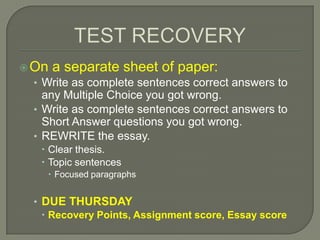
TEST RECOVERYOn a separate sheet of paper:Write as complete sentences correct answers to any Multiple Choice you got wrong.Write as complete sentences correct answers to Short Answer questions you got wrong.REWRITE the essay.Clear thesis.Topic sentencesFocused paragraphsDUE THURSDAYRecovery Points, Assignment score, Essay score
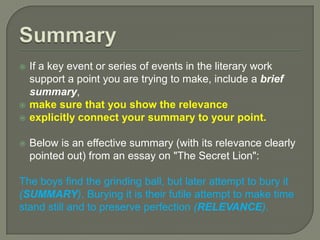
SummaryIf a key event or series of events in the literary work support a point you are trying to make, include a brief summary, make sure that you show the relevanceexplicitly connect your summary to your point. Below is an effective summary (with its relevance clearly pointed out) from an essay on "The Secret Lion":The boys find the grinding ball, but later attempt to bury it (SUMMARY). Burying it is their futile attempt to make time stand still and to preserve perfection (RELEVANCE).
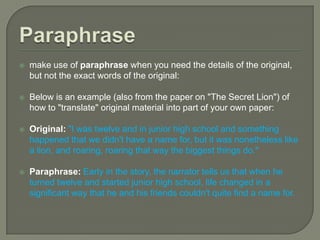
Paraphrasemake use of paraphrase when you need the details of the original, but not the exact words of the original: Below is an example (also from the paper on "The Secret Lion") of how to "translate" original material into part of your own paper:Original: "I was twelve and in junior high school and something happened that we didn't have a name for, but it was nonetheless like a lion, and roaring, roaring that way the biggest things do."Paraphrase: Early in the story, the narrator tells us that when he turned twelve and started junior high school, life changed in a significant way that he and his friends couldn't quite find a name for.
Independent Reading12/15/10READ YOUR BOOKAfter 15 minutes (or until Mr. Woock says so), there will be a prompt.Without sounding like the back cover of your book, summarize what you read today. Be sure to only summarize what you read today.  Write down the page numbers of what you read. DON’T FORGET:   Weekly Reading Logs DUE EVERY MONDAY.Content: Literary Analysis
TODAYTest Recovery AssignmentLiterary Analysis TipsContinue writing Recitatif analysis
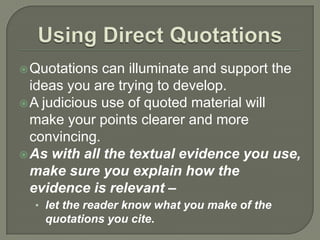
Using Direct QuotationsQuotations can illuminate and support the ideas you are trying to develop. A judicious use of quoted material will make your points clearer and more convincing. As with all the textual evidence you use, make sure you explain how the evidence is relevant – let the reader know what you make of the quotations you cite.
1. Brief quotations should be carefully introduced and integrated into the text of your paper. Put quotation marks around all briefly quoted material.Prose example:As the "manager" of the A & P, Lengel is both the guardian and enforcer of "policy." When he gives the girls "that sad Sunday-school-superintendent stare," we know we are in the presence of the A & P's version of a dreary bureaucrat who "doesn't miss much" (487).Make sure you give page numbers when necessary. Notice that in this example the page numbers are in parenthesis after the quotation marks but before the period.
I WILL NOTStart a paragraph with a quotationPut full quotations by themselves
BracketsIf any words are added to a quotation in order to explain who or what the quotation refers to, you must use brackets to distinguish your addition from the original source.Example:The literary critic John Strauss asserts that "he [Young Goodman Brown] is portrayed as self-righteous and disillusioned." Brackets are used here because there is no way of knowing who "he" is unless you add that information.
The literary critic John Strauss asserts that Young Goodman Brown “is portrayed as self-righteous and disillusioned.“The literary critic John Strauss asserts that “contrary to many interpretations, he [Young Goodman Brown] is portrayed as self-righteous and disillusioned."
BracketsBrackets are also used to change the grammatical structure of a quotation so that it fits into your sentence.Example:		Strauss also argues that Hawthorne "present[s] Young Goodman Brown in an ambivalent light." Brackets are used here to add the "s" to the verb "present" because otherwise the sentence would not be grammatically correct.
EllipsesYou must use ellipsis if you omit any words from the original source you are quoting.Ellipsis can be used at the beginning, in the middle, or at the end of the quotation, depending on where the missing words were originally. Ellipsis is formed by three periods with a space between each period.STYLE TIP:  MLA says put a bracket around an ellipsis when omitting in the middle of quoted text[. . .]
Original: "Early to bed and early to rise makes a man healthy, wealthy and wise."Example (omission from beginning):This behavior ". . . makes a man healthy, wealthy, and wise."Example (omission from middle):This maxim claims that "Early to bed . . . makes a man healthy, wealthy, and wise." Example (omission from end):He said, "Early to bed and early to rise makes a man healthy . . . ."
	Roberta admits to Twyla, “...you were right. We didn’t kick her [...] but, well, I wanted to.”Roberta says, “you were right. We [...] kick[ed] her [...] I wanted to.”
NOTEUse the present tense when you are discussing and writing about literature -- literary works are considered to exist in the present (see all the example paragraphs throughout).
“My Support”In Class Notes
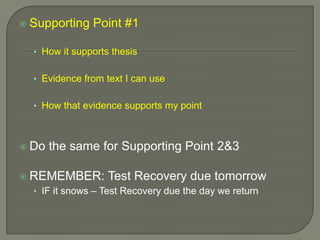
Supporting Point #1How it supports thesisEvidence from text I can useHow that evidence supports my pointDo the same for Supporting Point 2&3REMEMBER: Test Recovery due tomorrowIF it snows – Test Recovery due the day we return
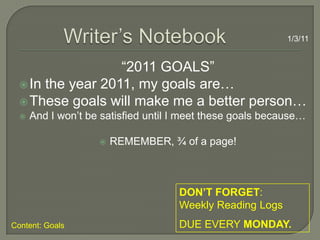
Writer’s Notebook1/3/11“2011 GOALS”In the year 2011, my goals are…These goals will make me a better person…And I won’t be satisfied until I meet these goals because…REMEMBER, ¾ of a page!DON’T FORGET:   Weekly Reading Logs DUE EVERY MONDAY.Content: Goals
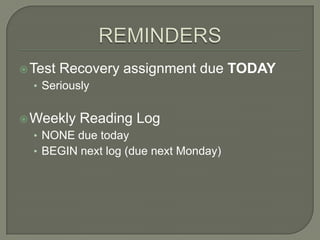
REMINDERSTest Recovery assignment due TODAYSeriouslyWeekly Reading LogNONE due todayBEGIN next log (due next Monday)
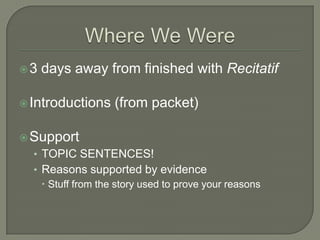
Where We Were3 days away from finished with RecitatifIntroductions (from packet)SupportTOPIC SENTENCES!Reasons supported by evidenceStuff from the story used to prove your reasons
YOU SHOULD HAVETHESISNOT “Twyla/Roberta is black/white”3 Supporting ReasonsTopic Sentences
TODAYBy the end of class, you will haveTHESIS3 SUPPORTING REASONSEVIDENCE FOR EACH REASON
Next StepTurn it into an essay
Writer’s Notebook1/4/11“Achieving GOALS”Look back at the goals you set for yourself yesterday. Make a plan for how you will achieve each goal. Make sure this includes the steps/behaviors you need to complete.REMEMBER, ¾ of a page!DON’T FORGET:   Weekly Reading Logs DUE EVERY MONDAY.Content: Goals
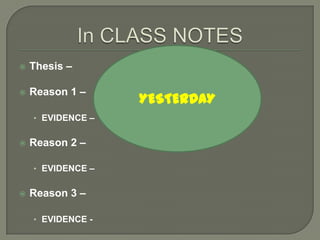
In CLASS NOTESThesis – Reason 1 – EVIDENCE – Reason 2 – EVIDENCE – Reason 3 – EVIDENCE - YESTERDAY
TODAYWe begin writing our essays.Look back at the “Introduction” notesWrite the IntroLook back at the “Topic Sentence” notesLook back at the “Summary, etc.” notesWrite the body paragraphs
Next page of Class NotesLiterary Analysis Essay	Begin writing your introduction. It should be a complete introduction.	Then continue writing, starting with your first supporting reason. Remember, you are not limited to one paragraph per reason.
Independent Reading1/5/11“Independent Reading”READ.Seriously, READ.Here’s an idea: you can spend this time reading Recitatif to get reacquainted with the story.DON’T FORGET:   Weekly Reading Logs DUE EVERY MONDAY.Content: IR

Literary analysis essay - writing it

  • 1.
  • 2.
    Independent Reading12/6/10READ YOURBOOKAfter 15 minutes, there will be a prompt about quality.First, this has nothing to do with whether you like the book or think it’s “good.” Rate the quality of the book. Is it a quality book? Is it well-written? Remember: not do you like it or is it “good?”DON’T FORGET: Weekly Reading Logs DUE EVERY MONDAY.Pick up a new log from the MUC.Content: Literary Analysis
  • 3.
    TodayLiterary Analysis EssayStructureIntroduction
  • 4.
    Literary Analysis EssayStructureFollows essay structureIntroductionSupport x3ConclusionArgument structureThesisCaseReason w/ evidencex3
  • 5.
    What do youneed?ThesisReasonsWhy thesis is trueNOT evidenceEvidenceProve the reason
  • 6.
    IntroductionWe will useyour thesis about RecitatifIs Twyla or Roberta white or black?
  • 7.
    Independent Reading12/7/10READ YOURBOOKAfter 15 minutes, there will be a prompt about character.Think about some of the decisions the main character has made or how he/she has acted. Is this character believable (realistic)? Does he/she make decisions/do things that a real person would? Why or why not? DON’T FORGET: Weekly Reading Logs DUE EVERY MONDAY.Pick up a new log from the MUC.Content: Literary Analysis
  • 8.
  • 9.
  • 10.
    THESIS MUST INCLUDETitleof textAuthor’s name
  • 11.
    Independent Reading12/8/10READ YOURBOOKAfter 15 minutes, there will be a prompt.Get out your Class Notes Notebook. Let’s continue learning about Lit Analysis Introductions. DON’T FORGET: Weekly Reading Logs DUE EVERY MONDAY.Pick up a new log from the MUC.Content: Literary Analysis
  • 12.
    The purpose ofToni Morrison’s “Recitatif” is to show how two friends learned that the value of friendship has nothing to do with race, but comes from the heart.Don’t judge people by their race.The purpose of Toni Morrison’s “Recitatif” is about how two girls have different lives not because of their race, but because of their different styles of mothers.
  • 13.
    The purpose ofToni Morrison’s “Recitatif” is to show readers how people determine the race of others.The purpose of Toni Morrison’s “Recitatif” is to show you your prejudice and also prove that there is no difference in people due to race.
  • 14.
    The purpose ofToni Morrison’s “Recitatif” is to show how two friends learned that the value of friendship has nothing to do with race, but comes from the heart.The purpose of Toni Morrison’s “Recitatif” is to show how the value of friendship has nothing to do with race, but comes from the heart.
  • 15.
    Don’t judge peopleby their race.The purpose of Toni Morrison’s “Recitatif” is to show that people should not judge others based on their race.
  • 16.
    The purpose ofToni Morrison’s “Recitatif” is about how two girls have different lives not because of their race, but because of their different styles of mothers.In the story “Recitatif” by Toni Morrison, the two main characters have different lives not because of their race, but because of their very different mothers.
  • 17.
    The purpose ofToni Morrison’s “Recitatif” is to show readers how people determine the race of others.The purpose of Toni Morrison’s “Recitatif” is to use intentionally ambiguous descriptions of its characters to challenge how each reader views race.
  • 18.
    The purpose ofToni Morrison’s “Recitatif” is to show you your prejudice and also prove that there is no difference in people due to race.The purpose of Toni Morrison’s “Recitatif” is to prove that their is no difference in people due to race.
  • 19.
    Your IntroIN YOURCLASS NOTESFix your thesisFinish steps 2-8 for your introduction
  • 20.
    Independent Reading12/9/10READ YOURBOOKAfter 15 minutes (or until Mr. Woock says so), there will be a prompt.Get out your Class Notes Notebook. Let’s continue learning about Lit Analysis Essays. DON’T FORGET: Weekly Reading Logs DUE EVERY MONDAY.Content: Literary Analysis
  • 21.
  • 22.
    Building your caseWeknow this.Don’t write this as notes.You wrote this previously.Seriously, recognize stuff you’ve seen.(next, you’ll recognize stuff you haven’t seen)CASEaRGUMENT (x3REASONEVIDENCEExplanation
  • 23.
    Analysis Essay SUPPORTGoodliterary analysis essays contain an explanation ofyour reasonsand evidence from the text (short story, poem, play) that supports those ideas. Textual evidence consists of summary, paraphrase, specific details, and direct quotations.
  • 24.
    CASEEVERY PARAGRAPH NEEDSTOPICSENTENCETOPIC SENTENCEIt’s about FOCUSIt’s like a THESIS for EVERY PARAGRAPH
  • 25.
    Topic Statementstates oneof the topics associated with your thesis, combined with some assertion about how the topic will support the central idea. The purpose of the topic sentence is twofold:1. To tie the details of the paragraph to your thesis statement.2. To tie the details of the paragraph together
  • 26.
    The setting ofJohn Updike’s story “A & P” is crucial to our understanding of Sammy’s decision to quit his job. Even though Sammy knows that his quitting will make life more difficult for him, he instinctively insists upon rejecting what the A & P represents in the story. When he rings up a “No Sale” and “saunter[s]” out of the store, Sammy leaves behind not only a job but the rigid state of mind associated with the A & P. Although Sammy is the central character in the story and we learn much about him, Updike seems to invest as much effort in describing the setting as he does Sammy. The title, after all, is not “Youthful Rebellion” or “Sammy Quits” but “A & P.” In fact, the setting is the antagonist of the story and plays a role that is as important as Sammy’s.
  • 27.
    Sammy's descriptions ofthe A & P present a setting that is ugly, monotonous, and rigidly regulated. We can identify with the uniformity Sammy describes because we have all been in chain stores. The fluorescent light is as blandly cool as the "checkerboard green-and-cream rubber tile floor" (486). The "usual traffic” in the store moves in one direction (except for the swim suited girls, who move against it), and everything is neatly organized and categorized in tidy aisles. The dehumanizing routine of this environment is suggested by Sammy's offhand references to the typical shoppers as "sheep,“ "house slaves," and "pigs." These regular customers seem to walk through the store in a stupor; as Sammy tells us, not even dynamite could move them out of their routine (485). This paragraph is a strong one because it is developed through the use of quotations, summary, details, and explanation to support the topic sentence. Notice how it relates back to the thesis statement.The setting of John Updike’s story “A & P” is crucial to our understanding of Sammy’s decision to quit his job. In fact, the setting is the antagonist of the story and plays a role that is as important as Sammy’s.
  • 28.
    In Class NotesThesisMyReasons...Argument #1
  • 29.
    Topic SentenceIndependent Reading12/10/10READYOUR BOOKAfter 15 minutes (or until Mr. Woock says so), there will be a prompt.Get out your Class Notes Notebook. Let’s continue learning about Lit Analysis Essays. DON’T FORGET: Weekly Reading Logs DUE EVERY MONDAY.Content: Literary Analysis
  • 30.
    TODAYAnalysis supportBY THEEND OF CLASS YOU WILL HAVE:ThesisIntroduction3 supporting pointsEvidence for support
  • 31.
  • 32.
  • 33.
    The purpose ofToni Morrison’s “Recitatif” is to show how the value of friendship has nothing to do with race, but comes from the heart.The purpose of Toni Morrison’s “Recitatif” is to show that people should not judge others based on their race.In the story “Recitatif” by Toni Morrison, the two main characters have different lives not because of their race, but because of their very different mothers. The purpose of Toni Morrison’s “Recitatif” is to use intentionally ambiguous descriptions of its characters to challenge how each reader views race.The purpose of Toni Morrison’s “Recitatif” is to prove that their is no difference in people due to race.“Recitatif” is not about race, but rather about gender and friendship, specifically the intimate bond between young girls without families. Toni Morrison’s Recitatif shows how focusing on race keeps people from getting along.In Recitatif, the intentional use of ambiguous racial cues forces readers to quit focusing on race and instead focus on the characters themselves.
  • 34.
    Independent Reading12/14/10READ YOURBOOKAfter 15 minutes (or until Mr. Woock says so), there will be a prompt.Without sounding like the back cover of your book, summarize what you read today. Be sure to only summarize what you read today. Write down the page numbers of what you read. DON’T FORGET: Weekly Reading Logs DUE EVERY MONDAY.Content: Literary Analysis
  • 35.
    TODAYTest Recovery AssignmentLiteraryAnalysis TipsContinue writing Recitatif analysis
  • 36.
    TEST RECOVERYOn aseparate sheet of paper:Write as complete sentences correct answers to any Multiple Choice you got wrong.Write as complete sentences correct answers to Short Answer questions you got wrong.REWRITE the essay.Clear thesis.Topic sentencesFocused paragraphsDUE THURSDAYRecovery Points, Assignment score, Essay score
  • 37.
    SummaryIf a keyevent or series of events in the literary work support a point you are trying to make, include a brief summary, make sure that you show the relevanceexplicitly connect your summary to your point. Below is an effective summary (with its relevance clearly pointed out) from an essay on "The Secret Lion":The boys find the grinding ball, but later attempt to bury it (SUMMARY). Burying it is their futile attempt to make time stand still and to preserve perfection (RELEVANCE).
  • 38.
    Paraphrasemake use ofparaphrase when you need the details of the original, but not the exact words of the original: Below is an example (also from the paper on "The Secret Lion") of how to "translate" original material into part of your own paper:Original: "I was twelve and in junior high school and something happened that we didn't have a name for, but it was nonetheless like a lion, and roaring, roaring that way the biggest things do."Paraphrase: Early in the story, the narrator tells us that when he turned twelve and started junior high school, life changed in a significant way that he and his friends couldn't quite find a name for.
  • 40.
    Independent Reading12/15/10READ YOURBOOKAfter 15 minutes (or until Mr. Woock says so), there will be a prompt.Without sounding like the back cover of your book, summarize what you read today. Be sure to only summarize what you read today. Write down the page numbers of what you read. DON’T FORGET: Weekly Reading Logs DUE EVERY MONDAY.Content: Literary Analysis
  • 41.
    TODAYTest Recovery AssignmentLiteraryAnalysis TipsContinue writing Recitatif analysis
  • 42.
    Using Direct QuotationsQuotationscan illuminate and support the ideas you are trying to develop. A judicious use of quoted material will make your points clearer and more convincing. As with all the textual evidence you use, make sure you explain how the evidence is relevant – let the reader know what you make of the quotations you cite.
  • 43.
    1. Brief quotationsshould be carefully introduced and integrated into the text of your paper. Put quotation marks around all briefly quoted material.Prose example:As the "manager" of the A & P, Lengel is both the guardian and enforcer of "policy." When he gives the girls "that sad Sunday-school-superintendent stare," we know we are in the presence of the A & P's version of a dreary bureaucrat who "doesn't miss much" (487).Make sure you give page numbers when necessary. Notice that in this example the page numbers are in parenthesis after the quotation marks but before the period.
  • 44.
    I WILL NOTStarta paragraph with a quotationPut full quotations by themselves
  • 45.
    BracketsIf any wordsare added to a quotation in order to explain who or what the quotation refers to, you must use brackets to distinguish your addition from the original source.Example:The literary critic John Strauss asserts that "he [Young Goodman Brown] is portrayed as self-righteous and disillusioned." Brackets are used here because there is no way of knowing who "he" is unless you add that information.
  • 46.
    The literary criticJohn Strauss asserts that Young Goodman Brown “is portrayed as self-righteous and disillusioned.“The literary critic John Strauss asserts that “contrary to many interpretations, he [Young Goodman Brown] is portrayed as self-righteous and disillusioned."
  • 47.
    BracketsBrackets are alsoused to change the grammatical structure of a quotation so that it fits into your sentence.Example: Strauss also argues that Hawthorne "present[s] Young Goodman Brown in an ambivalent light." Brackets are used here to add the "s" to the verb "present" because otherwise the sentence would not be grammatically correct.
  • 48.
    EllipsesYou must useellipsis if you omit any words from the original source you are quoting.Ellipsis can be used at the beginning, in the middle, or at the end of the quotation, depending on where the missing words were originally. Ellipsis is formed by three periods with a space between each period.STYLE TIP: MLA says put a bracket around an ellipsis when omitting in the middle of quoted text[. . .]
  • 49.
    Original: "Early tobed and early to rise makes a man healthy, wealthy and wise."Example (omission from beginning):This behavior ". . . makes a man healthy, wealthy, and wise."Example (omission from middle):This maxim claims that "Early to bed . . . makes a man healthy, wealthy, and wise." Example (omission from end):He said, "Early to bed and early to rise makes a man healthy . . . ."
  • 50.
    Roberta admits toTwyla, “...you were right. We didn’t kick her [...] but, well, I wanted to.”Roberta says, “you were right. We [...] kick[ed] her [...] I wanted to.”
  • 51.
    NOTEUse the presenttense when you are discussing and writing about literature -- literary works are considered to exist in the present (see all the example paragraphs throughout).
  • 52.
  • 53.
    Supporting Point #1Howit supports thesisEvidence from text I can useHow that evidence supports my pointDo the same for Supporting Point 2&3REMEMBER: Test Recovery due tomorrowIF it snows – Test Recovery due the day we return
  • 55.
    Writer’s Notebook1/3/11“2011 GOALS”Inthe year 2011, my goals are…These goals will make me a better person…And I won’t be satisfied until I meet these goals because…REMEMBER, ¾ of a page!DON’T FORGET: Weekly Reading Logs DUE EVERY MONDAY.Content: Goals
  • 56.
    REMINDERSTest Recovery assignmentdue TODAYSeriouslyWeekly Reading LogNONE due todayBEGIN next log (due next Monday)
  • 57.
    Where We Were3days away from finished with RecitatifIntroductions (from packet)SupportTOPIC SENTENCES!Reasons supported by evidenceStuff from the story used to prove your reasons
  • 58.
    YOU SHOULD HAVETHESISNOT“Twyla/Roberta is black/white”3 Supporting ReasonsTopic Sentences
  • 59.
    TODAYBy the endof class, you will haveTHESIS3 SUPPORTING REASONSEVIDENCE FOR EACH REASON
  • 60.
    Next StepTurn itinto an essay
  • 62.
    Writer’s Notebook1/4/11“Achieving GOALS”Lookback at the goals you set for yourself yesterday. Make a plan for how you will achieve each goal. Make sure this includes the steps/behaviors you need to complete.REMEMBER, ¾ of a page!DON’T FORGET: Weekly Reading Logs DUE EVERY MONDAY.Content: Goals
  • 63.
    In CLASS NOTESThesis– Reason 1 – EVIDENCE – Reason 2 – EVIDENCE – Reason 3 – EVIDENCE - YESTERDAY
  • 64.
    TODAYWe begin writingour essays.Look back at the “Introduction” notesWrite the IntroLook back at the “Topic Sentence” notesLook back at the “Summary, etc.” notesWrite the body paragraphs
  • 65.
    Next page ofClass NotesLiterary Analysis Essay Begin writing your introduction. It should be a complete introduction. Then continue writing, starting with your first supporting reason. Remember, you are not limited to one paragraph per reason.
  • 66.
    Independent Reading1/5/11“Independent Reading”READ.Seriously,READ.Here’s an idea: you can spend this time reading Recitatif to get reacquainted with the story.DON’T FORGET: Weekly Reading Logs DUE EVERY MONDAY.Content: IR