Bitcoin and the Blockchain
stubbornmule.net
March 2015
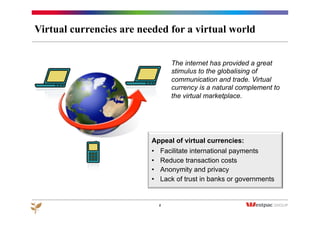
Virtual currencies are needed for a virtual world
2
Appeal of virtual currencies:
•  Facilitate international payments
•  Reduce transaction costs
•  Anonymity and privacy
•  Lack of trust in banks or governments
The internet has provided a great
stimulus to the globalising of
communication and trade. Virtual
currency is a natural complement to
the virtual marketplace.
But there is a “double spend” problem to solve
3
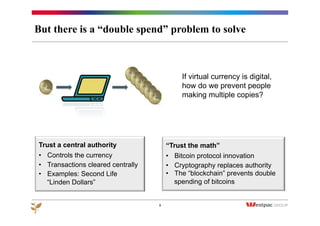
If virtual currency is digital,
how do we prevent people
making multiple copies?
Trust a central authority
•  Controls the currency
•  Transactions cleared centrally
•  Examples: Second Life
“Linden Dollars”
“Trust the math”*
•  Bitcoin protocol innovation
•  Cryptography replaces authority
•  The “blockchain” prevents double
spending of bitcoins
* Quoting Bruce Schneier on cryptography
The blockchain offers a de-centralised solution
4
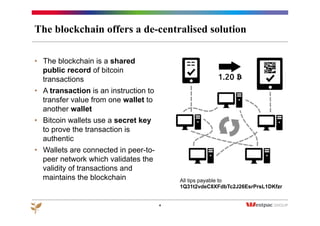
•  The blockchain is a shared
public record of bitcoin
transactions
•  A transaction is an instruction to
transfer value from one wallet to
another wallet
•  Bitcoin wallets use a secret key
to prove the transaction is
authentic
•  Wallets are connected in peer-to-
peer network which validates the
validity of transactions and
maintains the blockchain All tips payable to
1Q31t2vdeC8XFdbTc2J26EsrPrsL1DKfzr
There are a number of ways to obtain bitcoin
5
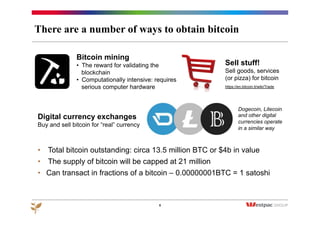
•  Total bitcoin outstanding: circa 13.5 million BTC or $4b in value
•  The supply of bitcoin will be capped at 21 million
•  Can transact in fractions of a bitcoin – 0.00000001BTC = 1 satoshi
Bitcoin mining
•  The reward for validating the
blockchain
•  Computationally intensive: requires
serious computer hardware
Digital currency exchanges
Buy and sell bitcoin for “real” currency
Sell stuff!
Sell goods, services
(or pizza) for bitcoin
Dogecoin, Litecoin
and other digital
currencies operate
in a similar way
https://en.bitcoin.it/wiki/Trade
Bitcoin peer-to-peer network provides the foundation
6
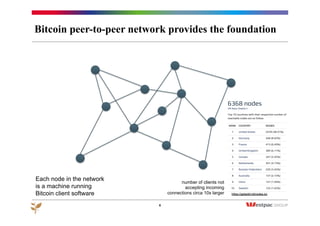
Each node in the network
is a machine running
Bitcoin client software https://getaddr.bitnodes.io/
number of clients not
accepting incoming
connections circa 10x larger
Peers announce transactions to the network
7
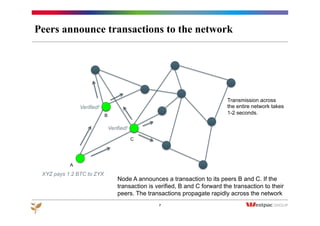
Node A announces a transaction to its peers B and C. If the
transaction is verified, B and C forward the transaction to their
peers. The transactions propagate rapidly across the network
A
B
C
XYZ pays 1.2 BTC to ZYX
Verified!
Verified!
Transmission across
the entire network takes
1-2 seconds.
Verification of transactions
8
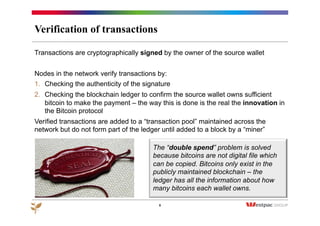
Transactions are cryptographically signed by the owner of the source wallet
Nodes in the network verify transactions by:
1.  Checking the authenticity of the signature
2.  Checking the blockchain ledger to confirm the source wallet owns sufficient
bitcoin to make the payment – the way this is done is the real the innovation in
the Bitcoin protocol
Verified transactions are added to a “transaction pool” maintained across the
network but do not form part of the ledger until added to a block by a “miner”
The “double spend” problem is solved
because bitcoins are not digital file which
can be copied. Bitcoins only exist in the
publicly maintained blockchain – the
ledger has all the information about how
many bitcoins each wallet owns.
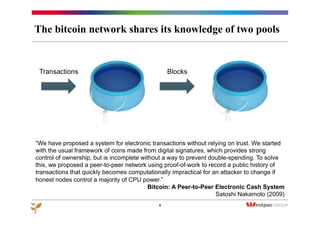
The bitcoin network shares its knowledge of two pools
9
Transactions Blocks
“We have proposed a system for electronic transactions without relying on trust. We started
with the usual framework of coins made from digital signatures, which provides strong
control of ownership, but is incomplete without a way to prevent double-spending. To solve
this, we proposed a peer-to-peer network using proof-of-work to record a public history of
transactions that quickly becomes computationally impractical for an attacker to change if
honest nodes control a majority of CPU power.”
Bitcoin: A Peer-to-Peer Electronic Cash System
Satoshi Nakamoto (2009)
Trapdoor functions
“Trapdoor” functions are a broad
class of functions that form the
foundations of cryptography,
including:
•  Public-key cryptography
•  Hash functions
•  Keyed hash functions
•  Cryptographic hash functions
10
A cryptographic hash function h takes a
message M and returns a fixed length “hash” or
“digest” value with the following properties:
•  Computability
h(M) is easy to compute (not necessarily by
hand)
•  Pre-image resistance
given d, it is it computationally difficult to
determine M such that d = h(M)
•  Collision resistance*
it is computationally difficult to find M and M′
such that h(M) = h(M′)
The SHA-2 family of functions are the current
state of the art – the Bitcoin protocol uses
SHA-256
* Collision resistance implies second pre-image resistance,
namely given M it is computationally difficult to find M′ such that
f(M) = f(M′). Second pre-image resistance is sometimes included
in the definition of cryptographic hash functions.
Public key cryptography
A public key encryption scheme involves a family of trapdoors function E(k,_) and a
mechanism for generating pairs of keys (P, p) with the property that:
E(P, E(p, M)) = M
E(p, E(P, M)) = M
•  P and p are mutual decrypters
•  Share the public key P with the world, keep the private key p secret
•  Encryption: the world encrypts using P, you decrypt using p
•  Authentication: send out M and E(p, M), others decrypt using P
11
•  Plain text attacks make this approach to
authentication dangerous – better practice is to
send out M and E(p, h(M)) where h is an agreed
upon hash function
•  There are many other public key signature
schemes – the Bitcoin protocol uses the Elliptic
Curve Digital Signature Algorithm (ECDSA)
known as secp256k1
Adding nonces makes block creation hard work
A “nonce” is a number or string only used once
For example: add a 5 digit nonce to the string “Bitcoin”:
SHA-256(‘Bitcoin [00000]’) =
A1e2246362756d82bbd442d55f9183572a8341f5bc593c1abbe982886e904acf
12
Message SHA-256
Bitcoin [00000] a1e2246362756d82bbd...
Bitcoin [00027] 0e69a2695aed2f112e8...
Bitcoin [01778] 009b37ae462a71c76cc…
Bitcoin [13855] 000921b4762782c5d5c…
Bitcoin [24354] 00007974c50fd431022…
Bitcoin [26605] 00000341a0effddcc593…
6167 nonces lead a leading zero, 423 nonces
yield at least 2 leading zeros, 27 at least 3, 2 at
least 4 and only one yields 5 yielding zeros.
Challenge: find a nonce that
yields a hash with a specified
“difficulty”, i.e. the required
number of leading zeros
Solution: use a brute-force
search – but the more leading
zeros, the longer the search is
likely to take
Finding the
nonce for a block
would now take
years on most
laptops!
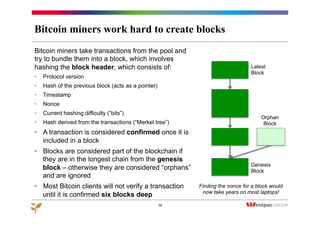
Bitcoin miners work hard to create blocks
Bitcoin miners take transactions from the pool and
try to bundle them into a block, which involves
hashing the block header, which consists of:
•  Protocol version
•  Hash of the previous block (acts as a pointer)
•  Timestamp
•  Nonce
•  Current hashing difficulty (“bits”)
•  Hash derived from the transactions (“Merkel tree”)
•  A transaction is considered confirmed once it is
included in a block
•  Blocks are considered part of the blockchain if
they are in the longest chain from the genesis
block – otherwise they are considered “orphans”
and are ignored
•  Most Bitcoin clients will not verify a transaction
until it is confirmed six blocks deep
13
Latest
Block
Orphan
Block
Genesis
Block
Finding the nonce for a block would
now take years on most laptops!
An attacker would require significant power
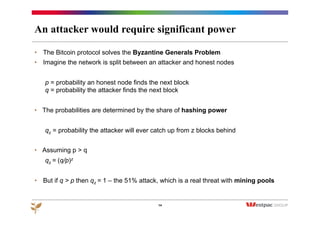
•  The Bitcoin protocol solves the Byzantine Generals Problem
•  Imagine the network is split between an attacker and honest nodes
p = probability an honest node finds the next block
q = probability the attacker finds the next block
•  The probabilities are determined by the share of hashing power
qz = probability the attacker will ever catch up from z blocks behind
•  Assuming p > q
qz = (q/p)z
•  But if q > p then qz = 1 – the 51% attack, which is a real threat with mining pools
14
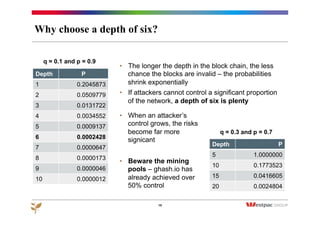
Why choose a depth of six?
Depth P
1 0.2045873
2 0.0509779
3 0.0131722
4 0.0034552
5 0.0009137
6 0.0002428
7 0.0000647
8 0.0000173
9 0.0000046
10 0.0000012
15
Depth P
5 1.0000000
10 0.1773523
15 0.0416605
20 0.0024804
q = 0.1 and p = 0.9
q = 0.3 and p = 0.7
•  The longer the depth in the block chain, the less
chance the blocks are invalid – the probabilities
shrink exponentially
•  If attackers cannot control a significant proportion
of the network, a depth of six is plenty
•  When an attacker’s
control grows, the risks
become far more
signicant
•  Beware the mining
pools – ghash.io has
already achieved over
50% control
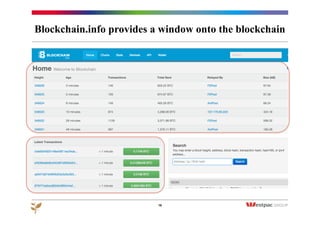
Blockchain.info provides a window onto the blockchain
16
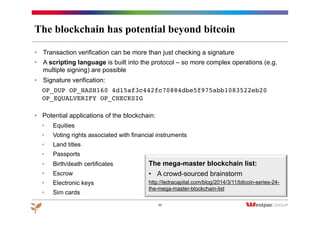
The blockchain has potential beyond bitcoin
•  Transaction verification can be more than just checking a signature
•  A scripting language is built into the protocol – so more complex operations (e.g.
multiple signing) are possible
•  Signature verification:
OP_DUP OP_HASH160 4d15af3c442fc70884dbe5f975abb1083522eb20
OP_EQUALVERIFY OP_CHECKSIG
•  Potential applications of the blockchain:
•  Equities
•  Voting rights associated with financial instruments
•  Land titles
•  Passports
•  Birth/death certificates
•  Escrow
•  Electronic keys
•  Sim cards
17
The mega-master blockchain list:
•  A crowd-sourced brainstorm
http://ledracapital.com/blog/2014/3/11/bitcoin-series-24-
the-mega-master-blockchain-list
As well as the fans, there are many bitcoin skeptics
•  “if the technology is to survive and prosper, and well it should, then the other
three – the pretend currency, the pretend commodity and the anarchist mob [the
conspiracy-loving Bitcoin aficionados] – will have to be rudely shoved out of its
way”
Jeffrey Robinson
•  “Blockchains and consensus ledgers may find traction outside of niches only if
they satiate mass consumer appeal, not just hobbyist interest”
Tim Swanson
•  “the hope that a whole new protocol — bitcoin — will essentially do for digital
transactions what the internet did for communications, just by dint of being
cheap and open-source. I wish it luck, but it’s going to need it.”
Felix Salmon
18
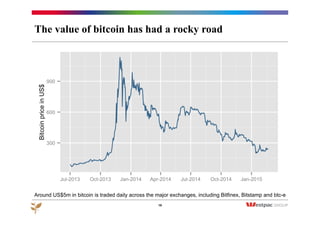
The value of bitcoin has had a rocky road
19
Around US$5m in bitcoin is traded daily across the major exchanges, including Bitfinex, Bitstamp and btc-e
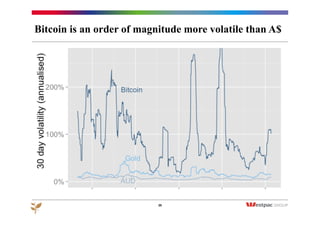
Bitcoin is an order of magnitude more volatile than A$
20
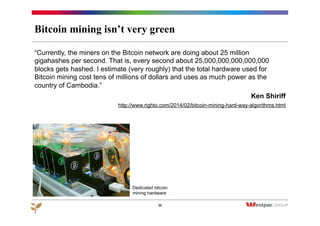
Bitcoin mining isn’t very green
“Currently, the miners on the Bitcoin network are doing about 25 million
gigahashes per second. That is, every second about 25,000,000,000,000,000
blocks gets hashed. I estimate (very roughly) that the total hardware used for
Bitcoin mining cost tens of millions of dollars and uses as much power as the
country of Cambodia.”
Ken Shiriff
http://www.righto.com/2014/02/bitcoin-mining-hard-way-algorithms.html
21
Dedicated bitcoin
mining hardware
In practice the need for trust has not been removed
“The root problem with conventional currency is all the trust that's required to make
it work. The central bank must be trusted not to debase the currency, but the
history of fiat currencies is full of breaches of that trust.”
Satoshi Nakamoto, 2009
•  Many bitcoin transactions are now mediated through online wallets, which are
far more convenient but are based on trust in the wallet provider
•  Bitcoin loss or theft from inputs.io, MtGox and, most recently, Bitstamp show
that this trust can be misplaced
22
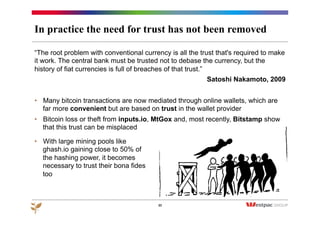
•  With large mining pools like
ghash.io gaining close to 50% of
the hashing power, it becomes
necessary to trust their bona fides
too
So what is the future of bitcoin?
“In many ways it is akin to Napster, the pioneering file-sharing service
that upended the music industry in 1999 by allowing internet users to call
up almost any song at will. Though Napster, unlike Bitcoin, was illegal, it
demonstrated that there was enormous demand for what it provided,
prompting many other services to spring up in its wake. Just as Napster
paved the way for BitTorrent, iTunes and Spotify, Bitcoin has triggered a
surge of innovation in digital money.”
The Economist (November 2013)
23

Bitcoin, Banking and the Blockchain

  • 1.
    Bitcoin and theBlockchain stubbornmule.net March 2015
  • 2.
    Virtual currencies areneeded for a virtual world 2 Appeal of virtual currencies: •  Facilitate international payments •  Reduce transaction costs •  Anonymity and privacy •  Lack of trust in banks or governments The internet has provided a great stimulus to the globalising of communication and trade. Virtual currency is a natural complement to the virtual marketplace.
  • 3.
    But there isa “double spend” problem to solve 3 If virtual currency is digital, how do we prevent people making multiple copies? Trust a central authority •  Controls the currency •  Transactions cleared centrally •  Examples: Second Life “Linden Dollars” “Trust the math”* •  Bitcoin protocol innovation •  Cryptography replaces authority •  The “blockchain” prevents double spending of bitcoins * Quoting Bruce Schneier on cryptography
  • 4.
    The blockchain offersa de-centralised solution 4 •  The blockchain is a shared public record of bitcoin transactions •  A transaction is an instruction to transfer value from one wallet to another wallet •  Bitcoin wallets use a secret key to prove the transaction is authentic •  Wallets are connected in peer-to- peer network which validates the validity of transactions and maintains the blockchain All tips payable to 1Q31t2vdeC8XFdbTc2J26EsrPrsL1DKfzr
  • 5.
    There are anumber of ways to obtain bitcoin 5 •  Total bitcoin outstanding: circa 13.5 million BTC or $4b in value •  The supply of bitcoin will be capped at 21 million •  Can transact in fractions of a bitcoin – 0.00000001BTC = 1 satoshi Bitcoin mining •  The reward for validating the blockchain •  Computationally intensive: requires serious computer hardware Digital currency exchanges Buy and sell bitcoin for “real” currency Sell stuff! Sell goods, services (or pizza) for bitcoin Dogecoin, Litecoin and other digital currencies operate in a similar way https://en.bitcoin.it/wiki/Trade
  • 6.
    Bitcoin peer-to-peer networkprovides the foundation 6 Each node in the network is a machine running Bitcoin client software https://getaddr.bitnodes.io/ number of clients not accepting incoming connections circa 10x larger
  • 7.
    Peers announce transactionsto the network 7 Node A announces a transaction to its peers B and C. If the transaction is verified, B and C forward the transaction to their peers. The transactions propagate rapidly across the network A B C XYZ pays 1.2 BTC to ZYX Verified! Verified! Transmission across the entire network takes 1-2 seconds.
  • 8.
    Verification of transactions 8 Transactionsare cryptographically signed by the owner of the source wallet Nodes in the network verify transactions by: 1.  Checking the authenticity of the signature 2.  Checking the blockchain ledger to confirm the source wallet owns sufficient bitcoin to make the payment – the way this is done is the real the innovation in the Bitcoin protocol Verified transactions are added to a “transaction pool” maintained across the network but do not form part of the ledger until added to a block by a “miner” The “double spend” problem is solved because bitcoins are not digital file which can be copied. Bitcoins only exist in the publicly maintained blockchain – the ledger has all the information about how many bitcoins each wallet owns.
  • 9.
    The bitcoin networkshares its knowledge of two pools 9 Transactions Blocks “We have proposed a system for electronic transactions without relying on trust. We started with the usual framework of coins made from digital signatures, which provides strong control of ownership, but is incomplete without a way to prevent double-spending. To solve this, we proposed a peer-to-peer network using proof-of-work to record a public history of transactions that quickly becomes computationally impractical for an attacker to change if honest nodes control a majority of CPU power.” Bitcoin: A Peer-to-Peer Electronic Cash System Satoshi Nakamoto (2009)
  • 10.
    Trapdoor functions “Trapdoor” functionsare a broad class of functions that form the foundations of cryptography, including: •  Public-key cryptography •  Hash functions •  Keyed hash functions •  Cryptographic hash functions 10 A cryptographic hash function h takes a message M and returns a fixed length “hash” or “digest” value with the following properties: •  Computability h(M) is easy to compute (not necessarily by hand) •  Pre-image resistance given d, it is it computationally difficult to determine M such that d = h(M) •  Collision resistance* it is computationally difficult to find M and M′ such that h(M) = h(M′) The SHA-2 family of functions are the current state of the art – the Bitcoin protocol uses SHA-256 * Collision resistance implies second pre-image resistance, namely given M it is computationally difficult to find M′ such that f(M) = f(M′). Second pre-image resistance is sometimes included in the definition of cryptographic hash functions.
  • 11.
    Public key cryptography Apublic key encryption scheme involves a family of trapdoors function E(k,_) and a mechanism for generating pairs of keys (P, p) with the property that: E(P, E(p, M)) = M E(p, E(P, M)) = M •  P and p are mutual decrypters •  Share the public key P with the world, keep the private key p secret •  Encryption: the world encrypts using P, you decrypt using p •  Authentication: send out M and E(p, M), others decrypt using P 11 •  Plain text attacks make this approach to authentication dangerous – better practice is to send out M and E(p, h(M)) where h is an agreed upon hash function •  There are many other public key signature schemes – the Bitcoin protocol uses the Elliptic Curve Digital Signature Algorithm (ECDSA) known as secp256k1
  • 12.
    Adding nonces makesblock creation hard work A “nonce” is a number or string only used once For example: add a 5 digit nonce to the string “Bitcoin”: SHA-256(‘Bitcoin [00000]’) = A1e2246362756d82bbd442d55f9183572a8341f5bc593c1abbe982886e904acf 12 Message SHA-256 Bitcoin [00000] a1e2246362756d82bbd... Bitcoin [00027] 0e69a2695aed2f112e8... Bitcoin [01778] 009b37ae462a71c76cc… Bitcoin [13855] 000921b4762782c5d5c… Bitcoin [24354] 00007974c50fd431022… Bitcoin [26605] 00000341a0effddcc593… 6167 nonces lead a leading zero, 423 nonces yield at least 2 leading zeros, 27 at least 3, 2 at least 4 and only one yields 5 yielding zeros. Challenge: find a nonce that yields a hash with a specified “difficulty”, i.e. the required number of leading zeros Solution: use a brute-force search – but the more leading zeros, the longer the search is likely to take Finding the nonce for a block would now take years on most laptops!
  • 13.
    Bitcoin miners workhard to create blocks Bitcoin miners take transactions from the pool and try to bundle them into a block, which involves hashing the block header, which consists of: •  Protocol version •  Hash of the previous block (acts as a pointer) •  Timestamp •  Nonce •  Current hashing difficulty (“bits”) •  Hash derived from the transactions (“Merkel tree”) •  A transaction is considered confirmed once it is included in a block •  Blocks are considered part of the blockchain if they are in the longest chain from the genesis block – otherwise they are considered “orphans” and are ignored •  Most Bitcoin clients will not verify a transaction until it is confirmed six blocks deep 13 Latest Block Orphan Block Genesis Block Finding the nonce for a block would now take years on most laptops!
  • 14.
    An attacker wouldrequire significant power •  The Bitcoin protocol solves the Byzantine Generals Problem •  Imagine the network is split between an attacker and honest nodes p = probability an honest node finds the next block q = probability the attacker finds the next block •  The probabilities are determined by the share of hashing power qz = probability the attacker will ever catch up from z blocks behind •  Assuming p > q qz = (q/p)z •  But if q > p then qz = 1 – the 51% attack, which is a real threat with mining pools 14
  • 15.
    Why choose adepth of six? Depth P 1 0.2045873 2 0.0509779 3 0.0131722 4 0.0034552 5 0.0009137 6 0.0002428 7 0.0000647 8 0.0000173 9 0.0000046 10 0.0000012 15 Depth P 5 1.0000000 10 0.1773523 15 0.0416605 20 0.0024804 q = 0.1 and p = 0.9 q = 0.3 and p = 0.7 •  The longer the depth in the block chain, the less chance the blocks are invalid – the probabilities shrink exponentially •  If attackers cannot control a significant proportion of the network, a depth of six is plenty •  When an attacker’s control grows, the risks become far more signicant •  Beware the mining pools – ghash.io has already achieved over 50% control
  • 16.
    Blockchain.info provides awindow onto the blockchain 16
  • 17.
    The blockchain haspotential beyond bitcoin •  Transaction verification can be more than just checking a signature •  A scripting language is built into the protocol – so more complex operations (e.g. multiple signing) are possible •  Signature verification: OP_DUP OP_HASH160 4d15af3c442fc70884dbe5f975abb1083522eb20 OP_EQUALVERIFY OP_CHECKSIG •  Potential applications of the blockchain: •  Equities •  Voting rights associated with financial instruments •  Land titles •  Passports •  Birth/death certificates •  Escrow •  Electronic keys •  Sim cards 17 The mega-master blockchain list: •  A crowd-sourced brainstorm http://ledracapital.com/blog/2014/3/11/bitcoin-series-24- the-mega-master-blockchain-list
  • 18.
    As well asthe fans, there are many bitcoin skeptics •  “if the technology is to survive and prosper, and well it should, then the other three – the pretend currency, the pretend commodity and the anarchist mob [the conspiracy-loving Bitcoin aficionados] – will have to be rudely shoved out of its way” Jeffrey Robinson •  “Blockchains and consensus ledgers may find traction outside of niches only if they satiate mass consumer appeal, not just hobbyist interest” Tim Swanson •  “the hope that a whole new protocol — bitcoin — will essentially do for digital transactions what the internet did for communications, just by dint of being cheap and open-source. I wish it luck, but it’s going to need it.” Felix Salmon 18
  • 19.
    The value ofbitcoin has had a rocky road 19 Around US$5m in bitcoin is traded daily across the major exchanges, including Bitfinex, Bitstamp and btc-e
  • 20.
    Bitcoin is anorder of magnitude more volatile than A$ 20
  • 21.
    Bitcoin mining isn’tvery green “Currently, the miners on the Bitcoin network are doing about 25 million gigahashes per second. That is, every second about 25,000,000,000,000,000 blocks gets hashed. I estimate (very roughly) that the total hardware used for Bitcoin mining cost tens of millions of dollars and uses as much power as the country of Cambodia.” Ken Shiriff http://www.righto.com/2014/02/bitcoin-mining-hard-way-algorithms.html 21 Dedicated bitcoin mining hardware
  • 22.
    In practice theneed for trust has not been removed “The root problem with conventional currency is all the trust that's required to make it work. The central bank must be trusted not to debase the currency, but the history of fiat currencies is full of breaches of that trust.” Satoshi Nakamoto, 2009 •  Many bitcoin transactions are now mediated through online wallets, which are far more convenient but are based on trust in the wallet provider •  Bitcoin loss or theft from inputs.io, MtGox and, most recently, Bitstamp show that this trust can be misplaced 22 •  With large mining pools like ghash.io gaining close to 50% of the hashing power, it becomes necessary to trust their bona fides too
  • 23.
    So what isthe future of bitcoin? “In many ways it is akin to Napster, the pioneering file-sharing service that upended the music industry in 1999 by allowing internet users to call up almost any song at will. Though Napster, unlike Bitcoin, was illegal, it demonstrated that there was enormous demand for what it provided, prompting many other services to spring up in its wake. Just as Napster paved the way for BitTorrent, iTunes and Spotify, Bitcoin has triggered a surge of innovation in digital money.” The Economist (November 2013) 23