Secure Digital Currency:
Bitcoin
Amir Houmansadr
CS660: Advanced Information Assurance
Spring 2015
Content may be borrowed from other resources.
See the last slide for acknowledgements!
Online Transactions
• Physical cash
– Non-traceable (well, mostly!)
– Secure (mostly)
– Low inflation
• Can’t be used online directly
Electronic credit or debit transactions
Bank sees all transactions
Merchants can track/profile customers
CS660 - Advanced Information Assurance -
UMassAmherst
2
E-Cash
• Secure
– Single use
– Reliable
• Low inflation
• Privacy-preserving
E-Cash Crypto Protocols
 Chaum82: blind signatures for e-cash
 Chaum88: retroactive double spender identification
 Brandis95: restricted blind signatures
 Camenisch05: compact offline e-cash
• Various practical issues:
– Need for trusted central party
– Computationally expensive
– Etc.
CS660 - Advanced Information Assurance -
UMassAmherst
4
Bitcoin
• A distributed, decentralized digital currency
system
• Released by Satoshi Nakamoto 2008
• Effectively a bank run by an ad hoc network
– Digital checks
– A distributed transaction log
Size of the BitCoin Economy
• Number of BitCoins in circulation 11.8 million
(December 2013)
• Total number of BitCoins generated cannot
exceed 21 million
• Average price of a Bitcoin: around $300
 Price has been unstable.
• Total balances held in BTC 1B$ compared with
1,200B$ circulating in USD.
• 30 Transactions per min. (Visa transaction
200,000 per minute.)
BitCoin: Challenges
• Creation of a virtual coin/note
– How is it created in the first place?
– How do you prevent inflation? (What prevents anyone from creating
lots of coins?)
• Validation
– Is the coin legit? (proof-of-work)
– How do you prevent a coin from double-spending?
• Buyer and Seller protection in online transactions
– Buyer pays, but the seller doesn’t deliver
– Seller delivers, buyer pays, but the buyer makes a claim.
• Trust on third-parties
– Rely on proof instead of trust
– Verifiable by everyone
– No central bank or clearing house
Security in Bitcoin
• Authentication
– Am I paying the right person? Not some other
impersonator?
• Integrity
– Is the coin double-spent?
– Can an attacker reverse or change transactions?
• Availability
– Can I make a transaction anytime I want?
• Confidentiality
– Are my transactions private? Anonymous?
Security in Bitcoin
• Authentication  Public Key Crypto: Digital Signatures
– Am I paying the right person? Not some other
impersonator?
• Integrity  Digital Signatures and Cryptographic Hash
– Is the coin double-spent?
– Can an attacker reverse or change transactions?
• Availability Broadcast messages to the P2P network
– Can I make a transaction anytime I want?
• Confidentiality Pseudonymity
– Are my transactions private? Anonymous?
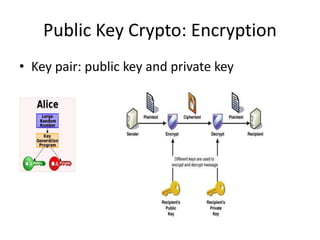
Public Key Crypto: Encryption
• Key pair: public key and private key
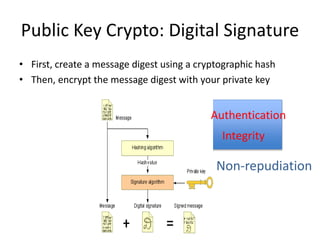
Public Key Crypto: Digital Signature
• First, create a message digest using a cryptographic hash
• Then, encrypt the message digest with your private key
Authentication
Integrity
Non-repudiation
12
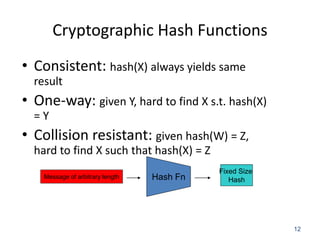
Cryptographic Hash Functions
• Consistent: hash(X) always yields same
result
• One-way: given Y, hard to find X s.t. hash(X)
= Y
• Collision resistant: given hash(W) = Z,
hard to find X such that hash(X) = Z
Hash Fn
Message of arbitrary length
Fixed Size
Hash
Back to BitCoin
• Validation
– Is the coin legit? (proof-of-work)  Use of
Cryptographic Hashes
– How do you prevent a coin from double-spending? 
Broadcast to all nodes
• Creation of a virtual coin/note
– How is it created in the first place?  Provide
incentives for miners
– How do you prevent inflation? (What prevents anyone
from creating lots of coins?)  Limit the creation rate
of the BitCoins
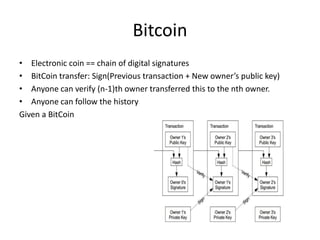
Bitcoin
• Electronic coin == chain of digital signatures
• BitCoin transfer: Sign(Previous transaction + New owner’s public key)
• Anyone can verify (n-1)th owner transferred this to the nth owner.
• Anyone can follow the history
Given a BitCoin
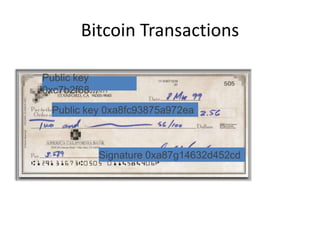
Bitcoin Transactions
Public key 0xa8fc93875a972ea
Signature 0xa87g14632d452cd
Public key
0xc7b2f68...
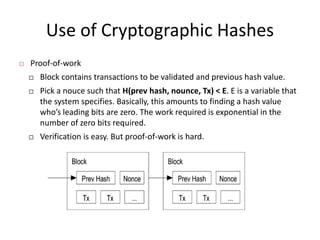
Use of Cryptographic Hashes
 Proof-of-work
 Block contains transactions to be validated and previous hash value.
 Pick a nouce such that H(prev hash, nounce, Tx) < E. E is a variable that
the system specifies. Basically, this amounts to finding a hash value
who’s leading bits are zero. The work required is exponential in the
number of zero bits required.
 Verification is easy. But proof-of-work is hard.
Preventing Double-spending
• The only way is to be aware of all transactions.
• Each node (miner) verifies that this is the first
spending of the Bitcoin by the payer.
• Only when it is verified it generates the proof-
of-work and attach it to the current chain.
Bitcoin Network
• Each P2P node runs the following algorithm:
– New transactions are broadcast to all nodes.
– Each node (miners) collects new transactions into a block.
– Each node works on finding a proof-of-work for its block. (Hard
to do. Probabilistic. The one to finish early will probably win.)
– When a node finds a proof-of-work, it broadcasts the block to all
nodes.
– Nodes accept the block only if all transactions in it are valid
(digital signature checking) and not already spent (check all the
transactions).
– Nodes express their acceptance by working on creating the next
block in the chain, using the hash of the accepted block as the
previous hash.
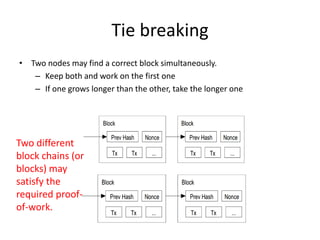
Tie breaking
• Two nodes may find a correct block simultaneously.
– Keep both and work on the first one
– If one grows longer than the other, take the longer one
Two different
block chains (or
blocks) may
satisfy the
required proof-
of-work.
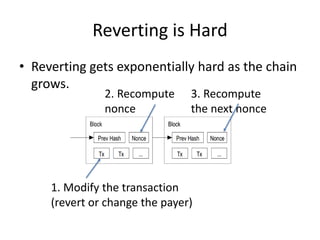
Reverting is Hard
• Reverting gets exponentially hard as the chain
grows.
1. Modify the transaction
(revert or change the payer)
2. Recompute
nonce
3. Recompute
the next nonce
Practical Limitation
• At least 10 mins to verify a transaction.
– Agree to pay
– Wait for one block (10 mins) for the transaction to
go through.
– But, for a large transaction ($$$) wait longer.
Because if you wait longer it becomes more
secure. For large $$$, you wait for six blocks (1
hour).
Optimizations
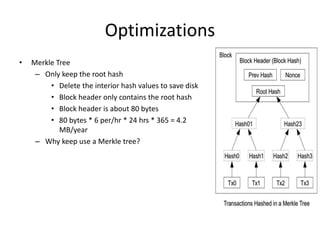
• Merkle Tree
– Only keep the root hash
• Delete the interior hash values to save disk
• Block header only contains the root hash
• Block header is about 80 bytes
• 80 bytes * 6 per/hr * 24 hrs * 365 = 4.2
MB/year
– Why keep use a Merkle tree?
Simplified payment verification
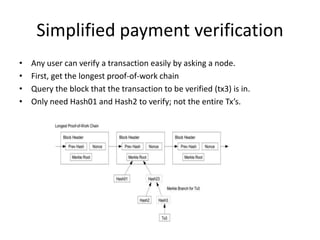
• Any user can verify a transaction easily by asking a node.
• First, get the longest proof-of-work chain
• Query the block that the transaction to be verified (tx3) is in.
• Only need Hash01 and Hash2 to verify; not the entire Tx’s.
BitCoin Economics
 Rate limiting on the creation of a new block
 Adapt to the “network’s capacity”
 A block created every 10 mins (six blocks every hour)
 How? Difficulty is adjusted every two weeks to keep the rate fixed
as capacity/computing power increases
 N new Bitcoins per each new block: credited to the
miner  incentives for miners
 N was 50 initially. In 2013, N=25.
 Halved every 210,000 blocks (every four years)
 Thus, the total number of BitCoins will not exceed 21 million.
(After this miner takes a fee)
Privacy Implications
• No anonymity, only pseudonymity
• All transactions remain on the block chain–
indefinitely!
• Retroactive data mining
– Target used data mining on customer purchases to
identify pregnant women and target ads at them
(NYT 2012), ended up informing a woman’s father
that his teenage daughter was pregnant
– Imagine what credit card companies could do with the
data
CS660 - Advanced Information Assurance -
UMassAmherst
25
Zerocoin
• A distributed approach to private electronic
cash
• Extends Bitcoin by adding an anonymous
currency on top of it
• Zerocoins are exchangeable for bitcoins
What is a zerocoin?
A zerocoin is:
Economically: a promissory note redeemable for a
bitcoin
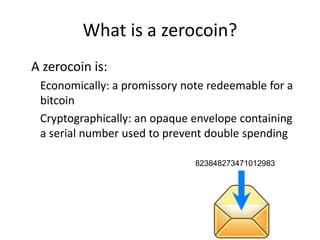
Cryptographically: an opaque envelope containing
a serial number used to prevent double spending
823848273471012983
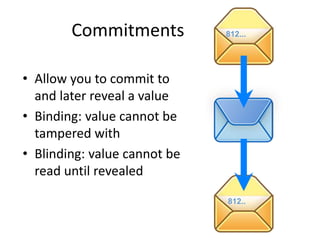
Commitments
• Allow you to commit to
and later reveal a value
• Binding: value cannot be
tampered with
• Blinding: value cannot be
read until revealed
812...
812..
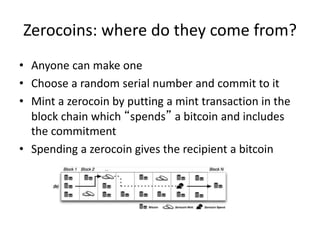
Zerocoins: where do they come from?
• Anyone can make one
• Choose a random serial number and commit to it
• Mint a zerocoin by putting a mint transaction in the
block chain which “spends” a bitcoin and includes
the commitment
• Spending a zerocoin gives the recipient a bitcoin
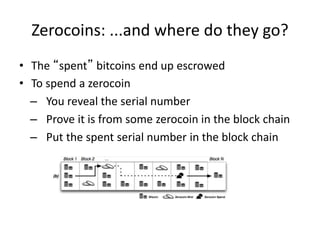
Zerocoins: ...and where do they go?
• The “spent” bitcoins end up escrowed
• To spend a zerocoin
– You reveal the serial number
– Prove it is from some zerocoin in the block chain
– Put the spent serial number in the block chain
Zero-knowledge proofs
• Zero-knowledge [Goldwasser, Micali 1980s,
and beyond]
• Prove knowledge of a witness satisfying a
statement
• Specific variant: non-interactive proof of
knowledge
• Here we prove we know:
1.The serial number of a zerocoin
2.That the coin is in the block chain
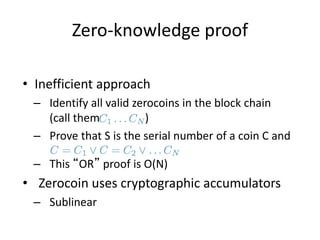
Zero-knowledge proof
• Inefficient approach
– Identify all valid zerocoins in the block chain
(call them )
– Prove that S is the serial number of a coin C and
– This “OR” proof is O(N)
• Zerocoin uses cryptographic accumulators
– Sublinear
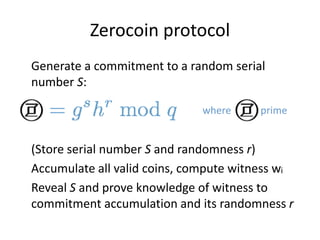
Zerocoin protocol
Generate a commitment to a random serial
number S:
(Store serial number S and randomness r)
Accumulate all valid coins, compute witness wi
Reveal S and prove knowledge of witness to
commitment accumulation and its randomness r
where is prime
Discussion
• The future of Bitcoin?
• Attacks on Zerocoin?
• Should we tradeoff privacy for usability? Is
privacy a main principle?
CS660 - Advanced Information Assurance -
UMassAmherst
34
Acknowledgement
• Some of the slides, content, or pictures are borrowed from
the following resources, and some pictures are obtained
through Google search without being referenced below:
• L24-BitCoin and Security, many of the slides borrowed from
this presentation with modifications.
• Ian Miers, Zerocoin: Anonymous Distributed E-Cash from
Bitcoin, IEE S&P slides
•
35
CS660 - Advanced Information Assurance -
UMassAmherst

Blockchain and Bitcoin.pptx

  • 1.
    Secure Digital Currency: Bitcoin AmirHoumansadr CS660: Advanced Information Assurance Spring 2015 Content may be borrowed from other resources. See the last slide for acknowledgements!
  • 2.
    Online Transactions • Physicalcash – Non-traceable (well, mostly!) – Secure (mostly) – Low inflation • Can’t be used online directly Electronic credit or debit transactions Bank sees all transactions Merchants can track/profile customers CS660 - Advanced Information Assurance - UMassAmherst 2
  • 3.
    E-Cash • Secure – Singleuse – Reliable • Low inflation • Privacy-preserving
  • 4.
    E-Cash Crypto Protocols Chaum82: blind signatures for e-cash  Chaum88: retroactive double spender identification  Brandis95: restricted blind signatures  Camenisch05: compact offline e-cash • Various practical issues: – Need for trusted central party – Computationally expensive – Etc. CS660 - Advanced Information Assurance - UMassAmherst 4
  • 5.
    Bitcoin • A distributed,decentralized digital currency system • Released by Satoshi Nakamoto 2008 • Effectively a bank run by an ad hoc network – Digital checks – A distributed transaction log
  • 6.
    Size of theBitCoin Economy • Number of BitCoins in circulation 11.8 million (December 2013) • Total number of BitCoins generated cannot exceed 21 million • Average price of a Bitcoin: around $300  Price has been unstable. • Total balances held in BTC 1B$ compared with 1,200B$ circulating in USD. • 30 Transactions per min. (Visa transaction 200,000 per minute.)
  • 7.
    BitCoin: Challenges • Creationof a virtual coin/note – How is it created in the first place? – How do you prevent inflation? (What prevents anyone from creating lots of coins?) • Validation – Is the coin legit? (proof-of-work) – How do you prevent a coin from double-spending? • Buyer and Seller protection in online transactions – Buyer pays, but the seller doesn’t deliver – Seller delivers, buyer pays, but the buyer makes a claim. • Trust on third-parties – Rely on proof instead of trust – Verifiable by everyone – No central bank or clearing house
  • 8.
    Security in Bitcoin •Authentication – Am I paying the right person? Not some other impersonator? • Integrity – Is the coin double-spent? – Can an attacker reverse or change transactions? • Availability – Can I make a transaction anytime I want? • Confidentiality – Are my transactions private? Anonymous?
  • 9.
    Security in Bitcoin •Authentication  Public Key Crypto: Digital Signatures – Am I paying the right person? Not some other impersonator? • Integrity  Digital Signatures and Cryptographic Hash – Is the coin double-spent? – Can an attacker reverse or change transactions? • Availability Broadcast messages to the P2P network – Can I make a transaction anytime I want? • Confidentiality Pseudonymity – Are my transactions private? Anonymous?
  • 10.
    Public Key Crypto:Encryption • Key pair: public key and private key
  • 11.
    Public Key Crypto:Digital Signature • First, create a message digest using a cryptographic hash • Then, encrypt the message digest with your private key Authentication Integrity Non-repudiation
  • 12.
    12 Cryptographic Hash Functions •Consistent: hash(X) always yields same result • One-way: given Y, hard to find X s.t. hash(X) = Y • Collision resistant: given hash(W) = Z, hard to find X such that hash(X) = Z Hash Fn Message of arbitrary length Fixed Size Hash
  • 13.
    Back to BitCoin •Validation – Is the coin legit? (proof-of-work)  Use of Cryptographic Hashes – How do you prevent a coin from double-spending?  Broadcast to all nodes • Creation of a virtual coin/note – How is it created in the first place?  Provide incentives for miners – How do you prevent inflation? (What prevents anyone from creating lots of coins?)  Limit the creation rate of the BitCoins
  • 14.
    Bitcoin • Electronic coin== chain of digital signatures • BitCoin transfer: Sign(Previous transaction + New owner’s public key) • Anyone can verify (n-1)th owner transferred this to the nth owner. • Anyone can follow the history Given a BitCoin
  • 15.
    Bitcoin Transactions Public key0xa8fc93875a972ea Signature 0xa87g14632d452cd Public key 0xc7b2f68...
  • 16.
    Use of CryptographicHashes  Proof-of-work  Block contains transactions to be validated and previous hash value.  Pick a nouce such that H(prev hash, nounce, Tx) < E. E is a variable that the system specifies. Basically, this amounts to finding a hash value who’s leading bits are zero. The work required is exponential in the number of zero bits required.  Verification is easy. But proof-of-work is hard.
  • 17.
    Preventing Double-spending • Theonly way is to be aware of all transactions. • Each node (miner) verifies that this is the first spending of the Bitcoin by the payer. • Only when it is verified it generates the proof- of-work and attach it to the current chain.
  • 18.
    Bitcoin Network • EachP2P node runs the following algorithm: – New transactions are broadcast to all nodes. – Each node (miners) collects new transactions into a block. – Each node works on finding a proof-of-work for its block. (Hard to do. Probabilistic. The one to finish early will probably win.) – When a node finds a proof-of-work, it broadcasts the block to all nodes. – Nodes accept the block only if all transactions in it are valid (digital signature checking) and not already spent (check all the transactions). – Nodes express their acceptance by working on creating the next block in the chain, using the hash of the accepted block as the previous hash.
  • 19.
    Tie breaking • Twonodes may find a correct block simultaneously. – Keep both and work on the first one – If one grows longer than the other, take the longer one Two different block chains (or blocks) may satisfy the required proof- of-work.
  • 20.
    Reverting is Hard •Reverting gets exponentially hard as the chain grows. 1. Modify the transaction (revert or change the payer) 2. Recompute nonce 3. Recompute the next nonce
  • 21.
    Practical Limitation • Atleast 10 mins to verify a transaction. – Agree to pay – Wait for one block (10 mins) for the transaction to go through. – But, for a large transaction ($$$) wait longer. Because if you wait longer it becomes more secure. For large $$$, you wait for six blocks (1 hour).
  • 22.
    Optimizations • Merkle Tree –Only keep the root hash • Delete the interior hash values to save disk • Block header only contains the root hash • Block header is about 80 bytes • 80 bytes * 6 per/hr * 24 hrs * 365 = 4.2 MB/year – Why keep use a Merkle tree?
  • 23.
    Simplified payment verification •Any user can verify a transaction easily by asking a node. • First, get the longest proof-of-work chain • Query the block that the transaction to be verified (tx3) is in. • Only need Hash01 and Hash2 to verify; not the entire Tx’s.
  • 24.
    BitCoin Economics  Ratelimiting on the creation of a new block  Adapt to the “network’s capacity”  A block created every 10 mins (six blocks every hour)  How? Difficulty is adjusted every two weeks to keep the rate fixed as capacity/computing power increases  N new Bitcoins per each new block: credited to the miner  incentives for miners  N was 50 initially. In 2013, N=25.  Halved every 210,000 blocks (every four years)  Thus, the total number of BitCoins will not exceed 21 million. (After this miner takes a fee)
  • 25.
    Privacy Implications • Noanonymity, only pseudonymity • All transactions remain on the block chain– indefinitely! • Retroactive data mining – Target used data mining on customer purchases to identify pregnant women and target ads at them (NYT 2012), ended up informing a woman’s father that his teenage daughter was pregnant – Imagine what credit card companies could do with the data CS660 - Advanced Information Assurance - UMassAmherst 25
  • 26.
    Zerocoin • A distributedapproach to private electronic cash • Extends Bitcoin by adding an anonymous currency on top of it • Zerocoins are exchangeable for bitcoins
  • 27.
    What is azerocoin? A zerocoin is: Economically: a promissory note redeemable for a bitcoin Cryptographically: an opaque envelope containing a serial number used to prevent double spending 823848273471012983
  • 28.
    Commitments • Allow youto commit to and later reveal a value • Binding: value cannot be tampered with • Blinding: value cannot be read until revealed 812... 812..
  • 29.
    Zerocoins: where dothey come from? • Anyone can make one • Choose a random serial number and commit to it • Mint a zerocoin by putting a mint transaction in the block chain which “spends” a bitcoin and includes the commitment • Spending a zerocoin gives the recipient a bitcoin
  • 30.
    Zerocoins: ...and wheredo they go? • The “spent” bitcoins end up escrowed • To spend a zerocoin – You reveal the serial number – Prove it is from some zerocoin in the block chain – Put the spent serial number in the block chain
  • 31.
    Zero-knowledge proofs • Zero-knowledge[Goldwasser, Micali 1980s, and beyond] • Prove knowledge of a witness satisfying a statement • Specific variant: non-interactive proof of knowledge • Here we prove we know: 1.The serial number of a zerocoin 2.That the coin is in the block chain
  • 32.
    Zero-knowledge proof • Inefficientapproach – Identify all valid zerocoins in the block chain (call them ) – Prove that S is the serial number of a coin C and – This “OR” proof is O(N) • Zerocoin uses cryptographic accumulators – Sublinear
  • 33.
    Zerocoin protocol Generate acommitment to a random serial number S: (Store serial number S and randomness r) Accumulate all valid coins, compute witness wi Reveal S and prove knowledge of witness to commitment accumulation and its randomness r where is prime
  • 34.
    Discussion • The futureof Bitcoin? • Attacks on Zerocoin? • Should we tradeoff privacy for usability? Is privacy a main principle? CS660 - Advanced Information Assurance - UMassAmherst 34
  • 35.
    Acknowledgement • Some ofthe slides, content, or pictures are borrowed from the following resources, and some pictures are obtained through Google search without being referenced below: • L24-BitCoin and Security, many of the slides borrowed from this presentation with modifications. • Ian Miers, Zerocoin: Anonymous Distributed E-Cash from Bitcoin, IEE S&P slides • 35 CS660 - Advanced Information Assurance - UMassAmherst