Analytical Reading
Reading is to the mind what exercise is to the body.” ― Joseph Addison
Prepared & Presented By: SADIA KHAN
Lecturer English, INS,KMU
PRN 1st INS,KMU
Contents
 Reading
 Importance of reading
 Analytical reading
 Importance of Analysis in Reading
 Analytical Reading Examples
 Steps for Analytical Reading
 Step One: Survey
 Step Two: Guiding Questions
 Step Three: Along with Way
 Step Four: Assess
 Analytical Reading Strategies
 Skimming
 Re-reading
 Integration
 Argument mapping
 Annotation
 Analytical Reading Examples
 Summary Of Analytical Reading
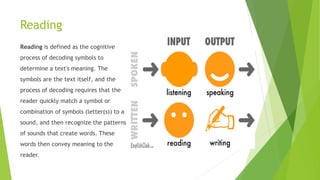
Reading
Reading is defined as the cognitive
process of decoding symbols to
determine a text's meaning. The
symbols are the text itself, and the
process of decoding requires that the
reader quickly match a symbol or
combination of symbols (letter(s)) to a
sound, and then recognize the patterns
of sounds that create words. These
words then convey meaning to the
reader.
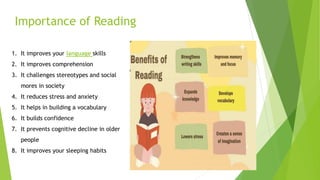
Importance of Reading
1. It improves your language skills
2. It improves comprehension
3. It challenges stereotypes and social
mores in society
4. It reduces stress and anxiety
5. It helps in building a vocabulary
6. It builds confidence
7. It prevents cognitive decline in older
people
8. It improves your sleeping habits
Analytical reading
 Analytical reading is defined as a high-level cognitive skill and a reading
strategy that serves the purpose of probing more deeply to comprehend both
the message and the intent or ultimate goal of the text at hand.
 Basic comprehension is just one component of good reading skills. Going from
simply reading as a form of entertainment to actually maximizing your
potential and extracting maximum value from the time you spend with a book
in your hand is no easy task.
 Whether you do your analytical reading as part of a school assignment where
you need to dissect a text and recognize its true meaning and everything the
author is trying to suggest, as part of your general reading routine because
you are dedicated to analyzing your books and extracting all the necessary
information from them, or simply as part of your job, this skill is, without a
doubt, one of the most important ones for a reader.
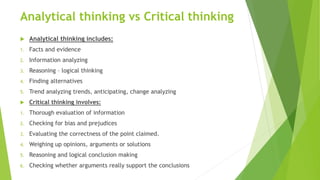
Analytical thinking vs Critical thinking
 Analytical thinking includes:
1. Facts and evidence
2. Information analyzing
3. Reasoning – logical thinking
4. Finding alternatives
5. Trend analyzing trends, anticipating, change analyzing
 Critical thinking involves:
1. Thorough evaluation of information
2. Checking for bias and prejudices
3. Evaluating the correctness of the point claimed.
4. Weighing up opinions, arguments or solutions
5. Reasoning and logical conclusion making
6. Checking whether arguments really support the conclusions
Importance of analysis in reading
 The importance of analytical thinking in reading and writing has much deeper roots than you
might expect. Reading analytically can help readers gain a deeper understanding of the text at
hand, extract the true ideas, understand its structure and meaning, and analyze it critically, thus
drawing the right conclusions about it.
 Another benefit of reading analytically is the fact that you will have much better comprehension
and retention levels at the end of your reading session. Granted, the process does take time and
you will go through a lot fewer pages within the same timeframe than you would when reading
passively, but the value you will be extracting from those few pages will be undeniably a lot
higher.
Cont..
 The analytical reading definition does mention that it is a high-level cognitive skill, but what does
that actually mean? Well, it means that it can only be achieved by readers with a high degree of
proficiency in reading. And there is actually a causality relationship between reading proficiency
and analytical reading skills: the only way to become a proficient reader is through text analysis
and the higher the proficiency level of the reader, the more accurate the analysis will be.
 On top of this amazing skill you will develop, there are also benefits for your brain’s health that
are worth mentioning. As you know, reading is a mentally challenging activity that results in good
brain health, better memory, and delayed onset of cognitive disorders among other things. Well,
as you would imagine, reading analytically is a lot more difficult and therefore a lot more effective
in providing your brain with an intense and effective workout. If reading is the equivalent of
cardio for your brain, analytical reading is a tough session of lifting weights.
Analytical Reading Examples
 Some examples might shed some much needed light on analytical reading as a
concept. To better understand what analytical reading is and how it is done, let’s
assume you are given the task to read a book analytically. To actually prove that
you have done, by the time the book is finished, you should be able to do the
following:
 Categorize the book according to genre, type, subject, and themes
 Be able to present the essential information about the book with utmost
brevity(fact that it is short or lasts for only a short time.)
 Be able to create a clear outline of the essential parts of the book in the correct
order and relation
 Identify and define the author’s intentions, techniques, and the problems they are
trying to solve
 While things might differ from one task to another, this example is the most
eloquent when it comes to understanding what the final purpose of analytical
reading is.
Steps for Analytical Reading
 Step One: Survey
1. Read the title, section headings, and first and last verses of each chapter. This should take
about fifteen-to-thirty minutes.
2. Then leaf through the book. Scan chapters that seem interesting. Notice headings.
 Step Two: Guiding Questions
As we read, it’s important to learn how to interact with the author’s big ideas so we can
understand them. When we read others’ ideas, we may leave with personal insights. However,
effective reading is focused on the author stimulating us by their ideas, insights, and arguments.
The following four questions can help you interact with the author’s ideas.
1. What is the book about? What’s the main point, the key theme, and subject matter?
2. What are the author’s main ideas? Arguments? What problem is the author trying to solve?
3. How does the author support his main ideas and arguments?
4. What difference do the author’s ideas make? What are the implications of the work?
Cont..
 Step Three: Along with Way
As we read, it’s helpful to utilize writing to summarize, highlight, and record. The best way to do
this is to read with a pen and journal so you can take notes.
1. Look for the author’s key words/ideas (what’s repeated), sentences, ideas, and main points.
2. Underline/highlight the sentence that captures the author’s main idea or argument.
3. Underline/highlight how the author explains or expands his main idea or argument.
4. Write questions, insights, and objections in the margin.
5. When you’re done with a chapter, write your own basic outline of the chapter.
When you’re done with the first three steps, you should understand the author and be able to:
1. Classify: what kind of book is this and what’s the subject matter?
2. Summarize: In a sentence or two, state what the whole book is about.
3. Outline: Describe the major points, arguments, questions and show relationships of
material.
4. Define: Define the problems the author is trying to solve.
Cont..
 Step Four: Assess
In the final step, assess and reflect on the author’s work. This step is about what
you think, how you were impacted, and what you might do as a result. Here are
helpful questions.
1. What did you learn? What new framework, argument, perspective got your
attention?
2. What new information did you get? New interpretations? New clarity?
3. What is personally challenging or affirming? What confirms or contradicts
your positions?
4. What questions were raised for you
Analytical Reading Strategies
Analytical reading as a strategy is the result of a series of techniques that need to be
applied. There are several important steps that go into reading analytically and you will
need to know and understand them well before you will be successful in analytical reading.
Skimming
Before reading a challenging text, you should read the introduction and conclusion, then
scan the headings and structure to find the main points and justifications for those points.
Why is this important? It should be done to make reading easier and to help bring the main
ideas in context. Learning this skill as part of your inspectional reading strategy is going to
give your reading habits and level of proficiency a considerable boost.
There are a couple of steps in skimming that should not be missed:
1. Consider why you should read this. (What makes me read it? Which genre does it
belong to?
2. While reading the introduction and summary, search for the thesis.
3. Look for important ideas, bolded phrases, and section titles in the text.
4. Go through each section’s opening sentences.
5. Describe your working summary (thesis and primary arguments) for yourself.
Re-reading
Reading analytically involves a deep level of understanding of the entire piece of content
you are going through. When reading challenging portions, take your time, reread the
text, and pause until you can sum it up in one or two phrases for yourself. Doing this is
essential to ensure comprehension of challenging concepts before moving on.
The important steps of re-reading are:
1. Go back and read the passage slowly, finding the last part of it you fully understood.
2. Read the paragraph once more slowly (perhaps out loud).
3. List any terms you don’t understand and do some research on them.
4. Look over any ideas that were supported previously in the text.
5. Continue until you can sum up the whole passage in one or two sentences for
yourself.
Integration
 This part refers to associating the newly acquired information with the knowledge
you already possess. You should recognize central concepts, assess what else you
know or have read about those ideas, and weigh similarities and differences
whenever you come across a central thought or when an idea reminds you of
something else.
 Doing this encourages greater comprehension and improves the quality of your
reading experience. These are the important steps and questions you should keep
in mind:
 Begin by listing the main ideas and assertions.
 In what other books have you come across similar ideas and concepts?
 How are the concepts or assertions used in comparable ways?
 How do the various applications of the ideas or assertions differ?
 Annotation
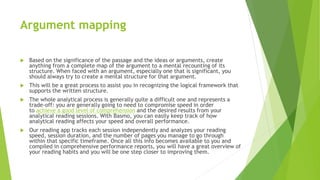
Argument mapping
 Based on the significance of the passage and the ideas or arguments, create
anything from a complete map of the argument to a mental recounting of its
structure. When faced with an argument, especially one that is significant, you
should always try to create a mental structure for that argument.
 This will be a great process to assist you in recognizing the logical framework that
supports the written structure.
 The whole analytical process is generally quite a difficult one and represents a
trade-off: you are generally going to need to compromise speed in order
to achieve a good level of comprehension and the desired results from your
analytical reading sessions. With Basmo, you can easily keep track of how
analytical reading affects your speed and overall performance.
 Our reading app tracks each session independently and analyzes your reading
speed, session duration, and the number of pages you manage to go through
within that specific timeframe. Once all this info becomes available to you and
compiled in comprehensive performance reports, you will have a great overview of
your reading habits and you will be one step closer to improving them.
Annotation
 Take notes on the text with your favorite method (annotating, taking separate notes,
or highlighting) when a passage excites you, fascinates you, or is simply important to
remember.
 Taking notes keeps you interested in the content and aids with memory retention. Here are
the main note-taking and annotating methodologies:
 The Cornell Method: Create two columns on a separate sheet of paper, allowing some room
at the bottom. Make a list of the main points from the book or passage in the right hand
column (your notes). Find the essential words for those thoughts in the left-hand column
(your cues). Write a short summary of the paragraph at the end.
 Jeff’s Method: This is just a modified Cornell Method, using the left-hand column for queries
and rebuttals. The author’s thoughts are listed in the right-hand column, and your thoughts
should be listed in the left.
 The Marginalia Method: Create a set of symbols to represent various reactions to the text,
such as one for a query, one for a major point, and one for an idea you didn’t comprehend.
Make notes in your text, expanding lengthy ideas where there is room or on a different piece
of paper.
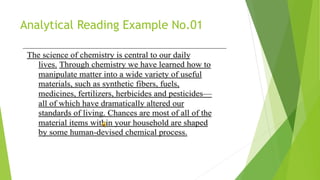
Analytical Reading Example No.01
Example no.02
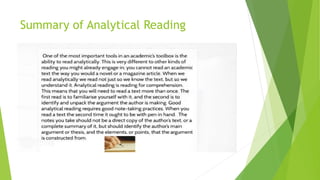
Summary of Analytical Reading

analytical reading slides for nurses .pdf

  • 1.
    Analytical Reading Reading isto the mind what exercise is to the body.” ― Joseph Addison Prepared & Presented By: SADIA KHAN Lecturer English, INS,KMU PRN 1st INS,KMU
  • 2.
    Contents  Reading  Importanceof reading  Analytical reading  Importance of Analysis in Reading  Analytical Reading Examples  Steps for Analytical Reading  Step One: Survey  Step Two: Guiding Questions  Step Three: Along with Way  Step Four: Assess  Analytical Reading Strategies  Skimming  Re-reading  Integration  Argument mapping  Annotation  Analytical Reading Examples  Summary Of Analytical Reading
  • 3.
    Reading Reading is definedas the cognitive process of decoding symbols to determine a text's meaning. The symbols are the text itself, and the process of decoding requires that the reader quickly match a symbol or combination of symbols (letter(s)) to a sound, and then recognize the patterns of sounds that create words. These words then convey meaning to the reader.
  • 4.
    Importance of Reading 1.It improves your language skills 2. It improves comprehension 3. It challenges stereotypes and social mores in society 4. It reduces stress and anxiety 5. It helps in building a vocabulary 6. It builds confidence 7. It prevents cognitive decline in older people 8. It improves your sleeping habits
  • 5.
    Analytical reading  Analyticalreading is defined as a high-level cognitive skill and a reading strategy that serves the purpose of probing more deeply to comprehend both the message and the intent or ultimate goal of the text at hand.  Basic comprehension is just one component of good reading skills. Going from simply reading as a form of entertainment to actually maximizing your potential and extracting maximum value from the time you spend with a book in your hand is no easy task.  Whether you do your analytical reading as part of a school assignment where you need to dissect a text and recognize its true meaning and everything the author is trying to suggest, as part of your general reading routine because you are dedicated to analyzing your books and extracting all the necessary information from them, or simply as part of your job, this skill is, without a doubt, one of the most important ones for a reader.
  • 6.
    Analytical thinking vsCritical thinking  Analytical thinking includes: 1. Facts and evidence 2. Information analyzing 3. Reasoning – logical thinking 4. Finding alternatives 5. Trend analyzing trends, anticipating, change analyzing  Critical thinking involves: 1. Thorough evaluation of information 2. Checking for bias and prejudices 3. Evaluating the correctness of the point claimed. 4. Weighing up opinions, arguments or solutions 5. Reasoning and logical conclusion making 6. Checking whether arguments really support the conclusions
  • 7.
    Importance of analysisin reading  The importance of analytical thinking in reading and writing has much deeper roots than you might expect. Reading analytically can help readers gain a deeper understanding of the text at hand, extract the true ideas, understand its structure and meaning, and analyze it critically, thus drawing the right conclusions about it.  Another benefit of reading analytically is the fact that you will have much better comprehension and retention levels at the end of your reading session. Granted, the process does take time and you will go through a lot fewer pages within the same timeframe than you would when reading passively, but the value you will be extracting from those few pages will be undeniably a lot higher.
  • 8.
    Cont..  The analyticalreading definition does mention that it is a high-level cognitive skill, but what does that actually mean? Well, it means that it can only be achieved by readers with a high degree of proficiency in reading. And there is actually a causality relationship between reading proficiency and analytical reading skills: the only way to become a proficient reader is through text analysis and the higher the proficiency level of the reader, the more accurate the analysis will be.  On top of this amazing skill you will develop, there are also benefits for your brain’s health that are worth mentioning. As you know, reading is a mentally challenging activity that results in good brain health, better memory, and delayed onset of cognitive disorders among other things. Well, as you would imagine, reading analytically is a lot more difficult and therefore a lot more effective in providing your brain with an intense and effective workout. If reading is the equivalent of cardio for your brain, analytical reading is a tough session of lifting weights.
  • 9.
    Analytical Reading Examples Some examples might shed some much needed light on analytical reading as a concept. To better understand what analytical reading is and how it is done, let’s assume you are given the task to read a book analytically. To actually prove that you have done, by the time the book is finished, you should be able to do the following:  Categorize the book according to genre, type, subject, and themes  Be able to present the essential information about the book with utmost brevity(fact that it is short or lasts for only a short time.)  Be able to create a clear outline of the essential parts of the book in the correct order and relation  Identify and define the author’s intentions, techniques, and the problems they are trying to solve  While things might differ from one task to another, this example is the most eloquent when it comes to understanding what the final purpose of analytical reading is.
  • 10.
    Steps for AnalyticalReading  Step One: Survey 1. Read the title, section headings, and first and last verses of each chapter. This should take about fifteen-to-thirty minutes. 2. Then leaf through the book. Scan chapters that seem interesting. Notice headings.  Step Two: Guiding Questions As we read, it’s important to learn how to interact with the author’s big ideas so we can understand them. When we read others’ ideas, we may leave with personal insights. However, effective reading is focused on the author stimulating us by their ideas, insights, and arguments. The following four questions can help you interact with the author’s ideas. 1. What is the book about? What’s the main point, the key theme, and subject matter? 2. What are the author’s main ideas? Arguments? What problem is the author trying to solve? 3. How does the author support his main ideas and arguments? 4. What difference do the author’s ideas make? What are the implications of the work?
  • 11.
    Cont..  Step Three:Along with Way As we read, it’s helpful to utilize writing to summarize, highlight, and record. The best way to do this is to read with a pen and journal so you can take notes. 1. Look for the author’s key words/ideas (what’s repeated), sentences, ideas, and main points. 2. Underline/highlight the sentence that captures the author’s main idea or argument. 3. Underline/highlight how the author explains or expands his main idea or argument. 4. Write questions, insights, and objections in the margin. 5. When you’re done with a chapter, write your own basic outline of the chapter. When you’re done with the first three steps, you should understand the author and be able to: 1. Classify: what kind of book is this and what’s the subject matter? 2. Summarize: In a sentence or two, state what the whole book is about. 3. Outline: Describe the major points, arguments, questions and show relationships of material. 4. Define: Define the problems the author is trying to solve.
  • 12.
    Cont..  Step Four:Assess In the final step, assess and reflect on the author’s work. This step is about what you think, how you were impacted, and what you might do as a result. Here are helpful questions. 1. What did you learn? What new framework, argument, perspective got your attention? 2. What new information did you get? New interpretations? New clarity? 3. What is personally challenging or affirming? What confirms or contradicts your positions? 4. What questions were raised for you
  • 13.
    Analytical Reading Strategies Analyticalreading as a strategy is the result of a series of techniques that need to be applied. There are several important steps that go into reading analytically and you will need to know and understand them well before you will be successful in analytical reading. Skimming Before reading a challenging text, you should read the introduction and conclusion, then scan the headings and structure to find the main points and justifications for those points. Why is this important? It should be done to make reading easier and to help bring the main ideas in context. Learning this skill as part of your inspectional reading strategy is going to give your reading habits and level of proficiency a considerable boost. There are a couple of steps in skimming that should not be missed: 1. Consider why you should read this. (What makes me read it? Which genre does it belong to? 2. While reading the introduction and summary, search for the thesis. 3. Look for important ideas, bolded phrases, and section titles in the text. 4. Go through each section’s opening sentences. 5. Describe your working summary (thesis and primary arguments) for yourself.
  • 14.
    Re-reading Reading analytically involvesa deep level of understanding of the entire piece of content you are going through. When reading challenging portions, take your time, reread the text, and pause until you can sum it up in one or two phrases for yourself. Doing this is essential to ensure comprehension of challenging concepts before moving on. The important steps of re-reading are: 1. Go back and read the passage slowly, finding the last part of it you fully understood. 2. Read the paragraph once more slowly (perhaps out loud). 3. List any terms you don’t understand and do some research on them. 4. Look over any ideas that were supported previously in the text. 5. Continue until you can sum up the whole passage in one or two sentences for yourself.
  • 15.
    Integration  This partrefers to associating the newly acquired information with the knowledge you already possess. You should recognize central concepts, assess what else you know or have read about those ideas, and weigh similarities and differences whenever you come across a central thought or when an idea reminds you of something else.  Doing this encourages greater comprehension and improves the quality of your reading experience. These are the important steps and questions you should keep in mind:  Begin by listing the main ideas and assertions.  In what other books have you come across similar ideas and concepts?  How are the concepts or assertions used in comparable ways?  How do the various applications of the ideas or assertions differ?  Annotation
  • 16.
    Argument mapping  Basedon the significance of the passage and the ideas or arguments, create anything from a complete map of the argument to a mental recounting of its structure. When faced with an argument, especially one that is significant, you should always try to create a mental structure for that argument.  This will be a great process to assist you in recognizing the logical framework that supports the written structure.  The whole analytical process is generally quite a difficult one and represents a trade-off: you are generally going to need to compromise speed in order to achieve a good level of comprehension and the desired results from your analytical reading sessions. With Basmo, you can easily keep track of how analytical reading affects your speed and overall performance.  Our reading app tracks each session independently and analyzes your reading speed, session duration, and the number of pages you manage to go through within that specific timeframe. Once all this info becomes available to you and compiled in comprehensive performance reports, you will have a great overview of your reading habits and you will be one step closer to improving them.
  • 17.
    Annotation  Take noteson the text with your favorite method (annotating, taking separate notes, or highlighting) when a passage excites you, fascinates you, or is simply important to remember.  Taking notes keeps you interested in the content and aids with memory retention. Here are the main note-taking and annotating methodologies:  The Cornell Method: Create two columns on a separate sheet of paper, allowing some room at the bottom. Make a list of the main points from the book or passage in the right hand column (your notes). Find the essential words for those thoughts in the left-hand column (your cues). Write a short summary of the paragraph at the end.  Jeff’s Method: This is just a modified Cornell Method, using the left-hand column for queries and rebuttals. The author’s thoughts are listed in the right-hand column, and your thoughts should be listed in the left.  The Marginalia Method: Create a set of symbols to represent various reactions to the text, such as one for a query, one for a major point, and one for an idea you didn’t comprehend. Make notes in your text, expanding lengthy ideas where there is room or on a different piece of paper.
  • 18.
  • 20.
  • 22.