● Presented :Baraiya Krisha L.
● STD : M.A Semester 1
● Paper : Literature of The Romantic Paper 103
● Topic : Life and Works of John Keats
● Roll no. : 11
● Enrollment no. : 5108240003
● Department : Department of English
● Email ID : krishnageerbaraiya@gmail.com
Personal Inforation
3.
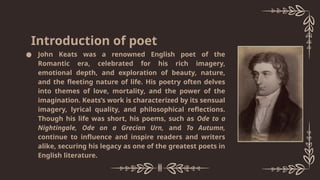
● John Keatswas a renowned English poet of the
Romantic era, celebrated for his rich imagery,
emotional depth, and exploration of beauty, nature,
and the fleeting nature of life. His poetry often delves
into themes of love, mortality, and the power of the
imagination. Keats’s work is characterized by its sensual
imagery, lyrical quality, and philosophical reflections.
Though his life was short, his poems, such as Ode to a
Nightingale, Ode on a Grecian Urn, and To Autumn,
continue to influence and inspire readers and writers
alike, securing his legacy as one of the greatest poets in
English literature.
Introduction of poet
4.
Early life:
● Bornin London, England, in 1795.
● Parents: Thomas Keats (a stablekeeper) and Frances Jennings.
● Mother died when Keats was 14; father passed away earlier.
● Keats was apprenticed to a surgeon before pursuing poetry.
● Encouraged to write poetry by his friend Leigh Hunt.
● He faced financial difficulties and family struggles during his youth.
● Early education at Enfield School, where he developed a love for literature.
● Inspired by works of writers like Shakespeare, Spenser, and Milton.
Early Life of Keats
5.
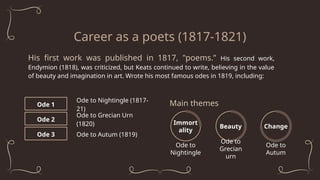
Career as apoets (1817-1821)
Ode 1
Ode to Nightingle (1817-
21)
His first work was published in 1817, "poems.” His second work,
Endymion (1818), was criticized, but Keats continued to write, believing in the value
of beauty and imagination in art. Wrote his most famous odes in 1819, including:
Ode 2
Ode to Grecian Urn
(1820)
Ode 3 Ode to Autum (1819)
Immort
ality
Beauty Change
Ode to
Nightingle
Ode to
Grecian
urn
Ode to
Autum
Main themes
6.
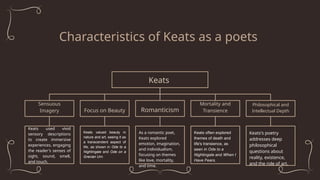
Characteristics of Keatsas a poets
Sensuous
Imagery
Keats used vivid
sensory descriptions
to create immersive
experiences, engaging
the reader's senses of
sight, sound, smell,
and touch.
Focus on Beauty
Keats valued beauty in
nature and art, seeing it as
a transcendent aspect of
life, as shown in Ode to a
Nightingale and Ode on a
Grecian Urn.
Romanticism
As a romantic poet,
Keats explored
emotion, imagination,
and individualism,
focusing on themes
like love, mortality,
and time.
Mortality and
Transience
Keats often explored
themes of death and
life's transience, as
seen in Ode to a
Nightingale and When I
Have Fears.
Philosophical and
Intellectual Depth
Keats's poetry
addresses deep
philosophical
questions about
reality, existence,
and the role of art.
Keats
7.
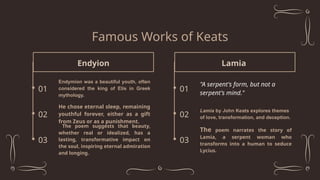
Famous Works ofKeats
Endyion
Endymion was a beautiful youth, often
considered the king of Elis in Greek
mythology.
01
He chose eternal sleep, remaining
youthful forever, either as a gift
from Zeus or as a punishment.
02
03
The poem suggests that beauty,
whether real or idealized, has a
lasting, transformative impact on
the soul, inspiring eternal admiration
and longing.
Lamia
"A serpent's form, but not a
serpent's mind."
01
Lamia by John Keats explores themes
of love, transformation, and deception.
02
03
The poem narrates the story of
Lamia, a serpent woman who
transforms into a human to seduce
Lycius.
8.
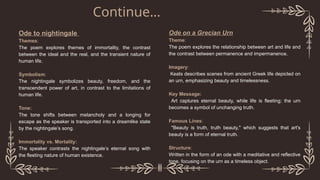
Ode to nightingale
Themes:
Thepoem explores themes of immortality, the contrast
between the ideal and the real, and the transient nature of
human life.
Symbolism:
The nightingale symbolizes beauty, freedom, and the
transcendent power of art, in contrast to the limitations of
human life.
Tone:
The tone shifts between melancholy and a longing for
escape as the speaker is transported into a dreamlike state
by the nightingale’s song.
Immortality vs. Mortality:
The speaker contrasts the nightingale’s eternal song with
the fleeting nature of human existence.
Ode on a Grecian Urn
Theme:
The poem explores the relationship between art and life and
the contrast between permanence and impermanence.
Imagery:
Keats describes scenes from ancient Greek life depicted on
an urn, emphasizing beauty and timelessness.
Key Message:
Art captures eternal beauty, while life is fleeting; the urn
becomes a symbol of unchanging truth.
Famous Lines:
"Beauty is truth, truth beauty," which suggests that art's
beauty is a form of eternal truth.
Structure:
Written in the form of an ode with a meditative and reflective
tone, focusing on the urn as a timeless object.
Continue…
9.
John Keats's lifeand works reflect a deep engagement with the beauty and tragedy
of human existence. Despite his short life—he died at 25—his poetry explores
profound themes such as love, mortality, and the pursuit of beauty. Keats believed
that beauty, both in nature and art, transcended the hardships of life, and his works
continue to resonate with readers for their emotional depth, vivid imagery, and
philosophical reflections. Ultimately, Keats’s poetry celebrates the power of
imagination and art to capture the fleeting moments of life, offering both solace
and insight into the human condition.
Conclusion :
10.
● Hough, GrahamGoulder. “John Keats | Biography, Poems, Odes, Philosophy, Death, and Facts.”
Encyclopedia Britannica, 29 Oct. 2024, www.britannica.com/biography/John-Keats.
● “John Keats.” The Poetry Foundation, www.poetryfoundation.org/poets/john-keats.
● “John Keats: ‘To Autumn.’” The Poetry Foundation, 11 June 2024,
● www.poetryfoundation.org/articles/69595/john-keats-to-autumn.
● The Editors of Encyclopaedia Britannica. “Endymion | King of Elis, Moon God, Lover of Selene.”
Encyclopedia Britannica, 20 July 1998, www.britannica.com/topic/Endymion-Greek-mythology.
References