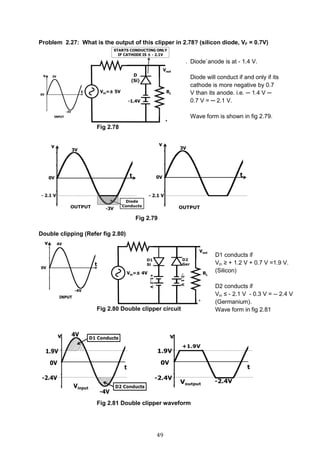
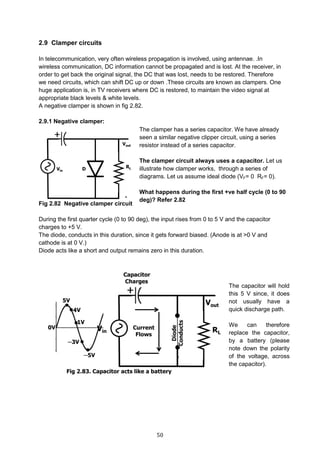
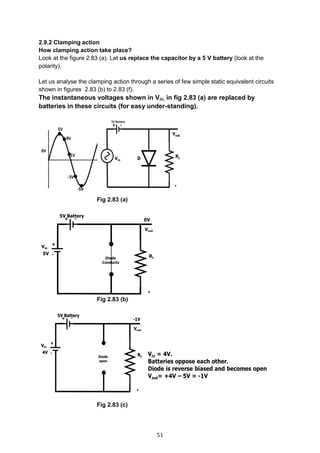
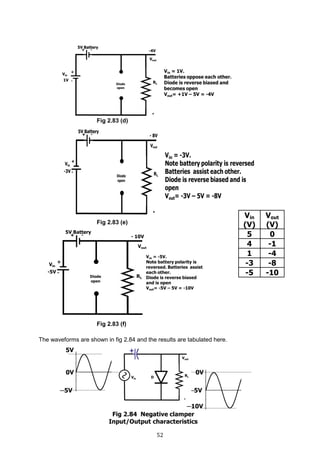
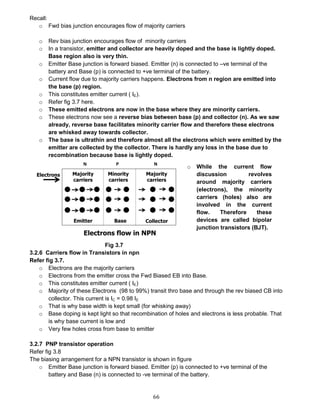
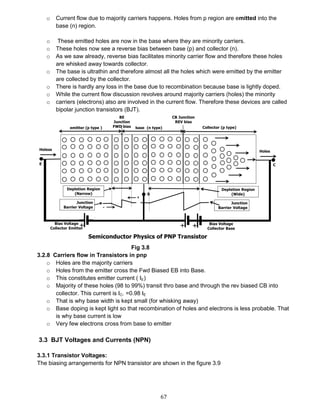
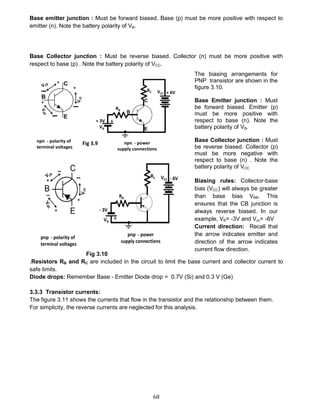
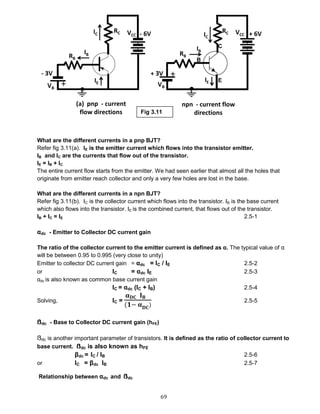
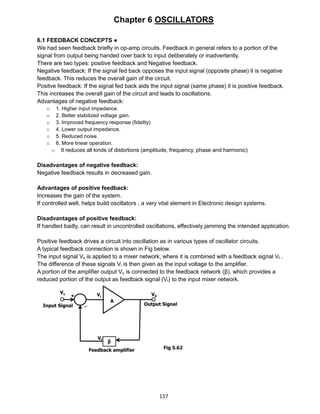
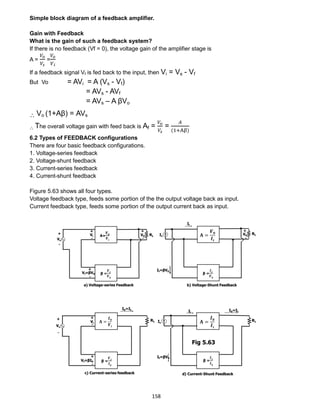
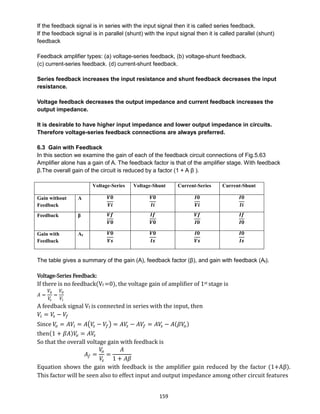
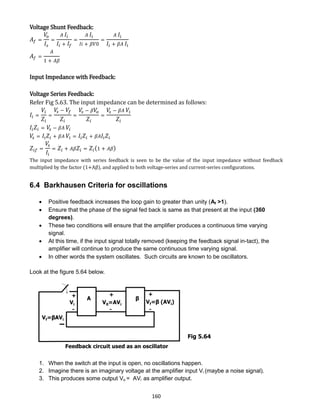
Analog Electronic Circuit
Design
----------------------------------
As per KL University Vijayawada Syllabus 2018-19
V Ramani Kumar
Prof (ECE) – KL University,
Vijayawada
Jul 18
Analog Electronic Circuit Design
----------------------------------------------
As per KL University Vijayawada Syllabus 2018-19
V Ramani Kumar
Prof (ECE) – KL University, Vijayawada
Jul 18
i
About the book and the author………………..
Why I wrote (write?) this book?
There are so many books on Analog Electonic Circuit Design. Why one more?
I thought quite a lot about it.
I am from the Industry. I had worked in Telecom R&D for nearly 35 years (electronics, embedded and
wireless).
I have been part of huge R&D teams of some of the best Telecom institutions of India
- DRDO Bangalore, Gujarat communications Baroda, Escorts Telecom Delhi. Solidaire Chennai, Telecom
Technology Ltd Hong Kong, Tata Telecom Chennai, Bharti Telecom, Delhi and Premier Evolvics,
Coimbatore
So what?
I had the fortune of working with hundreds of engineers everywhere …..fresh engineers straight out of the
college. I had trained them in circuit designs, embedded designs and system designs. I understand the gap
between the industry expectations and the academic objectives, better than many professionals or academicians.
I thought I am qualified enough to address this gap. I teach in Engineering colleges too and try my best to
bring an Industry perspective into every lecture of mine. The students, as well as the faculty. seem to like this
approach.
This encouraged(s) me to write a book on basic electronics first for VTU Bangalore and now on Analog
Electronic Circuits Design for KLU Vijayawada. This maybe a one-stop-solution for a good book on AECD.
The approach is simple, bringing out the design issues at every opportunity, with an objective to make the
student master the concepts.
Simple structured presentation of the syllabus, with plenty of illustrations, should help demystification of
Analog electronics.
I dedicate this book to
My wife Karpagam – For her great contribution in bringing out this book.
KLU family of Students - Vijayawada and Hyderabad
This text book follows the KLU syllabus verbatim and is brought out in fewer than 200 pages. I am sure, the
student world will welcome this.
My sincere and special thanks to President KL University, for encouraging me to write this book. As always, he
is a great source of inspiration………………
Pls explore my animation videos at https://www.youtube.com/dashboard?o=U
Good luck,
ramani kumar
ii
As per the proposed new syllabus of KL University Vijayawada
AECD – Proposed new syllabus
Diodes: Diode theory, forward and reverse-biased junctions, reverse-bias breakdown, load line
analysis, diode applications - Limiters, clippers, clampers, voltage multipliers, half wave & full
wave rectification, Capacitor filters, ripple factor, Zener diode,. Regulators: Series and shunt
voltage regulator,
Transistors: Q point, Self-Bias-CE, h-model of Transistor, Expression of voltage gain, current
gain, input & output impedance, Emitter follower circuits, High frequency model of Transistor,
FET fundamentals, Configurations, current-voltage characteristics, parameters of JFET, Biasing
of JFET, Biasing of MOSFET. RC coupled amplifier and analysis, FET small signal model,
Concept of Feedback, Feedback amplifier configurations.
Op-amps: Ideal OPAMP, Concept of differential amplifier, CMRR, Open & closed loop circuits,
importance of feedback loop (positive & negative), inverting & non-inverting amplifiers, Voltage
follower circuits. Adder, Integrator & Differentiator, Comparator, Schmitt Trigger, Instrumentation
Amplifier. Filter Circuits: Analysis of Low pass, High pass, Bandpass, Band reject,
Oscillators: Barkhausen criterion, Colpitt, Hartley’s, RC Phase shift, Wien bridge, & Crystal
oscillators.
555 applications: Monostable & Astable operation using 555 timers
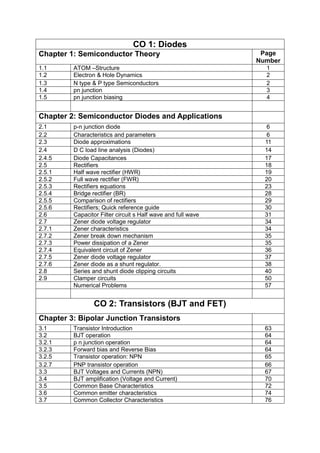
CO 1: Diodes
Chapter 1: Semiconductor Theory Page
Number
1.1 ATOM –Structure 1
1.2 Electron & Hole Dynamics 2
1.3 N type & P type Semiconductors 2
1.4 pn junction 3
1.5 pn junction biasing 4
Chapter 2: Semiconductor Diodes and Applications
2.1 p-n junction diode 6
2.2 Characteristics and parameters 6
2.3 Diode approximations 11
2.4 D C load line analysis (Diodes) 14
2.4.5 Diode Capacitances 17
2.5 Rectifiers 18
2.5.1 Half wave rectifier (HWR) 19
2.5.2 Full wave rectifier (FWR) 20
2.5.3 Rectifiers equations 23
2.5.4 Bridge rectifier (BR) 28
2.5.5 Comparison of rectifiers 29
2.5.6 Rectifiers; Quick reference guide 30
2.6 Capacitor Filter circuit s Half wave and full wave 31
2.7 Zener diode voltage regulator 34
2.7.1 Zener characteristics 34
2.7.2 Zener break down mechanism 35
2.7.3 Power dissipation of a Zener 35
2.7.4 Equivalent circuit of Zener 36
2.7.5 Zener diode voltage regulator 37
2.7.6 Zener diode as a shunt regulator. 38
2.8 Series and shunt diode clipping circuits 40
2.9 Clamper circuits 50
Numerical Problems 57
CO 2: Transistors (BJT and FET)
Chapter 3: Bipolar Junction Transistors
3.1 Transistor Introduction 63
3.2 BJT operation 64
3.2.1 p n junction operation 64
3.2.3 Forward bias and Reverse Bias 64
3.2.5 Transistor operation: NPN 65
3.2.7 PNP transistor operation 66
3.3 BJT Voltages and Currents (NPN) 67
3.4 BJT amplification (Voltage and Current) 70
3.5 Common Base Characteristics 72
3.6 Common emitter characteristics 74
3.7 Common Collector Characteristics 76
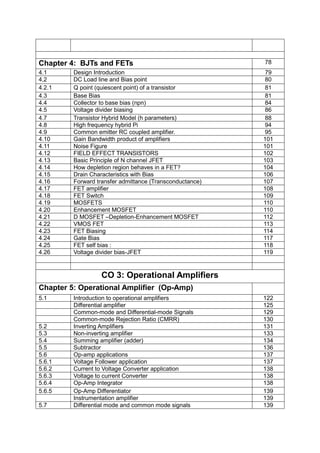
Chapter 4: BJTs and FETs 78
4.1 Design Introduction 79
4,2 DC Load line and Bias point 80
4.2.1 Q point (quiescent point) of a transistor 81
4.3 Base Bias 81
4.4 Collector to base bias (npn) 84
4.5 Voltage divider biasing 86
4.7 Transistor Hybrid Model (h parameters) 88
4.8 High frequency hybrid Pi 94
4.9 Common emitter RC coupled amplifier. 95
4.10 Gain Bandwidth product of amplifiers 101
4.11 Noise Figure 101
4.12 FIELD EFFECT TRANSISTORS 102
4.13 Basic Principle of N channel JFET 103
4.14 How depletion region behaves in a FET? 104
4.15 Drain Characteristics with Bias 106
4.16 Forward transfer admittance (Transconductance) 107
4.17 FET amplifier 108
4.18 FET Switch 109
4.19 MOSFETS 110
4.20 Enhancement MOSFET 110
4.21 D MOSFET –Depletion-Enhancement MOSFET 112
4.22 VMOS FET 113
4.23 FET Biasing 114
4.24 Gate Bias 117
4.25 FET self bias : 118
4.26 Voltage divider bias-JFET 119
CO 3: Operational Amplifiers
Chapter 5: Operational Amplifier (Op-Amp)
5.1 Introduction to operational amplifiers 122
Differential amplifier 125
Common-mode and Differential-mode Signals 129
Common-mode Rejection Ratio (CMRR) 130
5.2 Inverting Amplifiers 131
5.3 Non-inverting amplifier 133
5.4 Summing amplifier (adder) 134
5.5 Subtractor 136
5.6 Op-amp applications 137
5.6.1 Voltage Follower application 137
5.6.2 Current to Voltage Converter application 138
5.6.3 Voltage to current Converter 138
5.6.4 Op-Amp Integrator 138
5.6.5 Op-Amp Differentiator 139
Instrumentation amplifier 139
5.7 Differential mode and common mode signals 139
5.8 Ideal Operational amplifier. 143
5.9 Schmitt trigger 144
5.10 Filters using Operational Amplifiers 146
5.10.2 Low pass Filter Analysis 147
5.10.4 High pass filter examples 150
5.10.7 Design of a SECOND ORDER ACTIVE BAND PASS FILTER 154
5.10.8 SECOND ORDER ACTIVE BAND REJECT (BANDSTOP) FILTER 155
CO 4: Oscillators
Chapter 6 Oscillators
6.1 Feedback concepts 157
6.2 Types of feedback configurations 158
6.3 Gain with feedback 159
6.4 Barkhausen Criteria for oscillations 160
6.5 RC PHASE SHIFT OSCILLATOR. 161
6.6 Op-amp RC Oscillator Circuit 163
6.7 The Wien Bridge Oscillator 163
6.8 The Hartley Oscillator and Colpitts Oscillator 165
6.9 BJT- CRYSTAL OSCILLATORS 167
7.0 Astable and Monostable Multivibrator Using 555 IC 168
7.1 Astable Multi Vibrator 169
7.2 Monostable Multi Vibrator 170
1
Chapter 1: Semiconductor Theory
1.1 ATOM –Structure
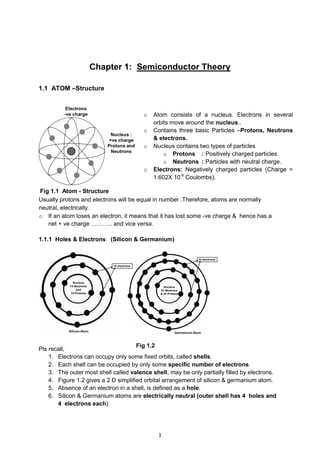
Usually protons and electrons will be equal in number .Therefore, atoms are normally
neutral, electrically.
o If an atom loses an electron, it means that it has lost some -ve charge & hence has a
net + ve charge ……….. and vice versa.
1.1.1 Holes & Electrons (Silicon & Germanium)
Pls recall,
1. Electrons can occupy only some fixed orbits, called shells.
2. Each shell can be occupied by only some specific number of electrons.
3. The outer most shell called valence shell, may be only partially filled by electrons.
4. Figure 1.2 gives a 2 D simplified orbital arrangement of silicon & germanium atom.
5. Absence of an electron in a shell, is defined as a hole.
6. Silicon & Germanium atoms are electrically neutral (outer shell has 4 holes and
4 electrons each)
o Atom consists of a nucleus. Electrons in several
orbits move around the nucleus..
o Contains three basic Particles –Protons, Neutrons
& electrons.
o Nucleus contains two types of particles
o Protons : Positively charged particles.
o Neutrons : Particles with neutral charge.
o Electrons: Negatively charged particles (Charge =
1.602X 10⁻⁹
Coulombs).
Fig 1.1 Atom - Structure
Fig 1.2
2
1.2 Electron & Hole Dynamics
1.3 N type & P type Semiconductors
1.3.1 Intrinsic semiconductor: It is very pure chemically. It has equal numbers of
electrons (-ve) and holes (+ve). It has poor conductivity.
1.3.2 Extrinsic semiconductor:
o When a small amount, of impurity is added to a pure semiconductor, the conductivity
of the semiconductor is increased manifold.
o Such materials are known as extrinsic semiconductors.
o The deliberate addition of a desirable impurity, is called doping.
o Doping yields two types of semiconductors viz p type and n type.
o The impurity atoms are called dopants.
o Such a material is also called a doped semiconductor.
o Silicon & Germanium are the standard semiconductor atoms, used by the industry.
Some of the popular dopants used, in doping the tetravalent Si or Ge are,
Trivalent atoms such as Boron or Aluminium, for producing p type semiconductors.
Pentavalent atoms such as Arsenic or Phosphorous, for producing n type
semiconductors.
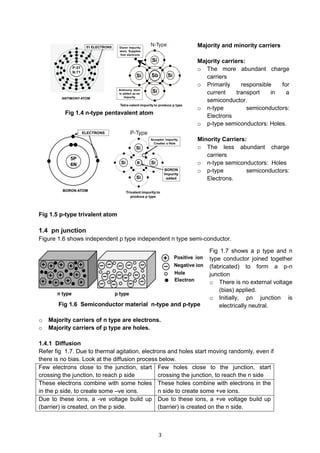
n type: Refer fig 1.4. Pentavalent (5) impurities like Arsenic (As), Antimony (Sb),
Phosphorous (P), when added to either silicon or germanium, will produce N type
semiconductors. Electrons are the majority carriers.
p type: Refer fig 1.5. Trivalent (3) impurities like Indium (In), Boron (B), Aluminium (Al)
when added to either Silicon or Germanium, will produce P type semiconductors. Holes
are the majority carriers.
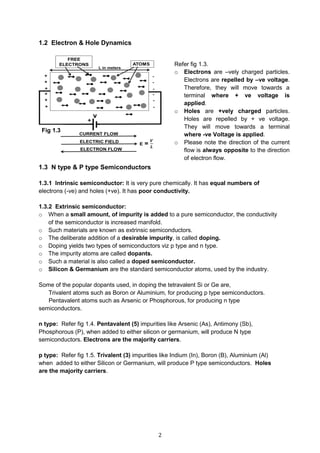
Refer fig 1.3.
o Electrons are –vely charged particles.
Electrons are repelled by –ve voltage.
Therefore, they will move towards a
terminal where + ve voltage is
applied.
o Holes are +vely charged particles.
Holes are repelled by + ve voltage.
They will move towards a terminal
where -ve Voltage is applied.
o Please note the direction of the current
flow is always opposite to the direction
of electron flow.
Fig 1.3
3
Fig 1.4 n-type pentavalent atom
Fig 1.5 p-type trivalent atom
1.4 pn junction
Figure 1.6 shows independent p type independent n type semi-conductor.
Fig 1.6 Semiconductor material n-type and p-type
o Majority carriers of n type are electrons.
o Majority carriers of p type are holes.
1.4.1 Diffusion
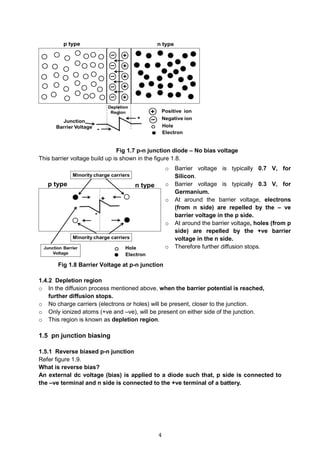
Refer fig 1.7. Due to thermal agitation, electrons and holes start moving randomly, even if
there is no bias. Look at the diffusion process below.
Few electrons close to the junction, start
crossing the junction, to reach p side
Few holes close to the junction, start
crossing the junction, to reach the n side
These electrons combine with some holes
in the p side, to create some –ve ions.
These holes combine with electrons in the
n side to create some +ve ions.
Due to these ions, a -ve voltage build up
(barrier) is created, on the p side.
Due to these ions, a +ve voltage build up
(barrier) is created on the n side.
Majority and minority carriers
Majority carriers:
o The more abundant charge
carriers
o Primarily responsible for
current transport in a
semiconductor.
o n-type semiconductors:
Electrons
o p-type semiconductors: Holes.
Minority Carriers:
o The less abundant charge
carriers
o n-type semiconductors: Holes
o p-type semiconductors:
Electrons.
Fig 1.7 shows a p type and n
type conductor joined together
(fabricated) to form a p-n
junction
o There is no external voltage
(bias) applied.
o Initially, pn junction is
electrically neutral.
4
Fig 1.7 p-n junction diode – No bias voltage
This barrier voltage build up is shown in the figure 1.8.
Fig 1.8 Barrier Voltage at p-n junction
1.4.2 Depletion region
o In the diffusion process mentioned above, when the barrier potential is reached,
further diffusion stops.
o No charge carriers (electrons or holes) will be present, closer to the junction.
o Only ionized atoms (+ve and –ve), will be present on either side of the junction.
o This region is known as depletion region.
1.5 pn junction biasing
1.5.1 Reverse biased p-n junction
Refer figure 1.9.
What is reverse bias?
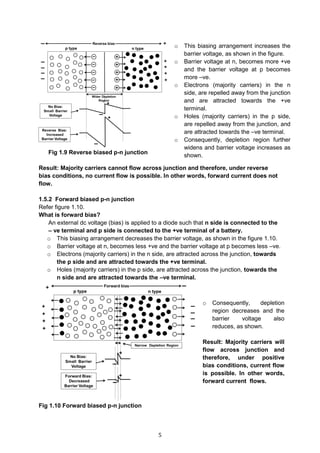
An external dc voltage (bias) is applied to a diode such that, p side is connected to
the –ve terminal and n side is connected to the +ve terminal of a battery.
o Barrier voltage is typically 0.7 V, for
Silicon.
o Barrier voltage is typically 0.3 V, for
Germanium.
o At around the barrier voltage, electrons
(from n side) are repelled by the – ve
barrier voltage in the p side.
o At around the barrier voltage, holes (from p
side) are repelled by the +ve barrier
voltage in the n side.
o Therefore further diffusion stops.
5
Fig 1.9 Reverse biased p-n junction
Result: Majority carriers cannot flow across junction and therefore, under reverse
bias conditions, no current flow is possible. In other words, forward current does not
flow.
1.5.2 Forward biased p-n junction
Refer figure 1.10.
What is forward bias?
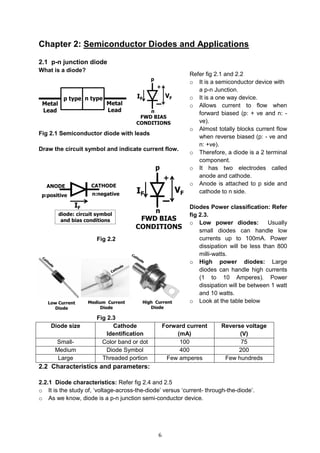
An external dc voltage (bias) is applied to a diode such that n side is connected to the
– ve terminal and p side is connected to the +ve terminal of a battery.
o This biasing arrangement decreases the barrier voltage, as shown in the figure 1.10.
o Barrier voltage at n, becomes less +ve and the barrier voltage at p becomes less –ve.
o Electrons (majority carriers) in the n side, are attracted across the junction, towards
the p side and are attracted towards the +ve terminal.
o Holes (majority carriers) in the p side, are attracted across the junction, towards the
n side and are attracted towards the –ve terminal.
Fig 1.10 Forward biased p-n junction
o This biasing arrangement increases the
barrier voltage, as shown in the figure.
o Barrier voltage at n, becomes more +ve
and the barrier voltage at p becomes
more –ve.
o Electrons (majority carriers) in the n
side, are repelled away from the junction
and are attracted towards the +ve
terminal.
o Holes (majority carriers) in the p side,
are repelled away from the junction, and
are attracted towards the –ve terminal.
o Consequently, depletion region further
widens and barrier voltage increases as
shown.
o Consequently, depletion
region decreases and the
barrier voltage also
reduces, as shown.
Result: Majority carriers will
flow across junction and
therefore, under positive
bias conditions, current flow
is possible. In other words,
forward current flows.
6
Chapter 2: Semiconductor Diodes and Applications
2.1 p-n junction diode
What is a diode?
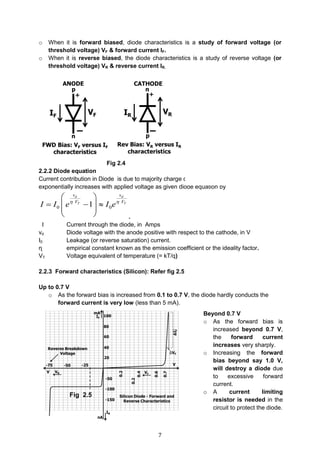
Fig 2.1 Semiconductor diode with leads
Draw the circuit symbol and indicate current flow.
Fig 2.2
Fig 2.3
Diode size Cathode
Identification
Forward current
(mA)
Reverse voltage
(V)
Small- Color band or dot 100 75
Medium Diode Symbol 400 200
Large Threaded portion Few amperes Few hundreds
2.2 Characteristics and parameters:
2.2.1 Diode characteristics: Refer fig 2.4 and 2.5
o It is the study of, ‘voltage-across-the-diode’ versus ‘current- through-the-diode’.
o As we know, diode is a p-n junction semi-conductor device.
Refer fig 2.1 and 2.2
o It is a semiconductor device with
a p-n Junction.
o It is a one way device.
o Allows current to flow when
forward biased (p: + ve and n: -
ve).
o Almost totally blocks current flow
when reverse biased (p: - ve and
n: +ve).
o Therefore, a diode is a 2 terminal
component.
o It has two electrodes called
anode and cathode.
o Anode is attached to p side and
cathode to n side.
Diodes Power classification: Refer
fig 2.3.
o Low power diodes: Usually
small diodes can handle low
currents up to 100mA. Power
dissipation will be less than 800
milli-watts.
o High power diodes: Large
diodes can handle high currents
(1 to 10 Amperes). Power
dissipation will be between 1 watt
and 10 watts.
o Look at the table below
7
o When it is forward biased, diode characteristics is a study of forward voltage (or
threshold voltage) VF & forward current IF.
o When it is reverse biased, the diode characteristics is a study of reverse voltage (or
threshold voltage) VR & reverse current IR.
Fig 2.4
2.2.2 Diode equation
Current contribution in Diode is due to majority charge carriers and diffusion/forward current
exponentially increases with applied voltage as given diode equation by
0 01
d d
T T
v v
V V
I I e I e 
 
   
 
  .
I Current through the diode, in Amps
vd Diode voltage with the anode positive with respect to the cathode, in V
I0 Leakage (or reverse saturation) current.
ɳ empirical constant known as the emission coefficient or the ideality factor.
VT Voltage equivalent of temperature (= kT/q)
2.2.3 Forward characteristics (Silicon): Refer fig 2.5
Up to 0.7 V
o As the forward bias is increased from 0.1 to 0.7 V, the diode hardly conducts the
forward current is very low (less than 5 mA).
Beyond 0.7 V
o As the forward bias is
increased beyond 0.7 V,
the forward current
increases very sharply.
o Increasing the forward
bias beyond say 1.0 V,
will destroy a diode due
to excessive forward
current.
o A current limiting
resistor is needed in the
circuit to protect the diode.
Fig 2.5
8
2.2.4 Reverse characteristics (Silicon)
0 to -75 V
o Please note the change of scale, in the y axis between forward & reverse
characteristics.
o Reverse current IR, is often very low (not more than 1 μA) for reverse voltages up to -
75 V for silicon
o IR is negligible compared to IF.
o For all practical purposes the diode behaves like an open circuit.
Beyond -75 V:
o Reverse break down happens (we shall study this later).
o The current increases abruptly.
o This can destroy the diode, unless protected by a current limiting resistor
o Peak Inverse Voltage (PIV): The maximum reverse-bias voltage that a diode can
withstand without “breaking down” is called the Peak Inverse Voltage, or PIV rating.
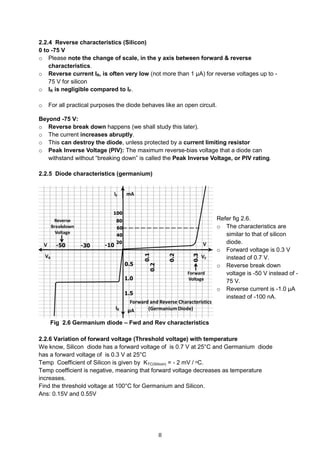
2.2.5 Diode characteristics (germanium)
Fig 2.6 Germanium diode – Fwd and Rev characteristics
2.2.6 Variation of forward voltage (Threshold voltage) with temperature
We know, Silicon diode has a forward voltage of is 0.7 V at 25°C and Germanium diode
has a forward voltage of is 0.3 V at 25°C
Temp Coefficient of Silicon is given by KTC(Silicon) = - 2 mV / ᵒC.
Temp coefficient is negative, meaning that forward voltage decreases as temperature
increases.
Find the threshold voltage at 100°C for Germanium and Silicon.
Ans: 0.15V and 0.55V
Refer fig 2.6.
o The characteristics are
similar to that of silicon
diode.
o Forward voltage is 0.3 V
instead of 0.7 V.
o Reverse break down
voltage is -50 V instead of -
75 V.
o Reverse current is -1.0 μA
instead of -100 nA.
9
2.2.7 Reverse bias break down mechanism
Case 1
Very narrow depletion region
o Reverse voltage produces very high field strength.
o What is field strength? Voltage per distance (Volts / Distance.)
o Electrons break away from their atoms due to this field strength.
o Due to this electron flow, depletion region is converted into a conductor (from insulator)
o This is called ionization by electric field
o This is known as Zener break down mechanism
o Usually occurs when reverse bias is < 5V
Case 2
Depletion region very wide
o In the reverse bias mode reverse saturation current flows.
o There are electrons moving in reverse saturation current.
o When these electrons travel in the wide depletion region, these electrons
gain a lot of energy
o These energetic electrons collide with atoms and cause their electrons to
break-free.
o Due to these new electrons, more collisions occur and more electrons get
released
o This is known as Avalanche break-down.
o Also known as Ionization by collision
o Usually occurs when reverse voltage is > 5V
2.2.8 What is reverse saturation current (ICO)?
Occurs during reverse bias conditions
When a diode is reverse biased, we know the depletion region width increases.
Therefore no current flow happens due to majority carriers
However minority carriers diffuse through this depletion region
In a PN junction diode, the reverse saturation current occurs due to diffusion flow of
electrons (minority carriers) from p region to n region and flow of holes (minority carriers)
from n region to p region.
This current is nearly constant and is known as reverse saturation current ICO
2,2,9 How does reverse saturation current (ICO) behave with temperature?
Reverses saturation current is a nuisance.
It increases rapidly with temperature.
The increase is of the order of 7%/ºC for both germanium and silicon
In other words ICO doubles for every 10ºC rise in temperature and is definitely serious.
I2 = I1 * 𝟐
(𝐓𝟐−𝐓𝟏)
𝟏𝟎 (I2 = Current at new temperature and I1 = Current at old temperature)
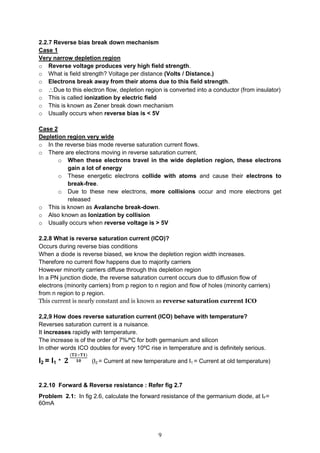
2.2.10 Forward & Reverse resistance : Refer fig 2.7
Problem 2.1: In fig 2.6, calculate the forward resistance of the germanium diode, at IF=
60mA
10
At IF = 60 mA, VF = 0.33 V (approx)
Therefore, forward resistance
(RF) =
𝐕𝐅
𝐈 𝐅
=
0.33 𝑉
60 𝑚𝐴
= 5.5 ohms.
Fig 2.7
Problem 2.2: In fig 2.5, calculate the reverse resistance of the silicon diode at VR =20V.
At VR = 20 V, IR = 90 nA (approx)
Therefore, reverse resistance (RR) =
𝐕 𝐑
𝐈 𝐑
=
20 V
90 nA
= 222 Mega ohms (approx)
2.2.11 Some of the important diode parameters.
VF - Forward voltage drop (0.3 V for Ge and 0.7 V for silicon).
IF - Forward current .
VR - Reverse voltage.
rd - Dynamic resistance =
𝚫𝐕𝐅
𝚫𝐈 𝐅
VBR - Break down voltage {50 V for Ge and 75 V for Si).
PD - Power dissipation.
2.2.12 Dynamic resistance rd
Recall the forward resistance that was calculated in problem 2.1. RF =
𝐕𝐅
𝐈 𝐅
. This is the DC
resistance of the diode, at one particular value of forward current. When the input varies by
∆VF, there will be large variation, in forward current (∆IF). This is shown in fig 2.5
Dynamic resistance rd =
𝚫𝐕 𝐅
𝚫𝐈 𝐅
. rd is also known as ac resistance or incremental resistance
There is another way of calculating dynamic resistance. It is not discussed here since it is
beyond the scope of this book.The formula is rd =
𝟐𝟔 𝐦𝐕
𝐈 𝐅
Problem 2.3: What is the dynamic resistance of a diode with a forward current of 5 mA
rd =
𝟐𝟔 𝐦𝐕
𝟓 𝐦𝐀
= 5.2 Ω.
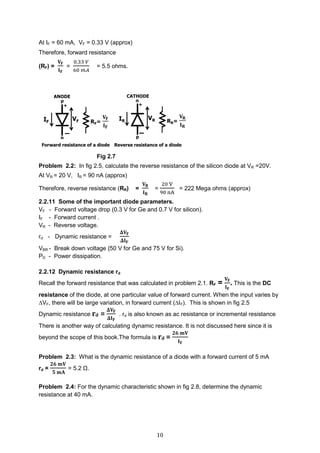
Problem 2.4: For the dynamic characteristic shown in fig 2.8, determine the dynamic
resistance at 40 mA.
11
Fig 2.8
2.3 Diode approximations:
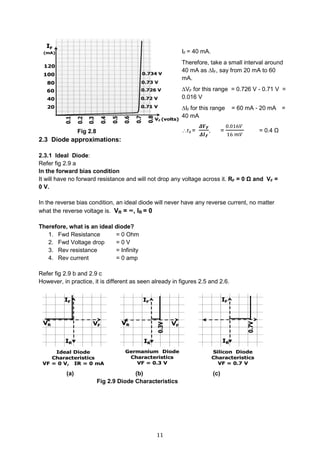
2.3.1 Ideal Diode:
Refer fig 2.9 a
In the forward bias condition
It will have no forward resistance and will not drop any voltage across it. RF = 0 Ω and VF =
0 V.
In the reverse bias condition, an ideal diode will never have any reverse current, no matter
what the reverse voltage is. VR = ∞, IR = 0
Therefore, what is an ideal diode?
1. Fwd Resistance = 0 Ohm
2. Fwd Voltage drop = 0 V
3. Rev resistance = Infinity
4. Rev current = 0 amp
Refer fig 2.9 b and 2.9 c
However, in practice, it is different as seen already in figures 2.5 and 2.6.
(a) (b) (c)
Fig 2.9 Diode Characteristics
IF = 40 mA.
Therefore, take a small interval around
40 mA as ∆IF, say from 20 mA to 60
mA.
∆VF for this range = 0.726 V - 0.71 V =
0.016 V
∆IF for this range = 60 mA - 20 mA =
40 mA
rd =
𝜟𝑽 𝑭
𝜟𝑰 𝑭
, =
0.016𝑉
16 𝑚𝑉
= 0.4 Ω
12
What are the assumptions of a near ideal diode (Si)?
Fwd Voltage drop = constant
Rev current = negligible (can be ignored)
2.3.2 Practical diode
What is a practical diode (Si)?
Fwd Resistance = 0 to 20 Ohms
Fwd Voltage drop = 0.6 to 1.0 Volt
Rev current = few micro amps
Diodes Comparison
Characteristic Ideal Practical
Threshold Voltage No Threshold Voltage (0V) Ge:0.3V, Si=0.7V
Forward current Infinite if Vin > 0V Finite
Forward Resistance Zero Finite
Reverse Resistance Infinite Large but finite
Breakdown Voltage No Breakdown Finite and depends on Doping
V-I Characteristic
2.3.3 Piece-wise approximation of a diode
The smooth diode curve of fig 2.5 or 2.6 can be approximated by taking samples at very
close intervals and interconnecting adjacent samples through short straight lines.
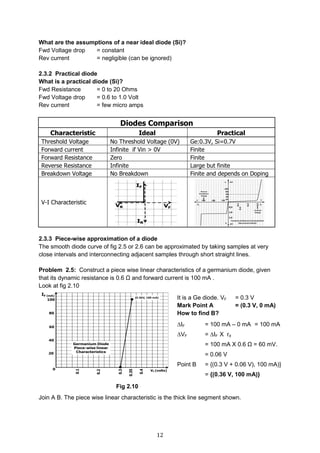
Problem 2.5: Construct a piece wise linear characteristics of a germanium diode, given
that its dynamic resistance is 0.6 Ω and forward current is 100 mA .
Look at fig 2.10
Fig 2.10
Join A B. The piece wise linear characteristic is the thick line segment shown.
It is a Ge diode. VF = 0.3 V
Mark Point A = (0.3 V, 0 mA)
How to find B?
∆IF = 100 mA – 0 mA = 100 mA
∆VF = ∆IF X rd
= 100 mA X 0.6 Ω = 60 mV.
= 0.06 V
Point B = {(0.3 V + 0.06 V), 100 mA)}
= {(0.36 V, 100 mA)}
Join A B .
The piece wise linear characteristic is
the thick line segment shown.
13
2.3.4 DC equivalent circuits of a diode
Fig 2.11
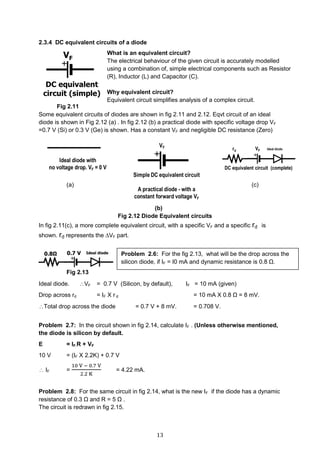
Some equivalent circuits of diodes are shown in fig 2.11 and 2.12. Eqvt circuit of an ideal
diode is shown in Fig 2.12 (a) . In fig 2.12 (b) a practical diode with specific voltage drop VF
=0.7 V (Si) or 0.3 V (Ge) is shown. Has a constant VF and negligible DC resistance (Zero)
(a) (c)
(b)
Fig 2.12 Diode Equivalent circuits
In fig 2.11(c), a more complete equivalent circuit, with a specific VF and a specific rd is
shown. rd represents the VF part.
Fig 2.13
Ideal diode. VF = 0.7 V (Silicon, by default), IF = 10 mA (given)
Drop across rd = IF X r d = 10 mA X 0.8 Ω = 8 mV.
Total drop across the diode = 0.7 V + 8 mV. = 0.708 V.
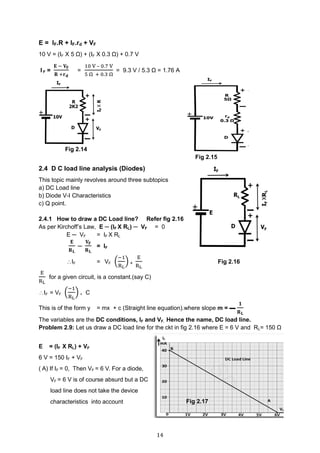
Problem 2.7: In the circuit shown in fig 2.14, calculate IF . (Unless otherwise mentioned,
the diode is silicon by default.
E = IF.R + VF
10 V = (IF X 2.2K) + 0.7 V
 IF =
10 V − 0.7 V
2.2 K
= 4.22 mA.
Problem 2.8: For the same circuit in fig 2.14, what is the new IF if the diode has a dynamic
resistance of 0.3 Ω and R = 5 Ω .
The circuit is redrawn in fig 2.15.
What is an equivalent circuit?
The electrical behaviour of the given circuit is accurately modelled
using a combination of, simple electrical components such as Resistor
(R), Inductor (L) and Capacitor (C).
Why equivalent circuit?
Equivalent circuit simplifies analysis of a complex circuit.
Problem 2.6: For the fig 2.13, what will be the drop across the
silicon diode, if IF = I0 mA and dynamic resistance is 0.8 Ω.
14
E = IF.R + IF.rd + VF
10 V = (IF X 5 Ω) + (IF X 0.3 Ω) + 0.7 V
I F =
𝐄 − 𝐕𝐅
𝐑 +𝐫 𝐝
=
10 V – 0.7 V
5 Ω + 0.3 Ω
= 9.3 V / 5.3 Ω = 1.76 A
Fig 2.14
Fig 2.15
2.4 D C load line analysis (Diodes)
This topic mainly revolves around three subtopics
a) DC Load line
b) Diode V-I Characteristics
c) Q point.
2.4.1 How to draw a DC Load line? Refer fig 2.16
As per Kirchoff’s Law, E ─ (IF X RL) ─ VF = 0
E ─ VF = IF X RL
𝐄
𝐑 𝐋
─
𝐕𝐅
𝐑 𝐋
= IF
IF = VF (
−1
RL
) +
E
RL
Fig 2.16
E
RL
for a given circuit, is a constant.(say C)
IF = VF (
−1
RL
) + C
This is of the form y = mx + c (Straight line equation).where slope m = ▬
𝟏
𝐑 𝐋
The variables are the DC conditions, IF and VF. Hence the name, DC load line.
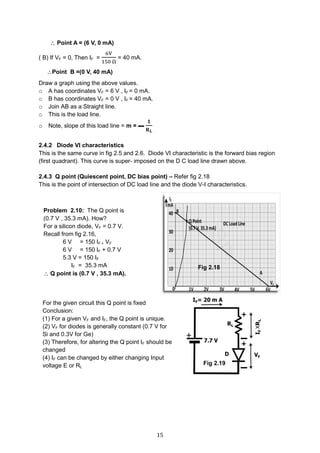
Problem 2.9: Let us draw a DC load line for the ckt in fig 2.16 where E = 6 V and RL= 150 Ω
E = (IF X RL) + VF
6 V = 150 IF + VF
( A) If IF = 0, Then VF = 6 V. For a diode,
VF = 6 V is of course absurd but a DC
load line does not take the device
characteristics into account Fig 2.17
15
 Point A = (6 V, 0 mA)
( B) If VF = 0, Then IF =
6V
150 Ω
= 40 mA.
Point B =(0 V, 40 mA)
Draw a graph using the above values.
o A has coordinates VF = 6 V , IF = 0 mA.
o B has coordinates VF = 0 V , IF = 40 mA.
o Join AB as a Straight line.
o This is the load line.
o Note, slope of this load line = m = ▬
𝟏
𝐑 𝐋
2.4.2 Diode VI characteristics
This is the same curve in fig 2.5 and 2.6. Diode VI characteristic is the forward bias region
(first quadrant). This curve is super- imposed on the D C load line drawn above.
2.4.3 Q point (Quiescent point, DC bias point) – Refer fig 2.18
This is the point of intersection of DC load line and the diode V-I characteristics.
Problem 2.10: The Q point is
(0.7 V , 35.3 mA). How?
For a silicon diode, VF = 0.7 V.
Recall from fig 2.16,
6 V = 150 IF + VF
6 V = 150 IF + 0.7 V
5.3 V = 150 IF
IF = 35.3 mA
 Q point is (0.7 V , 35.3 mA).
For the given circuit this Q point is fixed
Conclusion:
(1) For a given VF and IF, the Q point is unique.
(2) VF for diodes is generally constant (0.7 V for
Si and 0.3V for Ge)
(3) Therefore, for altering the Q point IF should be
changed
(4) IF can be changed by either changing Input
voltage E or RL
Fig 2.19
Fig 2.18
16
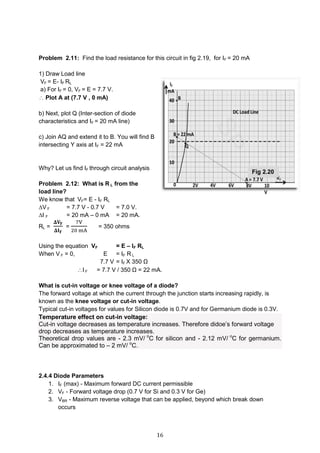
Problem 2.11: Find the load resistance for this circuit in fig 2.19, for IF = 20 mA
1) Draw Load line
VF = E- IF RL
a) For IF = 0, VF = E = 7.7 V.
 Plot A at (7.7 V , 0 mA)
b) Next, plot Q (Inter-section of diode
characteristics and IF = 20 mA line)
c) Join AQ and extend it to B. You will find B
intersecting Y axis at IF = 22 mA
Why? Let us find IF through circuit analysis
Problem 2.12: What is R L from the
load line?
We know that VF= E - IF RL
∆V F = 7.7 V - 0.7 V = 7.0 V.
∆I F = 20 mA – 0 mA = 20 mA.
RL =
𝚫𝐕𝐅
𝚫𝐈 𝐅
=
7V
20 mA
= 350 ohms
Using the equation VF = E – IF RL
When V F = 0, E = IF R L
7.7 V = IF X 350 Ω
I F = 7.7 V / 350 Ω = 22 mA.
What is cut-in voltage or knee voltage of a diode?
The forward voltage at which the current through the junction starts increasing rapidly, is
known as the knee voltage or cut-in voltage.
Typical cut-in voltages for values for Silicon diode is 0.7V and for Germanium diode is 0.3V.
Temperature effect on cut-in voltage:
Cut-in voltage decreases as temperature increases. Therefore didoe’s forward voltage
drop decreases as temperature increases.
Theoretical drop values are - 2.3 mV/ o
C for silicon and - 2.12 mV/ o
C for germanium.
Can be approximated to – 2 mV/ o
C.
2.4.4 Diode Parameters
1. IF (max) - Maximum forward DC current permissible
2. VF - Forward voltage drop (0.7 V for Si and 0.3 V for Ge)
3. VBR - Maximum reverse voltage that can be applied, beyond which break down
occurs
Fig 2.20
17
4. rd - Dynamic resistance
5. IR - Reverse saturation current (current flow when diode is reverse biased )
6. Cut-in voltage or Knee voltage - that forward voltage beyond which, forward
current increases exponentially
7. P - continuous maximum power dissipation permissible at 25 deg C
2.4.5 Diode Capacitances
A p-n junction diode, will have two types of capacitance viz Transition capacitance (CT) and
Diffusion capacitance (CD).
What is a capacitor?
 Capacitors store electric charge in the form of electric field.
 Charge is stored by using an arrangement of two electrically conducting plates (or
electrodes) placed close to each other, separated by an insulating material called
dielectric.
 The electrodes of the capacitor are good conductors and current can flow through
them.
 But dielectric material is an insulator and current cannot flow through it. However, it
efficiently allows electric field.
 When a voltage is applied to the capacitor, charge carriers flow through the
conducting wire. but hits a roadblock from the dielectric or insulating material.
 Therefore, a large number of charge carriers get trapped at the electrodes of the
capacitor and end up storing their electric charge.
 These charges in turn, exert an electric field between (across) the plates.
 The ability of the material to store electric charge is called capacitance.
 In a basic capacitor, the capacitance is directly proportional to the size of electrodes
or plates and inversely proportional to the distance between two plates.
2.4.6 Transition capacitance
Now look at a diode
A reverse biased p-n junction diode is a typical capacitor. It stores electric charge at the
depletion region, thanks to immobile positive and negative ions and the Depletion Region,
therefore, acts like a dielectric in a capacitor.
The p-type and n-type regions have low resistance and act like electrodes (conducting plate)
in a capacitor. Thus, p-n junction diode can be considered as a parallel plate capacitor.
Thus, there exists a capacitance at the depletion region.
When reverse bias voltage applied to the p-n junction diode is increased, we know, the width
of depletion region increases and therefore, the capacitance of the reverse bias p-n junction
diode decreases whenever reverse bias voltage increases.
The change of capacitance with changes in the reverse bias voltage is called
transition capacitance (or depletion region capacitance or junction capacitance or barrier
capacitance).
18
Transition capacitance can be defined as the change in electric charge (dQ) per change in
voltage (dV).
CT = dQ / dV
The transition capacitance is also given by,
CT = ε A / W
Where ε = Permittivity of the semiconductor, A = Area of plates or p-type and n-type regions
and W = Width of depletion region
2.4.7 Diffusion capacitance or storage Capacitance - (CD)
Diffusion capacitance occurs in a forward biased p-n junction diode.
In a forward biased diode, diffusion capacitance is quite large and transition capacitance is
negligible
.
As we know, when forward bias voltage is applied to the p-n junction diode, recombination
occurs in both sides of the junction and the width of depletion region decreases.
A large number of minority charge carriers, crowd around on either side of the depletion
region hoping to recombine, with the majority carriers. As a result, a large amount of charge
is stored at both sides of the depletion region, largely consisting of minority electrons and
minority holes.
Thus the accumulation of holes in the n-region and electrons in the p-region is separated by
a very thin depletion region or depletion layer. This depletion region acts like dielectric or
insulator of the capacitor and charge stored at both sides of the depletion layer acts like
conducting plates of the capacitor.
Diffusion capacitance is directly proportional to the electric current or applied voltage.
Larger the electric current, larger the charge and larger the diffusion capacitance.
When the width of depletion region decreases, the diffusion capacitance increases. The
diffusion capacitance value will be in the range of nano farads (nF) to micro farads (μF).
The formula for diffusion capacitance is
CD = τID / ηVT , where τ is the mean life time of the charge carrier, ID is the diode current and
VT is the applied forward voltage, and η is generation recombination factor. Diodes with high
CD, CT values are NOT SUITABLE for switching applications.
2.5 Rectifiers
Define ‘’Rectifier’’
Rectifier is a device such as diode, that converts alternating current to direct current (ac
to dc).
How is diode rectification done?
The rectification is done, by converting ac current to dc current, by suppression or inversion
of alternate half cycles of the input.
19
2.5.1 Half wave rectifier (HWR):
Look at figure 2.21. A simple half wave rectifier is shown.
HWR Operation
Refer fig 2.21
o The input is fed through a transformer primary (terminals 1 and 2.).
o During +ve cycle of input, terminal 3 is +ve and terminal 4 is –ve.
o Diode gets forward biased and the current flow is clock wise, as shown in fig.
o Output voltage is IL RL.
o During – ve cycle of input # 4 is +ve and # 3 is –ve. Diode is reverse biased and diode
behaves like an open circuit, as shown. No current flows in the circuit.
o The output voltage is zero. The peak inverse voltage across diode is, the input voltage
(peak value).
o The Wave forms are shown in fig 2.21
Problem 2.13: For the circuit shown, determine the peak output voltage, peak load current
and diode peak inverse voltage. The ac input is 10V, the load resistance is 1 kΩ and the
diode is germanium.
Fig 2.21
Half-wave rectifier
20
Input voltage is 10 V rms.
Input peak voltage: Vp in = √2 X 10 V = 14.14 V
Output peak voltage: Vp out = Vp in - VF
= 14.14 - 0.3 V = 13.84 V.
Peak load current = 13.84 V / 1 KΩ = 13.84 mA.
Peak inverse voltage = PIV = Vp in =14.14 V.
2.5.2 Full wave rectifier (FWR):
o
o As the name implies rectification happens, for both +ve and –ve cycles of the input
wave. Full wave rectifier, therefore, uses 2 diodes.
o A transformer input full wave rectifier (FWR) is shown in fig 2.23. The transformer
becomes complex, with a centre-tap operation.
FWR Center tap transformer:
Look at fig 2.23.
Fig 2.23 Center-tap transformer
FWR Operation:
A full wave rectifier using two diodes is shown in fig 2.24.
NOTE center tap is at ground (0V) potential.
Important : Unless otherwise mentioned, the input
is always specified as rms.
The relation between peak value & rms value is Vrms
= Vpeak / √2 and Irms = Ipeak / √2 and so on.
It consists of a primary winding (1,2) and two
secondary windings (3,4 and 5,6)
One end of, each of these secondary windings, is
joined together. In the figure 4 and 5 are joined.
The windings normally have the same number of
turns and therefore the 4, 5 junction becomes truly
a center tap.
The sense of these two secondary windings is in
such a way, that the two secondary outputs
always oppose each other, in phase.
Fig 2.22
21
Note, diode cathodes are returned to ground through the load resistor RL
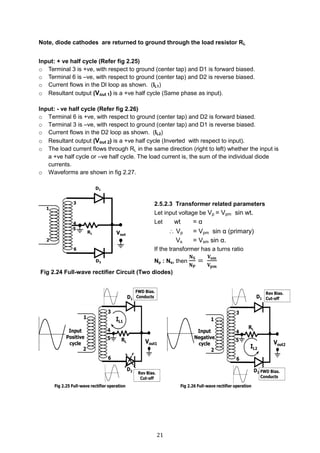
Input: + ve half cycle (Refer fig 2.25)
o Terminal 3 is +ve, with respect to ground (center tap) and D1 is forward biased.
o Terminal 6 is –ve, with respect to ground (center tap) and D2 is reverse biased.
o Current flows in the Dl loop as shown. (IL1)
o Resultant output (Vout 1) is a +ve half cycle (Same phase as input).
Input: - ve half cycle (Refer fig 2.26)
o Terminal 6 is +ve, with respect to ground (center tap) and D2 is forward biased.
o Terminal 3 is –ve, with respect to ground (center tap) and D1 is reverse biased.
o Current flows in the D2 loop as shown. (IL2)
o Resultant output (Vout 2) is a +ve half cycle (Inverted with respect to input).
o The load current flows through RL in the same direction (right to left) whether the input is
a +ve half cycle or –ve half cycle. The load current is, the sum of the individual diode
currents.
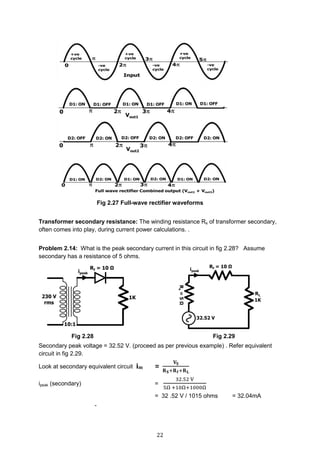
o Waveforms are shown in fig 2.27.
Fig 2.24 Full-wave rectifier Circuit (Two diodes)
2.5.2.3 Transformer related parameters
Let input voltage be Vp = Vpm sin wt.
Let wt = α
 Vp = Vpm sin α (primary)
Vs = Vsm sin α.
If the transformer has a turns ratio
Np : Ns, then
𝐍 𝐒
𝐍 𝐏
=
𝐕𝐬𝐦
𝐕 𝐩𝐦
22
Fig 2.27 Full-wave rectifier waveforms
Transformer secondary resistance: The winding resistance Rs of transformer secondary,
often comes into play, during current power calculations. .
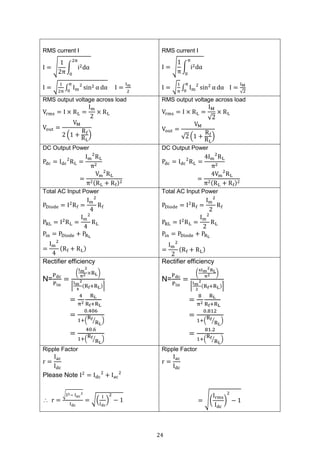
Problem 2.14: What is the peak secondary current in this circuit in fig 2.28? Assume
secondary has a resistance of 5 ohms.
Fig 2.28 Fig 2.29
Secondary peak voltage = 32.52 V. (proceed as per previous example) . Refer equivalent
circuit in fig 2.29.
Look at secondary equivalent circuit im =
𝐕𝐒
𝐑 𝐒+𝐑 𝐟+𝐑 𝐋
ipeak (secondary) =
32.52 V
5Ω +10Ω+1000Ω
= 32 .52 V / 1015 ohms = 32.04mA
-
23
2.5.3 RECTIFIERS EQUATIONS (Refer fig 2.30)
Half wave Full wave
DC Current Idc
Idc =
1
2π
∫ Im sin α dα
π
0
=
Im
2π
[− cos α]0
π
=
−Im
2π
[−1 − 1]
Idc =
Im
π
Idc =
Vm
π (Rf + RL + RS)
DC Current Idc
Idc =
1
π
∫ Im sin α dα
π
0
=
Im
π
[− cos α]0
π
=
−Im
π
[−1 − 1]
Idc =
2Im
π
Idc =
2Vm
π (Rf + RL + RS)
DC output Voltage Vdc
Vdc = IdcRL =
IM
π
RL
=
VM
π (1 +
Rf
RL
)
(Assume RS = 0)
DC output Voltage Vdc
Vdc = IdcRL =
2IM
π
RL
=
2VM
π (1 +
Rf
RL
)
(Assume RS = 0)
Fig 2.30
24
RMS current I
I = √
1
2π
∫ i2dα
2π
0
I = √
1
2π
∫ Im
2
sin2 α dα
π
0
I =
Im
2
RMS current I
I = √
1
π
∫ i2dα
π
0
I = √
1
π
∫ Im
2
sin2
α dα
π
0
I =
IM
√2
RMS output voltage across load
Vrms = I × RL =
Im
2
× RL
Vout =
VM
2 (1 +
Rf
RL
)
RMS output voltage across load
Vrms = I × RL =
IM
√2
× RL
Vout =
VM
√2 (1 +
Rf
RL
)
DC Output Power
Pdc = Idc
2
RL =
Im
2
RL
π2
=
Vm
2
RL
π2(RL + Rf)2
DC Output Power
Pdc = Idc
2
RL =
4Im
2
RL
π2
=
4Vm
2
RL
π2(RL + Rf)2
Total AC Input Power
PDiode = I2
Rf =
Im
2
4
Rf
PRL = I2
RL =
Im
2
4
RL
Pin = PDiode + PRL
=
Im
2
4
(Rf + RL)
Total AC Input Power
PDiode = I2
Rf =
Im
2
2
Rf
PRL = I2
RL =
Im
2
2
RL
Pin = PDiode + PRL
=
Im
2
2
(Rf + RL)
Rectifier efficiency
N=
Pdc
Pin
=
(
Im
2
π2 ×RL)
⌈
Im
2
4
(Rf+RL)⌉
=
4
π2
RL
Rf+RL
=
0.406
1+(
Rf
RL
⁄ )
=
40.6
1+(
Rf
RL
⁄ )
Rectifier efficiency
N=
Pdc
Pin
=
(
4Im
2RL
π2 )
⌈
Im
2
2
(Rf+RL)⌉
=
8
π2
RL
Rf+RL
=
0.812
1+(
Rf
RL
⁄ )
=
81.2
1+(
Rf
RL
⁄ )
Ripple Factor
r =
Iac
Idc
Please Note I2
= Idc
2
+ Iac
2
 r =
√I2− Iac
2
Idc
= √(
I
Idc
)
2
− 1
Ripple Factor
r =
Iac
Idc
= √(
Irms
Idc
)
2
− 1
25
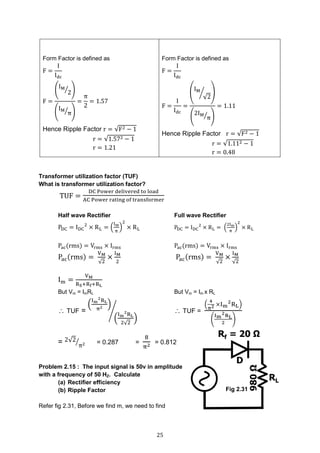
Form Factor is defined as
F =
I
Idc
F =
(
IM
2⁄ )
(
IM
π⁄ )
=
π
2
= 1.57
Hence Ripple Factor r = √F2 − 1
r = √1.572 − 1
r = 1.21
Form Factor is defined as
F =
I
Idc
F =
I
Idc
=
(
IM
√2
⁄ )
(
2IM
π⁄ )
= 1.11
Hence Ripple Factor r = √F2 − 1
r = √1.112 − 1
r = 0.48
Transformer utilization factor (TUF)
What is transformer utilization factor?
TUF =
DC Power delivered to load
AC Power rating of transformer
Half wave Rectifier Full wave Rectifier
PDC = IDC
2
× RL = (
Im
π
)
2
× RL PDC = IDC
2
× RL = (
2Im
π
)
2
× RL
Pac(rms) = Vrms × Irms Pac(rms) = Vrms × Irms
Pac(rms) =
VM
√2
×
IM
2
Pac(rms) =
VM
√2
×
IM
√2
Im =
VM
RS+Rf+RL
But Vm = ImRL But Vm = Im x RL
 TUF =
(
Im
2
RL
π2 )
(
Im
2
RL
2√2
)
⁄  TUF =
(
4
π2 ×Im
2
RL)
(
Im
2RL
2
)
= 2√2
π2⁄ = 0.287 =
8
π2 = 0.812
Problem 2.15 : The input signal is 50v in amplitude
with a frequency of 50 HZ. Calculate
(a) Rectifier efficiency
(b) Ripple Factor
Refer fig 2.31, Before we find m, we need to find
Fig 2.31
26
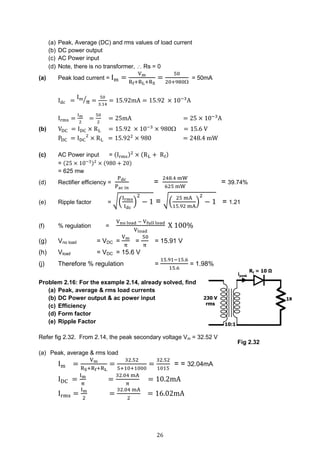
(a) Peak, Average (DC) and rms values of load current
(b) DC power output
(c) AC Power input
(d) Note, there is no transformer,  Rs = 0
(a) Peak load current = Im =
Vm
Rf+RL+RS
=
50
20+980
= 50mA
Idc =
Im
π⁄ =
50
3.14
= 15.92mA = 15.92 × 10⁻³
A
Irms =
Im
2
=
50
2
= 25mA = 25 × 10−3
A
(b) VDC = IDC × RL = 15.92 × 10−3
× 980 = 15.6 V
PDC = IDC
2
× RL = 15.922
× 980 = 248.4 mW
(c) AC Power input = (Irms)2
× (RL + Rf)
= (25 × 10−3)2
× (980 + 20)
= 625 mw
(d) Rectifier efficiency =
Pdc
Pac in
=
248.4 mW
625 mW
= 39.74%
(e) Ripple factor = √(
Irms
Idc
)
2
− 1 = √(
25 mA
15.92 mA
)
2
− 1 = 1.21
(f) % regulation =
Vno load − Vfull load
Vload
X 100%
(g) Vno load = VDC =
Vm
π
=
50
π
= 15.91 V
(h) Vload = VDC = 15.6 V
(j) Therefore % regulation =
15.91−15.6
15.6
= 1.98%
Problem 2.16: For the example 2.14, already solved, find
(a) Peak, average & rms load currents
(b) DC Power output & ac power input
(c) Efficiency
(d) Form factor
(e) Ripple Factor
Refer fig 2.32. From 2.14, the peak secondary voltage Vm = 32.52 V
(a) Peak, average & rms load
Im =
Vm
RS+Rf+RL
=
32.52
5+10+1000
=
32.52
1015
= = 32.04mA
IDC =
Im
π
=
32.04 mA
π
= 10.2mA
Irms =
Im
2
=
32.04 mA
2
= 16.02mA
Fig 2.32
27
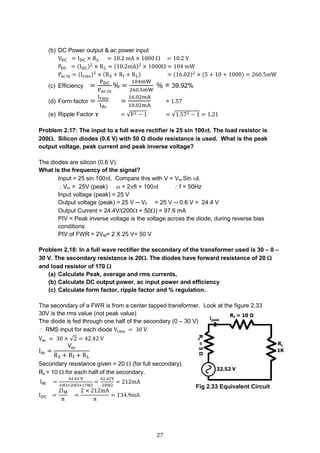
(b) DC Power output & ac power input
VDC = IDC × RL = 10.2 mA × 1000  = 10.2 V
PDC = (IDC)2
× RL = (10.2mA)2
× 1000 = 104 mW
Pac in = (Irms)2
× (RS + Rf + RL) = (16.02)2
× (5 + 10 + 1000) = 260.5mW
(c) Efficiency =
PDC
Pac in
% =
104mW
260.5mW
% = 39.92%
(d) Form factor =
Irms
Idc
=
16.02mA
10.02mA
= 1.57
(e) Ripple Factor ɤ = √F2 − 1 = √1.572 − 1 = 1.21
Problem 2.17: The input to a full wave rectifier is 25 sin 100t. The load resistor is
200. Silicon diodes (0.6 V) with 50 Ω diode resistance is used. What is the peak
output voltage, peak current and peak inverse voltage?
The diodes are silicon (0.6 V).
What is the frequency of the signal?
Input = 25 sin 100t, Compare this with V = Vm Sin t.
Vm = 25V (peak)  = 2ft = 100t f = 50Hz
Input voltage (peak) = 25 V
Output voltage (peak) = 25 V ─ VF = 25 V ─ 0.6 V = 24.4 V
Output Current = 24.4V/(200 + 50) = 97.6 mA
PIV = Peak inverse voltage is the voltage across the diode, during reverse bias
conditions
PIV of FWR = 2VM= 2 X 25 V= 50 V
Problem 2,18: In a full wave rectifier the secondary of the transformer used is 30 – 0 –
30 V. The secondary resistance is 20. The diodes have forward resistance of 20 
and load resistor of 170 
(a) Calculate Peak, average and rms currents,
(b) Calculate DC output power, ac input power and efficiency
(c) Calculate form factor, ripple factor and % regulation.
The secondary of a FWR is from a center tapped transformer. Look at the figure 2.33
30V is the rms value (not peak value)
The diode is fed through one half of the secondary (0 – 30 V)
 RMS input for each diode Vrms = 30 V
Vm = 30 × √2 = 42.42 V
Im =
Vm
RS + Rf + RL
Secondary resistance given = 20  (for full secondary)
Rs.= 10  for each half of the secondary.
IM =
42.42 V
10+20+170
=
42.42V
200
= 212mA
IDC =
2IM
π
=
2 × 212mA
π
= 134.9mA
Fig 2.33 Equivalent Circuit
28
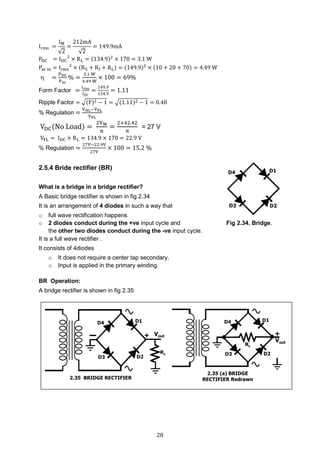
Irms =
IM
√2
=
212mA
√2
= 149.9mA
PDC = IDC
2
× RL = (134.9)2
× 170 = 3.1 W
Pac in = Irms
2
× (RS + Rf + RL) = (149.9)2
× (10 + 20 + 70) = 4.49 W
 =
PDC
Pac
% =
3.1 W
4.49 W
× 100 = 69%
Form Factor =
Irms
IDC
=
149.9
134.9
= 1.11
Ripple Factor = √(F)2 − 1 = √(1.11)2 − 1 = 0.48
% Regulation =
VNL−VFL
VFL
VDC(No Load) =
2VM
π
=
2×42.42
π
= 27 V
VFL = IDC × RL = 134.9 × 170 = 22.9 V
% Regulation =
27V−22.9V
27V
× 100 = 15.2 %
2.5.4 Bride rectifier (BR)
What is a bridge in a bridge rectifier?
A Basic bridge rectifier is shown in fig 2.34
It is an arrangement of 4 diodes in such a way that
o full wave rectification happens
o 2 diodes conduct during the +ve input cycle and Fig 2.34. Bridge.
the other two diodes conduct during the -ve input cycle.
It is a full wave rectifier .
It consists of 4diodes
o It does not require a center tap secondary.
o Input is applied in the primary winding.
BR Operation:
A bridge rectifier is shown in fig 2.35
29
The same bridge rectifier is redrawn to provide more clarity in fig 2.35(a).
+ve cycle:
When the input is a +ve cycle, top of the secondary is +ve and the bottom is –ve.
Diodes D1 and D3 will conduct as shown in fig 2.36.
─ ve Cycle:
When the input is a -ve cycle, bottom of secondary is +ve and the top is –ve.
Diodes D2 and D4 will conduct as shown in fig 2.36(a).
Note, the current through RL, is in the same direction (right to left), in both cycles
Equations of bridge rectifier:
They are same as that of FWR, except Im
Im =
𝐕 𝐦
𝐑 𝐬+𝐑 𝐟+𝐑 𝐟+𝐑 𝐋
[ since, 2 diodes are involved, per cycle]
IDC = 2
𝐈 𝐦

, VDC = 2
𝐕 𝐦

, Irms =
𝐈 𝐦
√𝟐
PDC = (IDC)2
X RL =
𝟒
 𝟐
Im
2
RL
Pac = I2
RMS (RS + 2 Rf + RL) =
𝐈 𝐦
𝟐
𝟐
[RS + 2Rf + RL]
Efficiency (η) =
𝟖
 𝟐
[ RL / (RS + 2Rf + RL) ] % = 81.2 %
F = 1.11, ϒ = 0.48, TUF = 0.812
2.5.5 Comparison of rectifiers
Compare advantages & disadvantages of all the three rectifiers.
H W F W Bridge
Only one diode. Easy design. 2 diodes. Complex design. 4 diodes. Complex design.
No centre-tap transformer Centre-tap transformer No centre-tap transformer
Ripple factor high. (1.21) Ripple factor Low. ( 0.48) Ripple factor low. (0.48)
TUF low. Inefficient. TUF High. Efficient. TUF high. Efficient.
30
Low efficiency 40.6%. High efficiency 81.2%. High efficiency 81.2%.
Output load voltage & current
low
Output load voltage & current
high.
Output load voltage & current
high.
Uni-directional current through
transformer. Therefore
transformer can saturate.
No net dc current through
transformer.
Therefore transformer will not
saturate.
Current is continuous always
hence transformer can be small
& Inexpensive.
PIV of diode low (Vm) PIV of diode high (2 Vm) PIV of diode low (vm)
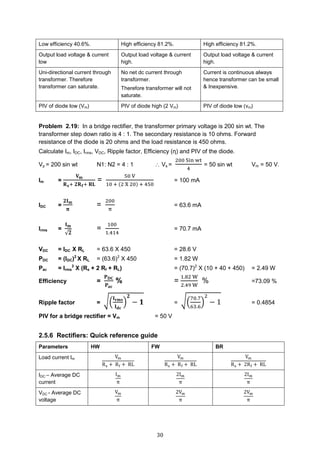
Problem 2.19: In a bridge rectifier, the transformer primary voltage is 200 sin wt. The
transformer step down ratio is 4 : 1. The secondary resistance is 10 ohms. Forward
resistance of the diode is 20 ohms and the load resistance is 450 ohms.
Calculate Im, IDC, Irms, VDC, Ripple factor, Efficiency (η) and PIV of the diode.
Vp = 200 sin wt N1: N2 = 4 : 1  Vs =
200 Sin wt
4
= 50 sin wt Vm = 50 V.
Im =
𝐕 𝐦
𝐑 𝐬+ 𝟐𝐑 𝐟+ 𝐑𝐋
=
50 V
10 + (2 X 20) + 450
= 100 mA
IDC =
𝟐𝐈 𝐦
𝛑
=
200
π
= 63.6 mA
Irms =
𝐈 𝐦
√𝟐
=
100
1.414
= 70.7 mA
VDC = IDC X RL = 63.6 X 450 = 28.6 V
PDC = (IDC)2
X RL = (63.6)2
X 450 = 1.82 W
Pac = Irms
2
X (Rs + 2 Rf + RL) = (70.7)2
X (10 + 40 + 450) = 2.49 W
Efficiency =
𝐏 𝐃𝐂
𝐏 𝐚𝐜
% =
1.82 W
2.49 W
% =73.09 %
Ripple factor = √(
𝐈 𝐫𝐦𝐬
𝐈 𝐝𝐜
)
𝟐
− 𝟏 = √(
70.7
63.6
)
2
− 1 = 0.4854
PIV for a bridge rectifier = Vm = 50 V
2.5.6 Rectifiers: Quick reference guide
Parameters HW FW BR
Load current Im Vm
Rs + Rf + RL
Vm
Rs + Rf + RL
Vm
Rs + 2Rf + RL
IDC – Average DC
current
Im
π
2Im
π
2Im
π
VDC - Average DC
voltage
Vm
π
2Vm
π
2Vm
π
31
Irms Im
2
Im
√2
Im
√2
Vrms Vm
2
Vm
√2
Vm
√2
PDC - DC Power
output (
Im
π
)
2
(
2Im
π
)
2
(
2Im
π
)
2
Pac - AC Power
output (
Im
2
)
2
(Rs + Rf + RL) (
Im
√2
)
2
(Rs + Rf + RL) (
Im
√2
)
2
(Rs + 2Rf + RL)
Efficiency 40.6% 81.2% 81.2%
Form factor 1.57 1.11 1.11
Ripple factor 1.21 0.482 0.482
TUF 0.287 0.812 0.693
Ripple freq f 2f 2f
PIV Vm 2 Vm Vm
2.6 Capacitor Filter Circuit
2.6.1 Half-wave rectifier with Capacitor filter
Fig 2.37 shows a HW rectifier, with a capacitor filter. Let us assume an ideal diode . VF =0
Operation What happens in cycle 1? 0 to 90 deg (Refer
fig 2.38)
o Input is switched on. During the first
quarter positive cycle (0 to 90 deg) of
the input, the diode conducts and the
capacitor charges to the peak value of
the input .
90 deg to 360 deg [Refer fig 2.38(a)]
o From 90 deg to 360 deg of the first
cycle the diode does not conduct .
Fig 2.37
32
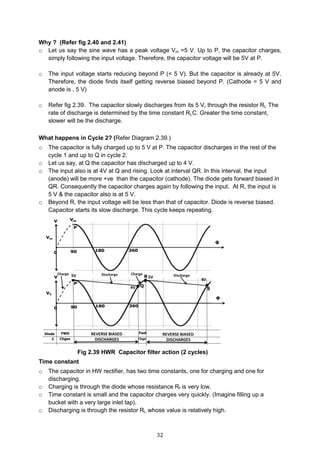
Why ? (Refer fig 2.40 and 2.41)
o Let us say the sine wave has a peak voltage Vm =5 V. Up to P, the capacitor charges,
simply following the input voltage. Therefore, the capacitor voltage will be 5V at P.
o The input voltage starts reducing beyond P (< 5 V). But the capacitor is already at 5V.
Therefore, the diode finds itself getting reverse biased beyond P. (Cathode = 5 V and
anode is , 5 V)
o Refer fig 2.39. The capacitor slowly discharges from its 5 V, through the resistor RL The
rate of discharge is determined by the time constant RLC. Greater the time constant,
slower will be the discharge.
What happens in Cycle 2? (Refer Diagram 2.39.)
o The capacitor is fully charged up to 5 V at P. The capacitor discharges in the rest of the
cycle 1 and up to Q in cycle 2.
o Let us say, at Q the capacitor has discharged up to 4 V.
o The input also is at 4V at Q and rising. Look at interval QR. In this interval, the input
(anode) will be more +ve than the capacitor (cathode). The diode gets forward biased in
QR. Consequently the capacitor charges again by following the input. At R, the input is
5 V & the capacitor also is at 5 V.
o Beyond R, the input voltage will be less than that of capacitor. Diode is reverse biased.
Capacitor starts its slow discharge. This cycle keeps repeating.
Fig 2.39 HWR Capacitor filter action (2 cycles)
Time constant
o The capacitor in HW rectifier, has two time constants, one for charging and one for
discharging.
o Charging is through the diode whose resistance Rf is very low.
o Time constant is small and the capacitor charges very quickly. (Imagine filling up a
bucket with a very large inlet tap).
o Discharging is through the resistor RL whose value is relatively high.
33
o Time constant is large and the capacitor discharges very slowly. (Imagine emptying the
bucket through a very small outlet tap).
Output ripple will be less as seen above. The ripple factor ϒ, frequency, capacitor value and
the load resistor are inter-related by the equation,
o For a half wave rectifier, ϒ =
𝟏
𝟐√𝟑 𝐂𝐟𝐑 𝐋
2.6.2 Full wave rectifier with capacitor filter
The theory is exactly similar to HW rectifier discussed earlier. The circuit diagram of FWR
and the wave forms are shown in fig 2.40.
Wave forms are shown in fig 2.40(a)
Why capacitor filter? Fig 2.40(a) FWR - Capacitor filter action (2
cycles).
Output ripple will be less as seen above. The ripple factor ϒ, frequency, capacitor value and
the load resistor are inter-related by the equation,
For a full wave rectifier, ϒ =
𝟏
𝟒√𝟑 𝐂𝐟𝐑 𝐋
Problem 2.20: If a full wave rectifier is fed a sine wave of 10 V, 400 Hz, what is the
capacitor value required, if the load current required is 20 mA and ripple factor is 2
%
Full wave rectifier .Ripple = 2f = 800 Hz.
What is RL?
VDC =
𝟐𝐕 𝐦
𝛑
IDC X RL =
𝟐𝐕 𝐦
𝛑
RL =
𝟐𝐕 𝐦
𝛑
X
𝟏
𝐈 𝐃𝐂
Sine wave i/p = 10 V (rms) [unless otherwise mentioned V is rms]
Vm = 10 V X √𝟐 = 14.14 V
IDC = 20 mA
Fig 2.40
Fig 2.40
34
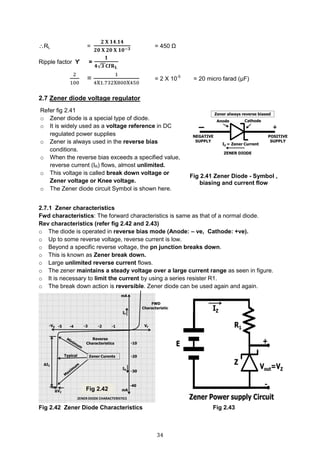
RL =
𝟐 𝐗 𝟏𝟒.𝟏𝟒
𝟐𝟎 𝐗 𝟐𝟎 𝐗 𝟏𝟎−𝟑
= 450 Ω
Ripple factor ϒ =
𝟏
𝟒√𝟑 𝐂𝐟𝐑 𝐋
2
100
=
1
4X1.732X800X450
= 2 X 10-5
= 20 micro farad (μF)
2.7 Zener diode voltage regulator
2.7.1 Zener characteristics
Fwd characteristics: The forward characteristics is same as that of a normal diode.
Rev characteristics (refer fig 2.42 and 2.43)
o The diode is operated in reverse bias mode (Anode: – ve, Cathode: +ve).
o Up to some reverse voltage, reverse current is low.
o Beyond a specific reverse voltage, the pn junction breaks down.
o This is known as Zener break down.
o Large unlimited reverse current flows.
o The zener maintains a steady voltage over a large current range as seen in figure.
o It is necessary to limit the current by using a series resister R1.
o The break down action is reversible. Zener diode can be used again and again.
Fig 2.42 Zener Diode Characteristics Fig 2.43
Refer fig 2.41
o Zener diode is a special type of diode.
o It is widely used as a voltage reference in DC
regulated power supplies
o Zener is always used in the reverse bias
conditions.
o When the reverse bias exceeds a specified value,
reverse current (IR) flows, almost unlimited.
o This voltage is called break down voltage or
Zener voltage or Knee voltage.
o The Zener diode circuit Symbol is shown here.
Fig 2.41 Zener Diode - Symbol ,
biasing and current flow
Fig 2.42
35
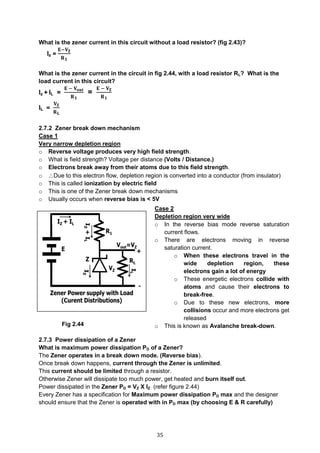
What is the zener current in this circuit without a load resistor? (fig 2.43)?
Iz =
𝐄−𝐕 𝐙
𝐑 𝟏
What is the zener current in the circuit in fig 2.44, with a load resistor RL? What is the
load current in this circuit?
Iz + IL =
𝐄 − 𝐕 𝐨𝐮𝐭
𝐑 𝟏
=
𝐄 − 𝐕 𝐙
𝐑 𝟏
IL =
𝐕 𝐙
𝐑 𝐋
2.7.2 Zener break down mechanism
Case 1
Very narrow depletion region
o Reverse voltage produces very high field strength.
o What is field strength? Voltage per distance (Volts / Distance.)
o Electrons break away from their atoms due to this field strength.
o Due to this electron flow, depletion region is converted into a conductor (from insulator)
o This is called ionization by electric field
o This is one of the Zener break down mechanisms
o Usually occurs when reverse bias is < 5V
Fig 2.44
2.7.3 Power dissipation of a Zener
What is maximum power dissipation PD of a Zener?
The Zener operates in a break down mode. (Reverse bias).
Once break down happens, current through the Zener is unlimited.
This current should be limited through a resistor.
Otherwise Zener will dissipate too much power, get heated and burn itself out.
Power dissipated in the Zener PD = VZ X IZ (refer figure 2.44)
Every Zener has a specification for Maximum power dissipation PD max and the designer
should ensure that the Zener is operated with in PD max (by choosing E & R carefully)
Case 2
Depletion region very wide
o In the reverse bias mode reverse saturation
current flows.
o There are electrons moving in reverse
saturation current.
o When these electrons travel in the
wide depletion region, these
electrons gain a lot of energy
o These energetic electrons collide with
atoms and cause their electrons to
break-free.
o Due to these new electrons, more
collisions occur and more electrons get
released
o This is known as Avalanche break-down.
o Also known as Ionization by collision
o Usually occurs when reverse voltage is > 5V
36
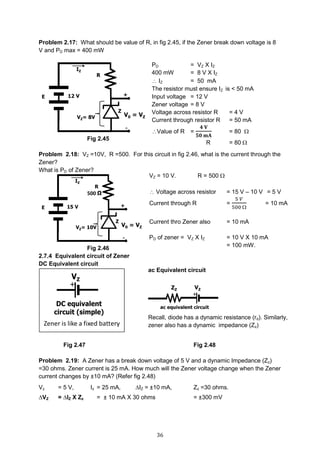
Problem 2.17: What should be value of R, in fig 2.45, if the Zener break down voltage is 8
V and PD max = 400 mW
Fig 2.45
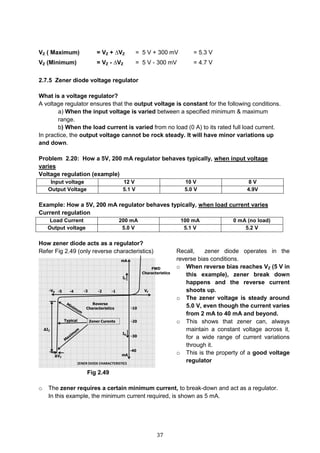
Problem 2.18: VZ =10V, R =500. For this circuit in fig 2.46, what is the current through the
Zener?
What is PD of Zener?
Fig 2.46
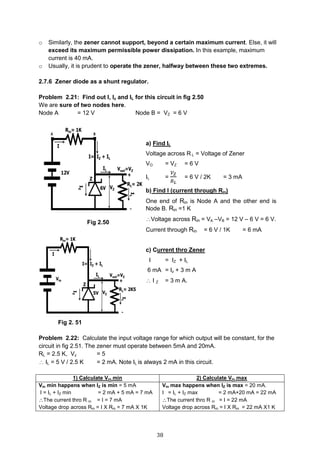
2.7.4 Equivalent circuit of Zener
DC Equivalent circuit
Fig 2.47 Fig 2.48
Problem 2.19: A Zener has a break down voltage of 5 V and a dynamic Impedance (Zz)
=30 ohms. Zener current is 25 mA. How much will the Zener voltage change when the Zener
current changes by ±10 mA? (Refer fig 2.48)
Vz = 5 V, Iz = 25 mA, ∆IZ = ±10 mA, Zz =30 ohms.
∆VZ = ∆IZ X Zz = ± 10 mA X 30 ohms = ±300 mV
PD = VZ X IZ
400 mW = 8 V X IZ
 IZ = 50 mA
The resistor must ensure IZ is < 50 mA
Input voltage = 12 V
Zener voltage = 8 V
Voltage across resistor R = 4 V
Current through resistor R = 50 mA
Value of R =
𝟒 𝐕
𝟓𝟎 𝐦𝐀
= 80 
R = 80 
VZ = 10 V. R = 500 
 Voltage across resistor = 15 V – 10 V = 5 V
Current through R =
5 𝑉
500 
= 10 mA
Current thro Zener also = 10 mA
PD of zener = VZ X IZ = 10 V X 10 mA
= 100 mW.
ac Equivalent circuit
Recall, diode has a dynamic resistance (rd). Similarly,
zener also has a dynamic impedance (Zz)
37
VZ ( Maximum) = VZ + ∆VZ = 5 V + 300 mV = 5.3 V
VZ (Minimum) = VZ - ∆VZ = 5 V - 300 mV = 4.7 V
2.7.5 Zener diode voltage regulator
What is a voltage regulator?
A voltage regulator ensures that the output voltage is constant for the following conditions.
a) When the input voltage is varied between a specified minimum & maximum
range.
b) When the load current is varied from no load (0 A) to its rated full load current.
In practice, the output voltage cannot be rock steady. It will have minor variations up
and down.
Problem 2.20: How a 5V, 200 mA regulator behaves typically, when input voltage
varies
Voltage regulation (example)
Input voltage 12 V 10 V 8 V
Output Voltage 5.1 V 5.0 V 4.9V
Example: How a 5V, 200 mA regulator behaves typically, when load current varies
Current regulation
Load Current 200 mA 100 mA 0 mA (no load)
Output voltage 5.0 V 5.1 V 5.2 V
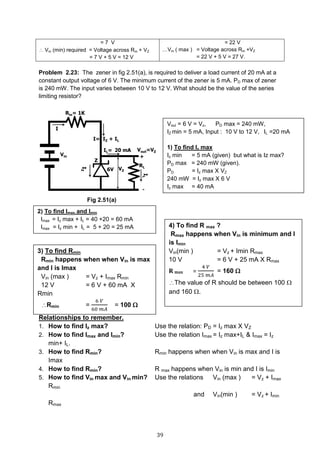
How zener diode acts as a regulator?
Refer Fig 2.49 (only reverse characteristics)
Fig 2.49
o The zener requires a certain minimum current, to break-down and act as a regulator.
In this example, the minimum current required, is shown as 5 mA.
Recall, zener diode operates in the
reverse bias conditions.
o When reverse bias reaches VZ (5 V in
this example), zener break down
happens and the reverse current
shoots up.
o The zener voltage is steady around
5.0 V, even though the current varies
from 2 mA to 40 mA and beyond.
o This shows that zener can, always
maintain a constant voltage across it,
for a wide range of current variations
through it.
o This is the property of a good voltage
regulator
38
o Similarly, the zener cannot support, beyond a certain maximum current. Else, it will
exceed its maximum permissible power dissipation. In this example, maximum
current is 40 mA.
o Usually, it is prudent to operate the zener, halfway between these two extremes.
2.7.6 Zener diode as a shunt regulator.
Problem 2.21: Find out I, Iz and IL for this circuit in fig 2.50
We are sure of two nodes here.
Node A = 12 V Node B = VZ = 6 V
Fig 2.50
Fig 2. 51
Problem 2.22: Calculate the input voltage range for which output will be constant, for the
circuit in fig 2.51. The zener must operate between 5mA and 20mA.
RL = 2.5 K, Vz = 5
 IL = 5 V / 2.5 K = 2 mA. Note IL is always 2 mA in this circuit.
1) Calculate Vin min 2) Calculate Vin max
Vin min happens when IZ is min = 5 mA
I = IL + IZ min = 2 mA + 5 mA = 7 mA
The current thro R in = I = 7 mA
Voltage drop across Rin = I X Rin = 7 mA X 1K
Vin max happens when IZ is max = 20 mA.
I = IL + IZ max = 2 mA+20 mA = 22 mA
The current thro R in = I = 22 mA
Voltage drop across Rin = I X Rin = 22 mA X1 K
a) Find IL
Voltage across R L = Voltage of Zener
VO = VZ = 6 V
IL =
𝑉𝑍
𝑅 𝐿
= 6 V / 2K = 3 mA
b) Find I (current through Rin)
One end of Rin is Node A and the other end is
Node B. Rin =1 K
Voltage across Rin = VA –VB = 12 V – 6 V = 6 V.
Current through Rin = 6 V / 1K = 6 mA
c) Current thro Zener
I = IZ + IL
6 mA = Iz + 3 m A
 I Z = 3 m A.
39
Problem 2.23: The zener in fig 2.51(a), is required to deliver a load current of 20 mA at a
constant output voltage of 6 V. The minimum current of the zener is 5 mA. PD max of zener
is 240 mW. The input varies between 10 V to 12 V. What should be the value of the series
limiting resistor?
Fig 2.51(a)
Relationships to remember.
1. How to find Iz max? Use the relation: PD = Iz max X VZ
2. How to find Imax and Imin? Use the relation Imax = Iz max+IL & Imax = Iz
min+ IL.
3. How to find Rmin? Rmin happens when when Vin is max and I is
Imax
4. How to find Rmin? R max happens when Vin is min and I is Imin
5. How to find Vin max and Vin min? Use the relations Vin (max ) = Vz + Imax
Rmin
and Vin(min ) = Vz + Imin
Rmax
= 7 V
 Vin (min) required = Voltage across Rin + VZ
= 7 V + 5 V = 12 V
= 22 V
…Vin ( max ) = Voltage across Rin +VZ
= 22 V + 5 V = 27 V.
Voul = 6 V = Vz, PD max = 240 mW,
IZ min = 5 mA, Input : 10 V to 12 V, IL =20 mA
1) To find Iz max
Iz min = 5 mA (given) but what is Iz max?
PD max = 240 mW (given).
PD = Iz max X VZ
240 mW = Iz max X 6 V
Iz max = 40 mA
2) To find Imax and Imin
Imax = Iz max + IL = 40 +20 = 60 mA
Imax = Iz min + IL = 5 + 20 = 25 mA
3) To find Rmin
Rmin happens when when Vin is max
and I is Imax
Vin (max ) = Vz + Imax Rmin
12 V = 6 V + 60 mA X
Rmin
Rmin =
6 𝑉
60 𝑚𝐴
= 100 
4) To find R max ?
Rmax happens when Vin is minimum and I
is Imin
Vin(min ) = Vz + Imin Rmax
10 V = 6 V + 25 mA X Rmax
R max =
4 𝑉
25 𝑚𝐴
= 160 
The value of R should be between 100 
and 160 .
40
2.8 Series and shunt diode clipping circuits
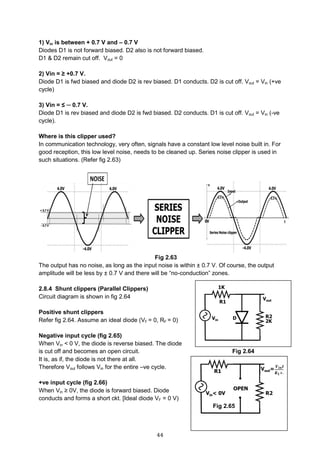
What is clipper?
o A circuit, which removes unwanted segments of a wave-form, is called a clipper.
o A clipper is also known as a limiter.
o A half wave rectifier is an example of clipper which clips one half cycle of the input.
o Diodes are used in clippers.
o If the diode is in series with the load, it is called a series clipper.
o If the diode is in parallel with the load, it is called a parallel clipper.
2.8.1 Series clippers (refer fig 2.52)
The diode is series with the load.
If the + ve part of the input signal is clipped off, it is a +ve clipper.
If the – ve part of the input signal is clipped off , it is a –ve clipper.
Series –ve clipper (Silicon Diode)
Fig 2.52 Fig 2.53
Fig 2.53
Look at the cicuit diagram (fig 2.52) and the wave form (fig 2.53). Assume Silicon diode.
Input : Solid sine wave. Output : Dotted sine wave .
A  Input is at 0 V.
Diode has zero bias. (Anode is at 0 V and cathode also is at 0 V through the
qrounded RL).
Diode does not conduct (cut off)
B  Input is at 0.7 V.
Diode is FWD biased (Anode is at 0.7 V and cathode is at 0 V).
Output is Vin –VF = 0.7 V - 0.7 V = 0 V.
Diode begins to conduct.
C  Input is at its peak 2 V.
Diode continues to be forward biased.
Output is Vin –VF = 2 V - 0.7 V = 1.3 V.
D  Input has reduced back to 0.7 V.
Diode is still fwd biased.
Output is Vin –VF = 0.7 V - 0.7 V = 0
Diode is about to cut-off..
41
E  Input = 0 V. Diode is zero biased, as at A. Diode is cut off. Output is at 0 V (since RL
is grounded).
E to F  The input is less than 0V.Diode is reverse biased and cut off . Output is 0 V.
.
It is clear from the above that the diode, conducts during major portion of +ve input cycle
and is cut off entirely during –ve input cycle. The output follows input, during +ve
input cycle and is clipped during –ve input cycle. it is a –ve clipper.
Note that there is a 0.7 V difference, between input & output, due to silicon diode drop of
0.7 V.
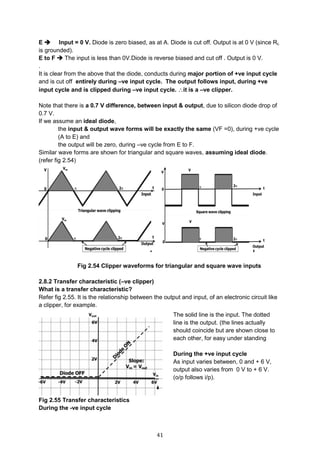
If we assume an ideal diode,
the input & output wave forms will be exactly the same (VF =0), during +ve cycle
(A to E) and
the output will be zero, during –ve cycle from E to F.
Similar wave forms are shown for triangular and square waves, assuming ideal diode.
(refer fig 2.54)
Fig 2.54 Clipper waveforms for triangular and square wave inputs
2.8.2 Transfer characteristic (–ve clipper)
What is a transfer characteristic?
Refer fig 2.55. It is the relationship between the output and input, of an electronic circuit like
a clipper, for example.
Fig 2.55 Transfer characteristics
During the -ve input cycle
The solid line is the input. The dotted
line is the output. (the lines actually
should coincide but are shown close to
each other, for easy under standing
During the +ve input cycle
As input varies between, 0 and + 6 V,
output also varies from 0 V to + 6 V.
(o/p follows i/p).
42
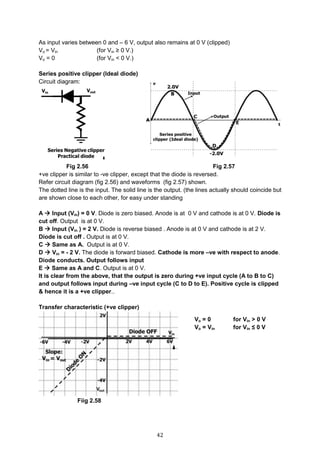
As input varies between 0 and – 6 V, output also remains at 0 V (clipped)
Vo = Vin (for Vin ≥ 0 V.)
Vo = 0 (for Vin < 0 V.)
Series positive clipper (Ideal diode)
Circuit diagram:
Fig 2.56 Fig 2.57
+ve clipper is similar to -ve clipper, except that the diode is reversed.
Refer circuit diagram (fig 2.56) and waveforms (fig 2.57) shown.
The dotted line is the input. The solid line is the output. (the lines actually should coincide but
are shown close to each other, for easy under standing
A  Input (Vin) = 0 V. Diode is zero biased. Anode is at 0 V and cathode is at 0 V. Diode is
cut off. Output is at 0 V.
B  Input (Vin ) = 2 V. Diode is reverse biased . Anode is at 0 V and cathode is at 2 V.
Diode is cut off . Output is at 0 V.
C  Same as A. Output is at 0 V.
D  Vin = - 2 V. The diode is forward biased. Cathode is more –ve with respect to anode.
Diode conducts. Output follows input
E  Same as A and C. Output is at 0 V.
It is clear from the above, that the output is zero during +ve input cycle (A to B to C)
and output follows input during –ve input cycle (C to D to E). Positive cycle is clipped
& hence it is a +ve clipper..
Transfer characteristic (+ve clipper)
Fiig 2.58
Vo = 0 for Vin > 0 V
Vo = Vin for Vin ≤ 0 V
43
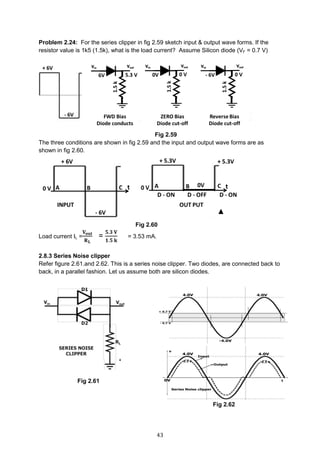
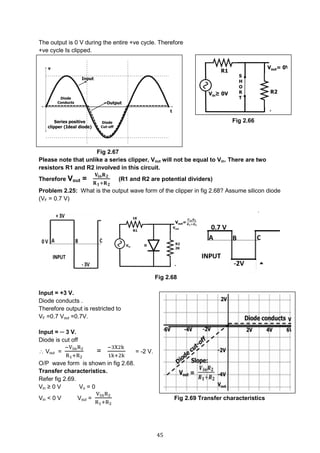
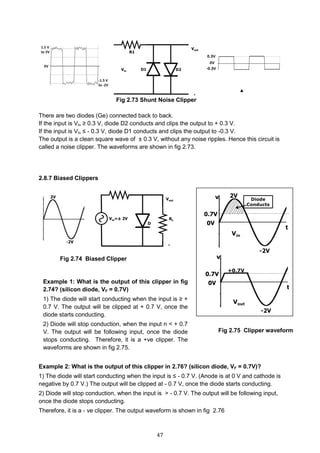
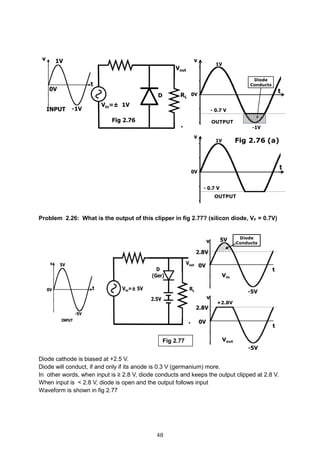
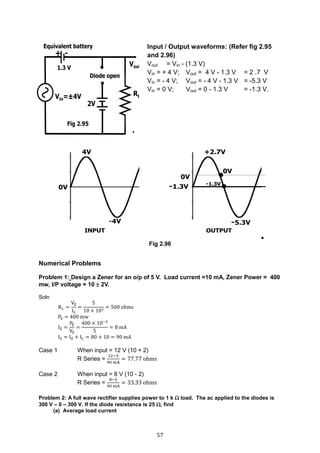
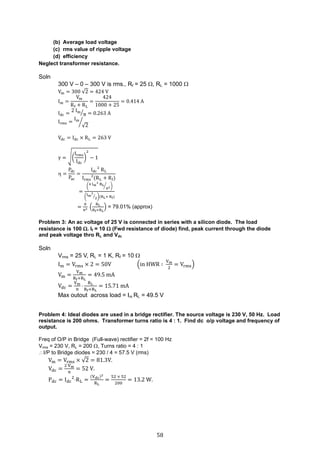
Problem 2.24: For the series clipper in fig 2.59 sketch input & output wave forms. If the
resistor value is 1k5 (1.5k), what is the load current? Assume Silicon diode (VF = 0.7 V)
Fig 2.59
The three conditions are shown in fig 2.59 and the input and output wave forms are as
shown in fig 2.60.
Fig 2.60
Load current IL =
𝐕 𝐨𝐮𝐭
𝐑 𝐋
=
𝟓.𝟑 𝐕
𝟏.𝟓 𝐤
= 3.53 mA.
2.8.3 Series Noise clipper
Refer figure 2.61.and 2.62. This is a series noise clipper. Two diodes, are connected back to
back, in a parallel fashion. Let us assume both are silicon diodes.
Wave-forms
Fig 2.61
Fig 2.62
44
1) Vin is between + 0.7 V and – 0.7 V
Diodes D1 is not forward biased. D2 also is not forward biased.
D1 & D2 remain cut off. Vout = 0
2) Vin = ≥ +0.7 V.
Diode D1 is fwd biased and diode D2 is rev biased. D1 conducts. D2 is cut off. Vout = Vin (+ve
cycle)
3) Vin = ≤ ─ 0.7 V.
Diode D1 is rev biased and diode D2 is fwd biased. D2 conducts. D1 is cut off. Vout = Vin (-ve
cycle).
Where is this clipper used?
In communication technology, very often, signals have a constant low level noise built in. For
good reception, this low level noise, needs to be cleaned up. Series noise clipper is used in
such situations. (Refer fig 2.63)
Fig 2.63
The output has no noise, as long as the input noise is within ± 0.7 V. Of course, the output
amplitude will be less by ± 0.7 V and there will be “no-conduction” zones.
2.8.4 Shunt clippers (Parallel Clippers)
Circuit diagram is shown in fig 2.64
Positive shunt clippers
Refer fig 2.64. Assume an ideal diode (VF = 0, RF = 0)
Negative input cycle (fig 2.65)
When Vin < 0 V, the diode is reverse biased. The diode
is cut off and becomes an open circuit. Fig 2.64
It is, as if, the diode is not there at all.
Therefore Vout follows Vin for the entire –ve cycle.
+ve input cycle (fig 2.66)
When Vin ≥ 0V, the diode is forward biased. Diode
conducts and forms a short ckt. [Ideal diode VF = 0 V)
Fig 2.65
45
The output is 0 V during the entire +ve cycle. Therefore
+ve cycle Is clipped.
Fig 2.66
Fig 2.67
Please note that unlike a series clipper, Vout will not be equal to Vin. There are two
resistors R1 and R2 involved in this circuit.
Therefore Vout =
𝐕𝐢𝐧 𝐑 𝟐
𝐑 𝟏+𝐑 𝟐
(R1 and R2 are potential dividers)
Problem 2.25: What is the output wave form of the clipper in fig 2.68? Assume silicon diode
(VF = 0.7 V)
Fig 2.68
Input = +3 V.
Diode conducts .
Therefore output is restricted to
VF =0.7 Vout =0.7V.
Input = ─ 3 V.
Diode is cut off
 Vout =
−VinR2
R1+R2
=
−3X2k
1k+2k
= -2 V.
O/P wave form is shown in fig 2.68.
Transfer characteristics.
Refer fig 2.69.
Vin ≥ 0 V Vo = 0
Vin < 0 V Vout =
VinR2
R1+R2
Fig 2.69 Transfer characteristics
46
2.8.5 Negative shunt clippers
Refer circuit diagram 2.70. It is similar to parallel +ve clipper, except that the diode is
reversed. Again assume an ideal diode (VF = 0 V, RF = 0 )
Fig 2.70 Negative clipper
Please note that unlike a series clipper, Vout will not be equal to Vin. There are two
resistors R1 and R2 involved in this circuit. The waveforms are shown in fig 2.72
Therefore Vout =
𝐕𝐢𝐧 𝐑 𝟐
𝐑 𝟏+𝐑 𝟐
(R1 and R2 are potential dividers)
Transfer characteristics (fig 2.71)
Fig 2.71 Transfer Characteristics Fig 2.72
Vin ≥ 0 V Vout =
VinR2
R1+R2
Vin < 0 V Vo = 0
2.8.6 Shunt Noise clipper (Using Germanium Diodes)
Refer fig 2,73 for circuit diagram. Assume germanium diodes. (VF = 0.3 V)
Look at input wave form. It has ripples (noise) between + 1.5 V & + 2.0 V and also between
-1.5 V and -2.0 V..
Negative clippers
- ve input cycle
o When Vin < 0 V, the diode is forward biased.
o Diode conducts and forms a short ckt. [Ideal diode
VF = 0 V]
o The output is 0 V during the entire -ve cycle.
o Therefore -ve cycle Is clipped.
+ve input cycle
o When Vin ≥ 0V, the diode is reverse biased.
o The diode is cut off and becomes an open circuit.
o It is as if, the diode is not there at all.
o Therefore Vout follows Vin for the entire –ve cycle.
47
Fig 2.73 Shunt Noise Clipper
There are two diodes (Ge) connected back to back.
If the input is Vin ≥ 0.3 V, diode D2 conducts and clips the output to + 0.3 V.
If the input is Vin ≤ - 0.3 V, diode D1 conducts and clips the output to -0.3 V.
The output is a clean square wave of ± 0.3 V, without any noise ripples. Hence this circuit is
called a noise clipper. The waveforms are shown in fig 2.73.
2.8.7 Biased Clippers
Example 2: What is the output of this clipper in fig
Example 2: What is the output of this clipper in 2.76? (silicon diode, VF = 0.7V)?
1) The diode will start conducting when the input is ≤ - 0.7 V. (Anode is at 0 V and cathode is
negative by 0.7 V.) The output will be clipped at - 0.7 V, once the diode starts conducting.
2) Diode will stop conduction, when the input is > - 0.7 V. The output will be following input,
once the diode stops conducting.
Therefore, it is a - ve clipper. The output waveform is shown in fig 2.76
Example 1: What is the output of this clipper in fig
2.74? (silicon diode, VF = 0.7V)
1) The diode will start conducting when the input is ≥ +
0.7 V. The output will be clipped at + 0.7 V, once the
diode starts conducting.
2) Diode will stop conduction, when the input n < + 0.7
V. The output will be following input, once the diode
stops conducting. Therefore, it is a +ve clipper. The
waveforms are shown in fig 2.75.
Fig 2.74 Biased Clipper
Fig 2.75 Clipper waveform
48
Problem 2.26: What is the output of this clipper in fig 2.77? (silicon diode, VF = 0.7V)
Diode cathode is biased at +2.5 V.
Diode will conduct, if and only if its anode is 0.3 V (germanium) more.
In other words, when input is ≥ 2.8 V, diode conducts and keeps the output clipped at 2.8 V.
When input is < 2.8 V, diode is open and the output follows input
Waveform is shown in fig 2.77
Fig 2.77
49
Problem 2.27: What is the output of this clipper in 2.78? (silicon diode, VF = 0.7V)
Fig 2.78
Fig 2.79
Double clipping (Refer fig 2.80)
Fig 2.80 Double clipper circuit
Fig 2.81 Double clipper waveform
.
D1 conducts if
Vin ≥ + 1.2 V + 0.7 V =1.9 V.
(Silicon)
D2 conducts if
Vin ≤ - 2.1 V - 0.3 V = -- 2.4 V
(Germanium).
Wave form in fig 2.81
Diode`anode is at - 1.4 V.
Diode will conduct if and only if its
cathode is more negative by 0.7
V than its anode. i.e. ─ 1.4 V ─
0.7 V = ─ 2.1 V.
Wave form is shown in fig 2.79.
50
2.9 Clamper circuits
In telecommunication, very often wireless propagation is involved, using antennae. .In
wireless communication, DC information cannot be propagated and is lost. At the receiver, in
order to get back the original signal, the DC that was lost, needs to be restored. Therefore
we need circuits, which can shift DC up or down .These circuits are known as clampers. One
huge application is, in TV receivers where DC is restored, to maintain the video signal at
appropriate black levels & white levels.
A negative clamper is shown in fig 2.82.
2.9.1 Negative clamper:
Fig 2.82 Negative clamper circuit
During the first quarter cycle (0 to 90 deg), the input rises from 0 to 5 V and the capacitor
charges to +5 V.
The diode, conducts in this duration, since it gets forward biased. (Anode is at >0 V and
cathode is at 0 V.)
Diode acts like a short and output remains zero in this duration.
The clamper has a series capacitor. We have already
seen a similar negative clipper circuit, using a series
resistor instead of a series capacitor.
The clamper circuit always uses a capacitor. Let us
illustrate how clamper works, through a series of
diagrams. Let us assume ideal diode (VF= 0 RF= 0).
What happens during the first +ve half cycle (0 to 90
deg)? Refer 2.82
The capacitor will hold
this 5 V since, it does
not usually have a
quick discharge path.
We can therefore
replace the capacitor,
by a battery (please
note down the polarity
of the voltage, across
the capacitor).
51
2.9.2 Clamping action
How clamping action take place?
Look at the figure 2.83 (a). Let us replace the capacitor by a 5 V battery (look at the
polarity).
Let us analyse the clamping action through a series of few simple static equivalent circuits
shown in figures 2.83 (b) to 2.83 (f).
The instantaneous voltages shown in Vin, in fig 2.83 (a) are replaced by
batteries in these circuits (for easy under-standing).
Fig 2.83 (a)
Fig 2.83 (b)
Fig 2.83 (c)
52
Fig 2.83 (d)
Fig 2.83 (e)
Fig 2.83 (f)
The waveforms are shown in fig 2.84 and the results are tabulated here.
Vin
(V)
Vout
(V)
5 0
4 -1
1 -4
-3 -8
-5 -10
53
The input range of +5 V to – 5 V, has been shifted down to 0 V to -10 V. Hence it is a
negative clamper.
2.9.2 Positive clamper (Ideal diode)
Operation
Refer fig 2.85(a). Note the polarity reversal of the capacitor.
Fig 2.85 (a)
Fig 2.85 (b)
Let us analyse the clamping action through a series of few simple static equivalent circuits,
shown in figures 2.85 (c) to 2.85 (f)..
The instantaneous voltages shown in Vin, are replaced by batteries in these circuits (for easy
under-standing).
Refer figures 2.85 (c) to (f). The analysis is similar to that of negative clamper except that the
polarities of signals and battery voltages are changed.
During the first quarter
cycle (0 to 90 deg), the
input varies from 0 to -5
V and the capacitor
charges to -5V.
The diode conducts in
this duration, since it
gets forward biased.
(Anode is at 0V and
cathode is more negative
with respect to anode.)
Diode acts like a short and output
remains zero in this duration (fig 2.85
(b))
.
The capacitor will hold this -5 V
since, it does not usually have a
quick discharge path. We can
therefore replace the capacitor, by a
battery (please note the polarity of
the voltage, across the capacitor).
54
Fig 2.85 (c) Fig 2.85 (d)
Fig 2.85 (e) Fig 2.85 (f)
The clamper waveform is shown below in fig 2.86. The results are tabulated here.
Fig 2.86 Negative clamper Input Output characteristics
Problem 2.28: Design a - ve clamper with a silicon diode
(VF = 0.7 V). What will be the output, for an input signal of ± 3 V.
In the previous section the diode was assumed to be an ideal diode. Now we have a
practical diode, with VF = 0.7 V.
Refer fig 2.87. During the first quarter of the input cycle, the voltage rises from 0 V to +3 V.
Vout starts following the input (capacitor couples input signal to output)
The diode gets forward biased when the input is ≥ 0.7 V. (Refer negative clamper theory)
.
Fig 2.87
Voltage across capacitor = 3 V – 0.7 V = 2.3 V.
Vin (V) Vout (V)
-5 0
-4 +1
0 +5
+2 +7
+5 +10
Once the diode conducts, Vout
becomes 0.7 V (In the previous
section, Vout was 0 V, since the
diode was ideal).
Vin = ±3 V (given )
When input reaches +3 V, the +ve
plate of the capacitor is +3 V and
the negative plate of the capacitor is
0.7 V. Therefore, the voltage across
capacitor is 3 V – 0.7 V = 2.3 V.
55
Now onwards, follow the same explanation as in the previous section, except that the
capacitor should be replaced by, an equivalent battery of 2.3 V (instead of 5.0 V battery as in
previous section), as shown in figure 2.88.
Fig 2.88 Negative clamper Input Output characteristics
The output swings between + 0.7 V and – 5.3 V as seen below. The waveforms are shown
in fig 2.89
1) Vin = +3 V
Vout = +3 V - 2.3 V = +0.7 V
2) Vin = 0 V
Vout = 0 V - 2.3V = -2.3 V
3) Vin = --3 V
Vout = -3 V - 2.3 V = --5.3 V
The circuit has clamped the input by -2.3 V. It is a negative clamper.
2.9.3 Diode’s role
The diode conducts only during the first quarter cycle of the input. Refer fig 2.90. After that
the diode never conducts (assuming an ideal diode and ideal capacitor which never loses
charge)
Fig 2.90 Fig 2.91
Problem 2.29: Design a +ve clamper, with a germanium diode (VF = 0.3 V). What will be
the output, for an input signal of ± 3.5 V?
Refer fig 2.91. During the first quarter of the input cycle, voltage swings from 0 V to -3.5 V.
56
Therefore, Vout starts following the input (capacitor couples input signal to output)
When the input is less than - 0.3 V, the diode gets forward biased (refer positive clamper
theory).
Once the diode conducts, Vout gets clamped to -0.3 V (In the previous section, Vout was + 0.7
V, since the diode was silicon and the circuit was a negative clamper)
VIN = ± 3.5 V (given)
When input reaches -3.5 V, the -ve plate of the capacitor is -3.5 V and the positive plate of
the capacitor is -0.3 V. Therefore, the voltage across capacitor is -3.5 V – (-0.3 V) = -3.2 V.
Refer diagrams 2.92 and 2.93 below
Fig 2.92
1) When Vin = -3.5 V
Vout = - 3.5 V – (- 3.2 V)
= - 3.5 V + 3.2 V
= - 0.3 V.
Problem 2.30: Biased clamper (silicon diode VF = 0.7 V): Sketch input and output wave
forms for this - ve clamper in fig 2.94. 1) When does the diode conduct?
Cathode is at 2 V. Diode is Silicon. For the
diode to conduct, anode needs to be 0.7 V
more positive. than the cathode. Therefore
diode starts conducting only if anode is ≥ 2.7 V.
2) What is the equivalent battery voltage of
the capacitor?
Input (max peak) = +4 V
Diode starts conducting at 2.7 V
Voltage across the capacitor is 4 V – 2.7 V =
+1.3 V.
This is the equivalent battery voltage.
Fig 2.93
2) When Vin = 0 V
Vout = 0 v - (- 3.2 V)
= + 3.2 V
3) When Vin = +3.5 V
Vout = + 3.5 V - (- 3.2 V)
= 6.7 V
Therefore an input voltage of +3.5 V to –
3.5 V is converted as –0.3 V to +6.7 V.
The output is clamped by +3.2 V as
shown in fig 2.93.
57
Fig 2.96
Numerical Problems
Problem 1: Design a Zener for an o/p of 5 V. Load current =10 mA, Zener Power = 400
mw, I/P voltage = 10  2V.
Soln
RL =
VZ
IL
=
5
10 × 103
= 500 ohms
PZ = 400 mw
IZ =
PZ
VZ
=
400 × 10−3
5
= 8 mA
IS = IZ + IL = 80 + 10 = 90 mA
Case 1 When input = 12 V (10 + 2)
R Series =
12−5
90 mA
= 77.77 ohms
Case 2 When input = 8 V (10 - 2)
R Series =
8−5
90 mA
= 33.33 ohms
Problem 2: A full wave rectifier supplies power to 1 k  load. The ac applied to the diodes is
300 V – 0 – 300 V. If the diode resistance is 25 , find
(a) Average load current
Input / Output waveforms: (Refer fig 2.95
and 2.96)
Vout = Vin - (1.3 V)
Vin = + 4 V; Vout = 4 V - 1.3 V = 2 .7 V
Vin = - 4 V; Vout = - 4 V - 1.3 V = -5.3 V
Vin = 0 V; Vout = 0 - 1.3 V = -1.3 V.
58
(b) Average load voltage
(c) rms value of ripple voltage
(d) efficiency
Neglect transformer resistance.
Soln
300 V – 0 – 300 V is rms., Rf = 25 , RL = 1000 
Vm = 300 √2 = 424 V
Im =
Vm
Rf + RL
=
424
1000 + 25
= 0.414 A
Idc =
2 Im
π⁄ = 0.263 A
Irms =
Im
√2
⁄
Vdc = Idc × RL = 263 V
γ = √(
Irms
Idc
)
2
− 1
 =
Pdc
Pac
=
Idc
2
RL
Irms
2
(RL + Rf)
=
(
4 Im
2
RL
π2⁄ )
(
Im
2
2
⁄ )(RL+ Rf)
=
8
π2 (
RL
Rf+RL
) = 79.01% (approx)
Problem 3: An ac voltage of 25 V is connected in series with a silicon diode. The load
resistance is 100 . If = 10  (Fwd resistance of diode) find, peak current through the diode
and peak voltage thro RL and Vdc
Soln
Vrms = 25 V, RL = 1 K, Rf = 10 
Im = Vrms × 2 = 50V (in HWR ∶
Vm
2
= Vrms)
Vm =
Vm
Rf+RL
= 49.5 mA
Vdc =
Vm
π

RL
Rf+RL
= 15.71 mA
Max outout across load = Im RL = 49.5 V
Problem 4: Ideal diodes are used in a bridge rectifier. The source voltage is 230 V, 50 Hz. Load
resistance is 200 ohms. Transformer turns ratio is 4 : 1. Find dc o/p voltage and frequency of
output.
Freq of O/P in Bridge (Full-wave) rectifier = 2f = 100 Hz
Vrms = 230 V, RL = 200 , Turns ratio = 4 : 1
I/P to Bridge diodes = 230 / 4 = 57.5 V (rms)
Vm = Vrms × √2 = 81.3V.
Vdc =
2 Vm
π
= 52 V.
Pdc = Idc
2
RL =
(Vdc)2
RL
=
52 × 52
200
= 13.2 W.
59
Problem 5: For the circuit shown, fine max and min vale of Zener current.
Case 1
I2 (Max) occurs when
(a) RL is removed and
(b) Vin is maximum
IZMax =
120−50
5K
= 14 mA.
The entire current flows thro Zener since RL is removed
Case 2
I2 (Min) occurs when
(a) 10K is connected (RL)
(b) Vin = Min = 80 V
since Zener voltage = 50 V, voltage across
RL also is 50 V
IL =
50V
10K
= 5 mA.
I1 =
80−50
5K
= 6 mA.
 IZ min = I1 – IL = 6 ─ 5 = 1mA
Problem 6: A 24 V, 600 mw Zener diode is used to provide 24 V stabilized supply to a variable
load. Input is 32 V. RL = 1200 .
Calculate
(1) The series resistance required.
(2) Zener current when load = 1200 
Soln :
PZ = 600 mw, VZ = 24 V. IZ = ?
(a) PZ = VZ x IZ  IZ =
600 mw
24V
= 25 mA
(b) IL =?
24 V
1200 
= 20 mA [since Zener voltage = 24 V, voltage across RL also is 24 V]
(c) IS = ? IS = IZ + IL = 25 + 20 = 45 mA
(d) Rs = ? Rs =
Volage across RS
Current thro RS
=
32 V − 24 V
45 mA
=
8 V
45 mA
= 177.78 
Problem 7: In a 2 diode full wave rectifier, the voltage across half the secondary is 100 V. Load
Resistance is 950  and Rf = 50  . Find load current of RMS current.
Vrms = 100 V Idc = ? Irms =?
Irms =
Vrms
RL + Rf
=
100
950 + 50
= 100 mA
Vm = Vrms × √2 = 100 × 1.414 = 141.4 V
RL
10K50V
RS
5K80 to
120V
RL = 1200VZ
= 24V
RS = ?
32V
Is
IZ=25mA
IL = ?
10K50V
5K80V
I1
I2
IL
(Min)
5K
50V120V
I2Max
60
Idc =
2Im
π
=
2Vm
π (RL + Rf)
=
2 × 141.4
π × 1000
= 0.08998 A = 89.98 mA
Problem 8: What is VO? What is the diode current?
The diode used is silicon, therefore Vf = 0.7 V
The voltage across RL = 8 ─ 0.7 V = 7.3 V
Current thro RL = Current ho diode =
7.3 V
2.2 K
= 3.32 mA
Problem 9: If the diode is reversed in example 8, what happens?
The diode is reverse biased,
There is no current flow anywhere
Output across RL = 0 V.
Current IL = 0
Current ID = 0
Problem 10: If the supply voltage is 0.4 V in example 8, what happens?
The diode is not sufficiently forward biased (silicon diode needs 0.7 V to conduct). Diode does
not conduct
 IL = 0, ID = 0, VR = 0
Problem 11: VO = ? ID = ?
Voltage at A = 12 V – Silicon Diode drop – Germanium diode drop
= 12 V – 0.7 V – 0.3 V = 11 V.
IL =
11 V
5600
= 1.96 mA
ID = IL = 1.96 mA
1) VA = ? VO = ? IL = ?
Method 1
KVL : Kirchoffs Voltage law
As per KVL : −10V + (IL × 4.7K) + 0.7V + (IL × 2.2K) + 5V = 0
IL = 2.07 mA
V1 = IL X R1 = 2.07 mA x 4.7 K = 9.73 V (approx)
The DC Voltage at A = 10 – V1 – 0.7
= 10 – 9.73 – 0.7 = -0.43V.
VO = IL X RL = 2.07 mA x 2.2 K = 4.55 V (approx)
Method 2
If you are not yet familiar with kirchoff’s laws,
Draw equivalent circuit
ID
VO
RL
Si
8V
IL
VO
2.2k
Si 5K6
IL
RL
VO = ?
Ge
ID
A
+12V
0.4 V
2K2
V1
R1 = 4.7K
2.2KIL
RL
VA = ?
Si
A
+10V
IL
0.7V
VO
-5V
61
i)
Total Current I = ?
Total Voltage = 9.3 V + 5 V = 14.3 V
Total Resistance = 4K7 + 2K2 = 6.9 K
 I =
14.3 V
6.9 K
Find I
Drop across 4K7 = I x 4.7 K
Drop across 2K2 = I x 2K2 & so on ………………
Problem 12: Analyze this circuit.
(a) I1 = ?
10 V−Vout
0.33 K
(b) Vout = ? Vout = 0.7 V (since both are silicon didoes with 0.7 V drop)
(a) IL =
10 −0.7 V
0.33 K
= 28.18 mA
(b) What is ID1 & What is ID2?
I1 is shared equally by diode 1 and diode 2
 ID1 = ID2 = I1/2 = 14.09 mA
Problem 13: What is Vout?
Across AB there are 2 diodes Si and
Ge. When Germanium conducts VAB
will be frozen at 0.3V.
On the other hand Si diode requires
0.7 V to conduct, which it will never
get. Therefore Si diode will never
ever be able to conduct.
 Vout = 20 V – Vge = 20 V – 0.3 V =
19.7 V
Problem 14: What is Vout?
If input is +20 V, D1 is FWD biased & will
conduct. Diode D2 will always be reverse
biased and will not conduct.
 Vout = 20 – 0.7 V = 19.3 V
4K7
2K2
VA
+10V
-5V
VA
4K7
2K2
+10V
-5V
0.7V 4K7
2K2
VA
+10V
-5V
0.7V
4K7
2K2
VA
9.3V
-5V
4K7
2K2
VA
9.3V
-5V
I
I
ID1
Vout
0.33K
R
10V
I1
ID2
Si Si
Vout
Vout
B20V A
Ge
Si
RL
Vout
R
+20V
2K2
D2
D1
RL
Si
Si
62
Problem 15: What is I ?
D1 - FWD biased & will conduct
D2 - REV biased & will NOT conduct
I =
E1−E2−Vf
R
I =
20 V−4 V−0.7 V
2.2 K
=
15.3 V
2.2 K
= 6.95 mA
Problem 16: For the circuit shown, what is the o/p waveform?
When Will the diode become forward biased ?
(a) Cathode is at 0 V
(b) Anode is at +5V (due to series Battery)
(c) Diode will conduct ifand only if the input sine wave goes above
+5.7V.
(d) The o/p wave form will be that portion of Input Sine wave with
amplitude > +5.7V as shown in fig (Hatched)
(e) The output will be zero when I/P is below +5.7V.
+4V
R=2K2+20V
D2
D1
I = ?
Si
Si
I
E1
0.7
E2
Vo = ?Vi
- +
Si
R
5V
Vi
0
20V
T
2⁄ T
t
I/P Vi
t
+5.7V +5.7V
Vi
t
5.7V
20-5.7=14.3V
O/P
14.3
V
14.3
V
63
Chapter 3 Basics of Bipolar Junction Transistors
3.1 Transistor Introduction
What is a transistor?
o A transistor is a semiconductor device. It is a 3 layer device. Two types of
arrangements are possible -- npn or pnp.
o It has three layers – emitter, base and collector
o Transistor is a current controlled device and NOT a voltage controlled device.
o A very small amount of current in the base region can control a large amount of
current between emitter and collector. This means transistor can be used in current
amplification and therefore power amplification..
o Transistor can be used as a basic switch (on–off switch) in digital logic circuits
3.1.1 Transistor construction and circuit symbols:
Fig 3.1
Figure 3.1 shows two types of transistor packages in semiconductor form – NPN and PNP.
PNP Transistor:
In PNP, a n type semiconductor is sandwiched between two p type semiconductors. The
transistor has three terminals – Emitter (p type), Base (n type) and Collector (p type)
NPN Transistor:
In NPN, a p type semiconductor is sandwiched between two n type semiconductors. The
transistor has three terminals – Emitter (n type), Base (p type) and Collector (n type)
Transistors have two pn junctions, a collector base junction and an emitter base junction.
3.1.2 Circuit Symbols:
The circuit symbols for an NPN transistor and a PNP transistor are shown in fig 3.2. The emitter is
always identified through an arrow. The direction of the arrow indicates the direction of the
current flow.
64
Fig 3.2
Fig 3.3
Some common metal can packages found in your lab are shown in fig 3.3
3.2 BJT Operation
3.2.1 pn junction operation
Fig 3.4 Fig 3.5
Recall the pn junction diffusion process discussed earlier on in section 1.4.1... The doping levels in
emitter, base and collector are shown in fig 3.4 and 3.5
3.2.2 No bias: In the absence of any bias voltage, some electrons move from n region (majority
carriers) to p and some holes move from p region (majority carriers) to n. This causes a buildup of
+ve ions in n region and -ve ions in the p region causing a potential barrier. This barrier prevents
further movement of carriers across the junction.
3.2.3 Forward bias (Emitter-Base junction): A npn transistor is shown in fig 3.6. Connect an
external battery to the pn junction such that p is connected to +ve and n is connected to the –ve
In a NPN transistor, the current is flowing
out of the emitter and in a PNP transistor,
the current is flowing into the emitter.
The current flow direction also is indicated in
the diagram.
In NPN type the arrow is from p to n. In PNP
type the arrow is also from p to n. Therefore
remember that the current flow is always
from p to n.
65
terminal of the battery. Under this condition the emitter base junction is said to be forward
biased.
When a pn junction is forward biased,
o Electrons (majority carriers) from n side are attracted by the +ve potential in the p side
and therefore electrons start crossing the junction and land in p side.
o Holes (majority carriers) from p side are attracted by the -ve potential in the n side and
therefore holes start crossing the junction and land in p side
o Current flows in the pn junction from p to n under forward bias conditions
o Current flow is due to majority carriers under forward bias conditions.
3.2.4 Reverse bias (Collector-Base junction): Connect an external battery to the pn junction
such that p is connected to -ve and n is connected to the +ve terminal of the battery. Under
this condition the collector base junction is said to be reverse biased.
Majority carriers
o Electrons (majority carriers) from n side are repelled by the -ve potential in the p side
and therefore electrons move away from the junction and remain in n side itself.
o Holes (majority carriers) from p side are repelled by the +ve potential in the n side
and therefore holes move away from the junction and remain in p side itself.
Minority carriers
o However, holes (minority carriers) from n side will be attracted by the -ve potential in the p side
and therefore holes start crossing the junction and land in p side.
o Similarly electrons (minority carriers) from p side will be attracted by the +ve potential in the n
side and therefore electrons start crossing the junction and land in n side.
Current flow due to majority carriers is not possible under reverse bias conditions but
current flow due to minority carriers is a distinct possibility.
3.2.5 Transistor operation: NPN
The biasing arrangement for a NPN transistor is shown in figure 3.6
Fig 3.6
66
Recall:
o Fwd bias junction encourages flow of majority carriers
o Rev bias junction encourages flow of minority carriers
o In a transistor, emitter and collector are heavily doped and the base is lightly doped.
Base region also is very thin.
o Emitter Base junction is forward biased. Emitter (n) is connected to –ve terminal of the
battery and Base (p) is connected to +ve terminal of the battery.
o Current flow due to majority carriers happens. Electrons from n region are emitted into
the base (p) region.
o This constitutes emitter current ( IE).
o Refer fig 3.7 here.
o These emitted electrons are now in the base where they are minority carriers.
o These electrons now see a reverse bias between base (p) and collector (n). As we saw
already, reverse base facilitates minority carrier flow and therefore these electrons
are whisked away towards collector.
o The base is ultrathin and therefore almost all the electrons which were emitted by the
emitter are collected by the collector. There is hardly any loss in the base due to
recombination because base is lightly doped.
Fig 3.7
3.2.6 Carriers flow in Transistors in npn
Refer fig 3.7.
o Electrons are the majority carriers
o Electrons from the emitter cross the Fwd Biased EB into Base.
o This constitutes emitter current ( IE)
o Majority of these Electrons (98 to 99%) transit thro base and through the rev biased CB into
collector. This current is IC = 0.98 IE
o That is why base width is kept small (for whisking away)
o Base doping is kept light so that recombination of holes and electrons is less probable. That
is why base current is low and
o Very few holes cross from base to emitter
3.2.7 PNP transistor operation
Refer fig 3.8
The biasing arrangement for a NPN transistor is shown in figure
o Emitter Base junction is forward biased. Emitter (p) is connected to +ve terminal of the
battery and Base (n) is connected to -ve terminal of the battery.
o While the current flow
discussion revolves
around majority carriers
(electrons), the minority
carriers (holes) also are
involved in the current
flow. Therefore these
devices are called bipolar
junction transistors (BJT).
67
o Current flow due to majority carriers happens. Holes from p region are emitted into the
base (n) region.
o These emitted holes are now in the base where they are minority carriers.
o These holes now see a reverse bias between base (p) and collector (n).
o As we saw already, reverse bias facilitates minority carrier flow and therefore these holes
are whisked away towards collector.
o The base is ultrathin and therefore almost all the holes which were emitted by the emitter
are collected by the collector.
o There is hardly any loss in the base due to recombination because base is lightly doped.
o While the current flow discussion revolves around majority carriers (holes) the minority
o carriers (electrons) also are involved in the current flow. Therefore these devices are called
bipolar junction transistors (BJT).
Fig 3.8
3.2.8 Carriers flow in Transistors in pnp
o Holes are the majority carriers
o Holes from the emitter cross the Fwd Biased EB into Base.
o This constitutes emitter current ( IE)
o Majority of these holes (98 to 99%) transit thro base and through the rev biased CB into
collector. This current is IC. =0.98 IE
o That is why base width is kept small (for whisking away)
o Base doping is kept light so that recombination of holes and electrons is less probable. That
is why base current is low
o Very few electrons cross from base to emitter
3.3 BJT Voltages and Currents (NPN)
3.3.1 Transistor Voltages:
The biasing arrangements for NPN transistor are shown in the figure 3.9
68
Base emitter junction : Must be forward biased. Base (p) must be more positive with respect to
emitter (n). Note the battery polarity of VB.
Base Collector junction : Must be reverse biased. Collector (n) must be more positive with
respect to base (p) . Note the battery polarity of VCC.
Fig 3.9
Fig 3.10
.Resistors RB and RC are included in the circuit to limit the base current and collector current to
safe limits.
Diode drops: Remember Base - Emitter Diode drop = 0.7V (Si) and 0.3 V (Ge)
3.3.3 Transistor currents:
The figure 3.11 shows the currents that flow in the transistor and the relationship between them.
For simplicity, the reverse currents are neglected for this analysis.
The biasing arrangements for
PNP transistor are shown in the
figure 3.10.
Base Emitter junction : Must
be forward biased. Emitter (p)
must be more positive with
respect to base (n). Note the
battery polarity of VB.
Base Collector junction : Must
be reverse biased. Collector (p)
must be more negative with
respect to base (n) . Note the
battery polarity of VCC
Biasing rules: Collector-base
bias (VCC) will always be greater
than base bias VBB. This
ensures that the CB junction is
always reverse biased. In our
example, VB= -3V and Vcc= -6V
Current direction: Recall that
the arrow indicates emitter and
direction of the arrow indicates
current flow direction.
Fig 3.9
69
What are the different currents in a pnp BJT?
Refer fig 3.11(a). IE is the emitter current which flows into the transistor emitter.
IB and IC are the currents that flow out of the transistor.
IE = IB + IC
The entire current flow starts from the emitter. We had seen earlier that almost all the holes that
originate from emitter reach collector and only a very few holes are lost in the base.
What are the different currents in a npn BJT?
Refer fig 3.11(b). IC is the collector current which flows into the transistor. IB is the base current
which also flows into the transistor. IE is the combined current, that flows out of the transistor.
IB + IC = IE 2.5-1
αdc - Emitter to Collector DC current gain
The ratio of the collector current to the emitter current is defined as α. The typical value of α
will be between 0.95 to 0.995 (very close to unity)
Emitter to collector DC current gain = αdc = IC / IE 2.5-2
or IC = αdc IE 2.5-3
αdc is also known as common base current gain
IC = αdc (IC + IB) 2.5-4
Solving, IC =
𝛂 𝐃𝐂 𝐈 𝐁
(𝟏− 𝛂 𝐃𝐂)
2.5-5
ẞdc - Base to Collector DC current gain (hFE)
ẞdc is another important parameter of transistors. It is defined as the ratio of collector current to
base current. ẞdc is also known as hFE
βdc = IC / IB 2.5-6
or IC = βdc IB 2.5-7
Relationship between αdc and ẞdc
Fig 3.11
70
(from 2.5-5) IC =
𝛂 𝐃𝐂 𝐈 𝐁
(𝟏− 𝛂 𝐃𝐂)
𝐈 𝐂
𝐈 𝐁
=
𝛂 𝐃𝐂
(𝟏− 𝛂 𝐃𝐂)
βdc =
𝛂 𝐃𝐂
(𝟏− 𝛂 𝐃𝐂)
2.5-8
or αdc =
𝛃 𝐃𝐂
(𝟏+ 𝛃 𝐃𝐂)
2.5-9
Problem 3. 1 : A transistor has a αdc of 0.95. The base current is 0.015 mA. Find out IB, IC
and ẞdc ,
IB = 0.015 mA = 150 μA. αdc = 0.95
IC =
𝛂 𝐃𝐂 𝐈 𝐁
(𝟏− 𝛂 𝐃𝐂)
=
0.95 X 150 μA
1−0.95
= 2.85 mA
IE = IC / αdc = 2.85 / 0.95 = 3 mA
βdc =
𝛂 𝐃𝐂
(𝟏− 𝛂 𝐃𝐂)
=
0.95
1−0.95
=19
Problem 3. 2: A transistor has a collector current of 10 mA. The base current is 50 μA.
Calculate IE, βdc and αdc of this transistor. If the collector current doubles, what is the new
emitter current?
βdc = IC / IB = 10 mA/ 50 μA = 200
αdc = βdc /(1+ βdc ) = 200 / (1+200) = 200 / 201 = 0.995
IE = IB + IC = 10 mA + 50 μA = 10 mA + 0.05 mA = 10.05 mA
If collector current doubles, new IC = 20 mA
New IB = IC / βdc = 20 mA / 200 = 100 μA
New IE = IB + IC = 20 mA + 100 μA = 20 mA + 0.1 mA = 20.01 mA.
What is reverse leakage current (ICBO) in transistor?
When the collector-base diode in a transistor semiconductor device is reverse biased ideally
there should be nil current across the junction. However, due to increased barrier potential, the free
electrons on the p side are attracted to the battery's positive potential and the holes on the n side
are attracted to battery's negative potential. Thus the minority carriers produce a very small
reverse current Hence it is also called as reverse saturation current (ICBO).
Therefore ideally IC = αdc IE + ICBO
3.4 BJT Amplification
3.4.1 BJT Current Amplification
It is stressed here that the transistor is, a current amplifier.
The DC current gain βdc = IC / IB . A small base current produces large collector current. This is a
DC parameter. A small amount of base current variation ∆IB will produce a large amount of
collector current variation as ∆Ic. Therefore
DC Current amplification = βdc = ∆Ic / ∆IB.
71
But, amplifiers work on ac mode. Therefore we can define a new term βac = Ic / Ib.
Convention : Capital letters for DC parameters and small letters for ac parameters.
3.4.2 BJT voltage Amplification
In a transistor amplifier,
1. Small variation in base current results in small variations of base voltage.
2. However, a small variation in base current results in large variations in collector current.
3. Large variation in collector current leads to large variations of collector voltage.
Correlate 1, 2 and 3. Small variations in base voltage results in large variations in collector
voltage. Therefore voltage amplification happens
Voltage amplification =
∆𝐕 𝐂
∆𝐕 𝐁
Conclusions:
Transistor produces current amplification and as a consequence voltage amplification too.
Problem 3.3: What is the voltage amplification of the circuit in fig 3.12?
Base side:
Base voltage variation = ∆VB = ±30 mV. IB = 16 μA
From the graph, base current variation = ∆IB = ± 4 μA variation.
Collector side :
ẞ =100 (given)
Therefore Ic = βdc X IB = 100 X 16 μA = 1.6 mA.
The voltage drop across Rc = Ic X RC
= 1.6 mA X 10K = 16 V
Collector voltage (VC) = VCC – voltage drop across Rc
= 25 V – 16 V = 9 V
Collector current variation (∆Ic) = ± 4 μA X 100 = ± 400 μA
Collector voltage swing (∆Vc) = ∆Ic X RC
= ± 400 μA X 10000 ohms = ± 4 V
Voltage amplification = ∆Vc / ∆VB = ± 4 V / ± 30 mV = 133.33
72
Problem 3.4: For the IB vs VBE characteristics in fig 3.13, what is the voltage gain?
Base side:
Base voltage variation = ∆VB = ± 50 mV, IB = 20 μA
From the graph, base current variation = ∆IB = ± 5 μA variation.
Collector side :
βdc =100 (given), IB = 20 μA,
Therefore Ic = βdc X IB = 100 X 20 μA = 2 mA.
The voltage drop across Rc = Ic X RC
= 2 mA X 5K = 10 V
Collector voltage (VC) = VCC – voltage drop across Rc
= 20 V – 10 V = 10 V
Collector current variation (∆Ic) = ∆IB X βac
= ± 5 μA X 100 = ± 500 μA
Collector voltage swing : ∆Vc = ∆Ic X RC
= ± 500 μA X 5000 ohms ( Since RC = 5K)
= ± 2.5 V
Voltage amplification = ∆Vc / ∆VB = ± 2.5 V / ± 50 mV = 50
3.5 Common Base Characteristics
Figure 3.14 shows a pnp transistor
in common base configuration. The
base is common to both input
and output terminals.
Common base characteristics deals
with two analyses
o Study of input characteristics
o Study of output characteristics
Fig 3.14
73
Characteristics X axis Y axis Variable
Input VEB IE VCB
Output VCB IC IE
3.5.1 Common Base Input Characteristics
Input characteristics are a plot of, input voltage (VEB) in X axis and Input current (IE) in Y axis, for
various constant values of collector-base voltages.. It is similar to, a forward-biased diode
characteristic.
The curve also shows that as the emitter base voltage is increased, emitter current increases.
Fig 3.15
3.5.2 Common Base output Characteristics
Fig 3.16
Experiment.
1. Make the connections as per circuit in
fig 3.14.
2. Keep VCB at 0 V
3. Vary VEB from 0.3 to 0.75 V & note IE
4. Ensure VCB does not vary
5. Plot the curve
6. Repeat 2 to 5 for other values of VCB
74
Experiment.
1. Make the connections as per circuit in fig 3.14.
2. Keep IE at 1 mA.
3. Vary VCB from 0 to -20 V for pnp (0 to +20 V for npn). Measure IC
4. Ensure IE does not vary.
5. Plot the curve.
6. Repeat 2 to 5 for other values of IE.
Output characteristics is a plot of output voltage (VCB) in X axis and output current (IC) in Y axis, for
various constant values of emitter currents.. The graph can be divided into four regions.
1. Active region:
o E-B junction forward bias. C-B junction reverse bias.
o In this region collector current is almost equal to emitter current.
o Output current (IC) remains constant for a wide range of output voltage (VCB)
2. Saturation region:
o When output voltage (VCB) is zero, the output current (IC) still flows, mainly due to flow of
minority carriers.
o Output current (IC) becomes zero only when Collector base is forward biased.
3. Break down region:
o When reverse bias increases beyond maximum permissible voltage, collector base
junction breaks down.
o This is due to a condition known as Punch Through where collector-base depletion region
penetrates too far into the base and meets emitter base depletion region.
4. Cut-off region:
The region below IE=0, is known as cut off region. Transistor gets cut off. Both collector base
junction and emitter base junction are reverse biased
3.6 Common Emitter Characteristics
Fig 3.17
Characteristics X axis Y axis Variable
Input VBE IB VCE
Output VCE IC IB
Figure 3.17, shows a pnp transistor
in common emitter configuration.
The emitter is common to both
input and output terminals.
Common emitter characteristics
deals with two analyses
o Study of input characteristics
o Study of output characteristics
75
3.6.1 Common Emitter input Characteristics
Experiment.
1. Make the connections as per circuit in fig 3.17.
2. Keep VCE at 2 V
3. Vary VBE from 0.3 to 0.75 V and note IB
4. Ensure VCE does not vary
5. Plot the curve
6. Repeat 2 to 5 for other values of VCE
Fig 3.18
3.6.2 Common Emitter output Characteristics:
1. Make the connections as per circuit in fig 3.17.
2. Keep IB at 0 μA
3. Vary VCE from 0 to -20V for pnp (0 to +20V for npn). Measure IC
4. Ensure IB does not vary
5. Plot the curve
6. Repeat 2 to 5 for other values of IB
Output characteristics (fig 3.19) is a plot of output voltage (VCE) in X axis and output current (IC) in
Y axis. The graph can be divided into four regions
o Input characteristics (fig 3.18) is a plot of
input voltage (VBE) in X axis and Input
current (IB) in Y axis, for various constant
values of collector-emitter voltages. It is
also similar to a forward-biased diode
characteristic
o The curve also shows that as the base
emitter voltage is increased, base current
increases beyond the knee voltage.
(Knee voltage is 0.7V for silicon and
0.3V for Germanium).
o IB reduces as VCE is increased.
1. Active region:
o E-B junction forward bias. C-B
junction reverse bias.
o In this region output current (IC)
increases gradually, as output
voltage (VCE) increases.
o This is the linear region suitable
for amplifiers.
2. Saturation region:
o E-B junction forward bias. C-B
junction forward bias.
o When output voltage (VCE) is
zero, the output current (IC) is
zero.
o VCE at saturation is 0.3V for
Silicon and 0.1V for Germanium
Fig 3.19
76
Fig 3.20
3.7 Common Collector Characteristics
Common collector amplifier is also known as emitter follower. Refer fig 3.21
Difficult to set up this experiment since IB is very sensitive and keeps changing
3.7.1 Common Collector Input Characteristics
Fig 3.21
3. Break down region:
o When reverse bias increases beyond maximum permissible voltage, collector base junction breaks
down.
o This is due to a condition known as Punch Through where collector-base depletion region penetrates
too far into the base and meets emitter base depletion region.
4. Cut-off region:
o The region below IB=0 is known as cut off region. Transistor gets cut off. Both collector base
junction and emitter base junction are reverse biased
Input characteristics in fig 3.21, is a
plot of input voltage (VCB) in X axis
and Input current (IB) in Y axis, for
various constant values of collector-
emitter voltages.
The characteristic exhibits a
different behaviour than CB or CE
configuration.
BC Junction (input) is fwd biased
and CE Junction (output) is reverse
biased.
We can see VCE = VCB + VBE
VCB = VCE - VBE
77
3.7.2 Common collector Output characteristics: Refer fig 3.22 .It is very much similar to
Common emitter output characteristics in all respects
Fig 3.22
78
Chapter 4: BJTs and FETs
Syllabus: BJT Biasing (Text-1) : DC Load line and Bias Point, Base Bias, Voltage divider Bias,
Numerical examples as applicable.
4.1 Design Introduction
What are the design issues in transistor biasing?
 DC voltages of C,B and E should be stable and constant
 DC currents IC, IB and IE should be stable and constant
What is a Q point?
Q point is known as DC operating point or quiescent point. It specifies the operating
point of a transistor based on its circuit design. It is specified in terms of the value of IC and
VCE , with no input signal applied.
 DC operating point or a Q point always needs to be specified for a transistor circuit.
Can a bias voltage or bias current remain constant? No. Why?
 β (hFE) variations and temp variations result in bias variations
If the bias voltage can be made stable, Q point can be stabilized and designs can exhibit
predictable behaviour.
Fig 4.2
What is a load line?
o Load line is a straight line drawn on,
BJT output characteristics (Refer fig
4.1)
o Recall BJT O/P characteristics is a
graph, with VCE on the x axis and IC
on the y axis
o Therefore any point on the load line,
has coordinates (VCE, IC)
What is a load line for Common
Emitter circuit?
It is a graph of IC vs VCE (RC and VCC
fixed)
Fig 4.1
Why load line?
Load line gives a complete analysis of all Q points
possible in a transistor circuit.
What is biasing and what are the biasing issues?
Look at fig.4.2. In the circuit, BE Junction is
79
4,2 DC Load line and Bias point
Problem 4.1: Draw a DC load line for the circuit shown in fig 4.2 for a VCC =10 V
VCE = VCC – Voltage drop across RC
= VCC – ICRC
When VBE = 0 V,
Transistor does not conduct. IC = 0
VCE = 10 V – (0 mA X 5 K ohm)
= 10 V.
Refer fig 4.3. Mark point X = 10 V on the X axis
When VBE = 0.7 V
Transistor conducts. VCE becomes zero
0 = 10 V – (IC X 5 K ohm).
IC = 2 mA. Mark point Y = (0 V, 2 mA) on the Y axis.
forward biased and CB junction is
reverse biased.
o For a transistor to operate as per
design, external DC voltages (VCC
Power supply) need to be applied.
The voltages should be of the correct
polarity and permissible magnitude
for EB junction and CB junction.
This is known as biasing
o Emitter Base junction needs to be
forward biased and Collector Base
junction needs to be reverse biased.
(0.7V for silicon or 0.3 V for gemanium
need to be ensured)
o The operating point of a transistor,
has to be preferably at the center
(VCE = VCC/2), for maximum voltage
swing on either side.
o The bias needs to be stabilised. The
bias point should not vary due to
temperature variations or β variations
or input mains supply variations
What are the basic biasing
techniques?
Three popular methods are used. They
are, Base bias, Collector to Base
bias and Voltage Divider bias.
Fig 4.3
Fig 4.4
80
Recall, any point on the load line has the coordinates (VCE, IC). Join XY and this line is the DC load
line for this circuit. If any one of these circuit parameters vary, a new load line is to be drawn.
What is the Q point at Z in fig 4.3?
IC= 0.8 mA and VCE = 6 V
Problem 4.2: Draw the new DC load line for the circuit in fig 4.2, when RC = 2K
VCE = VCC – IC X RC
Case1 :
VBE =0, BJT  Not conducting, IC = 0
VCE = 10 V – 0 mA X 2 K = 10 V
Point A on load line will be (10 V, 0 mA)
Case 2:
VCE = 0 V
0V = 10V – IC X 2 K IC = 5 mA
Point B on load line will be (0V, 5 mA)
Draw AB…….This is the load line for THIS circuit.
4.2.1 Q point (quiescent point) of a transistor
What is a Q point of a transistor?
It is the DC Point of the transistor in a given circuit. It describes its operating point, in terms of
(VCE, IC) coordinates. Ref fig 4.5 which is basically same as fig 4.4.
Graph illustrates the relationship between the various Q points and how they are related to the
important circuit parameters such as IB, IC and VCE
The excel table (fig 4.6) tabulates five Q points (A, B, C, D, E) in the graph, in terms of these
parameters.
Q points analysis
Q point IB (μA) VCE (V) IC (mA)
A 0 10 0
B xx 0 5
C 10 8.8 0.7
D 20 6.0. 2.0.
E 30 2.7 3.6
Fig 4.5
Fig 4.6
81
4.2.2 What are the inferences?
1. When base current varies between 10 μA and 30 μA, VCE varies between 2.7 V and 8.8 V.
2. At extreme points (A and B), the VCE Swings between Vcc and 0 V.
3. The best Q point should preferably be, therefore at VCC/2
4. The collector current varies between 5.0 mA (saturation) and 0 mA (cut-off).
5. Small variations in base current (10 μA to 30 μA) causes large variations in VCE (2.7 V to
8.8 V)
6. Small variations in base current (10 μA to 30 μA) causes large variations in collector current
IC (0.7 mA to 3.6 mA). Transistor is a current amplifier
4.2.3 Q point – 2 conditions
This figure 4.7 illustrates two extremes of the Q point variations and the end points of the DC load
line.
4.3 Base Bias
Problem 4.3: What is the Q point for this Germanium
transistor in fig 4.8 ? Draw the DC load line. (β =100.)
VBE = 0.3V (Germanium)
(a) Find IB
Apply KVL
VCC – (IB X R2) – VBE = 0
10V – (IB X 470 K) - 0.3 V = 0
IB = 20.6 mA
(b) Find Ic
IC = β X IB = 20.6 mA X 100 = 2.1 mA (Q point: IC)
(c) Find collector voltage Vc
VCE = Vcc - (IC X R1)
= 10 V - (2.1 mA X 2000 Ω)
= 5.8 V (Q point : VCE)
Therefore, Q point is ( 5.8 V , 2.1 mA )
Fig 4.7
Fig 4.8
82
(d) How to draw load line?
Point A : When Ic = 0, VCE = VCC = 10V, A = (10 , 0)
Point B : when VCE = 0, IC =
𝐕𝐂𝐂
𝐑 𝟐
=
𝟏𝟎 𝐕
𝟐𝐊
= 5 mA, B = (0 , 5)
Draw AB. The load line is shown in fig 4.9. Q point, as calculated = (5.8 V , 2.1 mA)
Problem 4.4: What is the Q point of this circuit in fig 4.10 and what is the emitter current?
Assume silicon transistor.
VBE = 0.7 V (Si )
(a) Base current
V1 – (IB X R1) – 0.7 V = 0
4V – (IB X 330 K) – 0.7 = 0
IB =
𝟑.𝟑 𝐕
𝟑𝟑𝟎 𝐊
= 10 μA
b) Collector current ( IC )
I C = IB X β = 10 μA X 200 = 2 mA
(c) VCE
VCE = VCC – IC X R2
= 12 V –2 mA X 3300 Ω
= 5.4 V
Q point = (VCE , IC ) = ( 5.4 V, 2 mA)
(d) Emitter current
IE = IB + IC = 2 mA + 10 mA = 2.01 mA.
Problem 4.5: Look at the pnp. Silicon transistor in
fig 4.11. β=100. Find all the currents and value of R2,
given the condition VEC =
𝐕𝐂𝐂
𝟐
(a) Find IB
VEB = 0.7 V (Silicon)
Fig 4.9
Fig 4.10
Fig 4.11
83
VB = VCC – VEB = 10 V - 0.7 V = 9.3 V
Voltage across R1 = 9.3 V – 2.5 V = 6.8 V
IB =
𝟔.𝟖 𝐕
𝟔𝟖𝐊
= 100 μA
(b) Find IC
IC = IB X β
=100 μA X 100 =10 mA.
(c) Find R2
VCC = 10 V,
VEC =
𝐕𝐂𝐂
𝟐
(given) =
𝟏𝟎 𝐕
𝟐
= 5 V
VC (at collector) =10 V - 5 V = 5 V
R2 =
𝐕𝐂
𝐈 𝐂
=
𝟓 𝐕
𝟏𝟎 𝐦𝐀
= 500 Ω
d) Emitter current
IE = IC + IB
= 10 mA +100 μA
= 10.1 mA
4.3.1 Effect of emitter resistor
Look at this circuit. fig 4.12.
There is no resistor in the collector but there is an emitter
resistor RE. What is the dc load line (RL), for this circuit ?
Let IE be the emitter current
Applying KVL, VCC ─ VCE ─ IE RE =0
Load line for this circuit
Point B : When VCE =O, IE =
𝐕𝐂𝐂
𝐑 𝐄
Point A : When IE =0, Vcc = VCE
Look at this circuit fig 4.13.
There are two resistors, RC and RE .
What will be the dc load line (R L) for this circuit?
For this circuit, the total dc load resistance = Rc + RE.
We need to make an assumption that IC = IE (neglecting base current)
Applying KVL , VCC ─ IC RC ─ VCE ─ Ic RE = 0
Load line for this circuit
Point A : When IC =0, VCC = VCE
Point B : When VCE =0, IC =
𝐕𝐂𝐂
𝐑 𝐂+𝐑 𝐄
Problem 4.6: Draw DC load line for this circuit in fig 4.14.
What is the Q point ? Assume Germanium transistor, and
assume β = 99. Find the Q point also.
Fig 4.12
Fig 4.13
Fig 4.14
84
Apply KVL to base circuit
VCC – (IB X RB) ─ VBE – (IE X RE) = 0
IE = IC +IB = (β.IB) +IB = IB (β+1) ( since IC = β.IB )
VCC – (I B X RB) ─ VBE ─ (β+1) IB.RE = 0
IB =
𝐕𝐂𝐂−𝐕 𝐁𝐄
𝐑 𝐁+ 𝐑 𝐄 (𝛃+𝟏)
=
12−0.3 V
150K+(99+1) 1K
=
11.7 V
250 K
= 47 μA
IC = β X IB = 47 μA X 99 = 4.6 mA (Q point)
IE = IB + IC = 47 μA + 4.6 mA = 4.65 mA
Apply KVL to collector circuit
VCC ─ (IC X RC) ─ VCE ─ (IE X RE) = 0
12 V ─ (4.6 mA X 1K ) ─ VCE – (4.65 mA X 1K) = 0
VCE = 12 V ─ 4.6 V ─ 4.65 V
= 2.75 V (Q Point)
Q point = (2.75 V, 4.6 mA)
Load line
Point A : When Ic = 0, VCE = VCC = 12 V
Point B: When VCE =0, IC =
𝐕𝐂𝐂
𝐑 𝐂+𝐑 𝐄
=
12 V
2K
= 6 mA
4.3.2 Effect of β variations.
Problem 4.7: Calculate two Q points for the base bias circuit shown in fig 4.15, when hFE =
50 and hFE = 100. Assume Silicon transistor.
VBE = 0.7 V (Si).
IB =
𝐕𝐂𝐂−𝐕 𝐁𝐄
𝐑 𝟏
=
𝟓−𝟎.𝟕 𝐕
𝟒𝟑𝟎 𝐊
= 10 μA
hFE = 50 hFE = 100
IC = IB X hFE
=10 μA X 50 = 0.5 mA
IC = IB X hFE
= 10 μA X 100 = 1 mA
VCE = VCC – (IC X R1)
= 5 V – 0.5 mA X 2K
= 4 V
VCE = VCC – (IC X R1)
= 5 V – (1 mA X 2K)
= 3 V
Q Point = (4 V, 0.5 mA) Q point (3 V, 1 mA)
4.4 Collector to base bias (npn)
The collector to base bias circuit is shown in fig 4.16. Fig 4.15
85
From base side
VCE = IB RB + VBE 4.4.1
IB =
𝐕𝐂𝐂−𝐕 𝐁𝐄
𝐑 𝐁
4.4.2
From collector side
VCE = VCC ─ ( IC + IB ) RC 4.4.3
Self-stabilizing action
Collector to base works in a self-correction mode and has good bias stability.
o If Ic increases for some reason, drop across RC increases
o Therefore VCE drops.
o Because VCE drops, IB decreases.
o Because IB decreases, IC decreases.
Conclusion : If IC tends to increase, the loop prevents this
Tendency
Equating both 4.4.1 and 4.4.3,
IB RB + VBE = VCC - (IC +IB ).RC
Substituting IC = β IB
 IB RB + VBE = VCC – [(βIB + IB).RC]
IB RB + [ IB (β + 1) RC ] = VCC ─ VBE
IB =
𝐕𝐂𝐂 ─ 𝐕 𝐁𝐄
𝐑 𝐁 + 𝐑 𝐂 ( 𝛃 + 𝟏 )
Problem 4.8: For the germanium transistor circuit in fig 4.17,
with collector-to-base bias, determine IB, IC, IE, VCE and Q point.
VBE = 0.3 V (Ger)
IB =
𝐕𝐂𝐂 − 𝐕 𝐁𝐄
𝐑 𝐁 + 𝐑 𝐂( 𝛃 + 𝟏)
=
𝟏𝟐− 𝟎.𝟑 𝐕
𝟐𝟐𝟎𝐊 +𝟐𝐊 (𝟖𝟎 + 𝟏 )
= 31 μA
IC = βIB = 80 X 31 μA = 2.48 mA
IE = IB + IC = 31 μA + 2.48 mA = 2.511 mA (how?)
VCE = VCC - RC (IC + IB)
= 12 V – 2K (2.48 mA + 31 mA)
= 7.0 V.
Q point = ( VCE, IC ) = ( 7.0 V, 228 mA )
Fig 4.16
Fig 4.17
Fig 4.18
86
Collector to base bias (PNP) : C to B biasing of pnp is shown in fig 4.18. Reader may analyse the
circuit.
4.5 Voltage divider biasing
It is the most stable biasing technique.
Look at the figure 4.19.
Two resistors R1 and R2 are connected in the base
circuit, as potential divider. The current and voltage
relationships are in the figure 4.19.
1) VB =
𝐕𝐂𝐂 𝐗 𝐑𝟐
𝐑 𝟏+ 𝐑 𝟐
(5 - 7.1 )
2) VE = VB - VBE (5 - 7.2)
3) IE =
𝐕𝐄
𝐑 𝐄
=
𝐕 𝐁 − 𝐕 𝐁𝐄
𝐑 𝐄
(5 - 7.3)
Assume IE = IC (neglect IB)
5) VC = Vcc - IC RC (5 - 7.4)
4) IC = IE
6) VCE = VC - VE (5 - 7.5)
7) VCE = Vcc - IC ( RC + RE ) (5 - 7.6)
Circuit analysis –voltage divider bias
Let us analyse the circuit with a numerical example below.
Problem 4.9: Approximate analysis
Analyze this circuit. Neglect IB. Find VB, VC, VE, IB, IC, IE
and VCE (silicon transistor).
1) VB =
𝐕𝐂𝐂 𝐗 𝐑𝟐
𝐑 𝟏+ 𝐑 𝟐
=
𝟏𝟓𝐕 𝐗 𝟒.𝟕𝐊
𝟏𝟎𝐊+𝟒.𝟕𝐊
= 4.8 V
2) VE = VB ─ VBE = 4.8 ─ 0.7 = 4.1 V
3) IE =
𝐕𝐄
𝐑 𝐄
=
𝟒.𝟏𝐕
𝟐,𝟕𝐊
= 1.5 mA
Assume IE = IC (Neglect IB )
4)IC = 1.5 mA
5) VC = Vcc ─ Ic Rc = 15 V ─ (1.5 mA X 3.3 K) = 10 V
6) VCE = VC ─ VE = 10 V ─ 4.1 V = 5.9 V
Q point = ( 5.9 V, 1.5 mA )
4.5.1 Thevenin Analysis  precise analysis
How to determine a Thevenin’s equivalent circuit ?
Assume hFE = β = 50
Problem 4.10: Analyze the same circuit precisely, (using Thevenin’s equivalent)
VTh =
𝐕𝐂𝐂 𝐗 𝐑𝟐
𝐑 𝟏+ 𝐑 𝟐
=
𝟏𝟓𝐕 𝐗 𝟒.𝟕𝐊
𝟏𝟎𝐊 + 𝟒.𝟕𝐊
= 4.8 V
RTh = R1 ll R2 =
𝐑𝟏 𝐗 𝐑𝟐
𝐑𝟏 + 𝐑𝟐
=
𝟏𝟎𝐊 𝐗 𝟒.𝟕𝐊
𝟏𝟎𝐊 + 𝟒.𝟕𝐊
= 3.2 K
Look at the modified circuit in fig 4.20.
Fig 4.19
87
Following KVL,
VTh = IB RTh + VBE + RE ( IB + IC )
IC = hFE X IB = β.IB (since hFE = β)
VTh = IB RTh + VBE + RE IB ( 1 + β )
IB =
𝐕 𝐓𝐡− 𝐕 𝐁𝐄
𝐑 𝐓𝐡 + 𝐑 𝐄( 𝟏 + 𝛃 )
IB =
𝐕 𝐓𝐡
𝐑 𝐓𝐡 + 𝐑 𝐄 ( 𝛃 + 𝟏 )
=
𝟒.𝟖𝐕 − 𝟎.𝟕𝐕
𝟑.𝟐𝐊 + 𝟐.𝟕𝐊 ( 𝟏 + 𝟓𝟎 )
= 29 μA.
IC = hFE X IB
= 50 X 29 μA = 1.45 mA
IE = IB + IC
= 29 μA +1.45 mA = 1.479 mA
VE = IERE = 1.479 mA X 2.7K = 4.0 V
VC = Vcc – IcRc = 15V – ( 1.45 mA X 3.3 K ) = 10.215V
VCE = VC - VE = 10.215 V - 4.0 V. = 6.215V
Q point = ( 6.125 V , 1.45 mA )
Numerical example
Problem 4.11: Draw a DC load line for problem 4.9.
Point A: When IC =0, VCE = VCC = 15 V.
Point B: When VCE = 0, IC =
𝐕𝐂𝐂
𝐑 𝐂+ 𝐑 𝐄
=
𝟏𝟓𝐕
𝟑𝐊𝟑+𝟐𝐊𝟕
= 2.5 mA.
Draw a load line with A (15 V, 0 mA ) and B (0 V, 2.5 mA)
Q point from problem 4.10 = ( VCE , IC ) = ( 6.215 V , 1.45 mA )
Load line is drawn as shown in fig 4.21
Fig 4.20
88
4.6 Voltage divider, bias circuit for PNP transistor.
The voltage divider using PnP transistor is shown in fig 4.22. Compare this with npn circuit. Note, in
pnp the emitter and RE are normally drawn at the top, and the collector and RC are drawn at the
bottom. Biasing resistors R1, and R2 are inverted.
Fig 4.21 Fig 4.22
What is Alpha cut-off frequency fα ?
Alpha cut-off frequency fα is the frequency at which the common base DC current gain α drops to
0.707 of its low frequency value. The common base DC current gain α =
IC
IE
What is Beta cut-off frequency fβ ?
Beta cut-off frequency fβ is the frequency at which the common emitter current gain β value drops
to 0.707 of its low frequency value. The common emitter DC current gain β =
IC
IB
4.7 Transistor Hybrid Model (h parameters)
What is the purpose of h parameter Hybrid model?
h parameter modelling was used to predict the behaviour of a device in a particular operating
region. The small-signal ac response can be described by the hybrid model.
This h parameter model is no longer being used
4.7.1 Two port devices & Network Parameters:-
A transistor can be treated as a two part network. The terminal behaviour of any two part network
can be specified by the terminal voltages V1 & V2 at parts 1 & 2 respectively and current i1 and i2,
entering parts 1 & 2, respectively, as shown in figure.
89
4.7.2 Two port network
Of these four variables V1, V2, i1 and i2, two can be selected as independent variables and the
remaining two can be expressed in terms of these independent variables. This leads to various two
part parameters out of which we will look at H – Parameters (or) Hybrid parameters.
Hybrid parameters (or) h – parameters:-
If the input current i1 and output Voltage V2 are takes as independent variables, the input voltage V1
and output current i2 can be written as
V1 = h11 i1 + h12 V2
i2 = h21 i1 + h22 V2
The four hybrid parameters h11, h12, h21 and h22 are defined as follows.
h11 = [V1 / i1] with V2 = 0
= Input Impedance with output part short circuited (expressed in ohms)
h22 = [i2 / V2] with i1 = 0
= Output admittance with input part open circuited. (expressed in mhos)
h12 = [V1 / V2] with i1 = 0
= reverse voltage transfer ratio with input part open circuited. (No dimensions)
h21 = [i2 / i1] with V2 = 0
= Forward current gain with output part short circuited. (No dimensions)
Necessity of h parameter model
Notations used in transistor circuits:-
hie = h11e = Short circuit input impedance
h0e = h22e = Open circuit output admittance
hre = h12e = Open circuit reverse voltage transfer ratio
hfe = h21e = Short circuit forward current Gain.
4.7.3 The Hybrid Model for Two-port Network:-
V1 = h11 i1 + h12 V2
I2 = h1 i1 + h22 V2
Fig 4.23
90
V1 = h1 i1 + hr V2
I2 = hf i1 + h0 V2
The Hybrid Model for Two-port Network
4.7.4 Transistor h parameters analysis of a - RC Coupled amplifier
Refer figure
Defining the important parameters demonstrating the reason for the defined
of any system. directions and polarities.
The parameters of this Fig are
1. Input current Ii and output current Io
2. Zi is the impedance “looking into” the system
3. Zo is the impedance “looking back into” the system from the output side.
4. Both the input impedance and output impedance are defined as having positive values.
Zi = Vi / Ii and Zo = Vo / Io
A RC coupled amplifier and its equivalent are shown below.
.
Fig 4.24
Fig 4.25
Fig 4.26
91
Reactance values of coupling capacitors C1 and C2 and by pass capacitor C3 will all be very low
and can be replaced by shorts. The power supply points will have very low impedance for ac
signals thanks to hefty filter capacitors
The equivalent circuit is on the right hand side.diagram. Vs is the input signal generator with a
source impedance Rs.
From the diagram, the input impedance will be RB1 || RB2.. The resultant figure is shown below.
The rectangle represents the small signal ac equivalent of the transistor.
The hybrid model as we know for a common emitter configuration is
hie input impedance (ohms)
hre reverse voltage ratio (dimensionless)
hfe forward current transfer ratio (dimensionless)
hoe output admittance (Siemen)
Note: Lower case suffixes indicate small signal values and the last suffix indicates the mode.
Therefore
hie is input impedance in common emitter
hfb would be forward current transfer ration in common base mode, etc.
The hybrid model for the BJT in common emitter mode is shown below:
This hybrid model is accurate enough for small signals at mid band.
Fig 4.27
Fig 4.28
92
Two equations using h parameters can be derived from the diagram, in terms of voltage vbe and
output ic:
vbe = hie ib + hre vce
ic = hfe ib + hoe vce
If ib is held constant (ib=0) then hre and hoe can be solved:
hre = vbe / vce | ib = 0
hoe = ic / vce | ib = 0
Also if vce is held constant (vce=0) then hie and hfe can be solved:
hie = vbe / ib | vce = 0
hfe = ic / ib | vce = 0
These are the four basic p parameters for a BJT in common emitter.
Typical values are
hre = 1 x10⁻⁴
,
hoe = 20 mhos
hie = 1k to 20k
hfe = 50 - 750.
The H-parameters can be found on the transistor datasheets.
The table below lists the four h-parameters for the BJT in common base and common collector
(emitter follower) mode.
h-parameters of Bipolar Junction Transistor
Common
Base
Common
Emitter
Common
Collector
Definitions
Input Impedance with
Output Short Circuit
Reverse Voltage Ratio
Input Open Circuit
Forward Current Gain
Output Short Circuit
Output Admittance
Input Open Circuit
93
Example
Consider a Common Emitter RC coupled amplifier with RE Bypass capacitor.
We will derive expressions for voltage gain, current gain, input and output impedance. Refer figure
below
The small signal parameter hreVce is too small and can be neglected.
Therefore, the input resistance is just hie.
Similarly, output resistance hoe is quite large and can be neglected.
The simplified h-parameter equivalent is shown below:
4.7.5 Input Impedance Zi
RBB will represent the parallel combination of Resistors RB1 and RB2.
RBB = RB1 || RB2 =(RB1 RB2)/ (RB1 + RB2)
Also RBB is in parallel with hie
Therefore input impedance Zi = RBB || hie
4.7.6 Output Impedance Zo
hfeIb is an ideal current generator with infinite output impedance, then output impedance looking
into the circuit is:
Zo = RC
Voltage Gain Av
Vo = -Io RC
= - hfe Ib RC
Fig 4.29
Fig 4.30
94
But Ib = Vi / hie then:
Therefore Vo = -
−hfe
hie
Vi RC
Av =
vo
vi
=
−hfe
hie
RC
Current Gain Ai
The current gain is the ratio Io / Ii. At the input the current is split between the parallel branch RBB
and hie. So looking at the equivalent h-parameter model again (shown below):
Limitations: The hybrid model always is for a specific set of operating conditions for accuracy. If
any of the device parameters vary, then the h parameters need to be recalculated..
4.8 High frequency hybrid Pi or Giacoletto model of BJT
Introduction to High frequency hybrid Pi or Giacoletto model of BJT
The low frequency small signal model of BJT is good enough up to 1 MHz. For frequencies
greater than 1 MHz, the response of internal and parasitic capacitances needs to be taken into
account. These capacitances do affect the performance of BJT at higher frequencies.
The high frequency small signal model of transistor shown below takes into account the effects of
internal and parasitic capacitance’s encountered in BJTs.
This high frequency hybrid pi model is also called as Giacoletto model.
What are the effects on BJT at high frequencies?
 The internal feedback capacitances reduce the gain at high frequencies.
High frequency Model of BJT
 BJTs therefore will have a high frequency performance deficiency.
 The capacitances will store charges and therefore limit the switching speeds of the BJTs
and therefore high speed switching circuits will underperform..
Where
gm = Transconductance
B’ = internal reference point in base
Rbb’ = Base spreading resistance
Rb’e = Internal resistance between b’ and e
Rb’c = Feedback resistance between b’ and c
Rce = collector to emitter resistance
Ce = emitter base junction diffusion capacitance
Cc = transition or space charge capacitance of base collector junction.
Fig 4.31
95
4.8.1 Physical explanation of parameters of high frequency model of BJT
Rbb’ : Base spreading resistance. It is the resistance of the semiconductor material between the
external base terminal and the internal contact point inside the transistor which is inaccessible.
Typically value: A few hundred ohms.
Rb’e : Internal resistance between b’ and e.This represents increase in recombination base current
(very less really) when emitter current increases. It shunts the collector circuit and reduces the
collector current value from emitter current. Typically value: A few kilo ohms.
Rb’c : Feedback resistance from B’ to C.internal base node to collector node. It simulates “early
effect”. What is early effect? If reverse bias of collector junction is increased, collector current
increases as a feedback response. This feedback effect is called “early effect” and this is
represented by Rb’c.
Rce : This is the bulk resistance of the semiconductor material between collector to emitter.
Ce: Diffusion capacitance of emitter base junction. We know
Ce = τF*IE/VT
CC : Transition or space charge capacitance.
gm  Trans conductance: the ratio of the change in current at the output terminal to the change in
the voltage at the input terminal of an active device. In a BJT, gm =
dIc
dVbe
4.9 Common emitter RC coupled amplifier.
The circuit diagram of a single stage common emitter RC coupled amplifier using transistor is
shown in Fig
Cin : This capacitor has two major roles. It blocks any DC (both ways) between this RC amplifier
and the previous stage. It also couples the ac signal from the previous stage.
The value must be fairly large (in microfarads) for low frequency response to improve.
The choice of lower values for coupling capacitors result in poor performance in lower frequencies
R1 and R2: These are the biasing resistors which sets the value of the base bias as per design
requirement...
For a transistor amplifier to function properly, it should operate in the active region. Larger values of
R1 and R2 increases the input impedance, a highly desirable property.
Cout: This capacitor also has two major roles. It blocks any DC (both ways) between this RC
amplifier and the previous stage. It also couples the ac signal from the previous stage.
Fig 4.32
96
The value must be fairly large (in microfarads) for low frequency response to improve.
The choice of lower values for coupling capacitors result in poor performance in lower frequencies.
Rc : This is the collector resistor and Re is the emitter resistor. The Q point (operating point) of a
transistor amplifier is determined based on the amplifier requirements and accordingly Rc and Re
are selected.
Selection of Rc and Re in general (a thumb rule really) will be such that 50% of Vcc gets dropped
across the collector & emitter of the transistor and 10% of Vcc will be the emitter voltage..
This is done to ensure that the operating point is positioned at the center of the load line. 40% of
Vcc is dropped across Rc and 10% of Vcc is dropped across Re.
Ce : This is the emitter by-pass capacitor. At zero signal condition (i.e, no input) only the quiescent
current (set by the biasing resistors R1 and R2 flows through the Re). Ce has no role in handling
DC. When ac input signal is applied, Ce presents a low reactance across Re and increases the gain
for ac signals. Ce acts as a bypass capacitor for ac signals. The choice of lower values for Ce
affects low frequency performance of the amplifier.
4.9.2 Design of an RC coupled amplifier
RC COUPLED AMPLIFIER - BJT
AIM: Design an RC coupled single stage BJT amplifier and determine its gain and frequency
response, input and output impedances.
Given VCC = 12V, IC = 4mA, β = 100.
Follow these general design rules
Emitter bias (VRE) = Vcc/10, VCE= Vcc/2
How to find RE:
The general design rule is (VRE) = Vcc / 10
Therefore VRE = VCC / 10 = 12 / 10 = 1.2V ------for biasing
IE is approximately equal to IC = 4 mA (given)
Fig 4.33
97
From the the circuit diagram, IERE = VRE
RE = 1.2 / (4 x 10⁻³
) = 300 ohms
Therefore Choose RE = 330 ohms (commercially available value)
How to find RC:
Another general design rule is VCE = VCC / 2 = 6V ----- for Q point to be in active region
Applying KVL to output loop
VCC – ICRC – VCE – VRE = 0
12 – 4 x 10⁻³
RC – 6 – 1.2 = 0
Therefore RC = 1.2 kΩ
How to find R1 & R2 ?
From biasing circuit VB = VBE+ VRE = 0.7 + 1.2
VB = 1.9V
Assume 10 IB flows through R1 and 9 IB flows through R2.
We know IC = β IB
4 x 10-3
= 100 IB
Therefore IB = 40 μA
R1 = VCC – VB / 10 IB = 12 – 1.9 / (10 x 40 x 10-6
) = 25.25 kΩ
Therefore Choose R1 = 22 kΩ (commercially available value)
R2 = VB / 9 IB = 1.9 / ( 9 x 40 x 10-6
) = 5.28 kΩ
Therefore Choose R2 = 4.7kΩ (commercially available value)
How to find CE, CC, CB ?
Let CB = CC = 0.1 μF
Assume a very low frequency of f = 100 Hz. At this frequency, the impedance of the capacitor CE
should be 10 times lower than the resistor value RE.
XCE = RE/10
Therefore XCE should be = 330/10 at f = 100 Hz
XCE = 33 Ω
XCE = 1 / 2π f CE
Therefore CE = 1 / 2π (100)(33) = 48 μF Choose CE = 47 μF.
4.9.3 What is the Q point of this design?
To find Q point:
VCE was kept at 6V by design.
Ic was given as 4 mA.
Therefore Q point for this design is Q(VCE, Ic) = (6V, 4mA)
Procedure to measure input impedance Zi:
1) Connect the circuit as in figure below.
98
2) Set the following: DRB (Decade resistance Box) to zero. Feed a sine wave of amplitude of 40
mV at 1 KHz frequency.
3) Measure Vo(peak-peak)
4) Increase DRB till VO = Vo / 2 (peak-peak). The corresponding DRB value gives the input
impedance Zi.
Procedure to measure output impedance Zo
1) Connect the circuit as in figure below.
2) Set the following: DRB (Decade resistance Box) to zero. Feed a sine wave of amplitude of 40
mV at 1 KHz frequency.
3) Measure Vo(peak-peak).
4) Decrease DRB till Vo = Vo / 2(peak-peak). The corresponding DRB value gives the output
impedance Zo.
4.9.4 Operation of multi stage RC Coupled Amplifier
When an AC input signal is applied to the base of first transistor, it gets amplified and appears at
the collector load RL of first amplifier. This is then passed through the coupling capacitor CC to the
second stage. This becomes the input of the second stage, whose amplified output again appears
across its collector load. Thus the signal is amplified in stage by stage action.
Fig 4.35
Fig 4.34
Fig 4.36
99
The important point that has to be noted here is that the total gain is less than the product of the
gains of individual stages.
Why?
When a second stage follows the first stage, the effective load resistance (output impedance) of
the first stage gets reduced
Why?
Due to the shunting effect of the input resistance (impedance) of the second stage.
Phase: Remember. each amplifier inverts the phase once.
Overall gain of multistage cascaded amplifiers
The overall gain of a multistage amplifier is the product of the gains of the individual stages
(ignoring potential loading effects):
Gain (A) = A1* A2*A3 *A4 *... *An.
A1, A2, A3 are gains of individual stages.
4.9.5 Frequency Response of RC Coupled Amplifier
Frequency response curve is a graph that indicates the relationship between voltage gain at the
output of an amplifier and as the signal frequency is varied from a very low value (say 50Hz) to a
high value (say 1 MHz) The frequency response of a RC coupled amplifier is as shown in the
following graph.
Critical frequencies:
Two critical frequencies -> f1, f2
These are known as - 3 dB points (corner frequencies, cutoff frequencies)
At f1 and f2 the output voltage will fall down to 0.707 times that of midband values.
Why - 3 dB?
We know dB (voltage) = 20 log10
𝐕𝟏
𝐕𝟐
. If
V1
V2
= 0.707 then the dB value 0 is 20 log10 (0.707) = 3dB
4.9.6 What is the bandwidth of an amplifier?
The range of frequencies between ƒL and ƒH is called the circuits bandwidth.
Frequency points ƒ1 and ƒ2 relate to the lower corner or cut-off frequency and the upper corner or
cut-off frequency points respectively were the circuits gain (or voltage level) falls off to a specific
value which is 0.707 of the value at mid band.
Fig 4.37
100
These points on a frequency response curve are known commonly as the -3dB (decibel) points. So
the bandwidth is simply given as:
Therefore Bandwidth BW = ƒ1 – ƒ2
Mid band frequencies:
This mid band frequencies will be typically between 10 * f1 and 0.1 * f2.
The mid band is where an amplifier should be operated.
Example: Find the mid band of an amplifier with f1 = 5 Hz and f2 = 100 KHz.
10 * f1 = 10 * 5 Hz = 50 Hz -- > lower end
0.1 * f2 = 0.1 * 100 KHz = 10 KHz -- > upper end
Midband: 50 Hz - 10 KHz
From the above graph, it is understood that the frequency rolls off or decreases for the frequencies
below 50Hz and for the frequencies above 20 KHz. whereas the voltage gain for the range of
frequencies between 50Hz and 20 KHz is constant.
Figure shows the typical frequency response of an amplifier. At low frequencies the output voltage
decreases because of coupling and bypass capacitors. At high frequencies, the output voltage
decreases because of transistor and stray wiring capacitance
What is Alpha cut-off frequency of a transistor?
Alpha cut-off frequency fα is the frequency at which the common base DC current gain α drops to
0.707 of its low frequency value. The common base DC current gain α =
𝑰 𝑪
𝑰 𝑬
What is Beta cut-off frequency of a transistor?
Beta cut-off frequency fβ is the frequency at which the common emitter current gain β value
drops to 0.707 of its low frequency value. The common emitter DC current gain β =
𝑰 𝑪
𝑰 𝑩
Advantages of RC Coupled Amplifier
The following are the advantages of RC coupled amplifier.
 The frequency response of RC amplifier provides constant gain over a wide frequency
range, hence most suitable for audio applications.
 The circuit is simple and has lower cost because it employs resistors and capacitors which
are cheap.
 It becomes more compact with the upgrading technology.
Disadvantages of RC Coupled Amplifier
The following are the disadvantages of RC coupled amplifier.
 The voltage and power gain are low because of the effective load resistance.
 They become noisy with age.
 Due to poor impedance matching, power transfer will be low.
Applications of RC Coupled Amplifier
The following are the applications of RC coupled amplifier.
 They have excellent audio fidelity over a wide range of frequency.
 Widely used as Voltage amplifiers
 Due to poor impedance matching, RC coupling is rarely used in the final stages.
101
4.10 Gain Bandwidth product of amplifiers
In Amplifiers, the gain gets reduced (drops off) at higher as well as lower frequencies. In other
words, bandwidth gets reduced. Therefore to make the amplifier useful at higher frequencies, gain
is sacrificed for bandwidth. Gain Bandwidth product of a given device (say transistor) is constant.
High gain would mean lower bandwidth and vice versa.
In general wide band amplifiers will have lower gain and narrow band amplifies can have high gains
The gain bandwidth product (GBW) is given by GBW = ANBW
Example: A transistor RC coupled amplifier, with a gain of 10K has a bandwidth of 200 Hz. What is
the GBW?
GBW = 10K X 200 Hz = 2 MHz
Overall Bandwidth of a n stage cascaded amplifier
As more number of amplifiers are cascaded,
 The overall bandwidth of the cascaded chain gets reduced, It follows the GBW concept.
Or
 Gain of the chain increases and therefore bandwidth of the chain gets reduced
BWT - Bandwidth of the total cascaded amplifiers. BWS - Bandwidth of a single amplifier
The total bandwidth of a cascaded chain of amplifiers is given by the formula
BWT = BWS
√(2
1
n − 1) n Number of amplifiers in the chain
Example: What is the total bandwidth of a 3 amplifier cascade chain if GBW = 10MHz and Gain of
individual amplifier is 10
BWS = 10 MHz/ 10 = 1 MHz
BWT = 1 MHz (√(2
1
4 − 1) = 1 MHz X 0.435 = 0.435 MHz
Note: In this example, even though the individual amplifiers have a bandwidth of 1 MHz, the
overall bandwidth of the chain comes down to 0.435 MHz.
4.11 Noise Figure:
Noise figure (NF) and Noise Factor (F) are measures of degradation of the signal-to-noise ratio
(SNR), caused by components in a signal chain (say amplifier chain).
NF is just a number. This Noise Figure indicates the performance (merit) of an amplifier or a radio
receiver.
Ideal Noise Figure value is 1.Lower noise figure values indicate better performance.
Noise figure is expressed in dB, always
It is the ratio of signal to noise ratio at the output of an amplifier to the signal to noise ratio at
the input of an amplifier expressed in dB. More accurately, it can be an amplifier or a receiver
or can be any electronis system really.
102
Noise factor (F) : It is the ratio of signal to noise ratio at the output to the signal to noise ratio at the
input expressed in number
The noise figure is simply the noise factor expressed in decibels
where F= noise figure as power ratio (also known as noise factor)
Si = input signal power
Ni = input noise power
So = output signal power
No = output noise power
NF = 10 log(F)
Field effect transistor (FET)
4.12 Field effect transistor (FET)
 FET is a voltage operated device (BJT is a current operated device)
 FET requires (virtually) no input current but requires input voltage
 Therefore the input resistance of a FET is extremely high, a desirable property. This implies that FET
circuits do not load the source or the previous stage.
 There are two major categories of FETs viz Junction FETs (JFET) and Metal Oxide Semiconductor
FETs (MOSFET).
 FETs can be n channel or p channel devices.
N- channel JFET
 Refer figure4.38 below.
 They represent a block diagram cross section of a n channel FET.
 A n type semiconductor (CHANNEL) is sandwiched between two p type materials (GATES).
 One end of the channel is called drain and the other end is called the source.
Figure 9-1
 Therefore there are three terminals to a FET viz Source, Drain and a Gate
 In a n channel JFET, current flows from drain, through the channel towards source. It is called the
drain current ID
Fig 4.38
103
4.13 Basic principle of operation of n Chennel JFET (nJFET):
The three figures indicate the FET action completely
Fig A: There is no voltage at the Gate. It is open. Current flows from Drain (positive)
towards the Source (Negative), through the n-channel. The p type gates have no effect on
the current flow.
Fig B: The gate has a small reverse bias. From diode theory, we know, a reverse biased
junction will have a depletion region which penetrates into the lightly doped region. We also
know, this phenomenon is due to electric field at the reverse biased gate junction. In this
case, the depletion layer penetrates into the n channel as shown in the figure. There is a
constriction now and this resists the current flow through the n channel. The drain to
source current decreases than the previous case.
Fig C: The reverse bias is further increased. The depletion layers penetrate farther into the
channel. The gates are on either side of the channel and the depletion layers touch each
other and totally block the current in the n channel. The drain to source current becomes
steady and saturated. (pinched). The gate voltage at which the blockage happens, is called
a pinch off voltage.
FET ac operation:
If an ac signal is now applied at the gate, the instantaneous voltage at the gate will go positive and
negative alternately. When the bias becomes negative, the depletion layer penetration is deep and
the drain current becomes less. When the bias becomes positive, the depletion layer penetration is
shallow and the drain current becomes more.
The gate is normally maintained at a slight reverse bias (slightly negative voltage for nJFET so that
the gate current is very low.
Why the name Field Effect Transistor?
Depletion regions are produced by the electric field at the reverse biased junction. In FETs, currents
are controlled by depletion layer penetration into the channel and this happens due the effect of
electric fields. Hence the name Field Effect Transistor.
The figure 4.38a shows the circuit symbols. The arrow for a n channel Junction FET (nJFET) is
from p type gate to n type channel as shown. Both symbols are used in practice
Fig 4.38 a
104
p Channel JFET (pJFET)
A p channel JFET is shown in fig 4.39.. Note channel is p type and gates are n type. The supply
voltage at Drain is negative with respect to Source. The current flow is from Source to Drain in
pJFET ( in nJFETS,the current flow is from Drain to Source).
A positive voltage at the gate of a pJFET increases reverse bias, increases depletion penetration
and reduces drain current.
A negative voltage at the gate of a pJFET decreases reverse bias, decreases depletion penetration
and increases drain current.
4.14 How depletion region behaves in a FET?
In a nFET we know current flows from drain to source. If we take three points A, B and C in the
channel, the voltage at A will be high compared to B and C. Voltage at C will be lowest .
Therefore the reverse bias between Gate and A will be high, between Gate and B will be medium
and between Gate and C will be least. Therefore the depletion region penetration will be maximum
at A and minimum at C.
Fig 4.40
Fig 4.39
105
The figure 4.40 shows this skewed depletion region.
Drain Characteristics
Like the output characteristics of BJT, we can plot output characteristics (Drain Characteristics) of
JFET also. Refer fig 4.41
Let us keep V GS = 0
As VDS is an increased nJFET exhibits
Three distinct regions (Figure 4.42)
a) Ohmic region: As VDS is increased gradually from OV, the current increases linearly. This implies
that FET acts like a resistor. As VDS increases, the depletion region approaches pinch off and FET
deviates sharply from its ohmic behaviour.
b) Pinch off region: When VDS approaches 4.5V (in our example) (Point A in figure 4.41) has a reverse
bias equal to pinch off voltage. The depletion layers from both Gates touch each other beyond this.
An an equilibrium (saturation) is reached and ID does not increase even if VDS is increased. This
saturation current is
known as IDSS. The drain-source voltage, where the saturation begins is pinch-off voltage (4.5V, in
this example).
Fig 4.41
Fig 4.42
106
c) Break down region: If the VDS increased further, at a particular voltage, the reverse biased gate-
channel junction breaks down. When this happens ID rises without control and the device may get
destroyed.
What is the difference between pinch-off voltage and VGS(off)?
Pinch off voltage (Vp): Pinch off voltage is the drain to source voltage after which the drain to
source current becomes almost constant and JFET enters into saturation region and is defined only
when gate to source voltage is zero.
VGS(off) voltage: It is the Cut-off Voltage of a FET. This is the voltage necessary to turn the FET off.
JFETs and MOSFETs are normally on with a drain current between drain and source. However, a
specific voltage VGS(off) should be applied to the gate-source region to will turn the FET off, so that
no current flows from drain to source.
4.15 Drain Characteristics with Bias (Fig 4.43)
 Keep VGS at -1V. Increase VDS gradually from 0V to 14V and measure ID and plot the curve.
 Repeat the same exercise for different VGS values and plot a family of curves.
 As VGS = -1V, there is already a fixed reverse bias of 1V. Therefore the pinch-off will occurs 1V
earlier at 3.5V (when VGS = 0, pinch-off = 4.5V). At VGS = -2V, there is already a fixed reverse bias of
2V. Therefore the pinch-off will occurs 2V earlier at 2.5V
.
Transfer Characteristics
For an nJFET, transfer characteristics is plot of ID versus VGS. Refer fig.4.44. We know gate-source
voltage controls ID.
Fig 4.43
Fig 4.44
107
A circuit for plotting the characteristics is shown. The characteristics extend from ID= IDSS at VGS =0 to
ID= 0 at VGS = -VGS (off).
How to choose a FET?
Begin by choosing an appropriate type number (n channel or p channel) understand the maximum
rating on VGS (Drain to Source voltage), Gate Current, (IG ) drain-gate voltage (VDG) and reverse
Gate-Source voltage (VGS(r)), make sure your operating condition never exceed these.
How do you relate these parameters?
Example: For an nJFET 2N5457, maximum VDS=25V. We need to operate the gate at VGS =-3V.
What can be maximum VDS permissible?
VDS= VDG(max) - VGS = 25-3 = 22V
How do we find maximum drain current (ID(max))?
Find the maximum power dissipation from the data sheet and divide it by maximum VDS permissible.
Why do we have gate current IG specified?
In a reverse bias situation of the gate, there will be negligible gate current (IG) flow. However in
situations where gate is forward biased, IG will flow and it should be ensured that IG is kept below the
maximum value specified.
What is the saturation current in a FET?
We learnt that the drain source saturation current (I DSS) is the maximum current that flows through a
FET when VGS =0V
(Refer fig 4.42). IDSS is listed in the data sheet. In practice IDSS is specified for VGS value. For
example, for the FET IN5457 VGS can vary between -0.5V and -6V and the corresponding IDSS
varies between 1mA and 5mA.
The FET equation for ID in terms of IDSS is
𝐈 𝐃 = 𝐈 𝐃𝐒𝐒 (𝟏 −
𝐕 𝐆𝐒
𝐕 𝐆𝐒(𝐨𝐟𝐟)
)
𝟐
VGS(off) is the cut-off voltage
Example; Find the drain current ID when VGS = 0.5VGS(off) and IDSS = 8mA
ID = IDSS (1 −
VGS
VGS(off)
)
2
= 8mA (1 − 0.5)2
= 8mA (0.5)2
= 2mA
4.16 Forward transfer admittance (Transconductance)
It is denoted by γfs
Transconductance is an important and popular specification.
γfs =
Variation in ID
Variation in VGS
(when VDS is constant)
γfs units will be in micro siemens (𝜇𝑆) or micro mhos
microamps/volt (𝜇𝐴/𝑉) or millisiemens (mS) or
millimhos or milliamps/volt(mA/V)
108
If γfs = 5mA/V, it means that the drain current (ID) varies by 5mA when input VGS changes by 1 volt
We know ID = IDSS (1 −
VGS
VGS(off)
)
2
γfs =
∆ID
∆VGS
=
2IDSS
VGS(off)
(1 −
VGS
VGS(off)
)
Example : Given VGS(off) = - 8V and IDSS = 10 mA. Find out transconductance at VGS = -2V and VGS
= -5V for a JFET.
γfs =
2IDSS
VGS(off)
(1 −
VGS
VGS(off)
) =
2×10
8
(1 −
(−5𝑉)
(−8𝑉)
)
= 2.5 ×
3
8
= 0.925 𝜇𝑆
Output admittance (𝛄 𝐨𝐬)
γos =
∆ID
∆VDS
|VGS =
Variation in ID
Variation in VDS
when VGS is constant
4.17 FET amplifier
A JFET amplifier is shown in fig 4.45
Drain is connected to the +ve supply and source is grounded (-ve terminal of the supply).
Gate source is reverse biased by a -ve power supply. An ac voltage source is connected in series.
We know FET is a voltage driven device.
As seen earlier, a change in gate source voltage (∆VGS) causes a change in drain current.
As the drain current changes, the drop across 𝑅1 changes correspondingly.
Let 𝑉𝐷𝐷 = 10V, R = 2kΩ
Let VGS be biased such that ID = 1.5mA
Let γfs = 5000𝜇S. The signal varies by ±40𝑚𝑉
The voltage at drain terminal 𝑉𝐷 = 𝑉𝐷𝐷 - ID 𝑅1
= 10V – 1.5mA × 2𝑘
= 7V
The variation in drain current at +40mV :∆ID=γfs X Vi
Fig 4.45
109
=5000µs X 40mv
=0.2mA
⸫Voltage VD at drain = 𝑉𝐷𝐷 - R1(ID +∆ID)
= 10v-2K(1.5mA+0.2mA)
= 10v-3.4v
= 6.6v
∆VD = 7.0v-6.6v = 0.4v
Variation in drain current at -40mv :∆ID=-0.2mA
⸫Voltage VD at drain = 𝑉𝐷𝐷 - R1(ID −∆ID)
= 10v-2K(1.5mA-0.2mA)
= 10v-2.6v
= 7.4v
∆VD = 7.0v-7.4v = -0.4v
Output variation V0 = ±0.4v
Input variation = ±40mv
⸫Gain of the amplifier= AV =
𝑉𝑜
𝑉𝑖
=
0.4𝑣
40𝑚𝑣
=10
4.18 FET Switch
An FET switch is shown in figure 4,46. It looks similar to a BJT switch.
When the input voltage is zero, FET is on drain current flows. The drain voltage VDS will be at
ground potential. FET in this conduction state has a drain-source on resistance [rDS(on)]. This is very
much lower than the saturation resistance of BJT.
When input goes negative, FET is sufficiently reverse biased so that FET is off and no drain current
flows.VDS=VDD in this state.
You can see when input is ZERO, output is ONE and when input is ONE, output is ZERO. It is an
inverter and a switch.
BJT and FETs have switch on time and off time. These constitute, rise time, fall time and storage
time, popularly termed as propagation delay. Longer the propagation delay, slower is the device.
Which is faster? BJT or FET?
FETs are faster switching devices than BJT since they do not have forward biased junctions
and therefore do not have diffusion capacitance.
Fig 4.46
110
4.19 MOSFETS
What is a MOSFET?
Metal oxide semiconductor FET (MOSFET)
Where it is used?
Widely used in amplifiers and switching circuits
What are the differences between MOSFET and BJT?
BJT MOSFET
3 terminal devices
Emitter, base, Collector
3 or 4 terminal devices
Source, drain, gate, body
Current controlled devices Voltage controlled devices
4.20 Enhancement MOSFET
MOSFET is also is known as insulated gate FET. It consists of a p type substrate which is highly
resistive on which 2 blocks of n type substrate are diffused. Refer Fig 4.47. These n type substrates
are highly doped.
The surface is a layer of Silicon-di-oxide. Now holes are cut through the SiO2 layer to access the n-
type material. Metal is deposited through the holes, on both n-type material and designated as
drain and source.
A metal deposited on the surface area between drain and source and is designated as Gate.
 Drain of a MOSFET is positive.
 The two n-blocks and the p block form two p-n junctions, back to back.
 The drain junction is reverse biased. Negligible current flows through it.
 In fig 4,48, source is connected to substrate.
Fig 4.47
Fig 4.48
111
 Apply a +ve gate voltage now.
 The negative (Minority) charge carriers (electrons in this case), are attracted towards the positive
plate which is the gate.
 These electrons cannot cross SiO2 layer hence accumulate close to the surface of the substrate as
shown in figure 4.48b.

You can now see a n channel between drain and source.

If a gate-source voltage is made more positive, this channel accumulates more electrons. The
channel resistance reduces and current starts flowing between drain and source.

In other words, drain-source current ID proportional to VGS.
 The conductivity of the channel is ENHANCED by the positive gate voltage.
 So, this device is known as enhancement MOSFET or EMOS transistor.
MOSFET-Drain and Transfer Characteristics
Refer fig 4.49. The drain characteristics for n channel EMOS is shown.
o As positive VGS increases ID increases
o There is no gate source leakage current in MOSFET-why?
o By construction, Gate is insulated from the channel, thanks to SiO2 layer. Therefore MOSFETs
have an extremely high input
resistance (1015
ohms really !).
o Like JFET, MOSFETs a transfer admittance (trans-conductance) ranging from 1ms(1mA/v) to
6ms(6mA/v)
Fig shows the graphic symbols of an n channel MOSFET, one with source and substrate connected
together and another one separated.
Note: Device channel is broken into 3 sections. Why?
A channel does not exist until and unless a gate voltage is applied.
Note: The gate does not make contact with the channel. Why? Because gate and channel are
insulated by SiO2 layer.
Fig 4.49
Fig 4.50
112
P channel MOSFET
Construction is similar to N-MOSFET. Refer Fig 4.51
Description also is similar except that all voltages and polarities and current flows are to be
reversed.
Drain to source voltage is negative
Gate –source voltage is negative.
4.21 D MOSFET –Depletion-Enhancement MOSFET (Fig 4.52).
It is similar to n channel EMOS seen already . The n type channel is lightly doped in this device.
When a +VE VDS is applied, a drain current ID flows even if VGS = 0
Some of the negative charge carriers are repelled away from the gate and move away from the “n
to n” region, as shown in the figure. This creates a depletion region in the channel (n to n region)
and ID decreases. This phenomenon is similar to what happens in JFET. Hence this can be called
depletion mode JFET.
Now apply a +ve VGS . N type charge carriers do get attracted from the p substrate and accumulate
in the channel (n to n region).This enhances conductivity and increases ID . Therefore depletion
mode FET can also multiplex as enhancement FET. Hence this device is called depletion
enhancement MOSFET or DEMOSFET or DMOSFET.
Fig 4.51
Fig 4.52
113
Comparison of n and p channel FETs
n Channel FETs have lower resistivity and hence lower RD resistance. For a given RD, p
Channel FETs are more expensive.
MOSFET Handling
They are low current devices and can be easily destroyed by Electro-Static Discharge (ESD). A
person walking across a carpet can generate 20000 Volts as a static electricity, believe it or not!
If that person handles a MOSFET, there may be an electrostatic discharge of such voltages from
the person to the device which can potentially damage a MOSFET.
Hence, ESD (anti-static) precautions are needed while handling MOSFET devices.
1. MOSFETs should be stored in conductive containers which do not allow charge
accumulation.
2. Wear anti-static globes or grounded-wrist-bands while handling MOSFET.
3. Tools such as soldering irons must have grounded tips.
4. Operator chairs must be grounded.
5. Working area should have grounded conductive carpets or conductive flooring.
4.22 VMOS FET
What is VMOS FET?
V shaped MOSFET.
Construction
VMOSFET creates vertical channels where as MOSFETS create horizontal channels. Vertical
channels allow construction of small channel length, lower resistance devices with higher power
handling capacities, better frequency response and high values of trans-conductance.
Refer Fig 4.53
 There is a V-CUT which expands from n+, p, n- layers, all the way up to n+ substrate.
 SiO2 layer covers the horizontal layers and vertical grooves.
 Gate is a metallic thin plate deposited on SiO2 layer, in the V groove.
 Drain is the bottom most n
+
substrate.
 Source is the top n
+
region and p
+
region.
Fig 4.53
114
Operation
V MOSFET works on enhancement mode. In the absence of positive VGS, no ID current flows.
When VGS is positive, negative charge carriers (electrons) get attracted to the positive plate which is
the gate.
These electrons cannot cross the SiO2 layer and hence accumulate, along the V groove, as shown
in Figure.
Current flows vertically, from drain to source and hence the name VMOSFET.
4.23 FET Biasing
Like BJTs, FETs have biasing technologies. FETs also can be analysed using DC load lines and Q-
points.
How to draw a load line for the circuit shown in Fig 4.55?
DC load lines are drawn on output characteristics (like BJT) or drain characteristics. In the figure
4.55, gate is biased to a voltage -VG through a resistor RG. DC load lines will be drawn on graph of
ID and VDS. In Fig 4.56
From the circuit we known VDS = VDD – ID R1
Case.1
When ID = 0, VDS = VDD – IDR1
= 22V – 0 = 22V
Point A coordinates on Fig. 4.56
ID = 0, VDD = 22mA
Fig 4.54
Fig 4.55
115
Case 2
When VDS = 0, 0 = VDD – IDR1
= 22V – 2.2k ID
ID = 10mA
Point B Coordinates are
ID = 10mA, VDD = 0
The DC load line AB is shown in Fig. 4.56, for R1 = 2.2KΩ.
Q-Point:
What is a Q-point?
It is the operating point of a FET when there is no ac signal. The coordinates are ID and VDS.
When an AC signal is applied, VDS varies and therefore IDS also varies.
Refer Fig. 4.57. In FET, VDS must always remain in pinch off region. VDS should never be allowed to
fall below the Gate-Source cutoff voltage VGS(off), to avoid going into the ohmic region. Therefore, as
a precaution, VDS should always be 1V more than VGS(off).. A safe design should ensure a cushion.
𝐕 𝐃𝐒(𝐦𝐢𝐧) = 𝐕 𝐆𝐒(𝐨𝐟𝐟) + 𝟏𝐕
Also, from the figure note the actual cut-off voltage keeps shifting depending on the gate bias
voltage. In the figure
When VGS = 0 VGS(Off) = 4.5V VDS(min)= 5.5V
Fig 4.56
Fig 4.57
116
VGS = -2V VGS(Off) = 2.5V
Therefore VDS(min)= VGS(Off) – VGS +1
Example: For the circuit shown in Fig. 4.58, find the maximum permissible output voltage swing for
Q points at VDS = 10V and at VDS = 16V.
Case.1: Assumption VG = 0;
For a Q-point at VDS = 10V,
ΔVS in the upper side = 22V – 10V = 12V
ΔVS in the lower side = 10V – 5.5V = 4.5V
The positive swing possible is 12V.
Whereas the negative swing possible is 5.5V.
The maximum undistorted swing possible is ±5.5V.
Case.2:
For a Q-Point at VDS = 16V.
The upper swing possible = 22V – 16V = 6
The lower swing possible = 16V – 4.5V = 11.5V
The maximum undistorted swing possible is ±6V only.
Source Resistance
Figures 4.59 shows resisters in the source and source+drain respectively.
VDS = VDD – IDR1
VDS = VDD – ID (R1+ R2)
Fig 4.58
Fig 4.59
117
4.24 Gate Bias
FETs can be configured to operate with a gate bias as shown in Fig. 4.60. Gate is returned to a bias
of -2.0V through a resistor R2. The drain resistance R1 (4K) is connected to a +20V supply.
Example.3:
For the circuit in Fig. 4.60, what are the ID(max), ID(min), VDS(max) and VDS(min)? VGS = -2V
Draw a vertical line at VG = -2V, on the transfer function characteristics in Fig. 4.60. It intercepts,
the ID(max) curve at 4.0 mA and ID(min) curve at 0.5mA.
Therefore, ID(max) = 4 mA ID(max) = 0.5 mA
VDS(min) = VDD – ID(max)R1 = 25 – (4 mA × 4k) = 9V
VDS(max) = VDD – ID(min)R1 = 25 – (0.5 mA × 4k) = 23V
Note: Gate bias technique has a limited usage. If a FET is replaced by different FET type all the
above values will change.
Gate bias – p-channel JFET
Circuit configurations are shown using -VDD and +VDD
Analysis is similar to nJFET.
Fig 4.60
Fig 4.61
Fig 4.62
118
4.25 FET self bias :
Fig 4.63 shows an nJFET self bias circuit
𝑅1 is a drain resistor from Drain connected to +𝑉𝐷𝐷
𝑅2 is a gate bias resistor connected between gate and ground
𝑅3 is a source resistor connected between source and ground
The voltage drop across source resistor 𝑅3 is 𝑉𝑆= 𝐼 𝐷 𝑅3
If 𝐼 𝐷= 0.5mA and 𝑅3 = 2k, then 𝑉𝑆 = 1V
What is the 𝑽 𝑮𝑺 bias like ?
Voltage at source is +1V
Voltage at gate is 0V ( Why? Because there is negligible gate current through the gate resistor 𝑅2 )
∴ 𝑉𝐺𝑆 is reverse biased to an extent of 1V. 𝑉𝐺𝑆 = -1V
Or 𝑉𝐺𝑆 = -𝑉𝑆 = -𝐼 𝐷 𝑅3
Feedback effect : This biasing arrangement is an excellent feedback network.
If 𝐼 𝐷 tends to increase, 𝑉𝑆 increases.
Because 𝑉𝑆 increase, the reverse bias 𝑉𝐺𝑆 (= -𝑉𝑆) increases and opposes the tendency of 𝐼 𝐷 to
increase.
Self bias analysis :
Transfer characteristics help us in analysis of a self-bias JFET circuit
Bias lines are drawn in the case of self bias too. But they are not vertical lines as in the case of gate
bias.
Fig 4.63
Fig 4.64
119
We know 𝑉𝐺𝑆 = -𝐼 𝐷 𝑅3
Let us assume 𝑅3 = 2K. and 𝑉𝐺𝑆 = -4V
∴ 𝐼 𝐷 = 2mA
Let us plot point B with coordinates (-4,2)
When 𝐼 𝐷 = 0, 𝑉𝐺𝑠= 0. Origin A will be the other point
Join AB which is the bias line for 𝑅3 = 2K.
Similarly for another value of R3 = 1K, 𝑉𝐺𝑠 = -4, 𝐼 𝐷 = 4mA and we can plot C as (-4,4)
Let us find 𝐼 𝐷𝑚𝑎𝑥 , 𝐼 𝐷𝑚𝑖𝑛, 𝑉𝐷𝑆(𝑚𝑎𝑥) and 𝑉𝐷𝑆(𝑚𝑖𝑛) for 𝑅3 = 2k in our example.
Line AB which is a bias line for 𝑅3 = 2k cuts the “minimum and maximum” transfer characteristics at
𝐼 𝐷𝑚𝑎𝑥 = 1.8mA and 𝐼 𝐷𝑚𝑖𝑛 at 0.9mA
We know 𝑉𝐷𝐷 = 𝐼 𝐷 𝑅1 + 𝑉𝐷𝑆 + 𝐼 𝐷 𝑅3
20V = 1.8mA × 3k + 𝑉𝐷𝑆 + 1.8mA × 2k
𝑉𝐷𝑆𝑚𝑖𝑛 = 20 - 5.4 - 3.6
= 11V
𝑉𝐷𝑆𝑚𝑎𝑥 = 20V - 0.9mA × 3k - 0.9mA × 2k
= 20V - 4.5V
= 15.5V
Similarly, the values of 𝐼 𝐷𝑚𝑎𝑥 , 𝐼 𝐷𝑚𝑖𝑛, 𝑉𝐷𝑆(𝑚𝑎𝑥) and 𝑉𝐷𝑆(𝑚𝑖𝑛) for R3 = 1K can also be found out.
Self-bias for p-channel JFET :
Refer fig 4.65
Note:
Gate is returned to +𝑉𝐷𝐷 through R2
Source is returned to +𝑉𝐷𝐷 through R3
Drain is returned to GND through R1
Find 𝐼 𝐷𝑚𝑎𝑥 and 𝐼 𝐷𝑚𝑖𝑛 of the circuit in Fig 4.65 with R1+ 3K and R2=1M and R3 =1K. This is left to
the reader.
The analysis is exactly similar to that of nJFET, otherwise.
4.26 Voltage divider bias-JFET
We had seen in self bias analysis, increasing RS brings ID(max) and ID(min) closer together. Not only
that the absolute values of ID also get lowered.
Fig 4.65
120
Figure 4.66 shows a voltage divider bias circuit. It is similar to that of BJT except that there is no
specific base-emitter junction in FET with a drop of 0.7V
Gate bias VG is determined by R1,R2 junction. Source voltage VS is determined by R3 and ID.
VGS=VG-VS
Voltage Divider analysis
A FET circuit is shown in fig. 4.67. Let us analyse its operation using the transfer characteristics.
Let us find out ID(max), ID(min), VD(max) and VD(min)
VG=
VDD 𝑋 𝑅2
R2+R4
=
20V 𝑋 1𝑀
1M+4M
=4V
Case 1:
When ID=0, VGS=VG-IDR3
=4V
Plot A at ID=0 and VGS=4V
Case-2:
When VGS=0, ID =
VG
R3
=
4V
2K
=2mA
Plot B with ID=2mA and VGS=0v
Draw the line AB which is the bias line for R3=2K
It intersects the transfer characteristics at ID(max)=3.0mA, ID(min)=1.9mA
We know VDS(min)= VDD- IDD(max)(R1+R3)
Fig 4.66
Fig 4.67
121
= 20V-3.0mA(3K+2K)
= 5V
VDS(max)= VDD- IDD(min)(R1+R3)
= 20v-1.9mA(3K+2K)
= 11.5V
Voltage divider bias for p-channel FET
Refer Fig 4.68
Gate is returned to +VDD through R4
Source is returned to +VSS (GND) through R3
Drain is returned to +VDD through R1
The voltage divider resistors are R2 and R4. The analysis is similar to n JFET otherwise.
Fig 4.68
122
Chapter 5 Operational Amplifier (Op-Amp)
What is an integrated circuit (IC)?
IC is an electronic circuit formed on a small piece of semiconducting material, normally silicon,
which performs the same function as a larger circuit made from discrete components. The
integration of large numbers of tiny transistors into a small chip results in circuits that are orders of
magnitude smaller, cheaper, and faster than those constructed of discrete electronic components
5.1 Introduction to operational amplifiers
What is an Operational Amplifier?
o Op-amp is the most important analog component. It has two inputs terminals and one
output.
o It is an amplifier with high gain and high input impedance (usually with external feedback),
used especially in circuits for performing mathematical operations on an input voltage.
o The input terminals are called non- inverting (+) and inverting (─).
o It is a high gain direct coupled (dc) amplifier.
o The operational amplifier works on a dual supply (V+ and V-). There will be a common
ground.
o The op-amp has a huge gain A (of the order of 10000).
o An Operational Amplifier, or op-amp for short, is fundamentally a voltage amplifying device
designed to be used with external feedback components such as resistors and capacitors
between its output and input terminals.
o The magnitude of difference between non –inverting and inverting voltage is called
differential input Vd
o Output of op amp = Vout = A X Vd
= A.( Vnon-inv ─ Vinv )
What is the circuit symbol?
Refer Fig 5.1 for circuit symbol.
Abbreviations:
We shall use the following abbreviations in this chapter.
123
Operational amplifier  op-amp
Inverting  inv
Non- Inverting  non-inv
What is a differential amplifier? What is an inverting amplifier?
What is a non-inverting amplifier?
In the Non-Inverting amplifier, the output waveform is in the same phase with respect to the input.
There is no inversion. Refer fig 5.4
Op amp terminals and Packages
Popular Op amp: 741 , 747 is a dual 741
Op amp Power supply connections
In Inverting amplifier, the output waveform is
inverted with respect to the input. (Opposite
phase). Refer fig 5.3.
o Note that in inverting amplifier
configuration, the non-inverting (+) input is
grounded.
o Output Vo = ─ Av Vin
o Av – Gain of the op amp.
Fig 5.1(a)
Fig 5.2
Fig 5.2 (a)
124
The µA741 op-amp is a general-purpose op-amp with a BJT input stage. It is capable of producing
output voltages of ±14V with DC power supply voltages of ±15V.
The parameters are
Ri = 2MΩ, Ro= 75Ω, Ao= 2×10⁵
,
Break frequency fb = 10Hz,
and unity-gain bandwidth fbw = 1MHz.
In reality what do you get in Op amps?
What is the differential input concept?
Refer fig 5.4 (a) and 5.5. The op-amp always amplifies the difference between the inv and non-inv
inputs.
Vd is the difference between the voltages present at inv and non-inv terminals.
Fig 5.4 (a)
125
Vd = V2 – V1 (Differential voltage)
Output will be Vd X Gain of the op-amp (A).
Vo = Vd X A.
For an ideal op-amp gain A = ∞.
 Vd = V2 – V1 =
𝐕 𝐎
𝐀
=
𝐕 𝐎
∞
= 𝟎
 There are two interesting conclusions here.
1. For an op-amp, the differential voltage = 0
2. For an op-amp, Inverting and Non-Inverting terminals will be at the same potential.
They follow each other
What is the virtual ground in an op-amp?
Differential Amplifier
What is a differential amplifier?
A differential amplifier is a circuit that can accept two input signals and amplify the difference
between these two input signals
A simple differential amplifier with two inputs marked V1 and V2 is shown. TR1 and TR2 are identical
transistors and they are both biased at the same operating point with their emitters connected
together and returned to the common –ve power supply, -VEE through resistor RE.
The circuit operates from a dual supply +Vcc and -VEE. The output voltage Vout is the difference
between the two input signals as the two base inputs are in anti-phase with each other.So as the
forward bias of transistor, TR1 is increased, the forward bias of transistor TR2 is reduced and vice
versa. Why?
This is applicable to inverting amplifiers. Virtual
ground means that if V2 is grounded, V1 also will
be at ground potential (0 V). Therefore
notionally, V1 also is grounded even if there
is no physical connection to ground. V1 is
said to be virtually grounded.
Fig 5.6
126
If signal V1 at TR1 base voltage is increased, the junction of TR1 emitter, TR2 emitter and resistor RE
also rises (simply follows V1). If V2 is at a a constant potential, the bias voltage across TR2 base
emitter decrease. Then if the two transistors are perfectly matched, the current flowing through the
common emitter resistor, RE will remain constant
Common Mode of Operation : Assume V1 and V2 are exactly identical, Assume the
characteristics of both the transistors are also identical. Therefore the collector voltages of each
transistor will be at the same value. The output voltage signal Vout, is taken between the two
collectors and therefore Vout will be zero.
The common mode gain of the amplifier is the output gain when the input is zero.
Fig.5.7 a shows the block diagram of an ordinary amplifier. The input voltage v is amplified
to Av where A is the voltage gain of the amplifier. Therefore, the ouput voltage is v0 = Av.
Fig. 5.7 b shows the block diagram of a differential amplifier. There are two input voltages v1
and v2. This amplifier amplifies the difference between the two input voltages. Therefore, the output
voltage is v0 = A(v1 – v2) where A is the voltage gain of the amplifier.
Example 1. A differential amplifier has an open-circuit voltage gain of 200. The input
signals are 3.5 V and 3.4 V. Determine the output voltage.
Output voltage, v0 = A(v1 – v2), Here, A = 200 ; v1 = 3.5 V : v2 = 3.4V
∴ v0 = 200(3.5 – 3.4) = 20V
Basic Circuit of Differential Amplifier
Fig 5.8
Fig 5.7 (a) Fig 5.7 (b)
127
Fig. 5.8 shows the basic circuit of a differential amplifier. It consists of two transistors Q1 and Q2
that have identical characteristics. VCC and VEE are the positive and negative supplies. Differential
amplifier is a symmetrical circuit.
Note,
The differential amplifier (DA) is a two-input terminal device and a two output terminals (vout 1 and
vout 2).
Resistors RC1 and RC) are also equal.
Input methods:
(a) Single-ended input : The signal can be applied to just one input and the other input is
grounded.
(b) Dual-ended or double-ended input: The signals are applied to both inputs of DA.
Output methods:
(a) Single-ended output: Output is taken from one of the output terminals and the other output is
grounded.
(b) Double-ended output: Output is taken between the two output terminals (i.e., between the
collectors of Q1 and Q2).
In general, the differential amplifier is operated for single-ended output.
Operation of Differential Amplifier
Assume the signal is applied to input 1 (i.e., base of transistor Q1) and input 2 (i.e., base
of transistor Q2) is grounded as shown in Fig,
The input signal at transistor Q1 will appear at output 1(collector of Q1) as amplified and inverted.
The input signal at transistor Q1, also appears on the emitter of Q1 in phase with the input and
slightly attenuated.
Fig 5.9
128
The emitters of Q1 and Q2 are common and therefore, the emitter signal becomes input to Q2. You
can see, Q2 functions as a *common base amplifier.
Therefore, the signal on the emitter of Q2 will be amplified and appears on output 2 (collector of
Q2) in phase with the emitter signal and hence in phase with the input signal (signal at input 1).
This is illustrated in Fig 5.9.
Alternatively if the signal is applied to input 2, the roles of Q1 and Q2 are reversed. Q2 acts as a
common emitter amplifier while Q1 functions as a common base amplifier. This is shown in the
figure 5.10 below.
What is happening here?
When signal is applied to input 1 and input 2 is grounded, an inverted signal appears at output 1
and non-inverted signal appears at output 2.
When signal is applied to input 2 and input 1 is grounded, an inverted signal appears at output 2
and non-inverted signal appears at output 1.
This is shown in figure 5.11 below
Fig 5.10
Fig 5.11
129
When signal applied to the input of DA produces no phase shift in the output, it is called
noninverting input [See Fig].
 In other words, for noninverting input, the output signal is in phase with the input signal. The
noninverting input is then represented by +*sign.
 When the signal applied to the input of DA produces 180° phase shift, it is called inverting
input [See Fig].
 In other words, for inverting input, the output signal is 180° out of phase with the input
signal.It is often identified with –sign.
Note that in Fig.5.11, the noninverting input terminal is given the +ve sign while the inverting input
terminal is given the –ve sign.
It may be noted that terms noninverting input and inverting input are meaningful when only one
output terminal of DA is available.
Common-mode and Differential-mode Signals
In a differential amplifier, the outputs are proportional to the difference between the two input
signals. Thus the circuit can be used to amplify the difference between the two input signals or
amplify only one input signal simply by grounding the other input.
The input signals to a DA can be of two types.
(i) Common-mode signals (ii) Differential-mode signals
(i) Common-mode signals : When the input signals to a DA are in phase and exactly equal in
amplitude, they are called common-mode signals as shown in Fig 5.12.
The common-mode signals are rejected (not amplified) by the differential amplifier. It is because a
differential amplifier amplifies the difference between the two signals (v1 – v2) and for common-
mode signals, this difference is zero. Note that for common-mode operations, v1 = v2.
(ii) Differential-mode signals. When the input signals to a DA are 180° out of phase and
exactly equal in amplitude, they are called differential-mode signals as shown in Fig 5.12.
The differential-mode signals are amplified by the differential amplifier. It is because the
Fig 5.12
130
difference in the signals is twice the value of each signal. For differential-mode signals, v1 = –v2.
Thus we arrive at a very important conclusion that a differential amplifier will amplify
the differential-mode signals while it will reject the common-mode signals.
6. Voltage Gains of DA
The voltage gain of a DA operating in differential mode is called differential-mode voltage gain and
is denoted by ADM.
The voltage gain of DA operating in common-mode is called common-mode voltage gain and is
denoted by ACM.
Ideally, a DA provides infinite voltage gain for differential-mode signals and zero gain for
common-mode signals.
But, in practice, it does not happen. At best differential voltage gain will be very high of the order of
several thousands and common-mode gain will be very small, usually much less than 1 but not
zero.
The op amp will have a high figure of merit if the ratio of differential gain to. the common-mode
gain is very high.
7 Common-mode Rejection Ratio (CMRR)
A differential amplifier should have high differential voltage gain (ADM) and very low common-mode
voltage gain (ACM).
The ratio ADM/ACM is called common-mode rejection ratio (CMRR)
CMRR =
ADM
ACM
Very often, the CMRR is expressed in decibels (dB). The decibel measure for CMRR is given by;
CMRRdB = 20log10
ADM
ACM
= 20 log10CMRR
The following table shows the relation between the two measurements :
CMRR CMRRdB
10 20dB
103
60dB
105
100dB
107
140dB
Importance of CMRR. The CMRR is the ability of a DA to reject the common-mode signals.
The larger the CMRR, the better the DA is at eliminating common-mode signals.
Let us illustrate this point.
Suppose the differential amplifier in Fig has a differential voltage gain of 1500 (i.e., ADM = 1500)
and a common-mode gain of 0.01 (i.e., ACM = 0.01).
131
CMRR = 1500/0.01 = 150,000
Why high CMRR?
Common-mode signals are usually undesired signals caused by external interference.
For example, any RF signals or noise picked up by the DA inputs would be considered undesirable.
The CMRR indicates the DA’s ability to reject such unwanted signals.
Example 2. A certain differential amplifier has a differential voltage gain of 1000 and a
common mode gain of 0.1.What is CMRR and express it in dB.
Solution. CMRR = ADM/ ACM = 1000/ 0.1 = 10,000
CMRRdB = 20 log10 10,000 = 80dB
Example 3. A differential amplifier has an output of 2V with a differential input of 10 mV
and an output of 2,5 mV with a common-mode input of 10 mV. Find the CMRR in dB.
Solution.
Differential gain, ADM = 2V/10 mV = 200
Common-mode gain, ACM = 2.5 mV/10 mV =0.25
∴ CMRRdB = 20 log10 (200/0.25) = 49 dB
Example 4.
A differential amplifier with a CMRR of 80 dB.has a voltage gain of 200. The
input signals are 150 mV and 200 mV with 1 mV of noise on each input. Find (i) the output signal
(ii) the noise on the output.
Solution.
(i) Output signal, vout = ADM(v1 – v2) = 200 (200 mV –150 mV) = 10 V
(ii) CMRRdB = 20 log10 (200/ACM)
or 80 = 20 log10 (200/ACM)
∴ ACM = 20 × 10–3
Noise on output = ACM × 1 mV = 20 × 10–3
× 1mV = 20 × 10–6
V
5.2 Inverting Amplifiers
Derive an expression for gain of an inverting amplifier (Fig 5.13).
o Input is fed to the Inverting (─) terminal.
o Non-inv (+) is grounded.
o Therefore, Inv input = 0 V (Virtual ground).
o The op-amp input terminals never draw any input
current.
o Therefore, the entire input current I1 flows into the
feedback circuit as IF. Therefore I1 = IF
𝐕𝐈𝐍 − 𝟎
𝐑 𝟏
=
𝟎 − 𝐕 𝐎
𝐑 𝐅

𝐕𝐈𝐍
𝐑 𝟏
=
− 𝐕 𝐎
𝐑 𝐅
Therefore,
𝐕 𝐎
𝐕𝐈𝐍
= −
𝐑 𝐅
𝐑 𝟏
132
What are the important aspects to be understood, in op amp circuits ?
Note 1: If non- inverting input is grounded, inverting input also will be at ground potential.
This concept is called virtual ground (Inv input will be at ground potential without any physical
connection to ground).
Note 2: If inverting input is at a potential V1, the non – inverting input also be at V1. (“Non-inv”
will follow “inv”).
Note 3: From both (1) and (2), it can be inferred, that inverting and non – inverting inputs follow
each other. The difference between “inv” and “non-inv” inputs is called differential voltage and is
denoted by Vd. (Vd = V+ - V-) Vd in an op-amp is always zero.
Note 4: The current drawn by the inverting input terminal or the non- inverting input terminal
is zero. Therefore, in op amp analysis current drawn by V+ pin or V─ pin can be neglected.
Problem 1: For the op-amp in fig 5.14, the input is a sinewave of I Volt, I kHz. What is the
output?
For non-inverting amplifier, Vout = ─ Vin
𝐑 𝟐
𝐑 𝟏
In this problem, frequency does not matter.
Vin = I Volt. [ I V is rms ( by default ) ]
Vin = I V rms = 1 V X √2 = 1.4 V peak.(just one peak)
= ± 1.4 V peak (both peaks )
Vout = ± 1.4 V X
𝟏𝟎𝟎𝐊
𝟔.𝟖𝐊
= ± 11.8 V peak .
Positive peak is 11.8 V and negative peak is - 11.8 V
This is not possible since the op amp has a DC supply
of +9 V and –9 V. Therefore the peaks will clip at the
power supply voltages.
The input / output waveforms are shown in fig 5.15
Problem 2: What is the input current and load current for
this op-amp shown in fig 5.16?
The inv input terminal is at 0 V (virtual ground ).
Input current =
2 V − 0 V
1K
= 2 mA
Vout = ─ Vin
R2
R1
= ─ 2 X
10K
2K
= ─ 10V
133
Load current = IL
Vout
RL
=
− 10 V
4.7K
= ─ 2.5 mA
IL is – ve. current flows from ground thro RL , into the op amp, as shown in the circuit diagram
516. The waveform is shown in fig 5.15.
Problem 3: What is VO for the op-amp in fig 5.17?
This is an inverting amplifier.
Therefore
𝐕 𝐎
𝐕𝐈𝐍
= −
𝐑 𝐅
𝐑 𝟏
Gain = ─
𝐕 𝐎
𝐕𝐈𝐍
= −
𝟏𝟎𝟎𝐊
𝟏𝟎 𝐊
= ─ 10
 Vo = ─ 10 X 0.6 V = ─ 6 V
5.3 Non-inverting amplifier
Derive an expression for gain of a non-inverting (+) amplifier.
Therefore I1 = IF
𝐕 𝟎−𝐕 𝟏
𝐑 𝐅
=
𝐕 𝟏−𝟎
𝐑 𝟏
𝐕 𝐎
𝐑 𝐅
=
𝐕𝟏
𝐑 𝟏
+
𝐕𝟏
𝐑 𝐅
VO = V1 {
𝐑 𝐅
𝐑 𝟏
+ 𝟏 }
= V1 {1+
𝐑 𝐅
𝐑 𝟏
}
Therefore, Gain =
𝐕 𝐎
𝐕 𝟏
= {𝟏 +
𝐑 𝐅
𝐑 𝟏
}
Problem 4: For the circuit in fig 5.19, Vo = ? Gain = ?
This is a non-inverting amplifier.
Gain =
𝐕 𝐎
𝐕 𝟏
= {𝟏 +
𝐑 𝐅
𝐑 𝟏
}
= (1 +
50 K
2 K
) = 26
Vo = Vin {𝟏 +
𝐑 𝐅
𝐑 𝟏
}
o Refer fig 5.18.
o Note that the feedback is always
between the Vo and Inv terminal.
o Input is now fed at non-inv (+) terminal.
o R1 is grounded.
o Note that Inv terminal (─) also is at V1.
(Both inv and non inv terminals will be at the
same potential and follow each other)
o No current flows into inv (─) terminal.
o Therefore, the entire current IF flows into the
input resistor as I1
134
= 16 X 26 =416 mV
Problem 5: For the circuit in fig 5.20, what is VO? What is the load current?
First, determine the voltage at B. Note the
voltage at B IS NOT 2.2 V but a potential
division of 1K and 1.2 K.
VB =
𝟐.𝟐 𝐕 𝐗 𝟏 𝐊
𝟏𝐊+𝟏.𝟐 𝐊
= 1.0 V
VO = VB (1 +
𝐑 𝐅
𝐑 𝐢𝐧
)
= 1.0 V (1 +
𝟐𝟐 𝐊
𝟐.𝟐 𝐊
)
= 1.0 V X 11 = +11 V. (Non-Inverting)
Problem 6: In the circuit shown in fig 5.21, Vout = ? Vgain =?
Vout = Vin (1+
Rf
Rin
)
What is Vin? Note Vin is NOT 5 V .
It will be the actual voltage Vin at the non-inverting (+)
terminal, after a potential division by R1 and R2.
Vin = 5 V
𝐑𝟐
𝐑𝟏+𝐑𝟐
= 5 V X
𝟑𝟑𝐊
𝟑𝟑𝐊 + 𝟒𝟕𝐊
= 2.1 V
Vout = Vin (1 +
𝐑 𝐟
𝐑 𝐢𝐧
) = 2.1 V (1 +
𝟏𝟎𝟎𝐊
𝟐𝟐𝐊
) = 11.65 V
Vgain =
𝐕 𝐨𝐮𝐭
𝐕𝐢𝐧
=
𝟏𝟏.𝟔𝟓𝐕
𝟓𝐕
= 2.33
5.4 Summing Amplifiers
Non inverting summing amplifier (Refer fig 5.22)
It is a non-inverting amplifier . Therefore Vout = V3 (1 +
𝐑 𝐟
𝐑 𝐢𝐧
)
How to find V3 ?
At the non-inv terminal, I1 flows through R1 and I2 flows through R2,
but the input current Iin to the non- inverting (+) terminal = 0
I1 +I2 = 0

𝐕 𝟏−𝐕 𝟑
𝐑 𝟏
+
𝐕 𝟐−𝐕 𝟑
𝐑 𝟐
= 0
𝐕 𝟏
𝐑 𝟏
+
𝐕 𝟐
𝐑 𝟐
=
𝐕 𝟑
𝐑 𝟏
+
𝐕 𝟑
𝐑 𝟐
= V3 ( 𝟏
𝐑 𝟏
+
𝟏`
𝐑 𝟐
)
𝐕 𝟏 𝐑 𝟐 + 𝐕 𝟐 𝐑 𝟏
𝐑 𝟏 𝐑 𝟐
= V3 ( 𝐑 𝟐 + 𝐑 𝟏
𝐑 𝟏 𝐑 𝟐
)
or V3 =
𝐕 𝟏 𝐑 𝟐 + 𝐕 𝟐 𝐑 𝟏
𝐑 𝟏+ 𝐑 𝟐
Vout = V3 (1 +
𝐑 𝐟
𝐑 𝐢𝐧
) [non–inv op amp ]
= ( 𝐕 𝟏 𝐑 𝟐 + 𝐕 𝟐 𝐑 𝟏
𝐑 𝟏+ 𝐑 𝟐
) (1 +
𝐑 𝐟
𝐑 𝐢𝐧
)
Case 1: Let R1 = R2, then Vout =
𝟏
𝟐
( V1 + V2 ) ( 1 +
𝐑 𝐟
𝐑 𝐢𝐧
)
Fig 5.20
Fig 5.21 Non- Inv
Amplifier
Fig 5.22 Non- Inv
Amplifier
135
Case 2: Also let Rf = Rin then Vout = ( V1 + V2 ) [ This is a SUMMING AMPLIFIER ]
Derive an expression for an inverting, summing amplifier.
Refer fig 5.23. VB = 0  VA = 0
I1 + I2 = I
I1 =
𝐕 𝟏 − 𝐕 𝐀
𝐑 𝟏
=
𝐕 𝟏
𝐑 𝟏
( since VA = 0)
I2 =
𝐕 𝟐 − 𝐕 𝐀
𝐑 𝟐
=
𝐕 𝟐
𝐑 𝟐
( since VA = 0)
I =
𝐕 𝐀 − 𝐕 𝐎
𝐑 𝐅
= −
𝐕 𝐎
𝐑 𝐅
I1 + I2 = I
𝐕 𝟏
𝐑 𝟏
+
𝐕 𝟐
𝐑 𝟐
= −
𝐕 𝐎
𝐑 𝐅
 VO = - { (
𝐑 𝐅
𝐑 𝟏
) V1 + (
𝐑 𝐅
𝐑 𝟐
) V2 }
Case 1: R1 = R2 = R VO = ─
𝐑 𝐅
𝐑
(V1 + V2) (Summing amplifier)
Case 2: R1 = R2 = RF = R VO = ─ (V1 + V2) (Summing amplifier)
Case 3: R1 = R2 = R and RF = (R/2) Vo = ─
(𝐕 𝟏+𝐕 𝟐)
𝟐
. (Averaging amplifier.)
Problem 7: Refer circuit shown in fig 5.24.
What is the output?
VO = RF (
𝐕 𝟏
𝐑 𝟏
+ 𝐕 𝟐
𝐑 𝟐
+ 𝐕 𝟑
𝐑 𝟑
)
= 12K (
−𝟐 𝐕
𝟐𝐊
+
𝟏.𝟓 𝐕
𝟑𝐊
−
𝟎.𝟓 𝐕
𝟒𝐊
)
= ─ 12 V + 6 V – 1.5 V.
VO = ─ 7.5 V
Summing circuit ( adder ) using super position
Problem 8 : What is the output of this circuit if V1 = 2 V, V2 = 3 V and V3 = 5 V
Refer fig 5.25. This can be analysed by using super position theorem.
Superposition principle : When one voltage source is connected all other voltage source should be
replaced by short. (in this example, to be replaced by ground) .
Fig 5.23 Summing
Amplifier
Fig 5.24
Fig 5.25
136
a) V1 is connected (Refer fig 5.26)
b) V2 is connected (Refer fig 5.27)
c) V3 is connected (Refer fig 5.28)
the final voltage at adder o/p V4 =3.9 + 3.8 +3.9 = 11.6V
The output at V5 = - V4 X
15K
10K
= -11.6 X1.5 = -17.4 V
5.5 Subtractor
Derive an expression for a subtractor.
Subtractor is also called (Difference Amplifier)
At negative terminal,
V1 − V′
R1
=
V′
− VO
R2
𝐕 𝐎
𝐑 𝟐
=
𝐕′
𝐑 𝟐
+
𝐕′
𝐑 𝟏
─
𝐕 𝟏
𝐑 𝟏
= V’ (
𝟏
𝐑 𝟐
+
𝟏
𝐑 𝟏
) ─
𝐕 𝟏
𝐑 𝟏
 (A)
V’ = V’’ =
𝐕 𝟐 𝐑 𝟐
𝐑 𝟏+ 𝐑 𝟐
Substitute for V’ in (A)
𝐕 𝐎
𝐑 𝟐
=
𝐕 𝟐 𝐑 𝟐
𝐑 𝟏+ 𝐑 𝟐
(
𝐑 𝟏+ 𝐑 𝟐
𝐑 𝟏 𝐑 𝟐
) ─
𝐕 𝟏
𝐑 𝟏
𝐕 𝐎
𝐑 𝟐
=
𝐕 𝟐
𝐑 𝟏
−
𝐕 𝟏
𝐑 𝟏
=
𝟏
𝐑 𝟏
( 𝐕𝟐 − 𝐕𝟏)
VB =
𝐕 𝟏 𝐗 𝟏.𝟗𝐊
𝟐𝐊+𝟏.𝟗𝐊
=
𝟐𝐕 𝐗 𝟏.𝟗𝐊
𝟑.𝟗𝐊
= 0.97 V
Vout = VB (1 +
𝐑 𝐟
𝐑 𝐢𝐧
) = 0.97 (1 +
𝟔𝐊
𝟐𝐊
) = 3.9 V
VB =
𝐕 𝟐 𝐗 𝟏.𝟒𝐊
𝟑𝐊+𝟏.𝟒𝐊
=
𝟑𝐕 𝐗 𝟏.𝟒𝐊
𝟒.𝟒𝐊
= 0.95 V
Vout = VB (1+
𝐑 𝐟
𝐑 𝐢𝐧
) = 0.95 (1 +
𝟔𝐊
𝟐𝐊
)= 3.8 V
VB =
𝐕 𝟑 𝐗 𝟏.𝟐𝐊
𝟓𝐊+𝟏.𝟐𝐊
=
𝟓𝑽 𝑿 𝟏.𝟐𝑲
𝟔.𝟐𝑲
= 0.97 V
Vout = VB (1+
𝐑 𝐟
𝐑 𝐢𝐧
) = 0.97 (1 +
𝟔𝐊
𝟐𝐊
)= 3.9 V
Fig 5.26
Fig 5.27
Fig 5.28
Fig 5.29
137
𝐕 𝐎 =
𝐑 𝟐
𝐑 𝟏
(𝐕𝟐 − 𝐕𝟏)
If R2 = R1, VO = (V2 – V1)
This is a subtractor.
Problem 9: Implement this. VO = V1 ─ 3V2 ─ 2V4 + 5V3. Assume RF = 30 K.
Implementation: Refer fig 5.30. Regroup all +ve terms all –ve terms.. VO = (V1 + 5 V3) – (3V2 +
2V4)
Problem 10: This is known as Scaling order. Design a scaling order to give an output VO = ─
(6V1 ─ 4V2 +3V3). Choose RF = 120 K. Refer fig 5.31.
Implementation:
5.6 Op-amp applications
5.6.1 Voltage Follower application: (Refer fig 5.32)
Voltage Gain = Unity
VB = Vin
VA = VB = Vin
VO = VA = VB = Vin
 VO = Vin
Output follows Input.
Fig 5.30
Fig 5.31
Fig 5.32
138
Hence the name “Voltage Follower”
Voltage Gain = Unity
Large Input impedance
Low output impedance
5.6.2 Current to Voltage Converter application
– Trans-resistance Amplifier: (Refer fig 5.33)
Iin = If
Iin =
𝟎−𝐕 𝐎
𝐑 𝐅
= −
𝐕 𝐎
𝐑 𝐅
 Iin is proportional to ─ Vo
Input Current is proportional to ─VO
Hence Current to Voltage Converter.
5.6.3 Voltage to current Converter –
(Trans-conductance Amplifier) : (Refer fig 5.34)
IS = IL
𝐕𝐒 − 𝟎
𝐑 𝐒
=
𝟎 − 𝐕 𝐎
𝐑 𝐋
𝐕𝐒
𝐑 𝐒
= 𝐈 𝐋
 VS is proportional to IL
Hence Voltage to Current converter.
5.6.4 Op-Amp Integrator
Refer Fig 5.35. Principle : I = C
𝐝𝐯
𝐝𝐭
Input side output side
I =
𝐕𝐒−𝟎
𝐑 𝐒
I = C
𝐝 (𝟎 − 𝐕 𝐨)
𝐝𝐭
= ─ C
𝐝𝐕 𝐨
𝐝𝐭
𝐕𝐒
𝐑 𝐒
= ─ C
𝐝𝐕 𝐨
𝐝𝐭
Integrate on both sides
∫
𝐕𝐬
𝐑 𝐬
𝐝𝐭
𝐭
𝟎
= ─ C ∫
𝐝𝐕 𝐨
𝐝𝐭
𝐝𝐭
𝐭
𝟎

𝟏
𝐑 𝐬
∫ 𝐕𝐬 𝐝𝐭
𝐭
𝟎
= ─ C Vo
Vo =
−𝟏
𝐑 𝐒 𝐂
∫ 𝐕𝐒 𝐝𝐭
𝐭
𝟎
+ initial conditions
RsC is known as time constant
Voutput is the integration of the input
INPUT OUT PUT
SIN ▬ COS
Square wave Triangular wave
Applications:
o In analog computers, solving differential Equations
o Signal wave shaping circuits
Fig 5.33
Fig 5.34
Fig 5.35
139
5.6.5 Op-Amp Differentiator: Refer 5.36
Input side output side
I = C
𝐝𝐕𝐒
𝐝𝐭
I =
𝟎−𝐕 𝐨
𝐑 𝐟
C
dVS
dt
=
− 𝐕 𝐨
𝐑 𝐟
Vo = -Rf C
𝐝𝐕𝐒
𝐝𝐭
Therefore Voutput is the differentiation of the input
Applications:
FM demodulators
Signal wave shaping circuits
Problem 11: A sine wave of peak value 6 mv and 2 KHz frequency is applied to an op-amp
integrator. R1= 100K, Cf = 1uF. What is the output voltage?
Solution: For integrator Vo = Vo =
−𝟏
𝐑 𝟏 𝐂 𝐟
∫ 𝐕𝐢𝐧 𝐝𝐭
𝐭
𝟎
where R1 = 100K , Cf = 1uf ,
Vin = Vm Sin(ωt), Vm = 6 mV , ω = 2πf = 2π (2000)
Vo =
−1
100K∗1uf
∫ 6mv ∗ Sin(2π(2000)t) dt
t
0
Vo= - 0.06 [-
𝐜𝐨𝐬(𝟒𝟎𝟎𝟎𝛑𝐭)
𝟒𝛑∗𝟏𝟎𝟎𝟎
]
t
0
Vo = 4.77( cos ( 4000π t ) – 1 ) u volts
Instrumentation Amplifier
What are the Requirements of a Good Instrumentation Amplifier?
An instrumentation amplifier is used to amplify very low level low-level signals, rejecting noise and
interference signals. Examples can be heartbeats, blood pressure, temperature, earth quakes and
so on
Therefore, the essential characteristics of a good instrumentation amplifier are as follows.
 Inputs to the instrumentation amplifiers will have very low signal energy. Therefore the
instrumentation amplifier should have high gain and should be accurate.
 The gain should be easily adjustable using a single control.
 It must have High Input Impedance and Low Output Impedance to prevent loading.
 The Instrumentation amplifier should have High CMRR since the transducer output will usually
contain common mode signals such as noise, when transmitted over long wires.
 It must also have a High Slew Rate to handle sharp rise times of events and provide maximum
undistorted output voltage swing
INPUT OUT PUT
COS - SIN
Triangular wave Square wave
Fig 5.36
140
Instrumentation amplifier
How does it work?
The op-amps 1 & 2 are non-inverting amplifiers and op-amp 3 is a difference amplifier. These three
op-amps together, form an instrumentation amplifier.
Instrumentation amplifier’s final output Vout is the amplified difference of the input signals applied to
the input terminals of op-amp 3.
Let the outputs of op-amp 1 and op-amp 2 be Vo1 and Vo2 respectively.
Then, Vout = (R3/R2)(Vo1-Vo2)
Look at the input stage of the instrumentation amplifier as shown in the figure below.
The potential at node A is the input voltage V1. Hence the potential at node B is also V1, from the
virtual short concept. Thus, the potential at node G is also V1.
The potential at node D is the input voltage V2. Hence the potential at node C is also V2, from the
virtual short. Thus, the potential at node H is also V2.
Ideally the current to the input stage op-amps is zero. Therefore the current I through the resistors
R1, Rgain and R1 remains the same.
Applying Ohm’s law between the nodes E and F,
Fig 5.37
Fig 5.38
141
I = (Vo1-Vo2)/(R1+Rgain+R1) ——————— 1
I = (Vo1-Vo2)/(2R1+Rgain)
Since no current is flowing to the input of the op-amps 1 & 2, the current I between the nodes G
and H can be given as,
I = (VG-VH) / Rgain = (V1-V2) / Rgain ————————- 2
Equating equations 1 and 2,
(Vo1-Vo2)/(2R1+Rgain) = (V1-V2)/Rgain
(Vo1-Vo2) = (2R1+Rgain)(V1-V2)/Rgain —————— 3
The output of the difference amplifier is given as,
Vout = (R3/R2) (Vo1-Vo2)
Therefore, (Vo1 – Vo2) = (R2/R3)Vout
Substituting (Vo1 – Vo2) value in the equation 3, we get
(R2/R3)Vout = (2R1+Rgain)(V1-V2)/Rgain
i.e. Vout = (R3/R2){(2R1+Rgain)/Rgain}(V1-V2)
This above equation gives the output voltage of an instrumentation amplifier.
Overall gain of the amplifier is given by the term (R3/R2){(2R1+Rgain)/Rgain}.
The overall voltage gain of an instrumentation amplifier can be controlled by adjusting the value of
resistor Rgain.
The common mode signal attenuation for the instrumentation amplifier is provided by the difference
amplifier.
Advantages of Three Op-amp Instrumentation Amplifier:
 The gain of a three op-amp instrumentation amplifier circuit can be easily varied by
adjusting the value of only one resistor Rgain .
 The gain of the amplifier depends only on the external resistors used.
 The input impedance is very high due to the emitter follower configurations of amplifiers 1
and 2
 The output impedance of the instrumentation amplifier is very low due to the difference
amplifier 3.
 The CMRR of the op-amp 3 is very high and almost all of the common mode signal will be
rejected.
Problem 12: In the circuit in fig 5.39, what is the V0?
V1 = - 1 X 10-6
A X 10 kΩ = - 0.1 V
Vo = V1 ( 1+
𝐑 𝐟
𝐑 𝟏
)
= - 0.1 ( 1+
𝟏𝟎𝟎𝐊
𝟐𝐊
) = - 5.1 V
Fig 5.39
142
Problem 13: In the circuit in fig 5.40, If RL varies from
1k to 60 k. What is the variation in Vo?
1) RL = 1K then Vo = 10 ( -
𝟏𝐊
𝟏𝟎𝟎𝐊
) = - 0.1 V
2) RL = 60K then Vo = 10 ( -
𝟔𝟎𝐊
𝟏𝟎𝟎𝐊
) = - 6.0 V
5.7 Differential mode and common mode signals:
Preamble: Input to an op-amp, in general, will have two types of signals called, difference signals
and common mode signals.
Difference signals are those signals present at V1 and V2 which are different (not same).
Common mode signals are those signals present at V1 and V2 which are exactly same.
What is the differential gain ( Ad) ?
Refer fig 5.41
Vd = V1 – V2 (V1 and V2 are different)
Vo = Ad Vd = Ad ( V1 – V2 )
Where Ad = differential gain
and Vd = differential voltage
What is a common mode signal ?
Refer fig 5.42. In common mode V1 and V2 are exactly same. Average level of the two input
signal V1 and V2 is defined as the common mode signal
Vc =
𝐕𝟏 + 𝐕𝟐
𝟐
For a common mode signal also, the op-amp
gives an output V0 = Ac Vc
where Ac = common mode gain
Vc = common mode signal
Therefore the total output of an Op-amp
Vo = common mode output + differential mode output
= AcVc + AdVd
In an ideal op amp
a) Common mode gain Ac must be Zero
b) Differential mode gain Ad must be infinity
What is common mode rejection ratio (CMRR)?
CMRR is the ability of an op-amp to accept the desired differential signals and reject undesired
common mode signals
CMRR =  = |
𝐀 𝐝
𝐀 𝐜
|
for ideal op amp CMRR = ∞ [ since Ad = ∞ and Ac = 0 ]
Fig 5.40
Fig 5.41
Fig 5.42
143
Problem 14: In an op-amp, the non-inverting input is 500 μV and the inverting input is 200 μV.
Differential gain is 3000 and CMRR = 105
. Find the common mode gain. What is the output
voltage?
CMRR = 105
Ad = 3000
CMRR = |
𝐀 𝐝
𝐀 𝐜
| = |
𝟑𝟎𝟎𝟎
𝐀 𝐜
|
Therefore Ac = 0.03
Vd = 500 - 200 = 300 μV.
Vc =
𝟓𝟎𝟎+𝟐𝟎𝟎
𝟑
= 350 μV
Vo = AcVc + AdVd
= 3000 X 300 μV + 0.03 X 350 μV
= 900.1015 mV
5.8 Ideal Operational amplifier.
What are the characteristics of an op amp?
1. Infinite open loop voltage gain (AV): The ideal OP-amp has a gain of infinity. (However, in
practice, AV will be around 10000)
2. Infinite bandwidth: The bandwidth of an op-amp is infinite. It has no low frequency cut –
neither off, nor high frequency cut –off.
3. Infinite input impedance (Rin ): Rin = ∞. This means, the op amp does not require any
input current and in fact the op-amp does not draw any input current.
4. Infinite output impedance (Rout ): Rout = 0. This means, the op-amp output will remain at
the same level whether the load RL = ∞ or RL = 0. The drive capability of the op-amp is
infinite
5. Zero offset voltage (VIOS): If the inputs, V1 = V2 = 0 V, the output will be exactly 0 V.
6. Infinite Common Mode Rejection Ratio – CMRR ():
7. CMRR = ∞. If the inputs are equal and identical (V1 =V2), the output will be zero volts. This
will ensure, noise signals at the input, will be rejected by the op-amp.
8. Infinite slew rate (S= ∞) : If the input is a step voltage, the output also will be a step output.
Slew rate is an indication of the rate at which the op-amp output rises. Slew rate S =
𝐝𝐕𝐨
𝐝𝐭
.
9. Power supply rejection ratio (PSRR) : Op amp has a good PSRR. Therefore even if the
power supply voltage fluctuates, the output will still be steady (will not fluctuate)
10. Temperature stability: The op amp characteristics will not change due to temperature
variations .
Draw a block diagram of an op-amp and explain its operation.
Fig 5.43
144
Op amp has 4 stages. Op amp can amplify both ac signals and DC signals
1) Input stage :
a) It is a double ended differential amplifier.
b) Two inputs & two outputs. It is a DC amplifier
c) This stage provides maximum gain for the op-amp.
d) Has high input impedance and low output impedance.
2) Single ended differential amplifier :
a) Provides moderate gain. This is also a DC amplifier
b) Two inputs and single output.
3) Emitter follower
a) It is a buffer.
b) Unity gain. DC amplifier, again.
4 ) Level translator and output stage :
a) All the previous 3 Stages are DC amplifiers. There will be a gradual DC shift in these 3 amplifiers
and this DC build up needs to be reset, to ground potential. This stage does this function of level
shifting .
b) The o/p stage presents, a low output impedance to the load
c) It can provide large voltage swings, in the output
d) It can source or sink large load currents.
5.9 Schmitt Trigger using Op-amps
What are the circuits used to generate square wave?
Ans: Schmitt Trigger, Astable Multivibrator, Zero Cross Detector, PLL.
What is a Schmitt Trigger?
 Schmitt trigger is a regenerative comparator.
 Employs positive feedback
 It converts sinusoidal input into a square wave output.
 The output of Schmitt trigger swings at upper and lower threshold voltages, which are the
reference voltages of the input waveform.
 It is a bi-stable circuit in which the output swings between two steady-state voltage levels
(High and Low) when the input reaches certain designed threshold voltage levels.
What are UTP and LTP?
UTP: Upper Trigger Point.
LTP: Lower Trigger Point.
What is hysteresis?
See figure on the right side.. When the input is higher than a certain chosen threshold (UTP), the
output is low.
.
145
When the input is below a threshold (LTP), the output is high; when the input is between the two,
the output retains its current value. This dual threshold action is called hysteresis.
V Hysteresis = UTP-LTP in our example
Define UTP and LTP. What are the values of UTP and LTP for the above circuit?
Upper threshold (Trigger) point, Lower Threshold (Trigger) points – these are the points where the
input signal is compared. The values are UTP = +V * R2 / (R1 + R2) and LTP = -V* R2 / (R1 + R2)
For what requirements, Schmitt Trigger is used?
When two levels are to be compared there may be oscillation (or hunting) at the border. Having
hysteresis prevents this oscillation problem is solved.
What is the basic difference between the comparator and Schmitt trigger?
Comparator compares always with a fixed reference voltage (single reference) whereas Schmitt
trigger compares with two different voltages called UTP and LTP.
For the Schmit trigger circuit below, what are the UTP, LTP values?
Fig 5.44
Fig 5.45
146
We know that UTP = +V * R2 / (R1 + R2) and LTP = -V* R2 / (R1 + R2)
UTP = +10V *
5𝐾
5𝐾+10𝐾
= + 3.33 V
LTP = -10V *
5𝐾
5𝐾+10𝐾
= - 3.33 V
5.10 Filters using Operational Amplifiers
5.10.1 What is a filter?
A filter is a frequency-selective circuit that passes a specified band of frequencies and blocks or
attenuates signals of frequencies outside this band.
What are the classifications?
Based on their frequency response: Low pass, high pass, bandpass and band stop (notch) filters
Based on devices used: Active or passive filters
o Passive filters employ only passive components such as resistors, capacitors and inductors.
o Active filters employ active components such as operational amplifiers, transistors or FET’s within
their circuit design.
o Passive Filters cannot provide gain whereas active filters provide gain.
o Load characteristics are far better in active filters since they use op-amps or emitter follower
transistors.
The most common active filters are Butterworth, Chebyshev and Bessel and elliptic filters.
o Butterworth filter has a flat response that rolls-off at 40dB per decade. The initial roll off rate is quite
gradual. The Butterworth filter is also termed a maximally flat magnitude filter.
o Chebyshev filter has a much sharper initial roll-off, but at the roll off point the response exhibits
kinks.
o Bessel filter has a performance similar to a Butterworth, but with a slower initial roll-off.
o Elliptic filter has the sharpest roll-off of all filters in the transition region but has ripples in both the
pass band and stop band regions.
Fig 5.46
147
Ideal Filter Responses:
5.10.2 Low pass Filter Analysis
A first order low pass filter is shown in the figure.
What is this circuit? A simple integrator. Note that integrator is the basic building block for low pass
filters
Fig 5.48
Fig 5.49
Fig 5.47
148
First order low pass analysis
Assume Z1 =
1
𝑗⍵𝐶1
,
V1 = Vi
𝑍1
𝑅1+𝑍1
= Vi
1
𝑗⍵𝐶1
𝑅1+
1
𝑗⍵𝐶1
= Vi
1
𝑗𝜔𝐶1 𝑅1+1
= Vi
1
𝑠𝐶1 𝑅1+1
(s = j⍵)
Transfer function is
𝑉1
𝑉 𝑖
=
1
𝑠𝐶1 𝑅1+1
Output reduces (attenuates) inversely as the frequency. If frequency doubles output is half. (- 6 dB
for every doubling of frequency or – 6 dB per octave).
This is a low pass filter of first order and the roll of is at -6 dB per octave.
5.10.3 Second order low pass filter
A second order low pass filter is shown in the figure.
Second order low pass analysis
Assume Z1 =
1
𝑗⍵𝐶1
,
V1 = Vi
𝑍1
𝑅1+𝑍1
= Vi
1
𝑗⍵𝐶1
𝑅1+
1
𝑗⍵𝐶1
= Vi
1
𝑗𝜔𝐶1 𝑅1+1
= Vi
1
𝑠𝐶1 𝑅1+1
(s = j⍵)
Next,
Assume Z2 =
1
𝑗⍵𝐶2
,
Fig 5.50
149
Vo = V1
𝑍2
𝑅2+𝑍2
= V1
1
𝑗⍵𝐶2
𝑅2+
1
𝑗⍵𝐶2
= V1
1
𝑗𝜔𝐶2 𝑅2+1
= V1
1
𝑠𝐶2 𝑅2+1
(s = j⍵)
= Vi
1
𝑠𝐶1 𝑅1+1
1
𝑠𝐶2 𝑅2+1
=
1
𝑠2 𝑅1 𝑅2 𝐶1 𝐶2+𝑠(𝑅1 𝐶1+𝑅2 𝐶2)+1
Therefore transfer function is a second order equation.
𝑉𝑜
𝑉𝑖
=
1
𝑠2 𝑅1 𝑅2 𝐶1 𝐶2+𝑠(𝑅1 𝐶1+𝑅2 𝐶2)+1
Output reduces (attenuates) inversely as the square of the frequency. If frequency doubles output is
1/4th
. (- 12 dB for every doubling of frequency or – 12 dB per octave).
This is a low pass filter of second order and the roll of is at -12 dB per octave.
Fig 5.51
Fig 5.52
150
5.10.4 High pass filter examples
Note that Differentiator is the basic building block for high pass filters
OP-AMP AS INTEGRATOR AND DIFFERENTIATOR
5.10.5 SECOND ORDER ACTIVE LOW PASS FILTER
Aim: To obtain the frequency response of an active low pass Butterworth filter for the desired Cut
off frequency
Given Specification: Design the low pass filter with cut off frequency fc=1 kHz
Basic circuit diagram
Fig 5.53
Fig 5.54
Fig 5.55
151
The normalised frequency response of the second order low pass filter is fixed by the RC network
and is generally identical to that of the first order type. The main difference between a 1st and 2nd
order low pass filter is that the stop band roll-off will be twice the 1st order filters at 40dB/decade
(12dB/octave) as the operating frequency increases above the cut-off frequency ƒc.
Design:
For a 2nd order Filter, Cut off frequency fc = 1 / 2πRC Hz
Let us design a low pass filter with fc = 1 kHz and R = 15 kΩ
Therefore, 1*10 3
=
1
2 π ∗15 ∗ 103 ∗ C
Therefore, C = 0.01 μF
The pass band gain of the filter, AF = (1 +
𝑅 𝑓
𝑅1
)
How to design the Gain of the amplifier (Butterworth):
 In active second order filters, there is a parameter called damping factor, ζ (zeta). There is a
parameter called quality factor Q. These two are inversely proportional.
 Both Q and ζ are independently determined by the gain of the amplifier A. If Q decreases the
damping factor increases.
 Look at the frequency response curve esp. around the cut-off region. Low pass filters have a
peaking tendency (overshoot) around the cut-off frequency as seen in the figure. This is called a
resonant peak. In this cut-off region, the gain can increases rapidly due to resonance effects of
the amplifiers gain.
 Q, the quality factor, represents the “peakiness” of this resonance peak. Peakiness is, the height
and narrowness around the cut-off frequency point, ƒC. A filter’s gain can control this peakiness.
Generally to maintain stability, an active filter’s gain must not be more than 3 and is best expressed
as:
The Quality Factor, “Q” A= 3 – (2 X ζ)
Where ζ =
𝟑−𝑨
𝟐
=
𝟏
𝟐𝑸
A = 3 -
𝟏
𝑸
Second Order Filter Amplitude Response (Butterworth)
Fig 5.56
152
The amplitude response of the second order low pass filter varies for different values of damping
factor, ζ.
 When ζ = 1.0 or more (2 is the maximum) the filter becomes what is called
“overdamped” with the frequency response showing a long flat curve.
 When ζ = 0, the filters output peaks sharply at the cut-off point resembling a sharp point
at which the filter is said to be “underdamped”.
Then somewhere in between, ζ = 0 and ζ = 2.0, there must be a point where the frequency
response is of the correct value, and there is. This is when the filter is “critically damped” and
occurs when ζ = 0.7071.
With ζ = 0.7071, the gain of a second order Butterworth filter, AF = 1.586,
Let R1 = 10KΩ . Therefore, Rf = 5.86kΩ
(Note that AF = 1.586 IS VALID ONLY FOR BUTTERWORTH RESPONSE DESIGNS. For a
Bessel second order filter design: 1.268, and for a Chebyshev low pass design: 1.234.)
According to the design,
R1=10kΩ , Rf = 5.6kΩ , R =15kΩ , C=0.01uF
A typical frequency response waveform is as follows
We can see that 3dB down frequency occurs at f = 1.0 kHz. So, Cut-off frequency fc=1 kHz.
5.10.6 SECOND ORDER ACTIVE HIGHPASS FILTER
Aim: To obtain the frequency response of an active high pass Butterworth filter for the desired Cut
off frequency.
Given Specification: Design the high pass filter with cut off frequency fc = 2 kHz
Fig 5.57
153
Basic circuit diagram
Design:
For a 2nd order Filter, fc = 1 / 2πRC Hz
Let fc = 2 kHz and R = 10 kΩ
Therefore, 2*10 3
=
1
2 π ∗10 ∗ 103 ∗ C
Therefore, C = 0.8000 pF
The pass band gain of the filter, AF = (1+R f / R1)
From the transfer function for a second order Butterworth filter, AF = 1.586, Let R1 = 10KΩ
Rf = 5.86kΩ
The pass band gain of the filter, AF = (1 +
𝑅 𝑓
𝑅1
)
According to the design,
R1=10kΩ , Rf=5.86kΩ , R =10kΩ , C=8000pF
Fig 5.58
Fig 5.59
154
5.10.7 Design of a SECOND ORDER ACTIVE BAND PASS FILTER
Aim: To obtain the frequency response of an active band pass filter from 2 KHz to 10 KHz
passband and to verify the roll off.
Design a 2nd order High pass filter 2 KHz cutoff.
Filter, F= 1 / 2πRC Hz
For High pass section
Let FL = 2 KHz and R = 33 K
Design:
For a 2nd order Filter, F= 1 / 2πRC Hz
(i) For High pass section
Let FL = 2 KHz and R = 33 K
Therefore, 2*103
=
1
2 π ∗ 33 ∗ 103 ∗ C
Therefore, C = 2700 pF (approx)
(i) For Low pass section
Let FL = 10 KHz and R = 33 K
Therefore, 10*103
=
1
2 π ∗ 33 ∗ 103 ∗ C
Therefore, C = 540 pF (approx)
Pass band gain of the filter,
AF = (1+R f / R1)
For a second order filter, AF = 1.586, Let R1 = 10K
RF = 5.86 k
The Center frequency FC =√FH ∗ FL
Hence fC = 4.5 KHz (approx)
Circuit Diagram:-
Fig 5.60
155
5.10.8 SECOND ORDER ACTIVE BAND REJECT (BANDSTOP) FILTER
Design of a SECOND ORDER ACTIVE BAND STOP (BAND ELIMINATION, BAND REJECT)
FILTER
Aim: To obtain the frequency response of an active band stop filter from 2 KHz to 10 KHz stop
band and to verify the roll off.
Design a 2nd order High pass filter 10 KHz cutoff.
Filter, F= 1 / 2πRC Hz
For High pass section
Let FL = 10 KHz and C = 0.01uF
Design:
For a 2nd order Filter, F= 1 / 2πRC Hz
(i) For High pass section
Let FL = 10 KHz and C = 0.01uF
Therefore, 10*103
=
1
2 π ∗ 0.01 ∗ 10−6 ∗ R
Therefore, R = 1.59 K ohms
(i) For Low pass section
Let FL = 2 KHz and R = 33 K
Therefore, 2*103
=
1
2 π ∗ 33 ∗ 103 ∗ C
1 / 2*π*33*103
*C
Therefore, C = 2700 pF (approx)
Circuit Diagram:-
Fig 5.61
156
Pass band gain of the filter,
AF = (1+Rf / R1)
For a second order filter, AF = 1.586, Let R1 = 10K
Rf = 5.86 k
The Center frequency FC =√FH ∗ FL
Hence fC = 4.5 KHz
157
Chapter 6 OSCILLATORS
6.1 FEEDBACK CONCEPTS ●
We had seen feedback briefly in op-amp circuits. Feedback in general refers to a portion of the
signal from output being handed over back to input deliberately or inadvertently.
There are two types: positive feedback and Negative feedback.
Negative feedback: If the signal fed back opposes the input signal (opposite phase) it is negative
feedback. This reduces the overall gain of the circuit.
Positve feedback: If the signal fed back aids the input signal (same phase) it is positive feedback.
This increases the overall gain of the circuit and leads to oscillations.
Advantages of negative feedback:
o 1. Higher input impedance.
o 2. Better stabilized voltage gain.
o 3. Improved frequency response (fidelity)
o 4. Lower output impedance.
o 5. Reduced noise.
o 6. More linear operation.
o It reduces all kinds of distortions (amplitude, frequency, phase and harmonic)
Disadvantages of negative feedback:
Negative feedback results in decreased gain.
Advantages of positive feedback:
Increases the gain of the system.
If controlled well, helps build oscillators , a very vital element in Electronic design systems.
Disadvantages of positive feedback:
If handled badly, can result in uncontrolled oscillations, effectively jamming the intended application.
Positive feedback drives a circuit into oscillation as in various types of oscillator circuits.
A typical feedback connection is shown in Fig below.
The input signal Vs is applied to a mixer network, where it is combined with a feedback signal Vf .
The difference of these signals Vi is then given as the input voltage to the amplifier.
A portion of the amplifier output Vo is connected to the feedback network (β), which provides a
reduced portion of the output as feedback signal (Vf) to the input mixer network.
Fig 5.62
158
Simple block diagram of a feedback amplifier.
Gain with Feedback
What is the gain of such a feedback system?
If there is no feedback (Vf = 0), the voltage gain of the amplifier stage is
A =
𝑉𝑜
𝑉𝑠
=
𝑉𝑜
𝑉𝑖
If a feedback signal Vf is fed back to the input, then Vi = Vs - Vf
But Vo = AVi = A (Vs - Vf)
= AVs - AVf
= AVs – A βVo
 Vo (1+Aβ) = AVs
 The overall voltage gain with feed back is Af =
𝑉𝑜
𝑉𝑠
=
𝐴
(1+Aβ)
6.2 Types of FEEDBACK configurations
There are four basic feedback configurations.
1. Voltage-series feedback
2. Voltage-shunt feedback
3. Current-series feedback
4. Current-shunt feedback
Figure 5.63 shows all four types.
Voltage feedback type, feeds some portion of the the output voltage back as input.
Current feedback type, feeds some portion of the output current back as input.
Fig 5.63
159
If the feedback signal is in series with the input signal then it is called series feedback.
If the feedback signal is in parallel (shunt) with the input signal then it is called parallel (shunt)
feedback
Feedback amplifier types: (a) voltage-series feedback, (b) voltage-shunt feedback.
(c) current-series feedback. (d) current-shunt feedback.
Series feedback increases the input resistance and shunt feedback decreases the input
resistance.
Voltage feedback decreases the output impedance and current feedback increases the
output impedance.
It is desirable to have higher input impedance and lower output impedance in circuits.
Therefore voltage-series feedback connections are always preferred.
6.3 Gain with Feedback
In this section we examine the gain of each of the feedback circuit connections of Fig.5.63
Amplifier alone has a gain of A. The feedback factor is that of the amplifier stage. With feedback
β.The overall gain of the circuit is reduced by a factor (1 + A β ).
Voltage-Series Voltage-Shunt Current-Series Current-Shunt
Gain without
Feedback
A 𝑽𝟎
𝑽𝒊
𝑽𝟎
𝑰𝒊
𝑰𝟎
𝑽𝒊
𝑰𝟎
𝑰𝒊
Feedback β 𝑽𝒇
𝑽𝟎
𝑰𝒇
𝑽𝟎
𝑽𝒇
𝑰𝟎
𝑰𝒇
𝑰𝟎
Gain with
Feedback
Af 𝑽𝟎
𝑽𝒔
𝑽𝟎
𝑰𝒔
𝑰𝟎
𝑽𝒔
𝑰𝟎
𝑰𝒔
The table gives a summary of the gain (A), feedback factor (β), and gain with feedback (Af).
Voltage-Series Feedback:
If there is no feedback(Vf =0), the voltage gain of amplifier of 1st stage is
𝐴 =
𝑉0
𝑉𝑠
=
𝑉0
𝑉𝑖
A feedback signal Vf is connected in series with the input, then
𝑉𝑖 = 𝑉𝑠 − 𝑉𝑓
Since 𝑉𝑜 = 𝐴𝑉𝑖 = 𝐴(𝑉𝑠 − 𝑉𝑓) = 𝐴𝑉𝑠 − 𝐴𝑉𝑓 = 𝐴𝑉𝑠 − 𝐴(𝛽𝑉𝑜)
then(1 + 𝛽𝐴)𝑉𝑜 = 𝐴𝑉𝑠
So that the overall voltage gain with feedback is
𝐴𝑓 =
𝑉𝑜
𝑉𝑠
=
𝐴
1 + 𝐴𝛽
Equation shows the gain with feedback is the amplifier gain reduced by the factor (1+Aβ).
This factor will be seen also to effect input and output impedance among other circuit features
160
Voltage Shunt Feedback:
𝐴 𝑓 =
𝑉𝑜
𝐼𝑠
=
𝐴 𝐼𝑖
𝐼𝑖 + 𝐼𝑓
=
𝐴 𝐼𝑖
𝐼𝑖 + 𝛽𝑉0
=
𝐴 𝐼𝑖
𝐼𝑖 + 𝛽𝐴 𝐼𝑖
𝐴 𝑓 =
𝐴
1 + 𝐴𝛽
Input Impedance with Feedback:
Voltage Series Feedback:
Refer Fig 5.63. The input impedance can be determined as follows:
𝐼𝑖 =
𝑉𝑖
𝑍𝑖
=
𝑉𝑠 − 𝑉𝑓
𝑍𝑖
=
𝑉𝑠 − 𝛽 𝑉𝑜
𝑍𝑖
=
𝑉𝑠 − 𝛽𝐴 𝑉𝑖
𝑍𝑖
𝐼𝑖 𝑍𝑖 = 𝑉𝑠 − 𝛽𝐴 𝑉𝑖
𝑉𝑠 = 𝐼𝑖 𝑍𝑖 + 𝛽𝐴 𝑉𝑖 = 𝐼𝑖 𝑍𝑖 + 𝛽𝐴 𝐼𝑖 𝑍𝑖
𝑍𝑖𝑓 =
𝑉𝑠
𝐼𝑖
= 𝑍𝑖 + 𝐴𝛽 𝑍𝑖 = 𝑍𝑖(1 + 𝐴𝛽)
The input impedance with series feedback is seen to be the value of the input impedance without feedback
multiplied by the factor (1+Aβ), and applied to both voltage-series and current-series configurations.
6.4 Barkhausen Criteria for oscillations
 Positive feedback increases the loop gain to greater than unity (Af >1).
 Ensure that the phase of the signal fed back is same as that present at the input (360
degrees).
 These two conditions will ensure that the amplifier produces a continuous time varying
signal.
 At this time, if the input signal totally removed (keeping the feedback signal in-tact), the
amplifier will continue to produce the same continuous time varying signal.
 In other words the system oscillates. Such circuits are known to be oscillators.
Look at the figure 5.64 below.
1. When the switch at the input is open, no oscillations happen.
2. Imagine there is an imaginary voltage at the amplifier input Vi (maybe a noise signal).
3. This produces some output Vo = AVi as amplifier output.
Fig 5.64
161
4. This in turn, produces a feedback voltage output Vf = β AVi
5. βA product is known as loop gain.
6. If the basic amplifier and the feedback network ensure that the feedback voltage is of
correct magnitude (.1) and correct phase 360ᵒ, Vf can be made equal to Vi
7. Now close the switch and remove the imaginary voltage. The circuit will run by itself since
the feedback input is of correct phase and right magnitude.
1) All these will happen if and only if βA > 1
2) All these will happen if and only if the feedback is positive (same phase or 360ᵒ)
Conditions 1 and 2 above are known as Barkheusen criteria
6.5 RC PHASE SHIFT OSCILLATOR.
The RC Oscillator Circuit
RC Oscillators use a 3 stage an RC network and an amplifier and to produce oscillations due to the
phase shift between the stages. Barkheusen criteria is the main focus.
Each RC combination is designed to give a 60ᵒ shift, With 3 such RC combinations a phase shift of
180o
is achieved. The figure illustrates this.
Fig 5.65
Fig 5.66
162
Refer figure 5.66. RC Oscillator consists of a 3 stage RC network which produces a phase shift of
180o
and an inverting amplifier which produces another 180o
. Therefore the total phase shift is
360ᵒ, one of the conditions for oscillations..
RC Phase Shift Oscillator details:
 The energy storage capacity of a capacitor in this circuit produces a noise voltage which is like
to a small sine wave, it is then amplified using an inverting amplifier.
 The 3 stage RC phase shift network attenuates the signal by a factor of 1/29. Therefore the gain
of the inverting amplifier should be at least 29 in order to keep the loop gain as unity.
 RC Oscillators are constant and provide a well-shaped sine wave output with the frequency
being proportional to 1/RC.
Frequency of oscillation (F)
F = 1/2πRC√2N
= 1/2πRC√2×3 (since N = Number of stages =3)
= 1/2πRC√6
Gain of the Op Amp inverting amplifier (G)
Gain = 29
The feedback RC network offers an attenuation that is 1/29, so the gain of the inverting amplifier
should be 29
By cascading four RC stages together (4 x 45o
), the stability of the oscillator can be greatly
improved.
Design example:
To design and test a RC-phase shift oscillator for a frequency of 10 kHz.
DESIGN OF TANK CIRCUIT:
fO =
𝟏
𝟐𝛑 𝐑𝐂√𝟔
Given fO = 10KHz
Assume C = 0.02 μF
R = 1/(2π x 0.02 x 10-6
x 10 x 103
x √6) = 330 ohms
Fig 5.67
163
6.6 Op-amp RC Oscillator Circuit
As the feedback is connected to the inverting input, the operational amplifier is therefore connected
in its “inverting amplifier” configuration which produces the required 180o
phase shift while
the RC network produces the other 180o
phase shift at the required frequency (180o
+ 180o
).
6.7 The Wien Bridge Oscillator
The Wien Bridge Oscillator uses two RC networks connected together to produce a sinusoidal
oscillator. Recall, RC phase shift Oscillator employed 3 RC combinations with an inverting amplifier.
The Wien Bridge Oscillator uses a feedback circuit consisting of a series RC circuit (High pass
Filter) connected with a parallel RC (Low pass Filter) of the same component. At the resonant
frequency ƒo the phase shift is 0o
or 360ᵒ. Refer figure below.
RC Phase Shift Network
The bridge network is a high Q (very selective) second-order Band Pass Filter, at the selected
frequency, ƒo.
Fig 5.68
Fig 5.69
164
Theory of the Wien Bridge:
o At frequencies below resonance, C1 offers very high impedance and blocks any input
signal. C1 acts like an open circuit. Since there is no input signal to the amplifier, there are
no oscillations possible.
o At frequencies above resonance, C2 offers very low impedance and bypasses any input
signal to ground. C1 acts like a short circuit. Since there is no input signal to the amplifier,
there are no oscillations possible.
o At resonance frequency (ƒo), C1 and C2 allow input signals to the amplifier where the output
voltage, VOUT reaches its maximum value.
o At the resonant frequency, the impedance of the capacitors equals the resistor values.
o It means Xc = R.
o Phase difference between the input and output equals zero degrees.
o The magnitude of the output voltage reaches its maximum value and this is equal to one
third (1/3) of the input voltage.
The circuit is shown in fig 5.70
Wien Bridge Oscillator Frequency
fO =
𝟏
𝟐𝛑 𝐑𝐂
The voltage gain of the amplifier circuit MUST be equal to or greater than three “Gain = 3” for
oscillations to start because as we have seen above, the input is 1/3 of the output.
Limitations: Due to the open-loop gain limitations of operational amplifiers, frequencies above
1MHz are unachievable without the use of special high frequency op-amps.
Fig 5.70
165
Example
Determine the frequency of oscillations of a Wien Bridge Oscillator circuit having a resistor
of 10kΩ and a capacitor of 0.01μF.
The frequency of oscillations for a Wien Bridge Oscillator is given as:
fO =
𝟏
𝟐𝛑 𝐑𝐂
fO =
1
(2π X 10000 X 0.01 X 10−6
= 1590 Hz
The Wien Bridge oscillator has excellent stability.
It has low distortion.
It is a very popular circuit as an audio frequency oscillator.
6.8 The Hartley Oscillator and Colpitts Oscillator
Both of these are LC class oscillators. The tank circuit (feedback circuit) uses inductors and
capacitors. Both are sine wave RF Oscillators.
In Colpitts the tank circuit uses two centre-tapped capacitors in series which are in turn parallel
with an inductor.
In Hartley the tank circuit uses two centre-tapped inductors in series which are in turn, parallel with
a capacitor inductor.
Oscillator Circuits
Fig 5.71
Fig 5.72
166
DESIGN:
BJT- Amplifier: Design a typical RC-Coupled BJT Amplifier. A minimum gain of 2.9 is
required to start oscillations.
Design of a Hartley Oscillator for 100 KHz.
fo = 100 kHz
Frequency of oscillation for Hartley Oscillator is given by:
fo =
𝟏
𝟐𝛑√𝑳𝑪
where L= L1 + L2 and [L1< L2]
C =
𝟏
𝟒𝝅 𝟐 𝒇 𝟐 𝐋
Let L1=100 μH, L2=1mH
Therefore, C=2.3nF
Design of a Colpitts Oscillator for 100 KHz.
fo =
𝟏
𝟐𝛑√𝑳𝑪
where Ceff= (C1 C2) /(C1 + C2)
L =
𝟏
𝟒𝝅 𝟐 𝒇 𝟐 𝑪 𝒆𝒇𝒇
Let C1 = C2 =0.01 pF
Therefore L = 0.05066H
Colpitts Oscillator Op-amp Circuit
Colpitts Oscillator sinewaves are purer than Hartley oscillator’s.
Colpitts oscillator can operate at very high frequencies.
Fig 5.73
167
6.9 BJT- CRYSTAL OSCILLATORS
What is a crystal oscillator?
A crystal oscillator is an electronic oscillator. It uses a component called piezoelectric crystal in its
feedback network.
What is a piezoelectric crystal?
Also known as quartz crystal. It is a transducer. Piezoelectricity is the ability of certain
materials to generate an AC (alternating current) voltage when subjected to mechanical stress or
vibration, or to vibrate when subjected to an AC voltage, or both. When such a material is used in
the tank circuit (feedback network) of an oscillator the frequency stability of the oscillator is very
good
DESIGN:
Choose an appropriate crystal for the desired frequency of operation
BJT- Amplifier: Design a proper RC-Coupled BJT Amplifier and connect the crystal of choice as
shown. The circuit as per the circuit diagram shown. The circuit will oscillate at the crystal
frequency
Fig 5.74
Fig 5.75
168
555 applications: Monostable & Astable operation using 555 timers
7.0 Astable and Monostable Multivibrator Using 555 IC
555 timer IC is a very popular IC used for Square wave genearation. Astable Multivibrator and the
Monostable multivibrator are the important applications.
The pinout diagram for 555 IC is given in fig 5.76. The 8 pin package is very popular.
The pinout details are in the figure 5.76
Pin Configuration and Functional diagram:-
Pin 8. – Supply +Vcc, This is the power supply pin. Let us assume VCC = 6V
Pin 1. – Ground, .
Pin 2. – Trigger: The negative input to the lower comparator. A negative pulse on this pin “sets” the
internal Flip-flop from LOW to HIGH, when the voltage drops below 1/3 Vcc (2V in our example).
Pin 3. – Output, 555 output any TTL circuit. It can source up to 200mA of current at an output
voltage of 1.5V. It is a terrific driver.
Pin 4. – Reset, When there is a LOW on this pin, output pin 3 goes low.
Pin 5. – Control Voltage, Internally it is set to 2/3 Vcc (4V in our example).It can be varied from
45% to 90% of the supply voltage. This variation causes the pulse width of the mono-stable to vary
or the output frequency of the astable to vary. A 0.01 capacitor is connected to this pin and ground,
to eliminate stray noise pick-up.
Fig 5.76
169
Pin 6. – Threshold: This is the positive input to the upper comparator. This pin connects directly to
the RC timing circuit. The threshold voltage in 555 is at 2/3 Vcc (4V in our example). When the
voltage at this input rises above this threshold value the output will go from HIGH TO LOW
(Resets). In both astable and monostable mode the voltage across the timing capacitor is
monitored through the Threshold input.
Pin 7. – Discharge, The discharge pin is connected directly to the Collector of an internal NPN
transistor. When the voltage across the timing capacitor exceeds the threshold value (4V in our
example), the timing capacitor is discharged through this input.and consequently the output at pin
3 goes “LOW”.
555 has three operating modes: Astable, Monostable and Bistable.
7.1 Astable Multivibrator: In astable multivibrator 555 produces a continuous square (rectangular)
wave. No input or external trigger is required in this mode. It is self-oscillating.and free running..
Astable mode is achieved by connecting the resistors RA, RB and the capacitor C to 555 as shown
in the figure. Connections are to be made as shown in the circuit diagram.
The output produced by the astable circuit is not stable in both the HIGH and the LOW states and it
continuously switches from one state to the other.
The timing (time period) during which the output is either high or low is determined by R1, R2 and
C1.
Astable Multivibrator Operation
1. An astable 555 timer circuit contains an SR flip flop, two comparators, a NPN driver
transistor and few discrete components like resistors and capacitors for its operation.
2. When the power supply is switched ON, the SR flip flop is RESET. Now, Q = 0. This forces
the transistor to cut-off state.
3. The capacitor, C is free to charge and therefore will charge through RA and RB up to Vcc.
with a time constant required for charging is equal to (RA + RB) C.
4. As the threshold voltage (capacitor voltage) becomes greater than 2/3 Vcc (4V in our
example), comparator 1 will become HIGH. This will drive the S/R flip-flop to SET. Now, Q =
1. This forces the transistor to saturation state.
5. Capacitor C will find a discharging path thro the transistor and therefore discharges.
Fig 5.77
170
6. The discharging takes place through the resistor RB. Hence the discharge time constant will
be RBC.
7. When the capacitor voltage becomes lower than 1/3 Vcc, comparator 1 will become LOW,
S/R flip flop is RESET and the cycle repeats.
TON = 0.693 (RA + RB) C
TOFF = 0.693 RB C
T = TON + TOFF
RA and RB are in ohms and C is in Farad
Duty cycle is the ratio of on time to the total time. Duty cycle =
𝑻 𝑶𝑵
𝑻
=
𝑹 𝑨+𝑹 𝑩
(𝑹 𝑨+𝟐𝑹 𝑩)
For 555 to operate as an astable multivibrator, it is necessary to retrigger the 555 IC after each and
every cycle. This retriggering can be achieved by connecting the pin2 and the pin6 together.
Advantages & Disadvantages
 Simple to design and construct
 The output is a perfect square wave..
 50% duty cycle is normally, difficult to achieve. This problem can be solved by inverting the
output or by using a diode parallel to R
7.2 Monostable Multi Vibrator
Fig 5.78
Fig 5.79
171
1. A negative pulse is required at the trigger input of the multivibrator.
2. Comparator of the 555 timer detects this input and causes the flip-flop output to change
from LOW to HIGH.
3. The transistor is driven to cut-off state..
4. The timing capacitor charges through resistor R1.
5. This charging will go on till voltage at pin6 of 555 timer reaches 2/3 Vcc.
6. When pin 6 reaches 2/3 Vcc, comparator output will move to HIGH.
7. This causes the flip-flop to go LOW and the driver
8. Now the Monostable multivibrator has to waiting for the other input trigger to repeat the
entire process of operation.
Thus the pulse width W of a Monostable is
W = 1.1 RC
Fig 5.80
https://www.youtube.com/dashboard?o=U
View industry perspective Technology
animations by Ramani Kumar at

Analog Electronic Circuit Design (AECD) text book

  • 1.
    Analog Electronic Circuit Design ---------------------------------- Asper KL University Vijayawada Syllabus 2018-19 V Ramani Kumar Prof (ECE) – KL University, Vijayawada Jul 18
  • 2.
    Analog Electronic CircuitDesign ---------------------------------------------- As per KL University Vijayawada Syllabus 2018-19 V Ramani Kumar Prof (ECE) – KL University, Vijayawada Jul 18
  • 3.
    i About the bookand the author……………….. Why I wrote (write?) this book? There are so many books on Analog Electonic Circuit Design. Why one more? I thought quite a lot about it. I am from the Industry. I had worked in Telecom R&D for nearly 35 years (electronics, embedded and wireless). I have been part of huge R&D teams of some of the best Telecom institutions of India - DRDO Bangalore, Gujarat communications Baroda, Escorts Telecom Delhi. Solidaire Chennai, Telecom Technology Ltd Hong Kong, Tata Telecom Chennai, Bharti Telecom, Delhi and Premier Evolvics, Coimbatore So what? I had the fortune of working with hundreds of engineers everywhere …..fresh engineers straight out of the college. I had trained them in circuit designs, embedded designs and system designs. I understand the gap between the industry expectations and the academic objectives, better than many professionals or academicians. I thought I am qualified enough to address this gap. I teach in Engineering colleges too and try my best to bring an Industry perspective into every lecture of mine. The students, as well as the faculty. seem to like this approach. This encouraged(s) me to write a book on basic electronics first for VTU Bangalore and now on Analog Electronic Circuits Design for KLU Vijayawada. This maybe a one-stop-solution for a good book on AECD. The approach is simple, bringing out the design issues at every opportunity, with an objective to make the student master the concepts. Simple structured presentation of the syllabus, with plenty of illustrations, should help demystification of Analog electronics. I dedicate this book to My wife Karpagam – For her great contribution in bringing out this book. KLU family of Students - Vijayawada and Hyderabad This text book follows the KLU syllabus verbatim and is brought out in fewer than 200 pages. I am sure, the student world will welcome this. My sincere and special thanks to President KL University, for encouraging me to write this book. As always, he is a great source of inspiration……………… Pls explore my animation videos at https://www.youtube.com/dashboard?o=U Good luck, ramani kumar
  • 4.
    ii As per theproposed new syllabus of KL University Vijayawada AECD – Proposed new syllabus Diodes: Diode theory, forward and reverse-biased junctions, reverse-bias breakdown, load line analysis, diode applications - Limiters, clippers, clampers, voltage multipliers, half wave & full wave rectification, Capacitor filters, ripple factor, Zener diode,. Regulators: Series and shunt voltage regulator, Transistors: Q point, Self-Bias-CE, h-model of Transistor, Expression of voltage gain, current gain, input & output impedance, Emitter follower circuits, High frequency model of Transistor, FET fundamentals, Configurations, current-voltage characteristics, parameters of JFET, Biasing of JFET, Biasing of MOSFET. RC coupled amplifier and analysis, FET small signal model, Concept of Feedback, Feedback amplifier configurations. Op-amps: Ideal OPAMP, Concept of differential amplifier, CMRR, Open & closed loop circuits, importance of feedback loop (positive & negative), inverting & non-inverting amplifiers, Voltage follower circuits. Adder, Integrator & Differentiator, Comparator, Schmitt Trigger, Instrumentation Amplifier. Filter Circuits: Analysis of Low pass, High pass, Bandpass, Band reject, Oscillators: Barkhausen criterion, Colpitt, Hartley’s, RC Phase shift, Wien bridge, & Crystal oscillators. 555 applications: Monostable & Astable operation using 555 timers
  • 5.
    CO 1: Diodes Chapter1: Semiconductor Theory Page Number 1.1 ATOM –Structure 1 1.2 Electron & Hole Dynamics 2 1.3 N type & P type Semiconductors 2 1.4 pn junction 3 1.5 pn junction biasing 4 Chapter 2: Semiconductor Diodes and Applications 2.1 p-n junction diode 6 2.2 Characteristics and parameters 6 2.3 Diode approximations 11 2.4 D C load line analysis (Diodes) 14 2.4.5 Diode Capacitances 17 2.5 Rectifiers 18 2.5.1 Half wave rectifier (HWR) 19 2.5.2 Full wave rectifier (FWR) 20 2.5.3 Rectifiers equations 23 2.5.4 Bridge rectifier (BR) 28 2.5.5 Comparison of rectifiers 29 2.5.6 Rectifiers; Quick reference guide 30 2.6 Capacitor Filter circuit s Half wave and full wave 31 2.7 Zener diode voltage regulator 34 2.7.1 Zener characteristics 34 2.7.2 Zener break down mechanism 35 2.7.3 Power dissipation of a Zener 35 2.7.4 Equivalent circuit of Zener 36 2.7.5 Zener diode voltage regulator 37 2.7.6 Zener diode as a shunt regulator. 38 2.8 Series and shunt diode clipping circuits 40 2.9 Clamper circuits 50 Numerical Problems 57 CO 2: Transistors (BJT and FET) Chapter 3: Bipolar Junction Transistors 3.1 Transistor Introduction 63 3.2 BJT operation 64 3.2.1 p n junction operation 64 3.2.3 Forward bias and Reverse Bias 64 3.2.5 Transistor operation: NPN 65 3.2.7 PNP transistor operation 66 3.3 BJT Voltages and Currents (NPN) 67 3.4 BJT amplification (Voltage and Current) 70 3.5 Common Base Characteristics 72 3.6 Common emitter characteristics 74 3.7 Common Collector Characteristics 76
  • 6.
    Chapter 4: BJTsand FETs 78 4.1 Design Introduction 79 4,2 DC Load line and Bias point 80 4.2.1 Q point (quiescent point) of a transistor 81 4.3 Base Bias 81 4.4 Collector to base bias (npn) 84 4.5 Voltage divider biasing 86 4.7 Transistor Hybrid Model (h parameters) 88 4.8 High frequency hybrid Pi 94 4.9 Common emitter RC coupled amplifier. 95 4.10 Gain Bandwidth product of amplifiers 101 4.11 Noise Figure 101 4.12 FIELD EFFECT TRANSISTORS 102 4.13 Basic Principle of N channel JFET 103 4.14 How depletion region behaves in a FET? 104 4.15 Drain Characteristics with Bias 106 4.16 Forward transfer admittance (Transconductance) 107 4.17 FET amplifier 108 4.18 FET Switch 109 4.19 MOSFETS 110 4.20 Enhancement MOSFET 110 4.21 D MOSFET –Depletion-Enhancement MOSFET 112 4.22 VMOS FET 113 4.23 FET Biasing 114 4.24 Gate Bias 117 4.25 FET self bias : 118 4.26 Voltage divider bias-JFET 119 CO 3: Operational Amplifiers Chapter 5: Operational Amplifier (Op-Amp) 5.1 Introduction to operational amplifiers 122 Differential amplifier 125 Common-mode and Differential-mode Signals 129 Common-mode Rejection Ratio (CMRR) 130 5.2 Inverting Amplifiers 131 5.3 Non-inverting amplifier 133 5.4 Summing amplifier (adder) 134 5.5 Subtractor 136 5.6 Op-amp applications 137 5.6.1 Voltage Follower application 137 5.6.2 Current to Voltage Converter application 138 5.6.3 Voltage to current Converter 138 5.6.4 Op-Amp Integrator 138 5.6.5 Op-Amp Differentiator 139 Instrumentation amplifier 139 5.7 Differential mode and common mode signals 139
  • 7.
    5.8 Ideal Operationalamplifier. 143 5.9 Schmitt trigger 144 5.10 Filters using Operational Amplifiers 146 5.10.2 Low pass Filter Analysis 147 5.10.4 High pass filter examples 150 5.10.7 Design of a SECOND ORDER ACTIVE BAND PASS FILTER 154 5.10.8 SECOND ORDER ACTIVE BAND REJECT (BANDSTOP) FILTER 155 CO 4: Oscillators Chapter 6 Oscillators 6.1 Feedback concepts 157 6.2 Types of feedback configurations 158 6.3 Gain with feedback 159 6.4 Barkhausen Criteria for oscillations 160 6.5 RC PHASE SHIFT OSCILLATOR. 161 6.6 Op-amp RC Oscillator Circuit 163 6.7 The Wien Bridge Oscillator 163 6.8 The Hartley Oscillator and Colpitts Oscillator 165 6.9 BJT- CRYSTAL OSCILLATORS 167 7.0 Astable and Monostable Multivibrator Using 555 IC 168 7.1 Astable Multi Vibrator 169 7.2 Monostable Multi Vibrator 170
  • 8.
    1 Chapter 1: SemiconductorTheory 1.1 ATOM –Structure Usually protons and electrons will be equal in number .Therefore, atoms are normally neutral, electrically. o If an atom loses an electron, it means that it has lost some -ve charge & hence has a net + ve charge ……….. and vice versa. 1.1.1 Holes & Electrons (Silicon & Germanium) Pls recall, 1. Electrons can occupy only some fixed orbits, called shells. 2. Each shell can be occupied by only some specific number of electrons. 3. The outer most shell called valence shell, may be only partially filled by electrons. 4. Figure 1.2 gives a 2 D simplified orbital arrangement of silicon & germanium atom. 5. Absence of an electron in a shell, is defined as a hole. 6. Silicon & Germanium atoms are electrically neutral (outer shell has 4 holes and 4 electrons each) o Atom consists of a nucleus. Electrons in several orbits move around the nucleus.. o Contains three basic Particles –Protons, Neutrons & electrons. o Nucleus contains two types of particles o Protons : Positively charged particles. o Neutrons : Particles with neutral charge. o Electrons: Negatively charged particles (Charge = 1.602X 10⁻⁹ Coulombs). Fig 1.1 Atom - Structure Fig 1.2
  • 9.
    2 1.2 Electron &Hole Dynamics 1.3 N type & P type Semiconductors 1.3.1 Intrinsic semiconductor: It is very pure chemically. It has equal numbers of electrons (-ve) and holes (+ve). It has poor conductivity. 1.3.2 Extrinsic semiconductor: o When a small amount, of impurity is added to a pure semiconductor, the conductivity of the semiconductor is increased manifold. o Such materials are known as extrinsic semiconductors. o The deliberate addition of a desirable impurity, is called doping. o Doping yields two types of semiconductors viz p type and n type. o The impurity atoms are called dopants. o Such a material is also called a doped semiconductor. o Silicon & Germanium are the standard semiconductor atoms, used by the industry. Some of the popular dopants used, in doping the tetravalent Si or Ge are, Trivalent atoms such as Boron or Aluminium, for producing p type semiconductors. Pentavalent atoms such as Arsenic or Phosphorous, for producing n type semiconductors. n type: Refer fig 1.4. Pentavalent (5) impurities like Arsenic (As), Antimony (Sb), Phosphorous (P), when added to either silicon or germanium, will produce N type semiconductors. Electrons are the majority carriers. p type: Refer fig 1.5. Trivalent (3) impurities like Indium (In), Boron (B), Aluminium (Al) when added to either Silicon or Germanium, will produce P type semiconductors. Holes are the majority carriers. Refer fig 1.3. o Electrons are –vely charged particles. Electrons are repelled by –ve voltage. Therefore, they will move towards a terminal where + ve voltage is applied. o Holes are +vely charged particles. Holes are repelled by + ve voltage. They will move towards a terminal where -ve Voltage is applied. o Please note the direction of the current flow is always opposite to the direction of electron flow. Fig 1.3
  • 10.
    3 Fig 1.4 n-typepentavalent atom Fig 1.5 p-type trivalent atom 1.4 pn junction Figure 1.6 shows independent p type independent n type semi-conductor. Fig 1.6 Semiconductor material n-type and p-type o Majority carriers of n type are electrons. o Majority carriers of p type are holes. 1.4.1 Diffusion Refer fig 1.7. Due to thermal agitation, electrons and holes start moving randomly, even if there is no bias. Look at the diffusion process below. Few electrons close to the junction, start crossing the junction, to reach p side Few holes close to the junction, start crossing the junction, to reach the n side These electrons combine with some holes in the p side, to create some –ve ions. These holes combine with electrons in the n side to create some +ve ions. Due to these ions, a -ve voltage build up (barrier) is created, on the p side. Due to these ions, a +ve voltage build up (barrier) is created on the n side. Majority and minority carriers Majority carriers: o The more abundant charge carriers o Primarily responsible for current transport in a semiconductor. o n-type semiconductors: Electrons o p-type semiconductors: Holes. Minority Carriers: o The less abundant charge carriers o n-type semiconductors: Holes o p-type semiconductors: Electrons. Fig 1.7 shows a p type and n type conductor joined together (fabricated) to form a p-n junction o There is no external voltage (bias) applied. o Initially, pn junction is electrically neutral.
  • 11.
    4 Fig 1.7 p-njunction diode – No bias voltage This barrier voltage build up is shown in the figure 1.8. Fig 1.8 Barrier Voltage at p-n junction 1.4.2 Depletion region o In the diffusion process mentioned above, when the barrier potential is reached, further diffusion stops. o No charge carriers (electrons or holes) will be present, closer to the junction. o Only ionized atoms (+ve and –ve), will be present on either side of the junction. o This region is known as depletion region. 1.5 pn junction biasing 1.5.1 Reverse biased p-n junction Refer figure 1.9. What is reverse bias? An external dc voltage (bias) is applied to a diode such that, p side is connected to the –ve terminal and n side is connected to the +ve terminal of a battery. o Barrier voltage is typically 0.7 V, for Silicon. o Barrier voltage is typically 0.3 V, for Germanium. o At around the barrier voltage, electrons (from n side) are repelled by the – ve barrier voltage in the p side. o At around the barrier voltage, holes (from p side) are repelled by the +ve barrier voltage in the n side. o Therefore further diffusion stops.
  • 12.
    5 Fig 1.9 Reversebiased p-n junction Result: Majority carriers cannot flow across junction and therefore, under reverse bias conditions, no current flow is possible. In other words, forward current does not flow. 1.5.2 Forward biased p-n junction Refer figure 1.10. What is forward bias? An external dc voltage (bias) is applied to a diode such that n side is connected to the – ve terminal and p side is connected to the +ve terminal of a battery. o This biasing arrangement decreases the barrier voltage, as shown in the figure 1.10. o Barrier voltage at n, becomes less +ve and the barrier voltage at p becomes less –ve. o Electrons (majority carriers) in the n side, are attracted across the junction, towards the p side and are attracted towards the +ve terminal. o Holes (majority carriers) in the p side, are attracted across the junction, towards the n side and are attracted towards the –ve terminal. Fig 1.10 Forward biased p-n junction o This biasing arrangement increases the barrier voltage, as shown in the figure. o Barrier voltage at n, becomes more +ve and the barrier voltage at p becomes more –ve. o Electrons (majority carriers) in the n side, are repelled away from the junction and are attracted towards the +ve terminal. o Holes (majority carriers) in the p side, are repelled away from the junction, and are attracted towards the –ve terminal. o Consequently, depletion region further widens and barrier voltage increases as shown. o Consequently, depletion region decreases and the barrier voltage also reduces, as shown. Result: Majority carriers will flow across junction and therefore, under positive bias conditions, current flow is possible. In other words, forward current flows.
  • 13.
    6 Chapter 2: SemiconductorDiodes and Applications 2.1 p-n junction diode What is a diode? Fig 2.1 Semiconductor diode with leads Draw the circuit symbol and indicate current flow. Fig 2.2 Fig 2.3 Diode size Cathode Identification Forward current (mA) Reverse voltage (V) Small- Color band or dot 100 75 Medium Diode Symbol 400 200 Large Threaded portion Few amperes Few hundreds 2.2 Characteristics and parameters: 2.2.1 Diode characteristics: Refer fig 2.4 and 2.5 o It is the study of, ‘voltage-across-the-diode’ versus ‘current- through-the-diode’. o As we know, diode is a p-n junction semi-conductor device. Refer fig 2.1 and 2.2 o It is a semiconductor device with a p-n Junction. o It is a one way device. o Allows current to flow when forward biased (p: + ve and n: - ve). o Almost totally blocks current flow when reverse biased (p: - ve and n: +ve). o Therefore, a diode is a 2 terminal component. o It has two electrodes called anode and cathode. o Anode is attached to p side and cathode to n side. Diodes Power classification: Refer fig 2.3. o Low power diodes: Usually small diodes can handle low currents up to 100mA. Power dissipation will be less than 800 milli-watts. o High power diodes: Large diodes can handle high currents (1 to 10 Amperes). Power dissipation will be between 1 watt and 10 watts. o Look at the table below
  • 14.
    7 o When itis forward biased, diode characteristics is a study of forward voltage (or threshold voltage) VF & forward current IF. o When it is reverse biased, the diode characteristics is a study of reverse voltage (or threshold voltage) VR & reverse current IR. Fig 2.4 2.2.2 Diode equation Current contribution in Diode is due to majority charge carriers and diffusion/forward current exponentially increases with applied voltage as given diode equation by 0 01 d d T T v v V V I I e I e            . I Current through the diode, in Amps vd Diode voltage with the anode positive with respect to the cathode, in V I0 Leakage (or reverse saturation) current. ɳ empirical constant known as the emission coefficient or the ideality factor. VT Voltage equivalent of temperature (= kT/q) 2.2.3 Forward characteristics (Silicon): Refer fig 2.5 Up to 0.7 V o As the forward bias is increased from 0.1 to 0.7 V, the diode hardly conducts the forward current is very low (less than 5 mA). Beyond 0.7 V o As the forward bias is increased beyond 0.7 V, the forward current increases very sharply. o Increasing the forward bias beyond say 1.0 V, will destroy a diode due to excessive forward current. o A current limiting resistor is needed in the circuit to protect the diode. Fig 2.5
  • 15.
    8 2.2.4 Reverse characteristics(Silicon) 0 to -75 V o Please note the change of scale, in the y axis between forward & reverse characteristics. o Reverse current IR, is often very low (not more than 1 μA) for reverse voltages up to - 75 V for silicon o IR is negligible compared to IF. o For all practical purposes the diode behaves like an open circuit. Beyond -75 V: o Reverse break down happens (we shall study this later). o The current increases abruptly. o This can destroy the diode, unless protected by a current limiting resistor o Peak Inverse Voltage (PIV): The maximum reverse-bias voltage that a diode can withstand without “breaking down” is called the Peak Inverse Voltage, or PIV rating. 2.2.5 Diode characteristics (germanium) Fig 2.6 Germanium diode – Fwd and Rev characteristics 2.2.6 Variation of forward voltage (Threshold voltage) with temperature We know, Silicon diode has a forward voltage of is 0.7 V at 25°C and Germanium diode has a forward voltage of is 0.3 V at 25°C Temp Coefficient of Silicon is given by KTC(Silicon) = - 2 mV / ᵒC. Temp coefficient is negative, meaning that forward voltage decreases as temperature increases. Find the threshold voltage at 100°C for Germanium and Silicon. Ans: 0.15V and 0.55V Refer fig 2.6. o The characteristics are similar to that of silicon diode. o Forward voltage is 0.3 V instead of 0.7 V. o Reverse break down voltage is -50 V instead of - 75 V. o Reverse current is -1.0 μA instead of -100 nA.
  • 16.
    9 2.2.7 Reverse biasbreak down mechanism Case 1 Very narrow depletion region o Reverse voltage produces very high field strength. o What is field strength? Voltage per distance (Volts / Distance.) o Electrons break away from their atoms due to this field strength. o Due to this electron flow, depletion region is converted into a conductor (from insulator) o This is called ionization by electric field o This is known as Zener break down mechanism o Usually occurs when reverse bias is < 5V Case 2 Depletion region very wide o In the reverse bias mode reverse saturation current flows. o There are electrons moving in reverse saturation current. o When these electrons travel in the wide depletion region, these electrons gain a lot of energy o These energetic electrons collide with atoms and cause their electrons to break-free. o Due to these new electrons, more collisions occur and more electrons get released o This is known as Avalanche break-down. o Also known as Ionization by collision o Usually occurs when reverse voltage is > 5V 2.2.8 What is reverse saturation current (ICO)? Occurs during reverse bias conditions When a diode is reverse biased, we know the depletion region width increases. Therefore no current flow happens due to majority carriers However minority carriers diffuse through this depletion region In a PN junction diode, the reverse saturation current occurs due to diffusion flow of electrons (minority carriers) from p region to n region and flow of holes (minority carriers) from n region to p region. This current is nearly constant and is known as reverse saturation current ICO 2,2,9 How does reverse saturation current (ICO) behave with temperature? Reverses saturation current is a nuisance. It increases rapidly with temperature. The increase is of the order of 7%/ºC for both germanium and silicon In other words ICO doubles for every 10ºC rise in temperature and is definitely serious. I2 = I1 * 𝟐 (𝐓𝟐−𝐓𝟏) 𝟏𝟎 (I2 = Current at new temperature and I1 = Current at old temperature) 2.2.10 Forward & Reverse resistance : Refer fig 2.7 Problem 2.1: In fig 2.6, calculate the forward resistance of the germanium diode, at IF= 60mA
  • 17.
    10 At IF =60 mA, VF = 0.33 V (approx) Therefore, forward resistance (RF) = 𝐕𝐅 𝐈 𝐅 = 0.33 𝑉 60 𝑚𝐴 = 5.5 ohms. Fig 2.7 Problem 2.2: In fig 2.5, calculate the reverse resistance of the silicon diode at VR =20V. At VR = 20 V, IR = 90 nA (approx) Therefore, reverse resistance (RR) = 𝐕 𝐑 𝐈 𝐑 = 20 V 90 nA = 222 Mega ohms (approx) 2.2.11 Some of the important diode parameters. VF - Forward voltage drop (0.3 V for Ge and 0.7 V for silicon). IF - Forward current . VR - Reverse voltage. rd - Dynamic resistance = 𝚫𝐕𝐅 𝚫𝐈 𝐅 VBR - Break down voltage {50 V for Ge and 75 V for Si). PD - Power dissipation. 2.2.12 Dynamic resistance rd Recall the forward resistance that was calculated in problem 2.1. RF = 𝐕𝐅 𝐈 𝐅 . This is the DC resistance of the diode, at one particular value of forward current. When the input varies by ∆VF, there will be large variation, in forward current (∆IF). This is shown in fig 2.5 Dynamic resistance rd = 𝚫𝐕 𝐅 𝚫𝐈 𝐅 . rd is also known as ac resistance or incremental resistance There is another way of calculating dynamic resistance. It is not discussed here since it is beyond the scope of this book.The formula is rd = 𝟐𝟔 𝐦𝐕 𝐈 𝐅 Problem 2.3: What is the dynamic resistance of a diode with a forward current of 5 mA rd = 𝟐𝟔 𝐦𝐕 𝟓 𝐦𝐀 = 5.2 Ω. Problem 2.4: For the dynamic characteristic shown in fig 2.8, determine the dynamic resistance at 40 mA.
  • 18.
    11 Fig 2.8 2.3 Diodeapproximations: 2.3.1 Ideal Diode: Refer fig 2.9 a In the forward bias condition It will have no forward resistance and will not drop any voltage across it. RF = 0 Ω and VF = 0 V. In the reverse bias condition, an ideal diode will never have any reverse current, no matter what the reverse voltage is. VR = ∞, IR = 0 Therefore, what is an ideal diode? 1. Fwd Resistance = 0 Ohm 2. Fwd Voltage drop = 0 V 3. Rev resistance = Infinity 4. Rev current = 0 amp Refer fig 2.9 b and 2.9 c However, in practice, it is different as seen already in figures 2.5 and 2.6. (a) (b) (c) Fig 2.9 Diode Characteristics IF = 40 mA. Therefore, take a small interval around 40 mA as ∆IF, say from 20 mA to 60 mA. ∆VF for this range = 0.726 V - 0.71 V = 0.016 V ∆IF for this range = 60 mA - 20 mA = 40 mA rd = 𝜟𝑽 𝑭 𝜟𝑰 𝑭 , = 0.016𝑉 16 𝑚𝑉 = 0.4 Ω
  • 19.
    12 What are theassumptions of a near ideal diode (Si)? Fwd Voltage drop = constant Rev current = negligible (can be ignored) 2.3.2 Practical diode What is a practical diode (Si)? Fwd Resistance = 0 to 20 Ohms Fwd Voltage drop = 0.6 to 1.0 Volt Rev current = few micro amps Diodes Comparison Characteristic Ideal Practical Threshold Voltage No Threshold Voltage (0V) Ge:0.3V, Si=0.7V Forward current Infinite if Vin > 0V Finite Forward Resistance Zero Finite Reverse Resistance Infinite Large but finite Breakdown Voltage No Breakdown Finite and depends on Doping V-I Characteristic 2.3.3 Piece-wise approximation of a diode The smooth diode curve of fig 2.5 or 2.6 can be approximated by taking samples at very close intervals and interconnecting adjacent samples through short straight lines. Problem 2.5: Construct a piece wise linear characteristics of a germanium diode, given that its dynamic resistance is 0.6 Ω and forward current is 100 mA . Look at fig 2.10 Fig 2.10 Join A B. The piece wise linear characteristic is the thick line segment shown. It is a Ge diode. VF = 0.3 V Mark Point A = (0.3 V, 0 mA) How to find B? ∆IF = 100 mA – 0 mA = 100 mA ∆VF = ∆IF X rd = 100 mA X 0.6 Ω = 60 mV. = 0.06 V Point B = {(0.3 V + 0.06 V), 100 mA)} = {(0.36 V, 100 mA)} Join A B . The piece wise linear characteristic is the thick line segment shown.
  • 20.
    13 2.3.4 DC equivalentcircuits of a diode Fig 2.11 Some equivalent circuits of diodes are shown in fig 2.11 and 2.12. Eqvt circuit of an ideal diode is shown in Fig 2.12 (a) . In fig 2.12 (b) a practical diode with specific voltage drop VF =0.7 V (Si) or 0.3 V (Ge) is shown. Has a constant VF and negligible DC resistance (Zero) (a) (c) (b) Fig 2.12 Diode Equivalent circuits In fig 2.11(c), a more complete equivalent circuit, with a specific VF and a specific rd is shown. rd represents the VF part. Fig 2.13 Ideal diode. VF = 0.7 V (Silicon, by default), IF = 10 mA (given) Drop across rd = IF X r d = 10 mA X 0.8 Ω = 8 mV. Total drop across the diode = 0.7 V + 8 mV. = 0.708 V. Problem 2.7: In the circuit shown in fig 2.14, calculate IF . (Unless otherwise mentioned, the diode is silicon by default. E = IF.R + VF 10 V = (IF X 2.2K) + 0.7 V  IF = 10 V − 0.7 V 2.2 K = 4.22 mA. Problem 2.8: For the same circuit in fig 2.14, what is the new IF if the diode has a dynamic resistance of 0.3 Ω and R = 5 Ω . The circuit is redrawn in fig 2.15. What is an equivalent circuit? The electrical behaviour of the given circuit is accurately modelled using a combination of, simple electrical components such as Resistor (R), Inductor (L) and Capacitor (C). Why equivalent circuit? Equivalent circuit simplifies analysis of a complex circuit. Problem 2.6: For the fig 2.13, what will be the drop across the silicon diode, if IF = I0 mA and dynamic resistance is 0.8 Ω.
  • 21.
    14 E = IF.R+ IF.rd + VF 10 V = (IF X 5 Ω) + (IF X 0.3 Ω) + 0.7 V I F = 𝐄 − 𝐕𝐅 𝐑 +𝐫 𝐝 = 10 V – 0.7 V 5 Ω + 0.3 Ω = 9.3 V / 5.3 Ω = 1.76 A Fig 2.14 Fig 2.15 2.4 D C load line analysis (Diodes) This topic mainly revolves around three subtopics a) DC Load line b) Diode V-I Characteristics c) Q point. 2.4.1 How to draw a DC Load line? Refer fig 2.16 As per Kirchoff’s Law, E ─ (IF X RL) ─ VF = 0 E ─ VF = IF X RL 𝐄 𝐑 𝐋 ─ 𝐕𝐅 𝐑 𝐋 = IF IF = VF ( −1 RL ) + E RL Fig 2.16 E RL for a given circuit, is a constant.(say C) IF = VF ( −1 RL ) + C This is of the form y = mx + c (Straight line equation).where slope m = ▬ 𝟏 𝐑 𝐋 The variables are the DC conditions, IF and VF. Hence the name, DC load line. Problem 2.9: Let us draw a DC load line for the ckt in fig 2.16 where E = 6 V and RL= 150 Ω E = (IF X RL) + VF 6 V = 150 IF + VF ( A) If IF = 0, Then VF = 6 V. For a diode, VF = 6 V is of course absurd but a DC load line does not take the device characteristics into account Fig 2.17
  • 22.
    15  Point A= (6 V, 0 mA) ( B) If VF = 0, Then IF = 6V 150 Ω = 40 mA. Point B =(0 V, 40 mA) Draw a graph using the above values. o A has coordinates VF = 6 V , IF = 0 mA. o B has coordinates VF = 0 V , IF = 40 mA. o Join AB as a Straight line. o This is the load line. o Note, slope of this load line = m = ▬ 𝟏 𝐑 𝐋 2.4.2 Diode VI characteristics This is the same curve in fig 2.5 and 2.6. Diode VI characteristic is the forward bias region (first quadrant). This curve is super- imposed on the D C load line drawn above. 2.4.3 Q point (Quiescent point, DC bias point) – Refer fig 2.18 This is the point of intersection of DC load line and the diode V-I characteristics. Problem 2.10: The Q point is (0.7 V , 35.3 mA). How? For a silicon diode, VF = 0.7 V. Recall from fig 2.16, 6 V = 150 IF + VF 6 V = 150 IF + 0.7 V 5.3 V = 150 IF IF = 35.3 mA  Q point is (0.7 V , 35.3 mA). For the given circuit this Q point is fixed Conclusion: (1) For a given VF and IF, the Q point is unique. (2) VF for diodes is generally constant (0.7 V for Si and 0.3V for Ge) (3) Therefore, for altering the Q point IF should be changed (4) IF can be changed by either changing Input voltage E or RL Fig 2.19 Fig 2.18
  • 23.
    16 Problem 2.11: Findthe load resistance for this circuit in fig 2.19, for IF = 20 mA 1) Draw Load line VF = E- IF RL a) For IF = 0, VF = E = 7.7 V.  Plot A at (7.7 V , 0 mA) b) Next, plot Q (Inter-section of diode characteristics and IF = 20 mA line) c) Join AQ and extend it to B. You will find B intersecting Y axis at IF = 22 mA Why? Let us find IF through circuit analysis Problem 2.12: What is R L from the load line? We know that VF= E - IF RL ∆V F = 7.7 V - 0.7 V = 7.0 V. ∆I F = 20 mA – 0 mA = 20 mA. RL = 𝚫𝐕𝐅 𝚫𝐈 𝐅 = 7V 20 mA = 350 ohms Using the equation VF = E – IF RL When V F = 0, E = IF R L 7.7 V = IF X 350 Ω I F = 7.7 V / 350 Ω = 22 mA. What is cut-in voltage or knee voltage of a diode? The forward voltage at which the current through the junction starts increasing rapidly, is known as the knee voltage or cut-in voltage. Typical cut-in voltages for values for Silicon diode is 0.7V and for Germanium diode is 0.3V. Temperature effect on cut-in voltage: Cut-in voltage decreases as temperature increases. Therefore didoe’s forward voltage drop decreases as temperature increases. Theoretical drop values are - 2.3 mV/ o C for silicon and - 2.12 mV/ o C for germanium. Can be approximated to – 2 mV/ o C. 2.4.4 Diode Parameters 1. IF (max) - Maximum forward DC current permissible 2. VF - Forward voltage drop (0.7 V for Si and 0.3 V for Ge) 3. VBR - Maximum reverse voltage that can be applied, beyond which break down occurs Fig 2.20
  • 24.
    17 4. rd -Dynamic resistance 5. IR - Reverse saturation current (current flow when diode is reverse biased ) 6. Cut-in voltage or Knee voltage - that forward voltage beyond which, forward current increases exponentially 7. P - continuous maximum power dissipation permissible at 25 deg C 2.4.5 Diode Capacitances A p-n junction diode, will have two types of capacitance viz Transition capacitance (CT) and Diffusion capacitance (CD). What is a capacitor?  Capacitors store electric charge in the form of electric field.  Charge is stored by using an arrangement of two electrically conducting plates (or electrodes) placed close to each other, separated by an insulating material called dielectric.  The electrodes of the capacitor are good conductors and current can flow through them.  But dielectric material is an insulator and current cannot flow through it. However, it efficiently allows electric field.  When a voltage is applied to the capacitor, charge carriers flow through the conducting wire. but hits a roadblock from the dielectric or insulating material.  Therefore, a large number of charge carriers get trapped at the electrodes of the capacitor and end up storing their electric charge.  These charges in turn, exert an electric field between (across) the plates.  The ability of the material to store electric charge is called capacitance.  In a basic capacitor, the capacitance is directly proportional to the size of electrodes or plates and inversely proportional to the distance between two plates. 2.4.6 Transition capacitance Now look at a diode A reverse biased p-n junction diode is a typical capacitor. It stores electric charge at the depletion region, thanks to immobile positive and negative ions and the Depletion Region, therefore, acts like a dielectric in a capacitor. The p-type and n-type regions have low resistance and act like electrodes (conducting plate) in a capacitor. Thus, p-n junction diode can be considered as a parallel plate capacitor. Thus, there exists a capacitance at the depletion region. When reverse bias voltage applied to the p-n junction diode is increased, we know, the width of depletion region increases and therefore, the capacitance of the reverse bias p-n junction diode decreases whenever reverse bias voltage increases. The change of capacitance with changes in the reverse bias voltage is called transition capacitance (or depletion region capacitance or junction capacitance or barrier capacitance).
  • 25.
    18 Transition capacitance canbe defined as the change in electric charge (dQ) per change in voltage (dV). CT = dQ / dV The transition capacitance is also given by, CT = ε A / W Where ε = Permittivity of the semiconductor, A = Area of plates or p-type and n-type regions and W = Width of depletion region 2.4.7 Diffusion capacitance or storage Capacitance - (CD) Diffusion capacitance occurs in a forward biased p-n junction diode. In a forward biased diode, diffusion capacitance is quite large and transition capacitance is negligible . As we know, when forward bias voltage is applied to the p-n junction diode, recombination occurs in both sides of the junction and the width of depletion region decreases. A large number of minority charge carriers, crowd around on either side of the depletion region hoping to recombine, with the majority carriers. As a result, a large amount of charge is stored at both sides of the depletion region, largely consisting of minority electrons and minority holes. Thus the accumulation of holes in the n-region and electrons in the p-region is separated by a very thin depletion region or depletion layer. This depletion region acts like dielectric or insulator of the capacitor and charge stored at both sides of the depletion layer acts like conducting plates of the capacitor. Diffusion capacitance is directly proportional to the electric current or applied voltage. Larger the electric current, larger the charge and larger the diffusion capacitance. When the width of depletion region decreases, the diffusion capacitance increases. The diffusion capacitance value will be in the range of nano farads (nF) to micro farads (μF). The formula for diffusion capacitance is CD = τID / ηVT , where τ is the mean life time of the charge carrier, ID is the diode current and VT is the applied forward voltage, and η is generation recombination factor. Diodes with high CD, CT values are NOT SUITABLE for switching applications. 2.5 Rectifiers Define ‘’Rectifier’’ Rectifier is a device such as diode, that converts alternating current to direct current (ac to dc). How is diode rectification done? The rectification is done, by converting ac current to dc current, by suppression or inversion of alternate half cycles of the input.
  • 26.
    19 2.5.1 Half waverectifier (HWR): Look at figure 2.21. A simple half wave rectifier is shown. HWR Operation Refer fig 2.21 o The input is fed through a transformer primary (terminals 1 and 2.). o During +ve cycle of input, terminal 3 is +ve and terminal 4 is –ve. o Diode gets forward biased and the current flow is clock wise, as shown in fig. o Output voltage is IL RL. o During – ve cycle of input # 4 is +ve and # 3 is –ve. Diode is reverse biased and diode behaves like an open circuit, as shown. No current flows in the circuit. o The output voltage is zero. The peak inverse voltage across diode is, the input voltage (peak value). o The Wave forms are shown in fig 2.21 Problem 2.13: For the circuit shown, determine the peak output voltage, peak load current and diode peak inverse voltage. The ac input is 10V, the load resistance is 1 kΩ and the diode is germanium. Fig 2.21 Half-wave rectifier
  • 27.
    20 Input voltage is10 V rms. Input peak voltage: Vp in = √2 X 10 V = 14.14 V Output peak voltage: Vp out = Vp in - VF = 14.14 - 0.3 V = 13.84 V. Peak load current = 13.84 V / 1 KΩ = 13.84 mA. Peak inverse voltage = PIV = Vp in =14.14 V. 2.5.2 Full wave rectifier (FWR): o o As the name implies rectification happens, for both +ve and –ve cycles of the input wave. Full wave rectifier, therefore, uses 2 diodes. o A transformer input full wave rectifier (FWR) is shown in fig 2.23. The transformer becomes complex, with a centre-tap operation. FWR Center tap transformer: Look at fig 2.23. Fig 2.23 Center-tap transformer FWR Operation: A full wave rectifier using two diodes is shown in fig 2.24. NOTE center tap is at ground (0V) potential. Important : Unless otherwise mentioned, the input is always specified as rms. The relation between peak value & rms value is Vrms = Vpeak / √2 and Irms = Ipeak / √2 and so on. It consists of a primary winding (1,2) and two secondary windings (3,4 and 5,6) One end of, each of these secondary windings, is joined together. In the figure 4 and 5 are joined. The windings normally have the same number of turns and therefore the 4, 5 junction becomes truly a center tap. The sense of these two secondary windings is in such a way, that the two secondary outputs always oppose each other, in phase. Fig 2.22
  • 28.
    21 Note, diode cathodesare returned to ground through the load resistor RL Input: + ve half cycle (Refer fig 2.25) o Terminal 3 is +ve, with respect to ground (center tap) and D1 is forward biased. o Terminal 6 is –ve, with respect to ground (center tap) and D2 is reverse biased. o Current flows in the Dl loop as shown. (IL1) o Resultant output (Vout 1) is a +ve half cycle (Same phase as input). Input: - ve half cycle (Refer fig 2.26) o Terminal 6 is +ve, with respect to ground (center tap) and D2 is forward biased. o Terminal 3 is –ve, with respect to ground (center tap) and D1 is reverse biased. o Current flows in the D2 loop as shown. (IL2) o Resultant output (Vout 2) is a +ve half cycle (Inverted with respect to input). o The load current flows through RL in the same direction (right to left) whether the input is a +ve half cycle or –ve half cycle. The load current is, the sum of the individual diode currents. o Waveforms are shown in fig 2.27. Fig 2.24 Full-wave rectifier Circuit (Two diodes) 2.5.2.3 Transformer related parameters Let input voltage be Vp = Vpm sin wt. Let wt = α  Vp = Vpm sin α (primary) Vs = Vsm sin α. If the transformer has a turns ratio Np : Ns, then 𝐍 𝐒 𝐍 𝐏 = 𝐕𝐬𝐦 𝐕 𝐩𝐦
  • 29.
    22 Fig 2.27 Full-waverectifier waveforms Transformer secondary resistance: The winding resistance Rs of transformer secondary, often comes into play, during current power calculations. . Problem 2.14: What is the peak secondary current in this circuit in fig 2.28? Assume secondary has a resistance of 5 ohms. Fig 2.28 Fig 2.29 Secondary peak voltage = 32.52 V. (proceed as per previous example) . Refer equivalent circuit in fig 2.29. Look at secondary equivalent circuit im = 𝐕𝐒 𝐑 𝐒+𝐑 𝐟+𝐑 𝐋 ipeak (secondary) = 32.52 V 5Ω +10Ω+1000Ω = 32 .52 V / 1015 ohms = 32.04mA -
  • 30.
    23 2.5.3 RECTIFIERS EQUATIONS(Refer fig 2.30) Half wave Full wave DC Current Idc Idc = 1 2π ∫ Im sin α dα π 0 = Im 2π [− cos α]0 π = −Im 2π [−1 − 1] Idc = Im π Idc = Vm π (Rf + RL + RS) DC Current Idc Idc = 1 π ∫ Im sin α dα π 0 = Im π [− cos α]0 π = −Im π [−1 − 1] Idc = 2Im π Idc = 2Vm π (Rf + RL + RS) DC output Voltage Vdc Vdc = IdcRL = IM π RL = VM π (1 + Rf RL ) (Assume RS = 0) DC output Voltage Vdc Vdc = IdcRL = 2IM π RL = 2VM π (1 + Rf RL ) (Assume RS = 0) Fig 2.30
  • 31.
    24 RMS current I I= √ 1 2π ∫ i2dα 2π 0 I = √ 1 2π ∫ Im 2 sin2 α dα π 0 I = Im 2 RMS current I I = √ 1 π ∫ i2dα π 0 I = √ 1 π ∫ Im 2 sin2 α dα π 0 I = IM √2 RMS output voltage across load Vrms = I × RL = Im 2 × RL Vout = VM 2 (1 + Rf RL ) RMS output voltage across load Vrms = I × RL = IM √2 × RL Vout = VM √2 (1 + Rf RL ) DC Output Power Pdc = Idc 2 RL = Im 2 RL π2 = Vm 2 RL π2(RL + Rf)2 DC Output Power Pdc = Idc 2 RL = 4Im 2 RL π2 = 4Vm 2 RL π2(RL + Rf)2 Total AC Input Power PDiode = I2 Rf = Im 2 4 Rf PRL = I2 RL = Im 2 4 RL Pin = PDiode + PRL = Im 2 4 (Rf + RL) Total AC Input Power PDiode = I2 Rf = Im 2 2 Rf PRL = I2 RL = Im 2 2 RL Pin = PDiode + PRL = Im 2 2 (Rf + RL) Rectifier efficiency N= Pdc Pin = ( Im 2 π2 ×RL) ⌈ Im 2 4 (Rf+RL)⌉ = 4 π2 RL Rf+RL = 0.406 1+( Rf RL ⁄ ) = 40.6 1+( Rf RL ⁄ ) Rectifier efficiency N= Pdc Pin = ( 4Im 2RL π2 ) ⌈ Im 2 2 (Rf+RL)⌉ = 8 π2 RL Rf+RL = 0.812 1+( Rf RL ⁄ ) = 81.2 1+( Rf RL ⁄ ) Ripple Factor r = Iac Idc Please Note I2 = Idc 2 + Iac 2  r = √I2− Iac 2 Idc = √( I Idc ) 2 − 1 Ripple Factor r = Iac Idc = √( Irms Idc ) 2 − 1
  • 32.
    25 Form Factor isdefined as F = I Idc F = ( IM 2⁄ ) ( IM π⁄ ) = π 2 = 1.57 Hence Ripple Factor r = √F2 − 1 r = √1.572 − 1 r = 1.21 Form Factor is defined as F = I Idc F = I Idc = ( IM √2 ⁄ ) ( 2IM π⁄ ) = 1.11 Hence Ripple Factor r = √F2 − 1 r = √1.112 − 1 r = 0.48 Transformer utilization factor (TUF) What is transformer utilization factor? TUF = DC Power delivered to load AC Power rating of transformer Half wave Rectifier Full wave Rectifier PDC = IDC 2 × RL = ( Im π ) 2 × RL PDC = IDC 2 × RL = ( 2Im π ) 2 × RL Pac(rms) = Vrms × Irms Pac(rms) = Vrms × Irms Pac(rms) = VM √2 × IM 2 Pac(rms) = VM √2 × IM √2 Im = VM RS+Rf+RL But Vm = ImRL But Vm = Im x RL  TUF = ( Im 2 RL π2 ) ( Im 2 RL 2√2 ) ⁄  TUF = ( 4 π2 ×Im 2 RL) ( Im 2RL 2 ) = 2√2 π2⁄ = 0.287 = 8 π2 = 0.812 Problem 2.15 : The input signal is 50v in amplitude with a frequency of 50 HZ. Calculate (a) Rectifier efficiency (b) Ripple Factor Refer fig 2.31, Before we find m, we need to find Fig 2.31
  • 33.
    26 (a) Peak, Average(DC) and rms values of load current (b) DC power output (c) AC Power input (d) Note, there is no transformer,  Rs = 0 (a) Peak load current = Im = Vm Rf+RL+RS = 50 20+980 = 50mA Idc = Im π⁄ = 50 3.14 = 15.92mA = 15.92 × 10⁻³ A Irms = Im 2 = 50 2 = 25mA = 25 × 10−3 A (b) VDC = IDC × RL = 15.92 × 10−3 × 980 = 15.6 V PDC = IDC 2 × RL = 15.922 × 980 = 248.4 mW (c) AC Power input = (Irms)2 × (RL + Rf) = (25 × 10−3)2 × (980 + 20) = 625 mw (d) Rectifier efficiency = Pdc Pac in = 248.4 mW 625 mW = 39.74% (e) Ripple factor = √( Irms Idc ) 2 − 1 = √( 25 mA 15.92 mA ) 2 − 1 = 1.21 (f) % regulation = Vno load − Vfull load Vload X 100% (g) Vno load = VDC = Vm π = 50 π = 15.91 V (h) Vload = VDC = 15.6 V (j) Therefore % regulation = 15.91−15.6 15.6 = 1.98% Problem 2.16: For the example 2.14, already solved, find (a) Peak, average & rms load currents (b) DC Power output & ac power input (c) Efficiency (d) Form factor (e) Ripple Factor Refer fig 2.32. From 2.14, the peak secondary voltage Vm = 32.52 V (a) Peak, average & rms load Im = Vm RS+Rf+RL = 32.52 5+10+1000 = 32.52 1015 = = 32.04mA IDC = Im π = 32.04 mA π = 10.2mA Irms = Im 2 = 32.04 mA 2 = 16.02mA Fig 2.32
  • 34.
    27 (b) DC Poweroutput & ac power input VDC = IDC × RL = 10.2 mA × 1000  = 10.2 V PDC = (IDC)2 × RL = (10.2mA)2 × 1000 = 104 mW Pac in = (Irms)2 × (RS + Rf + RL) = (16.02)2 × (5 + 10 + 1000) = 260.5mW (c) Efficiency = PDC Pac in % = 104mW 260.5mW % = 39.92% (d) Form factor = Irms Idc = 16.02mA 10.02mA = 1.57 (e) Ripple Factor ɤ = √F2 − 1 = √1.572 − 1 = 1.21 Problem 2.17: The input to a full wave rectifier is 25 sin 100t. The load resistor is 200. Silicon diodes (0.6 V) with 50 Ω diode resistance is used. What is the peak output voltage, peak current and peak inverse voltage? The diodes are silicon (0.6 V). What is the frequency of the signal? Input = 25 sin 100t, Compare this with V = Vm Sin t. Vm = 25V (peak)  = 2ft = 100t f = 50Hz Input voltage (peak) = 25 V Output voltage (peak) = 25 V ─ VF = 25 V ─ 0.6 V = 24.4 V Output Current = 24.4V/(200 + 50) = 97.6 mA PIV = Peak inverse voltage is the voltage across the diode, during reverse bias conditions PIV of FWR = 2VM= 2 X 25 V= 50 V Problem 2,18: In a full wave rectifier the secondary of the transformer used is 30 – 0 – 30 V. The secondary resistance is 20. The diodes have forward resistance of 20  and load resistor of 170  (a) Calculate Peak, average and rms currents, (b) Calculate DC output power, ac input power and efficiency (c) Calculate form factor, ripple factor and % regulation. The secondary of a FWR is from a center tapped transformer. Look at the figure 2.33 30V is the rms value (not peak value) The diode is fed through one half of the secondary (0 – 30 V)  RMS input for each diode Vrms = 30 V Vm = 30 × √2 = 42.42 V Im = Vm RS + Rf + RL Secondary resistance given = 20  (for full secondary) Rs.= 10  for each half of the secondary. IM = 42.42 V 10+20+170 = 42.42V 200 = 212mA IDC = 2IM π = 2 × 212mA π = 134.9mA Fig 2.33 Equivalent Circuit
  • 35.
    28 Irms = IM √2 = 212mA √2 = 149.9mA PDC= IDC 2 × RL = (134.9)2 × 170 = 3.1 W Pac in = Irms 2 × (RS + Rf + RL) = (149.9)2 × (10 + 20 + 70) = 4.49 W  = PDC Pac % = 3.1 W 4.49 W × 100 = 69% Form Factor = Irms IDC = 149.9 134.9 = 1.11 Ripple Factor = √(F)2 − 1 = √(1.11)2 − 1 = 0.48 % Regulation = VNL−VFL VFL VDC(No Load) = 2VM π = 2×42.42 π = 27 V VFL = IDC × RL = 134.9 × 170 = 22.9 V % Regulation = 27V−22.9V 27V × 100 = 15.2 % 2.5.4 Bride rectifier (BR) What is a bridge in a bridge rectifier? A Basic bridge rectifier is shown in fig 2.34 It is an arrangement of 4 diodes in such a way that o full wave rectification happens o 2 diodes conduct during the +ve input cycle and Fig 2.34. Bridge. the other two diodes conduct during the -ve input cycle. It is a full wave rectifier . It consists of 4diodes o It does not require a center tap secondary. o Input is applied in the primary winding. BR Operation: A bridge rectifier is shown in fig 2.35
  • 36.
    29 The same bridgerectifier is redrawn to provide more clarity in fig 2.35(a). +ve cycle: When the input is a +ve cycle, top of the secondary is +ve and the bottom is –ve. Diodes D1 and D3 will conduct as shown in fig 2.36. ─ ve Cycle: When the input is a -ve cycle, bottom of secondary is +ve and the top is –ve. Diodes D2 and D4 will conduct as shown in fig 2.36(a). Note, the current through RL, is in the same direction (right to left), in both cycles Equations of bridge rectifier: They are same as that of FWR, except Im Im = 𝐕 𝐦 𝐑 𝐬+𝐑 𝐟+𝐑 𝐟+𝐑 𝐋 [ since, 2 diodes are involved, per cycle] IDC = 2 𝐈 𝐦  , VDC = 2 𝐕 𝐦  , Irms = 𝐈 𝐦 √𝟐 PDC = (IDC)2 X RL = 𝟒  𝟐 Im 2 RL Pac = I2 RMS (RS + 2 Rf + RL) = 𝐈 𝐦 𝟐 𝟐 [RS + 2Rf + RL] Efficiency (η) = 𝟖  𝟐 [ RL / (RS + 2Rf + RL) ] % = 81.2 % F = 1.11, ϒ = 0.48, TUF = 0.812 2.5.5 Comparison of rectifiers Compare advantages & disadvantages of all the three rectifiers. H W F W Bridge Only one diode. Easy design. 2 diodes. Complex design. 4 diodes. Complex design. No centre-tap transformer Centre-tap transformer No centre-tap transformer Ripple factor high. (1.21) Ripple factor Low. ( 0.48) Ripple factor low. (0.48) TUF low. Inefficient. TUF High. Efficient. TUF high. Efficient.
  • 37.
    30 Low efficiency 40.6%.High efficiency 81.2%. High efficiency 81.2%. Output load voltage & current low Output load voltage & current high. Output load voltage & current high. Uni-directional current through transformer. Therefore transformer can saturate. No net dc current through transformer. Therefore transformer will not saturate. Current is continuous always hence transformer can be small & Inexpensive. PIV of diode low (Vm) PIV of diode high (2 Vm) PIV of diode low (vm) Problem 2.19: In a bridge rectifier, the transformer primary voltage is 200 sin wt. The transformer step down ratio is 4 : 1. The secondary resistance is 10 ohms. Forward resistance of the diode is 20 ohms and the load resistance is 450 ohms. Calculate Im, IDC, Irms, VDC, Ripple factor, Efficiency (η) and PIV of the diode. Vp = 200 sin wt N1: N2 = 4 : 1  Vs = 200 Sin wt 4 = 50 sin wt Vm = 50 V. Im = 𝐕 𝐦 𝐑 𝐬+ 𝟐𝐑 𝐟+ 𝐑𝐋 = 50 V 10 + (2 X 20) + 450 = 100 mA IDC = 𝟐𝐈 𝐦 𝛑 = 200 π = 63.6 mA Irms = 𝐈 𝐦 √𝟐 = 100 1.414 = 70.7 mA VDC = IDC X RL = 63.6 X 450 = 28.6 V PDC = (IDC)2 X RL = (63.6)2 X 450 = 1.82 W Pac = Irms 2 X (Rs + 2 Rf + RL) = (70.7)2 X (10 + 40 + 450) = 2.49 W Efficiency = 𝐏 𝐃𝐂 𝐏 𝐚𝐜 % = 1.82 W 2.49 W % =73.09 % Ripple factor = √( 𝐈 𝐫𝐦𝐬 𝐈 𝐝𝐜 ) 𝟐 − 𝟏 = √( 70.7 63.6 ) 2 − 1 = 0.4854 PIV for a bridge rectifier = Vm = 50 V 2.5.6 Rectifiers: Quick reference guide Parameters HW FW BR Load current Im Vm Rs + Rf + RL Vm Rs + Rf + RL Vm Rs + 2Rf + RL IDC – Average DC current Im π 2Im π 2Im π VDC - Average DC voltage Vm π 2Vm π 2Vm π
  • 38.
    31 Irms Im 2 Im √2 Im √2 Vrms Vm 2 Vm √2 Vm √2 PDC- DC Power output ( Im π ) 2 ( 2Im π ) 2 ( 2Im π ) 2 Pac - AC Power output ( Im 2 ) 2 (Rs + Rf + RL) ( Im √2 ) 2 (Rs + Rf + RL) ( Im √2 ) 2 (Rs + 2Rf + RL) Efficiency 40.6% 81.2% 81.2% Form factor 1.57 1.11 1.11 Ripple factor 1.21 0.482 0.482 TUF 0.287 0.812 0.693 Ripple freq f 2f 2f PIV Vm 2 Vm Vm 2.6 Capacitor Filter Circuit 2.6.1 Half-wave rectifier with Capacitor filter Fig 2.37 shows a HW rectifier, with a capacitor filter. Let us assume an ideal diode . VF =0 Operation What happens in cycle 1? 0 to 90 deg (Refer fig 2.38) o Input is switched on. During the first quarter positive cycle (0 to 90 deg) of the input, the diode conducts and the capacitor charges to the peak value of the input . 90 deg to 360 deg [Refer fig 2.38(a)] o From 90 deg to 360 deg of the first cycle the diode does not conduct . Fig 2.37
  • 39.
    32 Why ? (Referfig 2.40 and 2.41) o Let us say the sine wave has a peak voltage Vm =5 V. Up to P, the capacitor charges, simply following the input voltage. Therefore, the capacitor voltage will be 5V at P. o The input voltage starts reducing beyond P (< 5 V). But the capacitor is already at 5V. Therefore, the diode finds itself getting reverse biased beyond P. (Cathode = 5 V and anode is , 5 V) o Refer fig 2.39. The capacitor slowly discharges from its 5 V, through the resistor RL The rate of discharge is determined by the time constant RLC. Greater the time constant, slower will be the discharge. What happens in Cycle 2? (Refer Diagram 2.39.) o The capacitor is fully charged up to 5 V at P. The capacitor discharges in the rest of the cycle 1 and up to Q in cycle 2. o Let us say, at Q the capacitor has discharged up to 4 V. o The input also is at 4V at Q and rising. Look at interval QR. In this interval, the input (anode) will be more +ve than the capacitor (cathode). The diode gets forward biased in QR. Consequently the capacitor charges again by following the input. At R, the input is 5 V & the capacitor also is at 5 V. o Beyond R, the input voltage will be less than that of capacitor. Diode is reverse biased. Capacitor starts its slow discharge. This cycle keeps repeating. Fig 2.39 HWR Capacitor filter action (2 cycles) Time constant o The capacitor in HW rectifier, has two time constants, one for charging and one for discharging. o Charging is through the diode whose resistance Rf is very low. o Time constant is small and the capacitor charges very quickly. (Imagine filling up a bucket with a very large inlet tap). o Discharging is through the resistor RL whose value is relatively high.
  • 40.
    33 o Time constantis large and the capacitor discharges very slowly. (Imagine emptying the bucket through a very small outlet tap). Output ripple will be less as seen above. The ripple factor ϒ, frequency, capacitor value and the load resistor are inter-related by the equation, o For a half wave rectifier, ϒ = 𝟏 𝟐√𝟑 𝐂𝐟𝐑 𝐋 2.6.2 Full wave rectifier with capacitor filter The theory is exactly similar to HW rectifier discussed earlier. The circuit diagram of FWR and the wave forms are shown in fig 2.40. Wave forms are shown in fig 2.40(a) Why capacitor filter? Fig 2.40(a) FWR - Capacitor filter action (2 cycles). Output ripple will be less as seen above. The ripple factor ϒ, frequency, capacitor value and the load resistor are inter-related by the equation, For a full wave rectifier, ϒ = 𝟏 𝟒√𝟑 𝐂𝐟𝐑 𝐋 Problem 2.20: If a full wave rectifier is fed a sine wave of 10 V, 400 Hz, what is the capacitor value required, if the load current required is 20 mA and ripple factor is 2 % Full wave rectifier .Ripple = 2f = 800 Hz. What is RL? VDC = 𝟐𝐕 𝐦 𝛑 IDC X RL = 𝟐𝐕 𝐦 𝛑 RL = 𝟐𝐕 𝐦 𝛑 X 𝟏 𝐈 𝐃𝐂 Sine wave i/p = 10 V (rms) [unless otherwise mentioned V is rms] Vm = 10 V X √𝟐 = 14.14 V IDC = 20 mA Fig 2.40 Fig 2.40
  • 41.
    34 RL = 𝟐 𝐗𝟏𝟒.𝟏𝟒 𝟐𝟎 𝐗 𝟐𝟎 𝐗 𝟏𝟎−𝟑 = 450 Ω Ripple factor ϒ = 𝟏 𝟒√𝟑 𝐂𝐟𝐑 𝐋 2 100 = 1 4X1.732X800X450 = 2 X 10-5 = 20 micro farad (μF) 2.7 Zener diode voltage regulator 2.7.1 Zener characteristics Fwd characteristics: The forward characteristics is same as that of a normal diode. Rev characteristics (refer fig 2.42 and 2.43) o The diode is operated in reverse bias mode (Anode: – ve, Cathode: +ve). o Up to some reverse voltage, reverse current is low. o Beyond a specific reverse voltage, the pn junction breaks down. o This is known as Zener break down. o Large unlimited reverse current flows. o The zener maintains a steady voltage over a large current range as seen in figure. o It is necessary to limit the current by using a series resister R1. o The break down action is reversible. Zener diode can be used again and again. Fig 2.42 Zener Diode Characteristics Fig 2.43 Refer fig 2.41 o Zener diode is a special type of diode. o It is widely used as a voltage reference in DC regulated power supplies o Zener is always used in the reverse bias conditions. o When the reverse bias exceeds a specified value, reverse current (IR) flows, almost unlimited. o This voltage is called break down voltage or Zener voltage or Knee voltage. o The Zener diode circuit Symbol is shown here. Fig 2.41 Zener Diode - Symbol , biasing and current flow Fig 2.42
  • 42.
    35 What is thezener current in this circuit without a load resistor? (fig 2.43)? Iz = 𝐄−𝐕 𝐙 𝐑 𝟏 What is the zener current in the circuit in fig 2.44, with a load resistor RL? What is the load current in this circuit? Iz + IL = 𝐄 − 𝐕 𝐨𝐮𝐭 𝐑 𝟏 = 𝐄 − 𝐕 𝐙 𝐑 𝟏 IL = 𝐕 𝐙 𝐑 𝐋 2.7.2 Zener break down mechanism Case 1 Very narrow depletion region o Reverse voltage produces very high field strength. o What is field strength? Voltage per distance (Volts / Distance.) o Electrons break away from their atoms due to this field strength. o Due to this electron flow, depletion region is converted into a conductor (from insulator) o This is called ionization by electric field o This is one of the Zener break down mechanisms o Usually occurs when reverse bias is < 5V Fig 2.44 2.7.3 Power dissipation of a Zener What is maximum power dissipation PD of a Zener? The Zener operates in a break down mode. (Reverse bias). Once break down happens, current through the Zener is unlimited. This current should be limited through a resistor. Otherwise Zener will dissipate too much power, get heated and burn itself out. Power dissipated in the Zener PD = VZ X IZ (refer figure 2.44) Every Zener has a specification for Maximum power dissipation PD max and the designer should ensure that the Zener is operated with in PD max (by choosing E & R carefully) Case 2 Depletion region very wide o In the reverse bias mode reverse saturation current flows. o There are electrons moving in reverse saturation current. o When these electrons travel in the wide depletion region, these electrons gain a lot of energy o These energetic electrons collide with atoms and cause their electrons to break-free. o Due to these new electrons, more collisions occur and more electrons get released o This is known as Avalanche break-down. o Also known as Ionization by collision o Usually occurs when reverse voltage is > 5V
  • 43.
    36 Problem 2.17: Whatshould be value of R, in fig 2.45, if the Zener break down voltage is 8 V and PD max = 400 mW Fig 2.45 Problem 2.18: VZ =10V, R =500. For this circuit in fig 2.46, what is the current through the Zener? What is PD of Zener? Fig 2.46 2.7.4 Equivalent circuit of Zener DC Equivalent circuit Fig 2.47 Fig 2.48 Problem 2.19: A Zener has a break down voltage of 5 V and a dynamic Impedance (Zz) =30 ohms. Zener current is 25 mA. How much will the Zener voltage change when the Zener current changes by ±10 mA? (Refer fig 2.48) Vz = 5 V, Iz = 25 mA, ∆IZ = ±10 mA, Zz =30 ohms. ∆VZ = ∆IZ X Zz = ± 10 mA X 30 ohms = ±300 mV PD = VZ X IZ 400 mW = 8 V X IZ  IZ = 50 mA The resistor must ensure IZ is < 50 mA Input voltage = 12 V Zener voltage = 8 V Voltage across resistor R = 4 V Current through resistor R = 50 mA Value of R = 𝟒 𝐕 𝟓𝟎 𝐦𝐀 = 80  R = 80  VZ = 10 V. R = 500   Voltage across resistor = 15 V – 10 V = 5 V Current through R = 5 𝑉 500  = 10 mA Current thro Zener also = 10 mA PD of zener = VZ X IZ = 10 V X 10 mA = 100 mW. ac Equivalent circuit Recall, diode has a dynamic resistance (rd). Similarly, zener also has a dynamic impedance (Zz)
  • 44.
    37 VZ ( Maximum)= VZ + ∆VZ = 5 V + 300 mV = 5.3 V VZ (Minimum) = VZ - ∆VZ = 5 V - 300 mV = 4.7 V 2.7.5 Zener diode voltage regulator What is a voltage regulator? A voltage regulator ensures that the output voltage is constant for the following conditions. a) When the input voltage is varied between a specified minimum & maximum range. b) When the load current is varied from no load (0 A) to its rated full load current. In practice, the output voltage cannot be rock steady. It will have minor variations up and down. Problem 2.20: How a 5V, 200 mA regulator behaves typically, when input voltage varies Voltage regulation (example) Input voltage 12 V 10 V 8 V Output Voltage 5.1 V 5.0 V 4.9V Example: How a 5V, 200 mA regulator behaves typically, when load current varies Current regulation Load Current 200 mA 100 mA 0 mA (no load) Output voltage 5.0 V 5.1 V 5.2 V How zener diode acts as a regulator? Refer Fig 2.49 (only reverse characteristics) Fig 2.49 o The zener requires a certain minimum current, to break-down and act as a regulator. In this example, the minimum current required, is shown as 5 mA. Recall, zener diode operates in the reverse bias conditions. o When reverse bias reaches VZ (5 V in this example), zener break down happens and the reverse current shoots up. o The zener voltage is steady around 5.0 V, even though the current varies from 2 mA to 40 mA and beyond. o This shows that zener can, always maintain a constant voltage across it, for a wide range of current variations through it. o This is the property of a good voltage regulator
  • 45.
    38 o Similarly, thezener cannot support, beyond a certain maximum current. Else, it will exceed its maximum permissible power dissipation. In this example, maximum current is 40 mA. o Usually, it is prudent to operate the zener, halfway between these two extremes. 2.7.6 Zener diode as a shunt regulator. Problem 2.21: Find out I, Iz and IL for this circuit in fig 2.50 We are sure of two nodes here. Node A = 12 V Node B = VZ = 6 V Fig 2.50 Fig 2. 51 Problem 2.22: Calculate the input voltage range for which output will be constant, for the circuit in fig 2.51. The zener must operate between 5mA and 20mA. RL = 2.5 K, Vz = 5  IL = 5 V / 2.5 K = 2 mA. Note IL is always 2 mA in this circuit. 1) Calculate Vin min 2) Calculate Vin max Vin min happens when IZ is min = 5 mA I = IL + IZ min = 2 mA + 5 mA = 7 mA The current thro R in = I = 7 mA Voltage drop across Rin = I X Rin = 7 mA X 1K Vin max happens when IZ is max = 20 mA. I = IL + IZ max = 2 mA+20 mA = 22 mA The current thro R in = I = 22 mA Voltage drop across Rin = I X Rin = 22 mA X1 K a) Find IL Voltage across R L = Voltage of Zener VO = VZ = 6 V IL = 𝑉𝑍 𝑅 𝐿 = 6 V / 2K = 3 mA b) Find I (current through Rin) One end of Rin is Node A and the other end is Node B. Rin =1 K Voltage across Rin = VA –VB = 12 V – 6 V = 6 V. Current through Rin = 6 V / 1K = 6 mA c) Current thro Zener I = IZ + IL 6 mA = Iz + 3 m A  I Z = 3 m A.
  • 46.
    39 Problem 2.23: Thezener in fig 2.51(a), is required to deliver a load current of 20 mA at a constant output voltage of 6 V. The minimum current of the zener is 5 mA. PD max of zener is 240 mW. The input varies between 10 V to 12 V. What should be the value of the series limiting resistor? Fig 2.51(a) Relationships to remember. 1. How to find Iz max? Use the relation: PD = Iz max X VZ 2. How to find Imax and Imin? Use the relation Imax = Iz max+IL & Imax = Iz min+ IL. 3. How to find Rmin? Rmin happens when when Vin is max and I is Imax 4. How to find Rmin? R max happens when Vin is min and I is Imin 5. How to find Vin max and Vin min? Use the relations Vin (max ) = Vz + Imax Rmin and Vin(min ) = Vz + Imin Rmax = 7 V  Vin (min) required = Voltage across Rin + VZ = 7 V + 5 V = 12 V = 22 V …Vin ( max ) = Voltage across Rin +VZ = 22 V + 5 V = 27 V. Voul = 6 V = Vz, PD max = 240 mW, IZ min = 5 mA, Input : 10 V to 12 V, IL =20 mA 1) To find Iz max Iz min = 5 mA (given) but what is Iz max? PD max = 240 mW (given). PD = Iz max X VZ 240 mW = Iz max X 6 V Iz max = 40 mA 2) To find Imax and Imin Imax = Iz max + IL = 40 +20 = 60 mA Imax = Iz min + IL = 5 + 20 = 25 mA 3) To find Rmin Rmin happens when when Vin is max and I is Imax Vin (max ) = Vz + Imax Rmin 12 V = 6 V + 60 mA X Rmin Rmin = 6 𝑉 60 𝑚𝐴 = 100  4) To find R max ? Rmax happens when Vin is minimum and I is Imin Vin(min ) = Vz + Imin Rmax 10 V = 6 V + 25 mA X Rmax R max = 4 𝑉 25 𝑚𝐴 = 160  The value of R should be between 100  and 160 .
  • 47.
    40 2.8 Series andshunt diode clipping circuits What is clipper? o A circuit, which removes unwanted segments of a wave-form, is called a clipper. o A clipper is also known as a limiter. o A half wave rectifier is an example of clipper which clips one half cycle of the input. o Diodes are used in clippers. o If the diode is in series with the load, it is called a series clipper. o If the diode is in parallel with the load, it is called a parallel clipper. 2.8.1 Series clippers (refer fig 2.52) The diode is series with the load. If the + ve part of the input signal is clipped off, it is a +ve clipper. If the – ve part of the input signal is clipped off , it is a –ve clipper. Series –ve clipper (Silicon Diode) Fig 2.52 Fig 2.53 Fig 2.53 Look at the cicuit diagram (fig 2.52) and the wave form (fig 2.53). Assume Silicon diode. Input : Solid sine wave. Output : Dotted sine wave . A  Input is at 0 V. Diode has zero bias. (Anode is at 0 V and cathode also is at 0 V through the qrounded RL). Diode does not conduct (cut off) B  Input is at 0.7 V. Diode is FWD biased (Anode is at 0.7 V and cathode is at 0 V). Output is Vin –VF = 0.7 V - 0.7 V = 0 V. Diode begins to conduct. C  Input is at its peak 2 V. Diode continues to be forward biased. Output is Vin –VF = 2 V - 0.7 V = 1.3 V. D  Input has reduced back to 0.7 V. Diode is still fwd biased. Output is Vin –VF = 0.7 V - 0.7 V = 0 Diode is about to cut-off..
  • 48.
    41 E  Input= 0 V. Diode is zero biased, as at A. Diode is cut off. Output is at 0 V (since RL is grounded). E to F  The input is less than 0V.Diode is reverse biased and cut off . Output is 0 V. . It is clear from the above that the diode, conducts during major portion of +ve input cycle and is cut off entirely during –ve input cycle. The output follows input, during +ve input cycle and is clipped during –ve input cycle. it is a –ve clipper. Note that there is a 0.7 V difference, between input & output, due to silicon diode drop of 0.7 V. If we assume an ideal diode, the input & output wave forms will be exactly the same (VF =0), during +ve cycle (A to E) and the output will be zero, during –ve cycle from E to F. Similar wave forms are shown for triangular and square waves, assuming ideal diode. (refer fig 2.54) Fig 2.54 Clipper waveforms for triangular and square wave inputs 2.8.2 Transfer characteristic (–ve clipper) What is a transfer characteristic? Refer fig 2.55. It is the relationship between the output and input, of an electronic circuit like a clipper, for example. Fig 2.55 Transfer characteristics During the -ve input cycle The solid line is the input. The dotted line is the output. (the lines actually should coincide but are shown close to each other, for easy under standing During the +ve input cycle As input varies between, 0 and + 6 V, output also varies from 0 V to + 6 V. (o/p follows i/p).
  • 49.
    42 As input variesbetween 0 and – 6 V, output also remains at 0 V (clipped) Vo = Vin (for Vin ≥ 0 V.) Vo = 0 (for Vin < 0 V.) Series positive clipper (Ideal diode) Circuit diagram: Fig 2.56 Fig 2.57 +ve clipper is similar to -ve clipper, except that the diode is reversed. Refer circuit diagram (fig 2.56) and waveforms (fig 2.57) shown. The dotted line is the input. The solid line is the output. (the lines actually should coincide but are shown close to each other, for easy under standing A  Input (Vin) = 0 V. Diode is zero biased. Anode is at 0 V and cathode is at 0 V. Diode is cut off. Output is at 0 V. B  Input (Vin ) = 2 V. Diode is reverse biased . Anode is at 0 V and cathode is at 2 V. Diode is cut off . Output is at 0 V. C  Same as A. Output is at 0 V. D  Vin = - 2 V. The diode is forward biased. Cathode is more –ve with respect to anode. Diode conducts. Output follows input E  Same as A and C. Output is at 0 V. It is clear from the above, that the output is zero during +ve input cycle (A to B to C) and output follows input during –ve input cycle (C to D to E). Positive cycle is clipped & hence it is a +ve clipper.. Transfer characteristic (+ve clipper) Fiig 2.58 Vo = 0 for Vin > 0 V Vo = Vin for Vin ≤ 0 V
  • 50.
    43 Problem 2.24: Forthe series clipper in fig 2.59 sketch input & output wave forms. If the resistor value is 1k5 (1.5k), what is the load current? Assume Silicon diode (VF = 0.7 V) Fig 2.59 The three conditions are shown in fig 2.59 and the input and output wave forms are as shown in fig 2.60. Fig 2.60 Load current IL = 𝐕 𝐨𝐮𝐭 𝐑 𝐋 = 𝟓.𝟑 𝐕 𝟏.𝟓 𝐤 = 3.53 mA. 2.8.3 Series Noise clipper Refer figure 2.61.and 2.62. This is a series noise clipper. Two diodes, are connected back to back, in a parallel fashion. Let us assume both are silicon diodes. Wave-forms Fig 2.61 Fig 2.62
  • 51.
    44 1) Vin isbetween + 0.7 V and – 0.7 V Diodes D1 is not forward biased. D2 also is not forward biased. D1 & D2 remain cut off. Vout = 0 2) Vin = ≥ +0.7 V. Diode D1 is fwd biased and diode D2 is rev biased. D1 conducts. D2 is cut off. Vout = Vin (+ve cycle) 3) Vin = ≤ ─ 0.7 V. Diode D1 is rev biased and diode D2 is fwd biased. D2 conducts. D1 is cut off. Vout = Vin (-ve cycle). Where is this clipper used? In communication technology, very often, signals have a constant low level noise built in. For good reception, this low level noise, needs to be cleaned up. Series noise clipper is used in such situations. (Refer fig 2.63) Fig 2.63 The output has no noise, as long as the input noise is within ± 0.7 V. Of course, the output amplitude will be less by ± 0.7 V and there will be “no-conduction” zones. 2.8.4 Shunt clippers (Parallel Clippers) Circuit diagram is shown in fig 2.64 Positive shunt clippers Refer fig 2.64. Assume an ideal diode (VF = 0, RF = 0) Negative input cycle (fig 2.65) When Vin < 0 V, the diode is reverse biased. The diode is cut off and becomes an open circuit. Fig 2.64 It is, as if, the diode is not there at all. Therefore Vout follows Vin for the entire –ve cycle. +ve input cycle (fig 2.66) When Vin ≥ 0V, the diode is forward biased. Diode conducts and forms a short ckt. [Ideal diode VF = 0 V) Fig 2.65
  • 52.
    45 The output is0 V during the entire +ve cycle. Therefore +ve cycle Is clipped. Fig 2.66 Fig 2.67 Please note that unlike a series clipper, Vout will not be equal to Vin. There are two resistors R1 and R2 involved in this circuit. Therefore Vout = 𝐕𝐢𝐧 𝐑 𝟐 𝐑 𝟏+𝐑 𝟐 (R1 and R2 are potential dividers) Problem 2.25: What is the output wave form of the clipper in fig 2.68? Assume silicon diode (VF = 0.7 V) Fig 2.68 Input = +3 V. Diode conducts . Therefore output is restricted to VF =0.7 Vout =0.7V. Input = ─ 3 V. Diode is cut off  Vout = −VinR2 R1+R2 = −3X2k 1k+2k = -2 V. O/P wave form is shown in fig 2.68. Transfer characteristics. Refer fig 2.69. Vin ≥ 0 V Vo = 0 Vin < 0 V Vout = VinR2 R1+R2 Fig 2.69 Transfer characteristics
  • 53.
    46 2.8.5 Negative shuntclippers Refer circuit diagram 2.70. It is similar to parallel +ve clipper, except that the diode is reversed. Again assume an ideal diode (VF = 0 V, RF = 0 ) Fig 2.70 Negative clipper Please note that unlike a series clipper, Vout will not be equal to Vin. There are two resistors R1 and R2 involved in this circuit. The waveforms are shown in fig 2.72 Therefore Vout = 𝐕𝐢𝐧 𝐑 𝟐 𝐑 𝟏+𝐑 𝟐 (R1 and R2 are potential dividers) Transfer characteristics (fig 2.71) Fig 2.71 Transfer Characteristics Fig 2.72 Vin ≥ 0 V Vout = VinR2 R1+R2 Vin < 0 V Vo = 0 2.8.6 Shunt Noise clipper (Using Germanium Diodes) Refer fig 2,73 for circuit diagram. Assume germanium diodes. (VF = 0.3 V) Look at input wave form. It has ripples (noise) between + 1.5 V & + 2.0 V and also between -1.5 V and -2.0 V.. Negative clippers - ve input cycle o When Vin < 0 V, the diode is forward biased. o Diode conducts and forms a short ckt. [Ideal diode VF = 0 V] o The output is 0 V during the entire -ve cycle. o Therefore -ve cycle Is clipped. +ve input cycle o When Vin ≥ 0V, the diode is reverse biased. o The diode is cut off and becomes an open circuit. o It is as if, the diode is not there at all. o Therefore Vout follows Vin for the entire –ve cycle.
  • 54.
    47 Fig 2.73 ShuntNoise Clipper There are two diodes (Ge) connected back to back. If the input is Vin ≥ 0.3 V, diode D2 conducts and clips the output to + 0.3 V. If the input is Vin ≤ - 0.3 V, diode D1 conducts and clips the output to -0.3 V. The output is a clean square wave of ± 0.3 V, without any noise ripples. Hence this circuit is called a noise clipper. The waveforms are shown in fig 2.73. 2.8.7 Biased Clippers Example 2: What is the output of this clipper in fig Example 2: What is the output of this clipper in 2.76? (silicon diode, VF = 0.7V)? 1) The diode will start conducting when the input is ≤ - 0.7 V. (Anode is at 0 V and cathode is negative by 0.7 V.) The output will be clipped at - 0.7 V, once the diode starts conducting. 2) Diode will stop conduction, when the input is > - 0.7 V. The output will be following input, once the diode stops conducting. Therefore, it is a - ve clipper. The output waveform is shown in fig 2.76 Example 1: What is the output of this clipper in fig 2.74? (silicon diode, VF = 0.7V) 1) The diode will start conducting when the input is ≥ + 0.7 V. The output will be clipped at + 0.7 V, once the diode starts conducting. 2) Diode will stop conduction, when the input n < + 0.7 V. The output will be following input, once the diode stops conducting. Therefore, it is a +ve clipper. The waveforms are shown in fig 2.75. Fig 2.74 Biased Clipper Fig 2.75 Clipper waveform
  • 55.
    48 Problem 2.26: Whatis the output of this clipper in fig 2.77? (silicon diode, VF = 0.7V) Diode cathode is biased at +2.5 V. Diode will conduct, if and only if its anode is 0.3 V (germanium) more. In other words, when input is ≥ 2.8 V, diode conducts and keeps the output clipped at 2.8 V. When input is < 2.8 V, diode is open and the output follows input Waveform is shown in fig 2.77 Fig 2.77
  • 56.
    49 Problem 2.27: Whatis the output of this clipper in 2.78? (silicon diode, VF = 0.7V) Fig 2.78 Fig 2.79 Double clipping (Refer fig 2.80) Fig 2.80 Double clipper circuit Fig 2.81 Double clipper waveform . D1 conducts if Vin ≥ + 1.2 V + 0.7 V =1.9 V. (Silicon) D2 conducts if Vin ≤ - 2.1 V - 0.3 V = -- 2.4 V (Germanium). Wave form in fig 2.81 Diode`anode is at - 1.4 V. Diode will conduct if and only if its cathode is more negative by 0.7 V than its anode. i.e. ─ 1.4 V ─ 0.7 V = ─ 2.1 V. Wave form is shown in fig 2.79.
  • 57.
    50 2.9 Clamper circuits Intelecommunication, very often wireless propagation is involved, using antennae. .In wireless communication, DC information cannot be propagated and is lost. At the receiver, in order to get back the original signal, the DC that was lost, needs to be restored. Therefore we need circuits, which can shift DC up or down .These circuits are known as clampers. One huge application is, in TV receivers where DC is restored, to maintain the video signal at appropriate black levels & white levels. A negative clamper is shown in fig 2.82. 2.9.1 Negative clamper: Fig 2.82 Negative clamper circuit During the first quarter cycle (0 to 90 deg), the input rises from 0 to 5 V and the capacitor charges to +5 V. The diode, conducts in this duration, since it gets forward biased. (Anode is at >0 V and cathode is at 0 V.) Diode acts like a short and output remains zero in this duration. The clamper has a series capacitor. We have already seen a similar negative clipper circuit, using a series resistor instead of a series capacitor. The clamper circuit always uses a capacitor. Let us illustrate how clamper works, through a series of diagrams. Let us assume ideal diode (VF= 0 RF= 0). What happens during the first +ve half cycle (0 to 90 deg)? Refer 2.82 The capacitor will hold this 5 V since, it does not usually have a quick discharge path. We can therefore replace the capacitor, by a battery (please note down the polarity of the voltage, across the capacitor).
  • 58.
    51 2.9.2 Clamping action Howclamping action take place? Look at the figure 2.83 (a). Let us replace the capacitor by a 5 V battery (look at the polarity). Let us analyse the clamping action through a series of few simple static equivalent circuits shown in figures 2.83 (b) to 2.83 (f). The instantaneous voltages shown in Vin, in fig 2.83 (a) are replaced by batteries in these circuits (for easy under-standing). Fig 2.83 (a) Fig 2.83 (b) Fig 2.83 (c)
  • 59.
    52 Fig 2.83 (d) Fig2.83 (e) Fig 2.83 (f) The waveforms are shown in fig 2.84 and the results are tabulated here. Vin (V) Vout (V) 5 0 4 -1 1 -4 -3 -8 -5 -10
  • 60.
    53 The input rangeof +5 V to – 5 V, has been shifted down to 0 V to -10 V. Hence it is a negative clamper. 2.9.2 Positive clamper (Ideal diode) Operation Refer fig 2.85(a). Note the polarity reversal of the capacitor. Fig 2.85 (a) Fig 2.85 (b) Let us analyse the clamping action through a series of few simple static equivalent circuits, shown in figures 2.85 (c) to 2.85 (f).. The instantaneous voltages shown in Vin, are replaced by batteries in these circuits (for easy under-standing). Refer figures 2.85 (c) to (f). The analysis is similar to that of negative clamper except that the polarities of signals and battery voltages are changed. During the first quarter cycle (0 to 90 deg), the input varies from 0 to -5 V and the capacitor charges to -5V. The diode conducts in this duration, since it gets forward biased. (Anode is at 0V and cathode is more negative with respect to anode.) Diode acts like a short and output remains zero in this duration (fig 2.85 (b)) . The capacitor will hold this -5 V since, it does not usually have a quick discharge path. We can therefore replace the capacitor, by a battery (please note the polarity of the voltage, across the capacitor).
  • 61.
    54 Fig 2.85 (c)Fig 2.85 (d) Fig 2.85 (e) Fig 2.85 (f) The clamper waveform is shown below in fig 2.86. The results are tabulated here. Fig 2.86 Negative clamper Input Output characteristics Problem 2.28: Design a - ve clamper with a silicon diode (VF = 0.7 V). What will be the output, for an input signal of ± 3 V. In the previous section the diode was assumed to be an ideal diode. Now we have a practical diode, with VF = 0.7 V. Refer fig 2.87. During the first quarter of the input cycle, the voltage rises from 0 V to +3 V. Vout starts following the input (capacitor couples input signal to output) The diode gets forward biased when the input is ≥ 0.7 V. (Refer negative clamper theory) . Fig 2.87 Voltage across capacitor = 3 V – 0.7 V = 2.3 V. Vin (V) Vout (V) -5 0 -4 +1 0 +5 +2 +7 +5 +10 Once the diode conducts, Vout becomes 0.7 V (In the previous section, Vout was 0 V, since the diode was ideal). Vin = ±3 V (given ) When input reaches +3 V, the +ve plate of the capacitor is +3 V and the negative plate of the capacitor is 0.7 V. Therefore, the voltage across capacitor is 3 V – 0.7 V = 2.3 V.
  • 62.
    55 Now onwards, followthe same explanation as in the previous section, except that the capacitor should be replaced by, an equivalent battery of 2.3 V (instead of 5.0 V battery as in previous section), as shown in figure 2.88. Fig 2.88 Negative clamper Input Output characteristics The output swings between + 0.7 V and – 5.3 V as seen below. The waveforms are shown in fig 2.89 1) Vin = +3 V Vout = +3 V - 2.3 V = +0.7 V 2) Vin = 0 V Vout = 0 V - 2.3V = -2.3 V 3) Vin = --3 V Vout = -3 V - 2.3 V = --5.3 V The circuit has clamped the input by -2.3 V. It is a negative clamper. 2.9.3 Diode’s role The diode conducts only during the first quarter cycle of the input. Refer fig 2.90. After that the diode never conducts (assuming an ideal diode and ideal capacitor which never loses charge) Fig 2.90 Fig 2.91 Problem 2.29: Design a +ve clamper, with a germanium diode (VF = 0.3 V). What will be the output, for an input signal of ± 3.5 V? Refer fig 2.91. During the first quarter of the input cycle, voltage swings from 0 V to -3.5 V.
  • 63.
    56 Therefore, Vout startsfollowing the input (capacitor couples input signal to output) When the input is less than - 0.3 V, the diode gets forward biased (refer positive clamper theory). Once the diode conducts, Vout gets clamped to -0.3 V (In the previous section, Vout was + 0.7 V, since the diode was silicon and the circuit was a negative clamper) VIN = ± 3.5 V (given) When input reaches -3.5 V, the -ve plate of the capacitor is -3.5 V and the positive plate of the capacitor is -0.3 V. Therefore, the voltage across capacitor is -3.5 V – (-0.3 V) = -3.2 V. Refer diagrams 2.92 and 2.93 below Fig 2.92 1) When Vin = -3.5 V Vout = - 3.5 V – (- 3.2 V) = - 3.5 V + 3.2 V = - 0.3 V. Problem 2.30: Biased clamper (silicon diode VF = 0.7 V): Sketch input and output wave forms for this - ve clamper in fig 2.94. 1) When does the diode conduct? Cathode is at 2 V. Diode is Silicon. For the diode to conduct, anode needs to be 0.7 V more positive. than the cathode. Therefore diode starts conducting only if anode is ≥ 2.7 V. 2) What is the equivalent battery voltage of the capacitor? Input (max peak) = +4 V Diode starts conducting at 2.7 V Voltage across the capacitor is 4 V – 2.7 V = +1.3 V. This is the equivalent battery voltage. Fig 2.93 2) When Vin = 0 V Vout = 0 v - (- 3.2 V) = + 3.2 V 3) When Vin = +3.5 V Vout = + 3.5 V - (- 3.2 V) = 6.7 V Therefore an input voltage of +3.5 V to – 3.5 V is converted as –0.3 V to +6.7 V. The output is clamped by +3.2 V as shown in fig 2.93.
  • 64.
    57 Fig 2.96 Numerical Problems Problem1: Design a Zener for an o/p of 5 V. Load current =10 mA, Zener Power = 400 mw, I/P voltage = 10  2V. Soln RL = VZ IL = 5 10 × 103 = 500 ohms PZ = 400 mw IZ = PZ VZ = 400 × 10−3 5 = 8 mA IS = IZ + IL = 80 + 10 = 90 mA Case 1 When input = 12 V (10 + 2) R Series = 12−5 90 mA = 77.77 ohms Case 2 When input = 8 V (10 - 2) R Series = 8−5 90 mA = 33.33 ohms Problem 2: A full wave rectifier supplies power to 1 k  load. The ac applied to the diodes is 300 V – 0 – 300 V. If the diode resistance is 25 , find (a) Average load current Input / Output waveforms: (Refer fig 2.95 and 2.96) Vout = Vin - (1.3 V) Vin = + 4 V; Vout = 4 V - 1.3 V = 2 .7 V Vin = - 4 V; Vout = - 4 V - 1.3 V = -5.3 V Vin = 0 V; Vout = 0 - 1.3 V = -1.3 V.
  • 65.
    58 (b) Average loadvoltage (c) rms value of ripple voltage (d) efficiency Neglect transformer resistance. Soln 300 V – 0 – 300 V is rms., Rf = 25 , RL = 1000  Vm = 300 √2 = 424 V Im = Vm Rf + RL = 424 1000 + 25 = 0.414 A Idc = 2 Im π⁄ = 0.263 A Irms = Im √2 ⁄ Vdc = Idc × RL = 263 V γ = √( Irms Idc ) 2 − 1  = Pdc Pac = Idc 2 RL Irms 2 (RL + Rf) = ( 4 Im 2 RL π2⁄ ) ( Im 2 2 ⁄ )(RL+ Rf) = 8 π2 ( RL Rf+RL ) = 79.01% (approx) Problem 3: An ac voltage of 25 V is connected in series with a silicon diode. The load resistance is 100 . If = 10  (Fwd resistance of diode) find, peak current through the diode and peak voltage thro RL and Vdc Soln Vrms = 25 V, RL = 1 K, Rf = 10  Im = Vrms × 2 = 50V (in HWR ∶ Vm 2 = Vrms) Vm = Vm Rf+RL = 49.5 mA Vdc = Vm π  RL Rf+RL = 15.71 mA Max outout across load = Im RL = 49.5 V Problem 4: Ideal diodes are used in a bridge rectifier. The source voltage is 230 V, 50 Hz. Load resistance is 200 ohms. Transformer turns ratio is 4 : 1. Find dc o/p voltage and frequency of output. Freq of O/P in Bridge (Full-wave) rectifier = 2f = 100 Hz Vrms = 230 V, RL = 200 , Turns ratio = 4 : 1 I/P to Bridge diodes = 230 / 4 = 57.5 V (rms) Vm = Vrms × √2 = 81.3V. Vdc = 2 Vm π = 52 V. Pdc = Idc 2 RL = (Vdc)2 RL = 52 × 52 200 = 13.2 W.
  • 66.
    59 Problem 5: Forthe circuit shown, fine max and min vale of Zener current. Case 1 I2 (Max) occurs when (a) RL is removed and (b) Vin is maximum IZMax = 120−50 5K = 14 mA. The entire current flows thro Zener since RL is removed Case 2 I2 (Min) occurs when (a) 10K is connected (RL) (b) Vin = Min = 80 V since Zener voltage = 50 V, voltage across RL also is 50 V IL = 50V 10K = 5 mA. I1 = 80−50 5K = 6 mA.  IZ min = I1 – IL = 6 ─ 5 = 1mA Problem 6: A 24 V, 600 mw Zener diode is used to provide 24 V stabilized supply to a variable load. Input is 32 V. RL = 1200 . Calculate (1) The series resistance required. (2) Zener current when load = 1200  Soln : PZ = 600 mw, VZ = 24 V. IZ = ? (a) PZ = VZ x IZ  IZ = 600 mw 24V = 25 mA (b) IL =? 24 V 1200  = 20 mA [since Zener voltage = 24 V, voltage across RL also is 24 V] (c) IS = ? IS = IZ + IL = 25 + 20 = 45 mA (d) Rs = ? Rs = Volage across RS Current thro RS = 32 V − 24 V 45 mA = 8 V 45 mA = 177.78  Problem 7: In a 2 diode full wave rectifier, the voltage across half the secondary is 100 V. Load Resistance is 950  and Rf = 50  . Find load current of RMS current. Vrms = 100 V Idc = ? Irms =? Irms = Vrms RL + Rf = 100 950 + 50 = 100 mA Vm = Vrms × √2 = 100 × 1.414 = 141.4 V RL 10K50V RS 5K80 to 120V RL = 1200VZ = 24V RS = ? 32V Is IZ=25mA IL = ? 10K50V 5K80V I1 I2 IL (Min) 5K 50V120V I2Max
  • 67.
    60 Idc = 2Im π = 2Vm π (RL+ Rf) = 2 × 141.4 π × 1000 = 0.08998 A = 89.98 mA Problem 8: What is VO? What is the diode current? The diode used is silicon, therefore Vf = 0.7 V The voltage across RL = 8 ─ 0.7 V = 7.3 V Current thro RL = Current ho diode = 7.3 V 2.2 K = 3.32 mA Problem 9: If the diode is reversed in example 8, what happens? The diode is reverse biased, There is no current flow anywhere Output across RL = 0 V. Current IL = 0 Current ID = 0 Problem 10: If the supply voltage is 0.4 V in example 8, what happens? The diode is not sufficiently forward biased (silicon diode needs 0.7 V to conduct). Diode does not conduct  IL = 0, ID = 0, VR = 0 Problem 11: VO = ? ID = ? Voltage at A = 12 V – Silicon Diode drop – Germanium diode drop = 12 V – 0.7 V – 0.3 V = 11 V. IL = 11 V 5600 = 1.96 mA ID = IL = 1.96 mA 1) VA = ? VO = ? IL = ? Method 1 KVL : Kirchoffs Voltage law As per KVL : −10V + (IL × 4.7K) + 0.7V + (IL × 2.2K) + 5V = 0 IL = 2.07 mA V1 = IL X R1 = 2.07 mA x 4.7 K = 9.73 V (approx) The DC Voltage at A = 10 – V1 – 0.7 = 10 – 9.73 – 0.7 = -0.43V. VO = IL X RL = 2.07 mA x 2.2 K = 4.55 V (approx) Method 2 If you are not yet familiar with kirchoff’s laws, Draw equivalent circuit ID VO RL Si 8V IL VO 2.2k Si 5K6 IL RL VO = ? Ge ID A +12V 0.4 V 2K2 V1 R1 = 4.7K 2.2KIL RL VA = ? Si A +10V IL 0.7V VO -5V
  • 68.
    61 i) Total Current I= ? Total Voltage = 9.3 V + 5 V = 14.3 V Total Resistance = 4K7 + 2K2 = 6.9 K  I = 14.3 V 6.9 K Find I Drop across 4K7 = I x 4.7 K Drop across 2K2 = I x 2K2 & so on ……………… Problem 12: Analyze this circuit. (a) I1 = ? 10 V−Vout 0.33 K (b) Vout = ? Vout = 0.7 V (since both are silicon didoes with 0.7 V drop) (a) IL = 10 −0.7 V 0.33 K = 28.18 mA (b) What is ID1 & What is ID2? I1 is shared equally by diode 1 and diode 2  ID1 = ID2 = I1/2 = 14.09 mA Problem 13: What is Vout? Across AB there are 2 diodes Si and Ge. When Germanium conducts VAB will be frozen at 0.3V. On the other hand Si diode requires 0.7 V to conduct, which it will never get. Therefore Si diode will never ever be able to conduct.  Vout = 20 V – Vge = 20 V – 0.3 V = 19.7 V Problem 14: What is Vout? If input is +20 V, D1 is FWD biased & will conduct. Diode D2 will always be reverse biased and will not conduct.  Vout = 20 – 0.7 V = 19.3 V 4K7 2K2 VA +10V -5V VA 4K7 2K2 +10V -5V 0.7V 4K7 2K2 VA +10V -5V 0.7V 4K7 2K2 VA 9.3V -5V 4K7 2K2 VA 9.3V -5V I I ID1 Vout 0.33K R 10V I1 ID2 Si Si Vout Vout B20V A Ge Si RL Vout R +20V 2K2 D2 D1 RL Si Si
  • 69.
    62 Problem 15: Whatis I ? D1 - FWD biased & will conduct D2 - REV biased & will NOT conduct I = E1−E2−Vf R I = 20 V−4 V−0.7 V 2.2 K = 15.3 V 2.2 K = 6.95 mA Problem 16: For the circuit shown, what is the o/p waveform? When Will the diode become forward biased ? (a) Cathode is at 0 V (b) Anode is at +5V (due to series Battery) (c) Diode will conduct ifand only if the input sine wave goes above +5.7V. (d) The o/p wave form will be that portion of Input Sine wave with amplitude > +5.7V as shown in fig (Hatched) (e) The output will be zero when I/P is below +5.7V. +4V R=2K2+20V D2 D1 I = ? Si Si I E1 0.7 E2 Vo = ?Vi - + Si R 5V Vi 0 20V T 2⁄ T t I/P Vi t +5.7V +5.7V Vi t 5.7V 20-5.7=14.3V O/P 14.3 V 14.3 V
  • 70.
    63 Chapter 3 Basicsof Bipolar Junction Transistors 3.1 Transistor Introduction What is a transistor? o A transistor is a semiconductor device. It is a 3 layer device. Two types of arrangements are possible -- npn or pnp. o It has three layers – emitter, base and collector o Transistor is a current controlled device and NOT a voltage controlled device. o A very small amount of current in the base region can control a large amount of current between emitter and collector. This means transistor can be used in current amplification and therefore power amplification.. o Transistor can be used as a basic switch (on–off switch) in digital logic circuits 3.1.1 Transistor construction and circuit symbols: Fig 3.1 Figure 3.1 shows two types of transistor packages in semiconductor form – NPN and PNP. PNP Transistor: In PNP, a n type semiconductor is sandwiched between two p type semiconductors. The transistor has three terminals – Emitter (p type), Base (n type) and Collector (p type) NPN Transistor: In NPN, a p type semiconductor is sandwiched between two n type semiconductors. The transistor has three terminals – Emitter (n type), Base (p type) and Collector (n type) Transistors have two pn junctions, a collector base junction and an emitter base junction. 3.1.2 Circuit Symbols: The circuit symbols for an NPN transistor and a PNP transistor are shown in fig 3.2. The emitter is always identified through an arrow. The direction of the arrow indicates the direction of the current flow.
  • 71.
    64 Fig 3.2 Fig 3.3 Somecommon metal can packages found in your lab are shown in fig 3.3 3.2 BJT Operation 3.2.1 pn junction operation Fig 3.4 Fig 3.5 Recall the pn junction diffusion process discussed earlier on in section 1.4.1... The doping levels in emitter, base and collector are shown in fig 3.4 and 3.5 3.2.2 No bias: In the absence of any bias voltage, some electrons move from n region (majority carriers) to p and some holes move from p region (majority carriers) to n. This causes a buildup of +ve ions in n region and -ve ions in the p region causing a potential barrier. This barrier prevents further movement of carriers across the junction. 3.2.3 Forward bias (Emitter-Base junction): A npn transistor is shown in fig 3.6. Connect an external battery to the pn junction such that p is connected to +ve and n is connected to the –ve In a NPN transistor, the current is flowing out of the emitter and in a PNP transistor, the current is flowing into the emitter. The current flow direction also is indicated in the diagram. In NPN type the arrow is from p to n. In PNP type the arrow is also from p to n. Therefore remember that the current flow is always from p to n.
  • 72.
    65 terminal of thebattery. Under this condition the emitter base junction is said to be forward biased. When a pn junction is forward biased, o Electrons (majority carriers) from n side are attracted by the +ve potential in the p side and therefore electrons start crossing the junction and land in p side. o Holes (majority carriers) from p side are attracted by the -ve potential in the n side and therefore holes start crossing the junction and land in p side o Current flows in the pn junction from p to n under forward bias conditions o Current flow is due to majority carriers under forward bias conditions. 3.2.4 Reverse bias (Collector-Base junction): Connect an external battery to the pn junction such that p is connected to -ve and n is connected to the +ve terminal of the battery. Under this condition the collector base junction is said to be reverse biased. Majority carriers o Electrons (majority carriers) from n side are repelled by the -ve potential in the p side and therefore electrons move away from the junction and remain in n side itself. o Holes (majority carriers) from p side are repelled by the +ve potential in the n side and therefore holes move away from the junction and remain in p side itself. Minority carriers o However, holes (minority carriers) from n side will be attracted by the -ve potential in the p side and therefore holes start crossing the junction and land in p side. o Similarly electrons (minority carriers) from p side will be attracted by the +ve potential in the n side and therefore electrons start crossing the junction and land in n side. Current flow due to majority carriers is not possible under reverse bias conditions but current flow due to minority carriers is a distinct possibility. 3.2.5 Transistor operation: NPN The biasing arrangement for a NPN transistor is shown in figure 3.6 Fig 3.6
  • 73.
    66 Recall: o Fwd biasjunction encourages flow of majority carriers o Rev bias junction encourages flow of minority carriers o In a transistor, emitter and collector are heavily doped and the base is lightly doped. Base region also is very thin. o Emitter Base junction is forward biased. Emitter (n) is connected to –ve terminal of the battery and Base (p) is connected to +ve terminal of the battery. o Current flow due to majority carriers happens. Electrons from n region are emitted into the base (p) region. o This constitutes emitter current ( IE). o Refer fig 3.7 here. o These emitted electrons are now in the base where they are minority carriers. o These electrons now see a reverse bias between base (p) and collector (n). As we saw already, reverse base facilitates minority carrier flow and therefore these electrons are whisked away towards collector. o The base is ultrathin and therefore almost all the electrons which were emitted by the emitter are collected by the collector. There is hardly any loss in the base due to recombination because base is lightly doped. Fig 3.7 3.2.6 Carriers flow in Transistors in npn Refer fig 3.7. o Electrons are the majority carriers o Electrons from the emitter cross the Fwd Biased EB into Base. o This constitutes emitter current ( IE) o Majority of these Electrons (98 to 99%) transit thro base and through the rev biased CB into collector. This current is IC = 0.98 IE o That is why base width is kept small (for whisking away) o Base doping is kept light so that recombination of holes and electrons is less probable. That is why base current is low and o Very few holes cross from base to emitter 3.2.7 PNP transistor operation Refer fig 3.8 The biasing arrangement for a NPN transistor is shown in figure o Emitter Base junction is forward biased. Emitter (p) is connected to +ve terminal of the battery and Base (n) is connected to -ve terminal of the battery. o While the current flow discussion revolves around majority carriers (electrons), the minority carriers (holes) also are involved in the current flow. Therefore these devices are called bipolar junction transistors (BJT).
  • 74.
    67 o Current flowdue to majority carriers happens. Holes from p region are emitted into the base (n) region. o These emitted holes are now in the base where they are minority carriers. o These holes now see a reverse bias between base (p) and collector (n). o As we saw already, reverse bias facilitates minority carrier flow and therefore these holes are whisked away towards collector. o The base is ultrathin and therefore almost all the holes which were emitted by the emitter are collected by the collector. o There is hardly any loss in the base due to recombination because base is lightly doped. o While the current flow discussion revolves around majority carriers (holes) the minority o carriers (electrons) also are involved in the current flow. Therefore these devices are called bipolar junction transistors (BJT). Fig 3.8 3.2.8 Carriers flow in Transistors in pnp o Holes are the majority carriers o Holes from the emitter cross the Fwd Biased EB into Base. o This constitutes emitter current ( IE) o Majority of these holes (98 to 99%) transit thro base and through the rev biased CB into collector. This current is IC. =0.98 IE o That is why base width is kept small (for whisking away) o Base doping is kept light so that recombination of holes and electrons is less probable. That is why base current is low o Very few electrons cross from base to emitter 3.3 BJT Voltages and Currents (NPN) 3.3.1 Transistor Voltages: The biasing arrangements for NPN transistor are shown in the figure 3.9
  • 75.
    68 Base emitter junction: Must be forward biased. Base (p) must be more positive with respect to emitter (n). Note the battery polarity of VB. Base Collector junction : Must be reverse biased. Collector (n) must be more positive with respect to base (p) . Note the battery polarity of VCC. Fig 3.9 Fig 3.10 .Resistors RB and RC are included in the circuit to limit the base current and collector current to safe limits. Diode drops: Remember Base - Emitter Diode drop = 0.7V (Si) and 0.3 V (Ge) 3.3.3 Transistor currents: The figure 3.11 shows the currents that flow in the transistor and the relationship between them. For simplicity, the reverse currents are neglected for this analysis. The biasing arrangements for PNP transistor are shown in the figure 3.10. Base Emitter junction : Must be forward biased. Emitter (p) must be more positive with respect to base (n). Note the battery polarity of VB. Base Collector junction : Must be reverse biased. Collector (p) must be more negative with respect to base (n) . Note the battery polarity of VCC Biasing rules: Collector-base bias (VCC) will always be greater than base bias VBB. This ensures that the CB junction is always reverse biased. In our example, VB= -3V and Vcc= -6V Current direction: Recall that the arrow indicates emitter and direction of the arrow indicates current flow direction. Fig 3.9
  • 76.
    69 What are thedifferent currents in a pnp BJT? Refer fig 3.11(a). IE is the emitter current which flows into the transistor emitter. IB and IC are the currents that flow out of the transistor. IE = IB + IC The entire current flow starts from the emitter. We had seen earlier that almost all the holes that originate from emitter reach collector and only a very few holes are lost in the base. What are the different currents in a npn BJT? Refer fig 3.11(b). IC is the collector current which flows into the transistor. IB is the base current which also flows into the transistor. IE is the combined current, that flows out of the transistor. IB + IC = IE 2.5-1 αdc - Emitter to Collector DC current gain The ratio of the collector current to the emitter current is defined as α. The typical value of α will be between 0.95 to 0.995 (very close to unity) Emitter to collector DC current gain = αdc = IC / IE 2.5-2 or IC = αdc IE 2.5-3 αdc is also known as common base current gain IC = αdc (IC + IB) 2.5-4 Solving, IC = 𝛂 𝐃𝐂 𝐈 𝐁 (𝟏− 𝛂 𝐃𝐂) 2.5-5 ẞdc - Base to Collector DC current gain (hFE) ẞdc is another important parameter of transistors. It is defined as the ratio of collector current to base current. ẞdc is also known as hFE βdc = IC / IB 2.5-6 or IC = βdc IB 2.5-7 Relationship between αdc and ẞdc Fig 3.11
  • 77.
    70 (from 2.5-5) IC= 𝛂 𝐃𝐂 𝐈 𝐁 (𝟏− 𝛂 𝐃𝐂) 𝐈 𝐂 𝐈 𝐁 = 𝛂 𝐃𝐂 (𝟏− 𝛂 𝐃𝐂) βdc = 𝛂 𝐃𝐂 (𝟏− 𝛂 𝐃𝐂) 2.5-8 or αdc = 𝛃 𝐃𝐂 (𝟏+ 𝛃 𝐃𝐂) 2.5-9 Problem 3. 1 : A transistor has a αdc of 0.95. The base current is 0.015 mA. Find out IB, IC and ẞdc , IB = 0.015 mA = 150 μA. αdc = 0.95 IC = 𝛂 𝐃𝐂 𝐈 𝐁 (𝟏− 𝛂 𝐃𝐂) = 0.95 X 150 μA 1−0.95 = 2.85 mA IE = IC / αdc = 2.85 / 0.95 = 3 mA βdc = 𝛂 𝐃𝐂 (𝟏− 𝛂 𝐃𝐂) = 0.95 1−0.95 =19 Problem 3. 2: A transistor has a collector current of 10 mA. The base current is 50 μA. Calculate IE, βdc and αdc of this transistor. If the collector current doubles, what is the new emitter current? βdc = IC / IB = 10 mA/ 50 μA = 200 αdc = βdc /(1+ βdc ) = 200 / (1+200) = 200 / 201 = 0.995 IE = IB + IC = 10 mA + 50 μA = 10 mA + 0.05 mA = 10.05 mA If collector current doubles, new IC = 20 mA New IB = IC / βdc = 20 mA / 200 = 100 μA New IE = IB + IC = 20 mA + 100 μA = 20 mA + 0.1 mA = 20.01 mA. What is reverse leakage current (ICBO) in transistor? When the collector-base diode in a transistor semiconductor device is reverse biased ideally there should be nil current across the junction. However, due to increased barrier potential, the free electrons on the p side are attracted to the battery's positive potential and the holes on the n side are attracted to battery's negative potential. Thus the minority carriers produce a very small reverse current Hence it is also called as reverse saturation current (ICBO). Therefore ideally IC = αdc IE + ICBO 3.4 BJT Amplification 3.4.1 BJT Current Amplification It is stressed here that the transistor is, a current amplifier. The DC current gain βdc = IC / IB . A small base current produces large collector current. This is a DC parameter. A small amount of base current variation ∆IB will produce a large amount of collector current variation as ∆Ic. Therefore DC Current amplification = βdc = ∆Ic / ∆IB.
  • 78.
    71 But, amplifiers workon ac mode. Therefore we can define a new term βac = Ic / Ib. Convention : Capital letters for DC parameters and small letters for ac parameters. 3.4.2 BJT voltage Amplification In a transistor amplifier, 1. Small variation in base current results in small variations of base voltage. 2. However, a small variation in base current results in large variations in collector current. 3. Large variation in collector current leads to large variations of collector voltage. Correlate 1, 2 and 3. Small variations in base voltage results in large variations in collector voltage. Therefore voltage amplification happens Voltage amplification = ∆𝐕 𝐂 ∆𝐕 𝐁 Conclusions: Transistor produces current amplification and as a consequence voltage amplification too. Problem 3.3: What is the voltage amplification of the circuit in fig 3.12? Base side: Base voltage variation = ∆VB = ±30 mV. IB = 16 μA From the graph, base current variation = ∆IB = ± 4 μA variation. Collector side : ẞ =100 (given) Therefore Ic = βdc X IB = 100 X 16 μA = 1.6 mA. The voltage drop across Rc = Ic X RC = 1.6 mA X 10K = 16 V Collector voltage (VC) = VCC – voltage drop across Rc = 25 V – 16 V = 9 V Collector current variation (∆Ic) = ± 4 μA X 100 = ± 400 μA Collector voltage swing (∆Vc) = ∆Ic X RC = ± 400 μA X 10000 ohms = ± 4 V Voltage amplification = ∆Vc / ∆VB = ± 4 V / ± 30 mV = 133.33
  • 79.
    72 Problem 3.4: Forthe IB vs VBE characteristics in fig 3.13, what is the voltage gain? Base side: Base voltage variation = ∆VB = ± 50 mV, IB = 20 μA From the graph, base current variation = ∆IB = ± 5 μA variation. Collector side : βdc =100 (given), IB = 20 μA, Therefore Ic = βdc X IB = 100 X 20 μA = 2 mA. The voltage drop across Rc = Ic X RC = 2 mA X 5K = 10 V Collector voltage (VC) = VCC – voltage drop across Rc = 20 V – 10 V = 10 V Collector current variation (∆Ic) = ∆IB X βac = ± 5 μA X 100 = ± 500 μA Collector voltage swing : ∆Vc = ∆Ic X RC = ± 500 μA X 5000 ohms ( Since RC = 5K) = ± 2.5 V Voltage amplification = ∆Vc / ∆VB = ± 2.5 V / ± 50 mV = 50 3.5 Common Base Characteristics Figure 3.14 shows a pnp transistor in common base configuration. The base is common to both input and output terminals. Common base characteristics deals with two analyses o Study of input characteristics o Study of output characteristics Fig 3.14
  • 80.
    73 Characteristics X axisY axis Variable Input VEB IE VCB Output VCB IC IE 3.5.1 Common Base Input Characteristics Input characteristics are a plot of, input voltage (VEB) in X axis and Input current (IE) in Y axis, for various constant values of collector-base voltages.. It is similar to, a forward-biased diode characteristic. The curve also shows that as the emitter base voltage is increased, emitter current increases. Fig 3.15 3.5.2 Common Base output Characteristics Fig 3.16 Experiment. 1. Make the connections as per circuit in fig 3.14. 2. Keep VCB at 0 V 3. Vary VEB from 0.3 to 0.75 V & note IE 4. Ensure VCB does not vary 5. Plot the curve 6. Repeat 2 to 5 for other values of VCB
  • 81.
    74 Experiment. 1. Make theconnections as per circuit in fig 3.14. 2. Keep IE at 1 mA. 3. Vary VCB from 0 to -20 V for pnp (0 to +20 V for npn). Measure IC 4. Ensure IE does not vary. 5. Plot the curve. 6. Repeat 2 to 5 for other values of IE. Output characteristics is a plot of output voltage (VCB) in X axis and output current (IC) in Y axis, for various constant values of emitter currents.. The graph can be divided into four regions. 1. Active region: o E-B junction forward bias. C-B junction reverse bias. o In this region collector current is almost equal to emitter current. o Output current (IC) remains constant for a wide range of output voltage (VCB) 2. Saturation region: o When output voltage (VCB) is zero, the output current (IC) still flows, mainly due to flow of minority carriers. o Output current (IC) becomes zero only when Collector base is forward biased. 3. Break down region: o When reverse bias increases beyond maximum permissible voltage, collector base junction breaks down. o This is due to a condition known as Punch Through where collector-base depletion region penetrates too far into the base and meets emitter base depletion region. 4. Cut-off region: The region below IE=0, is known as cut off region. Transistor gets cut off. Both collector base junction and emitter base junction are reverse biased 3.6 Common Emitter Characteristics Fig 3.17 Characteristics X axis Y axis Variable Input VBE IB VCE Output VCE IC IB Figure 3.17, shows a pnp transistor in common emitter configuration. The emitter is common to both input and output terminals. Common emitter characteristics deals with two analyses o Study of input characteristics o Study of output characteristics
  • 82.
    75 3.6.1 Common Emitterinput Characteristics Experiment. 1. Make the connections as per circuit in fig 3.17. 2. Keep VCE at 2 V 3. Vary VBE from 0.3 to 0.75 V and note IB 4. Ensure VCE does not vary 5. Plot the curve 6. Repeat 2 to 5 for other values of VCE Fig 3.18 3.6.2 Common Emitter output Characteristics: 1. Make the connections as per circuit in fig 3.17. 2. Keep IB at 0 μA 3. Vary VCE from 0 to -20V for pnp (0 to +20V for npn). Measure IC 4. Ensure IB does not vary 5. Plot the curve 6. Repeat 2 to 5 for other values of IB Output characteristics (fig 3.19) is a plot of output voltage (VCE) in X axis and output current (IC) in Y axis. The graph can be divided into four regions o Input characteristics (fig 3.18) is a plot of input voltage (VBE) in X axis and Input current (IB) in Y axis, for various constant values of collector-emitter voltages. It is also similar to a forward-biased diode characteristic o The curve also shows that as the base emitter voltage is increased, base current increases beyond the knee voltage. (Knee voltage is 0.7V for silicon and 0.3V for Germanium). o IB reduces as VCE is increased. 1. Active region: o E-B junction forward bias. C-B junction reverse bias. o In this region output current (IC) increases gradually, as output voltage (VCE) increases. o This is the linear region suitable for amplifiers. 2. Saturation region: o E-B junction forward bias. C-B junction forward bias. o When output voltage (VCE) is zero, the output current (IC) is zero. o VCE at saturation is 0.3V for Silicon and 0.1V for Germanium Fig 3.19
  • 83.
    76 Fig 3.20 3.7 CommonCollector Characteristics Common collector amplifier is also known as emitter follower. Refer fig 3.21 Difficult to set up this experiment since IB is very sensitive and keeps changing 3.7.1 Common Collector Input Characteristics Fig 3.21 3. Break down region: o When reverse bias increases beyond maximum permissible voltage, collector base junction breaks down. o This is due to a condition known as Punch Through where collector-base depletion region penetrates too far into the base and meets emitter base depletion region. 4. Cut-off region: o The region below IB=0 is known as cut off region. Transistor gets cut off. Both collector base junction and emitter base junction are reverse biased Input characteristics in fig 3.21, is a plot of input voltage (VCB) in X axis and Input current (IB) in Y axis, for various constant values of collector- emitter voltages. The characteristic exhibits a different behaviour than CB or CE configuration. BC Junction (input) is fwd biased and CE Junction (output) is reverse biased. We can see VCE = VCB + VBE VCB = VCE - VBE
  • 84.
    77 3.7.2 Common collectorOutput characteristics: Refer fig 3.22 .It is very much similar to Common emitter output characteristics in all respects Fig 3.22
  • 85.
    78 Chapter 4: BJTsand FETs Syllabus: BJT Biasing (Text-1) : DC Load line and Bias Point, Base Bias, Voltage divider Bias, Numerical examples as applicable. 4.1 Design Introduction What are the design issues in transistor biasing?  DC voltages of C,B and E should be stable and constant  DC currents IC, IB and IE should be stable and constant What is a Q point? Q point is known as DC operating point or quiescent point. It specifies the operating point of a transistor based on its circuit design. It is specified in terms of the value of IC and VCE , with no input signal applied.  DC operating point or a Q point always needs to be specified for a transistor circuit. Can a bias voltage or bias current remain constant? No. Why?  β (hFE) variations and temp variations result in bias variations If the bias voltage can be made stable, Q point can be stabilized and designs can exhibit predictable behaviour. Fig 4.2 What is a load line? o Load line is a straight line drawn on, BJT output characteristics (Refer fig 4.1) o Recall BJT O/P characteristics is a graph, with VCE on the x axis and IC on the y axis o Therefore any point on the load line, has coordinates (VCE, IC) What is a load line for Common Emitter circuit? It is a graph of IC vs VCE (RC and VCC fixed) Fig 4.1 Why load line? Load line gives a complete analysis of all Q points possible in a transistor circuit. What is biasing and what are the biasing issues? Look at fig.4.2. In the circuit, BE Junction is
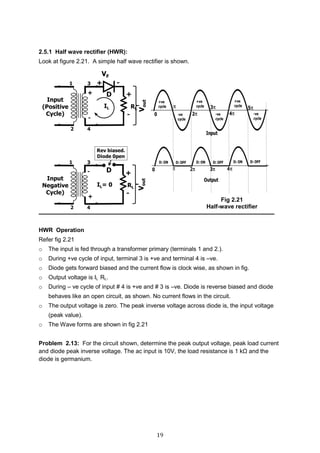
  • 86.
    79 4,2 DC Loadline and Bias point Problem 4.1: Draw a DC load line for the circuit shown in fig 4.2 for a VCC =10 V VCE = VCC – Voltage drop across RC = VCC – ICRC When VBE = 0 V, Transistor does not conduct. IC = 0 VCE = 10 V – (0 mA X 5 K ohm) = 10 V. Refer fig 4.3. Mark point X = 10 V on the X axis When VBE = 0.7 V Transistor conducts. VCE becomes zero 0 = 10 V – (IC X 5 K ohm). IC = 2 mA. Mark point Y = (0 V, 2 mA) on the Y axis. forward biased and CB junction is reverse biased. o For a transistor to operate as per design, external DC voltages (VCC Power supply) need to be applied. The voltages should be of the correct polarity and permissible magnitude for EB junction and CB junction. This is known as biasing o Emitter Base junction needs to be forward biased and Collector Base junction needs to be reverse biased. (0.7V for silicon or 0.3 V for gemanium need to be ensured) o The operating point of a transistor, has to be preferably at the center (VCE = VCC/2), for maximum voltage swing on either side. o The bias needs to be stabilised. The bias point should not vary due to temperature variations or β variations or input mains supply variations What are the basic biasing techniques? Three popular methods are used. They are, Base bias, Collector to Base bias and Voltage Divider bias. Fig 4.3 Fig 4.4
  • 87.
    80 Recall, any pointon the load line has the coordinates (VCE, IC). Join XY and this line is the DC load line for this circuit. If any one of these circuit parameters vary, a new load line is to be drawn. What is the Q point at Z in fig 4.3? IC= 0.8 mA and VCE = 6 V Problem 4.2: Draw the new DC load line for the circuit in fig 4.2, when RC = 2K VCE = VCC – IC X RC Case1 : VBE =0, BJT  Not conducting, IC = 0 VCE = 10 V – 0 mA X 2 K = 10 V Point A on load line will be (10 V, 0 mA) Case 2: VCE = 0 V 0V = 10V – IC X 2 K IC = 5 mA Point B on load line will be (0V, 5 mA) Draw AB…….This is the load line for THIS circuit. 4.2.1 Q point (quiescent point) of a transistor What is a Q point of a transistor? It is the DC Point of the transistor in a given circuit. It describes its operating point, in terms of (VCE, IC) coordinates. Ref fig 4.5 which is basically same as fig 4.4. Graph illustrates the relationship between the various Q points and how they are related to the important circuit parameters such as IB, IC and VCE The excel table (fig 4.6) tabulates five Q points (A, B, C, D, E) in the graph, in terms of these parameters. Q points analysis Q point IB (μA) VCE (V) IC (mA) A 0 10 0 B xx 0 5 C 10 8.8 0.7 D 20 6.0. 2.0. E 30 2.7 3.6 Fig 4.5 Fig 4.6
  • 88.
    81 4.2.2 What arethe inferences? 1. When base current varies between 10 μA and 30 μA, VCE varies between 2.7 V and 8.8 V. 2. At extreme points (A and B), the VCE Swings between Vcc and 0 V. 3. The best Q point should preferably be, therefore at VCC/2 4. The collector current varies between 5.0 mA (saturation) and 0 mA (cut-off). 5. Small variations in base current (10 μA to 30 μA) causes large variations in VCE (2.7 V to 8.8 V) 6. Small variations in base current (10 μA to 30 μA) causes large variations in collector current IC (0.7 mA to 3.6 mA). Transistor is a current amplifier 4.2.3 Q point – 2 conditions This figure 4.7 illustrates two extremes of the Q point variations and the end points of the DC load line. 4.3 Base Bias Problem 4.3: What is the Q point for this Germanium transistor in fig 4.8 ? Draw the DC load line. (β =100.) VBE = 0.3V (Germanium) (a) Find IB Apply KVL VCC – (IB X R2) – VBE = 0 10V – (IB X 470 K) - 0.3 V = 0 IB = 20.6 mA (b) Find Ic IC = β X IB = 20.6 mA X 100 = 2.1 mA (Q point: IC) (c) Find collector voltage Vc VCE = Vcc - (IC X R1) = 10 V - (2.1 mA X 2000 Ω) = 5.8 V (Q point : VCE) Therefore, Q point is ( 5.8 V , 2.1 mA ) Fig 4.7 Fig 4.8
  • 89.
    82 (d) How todraw load line? Point A : When Ic = 0, VCE = VCC = 10V, A = (10 , 0) Point B : when VCE = 0, IC = 𝐕𝐂𝐂 𝐑 𝟐 = 𝟏𝟎 𝐕 𝟐𝐊 = 5 mA, B = (0 , 5) Draw AB. The load line is shown in fig 4.9. Q point, as calculated = (5.8 V , 2.1 mA) Problem 4.4: What is the Q point of this circuit in fig 4.10 and what is the emitter current? Assume silicon transistor. VBE = 0.7 V (Si ) (a) Base current V1 – (IB X R1) – 0.7 V = 0 4V – (IB X 330 K) – 0.7 = 0 IB = 𝟑.𝟑 𝐕 𝟑𝟑𝟎 𝐊 = 10 μA b) Collector current ( IC ) I C = IB X β = 10 μA X 200 = 2 mA (c) VCE VCE = VCC – IC X R2 = 12 V –2 mA X 3300 Ω = 5.4 V Q point = (VCE , IC ) = ( 5.4 V, 2 mA) (d) Emitter current IE = IB + IC = 2 mA + 10 mA = 2.01 mA. Problem 4.5: Look at the pnp. Silicon transistor in fig 4.11. β=100. Find all the currents and value of R2, given the condition VEC = 𝐕𝐂𝐂 𝟐 (a) Find IB VEB = 0.7 V (Silicon) Fig 4.9 Fig 4.10 Fig 4.11
  • 90.
    83 VB = VCC– VEB = 10 V - 0.7 V = 9.3 V Voltage across R1 = 9.3 V – 2.5 V = 6.8 V IB = 𝟔.𝟖 𝐕 𝟔𝟖𝐊 = 100 μA (b) Find IC IC = IB X β =100 μA X 100 =10 mA. (c) Find R2 VCC = 10 V, VEC = 𝐕𝐂𝐂 𝟐 (given) = 𝟏𝟎 𝐕 𝟐 = 5 V VC (at collector) =10 V - 5 V = 5 V R2 = 𝐕𝐂 𝐈 𝐂 = 𝟓 𝐕 𝟏𝟎 𝐦𝐀 = 500 Ω d) Emitter current IE = IC + IB = 10 mA +100 μA = 10.1 mA 4.3.1 Effect of emitter resistor Look at this circuit. fig 4.12. There is no resistor in the collector but there is an emitter resistor RE. What is the dc load line (RL), for this circuit ? Let IE be the emitter current Applying KVL, VCC ─ VCE ─ IE RE =0 Load line for this circuit Point B : When VCE =O, IE = 𝐕𝐂𝐂 𝐑 𝐄 Point A : When IE =0, Vcc = VCE Look at this circuit fig 4.13. There are two resistors, RC and RE . What will be the dc load line (R L) for this circuit? For this circuit, the total dc load resistance = Rc + RE. We need to make an assumption that IC = IE (neglecting base current) Applying KVL , VCC ─ IC RC ─ VCE ─ Ic RE = 0 Load line for this circuit Point A : When IC =0, VCC = VCE Point B : When VCE =0, IC = 𝐕𝐂𝐂 𝐑 𝐂+𝐑 𝐄 Problem 4.6: Draw DC load line for this circuit in fig 4.14. What is the Q point ? Assume Germanium transistor, and assume β = 99. Find the Q point also. Fig 4.12 Fig 4.13 Fig 4.14
  • 91.
    84 Apply KVL tobase circuit VCC – (IB X RB) ─ VBE – (IE X RE) = 0 IE = IC +IB = (β.IB) +IB = IB (β+1) ( since IC = β.IB ) VCC – (I B X RB) ─ VBE ─ (β+1) IB.RE = 0 IB = 𝐕𝐂𝐂−𝐕 𝐁𝐄 𝐑 𝐁+ 𝐑 𝐄 (𝛃+𝟏) = 12−0.3 V 150K+(99+1) 1K = 11.7 V 250 K = 47 μA IC = β X IB = 47 μA X 99 = 4.6 mA (Q point) IE = IB + IC = 47 μA + 4.6 mA = 4.65 mA Apply KVL to collector circuit VCC ─ (IC X RC) ─ VCE ─ (IE X RE) = 0 12 V ─ (4.6 mA X 1K ) ─ VCE – (4.65 mA X 1K) = 0 VCE = 12 V ─ 4.6 V ─ 4.65 V = 2.75 V (Q Point) Q point = (2.75 V, 4.6 mA) Load line Point A : When Ic = 0, VCE = VCC = 12 V Point B: When VCE =0, IC = 𝐕𝐂𝐂 𝐑 𝐂+𝐑 𝐄 = 12 V 2K = 6 mA 4.3.2 Effect of β variations. Problem 4.7: Calculate two Q points for the base bias circuit shown in fig 4.15, when hFE = 50 and hFE = 100. Assume Silicon transistor. VBE = 0.7 V (Si). IB = 𝐕𝐂𝐂−𝐕 𝐁𝐄 𝐑 𝟏 = 𝟓−𝟎.𝟕 𝐕 𝟒𝟑𝟎 𝐊 = 10 μA hFE = 50 hFE = 100 IC = IB X hFE =10 μA X 50 = 0.5 mA IC = IB X hFE = 10 μA X 100 = 1 mA VCE = VCC – (IC X R1) = 5 V – 0.5 mA X 2K = 4 V VCE = VCC – (IC X R1) = 5 V – (1 mA X 2K) = 3 V Q Point = (4 V, 0.5 mA) Q point (3 V, 1 mA) 4.4 Collector to base bias (npn) The collector to base bias circuit is shown in fig 4.16. Fig 4.15
  • 92.
    85 From base side VCE= IB RB + VBE 4.4.1 IB = 𝐕𝐂𝐂−𝐕 𝐁𝐄 𝐑 𝐁 4.4.2 From collector side VCE = VCC ─ ( IC + IB ) RC 4.4.3 Self-stabilizing action Collector to base works in a self-correction mode and has good bias stability. o If Ic increases for some reason, drop across RC increases o Therefore VCE drops. o Because VCE drops, IB decreases. o Because IB decreases, IC decreases. Conclusion : If IC tends to increase, the loop prevents this Tendency Equating both 4.4.1 and 4.4.3, IB RB + VBE = VCC - (IC +IB ).RC Substituting IC = β IB  IB RB + VBE = VCC – [(βIB + IB).RC] IB RB + [ IB (β + 1) RC ] = VCC ─ VBE IB = 𝐕𝐂𝐂 ─ 𝐕 𝐁𝐄 𝐑 𝐁 + 𝐑 𝐂 ( 𝛃 + 𝟏 ) Problem 4.8: For the germanium transistor circuit in fig 4.17, with collector-to-base bias, determine IB, IC, IE, VCE and Q point. VBE = 0.3 V (Ger) IB = 𝐕𝐂𝐂 − 𝐕 𝐁𝐄 𝐑 𝐁 + 𝐑 𝐂( 𝛃 + 𝟏) = 𝟏𝟐− 𝟎.𝟑 𝐕 𝟐𝟐𝟎𝐊 +𝟐𝐊 (𝟖𝟎 + 𝟏 ) = 31 μA IC = βIB = 80 X 31 μA = 2.48 mA IE = IB + IC = 31 μA + 2.48 mA = 2.511 mA (how?) VCE = VCC - RC (IC + IB) = 12 V – 2K (2.48 mA + 31 mA) = 7.0 V. Q point = ( VCE, IC ) = ( 7.0 V, 228 mA ) Fig 4.16 Fig 4.17 Fig 4.18
  • 93.
    86 Collector to basebias (PNP) : C to B biasing of pnp is shown in fig 4.18. Reader may analyse the circuit. 4.5 Voltage divider biasing It is the most stable biasing technique. Look at the figure 4.19. Two resistors R1 and R2 are connected in the base circuit, as potential divider. The current and voltage relationships are in the figure 4.19. 1) VB = 𝐕𝐂𝐂 𝐗 𝐑𝟐 𝐑 𝟏+ 𝐑 𝟐 (5 - 7.1 ) 2) VE = VB - VBE (5 - 7.2) 3) IE = 𝐕𝐄 𝐑 𝐄 = 𝐕 𝐁 − 𝐕 𝐁𝐄 𝐑 𝐄 (5 - 7.3) Assume IE = IC (neglect IB) 5) VC = Vcc - IC RC (5 - 7.4) 4) IC = IE 6) VCE = VC - VE (5 - 7.5) 7) VCE = Vcc - IC ( RC + RE ) (5 - 7.6) Circuit analysis –voltage divider bias Let us analyse the circuit with a numerical example below. Problem 4.9: Approximate analysis Analyze this circuit. Neglect IB. Find VB, VC, VE, IB, IC, IE and VCE (silicon transistor). 1) VB = 𝐕𝐂𝐂 𝐗 𝐑𝟐 𝐑 𝟏+ 𝐑 𝟐 = 𝟏𝟓𝐕 𝐗 𝟒.𝟕𝐊 𝟏𝟎𝐊+𝟒.𝟕𝐊 = 4.8 V 2) VE = VB ─ VBE = 4.8 ─ 0.7 = 4.1 V 3) IE = 𝐕𝐄 𝐑 𝐄 = 𝟒.𝟏𝐕 𝟐,𝟕𝐊 = 1.5 mA Assume IE = IC (Neglect IB ) 4)IC = 1.5 mA 5) VC = Vcc ─ Ic Rc = 15 V ─ (1.5 mA X 3.3 K) = 10 V 6) VCE = VC ─ VE = 10 V ─ 4.1 V = 5.9 V Q point = ( 5.9 V, 1.5 mA ) 4.5.1 Thevenin Analysis  precise analysis How to determine a Thevenin’s equivalent circuit ? Assume hFE = β = 50 Problem 4.10: Analyze the same circuit precisely, (using Thevenin’s equivalent) VTh = 𝐕𝐂𝐂 𝐗 𝐑𝟐 𝐑 𝟏+ 𝐑 𝟐 = 𝟏𝟓𝐕 𝐗 𝟒.𝟕𝐊 𝟏𝟎𝐊 + 𝟒.𝟕𝐊 = 4.8 V RTh = R1 ll R2 = 𝐑𝟏 𝐗 𝐑𝟐 𝐑𝟏 + 𝐑𝟐 = 𝟏𝟎𝐊 𝐗 𝟒.𝟕𝐊 𝟏𝟎𝐊 + 𝟒.𝟕𝐊 = 3.2 K Look at the modified circuit in fig 4.20. Fig 4.19
  • 94.
    87 Following KVL, VTh =IB RTh + VBE + RE ( IB + IC ) IC = hFE X IB = β.IB (since hFE = β) VTh = IB RTh + VBE + RE IB ( 1 + β ) IB = 𝐕 𝐓𝐡− 𝐕 𝐁𝐄 𝐑 𝐓𝐡 + 𝐑 𝐄( 𝟏 + 𝛃 ) IB = 𝐕 𝐓𝐡 𝐑 𝐓𝐡 + 𝐑 𝐄 ( 𝛃 + 𝟏 ) = 𝟒.𝟖𝐕 − 𝟎.𝟕𝐕 𝟑.𝟐𝐊 + 𝟐.𝟕𝐊 ( 𝟏 + 𝟓𝟎 ) = 29 μA. IC = hFE X IB = 50 X 29 μA = 1.45 mA IE = IB + IC = 29 μA +1.45 mA = 1.479 mA VE = IERE = 1.479 mA X 2.7K = 4.0 V VC = Vcc – IcRc = 15V – ( 1.45 mA X 3.3 K ) = 10.215V VCE = VC - VE = 10.215 V - 4.0 V. = 6.215V Q point = ( 6.125 V , 1.45 mA ) Numerical example Problem 4.11: Draw a DC load line for problem 4.9. Point A: When IC =0, VCE = VCC = 15 V. Point B: When VCE = 0, IC = 𝐕𝐂𝐂 𝐑 𝐂+ 𝐑 𝐄 = 𝟏𝟓𝐕 𝟑𝐊𝟑+𝟐𝐊𝟕 = 2.5 mA. Draw a load line with A (15 V, 0 mA ) and B (0 V, 2.5 mA) Q point from problem 4.10 = ( VCE , IC ) = ( 6.215 V , 1.45 mA ) Load line is drawn as shown in fig 4.21 Fig 4.20
  • 95.
    88 4.6 Voltage divider,bias circuit for PNP transistor. The voltage divider using PnP transistor is shown in fig 4.22. Compare this with npn circuit. Note, in pnp the emitter and RE are normally drawn at the top, and the collector and RC are drawn at the bottom. Biasing resistors R1, and R2 are inverted. Fig 4.21 Fig 4.22 What is Alpha cut-off frequency fα ? Alpha cut-off frequency fα is the frequency at which the common base DC current gain α drops to 0.707 of its low frequency value. The common base DC current gain α = IC IE What is Beta cut-off frequency fβ ? Beta cut-off frequency fβ is the frequency at which the common emitter current gain β value drops to 0.707 of its low frequency value. The common emitter DC current gain β = IC IB 4.7 Transistor Hybrid Model (h parameters) What is the purpose of h parameter Hybrid model? h parameter modelling was used to predict the behaviour of a device in a particular operating region. The small-signal ac response can be described by the hybrid model. This h parameter model is no longer being used 4.7.1 Two port devices & Network Parameters:- A transistor can be treated as a two part network. The terminal behaviour of any two part network can be specified by the terminal voltages V1 & V2 at parts 1 & 2 respectively and current i1 and i2, entering parts 1 & 2, respectively, as shown in figure.
  • 96.
    89 4.7.2 Two portnetwork Of these four variables V1, V2, i1 and i2, two can be selected as independent variables and the remaining two can be expressed in terms of these independent variables. This leads to various two part parameters out of which we will look at H – Parameters (or) Hybrid parameters. Hybrid parameters (or) h – parameters:- If the input current i1 and output Voltage V2 are takes as independent variables, the input voltage V1 and output current i2 can be written as V1 = h11 i1 + h12 V2 i2 = h21 i1 + h22 V2 The four hybrid parameters h11, h12, h21 and h22 are defined as follows. h11 = [V1 / i1] with V2 = 0 = Input Impedance with output part short circuited (expressed in ohms) h22 = [i2 / V2] with i1 = 0 = Output admittance with input part open circuited. (expressed in mhos) h12 = [V1 / V2] with i1 = 0 = reverse voltage transfer ratio with input part open circuited. (No dimensions) h21 = [i2 / i1] with V2 = 0 = Forward current gain with output part short circuited. (No dimensions) Necessity of h parameter model Notations used in transistor circuits:- hie = h11e = Short circuit input impedance h0e = h22e = Open circuit output admittance hre = h12e = Open circuit reverse voltage transfer ratio hfe = h21e = Short circuit forward current Gain. 4.7.3 The Hybrid Model for Two-port Network:- V1 = h11 i1 + h12 V2 I2 = h1 i1 + h22 V2 Fig 4.23
  • 97.
    90 V1 = h1i1 + hr V2 I2 = hf i1 + h0 V2 The Hybrid Model for Two-port Network 4.7.4 Transistor h parameters analysis of a - RC Coupled amplifier Refer figure Defining the important parameters demonstrating the reason for the defined of any system. directions and polarities. The parameters of this Fig are 1. Input current Ii and output current Io 2. Zi is the impedance “looking into” the system 3. Zo is the impedance “looking back into” the system from the output side. 4. Both the input impedance and output impedance are defined as having positive values. Zi = Vi / Ii and Zo = Vo / Io A RC coupled amplifier and its equivalent are shown below. . Fig 4.24 Fig 4.25 Fig 4.26
  • 98.
    91 Reactance values ofcoupling capacitors C1 and C2 and by pass capacitor C3 will all be very low and can be replaced by shorts. The power supply points will have very low impedance for ac signals thanks to hefty filter capacitors The equivalent circuit is on the right hand side.diagram. Vs is the input signal generator with a source impedance Rs. From the diagram, the input impedance will be RB1 || RB2.. The resultant figure is shown below. The rectangle represents the small signal ac equivalent of the transistor. The hybrid model as we know for a common emitter configuration is hie input impedance (ohms) hre reverse voltage ratio (dimensionless) hfe forward current transfer ratio (dimensionless) hoe output admittance (Siemen) Note: Lower case suffixes indicate small signal values and the last suffix indicates the mode. Therefore hie is input impedance in common emitter hfb would be forward current transfer ration in common base mode, etc. The hybrid model for the BJT in common emitter mode is shown below: This hybrid model is accurate enough for small signals at mid band. Fig 4.27 Fig 4.28
  • 99.
    92 Two equations usingh parameters can be derived from the diagram, in terms of voltage vbe and output ic: vbe = hie ib + hre vce ic = hfe ib + hoe vce If ib is held constant (ib=0) then hre and hoe can be solved: hre = vbe / vce | ib = 0 hoe = ic / vce | ib = 0 Also if vce is held constant (vce=0) then hie and hfe can be solved: hie = vbe / ib | vce = 0 hfe = ic / ib | vce = 0 These are the four basic p parameters for a BJT in common emitter. Typical values are hre = 1 x10⁻⁴ , hoe = 20 mhos hie = 1k to 20k hfe = 50 - 750. The H-parameters can be found on the transistor datasheets. The table below lists the four h-parameters for the BJT in common base and common collector (emitter follower) mode. h-parameters of Bipolar Junction Transistor Common Base Common Emitter Common Collector Definitions Input Impedance with Output Short Circuit Reverse Voltage Ratio Input Open Circuit Forward Current Gain Output Short Circuit Output Admittance Input Open Circuit
  • 100.
    93 Example Consider a CommonEmitter RC coupled amplifier with RE Bypass capacitor. We will derive expressions for voltage gain, current gain, input and output impedance. Refer figure below The small signal parameter hreVce is too small and can be neglected. Therefore, the input resistance is just hie. Similarly, output resistance hoe is quite large and can be neglected. The simplified h-parameter equivalent is shown below: 4.7.5 Input Impedance Zi RBB will represent the parallel combination of Resistors RB1 and RB2. RBB = RB1 || RB2 =(RB1 RB2)/ (RB1 + RB2) Also RBB is in parallel with hie Therefore input impedance Zi = RBB || hie 4.7.6 Output Impedance Zo hfeIb is an ideal current generator with infinite output impedance, then output impedance looking into the circuit is: Zo = RC Voltage Gain Av Vo = -Io RC = - hfe Ib RC Fig 4.29 Fig 4.30
  • 101.
    94 But Ib =Vi / hie then: Therefore Vo = - −hfe hie Vi RC Av = vo vi = −hfe hie RC Current Gain Ai The current gain is the ratio Io / Ii. At the input the current is split between the parallel branch RBB and hie. So looking at the equivalent h-parameter model again (shown below): Limitations: The hybrid model always is for a specific set of operating conditions for accuracy. If any of the device parameters vary, then the h parameters need to be recalculated.. 4.8 High frequency hybrid Pi or Giacoletto model of BJT Introduction to High frequency hybrid Pi or Giacoletto model of BJT The low frequency small signal model of BJT is good enough up to 1 MHz. For frequencies greater than 1 MHz, the response of internal and parasitic capacitances needs to be taken into account. These capacitances do affect the performance of BJT at higher frequencies. The high frequency small signal model of transistor shown below takes into account the effects of internal and parasitic capacitance’s encountered in BJTs. This high frequency hybrid pi model is also called as Giacoletto model. What are the effects on BJT at high frequencies?  The internal feedback capacitances reduce the gain at high frequencies. High frequency Model of BJT  BJTs therefore will have a high frequency performance deficiency.  The capacitances will store charges and therefore limit the switching speeds of the BJTs and therefore high speed switching circuits will underperform.. Where gm = Transconductance B’ = internal reference point in base Rbb’ = Base spreading resistance Rb’e = Internal resistance between b’ and e Rb’c = Feedback resistance between b’ and c Rce = collector to emitter resistance Ce = emitter base junction diffusion capacitance Cc = transition or space charge capacitance of base collector junction. Fig 4.31
  • 102.
    95 4.8.1 Physical explanationof parameters of high frequency model of BJT Rbb’ : Base spreading resistance. It is the resistance of the semiconductor material between the external base terminal and the internal contact point inside the transistor which is inaccessible. Typically value: A few hundred ohms. Rb’e : Internal resistance between b’ and e.This represents increase in recombination base current (very less really) when emitter current increases. It shunts the collector circuit and reduces the collector current value from emitter current. Typically value: A few kilo ohms. Rb’c : Feedback resistance from B’ to C.internal base node to collector node. It simulates “early effect”. What is early effect? If reverse bias of collector junction is increased, collector current increases as a feedback response. This feedback effect is called “early effect” and this is represented by Rb’c. Rce : This is the bulk resistance of the semiconductor material between collector to emitter. Ce: Diffusion capacitance of emitter base junction. We know Ce = τF*IE/VT CC : Transition or space charge capacitance. gm  Trans conductance: the ratio of the change in current at the output terminal to the change in the voltage at the input terminal of an active device. In a BJT, gm = dIc dVbe 4.9 Common emitter RC coupled amplifier. The circuit diagram of a single stage common emitter RC coupled amplifier using transistor is shown in Fig Cin : This capacitor has two major roles. It blocks any DC (both ways) between this RC amplifier and the previous stage. It also couples the ac signal from the previous stage. The value must be fairly large (in microfarads) for low frequency response to improve. The choice of lower values for coupling capacitors result in poor performance in lower frequencies R1 and R2: These are the biasing resistors which sets the value of the base bias as per design requirement... For a transistor amplifier to function properly, it should operate in the active region. Larger values of R1 and R2 increases the input impedance, a highly desirable property. Cout: This capacitor also has two major roles. It blocks any DC (both ways) between this RC amplifier and the previous stage. It also couples the ac signal from the previous stage. Fig 4.32
  • 103.
    96 The value mustbe fairly large (in microfarads) for low frequency response to improve. The choice of lower values for coupling capacitors result in poor performance in lower frequencies. Rc : This is the collector resistor and Re is the emitter resistor. The Q point (operating point) of a transistor amplifier is determined based on the amplifier requirements and accordingly Rc and Re are selected. Selection of Rc and Re in general (a thumb rule really) will be such that 50% of Vcc gets dropped across the collector & emitter of the transistor and 10% of Vcc will be the emitter voltage.. This is done to ensure that the operating point is positioned at the center of the load line. 40% of Vcc is dropped across Rc and 10% of Vcc is dropped across Re. Ce : This is the emitter by-pass capacitor. At zero signal condition (i.e, no input) only the quiescent current (set by the biasing resistors R1 and R2 flows through the Re). Ce has no role in handling DC. When ac input signal is applied, Ce presents a low reactance across Re and increases the gain for ac signals. Ce acts as a bypass capacitor for ac signals. The choice of lower values for Ce affects low frequency performance of the amplifier. 4.9.2 Design of an RC coupled amplifier RC COUPLED AMPLIFIER - BJT AIM: Design an RC coupled single stage BJT amplifier and determine its gain and frequency response, input and output impedances. Given VCC = 12V, IC = 4mA, β = 100. Follow these general design rules Emitter bias (VRE) = Vcc/10, VCE= Vcc/2 How to find RE: The general design rule is (VRE) = Vcc / 10 Therefore VRE = VCC / 10 = 12 / 10 = 1.2V ------for biasing IE is approximately equal to IC = 4 mA (given) Fig 4.33
  • 104.
    97 From the thecircuit diagram, IERE = VRE RE = 1.2 / (4 x 10⁻³ ) = 300 ohms Therefore Choose RE = 330 ohms (commercially available value) How to find RC: Another general design rule is VCE = VCC / 2 = 6V ----- for Q point to be in active region Applying KVL to output loop VCC – ICRC – VCE – VRE = 0 12 – 4 x 10⁻³ RC – 6 – 1.2 = 0 Therefore RC = 1.2 kΩ How to find R1 & R2 ? From biasing circuit VB = VBE+ VRE = 0.7 + 1.2 VB = 1.9V Assume 10 IB flows through R1 and 9 IB flows through R2. We know IC = β IB 4 x 10-3 = 100 IB Therefore IB = 40 μA R1 = VCC – VB / 10 IB = 12 – 1.9 / (10 x 40 x 10-6 ) = 25.25 kΩ Therefore Choose R1 = 22 kΩ (commercially available value) R2 = VB / 9 IB = 1.9 / ( 9 x 40 x 10-6 ) = 5.28 kΩ Therefore Choose R2 = 4.7kΩ (commercially available value) How to find CE, CC, CB ? Let CB = CC = 0.1 μF Assume a very low frequency of f = 100 Hz. At this frequency, the impedance of the capacitor CE should be 10 times lower than the resistor value RE. XCE = RE/10 Therefore XCE should be = 330/10 at f = 100 Hz XCE = 33 Ω XCE = 1 / 2π f CE Therefore CE = 1 / 2π (100)(33) = 48 μF Choose CE = 47 μF. 4.9.3 What is the Q point of this design? To find Q point: VCE was kept at 6V by design. Ic was given as 4 mA. Therefore Q point for this design is Q(VCE, Ic) = (6V, 4mA) Procedure to measure input impedance Zi: 1) Connect the circuit as in figure below.
  • 105.
    98 2) Set thefollowing: DRB (Decade resistance Box) to zero. Feed a sine wave of amplitude of 40 mV at 1 KHz frequency. 3) Measure Vo(peak-peak) 4) Increase DRB till VO = Vo / 2 (peak-peak). The corresponding DRB value gives the input impedance Zi. Procedure to measure output impedance Zo 1) Connect the circuit as in figure below. 2) Set the following: DRB (Decade resistance Box) to zero. Feed a sine wave of amplitude of 40 mV at 1 KHz frequency. 3) Measure Vo(peak-peak). 4) Decrease DRB till Vo = Vo / 2(peak-peak). The corresponding DRB value gives the output impedance Zo. 4.9.4 Operation of multi stage RC Coupled Amplifier When an AC input signal is applied to the base of first transistor, it gets amplified and appears at the collector load RL of first amplifier. This is then passed through the coupling capacitor CC to the second stage. This becomes the input of the second stage, whose amplified output again appears across its collector load. Thus the signal is amplified in stage by stage action. Fig 4.35 Fig 4.34 Fig 4.36
  • 106.
    99 The important pointthat has to be noted here is that the total gain is less than the product of the gains of individual stages. Why? When a second stage follows the first stage, the effective load resistance (output impedance) of the first stage gets reduced Why? Due to the shunting effect of the input resistance (impedance) of the second stage. Phase: Remember. each amplifier inverts the phase once. Overall gain of multistage cascaded amplifiers The overall gain of a multistage amplifier is the product of the gains of the individual stages (ignoring potential loading effects): Gain (A) = A1* A2*A3 *A4 *... *An. A1, A2, A3 are gains of individual stages. 4.9.5 Frequency Response of RC Coupled Amplifier Frequency response curve is a graph that indicates the relationship between voltage gain at the output of an amplifier and as the signal frequency is varied from a very low value (say 50Hz) to a high value (say 1 MHz) The frequency response of a RC coupled amplifier is as shown in the following graph. Critical frequencies: Two critical frequencies -> f1, f2 These are known as - 3 dB points (corner frequencies, cutoff frequencies) At f1 and f2 the output voltage will fall down to 0.707 times that of midband values. Why - 3 dB? We know dB (voltage) = 20 log10 𝐕𝟏 𝐕𝟐 . If V1 V2 = 0.707 then the dB value 0 is 20 log10 (0.707) = 3dB 4.9.6 What is the bandwidth of an amplifier? The range of frequencies between ƒL and ƒH is called the circuits bandwidth. Frequency points ƒ1 and ƒ2 relate to the lower corner or cut-off frequency and the upper corner or cut-off frequency points respectively were the circuits gain (or voltage level) falls off to a specific value which is 0.707 of the value at mid band. Fig 4.37
  • 107.
    100 These points ona frequency response curve are known commonly as the -3dB (decibel) points. So the bandwidth is simply given as: Therefore Bandwidth BW = ƒ1 – ƒ2 Mid band frequencies: This mid band frequencies will be typically between 10 * f1 and 0.1 * f2. The mid band is where an amplifier should be operated. Example: Find the mid band of an amplifier with f1 = 5 Hz and f2 = 100 KHz. 10 * f1 = 10 * 5 Hz = 50 Hz -- > lower end 0.1 * f2 = 0.1 * 100 KHz = 10 KHz -- > upper end Midband: 50 Hz - 10 KHz From the above graph, it is understood that the frequency rolls off or decreases for the frequencies below 50Hz and for the frequencies above 20 KHz. whereas the voltage gain for the range of frequencies between 50Hz and 20 KHz is constant. Figure shows the typical frequency response of an amplifier. At low frequencies the output voltage decreases because of coupling and bypass capacitors. At high frequencies, the output voltage decreases because of transistor and stray wiring capacitance What is Alpha cut-off frequency of a transistor? Alpha cut-off frequency fα is the frequency at which the common base DC current gain α drops to 0.707 of its low frequency value. The common base DC current gain α = 𝑰 𝑪 𝑰 𝑬 What is Beta cut-off frequency of a transistor? Beta cut-off frequency fβ is the frequency at which the common emitter current gain β value drops to 0.707 of its low frequency value. The common emitter DC current gain β = 𝑰 𝑪 𝑰 𝑩 Advantages of RC Coupled Amplifier The following are the advantages of RC coupled amplifier.  The frequency response of RC amplifier provides constant gain over a wide frequency range, hence most suitable for audio applications.  The circuit is simple and has lower cost because it employs resistors and capacitors which are cheap.  It becomes more compact with the upgrading technology. Disadvantages of RC Coupled Amplifier The following are the disadvantages of RC coupled amplifier.  The voltage and power gain are low because of the effective load resistance.  They become noisy with age.  Due to poor impedance matching, power transfer will be low. Applications of RC Coupled Amplifier The following are the applications of RC coupled amplifier.  They have excellent audio fidelity over a wide range of frequency.  Widely used as Voltage amplifiers  Due to poor impedance matching, RC coupling is rarely used in the final stages.
  • 108.
    101 4.10 Gain Bandwidthproduct of amplifiers In Amplifiers, the gain gets reduced (drops off) at higher as well as lower frequencies. In other words, bandwidth gets reduced. Therefore to make the amplifier useful at higher frequencies, gain is sacrificed for bandwidth. Gain Bandwidth product of a given device (say transistor) is constant. High gain would mean lower bandwidth and vice versa. In general wide band amplifiers will have lower gain and narrow band amplifies can have high gains The gain bandwidth product (GBW) is given by GBW = ANBW Example: A transistor RC coupled amplifier, with a gain of 10K has a bandwidth of 200 Hz. What is the GBW? GBW = 10K X 200 Hz = 2 MHz Overall Bandwidth of a n stage cascaded amplifier As more number of amplifiers are cascaded,  The overall bandwidth of the cascaded chain gets reduced, It follows the GBW concept. Or  Gain of the chain increases and therefore bandwidth of the chain gets reduced BWT - Bandwidth of the total cascaded amplifiers. BWS - Bandwidth of a single amplifier The total bandwidth of a cascaded chain of amplifiers is given by the formula BWT = BWS √(2 1 n − 1) n Number of amplifiers in the chain Example: What is the total bandwidth of a 3 amplifier cascade chain if GBW = 10MHz and Gain of individual amplifier is 10 BWS = 10 MHz/ 10 = 1 MHz BWT = 1 MHz (√(2 1 4 − 1) = 1 MHz X 0.435 = 0.435 MHz Note: In this example, even though the individual amplifiers have a bandwidth of 1 MHz, the overall bandwidth of the chain comes down to 0.435 MHz. 4.11 Noise Figure: Noise figure (NF) and Noise Factor (F) are measures of degradation of the signal-to-noise ratio (SNR), caused by components in a signal chain (say amplifier chain). NF is just a number. This Noise Figure indicates the performance (merit) of an amplifier or a radio receiver. Ideal Noise Figure value is 1.Lower noise figure values indicate better performance. Noise figure is expressed in dB, always It is the ratio of signal to noise ratio at the output of an amplifier to the signal to noise ratio at the input of an amplifier expressed in dB. More accurately, it can be an amplifier or a receiver or can be any electronis system really.
  • 109.
    102 Noise factor (F): It is the ratio of signal to noise ratio at the output to the signal to noise ratio at the input expressed in number The noise figure is simply the noise factor expressed in decibels where F= noise figure as power ratio (also known as noise factor) Si = input signal power Ni = input noise power So = output signal power No = output noise power NF = 10 log(F) Field effect transistor (FET) 4.12 Field effect transistor (FET)  FET is a voltage operated device (BJT is a current operated device)  FET requires (virtually) no input current but requires input voltage  Therefore the input resistance of a FET is extremely high, a desirable property. This implies that FET circuits do not load the source or the previous stage.  There are two major categories of FETs viz Junction FETs (JFET) and Metal Oxide Semiconductor FETs (MOSFET).  FETs can be n channel or p channel devices. N- channel JFET  Refer figure4.38 below.  They represent a block diagram cross section of a n channel FET.  A n type semiconductor (CHANNEL) is sandwiched between two p type materials (GATES).  One end of the channel is called drain and the other end is called the source. Figure 9-1  Therefore there are three terminals to a FET viz Source, Drain and a Gate  In a n channel JFET, current flows from drain, through the channel towards source. It is called the drain current ID Fig 4.38
  • 110.
    103 4.13 Basic principleof operation of n Chennel JFET (nJFET): The three figures indicate the FET action completely Fig A: There is no voltage at the Gate. It is open. Current flows from Drain (positive) towards the Source (Negative), through the n-channel. The p type gates have no effect on the current flow. Fig B: The gate has a small reverse bias. From diode theory, we know, a reverse biased junction will have a depletion region which penetrates into the lightly doped region. We also know, this phenomenon is due to electric field at the reverse biased gate junction. In this case, the depletion layer penetrates into the n channel as shown in the figure. There is a constriction now and this resists the current flow through the n channel. The drain to source current decreases than the previous case. Fig C: The reverse bias is further increased. The depletion layers penetrate farther into the channel. The gates are on either side of the channel and the depletion layers touch each other and totally block the current in the n channel. The drain to source current becomes steady and saturated. (pinched). The gate voltage at which the blockage happens, is called a pinch off voltage. FET ac operation: If an ac signal is now applied at the gate, the instantaneous voltage at the gate will go positive and negative alternately. When the bias becomes negative, the depletion layer penetration is deep and the drain current becomes less. When the bias becomes positive, the depletion layer penetration is shallow and the drain current becomes more. The gate is normally maintained at a slight reverse bias (slightly negative voltage for nJFET so that the gate current is very low. Why the name Field Effect Transistor? Depletion regions are produced by the electric field at the reverse biased junction. In FETs, currents are controlled by depletion layer penetration into the channel and this happens due the effect of electric fields. Hence the name Field Effect Transistor. The figure 4.38a shows the circuit symbols. The arrow for a n channel Junction FET (nJFET) is from p type gate to n type channel as shown. Both symbols are used in practice Fig 4.38 a
  • 111.
    104 p Channel JFET(pJFET) A p channel JFET is shown in fig 4.39.. Note channel is p type and gates are n type. The supply voltage at Drain is negative with respect to Source. The current flow is from Source to Drain in pJFET ( in nJFETS,the current flow is from Drain to Source). A positive voltage at the gate of a pJFET increases reverse bias, increases depletion penetration and reduces drain current. A negative voltage at the gate of a pJFET decreases reverse bias, decreases depletion penetration and increases drain current. 4.14 How depletion region behaves in a FET? In a nFET we know current flows from drain to source. If we take three points A, B and C in the channel, the voltage at A will be high compared to B and C. Voltage at C will be lowest . Therefore the reverse bias between Gate and A will be high, between Gate and B will be medium and between Gate and C will be least. Therefore the depletion region penetration will be maximum at A and minimum at C. Fig 4.40 Fig 4.39
  • 112.
    105 The figure 4.40shows this skewed depletion region. Drain Characteristics Like the output characteristics of BJT, we can plot output characteristics (Drain Characteristics) of JFET also. Refer fig 4.41 Let us keep V GS = 0 As VDS is an increased nJFET exhibits Three distinct regions (Figure 4.42) a) Ohmic region: As VDS is increased gradually from OV, the current increases linearly. This implies that FET acts like a resistor. As VDS increases, the depletion region approaches pinch off and FET deviates sharply from its ohmic behaviour. b) Pinch off region: When VDS approaches 4.5V (in our example) (Point A in figure 4.41) has a reverse bias equal to pinch off voltage. The depletion layers from both Gates touch each other beyond this. An an equilibrium (saturation) is reached and ID does not increase even if VDS is increased. This saturation current is known as IDSS. The drain-source voltage, where the saturation begins is pinch-off voltage (4.5V, in this example). Fig 4.41 Fig 4.42
  • 113.
    106 c) Break downregion: If the VDS increased further, at a particular voltage, the reverse biased gate- channel junction breaks down. When this happens ID rises without control and the device may get destroyed. What is the difference between pinch-off voltage and VGS(off)? Pinch off voltage (Vp): Pinch off voltage is the drain to source voltage after which the drain to source current becomes almost constant and JFET enters into saturation region and is defined only when gate to source voltage is zero. VGS(off) voltage: It is the Cut-off Voltage of a FET. This is the voltage necessary to turn the FET off. JFETs and MOSFETs are normally on with a drain current between drain and source. However, a specific voltage VGS(off) should be applied to the gate-source region to will turn the FET off, so that no current flows from drain to source. 4.15 Drain Characteristics with Bias (Fig 4.43)  Keep VGS at -1V. Increase VDS gradually from 0V to 14V and measure ID and plot the curve.  Repeat the same exercise for different VGS values and plot a family of curves.  As VGS = -1V, there is already a fixed reverse bias of 1V. Therefore the pinch-off will occurs 1V earlier at 3.5V (when VGS = 0, pinch-off = 4.5V). At VGS = -2V, there is already a fixed reverse bias of 2V. Therefore the pinch-off will occurs 2V earlier at 2.5V . Transfer Characteristics For an nJFET, transfer characteristics is plot of ID versus VGS. Refer fig.4.44. We know gate-source voltage controls ID. Fig 4.43 Fig 4.44
  • 114.
    107 A circuit forplotting the characteristics is shown. The characteristics extend from ID= IDSS at VGS =0 to ID= 0 at VGS = -VGS (off). How to choose a FET? Begin by choosing an appropriate type number (n channel or p channel) understand the maximum rating on VGS (Drain to Source voltage), Gate Current, (IG ) drain-gate voltage (VDG) and reverse Gate-Source voltage (VGS(r)), make sure your operating condition never exceed these. How do you relate these parameters? Example: For an nJFET 2N5457, maximum VDS=25V. We need to operate the gate at VGS =-3V. What can be maximum VDS permissible? VDS= VDG(max) - VGS = 25-3 = 22V How do we find maximum drain current (ID(max))? Find the maximum power dissipation from the data sheet and divide it by maximum VDS permissible. Why do we have gate current IG specified? In a reverse bias situation of the gate, there will be negligible gate current (IG) flow. However in situations where gate is forward biased, IG will flow and it should be ensured that IG is kept below the maximum value specified. What is the saturation current in a FET? We learnt that the drain source saturation current (I DSS) is the maximum current that flows through a FET when VGS =0V (Refer fig 4.42). IDSS is listed in the data sheet. In practice IDSS is specified for VGS value. For example, for the FET IN5457 VGS can vary between -0.5V and -6V and the corresponding IDSS varies between 1mA and 5mA. The FET equation for ID in terms of IDSS is 𝐈 𝐃 = 𝐈 𝐃𝐒𝐒 (𝟏 − 𝐕 𝐆𝐒 𝐕 𝐆𝐒(𝐨𝐟𝐟) ) 𝟐 VGS(off) is the cut-off voltage Example; Find the drain current ID when VGS = 0.5VGS(off) and IDSS = 8mA ID = IDSS (1 − VGS VGS(off) ) 2 = 8mA (1 − 0.5)2 = 8mA (0.5)2 = 2mA 4.16 Forward transfer admittance (Transconductance) It is denoted by γfs Transconductance is an important and popular specification. γfs = Variation in ID Variation in VGS (when VDS is constant) γfs units will be in micro siemens (𝜇𝑆) or micro mhos microamps/volt (𝜇𝐴/𝑉) or millisiemens (mS) or millimhos or milliamps/volt(mA/V)
  • 115.
    108 If γfs =5mA/V, it means that the drain current (ID) varies by 5mA when input VGS changes by 1 volt We know ID = IDSS (1 − VGS VGS(off) ) 2 γfs = ∆ID ∆VGS = 2IDSS VGS(off) (1 − VGS VGS(off) ) Example : Given VGS(off) = - 8V and IDSS = 10 mA. Find out transconductance at VGS = -2V and VGS = -5V for a JFET. γfs = 2IDSS VGS(off) (1 − VGS VGS(off) ) = 2×10 8 (1 − (−5𝑉) (−8𝑉) ) = 2.5 × 3 8 = 0.925 𝜇𝑆 Output admittance (𝛄 𝐨𝐬) γos = ∆ID ∆VDS |VGS = Variation in ID Variation in VDS when VGS is constant 4.17 FET amplifier A JFET amplifier is shown in fig 4.45 Drain is connected to the +ve supply and source is grounded (-ve terminal of the supply). Gate source is reverse biased by a -ve power supply. An ac voltage source is connected in series. We know FET is a voltage driven device. As seen earlier, a change in gate source voltage (∆VGS) causes a change in drain current. As the drain current changes, the drop across 𝑅1 changes correspondingly. Let 𝑉𝐷𝐷 = 10V, R = 2kΩ Let VGS be biased such that ID = 1.5mA Let γfs = 5000𝜇S. The signal varies by ±40𝑚𝑉 The voltage at drain terminal 𝑉𝐷 = 𝑉𝐷𝐷 - ID 𝑅1 = 10V – 1.5mA × 2𝑘 = 7V The variation in drain current at +40mV :∆ID=γfs X Vi Fig 4.45
  • 116.
    109 =5000µs X 40mv =0.2mA ⸫VoltageVD at drain = 𝑉𝐷𝐷 - R1(ID +∆ID) = 10v-2K(1.5mA+0.2mA) = 10v-3.4v = 6.6v ∆VD = 7.0v-6.6v = 0.4v Variation in drain current at -40mv :∆ID=-0.2mA ⸫Voltage VD at drain = 𝑉𝐷𝐷 - R1(ID −∆ID) = 10v-2K(1.5mA-0.2mA) = 10v-2.6v = 7.4v ∆VD = 7.0v-7.4v = -0.4v Output variation V0 = ±0.4v Input variation = ±40mv ⸫Gain of the amplifier= AV = 𝑉𝑜 𝑉𝑖 = 0.4𝑣 40𝑚𝑣 =10 4.18 FET Switch An FET switch is shown in figure 4,46. It looks similar to a BJT switch. When the input voltage is zero, FET is on drain current flows. The drain voltage VDS will be at ground potential. FET in this conduction state has a drain-source on resistance [rDS(on)]. This is very much lower than the saturation resistance of BJT. When input goes negative, FET is sufficiently reverse biased so that FET is off and no drain current flows.VDS=VDD in this state. You can see when input is ZERO, output is ONE and when input is ONE, output is ZERO. It is an inverter and a switch. BJT and FETs have switch on time and off time. These constitute, rise time, fall time and storage time, popularly termed as propagation delay. Longer the propagation delay, slower is the device. Which is faster? BJT or FET? FETs are faster switching devices than BJT since they do not have forward biased junctions and therefore do not have diffusion capacitance. Fig 4.46
  • 117.
    110 4.19 MOSFETS What isa MOSFET? Metal oxide semiconductor FET (MOSFET) Where it is used? Widely used in amplifiers and switching circuits What are the differences between MOSFET and BJT? BJT MOSFET 3 terminal devices Emitter, base, Collector 3 or 4 terminal devices Source, drain, gate, body Current controlled devices Voltage controlled devices 4.20 Enhancement MOSFET MOSFET is also is known as insulated gate FET. It consists of a p type substrate which is highly resistive on which 2 blocks of n type substrate are diffused. Refer Fig 4.47. These n type substrates are highly doped. The surface is a layer of Silicon-di-oxide. Now holes are cut through the SiO2 layer to access the n- type material. Metal is deposited through the holes, on both n-type material and designated as drain and source. A metal deposited on the surface area between drain and source and is designated as Gate.  Drain of a MOSFET is positive.  The two n-blocks and the p block form two p-n junctions, back to back.  The drain junction is reverse biased. Negligible current flows through it.  In fig 4,48, source is connected to substrate. Fig 4.47 Fig 4.48
  • 118.
    111  Apply a+ve gate voltage now.  The negative (Minority) charge carriers (electrons in this case), are attracted towards the positive plate which is the gate.  These electrons cannot cross SiO2 layer hence accumulate close to the surface of the substrate as shown in figure 4.48b.  You can now see a n channel between drain and source.  If a gate-source voltage is made more positive, this channel accumulates more electrons. The channel resistance reduces and current starts flowing between drain and source.  In other words, drain-source current ID proportional to VGS.  The conductivity of the channel is ENHANCED by the positive gate voltage.  So, this device is known as enhancement MOSFET or EMOS transistor. MOSFET-Drain and Transfer Characteristics Refer fig 4.49. The drain characteristics for n channel EMOS is shown. o As positive VGS increases ID increases o There is no gate source leakage current in MOSFET-why? o By construction, Gate is insulated from the channel, thanks to SiO2 layer. Therefore MOSFETs have an extremely high input resistance (1015 ohms really !). o Like JFET, MOSFETs a transfer admittance (trans-conductance) ranging from 1ms(1mA/v) to 6ms(6mA/v) Fig shows the graphic symbols of an n channel MOSFET, one with source and substrate connected together and another one separated. Note: Device channel is broken into 3 sections. Why? A channel does not exist until and unless a gate voltage is applied. Note: The gate does not make contact with the channel. Why? Because gate and channel are insulated by SiO2 layer. Fig 4.49 Fig 4.50
  • 119.
    112 P channel MOSFET Constructionis similar to N-MOSFET. Refer Fig 4.51 Description also is similar except that all voltages and polarities and current flows are to be reversed. Drain to source voltage is negative Gate –source voltage is negative. 4.21 D MOSFET –Depletion-Enhancement MOSFET (Fig 4.52). It is similar to n channel EMOS seen already . The n type channel is lightly doped in this device. When a +VE VDS is applied, a drain current ID flows even if VGS = 0 Some of the negative charge carriers are repelled away from the gate and move away from the “n to n” region, as shown in the figure. This creates a depletion region in the channel (n to n region) and ID decreases. This phenomenon is similar to what happens in JFET. Hence this can be called depletion mode JFET. Now apply a +ve VGS . N type charge carriers do get attracted from the p substrate and accumulate in the channel (n to n region).This enhances conductivity and increases ID . Therefore depletion mode FET can also multiplex as enhancement FET. Hence this device is called depletion enhancement MOSFET or DEMOSFET or DMOSFET. Fig 4.51 Fig 4.52
  • 120.
    113 Comparison of nand p channel FETs n Channel FETs have lower resistivity and hence lower RD resistance. For a given RD, p Channel FETs are more expensive. MOSFET Handling They are low current devices and can be easily destroyed by Electro-Static Discharge (ESD). A person walking across a carpet can generate 20000 Volts as a static electricity, believe it or not! If that person handles a MOSFET, there may be an electrostatic discharge of such voltages from the person to the device which can potentially damage a MOSFET. Hence, ESD (anti-static) precautions are needed while handling MOSFET devices. 1. MOSFETs should be stored in conductive containers which do not allow charge accumulation. 2. Wear anti-static globes or grounded-wrist-bands while handling MOSFET. 3. Tools such as soldering irons must have grounded tips. 4. Operator chairs must be grounded. 5. Working area should have grounded conductive carpets or conductive flooring. 4.22 VMOS FET What is VMOS FET? V shaped MOSFET. Construction VMOSFET creates vertical channels where as MOSFETS create horizontal channels. Vertical channels allow construction of small channel length, lower resistance devices with higher power handling capacities, better frequency response and high values of trans-conductance. Refer Fig 4.53  There is a V-CUT which expands from n+, p, n- layers, all the way up to n+ substrate.  SiO2 layer covers the horizontal layers and vertical grooves.  Gate is a metallic thin plate deposited on SiO2 layer, in the V groove.  Drain is the bottom most n + substrate.  Source is the top n + region and p + region. Fig 4.53
  • 121.
    114 Operation V MOSFET workson enhancement mode. In the absence of positive VGS, no ID current flows. When VGS is positive, negative charge carriers (electrons) get attracted to the positive plate which is the gate. These electrons cannot cross the SiO2 layer and hence accumulate, along the V groove, as shown in Figure. Current flows vertically, from drain to source and hence the name VMOSFET. 4.23 FET Biasing Like BJTs, FETs have biasing technologies. FETs also can be analysed using DC load lines and Q- points. How to draw a load line for the circuit shown in Fig 4.55? DC load lines are drawn on output characteristics (like BJT) or drain characteristics. In the figure 4.55, gate is biased to a voltage -VG through a resistor RG. DC load lines will be drawn on graph of ID and VDS. In Fig 4.56 From the circuit we known VDS = VDD – ID R1 Case.1 When ID = 0, VDS = VDD – IDR1 = 22V – 0 = 22V Point A coordinates on Fig. 4.56 ID = 0, VDD = 22mA Fig 4.54 Fig 4.55
  • 122.
    115 Case 2 When VDS= 0, 0 = VDD – IDR1 = 22V – 2.2k ID ID = 10mA Point B Coordinates are ID = 10mA, VDD = 0 The DC load line AB is shown in Fig. 4.56, for R1 = 2.2KΩ. Q-Point: What is a Q-point? It is the operating point of a FET when there is no ac signal. The coordinates are ID and VDS. When an AC signal is applied, VDS varies and therefore IDS also varies. Refer Fig. 4.57. In FET, VDS must always remain in pinch off region. VDS should never be allowed to fall below the Gate-Source cutoff voltage VGS(off), to avoid going into the ohmic region. Therefore, as a precaution, VDS should always be 1V more than VGS(off).. A safe design should ensure a cushion. 𝐕 𝐃𝐒(𝐦𝐢𝐧) = 𝐕 𝐆𝐒(𝐨𝐟𝐟) + 𝟏𝐕 Also, from the figure note the actual cut-off voltage keeps shifting depending on the gate bias voltage. In the figure When VGS = 0 VGS(Off) = 4.5V VDS(min)= 5.5V Fig 4.56 Fig 4.57
  • 123.
    116 VGS = -2VVGS(Off) = 2.5V Therefore VDS(min)= VGS(Off) – VGS +1 Example: For the circuit shown in Fig. 4.58, find the maximum permissible output voltage swing for Q points at VDS = 10V and at VDS = 16V. Case.1: Assumption VG = 0; For a Q-point at VDS = 10V, ΔVS in the upper side = 22V – 10V = 12V ΔVS in the lower side = 10V – 5.5V = 4.5V The positive swing possible is 12V. Whereas the negative swing possible is 5.5V. The maximum undistorted swing possible is ±5.5V. Case.2: For a Q-Point at VDS = 16V. The upper swing possible = 22V – 16V = 6 The lower swing possible = 16V – 4.5V = 11.5V The maximum undistorted swing possible is ±6V only. Source Resistance Figures 4.59 shows resisters in the source and source+drain respectively. VDS = VDD – IDR1 VDS = VDD – ID (R1+ R2) Fig 4.58 Fig 4.59
  • 124.
    117 4.24 Gate Bias FETscan be configured to operate with a gate bias as shown in Fig. 4.60. Gate is returned to a bias of -2.0V through a resistor R2. The drain resistance R1 (4K) is connected to a +20V supply. Example.3: For the circuit in Fig. 4.60, what are the ID(max), ID(min), VDS(max) and VDS(min)? VGS = -2V Draw a vertical line at VG = -2V, on the transfer function characteristics in Fig. 4.60. It intercepts, the ID(max) curve at 4.0 mA and ID(min) curve at 0.5mA. Therefore, ID(max) = 4 mA ID(max) = 0.5 mA VDS(min) = VDD – ID(max)R1 = 25 – (4 mA × 4k) = 9V VDS(max) = VDD – ID(min)R1 = 25 – (0.5 mA × 4k) = 23V Note: Gate bias technique has a limited usage. If a FET is replaced by different FET type all the above values will change. Gate bias – p-channel JFET Circuit configurations are shown using -VDD and +VDD Analysis is similar to nJFET. Fig 4.60 Fig 4.61 Fig 4.62
  • 125.
    118 4.25 FET selfbias : Fig 4.63 shows an nJFET self bias circuit 𝑅1 is a drain resistor from Drain connected to +𝑉𝐷𝐷 𝑅2 is a gate bias resistor connected between gate and ground 𝑅3 is a source resistor connected between source and ground The voltage drop across source resistor 𝑅3 is 𝑉𝑆= 𝐼 𝐷 𝑅3 If 𝐼 𝐷= 0.5mA and 𝑅3 = 2k, then 𝑉𝑆 = 1V What is the 𝑽 𝑮𝑺 bias like ? Voltage at source is +1V Voltage at gate is 0V ( Why? Because there is negligible gate current through the gate resistor 𝑅2 ) ∴ 𝑉𝐺𝑆 is reverse biased to an extent of 1V. 𝑉𝐺𝑆 = -1V Or 𝑉𝐺𝑆 = -𝑉𝑆 = -𝐼 𝐷 𝑅3 Feedback effect : This biasing arrangement is an excellent feedback network. If 𝐼 𝐷 tends to increase, 𝑉𝑆 increases. Because 𝑉𝑆 increase, the reverse bias 𝑉𝐺𝑆 (= -𝑉𝑆) increases and opposes the tendency of 𝐼 𝐷 to increase. Self bias analysis : Transfer characteristics help us in analysis of a self-bias JFET circuit Bias lines are drawn in the case of self bias too. But they are not vertical lines as in the case of gate bias. Fig 4.63 Fig 4.64
  • 126.
    119 We know 𝑉𝐺𝑆= -𝐼 𝐷 𝑅3 Let us assume 𝑅3 = 2K. and 𝑉𝐺𝑆 = -4V ∴ 𝐼 𝐷 = 2mA Let us plot point B with coordinates (-4,2) When 𝐼 𝐷 = 0, 𝑉𝐺𝑠= 0. Origin A will be the other point Join AB which is the bias line for 𝑅3 = 2K. Similarly for another value of R3 = 1K, 𝑉𝐺𝑠 = -4, 𝐼 𝐷 = 4mA and we can plot C as (-4,4) Let us find 𝐼 𝐷𝑚𝑎𝑥 , 𝐼 𝐷𝑚𝑖𝑛, 𝑉𝐷𝑆(𝑚𝑎𝑥) and 𝑉𝐷𝑆(𝑚𝑖𝑛) for 𝑅3 = 2k in our example. Line AB which is a bias line for 𝑅3 = 2k cuts the “minimum and maximum” transfer characteristics at 𝐼 𝐷𝑚𝑎𝑥 = 1.8mA and 𝐼 𝐷𝑚𝑖𝑛 at 0.9mA We know 𝑉𝐷𝐷 = 𝐼 𝐷 𝑅1 + 𝑉𝐷𝑆 + 𝐼 𝐷 𝑅3 20V = 1.8mA × 3k + 𝑉𝐷𝑆 + 1.8mA × 2k 𝑉𝐷𝑆𝑚𝑖𝑛 = 20 - 5.4 - 3.6 = 11V 𝑉𝐷𝑆𝑚𝑎𝑥 = 20V - 0.9mA × 3k - 0.9mA × 2k = 20V - 4.5V = 15.5V Similarly, the values of 𝐼 𝐷𝑚𝑎𝑥 , 𝐼 𝐷𝑚𝑖𝑛, 𝑉𝐷𝑆(𝑚𝑎𝑥) and 𝑉𝐷𝑆(𝑚𝑖𝑛) for R3 = 1K can also be found out. Self-bias for p-channel JFET : Refer fig 4.65 Note: Gate is returned to +𝑉𝐷𝐷 through R2 Source is returned to +𝑉𝐷𝐷 through R3 Drain is returned to GND through R1 Find 𝐼 𝐷𝑚𝑎𝑥 and 𝐼 𝐷𝑚𝑖𝑛 of the circuit in Fig 4.65 with R1+ 3K and R2=1M and R3 =1K. This is left to the reader. The analysis is exactly similar to that of nJFET, otherwise. 4.26 Voltage divider bias-JFET We had seen in self bias analysis, increasing RS brings ID(max) and ID(min) closer together. Not only that the absolute values of ID also get lowered. Fig 4.65
  • 127.
    120 Figure 4.66 showsa voltage divider bias circuit. It is similar to that of BJT except that there is no specific base-emitter junction in FET with a drop of 0.7V Gate bias VG is determined by R1,R2 junction. Source voltage VS is determined by R3 and ID. VGS=VG-VS Voltage Divider analysis A FET circuit is shown in fig. 4.67. Let us analyse its operation using the transfer characteristics. Let us find out ID(max), ID(min), VD(max) and VD(min) VG= VDD 𝑋 𝑅2 R2+R4 = 20V 𝑋 1𝑀 1M+4M =4V Case 1: When ID=0, VGS=VG-IDR3 =4V Plot A at ID=0 and VGS=4V Case-2: When VGS=0, ID = VG R3 = 4V 2K =2mA Plot B with ID=2mA and VGS=0v Draw the line AB which is the bias line for R3=2K It intersects the transfer characteristics at ID(max)=3.0mA, ID(min)=1.9mA We know VDS(min)= VDD- IDD(max)(R1+R3) Fig 4.66 Fig 4.67
  • 128.
    121 = 20V-3.0mA(3K+2K) = 5V VDS(max)=VDD- IDD(min)(R1+R3) = 20v-1.9mA(3K+2K) = 11.5V Voltage divider bias for p-channel FET Refer Fig 4.68 Gate is returned to +VDD through R4 Source is returned to +VSS (GND) through R3 Drain is returned to +VDD through R1 The voltage divider resistors are R2 and R4. The analysis is similar to n JFET otherwise. Fig 4.68
  • 129.
    122 Chapter 5 OperationalAmplifier (Op-Amp) What is an integrated circuit (IC)? IC is an electronic circuit formed on a small piece of semiconducting material, normally silicon, which performs the same function as a larger circuit made from discrete components. The integration of large numbers of tiny transistors into a small chip results in circuits that are orders of magnitude smaller, cheaper, and faster than those constructed of discrete electronic components 5.1 Introduction to operational amplifiers What is an Operational Amplifier? o Op-amp is the most important analog component. It has two inputs terminals and one output. o It is an amplifier with high gain and high input impedance (usually with external feedback), used especially in circuits for performing mathematical operations on an input voltage. o The input terminals are called non- inverting (+) and inverting (─). o It is a high gain direct coupled (dc) amplifier. o The operational amplifier works on a dual supply (V+ and V-). There will be a common ground. o The op-amp has a huge gain A (of the order of 10000). o An Operational Amplifier, or op-amp for short, is fundamentally a voltage amplifying device designed to be used with external feedback components such as resistors and capacitors between its output and input terminals. o The magnitude of difference between non –inverting and inverting voltage is called differential input Vd o Output of op amp = Vout = A X Vd = A.( Vnon-inv ─ Vinv ) What is the circuit symbol? Refer Fig 5.1 for circuit symbol. Abbreviations: We shall use the following abbreviations in this chapter.
  • 130.
    123 Operational amplifier op-amp Inverting  inv Non- Inverting  non-inv What is a differential amplifier? What is an inverting amplifier? What is a non-inverting amplifier? In the Non-Inverting amplifier, the output waveform is in the same phase with respect to the input. There is no inversion. Refer fig 5.4 Op amp terminals and Packages Popular Op amp: 741 , 747 is a dual 741 Op amp Power supply connections In Inverting amplifier, the output waveform is inverted with respect to the input. (Opposite phase). Refer fig 5.3. o Note that in inverting amplifier configuration, the non-inverting (+) input is grounded. o Output Vo = ─ Av Vin o Av – Gain of the op amp. Fig 5.1(a) Fig 5.2 Fig 5.2 (a)
  • 131.
    124 The µA741 op-ampis a general-purpose op-amp with a BJT input stage. It is capable of producing output voltages of ±14V with DC power supply voltages of ±15V. The parameters are Ri = 2MΩ, Ro= 75Ω, Ao= 2×10⁵ , Break frequency fb = 10Hz, and unity-gain bandwidth fbw = 1MHz. In reality what do you get in Op amps? What is the differential input concept? Refer fig 5.4 (a) and 5.5. The op-amp always amplifies the difference between the inv and non-inv inputs. Vd is the difference between the voltages present at inv and non-inv terminals. Fig 5.4 (a)
  • 132.
    125 Vd = V2– V1 (Differential voltage) Output will be Vd X Gain of the op-amp (A). Vo = Vd X A. For an ideal op-amp gain A = ∞.  Vd = V2 – V1 = 𝐕 𝐎 𝐀 = 𝐕 𝐎 ∞ = 𝟎  There are two interesting conclusions here. 1. For an op-amp, the differential voltage = 0 2. For an op-amp, Inverting and Non-Inverting terminals will be at the same potential. They follow each other What is the virtual ground in an op-amp? Differential Amplifier What is a differential amplifier? A differential amplifier is a circuit that can accept two input signals and amplify the difference between these two input signals A simple differential amplifier with two inputs marked V1 and V2 is shown. TR1 and TR2 are identical transistors and they are both biased at the same operating point with their emitters connected together and returned to the common –ve power supply, -VEE through resistor RE. The circuit operates from a dual supply +Vcc and -VEE. The output voltage Vout is the difference between the two input signals as the two base inputs are in anti-phase with each other.So as the forward bias of transistor, TR1 is increased, the forward bias of transistor TR2 is reduced and vice versa. Why? This is applicable to inverting amplifiers. Virtual ground means that if V2 is grounded, V1 also will be at ground potential (0 V). Therefore notionally, V1 also is grounded even if there is no physical connection to ground. V1 is said to be virtually grounded. Fig 5.6
  • 133.
    126 If signal V1at TR1 base voltage is increased, the junction of TR1 emitter, TR2 emitter and resistor RE also rises (simply follows V1). If V2 is at a a constant potential, the bias voltage across TR2 base emitter decrease. Then if the two transistors are perfectly matched, the current flowing through the common emitter resistor, RE will remain constant Common Mode of Operation : Assume V1 and V2 are exactly identical, Assume the characteristics of both the transistors are also identical. Therefore the collector voltages of each transistor will be at the same value. The output voltage signal Vout, is taken between the two collectors and therefore Vout will be zero. The common mode gain of the amplifier is the output gain when the input is zero. Fig.5.7 a shows the block diagram of an ordinary amplifier. The input voltage v is amplified to Av where A is the voltage gain of the amplifier. Therefore, the ouput voltage is v0 = Av. Fig. 5.7 b shows the block diagram of a differential amplifier. There are two input voltages v1 and v2. This amplifier amplifies the difference between the two input voltages. Therefore, the output voltage is v0 = A(v1 – v2) where A is the voltage gain of the amplifier. Example 1. A differential amplifier has an open-circuit voltage gain of 200. The input signals are 3.5 V and 3.4 V. Determine the output voltage. Output voltage, v0 = A(v1 – v2), Here, A = 200 ; v1 = 3.5 V : v2 = 3.4V ∴ v0 = 200(3.5 – 3.4) = 20V Basic Circuit of Differential Amplifier Fig 5.8 Fig 5.7 (a) Fig 5.7 (b)
  • 134.
    127 Fig. 5.8 showsthe basic circuit of a differential amplifier. It consists of two transistors Q1 and Q2 that have identical characteristics. VCC and VEE are the positive and negative supplies. Differential amplifier is a symmetrical circuit. Note, The differential amplifier (DA) is a two-input terminal device and a two output terminals (vout 1 and vout 2). Resistors RC1 and RC) are also equal. Input methods: (a) Single-ended input : The signal can be applied to just one input and the other input is grounded. (b) Dual-ended or double-ended input: The signals are applied to both inputs of DA. Output methods: (a) Single-ended output: Output is taken from one of the output terminals and the other output is grounded. (b) Double-ended output: Output is taken between the two output terminals (i.e., between the collectors of Q1 and Q2). In general, the differential amplifier is operated for single-ended output. Operation of Differential Amplifier Assume the signal is applied to input 1 (i.e., base of transistor Q1) and input 2 (i.e., base of transistor Q2) is grounded as shown in Fig, The input signal at transistor Q1 will appear at output 1(collector of Q1) as amplified and inverted. The input signal at transistor Q1, also appears on the emitter of Q1 in phase with the input and slightly attenuated. Fig 5.9
  • 135.
    128 The emitters ofQ1 and Q2 are common and therefore, the emitter signal becomes input to Q2. You can see, Q2 functions as a *common base amplifier. Therefore, the signal on the emitter of Q2 will be amplified and appears on output 2 (collector of Q2) in phase with the emitter signal and hence in phase with the input signal (signal at input 1). This is illustrated in Fig 5.9. Alternatively if the signal is applied to input 2, the roles of Q1 and Q2 are reversed. Q2 acts as a common emitter amplifier while Q1 functions as a common base amplifier. This is shown in the figure 5.10 below. What is happening here? When signal is applied to input 1 and input 2 is grounded, an inverted signal appears at output 1 and non-inverted signal appears at output 2. When signal is applied to input 2 and input 1 is grounded, an inverted signal appears at output 2 and non-inverted signal appears at output 1. This is shown in figure 5.11 below Fig 5.10 Fig 5.11
  • 136.
    129 When signal appliedto the input of DA produces no phase shift in the output, it is called noninverting input [See Fig].  In other words, for noninverting input, the output signal is in phase with the input signal. The noninverting input is then represented by +*sign.  When the signal applied to the input of DA produces 180° phase shift, it is called inverting input [See Fig].  In other words, for inverting input, the output signal is 180° out of phase with the input signal.It is often identified with –sign. Note that in Fig.5.11, the noninverting input terminal is given the +ve sign while the inverting input terminal is given the –ve sign. It may be noted that terms noninverting input and inverting input are meaningful when only one output terminal of DA is available. Common-mode and Differential-mode Signals In a differential amplifier, the outputs are proportional to the difference between the two input signals. Thus the circuit can be used to amplify the difference between the two input signals or amplify only one input signal simply by grounding the other input. The input signals to a DA can be of two types. (i) Common-mode signals (ii) Differential-mode signals (i) Common-mode signals : When the input signals to a DA are in phase and exactly equal in amplitude, they are called common-mode signals as shown in Fig 5.12. The common-mode signals are rejected (not amplified) by the differential amplifier. It is because a differential amplifier amplifies the difference between the two signals (v1 – v2) and for common- mode signals, this difference is zero. Note that for common-mode operations, v1 = v2. (ii) Differential-mode signals. When the input signals to a DA are 180° out of phase and exactly equal in amplitude, they are called differential-mode signals as shown in Fig 5.12. The differential-mode signals are amplified by the differential amplifier. It is because the Fig 5.12
  • 137.
    130 difference in thesignals is twice the value of each signal. For differential-mode signals, v1 = –v2. Thus we arrive at a very important conclusion that a differential amplifier will amplify the differential-mode signals while it will reject the common-mode signals. 6. Voltage Gains of DA The voltage gain of a DA operating in differential mode is called differential-mode voltage gain and is denoted by ADM. The voltage gain of DA operating in common-mode is called common-mode voltage gain and is denoted by ACM. Ideally, a DA provides infinite voltage gain for differential-mode signals and zero gain for common-mode signals. But, in practice, it does not happen. At best differential voltage gain will be very high of the order of several thousands and common-mode gain will be very small, usually much less than 1 but not zero. The op amp will have a high figure of merit if the ratio of differential gain to. the common-mode gain is very high. 7 Common-mode Rejection Ratio (CMRR) A differential amplifier should have high differential voltage gain (ADM) and very low common-mode voltage gain (ACM). The ratio ADM/ACM is called common-mode rejection ratio (CMRR) CMRR = ADM ACM Very often, the CMRR is expressed in decibels (dB). The decibel measure for CMRR is given by; CMRRdB = 20log10 ADM ACM = 20 log10CMRR The following table shows the relation between the two measurements : CMRR CMRRdB 10 20dB 103 60dB 105 100dB 107 140dB Importance of CMRR. The CMRR is the ability of a DA to reject the common-mode signals. The larger the CMRR, the better the DA is at eliminating common-mode signals. Let us illustrate this point. Suppose the differential amplifier in Fig has a differential voltage gain of 1500 (i.e., ADM = 1500) and a common-mode gain of 0.01 (i.e., ACM = 0.01).
  • 138.
    131 CMRR = 1500/0.01= 150,000 Why high CMRR? Common-mode signals are usually undesired signals caused by external interference. For example, any RF signals or noise picked up by the DA inputs would be considered undesirable. The CMRR indicates the DA’s ability to reject such unwanted signals. Example 2. A certain differential amplifier has a differential voltage gain of 1000 and a common mode gain of 0.1.What is CMRR and express it in dB. Solution. CMRR = ADM/ ACM = 1000/ 0.1 = 10,000 CMRRdB = 20 log10 10,000 = 80dB Example 3. A differential amplifier has an output of 2V with a differential input of 10 mV and an output of 2,5 mV with a common-mode input of 10 mV. Find the CMRR in dB. Solution. Differential gain, ADM = 2V/10 mV = 200 Common-mode gain, ACM = 2.5 mV/10 mV =0.25 ∴ CMRRdB = 20 log10 (200/0.25) = 49 dB Example 4. A differential amplifier with a CMRR of 80 dB.has a voltage gain of 200. The input signals are 150 mV and 200 mV with 1 mV of noise on each input. Find (i) the output signal (ii) the noise on the output. Solution. (i) Output signal, vout = ADM(v1 – v2) = 200 (200 mV –150 mV) = 10 V (ii) CMRRdB = 20 log10 (200/ACM) or 80 = 20 log10 (200/ACM) ∴ ACM = 20 × 10–3 Noise on output = ACM × 1 mV = 20 × 10–3 × 1mV = 20 × 10–6 V 5.2 Inverting Amplifiers Derive an expression for gain of an inverting amplifier (Fig 5.13). o Input is fed to the Inverting (─) terminal. o Non-inv (+) is grounded. o Therefore, Inv input = 0 V (Virtual ground). o The op-amp input terminals never draw any input current. o Therefore, the entire input current I1 flows into the feedback circuit as IF. Therefore I1 = IF 𝐕𝐈𝐍 − 𝟎 𝐑 𝟏 = 𝟎 − 𝐕 𝐎 𝐑 𝐅  𝐕𝐈𝐍 𝐑 𝟏 = − 𝐕 𝐎 𝐑 𝐅 Therefore, 𝐕 𝐎 𝐕𝐈𝐍 = − 𝐑 𝐅 𝐑 𝟏
  • 139.
    132 What are theimportant aspects to be understood, in op amp circuits ? Note 1: If non- inverting input is grounded, inverting input also will be at ground potential. This concept is called virtual ground (Inv input will be at ground potential without any physical connection to ground). Note 2: If inverting input is at a potential V1, the non – inverting input also be at V1. (“Non-inv” will follow “inv”). Note 3: From both (1) and (2), it can be inferred, that inverting and non – inverting inputs follow each other. The difference between “inv” and “non-inv” inputs is called differential voltage and is denoted by Vd. (Vd = V+ - V-) Vd in an op-amp is always zero. Note 4: The current drawn by the inverting input terminal or the non- inverting input terminal is zero. Therefore, in op amp analysis current drawn by V+ pin or V─ pin can be neglected. Problem 1: For the op-amp in fig 5.14, the input is a sinewave of I Volt, I kHz. What is the output? For non-inverting amplifier, Vout = ─ Vin 𝐑 𝟐 𝐑 𝟏 In this problem, frequency does not matter. Vin = I Volt. [ I V is rms ( by default ) ] Vin = I V rms = 1 V X √2 = 1.4 V peak.(just one peak) = ± 1.4 V peak (both peaks ) Vout = ± 1.4 V X 𝟏𝟎𝟎𝐊 𝟔.𝟖𝐊 = ± 11.8 V peak . Positive peak is 11.8 V and negative peak is - 11.8 V This is not possible since the op amp has a DC supply of +9 V and –9 V. Therefore the peaks will clip at the power supply voltages. The input / output waveforms are shown in fig 5.15 Problem 2: What is the input current and load current for this op-amp shown in fig 5.16? The inv input terminal is at 0 V (virtual ground ). Input current = 2 V − 0 V 1K = 2 mA Vout = ─ Vin R2 R1 = ─ 2 X 10K 2K = ─ 10V
  • 140.
    133 Load current =IL Vout RL = − 10 V 4.7K = ─ 2.5 mA IL is – ve. current flows from ground thro RL , into the op amp, as shown in the circuit diagram 516. The waveform is shown in fig 5.15. Problem 3: What is VO for the op-amp in fig 5.17? This is an inverting amplifier. Therefore 𝐕 𝐎 𝐕𝐈𝐍 = − 𝐑 𝐅 𝐑 𝟏 Gain = ─ 𝐕 𝐎 𝐕𝐈𝐍 = − 𝟏𝟎𝟎𝐊 𝟏𝟎 𝐊 = ─ 10  Vo = ─ 10 X 0.6 V = ─ 6 V 5.3 Non-inverting amplifier Derive an expression for gain of a non-inverting (+) amplifier. Therefore I1 = IF 𝐕 𝟎−𝐕 𝟏 𝐑 𝐅 = 𝐕 𝟏−𝟎 𝐑 𝟏 𝐕 𝐎 𝐑 𝐅 = 𝐕𝟏 𝐑 𝟏 + 𝐕𝟏 𝐑 𝐅 VO = V1 { 𝐑 𝐅 𝐑 𝟏 + 𝟏 } = V1 {1+ 𝐑 𝐅 𝐑 𝟏 } Therefore, Gain = 𝐕 𝐎 𝐕 𝟏 = {𝟏 + 𝐑 𝐅 𝐑 𝟏 } Problem 4: For the circuit in fig 5.19, Vo = ? Gain = ? This is a non-inverting amplifier. Gain = 𝐕 𝐎 𝐕 𝟏 = {𝟏 + 𝐑 𝐅 𝐑 𝟏 } = (1 + 50 K 2 K ) = 26 Vo = Vin {𝟏 + 𝐑 𝐅 𝐑 𝟏 } o Refer fig 5.18. o Note that the feedback is always between the Vo and Inv terminal. o Input is now fed at non-inv (+) terminal. o R1 is grounded. o Note that Inv terminal (─) also is at V1. (Both inv and non inv terminals will be at the same potential and follow each other) o No current flows into inv (─) terminal. o Therefore, the entire current IF flows into the input resistor as I1
  • 141.
    134 = 16 X26 =416 mV Problem 5: For the circuit in fig 5.20, what is VO? What is the load current? First, determine the voltage at B. Note the voltage at B IS NOT 2.2 V but a potential division of 1K and 1.2 K. VB = 𝟐.𝟐 𝐕 𝐗 𝟏 𝐊 𝟏𝐊+𝟏.𝟐 𝐊 = 1.0 V VO = VB (1 + 𝐑 𝐅 𝐑 𝐢𝐧 ) = 1.0 V (1 + 𝟐𝟐 𝐊 𝟐.𝟐 𝐊 ) = 1.0 V X 11 = +11 V. (Non-Inverting) Problem 6: In the circuit shown in fig 5.21, Vout = ? Vgain =? Vout = Vin (1+ Rf Rin ) What is Vin? Note Vin is NOT 5 V . It will be the actual voltage Vin at the non-inverting (+) terminal, after a potential division by R1 and R2. Vin = 5 V 𝐑𝟐 𝐑𝟏+𝐑𝟐 = 5 V X 𝟑𝟑𝐊 𝟑𝟑𝐊 + 𝟒𝟕𝐊 = 2.1 V Vout = Vin (1 + 𝐑 𝐟 𝐑 𝐢𝐧 ) = 2.1 V (1 + 𝟏𝟎𝟎𝐊 𝟐𝟐𝐊 ) = 11.65 V Vgain = 𝐕 𝐨𝐮𝐭 𝐕𝐢𝐧 = 𝟏𝟏.𝟔𝟓𝐕 𝟓𝐕 = 2.33 5.4 Summing Amplifiers Non inverting summing amplifier (Refer fig 5.22) It is a non-inverting amplifier . Therefore Vout = V3 (1 + 𝐑 𝐟 𝐑 𝐢𝐧 ) How to find V3 ? At the non-inv terminal, I1 flows through R1 and I2 flows through R2, but the input current Iin to the non- inverting (+) terminal = 0 I1 +I2 = 0  𝐕 𝟏−𝐕 𝟑 𝐑 𝟏 + 𝐕 𝟐−𝐕 𝟑 𝐑 𝟐 = 0 𝐕 𝟏 𝐑 𝟏 + 𝐕 𝟐 𝐑 𝟐 = 𝐕 𝟑 𝐑 𝟏 + 𝐕 𝟑 𝐑 𝟐 = V3 ( 𝟏 𝐑 𝟏 + 𝟏` 𝐑 𝟐 ) 𝐕 𝟏 𝐑 𝟐 + 𝐕 𝟐 𝐑 𝟏 𝐑 𝟏 𝐑 𝟐 = V3 ( 𝐑 𝟐 + 𝐑 𝟏 𝐑 𝟏 𝐑 𝟐 ) or V3 = 𝐕 𝟏 𝐑 𝟐 + 𝐕 𝟐 𝐑 𝟏 𝐑 𝟏+ 𝐑 𝟐 Vout = V3 (1 + 𝐑 𝐟 𝐑 𝐢𝐧 ) [non–inv op amp ] = ( 𝐕 𝟏 𝐑 𝟐 + 𝐕 𝟐 𝐑 𝟏 𝐑 𝟏+ 𝐑 𝟐 ) (1 + 𝐑 𝐟 𝐑 𝐢𝐧 ) Case 1: Let R1 = R2, then Vout = 𝟏 𝟐 ( V1 + V2 ) ( 1 + 𝐑 𝐟 𝐑 𝐢𝐧 ) Fig 5.20 Fig 5.21 Non- Inv Amplifier Fig 5.22 Non- Inv Amplifier
  • 142.
    135 Case 2: Alsolet Rf = Rin then Vout = ( V1 + V2 ) [ This is a SUMMING AMPLIFIER ] Derive an expression for an inverting, summing amplifier. Refer fig 5.23. VB = 0  VA = 0 I1 + I2 = I I1 = 𝐕 𝟏 − 𝐕 𝐀 𝐑 𝟏 = 𝐕 𝟏 𝐑 𝟏 ( since VA = 0) I2 = 𝐕 𝟐 − 𝐕 𝐀 𝐑 𝟐 = 𝐕 𝟐 𝐑 𝟐 ( since VA = 0) I = 𝐕 𝐀 − 𝐕 𝐎 𝐑 𝐅 = − 𝐕 𝐎 𝐑 𝐅 I1 + I2 = I 𝐕 𝟏 𝐑 𝟏 + 𝐕 𝟐 𝐑 𝟐 = − 𝐕 𝐎 𝐑 𝐅  VO = - { ( 𝐑 𝐅 𝐑 𝟏 ) V1 + ( 𝐑 𝐅 𝐑 𝟐 ) V2 } Case 1: R1 = R2 = R VO = ─ 𝐑 𝐅 𝐑 (V1 + V2) (Summing amplifier) Case 2: R1 = R2 = RF = R VO = ─ (V1 + V2) (Summing amplifier) Case 3: R1 = R2 = R and RF = (R/2) Vo = ─ (𝐕 𝟏+𝐕 𝟐) 𝟐 . (Averaging amplifier.) Problem 7: Refer circuit shown in fig 5.24. What is the output? VO = RF ( 𝐕 𝟏 𝐑 𝟏 + 𝐕 𝟐 𝐑 𝟐 + 𝐕 𝟑 𝐑 𝟑 ) = 12K ( −𝟐 𝐕 𝟐𝐊 + 𝟏.𝟓 𝐕 𝟑𝐊 − 𝟎.𝟓 𝐕 𝟒𝐊 ) = ─ 12 V + 6 V – 1.5 V. VO = ─ 7.5 V Summing circuit ( adder ) using super position Problem 8 : What is the output of this circuit if V1 = 2 V, V2 = 3 V and V3 = 5 V Refer fig 5.25. This can be analysed by using super position theorem. Superposition principle : When one voltage source is connected all other voltage source should be replaced by short. (in this example, to be replaced by ground) . Fig 5.23 Summing Amplifier Fig 5.24 Fig 5.25
  • 143.
    136 a) V1 isconnected (Refer fig 5.26) b) V2 is connected (Refer fig 5.27) c) V3 is connected (Refer fig 5.28) the final voltage at adder o/p V4 =3.9 + 3.8 +3.9 = 11.6V The output at V5 = - V4 X 15K 10K = -11.6 X1.5 = -17.4 V 5.5 Subtractor Derive an expression for a subtractor. Subtractor is also called (Difference Amplifier) At negative terminal, V1 − V′ R1 = V′ − VO R2 𝐕 𝐎 𝐑 𝟐 = 𝐕′ 𝐑 𝟐 + 𝐕′ 𝐑 𝟏 ─ 𝐕 𝟏 𝐑 𝟏 = V’ ( 𝟏 𝐑 𝟐 + 𝟏 𝐑 𝟏 ) ─ 𝐕 𝟏 𝐑 𝟏  (A) V’ = V’’ = 𝐕 𝟐 𝐑 𝟐 𝐑 𝟏+ 𝐑 𝟐 Substitute for V’ in (A) 𝐕 𝐎 𝐑 𝟐 = 𝐕 𝟐 𝐑 𝟐 𝐑 𝟏+ 𝐑 𝟐 ( 𝐑 𝟏+ 𝐑 𝟐 𝐑 𝟏 𝐑 𝟐 ) ─ 𝐕 𝟏 𝐑 𝟏 𝐕 𝐎 𝐑 𝟐 = 𝐕 𝟐 𝐑 𝟏 − 𝐕 𝟏 𝐑 𝟏 = 𝟏 𝐑 𝟏 ( 𝐕𝟐 − 𝐕𝟏) VB = 𝐕 𝟏 𝐗 𝟏.𝟗𝐊 𝟐𝐊+𝟏.𝟗𝐊 = 𝟐𝐕 𝐗 𝟏.𝟗𝐊 𝟑.𝟗𝐊 = 0.97 V Vout = VB (1 + 𝐑 𝐟 𝐑 𝐢𝐧 ) = 0.97 (1 + 𝟔𝐊 𝟐𝐊 ) = 3.9 V VB = 𝐕 𝟐 𝐗 𝟏.𝟒𝐊 𝟑𝐊+𝟏.𝟒𝐊 = 𝟑𝐕 𝐗 𝟏.𝟒𝐊 𝟒.𝟒𝐊 = 0.95 V Vout = VB (1+ 𝐑 𝐟 𝐑 𝐢𝐧 ) = 0.95 (1 + 𝟔𝐊 𝟐𝐊 )= 3.8 V VB = 𝐕 𝟑 𝐗 𝟏.𝟐𝐊 𝟓𝐊+𝟏.𝟐𝐊 = 𝟓𝑽 𝑿 𝟏.𝟐𝑲 𝟔.𝟐𝑲 = 0.97 V Vout = VB (1+ 𝐑 𝐟 𝐑 𝐢𝐧 ) = 0.97 (1 + 𝟔𝐊 𝟐𝐊 )= 3.9 V Fig 5.26 Fig 5.27 Fig 5.28 Fig 5.29
  • 144.
    137 𝐕 𝐎 = 𝐑𝟐 𝐑 𝟏 (𝐕𝟐 − 𝐕𝟏) If R2 = R1, VO = (V2 – V1) This is a subtractor. Problem 9: Implement this. VO = V1 ─ 3V2 ─ 2V4 + 5V3. Assume RF = 30 K. Implementation: Refer fig 5.30. Regroup all +ve terms all –ve terms.. VO = (V1 + 5 V3) – (3V2 + 2V4) Problem 10: This is known as Scaling order. Design a scaling order to give an output VO = ─ (6V1 ─ 4V2 +3V3). Choose RF = 120 K. Refer fig 5.31. Implementation: 5.6 Op-amp applications 5.6.1 Voltage Follower application: (Refer fig 5.32) Voltage Gain = Unity VB = Vin VA = VB = Vin VO = VA = VB = Vin  VO = Vin Output follows Input. Fig 5.30 Fig 5.31 Fig 5.32
  • 145.
    138 Hence the name“Voltage Follower” Voltage Gain = Unity Large Input impedance Low output impedance 5.6.2 Current to Voltage Converter application – Trans-resistance Amplifier: (Refer fig 5.33) Iin = If Iin = 𝟎−𝐕 𝐎 𝐑 𝐅 = − 𝐕 𝐎 𝐑 𝐅  Iin is proportional to ─ Vo Input Current is proportional to ─VO Hence Current to Voltage Converter. 5.6.3 Voltage to current Converter – (Trans-conductance Amplifier) : (Refer fig 5.34) IS = IL 𝐕𝐒 − 𝟎 𝐑 𝐒 = 𝟎 − 𝐕 𝐎 𝐑 𝐋 𝐕𝐒 𝐑 𝐒 = 𝐈 𝐋  VS is proportional to IL Hence Voltage to Current converter. 5.6.4 Op-Amp Integrator Refer Fig 5.35. Principle : I = C 𝐝𝐯 𝐝𝐭 Input side output side I = 𝐕𝐒−𝟎 𝐑 𝐒 I = C 𝐝 (𝟎 − 𝐕 𝐨) 𝐝𝐭 = ─ C 𝐝𝐕 𝐨 𝐝𝐭 𝐕𝐒 𝐑 𝐒 = ─ C 𝐝𝐕 𝐨 𝐝𝐭 Integrate on both sides ∫ 𝐕𝐬 𝐑 𝐬 𝐝𝐭 𝐭 𝟎 = ─ C ∫ 𝐝𝐕 𝐨 𝐝𝐭 𝐝𝐭 𝐭 𝟎  𝟏 𝐑 𝐬 ∫ 𝐕𝐬 𝐝𝐭 𝐭 𝟎 = ─ C Vo Vo = −𝟏 𝐑 𝐒 𝐂 ∫ 𝐕𝐒 𝐝𝐭 𝐭 𝟎 + initial conditions RsC is known as time constant Voutput is the integration of the input INPUT OUT PUT SIN ▬ COS Square wave Triangular wave Applications: o In analog computers, solving differential Equations o Signal wave shaping circuits Fig 5.33 Fig 5.34 Fig 5.35
  • 146.
    139 5.6.5 Op-Amp Differentiator:Refer 5.36 Input side output side I = C 𝐝𝐕𝐒 𝐝𝐭 I = 𝟎−𝐕 𝐨 𝐑 𝐟 C dVS dt = − 𝐕 𝐨 𝐑 𝐟 Vo = -Rf C 𝐝𝐕𝐒 𝐝𝐭 Therefore Voutput is the differentiation of the input Applications: FM demodulators Signal wave shaping circuits Problem 11: A sine wave of peak value 6 mv and 2 KHz frequency is applied to an op-amp integrator. R1= 100K, Cf = 1uF. What is the output voltage? Solution: For integrator Vo = Vo = −𝟏 𝐑 𝟏 𝐂 𝐟 ∫ 𝐕𝐢𝐧 𝐝𝐭 𝐭 𝟎 where R1 = 100K , Cf = 1uf , Vin = Vm Sin(ωt), Vm = 6 mV , ω = 2πf = 2π (2000) Vo = −1 100K∗1uf ∫ 6mv ∗ Sin(2π(2000)t) dt t 0 Vo= - 0.06 [- 𝐜𝐨𝐬(𝟒𝟎𝟎𝟎𝛑𝐭) 𝟒𝛑∗𝟏𝟎𝟎𝟎 ] t 0 Vo = 4.77( cos ( 4000π t ) – 1 ) u volts Instrumentation Amplifier What are the Requirements of a Good Instrumentation Amplifier? An instrumentation amplifier is used to amplify very low level low-level signals, rejecting noise and interference signals. Examples can be heartbeats, blood pressure, temperature, earth quakes and so on Therefore, the essential characteristics of a good instrumentation amplifier are as follows.  Inputs to the instrumentation amplifiers will have very low signal energy. Therefore the instrumentation amplifier should have high gain and should be accurate.  The gain should be easily adjustable using a single control.  It must have High Input Impedance and Low Output Impedance to prevent loading.  The Instrumentation amplifier should have High CMRR since the transducer output will usually contain common mode signals such as noise, when transmitted over long wires.  It must also have a High Slew Rate to handle sharp rise times of events and provide maximum undistorted output voltage swing INPUT OUT PUT COS - SIN Triangular wave Square wave Fig 5.36
  • 147.
    140 Instrumentation amplifier How doesit work? The op-amps 1 & 2 are non-inverting amplifiers and op-amp 3 is a difference amplifier. These three op-amps together, form an instrumentation amplifier. Instrumentation amplifier’s final output Vout is the amplified difference of the input signals applied to the input terminals of op-amp 3. Let the outputs of op-amp 1 and op-amp 2 be Vo1 and Vo2 respectively. Then, Vout = (R3/R2)(Vo1-Vo2) Look at the input stage of the instrumentation amplifier as shown in the figure below. The potential at node A is the input voltage V1. Hence the potential at node B is also V1, from the virtual short concept. Thus, the potential at node G is also V1. The potential at node D is the input voltage V2. Hence the potential at node C is also V2, from the virtual short. Thus, the potential at node H is also V2. Ideally the current to the input stage op-amps is zero. Therefore the current I through the resistors R1, Rgain and R1 remains the same. Applying Ohm’s law between the nodes E and F, Fig 5.37 Fig 5.38
  • 148.
    141 I = (Vo1-Vo2)/(R1+Rgain+R1)——————— 1 I = (Vo1-Vo2)/(2R1+Rgain) Since no current is flowing to the input of the op-amps 1 & 2, the current I between the nodes G and H can be given as, I = (VG-VH) / Rgain = (V1-V2) / Rgain ————————- 2 Equating equations 1 and 2, (Vo1-Vo2)/(2R1+Rgain) = (V1-V2)/Rgain (Vo1-Vo2) = (2R1+Rgain)(V1-V2)/Rgain —————— 3 The output of the difference amplifier is given as, Vout = (R3/R2) (Vo1-Vo2) Therefore, (Vo1 – Vo2) = (R2/R3)Vout Substituting (Vo1 – Vo2) value in the equation 3, we get (R2/R3)Vout = (2R1+Rgain)(V1-V2)/Rgain i.e. Vout = (R3/R2){(2R1+Rgain)/Rgain}(V1-V2) This above equation gives the output voltage of an instrumentation amplifier. Overall gain of the amplifier is given by the term (R3/R2){(2R1+Rgain)/Rgain}. The overall voltage gain of an instrumentation amplifier can be controlled by adjusting the value of resistor Rgain. The common mode signal attenuation for the instrumentation amplifier is provided by the difference amplifier. Advantages of Three Op-amp Instrumentation Amplifier:  The gain of a three op-amp instrumentation amplifier circuit can be easily varied by adjusting the value of only one resistor Rgain .  The gain of the amplifier depends only on the external resistors used.  The input impedance is very high due to the emitter follower configurations of amplifiers 1 and 2  The output impedance of the instrumentation amplifier is very low due to the difference amplifier 3.  The CMRR of the op-amp 3 is very high and almost all of the common mode signal will be rejected. Problem 12: In the circuit in fig 5.39, what is the V0? V1 = - 1 X 10-6 A X 10 kΩ = - 0.1 V Vo = V1 ( 1+ 𝐑 𝐟 𝐑 𝟏 ) = - 0.1 ( 1+ 𝟏𝟎𝟎𝐊 𝟐𝐊 ) = - 5.1 V Fig 5.39
  • 149.
    142 Problem 13: Inthe circuit in fig 5.40, If RL varies from 1k to 60 k. What is the variation in Vo? 1) RL = 1K then Vo = 10 ( - 𝟏𝐊 𝟏𝟎𝟎𝐊 ) = - 0.1 V 2) RL = 60K then Vo = 10 ( - 𝟔𝟎𝐊 𝟏𝟎𝟎𝐊 ) = - 6.0 V 5.7 Differential mode and common mode signals: Preamble: Input to an op-amp, in general, will have two types of signals called, difference signals and common mode signals. Difference signals are those signals present at V1 and V2 which are different (not same). Common mode signals are those signals present at V1 and V2 which are exactly same. What is the differential gain ( Ad) ? Refer fig 5.41 Vd = V1 – V2 (V1 and V2 are different) Vo = Ad Vd = Ad ( V1 – V2 ) Where Ad = differential gain and Vd = differential voltage What is a common mode signal ? Refer fig 5.42. In common mode V1 and V2 are exactly same. Average level of the two input signal V1 and V2 is defined as the common mode signal Vc = 𝐕𝟏 + 𝐕𝟐 𝟐 For a common mode signal also, the op-amp gives an output V0 = Ac Vc where Ac = common mode gain Vc = common mode signal Therefore the total output of an Op-amp Vo = common mode output + differential mode output = AcVc + AdVd In an ideal op amp a) Common mode gain Ac must be Zero b) Differential mode gain Ad must be infinity What is common mode rejection ratio (CMRR)? CMRR is the ability of an op-amp to accept the desired differential signals and reject undesired common mode signals CMRR =  = | 𝐀 𝐝 𝐀 𝐜 | for ideal op amp CMRR = ∞ [ since Ad = ∞ and Ac = 0 ] Fig 5.40 Fig 5.41 Fig 5.42
  • 150.
    143 Problem 14: Inan op-amp, the non-inverting input is 500 μV and the inverting input is 200 μV. Differential gain is 3000 and CMRR = 105 . Find the common mode gain. What is the output voltage? CMRR = 105 Ad = 3000 CMRR = | 𝐀 𝐝 𝐀 𝐜 | = | 𝟑𝟎𝟎𝟎 𝐀 𝐜 | Therefore Ac = 0.03 Vd = 500 - 200 = 300 μV. Vc = 𝟓𝟎𝟎+𝟐𝟎𝟎 𝟑 = 350 μV Vo = AcVc + AdVd = 3000 X 300 μV + 0.03 X 350 μV = 900.1015 mV 5.8 Ideal Operational amplifier. What are the characteristics of an op amp? 1. Infinite open loop voltage gain (AV): The ideal OP-amp has a gain of infinity. (However, in practice, AV will be around 10000) 2. Infinite bandwidth: The bandwidth of an op-amp is infinite. It has no low frequency cut – neither off, nor high frequency cut –off. 3. Infinite input impedance (Rin ): Rin = ∞. This means, the op amp does not require any input current and in fact the op-amp does not draw any input current. 4. Infinite output impedance (Rout ): Rout = 0. This means, the op-amp output will remain at the same level whether the load RL = ∞ or RL = 0. The drive capability of the op-amp is infinite 5. Zero offset voltage (VIOS): If the inputs, V1 = V2 = 0 V, the output will be exactly 0 V. 6. Infinite Common Mode Rejection Ratio – CMRR (): 7. CMRR = ∞. If the inputs are equal and identical (V1 =V2), the output will be zero volts. This will ensure, noise signals at the input, will be rejected by the op-amp. 8. Infinite slew rate (S= ∞) : If the input is a step voltage, the output also will be a step output. Slew rate is an indication of the rate at which the op-amp output rises. Slew rate S = 𝐝𝐕𝐨 𝐝𝐭 . 9. Power supply rejection ratio (PSRR) : Op amp has a good PSRR. Therefore even if the power supply voltage fluctuates, the output will still be steady (will not fluctuate) 10. Temperature stability: The op amp characteristics will not change due to temperature variations . Draw a block diagram of an op-amp and explain its operation. Fig 5.43
  • 151.
    144 Op amp has4 stages. Op amp can amplify both ac signals and DC signals 1) Input stage : a) It is a double ended differential amplifier. b) Two inputs & two outputs. It is a DC amplifier c) This stage provides maximum gain for the op-amp. d) Has high input impedance and low output impedance. 2) Single ended differential amplifier : a) Provides moderate gain. This is also a DC amplifier b) Two inputs and single output. 3) Emitter follower a) It is a buffer. b) Unity gain. DC amplifier, again. 4 ) Level translator and output stage : a) All the previous 3 Stages are DC amplifiers. There will be a gradual DC shift in these 3 amplifiers and this DC build up needs to be reset, to ground potential. This stage does this function of level shifting . b) The o/p stage presents, a low output impedance to the load c) It can provide large voltage swings, in the output d) It can source or sink large load currents. 5.9 Schmitt Trigger using Op-amps What are the circuits used to generate square wave? Ans: Schmitt Trigger, Astable Multivibrator, Zero Cross Detector, PLL. What is a Schmitt Trigger?  Schmitt trigger is a regenerative comparator.  Employs positive feedback  It converts sinusoidal input into a square wave output.  The output of Schmitt trigger swings at upper and lower threshold voltages, which are the reference voltages of the input waveform.  It is a bi-stable circuit in which the output swings between two steady-state voltage levels (High and Low) when the input reaches certain designed threshold voltage levels. What are UTP and LTP? UTP: Upper Trigger Point. LTP: Lower Trigger Point. What is hysteresis? See figure on the right side.. When the input is higher than a certain chosen threshold (UTP), the output is low. .
  • 152.
    145 When the inputis below a threshold (LTP), the output is high; when the input is between the two, the output retains its current value. This dual threshold action is called hysteresis. V Hysteresis = UTP-LTP in our example Define UTP and LTP. What are the values of UTP and LTP for the above circuit? Upper threshold (Trigger) point, Lower Threshold (Trigger) points – these are the points where the input signal is compared. The values are UTP = +V * R2 / (R1 + R2) and LTP = -V* R2 / (R1 + R2) For what requirements, Schmitt Trigger is used? When two levels are to be compared there may be oscillation (or hunting) at the border. Having hysteresis prevents this oscillation problem is solved. What is the basic difference between the comparator and Schmitt trigger? Comparator compares always with a fixed reference voltage (single reference) whereas Schmitt trigger compares with two different voltages called UTP and LTP. For the Schmit trigger circuit below, what are the UTP, LTP values? Fig 5.44 Fig 5.45
  • 153.
    146 We know thatUTP = +V * R2 / (R1 + R2) and LTP = -V* R2 / (R1 + R2) UTP = +10V * 5𝐾 5𝐾+10𝐾 = + 3.33 V LTP = -10V * 5𝐾 5𝐾+10𝐾 = - 3.33 V 5.10 Filters using Operational Amplifiers 5.10.1 What is a filter? A filter is a frequency-selective circuit that passes a specified band of frequencies and blocks or attenuates signals of frequencies outside this band. What are the classifications? Based on their frequency response: Low pass, high pass, bandpass and band stop (notch) filters Based on devices used: Active or passive filters o Passive filters employ only passive components such as resistors, capacitors and inductors. o Active filters employ active components such as operational amplifiers, transistors or FET’s within their circuit design. o Passive Filters cannot provide gain whereas active filters provide gain. o Load characteristics are far better in active filters since they use op-amps or emitter follower transistors. The most common active filters are Butterworth, Chebyshev and Bessel and elliptic filters. o Butterworth filter has a flat response that rolls-off at 40dB per decade. The initial roll off rate is quite gradual. The Butterworth filter is also termed a maximally flat magnitude filter. o Chebyshev filter has a much sharper initial roll-off, but at the roll off point the response exhibits kinks. o Bessel filter has a performance similar to a Butterworth, but with a slower initial roll-off. o Elliptic filter has the sharpest roll-off of all filters in the transition region but has ripples in both the pass band and stop band regions. Fig 5.46
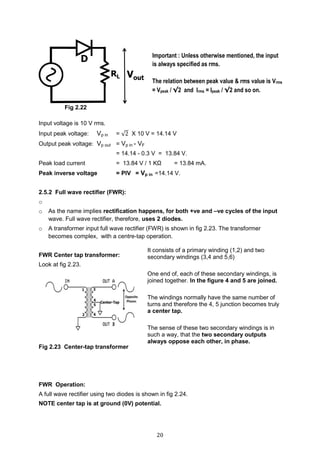
  • 154.
    147 Ideal Filter Responses: 5.10.2Low pass Filter Analysis A first order low pass filter is shown in the figure. What is this circuit? A simple integrator. Note that integrator is the basic building block for low pass filters Fig 5.48 Fig 5.49 Fig 5.47
  • 155.
    148 First order lowpass analysis Assume Z1 = 1 𝑗⍵𝐶1 , V1 = Vi 𝑍1 𝑅1+𝑍1 = Vi 1 𝑗⍵𝐶1 𝑅1+ 1 𝑗⍵𝐶1 = Vi 1 𝑗𝜔𝐶1 𝑅1+1 = Vi 1 𝑠𝐶1 𝑅1+1 (s = j⍵) Transfer function is 𝑉1 𝑉 𝑖 = 1 𝑠𝐶1 𝑅1+1 Output reduces (attenuates) inversely as the frequency. If frequency doubles output is half. (- 6 dB for every doubling of frequency or – 6 dB per octave). This is a low pass filter of first order and the roll of is at -6 dB per octave. 5.10.3 Second order low pass filter A second order low pass filter is shown in the figure. Second order low pass analysis Assume Z1 = 1 𝑗⍵𝐶1 , V1 = Vi 𝑍1 𝑅1+𝑍1 = Vi 1 𝑗⍵𝐶1 𝑅1+ 1 𝑗⍵𝐶1 = Vi 1 𝑗𝜔𝐶1 𝑅1+1 = Vi 1 𝑠𝐶1 𝑅1+1 (s = j⍵) Next, Assume Z2 = 1 𝑗⍵𝐶2 , Fig 5.50
  • 156.
    149 Vo = V1 𝑍2 𝑅2+𝑍2 =V1 1 𝑗⍵𝐶2 𝑅2+ 1 𝑗⍵𝐶2 = V1 1 𝑗𝜔𝐶2 𝑅2+1 = V1 1 𝑠𝐶2 𝑅2+1 (s = j⍵) = Vi 1 𝑠𝐶1 𝑅1+1 1 𝑠𝐶2 𝑅2+1 = 1 𝑠2 𝑅1 𝑅2 𝐶1 𝐶2+𝑠(𝑅1 𝐶1+𝑅2 𝐶2)+1 Therefore transfer function is a second order equation. 𝑉𝑜 𝑉𝑖 = 1 𝑠2 𝑅1 𝑅2 𝐶1 𝐶2+𝑠(𝑅1 𝐶1+𝑅2 𝐶2)+1 Output reduces (attenuates) inversely as the square of the frequency. If frequency doubles output is 1/4th . (- 12 dB for every doubling of frequency or – 12 dB per octave). This is a low pass filter of second order and the roll of is at -12 dB per octave. Fig 5.51 Fig 5.52
  • 157.
    150 5.10.4 High passfilter examples Note that Differentiator is the basic building block for high pass filters OP-AMP AS INTEGRATOR AND DIFFERENTIATOR 5.10.5 SECOND ORDER ACTIVE LOW PASS FILTER Aim: To obtain the frequency response of an active low pass Butterworth filter for the desired Cut off frequency Given Specification: Design the low pass filter with cut off frequency fc=1 kHz Basic circuit diagram Fig 5.53 Fig 5.54 Fig 5.55
  • 158.
    151 The normalised frequencyresponse of the second order low pass filter is fixed by the RC network and is generally identical to that of the first order type. The main difference between a 1st and 2nd order low pass filter is that the stop band roll-off will be twice the 1st order filters at 40dB/decade (12dB/octave) as the operating frequency increases above the cut-off frequency ƒc. Design: For a 2nd order Filter, Cut off frequency fc = 1 / 2πRC Hz Let us design a low pass filter with fc = 1 kHz and R = 15 kΩ Therefore, 1*10 3 = 1 2 π ∗15 ∗ 103 ∗ C Therefore, C = 0.01 μF The pass band gain of the filter, AF = (1 + 𝑅 𝑓 𝑅1 ) How to design the Gain of the amplifier (Butterworth):  In active second order filters, there is a parameter called damping factor, ζ (zeta). There is a parameter called quality factor Q. These two are inversely proportional.  Both Q and ζ are independently determined by the gain of the amplifier A. If Q decreases the damping factor increases.  Look at the frequency response curve esp. around the cut-off region. Low pass filters have a peaking tendency (overshoot) around the cut-off frequency as seen in the figure. This is called a resonant peak. In this cut-off region, the gain can increases rapidly due to resonance effects of the amplifiers gain.  Q, the quality factor, represents the “peakiness” of this resonance peak. Peakiness is, the height and narrowness around the cut-off frequency point, ƒC. A filter’s gain can control this peakiness. Generally to maintain stability, an active filter’s gain must not be more than 3 and is best expressed as: The Quality Factor, “Q” A= 3 – (2 X ζ) Where ζ = 𝟑−𝑨 𝟐 = 𝟏 𝟐𝑸 A = 3 - 𝟏 𝑸 Second Order Filter Amplitude Response (Butterworth) Fig 5.56
  • 159.
    152 The amplitude responseof the second order low pass filter varies for different values of damping factor, ζ.  When ζ = 1.0 or more (2 is the maximum) the filter becomes what is called “overdamped” with the frequency response showing a long flat curve.  When ζ = 0, the filters output peaks sharply at the cut-off point resembling a sharp point at which the filter is said to be “underdamped”. Then somewhere in between, ζ = 0 and ζ = 2.0, there must be a point where the frequency response is of the correct value, and there is. This is when the filter is “critically damped” and occurs when ζ = 0.7071. With ζ = 0.7071, the gain of a second order Butterworth filter, AF = 1.586, Let R1 = 10KΩ . Therefore, Rf = 5.86kΩ (Note that AF = 1.586 IS VALID ONLY FOR BUTTERWORTH RESPONSE DESIGNS. For a Bessel second order filter design: 1.268, and for a Chebyshev low pass design: 1.234.) According to the design, R1=10kΩ , Rf = 5.6kΩ , R =15kΩ , C=0.01uF A typical frequency response waveform is as follows We can see that 3dB down frequency occurs at f = 1.0 kHz. So, Cut-off frequency fc=1 kHz. 5.10.6 SECOND ORDER ACTIVE HIGHPASS FILTER Aim: To obtain the frequency response of an active high pass Butterworth filter for the desired Cut off frequency. Given Specification: Design the high pass filter with cut off frequency fc = 2 kHz Fig 5.57
  • 160.
    153 Basic circuit diagram Design: Fora 2nd order Filter, fc = 1 / 2πRC Hz Let fc = 2 kHz and R = 10 kΩ Therefore, 2*10 3 = 1 2 π ∗10 ∗ 103 ∗ C Therefore, C = 0.8000 pF The pass band gain of the filter, AF = (1+R f / R1) From the transfer function for a second order Butterworth filter, AF = 1.586, Let R1 = 10KΩ Rf = 5.86kΩ The pass band gain of the filter, AF = (1 + 𝑅 𝑓 𝑅1 ) According to the design, R1=10kΩ , Rf=5.86kΩ , R =10kΩ , C=8000pF Fig 5.58 Fig 5.59
  • 161.
    154 5.10.7 Design ofa SECOND ORDER ACTIVE BAND PASS FILTER Aim: To obtain the frequency response of an active band pass filter from 2 KHz to 10 KHz passband and to verify the roll off. Design a 2nd order High pass filter 2 KHz cutoff. Filter, F= 1 / 2πRC Hz For High pass section Let FL = 2 KHz and R = 33 K Design: For a 2nd order Filter, F= 1 / 2πRC Hz (i) For High pass section Let FL = 2 KHz and R = 33 K Therefore, 2*103 = 1 2 π ∗ 33 ∗ 103 ∗ C Therefore, C = 2700 pF (approx) (i) For Low pass section Let FL = 10 KHz and R = 33 K Therefore, 10*103 = 1 2 π ∗ 33 ∗ 103 ∗ C Therefore, C = 540 pF (approx) Pass band gain of the filter, AF = (1+R f / R1) For a second order filter, AF = 1.586, Let R1 = 10K RF = 5.86 k The Center frequency FC =√FH ∗ FL Hence fC = 4.5 KHz (approx) Circuit Diagram:- Fig 5.60
  • 162.
    155 5.10.8 SECOND ORDERACTIVE BAND REJECT (BANDSTOP) FILTER Design of a SECOND ORDER ACTIVE BAND STOP (BAND ELIMINATION, BAND REJECT) FILTER Aim: To obtain the frequency response of an active band stop filter from 2 KHz to 10 KHz stop band and to verify the roll off. Design a 2nd order High pass filter 10 KHz cutoff. Filter, F= 1 / 2πRC Hz For High pass section Let FL = 10 KHz and C = 0.01uF Design: For a 2nd order Filter, F= 1 / 2πRC Hz (i) For High pass section Let FL = 10 KHz and C = 0.01uF Therefore, 10*103 = 1 2 π ∗ 0.01 ∗ 10−6 ∗ R Therefore, R = 1.59 K ohms (i) For Low pass section Let FL = 2 KHz and R = 33 K Therefore, 2*103 = 1 2 π ∗ 33 ∗ 103 ∗ C 1 / 2*π*33*103 *C Therefore, C = 2700 pF (approx) Circuit Diagram:- Fig 5.61
  • 163.
    156 Pass band gainof the filter, AF = (1+Rf / R1) For a second order filter, AF = 1.586, Let R1 = 10K Rf = 5.86 k The Center frequency FC =√FH ∗ FL Hence fC = 4.5 KHz
  • 164.
    157 Chapter 6 OSCILLATORS 6.1FEEDBACK CONCEPTS ● We had seen feedback briefly in op-amp circuits. Feedback in general refers to a portion of the signal from output being handed over back to input deliberately or inadvertently. There are two types: positive feedback and Negative feedback. Negative feedback: If the signal fed back opposes the input signal (opposite phase) it is negative feedback. This reduces the overall gain of the circuit. Positve feedback: If the signal fed back aids the input signal (same phase) it is positive feedback. This increases the overall gain of the circuit and leads to oscillations. Advantages of negative feedback: o 1. Higher input impedance. o 2. Better stabilized voltage gain. o 3. Improved frequency response (fidelity) o 4. Lower output impedance. o 5. Reduced noise. o 6. More linear operation. o It reduces all kinds of distortions (amplitude, frequency, phase and harmonic) Disadvantages of negative feedback: Negative feedback results in decreased gain. Advantages of positive feedback: Increases the gain of the system. If controlled well, helps build oscillators , a very vital element in Electronic design systems. Disadvantages of positive feedback: If handled badly, can result in uncontrolled oscillations, effectively jamming the intended application. Positive feedback drives a circuit into oscillation as in various types of oscillator circuits. A typical feedback connection is shown in Fig below. The input signal Vs is applied to a mixer network, where it is combined with a feedback signal Vf . The difference of these signals Vi is then given as the input voltage to the amplifier. A portion of the amplifier output Vo is connected to the feedback network (β), which provides a reduced portion of the output as feedback signal (Vf) to the input mixer network. Fig 5.62
  • 165.
    158 Simple block diagramof a feedback amplifier. Gain with Feedback What is the gain of such a feedback system? If there is no feedback (Vf = 0), the voltage gain of the amplifier stage is A = 𝑉𝑜 𝑉𝑠 = 𝑉𝑜 𝑉𝑖 If a feedback signal Vf is fed back to the input, then Vi = Vs - Vf But Vo = AVi = A (Vs - Vf) = AVs - AVf = AVs – A βVo  Vo (1+Aβ) = AVs  The overall voltage gain with feed back is Af = 𝑉𝑜 𝑉𝑠 = 𝐴 (1+Aβ) 6.2 Types of FEEDBACK configurations There are four basic feedback configurations. 1. Voltage-series feedback 2. Voltage-shunt feedback 3. Current-series feedback 4. Current-shunt feedback Figure 5.63 shows all four types. Voltage feedback type, feeds some portion of the the output voltage back as input. Current feedback type, feeds some portion of the output current back as input. Fig 5.63
  • 166.
    159 If the feedbacksignal is in series with the input signal then it is called series feedback. If the feedback signal is in parallel (shunt) with the input signal then it is called parallel (shunt) feedback Feedback amplifier types: (a) voltage-series feedback, (b) voltage-shunt feedback. (c) current-series feedback. (d) current-shunt feedback. Series feedback increases the input resistance and shunt feedback decreases the input resistance. Voltage feedback decreases the output impedance and current feedback increases the output impedance. It is desirable to have higher input impedance and lower output impedance in circuits. Therefore voltage-series feedback connections are always preferred. 6.3 Gain with Feedback In this section we examine the gain of each of the feedback circuit connections of Fig.5.63 Amplifier alone has a gain of A. The feedback factor is that of the amplifier stage. With feedback β.The overall gain of the circuit is reduced by a factor (1 + A β ). Voltage-Series Voltage-Shunt Current-Series Current-Shunt Gain without Feedback A 𝑽𝟎 𝑽𝒊 𝑽𝟎 𝑰𝒊 𝑰𝟎 𝑽𝒊 𝑰𝟎 𝑰𝒊 Feedback β 𝑽𝒇 𝑽𝟎 𝑰𝒇 𝑽𝟎 𝑽𝒇 𝑰𝟎 𝑰𝒇 𝑰𝟎 Gain with Feedback Af 𝑽𝟎 𝑽𝒔 𝑽𝟎 𝑰𝒔 𝑰𝟎 𝑽𝒔 𝑰𝟎 𝑰𝒔 The table gives a summary of the gain (A), feedback factor (β), and gain with feedback (Af). Voltage-Series Feedback: If there is no feedback(Vf =0), the voltage gain of amplifier of 1st stage is 𝐴 = 𝑉0 𝑉𝑠 = 𝑉0 𝑉𝑖 A feedback signal Vf is connected in series with the input, then 𝑉𝑖 = 𝑉𝑠 − 𝑉𝑓 Since 𝑉𝑜 = 𝐴𝑉𝑖 = 𝐴(𝑉𝑠 − 𝑉𝑓) = 𝐴𝑉𝑠 − 𝐴𝑉𝑓 = 𝐴𝑉𝑠 − 𝐴(𝛽𝑉𝑜) then(1 + 𝛽𝐴)𝑉𝑜 = 𝐴𝑉𝑠 So that the overall voltage gain with feedback is 𝐴𝑓 = 𝑉𝑜 𝑉𝑠 = 𝐴 1 + 𝐴𝛽 Equation shows the gain with feedback is the amplifier gain reduced by the factor (1+Aβ). This factor will be seen also to effect input and output impedance among other circuit features
  • 167.
    160 Voltage Shunt Feedback: 𝐴𝑓 = 𝑉𝑜 𝐼𝑠 = 𝐴 𝐼𝑖 𝐼𝑖 + 𝐼𝑓 = 𝐴 𝐼𝑖 𝐼𝑖 + 𝛽𝑉0 = 𝐴 𝐼𝑖 𝐼𝑖 + 𝛽𝐴 𝐼𝑖 𝐴 𝑓 = 𝐴 1 + 𝐴𝛽 Input Impedance with Feedback: Voltage Series Feedback: Refer Fig 5.63. The input impedance can be determined as follows: 𝐼𝑖 = 𝑉𝑖 𝑍𝑖 = 𝑉𝑠 − 𝑉𝑓 𝑍𝑖 = 𝑉𝑠 − 𝛽 𝑉𝑜 𝑍𝑖 = 𝑉𝑠 − 𝛽𝐴 𝑉𝑖 𝑍𝑖 𝐼𝑖 𝑍𝑖 = 𝑉𝑠 − 𝛽𝐴 𝑉𝑖 𝑉𝑠 = 𝐼𝑖 𝑍𝑖 + 𝛽𝐴 𝑉𝑖 = 𝐼𝑖 𝑍𝑖 + 𝛽𝐴 𝐼𝑖 𝑍𝑖 𝑍𝑖𝑓 = 𝑉𝑠 𝐼𝑖 = 𝑍𝑖 + 𝐴𝛽 𝑍𝑖 = 𝑍𝑖(1 + 𝐴𝛽) The input impedance with series feedback is seen to be the value of the input impedance without feedback multiplied by the factor (1+Aβ), and applied to both voltage-series and current-series configurations. 6.4 Barkhausen Criteria for oscillations  Positive feedback increases the loop gain to greater than unity (Af >1).  Ensure that the phase of the signal fed back is same as that present at the input (360 degrees).  These two conditions will ensure that the amplifier produces a continuous time varying signal.  At this time, if the input signal totally removed (keeping the feedback signal in-tact), the amplifier will continue to produce the same continuous time varying signal.  In other words the system oscillates. Such circuits are known to be oscillators. Look at the figure 5.64 below. 1. When the switch at the input is open, no oscillations happen. 2. Imagine there is an imaginary voltage at the amplifier input Vi (maybe a noise signal). 3. This produces some output Vo = AVi as amplifier output. Fig 5.64
  • 168.
    161 4. This inturn, produces a feedback voltage output Vf = β AVi 5. βA product is known as loop gain. 6. If the basic amplifier and the feedback network ensure that the feedback voltage is of correct magnitude (.1) and correct phase 360ᵒ, Vf can be made equal to Vi 7. Now close the switch and remove the imaginary voltage. The circuit will run by itself since the feedback input is of correct phase and right magnitude. 1) All these will happen if and only if βA > 1 2) All these will happen if and only if the feedback is positive (same phase or 360ᵒ) Conditions 1 and 2 above are known as Barkheusen criteria 6.5 RC PHASE SHIFT OSCILLATOR. The RC Oscillator Circuit RC Oscillators use a 3 stage an RC network and an amplifier and to produce oscillations due to the phase shift between the stages. Barkheusen criteria is the main focus. Each RC combination is designed to give a 60ᵒ shift, With 3 such RC combinations a phase shift of 180o is achieved. The figure illustrates this. Fig 5.65 Fig 5.66
  • 169.
    162 Refer figure 5.66.RC Oscillator consists of a 3 stage RC network which produces a phase shift of 180o and an inverting amplifier which produces another 180o . Therefore the total phase shift is 360ᵒ, one of the conditions for oscillations.. RC Phase Shift Oscillator details:  The energy storage capacity of a capacitor in this circuit produces a noise voltage which is like to a small sine wave, it is then amplified using an inverting amplifier.  The 3 stage RC phase shift network attenuates the signal by a factor of 1/29. Therefore the gain of the inverting amplifier should be at least 29 in order to keep the loop gain as unity.  RC Oscillators are constant and provide a well-shaped sine wave output with the frequency being proportional to 1/RC. Frequency of oscillation (F) F = 1/2πRC√2N = 1/2πRC√2×3 (since N = Number of stages =3) = 1/2πRC√6 Gain of the Op Amp inverting amplifier (G) Gain = 29 The feedback RC network offers an attenuation that is 1/29, so the gain of the inverting amplifier should be 29 By cascading four RC stages together (4 x 45o ), the stability of the oscillator can be greatly improved. Design example: To design and test a RC-phase shift oscillator for a frequency of 10 kHz. DESIGN OF TANK CIRCUIT: fO = 𝟏 𝟐𝛑 𝐑𝐂√𝟔 Given fO = 10KHz Assume C = 0.02 μF R = 1/(2π x 0.02 x 10-6 x 10 x 103 x √6) = 330 ohms Fig 5.67
  • 170.
    163 6.6 Op-amp RCOscillator Circuit As the feedback is connected to the inverting input, the operational amplifier is therefore connected in its “inverting amplifier” configuration which produces the required 180o phase shift while the RC network produces the other 180o phase shift at the required frequency (180o + 180o ). 6.7 The Wien Bridge Oscillator The Wien Bridge Oscillator uses two RC networks connected together to produce a sinusoidal oscillator. Recall, RC phase shift Oscillator employed 3 RC combinations with an inverting amplifier. The Wien Bridge Oscillator uses a feedback circuit consisting of a series RC circuit (High pass Filter) connected with a parallel RC (Low pass Filter) of the same component. At the resonant frequency ƒo the phase shift is 0o or 360ᵒ. Refer figure below. RC Phase Shift Network The bridge network is a high Q (very selective) second-order Band Pass Filter, at the selected frequency, ƒo. Fig 5.68 Fig 5.69
  • 171.
    164 Theory of theWien Bridge: o At frequencies below resonance, C1 offers very high impedance and blocks any input signal. C1 acts like an open circuit. Since there is no input signal to the amplifier, there are no oscillations possible. o At frequencies above resonance, C2 offers very low impedance and bypasses any input signal to ground. C1 acts like a short circuit. Since there is no input signal to the amplifier, there are no oscillations possible. o At resonance frequency (ƒo), C1 and C2 allow input signals to the amplifier where the output voltage, VOUT reaches its maximum value. o At the resonant frequency, the impedance of the capacitors equals the resistor values. o It means Xc = R. o Phase difference between the input and output equals zero degrees. o The magnitude of the output voltage reaches its maximum value and this is equal to one third (1/3) of the input voltage. The circuit is shown in fig 5.70 Wien Bridge Oscillator Frequency fO = 𝟏 𝟐𝛑 𝐑𝐂 The voltage gain of the amplifier circuit MUST be equal to or greater than three “Gain = 3” for oscillations to start because as we have seen above, the input is 1/3 of the output. Limitations: Due to the open-loop gain limitations of operational amplifiers, frequencies above 1MHz are unachievable without the use of special high frequency op-amps. Fig 5.70
  • 172.
    165 Example Determine the frequencyof oscillations of a Wien Bridge Oscillator circuit having a resistor of 10kΩ and a capacitor of 0.01μF. The frequency of oscillations for a Wien Bridge Oscillator is given as: fO = 𝟏 𝟐𝛑 𝐑𝐂 fO = 1 (2π X 10000 X 0.01 X 10−6 = 1590 Hz The Wien Bridge oscillator has excellent stability. It has low distortion. It is a very popular circuit as an audio frequency oscillator. 6.8 The Hartley Oscillator and Colpitts Oscillator Both of these are LC class oscillators. The tank circuit (feedback circuit) uses inductors and capacitors. Both are sine wave RF Oscillators. In Colpitts the tank circuit uses two centre-tapped capacitors in series which are in turn parallel with an inductor. In Hartley the tank circuit uses two centre-tapped inductors in series which are in turn, parallel with a capacitor inductor. Oscillator Circuits Fig 5.71 Fig 5.72
  • 173.
    166 DESIGN: BJT- Amplifier: Designa typical RC-Coupled BJT Amplifier. A minimum gain of 2.9 is required to start oscillations. Design of a Hartley Oscillator for 100 KHz. fo = 100 kHz Frequency of oscillation for Hartley Oscillator is given by: fo = 𝟏 𝟐𝛑√𝑳𝑪 where L= L1 + L2 and [L1< L2] C = 𝟏 𝟒𝝅 𝟐 𝒇 𝟐 𝐋 Let L1=100 μH, L2=1mH Therefore, C=2.3nF Design of a Colpitts Oscillator for 100 KHz. fo = 𝟏 𝟐𝛑√𝑳𝑪 where Ceff= (C1 C2) /(C1 + C2) L = 𝟏 𝟒𝝅 𝟐 𝒇 𝟐 𝑪 𝒆𝒇𝒇 Let C1 = C2 =0.01 pF Therefore L = 0.05066H Colpitts Oscillator Op-amp Circuit Colpitts Oscillator sinewaves are purer than Hartley oscillator’s. Colpitts oscillator can operate at very high frequencies. Fig 5.73
  • 174.
    167 6.9 BJT- CRYSTALOSCILLATORS What is a crystal oscillator? A crystal oscillator is an electronic oscillator. It uses a component called piezoelectric crystal in its feedback network. What is a piezoelectric crystal? Also known as quartz crystal. It is a transducer. Piezoelectricity is the ability of certain materials to generate an AC (alternating current) voltage when subjected to mechanical stress or vibration, or to vibrate when subjected to an AC voltage, or both. When such a material is used in the tank circuit (feedback network) of an oscillator the frequency stability of the oscillator is very good DESIGN: Choose an appropriate crystal for the desired frequency of operation BJT- Amplifier: Design a proper RC-Coupled BJT Amplifier and connect the crystal of choice as shown. The circuit as per the circuit diagram shown. The circuit will oscillate at the crystal frequency Fig 5.74 Fig 5.75
  • 175.
    168 555 applications: Monostable& Astable operation using 555 timers 7.0 Astable and Monostable Multivibrator Using 555 IC 555 timer IC is a very popular IC used for Square wave genearation. Astable Multivibrator and the Monostable multivibrator are the important applications. The pinout diagram for 555 IC is given in fig 5.76. The 8 pin package is very popular. The pinout details are in the figure 5.76 Pin Configuration and Functional diagram:- Pin 8. – Supply +Vcc, This is the power supply pin. Let us assume VCC = 6V Pin 1. – Ground, . Pin 2. – Trigger: The negative input to the lower comparator. A negative pulse on this pin “sets” the internal Flip-flop from LOW to HIGH, when the voltage drops below 1/3 Vcc (2V in our example). Pin 3. – Output, 555 output any TTL circuit. It can source up to 200mA of current at an output voltage of 1.5V. It is a terrific driver. Pin 4. – Reset, When there is a LOW on this pin, output pin 3 goes low. Pin 5. – Control Voltage, Internally it is set to 2/3 Vcc (4V in our example).It can be varied from 45% to 90% of the supply voltage. This variation causes the pulse width of the mono-stable to vary or the output frequency of the astable to vary. A 0.01 capacitor is connected to this pin and ground, to eliminate stray noise pick-up. Fig 5.76
  • 176.
    169 Pin 6. –Threshold: This is the positive input to the upper comparator. This pin connects directly to the RC timing circuit. The threshold voltage in 555 is at 2/3 Vcc (4V in our example). When the voltage at this input rises above this threshold value the output will go from HIGH TO LOW (Resets). In both astable and monostable mode the voltage across the timing capacitor is monitored through the Threshold input. Pin 7. – Discharge, The discharge pin is connected directly to the Collector of an internal NPN transistor. When the voltage across the timing capacitor exceeds the threshold value (4V in our example), the timing capacitor is discharged through this input.and consequently the output at pin 3 goes “LOW”. 555 has three operating modes: Astable, Monostable and Bistable. 7.1 Astable Multivibrator: In astable multivibrator 555 produces a continuous square (rectangular) wave. No input or external trigger is required in this mode. It is self-oscillating.and free running.. Astable mode is achieved by connecting the resistors RA, RB and the capacitor C to 555 as shown in the figure. Connections are to be made as shown in the circuit diagram. The output produced by the astable circuit is not stable in both the HIGH and the LOW states and it continuously switches from one state to the other. The timing (time period) during which the output is either high or low is determined by R1, R2 and C1. Astable Multivibrator Operation 1. An astable 555 timer circuit contains an SR flip flop, two comparators, a NPN driver transistor and few discrete components like resistors and capacitors for its operation. 2. When the power supply is switched ON, the SR flip flop is RESET. Now, Q = 0. This forces the transistor to cut-off state. 3. The capacitor, C is free to charge and therefore will charge through RA and RB up to Vcc. with a time constant required for charging is equal to (RA + RB) C. 4. As the threshold voltage (capacitor voltage) becomes greater than 2/3 Vcc (4V in our example), comparator 1 will become HIGH. This will drive the S/R flip-flop to SET. Now, Q = 1. This forces the transistor to saturation state. 5. Capacitor C will find a discharging path thro the transistor and therefore discharges. Fig 5.77
  • 177.
    170 6. The dischargingtakes place through the resistor RB. Hence the discharge time constant will be RBC. 7. When the capacitor voltage becomes lower than 1/3 Vcc, comparator 1 will become LOW, S/R flip flop is RESET and the cycle repeats. TON = 0.693 (RA + RB) C TOFF = 0.693 RB C T = TON + TOFF RA and RB are in ohms and C is in Farad Duty cycle is the ratio of on time to the total time. Duty cycle = 𝑻 𝑶𝑵 𝑻 = 𝑹 𝑨+𝑹 𝑩 (𝑹 𝑨+𝟐𝑹 𝑩) For 555 to operate as an astable multivibrator, it is necessary to retrigger the 555 IC after each and every cycle. This retriggering can be achieved by connecting the pin2 and the pin6 together. Advantages & Disadvantages  Simple to design and construct  The output is a perfect square wave..  50% duty cycle is normally, difficult to achieve. This problem can be solved by inverting the output or by using a diode parallel to R 7.2 Monostable Multi Vibrator Fig 5.78 Fig 5.79
  • 178.
    171 1. A negativepulse is required at the trigger input of the multivibrator. 2. Comparator of the 555 timer detects this input and causes the flip-flop output to change from LOW to HIGH. 3. The transistor is driven to cut-off state.. 4. The timing capacitor charges through resistor R1. 5. This charging will go on till voltage at pin6 of 555 timer reaches 2/3 Vcc. 6. When pin 6 reaches 2/3 Vcc, comparator output will move to HIGH. 7. This causes the flip-flop to go LOW and the driver 8. Now the Monostable multivibrator has to waiting for the other input trigger to repeat the entire process of operation. Thus the pulse width W of a Monostable is W = 1.1 RC Fig 5.80
  • 179.