Geographic Information Systems
 Geographic information systems(GIS) are
used to collect, model, and analyze
information describing physical properties
of the geographical world.
Geographic Information Systems
 The scope of GIS broadly encompasses two types of data:
 Spatial data, originating from maps, digital images,
administrative and political boundaries, roads,
transportation networks, physical data, such as rivers, soil
characteristics, climatic regions, land elevations, and
 Non-spatial data, such as socio-economic data (like census
counts), economic data, and sales or marketing information.
GIS is a rapidly developing domain that offers highly
innovative approaches to meet some challenging technical
demands.
GIS Applications
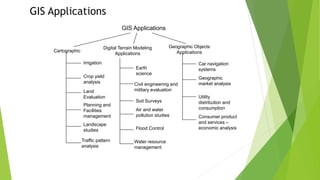
 It is possible to divide GISs into three
categories:
Cartographic applications
Digital terrain modeling applications
Geographic objects applications
GIS Applications
Civil engineering and
military evaluation
GIS Applications
Cartographic
Irrigation
Crop yield
analysis
Land
Evaluation
Planning and
Facilities
management
Landscape
studies
Traffic pattern
analysis
Digital Terrain Modeling
Applications
Air and water
pollution studies
Earth
science
Soil Surveys
Flood Control
Water resource
management
Consumer product
and services –
economic analysis
Geographic Objects
Applications
Car navigation
systems
Utility
distribution and
consumption
Geographic
market analysis
Data Management Requirements of GIS
The functional requirements of the GIS
applications above translate into the
following database requirements.
Data Management Requirements of GIS
Data Modeling and Representation
 GIS data can be broadly represented in two
formats:
Vector data represents geometric objects such
as points, lines, and polygons.
 Raster data is characterized as an array of
points, where each point represents the value
of an attribute for a real-world location.
Data Management Requirements of GIS
Data Analysis:
 GIS data undergoes various types of analysis.
 For example, in applications
such as soil erosion studies, environmental
impact studies, or hydrological runoff simulations
Data Integration:
 GISs must integrate both vector and raster data from a
variety of sources.
Data Capture:
 To capture the two-dimensional or three-dimensional
geographical information in digital form.
GIS Data Operations
 GIS applications are conducted through the use of
special operators such as the following:
 Interpolation
 Interpretation
 Proximity analysis
 Raster image processing
 Analysis of networks
Geographic information systems

Geographic information systems

  • 1.
  • 2.
    Geographic Information Systems Geographic information systems(GIS) are used to collect, model, and analyze information describing physical properties of the geographical world.
  • 3.
    Geographic Information Systems The scope of GIS broadly encompasses two types of data:  Spatial data, originating from maps, digital images, administrative and political boundaries, roads, transportation networks, physical data, such as rivers, soil characteristics, climatic regions, land elevations, and  Non-spatial data, such as socio-economic data (like census counts), economic data, and sales or marketing information. GIS is a rapidly developing domain that offers highly innovative approaches to meet some challenging technical demands.
  • 4.
    GIS Applications  Itis possible to divide GISs into three categories: Cartographic applications Digital terrain modeling applications Geographic objects applications
  • 5.
    GIS Applications Civil engineeringand military evaluation GIS Applications Cartographic Irrigation Crop yield analysis Land Evaluation Planning and Facilities management Landscape studies Traffic pattern analysis Digital Terrain Modeling Applications Air and water pollution studies Earth science Soil Surveys Flood Control Water resource management Consumer product and services – economic analysis Geographic Objects Applications Car navigation systems Utility distribution and consumption Geographic market analysis
  • 6.
    Data Management Requirementsof GIS The functional requirements of the GIS applications above translate into the following database requirements.
  • 7.
    Data Management Requirementsof GIS Data Modeling and Representation  GIS data can be broadly represented in two formats: Vector data represents geometric objects such as points, lines, and polygons.  Raster data is characterized as an array of points, where each point represents the value of an attribute for a real-world location.
  • 8.
    Data Management Requirementsof GIS Data Analysis:  GIS data undergoes various types of analysis.  For example, in applications such as soil erosion studies, environmental impact studies, or hydrological runoff simulations Data Integration:  GISs must integrate both vector and raster data from a variety of sources. Data Capture:  To capture the two-dimensional or three-dimensional geographical information in digital form.
  • 9.
    GIS Data Operations GIS applications are conducted through the use of special operators such as the following:  Interpolation  Interpretation  Proximity analysis  Raster image processing  Analysis of networks