1
GENERAL ANAESTHESIA
Dr. Shafi Md Anis
PGT OMFS.
2
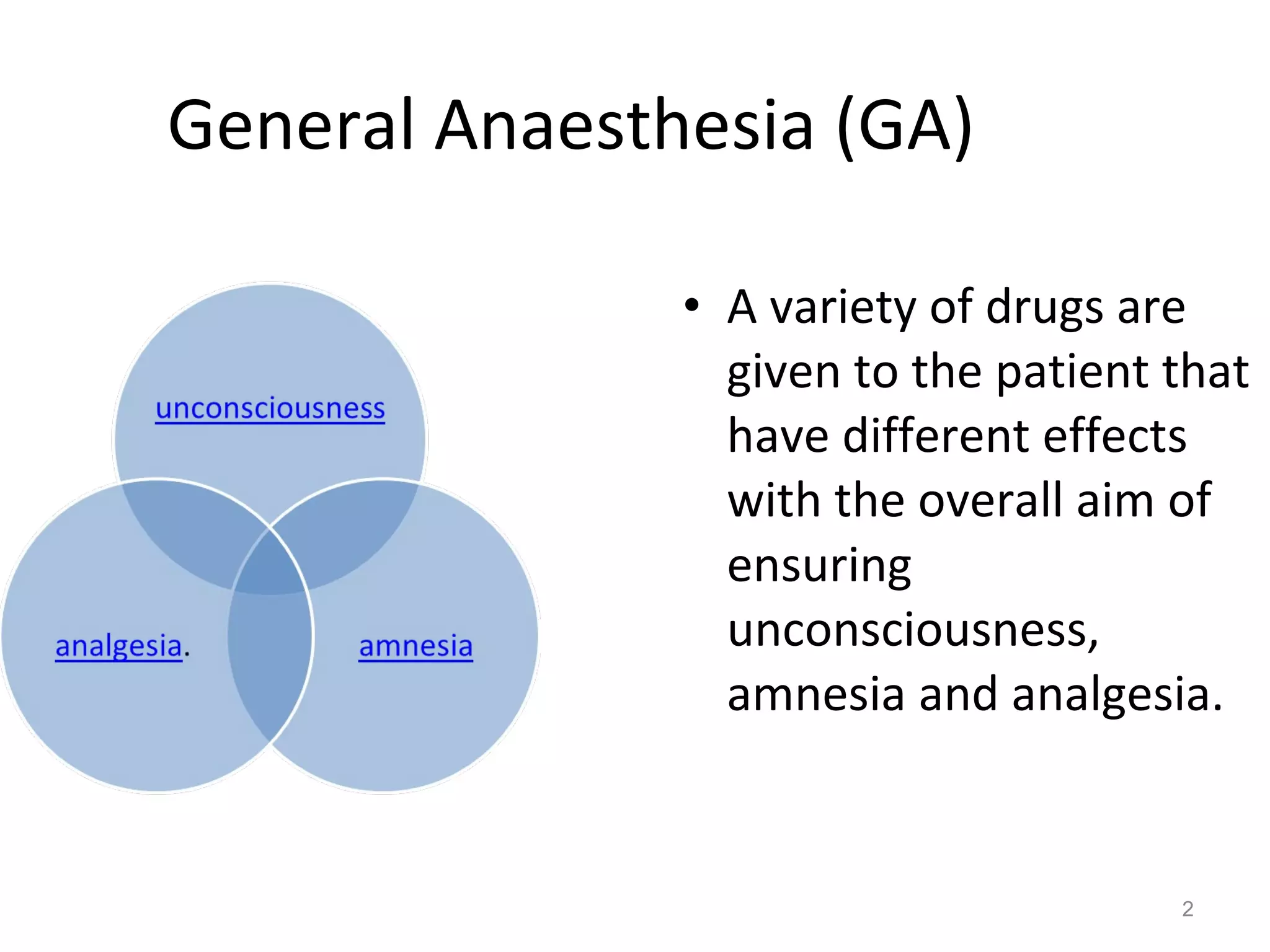
General Anaesthesia (GA)
• A variety of drugs are
given to the patient that
have different effects
with the overall aim of
ensuring
unconsciousness,
amnesia and analgesia.
3
Overview
• General anaesthesia is a complex procedure
involving :
• Pre-anaesthetic assessment
• Administration of general anaesthetic drugs
• Cardio-respiratory monitoring
• Analgesia
• Airway management
• Fluid management
• Postoperative pain relief
4
Pre-anaesthetic evaluation
5
Pre-anaesthetic evaluation
6
Premedication
7
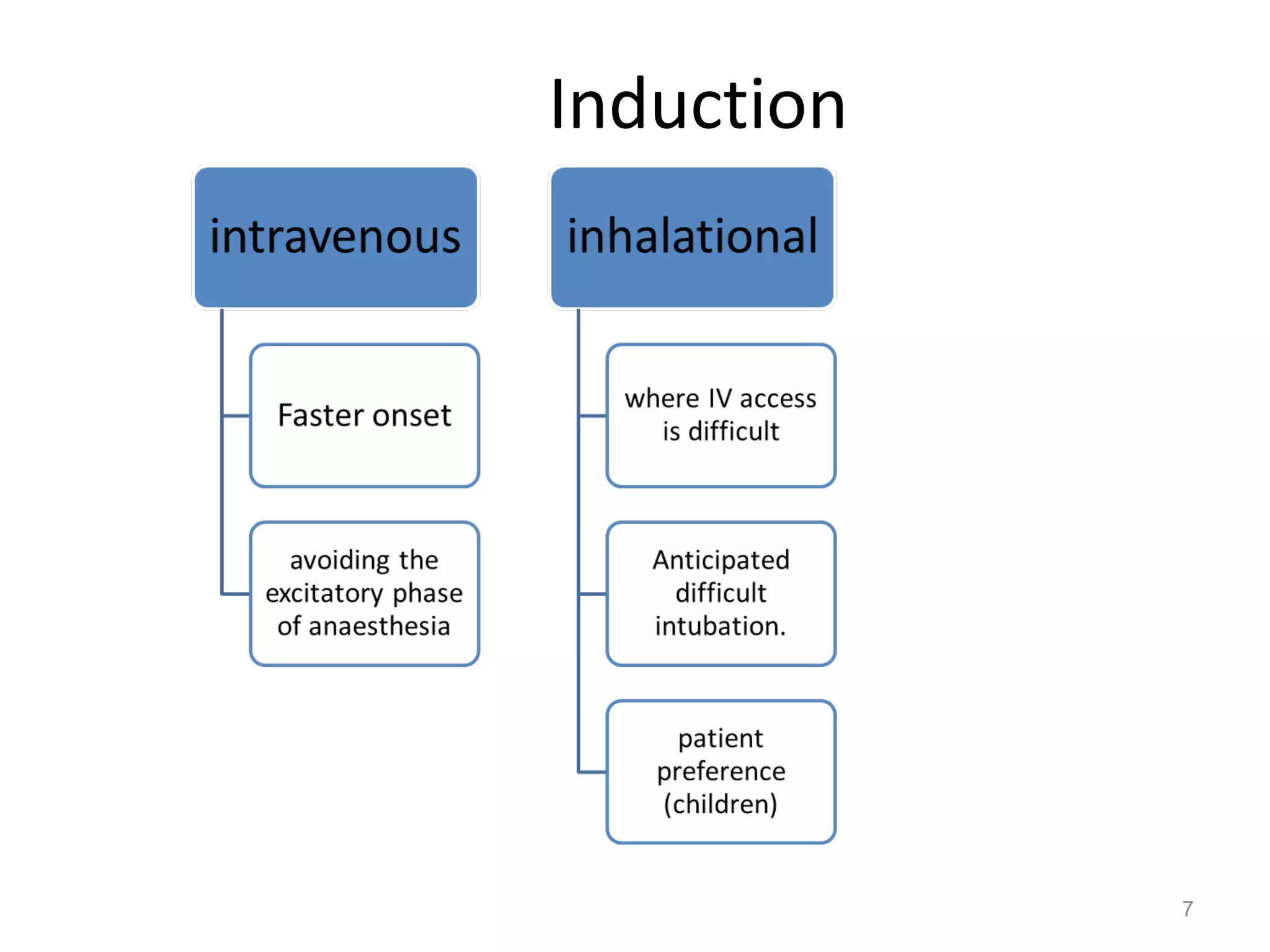
Induction
8
Intravenous Induction Agents
• Commonly used IV induction agents include Prpofol, Sodium
Thiopental and Ketamine.
• They modulate GABAergic neuronal transmission. (GABA is
the most common inhibitory neurotransmitter in humans).
• The duration of action of IV induction agents is generally 5 to
10 minutes, after which time spontaneous recovery of
consciousness will occur.
9
(1) Propofol
• Short-acting agent used for the
induction, maintenance of GA
and sedation in adult patients
and pediatric patients older
than 3 years of age.
• It is highly protein bound in vivo
and is metabolised by
conjugation in the liver.
• Side-effects is pain on injection
hypotension and transient
apnea following induction
10
(2) Sodium thiopental
• Rapid-onset ultra-short acting
barbiturate, rapidly reaches the brain
and causes unconsciousness within
30–45 seconds.
• The short duration of action is due to
its redistribution away from central
circulation towards muscle and fat
• The dose for induction is 3 to 7 mg/kg.
• Causes hypotension, apnea and airway
obstruction
11
(3) Ketamine
• Ketamine is a general dissociative
anaesthetic.
• Ketamine is classified as an NMDA (n-
methyl-d-aspertate)Receptor
Antagonist.
• The effect of Ketamine on the
respiratory and circulatory systems is
different . When used at anaesthetic
doses, it will usually stimulate rather
than depress the circulatory system.
12
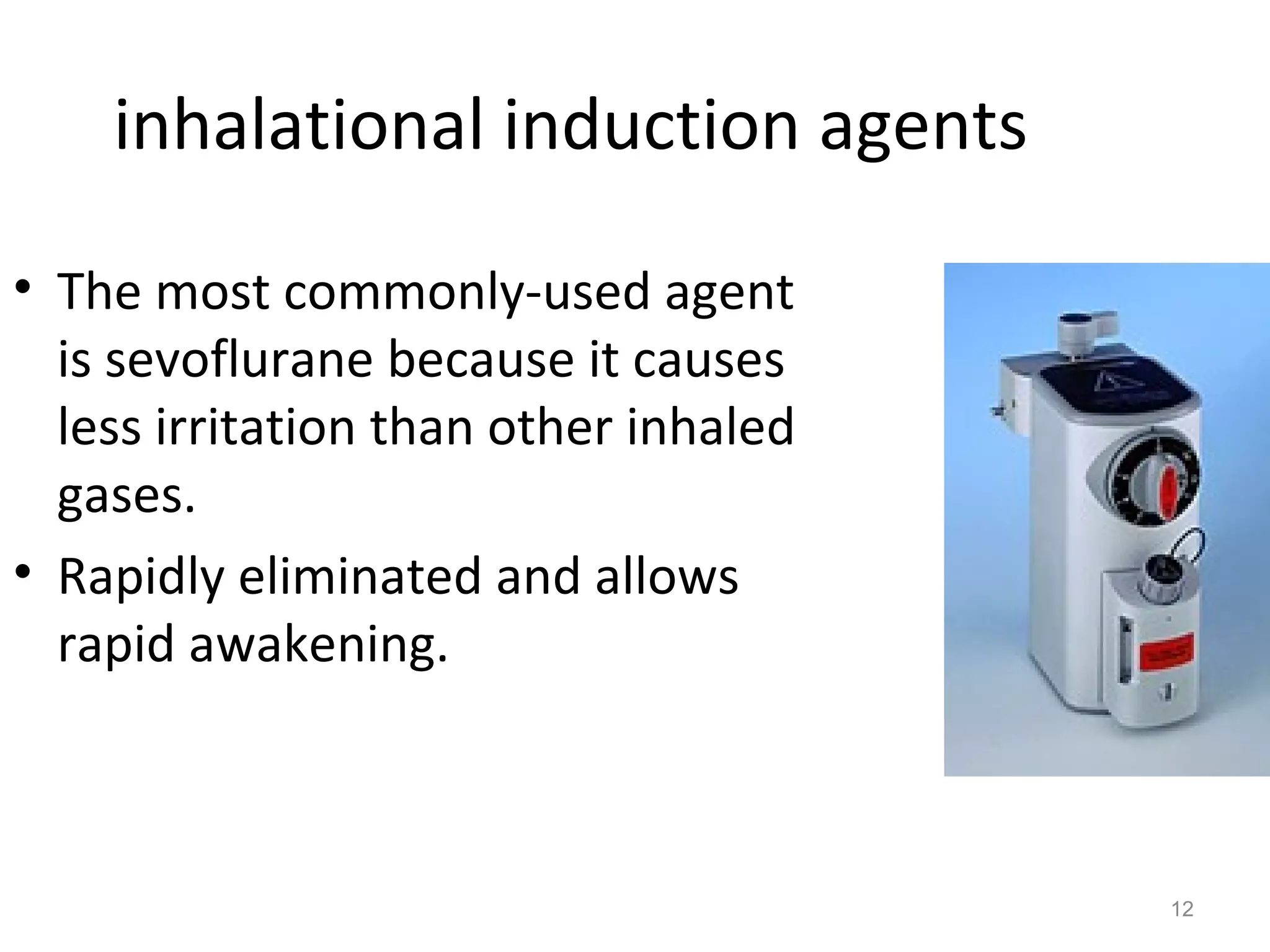
inhalational induction agents
• The most commonly-used agent
is sevoflurane because it causes
less irritation than other inhaled
gases.
• Rapidly eliminated and allows
rapid awakening.
13
Maintenance
• In order to prolong anaesthesia for the
required duration (usually the duration of
surgery), patient has to breathe a carefully
controlled mixture of oxygen, nitrous oxide,
and a volatile anaesthetic agent. This is
transferred to the patient's brain via the lungs
and the bloodstream, and the patient remains
unconscious.
14
Maintenance
• Inhaled agents are supplemented by intravenous
anaesthetics, such as opioids (usually fentanyl or
morphine).
• At the end of surgery the volatile anaesthetic is
discontinued.
• Recovery of consciousness occurs when the
concentration of anaesthetic in the brain drops
below a certain level (usually within 1 to 30
minutes depending upon the duration of
surgery).
15
Maintenance
• Total Intra-Venous Anaesthesia (TIVA): this
involves using a computer controlled syringe
driver (pump) to infuse Propofol throughout
the duration of surgery, removing the need for
a volatile anaesthetic.
• Advantages: faster recovery from anaesthesia,
reduced incidence of post-operative nausea
and vomiting, and absence of a trigger for
malignant hyperthermia.
16
Neuromuscular-blocking drugs
• Blocks neuromuscular transmission at the
neuromuscular junction.
• Used as an adjunct to anesthesia to induce
paralysis.
• Mechanical ventilation should be available to
maintain adequate respiration.
17
Types of NMB
18
Airway management
• To maintain an open airway and
enable mechanical ventilation, an
endotracheal tube or laryngeal
mask airways are often used.
19
Monitoring
• ECG
• Pulse oximetry (SpO2)
• Blood Pressure Monitoring (NIBP or IBP)
• Agent concentration measurement
• Low oxygen alarm
• Carbon dioxide measurement
(capnography)
• Temperature measurement
• Circuit disconnect alarm
20
Postoperative Analgesia
21
Mortality rates
• Overall, about five deaths per million.
• Most commonly related to surgical factors or pre-existing
medical conditions ( haemorrhage, sepsis).
• Common causes of death directly related to anaesthesia
include:
1- aspiration of stomach contents
2- suffocation (due to inadequate airway management)
3- allergic reactions to anaesthesia
4- human error
5- equipment failure
REFERENCES
• MILLERS ANESTHESIA, RONALD D MILLER 8TH
EDITION
• HANDBOOK IF CLINICAL ANESTHESIA, PAUL G
BARASH
• ANESTHESIOLOGY, DAVID E LONGNECKER.
22
23

General Anaesthesia In Maxillofacial Surgery. Overview

  • 1.
  • 2.
    2 General Anaesthesia (GA) •A variety of drugs are given to the patient that have different effects with the overall aim of ensuring unconsciousness, amnesia and analgesia.
  • 3.
    3 Overview • General anaesthesiais a complex procedure involving : • Pre-anaesthetic assessment • Administration of general anaesthetic drugs • Cardio-respiratory monitoring • Analgesia • Airway management • Fluid management • Postoperative pain relief
  • 4.
  • 5.
  • 6.
  • 7.
  • 8.
    8 Intravenous Induction Agents •Commonly used IV induction agents include Prpofol, Sodium Thiopental and Ketamine. • They modulate GABAergic neuronal transmission. (GABA is the most common inhibitory neurotransmitter in humans). • The duration of action of IV induction agents is generally 5 to 10 minutes, after which time spontaneous recovery of consciousness will occur.
  • 9.
    9 (1) Propofol • Short-actingagent used for the induction, maintenance of GA and sedation in adult patients and pediatric patients older than 3 years of age. • It is highly protein bound in vivo and is metabolised by conjugation in the liver. • Side-effects is pain on injection hypotension and transient apnea following induction
  • 10.
    10 (2) Sodium thiopental •Rapid-onset ultra-short acting barbiturate, rapidly reaches the brain and causes unconsciousness within 30–45 seconds. • The short duration of action is due to its redistribution away from central circulation towards muscle and fat • The dose for induction is 3 to 7 mg/kg. • Causes hypotension, apnea and airway obstruction
  • 11.
    11 (3) Ketamine • Ketamineis a general dissociative anaesthetic. • Ketamine is classified as an NMDA (n- methyl-d-aspertate)Receptor Antagonist. • The effect of Ketamine on the respiratory and circulatory systems is different . When used at anaesthetic doses, it will usually stimulate rather than depress the circulatory system.
  • 12.
    12 inhalational induction agents •The most commonly-used agent is sevoflurane because it causes less irritation than other inhaled gases. • Rapidly eliminated and allows rapid awakening.
  • 13.
    13 Maintenance • In orderto prolong anaesthesia for the required duration (usually the duration of surgery), patient has to breathe a carefully controlled mixture of oxygen, nitrous oxide, and a volatile anaesthetic agent. This is transferred to the patient's brain via the lungs and the bloodstream, and the patient remains unconscious.
  • 14.
    14 Maintenance • Inhaled agentsare supplemented by intravenous anaesthetics, such as opioids (usually fentanyl or morphine). • At the end of surgery the volatile anaesthetic is discontinued. • Recovery of consciousness occurs when the concentration of anaesthetic in the brain drops below a certain level (usually within 1 to 30 minutes depending upon the duration of surgery).
  • 15.
    15 Maintenance • Total Intra-VenousAnaesthesia (TIVA): this involves using a computer controlled syringe driver (pump) to infuse Propofol throughout the duration of surgery, removing the need for a volatile anaesthetic. • Advantages: faster recovery from anaesthesia, reduced incidence of post-operative nausea and vomiting, and absence of a trigger for malignant hyperthermia.
  • 16.
    16 Neuromuscular-blocking drugs • Blocksneuromuscular transmission at the neuromuscular junction. • Used as an adjunct to anesthesia to induce paralysis. • Mechanical ventilation should be available to maintain adequate respiration.
  • 17.
  • 18.
    18 Airway management • Tomaintain an open airway and enable mechanical ventilation, an endotracheal tube or laryngeal mask airways are often used.
  • 19.
    19 Monitoring • ECG • Pulseoximetry (SpO2) • Blood Pressure Monitoring (NIBP or IBP) • Agent concentration measurement • Low oxygen alarm • Carbon dioxide measurement (capnography) • Temperature measurement • Circuit disconnect alarm
  • 20.
  • 21.
    21 Mortality rates • Overall,about five deaths per million. • Most commonly related to surgical factors or pre-existing medical conditions ( haemorrhage, sepsis). • Common causes of death directly related to anaesthesia include: 1- aspiration of stomach contents 2- suffocation (due to inadequate airway management) 3- allergic reactions to anaesthesia 4- human error 5- equipment failure
  • 22.
    REFERENCES • MILLERS ANESTHESIA,RONALD D MILLER 8TH EDITION • HANDBOOK IF CLINICAL ANESTHESIA, PAUL G BARASH • ANESTHESIOLOGY, DAVID E LONGNECKER. 22
  • 23.