© Copyright Khronos Group 2015 - Page 1
Update on Khronos Open Standard
APIs for Vision Processing
Neil Trevett | Khronos President
NVIDIA Vice President Mobile Ecosystem
© Copyright Khronos Group 2015 - Page 2
Khronos Connects Software to Silicon
Open Consortium creating
ROYALTY-FREE, OPEN STANDARD
APIs for hardware acceleration
Defining the roadmap for
low-level silicon interfaces needed
on every platform
Graphics, compute
and vision processing
Rigorous specifications AND
conformance tests for cross-vendor
portability
Acceleration APIs
BY the Industry
FOR the Industry
Well over a BILLION people use Khronos APIs
Every Day…
© Copyright Khronos Group 2015 - Page 3
Khronos Standards for Vision Processing
Low-power, portable
vision processing
Heterogeneous Parallel Processing for
Vision and Neural Net acceleration
GPU Graphics and
GPU Compute
Image: ScreenMedia
© Copyright Khronos Group 2015 - Page 4
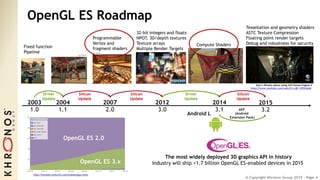
OpenGL ES Roadmap
2003
1.0
2004
1.1
2007
2.0
2012
3.0
2014
3.1
Driver
Update
Silicon
Update
Silicon
Update
Driver
Update
Compute Shaders
32-bit integers and floats
NPOT, 3D/depth textures
Texture arrays
Multiple Render Targets
Programmable
Vertex and
fragment shadersFixed function
Pipeline
Android L
2015
3.2
Silicon
Update
Tessellation and geometry shaders
ASTC Texture Compression
Floating point render targets
Debug and robustness for security
Epic’s Rivalry demo using full Unreal Engine 4
https://www.youtube.com/watch?v=jRr-G95GdaM
http://hwstats.unity3d.com/mobile/gpu.html
OpenGL ES 2.0
OpenGL ES 3.x
AEP
(Android
Extension Pack)
The most widely deployed 3D graphics API in history
Industry will ship >1.7 billion OpenGL ES-enabled devices in 2015
© Copyright Khronos Group 2015 - Page 5
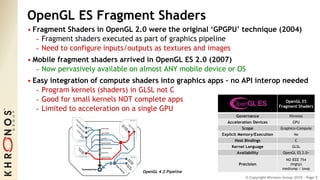
OpenGL ES Fragment Shaders
• Fragment Shaders in OpenGL 2.0 were the original ‘GPGPU’ technique (2004)
- Fragment shaders executed as part of graphics pipeline
- Need to configure inputs/outputs as textures and images
• Mobile fragment shaders arrived in OpenGL ES 2.0 (2007)
- Now pervasively available on almost ANY mobile device or OS
• Easy integration of compute shaders into graphics apps – no API interop needed
- Program kernels (shaders) in GLSL not C
- Good for small kernels NOT complete apps
- Limited to acceleration on a single GPU
OpenGL 4.2 Pipeline
OpenGL ES
Fragment Shaders
Governance Khronos
Acceleration Devices GPU
Scope Graphics+Compute
Explicit Memory/Execution No
Host Bindings C
Kernel Language GLSL
Availability OpenGL ES 2.0+
Precision
NO IEEE 754
(highp)
mediump / lowp
© Copyright Khronos Group 2015 - Page 6
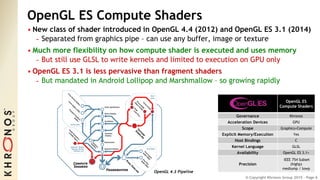
OpenGL ES Compute Shaders
• New class of shader introduced in OpenGL 4.4 (2012) and OpenGL ES 3.1 (2014)
- Separated from graphics pipe – can use any buffer, image or texture
• Much more flexibility on how compute shader is executed and uses memory
- But still use GLSL to write kernels and limited to execution on GPU only
• OpenGL ES 3.1 is less pervasive than fragment shaders
- But mandated in Android Lollipop and Marshmallow – so growing rapidly
OpenGL 4.3 Pipeline
OpenGL ES
Compute Shaders
Governance Khronos
Acceleration Devices GPU
Scope Graphics+Compute
Explicit Memory/Execution Yes
Host Bindings C
Kernel Language GLSL
Availability OpenGL ES 3.1+
Precision
IEEE 754 Subset
(highp)
mediump / lowp
© Copyright Khronos Group 2015 - Page 7
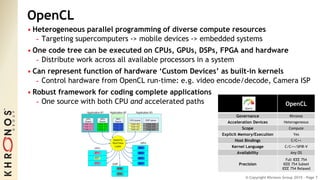
OpenCL
• Heterogeneous parallel programming of diverse compute resources
- Targeting supercomputers -> mobile devices -> embedded systems
• One code tree can be executed on CPUs, GPUs, DSPs, FPGA and hardware
- Distribute work across all available processors in a system
• Can represent function of hardware ‘Custom Devices’ as built-in kernels
- Control hardware from OpenCL run-time: e.g. video encode/decode, Camera ISP
• Robust framework for coding complete applications
- One source with both CPU and accelerated paths OpenCL
Governance Khronos
Acceleration Devices Heterogeneous
Scope Compute
Explicit Memory/Execution Yes
Host Bindings C/C++
Kernel Language C/C++/SPIR-V
Availability Any OS
Precision
Full IEEE 754
IEEE 754 Subset
IEEE 754 Relaxed
© Copyright Khronos Group 2015 - Page 8
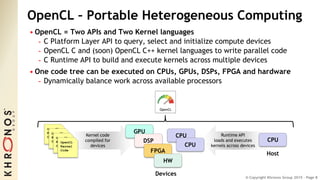
OpenCL – Portable Heterogeneous Computing
• OpenCL = Two APIs and Two Kernel languages
- C Platform Layer API to query, select and initialize compute devices
- OpenCL C and (soon) OpenCL C++ kernel languages to write parallel code
- C Runtime API to build and execute kernels across multiple devices
• One code tree can be executed on CPUs, GPUs, DSPs, FPGA and hardware
- Dynamically balance work across available processors
OpenCL
Kernel
Code
OpenCL
Kernel
Code
OpenCL
Kernel
Code
OpenCL
Kernel
Code
GPU
DSP
CPU
CPU
FPGA
HW
Kernel code
compiled for
devices
Devices
CPU
Host
Runtime API
loads and executes
kernels across devices
© Copyright Khronos Group 2015 - Page 9
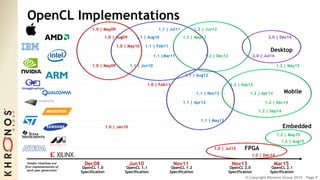
OpenCL Implementations
OpenCL 1.0
Specification
Dec08 Jun10
OpenCL 1.1
Specification
Nov11
OpenCL 1.2
Specification
OpenCL 2.0
Specification
Nov13
1.0 | Jul13
1.0 | Aug09
1.0 | May09
1.0 | May10
1.0 | Feb11
1.0 | May09
1.0 | Jan10
1.1 | Aug10
1.1 | Jul11
1.2 | May12
1.2 | Jun12
1.1 | Feb11
1.1 |Mar11
1.1 | Jun10
1.1 | Aug12
1.1 | Nov12
1.1 | May13
1.1 | Apr12
1.2 | Apr14
1.2 | Sep13
1.2 | Dec12
Desktop
Mobile
FPGA
2.0 | Jul14
OpenCL 2.1
Specification
Mar15
1.2 | May15
2.0 | Dec14
1.0 | Dec14
1.2 | Dec14
1.2 | Sep14
Vendor timelines are
first implementation of
each spec generation
1.2 | May15
Embedded
1.2 | Aug15
© Copyright Khronos Group 2015 - Page 10
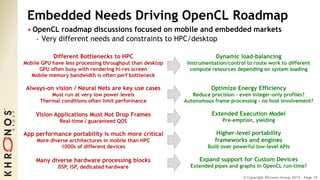
Embedded Needs Driving OpenCL Roadmap
• OpenCL roadmap discussions focused on mobile and embedded markets
- Very different needs and constraints to HPC/desktop
Different Bottlenecks to HPC
Mobile GPU have less processing throughput than desktop
GPU often busy with rendering hi-res screen
Mobile memory bandwidth is often perf bottleneck
Always-on vision / Neural Nets are key use cases
Must run at very low power levels
Thermal conditions often limit performance
Vision Applications Must Not Drop Frames
Real-time / guaranteed QOS
App performance portability is much more critical
More diverse architectures in mobile than HPC
1000s of different devices
Many diverse hardware processing blocks
DSP, ISP, dedicated hardware
Dynamic load-balancing
Instrumentation/control to route work to different
compute resources depending on system loading
Optimize Energy Efficiency
Reduce precision – even integer-only profiles?
Autonomous frame processing - no host involvement?
Extended Execution Model
Pre-emption, yielding
Higher-level portability
frameworks and engines
Built over powerful low-level APIs
Expand support for Custom Devices
Extended pipes and graphs in OpenCL run-time?
© Copyright Khronos Group 2015 - Page 11
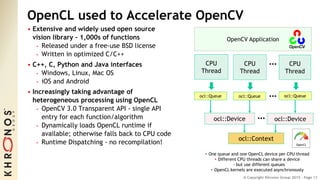
OpenCL used to Accelerate OpenCV
• Extensive and widely used open source
vision library – 1,000s of functions
- Released under a free-use BSD license
- Written in optimized C/C++
• C++, C, Python and Java interfaces
- Windows, Linux, Mac OS
- iOS and Android
• Increasingly taking advantage of
heterogeneous processing using OpenCL
- OpenCV 3.0 Transparent API - single API
entry for each function/algorithm
- Dynamically loads OpenCL runtime if
available; otherwise falls back to CPU code
- Runtime Dispatching - no recompilation!
CPU
Thread
CPU
Thread
CPU
Thread
…
ocl::Queue
ocl::Device
ocl::Queue ocl::Queue
ocl::Device
…
…
ocl::Context
OpenCV Application
• One queue and one OpenCL device per CPU thread
• Different CPU threads can share a device
- but use different queues
• OpenCL kernels are executed asynchronously
© Copyright Khronos Group 2015 - Page 12
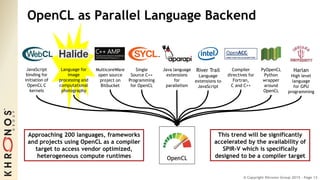
OpenCL as Parallel Language Backend
JavaScript
binding for
initiation of
OpenCL C
kernels
River Trail
Language
extensions to
JavaScript
MulticoreWare
open source
project on
Bitbucket
Harlan
High level
language
for GPU
programming
Compiler
directives for
Fortran,
C and C++
Java language
extensions
for
parallelism
PyOpenCL
Python
wrapper
around
OpenCL
Language for
image
processing and
computational
photography
Single
Source C++
Programming
for OpenCL
Approaching 200 languages, frameworks
and projects using OpenCL as a compiler
target to access vendor optimized,
heterogeneous compute runtimes
This trend will be significantly
accelerated by the availability of
SPIR-V which is specifically
designed to be a compiler target
© Copyright Khronos Group 2015 - Page 13
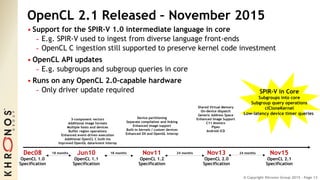
OpenCL 2.1 Released – November 2015
• Support for the SPIR-V 1.0 intermediate language in core
- E.g. SPIR-V used to ingest from diverse language front-ends
- OpenCL C ingestion still supported to preserve kernel code investment
• OpenCL API updates
- E.g. subgroups and subgroup queries in core
• Runs on any OpenCL 2.0-capable hardware
- Only driver update required
OpenCL 1.0
Specification
Dec08 Jun10
OpenCL 1.1
Specification
Nov11
OpenCL 1.2
Specification
OpenCL 2.0
Specification
Nov13
Device partitioning
Separate compilation and linking
Enhanced image support
Built-in kernels / custom devices
Enhanced DX and OpenGL Interop
Shared Virtual Memory
On-device dispatch
Generic Address Space
Enhanced Image Support
C11 Atomics
Pipes
Android ICD
3-component vectors
Additional image formats
Multiple hosts and devices
Buffer region operations
Enhanced event-driven execution
Additional OpenCL C built-ins
Improved OpenGL data/event interop
18 months 18 months 24 months
OpenCL 2.1
Specification
Nov1524 months
SPIR-V in Core
Subgroups into core
Subgroup query operations
clCloneKernel
Low-latency device timer queries
© Copyright Khronos Group 2015 - Page 14
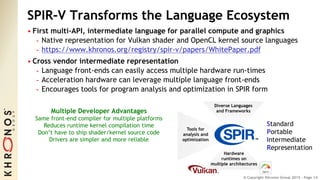
SPIR-V Transforms the Language Ecosystem
• First multi-API, intermediate language for parallel compute and graphics
- Native representation for Vulkan shader and OpenCL kernel source languages
- https://www.khronos.org/registry/spir-v/papers/WhitePaper.pdf
• Cross vendor intermediate representation
- Language front-ends can easily access multiple hardware run-times
- Acceleration hardware can leverage multiple language front-ends
- Encourages tools for program analysis and optimization in SPIR form
Diverse Languages
and Frameworks
Hardware
runtimes on
multiple architectures
Tools for
analysis and
optimization
Standard
Portable
Intermediate
Representation
Multiple Developer Advantages
Same front-end compiler for multiple platforms
Reduces runtime kernel compilation time
Don’t have to ship shader/kernel source code
Drivers are simpler and more reliable
© Copyright Khronos Group 2015 - Page 15
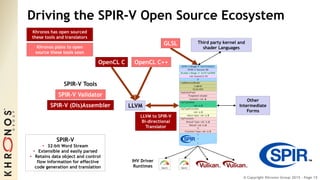
Driving the SPIR-V Open Source Ecosystem
LLVM
Third party kernel and
shader Languages
SPIR-V
• 32-bit Word Stream
• Extensible and easily parsed
• Retains data object and control
flow information for effective
code generation and translation
OpenCL C++OpenCL C
GLSL
Khronos has open sourced
these tools and translators
IHV Driver
Runtimes
Other
Intermediate
Forms
SPIR-V Validator
SPIR-V Tools
SPIR-V (Dis)Assembler
LLVM to SPIR-V
Bi-directional
Translator
Khronos plans to open
source these tools soon
© Copyright Khronos Group 2015 - Page 16
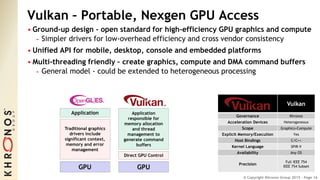
Vulkan – Portable, Nexgen GPU Access
Vulkan
Governance Khronos
Acceleration Devices Heterogeneous
Scope Graphics+Compute
Explicit Memory/Execution Yes
Host Bindings C/C++
Kernel Language SPIR-V
Availability Any OS
Precision
Full IEEE 754
IEEE 754 Subset
• Ground-up design - open standard for high-efficiency GPU graphics and compute
- Simpler drivers for low-overhead efficiency and cross vendor consistency
• Unified API for mobile, desktop, console and embedded platforms
• Multi-threading friendly – create graphics, compute and DMA command buffers
- General model - could be extended to heterogeneous processing
GPU
Traditional graphics
drivers include
significant context,
memory and error
management
Application
GPU
Direct GPU Control
Application
responsible for
memory allocation
and thread
management to
generate command
buffers
© Copyright Khronos Group 2015 - Page 17
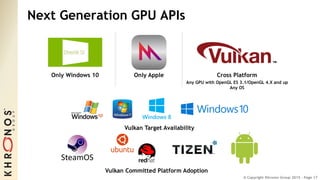
Next Generation GPU APIs
Only AppleOnly Windows 10 Cross Platform
Vulkan Target Availability
Vulkan Committed Platform Adoption
Any GPU with OpenGL ES 3.1/OpenGL 4.X and up
Any OS
© Copyright Khronos Group 2015 - Page 18
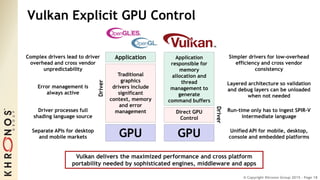
Vulkan Explicit GPU Control
GPU
Traditional
graphics
drivers include
significant
context, memory
and error
management
Application
GPU
Direct GPU
Control
Application
responsible for
memory
allocation and
thread
management to
generate
command buffers
Separate APIs for desktop
and mobile markets
Unified API for mobile, desktop,
console and embedded platforms
Error management is
always active
Layered architecture so validation
and debug layers can be unloaded
when not needed
Driver processes full
shading language source
Run-time only has to ingest SPIR-V
intermediate language
Complex drivers lead to driver
overhead and cross vendor
unpredictability
Simpler drivers for low-overhead
efficiency and cross vendor
consistency
Vulkan delivers the maximized performance and cross platform
portability needed by sophisticated engines, middleware and apps
Driver
Driver
© Copyright Khronos Group 2015 - Page 19
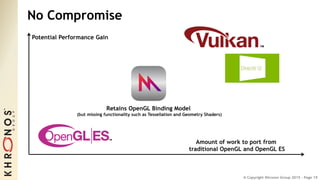
No Compromise
Potential Performance Gain
Retains OpenGL Binding Model
(but missing functionality such as Tessellation and Geometry Shaders)
Amount of work to port from
traditional OpenGL and OpenGL ES
© Copyright Khronos Group 2015 - Page 20
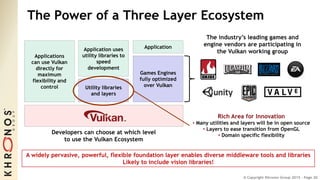
The Power of a Three Layer Ecosystem
Applications
can use Vulkan
directly for
maximum
flexibility and
control Utility libraries
and layers
Application
Games Engines
fully optimized
over Vulkan
Application uses
utility libraries to
speed
development
Rich Area for Innovation
• Many utilities and layers will be in open source
• Layers to ease transition from OpenGL
• Domain specific flexibility
Developers can choose at which level
to use the Vulkan Ecosystem
The industry’s leading games and
engine vendors are participating in
the Vulkan working group
A widely pervasive, powerful, flexible foundation layer enables diverse middleware tools and libraries
Likely to include vision libraries!
© Copyright Khronos Group 2015 - Page 21
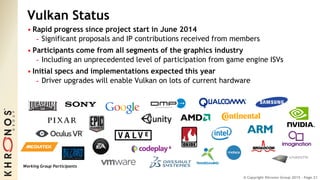
Vulkan Status
• Rapid progress since project start in June 2014
- Significant proposals and IP contributions received from members
• Participants come from all segments of the graphics industry
- Including an unprecedented level of participation from game engine ISVs
• Initial specs and implementations expected this year
- Driver upgrades will enable Vulkan on lots of current hardware
Working Group Participants
© Copyright Khronos Group 2015 - Page 22
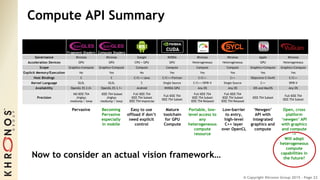
Compute API Summary
Fragment Shaders Compute Shaders
Governance Khronos Khronos Google NVIDIA Khronos Khronos Apple Khronos
Acceleration Devices GPU GPU CPU + GPU GPU Heterogeneous Heterogeneous GPU Heterogeneous
Scope Graphics+Compute Graphics+Compute Compute Compute Compute Compute Graphics+Compute Graphics+Compute
Explicit Memory/Execution No Yes No Yes Yes Yes Yes Yes
Host Bindings C C C/C++/Java C/C++/Fortran C/C++ C++ Objective-C/Swift C/C++
Kernel Language GLSL GLSL C Single Source C/C++/SPIR-V Single Source C++ SPIR-V
Availability OpenGL ES 2.0+ OpenGL ES 3.1+ Android NVIDIA GPU Any OS Any OS iOS and MacOS Any OS
Precision
NO IEEE 754
(highp)
mediump / lowp
IEEE 754 Subset
(highp)
mediump / lowp
Full IEEE 754
IEEE 754 Subset
IEEE 754 Imprecise
Full IEEE 754
IEEE 754 Subset
Full IEEE 754
IEEE 754 Subset
IEEE 754 Relaxed
Full IEEE 754
IEEE 754 Subset
IEEE 754 Relaxed
IEEE 754 Subset
Full IEEE 754
IEEE 754 Subset
RS
Pervasive Becoming
Pervasive
especially
in mobile
Easy to use
offload if don’t
need explicit
control
Mature
toolchain
for GPU
Compute
Portable, low-
level access to
any
heterogeneous
compute
resource
Low-barrier
to entry,
high-level
C++ layer
over OpenCL
‘Newgen’
API with
integrated
graphics and
compute
Open, cross
platform
‘newgen’ API
with graphics
and compute
->
Will adopt
heterogeneous
compute
capabilities in
the future?Now to consider an actual vision framework…
© Copyright Khronos Group 2015 - Page 23
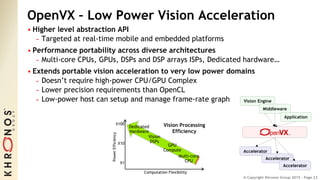
OpenVX – Low Power Vision Acceleration
• Higher level abstraction API
- Targeted at real-time mobile and embedded platforms
• Performance portability across diverse architectures
- Multi-core CPUs, GPUs, DSPs and DSP arrays ISPs, Dedicated hardware…
• Extends portable vision acceleration to very low power domains
- Doesn’t require high-power CPU/GPU Complex
- Lower precision requirements than OpenCL
- Low-power host can setup and manage frame-rate graph
Accelerator
Vision Engine
Middleware
Application
Accelerator
Accelerator
PowerEfficiency
Computation Flexibility
Dedicated
Hardware
GPU
Compute
Multi-core
CPUX1
X10
X100 Vision Processing
Efficiency
Vision
DSPs
© Copyright Khronos Group 2015 - Page 24
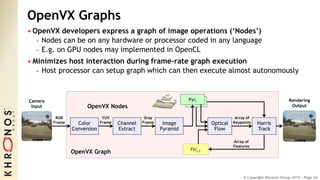
OpenVX Graphs
• OpenVX developers express a graph of image operations (‘Nodes’)
- Nodes can be on any hardware or processor coded in any language
- E.g. on GPU nodes may implemented in OpenCL
• Minimizes host interaction during frame-rate graph execution
- Host processor can setup graph which can then execute almost autonomously
Array of
Keypoints
YUV
Frame
Gray
Frame
Camera
Input
Rendering
Output
Pyrt
Color
Conversion
Channel
Extract
Optical
Flow
Harris
Track
Image
Pyramid
RGB
Frame
Array of
Features
Ftrt-1OpenVX Graph
OpenVX Nodes
© Copyright Khronos Group 2015 - Page 25
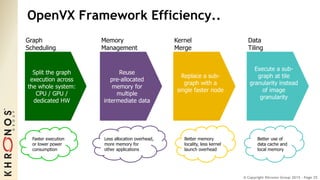
OpenVX Framework Efficiency..
Reuse
pre-allocated
memory for
multiple
intermediate data
Memory
Management
Less allocation overhead,
more memory for
other applications
Replace a sub-
graph with a
single faster node
Kernel
Merge
Better memory
locality, less kernel
launch overhead
Split the graph
execution across
the whole system:
CPU / GPU /
dedicated HW
Graph
Scheduling
Faster execution
or lower power
consumption
Execute a sub-
graph at tile
granularity instead
of image
granularity
Data
Tiling
Better use of
data cache and
local memory
© Copyright Khronos Group 2015 - Page 26
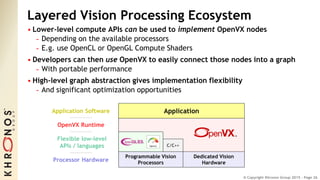
Layered Vision Processing Ecosystem
• Lower-level compute APIs can be used to implement OpenVX nodes
- Depending on the available processors
- E.g. use OpenCL or OpenGL Compute Shaders
• Developers can then use OpenVX to easily connect those nodes into a graph
- With portable performance
• High-level graph abstraction gives implementation flexibility
- And significant optimization opportunities
Programmable Vision
Processors
Dedicated Vision
Hardware
Application
Processor Hardware
Flexible low-level
APIs / languages
Application Software
OpenVX Runtime
C/C++
© Copyright Khronos Group 2015 - Page 27
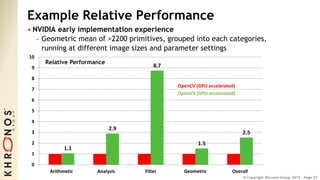
Example Relative Performance
• NVIDIA early implementation experience
- Geometric mean of >2200 primitives, grouped into each categories,
running at different image sizes and parameter settings
1.1
2.9
8.7
1.5
2.5
0
1
2
3
4
5
6
7
8
9
10
Arithmetic Analysis Filter Geometric Overall
OpenCV (GPU accelerated)
OpenVX (GPU accelerated)
Relative Performance
© Copyright Khronos Group 2015 - Page 28
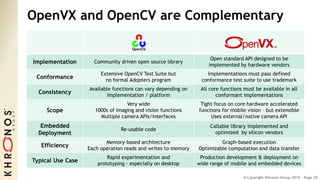
OpenVX and OpenCV are Complementary
Implementation Community driven open source library
Open standard API designed to be
implemented by hardware vendors
Conformance
Extensive OpenCV Test Suite but
no formal Adopters program
Implementations must pass defined
conformance test suite to use trademark
Consistency
Available functions can vary depending on
implementation / platform
All core functions must be available in all
conformant implementations
Scope
Very wide
1000s of imaging and vision functions
Multiple camera APIs/interfaces
Tight focus on core hardware accelerated
functions for mobile vision – but extensible
Uses external/native camera API
Embedded
Deployment
Re-usable code
Callable library implemented and
optimized by silicon vendors
Efficiency
Memory-based architecture
Each operation reads and writes to memory
Graph-based execution
Optimizable computation and data transfer
Typical Use Case
Rapid experimentation and
prototyping - especially on desktop
Production development & deployment on
wide range of mobile and embedded devices
© Copyright Khronos Group 2015 - Page 29
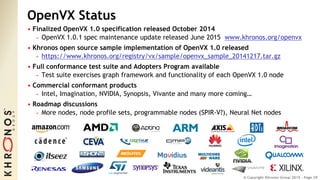
OpenVX Status
• Finalized OpenVX 1.0 specification released October 2014
- OpenVX 1.0.1 spec maintenance update released June 2015 www.khronos.org/openvx
• Khronos open source sample implementation of OpenVX 1.0 released
- https://www.khronos.org/registry/vx/sample/openvx_sample_20141217.tar.gz
• Full conformance test suite and Adopters Program available
- Test suite exercises graph framework and functionality of each OpenVX 1.0 node
• Commercial conformant products
- Intel, Imagination, NVIDIA, Synopsis, Vivante and many more coming…
• Roadmap discussions
- More nodes, node profile sets, programmable nodes (SPIR-V?), Neural Net nodes
© Copyright Khronos Group 2015 - Page 30
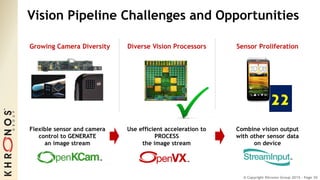
Vision Pipeline Challenges and Opportunities
22
Sensor ProliferationGrowing Camera Diversity Diverse Vision Processors
Flexible sensor and camera
control to GENERATE
an image stream
Use efficient acceleration to
PROCESS
the image stream
Combine vision output
with other sensor data
on device
© Copyright Khronos Group 2015 - Page 31
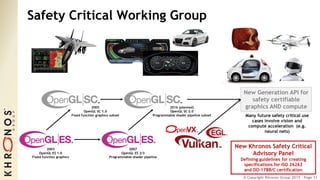
Safety Critical Working Group
New Generation API for
safety certifiable
graphics AND compute
2003
OpenGL ES 1.0
Fixed function graphics
2007
OpenGL ES 2/3
Programmable shader pipeline
2005
OpenGL SC 1.0
Fixed function graphics subset
2016 (planned)
OpenGL SC 2.0
Programmable shader pipeline subset Many future safety critical use
cases involve vision and
compute acceleration (e.g.
neural nets)
New Khronos Safety Critical
Advisory Panel
Defining guidelines for creating
specifications for ISO 26262
and DO-178B/C certification
© Copyright Khronos Group 2015 - Page 32
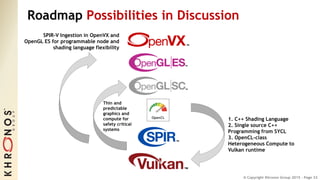
Roadmap Possibilities in Discussion
1. C++ Shading Language
2. Single source C++
Programming from SYCL
3. OpenCL-class
Heterogeneous Compute to
Vulkan runtime
SPIR-V Ingestion in OpenVX and
OpenGL ES for programmable node and
shading language flexibility
Thin and
predictable
graphics and
compute for
safety critical
systems
© Copyright Khronos Group 2015 - Page 33
Summary
• Khronos standards are key to many emerging embedded vision markets
- GPU graphics and compute, parallel computation and vision
- Khronos APIs are royalty-free
• Any company is welcome to join Khronos to influence the direction of these
standards – and propose new initiatives
- $15K annual membership fee for access to all Khronos API working groups
- Well-defined IP framework protects your IP and conformant implementations
• More Information
- www.khronos.org
- ntrevett@nvidia.com
- @neilt3d

"An Update on Open Standard APIs for Vision Processing," a Presentation from Khronos

  • 1.
    © Copyright KhronosGroup 2015 - Page 1 Update on Khronos Open Standard APIs for Vision Processing Neil Trevett | Khronos President NVIDIA Vice President Mobile Ecosystem
  • 2.
    © Copyright KhronosGroup 2015 - Page 2 Khronos Connects Software to Silicon Open Consortium creating ROYALTY-FREE, OPEN STANDARD APIs for hardware acceleration Defining the roadmap for low-level silicon interfaces needed on every platform Graphics, compute and vision processing Rigorous specifications AND conformance tests for cross-vendor portability Acceleration APIs BY the Industry FOR the Industry Well over a BILLION people use Khronos APIs Every Day…
  • 3.
    © Copyright KhronosGroup 2015 - Page 3 Khronos Standards for Vision Processing Low-power, portable vision processing Heterogeneous Parallel Processing for Vision and Neural Net acceleration GPU Graphics and GPU Compute Image: ScreenMedia
  • 4.
    © Copyright KhronosGroup 2015 - Page 4 OpenGL ES Roadmap 2003 1.0 2004 1.1 2007 2.0 2012 3.0 2014 3.1 Driver Update Silicon Update Silicon Update Driver Update Compute Shaders 32-bit integers and floats NPOT, 3D/depth textures Texture arrays Multiple Render Targets Programmable Vertex and fragment shadersFixed function Pipeline Android L 2015 3.2 Silicon Update Tessellation and geometry shaders ASTC Texture Compression Floating point render targets Debug and robustness for security Epic’s Rivalry demo using full Unreal Engine 4 https://www.youtube.com/watch?v=jRr-G95GdaM http://hwstats.unity3d.com/mobile/gpu.html OpenGL ES 2.0 OpenGL ES 3.x AEP (Android Extension Pack) The most widely deployed 3D graphics API in history Industry will ship >1.7 billion OpenGL ES-enabled devices in 2015
  • 5.
    © Copyright KhronosGroup 2015 - Page 5 OpenGL ES Fragment Shaders • Fragment Shaders in OpenGL 2.0 were the original ‘GPGPU’ technique (2004) - Fragment shaders executed as part of graphics pipeline - Need to configure inputs/outputs as textures and images • Mobile fragment shaders arrived in OpenGL ES 2.0 (2007) - Now pervasively available on almost ANY mobile device or OS • Easy integration of compute shaders into graphics apps – no API interop needed - Program kernels (shaders) in GLSL not C - Good for small kernels NOT complete apps - Limited to acceleration on a single GPU OpenGL 4.2 Pipeline OpenGL ES Fragment Shaders Governance Khronos Acceleration Devices GPU Scope Graphics+Compute Explicit Memory/Execution No Host Bindings C Kernel Language GLSL Availability OpenGL ES 2.0+ Precision NO IEEE 754 (highp) mediump / lowp
  • 6.
    © Copyright KhronosGroup 2015 - Page 6 OpenGL ES Compute Shaders • New class of shader introduced in OpenGL 4.4 (2012) and OpenGL ES 3.1 (2014) - Separated from graphics pipe – can use any buffer, image or texture • Much more flexibility on how compute shader is executed and uses memory - But still use GLSL to write kernels and limited to execution on GPU only • OpenGL ES 3.1 is less pervasive than fragment shaders - But mandated in Android Lollipop and Marshmallow – so growing rapidly OpenGL 4.3 Pipeline OpenGL ES Compute Shaders Governance Khronos Acceleration Devices GPU Scope Graphics+Compute Explicit Memory/Execution Yes Host Bindings C Kernel Language GLSL Availability OpenGL ES 3.1+ Precision IEEE 754 Subset (highp) mediump / lowp
  • 7.
    © Copyright KhronosGroup 2015 - Page 7 OpenCL • Heterogeneous parallel programming of diverse compute resources - Targeting supercomputers -> mobile devices -> embedded systems • One code tree can be executed on CPUs, GPUs, DSPs, FPGA and hardware - Distribute work across all available processors in a system • Can represent function of hardware ‘Custom Devices’ as built-in kernels - Control hardware from OpenCL run-time: e.g. video encode/decode, Camera ISP • Robust framework for coding complete applications - One source with both CPU and accelerated paths OpenCL Governance Khronos Acceleration Devices Heterogeneous Scope Compute Explicit Memory/Execution Yes Host Bindings C/C++ Kernel Language C/C++/SPIR-V Availability Any OS Precision Full IEEE 754 IEEE 754 Subset IEEE 754 Relaxed
  • 8.
    © Copyright KhronosGroup 2015 - Page 8 OpenCL – Portable Heterogeneous Computing • OpenCL = Two APIs and Two Kernel languages - C Platform Layer API to query, select and initialize compute devices - OpenCL C and (soon) OpenCL C++ kernel languages to write parallel code - C Runtime API to build and execute kernels across multiple devices • One code tree can be executed on CPUs, GPUs, DSPs, FPGA and hardware - Dynamically balance work across available processors OpenCL Kernel Code OpenCL Kernel Code OpenCL Kernel Code OpenCL Kernel Code GPU DSP CPU CPU FPGA HW Kernel code compiled for devices Devices CPU Host Runtime API loads and executes kernels across devices
  • 9.
    © Copyright KhronosGroup 2015 - Page 9 OpenCL Implementations OpenCL 1.0 Specification Dec08 Jun10 OpenCL 1.1 Specification Nov11 OpenCL 1.2 Specification OpenCL 2.0 Specification Nov13 1.0 | Jul13 1.0 | Aug09 1.0 | May09 1.0 | May10 1.0 | Feb11 1.0 | May09 1.0 | Jan10 1.1 | Aug10 1.1 | Jul11 1.2 | May12 1.2 | Jun12 1.1 | Feb11 1.1 |Mar11 1.1 | Jun10 1.1 | Aug12 1.1 | Nov12 1.1 | May13 1.1 | Apr12 1.2 | Apr14 1.2 | Sep13 1.2 | Dec12 Desktop Mobile FPGA 2.0 | Jul14 OpenCL 2.1 Specification Mar15 1.2 | May15 2.0 | Dec14 1.0 | Dec14 1.2 | Dec14 1.2 | Sep14 Vendor timelines are first implementation of each spec generation 1.2 | May15 Embedded 1.2 | Aug15
  • 10.
    © Copyright KhronosGroup 2015 - Page 10 Embedded Needs Driving OpenCL Roadmap • OpenCL roadmap discussions focused on mobile and embedded markets - Very different needs and constraints to HPC/desktop Different Bottlenecks to HPC Mobile GPU have less processing throughput than desktop GPU often busy with rendering hi-res screen Mobile memory bandwidth is often perf bottleneck Always-on vision / Neural Nets are key use cases Must run at very low power levels Thermal conditions often limit performance Vision Applications Must Not Drop Frames Real-time / guaranteed QOS App performance portability is much more critical More diverse architectures in mobile than HPC 1000s of different devices Many diverse hardware processing blocks DSP, ISP, dedicated hardware Dynamic load-balancing Instrumentation/control to route work to different compute resources depending on system loading Optimize Energy Efficiency Reduce precision – even integer-only profiles? Autonomous frame processing - no host involvement? Extended Execution Model Pre-emption, yielding Higher-level portability frameworks and engines Built over powerful low-level APIs Expand support for Custom Devices Extended pipes and graphs in OpenCL run-time?
  • 11.
    © Copyright KhronosGroup 2015 - Page 11 OpenCL used to Accelerate OpenCV • Extensive and widely used open source vision library – 1,000s of functions - Released under a free-use BSD license - Written in optimized C/C++ • C++, C, Python and Java interfaces - Windows, Linux, Mac OS - iOS and Android • Increasingly taking advantage of heterogeneous processing using OpenCL - OpenCV 3.0 Transparent API - single API entry for each function/algorithm - Dynamically loads OpenCL runtime if available; otherwise falls back to CPU code - Runtime Dispatching - no recompilation! CPU Thread CPU Thread CPU Thread … ocl::Queue ocl::Device ocl::Queue ocl::Queue ocl::Device … … ocl::Context OpenCV Application • One queue and one OpenCL device per CPU thread • Different CPU threads can share a device - but use different queues • OpenCL kernels are executed asynchronously
  • 12.
    © Copyright KhronosGroup 2015 - Page 12 OpenCL as Parallel Language Backend JavaScript binding for initiation of OpenCL C kernels River Trail Language extensions to JavaScript MulticoreWare open source project on Bitbucket Harlan High level language for GPU programming Compiler directives for Fortran, C and C++ Java language extensions for parallelism PyOpenCL Python wrapper around OpenCL Language for image processing and computational photography Single Source C++ Programming for OpenCL Approaching 200 languages, frameworks and projects using OpenCL as a compiler target to access vendor optimized, heterogeneous compute runtimes This trend will be significantly accelerated by the availability of SPIR-V which is specifically designed to be a compiler target
  • 13.
    © Copyright KhronosGroup 2015 - Page 13 OpenCL 2.1 Released – November 2015 • Support for the SPIR-V 1.0 intermediate language in core - E.g. SPIR-V used to ingest from diverse language front-ends - OpenCL C ingestion still supported to preserve kernel code investment • OpenCL API updates - E.g. subgroups and subgroup queries in core • Runs on any OpenCL 2.0-capable hardware - Only driver update required OpenCL 1.0 Specification Dec08 Jun10 OpenCL 1.1 Specification Nov11 OpenCL 1.2 Specification OpenCL 2.0 Specification Nov13 Device partitioning Separate compilation and linking Enhanced image support Built-in kernels / custom devices Enhanced DX and OpenGL Interop Shared Virtual Memory On-device dispatch Generic Address Space Enhanced Image Support C11 Atomics Pipes Android ICD 3-component vectors Additional image formats Multiple hosts and devices Buffer region operations Enhanced event-driven execution Additional OpenCL C built-ins Improved OpenGL data/event interop 18 months 18 months 24 months OpenCL 2.1 Specification Nov1524 months SPIR-V in Core Subgroups into core Subgroup query operations clCloneKernel Low-latency device timer queries
  • 14.
    © Copyright KhronosGroup 2015 - Page 14 SPIR-V Transforms the Language Ecosystem • First multi-API, intermediate language for parallel compute and graphics - Native representation for Vulkan shader and OpenCL kernel source languages - https://www.khronos.org/registry/spir-v/papers/WhitePaper.pdf • Cross vendor intermediate representation - Language front-ends can easily access multiple hardware run-times - Acceleration hardware can leverage multiple language front-ends - Encourages tools for program analysis and optimization in SPIR form Diverse Languages and Frameworks Hardware runtimes on multiple architectures Tools for analysis and optimization Standard Portable Intermediate Representation Multiple Developer Advantages Same front-end compiler for multiple platforms Reduces runtime kernel compilation time Don’t have to ship shader/kernel source code Drivers are simpler and more reliable
  • 15.
    © Copyright KhronosGroup 2015 - Page 15 Driving the SPIR-V Open Source Ecosystem LLVM Third party kernel and shader Languages SPIR-V • 32-bit Word Stream • Extensible and easily parsed • Retains data object and control flow information for effective code generation and translation OpenCL C++OpenCL C GLSL Khronos has open sourced these tools and translators IHV Driver Runtimes Other Intermediate Forms SPIR-V Validator SPIR-V Tools SPIR-V (Dis)Assembler LLVM to SPIR-V Bi-directional Translator Khronos plans to open source these tools soon
  • 16.
    © Copyright KhronosGroup 2015 - Page 16 Vulkan – Portable, Nexgen GPU Access Vulkan Governance Khronos Acceleration Devices Heterogeneous Scope Graphics+Compute Explicit Memory/Execution Yes Host Bindings C/C++ Kernel Language SPIR-V Availability Any OS Precision Full IEEE 754 IEEE 754 Subset • Ground-up design - open standard for high-efficiency GPU graphics and compute - Simpler drivers for low-overhead efficiency and cross vendor consistency • Unified API for mobile, desktop, console and embedded platforms • Multi-threading friendly – create graphics, compute and DMA command buffers - General model - could be extended to heterogeneous processing GPU Traditional graphics drivers include significant context, memory and error management Application GPU Direct GPU Control Application responsible for memory allocation and thread management to generate command buffers
  • 17.
    © Copyright KhronosGroup 2015 - Page 17 Next Generation GPU APIs Only AppleOnly Windows 10 Cross Platform Vulkan Target Availability Vulkan Committed Platform Adoption Any GPU with OpenGL ES 3.1/OpenGL 4.X and up Any OS
  • 18.
    © Copyright KhronosGroup 2015 - Page 18 Vulkan Explicit GPU Control GPU Traditional graphics drivers include significant context, memory and error management Application GPU Direct GPU Control Application responsible for memory allocation and thread management to generate command buffers Separate APIs for desktop and mobile markets Unified API for mobile, desktop, console and embedded platforms Error management is always active Layered architecture so validation and debug layers can be unloaded when not needed Driver processes full shading language source Run-time only has to ingest SPIR-V intermediate language Complex drivers lead to driver overhead and cross vendor unpredictability Simpler drivers for low-overhead efficiency and cross vendor consistency Vulkan delivers the maximized performance and cross platform portability needed by sophisticated engines, middleware and apps Driver Driver
  • 19.
    © Copyright KhronosGroup 2015 - Page 19 No Compromise Potential Performance Gain Retains OpenGL Binding Model (but missing functionality such as Tessellation and Geometry Shaders) Amount of work to port from traditional OpenGL and OpenGL ES
  • 20.
    © Copyright KhronosGroup 2015 - Page 20 The Power of a Three Layer Ecosystem Applications can use Vulkan directly for maximum flexibility and control Utility libraries and layers Application Games Engines fully optimized over Vulkan Application uses utility libraries to speed development Rich Area for Innovation • Many utilities and layers will be in open source • Layers to ease transition from OpenGL • Domain specific flexibility Developers can choose at which level to use the Vulkan Ecosystem The industry’s leading games and engine vendors are participating in the Vulkan working group A widely pervasive, powerful, flexible foundation layer enables diverse middleware tools and libraries Likely to include vision libraries!
  • 21.
    © Copyright KhronosGroup 2015 - Page 21 Vulkan Status • Rapid progress since project start in June 2014 - Significant proposals and IP contributions received from members • Participants come from all segments of the graphics industry - Including an unprecedented level of participation from game engine ISVs • Initial specs and implementations expected this year - Driver upgrades will enable Vulkan on lots of current hardware Working Group Participants
  • 22.
    © Copyright KhronosGroup 2015 - Page 22 Compute API Summary Fragment Shaders Compute Shaders Governance Khronos Khronos Google NVIDIA Khronos Khronos Apple Khronos Acceleration Devices GPU GPU CPU + GPU GPU Heterogeneous Heterogeneous GPU Heterogeneous Scope Graphics+Compute Graphics+Compute Compute Compute Compute Compute Graphics+Compute Graphics+Compute Explicit Memory/Execution No Yes No Yes Yes Yes Yes Yes Host Bindings C C C/C++/Java C/C++/Fortran C/C++ C++ Objective-C/Swift C/C++ Kernel Language GLSL GLSL C Single Source C/C++/SPIR-V Single Source C++ SPIR-V Availability OpenGL ES 2.0+ OpenGL ES 3.1+ Android NVIDIA GPU Any OS Any OS iOS and MacOS Any OS Precision NO IEEE 754 (highp) mediump / lowp IEEE 754 Subset (highp) mediump / lowp Full IEEE 754 IEEE 754 Subset IEEE 754 Imprecise Full IEEE 754 IEEE 754 Subset Full IEEE 754 IEEE 754 Subset IEEE 754 Relaxed Full IEEE 754 IEEE 754 Subset IEEE 754 Relaxed IEEE 754 Subset Full IEEE 754 IEEE 754 Subset RS Pervasive Becoming Pervasive especially in mobile Easy to use offload if don’t need explicit control Mature toolchain for GPU Compute Portable, low- level access to any heterogeneous compute resource Low-barrier to entry, high-level C++ layer over OpenCL ‘Newgen’ API with integrated graphics and compute Open, cross platform ‘newgen’ API with graphics and compute -> Will adopt heterogeneous compute capabilities in the future?Now to consider an actual vision framework…
  • 23.
    © Copyright KhronosGroup 2015 - Page 23 OpenVX – Low Power Vision Acceleration • Higher level abstraction API - Targeted at real-time mobile and embedded platforms • Performance portability across diverse architectures - Multi-core CPUs, GPUs, DSPs and DSP arrays ISPs, Dedicated hardware… • Extends portable vision acceleration to very low power domains - Doesn’t require high-power CPU/GPU Complex - Lower precision requirements than OpenCL - Low-power host can setup and manage frame-rate graph Accelerator Vision Engine Middleware Application Accelerator Accelerator PowerEfficiency Computation Flexibility Dedicated Hardware GPU Compute Multi-core CPUX1 X10 X100 Vision Processing Efficiency Vision DSPs
  • 24.
    © Copyright KhronosGroup 2015 - Page 24 OpenVX Graphs • OpenVX developers express a graph of image operations (‘Nodes’) - Nodes can be on any hardware or processor coded in any language - E.g. on GPU nodes may implemented in OpenCL • Minimizes host interaction during frame-rate graph execution - Host processor can setup graph which can then execute almost autonomously Array of Keypoints YUV Frame Gray Frame Camera Input Rendering Output Pyrt Color Conversion Channel Extract Optical Flow Harris Track Image Pyramid RGB Frame Array of Features Ftrt-1OpenVX Graph OpenVX Nodes
  • 25.
    © Copyright KhronosGroup 2015 - Page 25 OpenVX Framework Efficiency.. Reuse pre-allocated memory for multiple intermediate data Memory Management Less allocation overhead, more memory for other applications Replace a sub- graph with a single faster node Kernel Merge Better memory locality, less kernel launch overhead Split the graph execution across the whole system: CPU / GPU / dedicated HW Graph Scheduling Faster execution or lower power consumption Execute a sub- graph at tile granularity instead of image granularity Data Tiling Better use of data cache and local memory
  • 26.
    © Copyright KhronosGroup 2015 - Page 26 Layered Vision Processing Ecosystem • Lower-level compute APIs can be used to implement OpenVX nodes - Depending on the available processors - E.g. use OpenCL or OpenGL Compute Shaders • Developers can then use OpenVX to easily connect those nodes into a graph - With portable performance • High-level graph abstraction gives implementation flexibility - And significant optimization opportunities Programmable Vision Processors Dedicated Vision Hardware Application Processor Hardware Flexible low-level APIs / languages Application Software OpenVX Runtime C/C++
  • 27.
    © Copyright KhronosGroup 2015 - Page 27 Example Relative Performance • NVIDIA early implementation experience - Geometric mean of >2200 primitives, grouped into each categories, running at different image sizes and parameter settings 1.1 2.9 8.7 1.5 2.5 0 1 2 3 4 5 6 7 8 9 10 Arithmetic Analysis Filter Geometric Overall OpenCV (GPU accelerated) OpenVX (GPU accelerated) Relative Performance
  • 28.
    © Copyright KhronosGroup 2015 - Page 28 OpenVX and OpenCV are Complementary Implementation Community driven open source library Open standard API designed to be implemented by hardware vendors Conformance Extensive OpenCV Test Suite but no formal Adopters program Implementations must pass defined conformance test suite to use trademark Consistency Available functions can vary depending on implementation / platform All core functions must be available in all conformant implementations Scope Very wide 1000s of imaging and vision functions Multiple camera APIs/interfaces Tight focus on core hardware accelerated functions for mobile vision – but extensible Uses external/native camera API Embedded Deployment Re-usable code Callable library implemented and optimized by silicon vendors Efficiency Memory-based architecture Each operation reads and writes to memory Graph-based execution Optimizable computation and data transfer Typical Use Case Rapid experimentation and prototyping - especially on desktop Production development & deployment on wide range of mobile and embedded devices
  • 29.
    © Copyright KhronosGroup 2015 - Page 29 OpenVX Status • Finalized OpenVX 1.0 specification released October 2014 - OpenVX 1.0.1 spec maintenance update released June 2015 www.khronos.org/openvx • Khronos open source sample implementation of OpenVX 1.0 released - https://www.khronos.org/registry/vx/sample/openvx_sample_20141217.tar.gz • Full conformance test suite and Adopters Program available - Test suite exercises graph framework and functionality of each OpenVX 1.0 node • Commercial conformant products - Intel, Imagination, NVIDIA, Synopsis, Vivante and many more coming… • Roadmap discussions - More nodes, node profile sets, programmable nodes (SPIR-V?), Neural Net nodes
  • 30.
    © Copyright KhronosGroup 2015 - Page 30 Vision Pipeline Challenges and Opportunities 22 Sensor ProliferationGrowing Camera Diversity Diverse Vision Processors Flexible sensor and camera control to GENERATE an image stream Use efficient acceleration to PROCESS the image stream Combine vision output with other sensor data on device
  • 31.
    © Copyright KhronosGroup 2015 - Page 31 Safety Critical Working Group New Generation API for safety certifiable graphics AND compute 2003 OpenGL ES 1.0 Fixed function graphics 2007 OpenGL ES 2/3 Programmable shader pipeline 2005 OpenGL SC 1.0 Fixed function graphics subset 2016 (planned) OpenGL SC 2.0 Programmable shader pipeline subset Many future safety critical use cases involve vision and compute acceleration (e.g. neural nets) New Khronos Safety Critical Advisory Panel Defining guidelines for creating specifications for ISO 26262 and DO-178B/C certification
  • 32.
    © Copyright KhronosGroup 2015 - Page 32 Roadmap Possibilities in Discussion 1. C++ Shading Language 2. Single source C++ Programming from SYCL 3. OpenCL-class Heterogeneous Compute to Vulkan runtime SPIR-V Ingestion in OpenVX and OpenGL ES for programmable node and shading language flexibility Thin and predictable graphics and compute for safety critical systems
  • 33.
    © Copyright KhronosGroup 2015 - Page 33 Summary • Khronos standards are key to many emerging embedded vision markets - GPU graphics and compute, parallel computation and vision - Khronos APIs are royalty-free • Any company is welcome to join Khronos to influence the direction of these standards – and propose new initiatives - $15K annual membership fee for access to all Khronos API working groups - Well-defined IP framework protects your IP and conformant implementations • More Information - www.khronos.org - ntrevett@nvidia.com - @neilt3d