OXFAM WASH COMMITTE GUIDE FOR
SOOL AND SANAAG WASH COMMITTEE
TRAINING-SEPT 2017
PROJECT-WASHPROJECT-DROUGHT
RESPONSE
Oct 2017-March 2018
TOPICS
• Water sources and Safe drinking water
• Role and responsibility of WASH Committees
• Leadership skills
• Conflict management
• Equal representation
• Effective Communication
• The concept of sustainability
• Water Uses Governance-Constitution
• Financial Management
• Operation and Maintenance of shallow well/pump
• Cholera/ORS preparation
Community water sources
• In a group, list the water sources in you area
• Each group to pick a presenter
• Session to last 10 mins
Common water sources
Surface water Underground water sources
1. Rivers 1.Wells
2.Streams 2. Boreholes
3. Spring
4. Ponds
5. Swamps
6. Dams
7. Lakes, Seas, Oceans
8. Birkads
9. Rain water harvesting.
Common uses of water
Domestic Uses
• Washing
• Bathing
• Cleaning
• Cooking
• Drinking
Industrial Uses
• Construction
• Manufacturing
• Milling
• Waste Management
• Power Generation
• Fishing
• Irrigation
Drinking water
What is safe drinking water?
Quality of safe water? brain storming !
• Water that is free from contamination, that does not have harmful
substances such as bacteria
• It is important for drinking water to make sure that drinking water is
safe to live healthy lives
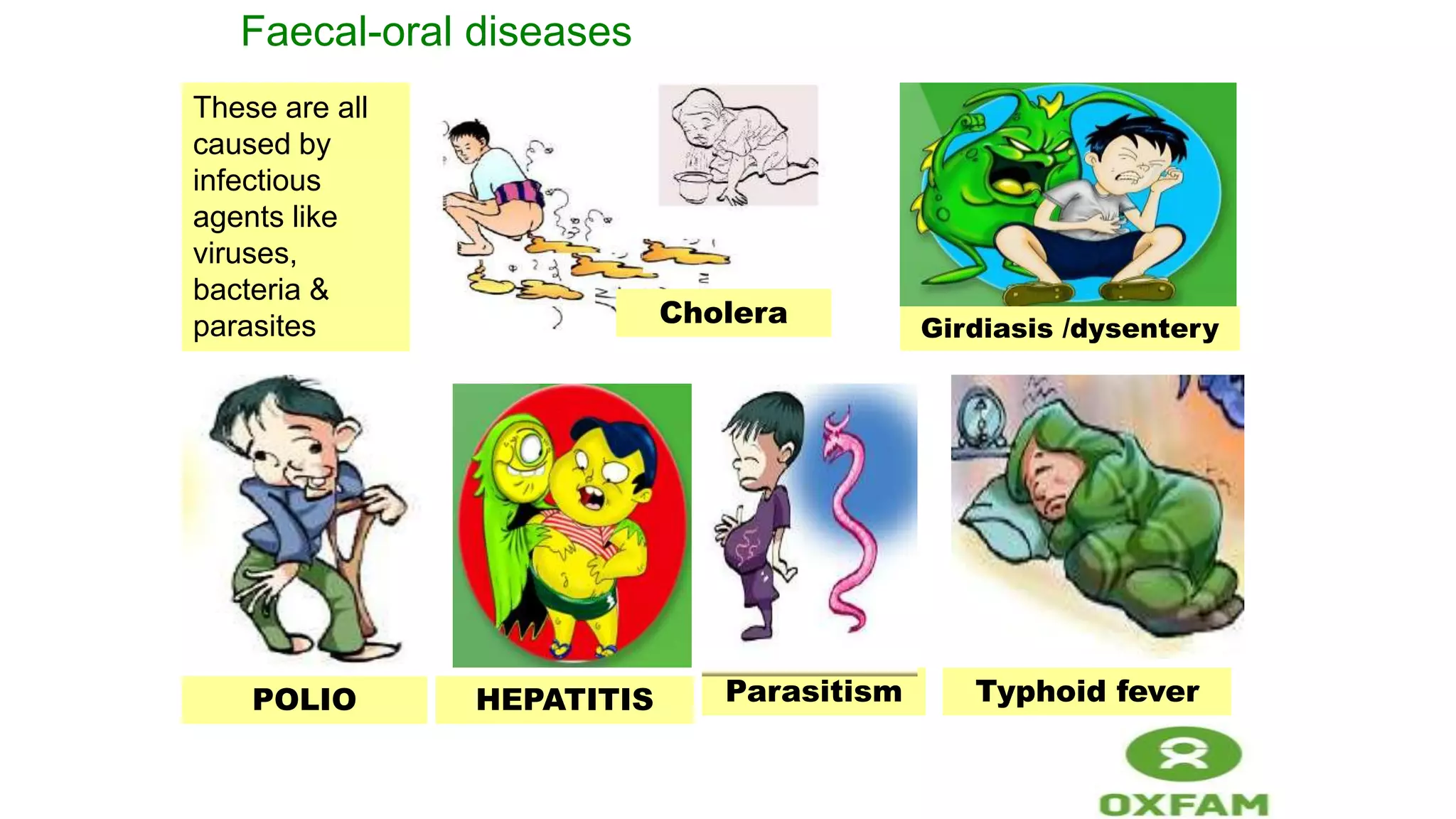
Faecal-oral diseases
Girdiasis /dysentery
HEPATITIS Typhoid fever
POLIO Parasitism
These are all
caused by
infectious
agents like
viruses,
bacteria &
parasites Cholera
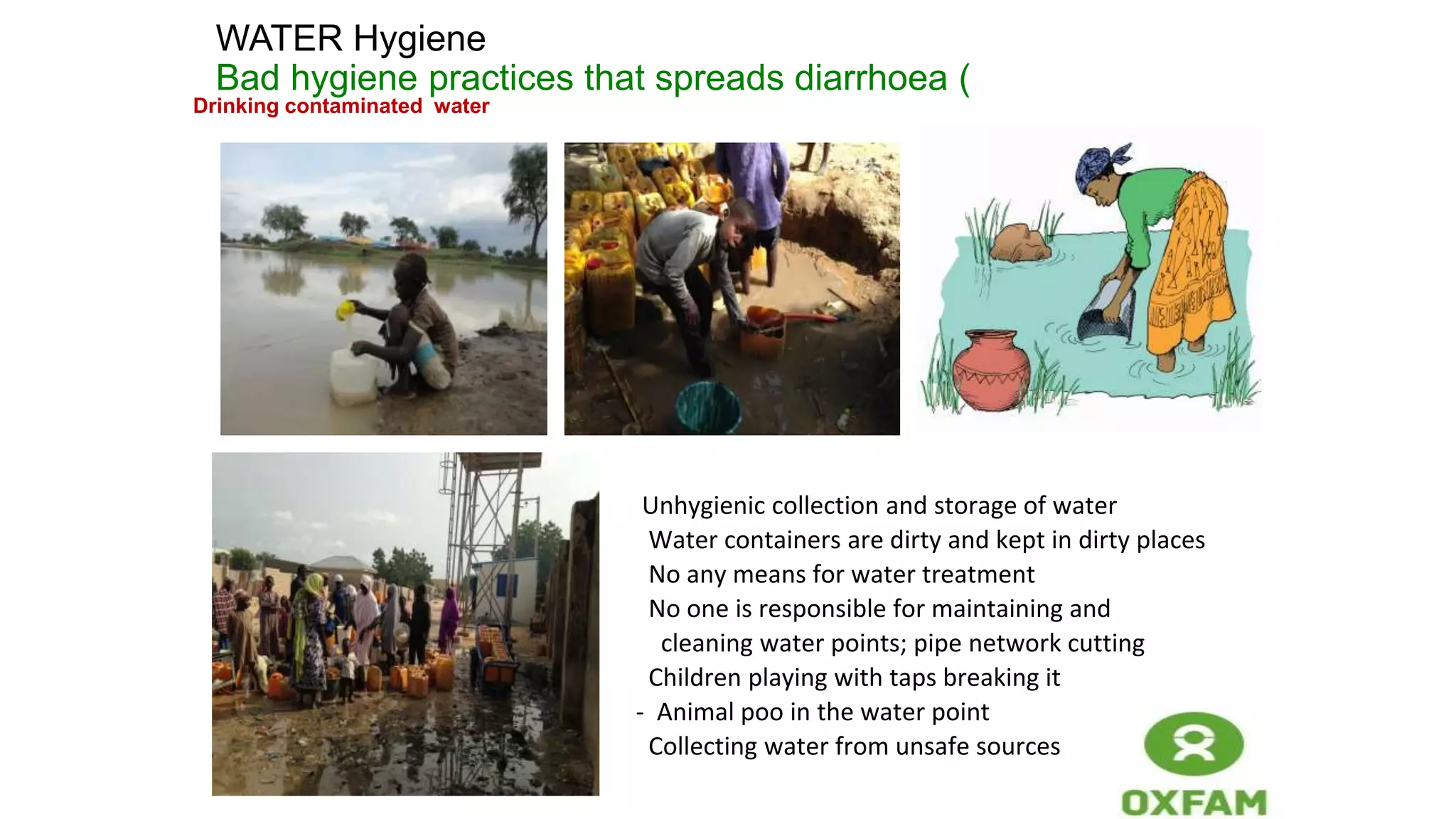
Drinking contaminated water
WATER Hygiene
Bad hygiene practices that spreads diarrhoea (
Unhygienic collection and storage of water
Water containers are dirty and kept in dirty places
No any means for water treatment
No one is responsible for maintaining and
cleaning water points; pipe network cutting
Children playing with taps breaking it
- Animal poo in the water point
Collecting water from unsafe sources
Water Treatment
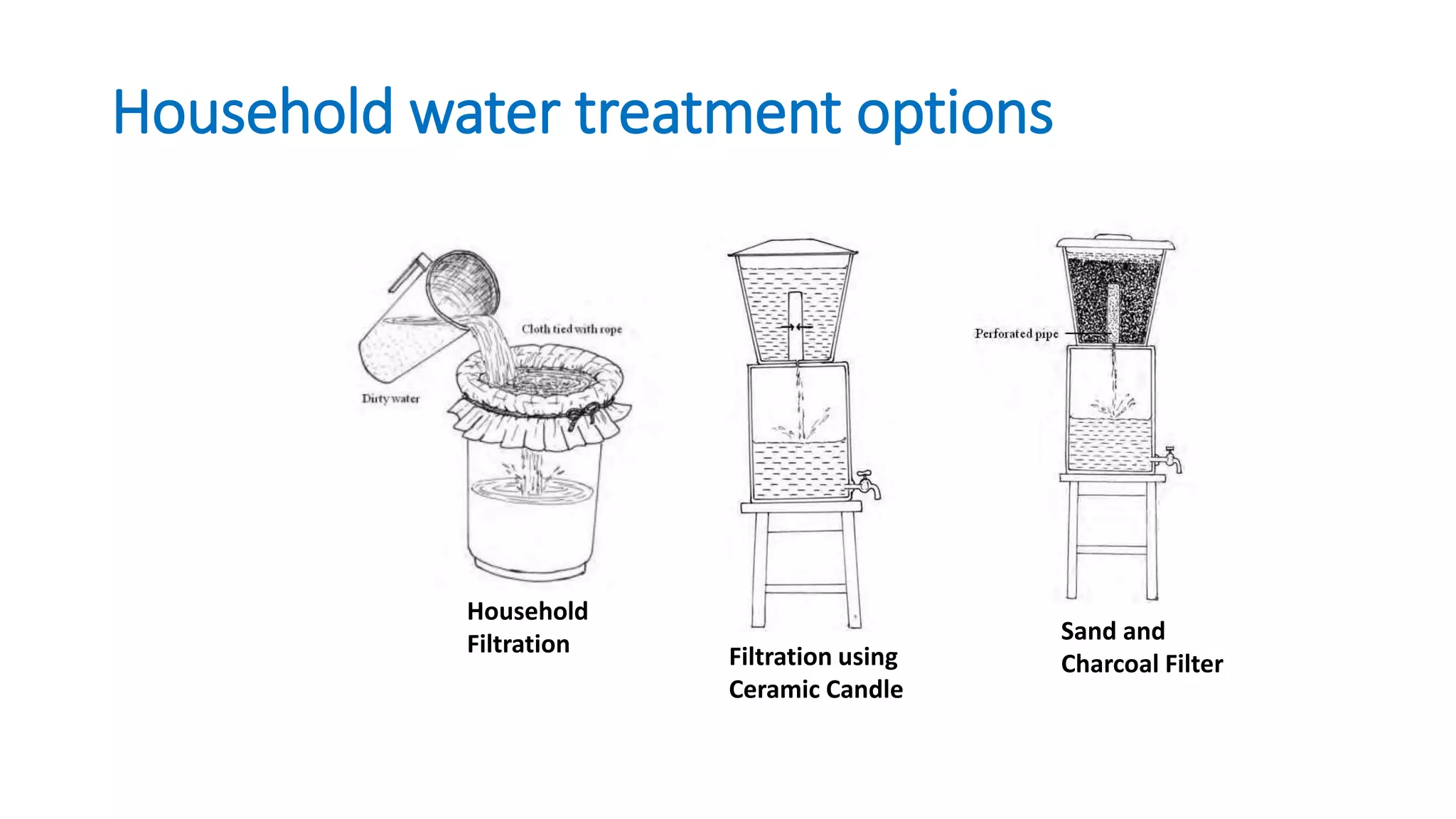
Household water treatment options: brain storming !
• Boiling of water
• Use of PUR or aqua tabs
• Filtering
• Solar disinfection
• Chemical disinfection
Household water treatment options
Household
Filtration Filtration using
Ceramic Candle
Sand and
Charcoal Filter
Household water treatment options
24 hours Sunlight
Disinfection System -
SODIS
Disinfection through
Boiling
Chlorine
Solution-
Demonstrate
best use of
aqua tabs and
water makers
Effective Water Management Point
• Allah provides us clean water but humans through their activities
contaminate it. We need to have safe drinking water and it is our
responsibility to promote healthy families.
• How can we manage water points? Group discussion.
WASH Committees composition
• Chairman
• Vice chairman
• Secretary
• Treasurer
• Operator
• Community Health Mobilizer/Worker
Roles of a Water point committee
• To work closely together with other local leaders the maintenance of their water point.
• To ensure the water point surroundings clean.
• To report any water point breakdowns which are beyond the abilities of the caretakers.
• To mobilise water point beneficiaries to perform any task required at the water point.
• To report to other local leaders any misconduct directed at affecting the proper functioning of the
water point.
• To hold meetings with other local leaders and beneficiaries to implement the agreed constitution.
• To encourage communities to undertake co-operative gardening if the water point has a good
yield.
• To keep a record of water point beneficiaries, cleaning schedule and fees paid
• To keep safely records of water point meetings, money contributed and all work done at the
water point by the community
.
Role and responsibility of chairman-WMC
Provide leadership to the management committee to enable it to
fulfil its roles and this includes;
• Chair all WUA meetings
• Ensure all WUA records are probably maintained
• Ensure smooth running of WUA activities
• Enforcement of bylaws
Role and responsibility of Vice-chairman-WMC
• Chair all Water management meetings on behalf of the chairman
• Ensure all Water management records are probably maintained
• Ensure smooth running of WASH facilities
• Enforcement of bylaws
Role and responsibility of secretary-WMC
• Keep WASH records;
• To record minutes of all meetings
• To maintain members register
• To ensure that the water supply correspondence is correctly and
efficiently attended to
Role and responsibility of treasurer-WMC
To be responsible for all finance of the WASH Committees;
• Keep records of the WASH asset and finance
• To check all payments
• To sign all payment vouchers
• To ensure Banking of all monies received on behalf of the WMC
Role and responsibility of Community
Health Mobilizers/Workers
• Ensure hygiene awareness session/campaign conducted in the
community level
• Ensure the water point is clean/monitor hygiene level
• Promote safe drinking water at household
• Report cases of diseases outbreak in the community/water point
Role and responsibility of Water Operator- WMC
• Ensure the water facility are functional
• Conduct operation maintenance incase of breakdown
• Safeguard the water s/sanitation facilities against vandalism
• Report incase of misuse of water/sanitation facilities
Leadership-Exercise
Group Exercise
• Divide participants into groups
• Ask each group to brainstorm on the following;
• Who is a leader?
• How do you identify a good leader?
• What are the qualities of a good leader?
• Name 5 leaders you like and list the reasons you like them.
• Each group to record the responses and present in a plenary session
where the facilitator will bring out the aspects of leadership as discussed.
Qualities of a good leader
• Acceptability: A person who commands respect and self discipline. Has
good interpersonal relation and meets minimum community norms of good
conduct
• Job competence: Has good record of exemplary performance
• Ability to listen: Listens patiently for meaning and understanding
• Tolerance: Has ability to listen and accommodate dissenting views and
constructive criticism
• Delegation: Willing and able share responsibility in order to build the
potential of others
• Flexibility: Open to change and reason
• Self organization: Sets an example on personal orderliness
• Honesty: Can be trusted at all times
• Reliability: Is dependable on words, promise and deeds
• Impartial: is guided by fairness, truth and justice in making all decisions
Conflict management
Definition
• Conflict is defined as „clash of interests between two or more parties
when at least one of the parties seeks to assert its interests at the
expense of another party's interests‟.
Steps to Minimizing Conflicts
• Frequent and timely meetings can help to reduce conflicts.
• Transparency and accountability especially in finances and
groups/committees assets will ensure that conflicts are easily
resolved. Production of records i.e. treasurers report and reading in
the AGMs will always ensure confidence
Conflict management
• Timely elections – It is important for leaders to renew their mandate by
calling for the elections at the scheduled time. The elections must always be
transparent.
• Conflicts can be managed through regular consultations among officials and
members. This reduces suspicions and unnecessary rumours.
• Open tendering and staff recruitment for groups/committees with such
provisions will reduce conflict. This will always encourage professionalism
and reduce such vices as nepotism, favoritism, clan-ism.
• Gender balanced committees are normally stable and more accountable.
Groups are encouraged to include all interested parties in the composition
of the committees.
Conflict management
• Sometimes coercion/force may be used to resolve conflicts. Errant
members who refuse to reform may be suspended or expelled to
safeguard the interests of the group. However coercion must be used
as a last resort.
• Co-option may help in solving/reducing conflicts. Some relevant
stakeholders may be included in a project if their inclusion will add
value to the objective of the group/committee.
• Training of officials/members can reduce conflict; training increases
efficiency and effectiveness of the group leaders. For members it
increases participation especially on community contribution and
decision-making.
Conflict management(Participants form two
groups:
Group 1: to discuss if and when a conflict is needed
• Helps to raise and address problems.
• Energizes work to be on the most appropriate issues.
• Helps people "be real", for example, it motivates them to participate.
• Helps people learn how to recognize and benefit from their
differences.
• Conflict is not the same as discomfort. The conflict isn't the problem -
it is when conflict is poorly managed that is the problem.
Conflict management(Participants form two
groups:
Group 2: when a conflict is a problem:
• Hampers productivity.
• Lowers morale.
• Causes more and continued conflicts.
• Causes inappropriate behaviours.
• The groups discuss the topics and present to the plenary where
other participants discuss the topics further.
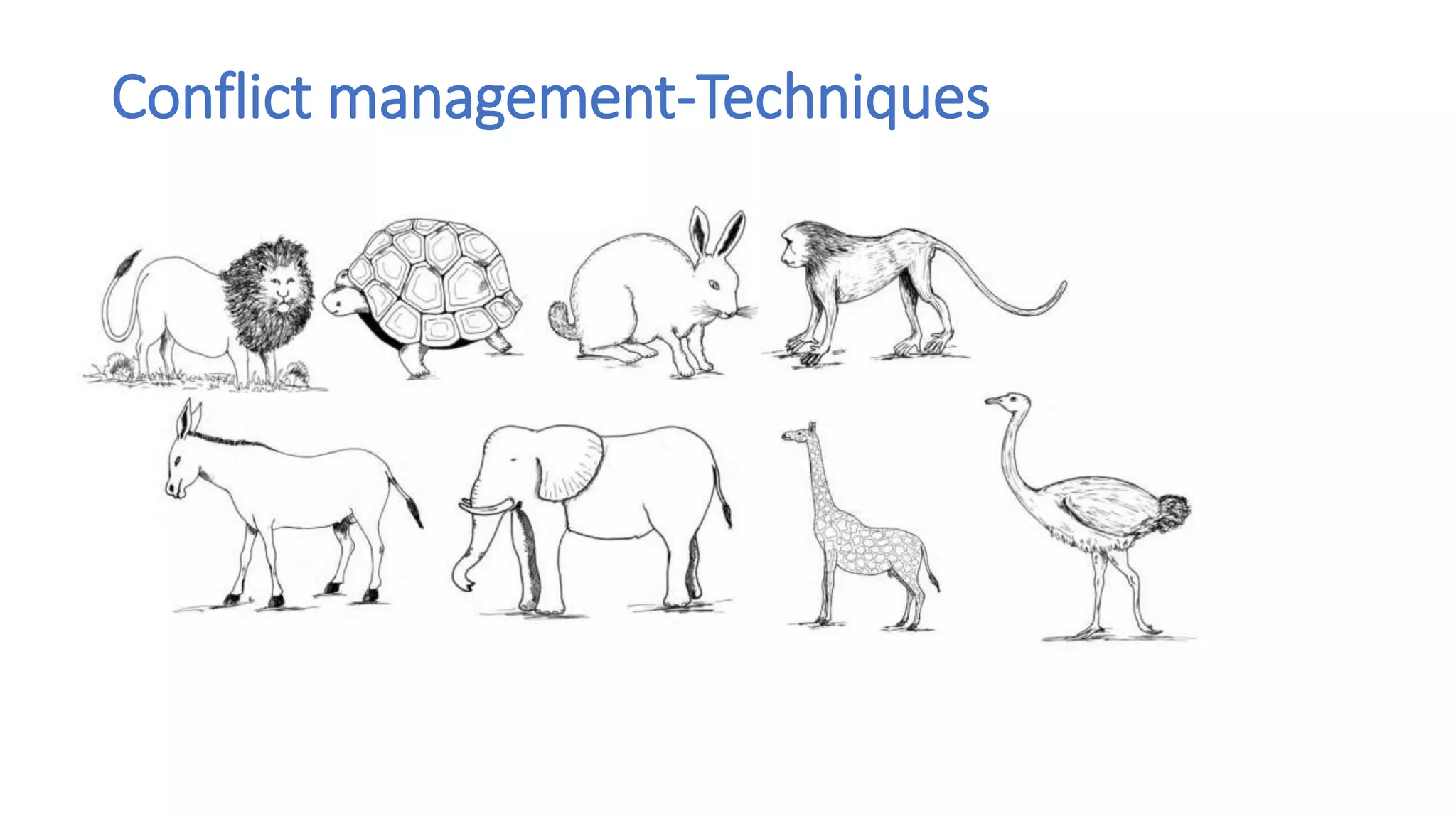
Conflict management-Techniques
Equal representation
What is Gender?
• Gender relates to both men and women. A gender based approach
looks at the social differences between men and women to seek a
balance, which optimizes the roles and responsibilities of both men
and women.
Water management
Group work
• Who is responsible for water collection in the households
• Who managed the use of water in the home?
• Who would most likely know the amount of water required for
household use
• Who in most instances is home more often taking care of the family
• Who should take decisions concerning water
Effective meeting and Decision Making
Objective;
• Differentiate between the different types of meetings in the WUA
constitution;
• Discuss the procedures for conducting meetings and decision making;
• importance of minutes of a WUA meeting and how to take them.
Different Types of WMC Meetings
• Committee Meetings
• Held regularly, e.g. once every month by the project committee
members;
• To discuss matters mainly concerning administration of the project.
Effective meeting and Decision Making
Committees to decide the schedule of the meetings and topics under
discussion?
• Status of the water
• Problems
• Operation and Maintenance and schedule(Cleaning, planning,
campaigns )
• Community Contributions and expenditures
Effective meeting and Decision Making
Stages of Making Decisions
• Gathering the facts
• Consulting those involved
• Making the decision and actions
• Explaining the decision
• Reporting and the signature
• Monitoring the process and results of the decision
The concept of sustainability
Does the system is functioning? What is the problem?
How can we ensure our water points are durable?
Water Management Committees Financial
Management
Setting Tariffs
The purpose of this session is to establish the financial basis for
sustainable operation, along with considerations that go in to setting a
tariff structure. Without a properly agreed tariff the community will not
be sustainable as either the members will feel they are paying too
much money or there will be no funds to pay for operation and
maintenance
Commonly used tariff structures:
• Flat rate per household per month or year: It is easy to implement.
Tariff is unfair in that low consumers pay the same as high consumers
Water Management Bylaws
Steps that a group can take to minimize the bylaws being overlooked
are:
• Ensure all project members have a copy of the constitution and have
had a chance to be „inducted‟ into the constitution;
• Appoint an oversight or audit sub-committee whose job it is to
ensure that the constitution is followed and to raise any points to the
main committee where the constitution is overlooked
• In cases where the constitution is impractical, then it is necessary to
make a change to the constitution so that it can be followed more
easily.
WMC Bylaws-Component
• Article 1: Name
• Article 2: Area of Operation
• Article 3: Objective
• Article 4: The Membership-Cessation from Membership
-Suspension from Membership
• Article 5: Activities of the WUA
• Article 6:Committee Members
• Article 7 - The Management Committee
• Article 8 - Duties of the Management Committee
• Article 9:Office Bearers
• Article 10: Duties of Office Bearers
• Article 11: Duties of Ordinary Committee Members
• Article 12:Meetings
WMC Bylaws-Component
• Article 13: Sources of WUA Funds
• Article 14: Use of WUA Funds
• Article 15: Control of WUA Funds
• Article 16: Procurement and care of WUA Property
• Article 17: Books of the WUA
• Article 18: Auditors
• Article 19: Amendment of the Constitution
• Article 20: Arbitration
• Article 22: Accountability
• Article 21: Elections
• Article 23: Dissolution
Do’s and don’ts at water points.
• Key features of the water points?
Water Management Committees Financial
Management
• Flat rate per unit volume: Water gathered from a water kiosk or stand pipe
is commonly sold at a single price for uniform container (e.g. 20 litre jerry
can ). For metered connections, the tariff is fixed at a single rate for each
cubic metre of water
• Charge per unit of livestock: this is frequently used in pastoral areas where
livestock keeping predominant livelihood and livestock demand for water is
significant. Tariff will vary according to livestock
• Block tariff: The tariff is different for different quantities of water. Typically
the tariff increase as the total consumed per month volume increases. The
advantage of block tariff is that it enables low tariff to be charged for small
consumers and higher rates to be charged for larger consumers (a pro-poor
structure). This encourages consumers to reduce consumption and be more
efficient.
Water Management Committees Financial
Management
Basic for tariff settings;
• What people can
• What are willing to pay
• What the Bore hole requires to cover the operating costs (Partial cost
recovery)
• What the Bore hole requires to cover all operating costs and to
replace the assets when they need replacement (full cost recovery)
• The maximum the Bore hole can possibly charge
Water Management Committees Financial
Management
Tariff regulation
• Water is a basic human need and is constitutional right
• The cost of building water points with safe and reliable water is expensive
• A balance has to be found between setting a tariff that covers the cost of
operating the Bore hole and ensuring that consumers are not exploited
Ways to ensure that consumers are not exploited:
WUA should be transparent about the cost operating the Bore hole and how
the tariffs have been established. This approach is reflected in the
preparation and approval of the annual budget and the submission of
financial and audit report to the AGM. An independent Government
Organization is mandated to check that tariffs are justifiable. The
organization with mandate is not yet in place in Somalia
Operational budget for 1 water point
• Cost of pump attendant
• Cost of repairs
• Cost of water form private truckers
• Stationery for the committee
• Security fees for the water point
For the water point to run effectively throughout the year, how much
money should each household raise?
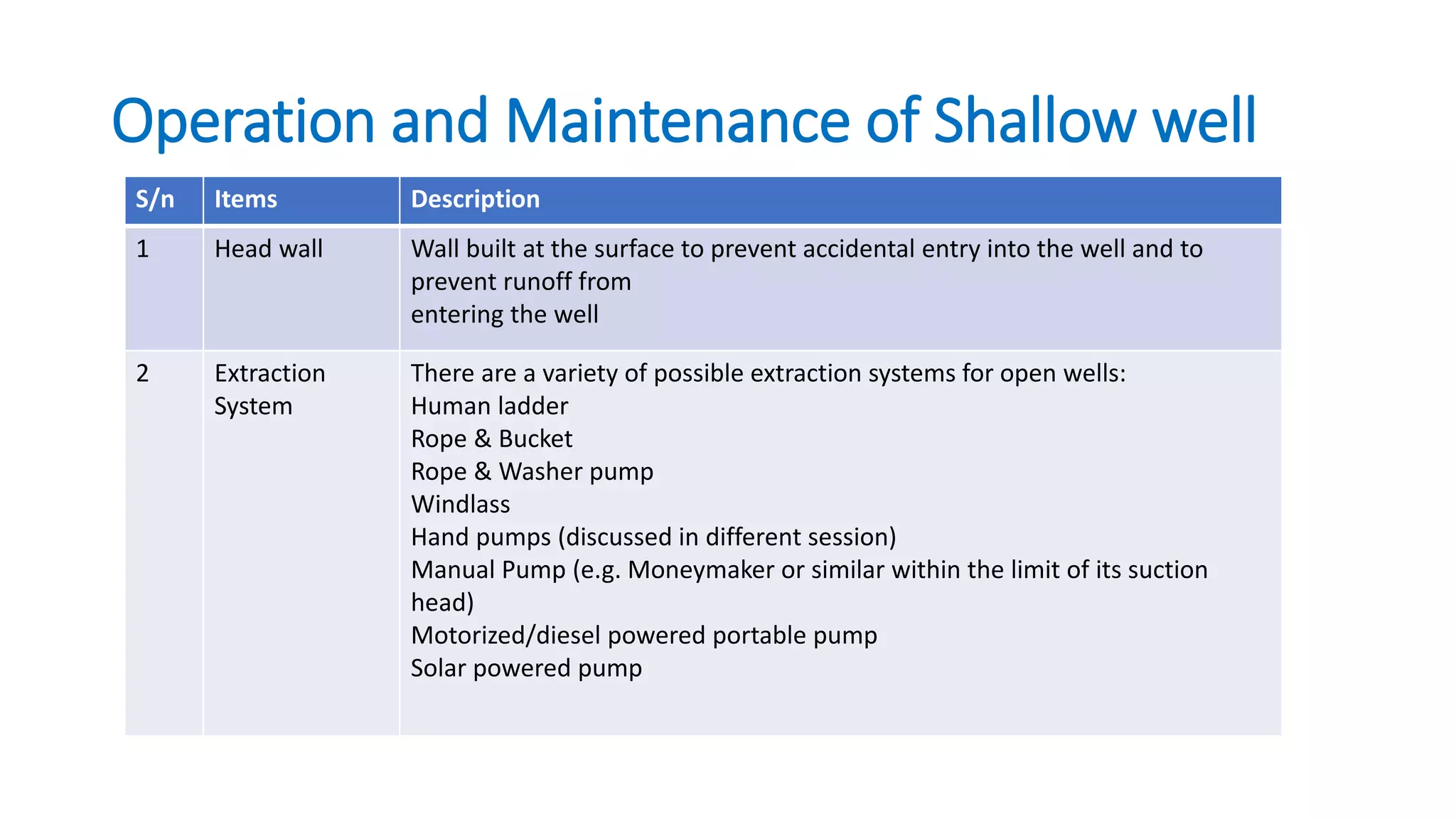
Operation and Maintenance of Shallow well
S/n Items Description
1 Head wall Wall built at the surface to prevent accidental entry into the well and to
prevent runoff from
entering the well
2 Extraction
System
There are a variety of possible extraction systems for open wells:
Human ladder
Rope & Bucket
Rope & Washer pump
Windlass
Hand pumps (discussed in different session)
Manual Pump (e.g. Moneymaker or similar within the limit of its suction
head)
Motorized/diesel powered portable pump
Solar powered pump
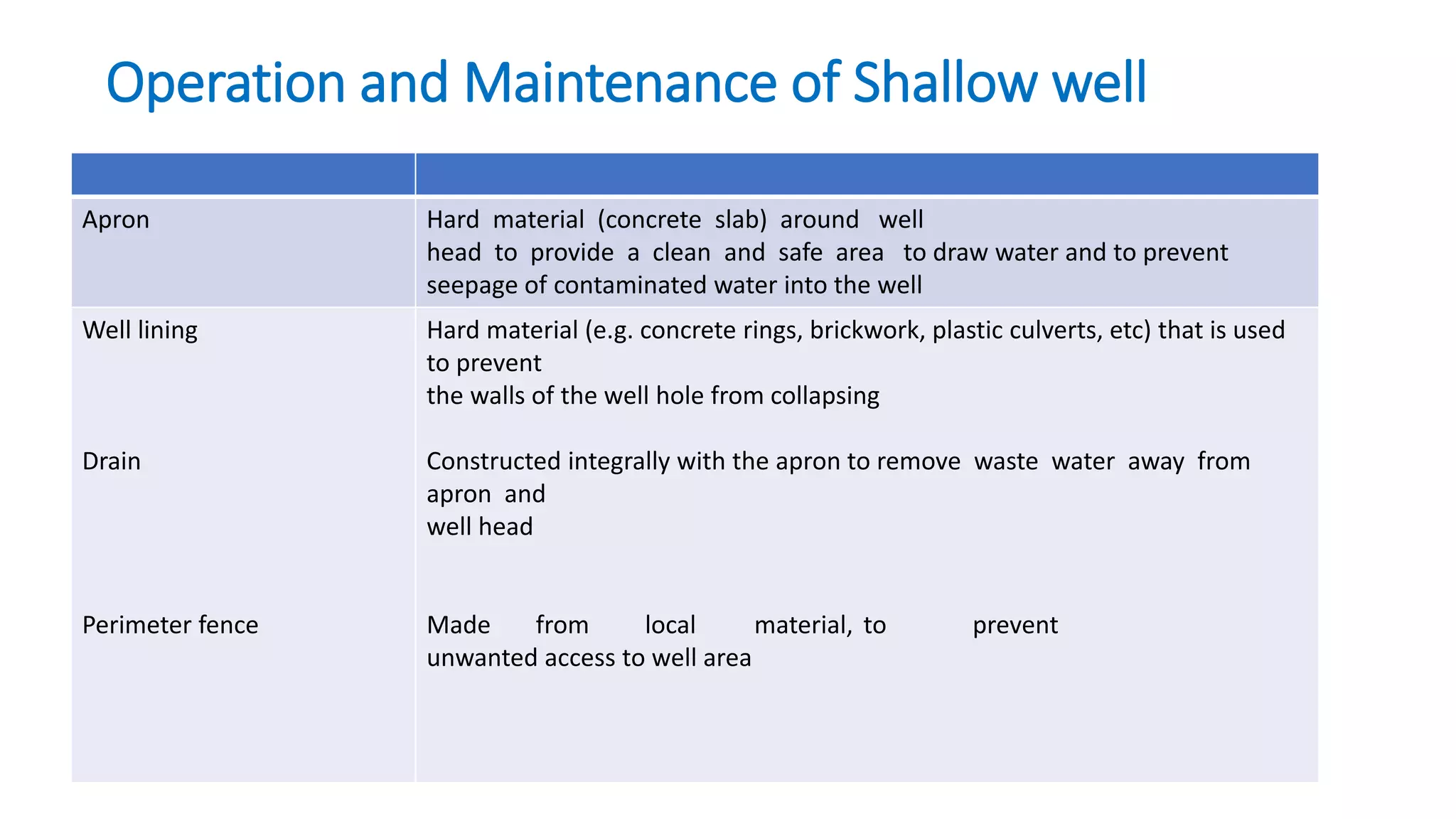
Operation and Maintenance of Shallow well
Apron Hard material (concrete slab) around well
head to provide a clean and safe area to draw water and to prevent
seepage of contaminated water into the well
Well lining
Drain
Perimeter fence
Hard material (e.g. concrete rings, brickwork, plastic culverts, etc) that is used
to prevent
the walls of the well hole from collapsing
Constructed integrally with the apron to remove waste water away from
apron and
well head
Made from local material, to prevent
unwanted access to well area
O/M of Handpump
Equipment that allows someone at the surface to manually work the
pump which is lower in the well.
Preventative Maintenance
• Undertaken while the system is in operation;
• Scheduled at an interval to pre-empt any failure of parts;
• Involves the replacement of parts before they have completely worn
out and exceeded their life span;
• Intended to keep systems working without any unexpected
breakdowns; it focuses on improving system reliability.
O/M of Handpump
The steps in preventive maintenance are; Understand if a pump is
functioning properly. If it is not, then understand the nature of the
problem and identify the solution required
Checking the discharge of the pump-This is done by observing whether the
discharge rate of water from the pump is adequate and timely. This gives a
very good picture of the condition of the Below- ground components of the
pump – the cylinder, the riser pipe and connecting rod assemblies
Checking the physical condition of the pump-This is done by observing the
movement of the handle, looking for external signs of wear and tear, rusting,
condition of components such as nuts & bolts, flanges, handle and handle
bracket, chain, etc. These observations give the condition of the Above-
ground components of the pump
O/M of Hand pump
• Dismantle the pump for maintenance, if necessary and reassemble it
after replacing the defective components or the components that
have reached their serviceable life span;
• Maintain a record of the maintenance history and observations of
pump condition for each pump in a given area (See Attachment 2:
Handpump Maintenance Record)
Maintenance of Pump Surroundings
The hand pump platform should offer good protection to the water
source because it seals off the well from surface contamination.
However, contamination can still occur, if
O/M of Hand pump
• The platform and drain are cracked or broken,
• the pump stand had become loose in its foundation,
• waste water accumulates in the close vicinity of the well,
• solid waste is disposed near the well in a garbage dump,
• animals (and humans) defecate close to the well,
• the well is in the natural drainage path and the platform is prone to flooding
during rains.
Weekly Checks
• Check that the base flange and head flange nuts and bolts are tight.
• Check that the Fulcrum pin and Hanger pin nuts are tight.
• Check that the handle moves smoothly, moves for its full arc, and water comes out when
the handle is operated.
O/M of Hand pump
• Regularly check all nuts and bolts are tight and that the movement of the handle is
smooth, complete and yields water,
• perform the Leakage and Discharge Tests and records the results
• check the platform and drain for cracks and breaks, the pump stand should be firm
• Eliminate collection and stagnation of waste water near the pump by keeping the drain
clean, by filling with earth and draining
• Maintain the fence, if any, around the pump to prevent animals from coming close to the
pump
• keep the pump surroundings clean at all times,
• instruct and motivate users to keep the pump surroundings clean and dry and to use the
pump properly
• Check perimeter fence and repair as required
Water point records
Types of records
• Minute book
• Visitors’ record book
• Duty roaster
• Contributions
• Maintenance register
• Asset register
• Constitution
WATER POINT GENERAL INFORMATION
1. Name of Water Point.......................................................
2. Date of Installation..........................................................
3. Type of Water Point........................................................
4. Number of users..............................................................
5. Name of Committee Member Position Held
.................................. ........................
.................................... ........................
.................................... ........................
6. WPC – Training received Date................
7. Name of chairperson ..................................................................................
DATE NAME DUTY TO BE PERFORMED
20 February 2018 Muhamed Mahamoud Sweeping
21 February 2018 Fatima Faadumo Fencing
22 February 2018 Aisha Muhamed Cutting grass
WATER POINT DUTY ROASTER
Water point Break down/Maintenance report
DATE NATURE OF
BREAKDOWN
REPORTER DATE OF REPAIR ACTION TAKEN SIGNATuRE OF
COMMITTEE
MEMBER
Minute of meetings
• Name of water point:
• Date of meeting:
• Purpose of meeting:
• Member present:
• Chair of meeting:
Discussion Action points and agreed date of
completion
Asset register
ITEM QUANTITY
SPANNER 17” 5
SCREW DRIVER 2
HAMMER 1
CHAIN (5M) 1
NAME OF WATER POINT:
MONTH:
NAME VILLAGE AMOUNT PAID SIGNATURE OF
HOUSEHOLD
MEMBER
WATER POINT CONTRIBUTIONS REGISTER
WATER POINT TOTAL BALANCE: ...................
NAME OF WATER POINT :
MONTH:
ITEM QUANTITY COST PAID TO SIGNATURE
GREASE 1 X 1KG 5.00 H&M
Hardware
SHOVEL 3 15.00 H&M
Hardware
WATER POINT EXPENDITURE RECORD
ACCOUNT BALANCE AS AT( PUT IN DATE): ………………………….

WASH Committees Training-OXFAM-WASH LC (003).pptx

  • 1.
    OXFAM WASH COMMITTEGUIDE FOR SOOL AND SANAAG WASH COMMITTEE TRAINING-SEPT 2017 PROJECT-WASHPROJECT-DROUGHT RESPONSE Oct 2017-March 2018
  • 2.
    TOPICS • Water sourcesand Safe drinking water • Role and responsibility of WASH Committees • Leadership skills • Conflict management • Equal representation • Effective Communication • The concept of sustainability • Water Uses Governance-Constitution • Financial Management • Operation and Maintenance of shallow well/pump • Cholera/ORS preparation
  • 3.
    Community water sources •In a group, list the water sources in you area • Each group to pick a presenter • Session to last 10 mins
  • 4.
    Common water sources Surfacewater Underground water sources 1. Rivers 1.Wells 2.Streams 2. Boreholes 3. Spring 4. Ponds 5. Swamps 6. Dams 7. Lakes, Seas, Oceans 8. Birkads 9. Rain water harvesting.
  • 5.
    Common uses ofwater Domestic Uses • Washing • Bathing • Cleaning • Cooking • Drinking Industrial Uses • Construction • Manufacturing • Milling • Waste Management • Power Generation • Fishing • Irrigation
  • 6.
    Drinking water What issafe drinking water? Quality of safe water? brain storming ! • Water that is free from contamination, that does not have harmful substances such as bacteria • It is important for drinking water to make sure that drinking water is safe to live healthy lives
  • 7.
    Faecal-oral diseases Girdiasis /dysentery HEPATITISTyphoid fever POLIO Parasitism These are all caused by infectious agents like viruses, bacteria & parasites Cholera
  • 8.
    Drinking contaminated water WATERHygiene Bad hygiene practices that spreads diarrhoea ( Unhygienic collection and storage of water Water containers are dirty and kept in dirty places No any means for water treatment No one is responsible for maintaining and cleaning water points; pipe network cutting Children playing with taps breaking it - Animal poo in the water point Collecting water from unsafe sources
  • 9.
    Water Treatment Household watertreatment options: brain storming ! • Boiling of water • Use of PUR or aqua tabs • Filtering • Solar disinfection • Chemical disinfection
  • 10.
    Household water treatmentoptions Household Filtration Filtration using Ceramic Candle Sand and Charcoal Filter
  • 11.
    Household water treatmentoptions 24 hours Sunlight Disinfection System - SODIS Disinfection through Boiling Chlorine Solution- Demonstrate best use of aqua tabs and water makers
  • 12.
    Effective Water ManagementPoint • Allah provides us clean water but humans through their activities contaminate it. We need to have safe drinking water and it is our responsibility to promote healthy families. • How can we manage water points? Group discussion.
  • 13.
    WASH Committees composition •Chairman • Vice chairman • Secretary • Treasurer • Operator • Community Health Mobilizer/Worker
  • 14.
    Roles of aWater point committee • To work closely together with other local leaders the maintenance of their water point. • To ensure the water point surroundings clean. • To report any water point breakdowns which are beyond the abilities of the caretakers. • To mobilise water point beneficiaries to perform any task required at the water point. • To report to other local leaders any misconduct directed at affecting the proper functioning of the water point. • To hold meetings with other local leaders and beneficiaries to implement the agreed constitution. • To encourage communities to undertake co-operative gardening if the water point has a good yield. • To keep a record of water point beneficiaries, cleaning schedule and fees paid • To keep safely records of water point meetings, money contributed and all work done at the water point by the community .
  • 15.
    Role and responsibilityof chairman-WMC Provide leadership to the management committee to enable it to fulfil its roles and this includes; • Chair all WUA meetings • Ensure all WUA records are probably maintained • Ensure smooth running of WUA activities • Enforcement of bylaws
  • 16.
    Role and responsibilityof Vice-chairman-WMC • Chair all Water management meetings on behalf of the chairman • Ensure all Water management records are probably maintained • Ensure smooth running of WASH facilities • Enforcement of bylaws
  • 17.
    Role and responsibilityof secretary-WMC • Keep WASH records; • To record minutes of all meetings • To maintain members register • To ensure that the water supply correspondence is correctly and efficiently attended to
  • 18.
    Role and responsibilityof treasurer-WMC To be responsible for all finance of the WASH Committees; • Keep records of the WASH asset and finance • To check all payments • To sign all payment vouchers • To ensure Banking of all monies received on behalf of the WMC
  • 19.
    Role and responsibilityof Community Health Mobilizers/Workers • Ensure hygiene awareness session/campaign conducted in the community level • Ensure the water point is clean/monitor hygiene level • Promote safe drinking water at household • Report cases of diseases outbreak in the community/water point
  • 20.
    Role and responsibilityof Water Operator- WMC • Ensure the water facility are functional • Conduct operation maintenance incase of breakdown • Safeguard the water s/sanitation facilities against vandalism • Report incase of misuse of water/sanitation facilities
  • 21.
    Leadership-Exercise Group Exercise • Divideparticipants into groups • Ask each group to brainstorm on the following; • Who is a leader? • How do you identify a good leader? • What are the qualities of a good leader? • Name 5 leaders you like and list the reasons you like them. • Each group to record the responses and present in a plenary session where the facilitator will bring out the aspects of leadership as discussed.
  • 22.
    Qualities of agood leader • Acceptability: A person who commands respect and self discipline. Has good interpersonal relation and meets minimum community norms of good conduct • Job competence: Has good record of exemplary performance • Ability to listen: Listens patiently for meaning and understanding • Tolerance: Has ability to listen and accommodate dissenting views and constructive criticism • Delegation: Willing and able share responsibility in order to build the potential of others • Flexibility: Open to change and reason • Self organization: Sets an example on personal orderliness • Honesty: Can be trusted at all times • Reliability: Is dependable on words, promise and deeds • Impartial: is guided by fairness, truth and justice in making all decisions
  • 23.
    Conflict management Definition • Conflictis defined as „clash of interests between two or more parties when at least one of the parties seeks to assert its interests at the expense of another party's interests‟. Steps to Minimizing Conflicts • Frequent and timely meetings can help to reduce conflicts. • Transparency and accountability especially in finances and groups/committees assets will ensure that conflicts are easily resolved. Production of records i.e. treasurers report and reading in the AGMs will always ensure confidence
  • 24.
    Conflict management • Timelyelections – It is important for leaders to renew their mandate by calling for the elections at the scheduled time. The elections must always be transparent. • Conflicts can be managed through regular consultations among officials and members. This reduces suspicions and unnecessary rumours. • Open tendering and staff recruitment for groups/committees with such provisions will reduce conflict. This will always encourage professionalism and reduce such vices as nepotism, favoritism, clan-ism. • Gender balanced committees are normally stable and more accountable. Groups are encouraged to include all interested parties in the composition of the committees.
  • 25.
    Conflict management • Sometimescoercion/force may be used to resolve conflicts. Errant members who refuse to reform may be suspended or expelled to safeguard the interests of the group. However coercion must be used as a last resort. • Co-option may help in solving/reducing conflicts. Some relevant stakeholders may be included in a project if their inclusion will add value to the objective of the group/committee. • Training of officials/members can reduce conflict; training increases efficiency and effectiveness of the group leaders. For members it increases participation especially on community contribution and decision-making.
  • 26.
    Conflict management(Participants formtwo groups: Group 1: to discuss if and when a conflict is needed • Helps to raise and address problems. • Energizes work to be on the most appropriate issues. • Helps people "be real", for example, it motivates them to participate. • Helps people learn how to recognize and benefit from their differences. • Conflict is not the same as discomfort. The conflict isn't the problem - it is when conflict is poorly managed that is the problem.
  • 27.
    Conflict management(Participants formtwo groups: Group 2: when a conflict is a problem: • Hampers productivity. • Lowers morale. • Causes more and continued conflicts. • Causes inappropriate behaviours. • The groups discuss the topics and present to the plenary where other participants discuss the topics further.
  • 28.
  • 29.
    Equal representation What isGender? • Gender relates to both men and women. A gender based approach looks at the social differences between men and women to seek a balance, which optimizes the roles and responsibilities of both men and women.
  • 30.
    Water management Group work •Who is responsible for water collection in the households • Who managed the use of water in the home? • Who would most likely know the amount of water required for household use • Who in most instances is home more often taking care of the family • Who should take decisions concerning water
  • 31.
    Effective meeting andDecision Making Objective; • Differentiate between the different types of meetings in the WUA constitution; • Discuss the procedures for conducting meetings and decision making; • importance of minutes of a WUA meeting and how to take them. Different Types of WMC Meetings • Committee Meetings • Held regularly, e.g. once every month by the project committee members; • To discuss matters mainly concerning administration of the project.
  • 32.
    Effective meeting andDecision Making Committees to decide the schedule of the meetings and topics under discussion? • Status of the water • Problems • Operation and Maintenance and schedule(Cleaning, planning, campaigns ) • Community Contributions and expenditures
  • 33.
    Effective meeting andDecision Making Stages of Making Decisions • Gathering the facts • Consulting those involved • Making the decision and actions • Explaining the decision • Reporting and the signature • Monitoring the process and results of the decision
  • 34.
    The concept ofsustainability Does the system is functioning? What is the problem? How can we ensure our water points are durable?
  • 35.
    Water Management CommitteesFinancial Management Setting Tariffs The purpose of this session is to establish the financial basis for sustainable operation, along with considerations that go in to setting a tariff structure. Without a properly agreed tariff the community will not be sustainable as either the members will feel they are paying too much money or there will be no funds to pay for operation and maintenance Commonly used tariff structures: • Flat rate per household per month or year: It is easy to implement. Tariff is unfair in that low consumers pay the same as high consumers
  • 36.
    Water Management Bylaws Stepsthat a group can take to minimize the bylaws being overlooked are: • Ensure all project members have a copy of the constitution and have had a chance to be „inducted‟ into the constitution; • Appoint an oversight or audit sub-committee whose job it is to ensure that the constitution is followed and to raise any points to the main committee where the constitution is overlooked • In cases where the constitution is impractical, then it is necessary to make a change to the constitution so that it can be followed more easily.
  • 37.
    WMC Bylaws-Component • Article1: Name • Article 2: Area of Operation • Article 3: Objective • Article 4: The Membership-Cessation from Membership -Suspension from Membership • Article 5: Activities of the WUA • Article 6:Committee Members • Article 7 - The Management Committee • Article 8 - Duties of the Management Committee • Article 9:Office Bearers • Article 10: Duties of Office Bearers • Article 11: Duties of Ordinary Committee Members • Article 12:Meetings
  • 38.
    WMC Bylaws-Component • Article13: Sources of WUA Funds • Article 14: Use of WUA Funds • Article 15: Control of WUA Funds • Article 16: Procurement and care of WUA Property • Article 17: Books of the WUA • Article 18: Auditors • Article 19: Amendment of the Constitution • Article 20: Arbitration • Article 22: Accountability • Article 21: Elections • Article 23: Dissolution
  • 39.
    Do’s and don’tsat water points. • Key features of the water points?
  • 40.
    Water Management CommitteesFinancial Management • Flat rate per unit volume: Water gathered from a water kiosk or stand pipe is commonly sold at a single price for uniform container (e.g. 20 litre jerry can ). For metered connections, the tariff is fixed at a single rate for each cubic metre of water • Charge per unit of livestock: this is frequently used in pastoral areas where livestock keeping predominant livelihood and livestock demand for water is significant. Tariff will vary according to livestock • Block tariff: The tariff is different for different quantities of water. Typically the tariff increase as the total consumed per month volume increases. The advantage of block tariff is that it enables low tariff to be charged for small consumers and higher rates to be charged for larger consumers (a pro-poor structure). This encourages consumers to reduce consumption and be more efficient.
  • 41.
    Water Management CommitteesFinancial Management Basic for tariff settings; • What people can • What are willing to pay • What the Bore hole requires to cover the operating costs (Partial cost recovery) • What the Bore hole requires to cover all operating costs and to replace the assets when they need replacement (full cost recovery) • The maximum the Bore hole can possibly charge
  • 42.
    Water Management CommitteesFinancial Management Tariff regulation • Water is a basic human need and is constitutional right • The cost of building water points with safe and reliable water is expensive • A balance has to be found between setting a tariff that covers the cost of operating the Bore hole and ensuring that consumers are not exploited Ways to ensure that consumers are not exploited: WUA should be transparent about the cost operating the Bore hole and how the tariffs have been established. This approach is reflected in the preparation and approval of the annual budget and the submission of financial and audit report to the AGM. An independent Government Organization is mandated to check that tariffs are justifiable. The organization with mandate is not yet in place in Somalia
  • 43.
    Operational budget for1 water point • Cost of pump attendant • Cost of repairs • Cost of water form private truckers • Stationery for the committee • Security fees for the water point For the water point to run effectively throughout the year, how much money should each household raise?
  • 44.
    Operation and Maintenanceof Shallow well S/n Items Description 1 Head wall Wall built at the surface to prevent accidental entry into the well and to prevent runoff from entering the well 2 Extraction System There are a variety of possible extraction systems for open wells: Human ladder Rope & Bucket Rope & Washer pump Windlass Hand pumps (discussed in different session) Manual Pump (e.g. Moneymaker or similar within the limit of its suction head) Motorized/diesel powered portable pump Solar powered pump
  • 45.
    Operation and Maintenanceof Shallow well Apron Hard material (concrete slab) around well head to provide a clean and safe area to draw water and to prevent seepage of contaminated water into the well Well lining Drain Perimeter fence Hard material (e.g. concrete rings, brickwork, plastic culverts, etc) that is used to prevent the walls of the well hole from collapsing Constructed integrally with the apron to remove waste water away from apron and well head Made from local material, to prevent unwanted access to well area
  • 46.
    O/M of Handpump Equipmentthat allows someone at the surface to manually work the pump which is lower in the well. Preventative Maintenance • Undertaken while the system is in operation; • Scheduled at an interval to pre-empt any failure of parts; • Involves the replacement of parts before they have completely worn out and exceeded their life span; • Intended to keep systems working without any unexpected breakdowns; it focuses on improving system reliability.
  • 47.
    O/M of Handpump Thesteps in preventive maintenance are; Understand if a pump is functioning properly. If it is not, then understand the nature of the problem and identify the solution required Checking the discharge of the pump-This is done by observing whether the discharge rate of water from the pump is adequate and timely. This gives a very good picture of the condition of the Below- ground components of the pump – the cylinder, the riser pipe and connecting rod assemblies Checking the physical condition of the pump-This is done by observing the movement of the handle, looking for external signs of wear and tear, rusting, condition of components such as nuts & bolts, flanges, handle and handle bracket, chain, etc. These observations give the condition of the Above- ground components of the pump
  • 48.
    O/M of Handpump • Dismantle the pump for maintenance, if necessary and reassemble it after replacing the defective components or the components that have reached their serviceable life span; • Maintain a record of the maintenance history and observations of pump condition for each pump in a given area (See Attachment 2: Handpump Maintenance Record) Maintenance of Pump Surroundings The hand pump platform should offer good protection to the water source because it seals off the well from surface contamination. However, contamination can still occur, if
  • 49.
    O/M of Handpump • The platform and drain are cracked or broken, • the pump stand had become loose in its foundation, • waste water accumulates in the close vicinity of the well, • solid waste is disposed near the well in a garbage dump, • animals (and humans) defecate close to the well, • the well is in the natural drainage path and the platform is prone to flooding during rains. Weekly Checks • Check that the base flange and head flange nuts and bolts are tight. • Check that the Fulcrum pin and Hanger pin nuts are tight. • Check that the handle moves smoothly, moves for its full arc, and water comes out when the handle is operated.
  • 50.
    O/M of Handpump • Regularly check all nuts and bolts are tight and that the movement of the handle is smooth, complete and yields water, • perform the Leakage and Discharge Tests and records the results • check the platform and drain for cracks and breaks, the pump stand should be firm • Eliminate collection and stagnation of waste water near the pump by keeping the drain clean, by filling with earth and draining • Maintain the fence, if any, around the pump to prevent animals from coming close to the pump • keep the pump surroundings clean at all times, • instruct and motivate users to keep the pump surroundings clean and dry and to use the pump properly • Check perimeter fence and repair as required
  • 51.
    Water point records Typesof records • Minute book • Visitors’ record book • Duty roaster • Contributions • Maintenance register • Asset register • Constitution
  • 52.
    WATER POINT GENERALINFORMATION 1. Name of Water Point....................................................... 2. Date of Installation.......................................................... 3. Type of Water Point........................................................ 4. Number of users.............................................................. 5. Name of Committee Member Position Held .................................. ........................ .................................... ........................ .................................... ........................ 6. WPC – Training received Date................ 7. Name of chairperson ..................................................................................
  • 53.
    DATE NAME DUTYTO BE PERFORMED 20 February 2018 Muhamed Mahamoud Sweeping 21 February 2018 Fatima Faadumo Fencing 22 February 2018 Aisha Muhamed Cutting grass WATER POINT DUTY ROASTER
  • 54.
    Water point Breakdown/Maintenance report DATE NATURE OF BREAKDOWN REPORTER DATE OF REPAIR ACTION TAKEN SIGNATuRE OF COMMITTEE MEMBER
  • 55.
    Minute of meetings •Name of water point: • Date of meeting: • Purpose of meeting: • Member present: • Chair of meeting: Discussion Action points and agreed date of completion
  • 56.
    Asset register ITEM QUANTITY SPANNER17” 5 SCREW DRIVER 2 HAMMER 1 CHAIN (5M) 1 NAME OF WATER POINT:
  • 57.
    NAME OF WATERPOINT: MONTH: NAME VILLAGE AMOUNT PAID SIGNATURE OF HOUSEHOLD MEMBER WATER POINT CONTRIBUTIONS REGISTER WATER POINT TOTAL BALANCE: ...................
  • 58.
    NAME OF WATERPOINT : MONTH: ITEM QUANTITY COST PAID TO SIGNATURE GREASE 1 X 1KG 5.00 H&M Hardware SHOVEL 3 15.00 H&M Hardware WATER POINT EXPENDITURE RECORD ACCOUNT BALANCE AS AT( PUT IN DATE): ………………………….