OpenStack – An Introduction
root:~# Muddassir Nazir
Linux System Administrator
root:~# Topics to be covered
• What is Openstack ?
• Openstack : A brief history
• Architecture
• Components in Openstack
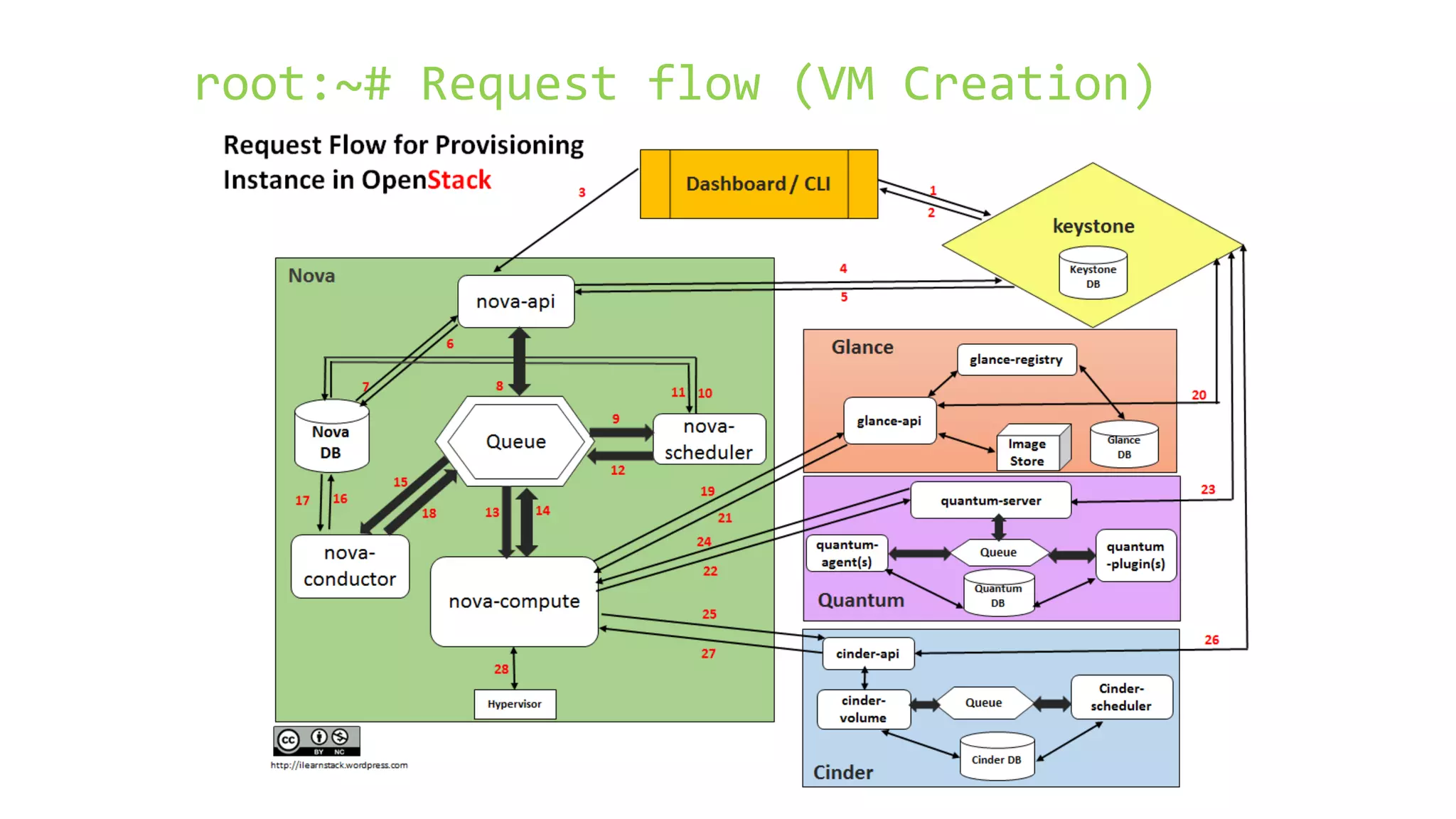
• Request flow for VM creation
• Installation
• Demo
root:~# What is Openstack ?
• The OpenStack project is an open source cloud computing
platform for all types of clouds, which aims to be simple to
implement, massively scalable, and feature rich.
• Project Listings : https://github.com/openstack
root:~# History of Openstack
• NASA wanted to host its own high resolution images without help from
Google, Microsoft of Amazon.
• Several free thinkers workers worked with NASA to bring up a Distributed
Computing environment named NASA nebula. Later it was called NOVA
which provided processing power.
• While NASA contributed Nova, Rackspace contributed Swift which
provided storage capacity.
• Along with NASA, Rackspace and a group of free thinkers, Openstack
emerged in July 2010.
root:~# History of Openstack
• In 3 years of conception, Openstack has interests from
over 2000 companies, actively participating in
contribution and adoption.
• Termed as the “Linux of the Cloud”
• Exponential growth in code base.
• Few renowned companies using it in production cloud.
Examples include HP Cloud, Paypal and Oracle.
root:~# Who is using Openstack today ?
• Web/ Saas/ Ecommerce : Pay Pal, HP, Wikimedia etc.
• Academics/ Research/ Government : Argonne National Labs, CERN, MIT
Computer Science and Artificial Intelligence Lab (CSAIL)
• IT : HP, IBM, Cisco, eNovance, Opera Software, Seagate, Aptira etc.
• Film/Media/Gaming : Comcast, Sony Gaming Network
• Complete List : http://openstack.org/user-stories/
root:~# Where does Openstack fit ?
• Virtual infrastructure managers/ Cloud OS :
1. Proprietary software for specific vendor’s software
e.g. VCloud Suite
2. Open source hypervisor/SDN/storage manager.
root:~# Where does Openstack fit ?
• Logical infrastructure managers/ DC management :
1. Proprietary software for specific vendor’s software
e.g. VCenter for ESXi
2. Open source hypervisor/SDN/storage manager such as Xen manager
root:~# Where does Openstack fit ?
• Physical infrastructure managers :
1. Proprietary software for specific vendor’s hardware
2. Open source rack managers such as RackMonkey, RackTables, etc.
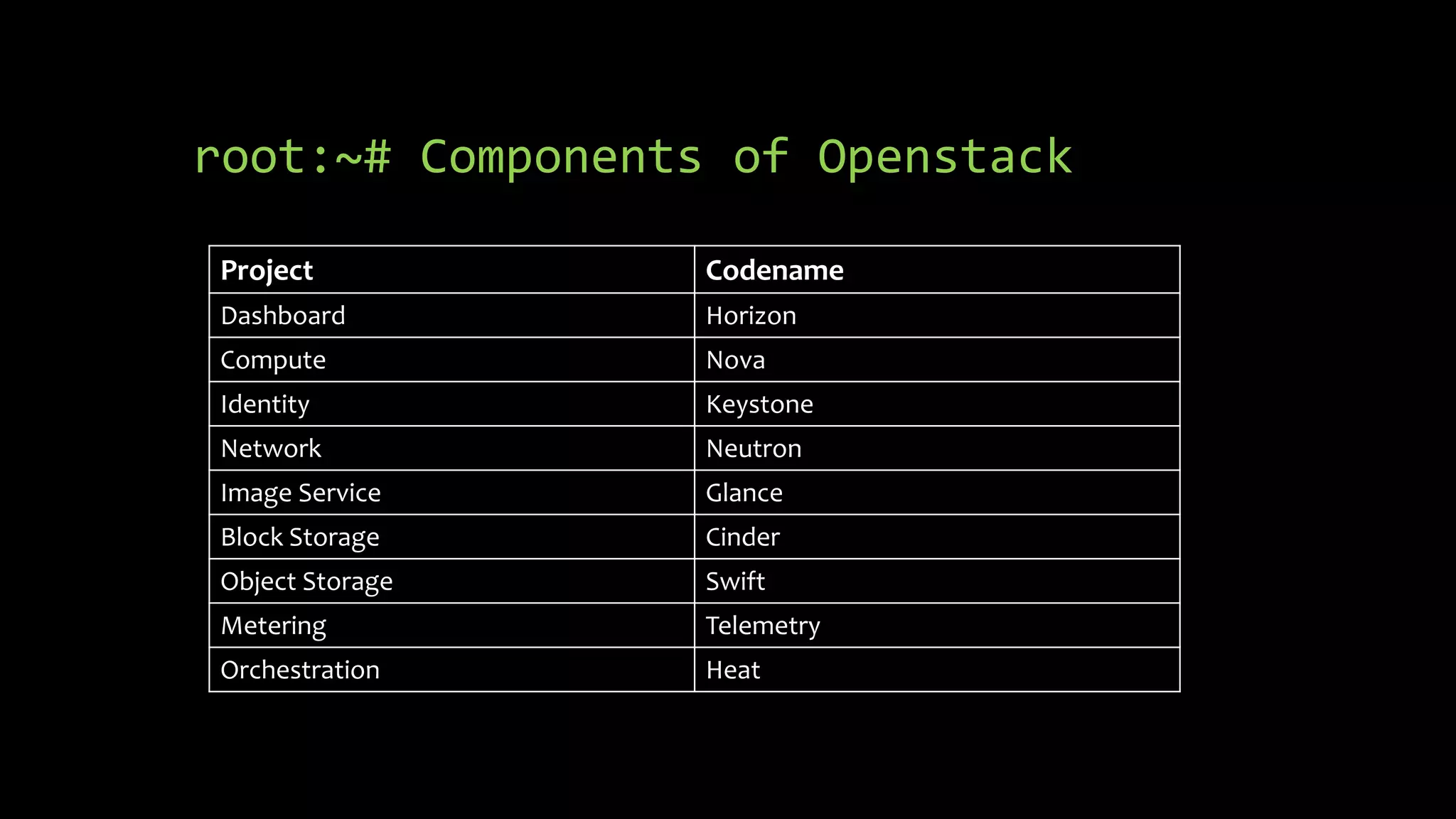
root:~# Components of Openstack
Project Codename
Dashboard Horizon
Compute Nova
Identity Keystone
Network Neutron
Image Service Glance
Block Storage Cinder
Object Storage Swift
Metering Telemetry
Orchestration Heat
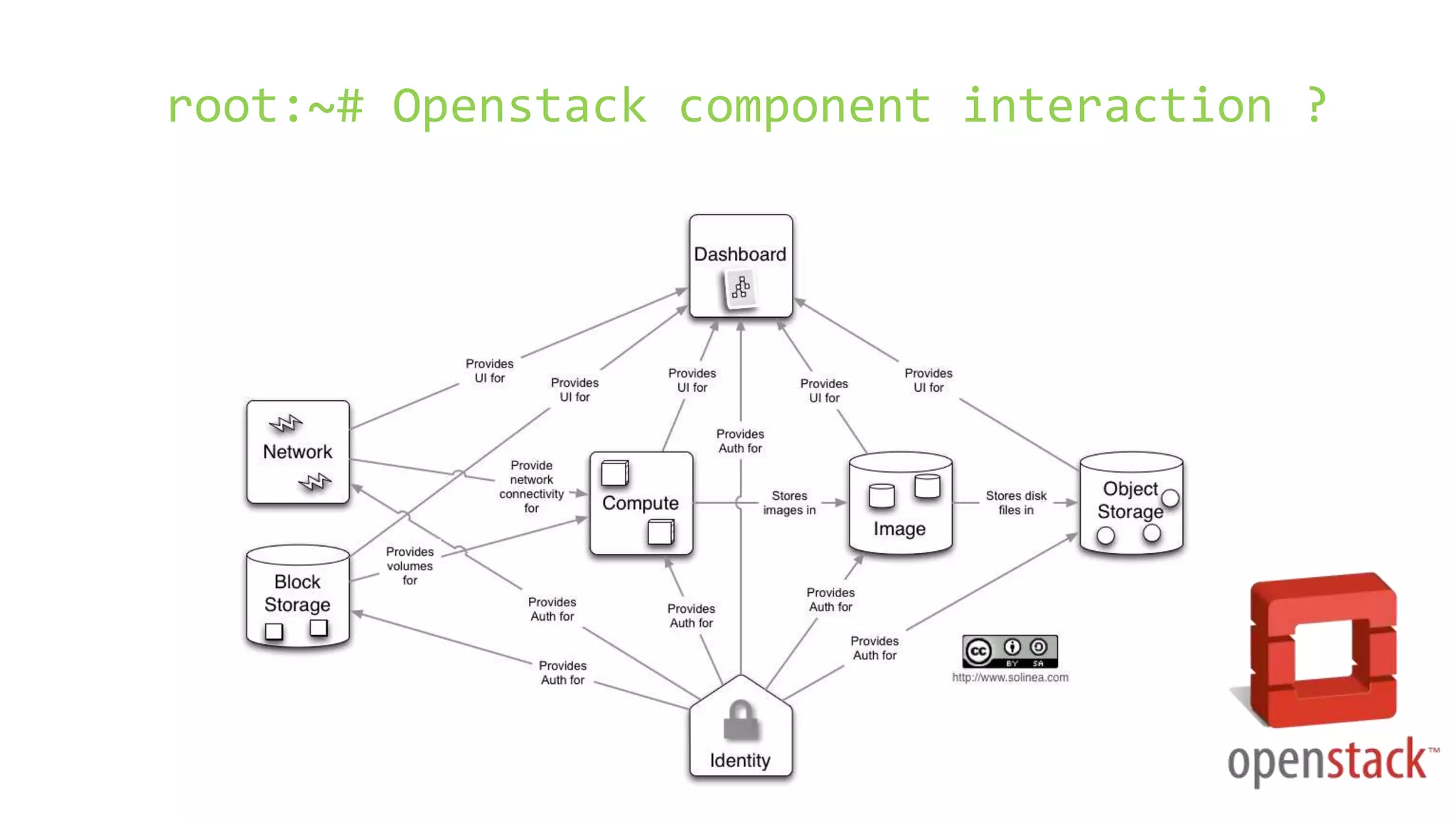
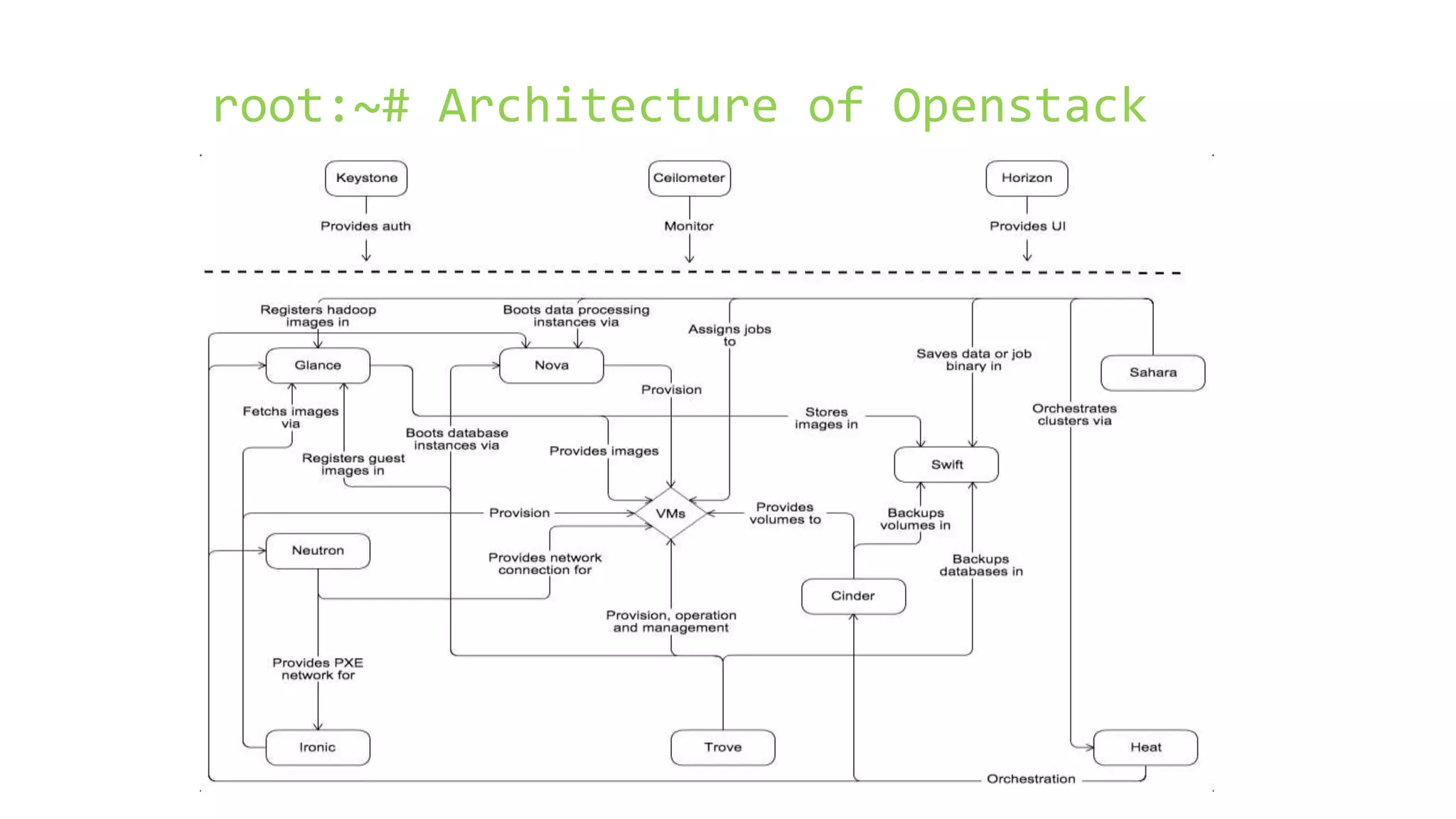
root:~# Openstack component interaction ?
root:~# Features of Openstack ?
• Completely Open Source
• Almost completely written in Python
• Highly Modular
• Highly Distributed
• Highly Pluggable Architecture
• Highly Configurable and Customizable
root:~# Nova (Compute Project)
• Nova is the compute project for openstack. A large number of processes
cooperate to turn end user API requests into running Virtual Machines.
• Instance Provisioning and VM related operations.
• It can manage KVM, ESX, HyperV, vCenter, Baremetal.
• Hypervisor and Support : https://wiki.openstack.org/wiki/HyperSupportMatrix
root:~# Glance
• Openstack Image store centralizes torage of virtual images that can be utilized
to start instances.
• You can compare it to Vmware templates for easier understanding.
• Features :
1. Disk Images and Associated Metadata
2. Multiple Disk Formats : raw, VHD, Vmdk, vdi, qcow2, aki, ari, ami
3. Multiple Container Formats : ovf, bare, aki, ari, ami
root:~# Keystone (Identity)
• Framework for authentication and authorization for all services. Provides
adding users to groups (tenants) and to mapping permissions.
• Features :
1. Authenticate users and issue tokens for access to services.
2. Store users and tenants for a role based access controls (RBAC).
3. Create policies across users and services.
4. Has a pluggable back-end which allows most support standard back-end like
LDAP, SQL as well as Key Value Stores (KVS).
root:~# Swift (Object Storage)
• It is designed to provide large scale storage of data that is accessible via APIs.
Unlike a traditional file server, it is completely distributed, storing multiple
copies of each object to achieve greater availability and scalability.
• Features :
1.Stores and retrieves objects (files)
2. Versioned Objects
3. Objects in container in accounts
4. 3+ replication factor
5. Stable and deployed in production
root:~# Neutron (Network)
• Allows users to create their own networks and the attach interfaces.
• Pluggable architecture to support for vendors and technologies by writing
your own plugins and agents. Earlier, neutron was called quantum.
• Features :
1.Provides networking for VMs provisioned by openstack.
2. Configure soft-switched and physical switches.
3. Provides policies at port level.
4. Plugins available for OVS (open virtual switch), Nicira, Cisco Nexus, brocade,
bigswitch etc.
root:~# Architecture of Openstack
root:~# Request flow (VM Creation)
root:~# Installation
• You can chose to install openstack based on ease of use and your familiarity of
components involved.
• Manual installation is very much possible but not recommended because of
sheer number of configurations involved. This would take a lot of time and
introduces high chances of error.
• You can use several Linux distributions to install openstack. Ubuntu and Red
Hat are highly popular among the developers.
• Some tools available for openstack installation :
For example : Red Hat Packstack and Foreman based installer, Cisco Openstack
installer, Ubuntu’s Juju platform, Mirantis Fuel etc.
root:~# Thank you…

Openstack – An introduction

  • 1.
    OpenStack – AnIntroduction root:~# Muddassir Nazir Linux System Administrator
  • 2.
    root:~# Topics tobe covered • What is Openstack ? • Openstack : A brief history • Architecture • Components in Openstack • Request flow for VM creation • Installation • Demo
  • 3.
    root:~# What isOpenstack ? • The OpenStack project is an open source cloud computing platform for all types of clouds, which aims to be simple to implement, massively scalable, and feature rich. • Project Listings : https://github.com/openstack
  • 4.
    root:~# History ofOpenstack • NASA wanted to host its own high resolution images without help from Google, Microsoft of Amazon. • Several free thinkers workers worked with NASA to bring up a Distributed Computing environment named NASA nebula. Later it was called NOVA which provided processing power. • While NASA contributed Nova, Rackspace contributed Swift which provided storage capacity. • Along with NASA, Rackspace and a group of free thinkers, Openstack emerged in July 2010.
  • 5.
    root:~# History ofOpenstack • In 3 years of conception, Openstack has interests from over 2000 companies, actively participating in contribution and adoption. • Termed as the “Linux of the Cloud” • Exponential growth in code base. • Few renowned companies using it in production cloud. Examples include HP Cloud, Paypal and Oracle.
  • 6.
    root:~# Who isusing Openstack today ? • Web/ Saas/ Ecommerce : Pay Pal, HP, Wikimedia etc. • Academics/ Research/ Government : Argonne National Labs, CERN, MIT Computer Science and Artificial Intelligence Lab (CSAIL) • IT : HP, IBM, Cisco, eNovance, Opera Software, Seagate, Aptira etc. • Film/Media/Gaming : Comcast, Sony Gaming Network • Complete List : http://openstack.org/user-stories/
  • 7.
    root:~# Where doesOpenstack fit ? • Virtual infrastructure managers/ Cloud OS : 1. Proprietary software for specific vendor’s software e.g. VCloud Suite 2. Open source hypervisor/SDN/storage manager.
  • 8.
    root:~# Where doesOpenstack fit ? • Logical infrastructure managers/ DC management : 1. Proprietary software for specific vendor’s software e.g. VCenter for ESXi 2. Open source hypervisor/SDN/storage manager such as Xen manager
  • 9.
    root:~# Where doesOpenstack fit ? • Physical infrastructure managers : 1. Proprietary software for specific vendor’s hardware 2. Open source rack managers such as RackMonkey, RackTables, etc.
  • 10.
    root:~# Components ofOpenstack Project Codename Dashboard Horizon Compute Nova Identity Keystone Network Neutron Image Service Glance Block Storage Cinder Object Storage Swift Metering Telemetry Orchestration Heat
  • 11.
  • 12.
    root:~# Features ofOpenstack ? • Completely Open Source • Almost completely written in Python • Highly Modular • Highly Distributed • Highly Pluggable Architecture • Highly Configurable and Customizable
  • 13.
    root:~# Nova (ComputeProject) • Nova is the compute project for openstack. A large number of processes cooperate to turn end user API requests into running Virtual Machines. • Instance Provisioning and VM related operations. • It can manage KVM, ESX, HyperV, vCenter, Baremetal. • Hypervisor and Support : https://wiki.openstack.org/wiki/HyperSupportMatrix
  • 14.
    root:~# Glance • OpenstackImage store centralizes torage of virtual images that can be utilized to start instances. • You can compare it to Vmware templates for easier understanding. • Features : 1. Disk Images and Associated Metadata 2. Multiple Disk Formats : raw, VHD, Vmdk, vdi, qcow2, aki, ari, ami 3. Multiple Container Formats : ovf, bare, aki, ari, ami
  • 15.
    root:~# Keystone (Identity) •Framework for authentication and authorization for all services. Provides adding users to groups (tenants) and to mapping permissions. • Features : 1. Authenticate users and issue tokens for access to services. 2. Store users and tenants for a role based access controls (RBAC). 3. Create policies across users and services. 4. Has a pluggable back-end which allows most support standard back-end like LDAP, SQL as well as Key Value Stores (KVS).
  • 16.
    root:~# Swift (ObjectStorage) • It is designed to provide large scale storage of data that is accessible via APIs. Unlike a traditional file server, it is completely distributed, storing multiple copies of each object to achieve greater availability and scalability. • Features : 1.Stores and retrieves objects (files) 2. Versioned Objects 3. Objects in container in accounts 4. 3+ replication factor 5. Stable and deployed in production
  • 17.
    root:~# Neutron (Network) •Allows users to create their own networks and the attach interfaces. • Pluggable architecture to support for vendors and technologies by writing your own plugins and agents. Earlier, neutron was called quantum. • Features : 1.Provides networking for VMs provisioned by openstack. 2. Configure soft-switched and physical switches. 3. Provides policies at port level. 4. Plugins available for OVS (open virtual switch), Nicira, Cisco Nexus, brocade, bigswitch etc.
  • 18.
  • 19.
    root:~# Request flow(VM Creation)
  • 20.
    root:~# Installation • Youcan chose to install openstack based on ease of use and your familiarity of components involved. • Manual installation is very much possible but not recommended because of sheer number of configurations involved. This would take a lot of time and introduces high chances of error. • You can use several Linux distributions to install openstack. Ubuntu and Red Hat are highly popular among the developers. • Some tools available for openstack installation : For example : Red Hat Packstack and Foreman based installer, Cisco Openstack installer, Ubuntu’s Juju platform, Mirantis Fuel etc.
  • 21.