Sustaining Your Career
How to sustain your IT career and your skills in an
increasingly cloud-centric world
Scott Lowe
blog.scottlowe.org
1
Before we begin
— Get involved! Audience participation is encouraged and requested.
— Feel free to take photos or videos of today's presentation and
share them online
— If you use Twitter, feel free to tweet about this session (use
hashtag #LabMan2015 or handle @LabMan2015)
— A PDF copy of this presentation will be available online after the
event
2
Brief background
— 20 years in the IT industry
— Authored or co-authored 7 books (2 more books in
the pipeline)
— Speaker at events worldwide
— Been through a couple of major industry transitions
3
4
Sustaining your career
means sustaining yourself
and sustaining your skills
5
What do you mean by"sustaining yourself"?
— Sustaining yourself is different than sustaining your
skills
— This is about sustaining your ability and capacity to
learn, grow, and adapt
— This is about sustaining your ability to deal with and
manage change
6
The only thing that is constant is
change.
— Heraclitus
7
If you dislike change, you're
going to dislike irrelevance even
more.
— Eric Shinseki
8
Sustaining yourself (continued)
— Strive to maintain a strong "work-life balance"
— Pursue learning outside of your career
— Prolonged bilingualism can improve cognitive skills (see
http://www2.uwstout.edu/content/lib/thesis/
2008/2008boesen.pdf)
— This may be true for music and various other hobbies as
well (no conclusive evidence yet)
— Avoid burnout
9
Anyone here like working hard
to only accomplish a
little?10
Avoiding burnout through efficiency
— Find yourself a trusted system (GTD is one example)
— Stop managing e-mail and start processing e-mail
1. If you can do it in less than 2 minutes, do it.
2. If it takes more than 2 minutes, put it in the trusted system.
3. If you need the information in the message, archive it.
4. Otherwise, delete the message.
— Stop using your inbox as a "to do" system---that's not what it
is!
11
Sustaining your skills
isn't just about technical
skills, either.
12
Sustaining skills
— Non-technical skills are very important in a cloud-centric world
— The non-technical skills are, in fact, more important than
technical skills
— Early 2013 IDC white paper (available from http://
www.microsoft.com/en-us/news/download/presskits/learning/
docs/idc.pdf) lists some important skills sought by hiring
managers
13
Important cloud-related job skills
1. Risk management
2. IT service management
3. Project/program management
4. Business-IT alignment
5. Technical skills in cloud implementation
14
Important cloud-related job skills
1. Risk management
2. IT service management
3. Project/program management
4. Business-IT alignment
5. Technical skills in cloud implementation
15
A sidebar on business-IT alignment
— Talk to the business: Find out the goals of the business,
and think about how IT can help achieve those goals.
— Don't use IT jargon: The business doesn't care about
IOPS, RAM, GHz, TB/PB, SAN, NAS, NFS, or VTEPs. They
care about meeting their goals.
— Try to say "Yes": Don't tell the business "No"; instead,
tell them what it would take to solve their problems.
16
17
Important cloud-related job skills
1. Risk management
2. IT service management
3. Project/program management
4. Business-IT alignment
5. Technical skills in cloud implementation
The proof point for this list is the strong adoption
of...
18
DevOps
19
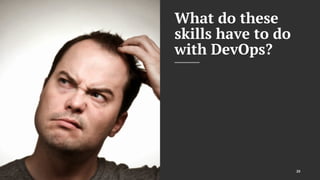
What do these
skills have to do
with DevOps?
20
DevOps isn't just about technology
— Some of these non-technical skills could be considered part of
DevOps
— Consider the "Three Ways of DevOps" (http://itrevolution.com/
the-three-ways-principles-underpinning-devops/)
— The First Way: Systems thinking
— The Second Way: Amplify feedback loops
— The Third Way: Culture of continuous experimentation and
learning
21
Technical skills
are still important,
though!
22
Some technical skills to investigate
— Automation and orchestration
— Cloud services
— Open source
23
Anyone here being asked to do
less with more?
24
The reality is we're
all being asked to
do more with less.
25
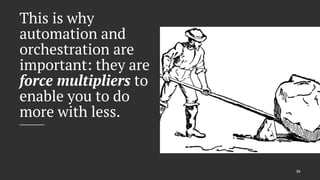
This is why
automation and
orchestration are
important: they are
force multipliers to
enable you to do
more with less.
26
Automation and orchestration examples
— Configuration management (Ansible, Chef, DSC,
Puppet, Salt)
— Cloud orchestration (OpenStack, CloudStack,
VMware vRealize Automation)
— Scripting (Bash, Perl, PowerShell, Python, Ruby)
— APIs (REST, JSON, XML)
27
Cloud services
— To become a "broker of cloud services" to the business, you
must understand how these cloud services work
— Major providers include Amazon, Google, Microsoft, and
VMware
— Most (if not all) of these providers have "free tiers" that
make it easier for you to experiment and learn how they
work (and what their value is)
28
Cloud services (continued)
— Lots of different cloud services to consider:
— Compute (EC2, Azure, GCE)
— Storage (Dropbox, Box, S3)
— SaaS
— XaaS (DRaaS via vCloud Air, DBaaS, etc.)
— Each of these may offer value to your organization
29
Open source
— Open source is affecting how IT is evolving
— Linux is increasingly pervasive in all aspects of the data center
— OpenStack is a leading open source cloud management
framework
— Open vSwitch is a key open source networking project
— Not to mention a whole host of other open source projects, like...
30
31
32
33
34
Remember the goal: IT exists to
support
the customer35
36
Ambition is the path to
success. Persistence is the
vehicle you arrive in.
— Bill Bradley
37
Thank you
Be sure to provide feedback to the VMUG leaders regarding
this session.
Blog: http://blog.scottlowe.org
Twitter: @scott_lowe
GitHub: https://github.com/lowescott
Life: Colossians 3:17
38

Sustaining Your Career

  • 1.
    Sustaining Your Career Howto sustain your IT career and your skills in an increasingly cloud-centric world Scott Lowe blog.scottlowe.org 1
  • 2.
    Before we begin —Get involved! Audience participation is encouraged and requested. — Feel free to take photos or videos of today's presentation and share them online — If you use Twitter, feel free to tweet about this session (use hashtag #LabMan2015 or handle @LabMan2015) — A PDF copy of this presentation will be available online after the event 2
  • 3.
    Brief background — 20years in the IT industry — Authored or co-authored 7 books (2 more books in the pipeline) — Speaker at events worldwide — Been through a couple of major industry transitions 3
  • 4.
  • 5.
    Sustaining your career meanssustaining yourself and sustaining your skills 5
  • 6.
    What do youmean by"sustaining yourself"? — Sustaining yourself is different than sustaining your skills — This is about sustaining your ability and capacity to learn, grow, and adapt — This is about sustaining your ability to deal with and manage change 6
  • 7.
    The only thingthat is constant is change. — Heraclitus 7
  • 8.
    If you dislikechange, you're going to dislike irrelevance even more. — Eric Shinseki 8
  • 9.
    Sustaining yourself (continued) —Strive to maintain a strong "work-life balance" — Pursue learning outside of your career — Prolonged bilingualism can improve cognitive skills (see http://www2.uwstout.edu/content/lib/thesis/ 2008/2008boesen.pdf) — This may be true for music and various other hobbies as well (no conclusive evidence yet) — Avoid burnout 9
  • 10.
    Anyone here likeworking hard to only accomplish a little?10
  • 11.
    Avoiding burnout throughefficiency — Find yourself a trusted system (GTD is one example) — Stop managing e-mail and start processing e-mail 1. If you can do it in less than 2 minutes, do it. 2. If it takes more than 2 minutes, put it in the trusted system. 3. If you need the information in the message, archive it. 4. Otherwise, delete the message. — Stop using your inbox as a "to do" system---that's not what it is! 11
  • 12.
    Sustaining your skills isn'tjust about technical skills, either. 12
  • 13.
    Sustaining skills — Non-technicalskills are very important in a cloud-centric world — The non-technical skills are, in fact, more important than technical skills — Early 2013 IDC white paper (available from http:// www.microsoft.com/en-us/news/download/presskits/learning/ docs/idc.pdf) lists some important skills sought by hiring managers 13
  • 14.
    Important cloud-related jobskills 1. Risk management 2. IT service management 3. Project/program management 4. Business-IT alignment 5. Technical skills in cloud implementation 14
  • 15.
    Important cloud-related jobskills 1. Risk management 2. IT service management 3. Project/program management 4. Business-IT alignment 5. Technical skills in cloud implementation 15
  • 16.
    A sidebar onbusiness-IT alignment — Talk to the business: Find out the goals of the business, and think about how IT can help achieve those goals. — Don't use IT jargon: The business doesn't care about IOPS, RAM, GHz, TB/PB, SAN, NAS, NFS, or VTEPs. They care about meeting their goals. — Try to say "Yes": Don't tell the business "No"; instead, tell them what it would take to solve their problems. 16
  • 17.
  • 18.
    Important cloud-related jobskills 1. Risk management 2. IT service management 3. Project/program management 4. Business-IT alignment 5. Technical skills in cloud implementation The proof point for this list is the strong adoption of... 18
  • 19.
  • 20.
    What do these skillshave to do with DevOps? 20
  • 21.
    DevOps isn't justabout technology — Some of these non-technical skills could be considered part of DevOps — Consider the "Three Ways of DevOps" (http://itrevolution.com/ the-three-ways-principles-underpinning-devops/) — The First Way: Systems thinking — The Second Way: Amplify feedback loops — The Third Way: Culture of continuous experimentation and learning 21
  • 22.
    Technical skills are stillimportant, though! 22
  • 23.
    Some technical skillsto investigate — Automation and orchestration — Cloud services — Open source 23
  • 24.
    Anyone here beingasked to do less with more? 24
  • 25.
    The reality iswe're all being asked to do more with less. 25
  • 26.
    This is why automationand orchestration are important: they are force multipliers to enable you to do more with less. 26
  • 27.
    Automation and orchestrationexamples — Configuration management (Ansible, Chef, DSC, Puppet, Salt) — Cloud orchestration (OpenStack, CloudStack, VMware vRealize Automation) — Scripting (Bash, Perl, PowerShell, Python, Ruby) — APIs (REST, JSON, XML) 27
  • 28.
    Cloud services — Tobecome a "broker of cloud services" to the business, you must understand how these cloud services work — Major providers include Amazon, Google, Microsoft, and VMware — Most (if not all) of these providers have "free tiers" that make it easier for you to experiment and learn how they work (and what their value is) 28
  • 29.
    Cloud services (continued) —Lots of different cloud services to consider: — Compute (EC2, Azure, GCE) — Storage (Dropbox, Box, S3) — SaaS — XaaS (DRaaS via vCloud Air, DBaaS, etc.) — Each of these may offer value to your organization 29
  • 30.
    Open source — Opensource is affecting how IT is evolving — Linux is increasingly pervasive in all aspects of the data center — OpenStack is a leading open source cloud management framework — Open vSwitch is a key open source networking project — Not to mention a whole host of other open source projects, like... 30
  • 31.
  • 32.
  • 33.
  • 34.
  • 35.
    Remember the goal:IT exists to support the customer35
  • 36.
  • 37.
    Ambition is thepath to success. Persistence is the vehicle you arrive in. — Bill Bradley 37
  • 38.
    Thank you Be sureto provide feedback to the VMUG leaders regarding this session. Blog: http://blog.scottlowe.org Twitter: @scott_lowe GitHub: https://github.com/lowescott Life: Colossians 3:17 38