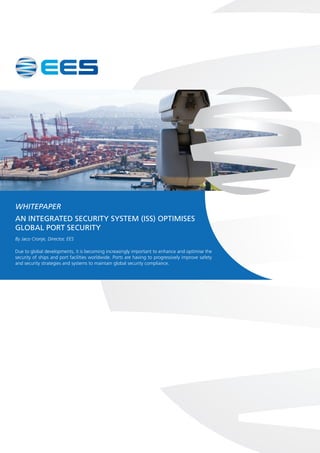
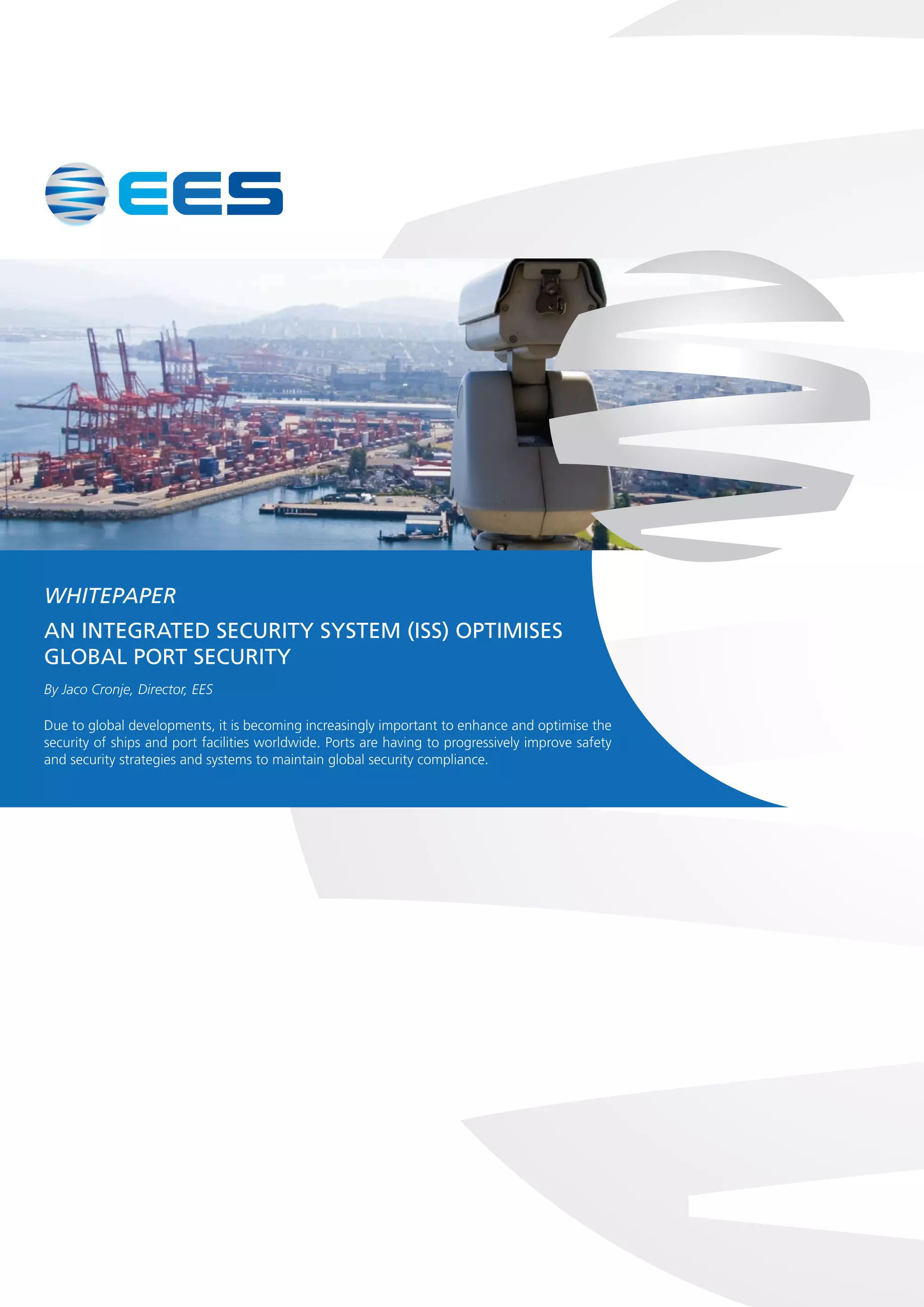
WHITEPAPER
AN INTEGRATED SECURITY SYSTEM (ISS) OPTIMISES
GLOBAL PORT SECURITY
By Jaco Cronje, Director, EES
Due to global developments, it is becoming increasingly important to enhance and optimise the
security of ships and port facilities worldwide. Ports are having to progressively improve safety
and security strategies and systems to maintain global security compliance.
ABOUT EES:
Established in 2001, EES Africa (Pty) Ltd specialises in the integration of multiple
system infrastructure including ICT, Data Centres, Audio Visual, Life Safety, Security
and Building Automation Systems. As an ISO 9001:2008 certified company, our
vision is to be Africa’s management, engineering and auditing professional service
provider of choice.
The EES Value Proposition focuses on translating technology into tangible delivera-
bles for clients through the experience of a talented team of Engineering and ICT
Consultants and Project Managers. With offices in Cape Town, Johannesburg and
Stellenbosch, EES operates predominantly in the Renewable Energy, Oil & Gas, Fi-
nancial Services, Infrastructure, Utilities, Telecoms and Mining sectors.
CONTENTS
Page 2 Introduction
Page 2 Context: ISPS Code
Page 2 Security Breaches
Page 3 Solution: an Integrated Security System (ISS)
Page 3 Recommendations
I MANAGEMENT I ENGINEERING I AUDITING I www.eeslive.com 1
EES Cape Town office:
G11 Silverberg Terrace
3 Silverwood Close
Steenberg Office Park
Cape Town 7945
PO Box 31322, Tokai 7966
Western Cape, South Africa
Email: info@eeslive.com
Tel: +27 (0)21 702 8340
Fax: +27 (0) 86 532 3532
EES Johannesburg office:
Unit 8, West Block Loft Offices,
First Floor, The Zone Phase II,
26 Cradock Avenue, Rosebank, 2186
PO Box 31322, Tokai 7966
Western Cape, South Africa
Email: info@eeslive.com
Tel: +27 (0)10 590 6270
Fax: +27 (0) 86 532 3532
EES Stellenbosch office:
18 Tegno Road
Techno Park
Stellenbosch 7599
PO Box 31322, Tokai 7966
Western Cape, South Africa
Email: info@eeslive.com
Tel: +27 (0)21 200 5939
Fax: +27 (0) 86 532 3532
Introduction
Due to global developments, it is becoming increasingly
important to enhance and optimise the security of ships
and port facilities worldwide. Ports are having to progres-
sively improve safety and security strategies and systems
to maintain global security compliance.
Throughout history, ports have handled a diverse range
of traffic. Because a key objective of a port is to enable
ships to dock and transfer people or cargo to or from
land, support and storage facilities vary widely and may
extend for miles.
Ports are evolving from mere transportation centres to
centres directly involved in more complex, value-added
activities such as cargo processing and logistics. This
requires new processes, practices and technological ad-
vances in control, integration and connectivity.
An integral role that technological advances in control,
integration and connectivity play is port security and pro-
tection of ports against acts of terrorism. The vital need
to enhance port security was highlighted in the wake of
the events of September 2001, which changed the na-
ture of security at all transportation hubs globally. Since
then, very significant progress has been made in the de-
sign and implementation of leading edge security sys-
tems. The piracy attacks of yachts, container vessels and
oil tankers globally and especially off the coast of East
Africa has further emphasised the need for the security
of both ships and other sea vessels.
Today international trade and open commerce produces
numerous challenges to port security. Different, complex
shipping systems and the need to keep traffic moving
smoothly, exacerbate these challenges. Optimal, inte-
grated and automated control in such a complex envi-
ronment is required.
The need to improve security is especially important in
the case of ports experiencing growth. This in particular
applies to emerging economies.
With growth, it is necessary to have security measures
that correlate with the increased people volumes, traffic
volumes and threats posed by such an important hub. To
accommodate the increased load, correct procedures are
in some cases not followed, exposing risks and making
ports, product and countries vulnerable to security attacks.
With regard to ports, the International Convention for
the Safety of Life at Sea (SOLAS), 1974, paves the way
for the International Ship and Port Facility Security Code
(ISPS Code) to enhance the security of ships and port
facilities. These are all supported by the United Nation’s
International Maritime Organisation (IMO).
AN INTEGRATED SECURITY SYSTEM (ISS)
OPTIMISES GLOBAL PORT SECURITY
March 2014
Context: ISPS Code
The International Ship and Port Facility Security Code (ISPS Code) is a com-
prehensive set of measures to enhance the security of ships and port fa-
cilities, developed in response to the perceived threats to ships and port
facilities after the 9/11 attacks in the United States.
The ISPS Code is implemented through chapter XI-2 “Special measures to
enhance maritime security” in the International Convention for the Safety
of Life at Sea (SOLAS), 1974. The Code has two parts, one mandatory and
one recommendatory.
International regulations based on the ISPS Code were enacted by Europe
and the United Kingdom in 2004, and in 2002 the United States enacted
the provisions of the Maritime Transportation Security Act of 2002 and
aligned domestic regulations with the maritime security standards of SO-
LAS and the ISPS Code.
In essence, the Code takes the approach that ensuring the security of ships
and port facilities is a risk management activity and that, to determine what
security measures are appropriate, an assessment of the risks must be made
in each particular case. The purpose of the Code is to provide a standard-
ised, consistent framework for evaluating risk. This enables Governments
to offset changes in threat with changes in vulnerability for ships and port
facilities through determination of appropriate security levels and corre-
sponding security measures.
Security Breaches
Security breaches can manifest themselves as:
• Petty Crime
• Syndicates
• Espionage
• Sabotage
• Hostage Taking
• National Security Threats
• Cyber Crime
• Fires
• Natural Disasters
As attacks become increasingly advanced, security systems can no longer
be viewed as individual silos as was previously the case, but it is essential
that all security elements are integrated.
As such, an Integrated Security System (ISS) is required to ensure access to
facilities and data is authenticated, authorised and accounted for.
I MANAGEMENT I ENGINEERING I AUDITING I
I MANAGEMENT I ENGINEERING I AUDITING I www.eeslive.com 2
AN INTEGRATED SECURITY SYSTEM (ISS)
OPTIMISES GLOBAL PORT SECURITY
March 2014
I MANAGEMENT I ENGINEERING I AUDITING I
I MANAGEMENT I ENGINEERING I AUDITING I www.eeslive.com 3
Written by Jaco Cronje
Director, EES
Tel +27 (0)10 590 6271,
Email info@eeslive.com
Jaco is the Operations Director at EES Africa
(Pty) Ltd and a registered Professional
Engineer (Electrical and Electronic). He has
been involved in Project Directorship and
Managementofamongstothers,FIFAWorld
Cup Stadia, urban surveillance projects, ICT
system design and implementation projects
in the retail and hospitality industry. Jaco
is a Green Star SA Accredited Professional.
Solution: an Integrated Security System (ISS)
The aim of an ISS, which is in line with the ISPS Code,
is to:
• Detect security threats and implement security
measures
• Establish roles and responsibilities concerning
maritime security for governments, local
administrations, ship and port industries at the
national and international level
• Collate and promulgate security-related information
• Provide a methodology for security assessments
in order to have in place appropriate plans and
procedures to react to changing security levels
ISS, as the term defines, provides a multi-layer, multi-
system approach to security. Drawing on experience in
analysing security risks to clients across multiple sectors,
a list of security systems to be audited, reported on, and
recommended can then be identified and recommended.
An ISS solution automatically links all security and surveil-
lance activities to the ISPS Code.
The systems listed in the paragraph below are integrated
and combined into a single physical space known as a
Security Operations Centre. This room is specially de-
signed to optimise lighting, temperature, air quality, dis-
play areas, ergonomics and operations.
The systems are:
• CCTV which includes
- Facial Detection
- Number Plate Recognition
- Analytics
• Weighbridges
- Access Control which includes Biometric and
Time & Attendance
• Electronic Scanning
• Technology Supporting Mobile Security Staff
• Fire Detection
• Intruder Alarm Systems
• Hard Wired Alarms
• PA Systems with Full Bi-directional Audio
• Physical Security Information Management (PSIM)
• Port Management Software
- Network Security which includes Authentication
Servers, Security Policies, Firewalls and Encryption
• Asset Tracking
• Holding Cells
• Search Facilities
• Visitor Management Systems
Recommendations
Ports need to ensure compliance to international codes and best practices
for safety of their clients (vessels & people) and to retain international cer-
tifications.
Annual audits of the technology, facilities, procedures and skill sets need
to be conducted to ensure ports stay competitive in terms of security man-
agement.
An experienced security advisory and project management company, skilled
in use of the relevant technology, should be appointed to provide the re-
quired professional services to implement an ISS platform.
The professional services provider would focus on:
• Audit and document current practices with regards to people
and process
• Providing advice to government and commercial bodies on
security matters
• Adapting existing systems and sourcing cutting edge technology
• Planning and design of security systems
• Independent procurement and tender evaluation
• Supervision of system installations
• System integration and commissioning
• Testing of port security systems
• Crisis management planning

An Integrated Security System Optimises Global Port Security

  • 1.
    WHITEPAPER AN INTEGRATED SECURITYSYSTEM (ISS) OPTIMISES GLOBAL PORT SECURITY By Jaco Cronje, Director, EES Due to global developments, it is becoming increasingly important to enhance and optimise the security of ships and port facilities worldwide. Ports are having to progressively improve safety and security strategies and systems to maintain global security compliance.
  • 2.
    ABOUT EES: Established in2001, EES Africa (Pty) Ltd specialises in the integration of multiple system infrastructure including ICT, Data Centres, Audio Visual, Life Safety, Security and Building Automation Systems. As an ISO 9001:2008 certified company, our vision is to be Africa’s management, engineering and auditing professional service provider of choice. The EES Value Proposition focuses on translating technology into tangible delivera- bles for clients through the experience of a talented team of Engineering and ICT Consultants and Project Managers. With offices in Cape Town, Johannesburg and Stellenbosch, EES operates predominantly in the Renewable Energy, Oil & Gas, Fi- nancial Services, Infrastructure, Utilities, Telecoms and Mining sectors. CONTENTS Page 2 Introduction Page 2 Context: ISPS Code Page 2 Security Breaches Page 3 Solution: an Integrated Security System (ISS) Page 3 Recommendations I MANAGEMENT I ENGINEERING I AUDITING I www.eeslive.com 1 EES Cape Town office: G11 Silverberg Terrace 3 Silverwood Close Steenberg Office Park Cape Town 7945 PO Box 31322, Tokai 7966 Western Cape, South Africa Email: info@eeslive.com Tel: +27 (0)21 702 8340 Fax: +27 (0) 86 532 3532 EES Johannesburg office: Unit 8, West Block Loft Offices, First Floor, The Zone Phase II, 26 Cradock Avenue, Rosebank, 2186 PO Box 31322, Tokai 7966 Western Cape, South Africa Email: info@eeslive.com Tel: +27 (0)10 590 6270 Fax: +27 (0) 86 532 3532 EES Stellenbosch office: 18 Tegno Road Techno Park Stellenbosch 7599 PO Box 31322, Tokai 7966 Western Cape, South Africa Email: info@eeslive.com Tel: +27 (0)21 200 5939 Fax: +27 (0) 86 532 3532
  • 3.
    Introduction Due to globaldevelopments, it is becoming increasingly important to enhance and optimise the security of ships and port facilities worldwide. Ports are having to progres- sively improve safety and security strategies and systems to maintain global security compliance. Throughout history, ports have handled a diverse range of traffic. Because a key objective of a port is to enable ships to dock and transfer people or cargo to or from land, support and storage facilities vary widely and may extend for miles. Ports are evolving from mere transportation centres to centres directly involved in more complex, value-added activities such as cargo processing and logistics. This requires new processes, practices and technological ad- vances in control, integration and connectivity. An integral role that technological advances in control, integration and connectivity play is port security and pro- tection of ports against acts of terrorism. The vital need to enhance port security was highlighted in the wake of the events of September 2001, which changed the na- ture of security at all transportation hubs globally. Since then, very significant progress has been made in the de- sign and implementation of leading edge security sys- tems. The piracy attacks of yachts, container vessels and oil tankers globally and especially off the coast of East Africa has further emphasised the need for the security of both ships and other sea vessels. Today international trade and open commerce produces numerous challenges to port security. Different, complex shipping systems and the need to keep traffic moving smoothly, exacerbate these challenges. Optimal, inte- grated and automated control in such a complex envi- ronment is required. The need to improve security is especially important in the case of ports experiencing growth. This in particular applies to emerging economies. With growth, it is necessary to have security measures that correlate with the increased people volumes, traffic volumes and threats posed by such an important hub. To accommodate the increased load, correct procedures are in some cases not followed, exposing risks and making ports, product and countries vulnerable to security attacks. With regard to ports, the International Convention for the Safety of Life at Sea (SOLAS), 1974, paves the way for the International Ship and Port Facility Security Code (ISPS Code) to enhance the security of ships and port facilities. These are all supported by the United Nation’s International Maritime Organisation (IMO). AN INTEGRATED SECURITY SYSTEM (ISS) OPTIMISES GLOBAL PORT SECURITY March 2014 Context: ISPS Code The International Ship and Port Facility Security Code (ISPS Code) is a com- prehensive set of measures to enhance the security of ships and port fa- cilities, developed in response to the perceived threats to ships and port facilities after the 9/11 attacks in the United States. The ISPS Code is implemented through chapter XI-2 “Special measures to enhance maritime security” in the International Convention for the Safety of Life at Sea (SOLAS), 1974. The Code has two parts, one mandatory and one recommendatory. International regulations based on the ISPS Code were enacted by Europe and the United Kingdom in 2004, and in 2002 the United States enacted the provisions of the Maritime Transportation Security Act of 2002 and aligned domestic regulations with the maritime security standards of SO- LAS and the ISPS Code. In essence, the Code takes the approach that ensuring the security of ships and port facilities is a risk management activity and that, to determine what security measures are appropriate, an assessment of the risks must be made in each particular case. The purpose of the Code is to provide a standard- ised, consistent framework for evaluating risk. This enables Governments to offset changes in threat with changes in vulnerability for ships and port facilities through determination of appropriate security levels and corre- sponding security measures. Security Breaches Security breaches can manifest themselves as: • Petty Crime • Syndicates • Espionage • Sabotage • Hostage Taking • National Security Threats • Cyber Crime • Fires • Natural Disasters As attacks become increasingly advanced, security systems can no longer be viewed as individual silos as was previously the case, but it is essential that all security elements are integrated. As such, an Integrated Security System (ISS) is required to ensure access to facilities and data is authenticated, authorised and accounted for. I MANAGEMENT I ENGINEERING I AUDITING I I MANAGEMENT I ENGINEERING I AUDITING I www.eeslive.com 2
  • 4.
    AN INTEGRATED SECURITYSYSTEM (ISS) OPTIMISES GLOBAL PORT SECURITY March 2014 I MANAGEMENT I ENGINEERING I AUDITING I I MANAGEMENT I ENGINEERING I AUDITING I www.eeslive.com 3 Written by Jaco Cronje Director, EES Tel +27 (0)10 590 6271, Email info@eeslive.com Jaco is the Operations Director at EES Africa (Pty) Ltd and a registered Professional Engineer (Electrical and Electronic). He has been involved in Project Directorship and Managementofamongstothers,FIFAWorld Cup Stadia, urban surveillance projects, ICT system design and implementation projects in the retail and hospitality industry. Jaco is a Green Star SA Accredited Professional. Solution: an Integrated Security System (ISS) The aim of an ISS, which is in line with the ISPS Code, is to: • Detect security threats and implement security measures • Establish roles and responsibilities concerning maritime security for governments, local administrations, ship and port industries at the national and international level • Collate and promulgate security-related information • Provide a methodology for security assessments in order to have in place appropriate plans and procedures to react to changing security levels ISS, as the term defines, provides a multi-layer, multi- system approach to security. Drawing on experience in analysing security risks to clients across multiple sectors, a list of security systems to be audited, reported on, and recommended can then be identified and recommended. An ISS solution automatically links all security and surveil- lance activities to the ISPS Code. The systems listed in the paragraph below are integrated and combined into a single physical space known as a Security Operations Centre. This room is specially de- signed to optimise lighting, temperature, air quality, dis- play areas, ergonomics and operations. The systems are: • CCTV which includes - Facial Detection - Number Plate Recognition - Analytics • Weighbridges - Access Control which includes Biometric and Time & Attendance • Electronic Scanning • Technology Supporting Mobile Security Staff • Fire Detection • Intruder Alarm Systems • Hard Wired Alarms • PA Systems with Full Bi-directional Audio • Physical Security Information Management (PSIM) • Port Management Software - Network Security which includes Authentication Servers, Security Policies, Firewalls and Encryption • Asset Tracking • Holding Cells • Search Facilities • Visitor Management Systems Recommendations Ports need to ensure compliance to international codes and best practices for safety of their clients (vessels & people) and to retain international cer- tifications. Annual audits of the technology, facilities, procedures and skill sets need to be conducted to ensure ports stay competitive in terms of security man- agement. An experienced security advisory and project management company, skilled in use of the relevant technology, should be appointed to provide the re- quired professional services to implement an ISS platform. The professional services provider would focus on: • Audit and document current practices with regards to people and process • Providing advice to government and commercial bodies on security matters • Adapting existing systems and sourcing cutting edge technology • Planning and design of security systems • Independent procurement and tender evaluation • Supervision of system installations • System integration and commissioning • Testing of port security systems • Crisis management planning