WHITEPAPER
Security in the network environment
By Laura Niehaus, Project Manager, EES
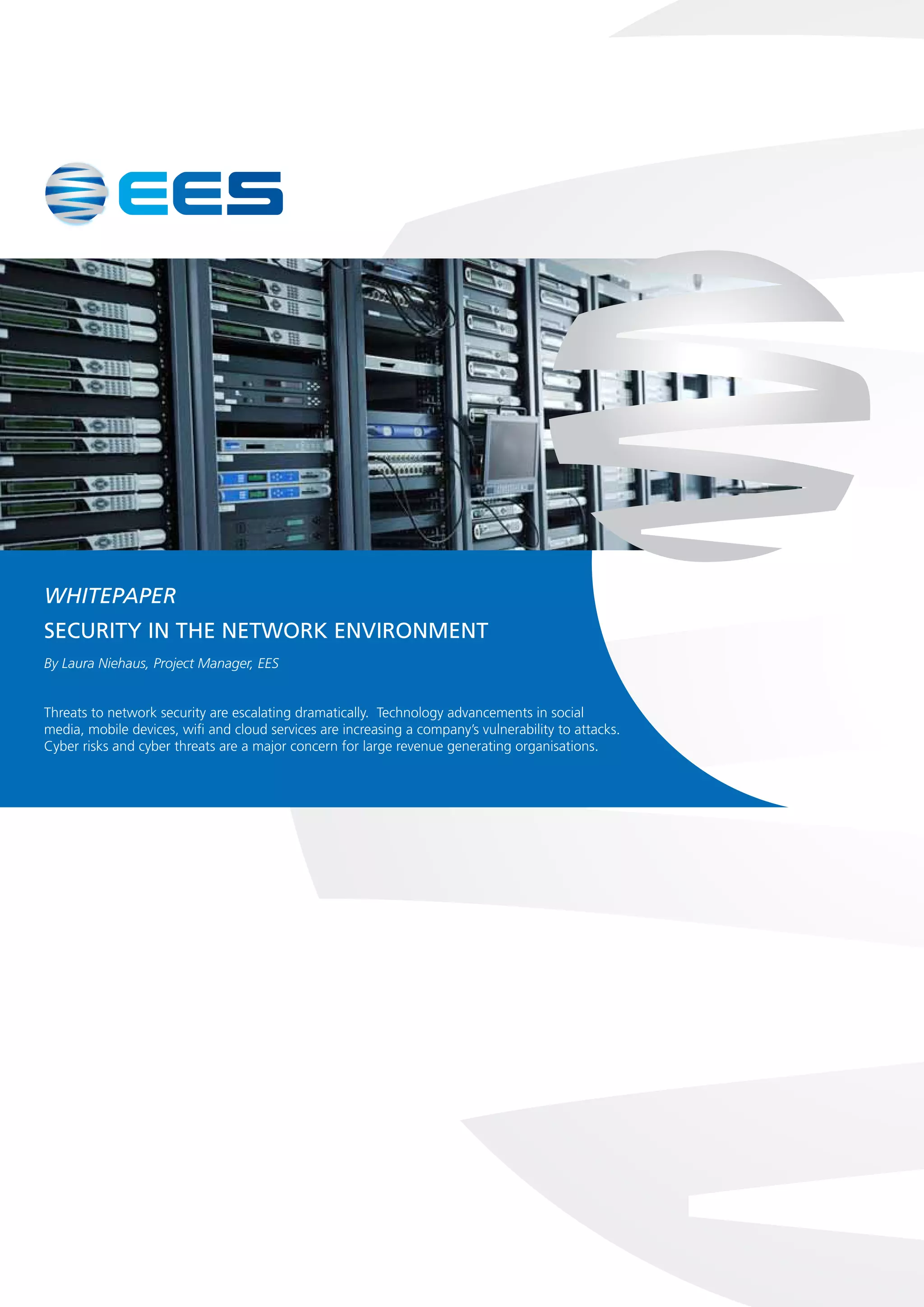
Threats to network security are escalating dramatically. Technology advancements in social
media, mobile devices, wifi and cloud services are increasing a company’s vulnerability to attacks.
Cyber risks and cyber threats are a major concern for large revenue generating organisations.
ABOUT EES:
Established in 2001, EES provides management, engineering and auditing services.
As an ISO 9001:2008 certified company, we specialise in the integration of mul-
tiple system infrastructure including ICT, Data Centres, Audio Visual, Life Safety,
Security and Building Automation Systems. With over 180 successful projects to date,
EES operates predominantly in the Renewable Energy, Oil & Gas, Financial Services,
Infrastructure, Utilities, Telecoms and Mining sectors.
EES is committed to proactively assisting clients reduce their carbon footprint and
facilitate the development of a ‘green’ commercial environment. With offices in
Johannesburg, Cape Town and Stellenbosch, EES plays a key role in mission criti-
cal environments in Africa. Having successfully delivered on numerous international
projects, our clients, partners and stakeholders benefit from the company’s global
knowledge and expertise.
CONTENTS
Page 2	 Access Control
Page 2	 Key Threats to Network Security
Page 2	 Strategy Going Forward
I MANAGEMENT I ENGINEERING I AUDITING I www.eeslive.com 1
EES Cape Town office:
G11 Silverberg Terrace
3 Silverwood Close
Steenberg Office Park
Cape Town 7945
PO Box 31322, Tokai 7966
Western Cape, South Africa
Email: info@eeslive.com
Tel: +27 (0)21 702 8340
Fax: +27 (0) 86 532 4481
EES Johannesburg office:
Block A, Wedgefield Office Park
17 Muswell Road
Bryanston
Johannesburg 2021
PO Box 68383, Bryanston 2021
Johannesburg, South Africa
Email: info@eeslive.com
Tel: +27 (0)10 590 6270
Fax: +27 (0) 86 532 4481
EES Stellenbosch office:
18 Tegno Road
Techno Park
Stellenbosch 7599
PO Box 31322, Tokai 7966
Western Cape, South Africa
Email: info@eeslive.com
Tel: +27 (0)21 200 5939
Fax: +27 (0) 86 532 4481
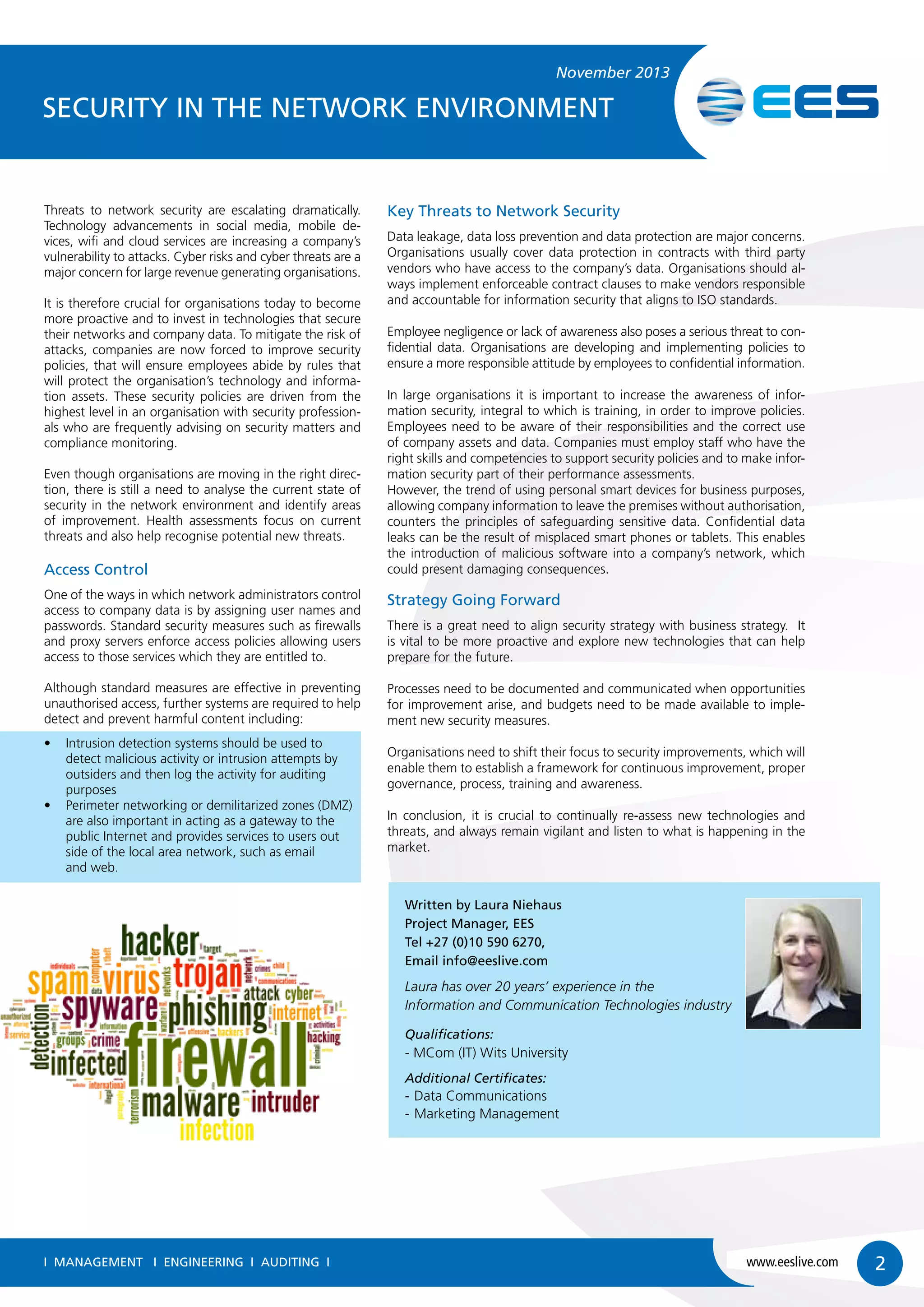
Threats to network security are escalating dramatically.
Technology advancements in social media, mobile de-
vices, wifi and cloud services are increasing a company’s
vulnerability to attacks. Cyber risks and cyber threats are a
major concern for large revenue generating organisations.
It is therefore crucial for organisations today to become
more proactive and to invest in technologies that secure
their networks and company data. To mitigate the risk of
attacks, companies are now forced to improve security
policies, that will ensure employees abide by rules that
will protect the organisation’s technology and informa-
tion assets. These security policies are driven from the
highest level in an organisation with security profession-
als who are frequently advising on security matters and
compliance monitoring.
Even though organisations are moving in the right direc-
tion, there is still a need to analyse the current state of
security in the network environment and identify areas
of improvement. Health assessments focus on current
threats and also help recognise potential new threats.
Access Control
One of the ways in which network administrators control
access to company data is by assigning user names and
passwords. Standard security measures such as firewalls
and proxy servers enforce access policies allowing users
access to those services which they are entitled to.
Although standard measures are effective in preventing
unauthorised access, further systems are required to help
detect and prevent harmful content including:
•	 Intrusion detection systems should be used to 	
	 detect malicious activity or intrusion attempts by 	
	 outsiders and then log the activity for auditing 	
	purposes
•	 Perimeter networking or demilitarized zones (DMZ) 	
	 are also important in acting as a gateway to the 	
	 public Internet and provides services to users out	
	 side of the local area network, such as email
	 and web.
Security in the network environment
November 2013
Key Threats to Network Security
Data leakage, data loss prevention and data protection are major concerns.
Organisations usually cover data protection in contracts with third party
vendors who have access to the company’s data. Organisations should al-
ways implement enforceable contract clauses to make vendors responsible
and accountable for information security that aligns to ISO standards.
Employee negligence or lack of awareness also poses a serious threat to con-
fidential data. Organisations are developing and implementing policies to
ensure a more responsible attitude by employees to confidential information.
In large organisations it is important to increase the awareness of infor-
mation security, integral to which is training, in order to improve policies.
Employees need to be aware of their responsibilities and the correct use
of company assets and data. Companies must employ staff who have the
right skills and competencies to support security policies and to make infor-
mation security part of their performance assessments.
However, the trend of using personal smart devices for business purposes,
allowing company information to leave the premises without authorisation,
counters the principles of safeguarding sensitive data. Confidential data
leaks can be the result of misplaced smart phones or tablets. This enables
the introduction of malicious software into a company’s network, which
could present damaging consequences.
Strategy Going Forward
There is a great need to align security strategy with business strategy. It
is vital to be more proactive and explore new technologies that can help
prepare for the future.
Processes need to be documented and communicated when opportunities
for improvement arise, and budgets need to be made available to imple-
ment new security measures.
Organisations need to shift their focus to security improvements, which will
enable them to establish a framework for continuous improvement, proper
governance, process, training and awareness.
In conclusion, it is crucial to continually re-assess new technologies and
threats, and always remain vigilant and listen to what is happening in the
market.
I MANAGEMENT I ENGINEERING I AUDITING I
I MANAGEMENT I ENGINEERING I AUDITING I www.eeslive.com 2
Written by Laura Niehaus
Project Manager, EES
Tel +27 (0)10 590 6270,
Email info@eeslive.com
Laura has over 20 years’ experience in the
Information and Communication Technologies industry
Qualifications:
- MCom (IT) Wits University
Additional Certificates:
-	Data Communications 		
-	Marketing Management

Whitepaper: Security in the Network Environment

  • 1.
    WHITEPAPER Security in thenetwork environment By Laura Niehaus, Project Manager, EES Threats to network security are escalating dramatically. Technology advancements in social media, mobile devices, wifi and cloud services are increasing a company’s vulnerability to attacks. Cyber risks and cyber threats are a major concern for large revenue generating organisations.
  • 2.
    ABOUT EES: Established in2001, EES provides management, engineering and auditing services. As an ISO 9001:2008 certified company, we specialise in the integration of mul- tiple system infrastructure including ICT, Data Centres, Audio Visual, Life Safety, Security and Building Automation Systems. With over 180 successful projects to date, EES operates predominantly in the Renewable Energy, Oil & Gas, Financial Services, Infrastructure, Utilities, Telecoms and Mining sectors. EES is committed to proactively assisting clients reduce their carbon footprint and facilitate the development of a ‘green’ commercial environment. With offices in Johannesburg, Cape Town and Stellenbosch, EES plays a key role in mission criti- cal environments in Africa. Having successfully delivered on numerous international projects, our clients, partners and stakeholders benefit from the company’s global knowledge and expertise. CONTENTS Page 2 Access Control Page 2 Key Threats to Network Security Page 2 Strategy Going Forward I MANAGEMENT I ENGINEERING I AUDITING I www.eeslive.com 1 EES Cape Town office: G11 Silverberg Terrace 3 Silverwood Close Steenberg Office Park Cape Town 7945 PO Box 31322, Tokai 7966 Western Cape, South Africa Email: info@eeslive.com Tel: +27 (0)21 702 8340 Fax: +27 (0) 86 532 4481 EES Johannesburg office: Block A, Wedgefield Office Park 17 Muswell Road Bryanston Johannesburg 2021 PO Box 68383, Bryanston 2021 Johannesburg, South Africa Email: info@eeslive.com Tel: +27 (0)10 590 6270 Fax: +27 (0) 86 532 4481 EES Stellenbosch office: 18 Tegno Road Techno Park Stellenbosch 7599 PO Box 31322, Tokai 7966 Western Cape, South Africa Email: info@eeslive.com Tel: +27 (0)21 200 5939 Fax: +27 (0) 86 532 4481
  • 3.
    Threats to networksecurity are escalating dramatically. Technology advancements in social media, mobile de- vices, wifi and cloud services are increasing a company’s vulnerability to attacks. Cyber risks and cyber threats are a major concern for large revenue generating organisations. It is therefore crucial for organisations today to become more proactive and to invest in technologies that secure their networks and company data. To mitigate the risk of attacks, companies are now forced to improve security policies, that will ensure employees abide by rules that will protect the organisation’s technology and informa- tion assets. These security policies are driven from the highest level in an organisation with security profession- als who are frequently advising on security matters and compliance monitoring. Even though organisations are moving in the right direc- tion, there is still a need to analyse the current state of security in the network environment and identify areas of improvement. Health assessments focus on current threats and also help recognise potential new threats. Access Control One of the ways in which network administrators control access to company data is by assigning user names and passwords. Standard security measures such as firewalls and proxy servers enforce access policies allowing users access to those services which they are entitled to. Although standard measures are effective in preventing unauthorised access, further systems are required to help detect and prevent harmful content including: • Intrusion detection systems should be used to detect malicious activity or intrusion attempts by outsiders and then log the activity for auditing purposes • Perimeter networking or demilitarized zones (DMZ) are also important in acting as a gateway to the public Internet and provides services to users out side of the local area network, such as email and web. Security in the network environment November 2013 Key Threats to Network Security Data leakage, data loss prevention and data protection are major concerns. Organisations usually cover data protection in contracts with third party vendors who have access to the company’s data. Organisations should al- ways implement enforceable contract clauses to make vendors responsible and accountable for information security that aligns to ISO standards. Employee negligence or lack of awareness also poses a serious threat to con- fidential data. Organisations are developing and implementing policies to ensure a more responsible attitude by employees to confidential information. In large organisations it is important to increase the awareness of infor- mation security, integral to which is training, in order to improve policies. Employees need to be aware of their responsibilities and the correct use of company assets and data. Companies must employ staff who have the right skills and competencies to support security policies and to make infor- mation security part of their performance assessments. However, the trend of using personal smart devices for business purposes, allowing company information to leave the premises without authorisation, counters the principles of safeguarding sensitive data. Confidential data leaks can be the result of misplaced smart phones or tablets. This enables the introduction of malicious software into a company’s network, which could present damaging consequences. Strategy Going Forward There is a great need to align security strategy with business strategy. It is vital to be more proactive and explore new technologies that can help prepare for the future. Processes need to be documented and communicated when opportunities for improvement arise, and budgets need to be made available to imple- ment new security measures. Organisations need to shift their focus to security improvements, which will enable them to establish a framework for continuous improvement, proper governance, process, training and awareness. In conclusion, it is crucial to continually re-assess new technologies and threats, and always remain vigilant and listen to what is happening in the market. I MANAGEMENT I ENGINEERING I AUDITING I I MANAGEMENT I ENGINEERING I AUDITING I www.eeslive.com 2 Written by Laura Niehaus Project Manager, EES Tel +27 (0)10 590 6270, Email info@eeslive.com Laura has over 20 years’ experience in the Information and Communication Technologies industry Qualifications: - MCom (IT) Wits University Additional Certificates: - Data Communications - Marketing Management