An inconvenient truth!
Results. Nothing less.
x
We have 25+ years of
hard-won experience in
program delivery and
rescue.
Our experts specialise in the IT,
Telecoms, and Media industries.
We are trusted by global
industry leaders, including
Vodafone, BT, Sky, EE, Tele2,
lastminute.com, Sony, Dell.
Most senior managers know how to
plan business-critical programs – but
have difficulty when it comes to
closing the gap between “knowing”
and "getting things done".
So, what is going on?
Most change initiatives are launched
with a PowerPoint presentation.
Questions either skirt around the
issues – or aren’t asked at all.
After all, who wants to tell
their boss that they don’t think
his idea is sensible?
As a result, people ask safely
manicured questions.
The really crunchy worries and fears are often
driven underground – only discussed in
hushed tones in hallways and during fag
breaks.
As a result, passive resistance
starts building.
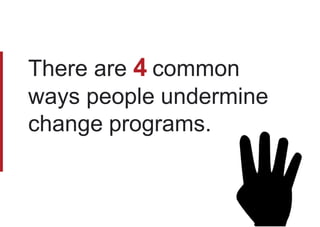
There are 4 common
ways people undermine
change programs.
1. Fear Mongering
Fear mongering is designed to raise
anxieties to extreme levels.
Any thoughtful assessment of a proposal
becomes either difficult, or impossible.
Patterns usually start with an “undeniable”
fact, followed by a tale of frightening
consequences that pushes almost
everyone’s buttons.
2. Death by delay
Discussions and intervals between
meetings are so drawn out, buy-in can’t be
achieved by a critical deadline.
Death by delay is very powerful and
easy to set up.
With delaying tactics, attention can be
diverted to some other pressing issue.
Building momentum toward buy-in slows to
where it can’t be recovered.
Death by delay is an easily available
weapon, simple to use and very
dangerous.
3. Confusion
It’s possible to kill ideas simply by polluting
conversations.
Adding “beside-the-point" facts and
convoluted logic makes intelligent
dialogue out of the question.
?
Some people are skilled at drawing others
into discussions that are so complicated – that
any reasonable person would simply
surrender and walk away.
Even the simplest plans can be pulled into a
maze of complexity where anyone can get
lost.
4. Ridicule
Occasionally, verbal darts don’t shoot at the
idea – but at the people behind the idea.
Watch out for condescending looks, seemingly
innocent questions, bogus concerns about
competence and character.
Strong buy-in is rarely achieved if people
feel uneasy about those behind the
transformation strategy proposal.
But the "ridicule tactic” is high risk – and used
far less than other tactics.
Mostly because it can backfire painfully on
the attacker.
What can be done?
If you find yourself in this position,
there are 3 simple, rational guidelines
to keep in mind:
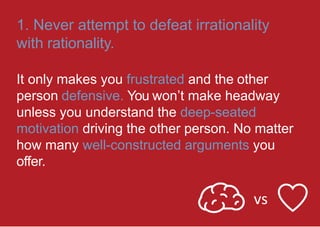
1. Never attempt to defeat irrationality
with rationality.
It only makes you frustrated and the other
person defensive. You won’t make headway
unless you understand the deep-seated
motivation driving the other person. No matter
how many well-constructed arguments you
offer.
vs
2. Focus on discovering and understanding
the other person’s rationale.
If your antagonist is driven by unconscious
motivations, you need to figure them out.
You won’t break through until you
understand where resistance to logic
comes from.
Pull the curtain back, and look at the
"questions that haven’t been raised".
3. Never underestimate the potential in
employee engagement.
Disengaged staff grind down the spirits of
other colleagues.
How can you get things back on track? It
all starts with individual managers.
Many transformational changes are
inflicted on people. They are told that
some awful crisis is on the way and what
is expected of them.
So, get ahead of the game. Test your
effectiveness by generating more
constructive actions that involve
your staff.
Managing teams would be a lot easier
if there weren’t any people involved,
right?
But it wouldn’t be
early as interesting.
Mentor has a proven approach that ensures
you succeed with your toughest execution
challenges.
Our direct, gritty, truth-telling approach helps
companies deliver their toughest execution
challenges. We’ve seen it all – everything from
helping greenfield startups launch, to working with
large global companies delivering business-critical
programs worth hundreds of millions of pounds.
Visit mentoreurope.com to find out how we get results.

Program execution: an inconvenient truth!

  • 1.
  • 2.
    We have 25+years of hard-won experience in program delivery and rescue. Our experts specialise in the IT, Telecoms, and Media industries. We are trusted by global industry leaders, including Vodafone, BT, Sky, EE, Tele2, lastminute.com, Sony, Dell.
  • 3.
    Most senior managersknow how to plan business-critical programs – but have difficulty when it comes to closing the gap between “knowing” and "getting things done". So, what is going on?
  • 4.
    Most change initiativesare launched with a PowerPoint presentation. Questions either skirt around the issues – or aren’t asked at all. After all, who wants to tell their boss that they don’t think his idea is sensible?
  • 5.
    As a result,people ask safely manicured questions. The really crunchy worries and fears are often driven underground – only discussed in hushed tones in hallways and during fag breaks. As a result, passive resistance starts building.
  • 6.
    There are 4common ways people undermine change programs.
  • 7.
    1. Fear Mongering Fearmongering is designed to raise anxieties to extreme levels. Any thoughtful assessment of a proposal becomes either difficult, or impossible. Patterns usually start with an “undeniable” fact, followed by a tale of frightening consequences that pushes almost everyone’s buttons.
  • 8.
    2. Death bydelay Discussions and intervals between meetings are so drawn out, buy-in can’t be achieved by a critical deadline. Death by delay is very powerful and easy to set up.
  • 9.
    With delaying tactics,attention can be diverted to some other pressing issue. Building momentum toward buy-in slows to where it can’t be recovered. Death by delay is an easily available weapon, simple to use and very dangerous.
  • 10.
    3. Confusion It’s possibleto kill ideas simply by polluting conversations. Adding “beside-the-point" facts and convoluted logic makes intelligent dialogue out of the question. ?
  • 11.
    Some people areskilled at drawing others into discussions that are so complicated – that any reasonable person would simply surrender and walk away. Even the simplest plans can be pulled into a maze of complexity where anyone can get lost.
  • 12.
    4. Ridicule Occasionally, verbaldarts don’t shoot at the idea – but at the people behind the idea. Watch out for condescending looks, seemingly innocent questions, bogus concerns about competence and character.
  • 13.
    Strong buy-in israrely achieved if people feel uneasy about those behind the transformation strategy proposal. But the "ridicule tactic” is high risk – and used far less than other tactics. Mostly because it can backfire painfully on the attacker.
  • 14.
    What can bedone? If you find yourself in this position, there are 3 simple, rational guidelines to keep in mind:
  • 15.
    1. Never attemptto defeat irrationality with rationality. It only makes you frustrated and the other person defensive. You won’t make headway unless you understand the deep-seated motivation driving the other person. No matter how many well-constructed arguments you offer. vs
  • 16.
    2. Focus ondiscovering and understanding the other person’s rationale. If your antagonist is driven by unconscious motivations, you need to figure them out. You won’t break through until you understand where resistance to logic comes from. Pull the curtain back, and look at the "questions that haven’t been raised".
  • 17.
    3. Never underestimatethe potential in employee engagement. Disengaged staff grind down the spirits of other colleagues. How can you get things back on track? It all starts with individual managers.
  • 18.
    Many transformational changesare inflicted on people. They are told that some awful crisis is on the way and what is expected of them. So, get ahead of the game. Test your effectiveness by generating more constructive actions that involve your staff.
  • 19.
    Managing teams wouldbe a lot easier if there weren’t any people involved, right? But it wouldn’t be early as interesting.
  • 20.
    Mentor has aproven approach that ensures you succeed with your toughest execution challenges. Our direct, gritty, truth-telling approach helps companies deliver their toughest execution challenges. We’ve seen it all – everything from helping greenfield startups launch, to working with large global companies delivering business-critical programs worth hundreds of millions of pounds. Visit mentoreurope.com to find out how we get results.