That doesn't
have a snowball’s
chance in hell!
Results. Nothing less.
We have 25+ years of
hard-won experience in
program delivery and
rescue.
Our experts specialise in the IT,
Telecoms, and Media industries.
We are trusted by global
industry leaders, including
Vodafone, BT, Sky, EE, Tele2,
lastminute.com, Sony, Dell.
Let’s talk about program delivery
tactics. Specifically, those which
are worn-out, overly focused on
‘command-and-control’, and
– in the end – thoroughly
unsuccessful.
The problem: Highly experienced
managers struggle to question
treasured beliefs.
In the face of undeniable evidence, many prefer
to squeeze out yet another increment of
efficiency. They believe it’s safer than
striking out in new directions.
Now, beyond doubt,
“management” was one of
the 20th-century’s greatest
inventions. However, it was
never designed to deal with
the quick-fire changes that
we see around us today.
Falling entry barriers… disruptive
technologies… growing customer
power… Now, these relentless
direction changes are the new
“normal".
There’s just one problem.
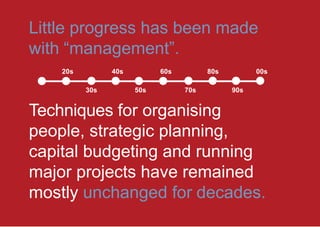
Little progress has been made
with “management”.
20s 40s 60s 80s 00s
30s 50s 70s 90s
Techniques for organising
people, strategic planning,
capital budgeting and running
major projects have remained
mostly unchanged for decades.
So what happens when management
is faced with a root-and-branch
transformative challenge?
One that will be hugely challenging; life will
be traumatic until it’s finished. No one
knows if this program is achievable – but
top management want it done.
More often than not,
it’s a case of denial
or rabbits
in headlights.
What can be done to change this
mindset, avoid glacial
management techniques,
and spectacularly boost
chances of success?
Five pillars will help companies
knock over yesterday’s
management thinking, master
new imaginative delivery
approaches - and put them
back in the driving seat.
Pillar 1: Make sure people really
understand the initiative
Many top managers understand these problems. But
somehow remain prisoners of sterile business
language: superiority, advantage, efficiency, value,
leadership, and “high-performance”.
Managers must get the message across with energy and
passion – and in plain English. This way people not only
buy the story – but are willing to act on
Pillar 2: Construct a realistic
but flexible plan
Break work up into logical cycles – act – learn – and,
based on what happens in the market, adjust for the
next cycle.
This serves as a catalyst for further change – often
beyond the original intent. When change is the rule,
standard techniques won’t make the grade.
Pillar 3: Create powerful
execution structure
The key to accountability is structure. Several
organisational options exist – ranging from a simple
coordination style through a more formal matrix
structure – to dedicated taskforces. For major
transformations a dedicated team approach works
best.
Pillar 4: Build a well-balanced
execution team
Execution must be driven by people with a winning state
of mind – people who can shake things up.
“Heavyweight” – experienced in managing high tempo,
high-change ventures.
This subject gets limited attention in many companies –
yet it is the single most important factor behind
failing programs.
Pillar 5: Differentiate between facts
and opinions, and act on facts
Pragmatism is at the heart of execution.
The performance management system is
pivotal - asks four basic questions:
• What has happened?
• Why has it happened?
• Is it going to continue?
• What are we going to do about it? ?
Executing ground-breaking programs is a
craft without gimmicks.
There is no recipe that guarantees
success – there are no shortcuts.
Execution is not abstract – it is concrete – and far
too rich in complexity to be reduced to superficial,
dumbed-down templates and blueprints.
Without measurement and accountability,
there will be a decline in performance.
With it, there will be stability, and usually,
improvement in performance.
There must be extraordinary intensity
in the review process.
Along with a willingness to have
a frank and open exchange – tough if
necessary – and to focus on the truly
significant drivers of the task.
So – pause for a moment – reflect on a few words
from Robert Frost’s poem, “The Road not Taken”.
Consider knocking over outmoded management
wisdom to get the results you want:
Two roads diverged in a wood, and I –
I took the one less travelled by,
and that has made all the difference.
Mentor has a proven approach that ensures
you succeed with your toughest execution
challenges.
Our direct, gritty, truth-telling approach helps
companies deliver their toughest execution
challenges. We’ve seen it all – everything from
helping greenfield startups launch, to working with
large global companies delivering business-critical
programs worth hundreds of millions of pounds.
Visit mentoreurope.com to find out how we deliver results.

Program delivery - that doesn't have a snowball's chance in hell!

  • 1.
    That doesn't have asnowball’s chance in hell! Results. Nothing less.
  • 2.
    We have 25+years of hard-won experience in program delivery and rescue. Our experts specialise in the IT, Telecoms, and Media industries. We are trusted by global industry leaders, including Vodafone, BT, Sky, EE, Tele2, lastminute.com, Sony, Dell.
  • 3.
    Let’s talk aboutprogram delivery tactics. Specifically, those which are worn-out, overly focused on ‘command-and-control’, and – in the end – thoroughly unsuccessful.
  • 4.
    The problem: Highlyexperienced managers struggle to question treasured beliefs. In the face of undeniable evidence, many prefer to squeeze out yet another increment of efficiency. They believe it’s safer than striking out in new directions.
  • 5.
    Now, beyond doubt, “management”was one of the 20th-century’s greatest inventions. However, it was never designed to deal with the quick-fire changes that we see around us today.
  • 6.
    Falling entry barriers…disruptive technologies… growing customer power… Now, these relentless direction changes are the new “normal". There’s just one problem.
  • 7.
    Little progress hasbeen made with “management”. 20s 40s 60s 80s 00s 30s 50s 70s 90s Techniques for organising people, strategic planning, capital budgeting and running major projects have remained mostly unchanged for decades.
  • 8.
    So what happenswhen management is faced with a root-and-branch transformative challenge? One that will be hugely challenging; life will be traumatic until it’s finished. No one knows if this program is achievable – but top management want it done.
  • 9.
    More often thannot, it’s a case of denial or rabbits in headlights.
  • 10.
    What can bedone to change this mindset, avoid glacial management techniques, and spectacularly boost chances of success?
  • 11.
    Five pillars willhelp companies knock over yesterday’s management thinking, master new imaginative delivery approaches - and put them back in the driving seat.
  • 12.
    Pillar 1: Makesure people really understand the initiative Many top managers understand these problems. But somehow remain prisoners of sterile business language: superiority, advantage, efficiency, value, leadership, and “high-performance”. Managers must get the message across with energy and passion – and in plain English. This way people not only buy the story – but are willing to act on
  • 13.
    Pillar 2: Constructa realistic but flexible plan Break work up into logical cycles – act – learn – and, based on what happens in the market, adjust for the next cycle. This serves as a catalyst for further change – often beyond the original intent. When change is the rule, standard techniques won’t make the grade.
  • 14.
    Pillar 3: Createpowerful execution structure The key to accountability is structure. Several organisational options exist – ranging from a simple coordination style through a more formal matrix structure – to dedicated taskforces. For major transformations a dedicated team approach works best.
  • 15.
    Pillar 4: Builda well-balanced execution team Execution must be driven by people with a winning state of mind – people who can shake things up. “Heavyweight” – experienced in managing high tempo, high-change ventures. This subject gets limited attention in many companies – yet it is the single most important factor behind failing programs.
  • 16.
    Pillar 5: Differentiatebetween facts and opinions, and act on facts Pragmatism is at the heart of execution. The performance management system is pivotal - asks four basic questions: • What has happened? • Why has it happened? • Is it going to continue? • What are we going to do about it? ?
  • 17.
    Executing ground-breaking programsis a craft without gimmicks. There is no recipe that guarantees success – there are no shortcuts. Execution is not abstract – it is concrete – and far too rich in complexity to be reduced to superficial, dumbed-down templates and blueprints.
  • 18.
    Without measurement andaccountability, there will be a decline in performance. With it, there will be stability, and usually, improvement in performance. There must be extraordinary intensity in the review process. Along with a willingness to have a frank and open exchange – tough if necessary – and to focus on the truly significant drivers of the task.
  • 19.
    So – pausefor a moment – reflect on a few words from Robert Frost’s poem, “The Road not Taken”. Consider knocking over outmoded management wisdom to get the results you want: Two roads diverged in a wood, and I – I took the one less travelled by, and that has made all the difference.
  • 20.
    Mentor has aproven approach that ensures you succeed with your toughest execution challenges. Our direct, gritty, truth-telling approach helps companies deliver their toughest execution challenges. We’ve seen it all – everything from helping greenfield startups launch, to working with large global companies delivering business-critical programs worth hundreds of millions of pounds. Visit mentoreurope.com to find out how we deliver results.