An Exemplar Model for Learning Object ClassesAuthors: Ondrej Chum Andrew Zisserman@University of OxfordPresenter: Shao-Chuan Wang
An Exemplar Model for Learning Object ClassesObjective:Give training images known to contain instances of an object class, without specifying locations and scales.Detect and localize objectKea Ideas: Learn region of interest (ROI) around class instance in weakly supervised training data.Based on discriminative features to initialize ROI for the optimization problem
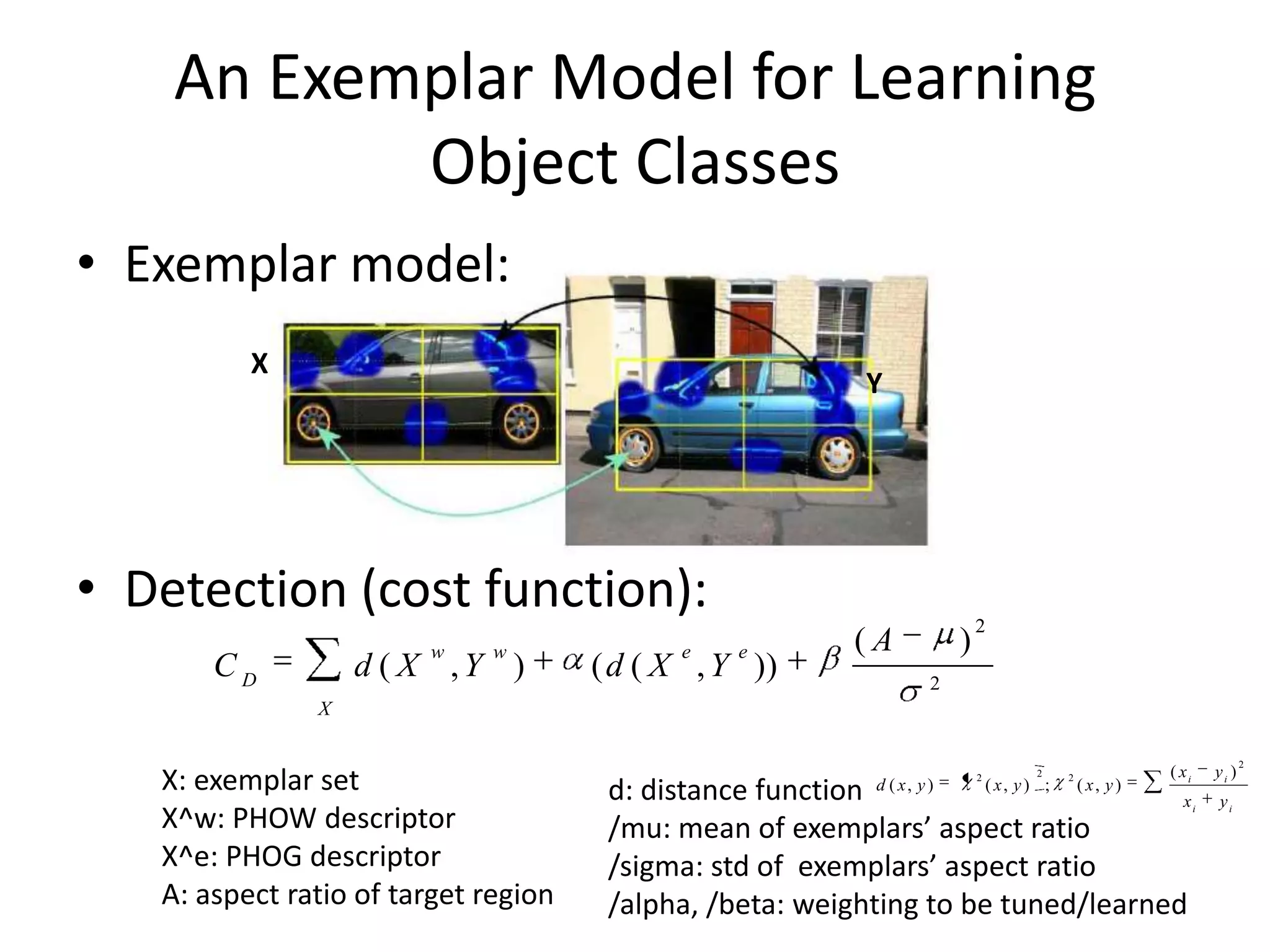
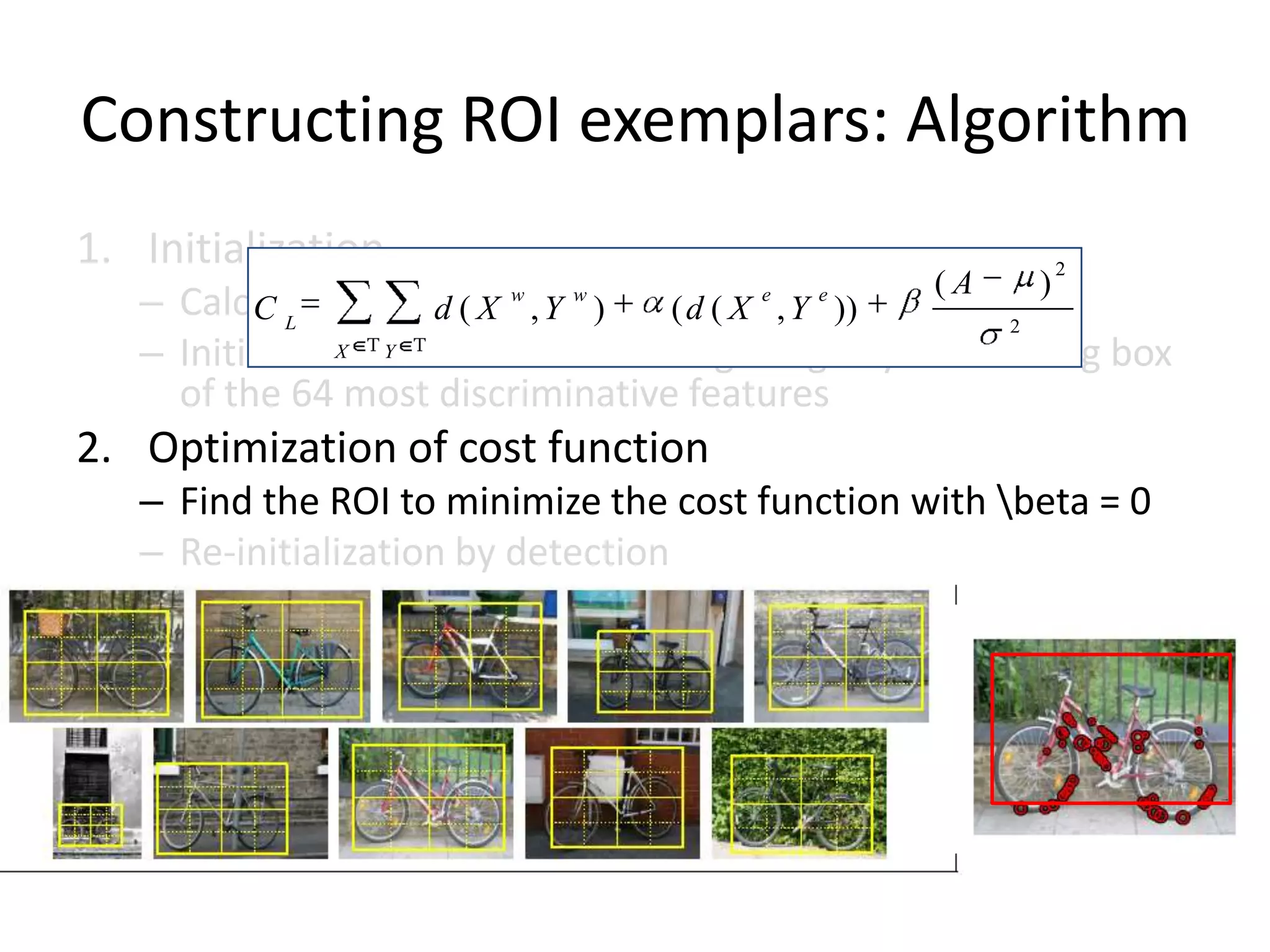
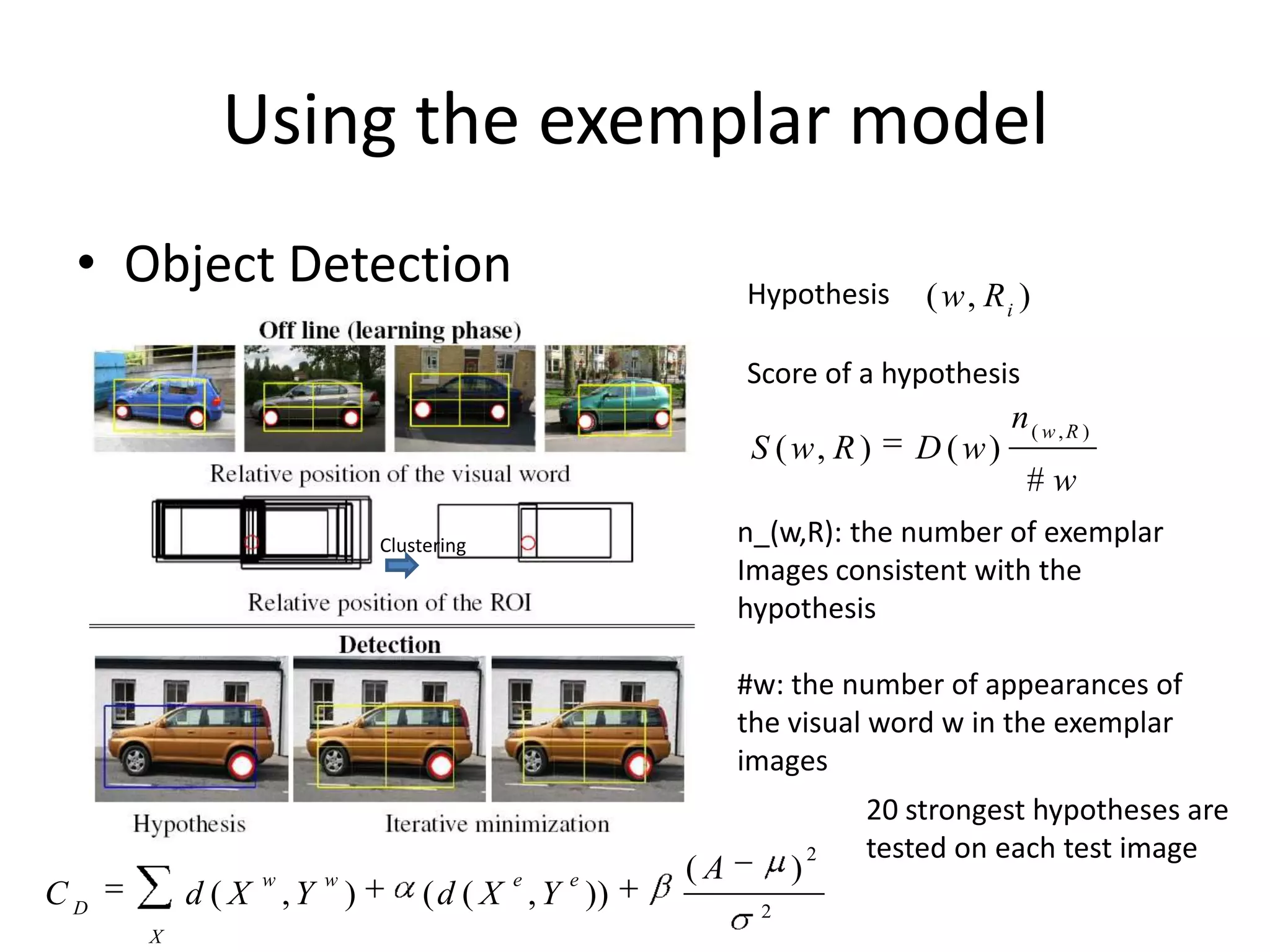
An Exemplar Model for Learning Object ClassesExemplar model:Detection (cost function):XYX: exemplar setX^w: PHOW descriptorX^e: PHOG descriptorA: aspect ratio of target regiond: distance function/mu: mean of exemplars’ aspect ratio/sigma: std of  exemplars’ aspect ratio/alpha, /beta: weighting to be tuned/learned
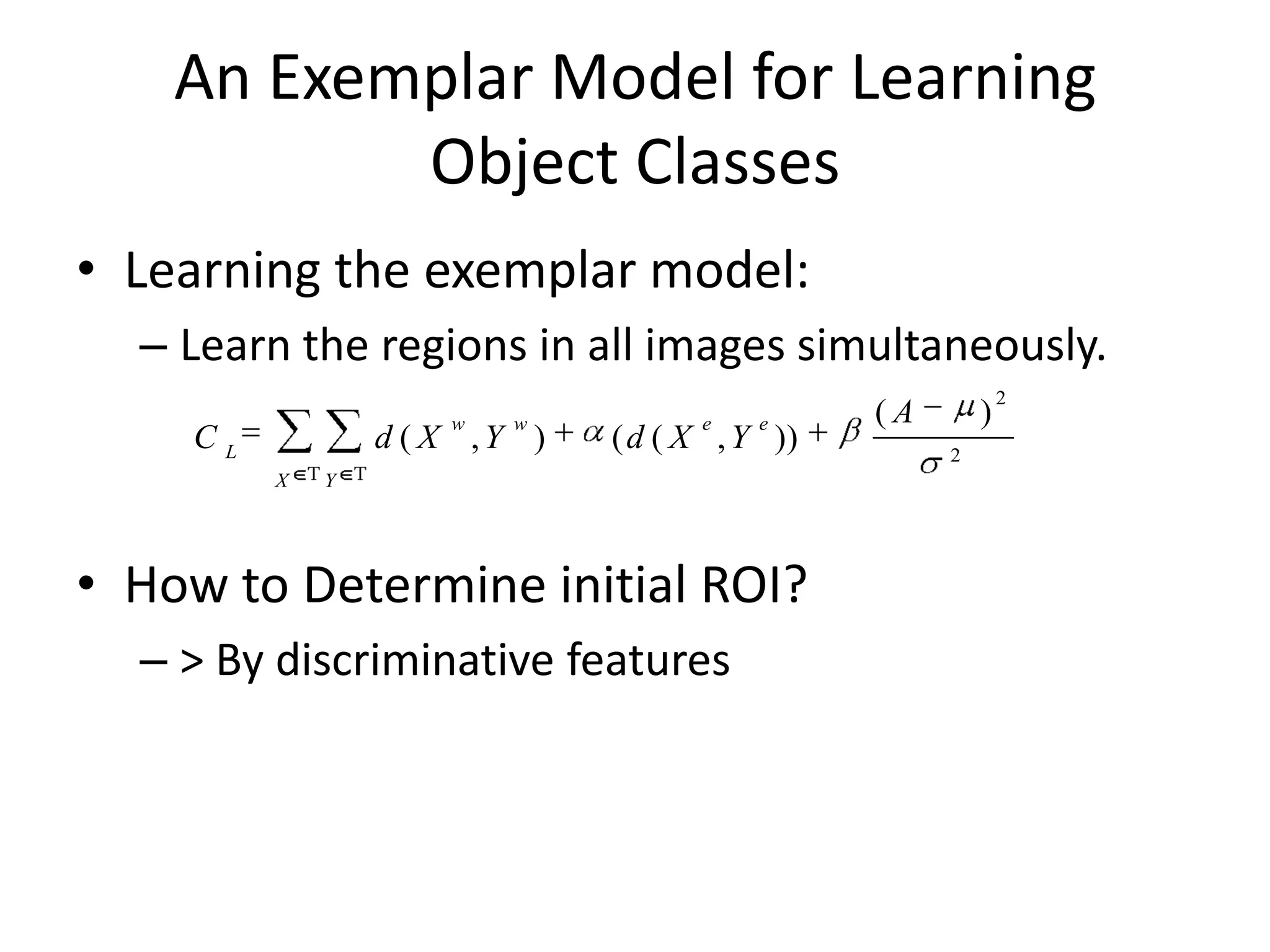
An Exemplar Model for Learning Object ClassesLearning the exemplar model:Learn the regions in all images simultaneously.How to Determine initial ROI?> By discriminative features
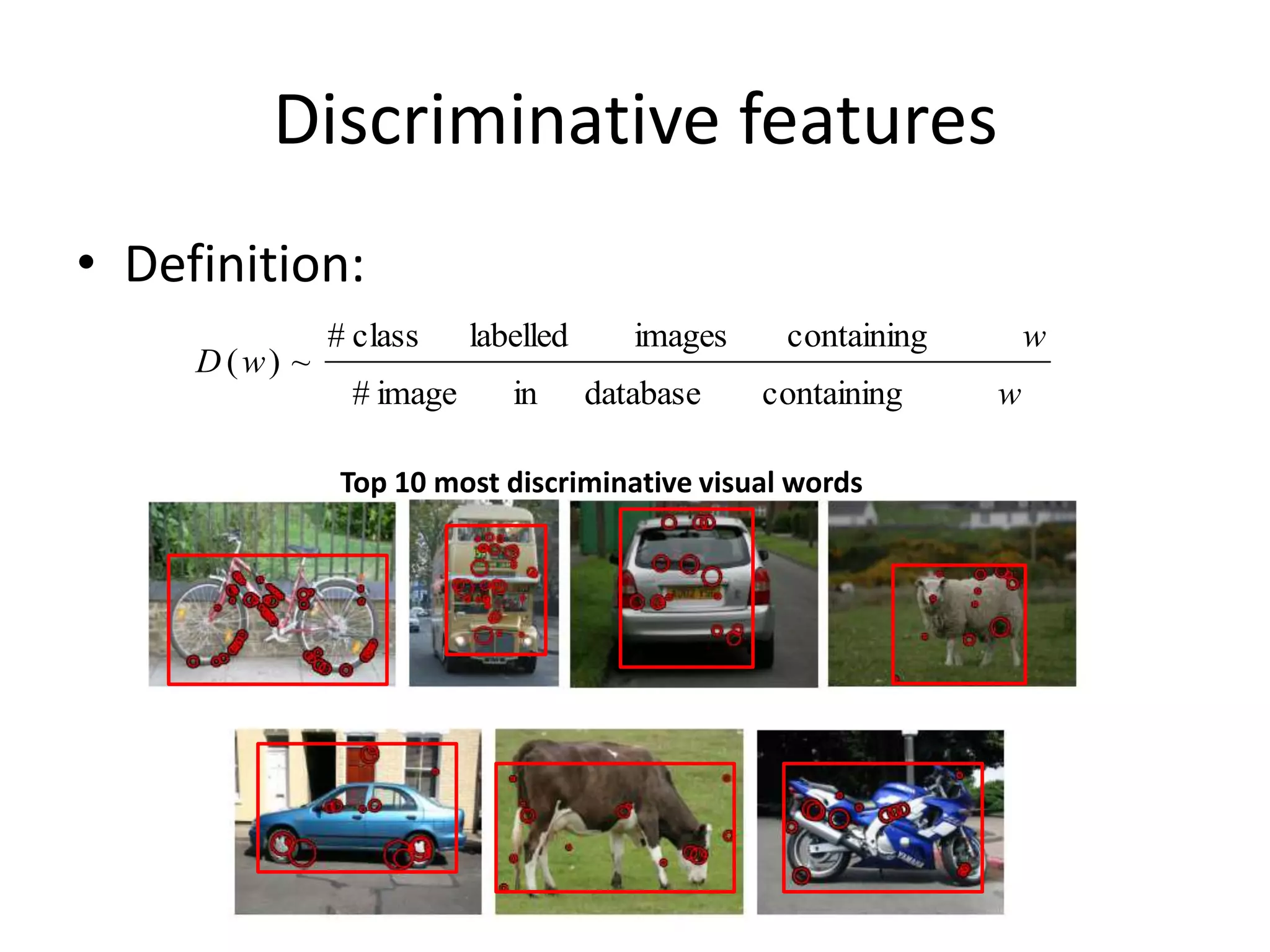
Top 10 most discriminative visual wordsDiscriminative featuresDefinition:
Constructing ROI exemplars: Algorithm
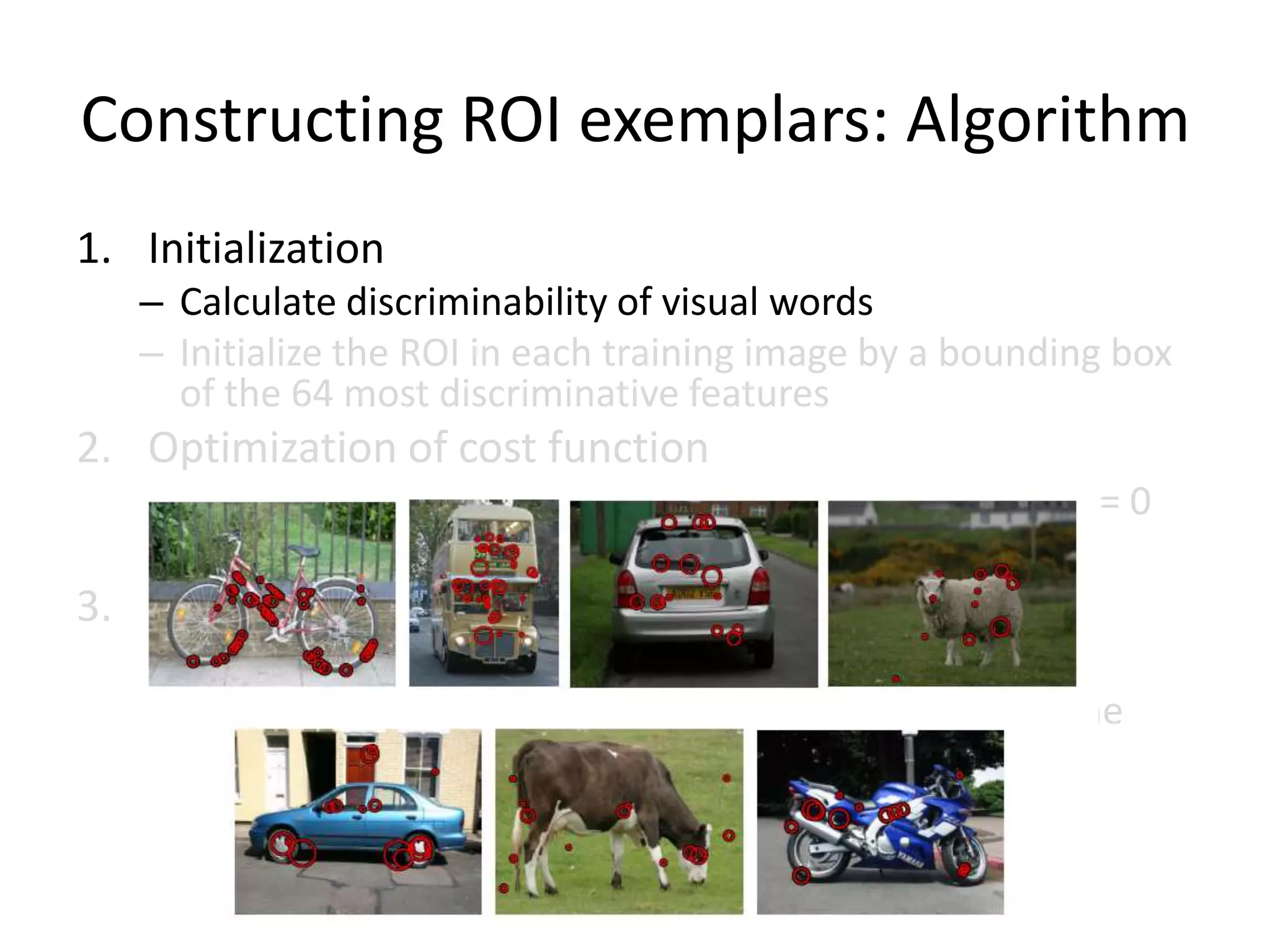
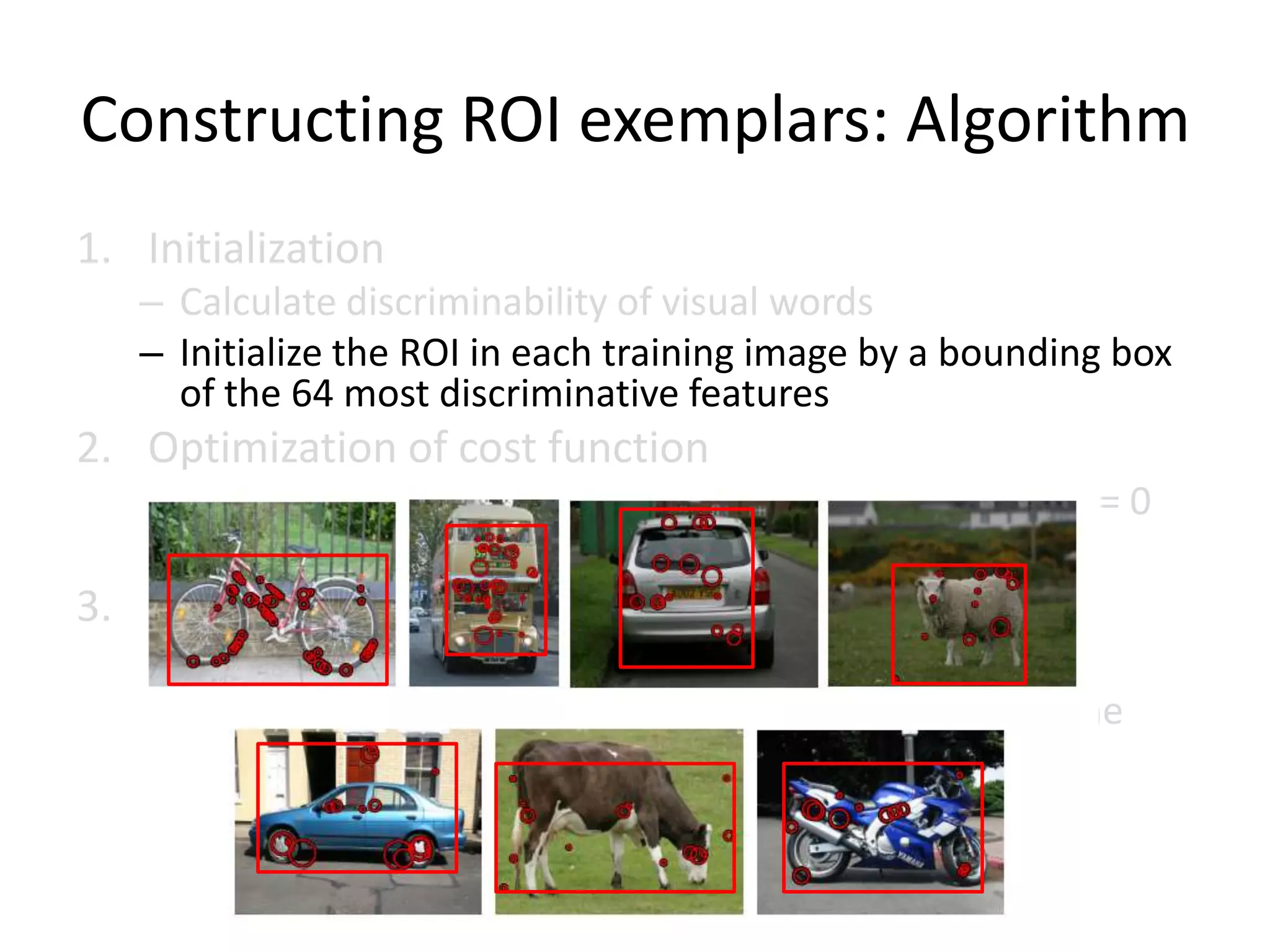
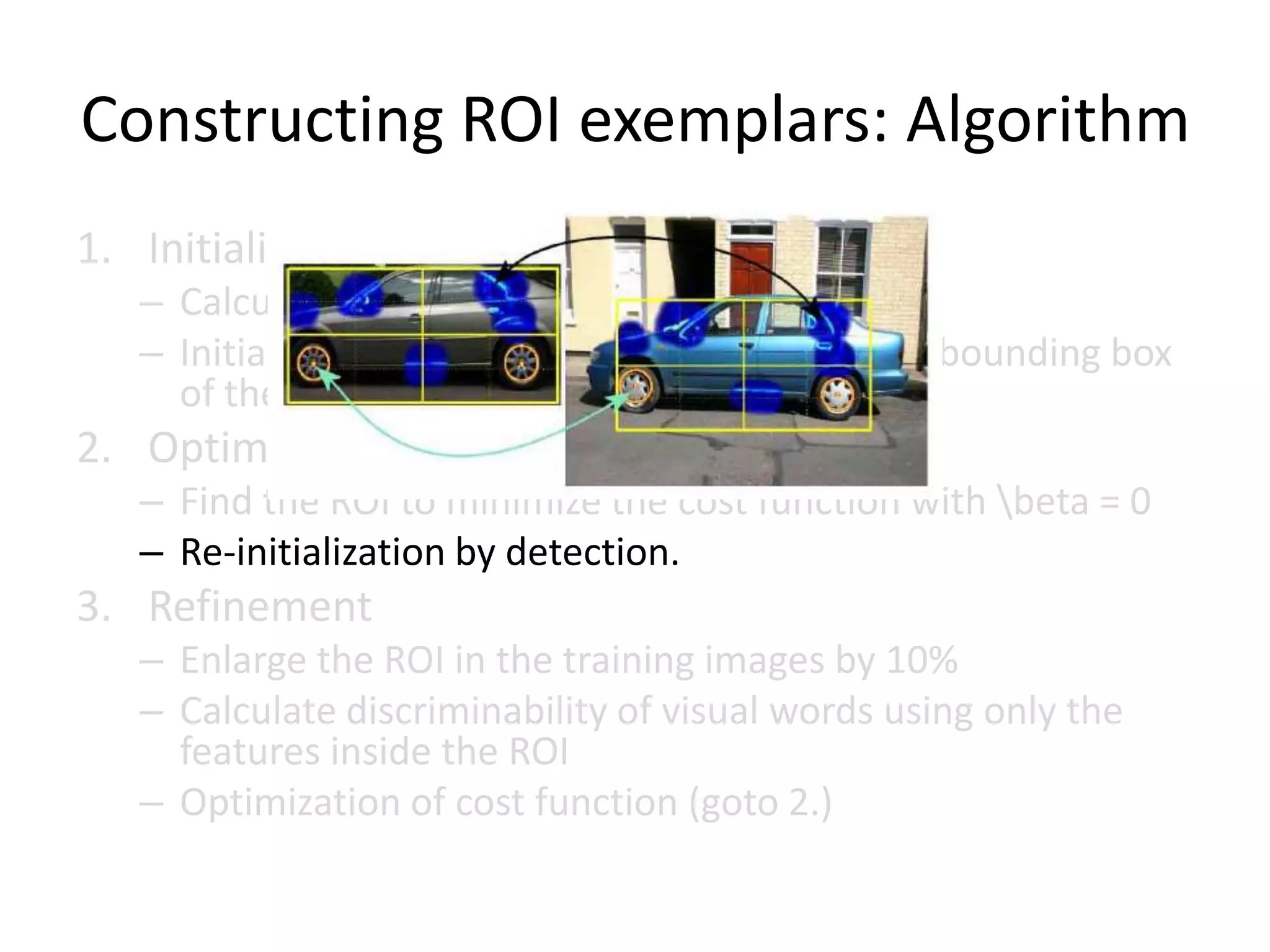
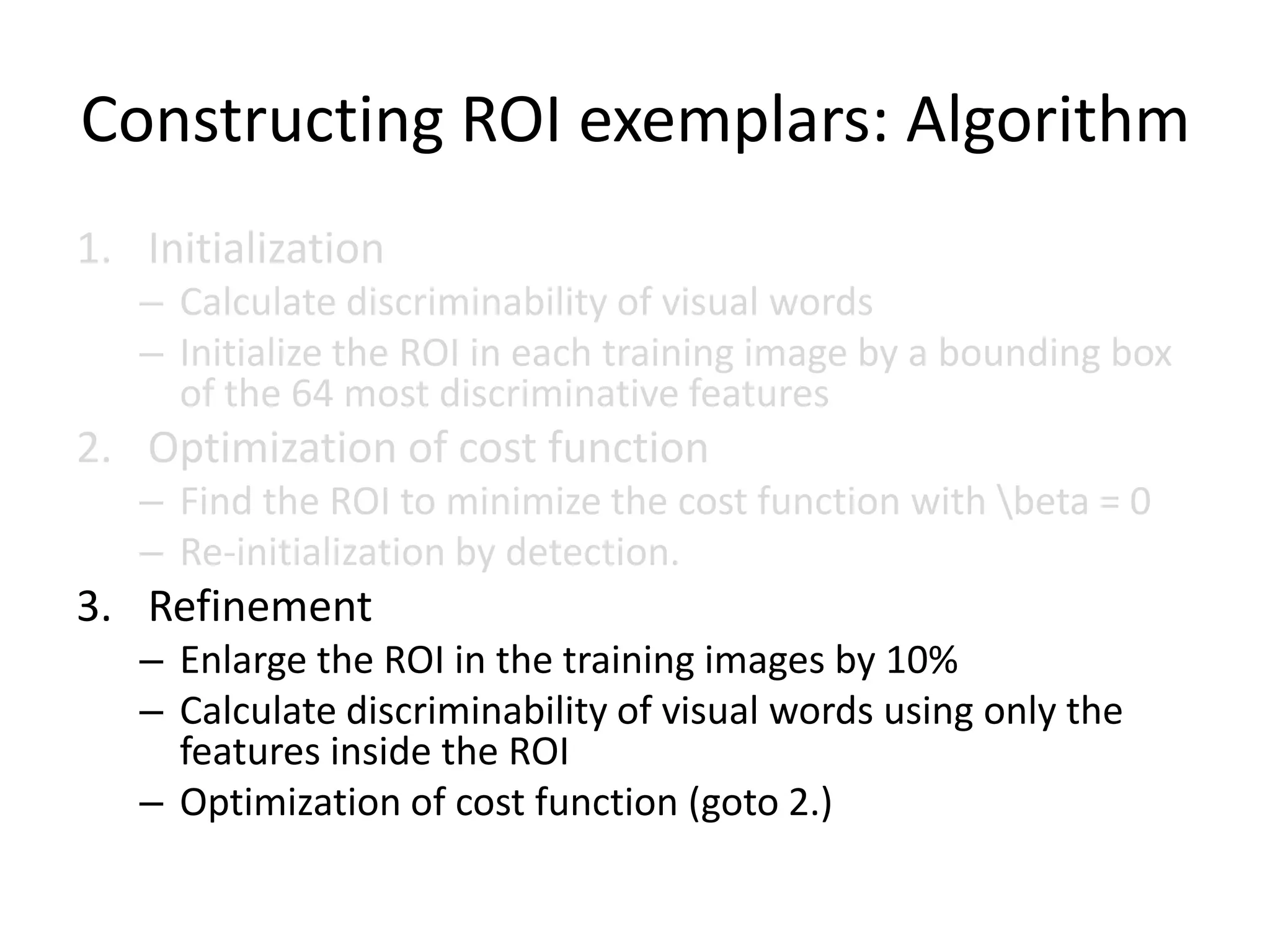
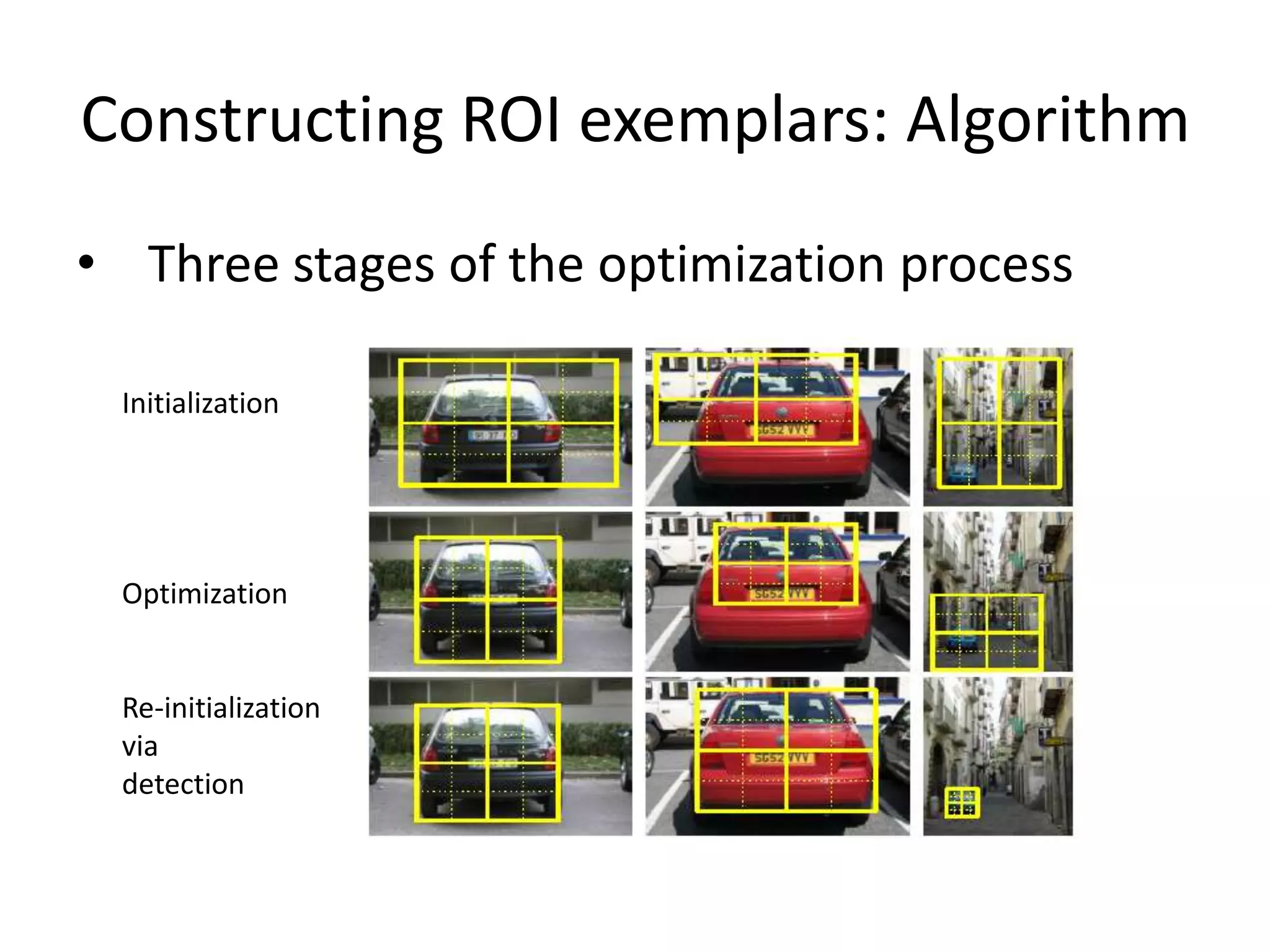
Constructing ROI exemplars: AlgorithmInitializationCalculate discriminability of visual wordsInitialize the ROI in each training image by a bounding box of the 64 most discriminative featuresOptimization of cost functionFind the ROI to minimize the cost function with \beta = 0Re-initialization by detectionRefinementEnlarge the ROI in the training images by 10%Calculate discriminability of visual words using only the features inside the ROIOptimization of cost function (goto 2.)
Constructing ROI exemplars: AlgorithmInitializationCalculate discriminability of visual wordsInitialize the ROI in each training image by a bounding box of the 64 most discriminative featuresOptimization of cost functionFind the ROI to minimize the cost function with \beta = 0Re-initialization by detection.RefinementEnlarge the ROI in the training images by 10%Calculate discriminability of visual words using only the features inside the ROIOptimization of cost function (goto 2.)
Constructing ROI exemplars: AlgorithmInitializationCalculate discriminability of visual wordsInitialize the ROI in each training image by a bounding box of the 64 most discriminative featuresOptimization of cost functionFind the ROI to minimize the cost function with \beta = 0Re-initialization by detection. RefinementEnlarge the ROI in the training images by 10%Calculate discriminability of visual words using only the features inside the ROIOptimization of cost function (goto 2.)
Constructing ROI exemplars: AlgorithmInitializationCalculate discriminability of visual wordsInitialize the ROI in each training image by a bounding box of the 64 most discriminative featuresOptimization of cost functionFind the ROI to minimize the cost function with \beta = 0Re-initialization by detection.RefinementEnlarge the ROI in the training images by 10%Calculate discriminability of visual words using only the features inside the ROIOptimization of cost function (goto 2.)
Constructing ROI exemplars: AlgorithmThree stages of the optimization processInitializationOptimizationRe-initializationviadetection
Using the exemplar modelObject Detection HypothesisScore of a hypothesisn_(w,R): the number of exemplar Images consistent with the hypothesis#w: the number of appearances of the visual word w in the exemplar imagesClustering20 strongest hypotheses are tested on each test image
Using other modelsTraining:Train an SVM, using features within ROI by exemplar modelsObject detectionScores are ranked by SVM score
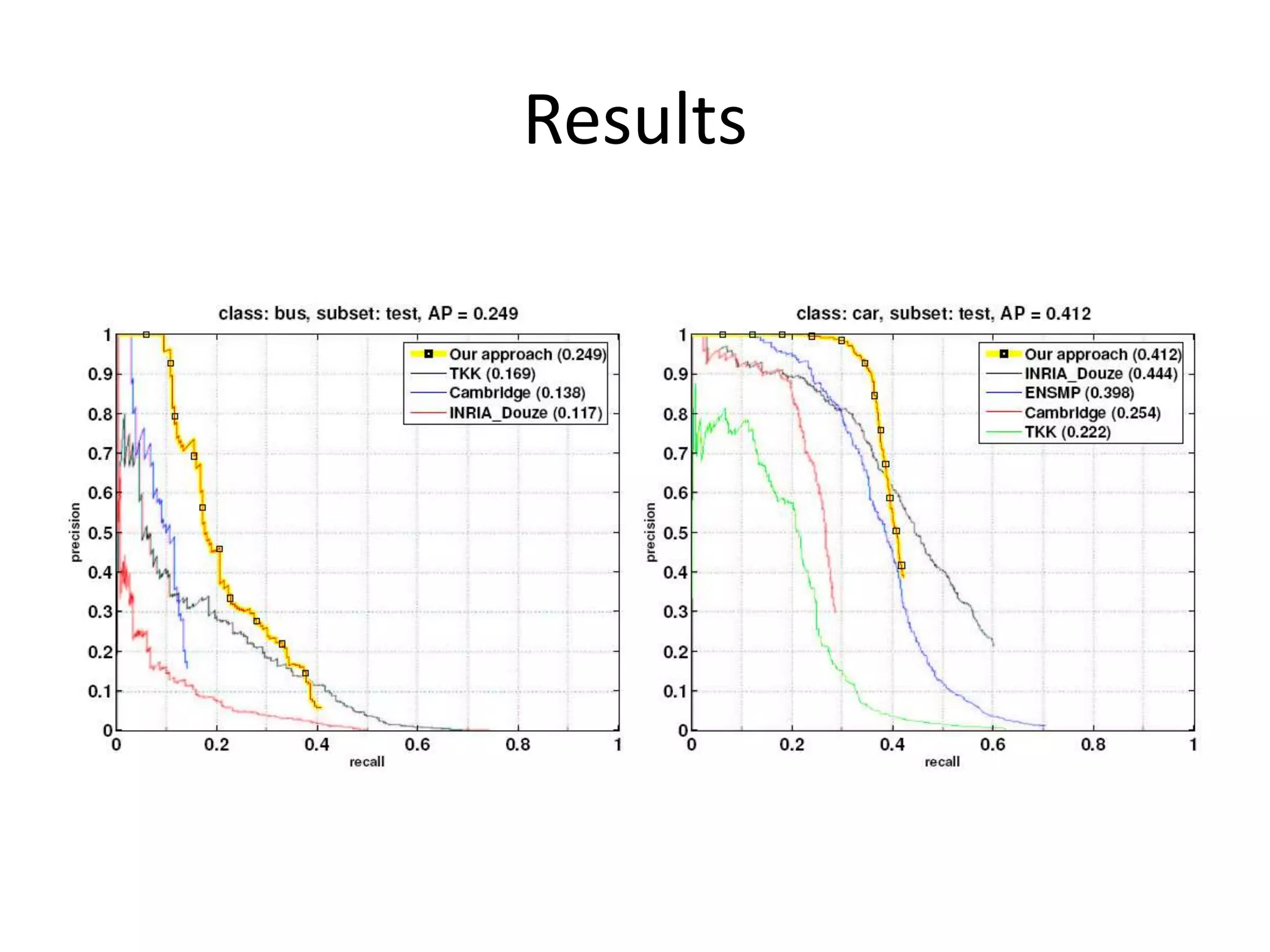
Results
ConclusionWhen constructing exemplars’ ROI, they use discriminability to initialize bounding boxIn detection, they used relative position of bounding boxes and visual words to try the most probable hypotheses.It may failed to detect when significant class variability in the exemplars, such as people class.

An Exemplar Model For Learning Object Classes

  • 1.
    An Exemplar Modelfor Learning Object ClassesAuthors: Ondrej Chum Andrew Zisserman@University of OxfordPresenter: Shao-Chuan Wang
  • 2.
    An Exemplar Modelfor Learning Object ClassesObjective:Give training images known to contain instances of an object class, without specifying locations and scales.Detect and localize objectKea Ideas: Learn region of interest (ROI) around class instance in weakly supervised training data.Based on discriminative features to initialize ROI for the optimization problem
  • 3.
    An Exemplar Modelfor Learning Object ClassesExemplar model:Detection (cost function):XYX: exemplar setX^w: PHOW descriptorX^e: PHOG descriptorA: aspect ratio of target regiond: distance function/mu: mean of exemplars’ aspect ratio/sigma: std of exemplars’ aspect ratio/alpha, /beta: weighting to be tuned/learned
  • 4.
    An Exemplar Modelfor Learning Object ClassesLearning the exemplar model:Learn the regions in all images simultaneously.How to Determine initial ROI?> By discriminative features
  • 5.
    Top 10 mostdiscriminative visual wordsDiscriminative featuresDefinition:
  • 6.
  • 7.
    Constructing ROI exemplars:AlgorithmInitializationCalculate discriminability of visual wordsInitialize the ROI in each training image by a bounding box of the 64 most discriminative featuresOptimization of cost functionFind the ROI to minimize the cost function with \beta = 0Re-initialization by detectionRefinementEnlarge the ROI in the training images by 10%Calculate discriminability of visual words using only the features inside the ROIOptimization of cost function (goto 2.)
  • 8.
    Constructing ROI exemplars:AlgorithmInitializationCalculate discriminability of visual wordsInitialize the ROI in each training image by a bounding box of the 64 most discriminative featuresOptimization of cost functionFind the ROI to minimize the cost function with \beta = 0Re-initialization by detectionRefinementEnlarge the ROI in the training images by 10%Calculate discriminability of visual words using only the features inside the ROIOptimization of cost function (goto 2.)
  • 9.
    Constructing ROI exemplars:AlgorithmInitializationCalculate discriminability of visual wordsInitialize the ROI in each training image by a bounding box of the 64 most discriminative featuresOptimization of cost functionFind the ROI to minimize the cost function with \beta = 0Re-initialization by detectionRefinementEnlarge the ROI in the training images by 10%Calculate discriminability of visual words using only the features inside the ROIOptimization of cost function (goto 2.)
  • 10.
    Constructing ROI exemplars:AlgorithmInitializationCalculate discriminability of visual wordsInitialize the ROI in each training image by a bounding box of the 64 most discriminative featuresOptimization of cost functionFind the ROI to minimize the cost function with \beta = 0Re-initialization by detection.RefinementEnlarge the ROI in the training images by 10%Calculate discriminability of visual words using only the features inside the ROIOptimization of cost function (goto 2.)
  • 11.
    Constructing ROI exemplars:AlgorithmInitializationCalculate discriminability of visual wordsInitialize the ROI in each training image by a bounding box of the 64 most discriminative featuresOptimization of cost functionFind the ROI to minimize the cost function with \beta = 0Re-initialization by detection. RefinementEnlarge the ROI in the training images by 10%Calculate discriminability of visual words using only the features inside the ROIOptimization of cost function (goto 2.)
  • 12.
    Constructing ROI exemplars:AlgorithmInitializationCalculate discriminability of visual wordsInitialize the ROI in each training image by a bounding box of the 64 most discriminative featuresOptimization of cost functionFind the ROI to minimize the cost function with \beta = 0Re-initialization by detection.RefinementEnlarge the ROI in the training images by 10%Calculate discriminability of visual words using only the features inside the ROIOptimization of cost function (goto 2.)
  • 13.
    Constructing ROI exemplars:AlgorithmThree stages of the optimization processInitializationOptimizationRe-initializationviadetection
  • 14.
    Using the exemplarmodelObject Detection HypothesisScore of a hypothesisn_(w,R): the number of exemplar Images consistent with the hypothesis#w: the number of appearances of the visual word w in the exemplar imagesClustering20 strongest hypotheses are tested on each test image
  • 15.
    Using other modelsTraining:Trainan SVM, using features within ROI by exemplar modelsObject detectionScores are ranked by SVM score
  • 16.
  • 17.
    ConclusionWhen constructing exemplars’ROI, they use discriminability to initialize bounding boxIn detection, they used relative position of bounding boxes and visual words to try the most probable hypotheses.It may failed to detect when significant class variability in the exemplars, such as people class.