Amortized Analysis (chap. 17)
• Not just consider one operation, but a sequence of
operations on a given data structure.
• Average cost over a sequence of operations.
• Probabilistic analysis:
– Average case running time: average over all possible inputs for
one algorithm (operation).
– If using probability, called expected running time.
• Amortized analysis:
– No involvement of probability
– Average performance on a sequence of operations, even some
operation is expensive.
– Guarantee average performance of each operation among the
sequence in worst case.
Three Methods of Amortized Analysis
• Aggregate analysis:
– Total cost of n operations/n,
• Accounting method:
– Assign each type of operation an (different) amortized cost
– overcharge some operations,
– store the overcharge as credit on specific objects,
– then use the credit for compensation for some later
operations.
• Potential method:
– Same as accounting method
– But store the credit as “potential energy” and as a whole.
Example for amortized analysis
• Stack operations:
– PUSH(S,x), O(1)
– POP(S), O(1)
– MULTIPOP(S,k), min(s,k)
• while not STACK-EMPTY(S) and k>0
• do POP(S)
• k=k-1
• Let us consider a sequence of n PUSH, POP,
MULTIPOP.
– The worst case cost for MULTIPOP in the sequence is
O(n), since the stack size is at most n.
– thus the cost of the sequence is O(n2
). Correct, but not
tight.
Aggregate Analysis
• In fact, a sequence of n operations on an
initially empty stack cost at most O(n). Why?
Each object can be POP only once (including in MULTIPOP) for each time
it is PUSHed. #POPs is at most #PUSHs, which is at most n.
Thus the average cost of an operation is O(n)/n = O(1).
Amortized cost in aggregate analysis is defined to be average cost.
Another example: increasing a binary counter
• Binary counter of length k, A[0..k-1] of bit
array.
• INCREMENT(A)
1. i0
2. while i<k and A[i]=1
3. do A[i]0 (flip, reset)
4. ii+1
5. if i<k
6. then A[i]1 (flip, set)
Analysis of INCREMENT(A)
• Cursory analysis:
– A single execution of INCREMENT takes
O(k) in the worst case (when A contains all
1s)
– So a sequence of n executions takes O(nk)
in worst case (suppose initial counter is 0).
– This bound is correct, but not tight.
• The tight bound is O(n) for n
executions.
Amortized (Aggregate) Analysis of INCREMENT(A)
Observation: The running time determined by #flips
but not all bits flip each time INCREMENT is called.
A[0] flips every time, total n times.
A[1] flips every other time, n/2 times.
A[2] flips every forth time, n/4 times.
….
for i=0,1,…,k-1, A[i] flips n/2i
 times.
Thus total #flips is ∑i=0
k-1
n/2i

< n∑i=0
∞
1/2i
=2n.
Amortized Analysis of INCREMENT(A)
• Thus the worst case running time is O(n)
for a sequence of n INCREMENTs.
• So the amortized cost per operation is
O(1).
Amortized Analysis: Accounting Method
• Idea:
– Assign differing charges to different operations.
– The amount of the charge is called amortized cost.
– amortized cost is more or less than actual cost.
– When amortized cost > actual cost, the difference is
saved in specific objects as credits.
– The credits can be used by later operations whose
amortized cost < actual cost.
• As a comparison, in aggregate analysis, all
operations have same amortized costs.
Accounting Method (cont.)
• Conditions:
– suppose actual cost is ci for the ith operation in the
sequence, and amortized cost is ci',
– ∑i=1
n
ci' ≥∑i=1
n
ci should hold.
• since we want to show the average cost per
operation is small using amortized cost, we need the
total amortized cost is an upper bound of total actual cost.
• holds for all sequences of operations.
– Total credits is ∑i=1
n
ci' - ∑i=1
n
ci , which should be
nonnegative,
• Moreover, ∑i=1
t
ci' - ∑i=1
t
ci ≥0 for anyt>0.
Accounting Method: Stack Operations
• Actual costs:
– PUSH :1, POP :1, MULTIPOP: min(s,k).
• Let assign the following amortized costs:
– PUSH:2, POP: 0, MULTIPOP: 0.
• Similar to a stack of plates in a cafeteria.
– Suppose $1 represents a unit cost.
– When pushing a plate, use one dollar to pay the actual cost of the push and
leave one dollar on the plate as credit.
– Whenever POPing a plate, the one dollar on the plate is used to pay the actual
cost of the POP. (same for MULTIPOP).
– By charging PUSH a little more, do not charge POP or MULTIPOP.
• The total amortized cost for n PUSH, POP, MULTIPOP is O(n), thus O(1)
for average amortized cost for each operation.
• Conditions hold: total amortized cost ≥total actual cost, and amount of
credits never becomes negative.
Accounting method: binary counter
• Let $1 represent each unit of cost (i.e., the flip of one bit).
• Charge an amortized cost of $2 to set a bit to 1.
• Whenever a bit is set, use $1 to pay the actual cost, and
store another $1 on the bit as credit.
• When a bit is reset, the stored $1 pays the cost.
• At any point, a 1 in the counter stores $1, the number of 1’s
is never negative, so is the total credits.
• At most one bit is set in each operation, so the amortized
cost of an operation is at most $2.
• Thus, total amortized cost of n operations is O(n), and
average is O(1).
The Potential Method
• Same as accounting method:
something prepaid is used later.
• Different from accounting method
– The prepaid work not as credit, but as
“potential energy”, or “potential”.
– The potential is associated with the data
structure as a whole rather than with
specific objects within the data structure.
The Potential Method (cont.)
• Initial data structure D0,
• n operations, resulting in D0, D1,…, Dn with costs c1,
c2,…, cn.
• A potential function Φ: {Di}  R (real numbers)
∀ Φ(Di) is called the potential of Di.
• Amortized cost ci' of the ith operation is:
– ci' = ci + Φ(Di) - Φ(Di-1). (actual cost + potential change)
∀ ∑i=1
n
ci'= ∑i=1
n
(ci + Φ(Di) - Φ(Di-1))
• = ∑i=1
n
ci + Φ(Dn) - Φ(D0)
The Potential Method (cont.)
• If Φ(Dn) ≥ Φ(D0), then total amortized cost is an upper
bound of total actual cost.
• But we do not know how many operations, so Φ(Di) ≥
Φ(D0) is required for any i.
• It is convenient to define Φ(D0)=0,and so Φ(Di) ≥0, for all i.
• If the potential change is positive (i.e., Φ(Di) - Φ(Di-1)>0),
then ci' is an overcharge (so store the increase as
potential),
• otherwise, undercharge (discharge the potential to pay the
actual cost).
Potential method: stack operation
• Potential for a stack is the number of objects in the stack.
• So Φ(D0)=0, and Φ(Di) ≥0
• Amortized cost of stack operations:
– PUSH:
• Potential change: Φ(Di)- Φ(Di-1) =(s+1)-s =1.
• Amortized cost: ci' = ci + Φ(Di) - Φ(Di-1)=1+1=2.
– POP:
• Potential change: Φ(Di)- Φ(Di-1) =(s-1) –s= -1.
• Amortized cost: ci' = ci + Φ(Di) - Φ(Di-1)=1+(-1)=0.
– MULTIPOP(S,k): k'=min(s,k)
• Potential change: Φ(Di)- Φ(Di-1) = –k'.
• Amortized cost: ci' = ci + Φ(Di) - Φ(Di-1)=k'+(-k')=0.
• So amortized cost of each operation is O(1), and total amortized cost of n
operations is O(n).
• Since total amortized cost is an upper bound of actual cost, the worse case
cost of n operations is O(n).
Potential method: binary counter
• Define the potential of the counter after the ith INCREMENT is
Φ(Di) =bi, the number of 1’s. clearly, Φ(Di)≥0.
• Let us compute amortized cost of an operation
– Suppose the ith operation resets ti bits.
– Actual cost ci of the operation is at most ti +1.
– If bi=0, then the ith operation resets all k bits, so bi-1=ti=k.
– If bi>0, then bi=bi-1-ti+1
– In either case, bi≤bi-1-ti+1.
– So potential change is Φ(Di) - Φ(Di-1) ≤bi-1-ti+1-bi-1=1-ti.
– So amortized cost is: ci' = ci+ Φ(Di) - Φ(Di-1)≤ ti +1+1-ti=2.
• The total amortized cost of n operations is O(n).
• Thus worst case cost is O(n).
Amortized analyses: dynamic table
• A nice use of amortized analysis
• Table-insertion, table-deletion.
• Scenario:
– A table –maybe a hash table
– Do not know how large in advance
– May expend with insertion
– May contract with deletion
– Detailed implementation is not important
• Goal:
– O(1) amortized cost.
– Unused space always ≤ constant fraction of allocated space.
Dynamic table
• Load factor α = num/size, where num = #
items stored, size = allocated size.
• If size = 0, then num = 0. Call α = 1.
• Never allow α > 1.
• Keep α >a constant fraction  goal (2).
Dynamic table: expansion with insertion
• Table expansion
• Consider only insertion.
• When the table becomes full, double its
size and reinsert all existing items.
• Guarantees that α ≥ 1/2.
• Each time we actually insert an item into
the table, it’s an elementary insertion.
Copyright © The McGraw-Hill Companies, Inc. Permission required for reproduction or display.
Num[t] ele. insertion
1 ele. insertion
Initially, num[T ] = size[T ] = 0.
Aggregate analysis
• Running time: Charge 1 per elementary insertion. Count only
elementary insertions,
• since all other costs together are constant per call.
• ci = actual cost of ith operation
– If not full, ci = 1.
– If full, have i − 1 items in the table at the start of the ith operation. Have
to copy all i − 1 existing items, then insert ith item, ⇒ ci = i
• Cursory analysis: n operations ⇒ ci = O(n) ⇒ O(n2
) time for n
operations.
• Of course, we don’t always expand:
– ci = i if i − 1 is exact power of 2 ,
1 otherwise .
• So total cost =∑i=1
n
ci ≤n+ ∑i=0
log(n)
2i
≤n+2n=3n
• Therefore, aggregate analysis says amortized cost per operation =
3.
Accounting analysis
• Charge $3 per insertion of x.
– $1 pays for x’s insertion.
– $1 pays for x to be moved in the future.
– $1 pays for some other item to be moved.
• Suppose we’ve just expanded, size = m before next expansion, size
= 2m after next expansion.
• Assume that the expansion used up all the credit, so that there’s no
credit stored after the expansion.
• Will expand again after another m insertions.
• Each insertion will put $1 on one of the m items that were in the
table just after expansion and will put $1 on the item inserted.
• Have $2m of credit by next expansion, when there are 2m items to
move. Just enough to pay for the expansion, with no credit left over!
Potential method
• Potential method
∀ Φ(T ) = 2 ・ num[T ] − size[T ]
• Initially, num = size = 0⇒ Φ = 0.
• • Just after expansion, size = 2 ・ num ⇒ Φ =
0.
• Just before expansion, size = num ⇒ Φ = num
⇒ have enough potential to pay for moving all
items.
• Need Φ ≥ 0, always.
• Always have
– size ≥ num ≥ ½ size ⇒ 2 ・ num ≥ size ⇒ Φ ≥ 0 .
Potential method
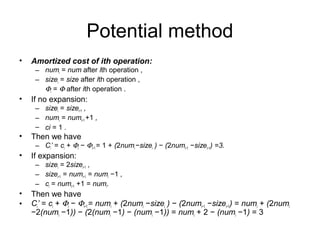
• Amortized cost of ith operation:
– numi = num after ith operation ,
– sizei = size after ith operation ,
Φi = Φ after ith operation .
• If no expansion:
– sizei = sizei−1 ,
– numi = numi−1 +1 ,
– ci = 1 .
• Then we have
– Ci’ = ci + Φi − Φi−1 = 1 + (2numi −sizei ) − (2numi−1 −sizei−1) =3.
• If expansion:
– sizei = 2sizei−1 ,
– sizei−1 = numi−1 = numi −1 ,
– ci = numi−1 +1 = numi.
• Then we have
• Ci’ = ci + Φi − Φi−1 = numi + (2numi −sizei ) − (2numi−1 −sizei−1) = numi + (2numi
−2(numi −1)) − (2(numi −1) − (numi −1)) = numi + 2 − (numi −1) = 3
Copyright © The McGraw-Hill Companies, Inc. Permission required for reproduction or display.
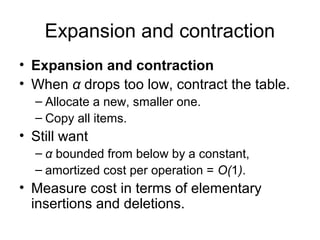
Expansion and contraction
• Expansion and contraction
• When α drops too low, contract the table.
– Allocate a new, smaller one.
– Copy all items.
• Still want
– α bounded from below by a constant,
– amortized cost per operation = O(1).
• Measure cost in terms of elementary
insertions and deletions.
Obvious strategy
• Double size when inserting into a full table (when α = 1, so that after
insertion α would become <1).
• Halve size when deletion would make table less than half full (when
α = 1/2, so that after deletion α would become >= 1/2).
• Then always have 1/2 ≤ α ≤ 1.
• Suppose we fill table.
– Then insert ⇒ double
– 2 deletes ⇒ halve
– 2 inserts ⇒ double
– 2 deletes ⇒ halve
– ・ ・ ・
– Cost of each expansion or contraction is Θ(n), so total n operation will
be Θ(n2
).
• Problem is that: Not performing enough operations after expansion
or contraction to pay for the next one.
Simple solution
• Double as before: when inserting with α = 1 ⇒ after doubling, α = 1/2.
• Halve size when deleting with α = 1/4 ⇒ after halving, α = 1/2.
• Thus, immediately after either expansion or contraction, have α = 1/2.
• Always have 1/4 ≤ α ≤ 1.
• Intuition:
• Want to make sure that we perform enough operations between
consecutive expansions/contractions to pay for the change in table
size.
• Need to delete half the items before contraction.
• Need to double number of items before expansion.
• Either way, number of operations between expansions/contractions is
at least a constant fraction of number of items copied.
Potential function
∀Φ(T) = 2num[T] − size[T] if α ≥ ½
size[T]/2 −num[T] ifα < ½ .
• T empty ⇒ Φ = 0.
• α ≥ 1/2 ⇒ num ≥ 1/2size ⇒ 2num ≥ size
⇒ Φ ≥ 0.
• α < 1/2 ⇒ num < 1/2size ⇒ Φ ≥ 0.
intuition
• measures how far from α = 1/2 we are.
– α = 1/2 ⇒ Φ = 2num−2num = 0.
– α = 1 ⇒ Φ = 2num−num = num.
– α = 1/4 ⇒ Φ = size /2 − num = 4num /2 − num = num.
• Therefore, when we double or halve, have enough potential to pay for
moving all num items.
• Potential increases linearly between α = 1/2 and α = 1, and it also increases
linearly between α = 1/2 and α = 1/4.
• Since α has different distances to go to get to 1 or 1/4, starting from 1/2,
rate of increase differs.
• For α to go from 1/2 to 1, num increases from size /2 to size, for a total
increase of size /2. Φ increases from 0 to size. Thus, Φ needs to increase
by 2 for each item inserted. That’s why there’s a coefficient of 2 on the
num[T ] term in the formula for when α ≥ 1/2.
• For α to go from 1/2 to 1/4, num decreases from size /2 to size /4, for a total
decrease of size /4. Φ increases from 0 to size /4. Thus, Φ needs to
increase by 1 for each item deleted. That’s why there’s a coefficient of −1 on
the num[T ] term in the formula for when α < 1/2.
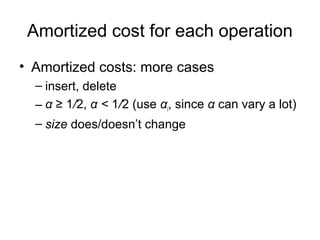
• Amortized costs: more cases
– insert, delete
– α ≥ 1/2, α < 1/2 (use αi, since α can vary a lot)
– size does/doesn’t change
Amortized cost for each operation
Splay tree
• A binary search tree (not balanced)
• Height may be larger than log n, even n-1.
• However a sequence of n operations takes O(nlog n).
• Assumptions: data values are distinct and form a totally
order set
• Operations:
– Member(i,S)
– Insert(i,S)
– Delete(i,S)
– Merge(S,S’)
– Split(i,S)
– All based on
• splay(i,S), reorganize tree so that i to be root if i∈S, otherwise, the
new root is either max{k ∈S |k<i} or min{k ∈S |k>i}
Splay tree (cont.)
• For examples,
– merge(S,S’)
• Call Splay(∞, S) and then make S’ the right child
– Delete(i,S), call Splay(i,S), remove I, then
merge(left(i), right(i)).
– Similar for others.
– Constant number of splays called.
Splay tree (cont.)
• Splay operation is based on basic
rotate(x) operation (either left or right).
• Three cases:
– y is the parent of x and x has not grandparent
• rotate(x)
– x is the left (or right) child of y and y is the left
(or right) child of z,
• rotate(y) and then rotate(x)
– x is the left (or right) child of y and y is the
right (or left) child of z,
• rotate(x) and then rotate(x)
Splay tree (cont.)
• Credit invariant: Node x always has at
least log µ(x) credits on deposit.
– Where µ(S)=log (|S|) and µ(x)=µ(S(x))
• Lemma:
– Each operation splay(x,S) requires no more
than 3(µ(S)-µ(x))+1 credits to perform the
operation and maintain the credit invariant.
• Theorem:
– A sequence of m operations involving n inserts
takes time O(mlog(n)).
Summary
• Amortized analysis
– Different from probabilistic analysis
• Three methods and their differences
• how to analyze

Amortized analysis

  • 1.
    Amortized Analysis (chap.17) • Not just consider one operation, but a sequence of operations on a given data structure. • Average cost over a sequence of operations. • Probabilistic analysis: – Average case running time: average over all possible inputs for one algorithm (operation). – If using probability, called expected running time. • Amortized analysis: – No involvement of probability – Average performance on a sequence of operations, even some operation is expensive. – Guarantee average performance of each operation among the sequence in worst case.
  • 2.
    Three Methods ofAmortized Analysis • Aggregate analysis: – Total cost of n operations/n, • Accounting method: – Assign each type of operation an (different) amortized cost – overcharge some operations, – store the overcharge as credit on specific objects, – then use the credit for compensation for some later operations. • Potential method: – Same as accounting method – But store the credit as “potential energy” and as a whole.
  • 3.
    Example for amortizedanalysis • Stack operations: – PUSH(S,x), O(1) – POP(S), O(1) – MULTIPOP(S,k), min(s,k) • while not STACK-EMPTY(S) and k>0 • do POP(S) • k=k-1 • Let us consider a sequence of n PUSH, POP, MULTIPOP. – The worst case cost for MULTIPOP in the sequence is O(n), since the stack size is at most n. – thus the cost of the sequence is O(n2 ). Correct, but not tight.
  • 4.
    Aggregate Analysis • Infact, a sequence of n operations on an initially empty stack cost at most O(n). Why? Each object can be POP only once (including in MULTIPOP) for each time it is PUSHed. #POPs is at most #PUSHs, which is at most n. Thus the average cost of an operation is O(n)/n = O(1). Amortized cost in aggregate analysis is defined to be average cost.
  • 5.
    Another example: increasinga binary counter • Binary counter of length k, A[0..k-1] of bit array. • INCREMENT(A) 1. i0 2. while i<k and A[i]=1 3. do A[i]0 (flip, reset) 4. ii+1 5. if i<k 6. then A[i]1 (flip, set)
  • 6.
    Analysis of INCREMENT(A) •Cursory analysis: – A single execution of INCREMENT takes O(k) in the worst case (when A contains all 1s) – So a sequence of n executions takes O(nk) in worst case (suppose initial counter is 0). – This bound is correct, but not tight. • The tight bound is O(n) for n executions.
  • 7.
    Amortized (Aggregate) Analysisof INCREMENT(A) Observation: The running time determined by #flips but not all bits flip each time INCREMENT is called. A[0] flips every time, total n times. A[1] flips every other time, n/2 times. A[2] flips every forth time, n/4 times. …. for i=0,1,…,k-1, A[i] flips n/2i  times. Thus total #flips is ∑i=0 k-1 n/2i  < n∑i=0 ∞ 1/2i =2n.
  • 8.
    Amortized Analysis ofINCREMENT(A) • Thus the worst case running time is O(n) for a sequence of n INCREMENTs. • So the amortized cost per operation is O(1).
  • 9.
    Amortized Analysis: AccountingMethod • Idea: – Assign differing charges to different operations. – The amount of the charge is called amortized cost. – amortized cost is more or less than actual cost. – When amortized cost > actual cost, the difference is saved in specific objects as credits. – The credits can be used by later operations whose amortized cost < actual cost. • As a comparison, in aggregate analysis, all operations have same amortized costs.
  • 10.
    Accounting Method (cont.) •Conditions: – suppose actual cost is ci for the ith operation in the sequence, and amortized cost is ci', – ∑i=1 n ci' ≥∑i=1 n ci should hold. • since we want to show the average cost per operation is small using amortized cost, we need the total amortized cost is an upper bound of total actual cost. • holds for all sequences of operations. – Total credits is ∑i=1 n ci' - ∑i=1 n ci , which should be nonnegative, • Moreover, ∑i=1 t ci' - ∑i=1 t ci ≥0 for anyt>0.
  • 11.
    Accounting Method: StackOperations • Actual costs: – PUSH :1, POP :1, MULTIPOP: min(s,k). • Let assign the following amortized costs: – PUSH:2, POP: 0, MULTIPOP: 0. • Similar to a stack of plates in a cafeteria. – Suppose $1 represents a unit cost. – When pushing a plate, use one dollar to pay the actual cost of the push and leave one dollar on the plate as credit. – Whenever POPing a plate, the one dollar on the plate is used to pay the actual cost of the POP. (same for MULTIPOP). – By charging PUSH a little more, do not charge POP or MULTIPOP. • The total amortized cost for n PUSH, POP, MULTIPOP is O(n), thus O(1) for average amortized cost for each operation. • Conditions hold: total amortized cost ≥total actual cost, and amount of credits never becomes negative.
  • 12.
    Accounting method: binarycounter • Let $1 represent each unit of cost (i.e., the flip of one bit). • Charge an amortized cost of $2 to set a bit to 1. • Whenever a bit is set, use $1 to pay the actual cost, and store another $1 on the bit as credit. • When a bit is reset, the stored $1 pays the cost. • At any point, a 1 in the counter stores $1, the number of 1’s is never negative, so is the total credits. • At most one bit is set in each operation, so the amortized cost of an operation is at most $2. • Thus, total amortized cost of n operations is O(n), and average is O(1).
  • 13.
    The Potential Method •Same as accounting method: something prepaid is used later. • Different from accounting method – The prepaid work not as credit, but as “potential energy”, or “potential”. – The potential is associated with the data structure as a whole rather than with specific objects within the data structure.
  • 14.
    The Potential Method(cont.) • Initial data structure D0, • n operations, resulting in D0, D1,…, Dn with costs c1, c2,…, cn. • A potential function Φ: {Di}  R (real numbers) ∀ Φ(Di) is called the potential of Di. • Amortized cost ci' of the ith operation is: – ci' = ci + Φ(Di) - Φ(Di-1). (actual cost + potential change) ∀ ∑i=1 n ci'= ∑i=1 n (ci + Φ(Di) - Φ(Di-1)) • = ∑i=1 n ci + Φ(Dn) - Φ(D0)
  • 15.
    The Potential Method(cont.) • If Φ(Dn) ≥ Φ(D0), then total amortized cost is an upper bound of total actual cost. • But we do not know how many operations, so Φ(Di) ≥ Φ(D0) is required for any i. • It is convenient to define Φ(D0)=0,and so Φ(Di) ≥0, for all i. • If the potential change is positive (i.e., Φ(Di) - Φ(Di-1)>0), then ci' is an overcharge (so store the increase as potential), • otherwise, undercharge (discharge the potential to pay the actual cost).
  • 16.
    Potential method: stackoperation • Potential for a stack is the number of objects in the stack. • So Φ(D0)=0, and Φ(Di) ≥0 • Amortized cost of stack operations: – PUSH: • Potential change: Φ(Di)- Φ(Di-1) =(s+1)-s =1. • Amortized cost: ci' = ci + Φ(Di) - Φ(Di-1)=1+1=2. – POP: • Potential change: Φ(Di)- Φ(Di-1) =(s-1) –s= -1. • Amortized cost: ci' = ci + Φ(Di) - Φ(Di-1)=1+(-1)=0. – MULTIPOP(S,k): k'=min(s,k) • Potential change: Φ(Di)- Φ(Di-1) = –k'. • Amortized cost: ci' = ci + Φ(Di) - Φ(Di-1)=k'+(-k')=0. • So amortized cost of each operation is O(1), and total amortized cost of n operations is O(n). • Since total amortized cost is an upper bound of actual cost, the worse case cost of n operations is O(n).
  • 17.
    Potential method: binarycounter • Define the potential of the counter after the ith INCREMENT is Φ(Di) =bi, the number of 1’s. clearly, Φ(Di)≥0. • Let us compute amortized cost of an operation – Suppose the ith operation resets ti bits. – Actual cost ci of the operation is at most ti +1. – If bi=0, then the ith operation resets all k bits, so bi-1=ti=k. – If bi>0, then bi=bi-1-ti+1 – In either case, bi≤bi-1-ti+1. – So potential change is Φ(Di) - Φ(Di-1) ≤bi-1-ti+1-bi-1=1-ti. – So amortized cost is: ci' = ci+ Φ(Di) - Φ(Di-1)≤ ti +1+1-ti=2. • The total amortized cost of n operations is O(n). • Thus worst case cost is O(n).
  • 18.
    Amortized analyses: dynamictable • A nice use of amortized analysis • Table-insertion, table-deletion. • Scenario: – A table –maybe a hash table – Do not know how large in advance – May expend with insertion – May contract with deletion – Detailed implementation is not important • Goal: – O(1) amortized cost. – Unused space always ≤ constant fraction of allocated space.
  • 19.
    Dynamic table • Loadfactor α = num/size, where num = # items stored, size = allocated size. • If size = 0, then num = 0. Call α = 1. • Never allow α > 1. • Keep α >a constant fraction  goal (2).
  • 20.
    Dynamic table: expansionwith insertion • Table expansion • Consider only insertion. • When the table becomes full, double its size and reinsert all existing items. • Guarantees that α ≥ 1/2. • Each time we actually insert an item into the table, it’s an elementary insertion.
  • 21.
    Copyright © TheMcGraw-Hill Companies, Inc. Permission required for reproduction or display. Num[t] ele. insertion 1 ele. insertion Initially, num[T ] = size[T ] = 0.
  • 22.
    Aggregate analysis • Runningtime: Charge 1 per elementary insertion. Count only elementary insertions, • since all other costs together are constant per call. • ci = actual cost of ith operation – If not full, ci = 1. – If full, have i − 1 items in the table at the start of the ith operation. Have to copy all i − 1 existing items, then insert ith item, ⇒ ci = i • Cursory analysis: n operations ⇒ ci = O(n) ⇒ O(n2 ) time for n operations. • Of course, we don’t always expand: – ci = i if i − 1 is exact power of 2 , 1 otherwise . • So total cost =∑i=1 n ci ≤n+ ∑i=0 log(n) 2i ≤n+2n=3n • Therefore, aggregate analysis says amortized cost per operation = 3.
  • 23.
    Accounting analysis • Charge$3 per insertion of x. – $1 pays for x’s insertion. – $1 pays for x to be moved in the future. – $1 pays for some other item to be moved. • Suppose we’ve just expanded, size = m before next expansion, size = 2m after next expansion. • Assume that the expansion used up all the credit, so that there’s no credit stored after the expansion. • Will expand again after another m insertions. • Each insertion will put $1 on one of the m items that were in the table just after expansion and will put $1 on the item inserted. • Have $2m of credit by next expansion, when there are 2m items to move. Just enough to pay for the expansion, with no credit left over!
  • 24.
    Potential method • Potentialmethod ∀ Φ(T ) = 2 ・ num[T ] − size[T ] • Initially, num = size = 0⇒ Φ = 0. • • Just after expansion, size = 2 ・ num ⇒ Φ = 0. • Just before expansion, size = num ⇒ Φ = num ⇒ have enough potential to pay for moving all items. • Need Φ ≥ 0, always. • Always have – size ≥ num ≥ ½ size ⇒ 2 ・ num ≥ size ⇒ Φ ≥ 0 .
  • 25.
    Potential method • Amortizedcost of ith operation: – numi = num after ith operation , – sizei = size after ith operation , Φi = Φ after ith operation . • If no expansion: – sizei = sizei−1 , – numi = numi−1 +1 , – ci = 1 . • Then we have – Ci’ = ci + Φi − Φi−1 = 1 + (2numi −sizei ) − (2numi−1 −sizei−1) =3. • If expansion: – sizei = 2sizei−1 , – sizei−1 = numi−1 = numi −1 , – ci = numi−1 +1 = numi. • Then we have • Ci’ = ci + Φi − Φi−1 = numi + (2numi −sizei ) − (2numi−1 −sizei−1) = numi + (2numi −2(numi −1)) − (2(numi −1) − (numi −1)) = numi + 2 − (numi −1) = 3
  • 26.
    Copyright © TheMcGraw-Hill Companies, Inc. Permission required for reproduction or display.
  • 27.
    Expansion and contraction •Expansion and contraction • When α drops too low, contract the table. – Allocate a new, smaller one. – Copy all items. • Still want – α bounded from below by a constant, – amortized cost per operation = O(1). • Measure cost in terms of elementary insertions and deletions.
  • 28.
    Obvious strategy • Doublesize when inserting into a full table (when α = 1, so that after insertion α would become <1). • Halve size when deletion would make table less than half full (when α = 1/2, so that after deletion α would become >= 1/2). • Then always have 1/2 ≤ α ≤ 1. • Suppose we fill table. – Then insert ⇒ double – 2 deletes ⇒ halve – 2 inserts ⇒ double – 2 deletes ⇒ halve – ・ ・ ・ – Cost of each expansion or contraction is Θ(n), so total n operation will be Θ(n2 ). • Problem is that: Not performing enough operations after expansion or contraction to pay for the next one.
  • 29.
    Simple solution • Doubleas before: when inserting with α = 1 ⇒ after doubling, α = 1/2. • Halve size when deleting with α = 1/4 ⇒ after halving, α = 1/2. • Thus, immediately after either expansion or contraction, have α = 1/2. • Always have 1/4 ≤ α ≤ 1. • Intuition: • Want to make sure that we perform enough operations between consecutive expansions/contractions to pay for the change in table size. • Need to delete half the items before contraction. • Need to double number of items before expansion. • Either way, number of operations between expansions/contractions is at least a constant fraction of number of items copied.
  • 30.
    Potential function ∀Φ(T) =2num[T] − size[T] if α ≥ ½ size[T]/2 −num[T] ifα < ½ . • T empty ⇒ Φ = 0. • α ≥ 1/2 ⇒ num ≥ 1/2size ⇒ 2num ≥ size ⇒ Φ ≥ 0. • α < 1/2 ⇒ num < 1/2size ⇒ Φ ≥ 0.
  • 31.
    intuition • measures howfar from α = 1/2 we are. – α = 1/2 ⇒ Φ = 2num−2num = 0. – α = 1 ⇒ Φ = 2num−num = num. – α = 1/4 ⇒ Φ = size /2 − num = 4num /2 − num = num. • Therefore, when we double or halve, have enough potential to pay for moving all num items. • Potential increases linearly between α = 1/2 and α = 1, and it also increases linearly between α = 1/2 and α = 1/4. • Since α has different distances to go to get to 1 or 1/4, starting from 1/2, rate of increase differs. • For α to go from 1/2 to 1, num increases from size /2 to size, for a total increase of size /2. Φ increases from 0 to size. Thus, Φ needs to increase by 2 for each item inserted. That’s why there’s a coefficient of 2 on the num[T ] term in the formula for when α ≥ 1/2. • For α to go from 1/2 to 1/4, num decreases from size /2 to size /4, for a total decrease of size /4. Φ increases from 0 to size /4. Thus, Φ needs to increase by 1 for each item deleted. That’s why there’s a coefficient of −1 on the num[T ] term in the formula for when α < 1/2.
  • 32.
    • Amortized costs:more cases – insert, delete – α ≥ 1/2, α < 1/2 (use αi, since α can vary a lot) – size does/doesn’t change Amortized cost for each operation
  • 33.
    Splay tree • Abinary search tree (not balanced) • Height may be larger than log n, even n-1. • However a sequence of n operations takes O(nlog n). • Assumptions: data values are distinct and form a totally order set • Operations: – Member(i,S) – Insert(i,S) – Delete(i,S) – Merge(S,S’) – Split(i,S) – All based on • splay(i,S), reorganize tree so that i to be root if i∈S, otherwise, the new root is either max{k ∈S |k<i} or min{k ∈S |k>i}
  • 34.
    Splay tree (cont.) •For examples, – merge(S,S’) • Call Splay(∞, S) and then make S’ the right child – Delete(i,S), call Splay(i,S), remove I, then merge(left(i), right(i)). – Similar for others. – Constant number of splays called.
  • 35.
    Splay tree (cont.) •Splay operation is based on basic rotate(x) operation (either left or right). • Three cases: – y is the parent of x and x has not grandparent • rotate(x) – x is the left (or right) child of y and y is the left (or right) child of z, • rotate(y) and then rotate(x) – x is the left (or right) child of y and y is the right (or left) child of z, • rotate(x) and then rotate(x)
  • 36.
    Splay tree (cont.) •Credit invariant: Node x always has at least log µ(x) credits on deposit. – Where µ(S)=log (|S|) and µ(x)=µ(S(x)) • Lemma: – Each operation splay(x,S) requires no more than 3(µ(S)-µ(x))+1 credits to perform the operation and maintain the credit invariant. • Theorem: – A sequence of m operations involving n inserts takes time O(mlog(n)).
  • 37.
    Summary • Amortized analysis –Different from probabilistic analysis • Three methods and their differences • how to analyze