Presented By
Christina Wieg
Christina Wieg
Interacting Professionally with People with Disabilities
Interacting
Professionally with
People with Disabilities
02
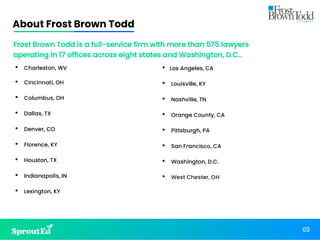
Frost Brown Todd is a full-service firm with more than 575 lawyers
operating in 17 offices across eight states and Washington, D.C..
• Charleston, WV
• Cincinnati, OH
• Columbus, OH
• Dallas, TX
• Denver, CO
• Florence, KY
• Houston, TX
• Indianapolis, IN
• Lexington, KY
About Frost Brown Todd
• Los Angeles, CA
• Louisville, KY
• Nashville, TN
• Orange County, CA
• Pittsburgh, PA
• San Francisco, CA
• Washington, D.C.
• West Chester, OH
03
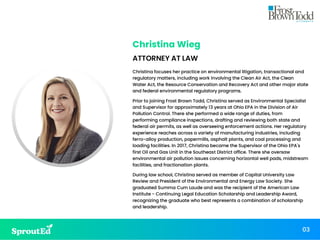
Christina Wieg
Christina Wieg
ATTORNEY AT LAW
Christina focuses her practice on environmental litigation, transactional and
regulatory matters, including work involving the Clean Air Act, the Clean
Water Act, the Resource Conservation and Recovery Act and other major state
and federal environmental regulatory programs.
Prior to joining Frost Brown Todd, Christina served as Environmental Specialist
and Supervisor for approximately 13 years at Ohio EPA in the Division of Air
Pollution Control. There she performed a wide range of duties, from
performing compliance inspections, drafting and reviewing both state and
federal air permits, as well as overseeing enforcement actions. Her regulatory
experience reaches across a variety of manufacturing industries, including
ferro-alloy production, papermills, asphalt plants, and coal processing and
loading facilities. In 2017, Christina became the Supervisor of the Ohio EPA's
first Oil and Gas Unit in the Southeast District office. There she oversaw
environmental air pollution issues concerning horizontal well pads, midstream
facilities, and fractionation plants.
During law school, Christina served as member of Capital University Law
Review and President of the Environmental and Energy Law Society. She
graduated Summa Cum Laude and was the recipient of the American Law
Institute - Continuing Legal Education Scholarship and Leadership Award,
recognizing the graduate who best represents a combination of scholarship
and leadership.
Disclaimer
04
• I do not practice labor and/or employment law nor am I an expert in
disability rights.
• My knowledge and perspective comes from my experiences being a
practicing attorney with a disability.
05
05
Agenda
06
• Disabilities in the U.S. and the Legal Field
• Professionalism in the Legal Field
• Disabilities: Legal Requirements
• Disabilities: Professional and Ethical Practice of Law
• Disabilities: Inclusion, Diversity, Equity, and Belonging
• Five Actions You Can Take Today
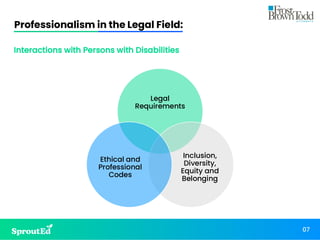
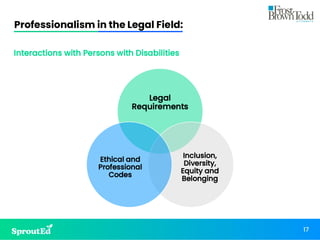
Professionalism in the Legal Field:
07
Interactions with Persons with Disabilities
Legal
Requirements
Inclusion,
Diversity,
Equity and
Belonging
Ethical and
Professional
Codes
What is a Disability?
08
It depends.
The answer to every
question ever posed in
law school.
What is a Disability?
09
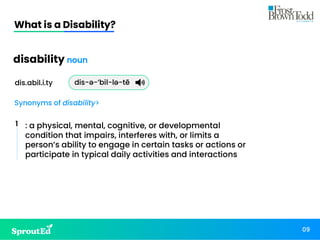
: a physical, mental, cognitive, or developmental
condition that impairs, interferes with, or limits a
person’s ability to engage in certain tasks or actions or
participate in typical daily activities and interactions
disability noun
dis.abil.i.ty
Synonyms of disability>
dis-ə-’bil-lə-tē
1
What is a Disability?
10
• The ADA defines a person with a disability as a person who has a
physical or mental impairment that substantially limits one or more
major life activity.
• This includes people who have a record of such an impairment,
even if they do not currently have a disability.
• It also includes individuals who do not have a disability but are
regarded as having a disability.
• The ADA also makes it unlawful to discriminate against a person
based on that person’s association with a person with a disability.
What is a Disability?
11
“Disability” is a term of art with different specialized meanings, each developed for
the particular policy or program that uses it. How we conceptualize disability shifts
relative to the methodologies used to learn about it and the contexts in which it is
addressed. The criteria for judging people to be disabled likewise fluctuate over
time and across different social and cultural contexts.
~ Perspectives on the Meaning of “Disability”, Leslie Francis, PhD, JD and Anita Silvers, PhD, AMA Journal of Ethics
The Diversity of Disabilities
12
• “Types”
• Broad – cognitive, physical, mental health, learning disabilities, etc.
• Narrow – specific diagnosis, such as blindness, anxiety, down syndrome, etc.
• Personal Experiences: through the lens of a person with disabilities
• How they became a person with a disability (born with v. acquired later in life)
• Different races, ethnicity, gender, sexuality, economic and social class,
education, and values
Disabilities in the U.S.
13
• Up to 1 in 4 adults (27%) in U.S. have some type of disability
• Based on 2022 data:
• Half of persons with a disability were age 65 or older.
• The jobless rate for persons with a disability was about twice as high as
the rate of persons without a disability.
• Approximately 30% of workers with a disability were employed part
time, compared with 16% for those with no disability.
• Employed persons with a disability were more likely to be self-
employed than those with no disability.
Disabilities in the Legal Profession
14
• The proportion of people with disabilities in the educational system declines
steadily from secondary school through law school.
• People with disabilities are less likely to graduate from 4-year institution.
• People with disabilities are underrepresented in law school, yet law schools
have the highest prevalence of people with disabilities among graduate
programs.
• Generally, people with disabilities who hold professional degrees (including
law) are underemployed.
• Statistics vary, but it is estimated that as low as 3.5% of lawyers between
the age of 18-64 have a disability.
Persons with Disabilities in U.S. Law Firms
15
In 2023, percentage of partners self-reported as having a disability grew by
approximately 1/3 of a percentage point to 1.41%, roughly three times the 2019
figure of .46%.
In 2023, percentage of associates self-reported as having a disability increased from
1.63% in 2022 to 2.44% in 2023. That is more than four times that of the 2019 figure of 0.59%.
Overall, 1.99% of all lawyers identified as having a disability, up from 1.41% in previous
years.
Although the presence of individuals with disabilities among law students is not precisely
known, research suggests that 6.2% of graduates self identified as having a disability.
Difficult to conclude trends when numbers are so small and 1/4 of the offices included in
the 2022 NDLE did not report data on lawyers with disabilities.
Ableism:
16
Ableism :
Discrimination and social prejudice against people with disabilities or who
are perceived to have disabilities. This can come in the form of ideas and
assumptions, stereotypes, attitudes and practices, physical barriers in the
environment, or larger scale oppression.
Personal v. Systemic
Professionalism in the Legal Field:
17
Interactions with Persons with Disabilities
Legal
Requirements
Inclusion,
Diversity,
Equity and
Belonging
Ethical and
Professional
Codes
Disabilities:
18
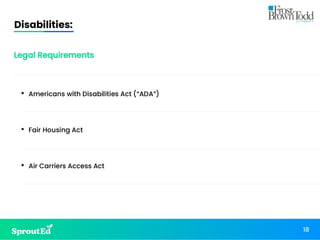
Legal Requirements
• Americans with Disabilities Act (“ADA”)
• Fair Housing Act
• Air Carriers Access Act
Americans with Disabilities Act
19
• Generally, ADA sets out requirements that apply to employers, state and local
governments, businesses that are open to the public, commercial facilities,
transportation providers, and telecommunication companies.
• ADA protects persons with a disability, which includes those who:
• has a physical or mental impairment that substantially limits one or more
major life activities,
• has a history or record of such an impairment (such as cancer that is in
remission), or
• is perceived by others as having such an impairment (such as a person who
has scars from a severe burn).
Americans with Disability Act
20
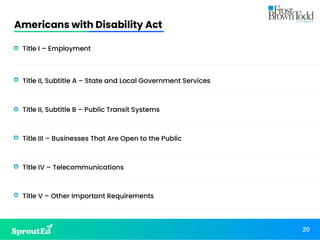
• Title I – Employment
• Title II, Subtitle A – State and Local Government Services
• Title II, Subtitle B – Public Transit Systems
• Title III – Businesses That Are Open to the Public
• Title IV – Telecommunications
• Title V – Other Important Requirements
ADA, Title I: Employment
21
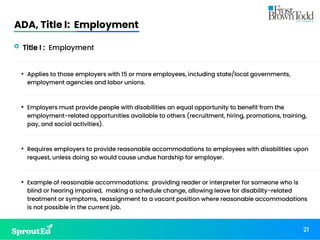
• Title I : Employment
• Applies to those employers with 15 or more employees, including state/local governments,
employment agencies and labor unions.
• Employers must provide people with disabilities an equal opportunity to benefit from the
employment-related opportunities available to others (recruitment, hiring, promotions, training,
pay, and social activities).
• Requires employers to provide reasonable accommodations to employees with disabilities upon
request, unless doing so would cause undue hardship for employer.
• Example of reasonable accommodations: providing reader or interpreter for someone who is
blind or hearing impaired, making a schedule change, allowing leave for disability-related
treatment or symptoms, reassignment to a vacant position where reasonable accommodations
is not possible in the current job.
ADA, Title III: Businesses That are
Open to the Public
22
• Business (including law firms) must provide people with disabilities an equal
opportunity to access the goods or services they offer
• For example, as a business, you must:
• Communicate with people with disabilities as effectively as you communicate with others.
• Make reasonable modifications to policies, practices, and procedures where needed.
• To make sure that a person with a disability can access the businesses’ goods or services.
• Allow service animals to be with their person even if you have a no pets policy.
• Follow specific standards for physical accessibility when building or altering a building or facility.
• Follow specific requirements for ticket sales and testing accommodations.
• Remove architectural barriers in buildings when it is readily achievable to do so.
Professionalism in the Legal Field:
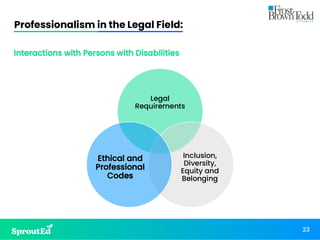
23
Interactions with Persons with Disabilities
Legal
Requirements
Inclusion,
Diversity,
Equity and
Belonging
Ethical and
Professional
Codes
Disabilities:
24
Professional and Ethical Codes in the Legal Field
• Defining Professionalism Ohio Gov. Bar Rule XV notes that professionalism
“connotes adherence by attorneys in their relations with judges, colleagues,
clients, employees and the public to aspirational standards of conduct.”
• “Although difficult to define precisely, professionalism has been said to
encompass ethics, personal integrity, intellectual honesty, independence,
civility, excellence and courage.”
• “Ethical rules represent the minimum standards below which a lawyer’s
conduct may not fall, while notions of professionalism represent the highest
standards of conduct that the public has a right to expect of lawyers and to
which all lawyers should aspire.”
Model Rules of Professional Conduct:
25
Practicing Law with a Disability
• Model Rule 1.1: Competence
• “A lawyer shall provide competent representation to a client. Competent
representation requires the legal knowledge, skill, thoroughness and preparation
reasonably necessary for the representation.”
• Model Rule 1.4: Communications
• “A lawyer shall explain a matter to the extent reasonably necessary to permit the
client to make informed decisions regarding the representation”
• Model Rule 1.16: Declining or Terminating Representation
• “A lawyer shall not represent a client or, where representation has commenced, shall
withdraw from the representation of a client if…the lawyer’s physical or mental
condition materially impairs the lawyer’s ability to represent the client.”
Model Rules of Professional Conduct:
26
Employing and Supervising a Lawyer with a Disability
• Model Rule 5.1: Responsibilities of a Partner or Supervisory Lawyer
• Affirmative obligation to operate their firm so as to reasonably assure that “all
lawyers in the firm conform to the Rules of Professional Conduct”
• “A lawyer having direct supervisory authority over another lawyer shall make
reasonable efforts to ensure that the other lawyer conforms to the Rules of
Professional Conduct.”
Model Rules of Professional Conduct:
27
Providing Legal Services to a Person with a Disability
• Model Rule 1.14: Client with Diminished Capacity
• “When a client's capacity to make adequately considered decisions in connection with a
representation is diminished, whether because of minority, mental impairment or for some
other reason, the lawyer shall, as far as reasonably possible, maintain a normal client-lawyer
relationship with the client.”
• “When the lawyer reasonably believes that the client has diminished capacity, is at risk of
substantial physical, financial or other harm unless action is taken and cannot adequately act
in the client's own interest, the lawyer may take reasonably necessary protective action,
including consulting with individuals or entities that have the ability to take action to protect
the client and, in appropriate cases, seeking the appointment of a guardian ad litem,
conservator or guardian.”
• Model Rule 1.4: Communications
• “A lawyer shall explain a matter to the extent reasonably necessary to permit the client to
make informed decisions regarding the representation.”
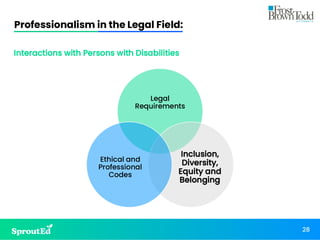
Professionalism in the Legal Field:
28
Interactions with Persons with Disabilities
Legal
Requirements
Inclusion,
Diversity,
Equity and
Belonging
Ethical and
Professional
Codes
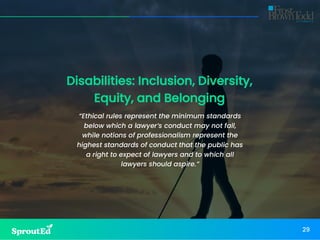
Disabilities: Inclusion, Diversity,
Equity, and Belonging
“Ethical rules represent the minimum standards
below which a lawyer’s conduct may not fall,
while notions of professionalism represent the
highest standards of conduct that the public has
a right to expect of lawyers and to which all
lawyers should aspire.”
29
Disabilities:
30
Inclusion, Diversity, Equity, and Belonging
• Diverse teams are reflective of the diverse clients they represent.
• Diverse teams can leverage a greater variety of perspectives and are
likely to consider information more thoroughly.
• Teams that include different viewpoints or thinking styles (cognitive diversity)
solve problems faster.
• Companies with more diverse executive-board were more likely to be
financially successful.
31
• Allows employers to tap into talent that has been underrepresented in
the workforce
• Clients are demanding diversity
• More clients requesting metrics on diversity, including disability
• Near future? Environmental, Social and Governance (“ESG”) – measures the
sustainability and ethical impact of a company
Disabilities:
Inclusion, Diversity, Equity, and Belonging
31
The Push for Disability Inclusion
32
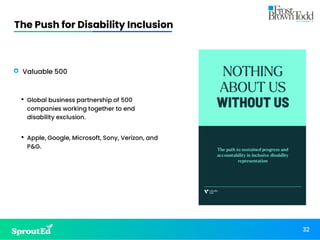
• Valuable 500
• Global business partnership of 500
companies working together to end
disability exclusion.
• Apple, Google, Microsoft, Sony, Verizon, and
P&G.
Diversity Certifications
33
“The Mansfield Rule is a structured certification process designed to ensure all
talent at participating law firms and legal departments have a fair and equal
opportunity to advance into leadership. Mansfield is focused on broadening the
talent pool for consideration, including those historically underrepresented in the
legal profession, to facilitate transparent leadership pathways. ”
Mansfield Rule
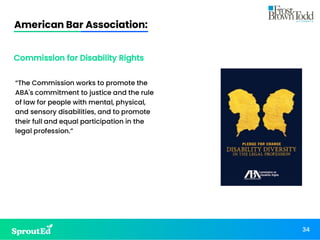
American Bar Association:
34
“The Commission works to promote the
ABA's commitment to justice and the rule
of law for people with mental, physical,
and sensory disabilities, and to promote
their full and equal participation in the
legal profession.”
Commission for Disability Rights
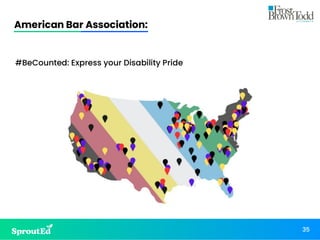
American Bar Association:
35
#BeCounted: Express your Disability Pride
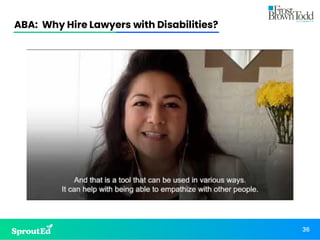
ABA: Why Hire Lawyers with Disabilities?
36
Accommodation v. Accessibility
37
• Accommodation
• Reactive and focuses on removing barriers caused by inaccessible
design
• Requires a person to identify their disability to another person (ask for
help or leave)
• Accessibility
• Proactive and strives to remove barriers during the design stage
• Benefits everyone
Accessible Environments Benefit Everyone
38
• Remote control
• Typewriter
• Telephone
• Office Scanner
• SMS text messages
• Captioning
Professionalism in the Legal Field:
39
5 Actions You Can Take Today
• Inclusive Language – “autistic v. person with autism”: if a person shares a disability,
ask their preference.
• Accessibility over Accommodations
• Carefully examine for personal and/or systematic biases
• Normalize disability inclusion (medical model v. social model)
• Reframe the perspective from “what will we loose” to “what will we gain” – to do so,
you must educate yourself
• Take ABA’s 21-Day Disability Equity Habit Building Challenge
• https://www.americanbar.org/groups/diversity/resources/celebrating-heritage-
months/disability-pride-month/aba-wide-21-day-disability-equity-habit-building-
challenge/
40
Contact Information
Christina Wieg
Christina Wieg
614.559.7219
cwieg@fbtlaw.com
frostbrowntodd.com
One Columbus Center 10 West Broad Street,
Suite 2300 Columbus, OH 43215 - 3484
Call or email and I'd be happy to speak with you more in-depth or answer any questions.
40

Interacting Professionally with People with Disabilities.pdf

  • 1.
    Presented By Christina Wieg ChristinaWieg Interacting Professionally with People with Disabilities Interacting Professionally with People with Disabilities
  • 2.
    02 Frost Brown Toddis a full-service firm with more than 575 lawyers operating in 17 offices across eight states and Washington, D.C.. • Charleston, WV • Cincinnati, OH • Columbus, OH • Dallas, TX • Denver, CO • Florence, KY • Houston, TX • Indianapolis, IN • Lexington, KY About Frost Brown Todd • Los Angeles, CA • Louisville, KY • Nashville, TN • Orange County, CA • Pittsburgh, PA • San Francisco, CA • Washington, D.C. • West Chester, OH
  • 3.
    03 Christina Wieg Christina Wieg ATTORNEYAT LAW Christina focuses her practice on environmental litigation, transactional and regulatory matters, including work involving the Clean Air Act, the Clean Water Act, the Resource Conservation and Recovery Act and other major state and federal environmental regulatory programs. Prior to joining Frost Brown Todd, Christina served as Environmental Specialist and Supervisor for approximately 13 years at Ohio EPA in the Division of Air Pollution Control. There she performed a wide range of duties, from performing compliance inspections, drafting and reviewing both state and federal air permits, as well as overseeing enforcement actions. Her regulatory experience reaches across a variety of manufacturing industries, including ferro-alloy production, papermills, asphalt plants, and coal processing and loading facilities. In 2017, Christina became the Supervisor of the Ohio EPA's first Oil and Gas Unit in the Southeast District office. There she oversaw environmental air pollution issues concerning horizontal well pads, midstream facilities, and fractionation plants. During law school, Christina served as member of Capital University Law Review and President of the Environmental and Energy Law Society. She graduated Summa Cum Laude and was the recipient of the American Law Institute - Continuing Legal Education Scholarship and Leadership Award, recognizing the graduate who best represents a combination of scholarship and leadership.
  • 4.
    Disclaimer 04 • I donot practice labor and/or employment law nor am I an expert in disability rights. • My knowledge and perspective comes from my experiences being a practicing attorney with a disability.
  • 5.
  • 6.
    Agenda 06 • Disabilities inthe U.S. and the Legal Field • Professionalism in the Legal Field • Disabilities: Legal Requirements • Disabilities: Professional and Ethical Practice of Law • Disabilities: Inclusion, Diversity, Equity, and Belonging • Five Actions You Can Take Today
  • 7.
    Professionalism in theLegal Field: 07 Interactions with Persons with Disabilities Legal Requirements Inclusion, Diversity, Equity and Belonging Ethical and Professional Codes
  • 8.
    What is aDisability? 08 It depends. The answer to every question ever posed in law school.
  • 9.
    What is aDisability? 09 : a physical, mental, cognitive, or developmental condition that impairs, interferes with, or limits a person’s ability to engage in certain tasks or actions or participate in typical daily activities and interactions disability noun dis.abil.i.ty Synonyms of disability> dis-ə-’bil-lə-tē 1
  • 10.
    What is aDisability? 10 • The ADA defines a person with a disability as a person who has a physical or mental impairment that substantially limits one or more major life activity. • This includes people who have a record of such an impairment, even if they do not currently have a disability. • It also includes individuals who do not have a disability but are regarded as having a disability. • The ADA also makes it unlawful to discriminate against a person based on that person’s association with a person with a disability.
  • 11.
    What is aDisability? 11 “Disability” is a term of art with different specialized meanings, each developed for the particular policy or program that uses it. How we conceptualize disability shifts relative to the methodologies used to learn about it and the contexts in which it is addressed. The criteria for judging people to be disabled likewise fluctuate over time and across different social and cultural contexts. ~ Perspectives on the Meaning of “Disability”, Leslie Francis, PhD, JD and Anita Silvers, PhD, AMA Journal of Ethics
  • 12.
    The Diversity ofDisabilities 12 • “Types” • Broad – cognitive, physical, mental health, learning disabilities, etc. • Narrow – specific diagnosis, such as blindness, anxiety, down syndrome, etc. • Personal Experiences: through the lens of a person with disabilities • How they became a person with a disability (born with v. acquired later in life) • Different races, ethnicity, gender, sexuality, economic and social class, education, and values
  • 13.
    Disabilities in theU.S. 13 • Up to 1 in 4 adults (27%) in U.S. have some type of disability • Based on 2022 data: • Half of persons with a disability were age 65 or older. • The jobless rate for persons with a disability was about twice as high as the rate of persons without a disability. • Approximately 30% of workers with a disability were employed part time, compared with 16% for those with no disability. • Employed persons with a disability were more likely to be self- employed than those with no disability.
  • 14.
    Disabilities in theLegal Profession 14 • The proportion of people with disabilities in the educational system declines steadily from secondary school through law school. • People with disabilities are less likely to graduate from 4-year institution. • People with disabilities are underrepresented in law school, yet law schools have the highest prevalence of people with disabilities among graduate programs. • Generally, people with disabilities who hold professional degrees (including law) are underemployed. • Statistics vary, but it is estimated that as low as 3.5% of lawyers between the age of 18-64 have a disability.
  • 15.
    Persons with Disabilitiesin U.S. Law Firms 15 In 2023, percentage of partners self-reported as having a disability grew by approximately 1/3 of a percentage point to 1.41%, roughly three times the 2019 figure of .46%. In 2023, percentage of associates self-reported as having a disability increased from 1.63% in 2022 to 2.44% in 2023. That is more than four times that of the 2019 figure of 0.59%. Overall, 1.99% of all lawyers identified as having a disability, up from 1.41% in previous years. Although the presence of individuals with disabilities among law students is not precisely known, research suggests that 6.2% of graduates self identified as having a disability. Difficult to conclude trends when numbers are so small and 1/4 of the offices included in the 2022 NDLE did not report data on lawyers with disabilities.
  • 16.
    Ableism: 16 Ableism : Discrimination andsocial prejudice against people with disabilities or who are perceived to have disabilities. This can come in the form of ideas and assumptions, stereotypes, attitudes and practices, physical barriers in the environment, or larger scale oppression. Personal v. Systemic
  • 17.
    Professionalism in theLegal Field: 17 Interactions with Persons with Disabilities Legal Requirements Inclusion, Diversity, Equity and Belonging Ethical and Professional Codes
  • 18.
    Disabilities: 18 Legal Requirements • Americanswith Disabilities Act (“ADA”) • Fair Housing Act • Air Carriers Access Act
  • 19.
    Americans with DisabilitiesAct 19 • Generally, ADA sets out requirements that apply to employers, state and local governments, businesses that are open to the public, commercial facilities, transportation providers, and telecommunication companies. • ADA protects persons with a disability, which includes those who: • has a physical or mental impairment that substantially limits one or more major life activities, • has a history or record of such an impairment (such as cancer that is in remission), or • is perceived by others as having such an impairment (such as a person who has scars from a severe burn).
  • 20.
    Americans with DisabilityAct 20 • Title I – Employment • Title II, Subtitle A – State and Local Government Services • Title II, Subtitle B – Public Transit Systems • Title III – Businesses That Are Open to the Public • Title IV – Telecommunications • Title V – Other Important Requirements
  • 21.
    ADA, Title I:Employment 21 • Title I : Employment • Applies to those employers with 15 or more employees, including state/local governments, employment agencies and labor unions. • Employers must provide people with disabilities an equal opportunity to benefit from the employment-related opportunities available to others (recruitment, hiring, promotions, training, pay, and social activities). • Requires employers to provide reasonable accommodations to employees with disabilities upon request, unless doing so would cause undue hardship for employer. • Example of reasonable accommodations: providing reader or interpreter for someone who is blind or hearing impaired, making a schedule change, allowing leave for disability-related treatment or symptoms, reassignment to a vacant position where reasonable accommodations is not possible in the current job.
  • 22.
    ADA, Title III:Businesses That are Open to the Public 22 • Business (including law firms) must provide people with disabilities an equal opportunity to access the goods or services they offer • For example, as a business, you must: • Communicate with people with disabilities as effectively as you communicate with others. • Make reasonable modifications to policies, practices, and procedures where needed. • To make sure that a person with a disability can access the businesses’ goods or services. • Allow service animals to be with their person even if you have a no pets policy. • Follow specific standards for physical accessibility when building or altering a building or facility. • Follow specific requirements for ticket sales and testing accommodations. • Remove architectural barriers in buildings when it is readily achievable to do so.
  • 23.
    Professionalism in theLegal Field: 23 Interactions with Persons with Disabilities Legal Requirements Inclusion, Diversity, Equity and Belonging Ethical and Professional Codes
  • 24.
    Disabilities: 24 Professional and EthicalCodes in the Legal Field • Defining Professionalism Ohio Gov. Bar Rule XV notes that professionalism “connotes adherence by attorneys in their relations with judges, colleagues, clients, employees and the public to aspirational standards of conduct.” • “Although difficult to define precisely, professionalism has been said to encompass ethics, personal integrity, intellectual honesty, independence, civility, excellence and courage.” • “Ethical rules represent the minimum standards below which a lawyer’s conduct may not fall, while notions of professionalism represent the highest standards of conduct that the public has a right to expect of lawyers and to which all lawyers should aspire.”
  • 25.
    Model Rules ofProfessional Conduct: 25 Practicing Law with a Disability • Model Rule 1.1: Competence • “A lawyer shall provide competent representation to a client. Competent representation requires the legal knowledge, skill, thoroughness and preparation reasonably necessary for the representation.” • Model Rule 1.4: Communications • “A lawyer shall explain a matter to the extent reasonably necessary to permit the client to make informed decisions regarding the representation” • Model Rule 1.16: Declining or Terminating Representation • “A lawyer shall not represent a client or, where representation has commenced, shall withdraw from the representation of a client if…the lawyer’s physical or mental condition materially impairs the lawyer’s ability to represent the client.”
  • 26.
    Model Rules ofProfessional Conduct: 26 Employing and Supervising a Lawyer with a Disability • Model Rule 5.1: Responsibilities of a Partner or Supervisory Lawyer • Affirmative obligation to operate their firm so as to reasonably assure that “all lawyers in the firm conform to the Rules of Professional Conduct” • “A lawyer having direct supervisory authority over another lawyer shall make reasonable efforts to ensure that the other lawyer conforms to the Rules of Professional Conduct.”
  • 27.
    Model Rules ofProfessional Conduct: 27 Providing Legal Services to a Person with a Disability • Model Rule 1.14: Client with Diminished Capacity • “When a client's capacity to make adequately considered decisions in connection with a representation is diminished, whether because of minority, mental impairment or for some other reason, the lawyer shall, as far as reasonably possible, maintain a normal client-lawyer relationship with the client.” • “When the lawyer reasonably believes that the client has diminished capacity, is at risk of substantial physical, financial or other harm unless action is taken and cannot adequately act in the client's own interest, the lawyer may take reasonably necessary protective action, including consulting with individuals or entities that have the ability to take action to protect the client and, in appropriate cases, seeking the appointment of a guardian ad litem, conservator or guardian.” • Model Rule 1.4: Communications • “A lawyer shall explain a matter to the extent reasonably necessary to permit the client to make informed decisions regarding the representation.”
  • 28.
    Professionalism in theLegal Field: 28 Interactions with Persons with Disabilities Legal Requirements Inclusion, Diversity, Equity and Belonging Ethical and Professional Codes
  • 29.
    Disabilities: Inclusion, Diversity, Equity,and Belonging “Ethical rules represent the minimum standards below which a lawyer’s conduct may not fall, while notions of professionalism represent the highest standards of conduct that the public has a right to expect of lawyers and to which all lawyers should aspire.” 29
  • 30.
    Disabilities: 30 Inclusion, Diversity, Equity,and Belonging • Diverse teams are reflective of the diverse clients they represent. • Diverse teams can leverage a greater variety of perspectives and are likely to consider information more thoroughly. • Teams that include different viewpoints or thinking styles (cognitive diversity) solve problems faster. • Companies with more diverse executive-board were more likely to be financially successful.
  • 31.
    31 • Allows employersto tap into talent that has been underrepresented in the workforce • Clients are demanding diversity • More clients requesting metrics on diversity, including disability • Near future? Environmental, Social and Governance (“ESG”) – measures the sustainability and ethical impact of a company Disabilities: Inclusion, Diversity, Equity, and Belonging 31
  • 32.
    The Push forDisability Inclusion 32 • Valuable 500 • Global business partnership of 500 companies working together to end disability exclusion. • Apple, Google, Microsoft, Sony, Verizon, and P&G.
  • 33.
    Diversity Certifications 33 “The MansfieldRule is a structured certification process designed to ensure all talent at participating law firms and legal departments have a fair and equal opportunity to advance into leadership. Mansfield is focused on broadening the talent pool for consideration, including those historically underrepresented in the legal profession, to facilitate transparent leadership pathways. ” Mansfield Rule
  • 34.
    American Bar Association: 34 “TheCommission works to promote the ABA's commitment to justice and the rule of law for people with mental, physical, and sensory disabilities, and to promote their full and equal participation in the legal profession.” Commission for Disability Rights
  • 35.
    American Bar Association: 35 #BeCounted:Express your Disability Pride
  • 36.
    ABA: Why HireLawyers with Disabilities? 36
  • 37.
    Accommodation v. Accessibility 37 •Accommodation • Reactive and focuses on removing barriers caused by inaccessible design • Requires a person to identify their disability to another person (ask for help or leave) • Accessibility • Proactive and strives to remove barriers during the design stage • Benefits everyone
  • 38.
    Accessible Environments BenefitEveryone 38 • Remote control • Typewriter • Telephone • Office Scanner • SMS text messages • Captioning
  • 39.
    Professionalism in theLegal Field: 39 5 Actions You Can Take Today • Inclusive Language – “autistic v. person with autism”: if a person shares a disability, ask their preference. • Accessibility over Accommodations • Carefully examine for personal and/or systematic biases • Normalize disability inclusion (medical model v. social model) • Reframe the perspective from “what will we loose” to “what will we gain” – to do so, you must educate yourself • Take ABA’s 21-Day Disability Equity Habit Building Challenge • https://www.americanbar.org/groups/diversity/resources/celebrating-heritage- months/disability-pride-month/aba-wide-21-day-disability-equity-habit-building- challenge/
  • 40.
    40 Contact Information Christina Wieg ChristinaWieg 614.559.7219 cwieg@fbtlaw.com frostbrowntodd.com One Columbus Center 10 West Broad Street, Suite 2300 Columbus, OH 43215 - 3484 Call or email and I'd be happy to speak with you more in-depth or answer any questions. 40