Understanding American Politics
– Politics refers to the process of making collective 
decisions to allocate public resources and to create 
and enforce rules for the operation of society.
– Institutions are codified constraints on behavior. 
The term institution can refer to several things, 
including organizations as large as a branch of the 
government and systems as specific as rules for 
conducting debates in Congress.
– The American political system is complex, in part due to 
its federal nature and in part due to the wide array of 
branches at each level of government and the many 
organizations, businesses, and movements that seek to 
shape politics.
Objective: Students
will…
• Consider the Electoral
College…
• Over 50% majority wins all 
electoral votes, whilst less 
than the majority total 
votes from a state are 
discarded.
• Had the institution for 
choosing the president 
been different, candidates 
winning the popular vote
would win the presidency.
Explore examples 
of political 
outcomes that are 
profoundly shaped 
by the institutions 
of government.
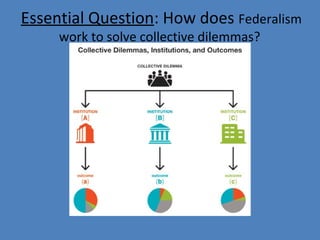
Essential Question: How does Federalism 
work to solve collective dilemmas? 
• Collective Dilemmas and the Need for Government
– A collective dilemma is a situation in which there is a 
conflict between group goals and self-interest.
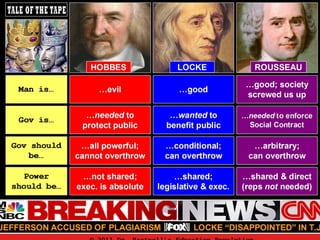
– Thomas Hobbes argued that concentrating power in a 
sovereign with final authority would prevent society from 
becoming a "war of all against all."
– Governments exist to solve the fundamental problem 
that Hobbes articulated, as well as other collective
dilemmas that society faces.
Types of Collective
Dilemmas
A collective-action
problem refers to a 
situation where 
people are individually 
better off trying 
to free ride and 
benefit from a public
good without 
contributing to it, but 
people as a group 
would be better off if 
they all contributed.
Types of Collective
Dilemmas
A prisoner’s dilemma is an 
interaction between two 
individuals in which 
neither actor has an 
incentive to cooperate, 
even though both would 
be better off if they 
cooperated. 
The collective-action
problem can be thought of 
as a multi-person version 
of the prisoner’s dilemma
• A coordination problem is a situation in which 
two or more people are all better off if every 
player chooses the same course of action, but 
there may be disagreement about which course 
of action is best.
A problem of unstable coalitions is one in which three
or more people must make a collective choice, but
any voting coalition for an alternative could be divided by
another proposal. One solution to this problem is
choosing an agenda setter who limits the alternatives
available to the group
• Principal-Agent Problems
– A principal-agent problem is any situation in which one person 
(a principal) hires another (an agent) to do a job on the 
principal’s behalf. The agent, however, may have incentives to 
deceive the principal for personal gain.
– In government, the bureaucracy is often thought of as an agent 
that implements policy on behalf of Congress and the president, 
who are principals. A bureaucrat, is an un-elected agent.
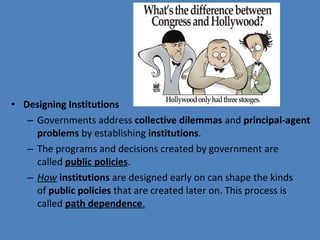
• Designing Institutions
– Governments address collective dilemmas and principal-agent
problems by establishing institutions.
– The programs and decisions created by government are 
called public policies.
– How institutions are designed early on can shape the kinds 
of public policies that are created later on. This process is 
called path dependence.
Types of Government Institutions
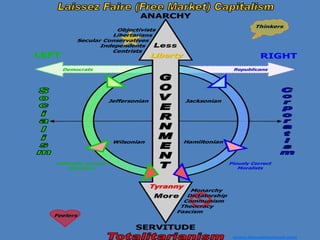
Political Systems- 
Authoritarianism, dictatorship,
 monarchy, oligarchy, and one-
party states.
–Democracy refers to rule by 
the people.  A true Republic, is 
constitutionally based and 
represented by those elected 
by the people who legislate to 
ideally protect political and
civil liberties; two common 
criteria for evaluating how 
democratic a nation is.
Types of Government Institutions
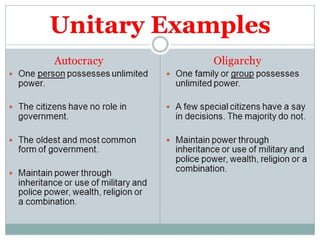
• Authoritarianism- 
Govts do not represent 
the people, nor do they 
have a voice in their 
government.
• Dictatorship- An 
authoritarian political 
system in which one 
individual reigns with 
sovereign power. 
• Monarchies-King or 
queen rules on the 
most critical matters.  
There is no competition 
for his or her position.
• Oligarchies- Power 
resides with a small 
group, often shared 
with a parliament or 
monarch.
• One Party States-
another form of 
monarchy. 
Solving Collective Dilemmas using Federalism
Solving dilemmas in a Republic
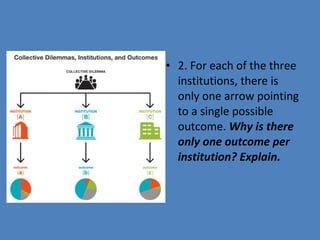
• 1. The figure shows three 
arrows coming from the 
problem and pointing to 
Institutions [A], [B], and [C], 
respectively. Why is there
more than one institution
that the public can choose
to solve its collective
dilemma? Explain.
• 2. For each of the three 
institutions, there is 
only one arrow pointing 
to a single possible 
outcome. Why is there
only one outcome per
institution? Explain.
The Federalism Approach to Collective-Action
Problem Solving (pg. 23)• State Power
• Leaders of small states 
argued in the Constitutional 
Convention, 1787 for the 
need of 2 Senators for each 
state.
• Designing this institution 
helps protect against 
benefitting larger states at 
the expense of smaller 
states.
• Leaders of large states 
wanted Congressional 
representation based on 
population (Path
Dependence until ‘60s.)
• Federal Power
• Baker v. Carr, 1962
• Wesberry v. Sanders
‘64
• Together, these 
decisions mandated 
that all districts within a 
state (House and state-
level house and senate) 
had to be roughly equal 
in size.
• Prior to this, rural areas 
• Analyzing Politics and Government
– In the context of this chapter, the 2009 stimulus 
debate in the federal government can be 
understood through two collective-action
problems: one among the public, which dislikes 
taxes but likes government programs, and another 
among politicians, who do not want to oppose a 
popular program for electoral reasons but may 
oppose it for the sake of a balanced budget.
– The story also illustrates that, 
while institutions are designed to solve collective
dilemmas, some dilemmas will be solved while 
others will persist.
What Happens When Institutions 
Can’t or Won’t Solve Dilemmas?
Where do you go if your 
representative, 
Congressman and or 
Senator, can’t fix your 
problem?
What might be the
potential political result
of them not fixing the
problem?
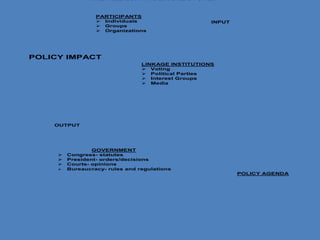
THE AMERICAN POLITICAL SYSTEM
PARTICIPANTS
 Individuals
 Groups
 Organizations
INPUT
LINKAGE INSTITUTIONS
 Voting
 Political Parties
 Interest Groups
 Media
POLICY AGENDA
GOVERNMENT
 Congress- statutes
 President- orders/decisions
 Courts- opinions
 Bureaucracy- rules and regulations
POLICY IMPACT
OUTPUT
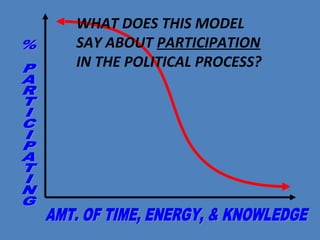
WHAT DOES THIS MODEL
SAY ABOUT PARTICIPATION
IN THE POLITICAL PROCESS?
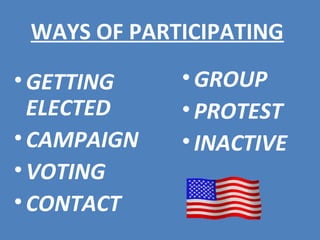
WAYS OF PARTICIPATING
•GETTING
ELECTED
•CAMPAIGN
•VOTING
•CONTACT
•GROUP
•PROTEST
•INACTIVE
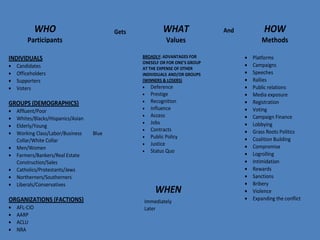
HOW
Methods
WHO
Participants
INDIVIDUALS
• Candidates 
• Officeholders 
• Supporters 
• Voters 
 
GROUPS (DEMOGRAPHICS)
• Affluent/Poor 
• Whites/Blacks/Hispanics/Asian 
• Elderly/Young 
• Working Class/Labor/Business         Blue 
Collar/White Collar 
• Men/Women 
• Farmers/Bankers/Real Estate      
Construction/Sales 
• Catholics/Protestants/Jews 
• Northerners/Southerners 
• Liberals/Conservatives 
 
ORGANIZATIONS (FACTIONS)
• AFL-CIO       
• AARP 
• ACLU 
• NRA 
• DNC 
Gets WHAT
Values
BROADLY: ADVANTAGES FOR
ONESELF OR FOR ONE’S GROUP
AT THE EXPENSE OF OTHER
INDIVIDUALS AND/OR GROUPS
(WINNERS & LOSERS)
• Deference
• Prestige
• Recognition
• Influence
• Access
• Jobs
• Contracts
• Public Policy
• Justice
• Status Quo
WHEN
Immediately 
Later 
And
• Platforms 
• Campaigns 
• Speeches 
• Rallies 
• Public relations 
• Media exposure 
• Registration 
• Voting 
• Campaign Finance  
• Lobbying 
• Grass Roots Politics 
• Coalition Building 
• Compromise 
• Logrolling 
• Intimidation 
• Rewards 
• Sanctions 
• Bribery 
• Violence 
• Expanding the conflict 
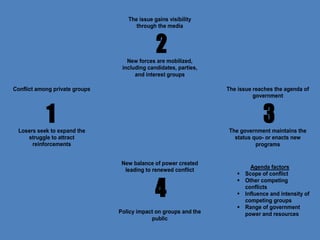
Agenda factors
 Scope of conflict
 Other competing
conflicts
 Influence and intensity of
competing groups
 Range of government
power and resources
Conflict among private groups
1Losers seek to expand the
struggle to attract
reinforcements
The issue gains visibility
through the media
2New forces are mobilized,
including candidates, parties,
and interest groups
New balance of power created
leading to renewed conflict
4
Policy impact on groups and the
public
The issue reaches the agenda of
government
3The government maintains the
status quo- or enacts new
programs
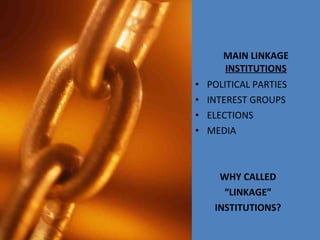
MAIN LINKAGE
INSTITUTIONS
• POLITICAL PARTIES
• INTEREST GROUPS
• ELECTIONS
• MEDIA
WHY CALLED
“LINKAGE”
INSTITUTIONS?
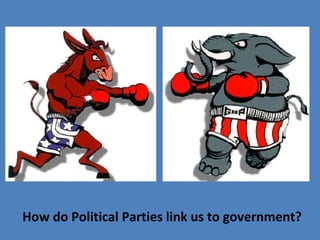
How do Political Parties link us to government?
How do Interest Groups link
us to government?
How do Elections link us to government?
How does Media link us to
government?
How does Congress make policy?
What are some ways the President can make policy?
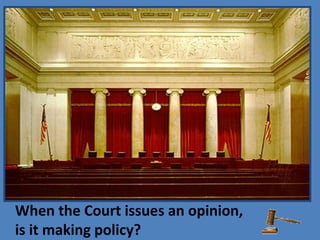
When the Court issues an opinion,
is it making policy?
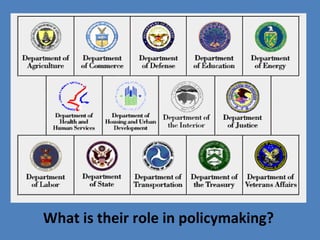
What is their role in policymaking?
What Exactly Are We Guaranteed?
• 7 Principles of the
Constitution
• Popular sovereignty
• Limited government
• Separation of powers
• Checks and balances
• Judicial review
• Federalism
• Republicanism
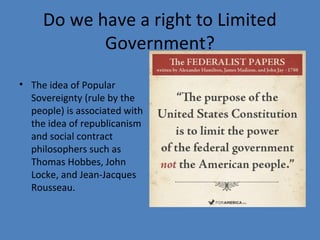
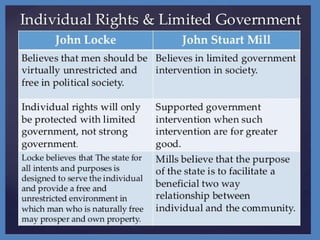
Do we have a right to Limited
Government?
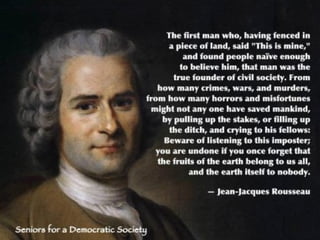
• The idea of Popular
Sovereignty (rule by the
people) is associated with
the idea of republicanism
and social contract
philosophers such as
Thomas Hobbes, John
Locke, and Jean-Jacques
Rousseau.
Why is Limited Government
Important?
• Limited government is a
common practice through
Western Culture, but it also
has roots in Hebraic Law.
Another non-Western
example of Limited
Government was the
Magna Carta, which
restricted the King's power
to be above the law.
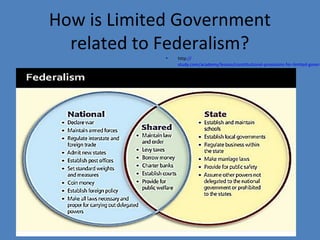
How is Limited Government
related to Federalism?
• http://
study.com/academy/lesson/constitutional-provisions-for-limited-govern
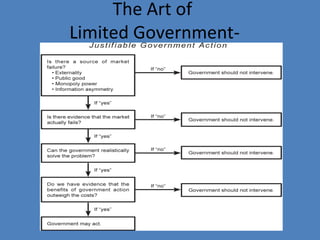
The Art of
Limited Government-
Marbury vs. Madison
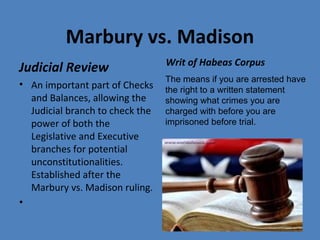
Judicial Review
• An important part of Checks
and Balances, allowing the
Judicial branch to check the
power of both the
Legislative and Executive
branches for potential
unconstitutionalities.
Established after the
Marbury vs. Madison ruling.
•
Writ of Habeas Corpus
The means if you are arrested have
the right to a written statement
showing what crimes you are
charged with before you are
imprisoned before trial.
Republicanism
• "The United States shall
guarantee to every State in
this Union a Republican
Form of Government,..."
(Article IV Section 4).
• People have the power in
government .
• Republicanism uses elected
Representatives, who
represent the people in the
House of Representatives
and the Senate.
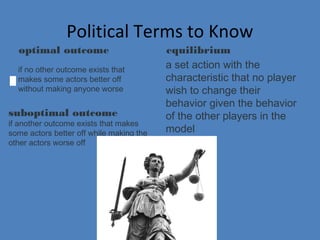
Political Terms to Know
optimal outcome equilibrium
a set action with the
characteristic that no player
wish to change their
behavior given the behavior
of the other players in the
model
if no other outcome exists that
makes some actors better off
without making anyone worse
suboptimal outcome
if another outcome exists that makes
some actors better off while making the
other actors worse off
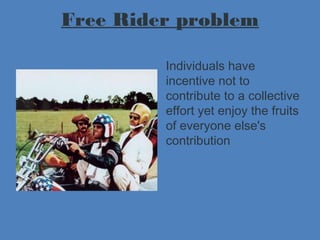
Free Rider problem
Individuals have
incentive not to
contribute to a collective
effort yet enjoy the fruits
of everyone else's
contribution
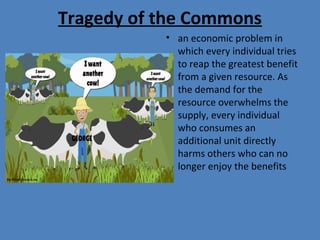
Tragedy of the Commons
• an economic problem in
which every individual tries
to reap the greatest benefit
from a given resource. As
the demand for the
resource overwhelms the
supply, every individual
who consumes an
additional unit directly
harms others who can no
longer enjoy the benefits
Whom has Power of the Purse?
• Article I, Section 9,
Clause 7 (the
Appropriations
Clause)
• Article I, Section 8,
Clause 1 (the Taxing
and Spending
Clause).
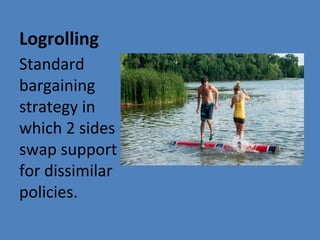
Logrolling
Standard
bargaining
strategy in
which 2 sides
swap support
for dissimilar
policies.
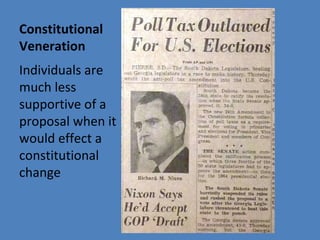
Constitutional
Veneration
Individuals are
much less
supportive of a
proposal when it
would effect a
constitutional
change
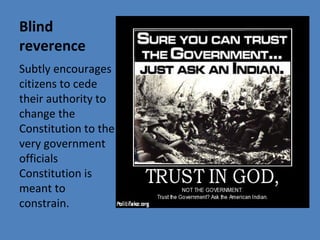
Blind
reverence
Subtly encourages
citizens to cede
their authority to
change the
Constitution to the
very government
officials
Constitution is
meant to
constrain.
Game Theory
Tool used to
model strategic
interactions
between actors;
one actor's
preferred
outcomes will
depend on
actions of the
other
Rational Choice
Theory
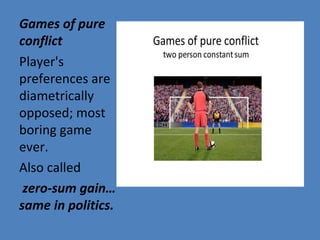
Games of pure
conflict
Player's
preferences are
diametrically
opposed; most
boring game
ever.
Also called
zero-sum gain…
same in politics.
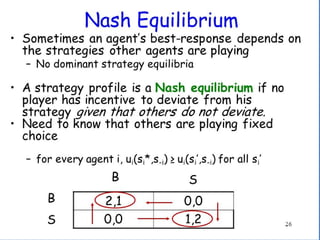
Nash Equilibrium
If both players have
dominant strategies,
then it's easy to
determine a game's
outcome; both are
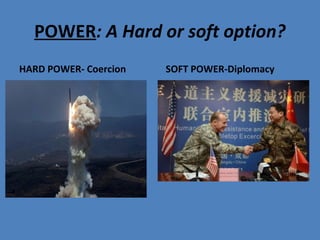
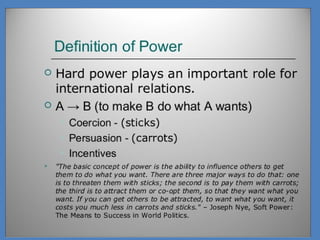
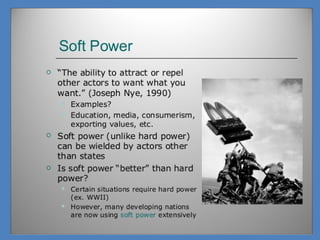
POWER: A Hard or soft option?
HARD POWER- Coercion SOFT POWER-Diplomacy
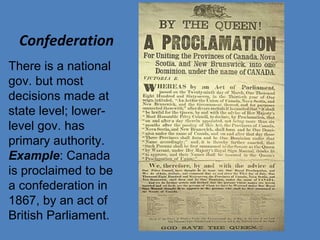
Confederation
There is a national
gov. but most
decisions made at
state level; lower-
level gov. has
primary authority.
Example: Canada
is proclaimed to be
a confederation in
1867, by an act of
British Parliament.
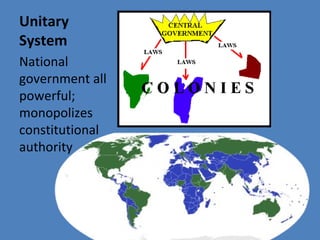
Unitary
System
National
government all
powerful;
monopolizes
constitutional
authority
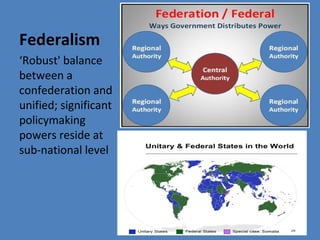
Federalism
‘Robust' balance
between a
confederation and
unified; significant
policymaking
powers reside at
sub-national level
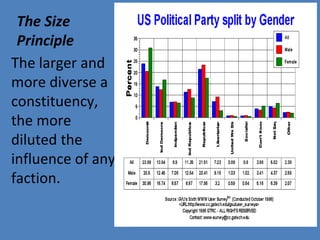
The Size
Principle
The larger and
more diverse a
constituency,
the more
diluted the
influence of any
faction.
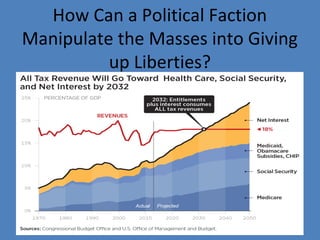
How Can a Political Faction
Manipulate the Masses into Giving
up Liberties?
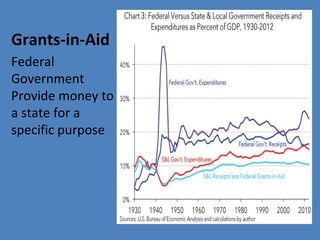
Grants-in-Aid
Federal
Government
Provide money to
a state for a
specific purpose
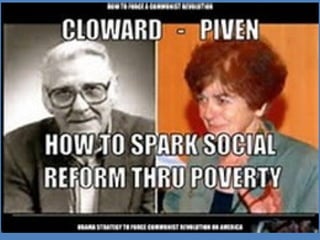
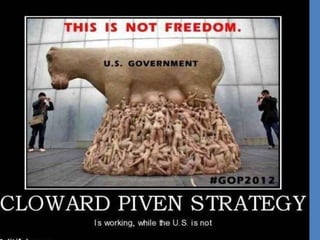
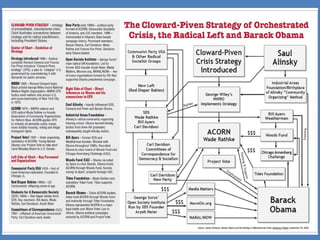
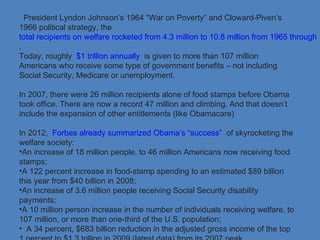
President Lyndon Johnson’s 1964 “War on Poverty” and Cloward-Piven’s
1966 political strategy, the
total recipients on welfare rocketed from 4.3 million to 10.8 million from 1965 through 1
.
Today, roughly $1 trillion annually is given to more than 107 million
Americans who receive some type of government benefits – not including
Social Security, Medicare or unemployment.
In 2007, there were 26 million recipients alone of food stamps before Obama
took office. There are now a record 47 million and climbing. And that doesn’t
include the expansion of other entitlements (like Obamacare)
In 2012, Forbes already summarized Obama’s “success” of skyrocketing the
welfare society:
•An increase of 18 million people, to 46 million Americans now receiving food
stamps;
•A 122 percent increase in food-stamp spending to an estimated $89 billion
this year from $40 billion in 2008;
•An increase of 3.6 million people receiving Social Security disability
payments;
•A 10 million person increase in the number of individuals receiving welfare, to
107 million, or more than one-third of the U.S. population;
• A 34 percent, $683 billion reduction in the adjusted gross income of the top
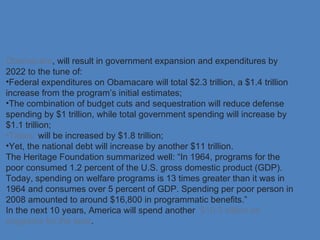
Obamacare, will result in government expansion and expenditures by
2022 to the tune of:
•Federal expenditures on Obamacare will total $2.3 trillion, a $1.4 trillion
increase from the program’s initial estimates;
•The combination of budget cuts and sequestration will reduce defense
spending by $1 trillion, while total government spending will increase by
$1.1 trillion;
•Taxes will be increased by $1.8 trillion;
•Yet, the national debt will increase by another $11 trillion.
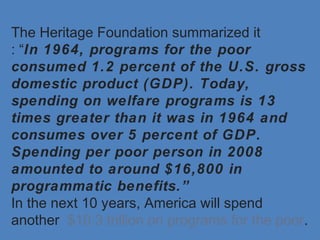
The Heritage Foundation summarized well: “In 1964, programs for the
poor consumed 1.2 percent of the U.S. gross domestic product (GDP).
Today, spending on welfare programs is 13 times greater than it was in
1964 and consumes over 5 percent of GDP. Spending per poor person in
2008 amounted to around $16,800 in programmatic benefits.”
In the next 10 years, America will spend another $10.3 trillion on
programs for the poor.
The Heritage Foundation summarized it
: “In 1964, programs for the poor
consumed 1.2 percent of the U.S. gross
domestic product (GDP). Today,
spending on welfare programs is 13
times greater than it was in 1964 and
consumes over 5 percent of GDP.
Spending per poor person in 2008
amounted to around $16,800 in
programmatic benefits.”
In the next 10 years, America will spend
another $10.3 trillion on programs for the poor.
Estimated number of victims[edit]
Stéphane Courtois states that "Communist regimes... turned mass crime into a full-
blown system of government."[4]:2
According to Courtois, the death toll amounts to 94
million.[4]:4
The breakdown of the number of deaths given by Courtois is as follows:
•65 million in the People's Republic of China
•20 million in the Soviet Union
•2 million in Cambodia
•2 million in North Korea
•1.7 million in Ethiopia
•1.5 million in Afghanistan
•1 million in the Eastern Bloc
•1 million in Vietnam
•150,000 in Latin America
•10,000 deaths "resulting from actions of the international Communist
movement and Communist parties not in power."[4]:4
Courtois writes that Communist regimes are responsible for a greater
number of deaths than any other political ideal or movement,
including Nazism. The statistics of victims include deaths through
executions, man-made hunger, deportations, and forced labor.
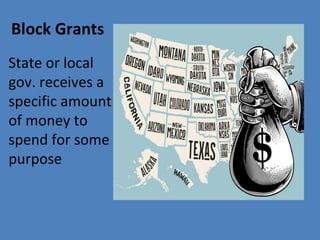
Block Grants
State or local
gov. receives a
specific amount
of money to
spend for some
purpose
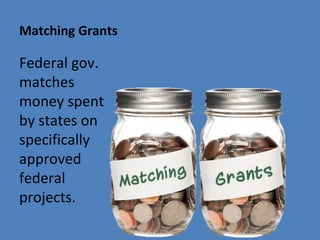
Matching Grants
Federal gov.
matches
money spent
by states on
specifically
approved
federal
projects.
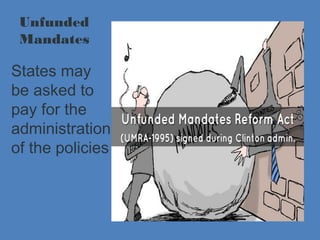
Unfunded
Mandates
States may
be asked to
pay for the
administration
of the policies
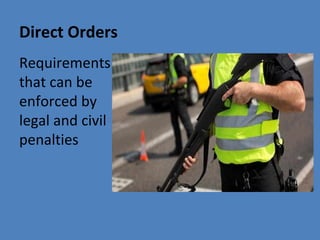
Direct Orders
Requirements
that can be
enforced by
legal and civil
penalties
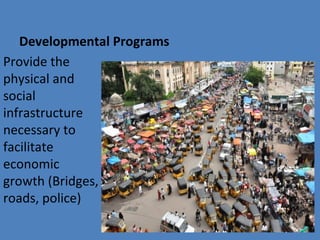
Developmental Programs
Provide the
physical and
social
infrastructure
necessary to
facilitate
economic
growth (Bridges,
roads, police)
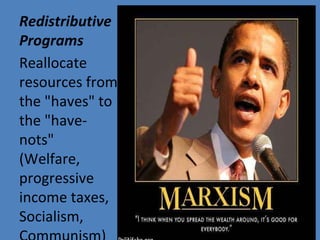
Redistributive
Programs
Reallocate
resources from
the "haves" to
the "have-
nots"
(Welfare,
progressive
income taxes,
Socialism,
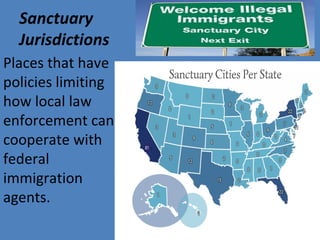
Sanctuary
Jurisdictions
Places that have
policies limiting
how local law
enforcement can
cooperate with
federal
immigration
agents.
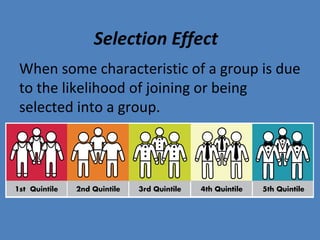
Selection Effect
When some characteristic of a group is due
to the likelihood of joining or being
selected into a group.
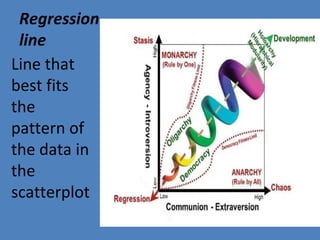
Regression
line
Line that
best fits
the
pattern of
the data in
the
scatterplot
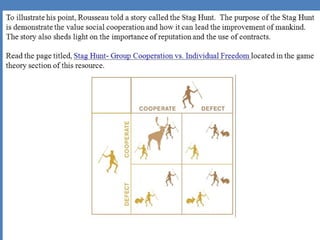
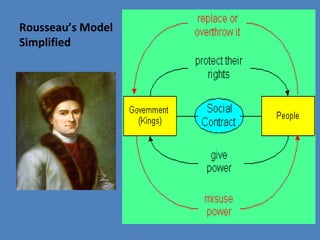
Rousseau’s Model
Simplified
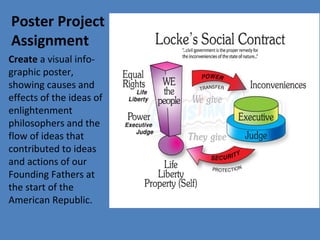
Poster Project
Assignment
Create a visual info-
graphic poster,
showing causes and
effects of the ideas of
enlightenment
philosophers and the
flow of ideas that
contributed to ideas
and actions of our
Founding Fathers at
the start of the
American Republic.
Americanpoliticalsystemppt 110919181530-phpapp01

Americanpoliticalsystemppt 110919181530-phpapp01

  • 2.
    Understanding American Politics –Politics refers to the process of making collective  decisions to allocate public resources and to create  and enforce rules for the operation of society. – Institutions are codified constraints on behavior.  The term institution can refer to several things,  including organizations as large as a branch of the  government and systems as specific as rules for  conducting debates in Congress. – The American political system is complex, in part due to  its federal nature and in part due to the wide array of  branches at each level of government and the many  organizations, businesses, and movements that seek to  shape politics.
  • 3.
    Objective: Students will… • Consider the Electoral College… •Over 50% majority wins all  electoral votes, whilst less  than the majority total  votes from a state are  discarded. • Had the institution for  choosing the president  been different, candidates  winning the popular vote would win the presidency. Explore examples  of political  outcomes that are  profoundly shaped  by the institutions  of government.
  • 4.
  • 5.
    • Collective Dilemmasand the Need for Government – A collective dilemma is a situation in which there is a  conflict between group goals and self-interest. – Thomas Hobbes argued that concentrating power in a  sovereign with final authority would prevent society from  becoming a "war of all against all." – Governments exist to solve the fundamental problem  that Hobbes articulated, as well as other collective dilemmas that society faces.
  • 6.
    Types of Collective Dilemmas A collective-action problem refers to a  situation where  people are individually  better off trying  to freeride and  benefit from a public good without  contributing to it, but  people as a group  would be better off if  they all contributed.
  • 7.
    Types of Collective Dilemmas A prisoner’sdilemma is an  interaction between two  individuals in which  neither actor has an  incentive to cooperate,  even though both would  be better off if they  cooperated.  The collective-action problem can be thought of  as a multi-person version  of the prisoner’s dilemma
  • 8.
  • 9.
    A problem ofunstable coalitions is one in which three or more people must make a collective choice, but any voting coalition for an alternative could be divided by another proposal. One solution to this problem is choosing an agenda setter who limits the alternatives available to the group
  • 10.
    • Principal-Agent Problems –A principal-agent problem is any situation in which one person  (a principal) hires another (an agent) to do a job on the  principal’s behalf. The agent, however, may have incentives to  deceive the principal for personal gain. – In government, the bureaucracy is often thought of as an agent  that implements policy on behalf of Congress and the president,  who are principals. A bureaucrat, is an un-elected agent.
  • 11.
    • Designing Institutions –Governments address collective dilemmas and principal-agent problems by establishing institutions. – The programs and decisions created by government are  called public policies. – How institutions are designed early on can shape the kinds  of public policies that are created later on. This process is  called path dependence.
  • 12.
    Types of GovernmentInstitutions Political Systems-  Authoritarianism, dictatorship,  monarchy, oligarchy, and one- party states. –Democracy refers to rule by  the people.  A true Republic, is  constitutionally based and  represented by those elected  by the people who legislate to  ideally protect political and civil liberties; two common  criteria for evaluating how  democratic a nation is.
  • 13.
    Types of GovernmentInstitutions • Authoritarianism-  Govts do not represent  the people, nor do they  have a voice in their  government. • Dictatorship- An  authoritarian political  system in which one  individual reigns with  sovereign power.  • Monarchies-King or  queen rules on the  most critical matters.   There is no competition  for his or her position. • Oligarchies- Power  resides with a small  group, often shared  with a parliament or  monarch. • One Party States- another form of  monarchy. 
  • 14.
    Solving Collective Dilemmasusing Federalism Solving dilemmas in a Republic • 1. The figure shows three  arrows coming from the  problem and pointing to  Institutions [A], [B], and [C],  respectively. Why is there more than one institution that the public can choose to solve its collective dilemma? Explain.
  • 15.
  • 16.
    The Federalism Approachto Collective-Action Problem Solving (pg. 23)• State Power • Leaders of small states  argued in the Constitutional  Convention, 1787 for the  need of 2 Senators for each  state. • Designing this institution  helps protect against  benefitting larger states at  the expense of smaller  states. • Leaders of large states  wanted Congressional  representation based on  population (Path Dependence until ‘60s.) • Federal Power • Baker v. Carr, 1962 • Wesberry v. Sanders ‘64 • Together, these  decisions mandated  that all districts within a  state (House and state- level house and senate)  had to be roughly equal  in size. • Prior to this, rural areas 
  • 17.
    • Analyzing Politicsand Government – In the context of this chapter, the 2009 stimulus  debate in the federal government can be  understood through two collective-action problems: one among the public, which dislikes  taxes but likes government programs, and another  among politicians, who do not want to oppose a  popular program for electoral reasons but may  oppose it for the sake of a balanced budget. – The story also illustrates that,  while institutions are designed to solve collective dilemmas, some dilemmas will be solved while  others will persist.
  • 18.
    What Happens When Institutions  Can’t or Won’t Solve Dilemmas? Where do yougo if your  representative,  Congressman and or  Senator, can’t fix your  problem? What might be the potential political result of them not fixing the problem?
  • 19.
    THE AMERICAN POLITICALSYSTEM PARTICIPANTS  Individuals  Groups  Organizations INPUT LINKAGE INSTITUTIONS  Voting  Political Parties  Interest Groups  Media POLICY AGENDA GOVERNMENT  Congress- statutes  President- orders/decisions  Courts- opinions  Bureaucracy- rules and regulations POLICY IMPACT OUTPUT
  • 20.
    WHAT DOES THISMODEL SAY ABOUT PARTICIPATION IN THE POLITICAL PROCESS?
  • 21.
  • 23.
    HOW Methods WHO Participants INDIVIDUALS • Candidates  • Officeholders  •Supporters  • Voters    GROUPS (DEMOGRAPHICS) • Affluent/Poor  • Whites/Blacks/Hispanics/Asian  • Elderly/Young  • Working Class/Labor/Business         Blue  Collar/White Collar  • Men/Women  • Farmers/Bankers/Real Estate       Construction/Sales  • Catholics/Protestants/Jews  • Northerners/Southerners  • Liberals/Conservatives    ORGANIZATIONS (FACTIONS) • AFL-CIO        • AARP  • ACLU  • NRA  • DNC  Gets WHAT Values BROADLY: ADVANTAGES FOR ONESELF OR FOR ONE’S GROUP AT THE EXPENSE OF OTHER INDIVIDUALS AND/OR GROUPS (WINNERS & LOSERS) • Deference • Prestige • Recognition • Influence • Access • Jobs • Contracts • Public Policy • Justice • Status Quo WHEN Immediately  Later  And • Platforms  • Campaigns  • Speeches  • Rallies  • Public relations  • Media exposure  • Registration  • Voting  • Campaign Finance   • Lobbying  • Grass Roots Politics  • Coalition Building  • Compromise  • Logrolling  • Intimidation  • Rewards  • Sanctions  • Bribery  • Violence  • Expanding the conflict 
  • 24.
    Agenda factors  Scopeof conflict  Other competing conflicts  Influence and intensity of competing groups  Range of government power and resources Conflict among private groups 1Losers seek to expand the struggle to attract reinforcements The issue gains visibility through the media 2New forces are mobilized, including candidates, parties, and interest groups New balance of power created leading to renewed conflict 4 Policy impact on groups and the public The issue reaches the agenda of government 3The government maintains the status quo- or enacts new programs
  • 25.
    MAIN LINKAGE INSTITUTIONS • POLITICAL PARTIES •INTEREST GROUPS • ELECTIONS • MEDIA WHY CALLED “LINKAGE” INSTITUTIONS?
  • 26.
    How do PoliticalParties link us to government?
  • 27.
    How do InterestGroups link us to government?
  • 28.
    How do Electionslink us to government?
  • 29.
    How does Medialink us to government?
  • 30.
    How does Congressmake policy?
  • 31.
    What are someways the President can make policy?
  • 32.
    When the Courtissues an opinion, is it making policy?
  • 33.
    What is theirrole in policymaking?
  • 35.
    What Exactly AreWe Guaranteed? • 7 Principles of the Constitution • Popular sovereignty • Limited government • Separation of powers • Checks and balances • Judicial review • Federalism • Republicanism
  • 36.
    Do we havea right to Limited Government? • The idea of Popular Sovereignty (rule by the people) is associated with the idea of republicanism and social contract philosophers such as Thomas Hobbes, John Locke, and Jean-Jacques Rousseau.
  • 37.
    Why is LimitedGovernment Important? • Limited government is a common practice through Western Culture, but it also has roots in Hebraic Law. Another non-Western example of Limited Government was the Magna Carta, which restricted the King's power to be above the law.
  • 38.
    How is LimitedGovernment related to Federalism? • http:// study.com/academy/lesson/constitutional-provisions-for-limited-govern
  • 39.
    The Art of LimitedGovernment-
  • 40.
    Marbury vs. Madison JudicialReview • An important part of Checks and Balances, allowing the Judicial branch to check the power of both the Legislative and Executive branches for potential unconstitutionalities. Established after the Marbury vs. Madison ruling. • Writ of Habeas Corpus The means if you are arrested have the right to a written statement showing what crimes you are charged with before you are imprisoned before trial.
  • 41.
    Republicanism • "The UnitedStates shall guarantee to every State in this Union a Republican Form of Government,..." (Article IV Section 4). • People have the power in government . • Republicanism uses elected Representatives, who represent the people in the House of Representatives and the Senate.
  • 42.
    Political Terms toKnow optimal outcome equilibrium a set action with the characteristic that no player wish to change their behavior given the behavior of the other players in the model if no other outcome exists that makes some actors better off without making anyone worse suboptimal outcome if another outcome exists that makes some actors better off while making the other actors worse off
  • 43.
    Free Rider problem Individualshave incentive not to contribute to a collective effort yet enjoy the fruits of everyone else's contribution
  • 44.
    Tragedy of theCommons • an economic problem in which every individual tries to reap the greatest benefit from a given resource. As the demand for the resource overwhelms the supply, every individual who consumes an additional unit directly harms others who can no longer enjoy the benefits
  • 45.
    Whom has Powerof the Purse? • Article I, Section 9, Clause 7 (the Appropriations Clause) • Article I, Section 8, Clause 1 (the Taxing and Spending Clause).
  • 46.
    Logrolling Standard bargaining strategy in which 2sides swap support for dissimilar policies.
  • 47.
    Constitutional Veneration Individuals are much less supportiveof a proposal when it would effect a constitutional change
  • 49.
    Blind reverence Subtly encourages citizens tocede their authority to change the Constitution to the very government officials Constitution is meant to constrain.
  • 50.
    Game Theory Tool usedto model strategic interactions between actors; one actor's preferred outcomes will depend on actions of the other
  • 51.
  • 53.
    Games of pure conflict Player's preferencesare diametrically opposed; most boring game ever. Also called zero-sum gain… same in politics.
  • 55.
    Nash Equilibrium If bothplayers have dominant strategies, then it's easy to determine a game's outcome; both are
  • 58.
    POWER: A Hardor soft option? HARD POWER- Coercion SOFT POWER-Diplomacy
  • 61.
    Confederation There is anational gov. but most decisions made at state level; lower- level gov. has primary authority. Example: Canada is proclaimed to be a confederation in 1867, by an act of British Parliament.
  • 62.
  • 64.
    Federalism ‘Robust' balance between a confederationand unified; significant policymaking powers reside at sub-national level
  • 65.
    The Size Principle The largerand more diverse a constituency, the more diluted the influence of any faction.
  • 67.
    How Can aPolitical Faction Manipulate the Masses into Giving up Liberties?
  • 73.
  • 76.
    President Lyndon Johnson’s1964 “War on Poverty” and Cloward-Piven’s 1966 political strategy, the total recipients on welfare rocketed from 4.3 million to 10.8 million from 1965 through 1 . Today, roughly $1 trillion annually is given to more than 107 million Americans who receive some type of government benefits – not including Social Security, Medicare or unemployment. In 2007, there were 26 million recipients alone of food stamps before Obama took office. There are now a record 47 million and climbing. And that doesn’t include the expansion of other entitlements (like Obamacare) In 2012, Forbes already summarized Obama’s “success” of skyrocketing the welfare society: •An increase of 18 million people, to 46 million Americans now receiving food stamps; •A 122 percent increase in food-stamp spending to an estimated $89 billion this year from $40 billion in 2008; •An increase of 3.6 million people receiving Social Security disability payments; •A 10 million person increase in the number of individuals receiving welfare, to 107 million, or more than one-third of the U.S. population; • A 34 percent, $683 billion reduction in the adjusted gross income of the top
  • 80.
    Obamacare, will resultin government expansion and expenditures by 2022 to the tune of: •Federal expenditures on Obamacare will total $2.3 trillion, a $1.4 trillion increase from the program’s initial estimates; •The combination of budget cuts and sequestration will reduce defense spending by $1 trillion, while total government spending will increase by $1.1 trillion; •Taxes will be increased by $1.8 trillion; •Yet, the national debt will increase by another $11 trillion. The Heritage Foundation summarized well: “In 1964, programs for the poor consumed 1.2 percent of the U.S. gross domestic product (GDP). Today, spending on welfare programs is 13 times greater than it was in 1964 and consumes over 5 percent of GDP. Spending per poor person in 2008 amounted to around $16,800 in programmatic benefits.” In the next 10 years, America will spend another $10.3 trillion on programs for the poor.
  • 81.
    The Heritage Foundationsummarized it : “In 1964, programs for the poor consumed 1.2 percent of the U.S. gross domestic product (GDP). Today, spending on welfare programs is 13 times greater than it was in 1964 and consumes over 5 percent of GDP. Spending per poor person in 2008 amounted to around $16,800 in programmatic benefits.” In the next 10 years, America will spend another $10.3 trillion on programs for the poor.
  • 83.
    Estimated number ofvictims[edit] Stéphane Courtois states that "Communist regimes... turned mass crime into a full- blown system of government."[4]:2 According to Courtois, the death toll amounts to 94 million.[4]:4 The breakdown of the number of deaths given by Courtois is as follows: •65 million in the People's Republic of China •20 million in the Soviet Union •2 million in Cambodia •2 million in North Korea •1.7 million in Ethiopia •1.5 million in Afghanistan •1 million in the Eastern Bloc •1 million in Vietnam •150,000 in Latin America •10,000 deaths "resulting from actions of the international Communist movement and Communist parties not in power."[4]:4 Courtois writes that Communist regimes are responsible for a greater number of deaths than any other political ideal or movement, including Nazism. The statistics of victims include deaths through executions, man-made hunger, deportations, and forced labor.
  • 84.
    Block Grants State orlocal gov. receives a specific amount of money to spend for some purpose
  • 85.
    Matching Grants Federal gov. matches moneyspent by states on specifically approved federal projects.
  • 87.
    Unfunded Mandates States may be askedto pay for the administration of the policies
  • 88.
    Direct Orders Requirements that canbe enforced by legal and civil penalties
  • 89.
    Developmental Programs Provide the physicaland social infrastructure necessary to facilitate economic growth (Bridges, roads, police)
  • 90.
    Redistributive Programs Reallocate resources from the "haves"to the "have- nots" (Welfare, progressive income taxes, Socialism,
  • 91.
    Sanctuary Jurisdictions Places that have policieslimiting how local law enforcement can cooperate with federal immigration agents.
  • 92.
    Selection Effect When somecharacteristic of a group is due to the likelihood of joining or being selected into a group.
  • 93.
  • 99.
  • 100.
    Poster Project Assignment Create avisual info- graphic poster, showing causes and effects of the ideas of enlightenment philosophers and the flow of ideas that contributed to ideas and actions of our Founding Fathers at the start of the American Republic.