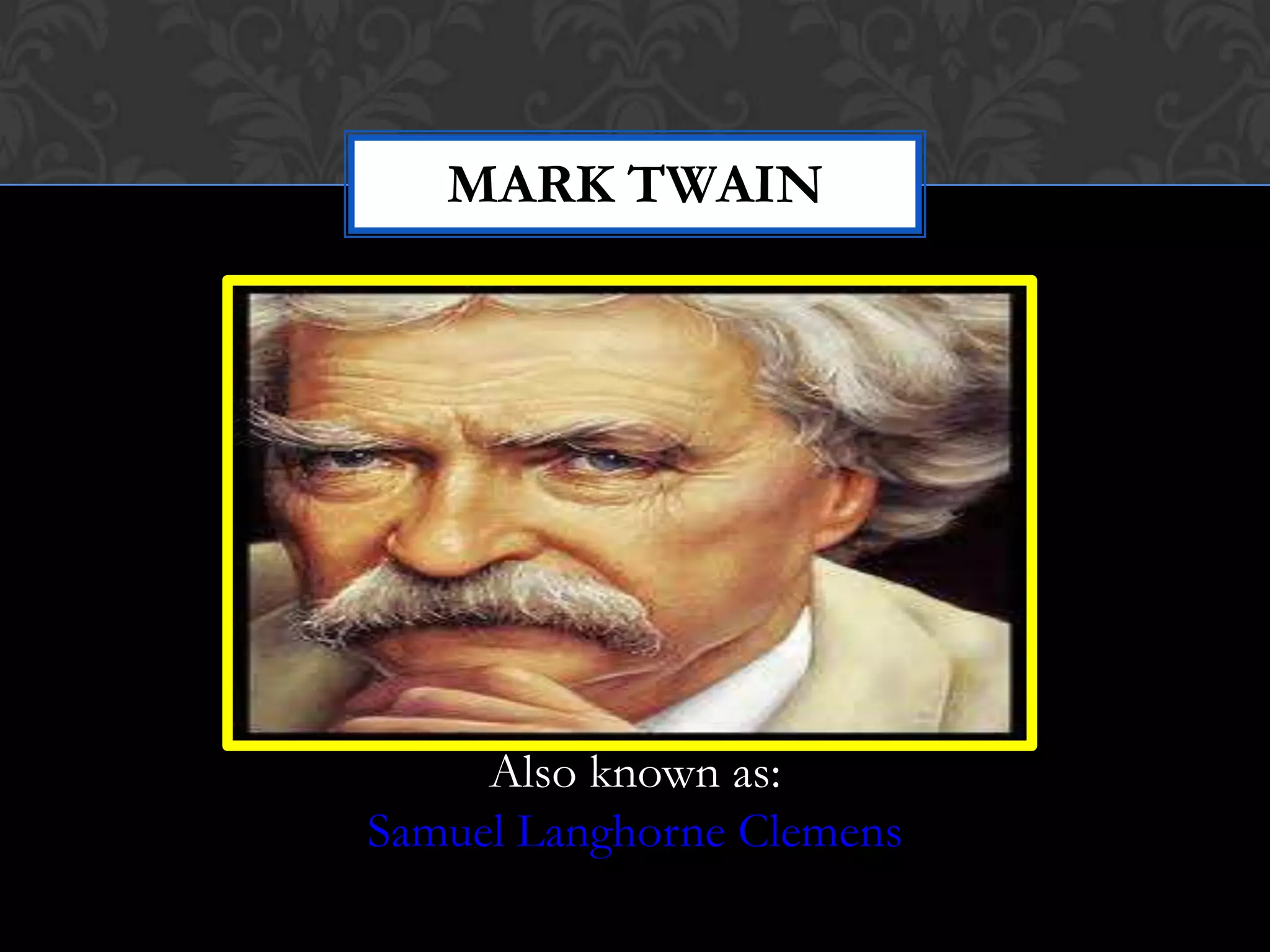
MARK TWAIN


     Also known as:
Samuel Langhorne Clemens
BACKGROUND

 Samuel Langhorne Clemens:               Moved to Hannibal, Missouri in
                                           1839, on the Mississippi River
 Born: November 30, 1835 in
  Florida, Missouri.                      His father passed when he was just
                                           12 years old and soon after begin
 Parents: John Marshall and Jane          writing for his brother Orion’s
  Moffit Clemens and was the sixth         newspaper. “Hannibal Journal”
  child.                                  Twain contributed reports, poems,
 Since Samuel was born 2 months           and humorous sketches to the Journal
  premature and therefore he               for several years.
  suffered for the first 10 years with
  his health.
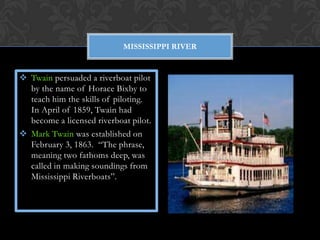
MISSISSIPPI RIVER


 Twain persuaded a riverboat pilot
  by the name of Horace Bixby to
  teach him the skills of piloting.
  In April of 1859, Twain had
  become a licensed riverboat pilot.
 Mark Twain was established on
  February 3, 1863. “The phrase,
  meaning two fathoms deep, was
  called in making soundings from
  Mississippi Riverboats”.
BACKGROUND


 Married: Olivia L. Langdon on
  February 2, 1870.
 They had four children. One son
  Langdon and three daughters:
  Susy, Clara, and Jean.
 In 1872, Langdon their infant son
  died.
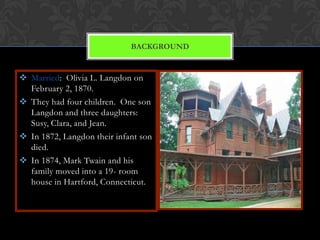
 In 1874, Mark Twain and his
  family moved into a 19- room
  house in Hartford, Connecticut.
MARK TWAIN


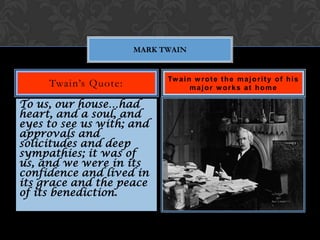
                            Tw a i n w r o t e t h e m a j o r i t y o f h i s
     Twain’s Quote:                 major works at home

To us, our house…had
heart, and a soul, and
eyes to see us with; and
approvals and
solicitudes and deep
sympathies; it was of
us, and we were in its
confidence and lived in
its grace and the peace
of its benediction.
A FEW OF TWAIN’S SHORT
                         STORIES AND NOVELS

 1873: 1st Novel: Roughing It. The     Adventures of Huckleberry
  title refers to the decades            Finn was considered to be
  succeeding the Civil War.              Twain’s greatest work.
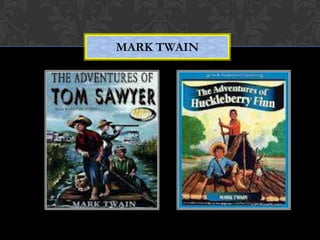
 1876: The Adventures of Tom           1889: A Connecticut Yankee in
  Sawyer. Twain’s first major use of
                                         King Arthur’s Court.
  memories of his childhood.
 1880: A Tramp Abroad.                 1892: The American Claimant.
 1882: The Prince and the Pauper.      1894: The Tragedy of Pudd’n
 1883: Life on the Mississippi.
                                         head Wilson.
 1884 in the United Kingdom and        1889: The Man That Corrupted
  1885 in the United States:             Hadleyburg.
  Adventures of Huckleberry Finn.
MARK TWAIN
AS THE HUMOR
   UNFOLDS

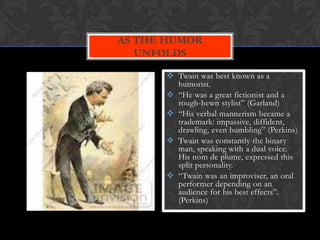
       Twain was best known as a
        humorist.
       “He was a great fictionist and a
        rough-hewn stylist” (Garland)
       “His verbal mannerism became a
        trademark: impassive, diffident,
        drawling, even bumbling” (Perkins)
       Twain was constantly the binary
        man, speaking with a dual voice.
        His nom de plume, expressed this
        split personality.
       “Twain was an improviser, an oral
        performer depending on an
        audience for his best effects”.
        (Perkins)
WHAT OTHER AUTHORS
                       SAID ABOUT TWAIN:

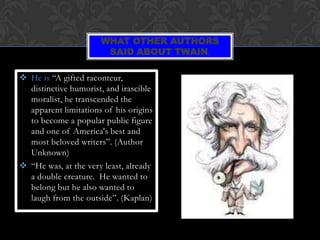
 He is “A gifted raconteur,
  distinctive humorist, and irascible
  moralist, he transcended the
  apparent limitations of his origins
  to become a popular public figure
  and one of America's best and
  most beloved writers”. (Author
  Unknown)
 “He was, at the very least, already
  a double creature. He wanted to
  belong but he also wanted to
  laugh from the outside”. (Kaplan)
MARK TWAIN

 With each book Twain focused on a multitude of things here’s
  a few examples.
 Huckleberry Finn: was written in the aftermath of
  Reconstruction after the Civil War. He used realistic language
  in this novel.
 Life on the Mississippi: describes the history, sights, people,
  and legends of the steamboats and towns of the Mississippi
  River region.
 The Tragedy of Pudd’n Head Wilson: Twain focused on racial
  prejudice as the most critical issue facing American society.
HIS FINAL CHAPTER

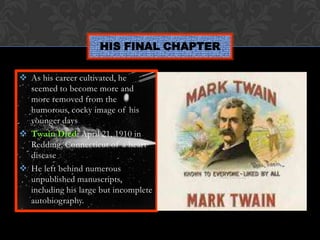
 As his career cultivated, he
  seemed to become more and
  more removed from the
  humorous, cocky image of his
  younger days.
 Twain Died: April 21, 1910 in
  Redding, Connecticut of a heart
  disease
 He left behind numerous
  unpublished manuscripts,
  including his large but incomplete
  autobiography.
WORKS CITED:

Craven, Jackie. The Mark Twain House. About.com. 2007. New York Times Co.

   http://architecture.about.com/od/housetours/ig/Mark-Twain-

   House/Mark-Twain-House.-0ia.htm

Garland, Hamlin. NAR. June 1910. p. 833

Kaplan, Justin. Mr. Clemens and Mark Twain (Simon). 1966. p.18

Leninger, Phillip., Perkins, Barbara., Perkins, George. Benet’s Readers Encyclopedia of American

   Literature. 1991. Harper Collins Publisher.

Mark Twain. 2011. A & E Television Networks., http://www.history.com/topics/mark-twain

Mark Twain

  • 1.
    MARK TWAIN Also known as: Samuel Langhorne Clemens
  • 2.
    BACKGROUND  Samuel LanghorneClemens:  Moved to Hannibal, Missouri in 1839, on the Mississippi River  Born: November 30, 1835 in Florida, Missouri.  His father passed when he was just 12 years old and soon after begin  Parents: John Marshall and Jane writing for his brother Orion’s Moffit Clemens and was the sixth newspaper. “Hannibal Journal” child.  Twain contributed reports, poems,  Since Samuel was born 2 months and humorous sketches to the Journal premature and therefore he for several years. suffered for the first 10 years with his health.
  • 3.
    MISSISSIPPI RIVER  Twainpersuaded a riverboat pilot by the name of Horace Bixby to teach him the skills of piloting. In April of 1859, Twain had become a licensed riverboat pilot.  Mark Twain was established on February 3, 1863. “The phrase, meaning two fathoms deep, was called in making soundings from Mississippi Riverboats”.
  • 4.
    BACKGROUND  Married: OliviaL. Langdon on February 2, 1870.  They had four children. One son Langdon and three daughters: Susy, Clara, and Jean.  In 1872, Langdon their infant son died.  In 1874, Mark Twain and his family moved into a 19- room house in Hartford, Connecticut.
  • 5.
    MARK TWAIN Tw a i n w r o t e t h e m a j o r i t y o f h i s Twain’s Quote: major works at home To us, our house…had heart, and a soul, and eyes to see us with; and approvals and solicitudes and deep sympathies; it was of us, and we were in its confidence and lived in its grace and the peace of its benediction.
  • 6.
    A FEW OFTWAIN’S SHORT STORIES AND NOVELS  1873: 1st Novel: Roughing It. The  Adventures of Huckleberry title refers to the decades Finn was considered to be succeeding the Civil War. Twain’s greatest work.  1876: The Adventures of Tom  1889: A Connecticut Yankee in Sawyer. Twain’s first major use of King Arthur’s Court. memories of his childhood.  1880: A Tramp Abroad.  1892: The American Claimant.  1882: The Prince and the Pauper.  1894: The Tragedy of Pudd’n  1883: Life on the Mississippi. head Wilson.  1884 in the United Kingdom and  1889: The Man That Corrupted 1885 in the United States: Hadleyburg. Adventures of Huckleberry Finn.
  • 7.
  • 8.
    AS THE HUMOR UNFOLDS  Twain was best known as a humorist.  “He was a great fictionist and a rough-hewn stylist” (Garland)  “His verbal mannerism became a trademark: impassive, diffident, drawling, even bumbling” (Perkins)  Twain was constantly the binary man, speaking with a dual voice. His nom de plume, expressed this split personality.  “Twain was an improviser, an oral performer depending on an audience for his best effects”. (Perkins)
  • 9.
    WHAT OTHER AUTHORS SAID ABOUT TWAIN:  He is “A gifted raconteur, distinctive humorist, and irascible moralist, he transcended the apparent limitations of his origins to become a popular public figure and one of America's best and most beloved writers”. (Author Unknown)  “He was, at the very least, already a double creature. He wanted to belong but he also wanted to laugh from the outside”. (Kaplan)
  • 10.
    MARK TWAIN  Witheach book Twain focused on a multitude of things here’s a few examples.  Huckleberry Finn: was written in the aftermath of Reconstruction after the Civil War. He used realistic language in this novel.  Life on the Mississippi: describes the history, sights, people, and legends of the steamboats and towns of the Mississippi River region.  The Tragedy of Pudd’n Head Wilson: Twain focused on racial prejudice as the most critical issue facing American society.
  • 11.
    HIS FINAL CHAPTER As his career cultivated, he seemed to become more and more removed from the humorous, cocky image of his younger days.  Twain Died: April 21, 1910 in Redding, Connecticut of a heart disease  He left behind numerous unpublished manuscripts, including his large but incomplete autobiography.
  • 12.
    WORKS CITED: Craven, Jackie.The Mark Twain House. About.com. 2007. New York Times Co. http://architecture.about.com/od/housetours/ig/Mark-Twain- House/Mark-Twain-House.-0ia.htm Garland, Hamlin. NAR. June 1910. p. 833 Kaplan, Justin. Mr. Clemens and Mark Twain (Simon). 1966. p.18 Leninger, Phillip., Perkins, Barbara., Perkins, George. Benet’s Readers Encyclopedia of American Literature. 1991. Harper Collins Publisher. Mark Twain. 2011. A & E Television Networks., http://www.history.com/topics/mark-twain