Susana Valverde
Literary Criticism
I Term - 2014
Nathaniel Hawthorne

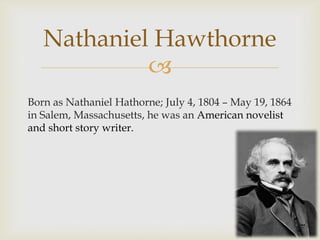
Born as Nathaniel Hathorne; July 4, 1804 – May 19, 1864
in Salem, Massachusetts, he was an American novelist
and short story writer.

His ancestors include John Hathorne, the only judge
involved in the Salem witch trials who never repented
of his actions.
Nathaniel later added a "w" to make his name
"Hawthorne" in order to hide this relation.
Writing Style


Symbols
 Adultery
 Sin
 Human morality

Theme
 Based on Psychology
 Allegory
 Sin
 Guilt
 Religion
Novels

 The Scarlet Letter (1850)
 The House of the Seven Gables (1851)
 The Blithedale Romance
Short Stories

 Twice-Told Tales (1837)
 Grandfather's Chair (1840)
 Mosses from an Old Manse (1846)
 The Snow-Image, and Other Twice-Told Tales (1852)
 A Wonder-Book for Girls and Boys (1852)
Influences

 Salem
-Early Childhood
 Puritan Family Background
-Forefather was a judge who direct over the
Salem witch trails
-Puritan tradition and moral sincerity
How he is related to
Salem trials ?

 Nathaniel Hawthorne is related to one of the puritan
judges
 He has written many times from the Salem trials
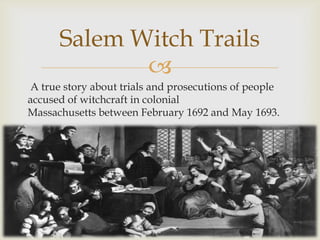
Salem Witch Trails

A true story about trials and prosecutions of people
accused of witchcraft in colonial
Massachusetts between February 1692 and May 1693.
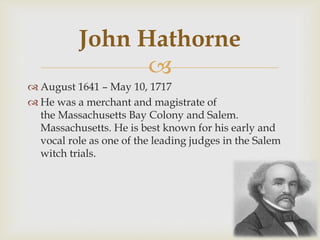
John Hathorne

 August 1641 – May 10, 1717
 He was a merchant and magistrate of
the Massachusetts Bay Colony and Salem.
Massachusetts. He is best known for his early and
vocal role as one of the leading judges in the Salem
witch trials.
Puritanism

 It is a religious reform movement from the 16th and
17th centuries.
Relation of Nathaniel
and the Puritanism

Nathaniel Hawthorne was born into a family that was
of Puritan belief since generations. But different from
his ancestors, he had a feeling to some extents of
Puritanism as being intolerant and cruel.

Thank You !

Nathaniel Hawthorne

  • 1.
  • 2.
    Nathaniel Hawthorne  Born asNathaniel Hathorne; July 4, 1804 – May 19, 1864 in Salem, Massachusetts, he was an American novelist and short story writer.
  • 3.
     His ancestors includeJohn Hathorne, the only judge involved in the Salem witch trials who never repented of his actions. Nathaniel later added a "w" to make his name "Hawthorne" in order to hide this relation.
  • 4.
  • 5.
     Theme  Based onPsychology  Allegory  Sin  Guilt  Religion
  • 6.
    Novels   The ScarletLetter (1850)  The House of the Seven Gables (1851)  The Blithedale Romance
  • 7.
    Short Stories   Twice-ToldTales (1837)  Grandfather's Chair (1840)  Mosses from an Old Manse (1846)  The Snow-Image, and Other Twice-Told Tales (1852)  A Wonder-Book for Girls and Boys (1852)
  • 8.
    Influences   Salem -Early Childhood Puritan Family Background -Forefather was a judge who direct over the Salem witch trails -Puritan tradition and moral sincerity
  • 9.
    How he isrelated to Salem trials ?   Nathaniel Hawthorne is related to one of the puritan judges  He has written many times from the Salem trials
  • 10.
    Salem Witch Trails  Atrue story about trials and prosecutions of people accused of witchcraft in colonial Massachusetts between February 1692 and May 1693.
  • 11.
    John Hathorne   August1641 – May 10, 1717  He was a merchant and magistrate of the Massachusetts Bay Colony and Salem. Massachusetts. He is best known for his early and vocal role as one of the leading judges in the Salem witch trials.
  • 12.
    Puritanism   It isa religious reform movement from the 16th and 17th centuries.
  • 13.
    Relation of Nathaniel andthe Puritanism  Nathaniel Hawthorne was born into a family that was of Puritan belief since generations. But different from his ancestors, he had a feeling to some extents of Puritanism as being intolerant and cruel.
  • 14.