A  CASE REPORT ON  AMELOBLASTOMA
INTRODUCTION True neoplasm of odontogenic epithelium Term “ Ameloblastoma” coined by Churchill – 1934. “ Unicentric, nonfunctional, intermittent in growth, anatomically benign, clinically persistent”. 2 nd  most common odontogenic neoplasm, & represents 1% of all oral odontogenic epithelial tumors & 11% of all odontogenic tumors.
CASE REPORT
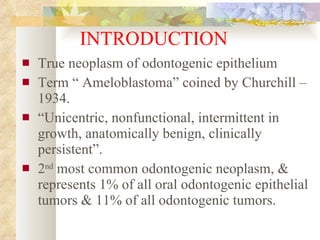
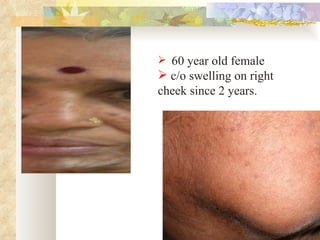
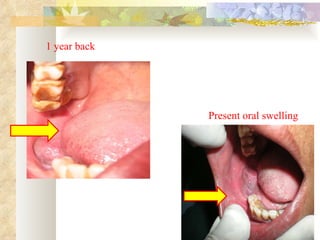
60 year old female c/o swelling on right cheek since 2 years.
Extra orally; 1 year back
Swelling 1 year back Present size
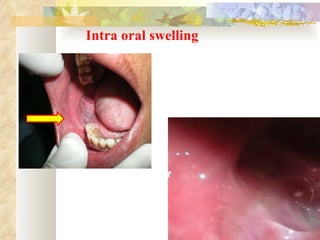
Intra oral swelling
1 year back Present oral swelling
Provisional diagnosis –  AMELOBLASTOMA Differential diagnosis – 1) Odontogenic Keratocyst  2) Central giant cell granuloma 3) CEOT 4) Odontogenic myxoma 5) COC
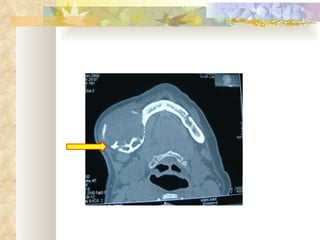
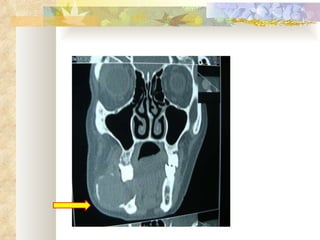
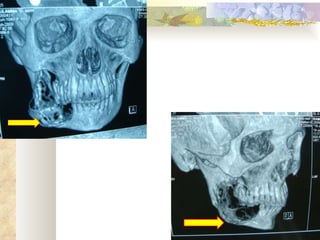
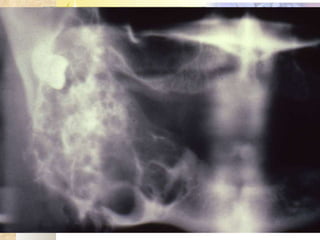
INVESTIGATIONS Radiological – OPG, lateral occlusal mandibular radiograph Complete blood picture, CT, BT Incisional biopsy
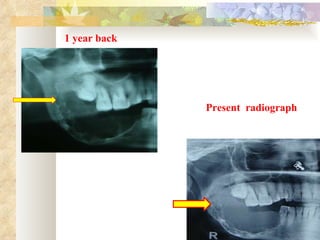
Present  radiograph 1 year back
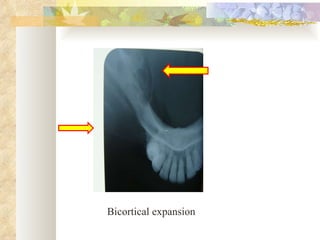
Bicortical expansion


Differential diagnosis – 1) central giant cell granuloma 2) odontogenic Keratocyst 3) odontogenic myxoma 4) ossifying fibroma
central giant cell granuloma
Odontogenic Keratocyst Right body and ramus of the mandible
03/27/10 Odontogenic myxoma
DISCUSSION
Etiology – Varied origin cell rests of enamel organ Epithelium of odontogenic cysts Disturbances of developing enamel organ Basal cells of surface epithelium of the jaws Heterotopic epithelium in other parts of the body
CLINICAL FEATURES Wide age range, but uncommon in children and adults < 20 yrs of age Posterior mandible Asymptomatic, often discovered on routine radiographs As tumor grows, painless enlargement may be noted
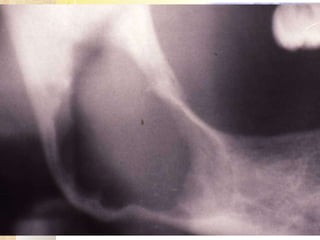
RADIOLOGICAL FEATURES Unilocular radiolucency, especially early lesions that often progress to multilocular ( soap-bubble, honeycomb ) May be associated with impacted tooth Cortical expansion and thinning Resorption of adjacent tooth roots, displacement of teeth can be seen


Ameloblastoma