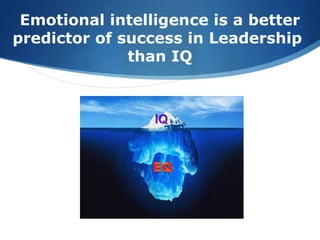
Emotional intelligence is a better
predictor of success in Leadership
than IQ
Background & Objectives
 The goal of this presentation is to summarize the
use of emotional intelligence to enhance
physicians self awareness, self control, social
awareness, and relationship management
 Effective leadership in HealthCare requires skills in
emotional intelligence
 Happy doctors lead to satisfied patients and good
staff morale
Coaching for Disruptive
Behavior
 The Joint Commission in its Sentinel Alert required
intervention for disruptive physician behavior.
 A Disruptive physician can best be described as
one whose interpersonal interactions with others
is angry, hostile, aggressive, demeaning,
disrespectful, or in someway, impacts positive
relationships.
 The major concern for disruptive behavior is
related to its potential for patient safety.
Intervention for
“disruptive physicians”
 Previous mandates for physician well-being
include,“psychiatric impairment”, sexual
harassment, and substance abuse.
 Many if not all of these programs now provide
anger management for disruptive physicians.
 Most programs provide these services in small
groups of 7 or 8 in San Diego or Nashville.
This discussion will be limited to
EI for disruptive physicians
 The assessments used in coaching are non-
psychiatric.
 Coaching is limited to EI skill enhancement rather
than psychotherapy for some diagnosed illness.
 There are no stigmas associated with coaching for
skill enhancement in EI.
First day of live training
 Coaching sessions begins with a detailed
discussion of the EQ-i- 2.0 Pre Assessment.
 Client is helped to formulate his or her own goals
for coaching relative to the assessment results.
 Client workbooks, DVDs and ancillary coaching
material along with first assignment is given.
What is EQ?
 Emotional intelligence (EI) refers to the ability to
perceive, control and evaluate emotions.
Perceiving Emotions: The first step in
understanding emotions is to accurately perceive
them. In many cases, this might involve
understanding nonverbal signals such as body
language and facial expressions.
Reasoning With Emotions: The next step involves
using emotions to promote thinking and cognitive
activity. Emotions help prioritize what we pay
attention and react to; we respond emotionally to
things that garner our attention.
Cont.
Managing Emotions: The ability to manage
emotions effectively is a key part of emotional
intelligence. Regulating emotions, responding
appropriately and responding to the emotions of
others are all important aspect of emotional
management.
Cont.
Understanding Emotions: The emotions that we
perceive can carry a wide variety of meanings. If
someone is expressing angry emotions, the observer
must interpret the cause of their anger and what it
might mean. For example, if your boss is acting
angry, it might mean that he is dissatisfied with your
work; or it could be because he got a speeding ticket
on his way to work that morning or that he's been
fighting with his wife.
First day of live training
 The first session begins with the physicians explanation of his
referral for disruptive behavior.
 Coaching sessions begins with a detailed discussion of the Bar
On EQ 2.0 Pre Assessment.
 The physicians score on each of our the 15 Bar On EQ scales
are reviewed in detail
 Client is help to formulate his or her own goals for coaching
relative to the assessment results.
 Client workbooks, DVD and ancillary material along with first
assignment is given.
Second Day Schedule
 Discussion of how EQ skill enhancement is based
on practice.
 Case examples and demonstration of how self-
awareness must be enhanced to increase
emotional intelligence.
 Analysis of the incident that resulted in the
physicians referral using coaching formula.
Assessments for EQ
 The Bar On EQ 2.0 Assessment is the most widely
used instrument for measuring EQ.
 The Bar On EQ 2.0 contains 5 composite and 15
related skills.
 These skills include: self awareness, self control,
social awareness and relationship.
Response to disruptive
physician behavior
 Behavior that may be considered, abusive,
demeaning, hostile or unresponsive. A pattern of
behavior that may compromise patient safety.
 All Healthcare Organization are required to have
written policy designed to address this issue.
When “in house” measures fail,
professional help may be
mandated
 Anger Management/Emotional Intelligence
Coaching
 Bar On EQ 2.0 Assessment
 Two day intensive followed by 6 month of phone
coaching
 Reports/feedback provided to referring source.
 Post Test
AMA_Presentation_Edited

AMA_Presentation_Edited

  • 1.
    Emotional intelligence isa better predictor of success in Leadership than IQ
  • 2.
    Background & Objectives The goal of this presentation is to summarize the use of emotional intelligence to enhance physicians self awareness, self control, social awareness, and relationship management  Effective leadership in HealthCare requires skills in emotional intelligence  Happy doctors lead to satisfied patients and good staff morale
  • 3.
    Coaching for Disruptive Behavior The Joint Commission in its Sentinel Alert required intervention for disruptive physician behavior.  A Disruptive physician can best be described as one whose interpersonal interactions with others is angry, hostile, aggressive, demeaning, disrespectful, or in someway, impacts positive relationships.  The major concern for disruptive behavior is related to its potential for patient safety.
  • 4.
    Intervention for “disruptive physicians” Previous mandates for physician well-being include,“psychiatric impairment”, sexual harassment, and substance abuse.  Many if not all of these programs now provide anger management for disruptive physicians.  Most programs provide these services in small groups of 7 or 8 in San Diego or Nashville.
  • 5.
    This discussion willbe limited to EI for disruptive physicians  The assessments used in coaching are non- psychiatric.  Coaching is limited to EI skill enhancement rather than psychotherapy for some diagnosed illness.  There are no stigmas associated with coaching for skill enhancement in EI.
  • 6.
    First day oflive training  Coaching sessions begins with a detailed discussion of the EQ-i- 2.0 Pre Assessment.  Client is helped to formulate his or her own goals for coaching relative to the assessment results.  Client workbooks, DVDs and ancillary coaching material along with first assignment is given.
  • 7.
    What is EQ? Emotional intelligence (EI) refers to the ability to perceive, control and evaluate emotions.
  • 8.
    Perceiving Emotions: Thefirst step in understanding emotions is to accurately perceive them. In many cases, this might involve understanding nonverbal signals such as body language and facial expressions. Reasoning With Emotions: The next step involves using emotions to promote thinking and cognitive activity. Emotions help prioritize what we pay attention and react to; we respond emotionally to things that garner our attention.
  • 9.
    Cont. Managing Emotions: Theability to manage emotions effectively is a key part of emotional intelligence. Regulating emotions, responding appropriately and responding to the emotions of others are all important aspect of emotional management.
  • 10.
    Cont. Understanding Emotions: Theemotions that we perceive can carry a wide variety of meanings. If someone is expressing angry emotions, the observer must interpret the cause of their anger and what it might mean. For example, if your boss is acting angry, it might mean that he is dissatisfied with your work; or it could be because he got a speeding ticket on his way to work that morning or that he's been fighting with his wife.
  • 11.
    First day oflive training  The first session begins with the physicians explanation of his referral for disruptive behavior.  Coaching sessions begins with a detailed discussion of the Bar On EQ 2.0 Pre Assessment.  The physicians score on each of our the 15 Bar On EQ scales are reviewed in detail  Client is help to formulate his or her own goals for coaching relative to the assessment results.  Client workbooks, DVD and ancillary material along with first assignment is given.
  • 12.
    Second Day Schedule Discussion of how EQ skill enhancement is based on practice.  Case examples and demonstration of how self- awareness must be enhanced to increase emotional intelligence.  Analysis of the incident that resulted in the physicians referral using coaching formula.
  • 13.
    Assessments for EQ The Bar On EQ 2.0 Assessment is the most widely used instrument for measuring EQ.  The Bar On EQ 2.0 contains 5 composite and 15 related skills.  These skills include: self awareness, self control, social awareness and relationship.
  • 14.
    Response to disruptive physicianbehavior  Behavior that may be considered, abusive, demeaning, hostile or unresponsive. A pattern of behavior that may compromise patient safety.  All Healthcare Organization are required to have written policy designed to address this issue.
  • 15.
    When “in house”measures fail, professional help may be mandated  Anger Management/Emotional Intelligence Coaching  Bar On EQ 2.0 Assessment  Two day intensive followed by 6 month of phone coaching  Reports/feedback provided to referring source.  Post Test