ALZHEIMER
1. Introduction
2. Characteristics
3. Cause
4. Diagnosis
5. Prevention
6. Management
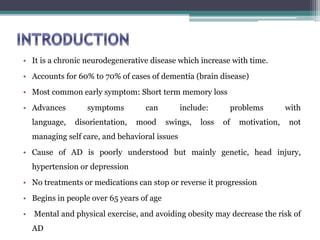
• It is a chronic neurodegenerative disease which increase with time.
• Accounts for 60% to 70% of cases of dementia (brain disease)
• Most common early symptom: Short term memory loss
• Advances symptoms can include: problems with
language, disorientation, mood swings, loss of motivation, not
managing self care, and behavioral issues
• Cause of AD is poorly understood but mainly genetic, head injury,
hypertension or depression
• No treatments or medications can stop or reverse it progression
• Begins in people over 65 years of age
• Mental and physical exercise, and avoiding obesity may decrease the risk of
AD
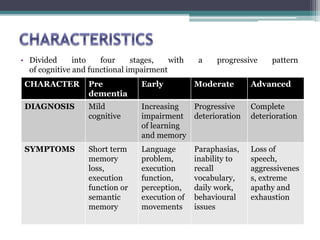
• Divided into four stages, with a progressive pattern
of cognitive and functional impairment
CHARACTER Pre
dementia
Early Moderate Advanced
DIAGNOSIS Mild
cognitive
Increasing
impairment
of learning
and memory
Progressive
deterioration
Complete
deterioration
SYMPTOMS Short term
memory
loss,
execution
function or
semantic
memory
Language
problem,
execution
function,
perception,
execution of
movements
Paraphasias,
inability to
recall
vocabulary,
daily work,
behavioural
issues
Loss of
speech,
aggressivenes
s, extreme
apathy and
exhaustion
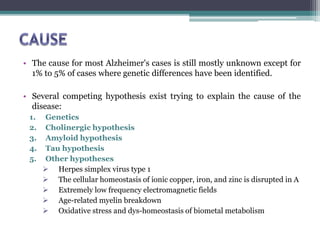
• The cause for most Alzheimer's cases is still mostly unknown except for
1% to 5% of cases where genetic differences have been identified.
• Several competing hypothesis exist trying to explain the cause of the
disease:
1. Genetics
2. Cholinergic hypothesis
3. Amyloid hypothesis
4. Tau hypothesis
5. Other hypotheses
 Herpes simplex virus type 1
 The cellular homeostasis of ionic copper, iron, and zinc is disrupted in A
 Extremely low frequency electromagnetic fields
 Age-related myelin breakdown
 Oxidative stress and dys-homeostasis of biometal metabolism
Alzheimer's disease is usually diagnosed based on the person's medical
history, history from relatives, and behavioural observations
1. Cerebral pathology or subtypes of dementia-CT, MRI, SPECT, PET for
getting medical imaging
2. Cognitive impairment and a suspected dementia syndrome -
Neuropsychological testing
3. Early AD - Neurological examination
1. Psychological tests
2. Analysis of cerebrospinal fluid
1. Supplemental testing - Blood tests, thyroid function tests, assess B12, rule
out syphilis, rule out metabolic problems (including tests for kidney function,
electrolyte levels and for diabetes), assess levels of heavy metals (e.g. lead, mercury)
and anaemia
At present, there is no definitive evidence to support that any
particular measure is effective in preventing AD
1. Medication
Statins, non-steroidal anti-inflammatory drugs (NSAIDs)
2. Lifestyle
People who engage in intellectual activities such as reading, playing
board games, completing crossword puzzles, playing musical
instruments, or regular social interaction show a reduced risk for
Alzheimer's disease
3. Diet
People who eat a healthy diet have a lower risk of AD.
Those who eat a diet high in saturated fats and simple
carbohydrates have a higher risk
• There is no cure for Alzheimer's disease; available treatments offer relatively small
symptomatic benefit but remain palliative in nature
• Current treatments can be divided into pharmaceutical, psychosocial and caregiving.
1. Medications
Five medications are currently used to treat the cognitive problems of AD
acetylcholinesterase inhibitors (tacrine, rivastigmine, galantamine and donepezil)
and the other (memantine) is an NMDA receptor antagonist
2. Psychosocial intervention
These are used as an adjunct to pharmaceutical treatment and can be classified
within behaviour-, emotion-, cognition- or stimulation-oriented approaches
3. Caregiving
Since Alzheimer's has no cure and it gradually renders people incapable of tending
for their own needs, caregiving essentially is the treatment and must be carefully
managed over the course of the disease.
Alzheimer

Alzheimer

  • 1.
  • 2.
    1. Introduction 2. Characteristics 3.Cause 4. Diagnosis 5. Prevention 6. Management
  • 3.
    • It isa chronic neurodegenerative disease which increase with time. • Accounts for 60% to 70% of cases of dementia (brain disease) • Most common early symptom: Short term memory loss • Advances symptoms can include: problems with language, disorientation, mood swings, loss of motivation, not managing self care, and behavioral issues • Cause of AD is poorly understood but mainly genetic, head injury, hypertension or depression • No treatments or medications can stop or reverse it progression • Begins in people over 65 years of age • Mental and physical exercise, and avoiding obesity may decrease the risk of AD
  • 4.
    • Divided intofour stages, with a progressive pattern of cognitive and functional impairment CHARACTER Pre dementia Early Moderate Advanced DIAGNOSIS Mild cognitive Increasing impairment of learning and memory Progressive deterioration Complete deterioration SYMPTOMS Short term memory loss, execution function or semantic memory Language problem, execution function, perception, execution of movements Paraphasias, inability to recall vocabulary, daily work, behavioural issues Loss of speech, aggressivenes s, extreme apathy and exhaustion
  • 5.
    • The causefor most Alzheimer's cases is still mostly unknown except for 1% to 5% of cases where genetic differences have been identified. • Several competing hypothesis exist trying to explain the cause of the disease: 1. Genetics 2. Cholinergic hypothesis 3. Amyloid hypothesis 4. Tau hypothesis 5. Other hypotheses  Herpes simplex virus type 1  The cellular homeostasis of ionic copper, iron, and zinc is disrupted in A  Extremely low frequency electromagnetic fields  Age-related myelin breakdown  Oxidative stress and dys-homeostasis of biometal metabolism
  • 6.
    Alzheimer's disease isusually diagnosed based on the person's medical history, history from relatives, and behavioural observations 1. Cerebral pathology or subtypes of dementia-CT, MRI, SPECT, PET for getting medical imaging 2. Cognitive impairment and a suspected dementia syndrome - Neuropsychological testing 3. Early AD - Neurological examination 1. Psychological tests 2. Analysis of cerebrospinal fluid 1. Supplemental testing - Blood tests, thyroid function tests, assess B12, rule out syphilis, rule out metabolic problems (including tests for kidney function, electrolyte levels and for diabetes), assess levels of heavy metals (e.g. lead, mercury) and anaemia
  • 7.
    At present, thereis no definitive evidence to support that any particular measure is effective in preventing AD 1. Medication Statins, non-steroidal anti-inflammatory drugs (NSAIDs) 2. Lifestyle People who engage in intellectual activities such as reading, playing board games, completing crossword puzzles, playing musical instruments, or regular social interaction show a reduced risk for Alzheimer's disease 3. Diet People who eat a healthy diet have a lower risk of AD. Those who eat a diet high in saturated fats and simple carbohydrates have a higher risk
  • 8.
    • There isno cure for Alzheimer's disease; available treatments offer relatively small symptomatic benefit but remain palliative in nature • Current treatments can be divided into pharmaceutical, psychosocial and caregiving. 1. Medications Five medications are currently used to treat the cognitive problems of AD acetylcholinesterase inhibitors (tacrine, rivastigmine, galantamine and donepezil) and the other (memantine) is an NMDA receptor antagonist 2. Psychosocial intervention These are used as an adjunct to pharmaceutical treatment and can be classified within behaviour-, emotion-, cognition- or stimulation-oriented approaches 3. Caregiving Since Alzheimer's has no cure and it gradually renders people incapable of tending for their own needs, caregiving essentially is the treatment and must be carefully managed over the course of the disease.