BY- VIDHI  GUPTA
 
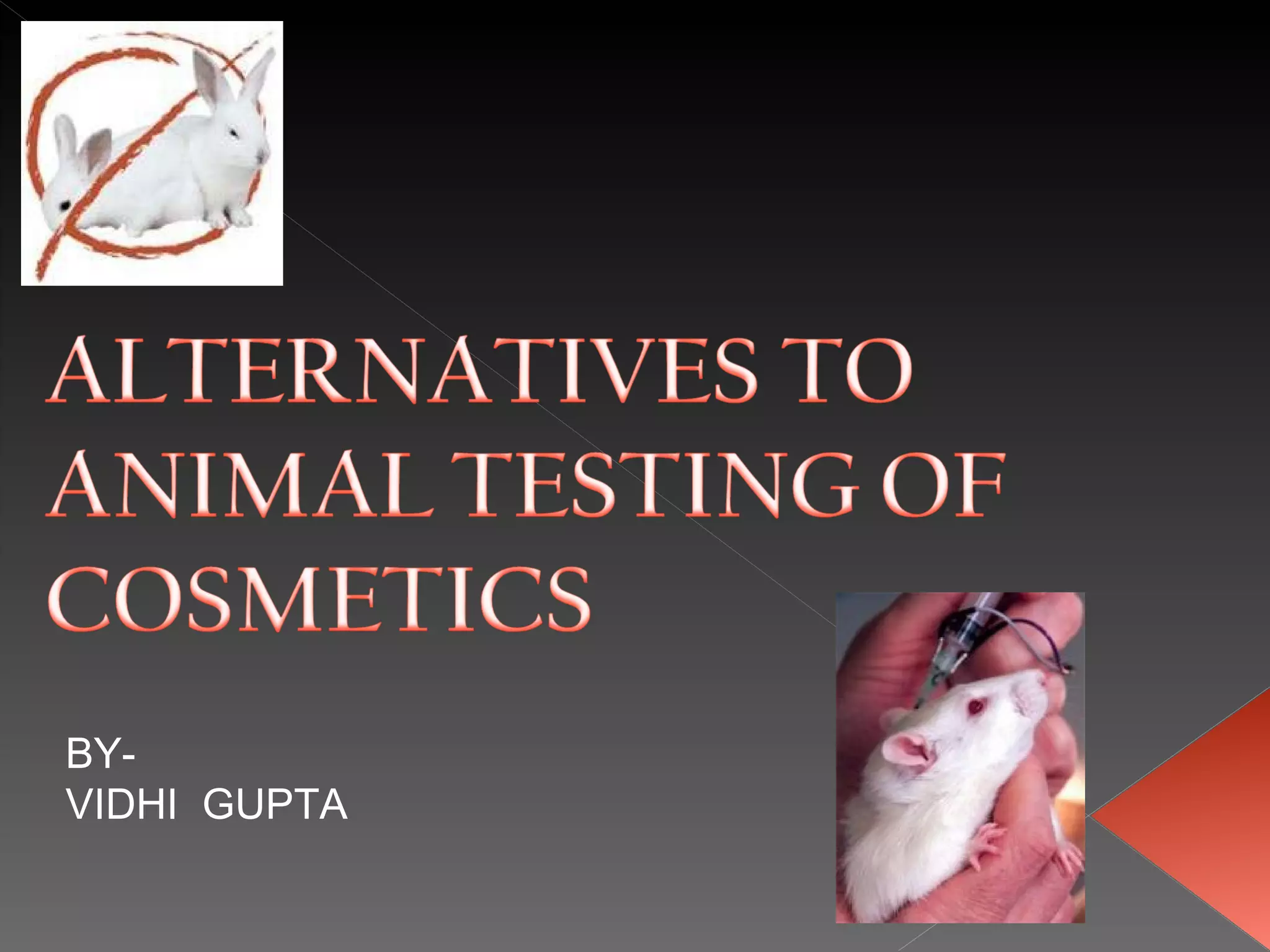
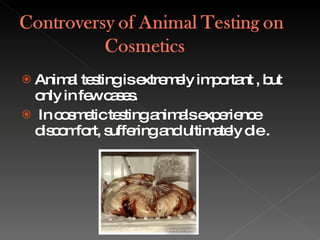
Animal testing is extremely important , but only in few cases. In cosmetic testing animals experience discomfort, suffering and ultimately die .
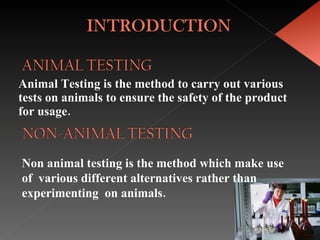
Animal Testing is the method to carry out various tests on animals to ensure the safety of the product for usage. Non animal testing is the method which make use of  various different alternatives rather than  experimenting  on animals.
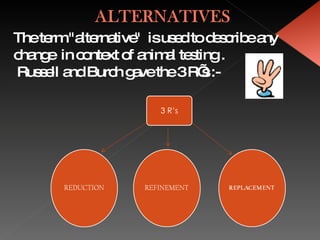
The term "alternative"  is used to describe any  change  in context of animal testing . Russell and Burch gave the 3 R’s :- 3 R’s
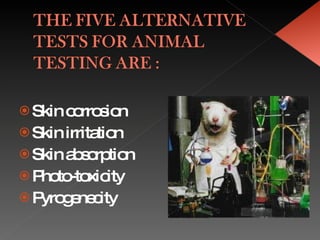
Skin corrosion Skin irritation Skin absorption Photo-toxicity Pyrogenecity
Skin corrosion  is the most extreme form of skin irritation, in which the skin is destroyed beyond the body’s ability to heal discoloration. Corrosive agents  Damage due to these tests. Cosmetic companies performing these tests.
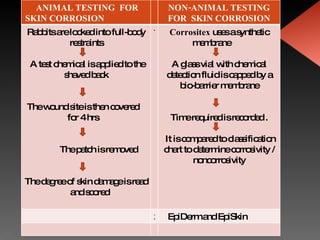
ANIMAL TESTING  FOR SKIN CORROSION  NON-ANIMAL TESTING FOR  SKIN CORROSION Rabbits are locked into full-body restraints A test chemical is applied to the shaved back The wound site is then covered  for 4 hrs  The patch is removed  The degree of skin damage is read  and scored  1 Corrositex  uses a synthetic membrane  A glass vial with chemical detection fluid is capped by a   bio-barrier membrane Time required is recorded . It is compared to classification chart to determine corrosivity / noncorrosivity 2 EpiDerm and EpiSkin
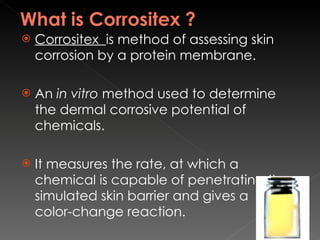
Corrositex  is method of assessing skin corrosion by a protein membrane. An  in vitro  method used to determine the dermal corrosive potential of chemicals.  It measures the rate, at which a chemical is capable of penetrating the simulated skin barrier and gives a  color-change reaction.
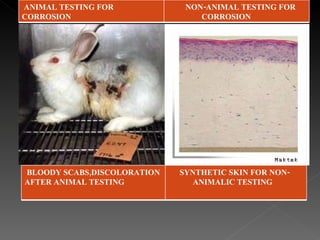
ANIMAL TESTING FOR CORROSION NON-ANIMAL TESTING FOR  CORROSION BLOODY SCABS,DISCOLORATION AFTER ANIMAL TESTING SYNTHETIC SKIN FOR NON-  ANIMALIC TESTING
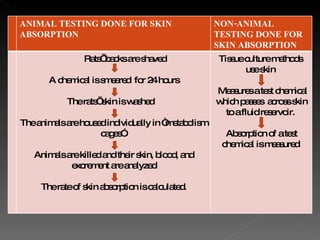
Skin absorption studies are carried out to determine the rate at which a chemical is able to penetrate the skin. Damage caused by the test. Cosmetic products involving these tests. Cosmetic companies using these tests.
ANIMAL TESTING DONE FOR SKIN ABSORPTION NON-ANIMAL TESTING DONE FOR SKIN ABSORPTION Rats’ backs are shaved  A chemical is smeared  for 24 hours  The rats’ skin is washed  The animals are housed individually in “metabolism cages”  Animals are killed and their skin, blood, and excrement are analyzed The rate of skin absorption is calculated. Tissue culture methods  use skin  Measures a test chemical which passes  across skin to a fluid reservoir.  Absorption of a test chemical is measured
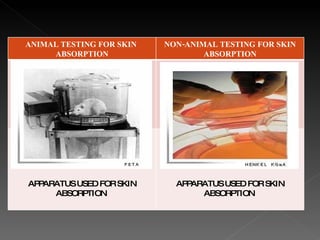
ANIMAL TESTING FOR SKIN  ABSORPTION NON-ANIMAL TESTING FOR SKIN ABSORPTION T APPARATUS USED FOR SKIN ABSORPTION  APPARATUS USED FOR SKIN ABSORPTION
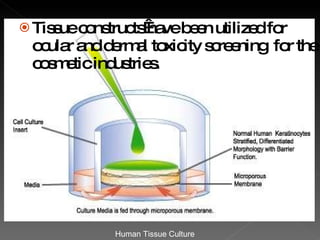
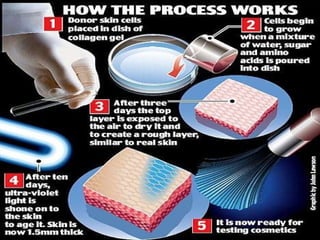
Tissue constructs have been utilized for ocular and dermal toxicity screening  for the cosmetic industries. Human Tissue Culture
 
 
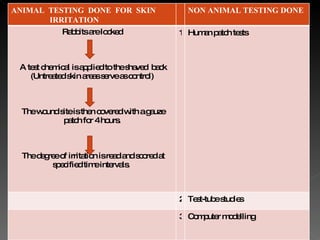
ANIMAL  TESTING  DONE  FOR  SKIN  IRRITATION NON ANIMAL TESTING DONE  FOR SKIN IRRITATION Rabbits are locked A test chemical is applied to the shaved  back (Untreated skin areas serve as control) The wound site is then covered with a gauze patch for 4 hours. The degree of irritation is read and scored at specified time intervals.   1 Human patch tests  2 Test-tube studies  3 Computer modelling
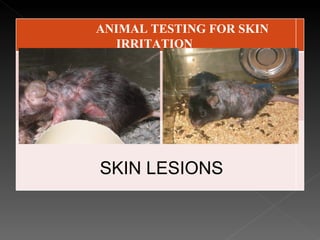
SKIN   LESIONS ANIMAL TESTING FOR SKIN IRRITATION
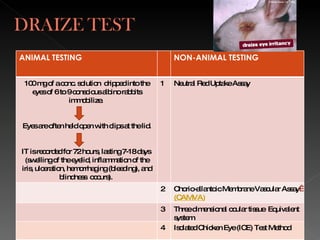
ANIMAL TESTING NON-ANIMAL TESTING 100 mg of a conc. solution  dripped into the eyes of 6 to 9 conscious albino rabbits immobilize.  Eyes are often held open with clips at the lid. IT is recorded for 72 hours, lasting 7-18 days  (swelling of the eyelid, inflammation of the iris, ulceration, hemorrhaging (bleeding), and blindness  occurs).  1 Neutral Red Uptake Assay 2 Chorio-allantoic Membrane Vascular Assay   (CAMVA) 3 Three dimensional ocular tissue  Equivalent system 4 Isolated Chicken Eye (ICE) Test Method
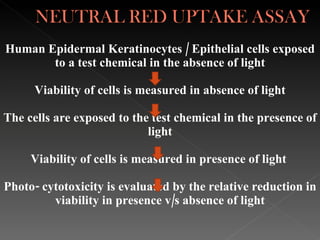
Human Epidermal Keratinocytes / Epithelial cells exposed to a test chemical in the absence of light Viability of cells is measured in absence of light The cells are exposed to the test chemical in the presence of light Viability of cells is measured in presence of light  Photo- cytotoxicity is evaluated by the relative reduction in viability in presence v/s absence of light
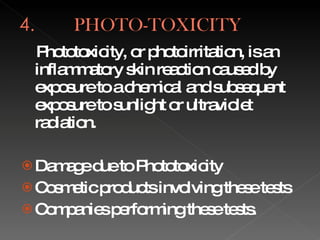
Phototoxicity, or photoirritation, is an inflammatory skin reaction caused by exposure to a chemical and subsequent exposure to sunlight or ultraviolet radiation. Damage due to Phototoxicity Cosmetic products involving these tests Companies performing these tests.
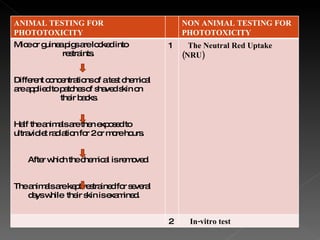
ANIMAL TESTING FOR  PHOTOTOXICITY NON ANIMAL TESTING FOR PHOTOTOXICITY  Mice or guinea pigs are locked into  restraints. Different concentrations of a test chemical are applied to patches of shaved skin on  their backs.  Half the animals are then exposed to ultraviolet radiation for 2 or more hours. After which the chemical is removed .  The animals are kept restrained for several  days while  their skin is examined.  1 The Neutral Red Uptake (NRU)  2 In-vitro test
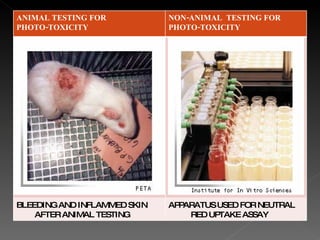
ANIMAL TESTING FOR  PHOTO-TOXICITY NON-ANIMAL  TESTING FOR  PHOTO-TOXICITY BLEEDING AND INFLAMMED SKIN  AFTER ANIMAL TESTING APPARATUS USED FOR NEUTRAL  RED UPTAKE ASSAY
The Skin tissue models allow to screen and measure with high precision, the irritation, penetration, metabolism, or efficacy of large number of formulations or actives.
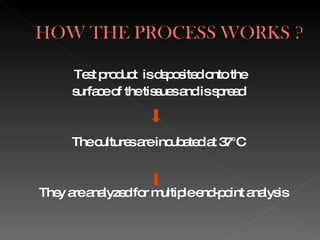
Test product  is deposited onto the  surface of the tissues and is spread  The cultures are incubated at 37°C  They are analyzed for multiple end-point analysis
Pyrogenicity is an immune reaction involving an interaction between a contaminant in a drug formulation and cells of the immune system. What are Pyrogens?
Helps in avoiding harm to animals. It is more reliable and accurate. It is cost effective. Painful and Deadly tests on animals can  be avoided.
Software packages are available which allow to predict chemicals' oral toxicity and irritation They are faster, cheaper and more accurate than animal tests,  are used by the FDA and  EPA.
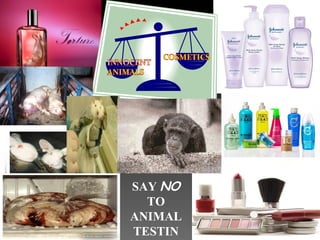
SAY  NO   TO ANIMAL TESTING
“  ITS  AN  APPEAL  TO  ALL  THE  RESEARCHERS  TO RESORT  TO  EXISTING ALTERNATIVES  TO  ANIMAL TESTING  AND  TO  INNOVATE”
ALTWEB, SITE FOR JOHN HOPKINS CENTRE ALTERNATIVE METHODS FOR SAFETY EVALUATION OF CHEMICALS IN COSMETIC INDUSTRY, NICOLA LOPRIENO PETA WEBSITE Animals Used for Experimentation FAQs", People for the Ethical Treatment of Animals.
 

Alternatives To Animal Testing

  • 1.
  • 2.
  • 3.
    Animal testing isextremely important , but only in few cases. In cosmetic testing animals experience discomfort, suffering and ultimately die .
  • 4.
    Animal Testing isthe method to carry out various tests on animals to ensure the safety of the product for usage. Non animal testing is the method which make use of various different alternatives rather than experimenting on animals.
  • 5.
    The term "alternative" is used to describe any change in context of animal testing . Russell and Burch gave the 3 R’s :- 3 R’s
  • 6.
    Skin corrosion Skinirritation Skin absorption Photo-toxicity Pyrogenecity
  • 7.
    Skin corrosion is the most extreme form of skin irritation, in which the skin is destroyed beyond the body’s ability to heal discoloration. Corrosive agents Damage due to these tests. Cosmetic companies performing these tests.
  • 8.
    ANIMAL TESTING FOR SKIN CORROSION NON-ANIMAL TESTING FOR SKIN CORROSION Rabbits are locked into full-body restraints A test chemical is applied to the shaved back The wound site is then covered for 4 hrs The patch is removed The degree of skin damage is read and scored 1 Corrositex uses a synthetic membrane A glass vial with chemical detection fluid is capped by a bio-barrier membrane Time required is recorded . It is compared to classification chart to determine corrosivity / noncorrosivity 2 EpiDerm and EpiSkin
  • 9.
    Corrositex ismethod of assessing skin corrosion by a protein membrane. An in vitro method used to determine the dermal corrosive potential of chemicals. It measures the rate, at which a chemical is capable of penetrating the simulated skin barrier and gives a color-change reaction.
  • 10.
    ANIMAL TESTING FORCORROSION NON-ANIMAL TESTING FOR CORROSION BLOODY SCABS,DISCOLORATION AFTER ANIMAL TESTING SYNTHETIC SKIN FOR NON- ANIMALIC TESTING
  • 11.
    Skin absorption studiesare carried out to determine the rate at which a chemical is able to penetrate the skin. Damage caused by the test. Cosmetic products involving these tests. Cosmetic companies using these tests.
  • 12.
    ANIMAL TESTING DONEFOR SKIN ABSORPTION NON-ANIMAL TESTING DONE FOR SKIN ABSORPTION Rats’ backs are shaved A chemical is smeared for 24 hours The rats’ skin is washed The animals are housed individually in “metabolism cages” Animals are killed and their skin, blood, and excrement are analyzed The rate of skin absorption is calculated. Tissue culture methods use skin Measures a test chemical which passes across skin to a fluid reservoir. Absorption of a test chemical is measured
  • 13.
    ANIMAL TESTING FORSKIN ABSORPTION NON-ANIMAL TESTING FOR SKIN ABSORPTION T APPARATUS USED FOR SKIN ABSORPTION APPARATUS USED FOR SKIN ABSORPTION
  • 14.
    Tissue constructs have beenutilized for ocular and dermal toxicity screening for the cosmetic industries. Human Tissue Culture
  • 15.
  • 16.
  • 17.
    ANIMAL TESTING DONE FOR SKIN IRRITATION NON ANIMAL TESTING DONE FOR SKIN IRRITATION Rabbits are locked A test chemical is applied to the shaved back (Untreated skin areas serve as control) The wound site is then covered with a gauze patch for 4 hours. The degree of irritation is read and scored at specified time intervals. 1 Human patch tests 2 Test-tube studies 3 Computer modelling
  • 18.
    SKIN LESIONS ANIMAL TESTING FOR SKIN IRRITATION
  • 19.
    ANIMAL TESTING NON-ANIMALTESTING 100 mg of a conc. solution dripped into the eyes of 6 to 9 conscious albino rabbits immobilize. Eyes are often held open with clips at the lid. IT is recorded for 72 hours, lasting 7-18 days (swelling of the eyelid, inflammation of the iris, ulceration, hemorrhaging (bleeding), and blindness occurs). 1 Neutral Red Uptake Assay 2 Chorio-allantoic Membrane Vascular Assay   (CAMVA) 3 Three dimensional ocular tissue Equivalent system 4 Isolated Chicken Eye (ICE) Test Method
  • 20.
    Human Epidermal Keratinocytes/ Epithelial cells exposed to a test chemical in the absence of light Viability of cells is measured in absence of light The cells are exposed to the test chemical in the presence of light Viability of cells is measured in presence of light Photo- cytotoxicity is evaluated by the relative reduction in viability in presence v/s absence of light
  • 21.
    Phototoxicity, or photoirritation,is an inflammatory skin reaction caused by exposure to a chemical and subsequent exposure to sunlight or ultraviolet radiation. Damage due to Phototoxicity Cosmetic products involving these tests Companies performing these tests.
  • 22.
    ANIMAL TESTING FOR PHOTOTOXICITY NON ANIMAL TESTING FOR PHOTOTOXICITY Mice or guinea pigs are locked into restraints. Different concentrations of a test chemical are applied to patches of shaved skin on their backs. Half the animals are then exposed to ultraviolet radiation for 2 or more hours. After which the chemical is removed . The animals are kept restrained for several days while their skin is examined. 1 The Neutral Red Uptake (NRU) 2 In-vitro test
  • 23.
    ANIMAL TESTING FOR PHOTO-TOXICITY NON-ANIMAL TESTING FOR PHOTO-TOXICITY BLEEDING AND INFLAMMED SKIN AFTER ANIMAL TESTING APPARATUS USED FOR NEUTRAL RED UPTAKE ASSAY
  • 24.
    The Skin tissuemodels allow to screen and measure with high precision, the irritation, penetration, metabolism, or efficacy of large number of formulations or actives.
  • 25.
    Test product is deposited onto the surface of the tissues and is spread The cultures are incubated at 37°C They are analyzed for multiple end-point analysis
  • 26.
    Pyrogenicity is animmune reaction involving an interaction between a contaminant in a drug formulation and cells of the immune system. What are Pyrogens?
  • 27.
    Helps in avoidingharm to animals. It is more reliable and accurate. It is cost effective. Painful and Deadly tests on animals can be avoided.
  • 28.
    Software packages areavailable which allow to predict chemicals' oral toxicity and irritation They are faster, cheaper and more accurate than animal tests, are used by the FDA and EPA.
  • 29.
    SAY NO TO ANIMAL TESTING
  • 30.
    “ ITS AN APPEAL TO ALL THE RESEARCHERS TO RESORT TO EXISTING ALTERNATIVES TO ANIMAL TESTING AND TO INNOVATE”
  • 31.
    ALTWEB, SITE FORJOHN HOPKINS CENTRE ALTERNATIVE METHODS FOR SAFETY EVALUATION OF CHEMICALS IN COSMETIC INDUSTRY, NICOLA LOPRIENO PETA WEBSITE Animals Used for Experimentation FAQs", People for the Ethical Treatment of Animals.
  • 32.