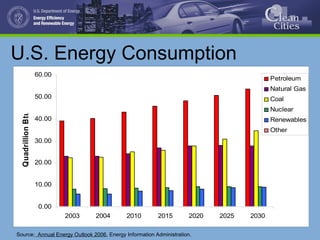
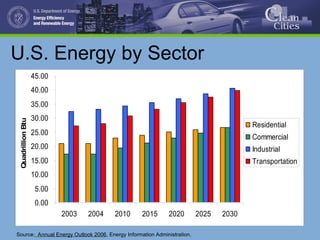
U.S. Energy bySector
0.00
5.00
10.00
15.00
20.00
25.00
30.00
35.00
40.00
45.00
2003 2004 2010 2015 2020 2025 2030
Quadrillion
Btu
Residential
Commercial
Industrial
Transportation
Source: Annual Energy Outlook 2006, Energy Information Administration.
4.
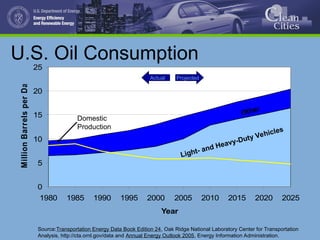
U.S. Oil Consumption
0
5
10
15
20
25
19801985 1990 1995 2000 2005 2010 2015 2020 2025
Year
Million
Barrels
per
Day
Domestic
Production
Projected
Actual
Light- and Heavy-Duty Vehicles
Other
Source:Transportation Energy Data Book Edition 24, Oak Ridge National Laboratory Center for Transportation
Analysis, http://cta.ornl.gov/data and Annual Energy Outlook 2005, Energy Information Administration.
5.
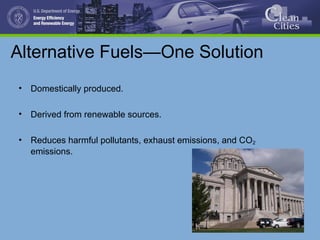
Alternative Fuels—One Solution
•Domestically produced.
• Derived from renewable sources.
• Reduces harmful pollutants, exhaust emissions, and CO2
emissions.
6.
Ethanol Properties
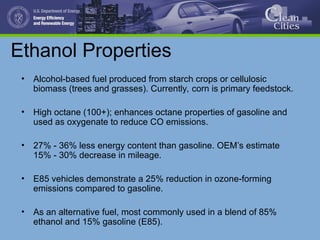
• Alcohol-basedfuel produced from starch crops or cellulosic
biomass (trees and grasses). Currently, corn is primary feedstock.
• High octane (100+); enhances octane properties of gasoline and
used as oxygenate to reduce CO emissions.
• 27% - 36% less energy content than gasoline. OEM’s estimate
15% - 30% decrease in mileage.
• E85 vehicles demonstrate a 25% reduction in ozone-forming
emissions compared to gasoline.
• As an alternative fuel, most commonly used in a blend of 85%
ethanol and 15% gasoline (E85).
7.
Ethanol Uses
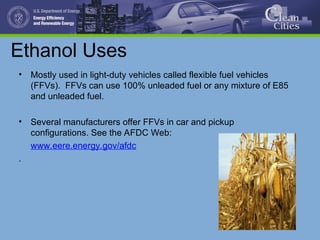
• Mostlyused in light-duty vehicles called flexible fuel vehicles
(FFVs). FFVs can use 100% unleaded fuel or any mixture of E85
and unleaded fuel.
• Several manufacturers offer FFVs in car and pickup
configurations. See the AFDC Web:
www.eere.energy.gov/afdc
.
8.
Ethanol Considerations
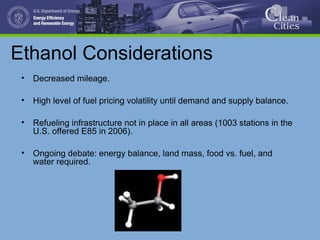
• Decreasedmileage.
• High level of fuel pricing volatility until demand and supply balance.
• Refueling infrastructure not in place in all areas (1003 stations in the
U.S. offered E85 in 2006).
• Ongoing debate: energy balance, land mass, food vs. fuel, and
water required.
9.
Natural Gas Properties
•Recovered from underground reserves.
• Used in two forms: CNG (compressed natural gas) and LNG
(liquefied natural gas).
• CNG and LNG vehicles can demonstrate reduced ozone-forming
emissions compared to gasoline. May have increased
hydrocarbon emissions.
• Contains 59% - 69% less energy content per gallon at 3000 - 3600
psig than gasoline.
• Widespread distribution infrastructure (737 CNG and 32 LNG
refueling stations in operation in 2006).
10.
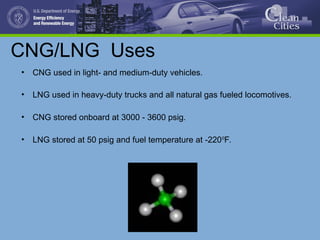
CNG/LNG Uses
• CNGused in light- and medium-duty vehicles.
• LNG used in heavy-duty trucks and all natural gas fueled locomotives.
• CNG stored onboard at 3000 - 3600 psig.
• LNG stored at 50 psig and fuel temperature at -2200
F.
11.
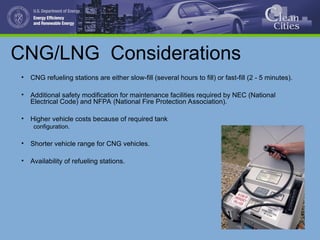
CNG/LNG Considerations
• CNGrefueling stations are either slow-fill (several hours to fill) or fast-fill (2 - 5 minutes).
• Additional safety modification for maintenance facilities required by NEC (National
Electrical Code) and NFPA (National Fire Protection Association).
• Higher vehicle costs because of required tank
configuration.
• Shorter vehicle range for CNG vehicles.
• Availability of refueling stations.
12.
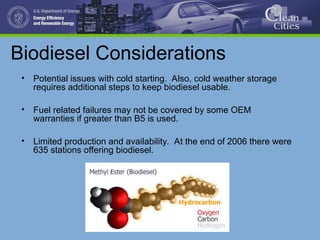
Biodiesel Properties
• Manufacturedfrom vegetable oils, animal fats, or recycled
restaurant greases; reacted with alcohol to produce fatty acid alkyl
ester.
• Nontoxic, biodegradable, and reduces serious air pollutants.
• B20 (20% biodiesel, 80% petroleum diesel) can generally be used
in unmodified diesel engines.
• Can be used in pure form (B100), but may require engine
modifications.
• Has a higher cetane number and provides more lubricity.
• B20 contains 9% less energy content per gallon than #2 diesel.
13.
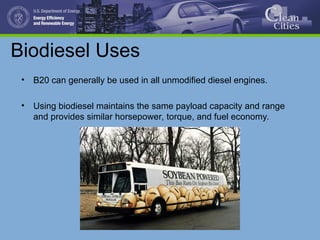
Biodiesel Uses
• B20can generally be used in all unmodified diesel engines.
• Using biodiesel maintains the same payload capacity and range
and provides similar horsepower, torque, and fuel economy.
14.
Biodiesel Considerations
• Potentialissues with cold starting. Also, cold weather storage
requires additional steps to keep biodiesel usable.
• Fuel related failures may not be covered by some OEM
warranties if greater than B5 is used.
• Limited production and availability. At the end of 2006 there were
635 stations offering biodiesel.
15.
Propane (LPG) Properties
•By-product of natural gas processing and crude oil refining.
• HD5, the automotive propane standard, a mixture of 90% propane
and other hydrocarbons.
• Contains 33% - 41% less energy content per gallon than gasoline.
• LPG vehicles can demonstrate a 60% reduction in ozone-forming
emissions compared to gasoline.
• High octane properties (~104) allow LPG vehicles to operate with
higher compression ratios; leads to higher efficiency/fuel
economy.
16.
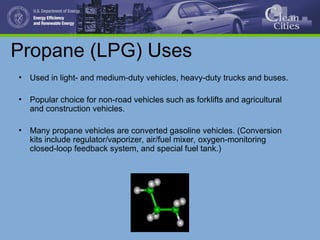
Propane (LPG) Uses
•Used in light- and medium-duty vehicles, heavy-duty trucks and buses.
• Popular choice for non-road vehicles such as forklifts and agricultural
and construction vehicles.
• Many propane vehicles are converted gasoline vehicles. (Conversion
kits include regulator/vaporizer, air/fuel mixer, oxygen-monitoring
closed-loop feedback system, and special fuel tank.)
17.
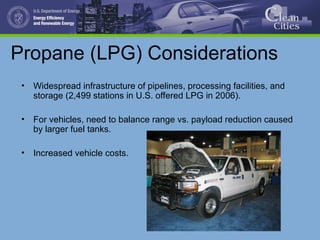
Propane (LPG) Considerations
•Widespread infrastructure of pipelines, processing facilities, and
storage (2,499 stations in U.S. offered LPG in 2006).
• For vehicles, need to balance range vs. payload reduction caused
by larger fuel tanks.
• Increased vehicle costs.
18.
Electricity Properties
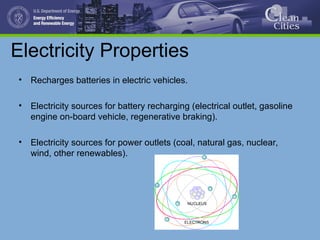
• Rechargesbatteries in electric vehicles.
• Electricity sources for battery recharging (electrical outlet, gasoline
engine on-board vehicle, regenerative braking).
• Electricity sources for power outlets (coal, natural gas, nuclear,
wind, other renewables).
19.
Electricity Uses
• Twocategories include EVs or plug-ins (externally charged) and HEVs or hybrid vehicles (self-
charged). Both use battery storage.
• Available in neighborhood electric vehicles, bicycles, light-duty vehicles, medium- and heavy-
duty trucks and buses.
• Hybrids use an electric motor or a combination of a gasoline engine and electric motor to drive
the wheels. Hybrids use batteries to store electricity produced by regenerative braking and
the onboard generator.
• Range of a dedicated electric is typically 50-130 miles.
20.
Electricity Considerations
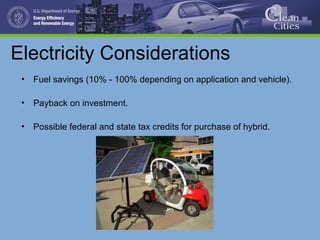
• Fuelsavings (10% - 100% depending on application and vehicle).
• Payback on investment.
• Possible federal and state tax credits for purchase of hybrid.
21.
Hydrogen Properties
• Doesnot occur to any significant extent on earth in its free,
elemental form.
• Found in chemical compositions such as water and hydrocarbons,
and dry coal.
• Pure hydrogen contains no carbon thus burns to form water with no
CO2 or CO emissions.
• One kg of hydrogen contains roughly equivalent energy to one
gallon of gasoline.
• Can be stored as compressed hydrogen at 5,000 – 10,000 psi or
liquid hydrogen (cooled to -4230
F).
22.
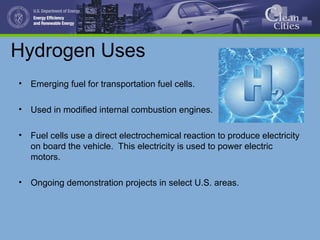
Hydrogen Uses
• Emergingfuel for transportation fuel cells.
• Used in modified internal combustion engines.
• Fuel cells use a direct electrochemical reaction to produce electricity
on board the vehicle. This electricity is used to power electric
motors.
• Ongoing demonstration projects in select U.S. areas.
23.
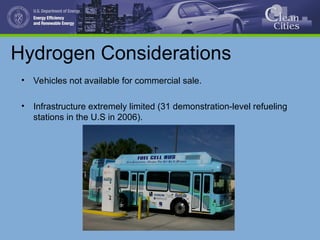
Hydrogen Considerations
• Vehiclesnot available for commercial sale.
• Infrastructure extremely limited (31 demonstration-level refueling
stations in the U.S in 2006).
24.
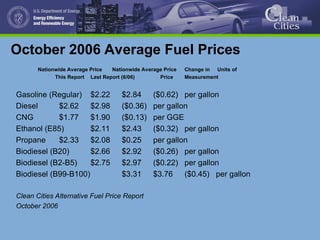
October 2006 AverageFuel Prices
Nationwide Average Price Nationwide Average Price Change in Units of
This Report Last Report (6/06) Price Measurement
Gasoline (Regular) $2.22 $2.84 ($0.62) per gallon
Diesel $2.62 $2.98 ($0.36) per gallon
CNG $1.77 $1.90 ($0.13) per GGE
Ethanol (E85) $2.11 $2.43 ($0.32) per gallon
Propane $2.33 $2.08 $0.25 per gallon
Biodiesel (B20) $2.66 $2.92 ($0.26) per gallon
Biodiesel (B2-B5) $2.75 $2.97 ($0.22) per gallon
Biodiesel (B99-B100) $3.31 $3.76 ($0.45) per gallon
Clean Cities Alternative Fuel Price Report
October 2006