Model Calibration using
                           Altair HyperStudy


Innovation Intelligence®   Fatma Koçer

                           Altair Engineering
                           May, 2012
Copyright © 2012 Altair Engineering, Inc. Proprietary and Confidential. All rights reserved.


HyperStudy is:


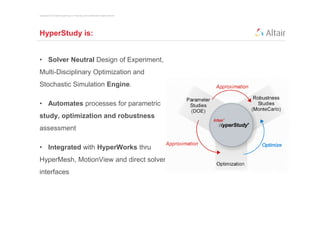
• Solver Neutral Design of Experiment,
Multi-Disciplinary Optimization and
Stochastic Simulation Engine.

• Automates processes for parametric
study, optimization and robustness
assessment

• Integrated with HyperWorks thru
HyperMesh, MotionView and direct solver
interfaces
Copyright © 2012 Altair Engineering, Inc. Proprietary and Confidential. All rights reserved.


HyperStudy: Business Benefits


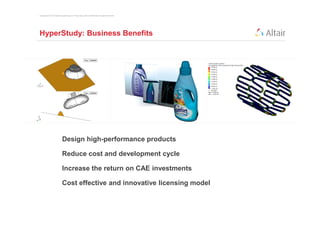
                           Design high-performance products

                           Reduce cost and development cycle

                           Increase the return on CAE investments

                           Cost effective and innovative licensing model
Copyright © 2012 Altair Engineering, Inc. Proprietary and Confidential. All rights reserved.


HyperStudy: User Benefits


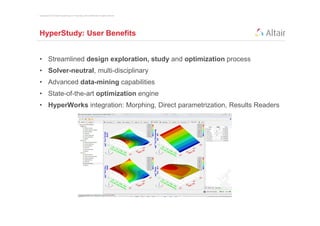
• Streamlined design exploration, study and optimization process
• Solver-neutral, multi-disciplinary
• Advanced data-mining capabilities
• State-of-the-art optimization engine
• HyperWorks integration: Morphing, Direct parametrization, Results Readers
Copyright © 2012 Altair Engineering, Inc. Proprietary and Confidential. All rights reserved.


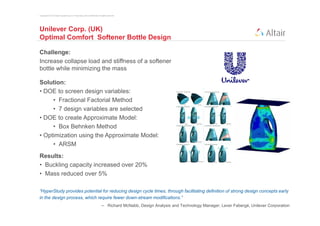
Unilever Corp. (UK)
Optimal Comfort Softener Bottle Design

Challenge:
Increase collapse load and stiffness of a softener
bottle while minimizing the mass

Solution:
• DOE to screen design variables:
     • Fractional Factorial Method
     • 7 design variables are selected
• DOE to create Approximate Model:
     • Box Behnken Method
• Optimization using the Approximate Model:
     • ARSM
Results:
• Buckling capacity increased over 20%
• Mass reduced over 5%

“HyperStudy provides potential for reducing design cycle times, through facilitating definition of strong design concepts early
in the design process, which require fewer down-stream modifications.”
                                                                            – Richard McNabb, Design Analysis and Technology Manager, Lever Fabergé, Unilever Corporation
Copyright © 2012 Altair Engineering, Inc. Proprietary and Confidential. All rights reserved.


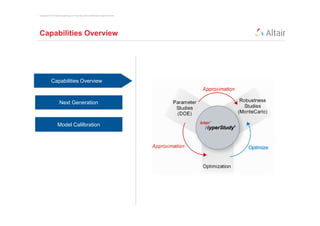
Capabilities Overview


              Capabilities Overview


                        Next Generation


                      User Interface
                     Model Calilbration
Copyright © 2012 Altair Engineering, Inc. Proprietary and Confidential. All rights reserved.


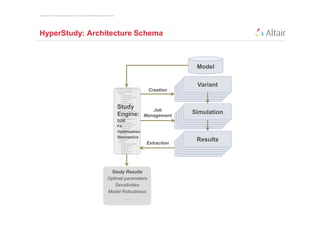
HyperStudy: Architecture Schema


                                                                                                                               Model

                                                                                                                               Variant
                                                                                                                               Variant
                                                                                                               Creation       Variant
                                                                                                                             Variant
                                                                                                                            Variant

                                                                                               Study             Job
                                                                                               Engine:        Management
                                                                                                                              Simulation
                                                                                                                              Simulation
                                                                                                                             Simulation
                                                                                                                            Simulation
                                                                                               DOE                         Simulation
                                                                                               Fit
                                                                                               Optimization
                                                                                               Stochastics
                                                                                                                               Results
                                                                                                                               Results
                                                                                                              Extraction      Results
                                                                                                                             Results
                                                                                                                            Results


                                                                                   Study Results
                                                                                  Optimal parameters
                                                                                      Sensitivities
                                                                                  Model Robustness
                                                                                          …
Copyright © 2012 Altair Engineering, Inc. Proprietary and Confidential. All rights reserved.


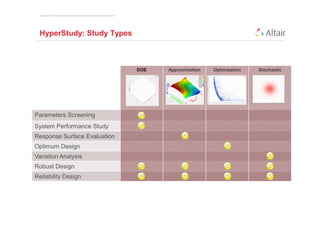
 HyperStudy: Study Types


                                                                                                DOE   Approximation   Optimization   Stochastic


Parameters Screening
System Performance Study
Response Surface Evaluation
Optimum Design
Variation Analysis
Robust Design
Reliability Design
Copyright © 2012 Altair Engineering, Inc. Proprietary and Confidential. All rights reserved.


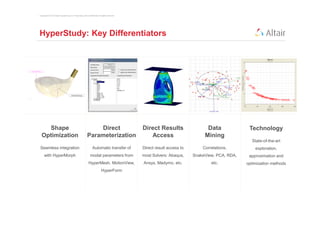
HyperStudy: Key Differentiators


    Shape                                                      Direct                          Direct Results                  Data              Technology
  Optimization                                            Parameterization                        Access                      Mining
                                                                                                                                                  State-of-the-art
Seamless integration                                            Automatic transfer of          Direct result access to       Correlations,          exploration,
     with HyperMorph                                         modal parameters from             most Solvers: Abaqus,     SnakeView, PCA, RDA,    approximation and
                                                            HyperMesh, MotionView,             Ansys, Madymo, etc.               etc.           optimization methods
                                                                           HyperForm
Copyright © 2012 Altair Engineering, Inc. Proprietary and Confidential. All rights reserved.


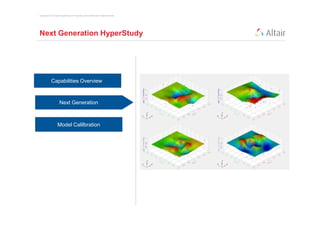
Next Generation HyperStudy


              Capabilities Overview


                        Next Generation


                      User Interface
                     Model Calilbration
Copyright © 2012 Altair Engineering, Inc. Proprietary and Confidential. All rights reserved.


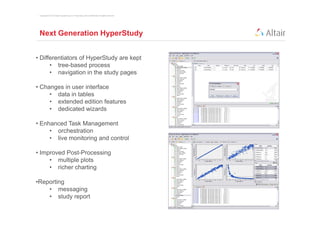
 Next Generation HyperStudy


• Differentiators of HyperStudy are kept
      • tree-based process
      • navigation in the study pages

• Changes in user interface
     • data in tables
     • extended edition features
     • dedicated wizards

• Enhanced Task Management
     • orchestration
     • live monitoring and control

• Improved Post-Processing
     • multiple plots
     • richer charting

•Reporting
    • messaging
    • study report
Copyright © 2012 Altair Engineering, Inc. Proprietary and Confidential. All rights reserved.


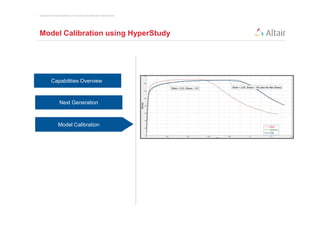
Model Calibration using HyperStudy


              Capabilities Overview


                        Next Generation


                       User Interface
                      Model Calibration
Copyright © 2012 Altair Engineering, Inc. Proprietary and Confidential. All rights reserved.


Background

•         We need to model 6063 T7 Aluminum material in Radioss for the first time.
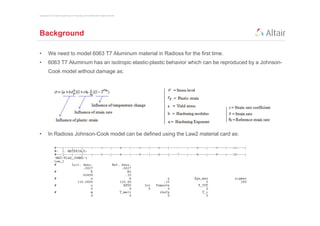
•         6063 T7 Aluminum has an isotropic elastic-plastic behavior which can be reproduced by a Johnson-
          Cook model without damage as:


•         In Radioss Johnson-Cook model can be defined using the Law2 material card as:
Copyright © 2012 Altair Engineering, Inc. Proprietary and Confidential. All rights reserved.


Background

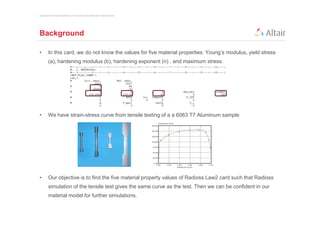
•         In this card, we do not know the values for five material properties: Young’s modulus, yield stress
          (a), hardening modulus (b), hardening exponent (n) , and maximum stress.


•         We have strain-stress curve from tensile testing of a a 6063 T7 Aluminum sample


•         Our objective is to find the five material property values of Radioss Law2 card such that Radioss
          simulation of the tensile test gives the same curve as the test. Then we can be confident in our
          material model for further simulations.
Copyright © 2012 Altair Engineering, Inc. Proprietary and Confidential. All rights reserved.


Background

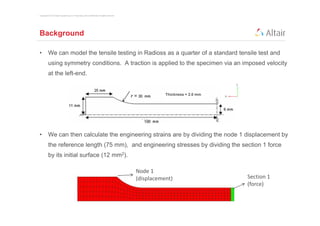
•         We can model the tensile testing in Radioss as a quarter of a standard tensile test and
          using symmetry conditions. A traction is applied to the specimen via an imposed velocity
          at the left-end.


                                                                                                          Thickness = 2.0 mm


•         We can then calculate the engineering strains are by dividing the node 1 displacement by
          the reference length (75 mm), and engineering stresses by dividing the section 1 force
          by its initial surface (12 mm2).

                                                                                               Node 1
                                                                                               (displacement)                  Section 1
                                                                                                                               (force)
Copyright © 2012 Altair Engineering, Inc. Proprietary and Confidential. All rights reserved.


Results from the Initial Radioss Simulation

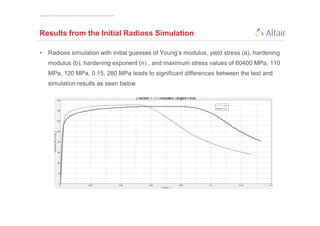
•         Radioss simulation with initial guesses of Young’s modulus, yield stress (a), hardening
          modulus (b), hardening exponent (n) , and maximum stress values of 60400 MPa, 110
          MPa, 120 MPa, 0.15, 280 MPa leads to significant differences between the test and
          simulation results as seen below
Copyright © 2012 Altair Engineering, Inc. Proprietary and Confidential. All rights reserved.


Objective

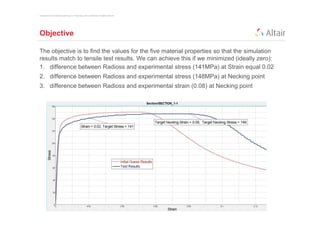
The objective is to find the values for the five material properties so that the simulation
results match to tensile test results. We can achieve this if we minimized (ideally zero):
1. difference between Radioss and experimental stress (141MPa) at Strain equal 0.02
2. difference between Radioss and experimental stress (148MPa) at Necking point
3. difference between Radioss and experimental strain (0.08) at Necking point
Copyright © 2012 Altair Engineering, Inc. Proprietary and Confidential. All rights reserved.


Method

•         We will use optimization to achieve this objective.


•         We will use a special optimization problem formulation called “System Identification”.


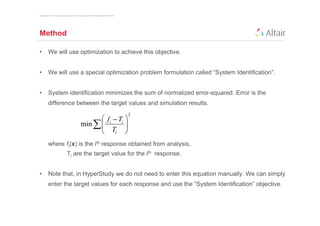
•         System identification minimizes the sum of normalized error-squared. Error is the
          difference between the target values and simulation results.
                                                                                               2
                                                         f i − Ti 
                                                  min ∑ 
                                                         T       
                                                              i   
          where fi(x) is the ith response obtained from analysis,
                                 Ti are the target value for the ith response.


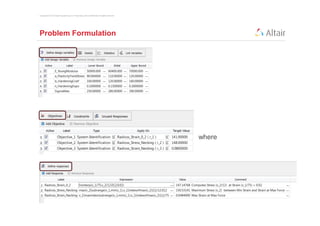
•         Note that, in HyperStudy we do not need to enter this equation manually. We can simply
          enter the target values for each response and use the “System Identification” objective.
Copyright © 2012 Altair Engineering, Inc. Proprietary and Confidential. All rights reserved.


Problem Formulation


                                                                                               where
Copyright © 2012 Altair Engineering, Inc. Proprietary and Confidential. All rights reserved.


                                                                                               Demonstration
Copyright © 2012 Altair Engineering, Inc. Proprietary and Confidential. All rights reserved.


    DOE Results

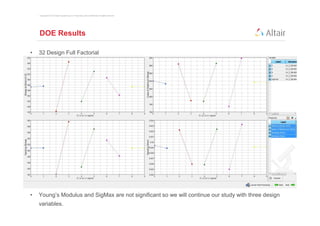
•   32 Design Full Factorial


•   Young’s Modulus and SigMax are not significant so we will continue our study with three design
    variables.
Copyright © 2012 Altair Engineering, Inc. Proprietary and Confidential. All rights reserved.


First Optimization Results

•         Adaptive Response Surface Method (ARSM) is used for this case.
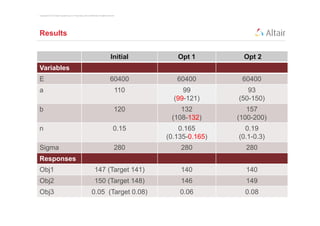
•         In 5 iterations, we minimized the system identification objective function value from
          0.158 to 0.06.
•         In the optimum design, the DV values are: 99, 132, 0.165
•         The response values are: 140, 146, 0.06 (note that the targets were 141, 148 and 0.08;
          initial design values were 147, 150, 0.05)


•         We observe that all three design variables are at their lower or upper bounds.
•         If we can relax those bounds; we may be able to get closer to the target values.
•         We started a new optimization from the best result of the first optimization and with
          relaxed bounds.
Copyright © 2012 Altair Engineering, Inc. Proprietary and Confidential. All rights reserved.


Second Optimization Results

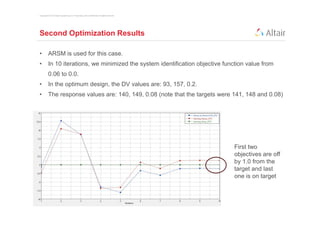
•         ARSM is used for this case.
•         In 10 iterations, we minimized the system identification objective function value from
          0.06 to 0.0.
•         In the optimum design, the DV values are: 93, 157, 0.2.
•         The response values are: 140, 149, 0.08 (note that the targets were 141, 148 and 0.08)


                                                                                               First two
                                                                                               objectives are off
                                                                                               by 1.0 from the
                                                                                               target and last
                                                                                               one is on target
Copyright © 2012 Altair Engineering, Inc. Proprietary and Confidential. All rights reserved.


Results


                                                                                       Initial      Opt 1          Opt 2
Variables
E                                                                                     60400         60400         60400
a                                                                                          110        99            93
                                                                                                   (99-121)      (50-150)
b                                                                                          120       132            157
                                                                                                  (108-132)      (100-200)
n                                                                                         0.15       0.165         0.19
                                                                                                 (0.135-0.165)   (0.1-0.3)
Sigma                                                                                      280       280           280
Responses
Obj1                                                               147 (Target 141)                  140           140
Obj2                                                               150 (Target 148)                  146           149
Obj3                                                           0.05 (Target 0.08)                    0.06          0.08
Copyright © 2012 Altair Engineering, Inc. Proprietary and Confidential. All rights reserved.


Results


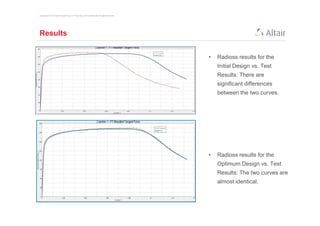
                                                                                               •   Radioss results for the
                                                                                                   Initial Design vs. Test
                                                                                                   Results: There are
                                                                                                   significant differences
                                                                                                   between the two curves.


                                                                                               •   Radioss results for the
                                                                                                   Optimum Design vs. Test
                                                                                                   Results: The two curves are
                                                                                                   almost identical.
Copyright © 2012 Altair Engineering, Inc. Proprietary and Confidential. All rights reserved.


Conclusions


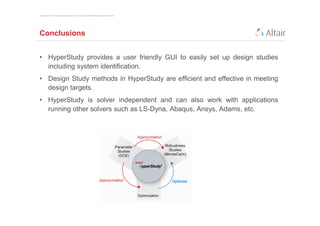
• HyperStudy provides a user friendly GUI to easily set up design studies
  including system identification.
• Design Study methods in HyperStudy are efficient and effective in meeting
  design targets.
• HyperStudy is solver independent and can also work with applications
  running other solvers such as LS-Dyna, Abaqus, Ansys, Adams, etc.
Copyright © 2012 Altair Engineering, Inc. Proprietary and Confidential. All rights reserved.


Altair HyperStudy


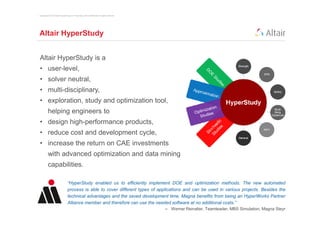
Altair HyperStudy is a
• user-level,
• solver neutral,
• multi-disciplinary,
• exploration, study and optimization tool,
          helping engineers to
• design high-performance products,
• reduce cost and development cycle,
• increase the return on CAE investments
          with advanced optimization and data mining
          capabilities.

                                  “HyperStudy enabled us to efficiently implement DOE and optimization methods. The new automated
                                  process is able to cover different types of applications and can be used in various projects. Besides the
                                  technical advantages and the saved development time, Magna benefits from being an HyperWorks Partner
                                  Alliance member and therefore can use the needed software at no additional costs.”
                                                                                  – Werner Reinalter, Teamleader, MBS Simulation, Magna Steyr

Altair HTC 2012 Hyper Study Training

  • 1.
    Model Calibration using Altair HyperStudy Innovation Intelligence® Fatma Koçer Altair Engineering May, 2012
  • 2.
    Copyright © 2012Altair Engineering, Inc. Proprietary and Confidential. All rights reserved. HyperStudy is: • Solver Neutral Design of Experiment, Multi-Disciplinary Optimization and Stochastic Simulation Engine. • Automates processes for parametric study, optimization and robustness assessment • Integrated with HyperWorks thru HyperMesh, MotionView and direct solver interfaces
  • 3.
    Copyright © 2012Altair Engineering, Inc. Proprietary and Confidential. All rights reserved. HyperStudy: Business Benefits Design high-performance products Reduce cost and development cycle Increase the return on CAE investments Cost effective and innovative licensing model
  • 4.
    Copyright © 2012Altair Engineering, Inc. Proprietary and Confidential. All rights reserved. HyperStudy: User Benefits • Streamlined design exploration, study and optimization process • Solver-neutral, multi-disciplinary • Advanced data-mining capabilities • State-of-the-art optimization engine • HyperWorks integration: Morphing, Direct parametrization, Results Readers
  • 5.
    Copyright © 2012Altair Engineering, Inc. Proprietary and Confidential. All rights reserved. Unilever Corp. (UK) Optimal Comfort Softener Bottle Design Challenge: Increase collapse load and stiffness of a softener bottle while minimizing the mass Solution: • DOE to screen design variables: • Fractional Factorial Method • 7 design variables are selected • DOE to create Approximate Model: • Box Behnken Method • Optimization using the Approximate Model: • ARSM Results: • Buckling capacity increased over 20% • Mass reduced over 5% “HyperStudy provides potential for reducing design cycle times, through facilitating definition of strong design concepts early in the design process, which require fewer down-stream modifications.” – Richard McNabb, Design Analysis and Technology Manager, Lever Fabergé, Unilever Corporation
  • 6.
    Copyright © 2012Altair Engineering, Inc. Proprietary and Confidential. All rights reserved. Capabilities Overview Capabilities Overview Next Generation User Interface Model Calilbration
  • 7.
    Copyright © 2012Altair Engineering, Inc. Proprietary and Confidential. All rights reserved. HyperStudy: Architecture Schema Model Variant Variant Creation Variant Variant Variant Study Job Engine: Management Simulation Simulation Simulation Simulation DOE Simulation Fit Optimization Stochastics Results Results Extraction Results Results Results Study Results Optimal parameters Sensitivities Model Robustness …
  • 8.
    Copyright © 2012Altair Engineering, Inc. Proprietary and Confidential. All rights reserved. HyperStudy: Study Types DOE Approximation Optimization Stochastic Parameters Screening System Performance Study Response Surface Evaluation Optimum Design Variation Analysis Robust Design Reliability Design
  • 9.
    Copyright © 2012Altair Engineering, Inc. Proprietary and Confidential. All rights reserved. HyperStudy: Key Differentiators Shape Direct Direct Results Data Technology Optimization Parameterization Access Mining State-of-the-art Seamless integration Automatic transfer of Direct result access to Correlations, exploration, with HyperMorph modal parameters from most Solvers: Abaqus, SnakeView, PCA, RDA, approximation and HyperMesh, MotionView, Ansys, Madymo, etc. etc. optimization methods HyperForm
  • 10.
    Copyright © 2012Altair Engineering, Inc. Proprietary and Confidential. All rights reserved. Next Generation HyperStudy Capabilities Overview Next Generation User Interface Model Calilbration
  • 11.
    Copyright © 2012Altair Engineering, Inc. Proprietary and Confidential. All rights reserved. Next Generation HyperStudy • Differentiators of HyperStudy are kept • tree-based process • navigation in the study pages • Changes in user interface • data in tables • extended edition features • dedicated wizards • Enhanced Task Management • orchestration • live monitoring and control • Improved Post-Processing • multiple plots • richer charting •Reporting • messaging • study report
  • 12.
    Copyright © 2012Altair Engineering, Inc. Proprietary and Confidential. All rights reserved. Model Calibration using HyperStudy Capabilities Overview Next Generation User Interface Model Calibration
  • 13.
    Copyright © 2012Altair Engineering, Inc. Proprietary and Confidential. All rights reserved. Background • We need to model 6063 T7 Aluminum material in Radioss for the first time. • 6063 T7 Aluminum has an isotropic elastic-plastic behavior which can be reproduced by a Johnson- Cook model without damage as: • In Radioss Johnson-Cook model can be defined using the Law2 material card as:
  • 14.
    Copyright © 2012Altair Engineering, Inc. Proprietary and Confidential. All rights reserved. Background • In this card, we do not know the values for five material properties: Young’s modulus, yield stress (a), hardening modulus (b), hardening exponent (n) , and maximum stress. • We have strain-stress curve from tensile testing of a a 6063 T7 Aluminum sample • Our objective is to find the five material property values of Radioss Law2 card such that Radioss simulation of the tensile test gives the same curve as the test. Then we can be confident in our material model for further simulations.
  • 15.
    Copyright © 2012Altair Engineering, Inc. Proprietary and Confidential. All rights reserved. Background • We can model the tensile testing in Radioss as a quarter of a standard tensile test and using symmetry conditions. A traction is applied to the specimen via an imposed velocity at the left-end. Thickness = 2.0 mm • We can then calculate the engineering strains are by dividing the node 1 displacement by the reference length (75 mm), and engineering stresses by dividing the section 1 force by its initial surface (12 mm2). Node 1 (displacement) Section 1 (force)
  • 16.
    Copyright © 2012Altair Engineering, Inc. Proprietary and Confidential. All rights reserved. Results from the Initial Radioss Simulation • Radioss simulation with initial guesses of Young’s modulus, yield stress (a), hardening modulus (b), hardening exponent (n) , and maximum stress values of 60400 MPa, 110 MPa, 120 MPa, 0.15, 280 MPa leads to significant differences between the test and simulation results as seen below
  • 17.
    Copyright © 2012Altair Engineering, Inc. Proprietary and Confidential. All rights reserved. Objective The objective is to find the values for the five material properties so that the simulation results match to tensile test results. We can achieve this if we minimized (ideally zero): 1. difference between Radioss and experimental stress (141MPa) at Strain equal 0.02 2. difference between Radioss and experimental stress (148MPa) at Necking point 3. difference between Radioss and experimental strain (0.08) at Necking point
  • 18.
    Copyright © 2012Altair Engineering, Inc. Proprietary and Confidential. All rights reserved. Method • We will use optimization to achieve this objective. • We will use a special optimization problem formulation called “System Identification”. • System identification minimizes the sum of normalized error-squared. Error is the difference between the target values and simulation results. 2  f i − Ti  min ∑   T    i  where fi(x) is the ith response obtained from analysis, Ti are the target value for the ith response. • Note that, in HyperStudy we do not need to enter this equation manually. We can simply enter the target values for each response and use the “System Identification” objective.
  • 19.
    Copyright © 2012Altair Engineering, Inc. Proprietary and Confidential. All rights reserved. Problem Formulation where
  • 20.
    Copyright © 2012Altair Engineering, Inc. Proprietary and Confidential. All rights reserved. Demonstration
  • 21.
    Copyright © 2012Altair Engineering, Inc. Proprietary and Confidential. All rights reserved. DOE Results • 32 Design Full Factorial • Young’s Modulus and SigMax are not significant so we will continue our study with three design variables.
  • 22.
    Copyright © 2012Altair Engineering, Inc. Proprietary and Confidential. All rights reserved. First Optimization Results • Adaptive Response Surface Method (ARSM) is used for this case. • In 5 iterations, we minimized the system identification objective function value from 0.158 to 0.06. • In the optimum design, the DV values are: 99, 132, 0.165 • The response values are: 140, 146, 0.06 (note that the targets were 141, 148 and 0.08; initial design values were 147, 150, 0.05) • We observe that all three design variables are at their lower or upper bounds. • If we can relax those bounds; we may be able to get closer to the target values. • We started a new optimization from the best result of the first optimization and with relaxed bounds.
  • 23.
    Copyright © 2012Altair Engineering, Inc. Proprietary and Confidential. All rights reserved. Second Optimization Results • ARSM is used for this case. • In 10 iterations, we minimized the system identification objective function value from 0.06 to 0.0. • In the optimum design, the DV values are: 93, 157, 0.2. • The response values are: 140, 149, 0.08 (note that the targets were 141, 148 and 0.08) First two objectives are off by 1.0 from the target and last one is on target
  • 24.
    Copyright © 2012Altair Engineering, Inc. Proprietary and Confidential. All rights reserved. Results Initial Opt 1 Opt 2 Variables E 60400 60400 60400 a 110 99 93 (99-121) (50-150) b 120 132 157 (108-132) (100-200) n 0.15 0.165 0.19 (0.135-0.165) (0.1-0.3) Sigma 280 280 280 Responses Obj1 147 (Target 141) 140 140 Obj2 150 (Target 148) 146 149 Obj3 0.05 (Target 0.08) 0.06 0.08
  • 25.
    Copyright © 2012Altair Engineering, Inc. Proprietary and Confidential. All rights reserved. Results • Radioss results for the Initial Design vs. Test Results: There are significant differences between the two curves. • Radioss results for the Optimum Design vs. Test Results: The two curves are almost identical.
  • 26.
    Copyright © 2012Altair Engineering, Inc. Proprietary and Confidential. All rights reserved. Conclusions • HyperStudy provides a user friendly GUI to easily set up design studies including system identification. • Design Study methods in HyperStudy are efficient and effective in meeting design targets. • HyperStudy is solver independent and can also work with applications running other solvers such as LS-Dyna, Abaqus, Ansys, Adams, etc.
  • 27.
    Copyright © 2012Altair Engineering, Inc. Proprietary and Confidential. All rights reserved. Altair HyperStudy Altair HyperStudy is a • user-level, • solver neutral, • multi-disciplinary, • exploration, study and optimization tool, helping engineers to • design high-performance products, • reduce cost and development cycle, • increase the return on CAE investments with advanced optimization and data mining capabilities. “HyperStudy enabled us to efficiently implement DOE and optimization methods. The new automated process is able to cover different types of applications and can be used in various projects. Besides the technical advantages and the saved development time, Magna benefits from being an HyperWorks Partner Alliance member and therefore can use the needed software at no additional costs.” – Werner Reinalter, Teamleader, MBS Simulation, Magna Steyr