NEXT GENERATION OF
MATHEMATICAL PROGRAMMING
MODELING AND SOLVING TOOLS
NEW YORK INFORMS METRO CHAPTER
UPDATED FEBRUARY 12 2013


                 Alkis Vazacopoulos
                 Industrial Algorithms
                 February 2013
Agenda
   Optimization Problems (OP)
   How do we solve OP?
   Can we Graph and Solve?
   Case Studies
Our Mission Statement
   To provide advanced modeling and solving tools for
    developing industrial applications in the decision-
    making and data-mining areas.
   Our targets are:
     Operating   companies in the process industries.
     Application software providers.

     Consulting service providers.
Our Industrial Modeling Frameworks

   Process industry business problems can be complex
    hence an Industrial Modeling Framework provides a
    pre-project or pre-problem advantage.
   An IMF embeds Intellectual Property related to the
    process’s flowsheet modeling as well as its problem-
    solving methodology.
Our Business Model
   What do we license: IMPRESS, IMF, Solvers.
   What is our pricing scheme: License Fee, Support &
    Maintenance Fee.
   What are our license terms: Based on Customer’s
    Needs i.e., Rental for a specified period (months to
    years) or Perpetual.
IA Services

   Application Support
     Free  prototyping to get you started (for a
      reasonable number of consulting hours).
     Full modeling and solving support.

   Consulting Services


                                            6
Academic Collaboration & Partnership

   Carnegie Mellon University
   University of Wisconsin
   Cornell
   Stevens Institute Of Tech
   Fairleigh Dickinson University
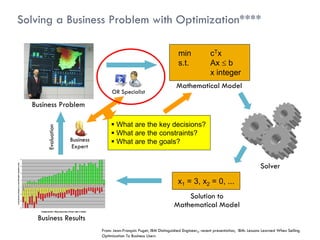
Solving a Business Problem with Optimization****

                                                                                                                                                                                                                                                                                                                                                                        min               cTx
                                                                                                                                                                                                                                                                                                                                                                        s.t.              Ax  b
                                                                                                                                                                                                                                                                                                                                                                                          x integer
                                                                                                                                                                                                                                                                                                                                                                       Mathematical Model
                                                                                                                                                                                                                                                                                                                                          OR Specialist

                                                                                            Business Problem

                                                                                                                                                                                                                                                                                                                                           What are the key decisions?
                                                                                                                                                   Evaluation


                                                                                                                                                                                                                                                                                                                                           What are the constraints?
                                                                                                                                                                                                                          Business                                                                                                         What are the goals?
                                                                                                                                                                                                                          Expert
                                                                                                                         Supply Chain Optimisation Programme
                                                                                                                              RASA Benefit Realisation Weekly Summary

                                                    35


                                                                                                                                                                                                                                                                                                                                                                                                                      Solver
Contribution Relative to Apr08 QS61 Baseline (£k)


                                                    25


                                                    15


                                                     5

                                                                                                                                                                                                                                                                                                                                                                        x1 = 3, x2 = 0, ...
                                                                             Mar*


                                                                                           w 19

                                                                                                  w 20

                                                                                                         w 21

                                                                                                                w 22

                                                                                                                       w 23

                                                                                                                              w 24

                                                                                                                                     w 25

                                                                                                                                            w 26

                                                                                                                                                    w 27

                                                                                                                                                           w 28

                                                                                                                                                                  w 29

                                                                                                                                                                         w 30

                                                                                                                                                                                w 31

                                                                                                                                                                                       w 32

                                                                                                                                                                                              w 33

                                                                                                                                                                                                     w 34

                                                                                                                                                                                                            w 35

                                                                                                                                                                                                                   w 36

                                                                                                                                                                                                                          w 37

                                                                                                                                                                                                                                 w 38

                                                                                                                                                                                                                                        w 39

                                                                                                                                                                                                                                               w 40

                                                                                                                                                                                                                                                      w 41

                                                                                                                                                                                                                                                             w 42

                                                                                                                                                                                                                                                                    w 43

                                                                                                                                                                                                                                                                           w 44

                                                                                                                                                                                                                                                                                  w 45

                                                                                                                                                                                                                                                                                         w 46

                                                                                                                                                                                                                                                                                                w 47

                                                                                                                                                                                                                                                                                                       w 48

                                                                                                                                                                                                                                                                                                              w 49

                                                                                                                                                                                                                                                                                                                     w 50

                                                                                                                                                                                                                                                                                                                            w 51

                                                                                                                                                                                                                                                                                                                                   w 52
                                                                      Feb*
                                                          2008 Jan*


                                                                                    Apr*


                                                     -5


                                                    -15


                                                    -25
                                                                                                                                                                                                                                                                                                                                                                          Solution to
                                                    -35
                                                                                                                                                                                                                                                                                                                                                                      Mathematical Model
                                                                                                                              Realised Benefit                           Missed Opportunity                           Actual ≠ QS61 or Optimal


                                                                                                                Business Results
                                                                                                                                                                                                                                                                                                                              From: Jean-François Puget, IBM Distinguished Engineer,, recent presentation, IBM: Lessons Learned When Selling
                                                                                                                                                                                                                                                                                                                              Optimization To Business Users
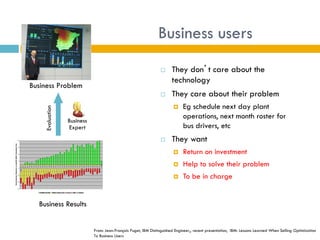
Business users
                                                                                                                                                                                                                                                                                                                                                        They don’t care about the
                                                                                                                                                                                                                                                                                                                                                         technology
                                                                                            Business Problem
                                                                                                                                                                                                                                                                                                                                                        They care about their problem
                                                                                                                                                                                                                                                                                                                                                              Eg schedule next day plant
                                                                                                                                                   Evaluation


                                                                                                                                                                                                                                                                                                                                                               operations, next month roster for
                                                                                                                                                                                                                          Business
                                                                                                                                                                                                                          Expert                                                                                                                               bus drivers, etc
                                                                                                                         Supply Chain Optimisation Programme
                                                                                                                              RASA Benefit Realisation Weekly Summary

                                                    35                                                                                                                                                                                                                                                                                                  They want
Contribution Relative to Apr08 QS61 Baseline (£k)


                                                    25


                                                    15
                                                                                                                                                                                                                                                                                                                                                              Return on investment
                                                                                                                                                                                                                                                                                                                                                               Help to solve their problem
                                                     5


                                                                                                                                                                                                                                                                                                                                                          
                                                                             Mar*


                                                                                           w 19

                                                                                                  w 20

                                                                                                         w 21

                                                                                                                w 22

                                                                                                                       w 23

                                                                                                                              w 24

                                                                                                                                     w 25

                                                                                                                                            w 26

                                                                                                                                                    w 27

                                                                                                                                                           w 28

                                                                                                                                                                  w 29

                                                                                                                                                                         w 30

                                                                                                                                                                                w 31

                                                                                                                                                                                       w 32

                                                                                                                                                                                              w 33

                                                                                                                                                                                                     w 34

                                                                                                                                                                                                            w 35

                                                                                                                                                                                                                   w 36

                                                                                                                                                                                                                          w 37

                                                                                                                                                                                                                                 w 38

                                                                                                                                                                                                                                        w 39

                                                                                                                                                                                                                                               w 40

                                                                                                                                                                                                                                                      w 41

                                                                                                                                                                                                                                                             w 42

                                                                                                                                                                                                                                                                    w 43

                                                                                                                                                                                                                                                                           w 44

                                                                                                                                                                                                                                                                                  w 45

                                                                                                                                                                                                                                                                                         w 46

                                                                                                                                                                                                                                                                                                w 47

                                                                                                                                                                                                                                                                                                       w 48

                                                                                                                                                                                                                                                                                                              w 49

                                                                                                                                                                                                                                                                                                                     w 50

                                                                                                                                                                                                                                                                                                                            w 51

                                                                                                                                                                                                                                                                                                                                   w 52
                                                                      Feb*
                                                          2008 Jan*


                                                                                    Apr*


                                                     -5


                                                    -15


                                                    -25
                                                                                                                                                                                                                                                                                                                                                              To be in charge
                                                    -35

                                                                                                                              Realised Benefit                           Missed Opportunity                           Actual ≠ QS61 or Optimal


                                                                                                                              Business Results


                                                                                                                                                                                                                                                                                                              From: Jean-François Puget, IBM Distinguished Engineer,, recent presentation, IBM: Lessons Learned When Selling Optimization
                                                                                                                                                                                                                                                                                                              To Business Users
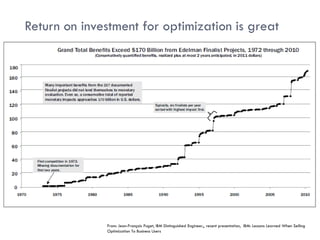
Return on investment for optimization is great


              From: Jean-François Puget, IBM Distinguished Engineer,, recent presentation, IBM: Lessons Learned When Selling
              Optimization To Business Users
What are common solving optimization
technologies?
   Linear Programming
   Mixed Integer Programming
   Nonlinear Programming
   Constrained Programming
   Meta-Heuristics
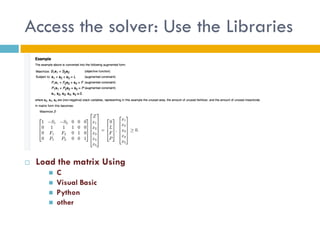
Access the solver: Use the Libraries


   Load the matrix Using
          C
          Visual Basic
          Python
          other
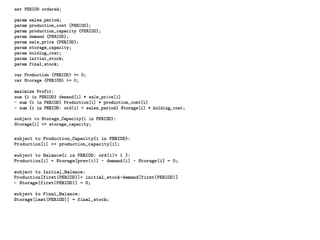
Access the solver: Use a modeling language

   Mathematical Programming language (basically
    they do the same thing):
     GAMS,

     AMPL

     AIMMS

     MOSEL

     MPL

     OPL

     LINDO
Question #1


   Can we automate the model formulation?
Our Goal: Automate the process of
matrix generation
   Literature
     EMOSL  (Dash Optimization)
     CONCERT (ILOG)

     Semantic/Structured Modeling (Professor A. Geoffrion)

     OPTEX – DecisionWare

     UOPSS (Jeff Kelly)
Our Modeling Environment: IMPRESS
17


        IMPRESS: Industrial Modeling & Presolving System is
         our proprietary modeling platform.
        You can model, solve, interface and interact with
         any supply-chain, production-chain, demand-chain
         and/or value-chain optimization problem.
        IMPRESS so far has been applied in:
          Production Planning
          Plant Scheduling
          Pipeline & Marine Shipping
          Energy Management

                          Copyright, Industrial Algorithms LLC   2/17/2013
Why are we unique?
18


        IMPRESS is flowsheet-based (i.e., a figurative
         language).
          This means that the modeling is inherently network or
           superstructure “aware” with equipment-to-equipment,
           resource-to-resource, activity-to-activity, etc. as explicit
           language constructs or objects.
          It also means that all of the effort of generating the sparse
           A matrix in the LP, MILP and NLP is done automatically by
           automatically creating all of the sets, parameters,
           variables and constraints when the model is configured
           using our proprietary and comprehensive library of sub-
           models.

                             Copyright, Industrial Algorithms LLC   2/17/2013
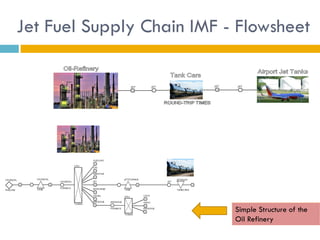
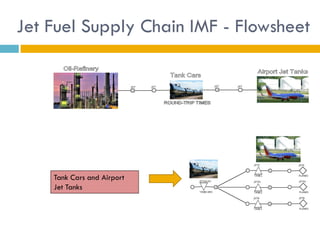
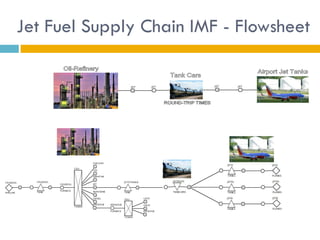
Jet Fuel Supply Chain IMF - Example
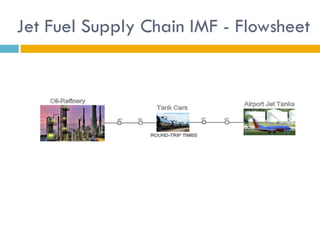
   One oil-refinery producing different grades of jet
    fuel and one airport terminal storing Jet-A, Jet-A1
    and Jet-B with a railroad in between.
   Logistics details such as the input-output or yield
    modeling of the refinery and the round-trip times of
    the tank-cars (similar to batch-processes with cycle-
    time) are modeled & solved as a MILP.
Jet Fuel Supply Chain IMF - Flowsheet


                           Simple Structure of the
                           Oil Refinery
Jet Fuel Supply Chain IMF - Flowsheet


    Tank Cars and Airport
    Jet Tanks
Jet Fuel Supply Chain IMF - Flowsheet
Question #2


   What type of Units can I represent in the flowsheet?
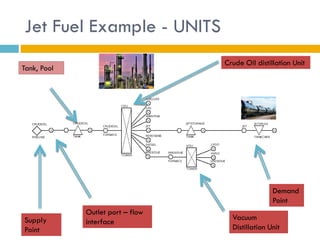
Jet Fuel Example - UNITS
                                  Crude Oil distillation Unit
Tank, Pool


                                                  Demand
                                                  Point
             Outlet port – flow
Supply                              Vacuum
             interface
Point                               Distillation Unit
Question #3

   How can you add a Unit in IMPRESS?

   What about a general purpose modeling
    language?
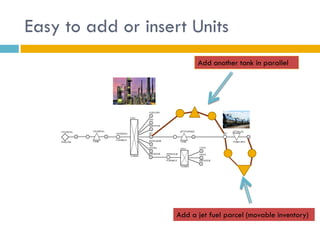
Easy to add or insert Units
                          Add another tank in parallel


                    Add a jet fuel parcel (movable inventory)
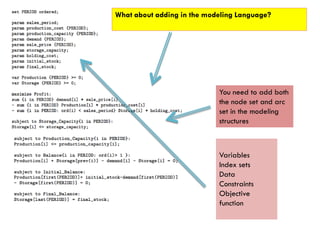
What about adding in the modeling Language?


                            You need to add both
                            the node set and arc
                            set in the modeling
                            structures


                            Variables
                            Index sets
                            Data
                            Constraints
                            Objective
                            function
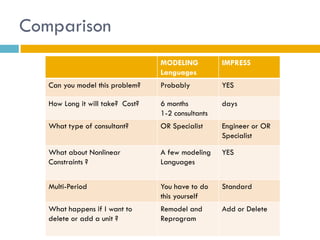
Comparison
                                  MODELING          IMPRESS
                                  Languages
   Can you model this problem?    Probably          YES

   How Long it will take? Cost?   6 months          days
                                  1-2 consultants
   What type of consultant?       OR Specialist     Engineer or OR
                                                    Specialist

   What about Nonlinear           A few modeling    YES
   Constraints ?                  Languages


   Multi-Period                   You have to do    Standard
                                  this yourself
   What happens if I want to      Remodel and       Add or Delete
   delete or add a unit ?         Reprogram
Question #4


   How do you draw a chart?
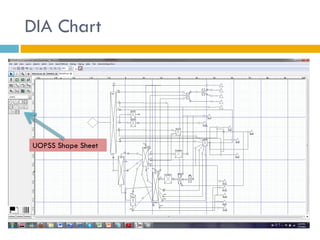
How do we draw the chart
   Use DIA Python, Open Source [Microsoft Visio]
   IML, Data File
   IPL, API
DIA Chart


UOPSS Shape Sheet
Question #5: Why this technology
now?
   No recent innovation in Modeling Languages
   Mixed Integer Programming Codes are Very Fast
    (Gurobi, CPLEX, Xpress)
   Engineering Disciplines use optimization, but they are
    not OR Specialists (they have little modeling
    expertise and MP expertise)
Question #5: Why this technology
now?
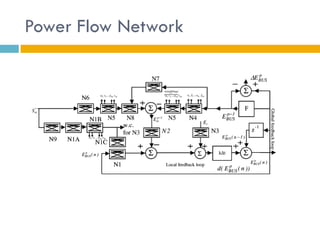
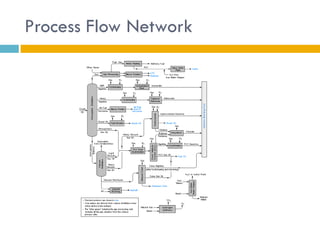
   Most of the difficult Planning and Scheduling
    problems have Special Structures (Electrical Eng.
    and Chemical Eng. : Power flow network, Process
    flowsheet, OR specialist have limited experience in
    modeling them).

   Engineers know about the modeling structure but
    have limited MP algorithmic experience .
Power Flow Network
Process Flow Network
Planning and Planning +Model
    Planuling =  Scheduling Scheduling

   Logistics (Quantity*Logic (proy’d-quality), MILP):
       “discrete-time” where each time-period has the same duration.
       Time-periods may be “small-buckets” (un-ary) or “big-buckets” (N-ary):
           If un-ary then only one activity per time-period (scheduling) but if N-ary then
            multiple activities per time-period where a “time-portion” variable for each
            operation is applied (planning).

   Quality (Quantity*quality (fixed-logic), NLP):
       “distributed-time” where each time-period may have a different
        duration (global/common time-grid).
       Same as logistics.

   All input data is entered in “continuous-time” (begin, end-times)
    and digitized i.e., discretized or distributed accordingly.
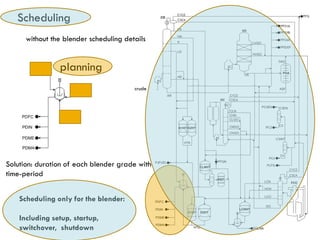
Scheduling
      without the blender scheduling details


                planning
                                        crude


Solution: duration of each blender grade with
time-period


    Scheduling only for the blender:

    Including setup, startup,
    switchover, shutdown
Prod A      Prod A

                                                                     Prod B     Prod B

                                                                    Prod C      Prod C

                                                                    Prod D      Prod D
Crude A
                                                                     Prod E     Prod E
Crude B
                                                                    Prod F      Prod F
Crude C                                                              Prod        Prod
                                                                      G           G
Crude D                                                             Prod H      Prod H


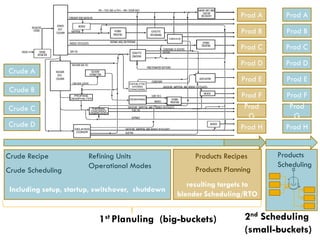
Crude Recipe            Refining Units                 Products Recipes       Products
                        Operational Modes                                     Scheduling
Crude Scheduling                                       Products Planning
                                                     resulting targets to
 Including setup, startup, switchover, shutdown
                                                  blender Scheduling/RTO


                           1st Planuling (big-buckets)                2nd Scheduling
                                                                      (small-buckets)
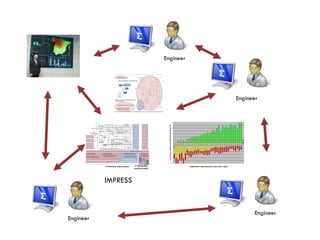
Engineer
                 IMPRESS
                                                            Contribution Relative to Apr08 QS61 Baseline (£k)
                                                      -35
                                                               -25
                                                                       -15
                                                                                 -5
                                                                                         5
                                                                                               15
                                                                                                       25
                                                                                                                35


                                                                             2008 Jan*

                                                                                 Feb*

                                                                                 Mar*

                                                                                 Apr*

                                                                                 w 19

                                                                                 w 20
                                                                                                                                                                                                                Engineer


                                                                                 w 21

                                                                                 w 22

                                                                                 w 23

                                                                                 w 24

                                                                                 w 25

                                                                                 w 26

                                                                                 w 27

                                                                                 w 28
                           Realised Benefit


                                                                                 w 29

                                                                                 w 30

                                                                                 w 31

                                                                                 w 32

                                                                                 w 33

                                                                                 w 34
                           Missed Opportunity


                                                                                 w 35

                                                                                 w 36

                                                                                 w 37

                                                                                 w 38

                                                                                 w 39

                                                                                 w 40
                                                                                                                     RASA Benefit Realisation Weekly Summary


                                                                                 w 41
                                                                                                                                                               Supply Chain Optimisation Programme


                                                                                 w 42

                                                                                 w 43
                           Actual ≠ QS61 or Optimal


                                                                                 w 44

                                                                                 w 45

                                                                                 w 46

                                                                                 w 47

                                                                                 w 48

                                                                                 w 49

                                                                                 w 50

                                                                                 w 51

                                                                                 w 52
                                                                                                                                                                                                     Engineer


      Engineer
A Planning and Scheduling Example:
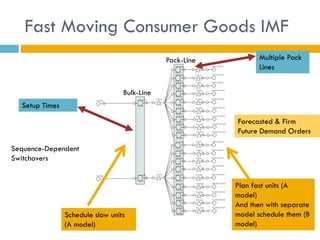
Fast Moving Consumer Goods IMF
   Two materials produced in bulk-unit produces
    eighteen different packaged materials in pack-unit.
   Sequence-dependent switchovers with
    setup/setdown times & “repetitive” maintenance
    cleanouts on bulk-unit with material families.
   Due to the slow & fast nature of the bulk & pack-
    units we perform “novel” hybrid planning &
    scheduling i.e., bulk-unit is scheduled & pack-unit is
    planned to reduce solve time (“planuling”).
Fast Moving Consumer Goods IMF
                                              Pack-Line          Multiple Pack
                                                                 Lines


                                  Bulk-Line
  Setup Times

                                                          Forecasted & Firm
                                                          Future Demand Orders

Sequence-Dependent
Switchovers


                                                          Plan fast units (A
                                                          model)
                                                          And then with separate
                Schedule slow units                       model schedule them (B
                (A model)                                 model)
Fast Moving Consumer Goods IMF
43


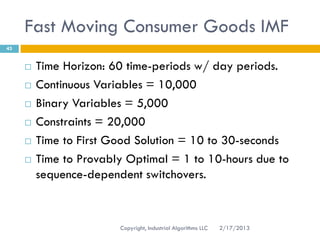
        Time Horizon: 60 time-periods w/ day periods.
        Continuous Variables = 10,000
        Binary Variables = 5,000
        Constraints = 20,000
        Time to First Good Solution = 10 to 30-seconds
        Time to Provably Optimal = 1 to 10-hours due to
         sequence-dependent switchovers.


                        Copyright, Industrial Algorithms LLC   2/17/2013
Cogeneration (Steam/Power) IMF
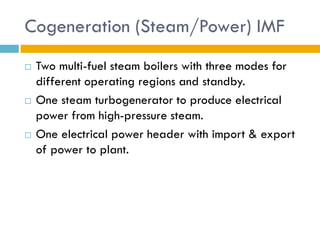
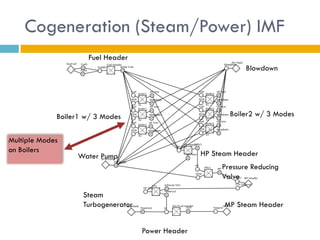
   Two multi-fuel steam boilers with three modes for
    different operating regions and standby.
   One steam turbogenerator to produce electrical
    power from high-pressure steam.
   One electrical power header with import & export
    of power to plant.
Cogeneration (Steam/Power) IMF
                     Fuel Header
                                                                Blowdown


             Boiler1 w/ 3 Modes                            Boiler2 w/ 3 Modes


Multiple Modes
on Boilers                                          HP Steam Header
                  Water Pump
                                                         Pressure Reducing
                                                         Valve

                    Steam
                    Turbogenerator                        MP Steam Header


                                     Power Header
Cogeneration (Steam/Power) IMF
46


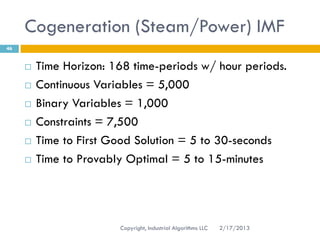
        Time Horizon: 168 time-periods w/ hour periods.
        Continuous Variables = 5,000
        Binary Variables = 1,000
        Constraints = 7,500
        Time to First Good Solution = 5 to 30-seconds
        Time to Provably Optimal = 5 to 15-minutes


                        Copyright, Industrial Algorithms LLC   2/17/2013
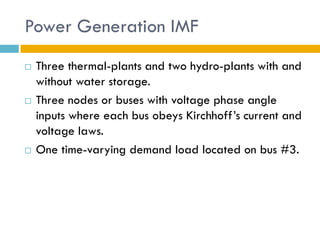
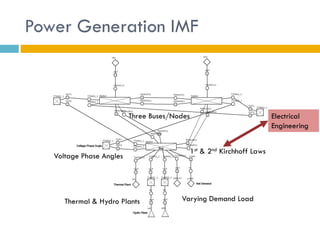
Power Generation IMF
   Three thermal-plants and two hydro-plants with and
    without water storage.
   Three nodes or buses with voltage phase angle
    inputs where each bus obeys Kirchhoff’s current and
    voltage laws.
   One time-varying demand load located on bus #3.
Power Generation IMF


                          Three Buses/Nodes                              Electrical
                                                                         Engineering


                                              1st & 2nd Kirchhoff Laws
   Voltage Phase Angles


      Thermal & Hydro Plants            Varying Demand Load
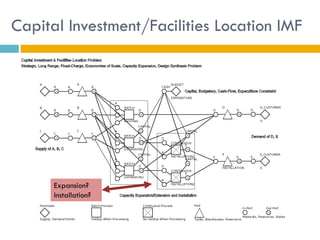
Capital Investment/Facilities Location IMF


      Expansion?
      Installation?
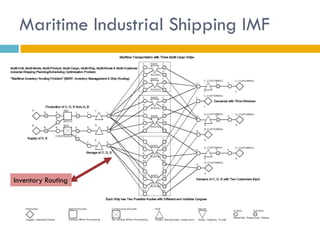
Maritime Industrial Shipping IMF


Inventory Routing
What is next?
   Risk Management in the Supply-Chain
   Supply-Chain Strategic Problem
   Marketing Optimization
   Wealth Management Optimization
   On-Line Optimization (RTO)

NY INFORMS METRO - Next Generation of modeling and Solving Tools

  • 1.
    NEXT GENERATION OF MATHEMATICALPROGRAMMING MODELING AND SOLVING TOOLS NEW YORK INFORMS METRO CHAPTER UPDATED FEBRUARY 12 2013 Alkis Vazacopoulos Industrial Algorithms February 2013
  • 2.
    Agenda  Optimization Problems (OP)  How do we solve OP?  Can we Graph and Solve?  Case Studies
  • 3.
    Our Mission Statement  To provide advanced modeling and solving tools for developing industrial applications in the decision- making and data-mining areas.  Our targets are:  Operating companies in the process industries.  Application software providers.  Consulting service providers.
  • 4.
    Our Industrial ModelingFrameworks  Process industry business problems can be complex hence an Industrial Modeling Framework provides a pre-project or pre-problem advantage.  An IMF embeds Intellectual Property related to the process’s flowsheet modeling as well as its problem- solving methodology.
  • 5.
    Our Business Model  What do we license: IMPRESS, IMF, Solvers.  What is our pricing scheme: License Fee, Support & Maintenance Fee.  What are our license terms: Based on Customer’s Needs i.e., Rental for a specified period (months to years) or Perpetual.
  • 6.
    IA Services  Application Support  Free prototyping to get you started (for a reasonable number of consulting hours).  Full modeling and solving support.  Consulting Services 6
  • 7.
    Academic Collaboration &Partnership  Carnegie Mellon University  University of Wisconsin  Cornell  Stevens Institute Of Tech  Fairleigh Dickinson University
  • 8.
    Solving a BusinessProblem with Optimization**** min cTx s.t. Ax  b x integer Mathematical Model OR Specialist Business Problem  What are the key decisions? Evaluation  What are the constraints? Business  What are the goals? Expert Supply Chain Optimisation Programme RASA Benefit Realisation Weekly Summary 35 Solver Contribution Relative to Apr08 QS61 Baseline (£k) 25 15 5 x1 = 3, x2 = 0, ... Mar* w 19 w 20 w 21 w 22 w 23 w 24 w 25 w 26 w 27 w 28 w 29 w 30 w 31 w 32 w 33 w 34 w 35 w 36 w 37 w 38 w 39 w 40 w 41 w 42 w 43 w 44 w 45 w 46 w 47 w 48 w 49 w 50 w 51 w 52 Feb* 2008 Jan* Apr* -5 -15 -25 Solution to -35 Mathematical Model Realised Benefit Missed Opportunity Actual ≠ QS61 or Optimal Business Results From: Jean-François Puget, IBM Distinguished Engineer,, recent presentation, IBM: Lessons Learned When Selling Optimization To Business Users
  • 9.
    Business users  They don’t care about the technology Business Problem  They care about their problem  Eg schedule next day plant Evaluation operations, next month roster for Business Expert bus drivers, etc Supply Chain Optimisation Programme RASA Benefit Realisation Weekly Summary 35  They want Contribution Relative to Apr08 QS61 Baseline (£k) 25 15  Return on investment Help to solve their problem 5  Mar* w 19 w 20 w 21 w 22 w 23 w 24 w 25 w 26 w 27 w 28 w 29 w 30 w 31 w 32 w 33 w 34 w 35 w 36 w 37 w 38 w 39 w 40 w 41 w 42 w 43 w 44 w 45 w 46 w 47 w 48 w 49 w 50 w 51 w 52 Feb* 2008 Jan* Apr* -5 -15 -25  To be in charge -35 Realised Benefit Missed Opportunity Actual ≠ QS61 or Optimal Business Results From: Jean-François Puget, IBM Distinguished Engineer,, recent presentation, IBM: Lessons Learned When Selling Optimization To Business Users
  • 10.
    Return on investmentfor optimization is great From: Jean-François Puget, IBM Distinguished Engineer,, recent presentation, IBM: Lessons Learned When Selling Optimization To Business Users
  • 11.
    What are commonsolving optimization technologies?  Linear Programming  Mixed Integer Programming  Nonlinear Programming  Constrained Programming  Meta-Heuristics
  • 12.
    Access the solver:Use the Libraries  Load the matrix Using  C  Visual Basic  Python  other
  • 13.
    Access the solver:Use a modeling language  Mathematical Programming language (basically they do the same thing):  GAMS,  AMPL  AIMMS  MOSEL  MPL  OPL  LINDO
  • 15.
    Question #1  Can we automate the model formulation?
  • 16.
    Our Goal: Automatethe process of matrix generation  Literature  EMOSL (Dash Optimization)  CONCERT (ILOG)  Semantic/Structured Modeling (Professor A. Geoffrion)  OPTEX – DecisionWare  UOPSS (Jeff Kelly)
  • 17.
    Our Modeling Environment:IMPRESS 17  IMPRESS: Industrial Modeling & Presolving System is our proprietary modeling platform.  You can model, solve, interface and interact with any supply-chain, production-chain, demand-chain and/or value-chain optimization problem.  IMPRESS so far has been applied in:  Production Planning  Plant Scheduling  Pipeline & Marine Shipping  Energy Management Copyright, Industrial Algorithms LLC 2/17/2013
  • 18.
    Why are weunique? 18  IMPRESS is flowsheet-based (i.e., a figurative language).  This means that the modeling is inherently network or superstructure “aware” with equipment-to-equipment, resource-to-resource, activity-to-activity, etc. as explicit language constructs or objects.  It also means that all of the effort of generating the sparse A matrix in the LP, MILP and NLP is done automatically by automatically creating all of the sets, parameters, variables and constraints when the model is configured using our proprietary and comprehensive library of sub- models. Copyright, Industrial Algorithms LLC 2/17/2013
  • 19.
    Jet Fuel SupplyChain IMF - Example  One oil-refinery producing different grades of jet fuel and one airport terminal storing Jet-A, Jet-A1 and Jet-B with a railroad in between.  Logistics details such as the input-output or yield modeling of the refinery and the round-trip times of the tank-cars (similar to batch-processes with cycle- time) are modeled & solved as a MILP.
  • 20.
    Jet Fuel SupplyChain IMF - Flowsheet
  • 21.
    Jet Fuel SupplyChain IMF - Flowsheet Simple Structure of the Oil Refinery
  • 22.
    Jet Fuel SupplyChain IMF - Flowsheet Tank Cars and Airport Jet Tanks
  • 23.
    Jet Fuel SupplyChain IMF - Flowsheet
  • 24.
    Question #2  What type of Units can I represent in the flowsheet?
  • 25.
    Jet Fuel Example- UNITS Crude Oil distillation Unit Tank, Pool Demand Point Outlet port – flow Supply Vacuum interface Point Distillation Unit
  • 26.
    Question #3  How can you add a Unit in IMPRESS?  What about a general purpose modeling language?
  • 27.
    Easy to addor insert Units Add another tank in parallel Add a jet fuel parcel (movable inventory)
  • 28.
    What about addingin the modeling Language? You need to add both the node set and arc set in the modeling structures Variables Index sets Data Constraints Objective function
  • 29.
    Comparison MODELING IMPRESS Languages Can you model this problem? Probably YES How Long it will take? Cost? 6 months days 1-2 consultants What type of consultant? OR Specialist Engineer or OR Specialist What about Nonlinear A few modeling YES Constraints ? Languages Multi-Period You have to do Standard this yourself What happens if I want to Remodel and Add or Delete delete or add a unit ? Reprogram
  • 30.
    Question #4  How do you draw a chart?
  • 31.
    How do wedraw the chart  Use DIA Python, Open Source [Microsoft Visio]  IML, Data File  IPL, API
  • 32.
  • 33.
    Question #5: Whythis technology now?  No recent innovation in Modeling Languages  Mixed Integer Programming Codes are Very Fast (Gurobi, CPLEX, Xpress)  Engineering Disciplines use optimization, but they are not OR Specialists (they have little modeling expertise and MP expertise)
  • 34.
    Question #5: Whythis technology now?  Most of the difficult Planning and Scheduling problems have Special Structures (Electrical Eng. and Chemical Eng. : Power flow network, Process flowsheet, OR specialist have limited experience in modeling them).  Engineers know about the modeling structure but have limited MP algorithmic experience .
  • 35.
  • 36.
  • 37.
    Planning and Planning+Model Planuling = Scheduling Scheduling  Logistics (Quantity*Logic (proy’d-quality), MILP):  “discrete-time” where each time-period has the same duration.  Time-periods may be “small-buckets” (un-ary) or “big-buckets” (N-ary):  If un-ary then only one activity per time-period (scheduling) but if N-ary then multiple activities per time-period where a “time-portion” variable for each operation is applied (planning).  Quality (Quantity*quality (fixed-logic), NLP):  “distributed-time” where each time-period may have a different duration (global/common time-grid).  Same as logistics.  All input data is entered in “continuous-time” (begin, end-times) and digitized i.e., discretized or distributed accordingly.
  • 38.
    Scheduling without the blender scheduling details planning crude Solution: duration of each blender grade with time-period Scheduling only for the blender: Including setup, startup, switchover, shutdown
  • 39.
    Prod A Prod A Prod B Prod B Prod C Prod C Prod D Prod D Crude A Prod E Prod E Crude B Prod F Prod F Crude C Prod Prod G G Crude D Prod H Prod H Crude Recipe Refining Units Products Recipes Products Operational Modes Scheduling Crude Scheduling Products Planning resulting targets to Including setup, startup, switchover, shutdown blender Scheduling/RTO 1st Planuling (big-buckets) 2nd Scheduling (small-buckets)
  • 40.
    Engineer IMPRESS Contribution Relative to Apr08 QS61 Baseline (£k) -35 -25 -15 -5 5 15 25 35 2008 Jan* Feb* Mar* Apr* w 19 w 20 Engineer w 21 w 22 w 23 w 24 w 25 w 26 w 27 w 28 Realised Benefit w 29 w 30 w 31 w 32 w 33 w 34 Missed Opportunity w 35 w 36 w 37 w 38 w 39 w 40 RASA Benefit Realisation Weekly Summary w 41 Supply Chain Optimisation Programme w 42 w 43 Actual ≠ QS61 or Optimal w 44 w 45 w 46 w 47 w 48 w 49 w 50 w 51 w 52 Engineer Engineer
  • 41.
    A Planning andScheduling Example: Fast Moving Consumer Goods IMF  Two materials produced in bulk-unit produces eighteen different packaged materials in pack-unit.  Sequence-dependent switchovers with setup/setdown times & “repetitive” maintenance cleanouts on bulk-unit with material families.  Due to the slow & fast nature of the bulk & pack- units we perform “novel” hybrid planning & scheduling i.e., bulk-unit is scheduled & pack-unit is planned to reduce solve time (“planuling”).
  • 42.
    Fast Moving ConsumerGoods IMF Pack-Line Multiple Pack Lines Bulk-Line Setup Times Forecasted & Firm Future Demand Orders Sequence-Dependent Switchovers Plan fast units (A model) And then with separate Schedule slow units model schedule them (B (A model) model)
  • 43.
    Fast Moving ConsumerGoods IMF 43  Time Horizon: 60 time-periods w/ day periods.  Continuous Variables = 10,000  Binary Variables = 5,000  Constraints = 20,000  Time to First Good Solution = 10 to 30-seconds  Time to Provably Optimal = 1 to 10-hours due to sequence-dependent switchovers. Copyright, Industrial Algorithms LLC 2/17/2013
  • 44.
    Cogeneration (Steam/Power) IMF  Two multi-fuel steam boilers with three modes for different operating regions and standby.  One steam turbogenerator to produce electrical power from high-pressure steam.  One electrical power header with import & export of power to plant.
  • 45.
    Cogeneration (Steam/Power) IMF Fuel Header Blowdown Boiler1 w/ 3 Modes Boiler2 w/ 3 Modes Multiple Modes on Boilers HP Steam Header Water Pump Pressure Reducing Valve Steam Turbogenerator MP Steam Header Power Header
  • 46.
    Cogeneration (Steam/Power) IMF 46  Time Horizon: 168 time-periods w/ hour periods.  Continuous Variables = 5,000  Binary Variables = 1,000  Constraints = 7,500  Time to First Good Solution = 5 to 30-seconds  Time to Provably Optimal = 5 to 15-minutes Copyright, Industrial Algorithms LLC 2/17/2013
  • 47.
    Power Generation IMF  Three thermal-plants and two hydro-plants with and without water storage.  Three nodes or buses with voltage phase angle inputs where each bus obeys Kirchhoff’s current and voltage laws.  One time-varying demand load located on bus #3.
  • 48.
    Power Generation IMF Three Buses/Nodes Electrical Engineering 1st & 2nd Kirchhoff Laws Voltage Phase Angles Thermal & Hydro Plants Varying Demand Load
  • 49.
    Capital Investment/Facilities LocationIMF Expansion? Installation?
  • 50.
    Maritime Industrial ShippingIMF Inventory Routing
  • 51.
    What is next?  Risk Management in the Supply-Chain  Supply-Chain Strategic Problem  Marketing Optimization  Wealth Management Optimization  On-Line Optimization (RTO)