Lecture Two
A computer is an electronic device, operating under the control of
instructions (software) stored in its own memory unit, that can accept data
(input), manipulate data (process), and produce information (output) from
the processing. Generally, the term is used to describe a collection of devices
that function together as a system.
What is the Computer ?
Types of Computers
❑ Supercomputers
are used to process very large amounts of information
including processing information to predict hurricanes,
satellite images and navigation, and process military war
scenarios.
❑ Mainframes
are used by government and businesses to process very large
amounts of information.
❑ Mini-Computers
are similar to mainframes...they are used by business and
government to process large amounts of information.
❑ Personal Computers (PC)…
What Does A Computer Do?
• Computers can perform four general operations,
which comprise the information processing cycle.
◼ Input
◼ Process
◼ Output
◼ Storage
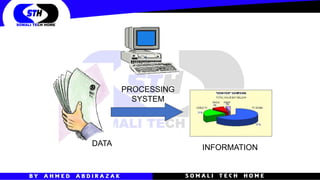
PROCESSING
SYSTEM
DATA INFORMATION
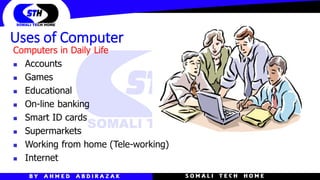
Uses of Computer
THE END
Lecture Two

All BAsic Of Ict

  • 1.
  • 2.
    A computer isan electronic device, operating under the control of instructions (software) stored in its own memory unit, that can accept data (input), manipulate data (process), and produce information (output) from the processing. Generally, the term is used to describe a collection of devices that function together as a system. What is the Computer ?
  • 3.
    Types of Computers ❑Supercomputers are used to process very large amounts of information including processing information to predict hurricanes, satellite images and navigation, and process military war scenarios. ❑ Mainframes are used by government and businesses to process very large amounts of information. ❑ Mini-Computers are similar to mainframes...they are used by business and government to process large amounts of information. ❑ Personal Computers (PC)…
  • 4.
    What Does AComputer Do? • Computers can perform four general operations, which comprise the information processing cycle. ◼ Input ◼ Process ◼ Output ◼ Storage
  • 5.
  • 6.
  • 7.