The Second  ANNUAL BIOFUELS SUMMIT 25th - 27th May 2009 Marina Mandarin, Singapore Syed Isa Syed Alwi
Content Group Overview Our Mission Group Activities The Site – Lab, Factory and Ponds Our Algae Lab Regional Supply and Demand Developments to identify the regional opportunity Technology Considerations from a regional perspective Competitive cost positioning of algae versus alternatives Opportunities and challenges relating to regional  developments The Algaetech Approach Conclusion
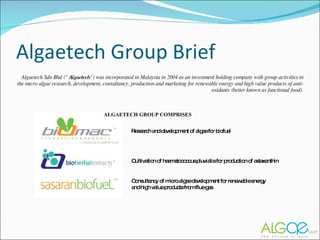
Algaetech Group Brief Algaetech Sdn Bhd (“ Algaetech ”) was incorporated in Malaysia in 2004 as an investment holding company with group activities in the micro algae research, development, consultancy, production and marketing for renewable energy and high value products of anti-oxidants (better known as functional food). Research and development of algae for biofuel Cultivation of haematococcus pluvialis for production of astaxanthin ALGAETECH GROUP COMPRISES Consultancy of micro algae development for renewable energy and high value products from flue gas
Algaetech Group Brief Algaetech was founded to : Acquire specific intellectual property, and exclusive microalgae cultivation technology  for commercial use.  Establish a fully integrated cultivation operation in Malaysia and the region.  Establish quality products from microalgae for the global market. Establish joint ventures as may be required to advance Algaetech's mission Engage in other such beneficial activities related to its existing plan that the Group determines will benefit its overall business strategy
Our Mission “  To become the leading, innovative and advance algae research and development centre and the largest producer of algae company in Asia “
These are the unanswered questions (or dodgy) To Make the price of 1 liter of algae oil to be the same as the price of 1 liter of fossil oil, because seriously, who really cares about global warming and pay U$D 0.10 cents more per liter for fuel? The strains,  what’s the best? How do I produce algae at USD 0.37cents per kg for oil? How to propagate? How do I create so much sea water?  The salt cost U$D 0.85 cents a kg. How to harvest? And the list goes on and on…… The Challenges
No , I don’t have all the answers…but neither does anyone… It depends on each research, and each goal. There are no magic strains, or magic PBR, or magic systems. Each goals must be defined and tuned into what it’s created for. The Answer
Algae Biofuel, Why Algae ? Much greater productivity than the terrestrial plants Non-food resources Use non-productive land, usually arid Can utilize saline water Can utilize CO2 waste Can be used in conjunction with waste water treatment Algae produce oils, protein, and carbohydrates, equivalent to bio-diesel, bio-ethanol and food
Advantage of micro algae Rapid growth rates, a high per-hectare yield; and algae biofuel contains no sulfur, is non toxic and is highly biodegradable. Some species of algae are ideally suited to biodiesel production due to their high oil content, in some species topping out near 70%. Micro-algae are single celled microscopic organisms which, like plants, use photosynthesis to convert the sun's energy into chemical energy. Micro-algae can be grown in large bioreactors that provide the algae with all the needs to maximize growth and oil production. Micro –algae are much more efficient converters of solar energy than any known plant.
Advantage of micro algae 6. Growth rates in bioreactors can be from 100 – 300 gm/m3/day. 7. Micro-algae are capable of producing many times the amount of oil (per year per unit area of land) when compared to oil seed crops. 8.  Micro-Algae can grow in both fresh and saline water.  9. Micro-algae are the fastest growing photosynthesizing organisms. They can complete an entire growing cycle within a day. 10. Algae production can be increased by increasing the carbon dioxide concentration in the water.
Project Objectives : To build a commercial algae production pond using the latest and advance technology in Malaysia;  To conduct research and development on the Biological and Chemical Engineering of microalgae production systems for the Biodiesel production and processing in Malaysia; To build and set up a Biodiesel processing plant on the extraction and production of biodiesel from algae; To patent the IP of the improved algae production and the extraction of Crude Algae Oil and processed biodiesel from algae; To market the technology, know-how and the product (algae-based products and biodiesel) locally and internationally. The pioneer in R&D and Pre-Commercialisation of algae for biodiesel in Malaysia. The project received a Technofund Grant from the Malaysian Ministry of Science,  Technology and Innovation totaling RM2.0 million (US$600k).
Project Milestone Milestone Activities Output Scheduled Completion date Signing agreement on technology transfer. Signing of agreement on technology transfer with the patent owner. Completed 28 November 2007 Suitable algae identified Isolation, screening and characterization of microalgae Completed 1 st  September 2008 Physiology/biochemistry of algae understood Study of physiology and biochemistry for algae / chemical and biochemical testes In Progress February 2009 Enzyme(s) isolated Isolation of enzyme which catalyzes a key metabolic steps in the synthesis of oil in algae  In Progress March 2009 Large scale production of algae in open ponds accomplish Carry out performance evaluation, sample analysis and data collection In Progress May 2009
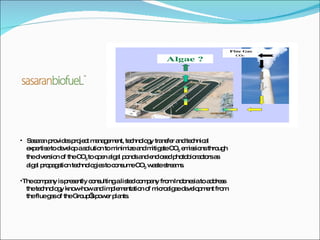
Sasaran provides project management, technology transfer and technical  expertise to develop a solution to minimize and mitigate CO 2  emissions through  the diversion of the CO 2  to open algal ponds and enclosed photobioractors as  algal propagation technologies to consume CO 2  waste streams.  The company is presently consulting a listed company from Indonesia to address  the technology know-how and implementation of microalgae development from  the flue gas of the Group’s power plants.
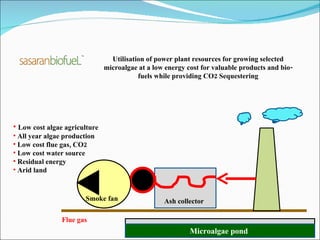
Utilisation of power plant resources for growing selected microalgae at a low energy cost for valuable products and bio-fuels while providing CO2 Sequestering Low cost algae agriculture  All year algae production  Low cost flue gas, CO2 Low cost water source Residual energy Arid land  Smoke fan Ash collector Flue gas Microalgae pond
The global microalgae market is a multi billion industry and is rapidly expanding.  The farming and processing will be undertaken utilizing  Algaetech's new and proprietary technology, while exploiting existing resources available in Malaysia BHE will be establishing its plant in TPM. The plant is a sophisticated, highly secure and fully operational state of the art research facility. Testing has commenced on the proprietary technology and has been proven successful. BHE believes that it can supply the global market with a superior quality microalgae at lower cost. Additionally, by virtue of the cultivation method, BHE can also contribute to preserving environmental quality and cleanliness. Commercialisation of haematococcus pluvialis for production of astaxanthin, the first in Malaysia and South East Asia.  The project is partly funded by Malaysian Technology Development Corporation (MTDC) for a US$1.0 million grant and scheduled to commence in March 2009.  GROUP ACTIVITIES
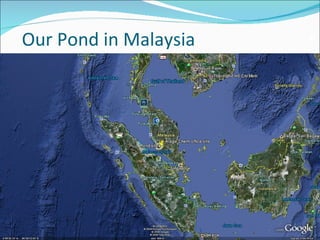
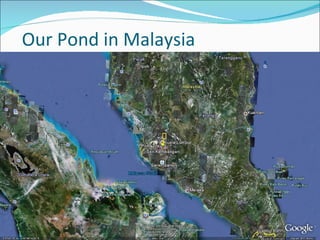
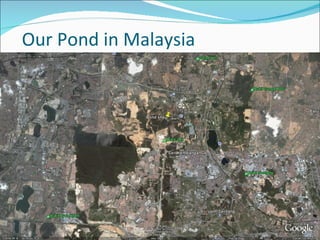
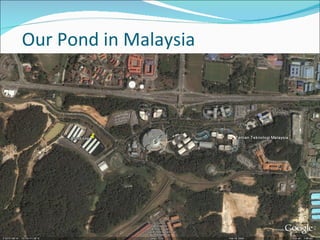
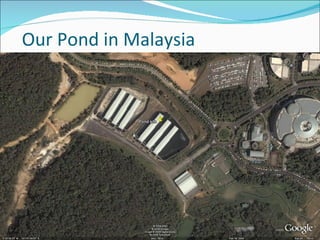
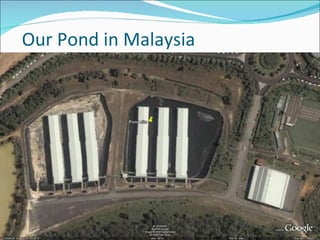
Factory and Lab Pond One Pond Two Our Pond in Malaysia
Our Pond in Malaysia
Laboratory  & Pilot Plant CO2 sequestratian technology (project) Government grants and assistance Algae hub for R&D and production Malaysian Experience
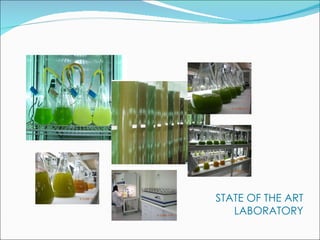
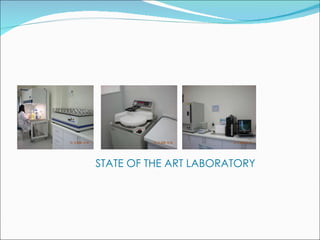
STATE OF THE ART LABORATORY
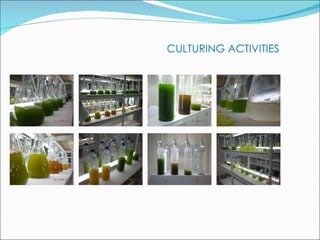
CULTURING ACTIVITIES
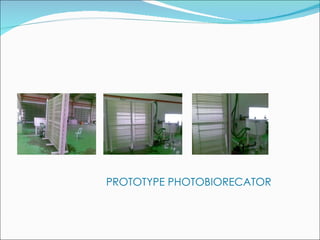
PROTOTYPE PHOTOBIORECATOR
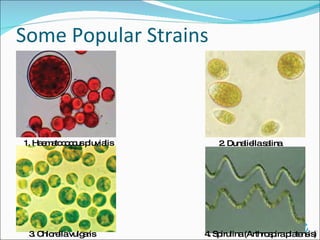
Some Popular Strains 4. Spirulina (Arthrospira platensis) 3. Chlorella vulgaris  1. Haematococcus pluvialis 2. Dunaliella salina
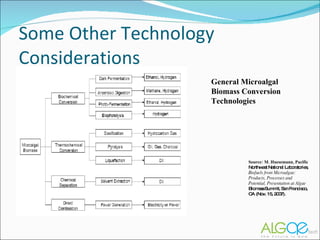
Some Other Technology Considerations Source: M. Huesemann, Pacific Northwest National Laboratories, Biofuels from Microalgae: Products, Processes and Potential, Presentation at Algae Biomass Summit, San Francisco, CA (Nov. 15, 2007). General Microalgal Biomass Conversion Technologies
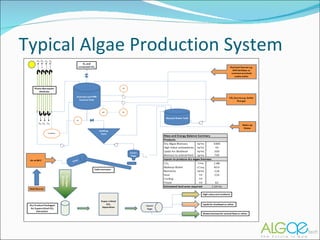
Typical Algae Production System
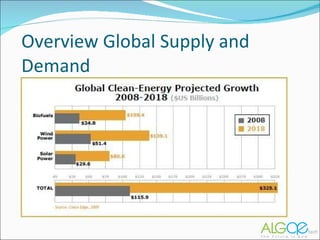
Overview Global Supply and Demand
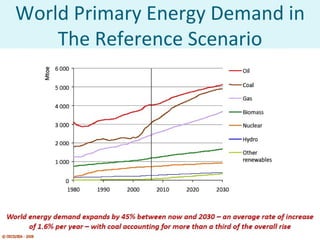
Regional Opportunity World Primary Energy Demand in The Reference Scenario
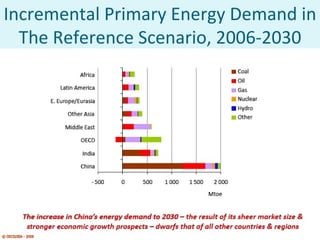
Incremental Primary Energy Demand in The Reference Scenario, 2006-2030
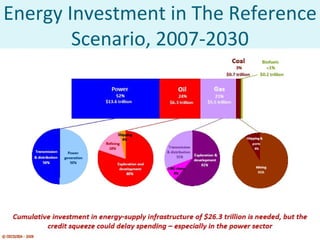
Energy Investment in The Reference Scenario, 2007-2030
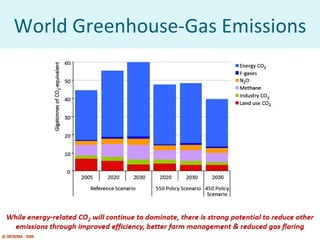
World Greenhouse-Gas Emissions
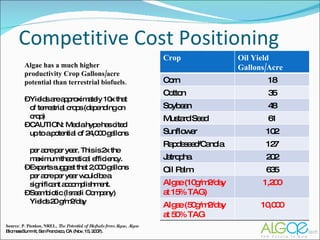
Competitive Cost Positioning Algae has a much higher productivity Crop Gallons/acre potential than terrestrial biofuels. –  Yields are approximately 10x that  of terrestrial crops (depending on  crop) –  CAUTION: Media hype has cited  up to a potential of 24,000 gallons  per acre per year. This is 2x the maximum theoretical efficiency. –  Experts suggest that 2,000 gallons per acre per year would be a significant accomplishment. –  Seambiotic (Israeli Company)  Yields 20 g/m2/day Source: P. Pienkos, NREL,  The Potential of Biofuels from Algae, Algae  Biomass Summit, San Francisco, CA (Nov. 15, 2007). Crop  Oil Yield Gallons/Acre Corn 18 Cotton 35 Soybean 48 Mustard Seed 61 Sunflower 102 Rapdeseed/Canola 127 Jatropha 202 Oil Palm 635 Algae (10g/m2/day at 15% TAG) 1,200 Algae (50g/m2/day at 50% TAG 10,000
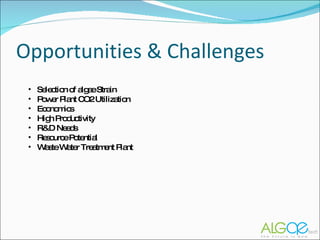
Opportunities & Challenges Selection of algae Strain Power Plant CO2 Utilization Economics High Productivity R&D Needs Resource Potential Waste Water Treatment Plant
Investing in Algae Biofuel Phase I – Search for right partnership Technology (R&D, Acquisition) Local Business Partner Financing Phase II – Pre-Commercialization activities Location (Land, Environmental Impact Study and CO2 source) Laboratory and Pilot Plant Demonstrations of proven technology Phase III – Commercialisation Commissioning  Off take agreement CDM and Financing
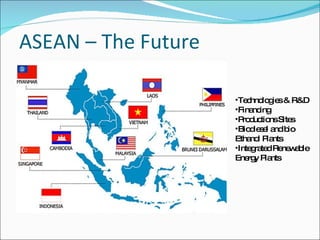
Technologies & R&D Financing Productions Sites Biodiesel and bio Ethanol Plants Integrated Renewable Energy Plants ASEAN – The Future
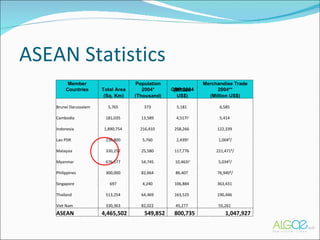
ASEAN Statistics Member Countries Total Area Population 2004* GDP 2004 Merchandise Trade 2004**   (Sq. Km) (Thousand) (Million US$) (Million US$) Brunei Darussalam 5,765  373  5,181  6,585  Cambodia 181,035  13,589  4,517⅟  5,414  Indonesia 1,890,754  216,410  258,266  122,339  Lao PDR 236,800  5,760  2,439⅟ 1,004²/  Malaysia 330,257  25,580  117,776  221,471²/  Myanmar 676,577  54,745  10,463⅟  5,034²/  Philippines 300,000  82,664  86,407  76,940²/  Singapore 697  4,240  106,884  363,431  Thailand 513,254  64,469  163,525  190,446  Viet Nam 330,363  82,022  45,277  55,261  ASEAN 4,465,502  549,852  800,735  1,047,927
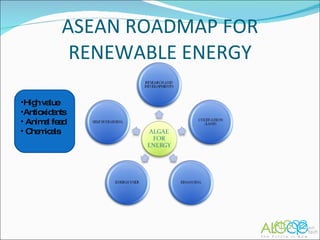
ASEAN ROADMAP FOR RENEWABLE ENERGY High value  Antioxidants Animal feed Chemicals
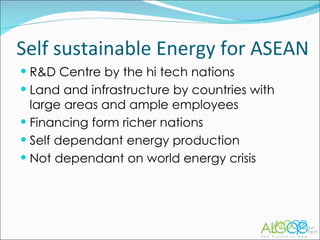
R&D Centre by the hi tech nations Land and infrastructure by countries with large areas and ample employees Financing form richer nations Self dependant energy production Not dependant on world energy crisis Self sustainable Energy for ASEAN
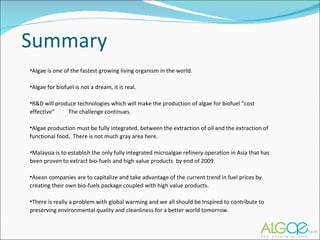
Summary Algae is one of the fastest growing living organism in the world. Algae for biofuel is not a dream, it is real. R&D will produce technologies which will make the production of algae for biofuel “cost effective”  The challenge continues. Algae production must be fully integrated, between the extraction of oil and the extraction of functional food.  There is not much gray area here. Malaysia is to establish the only fully integrated microalgae refinery operation in Asia that has  been proven to extract bio-fuels and high value products  by end of 2009.  Asean companies are to capitalize and take advantage of the current trend in fuel prices by creating their own bio-fuels package coupled with high value products.  There is really a problem with global warming and we all should be Inspired to contribute to preserving environmental quality and cleanliness for a better world tomorrow.
SYED ISA SYED ALWI Email :  [email_address] www.algaetech.com.my www.premia.com.my

Salvo May 2009

  • 1.
    The Second ANNUAL BIOFUELS SUMMIT 25th - 27th May 2009 Marina Mandarin, Singapore Syed Isa Syed Alwi
  • 2.
    Content Group OverviewOur Mission Group Activities The Site – Lab, Factory and Ponds Our Algae Lab Regional Supply and Demand Developments to identify the regional opportunity Technology Considerations from a regional perspective Competitive cost positioning of algae versus alternatives Opportunities and challenges relating to regional developments The Algaetech Approach Conclusion
  • 3.
    Algaetech Group BriefAlgaetech Sdn Bhd (“ Algaetech ”) was incorporated in Malaysia in 2004 as an investment holding company with group activities in the micro algae research, development, consultancy, production and marketing for renewable energy and high value products of anti-oxidants (better known as functional food). Research and development of algae for biofuel Cultivation of haematococcus pluvialis for production of astaxanthin ALGAETECH GROUP COMPRISES Consultancy of micro algae development for renewable energy and high value products from flue gas
  • 4.
    Algaetech Group BriefAlgaetech was founded to : Acquire specific intellectual property, and exclusive microalgae cultivation technology for commercial use. Establish a fully integrated cultivation operation in Malaysia and the region. Establish quality products from microalgae for the global market. Establish joint ventures as may be required to advance Algaetech's mission Engage in other such beneficial activities related to its existing plan that the Group determines will benefit its overall business strategy
  • 5.
    Our Mission “ To become the leading, innovative and advance algae research and development centre and the largest producer of algae company in Asia “
  • 6.
    These are theunanswered questions (or dodgy) To Make the price of 1 liter of algae oil to be the same as the price of 1 liter of fossil oil, because seriously, who really cares about global warming and pay U$D 0.10 cents more per liter for fuel? The strains, what’s the best? How do I produce algae at USD 0.37cents per kg for oil? How to propagate? How do I create so much sea water? The salt cost U$D 0.85 cents a kg. How to harvest? And the list goes on and on…… The Challenges
  • 7.
    No , Idon’t have all the answers…but neither does anyone… It depends on each research, and each goal. There are no magic strains, or magic PBR, or magic systems. Each goals must be defined and tuned into what it’s created for. The Answer
  • 8.
    Algae Biofuel, WhyAlgae ? Much greater productivity than the terrestrial plants Non-food resources Use non-productive land, usually arid Can utilize saline water Can utilize CO2 waste Can be used in conjunction with waste water treatment Algae produce oils, protein, and carbohydrates, equivalent to bio-diesel, bio-ethanol and food
  • 9.
    Advantage of microalgae Rapid growth rates, a high per-hectare yield; and algae biofuel contains no sulfur, is non toxic and is highly biodegradable. Some species of algae are ideally suited to biodiesel production due to their high oil content, in some species topping out near 70%. Micro-algae are single celled microscopic organisms which, like plants, use photosynthesis to convert the sun's energy into chemical energy. Micro-algae can be grown in large bioreactors that provide the algae with all the needs to maximize growth and oil production. Micro –algae are much more efficient converters of solar energy than any known plant.
  • 10.
    Advantage of microalgae 6. Growth rates in bioreactors can be from 100 – 300 gm/m3/day. 7. Micro-algae are capable of producing many times the amount of oil (per year per unit area of land) when compared to oil seed crops. 8. Micro-Algae can grow in both fresh and saline water. 9. Micro-algae are the fastest growing photosynthesizing organisms. They can complete an entire growing cycle within a day. 10. Algae production can be increased by increasing the carbon dioxide concentration in the water.
  • 11.
    Project Objectives :To build a commercial algae production pond using the latest and advance technology in Malaysia; To conduct research and development on the Biological and Chemical Engineering of microalgae production systems for the Biodiesel production and processing in Malaysia; To build and set up a Biodiesel processing plant on the extraction and production of biodiesel from algae; To patent the IP of the improved algae production and the extraction of Crude Algae Oil and processed biodiesel from algae; To market the technology, know-how and the product (algae-based products and biodiesel) locally and internationally. The pioneer in R&D and Pre-Commercialisation of algae for biodiesel in Malaysia. The project received a Technofund Grant from the Malaysian Ministry of Science, Technology and Innovation totaling RM2.0 million (US$600k).
  • 12.
    Project Milestone MilestoneActivities Output Scheduled Completion date Signing agreement on technology transfer. Signing of agreement on technology transfer with the patent owner. Completed 28 November 2007 Suitable algae identified Isolation, screening and characterization of microalgae Completed 1 st September 2008 Physiology/biochemistry of algae understood Study of physiology and biochemistry for algae / chemical and biochemical testes In Progress February 2009 Enzyme(s) isolated Isolation of enzyme which catalyzes a key metabolic steps in the synthesis of oil in algae In Progress March 2009 Large scale production of algae in open ponds accomplish Carry out performance evaluation, sample analysis and data collection In Progress May 2009
  • 13.
    Sasaran provides projectmanagement, technology transfer and technical expertise to develop a solution to minimize and mitigate CO 2 emissions through the diversion of the CO 2 to open algal ponds and enclosed photobioractors as algal propagation technologies to consume CO 2 waste streams. The company is presently consulting a listed company from Indonesia to address the technology know-how and implementation of microalgae development from the flue gas of the Group’s power plants.
  • 14.
    Utilisation of powerplant resources for growing selected microalgae at a low energy cost for valuable products and bio-fuels while providing CO2 Sequestering Low cost algae agriculture All year algae production Low cost flue gas, CO2 Low cost water source Residual energy Arid land Smoke fan Ash collector Flue gas Microalgae pond
  • 15.
    The global microalgaemarket is a multi billion industry and is rapidly expanding. The farming and processing will be undertaken utilizing Algaetech's new and proprietary technology, while exploiting existing resources available in Malaysia BHE will be establishing its plant in TPM. The plant is a sophisticated, highly secure and fully operational state of the art research facility. Testing has commenced on the proprietary technology and has been proven successful. BHE believes that it can supply the global market with a superior quality microalgae at lower cost. Additionally, by virtue of the cultivation method, BHE can also contribute to preserving environmental quality and cleanliness. Commercialisation of haematococcus pluvialis for production of astaxanthin, the first in Malaysia and South East Asia. The project is partly funded by Malaysian Technology Development Corporation (MTDC) for a US$1.0 million grant and scheduled to commence in March 2009. GROUP ACTIVITIES
  • 16.
    Factory and LabPond One Pond Two Our Pond in Malaysia
  • 17.
    Our Pond inMalaysia
  • 18.
    Our Pond inMalaysia
  • 19.
    Our Pond inMalaysia
  • 20.
    Our Pond inMalaysia
  • 21.
    Our Pond inMalaysia
  • 22.
    Laboratory &Pilot Plant CO2 sequestratian technology (project) Government grants and assistance Algae hub for R&D and production Malaysian Experience
  • 23.
    STATE OF THEART LABORATORY
  • 24.
    STATE OF THEART LABORATORY
  • 25.
  • 26.
  • 27.
    Some Popular Strains4. Spirulina (Arthrospira platensis) 3. Chlorella vulgaris 1. Haematococcus pluvialis 2. Dunaliella salina
  • 28.
    Some Other TechnologyConsiderations Source: M. Huesemann, Pacific Northwest National Laboratories, Biofuels from Microalgae: Products, Processes and Potential, Presentation at Algae Biomass Summit, San Francisco, CA (Nov. 15, 2007). General Microalgal Biomass Conversion Technologies
  • 29.
  • 30.
  • 31.
    Regional Opportunity WorldPrimary Energy Demand in The Reference Scenario
  • 32.
    Incremental Primary EnergyDemand in The Reference Scenario, 2006-2030
  • 33.
    Energy Investment inThe Reference Scenario, 2007-2030
  • 34.
  • 35.
    Competitive Cost PositioningAlgae has a much higher productivity Crop Gallons/acre potential than terrestrial biofuels. – Yields are approximately 10x that of terrestrial crops (depending on crop) – CAUTION: Media hype has cited up to a potential of 24,000 gallons per acre per year. This is 2x the maximum theoretical efficiency. – Experts suggest that 2,000 gallons per acre per year would be a significant accomplishment. – Seambiotic (Israeli Company) Yields 20 g/m2/day Source: P. Pienkos, NREL, The Potential of Biofuels from Algae, Algae Biomass Summit, San Francisco, CA (Nov. 15, 2007). Crop Oil Yield Gallons/Acre Corn 18 Cotton 35 Soybean 48 Mustard Seed 61 Sunflower 102 Rapdeseed/Canola 127 Jatropha 202 Oil Palm 635 Algae (10g/m2/day at 15% TAG) 1,200 Algae (50g/m2/day at 50% TAG 10,000
  • 36.
    Opportunities & ChallengesSelection of algae Strain Power Plant CO2 Utilization Economics High Productivity R&D Needs Resource Potential Waste Water Treatment Plant
  • 37.
    Investing in AlgaeBiofuel Phase I – Search for right partnership Technology (R&D, Acquisition) Local Business Partner Financing Phase II – Pre-Commercialization activities Location (Land, Environmental Impact Study and CO2 source) Laboratory and Pilot Plant Demonstrations of proven technology Phase III – Commercialisation Commissioning Off take agreement CDM and Financing
  • 38.
    Technologies & R&DFinancing Productions Sites Biodiesel and bio Ethanol Plants Integrated Renewable Energy Plants ASEAN – The Future
  • 39.
    ASEAN Statistics MemberCountries Total Area Population 2004* GDP 2004 Merchandise Trade 2004**   (Sq. Km) (Thousand) (Million US$) (Million US$) Brunei Darussalam 5,765 373 5,181 6,585 Cambodia 181,035 13,589 4,517⅟ 5,414 Indonesia 1,890,754 216,410 258,266 122,339 Lao PDR 236,800 5,760 2,439⅟ 1,004²/ Malaysia 330,257 25,580 117,776 221,471²/ Myanmar 676,577 54,745 10,463⅟ 5,034²/ Philippines 300,000 82,664 86,407 76,940²/ Singapore 697 4,240 106,884 363,431 Thailand 513,254 64,469 163,525 190,446 Viet Nam 330,363 82,022 45,277 55,261 ASEAN 4,465,502 549,852 800,735 1,047,927
  • 40.
    ASEAN ROADMAP FORRENEWABLE ENERGY High value Antioxidants Animal feed Chemicals
  • 41.
    R&D Centre bythe hi tech nations Land and infrastructure by countries with large areas and ample employees Financing form richer nations Self dependant energy production Not dependant on world energy crisis Self sustainable Energy for ASEAN
  • 42.
    Summary Algae isone of the fastest growing living organism in the world. Algae for biofuel is not a dream, it is real. R&D will produce technologies which will make the production of algae for biofuel “cost effective” The challenge continues. Algae production must be fully integrated, between the extraction of oil and the extraction of functional food. There is not much gray area here. Malaysia is to establish the only fully integrated microalgae refinery operation in Asia that has been proven to extract bio-fuels and high value products by end of 2009. Asean companies are to capitalize and take advantage of the current trend in fuel prices by creating their own bio-fuels package coupled with high value products. There is really a problem with global warming and we all should be Inspired to contribute to preserving environmental quality and cleanliness for a better world tomorrow.
  • 43.
    SYED ISA SYEDALWI Email : [email_address] www.algaetech.com.my www.premia.com.my