Prohibition
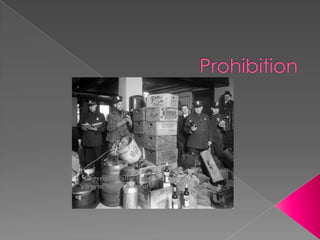
What was prohibition?Prohibition was a period for about 13 years where the making, distribution, and drinking otherwise sale of alcohol was illegal.Prohibition was also known as the Noble Experiment
The Noble ExperimentTemperance movements were growing in the mid-early 1900’s.Alcohol and drunkenness was thought to be the origin for crime in America.It was decided that they would ‘experiment’ to try to limit and control alcohol in America.
Why Prohibition?Lower crime ratesLower taxes for prisons and poorhousesImprove health in America as well as social and economic issues
When did Prohibition begin?It began January 6, 1920.It was put into effect by the eighteenth amendment.
ArgumentsThe two sides of prohibition were sometimes referred to as those for prohibition were the “dries,” and those against it were the “wets.”The dries wanted a safer nation.  They believed drunkenness and otherwise intoxicating beverages were the cause of corruption in America.The wets were mostly drunkards or regular alcohol drinkers.  Some major “dry” leaders, however, were not aiming for total prohibiting of alcohol, they just wanted it more moderately consumed, transported, and produced.
Volstead ActAlso called National Prohibition Act; It was written by Mr. Andrew Volstead, the Chairman of the House Judiciary Committee.This was created to clarify the eighteenth amendment.It gave more information on how the Prohibition law was supposed to be enforced.
SpeakeasiesAlthough it was illegal, alcohol was available at many speakeasies.These we exclusive clubs or bars that provided liquor.You could get into a speakeasy if you knew the location and has the correct password.Mid 1920’s was believed to have at least 100,000 of these illegal bars in just New York City.
A speakeasy
TechnicalitiesPeople began to come up with creative ways of how to smuggle liquor.Loopholes had been found in the Volstead Act and Prohibition law for some citizens to be able to have their liquor.The people did not follow the prohibition law and many regular citizens now had criminal offences.The increase of crime was also partly the government’s fault, who failed to properly enforce these laws.
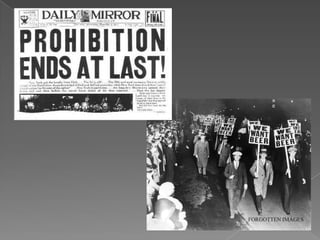
21st AmendmentThe Noble Experiment failed to control the alcohol or reduce crime in America.Ratified in December, 1933, the 21st amendment finally brought an end to national prohibition.America’s population of liquor drinkers were very happy and celebrated with more alcohol.The 21st amendment did not totally end prohibition across America.It allowed for the states to decide individually whether to be “wet” or “dry.”
Referenceshttp://alliance.ed.uiuc.edu/cdrom/hononegah/prohibition/speakeasies-s.htm http://www.albany.edu/~wm731882/21st_amendment_final.html http://www2.potsdam.edu/hansondj/Controversies/Volstead-Act.htmlhttp://www.google.com/imgres?imgurl=http://s1.eclectica.co.uk/img/lib/original/344.jpg&imgrefurlhttp://history1900s.about.com/od/1910s/a/18thamendment.htm
Prohibition- ko

Prohibition- ko