Alcohol and Tobacco use
adverse effects and prevention
Dr. Vanitha
Dept of Community medicine ,
SRMC &RI
Alcohol and Tobacco usage
 Drug abuse – Taking drug for reasons other than
medical reasons in quantity, strength, frequency
and manner which damage the social, physical and
mental functions - results in harm.
 Drug addiction – is the result of drug abuse which
produce both dependence and tolerance.
Alcohol and Tobacco adverse effects
and prevention
 Drug dependence – state resulting from the
interaction between a living organism and a drug,
characterized by a response that always makes a
compulsion to take drug continuously /periodically
to experience its psychic effects and often to avoid
the discomfort of its absence.
Types – physical and psychological dependence
Physical Dependence
 This state occurs when user's body becomes
accustomed to particular drug - requires the drug, in
increasing doses over a time, for normal functioning/
to obtain the same results as earlier, due- development
of 'tolerance' to drug. (Tolerance - requiring more &
more of a drug to get same effects)
 Abrupt stopping - Withdrawal symptoms.
 Whole life is focused on drug procurement and use
Psychological Dependence
 This state occurs when a drug is so central to a
person's thoughts, emotions and activities, that is
extremely difficult to stop using it or even stop
thinking about it.
 Psychological dependence is marked by an intense
craving for the drug'
Alcoholism
Body system or organ Established or suspected adverse health
effect of cigarette smoking
Lungs
•Lung cancer
•Chronic obstructive pulmonary disease
•Increased severity of asthma
•lncreased risk of developing various
•respiratory infections
Heart
•Coronary heart disease
•Angina pectoris
•Heart attack
•Increased risk of repeat heart attack
•Arrhythmia
•Aortic aneurysm
•Cardiomyopathy
Blood vessels
•Peripheral vascular disease
•Thromboangiitis obliterans
(Buerger's disease)
Skin
•Earlier wrinkling
•Fingernail discoloration
•Psoriasis
•Palmoplantar pustulosis
Cancer
•Lung cancer
•Esophageal cancer
•Laryngeal cancer
•Oral cancer
•Bladder cancer
•Kidney cancer
•Stomach cancer
•Pancreatic cancer
•Vulvular cancer
•Uervical cancer
•Colorectal cancer
Body system or organ Established or suspected adverse health
effect of cigarette smoking
Bones
•Disc degeneration
•Osteoporosis
•Osteoarthritis
•Less successful back surgery
•Delayed fracture healing
•Muscoloskeletal injury
Reproduction
•lnfertility
•Impoience
•Decreased sperm motility and density
•Miscarriage
•Earlier menopause
The Unborn Child
•Fetal growth retardation
•Prematurity
•Stillbirth
•Enhanced transmission of HIV to fetus
•Birth defects
•lntellectual impairment
•Sudden infant death syndrome
Brain
•Transient ischaemic attack
•Stroke
•Worsened muttiple sclerosis
Others
•Cataracts
•Macular
degeneration
•Snoring
•Periodontal disease
•Stomach and
duodenal ulcers
•Crohn disease
•Impaired immunity
A .Medical :
a.Gastro-intestinal Tract
 Gastritis
 Dyspepsia
 Vomiting
 Peptic ulcer
 Cancer
Adverse effects of Alcohol
Gastro intestinal system (continued) -
Reflex-oesophagitis
 Carcinoma of stomach and oesophagus,
larynx, liver, colon
 Fatty degeneration of the liver, interferes with
absorption of vitamin B-complex
 Cirrhosis of liver
 Hepatitis, Jaundice
 Liver cell carcinoma
 Acute and chronic
 pancreatitis
b. Cardiovascular System :
 Cardiomyopathy
 Hypertension
 Heart failure or stroke
 High risk for myocardial infarction.
c. Blood :
 Folic acid deficiency anaemia
 Decreased WBC production causes
infections
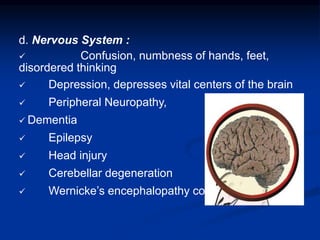
d. Nervous System :
 Confusion, numbness of hands, feet,
disordered thinking
 Depression, depresses vital centers of the brain
 Peripheral Neuropathy,
 Dementia
 Epilepsy
 Head injury
 Cerebellar degeneration
 Wernicke’s encephalopathy coma
e. Hormonal :
 Hypoglycemia
f. Muscle :
 Peripheral muscle weakness
 Wasting of muscles g. Bones :
 Interferes with the production of bones
 Thinning of bones, osteoporosis
 Fractures
I. Reproductive System :
 Sexual dysfunction in male
 Failure of ovulation in female
 Interruption in menstruation
j. Nutritional Deficiency Diseases :
 PEM
 B complex deficiency-Pellagra, Beriberi
k. Pregnancy :
 Fetal abnormalities
 Developmental disabilities- Mental
retardation, Growth retardation
 Low birth weight
 Still birth
 Birth defects
 Foetal alcohol syndrome
Social Complications :
 Domestic abuse, divorce,
poor performance in school
and at work.
 Prone for motor vehicle
accidents, susceptible for
accidental injuries, violence
acts,e.g. murder, reduced
productivity.
Any rapid decrease in the amount of alcohol
content in blood will produce withdrawal symptom
1 Simple Withdrawal Syndrome :
 Mild tremors, weakness
 Nausea ,vomiting
Irritability , Insomnia,
  Insomnia , Anxiety
 Tachycardia
 Hypertension
 Impaired attention
2 Delirium Tremors
3.ALCOHOLIC PARANOID : characterized by
suspicious nature, decreased sexual potency.
4.ALCOHOLIC HALLUCINATIONS
5.Dementia
6.Wernicke encephalopathy
7. 7.Korsakoff's syndrome: (amnesic-
confabulatory syndrome)is a brain disorder caused
by the lack of thiamine (vitamin B1) in the brain
Withdrawal syndrome (continued)
q CAGE questionnaire : named for its four type of
questions, is used to screen patients.
Two "yes" responses indicate that the respondent
should be investigated further. Eg-
 Have you ever felt you needed to Cut down
on your drinking?
 Have people Annoyed you by criticizing your
drinking?
 Have you ever felt Guilty about drinking?
 Have you ever felt you needed a drink first thing in
the morning (Eye-opener) to steady your nerves or to
get rid of a hangover?
OTHER SCREENING TEST AVAILABLE :
 Alcohol Dependence Data Questionnaire
 Michigan Alcohol Screening Test
 Alcohol Use Disorders Identification Test
(AUDIT)
Paddington Alcohol Test (PAT)
Urine and blood tests :
 Blood alcohol content (BAC).
 Treatment involves the replacement or
supplementation of thiamine by IV or IM
injection, together with proper nutrition
and hydration. However, the amnesia
and brain damage caused by the disease
does not always respond to thiamine
replacement therapy. So in some cases,
drug therapy is recommended
De-addiction procedure - steps
 Identification of the drug addicts
 Motivation for detoxification and Medical treatment
 Hospitalization -provide fear therapy, psychotherapy,
counseling
 Change of the environment
 Post-detoxification counseling to prevent relapse
 rehabilitation
q Detoxification :
 Alcohol detoxification or 'detox' for alcoholics is an
abrupt stop of alcohol drinking coupled with the
substitution of drugs that have similar effects to prevent
alcohol withdrawal.
 It treats the physical effects of prolonged use of alcohol,
but does not actually treat alcoholism. After detox is
complete, relapse is likely without further treatment.
q Drugs used for this are :
 Benzodiazepines – chlordiazep 80-
200mg/day.
 Diazepam 40-80 mg/day
 Thiamine 100 mg IM for 3-5 days followed by
vitamin b administration 100 mg OD
for atleast 6 months.
 Anticonvulsants can be given if necessary.
 Used for over 30 years.
 Works on principle of classical
conditioning.
 300-600 mg of drug mixed in alcohol
is given to the client for 6-8 times in a
week.
 fear of recurrence of reaction deters
him from taking alcohol.
 Detoxication to be done in the
hospital only.
 Still relapse rates are high.
 Soon after the ingestion of drug, adverse
reaction starts appearing and may last for 30-
120 minutes. Reaction consists of :
 Facial flushing , sweating
 Throbbing headache , Neck pain
 Tachycardia ,Respiratory distress
 Potentially serious drop in B.P.
 Nausea and vomiting.
 In severe disulfram reaction, diphenhydramine
hydrochloride 50 mg IM or IV is given.
 It must be taken daily atleast for 6-8 days,
period can last for upto 2 weeks.
 Alcohol containing substances (hidden alcohol) can
trigger the side effects, so these should be avoided.
These are :
 Foods as soups, apple ciders, anything made with wine
vinegar as pickles, flavour extracts used in cooking.
Medicines include cold and cough syrups, mouth
washes, vitamin and mineral tonics.
 Skin preparations include alcohol rubs, after shave
lotions, transdermal patches.
 Avoid inhaling fumes, substances that contain
alcohol as paints.
q It is an opoid antagonist which is now approved for
treatment of alcoholism. Unlike disulfram, it decreases
the pleasant and reinforcing effects of alcohol without
making the user ill.
MOTIVATIONAL INTERVIEWING :
 Explaining the complications and personal risks of
consuming alcohol
 Availability of treatment options to change their
behaviour related to alcohol consumption.
q INDIVIDUAL PSYCHOTHERAPY :
 Educate about the effects of alcohol consumption
and the coping strategies to overcome the habit.
 Precautionary measures, diversional activities.
 Methods to prevent occurrence of
complications.
q GROUP THERAPY :
 Observe the problems of alcoholic
 Provide oppurtunities to observe other problems and discuss
with each other.
 Explain them the better ways of coping with problems.
q COUNSELLING :
 To find out the problems and to solve them.
To guide about various methods to relax
mind and engaging themselves in productive
activities
q AVERSIVE COUNSELLING : Based on
principle of classical Condition in
 Explain the behaviour pattern which are
pleasurable, pros and cons of alcoholism,
maladaptive behaviour.
 Explain about the complications
of alcoholism and family complications.
q COGNITIVE THERAPY :
 Help the client to identify the maladaptive thinking
patterns; evil effects of alcoholism.
 To guide the individual to slowly reduce the dose of
alcohol intake and by understanding the evil effects of
alcohol.
q RELAPSE PREVENTION TECHNIQUE :
 It helps the client :
 Identify high risk relapse factors and develop
strategies to deal with them.
 Learn the methods to cope up with cognitive
distortions.
q CUE EXPOSURE TECHNIQUE :
Repeated exposures to desensitise the clients to the effects
of alcohol and thus improve their ability to remain abstinent.
q Client is exposed to adverse effects of
excessive alcohol consumption like chemical induced
vomiting, shock etc. thereby develops aversion towards the
evil habbits.
q SUPPORTIVE PSYCHOTHERAPY :
Symtomatic treatment along with educating the individual
about preventive measures against complications.
q BEHAVIOUR MODIFICATION TECHNIQUES:
 Systematic desensitization
 Relaxation techniques
 Operant conditioning
q FAMILY THERAPY :
 If the head of family develops
alcoholism, family will be affected with
economic crisis, maladjustment. Thus the
family need to be educated about
various cpoing strategies, evil effects of
alcoholism to children and preventive
measures to adopt.
qParents :
 Provide the child with a secure, stable home
environment (lack of love - cause of taking alcohol)
 Keep the child occupied .Provide opportunities for
sports, hobbies and other useful activities that could
stand him away from evil outlets.
 Keep the children informed about hazards of alcohol
addiction and how to stay away from people and
places that can influence him.
Prevention and control of drug abuse
Promote a well knit family feeling of interdependence .It
will lead to feeling of being wanted and loved.
Parents should build a relationship of mutual truth and
understanding. A healthy loving parent child relationship
can be a great help to avoid alcohol addiction.
 Individualisation :to establish mutual respect, parents
should began respecting the child as human being in his
own right.
 Taking time for recreation: Parents should
spend time with children in regard to their hobbies and
interests.
 Encouragement: Family and friends need to
know the child’s strength and help him to accept his
weakness in order to cope with the realities of life
 Communicating love :Children should be
dealt with love, sympathy, security and sense of well
being.
q Encountering alcohol abuse: Family should
not over react when they come to know about the
chemical dependence of the person .
 They should keep all lines of communication
open. Family should speak to his friends ,inform his
teacher and should consult for professional
evaluation.
 Accepting the fact: The professionals should
let the person recognize his alcohol depending and
that he is suffering with a disease and needs to be
controlled. Recognizing their reality means half their
battle won.
Confrontation:
If the person does not accept the disease , then
confront him. Family should talk honestly and
without anger, should describe their anger only
when the person can understand it and should be
specific while talking to the client.
At Community Level -
 Educational approach: Public campaigns on TV etc.,
Educational programs are arranged-school children.
Make the school and surroundings a drug-free zone.
 Service approach: Teen-centers to be established -
Make them healthy and active by participating in
sports, music, gymnasium, artistic activities, etc. and
prevent them from drifting in to drug taking.
 Self-help groups to be established, consisting of ex-
addicts, who encourage those who want to give up
the habit of taking drugs. They will be influenced and
leave the habit in course of time.
At Community Level –
 Legal approach: - Legislation may be directed at
various levels such as manufacture, distribution,
prescription, price, advertisements, consumption etc
 The related Public Health Act is 'Narcotic Drugs and
Psycho-trophtic Substances Act' 1985.
Rehabilitation
 changes in environment (home, school, college,
social circles) are important.
 Patient must effect a complete break with his group,
otherwise the chances of relapse are 100 per cent.
 If he has lost his job- given skilled training and
placed in appropriate job - relapses are frequent.
 Vocational training and sheltered work opportunities
are useful - prevent relapse.
Antismoking measures are :
q (a) prohibition of sale of tobacco products to minors;
 (b) restriction on sale of cigarettes from vending machines;
 (c) prohibition of smoking in schools and other places
frequented by young people;
 (d) prohibition of smoking in public place
 (e) prohibition of cigarette advertising at times, and in places
and ways, calculated to ensure its maximum impact on
adolescents;
Antismoking measures are :
(f) establishment of mandatory public health education on
health consequences of smoking;
(g) insisting on the placing of mandatory health warning on
cigarette packets.
The minimum age at which minors may legally have access
to alcoholic beverages, has been raised in some countries.
There is also legislation controlling the distribution of alcohol
in some countries. Mandatory jail sentences for drunken
driving have not been very effective.
alcohol prevention

alcohol prevention

  • 1.
    Alcohol and Tobaccouse adverse effects and prevention Dr. Vanitha Dept of Community medicine , SRMC &RI
  • 2.
    Alcohol and Tobaccousage  Drug abuse – Taking drug for reasons other than medical reasons in quantity, strength, frequency and manner which damage the social, physical and mental functions - results in harm.  Drug addiction – is the result of drug abuse which produce both dependence and tolerance.
  • 3.
    Alcohol and Tobaccoadverse effects and prevention  Drug dependence – state resulting from the interaction between a living organism and a drug, characterized by a response that always makes a compulsion to take drug continuously /periodically to experience its psychic effects and often to avoid the discomfort of its absence. Types – physical and psychological dependence
  • 4.
    Physical Dependence  Thisstate occurs when user's body becomes accustomed to particular drug - requires the drug, in increasing doses over a time, for normal functioning/ to obtain the same results as earlier, due- development of 'tolerance' to drug. (Tolerance - requiring more & more of a drug to get same effects)  Abrupt stopping - Withdrawal symptoms.  Whole life is focused on drug procurement and use
  • 5.
    Psychological Dependence  Thisstate occurs when a drug is so central to a person's thoughts, emotions and activities, that is extremely difficult to stop using it or even stop thinking about it.  Psychological dependence is marked by an intense craving for the drug'
  • 6.
  • 7.
    Body system ororgan Established or suspected adverse health effect of cigarette smoking Lungs •Lung cancer •Chronic obstructive pulmonary disease •Increased severity of asthma •lncreased risk of developing various •respiratory infections Heart •Coronary heart disease •Angina pectoris •Heart attack •Increased risk of repeat heart attack •Arrhythmia •Aortic aneurysm •Cardiomyopathy Blood vessels •Peripheral vascular disease •Thromboangiitis obliterans (Buerger's disease) Skin •Earlier wrinkling •Fingernail discoloration •Psoriasis •Palmoplantar pustulosis Cancer •Lung cancer •Esophageal cancer •Laryngeal cancer •Oral cancer •Bladder cancer •Kidney cancer •Stomach cancer •Pancreatic cancer •Vulvular cancer •Uervical cancer •Colorectal cancer
  • 8.
    Body system ororgan Established or suspected adverse health effect of cigarette smoking Bones •Disc degeneration •Osteoporosis •Osteoarthritis •Less successful back surgery •Delayed fracture healing •Muscoloskeletal injury Reproduction •lnfertility •Impoience •Decreased sperm motility and density •Miscarriage •Earlier menopause The Unborn Child •Fetal growth retardation •Prematurity •Stillbirth •Enhanced transmission of HIV to fetus •Birth defects •lntellectual impairment •Sudden infant death syndrome Brain •Transient ischaemic attack •Stroke •Worsened muttiple sclerosis Others •Cataracts •Macular degeneration •Snoring •Periodontal disease •Stomach and duodenal ulcers •Crohn disease •Impaired immunity
  • 9.
    A .Medical : a.Gastro-intestinalTract  Gastritis  Dyspepsia  Vomiting  Peptic ulcer  Cancer Adverse effects of Alcohol
  • 10.
    Gastro intestinal system(continued) - Reflex-oesophagitis  Carcinoma of stomach and oesophagus, larynx, liver, colon  Fatty degeneration of the liver, interferes with absorption of vitamin B-complex  Cirrhosis of liver  Hepatitis, Jaundice  Liver cell carcinoma  Acute and chronic  pancreatitis
  • 11.
    b. Cardiovascular System:  Cardiomyopathy  Hypertension  Heart failure or stroke  High risk for myocardial infarction. c. Blood :  Folic acid deficiency anaemia  Decreased WBC production causes infections
  • 12.
    d. Nervous System:  Confusion, numbness of hands, feet, disordered thinking  Depression, depresses vital centers of the brain  Peripheral Neuropathy,  Dementia  Epilepsy  Head injury  Cerebellar degeneration  Wernicke’s encephalopathy coma
  • 13.
    e. Hormonal : Hypoglycemia f. Muscle :  Peripheral muscle weakness  Wasting of muscles g. Bones :  Interferes with the production of bones  Thinning of bones, osteoporosis  Fractures
  • 14.
    I. Reproductive System:  Sexual dysfunction in male  Failure of ovulation in female  Interruption in menstruation j. Nutritional Deficiency Diseases :  PEM  B complex deficiency-Pellagra, Beriberi
  • 15.
    k. Pregnancy : Fetal abnormalities  Developmental disabilities- Mental retardation, Growth retardation  Low birth weight  Still birth  Birth defects  Foetal alcohol syndrome
  • 16.
    Social Complications : Domestic abuse, divorce, poor performance in school and at work.  Prone for motor vehicle accidents, susceptible for accidental injuries, violence acts,e.g. murder, reduced productivity.
  • 17.
    Any rapid decreasein the amount of alcohol content in blood will produce withdrawal symptom 1 Simple Withdrawal Syndrome :  Mild tremors, weakness  Nausea ,vomiting Irritability , Insomnia,   Insomnia , Anxiety  Tachycardia  Hypertension  Impaired attention
  • 18.
    2 Delirium Tremors 3.ALCOHOLICPARANOID : characterized by suspicious nature, decreased sexual potency. 4.ALCOHOLIC HALLUCINATIONS 5.Dementia 6.Wernicke encephalopathy 7. 7.Korsakoff's syndrome: (amnesic- confabulatory syndrome)is a brain disorder caused by the lack of thiamine (vitamin B1) in the brain Withdrawal syndrome (continued)
  • 19.
    q CAGE questionnaire: named for its four type of questions, is used to screen patients. Two "yes" responses indicate that the respondent should be investigated further. Eg-  Have you ever felt you needed to Cut down on your drinking?  Have people Annoyed you by criticizing your drinking?  Have you ever felt Guilty about drinking?  Have you ever felt you needed a drink first thing in the morning (Eye-opener) to steady your nerves or to get rid of a hangover?
  • 20.
    OTHER SCREENING TESTAVAILABLE :  Alcohol Dependence Data Questionnaire  Michigan Alcohol Screening Test  Alcohol Use Disorders Identification Test (AUDIT) Paddington Alcohol Test (PAT) Urine and blood tests :  Blood alcohol content (BAC).
  • 21.
     Treatment involvesthe replacement or supplementation of thiamine by IV or IM injection, together with proper nutrition and hydration. However, the amnesia and brain damage caused by the disease does not always respond to thiamine replacement therapy. So in some cases, drug therapy is recommended
  • 22.
    De-addiction procedure -steps  Identification of the drug addicts  Motivation for detoxification and Medical treatment  Hospitalization -provide fear therapy, psychotherapy, counseling  Change of the environment  Post-detoxification counseling to prevent relapse  rehabilitation
  • 23.
    q Detoxification : Alcohol detoxification or 'detox' for alcoholics is an abrupt stop of alcohol drinking coupled with the substitution of drugs that have similar effects to prevent alcohol withdrawal.  It treats the physical effects of prolonged use of alcohol, but does not actually treat alcoholism. After detox is complete, relapse is likely without further treatment.
  • 24.
    q Drugs usedfor this are :  Benzodiazepines – chlordiazep 80- 200mg/day.  Diazepam 40-80 mg/day  Thiamine 100 mg IM for 3-5 days followed by vitamin b administration 100 mg OD for atleast 6 months.  Anticonvulsants can be given if necessary.
  • 25.
     Used forover 30 years.  Works on principle of classical conditioning.  300-600 mg of drug mixed in alcohol is given to the client for 6-8 times in a week.  fear of recurrence of reaction deters him from taking alcohol.  Detoxication to be done in the hospital only.  Still relapse rates are high.
  • 26.
     Soon afterthe ingestion of drug, adverse reaction starts appearing and may last for 30- 120 minutes. Reaction consists of :  Facial flushing , sweating  Throbbing headache , Neck pain  Tachycardia ,Respiratory distress  Potentially serious drop in B.P.  Nausea and vomiting.  In severe disulfram reaction, diphenhydramine hydrochloride 50 mg IM or IV is given.
  • 27.
     It mustbe taken daily atleast for 6-8 days, period can last for upto 2 weeks.  Alcohol containing substances (hidden alcohol) can trigger the side effects, so these should be avoided. These are :  Foods as soups, apple ciders, anything made with wine vinegar as pickles, flavour extracts used in cooking.
  • 28.
    Medicines include coldand cough syrups, mouth washes, vitamin and mineral tonics.  Skin preparations include alcohol rubs, after shave lotions, transdermal patches.  Avoid inhaling fumes, substances that contain alcohol as paints.
  • 29.
    q It isan opoid antagonist which is now approved for treatment of alcoholism. Unlike disulfram, it decreases the pleasant and reinforcing effects of alcohol without making the user ill.
  • 30.
    MOTIVATIONAL INTERVIEWING : Explaining the complications and personal risks of consuming alcohol  Availability of treatment options to change their behaviour related to alcohol consumption.
  • 31.
    q INDIVIDUAL PSYCHOTHERAPY:  Educate about the effects of alcohol consumption and the coping strategies to overcome the habit.  Precautionary measures, diversional activities.  Methods to prevent occurrence of complications. q GROUP THERAPY :  Observe the problems of alcoholic  Provide oppurtunities to observe other problems and discuss with each other.  Explain them the better ways of coping with problems.
  • 32.
    q COUNSELLING : To find out the problems and to solve them. To guide about various methods to relax mind and engaging themselves in productive activities q AVERSIVE COUNSELLING : Based on principle of classical Condition in  Explain the behaviour pattern which are pleasurable, pros and cons of alcoholism, maladaptive behaviour.  Explain about the complications of alcoholism and family complications.
  • 33.
    q COGNITIVE THERAPY:  Help the client to identify the maladaptive thinking patterns; evil effects of alcoholism.  To guide the individual to slowly reduce the dose of alcohol intake and by understanding the evil effects of alcohol.
  • 34.
    q RELAPSE PREVENTIONTECHNIQUE :  It helps the client :  Identify high risk relapse factors and develop strategies to deal with them.  Learn the methods to cope up with cognitive distortions.
  • 35.
    q CUE EXPOSURETECHNIQUE : Repeated exposures to desensitise the clients to the effects of alcohol and thus improve their ability to remain abstinent. q Client is exposed to adverse effects of excessive alcohol consumption like chemical induced vomiting, shock etc. thereby develops aversion towards the evil habbits. q SUPPORTIVE PSYCHOTHERAPY : Symtomatic treatment along with educating the individual about preventive measures against complications. q BEHAVIOUR MODIFICATION TECHNIQUES:  Systematic desensitization  Relaxation techniques  Operant conditioning
  • 36.
    q FAMILY THERAPY:  If the head of family develops alcoholism, family will be affected with economic crisis, maladjustment. Thus the family need to be educated about various cpoing strategies, evil effects of alcoholism to children and preventive measures to adopt.
  • 37.
    qParents :  Providethe child with a secure, stable home environment (lack of love - cause of taking alcohol)  Keep the child occupied .Provide opportunities for sports, hobbies and other useful activities that could stand him away from evil outlets.  Keep the children informed about hazards of alcohol addiction and how to stay away from people and places that can influence him. Prevention and control of drug abuse
  • 38.
    Promote a wellknit family feeling of interdependence .It will lead to feeling of being wanted and loved. Parents should build a relationship of mutual truth and understanding. A healthy loving parent child relationship can be a great help to avoid alcohol addiction.  Individualisation :to establish mutual respect, parents should began respecting the child as human being in his own right.
  • 39.
     Taking timefor recreation: Parents should spend time with children in regard to their hobbies and interests.  Encouragement: Family and friends need to know the child’s strength and help him to accept his weakness in order to cope with the realities of life  Communicating love :Children should be dealt with love, sympathy, security and sense of well being.
  • 40.
    q Encountering alcoholabuse: Family should not over react when they come to know about the chemical dependence of the person .  They should keep all lines of communication open. Family should speak to his friends ,inform his teacher and should consult for professional evaluation.
  • 41.
     Accepting thefact: The professionals should let the person recognize his alcohol depending and that he is suffering with a disease and needs to be controlled. Recognizing their reality means half their battle won. Confrontation: If the person does not accept the disease , then confront him. Family should talk honestly and without anger, should describe their anger only when the person can understand it and should be specific while talking to the client.
  • 42.
    At Community Level-  Educational approach: Public campaigns on TV etc., Educational programs are arranged-school children. Make the school and surroundings a drug-free zone.  Service approach: Teen-centers to be established - Make them healthy and active by participating in sports, music, gymnasium, artistic activities, etc. and prevent them from drifting in to drug taking.  Self-help groups to be established, consisting of ex- addicts, who encourage those who want to give up the habit of taking drugs. They will be influenced and leave the habit in course of time.
  • 43.
    At Community Level–  Legal approach: - Legislation may be directed at various levels such as manufacture, distribution, prescription, price, advertisements, consumption etc  The related Public Health Act is 'Narcotic Drugs and Psycho-trophtic Substances Act' 1985.
  • 44.
    Rehabilitation  changes inenvironment (home, school, college, social circles) are important.  Patient must effect a complete break with his group, otherwise the chances of relapse are 100 per cent.  If he has lost his job- given skilled training and placed in appropriate job - relapses are frequent.  Vocational training and sheltered work opportunities are useful - prevent relapse.
  • 45.
    Antismoking measures are: q (a) prohibition of sale of tobacco products to minors;  (b) restriction on sale of cigarettes from vending machines;  (c) prohibition of smoking in schools and other places frequented by young people;  (d) prohibition of smoking in public place  (e) prohibition of cigarette advertising at times, and in places and ways, calculated to ensure its maximum impact on adolescents;
  • 46.
    Antismoking measures are: (f) establishment of mandatory public health education on health consequences of smoking; (g) insisting on the placing of mandatory health warning on cigarette packets. The minimum age at which minors may legally have access to alcoholic beverages, has been raised in some countries. There is also legislation controlling the distribution of alcohol in some countries. Mandatory jail sentences for drunken driving have not been very effective.

Editor's Notes