November 2005 
The Albanian Language/ Gjuha shqipe for Invitees 
Albanian for Invitees, Peace Corps/Albania Page 1 of 30
November 2005 
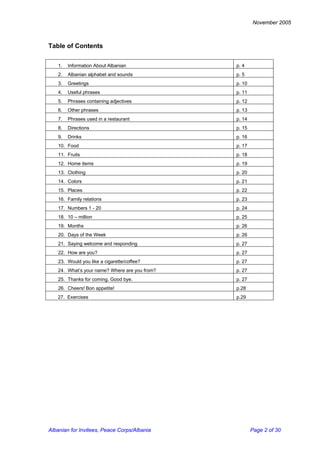
Table of Contents 
1. Information About Albanian 
p. 4 
2. Albanian alphabet and sounds 
p. 5 
3. Greetings 
p. 10 
4. Useful phrases 
p. 11 
5. Phrases containing adjectives 
p. 12 
6. Other phrases 
p. 13 
7. Phrases used in a restaurant 
p. 14 
8. Directions 
p. 15 
9. Drinks 
p. 16 
10. Food 
p. 17 
11. Fruits 
p. 18 
12. Home items 
p. 19 
13. Clothing 
p. 20 
14. Colors 
p. 21 
15. Places 
p. 22 
16. Family relations 
p. 23 
17. Numbers 1 - 20 
p. 24 
18. 10 – million 
p. 25 
19. Months 
p. 26 
20. Days of the Week 
p. 26 
21. Saying welcome and responding 
p. 27 
22. How are you? 
p. 27 
23. Would you like a cigarette/coffee? 
p. 27 
24. What’s your name? Where are you from? 
p. 27 
25. Thanks for coming. Good bye. 
p. 27 
26. Cheers! Bon appetite! 
p.28 
27. Exercises 
p.29 
Albanian for Invitees, Peace Corps/Albania Page 2 of 30
November 2005 
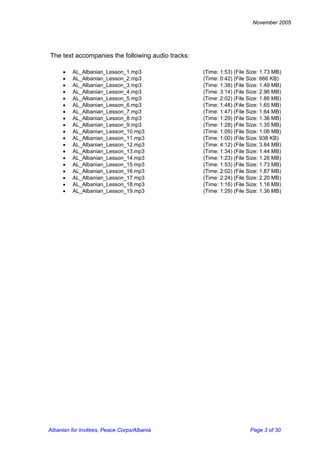
The text accompanies the following audio tracks: 
• AL_Albanian_Lesson_1.mp3 (Time: 1:53) (File Size: 1.73 MB) 
• AL_Albanian_Lesson_2.mp3 (Time: 0:42) (File Size: 666 KB) 
• AL_Albanian_Lesson_3.mp3 (Time: 1:38) (File Size: 1.49 MB) 
• AL_Albanian_Lesson_4.mp3 (Time: 3:14) (File Size: 2.96 MB) 
• AL_Albanian_Lesson_5.mp3 (Time: 2:02) (File Size: 1.86 MB) 
• AL_Albanian_Lesson_6.mp3 (Time: 1:48) (File Size: 1.65 MB) 
• AL_Albanian_Lesson_7.mp3 (Time: 1:47) (File Size: 1.64 MB) 
• AL_Albanian_Lesson_8.mp3 (Time: 1:29) (File Size: 1.36 MB) 
• AL_Albanian_Lesson_9.mp3 (Time: 1:28) (File Size: 1.35 MB) 
• AL_Albanian_Lesson_10.mp3 (Time: 1:09) (File Size: 1.06 MB) 
• AL_Albanian_Lesson_11.mp3 (Time: 1:00) (File Size: 938 KB) 
• AL_Albanian_Lesson_12.mp3 (Time: 4:12) (File Size: 3.84 MB) 
• AL_Albanian_Lesson_13.mp3 (Time: 1:34) (File Size: 1.44 MB) 
• AL_Albanian_Lesson_14.mp3 (Time: 1:23) (File Size: 1.26 MB) 
• AL_Albanian_Lesson_15.mp3 (Time: 1:53) (File Size: 1.73 MB) 
• AL_Albanian_Lesson_16.mp3 (Time: 2:02) (File Size: 1.87 MB) 
• AL_Albanian_Lesson_17.mp3 (Time: 2:24) (File Size: 2.20 MB) 
• AL_Albanian_Lesson_18.mp3 (Time: 1:16) (File Size: 1.16 MB) 
• AL_Albanian_Lesson_19.mp3 (Time: 1:29) (File Size: 1.36 MB) 
Albanian for Invitees, Peace Corps/Albania Page 3 of 30
November 2005 
Information about Albanian 
The Albanian language belongs to the family of Indo-European languages. It is one of the oldest languages, yet different from the others. Albanian language seems to have kept its own features from very ancient times. The earliest text in Albanian known so far is the "Baptizing Formula", written in 1462. Historically, unified national literary Albanian can be traced to 1908, when the decision was made to accept the Latin alphabet. Since 1972, the unified literary language remains the only one used in Albania and Yugoslavia. 
Albanian language is spelled more or less phonetically. Each letter has a specific sound that doesn't change in the context, making its reading and writing rather easy. As a rule, Albanian spelling corresponds to the pronunciation of words quite directly. The alphabet has 36 letters, 29 consonants and 7 vowels. There are two main dialects, the Geg dialect in the North of Albania and the Tosk dialect in the South. In spite of the differences of the two main dialects, both spoken and written Albanian are understood by all Albanians. Education and mass media have facilitated this process. Today Albanian is spoken by about 10 million people around the world, 3.5 million in Albania, 3 million in Yugoslavia (Kosovo, Macedonian, Serb and Montenegro), over 1 million in Turkey, as well as large groups of Albanians in South Italy (known as Arbereshe), Greece, Europe, USA, Canada and Australia. 
• Albanian is an inflected language, which means that grammatical endings play an indispensable role in the language grammatical system. 
• Nouns can have either a feminine or masculine gender (the neutral gender isn’t very common) 
• Depending on their role in the sentence (such as subject or object, nouns change their endings. The different roles they play are called cases. Albanian has five cases: Nominative (subject), Accusative (direct object), Dative (indirect object), Genitive (possession) and Ablative (nouns following prepositions). 
• Nouns can be either definite or indefinite. This is marked by their ending rather than an article like the English the. Even names of people and places can be definite. The capital Tirana could then be literally translated as the Tiranë. 
• Adjectives change depending on the gender, number, definiteness and case of the noun they follow. 
• Instead of the pronouns (I work, you work, he she/it works, we work, you work, they work), verbs use endings (punoj, punon, punon, punojmë, punoni, punojnë). The pronouns exist (unë, ti, ai/ajo, ne, ju, ata/ato) but are used only for emphasis. 
• Compared to the English 14, Albanian only has 8 tenses whose use is very similar to their English equivalents. 
• Another prominent feature or Albanian is its clitics e/i and their forms which have many different functions. One of the language’s functions is the direct object pronoun: Unë e shoh. (I see it.) What may be confusing is that it is used even when the full object is there: Unë e shoh librin. (I see [it] the book.) 
Albanian for Invitees, Peace Corps/Albania Page 4 of 30
November 2005 
 Lesson 1: Albanian alphabet and sounds 
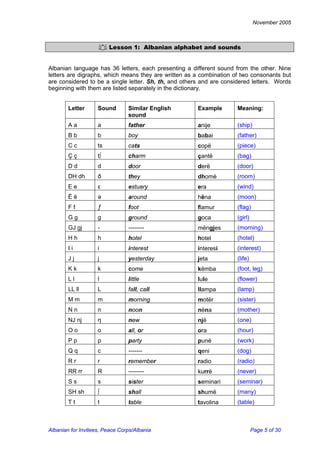
Albanian language has 36 letters, each presenting a different sound from the other. Nine letters are digraphs, which means they are written as a combination of two consonants but are considered to be a single letter. Sh, th, and others and are considered letters. Words beginning with them are listed separately in the dictionary. 
Letter 
Sound 
Similar English sound 
Example 
Meaning: 
A a 
a 
father 
anije 
(ship) 
B b 
b 
boy 
babai 
(father) 
C c 
ts 
cats 
copë 
(piece) 
Ç ç 
t∫ 
charm 
çantë 
(bag) 
D d 
d 
door 
derë 
(door) 
DH dh 
ð 
they 
dhomë 
(room) 
E e 
ε 
estuary 
era 
(wind) 
Ë ë 
ə 
around 
hëna 
(moon) 
F f 
ƒ 
foot 
flamur 
(flag) 
G g 
g 
ground 
goca 
(girl) 
GJ gj 
- 
-------- 
mëngjes 
(morning) 
H h 
h 
hotel 
hotel 
(hotel) 
I i 
i 
interest 
interesi 
(interest) 
J j 
j 
yesterday 
jeta 
(life) 
K k 
k 
come 
këmba 
(foot, leg) 
L l 
l 
little 
lule 
(flower) 
LL ll 
L 
fall, call 
llampa 
(lamp) 
M m 
m 
morning 
motër 
(sister) 
N n 
n 
noon 
nëna 
(mother) 
NJ nj 
η 
new 
një 
(one) 
O o 
o 
all, or 
ora 
(hour) 
P p 
p 
party 
punë 
(work) 
Q q 
c 
------- 
qeni 
(dog) 
R r 
r 
remember 
radio 
(radio) 
RR rr 
R 
-------- 
kurrë 
(never) 
S s 
s 
sister 
seminari 
(seminar) 
SH sh 
∫ 
shall 
shumë 
(many) 
T t 
t 
table 
tavolina 
(table) 
Albanian for Invitees, Peace Corps/Albania Page 5 of 30
November 2005 
TH th 
θ 
thank you 
thoni 
(speak) 
U u 
u 
cook, foot 
ura 
(bridge) 
V v 
v 
very 
vera 
(wine) 
X x 
dz 
-------- 
xixë 
(spark) 
XH xh 
d 
joke 
xhaxha 
(uncle) 
Y y 
y 
------- 
ylli 
(star) 
Z z 
z 
zoo, zero 
zogu 
(bird) 
ZH zh 
 
pleasure 
zhurmë 
(noise) 
 Lesson 2: Difficult sounds in Albanian 
These pairs of sounds are particularly difficult and often wrongly interchangeably when used: 
r 
rr 
l 
ll 
kur (when) 
kurrë (never) 
pula (hen) 
pulla (stamp) 
xh 
gj 
q 
ç 
xhaxha (uncle) 
gjellë (soup) 
qen (dog) 
çelës (key) 
Albanian for Invitees, Peace Corps/Albania Page 6 of 30
November 2005 
Sounds in Albanian Language 
(No Audio) 
Vowels 
Each of the vowels can be either short or long 
Case 
Name 
Phonetic symbol 
Note 
Ë ë 
Ë 
[ə] 
It is similar to the first vowel in English around when short, and to the vowel of burn when long. 
për [pər] for hënë [hə: n] 
A a 
A 
[a] 
It is similar to the English sound in cut when it is short, or cart when it is long. 
mal [mal] mountain zanë [za :n] fairy 
E e 
e 
[ε] 
It is very similar to the English sound as in get, dead, set etc. In Albanian it also has a long counterpart. 
vesh [vε ∫] ear bletë [blε: t] bee 
I i 
i 
[i] 
It is similar to the English sound as in hit, or as in meet if it is long. 
mik [mik] friend pikë [pi:k] point 
O o 
o 
[o] 
It is similar to the English hot when it is short, and thought when it is long. 
sot [sot] today botë[bo: t] world 
U u 
u 
[u] 
It is similar to the English bush when short, and moon when long. 
mbush[mbush] fill fushë[fu: ∫] field 
Consonants 
1.The following consonants: 
b[b], 
ç[t∫], 
f[f], 
g[g], 
j[j], 
m[m], 
n[n], 
s[s], 
sh[∫], 
v[v], 
xh[d], 
z[z], 
zh [] 
are like the initial English sounds in the following words: book, church, foot, goal, jet, moon, note, sheep, vowel, judgement, zipe and pleasure: 
bukë 
[bu:k] 
bread 
sa 
[sa] 
how ? 
çfarë 
[t∫ far] 
what? 
shikoj 
[∫ ikoj] 
to see 
Albanian for Invitees, Peace Corps/Albania Page 7 of 30
November 2005 
fik 
[fik] 
fig 
vit 
[vit] 
year 
gisht 
[gi∫t] 
finger 
xhep 
[dεp] 
pocket 
jam 
[jam] 
to be 
zi 
[zi] 
black 
me 
[mε] 
with 
zhurmë 
[u:rm] 
noise 
nesër 
[nεsər] 
tomorrow 
2. 
p[p], 
t[t], 
d[d], 
k[k] 
are pronounced like their English counterparts but are not aspirated even when they are in an initial position. They are similar to p, t, d and k in pen, top, door and skin. 
penë 
[pεn] 
pen 
derë 
[dεr] 
door 
tani 
[tani] 
now 
kokë 
[ko:k] 
head 
3. nj[η] is pronounced like the initial sounds in the English word new. 
njeri 
[ηεri] 
person 
4. h[h]is very similar to the English as in head, heat, etc. 
humb 
[humb] 
lose 
5. th[θ]and dh[ð]are similar to English in think and they, but in Albanian these two sounds tend to be more interdentally, that is, you put the tip of your tongue between teeth. 
thumb 
[θumb] 
sting 
dhe 
[ðε] 
and 
6. c [ts] is pronounce by trying to produce at the same time the sound [t] and [s], whereas 
x [dz] is pronounced by trying to produce at the same time the sound [d]and[z] 
ca 
[tsa] 
some 
xixë 
[dzi:dz] 
spark 
7. q [c] and gj [gj] are two consonants that do not exist in English. 
qaj 
[caj] 
cry 
gju 
[gju] 
knee 
8. r[r] is a single trill, whereas rr [R] involves more than one trill. 
risk 
[risk] 
risk 
rregull 
[ReguL] 
order 
9. l[l]is pronounced similarly to l in leaf or long, whereas ll[L]is more like the final sound in bill, hall, etc. 
lojë 
[lo:j] 
game 
lloj 
[Loj] 
kind 
Albanian for Invitees, Peace Corps/Albania Page 8 of 30
November 2005 
Syllables and word stress 
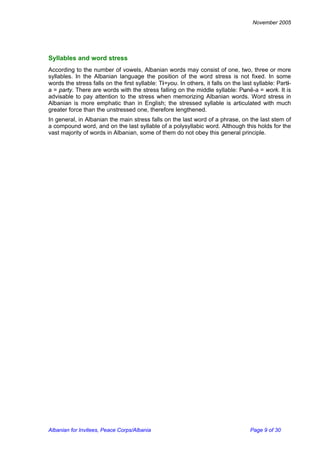
According to the number of vowels, Albanian words may consist of one, two, three or more syllables. In the Albanian language the position of the word stress is not fixed. In some words the stress falls on the first syllable: Ti=you. In others, it falls on the last syllable: Parti- a = party. There are words with the stress falling on the middle syllable: Punë-a = work. It is advisable to pay attention to the stress when memorizing Albanian words. Word stress in Albanian is more emphatic than in English; the stressed syllable is articulated with much greater force than the unstressed one, therefore lengthened. 
In general, in Albanian the main stress falls on the last word of a phrase, on the last stem of a compound word, and on the last syllable of a polysyllabic word. Although this holds for the vast majority of words in Albanian, some of them do not obey this general principle. 
Albanian for Invitees, Peace Corps/Albania Page 9 of 30
November 2005 
 Lesson 3: Greetings 
Përshendetje 
Welcome! 
Mirë se vini! 
Hello! 
Përshëndetje 
Good morning! 
Mirëmëngjes! 
Good afternoon! 
Mirëdita! 
Good evening ! 
Mirëmbrëma! 
Good bye! 
Mirupafshim! 
Please! 
Ju lutem! 
Excuse me. 
Më falni 
Thank you (very much)! 
Faleminderit (shumë)! 
Yes 
Po 
No 
Jo 
Albanian for Invitees, Peace Corps/Albania Page 10 of 30
November 2005 
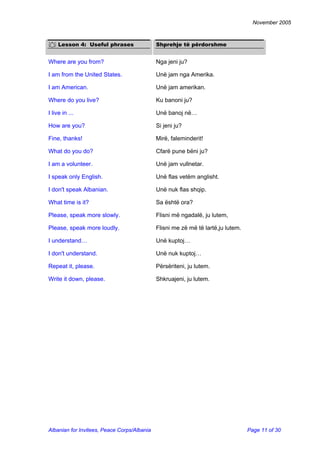
 Lesson 4: Useful phrases 
Shprehje të përdorshme 
Where are you from? 
Nga jeni ju? 
I am from the United States. 
Unë jam nga Amerika. 
I am American. 
Unë jam amerikan. 
Where do you live? 
Ku banoni ju? 
I live in ... 
Unë banoj në… 
How are you? 
Si jeni ju? 
Fine, thanks! 
Mirë, faleminderit! 
What do you do? 
Cfarë pune bëni ju? 
I am a volunteer. 
Unë jam vullnetar. 
I speak only English. 
Unë flas vetëm anglisht. 
I don't speak Albanian. 
Unë nuk flas shqip. 
What time is it? 
Sa është ora? 
Please, speak more slowly. 
Flisni më ngadalë, ju lutem, 
Please, speak more loudly. 
Flisni me zë më të lartë,ju lutem. 
I understand… 
Unë kuptoj… 
I don't understand. 
Unë nuk kuptoj… 
Repeat it, please. 
Përsëriteni, ju lutem. 
Write it down, please. 
Shkruajeni, ju lutem. 
Albanian for Invitees, Peace Corps/Albania Page 11 of 30
November 2005 
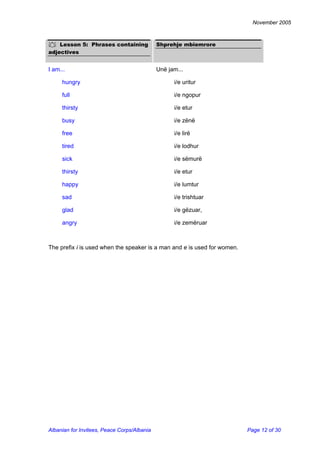
 Lesson 5: Phrases containing adjectives 
Shprehje mbiemrore 
I am... 
Unë jam... 
hungry 
i/e uritur 
full 
i/e ngopur 
thirsty 
i/e etur 
busy 
i/e zënë 
free 
i/e lirë 
tired 
i/e lodhur 
sick 
i/e sëmurë 
thirsty 
i/e etur 
happy 
i/e lumtur 
sad 
i/e trishtuar 
glad 
i/e gëzuar, 
angry 
i/e zemëruar 
The prefix i is used when the speaker is a man and e is used for women. 
Albanian for Invitees, Peace Corps/Albania Page 12 of 30
November 2005 
 Lesson 6: Other phrases 
Shprehje të tjera 
I need help. 
(Unë) Dua ndihmë. 
Look out! 
Kujdes! 
Listen! 
Dëgjoni! 
Can you help me? 
Mund të më ndihmoni? 
Can you tell me? 
Mund të më tregoni? 
I am looking for... 
Po kërkoj... 
I want to go… 
Unë dua të shkoj… 
I know 
(Unë) E di. 
I don't know 
(Unë) Nuk e di. 
I think so. 
(Unë) Mendoj kështu. 
I don't think so. 
(Unë) Nuk mendoj kështu. 
I believe, yes. 
(Unë) Besoj se po. 
I don’t believe. 
(Unë) Nuk besoj. 
Albanian for Invitees, Peace Corps/Albania Page 13 of 30
November 2005 
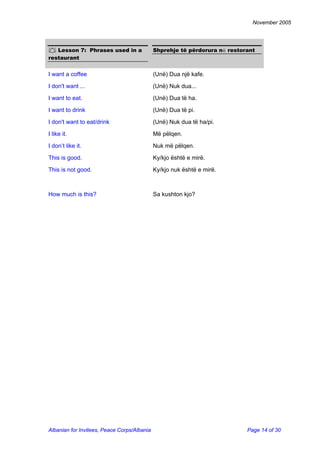
 Lesson 7: Phrases used in a restaurant 
Shprehje të përdorura në restorant 
I want a coffee 
(Unë) Dua një kafe. 
I don't want ... 
(Unë) Nuk dua... 
I want to eat. 
(Unë) Dua të ha. 
I want to drink 
(Unë) Dua të pi. 
I don't want to eat/drink 
(Unë) Nuk dua të ha/pi. 
I like it. 
Më pëlqen. 
I don’t like it. 
Nuk më pëlqen. 
This is good. 
Ky/kjo është e mirë. 
This is not good. 
Ky/kjo nuk është e mirë. 
How much is this? 
Sa kushton kjo? 
Albanian for Invitees, Peace Corps/Albania Page 14 of 30
November 2005 
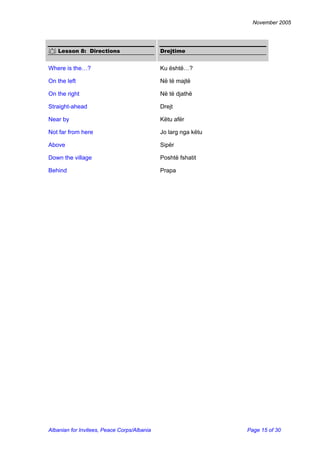
 Lesson 8: Directions 
Drejtime 
Where is the…? 
Ku është…? 
On the left 
Në të majtë 
On the right 
Në të djathë 
Straight-ahead 
Drejt 
Near by 
Këtu afër 
Not far from here 
Jo larg nga këtu 
Above 
Sipër 
Down the village 
Poshtë fshatit 
Behind 
Prapa 
Albanian for Invitees, Peace Corps/Albania Page 15 of 30
November 2005 
 Lesson 9: Drinks 
Pije 
water 
ujë 
coffee 
kafe 
tea 
çaj 
milk 
qumësht 
juice, lemonade 
limonatë 
mineral water 
ujë mineral 
wine 
verë 
beer 
birrë 
raki 
raki 
Albanian for Invitees, Peace Corps/Albania Page 16 of 30
November 2005 
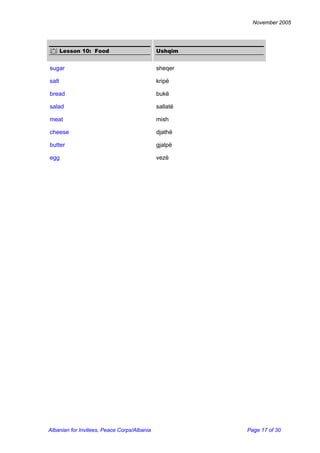
 Lesson 10: Food 
Ushqim 
sugar 
sheqer 
salt 
kripë 
bread 
bukë 
salad 
sallatë 
meat 
mish 
cheese 
djathë 
butter 
gjalpë 
egg 
vezë Albanian for Invitees, Peace Corps/Albania Page 17 of 30
November 2005 
 Lesson 11: Fruits 
Fruta 
grape 
rrush 
fig 
fik 
watermelon 
shalqi 
melon 
pjepër 
peach 
pjeshkë 
pear 
dardhë 
Albanian for Invitees, Peace Corps/Albania Page 18 of 30
November 2005 
 Lesson 12: Home items 
Artikuj shtëpiak 
glass 
gotë 
cup 
filxhan 
spoon 
lugë 
fork 
pirun 
knife 
thikë 
plate 
pjatë 
table 
tavolinë 
chair 
karrige 
door 
derë 
window 
dritare 
bed 
krevat 
bed sheet 
çarçaf 
blanket 
batanije 
pillow 
jastëk 
home 
shtëpi 
hotel 
hotel 
floor 
kat 
room 
dhomë 
bathroom 
banjë 
toilet 
banjë 
toilet paper 
letër higjenike 
soap 
sapun 
towel 
peshqir 
shampoo 
shampo 
kitchen 
guzhinë 
bedroom 
dhomë gjumi 
dining room / sitting room 
dhomë ngrënje / dhomë ndenje 
Albanian for Invitees, Peace Corps/Albania Page 19 of 30
November 2005 
 Lesson 13: Clothing 
Veshje 
pants 
pantallona 
blouse 
bluzë 
shirt 
këmishë 
dress 
fustan 
skirt 
fund 
shoes 
këpucë 
sandals 
sandale 
slippers 
shapka 
boots 
çizme 
jacket 
xhaketë 
coat 
pallto 
Albanian for Invitees, Peace Corps/Albania Page 20 of 30
November 2005 
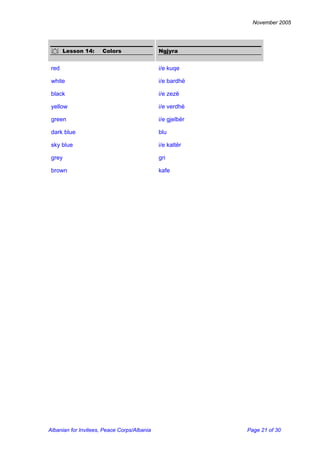
 Lesson 14: Colors 
Ngjyra 
red 
i/e kuqe 
white 
i/e bardhë 
black 
i/e zezë 
yellow 
i/e verdhë 
green 
i/e gjelbër 
dark blue 
blu 
sky blue 
i/e kaltër 
grey 
gri 
brown 
kafe 
Albanian for Invitees, Peace Corps/Albania Page 21 of 30
November 2005 
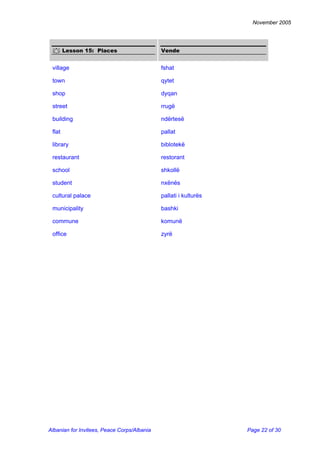
 Lesson 15: Places 
Vende 
village 
fshat 
town 
qytet 
shop 
dyqan 
street 
rrugë 
building 
ndërtesë 
flat 
pallat 
library 
biblotekë 
restaurant 
restorant 
school 
shkollë 
student 
nxënës 
cultural palace 
pallati i kulturës 
municipality 
bashki 
commune 
komunë 
office 
zyrë 
Albanian for Invitees, Peace Corps/Albania Page 22 of 30
November 2005 
 Lesson 16: Family relations 
Lidhjet familjare 
mother 
nënë 
father 
baba 
sister 
motër 
brother 
vëlla 
daughter 
e bija 
son 
i biri 
grandmother 
gjyshja 
grandfather 
gjyshi 
niece 
mbesa 
nephew 
nipi 
mother-in-law 
vjehrra 
father-in-law 
vjehrri 
sister-in-law 
kunata 
brother-in-law 
kunati 
Albanian for Invitees, Peace Corps/Albania Page 23 of 30
November 2005 
 Lesson 17: Numbers 1 - 20 
Numrat 1-20 
0 
zero 
1 
një 
2 
dy 
3 
tre 
4 
katër 
5 
pesë 
6 
gjashtë 
7 
shtatë 
8 
tetë 
9 
nëntë 
10 
dhjetë 
11 
njëmbëdhjetë 
12 
dymbëdhjetë 
13 
trembëdhjetë 
14 
katërmbëdhjetë 
15 
pesëmbëdhjetë 
16 
gjashtëmbëdhjetë 
17 
shtatëmbëdhjetë 
18 
tetëmbëdhjetë 
19 
nëntëmbëdhjetë 
20 
njëzetë 
Albanian for Invitees, Peace Corps/Albania Page 24 of 30
November 2005 
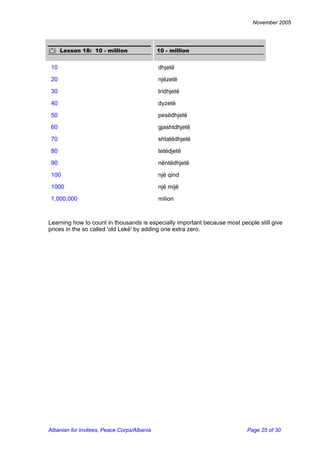
 Lesson 18: 10 - million 
10 - million 
10 
dhjetë 
20 
njëzetë 
30 
tridhjetë 
40 
dyzetë 
50 
pesëdhjetë 
60 
gjashtdhjetë 
70 
shtatëdhjetë 
80 
tetëdjetë 
90 
nëntëdhjetë 
100 
një qind 
1000 
një mijë 
1,000,000 
milion 
Learning how to count in thousands is especially important because most people still give prices in the so called 'old Lekë' by adding one extra zero. 
Albanian for Invitees, Peace Corps/Albania Page 25 of 30
November 2005 
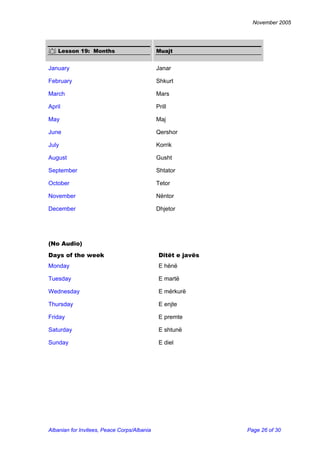
 Lesson 19: Months 
Muajt 
January 
Janar 
February 
Shkurt 
March 
Mars 
April 
Prill 
May 
Maj 
June 
Qershor 
July 
Korrik 
August 
Gusht 
September 
Shtator 
October 
Tetor 
November 
Nëntor 
December 
Dhjetor 
(No Audio) 
Days of the week 
Ditët e javës 
Monday 
E hënë 
Tuesday 
E martë 
Wednesday 
E mërkurë 
Thursday 
E enjte 
Friday 
E premte 
Saturday 
E shtunë 
Sunday 
E diel 
Albanian for Invitees, Peace Corps/Albania Page 26 of 30
November 2005 
Dialogs (no audio) 
Saying welcome and responding 
Mira: Mirë se vini! 
Beni: Mirë se ju gjeta! 
How are you? 
Mira: Si jeni? 
Beni: Mirë ,faleminderit! Po ju? 
Mira: Mirë,faleminderit! 
Would you like a cigarette/coffee? 
Mira: Doni një cigare? 
Beni: Jo, faleminderit. 
Mira: Doni një kafe? 
Beni: Po, faleminderit. 
What’s your name? Where are you from? 
Beni: Unë quhem Arben Marashi. Po ju si quheni? 
Mira : Unë quhem Mira Luca. 
Mira: Nga jeni ju? 
Beni: Unë jam nga Lezha. Po ju? 
Mira: Unë jam nga Tirana,unë banoj në Tiranë. 
Thanks for coming. Good bye. 
Mira: Faleminderit që erdhët. Shpresoj të shihemi së shpejti. 
Beni: Mirupafshim! 
Mira: Mirupafshim! 
Albanian for Invitees, Peace Corps/Albania Page 27 of 30
November 2005 
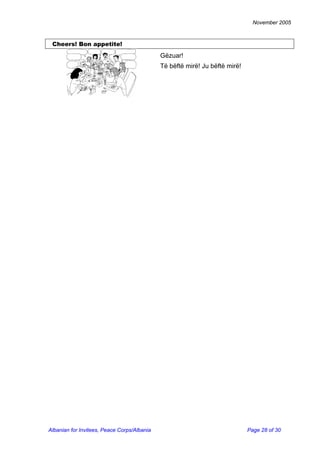
Cheers! Bon appetite! 
Gëzuar! 
Të bëftë mirë! Ju bëftë mirë! 
Albanian for Invitees, Peace Corps/Albania Page 28 of 30
November 2005 
Exercises 
Choose the correct answer. 
1. When someone greets you saying ‘Mirë se vini” what is the correct reply? 
a. Faleminderit 
b. Mirë se ju gjeta 
c. Mirupafshim 
2. “Unë jam nga Amerika” is the correct reply to: 
a. Si jeni? 
b. Nga jeni ju? 
c. Doni nje kafe? 
3. What would you like to drink? 
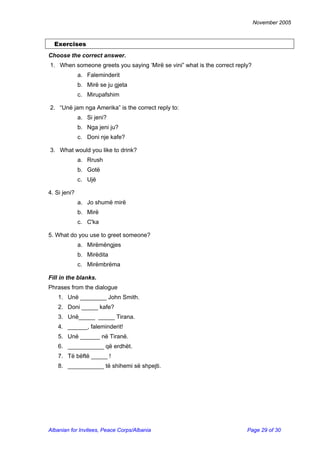
a. Rrush 
b. Gotë 
c. Ujë 
4. Si jeni? 
a. Jo shumë mirë 
b. Mirë 
c. C'ka 
5. What do you use to greet someone? 
a. Mirëmëngjes 
b. Mirëdita 
c. Mirëmbrëma 
Fill in the blanks. 
Phrases from the dialogue 
1. Unë ________ John Smith. 
2. Doni _____ kafe? 
3. Unë_____ _____ Tirana. 
4. ______, faleminderit! 
5. Unë ______ në Tiranë. 
6. ___________ që erdhët. 
7. Të bëftë _____ ! 
8. ___________ të shihemi së shpejti. 
Albanian for Invitees, Peace Corps/Albania Page 29 of 30
November 2005 
Other important Phrases 
1. Unë nuk _______ shqip. 
2. Kjo ________ e mirë. 
3. ____ kushton kjo? 
4. Unë ______ vullnetar. 
5. Flisni më ngadalë, ju ______. 
6. Cfarë pune ______ ju? 
7. Jo _____ nga këtu 
8. Unë _____ të pi. 
Find the word that does not belong to the group: 
1. Drinks 
a. Verë 
b. Qumësht 
c. Vezë 
2. Clothes 
a. Fustan 
b. Fshat 
c. Këpucë 
3. Fruits 
a. Shalqi 
b. Pjeshkë 
c. Gjalpë 
4. Weekdays 
a. E hënë 
b. E enjte 
c. E kuqe 
Albanian for Invitees, Peace Corps/Albania Page 30 of 30

Basic Albanian Language Course

  • 1.
    November 2005 TheAlbanian Language/ Gjuha shqipe for Invitees Albanian for Invitees, Peace Corps/Albania Page 1 of 30
  • 2.
    November 2005 Tableof Contents 1. Information About Albanian p. 4 2. Albanian alphabet and sounds p. 5 3. Greetings p. 10 4. Useful phrases p. 11 5. Phrases containing adjectives p. 12 6. Other phrases p. 13 7. Phrases used in a restaurant p. 14 8. Directions p. 15 9. Drinks p. 16 10. Food p. 17 11. Fruits p. 18 12. Home items p. 19 13. Clothing p. 20 14. Colors p. 21 15. Places p. 22 16. Family relations p. 23 17. Numbers 1 - 20 p. 24 18. 10 – million p. 25 19. Months p. 26 20. Days of the Week p. 26 21. Saying welcome and responding p. 27 22. How are you? p. 27 23. Would you like a cigarette/coffee? p. 27 24. What’s your name? Where are you from? p. 27 25. Thanks for coming. Good bye. p. 27 26. Cheers! Bon appetite! p.28 27. Exercises p.29 Albanian for Invitees, Peace Corps/Albania Page 2 of 30
  • 3.
    November 2005 Thetext accompanies the following audio tracks: • AL_Albanian_Lesson_1.mp3 (Time: 1:53) (File Size: 1.73 MB) • AL_Albanian_Lesson_2.mp3 (Time: 0:42) (File Size: 666 KB) • AL_Albanian_Lesson_3.mp3 (Time: 1:38) (File Size: 1.49 MB) • AL_Albanian_Lesson_4.mp3 (Time: 3:14) (File Size: 2.96 MB) • AL_Albanian_Lesson_5.mp3 (Time: 2:02) (File Size: 1.86 MB) • AL_Albanian_Lesson_6.mp3 (Time: 1:48) (File Size: 1.65 MB) • AL_Albanian_Lesson_7.mp3 (Time: 1:47) (File Size: 1.64 MB) • AL_Albanian_Lesson_8.mp3 (Time: 1:29) (File Size: 1.36 MB) • AL_Albanian_Lesson_9.mp3 (Time: 1:28) (File Size: 1.35 MB) • AL_Albanian_Lesson_10.mp3 (Time: 1:09) (File Size: 1.06 MB) • AL_Albanian_Lesson_11.mp3 (Time: 1:00) (File Size: 938 KB) • AL_Albanian_Lesson_12.mp3 (Time: 4:12) (File Size: 3.84 MB) • AL_Albanian_Lesson_13.mp3 (Time: 1:34) (File Size: 1.44 MB) • AL_Albanian_Lesson_14.mp3 (Time: 1:23) (File Size: 1.26 MB) • AL_Albanian_Lesson_15.mp3 (Time: 1:53) (File Size: 1.73 MB) • AL_Albanian_Lesson_16.mp3 (Time: 2:02) (File Size: 1.87 MB) • AL_Albanian_Lesson_17.mp3 (Time: 2:24) (File Size: 2.20 MB) • AL_Albanian_Lesson_18.mp3 (Time: 1:16) (File Size: 1.16 MB) • AL_Albanian_Lesson_19.mp3 (Time: 1:29) (File Size: 1.36 MB) Albanian for Invitees, Peace Corps/Albania Page 3 of 30
  • 4.
    November 2005 Informationabout Albanian The Albanian language belongs to the family of Indo-European languages. It is one of the oldest languages, yet different from the others. Albanian language seems to have kept its own features from very ancient times. The earliest text in Albanian known so far is the "Baptizing Formula", written in 1462. Historically, unified national literary Albanian can be traced to 1908, when the decision was made to accept the Latin alphabet. Since 1972, the unified literary language remains the only one used in Albania and Yugoslavia. Albanian language is spelled more or less phonetically. Each letter has a specific sound that doesn't change in the context, making its reading and writing rather easy. As a rule, Albanian spelling corresponds to the pronunciation of words quite directly. The alphabet has 36 letters, 29 consonants and 7 vowels. There are two main dialects, the Geg dialect in the North of Albania and the Tosk dialect in the South. In spite of the differences of the two main dialects, both spoken and written Albanian are understood by all Albanians. Education and mass media have facilitated this process. Today Albanian is spoken by about 10 million people around the world, 3.5 million in Albania, 3 million in Yugoslavia (Kosovo, Macedonian, Serb and Montenegro), over 1 million in Turkey, as well as large groups of Albanians in South Italy (known as Arbereshe), Greece, Europe, USA, Canada and Australia. • Albanian is an inflected language, which means that grammatical endings play an indispensable role in the language grammatical system. • Nouns can have either a feminine or masculine gender (the neutral gender isn’t very common) • Depending on their role in the sentence (such as subject or object, nouns change their endings. The different roles they play are called cases. Albanian has five cases: Nominative (subject), Accusative (direct object), Dative (indirect object), Genitive (possession) and Ablative (nouns following prepositions). • Nouns can be either definite or indefinite. This is marked by their ending rather than an article like the English the. Even names of people and places can be definite. The capital Tirana could then be literally translated as the Tiranë. • Adjectives change depending on the gender, number, definiteness and case of the noun they follow. • Instead of the pronouns (I work, you work, he she/it works, we work, you work, they work), verbs use endings (punoj, punon, punon, punojmë, punoni, punojnë). The pronouns exist (unë, ti, ai/ajo, ne, ju, ata/ato) but are used only for emphasis. • Compared to the English 14, Albanian only has 8 tenses whose use is very similar to their English equivalents. • Another prominent feature or Albanian is its clitics e/i and their forms which have many different functions. One of the language’s functions is the direct object pronoun: Unë e shoh. (I see it.) What may be confusing is that it is used even when the full object is there: Unë e shoh librin. (I see [it] the book.) Albanian for Invitees, Peace Corps/Albania Page 4 of 30
  • 5.
    November 2005 Lesson 1: Albanian alphabet and sounds Albanian language has 36 letters, each presenting a different sound from the other. Nine letters are digraphs, which means they are written as a combination of two consonants but are considered to be a single letter. Sh, th, and others and are considered letters. Words beginning with them are listed separately in the dictionary. Letter Sound Similar English sound Example Meaning: A a a father anije (ship) B b b boy babai (father) C c ts cats copë (piece) Ç ç t∫ charm çantë (bag) D d d door derë (door) DH dh ð they dhomë (room) E e ε estuary era (wind) Ë ë ə around hëna (moon) F f ƒ foot flamur (flag) G g g ground goca (girl) GJ gj - -------- mëngjes (morning) H h h hotel hotel (hotel) I i i interest interesi (interest) J j j yesterday jeta (life) K k k come këmba (foot, leg) L l l little lule (flower) LL ll L fall, call llampa (lamp) M m m morning motër (sister) N n n noon nëna (mother) NJ nj η new një (one) O o o all, or ora (hour) P p p party punë (work) Q q c ------- qeni (dog) R r r remember radio (radio) RR rr R -------- kurrë (never) S s s sister seminari (seminar) SH sh ∫ shall shumë (many) T t t table tavolina (table) Albanian for Invitees, Peace Corps/Albania Page 5 of 30
  • 6.
    November 2005 THth θ thank you thoni (speak) U u u cook, foot ura (bridge) V v v very vera (wine) X x dz -------- xixë (spark) XH xh d joke xhaxha (uncle) Y y y ------- ylli (star) Z z z zoo, zero zogu (bird) ZH zh pleasure zhurmë (noise) Lesson 2: Difficult sounds in Albanian These pairs of sounds are particularly difficult and often wrongly interchangeably when used: r rr l ll kur (when) kurrë (never) pula (hen) pulla (stamp) xh gj q ç xhaxha (uncle) gjellë (soup) qen (dog) çelës (key) Albanian for Invitees, Peace Corps/Albania Page 6 of 30
  • 7.
    November 2005 Soundsin Albanian Language (No Audio) Vowels Each of the vowels can be either short or long Case Name Phonetic symbol Note Ë ë Ë [ə] It is similar to the first vowel in English around when short, and to the vowel of burn when long. për [pər] for hënë [hə: n] A a A [a] It is similar to the English sound in cut when it is short, or cart when it is long. mal [mal] mountain zanë [za :n] fairy E e e [ε] It is very similar to the English sound as in get, dead, set etc. In Albanian it also has a long counterpart. vesh [vε ∫] ear bletë [blε: t] bee I i i [i] It is similar to the English sound as in hit, or as in meet if it is long. mik [mik] friend pikë [pi:k] point O o o [o] It is similar to the English hot when it is short, and thought when it is long. sot [sot] today botë[bo: t] world U u u [u] It is similar to the English bush when short, and moon when long. mbush[mbush] fill fushë[fu: ∫] field Consonants 1.The following consonants: b[b], ç[t∫], f[f], g[g], j[j], m[m], n[n], s[s], sh[∫], v[v], xh[d], z[z], zh [] are like the initial English sounds in the following words: book, church, foot, goal, jet, moon, note, sheep, vowel, judgement, zipe and pleasure: bukë [bu:k] bread sa [sa] how ? çfarë [t∫ far] what? shikoj [∫ ikoj] to see Albanian for Invitees, Peace Corps/Albania Page 7 of 30
  • 8.
    November 2005 fik [fik] fig vit [vit] year gisht [gi∫t] finger xhep [dεp] pocket jam [jam] to be zi [zi] black me [mε] with zhurmë [u:rm] noise nesër [nεsər] tomorrow 2. p[p], t[t], d[d], k[k] are pronounced like their English counterparts but are not aspirated even when they are in an initial position. They are similar to p, t, d and k in pen, top, door and skin. penë [pεn] pen derë [dεr] door tani [tani] now kokë [ko:k] head 3. nj[η] is pronounced like the initial sounds in the English word new. njeri [ηεri] person 4. h[h]is very similar to the English as in head, heat, etc. humb [humb] lose 5. th[θ]and dh[ð]are similar to English in think and they, but in Albanian these two sounds tend to be more interdentally, that is, you put the tip of your tongue between teeth. thumb [θumb] sting dhe [ðε] and 6. c [ts] is pronounce by trying to produce at the same time the sound [t] and [s], whereas x [dz] is pronounced by trying to produce at the same time the sound [d]and[z] ca [tsa] some xixë [dzi:dz] spark 7. q [c] and gj [gj] are two consonants that do not exist in English. qaj [caj] cry gju [gju] knee 8. r[r] is a single trill, whereas rr [R] involves more than one trill. risk [risk] risk rregull [ReguL] order 9. l[l]is pronounced similarly to l in leaf or long, whereas ll[L]is more like the final sound in bill, hall, etc. lojë [lo:j] game lloj [Loj] kind Albanian for Invitees, Peace Corps/Albania Page 8 of 30
  • 9.
    November 2005 Syllablesand word stress According to the number of vowels, Albanian words may consist of one, two, three or more syllables. In the Albanian language the position of the word stress is not fixed. In some words the stress falls on the first syllable: Ti=you. In others, it falls on the last syllable: Parti- a = party. There are words with the stress falling on the middle syllable: Punë-a = work. It is advisable to pay attention to the stress when memorizing Albanian words. Word stress in Albanian is more emphatic than in English; the stressed syllable is articulated with much greater force than the unstressed one, therefore lengthened. In general, in Albanian the main stress falls on the last word of a phrase, on the last stem of a compound word, and on the last syllable of a polysyllabic word. Although this holds for the vast majority of words in Albanian, some of them do not obey this general principle. Albanian for Invitees, Peace Corps/Albania Page 9 of 30
  • 10.
    November 2005 Lesson 3: Greetings Përshendetje Welcome! Mirë se vini! Hello! Përshëndetje Good morning! Mirëmëngjes! Good afternoon! Mirëdita! Good evening ! Mirëmbrëma! Good bye! Mirupafshim! Please! Ju lutem! Excuse me. Më falni Thank you (very much)! Faleminderit (shumë)! Yes Po No Jo Albanian for Invitees, Peace Corps/Albania Page 10 of 30
  • 11.
    November 2005 Lesson 4: Useful phrases Shprehje të përdorshme Where are you from? Nga jeni ju? I am from the United States. Unë jam nga Amerika. I am American. Unë jam amerikan. Where do you live? Ku banoni ju? I live in ... Unë banoj në… How are you? Si jeni ju? Fine, thanks! Mirë, faleminderit! What do you do? Cfarë pune bëni ju? I am a volunteer. Unë jam vullnetar. I speak only English. Unë flas vetëm anglisht. I don't speak Albanian. Unë nuk flas shqip. What time is it? Sa është ora? Please, speak more slowly. Flisni më ngadalë, ju lutem, Please, speak more loudly. Flisni me zë më të lartë,ju lutem. I understand… Unë kuptoj… I don't understand. Unë nuk kuptoj… Repeat it, please. Përsëriteni, ju lutem. Write it down, please. Shkruajeni, ju lutem. Albanian for Invitees, Peace Corps/Albania Page 11 of 30
  • 12.
    November 2005 Lesson 5: Phrases containing adjectives Shprehje mbiemrore I am... Unë jam... hungry i/e uritur full i/e ngopur thirsty i/e etur busy i/e zënë free i/e lirë tired i/e lodhur sick i/e sëmurë thirsty i/e etur happy i/e lumtur sad i/e trishtuar glad i/e gëzuar, angry i/e zemëruar The prefix i is used when the speaker is a man and e is used for women. Albanian for Invitees, Peace Corps/Albania Page 12 of 30
  • 13.
    November 2005 Lesson 6: Other phrases Shprehje të tjera I need help. (Unë) Dua ndihmë. Look out! Kujdes! Listen! Dëgjoni! Can you help me? Mund të më ndihmoni? Can you tell me? Mund të më tregoni? I am looking for... Po kërkoj... I want to go… Unë dua të shkoj… I know (Unë) E di. I don't know (Unë) Nuk e di. I think so. (Unë) Mendoj kështu. I don't think so. (Unë) Nuk mendoj kështu. I believe, yes. (Unë) Besoj se po. I don’t believe. (Unë) Nuk besoj. Albanian for Invitees, Peace Corps/Albania Page 13 of 30
  • 14.
    November 2005 Lesson 7: Phrases used in a restaurant Shprehje të përdorura në restorant I want a coffee (Unë) Dua një kafe. I don't want ... (Unë) Nuk dua... I want to eat. (Unë) Dua të ha. I want to drink (Unë) Dua të pi. I don't want to eat/drink (Unë) Nuk dua të ha/pi. I like it. Më pëlqen. I don’t like it. Nuk më pëlqen. This is good. Ky/kjo është e mirë. This is not good. Ky/kjo nuk është e mirë. How much is this? Sa kushton kjo? Albanian for Invitees, Peace Corps/Albania Page 14 of 30
  • 15.
    November 2005 Lesson 8: Directions Drejtime Where is the…? Ku është…? On the left Në të majtë On the right Në të djathë Straight-ahead Drejt Near by Këtu afër Not far from here Jo larg nga këtu Above Sipër Down the village Poshtë fshatit Behind Prapa Albanian for Invitees, Peace Corps/Albania Page 15 of 30
  • 16.
    November 2005 Lesson 9: Drinks Pije water ujë coffee kafe tea çaj milk qumësht juice, lemonade limonatë mineral water ujë mineral wine verë beer birrë raki raki Albanian for Invitees, Peace Corps/Albania Page 16 of 30
  • 17.
    November 2005 Lesson 10: Food Ushqim sugar sheqer salt kripë bread bukë salad sallatë meat mish cheese djathë butter gjalpë egg vezë Albanian for Invitees, Peace Corps/Albania Page 17 of 30
  • 18.
    November 2005 Lesson 11: Fruits Fruta grape rrush fig fik watermelon shalqi melon pjepër peach pjeshkë pear dardhë Albanian for Invitees, Peace Corps/Albania Page 18 of 30
  • 19.
    November 2005 Lesson 12: Home items Artikuj shtëpiak glass gotë cup filxhan spoon lugë fork pirun knife thikë plate pjatë table tavolinë chair karrige door derë window dritare bed krevat bed sheet çarçaf blanket batanije pillow jastëk home shtëpi hotel hotel floor kat room dhomë bathroom banjë toilet banjë toilet paper letër higjenike soap sapun towel peshqir shampoo shampo kitchen guzhinë bedroom dhomë gjumi dining room / sitting room dhomë ngrënje / dhomë ndenje Albanian for Invitees, Peace Corps/Albania Page 19 of 30
  • 20.
    November 2005 Lesson 13: Clothing Veshje pants pantallona blouse bluzë shirt këmishë dress fustan skirt fund shoes këpucë sandals sandale slippers shapka boots çizme jacket xhaketë coat pallto Albanian for Invitees, Peace Corps/Albania Page 20 of 30
  • 21.
    November 2005 Lesson 14: Colors Ngjyra red i/e kuqe white i/e bardhë black i/e zezë yellow i/e verdhë green i/e gjelbër dark blue blu sky blue i/e kaltër grey gri brown kafe Albanian for Invitees, Peace Corps/Albania Page 21 of 30
  • 22.
    November 2005 Lesson 15: Places Vende village fshat town qytet shop dyqan street rrugë building ndërtesë flat pallat library biblotekë restaurant restorant school shkollë student nxënës cultural palace pallati i kulturës municipality bashki commune komunë office zyrë Albanian for Invitees, Peace Corps/Albania Page 22 of 30
  • 23.
    November 2005 Lesson 16: Family relations Lidhjet familjare mother nënë father baba sister motër brother vëlla daughter e bija son i biri grandmother gjyshja grandfather gjyshi niece mbesa nephew nipi mother-in-law vjehrra father-in-law vjehrri sister-in-law kunata brother-in-law kunati Albanian for Invitees, Peace Corps/Albania Page 23 of 30
  • 24.
    November 2005 Lesson 17: Numbers 1 - 20 Numrat 1-20 0 zero 1 një 2 dy 3 tre 4 katër 5 pesë 6 gjashtë 7 shtatë 8 tetë 9 nëntë 10 dhjetë 11 njëmbëdhjetë 12 dymbëdhjetë 13 trembëdhjetë 14 katërmbëdhjetë 15 pesëmbëdhjetë 16 gjashtëmbëdhjetë 17 shtatëmbëdhjetë 18 tetëmbëdhjetë 19 nëntëmbëdhjetë 20 njëzetë Albanian for Invitees, Peace Corps/Albania Page 24 of 30
  • 25.
    November 2005 Lesson 18: 10 - million 10 - million 10 dhjetë 20 njëzetë 30 tridhjetë 40 dyzetë 50 pesëdhjetë 60 gjashtdhjetë 70 shtatëdhjetë 80 tetëdjetë 90 nëntëdhjetë 100 një qind 1000 një mijë 1,000,000 milion Learning how to count in thousands is especially important because most people still give prices in the so called 'old Lekë' by adding one extra zero. Albanian for Invitees, Peace Corps/Albania Page 25 of 30
  • 26.
    November 2005 Lesson 19: Months Muajt January Janar February Shkurt March Mars April Prill May Maj June Qershor July Korrik August Gusht September Shtator October Tetor November Nëntor December Dhjetor (No Audio) Days of the week Ditët e javës Monday E hënë Tuesday E martë Wednesday E mërkurë Thursday E enjte Friday E premte Saturday E shtunë Sunday E diel Albanian for Invitees, Peace Corps/Albania Page 26 of 30
  • 27.
    November 2005 Dialogs(no audio) Saying welcome and responding Mira: Mirë se vini! Beni: Mirë se ju gjeta! How are you? Mira: Si jeni? Beni: Mirë ,faleminderit! Po ju? Mira: Mirë,faleminderit! Would you like a cigarette/coffee? Mira: Doni një cigare? Beni: Jo, faleminderit. Mira: Doni një kafe? Beni: Po, faleminderit. What’s your name? Where are you from? Beni: Unë quhem Arben Marashi. Po ju si quheni? Mira : Unë quhem Mira Luca. Mira: Nga jeni ju? Beni: Unë jam nga Lezha. Po ju? Mira: Unë jam nga Tirana,unë banoj në Tiranë. Thanks for coming. Good bye. Mira: Faleminderit që erdhët. Shpresoj të shihemi së shpejti. Beni: Mirupafshim! Mira: Mirupafshim! Albanian for Invitees, Peace Corps/Albania Page 27 of 30
  • 28.
    November 2005 Cheers!Bon appetite! Gëzuar! Të bëftë mirë! Ju bëftë mirë! Albanian for Invitees, Peace Corps/Albania Page 28 of 30
  • 29.
    November 2005 Exercises Choose the correct answer. 1. When someone greets you saying ‘Mirë se vini” what is the correct reply? a. Faleminderit b. Mirë se ju gjeta c. Mirupafshim 2. “Unë jam nga Amerika” is the correct reply to: a. Si jeni? b. Nga jeni ju? c. Doni nje kafe? 3. What would you like to drink? a. Rrush b. Gotë c. Ujë 4. Si jeni? a. Jo shumë mirë b. Mirë c. C'ka 5. What do you use to greet someone? a. Mirëmëngjes b. Mirëdita c. Mirëmbrëma Fill in the blanks. Phrases from the dialogue 1. Unë ________ John Smith. 2. Doni _____ kafe? 3. Unë_____ _____ Tirana. 4. ______, faleminderit! 5. Unë ______ në Tiranë. 6. ___________ që erdhët. 7. Të bëftë _____ ! 8. ___________ të shihemi së shpejti. Albanian for Invitees, Peace Corps/Albania Page 29 of 30
  • 30.
    November 2005 Otherimportant Phrases 1. Unë nuk _______ shqip. 2. Kjo ________ e mirë. 3. ____ kushton kjo? 4. Unë ______ vullnetar. 5. Flisni më ngadalë, ju ______. 6. Cfarë pune ______ ju? 7. Jo _____ nga këtu 8. Unë _____ të pi. Find the word that does not belong to the group: 1. Drinks a. Verë b. Qumësht c. Vezë 2. Clothes a. Fustan b. Fshat c. Këpucë 3. Fruits a. Shalqi b. Pjeshkë c. Gjalpë 4. Weekdays a. E hënë b. E enjte c. E kuqe Albanian for Invitees, Peace Corps/Albania Page 30 of 30