anistuuna
Egyptian Colloquial
Naahid awni
t
(Nawny @ aucegypt.edu)
Designer
Dr. Ahmad p f i i f i
A writer's prayer
God, I have knowledge,
So will you show me now
How to use it wisely
And find a way somehow
To make the world I live in
A little better place..
And make life with its problems
A bit easier to face..
Grant me faith and courage
And put purpose in my days..
And show me how to serve Thee
In the most effective ways
So all my education,
My knowledge and my skill,
May find their true fulfillment
As I learn to do Thy Will
And may I ever be aware
In everything I do
That knowledge come from learning..
And wisdom comes from you.
Anonymous
Acknowledgements
I would like to express my deepest gratitude to all who supported and
encouragedme throughout the completion of this book.
I would like to express my deepest appreciation to Dr. El SaidBadawi,
chairman and director of the Arabic Language Institute (ALI)at the American
University for his supportive guidance, valuable remarks and great assistance.
Thank you.
I would like to sincerely thank Dr. David Wilmsen, director of the Arabic
Language Division (ALD) in the Center for Adults and Continuing Education
(CACE) at the American University, for his wise comments and valuable remarks.
Thank you.
I owe a special debt and gratitude to Dr. Richard Cahill, director of the
Middle East Studies Program (MESP), for his worthy advice, support and great
help.
Thank you.
Special thanks and gratitude owed to my dear friend Mohamed Eid for his
insightful comments and constructive criticism which guided me in writing this
book.
Thank you.
Due thanks are conveyed to Dalia Samir for her forbearance and generosity
in time and effort in writing down the book.
Thank you.
My warmest gratitude and appreciation go to the members of my family
especially my brother Mamdouh, my daughter Noha and my son in law Mohamed
who spared no effort, and supported me with inexhaustible patience and
indispensable inspiration which helped me pass this book into light.
Thank you.
Last, but not least. many thanks go to my dear students, at the American
University (AUC) and the Middle East Studies Program (MESP), who were the
subjects upon whom I exercised and experienced this book. Their remarks and
feedback were greatly useful and beneficial.
Thank you.
INTRODUCTION
Arabic is one of the major languages in the world. It is widely spread on two
continents. It is the official language of about 22 countries with a total
population of about 120 millions which places it among the top ten tongues of
the planet in regard to the number of speakers.
Arabic belongs to the Semitic family of languages and the term Arabic is used to
describe two different classes or forms of the same language.
The first is jGHa or the 'pure' language, and it involves two levels, the
Classical Arabic which is the language of the 'Kur'aan' the holy book of Islam,
and the Modem Standard Arabic or the Modem Literary Arabic.
The second 1.s the ? m ~  ~ ~ a .
. . which is the colloquial or the common language,
and it is of three levels. the Educated Spoken Arabic, the Enlightened Spoken
Arabic, and the Illiterate Spoken Arabic.
The main object of this book is to introduce the Educated Spoken Arabic or
Language which takes the two features of both fuSHa and ^amrniyyaand which
is a kind of reduced fuSHa and standardized colloquial. It is the spoken Arabic
of Egypt which aims to provide easy access to the Arabic which Egyptians,
particularly the educated of Cairo and Alexandria, learn in the house and use in
everyday life.
Thus this course is based on a functional approach yet the essential rules of
grammar, which only without which communication may fail, will be provided.
The main emphasis though will be on conversational pieces with vocabulary
expressions and some idiomatic formulas that are commonly used in everyday
life. In other words, the language itself will be presented not theories about it.
The main concern is to ensure that learners can speak and understand the
language in the shortest time available and in the simplest way possible. In
short, the focus will be on fluency rather than accuracy. The explanation, rules,
and instructions are also provided in English to ensure full understanding. Also
a good amount of drills & exercises are provided to guarantee reinforcement.
This book consists of:
First: Preliminary stage involving 4 stages.
Second: Two units, each unit consists of 5 lessons one of which is a review for
the 4 previous lessons.
Third: Appendices A, B, C
Fourth: Glossary
Fifth: Useful vocabulary for survi~al
Arabic
The preliminary stage consists of the very basic rules that any beginner should
be familiarized with, as an introductory stage that is essential to Arabic language
learning. This section is sequenced according to students' level. The teacher
begins with stage 1 if the students ha-eno idea about the Arabic language script.
The teacher may move to stage 2 if the students know the Alphabets well but do
not know how to read or wnte. The teacher may, as well, move directly to stage
3 if the students know the basic rules of the Arabic script and can fairly read or
write. Stage 4 is a continuum of stage 3.
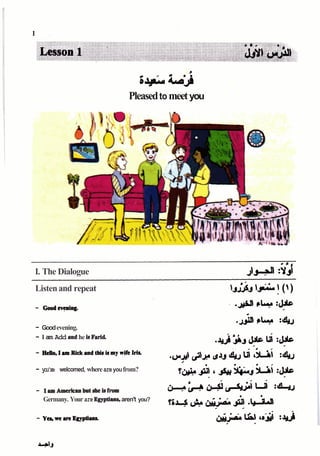
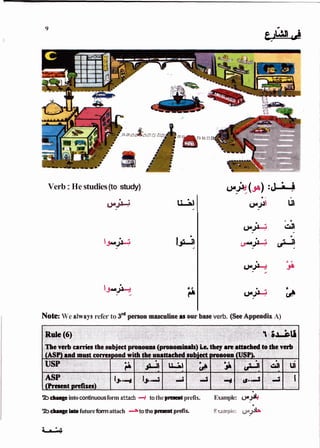
Each lesson begins with a picture, which illustrates the main objective of the
lesson.
In order to help students develop the language as fast as possible and to acquire
native like pronunciation and intonation, a tape is also provided together with
flashcards to challenge the students and enhance their listening comprehension.
Reading comprehension and creating conversational skits are also reinforced.
As the colloquial is basically the spoken language, listening and speaking are the
two skills of the language that are intensively emphasized. Reading and writing
are only used as a guide for students on learning the language and implementing
their assignments.
Some appendices are also added at the end for further instruction.
A Glossary is also provided.
A group of useful vocabulary words, which non-native speakers may need, to
survive with Arabic at the very beginning.
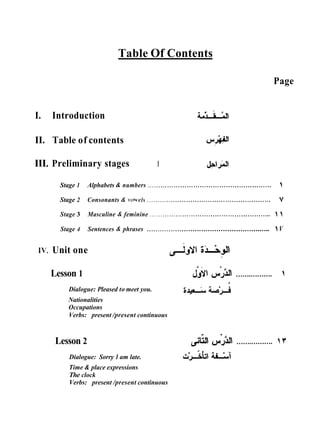
Table Of Contents
Page
I. Introduction L
+
&

II. Table of contents +a
111. Preliminary stages I JÈ
Stage 1 Alphabets & numbers ......................................................... 1
Stage 2 Consonants & vwels ......................................................... V
Stage 3 Masculine & feminine ........................................................1 1
Stage 4 Sentences & phrases .........................................................
1V
IV. Unit one
Lesson 1
f
Dialogue: Pleased to meet you. 5 6 &A
Nationalities
Occupations
Verbs: present /present continuous
Lesson 2
Dialogue: Sorry I am late.
Time & place expressions
The clock
Verbs: present /present continuous
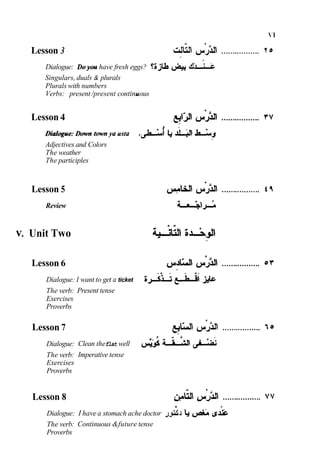
Lesson 3
Dialogue: Doyou have fresh eggs? %
j
& &
I
...d u
Singulars, duals & plurals
Plurals with numbers
Verbs: present /present continuous
Lesson 4
Adjectives and Colors
The weather
The participles
Lesson 5
Review
V. Unit Two
Lesson 6
Dialogue: I want to get a ticket
The verb:
Exercises
Proverbs
Lesson 7
Dialogue:
The verb:
Exercises
Proverbs
Lesson 8
Dialogue:
The verb:
Proverbs
Present tense
Clean theflat well
Imperative tense
e 0
I have a stomach ache doctor s
.
3 4 A
k
Continuous &future tense
VII
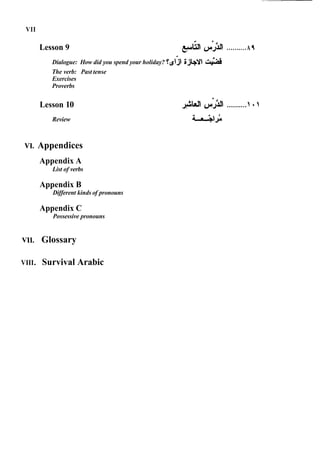
Lesson 9 ..........A f
Dialogue: How did you spend your holiday? T& gjbv (
-
4
The verb: Past tense
Exercises
Proverbs
Lesson 10
Review
VI. Appendices
Appendix A
List of verbs
Appendix B
Different kinds of pronouns
Appendix C
Possessive pronouns
VII. Glossary
VIII. Survival Arabic
Preliminary Stage
-uwl&
.
. -
!
I 9&if1 &
a
-
.. d
li
2
1
y
9
f
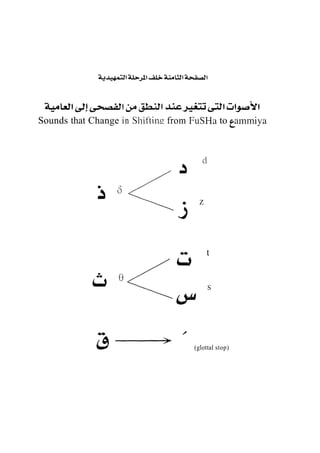
Sounds that Change in Shiftins
È_ from FuSHa to tammiya
^
is- (glottal stop)
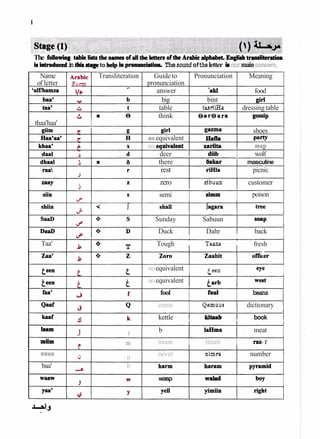
The following t^letiÇtitbe~~neflofçIltbelettenoftheArd>kah)habeLmtrunKterati
ia introducedi
nt
batqpto helphpronunciation. Thesound oftheletter iaourmainconcern.
Name 1 ~ ~ b i ~
I Transliteration
of letter . FQXBL
'alf/hamza
64
I/&
thaa'haa' 1 I
- I
- Taa' 1 A I * T
laam
J 1
miim
?
m
noun (Â¥ n
baa' h
Guideto Pronunciation Meaning
I pronunciation .
answer aid food
big bint giri
table tasriiHa dressingtable
think e a r e a r a gossip
-
gid s"=a shoes
' noequivalent Eafla Pam'
no eauivalent xariita man
deer 1 diib 1 wolf I
there 6akar masculine
rest m a picnic
zero zibuun customer
, ,
semi
I simm
I poison ,
I I
Sunday Sabuun
I
-P I
I I I
Duck Dahr 1 back 1
I I
Tough Taaza fresh
I noequivalent
I f
- I . .ye I
noequivalent
1 Aarb 1 ww 1
I 7
I
fool
I fuul
I beans
I I
come
I Qamaus dictionary
, ,
kettle I kitaab 1 book 1
b 1 laHma 1 . meat I
moon I mum I r a z e r 1
never nimra number
wasp 1 walad
I boy I
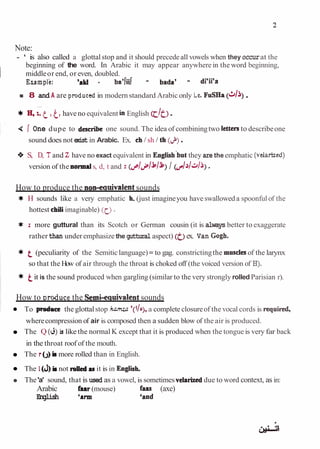
Note:
- ' is also called a glottalstop and it should precedeall vowels when they occurat the
1 beginning of the word. In Arabic it may appear anywherein the word beginning,
! middleor end, or even, doubled.
Example: *akl - baypi - badd -
rn 8 and A are produced in modern standard Arabic only i-e.FuSHa (&/A)
.
.
* H
,i
,c,t,have no equivalent i
n English (21~)
.
4 f One dupe to describe one sound. The idea of combiningtwo letten to describeone
sound does not exist in Arabic. Ex. ch / sh / th (2)
.
4
3 S, D, Tand Z have no exact equivalent in ~ n ~ l i s h b u t
they are the emphatic (velarized)
version of the n o d s, d, t and z (d/&h/b) / (&/i.~/b).
How to produce the non-equivalent sounds
* H sounds like a very emphatic h. (just imagineyou haveswalloweda spoonful of the
hottest c h i imaginable) (0.
* x more guttural than its Scotch or German cousin (it is always better to exaggerate
rather than underemphasize the guttural aspect) (^)ex. Van Gogh.
* (peculiarity of the Semiticlanguage)= to gag. constrictingthe musclesof the larynx
so that the How of air through the throat is choked off (the voiced version of H
)
.
* it is the sound produced when gargling (similar to the very strongly rolled Parisian r).
How to oroducethe Semi-eauivalent sounds
To produce the glottalstop hawa '('19, a complete closureof the vocal cords is required,
wherecompression of air is composed then a sudden blow of the air is produced.
The Q (J)islike the normal K except that it is produced when the tongueis very far back
in the throat roof of the mouth.
The r0)Bmore rolled than in English.
The 1(J)u not rolled asit is in English.
The'a' sound, that is used as a vowel, is sometimesvelarized due to word context, as in:
Arabic faar (mouse) faas (axe)
English 'ann 'and
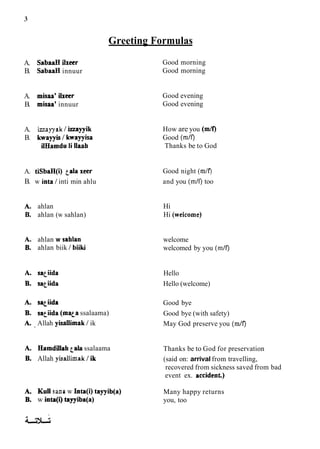
Greeting Formulas
A. SabaaH iheer
B. SabaaH innuur
A. misaa' ilxeer
B. misaa' innuur
A. izzayyak / izzayyik
B. kwayyis / kwayyisa
Wamdu li Ilaah
A. tiSbaH(i) tala xeer
B. w inta / inti min ahlu
ahlan
ahlan (w sahlan)
ahlan w sahlan
ahlan biik / biiki
sqiida
saciida
sqiida
satiida ( m q a ssalaama)
Allah yisallimak / ik
Hamdillah tala ssalaama
Allah yisallimak 1ik
Kull sana w Inta(i) tayyib(a)
w inta(i) tayyiba(a)
Good morning
Good morning
Good evening
Good evening
How are you (m/f)
Good (df)
Thanks be to God
Good night (m/f)
and you (df)
too
Hi
Hi (weicome)
welcome
welcomed by you (df)
Hello
Hello (welcome)
Good bye
Good bye (with safety)
May God preserve you (m/f)
Thanks be to God for preservation
(said on: arrival from travelling,
recovered from sickness saved from bad
event ex. accident)
Many happy returns
you, too
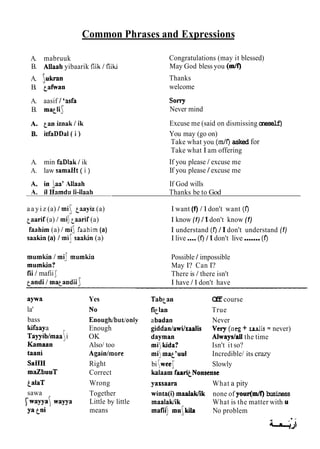
Common Phrases and Expressions
A. mabruuk
B. AUaah yibaarik fiik / fiiki
A. ukran
B. tafwan
A. aasif 1'asfa
B. matlil
A. min faDIak I ik
A. law samaHt ( i )
a a y i z (a) I mi[ taayiz (a)
taarif (a) / m$ taarif (a)
faahim (a) / mi faahim (a)
saakin (a) 1mil saakin (a)
mumkin / mil mumkin
mumkin?
fii / mafiif
and! / ma^andiiJ
L
Congratulations (may it blessed)
May God bless you ( d o
Thanks
welcome
Sorry
Never mind
Excuse me (said on dismissing oneself)
You may (go on)
Take what you (m/f) asked for
Take what I am offering
If you please / excuse me
If you please I excuse me
If God wills
Thanks be to God
I want (f) /1don't want (f)
I know (f) 11don't know (f)
I understand (f) 11don't understand (f)
I live....(f) 11don't live.......(f)
Possible I impossible
May I? Can I?
There is / there isn't
I have /1don't have
aywa
la'
bass
kifaaya
~ a ~ ~ i
b h a ai
Kamaan
taani
SaHH
maZbuuT
talaT
sawa
fwa?Ya WaYYa
Yes
Enough/bui/only
Enough
OK
Also/ too
Agaidmore
Right
Correct
Wrong
Together
Little by little
means
Tabcan O
f
fcourse
fitIan True
abadan Never
giddan/awi/xaalis Very (neg+ xaalis =never)
dayman Always/ail the time
mi kida? Isn't it so?
mi mq'uul Incredible/ its crazy
bi [wee! Slowly
kalaam faaqNonsense
yaxsaara What a pity
winta(i) maalakfik none of your(m/f) business
maalakfik What is the matter with u
mafii muikila No problem
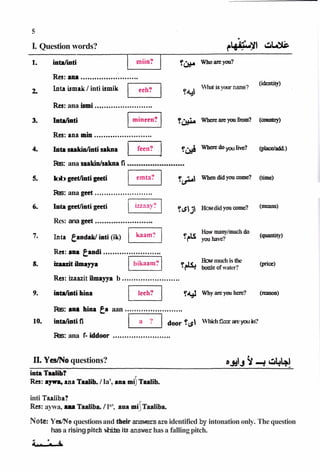
I. Question words?
Res: ana .........................
Inta ismak/ inti ismik What isyourname?
^
Res:ana ismi .........................
y* Whereareyonfiom?
Res: ana min .........................
Inti mida/iti h a 1 feen? 1 y.yi ~heredo
you live?
.........................
R
e
s
:ana saakinlsaknafi
emta?
lob gect/iti geeti ?& Whendidyoucome?
R
e
s
:ana get .........................
t )j
)HOWdidYOU C O ~ ?
Res: ana geet .........................
bit! @ndak/inti (
i
k
) F
I
Res:ana tandi .........................
izaazit ilmayya t lam?
Howmuchisthe
1 ^(^ battle ofwater?
Res:izaazit ilmayya b .........................
intaliinti him pq
R
e
s
:ana hina Pa aan .........................
I
Ã
‘
Ã
‘
Ã
‘
Ã
‘
into/intifi 1, a ? 1 door yrf Whichfloorareyouin?
R
e
s
:ana f- iddwr .........................
1
1
. YesNoquestions? t
s
l
~
9 .
-
^
l
a
.
 *
inta Taalib?
Res: aywa, anaTaalib. / la9
, ma 111)T d b .
inti T d b a ?
Ra:aywa, a m TaaIiba. / I*', am mi^~aaliba.
N0k Y M oquestionsand theiranswersare identified by intonation only. Thequestion
hasa risingpitch w
h
i
t
eits answerhasa falling pitch.
- * .
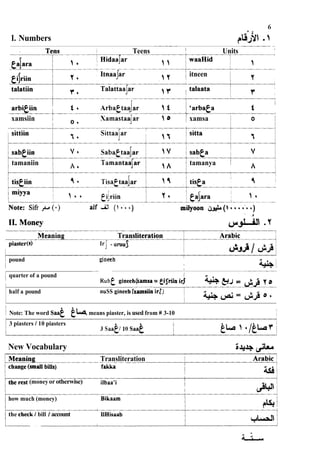
I. Numbers
-
-
&Y .
-
- -
Teens Units I
-
1
I -
-
A
itneen
talatiin Y 4 >r I
I
, - i
I
arbiciin t à ArbaFtaajar 1 f I *arbaca f
I
4
xamsiin i ~amastaafar 1 9 1I xamsa I o I
I 0 Ã
I I
1 tamaniin
I A .
~amantaakr 1 tamanya i
I I
I
1 pound gineeh I
I I
I
--
^
1 quarter of a pound I
~ u b p
gineeh(iamsa w cilriin id -S'4 &
,
1 = & 2 7 0
I
half a pound nuSS gineeh (x&siin ir7)
1 Note: The word k kmeans piaster, is used from # 3-10
13 piasters / 10 piasters
New Vocabulary ;+A+
n
i
l
*
-
Transliteration I
fakka
I
II
the rest (moneyor otherwise) ilbaa'i
I
1how much (money) Bikaam
the check / bill 1account IlHisaab
I
L
A
&

* * * Lid&
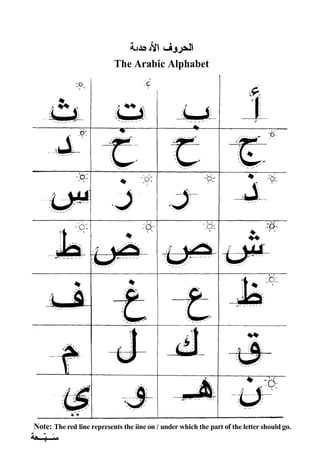
The Arabic Alphabet
Note: The red line represents the iine on / under which the part of the letter should go.
Characteristics of the Arabic Al~habet
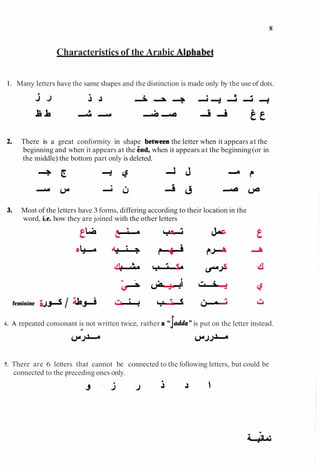
1. Many letters have the same shapes and the distinction is made only by the use of dots.
j J i A - A - A + A A +
There is a great conformity in shape bemeen the letter when it appears at the
beginning and when it appears at the h d , when it appears at the beginning(or in
the middle) the bottom part only is deleted.
Most of the letters have 3forms, differing according to their location in the
word, i.e. how they are joined with the other letters
4. A repeated consonant is not written twice, rather a'cgJdy*is put on the letter instead.
4
5. There are 6 letters that cannot be connected to the following letters, but could be
connected to the preceding ones only.
9
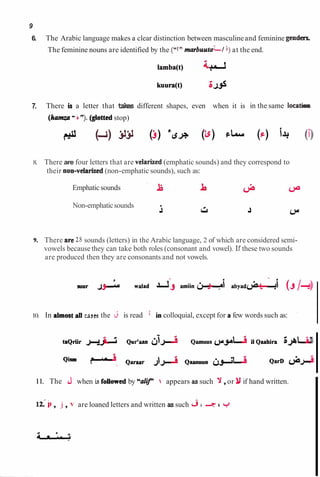
6. The Arabic language makes a clear distinction between masculineand feminine g e n k
The feminine nouns are identified by the ("t" ~ b u u t a ~ l
j) at the end.
7. There is a letter that takes different shapes, even when it is in the same l o c a h
(hanua"s").(glottd stop)
4 (A)$$ ( . 3 ) k J +
8. There are four letters that are velarued (emphatic sounds) and they correspond to
their non-velarized (non-emphatic sounds), such as:
Emphaticsounds
Non-emphaticsounds
9. There arc 28 sounds (letters) in the Arabic language, 2 of which are considered semi-
vowels becausethey can take both roles (consonant and vowel). Ifthese two sounds
are produced then they are consonants and not vowels.
10. In almost all camsthe d is read i in colloquial, except for a few words such as: -
-
taQ"ir J
+
& Qur9aan Qamuus ppu
il Qaahira g J h u
Qim dL,
Q- JA
Qaanuun -
u QmD &A
1
1
. The when i
s followed by "dip  appears as such y,or if hand written.
12.' P, j,v are loaned letters and written as such d c ac +
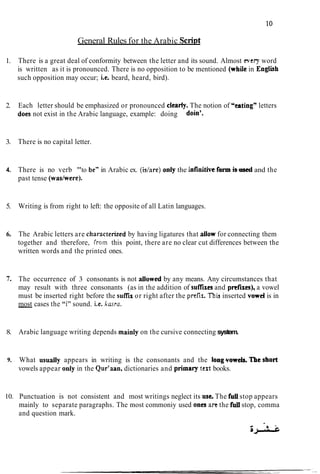
General Rules for the Arabic Script
1. There is a great deal of conformity between the letter and its sound. Almost wery word
is written as it is pronounced. There is no opposition to be mentioned (whiie in English
such opposition may occur; i.e. beard, heard, bird).
2. Each letter should be emphasized or pronounced cIear!y. The notion of ueating" letters
does not exist in the Arabic language, example: doing doin'.
3. There is no capital letter.
4. There is no verb "to be3 in Arabic ex. (idare)only the infinitive f m i s 4 and the
past tense (waslwere).
5. Writing is from right to left: the opposite of all Latin languages.
6. The Arabic letters are characterized by having ligatures that aiiow for connecting them
together and therefore, from this point, there are no clear cut differences between the
written words and the printed ones.
7. The occurrence of 3 consonants is not allowed by any means. Any circumstances that
may result with three consonants (as in the addition of suffies and prcfues), a vowel
must be inserted right before the sufix or right after the pmfk This inserted vowd is in
most cases the "i" sound. i.e. kusra.
-
8. Arabic language writing depends mainly on the cursive connecting system.
9. What usuaily appears in writing is the consonants and the longvow&. Tl~eshort
vowels appear only in the Qur'aan, dictionaries and primmy text books.
10. Punctuation is not consistent and most writings neglect its us&The full stop appears
mainly to separate paragraphs. The most commoniy used on- arc the full stop, comma
and question mark.
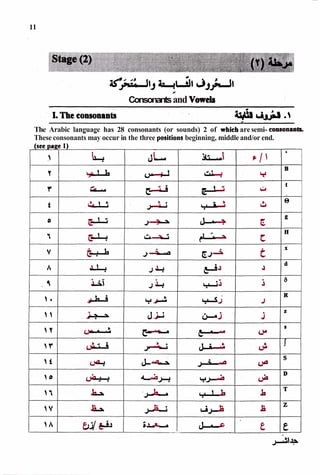
Consonantsand Vowels
-- -
The Arabic language has 28 consonants (or sounds) 2 of which aresemi- consonan-
- -
These consonants may occur in the three positignsbeginning, middleand/or end.
the
n
Y 4
Y!
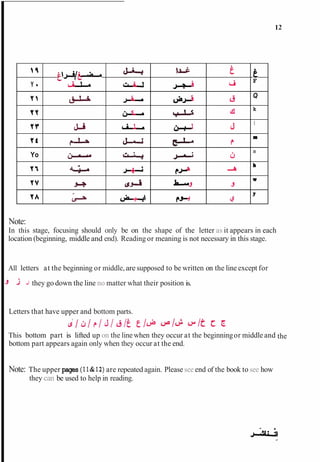
Y Y
Y Y
T t
Yo
Y 1
YV
Y A
Note:
In this stage, focusing should only be on the shape of the letter as it appears in each
location (beginning, middle and end). Reading or meaning is not necessary in this stage.
All letters at the beginning or middle,are supposed to be written on the line except for
3 -> J they go down the line no matter what their position is.
Letters that have upper and bottom parts.
t f / u / & S / d / f t / D " u^/& L ~ / CC E
This bottom part is lifted up on the line when they occur at the beginningor middle and
bottom part appears again only when they occur at the end.
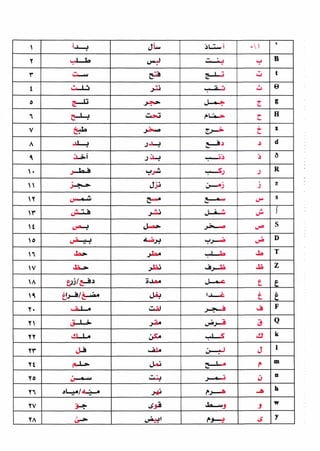
Note: The upper pages (11&12) are repeated again. Pleasesee end of the book to see how
they can be used to help in reading.
y^-VsÑ^
u
^-Ã
J-i
f-
d - " '
4-4-
J-Ã
(J-Ã
(^^
& A m A
6
<>-L-^
L
J-A-J
^Â
J-Ç-
t
f
d
OA-^j
1J-p
>-È-
U^JJ
4^-S
<>-+-Ã
e-i-
Â
?*
JÈÑ
?
-
Â
d
d
4
J
<*
d
Ñf
J
J
t
F
Q
k
I
rn
Â
h
w
Y
1
1
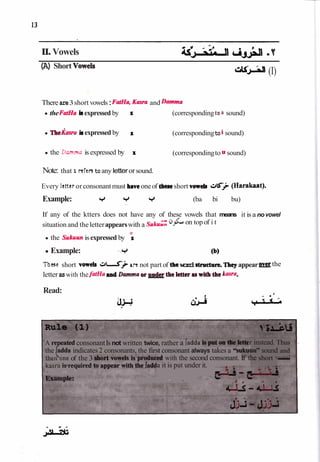
. Vowels is'&u-B <J& .Y
(A)Short Vowels
I^J-tH (I)
Thereare3short vowels:FatUq Kiwa and l-bma
theF d a hexpressed by x (correspondingtoa sound)
TheL-- - JSexpressed by x (correspondingtoi sound)
the Damma is expressed by x (correspondingto u sound)
Note: that xreferato any letterorsound.
Every letterorconsonantmust haveoneof theseshort vow& t-il~>'(~arakant).
Example: ^ È + (ba bi bu)
.-
If any of the ktters does not have any of these vowels that means it is a novowel
situation and theletterappearswith a --£>J
on top of i t
0
the Sukuunisexpressed by x
Example: 4
These short vow& dukare not part of thew
o
r
d structureTheyappear the
letteraswith the. and D~maorudertbektteraswiththe~
Read:
A repeated consonantIs not written twice, rather a Jadda r instead. Thus
the Jadda indicates 2 consonants, the first consonant always takes a "sukuun" sound and
thenone of the 3 with the second consonant. If the short vn-1
kasra is*required a it is put under it.
. ", >
$ -?
E~arnpIe:-~,~~ l-C,, .
'
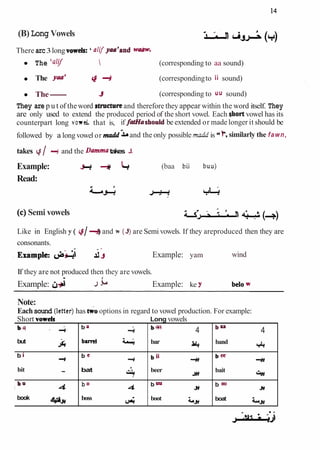
(B) Long Vowels
There arc3long vow&: '@f
~wa'and
The 'oSf  (corresponding to aa sound)
The y^
The-
(correspondingto ii sound)
(corresponding to uu sound)
They are p u t of theword structureand therefore they appear within the word itself. They
are only used to extend the produced period of the short vowel. Each short vowel has its
counterpart long vowd. that is, if fatffashould be extended or made longer it should be
followed by a long vowel or m o ~ ( and the only possiblemaA/ is " similarly the fawn,
takes iff Ã
‘ and the flaimfatakes 4
Example:
Read:
(c) Semi vowels
(baa bii buu)
Like in English y ( if/ +and w (3)are Semi vowels. If they areproduced then they are
consonants.
-
. Emimple: & Example: yam wind
If they are not produced then they are vowels.
.
Example: <ijl J*- Example: ke Y belo w
Note:
Eachsound (letter)has twooptions in regard to vowel production. For example:
Short vow& Long vowels
bf4 . 4.
but
-A
b i
Ã
‘
bit -
bU *
I 4
book
4AÃ
-& j)'j
b a
4
bard &
b e
Ñ
bat
Â
^
b 0 9
4
boss
04
b.44 4
bar
AL
b ii
Ã
‘
beer
JM
b uu
J*
boot
^Â¥
b"
4
band
4
4
bee
Ã
‘
bait
"*Ã
b 00
3
4
boat
<*-44
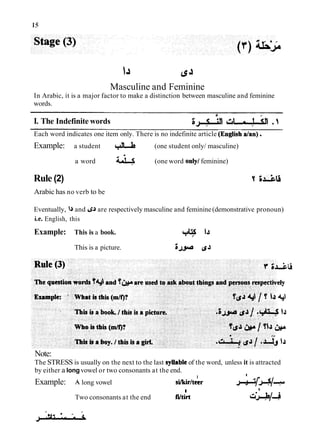
Masculine and Feminine
In Arabic, it is a major factor to make a distinction between masculine and feminine
words.
I. The Indefinite words
-- --
Each word indicates one item only. There is no indefinite article ( ~ n & i h
dan).
Example: a student (one student only/ masculine)
a word & (one word only1feminine)
Rule (2) t SAJ^A
Arabic has no verb to be
Eventually, a and & are respectively masculine and feminine(demonstrative pronoun)
i.e. English, this
Example: This is a book.
This is a picture.
Note:
The STRESS is usually on the next to the last syllableof the word, unless it is attracted
by either a longvowel or two consonants at the end.
I
Example: A long vowel si/kir/teer
I
Two consonants at the end fdtirt
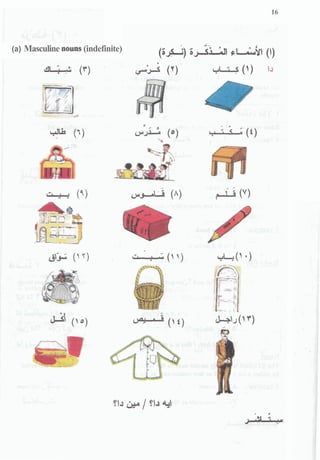
(a) Masculine nouns(indefinite)
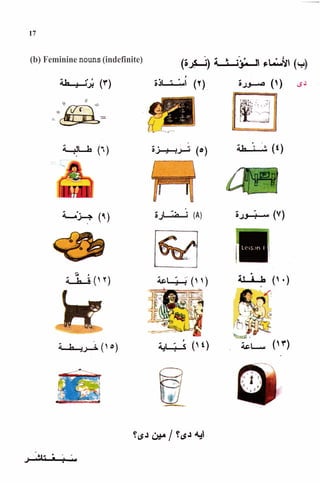
(b) Feminine nouns(indefinite)
S (A)
Example:
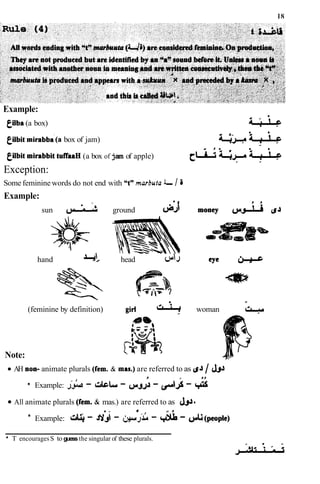
cilba (a box)
cilbit mirabb;(a box of jam)
cilbit mirabbit tuffaaH (a box of jam of apple)
Exception:
Some feminine words do not end with "t" marbuta 3Ã / a
Example:
sun w L A ground d
hand 4
(feminine by definition)
Note:
head 0"b
girl '-"-(
0
woman CL+M
AH non- animate plurals (fern. & mas.) are referred to as if4/ &J
n
* Example: J^s - b L - o-J> - y " l j - 4
All animate plurals (fern. & mas.) are referred to as &A -
à 0 fl
* Example: - - (>-&
- 4- @&(people)
* T encouragesS to guess the singular of these plurals.
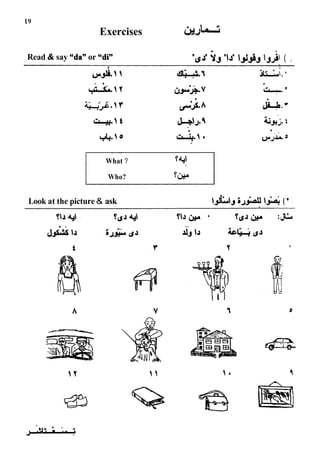
Exercises L W J ~
Read & say "da"or "di" '&A' Y~'hn
>dJ
1.j ( ,
- - - - -
What ? ^
Who? ^
Look at the picture & ask
-
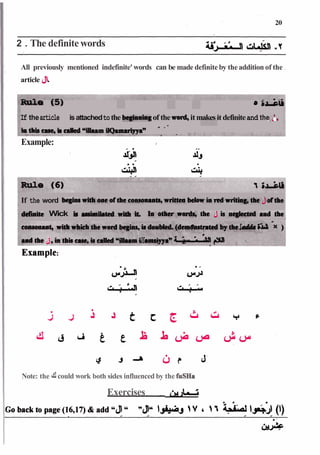
2 . The definite words ii*i-~Ll~
Ç^ .Y
All previously mentioned indefinite' words can be made definite by theaddition of the .
article &
K
U
J
i
e 13) 6 ftJL^u
If thearticle isattachedtothe beginnimgof the ww& itmakes it definiteand the ',
-
- .
inthiscue,bcalled'^iUJUirniIOamariyYam
Example: I
If the word b~withoneoftheco0901@writtenbelowinred~the ofthe
lUWte Wick isauimitetedwithit. botherm¥nk,theJisReflectedçdt
Note: the iflcould work both sides influenced by the fuSHa
Exercises -
& L d
Exercises (*uiL>Ñ
4 L f l +
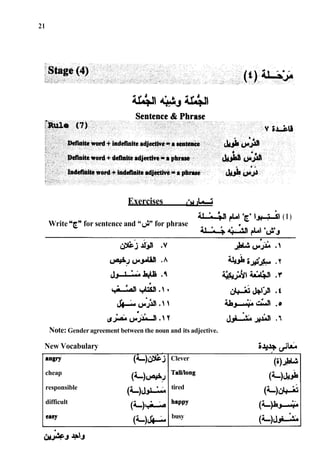
I ncn
I*& ( I )
Write "c"for sentence and "&"for phrase Ã
r^,
<,h-Ja &
,
 n&^
4~0.g
e A SJ^*+ .T
* 9 <AJ-^l ¥Lut^J.r
'-+,&.I. ~*--~JÈJ
.t
& & .  I .o
Ã
& & * J L J . I Y &Laid.7
Note: Genderagreement between the noun and its adjective.
New Vocabulary $*A(, d
l
*
.
.
angry (L)&
cheap
(<-)~w.J
responsible
(4-)J^È
difficult
(*-)+
easy
(*-)J*Ã
Clever
Tallllong
tired
happy
busy
...
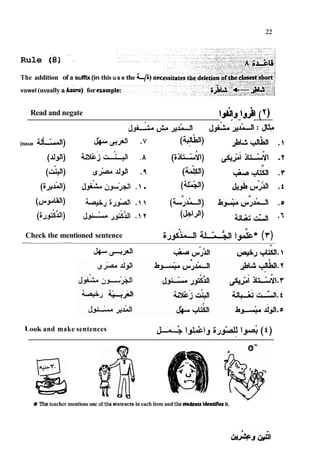
Rule ( 8 ) . . .
The addition of a suffix(in this u s e the <Ñ/Ãnet
. . . . ~
vowel (usually aA<wo) forexampl
Read and negate b$J 134
(y)
(issue -
1 &&A * V (+$4 . I
(u)-jL&J . A (sJL^~MJ~) y&i~-iij ~ i 
.T
(4)
9
^wAa^J1 - 4 (^a) ++un .Y
(i&) JjÇ &.ia~ . 1 . (U) J&&^ .Ã
(u.^.~) uJ;&
.  I (&d)
&&id .@
(i&Jl) &
- &A . I 7 (J^) && a .
Check the mentioned sentence
- -
sJ&-fl i
G
f
l
I&*
( )
Â¥
A--4 &a *>l 4
)
^La. 
I,oak and make sentences w bwjÃ̂
J b 4( q
w
Â¥Theteacher mentions one ofthe mteaces in each item andthe studentsidentifk it.
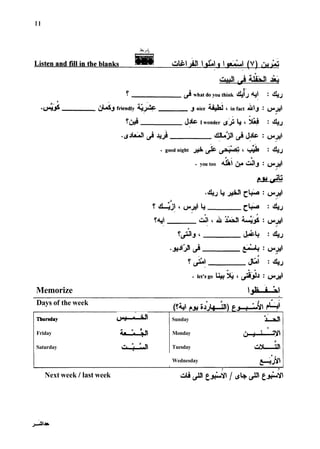
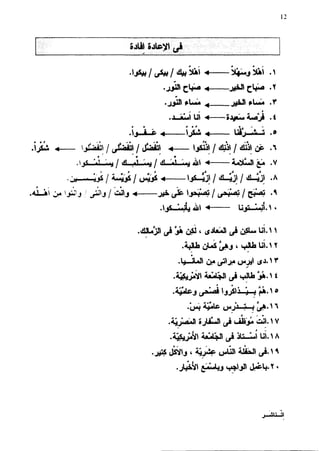
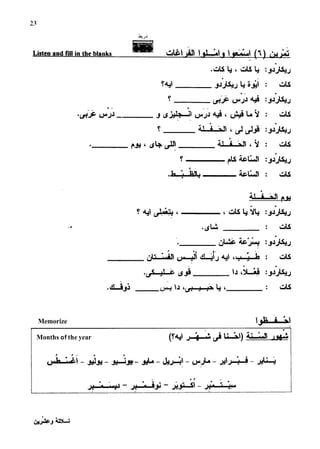
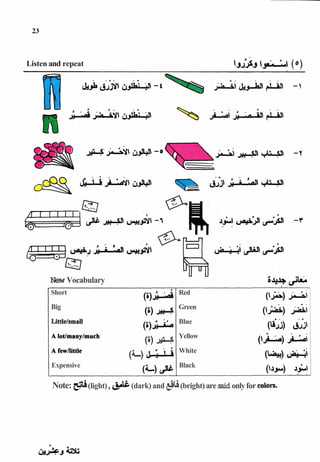
Listen and repeat 1 ~ 3 ~
( 0 )
New Vocabulary
Short
(*)a
Red
Big
Little/small
Green
Blue
Yellow
White
Black
(S) ^
(L)
(
>
&
Expensive
Note: ~9
(light),&& (dark) and fi&*(bright)aresaid onlyfor coion.
Unit (1)
Pleasedto meetyou
I. The Dialogue J J ~
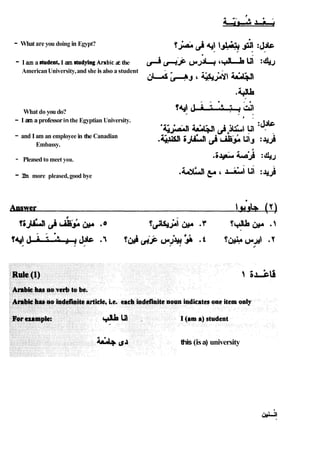
3
Listenand repeat
- Goodevening.
- Iam Add aodhe b Farid
- you're welcomed, whereareyoufrom?
- IamAmericanbutsheisfrom
Germany. Yourare Egypt- aren't you?
- What are you doing in Egypt?
- I am a *dent, I am ahdyingArabica
t the ~3 L^J& 'VsÑI 13
AmericanUniversity,and she isalso a student
' &Â¥^ 4*~t&1
What do you do?
f .
- I am a professorin the Egyptian University.
v ^ ~ s i
is~^s
dJU^I h
i
0
- and Iam an employee in the Canadian
Embassy.
f
- Pleased to meet you.
.iJJLu G
J
i
- I
'
m more pleased,good bye
.irffiCuit p ' L L l ul
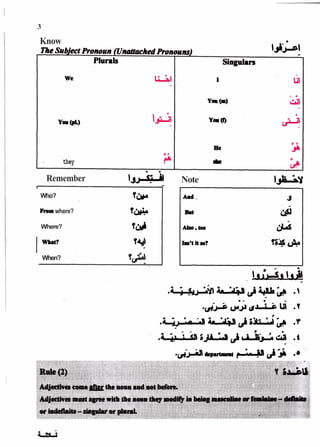
this (isa) university
3
Know
they f* a
k
a m
Remember l
a
&
& Note
Who?
f^ramwhere?
Where?
When? ^
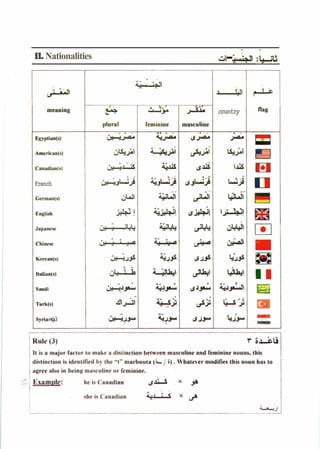
ILNationalities &4*a
:
&
Q
-.
. ..
,
.
. . - -
French
country
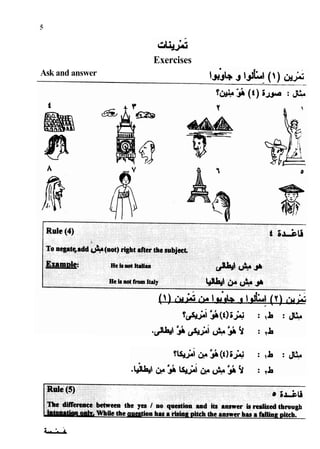
Exercises
Ask and answer
&.#
A
.ui^ +
$ u .
* .
.w-!i>
i i & a .7
 . ~ , ^ ~  J J Ã ˆ o r
.& ^4
% .t
Ã
.4_J^&<&JAÃ J*U .a
/
J
J
S
S J) living &s
/Â¥ 3 .
I
.L$J&~L~ & .v
J&lJJJbJ'i h -
.
.-~^JSy*^1*-^^-'1^ .'
.&^diaLiiy~^J~t-.tllyi~fl-.~*
..
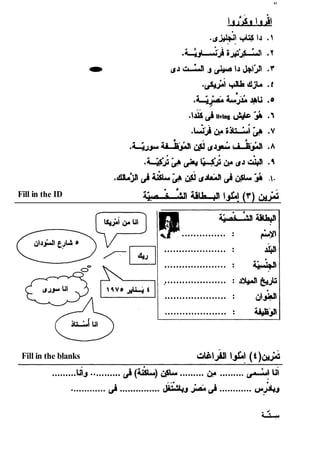
Fill in the ID &
a
#
a
h
u
h
4
f
l. &I (Y) 4
.
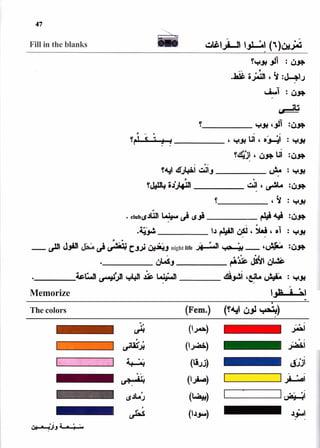
Fill in the blanks
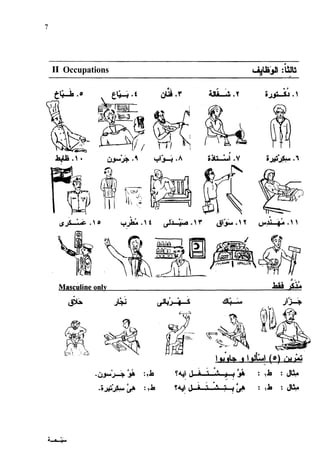
I1 Occupations
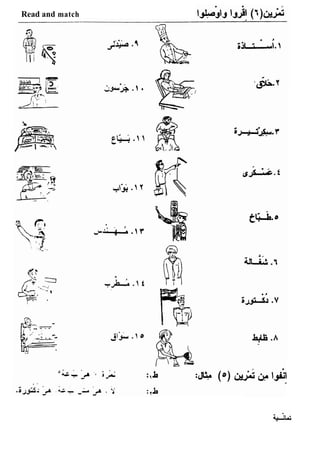
Read and match
Verb:He studies(to study)
w*
Note:We always refer to 3" penon masculineasour-bastverb. (See AppendixA)
T
ochangeintocontinuousform attach 4 to theprewt prefix. Example: o à §
*
.
T
ochangei
n
t
ofutureformattach tothe pruent p d i Fumpk: wJ-^
-
Drills
t o s p W a +
a
]
to read
^ ^
t o
/^
towork '
J
u
0
Uue allthew verb8 with each person ex:
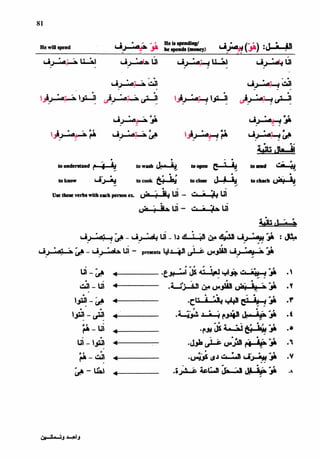
Note that the 4 is the variable that alwayschangesaccordingto person.
Memorize  & b d
Days of the week
(t41 p
* ;
iJlm&)
Ft&$l
1Tlurwiay 4 1Sunday
Friday
Saturday
Monday
Tuesday
Wednesday
Next week / last week ^ i y f f l s , ^ / i s b y f f l ~ & ~ ~
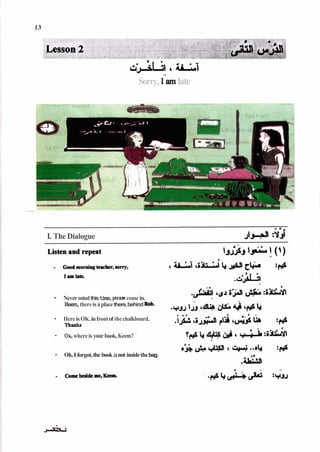
Sorry, <amlate
I. The Dialogue
- Nevermindthist
i
m
e
,pleuecome in.
Keem,thereisaplacethere,behindRob.
- HereisOK,infrontof thechalkboard.
Thanks
- Ok, whereis yourbook,Keem? '
- Oh, Iforgot,the bookisnot insidethebag.
- Comebeddeme,Keem.
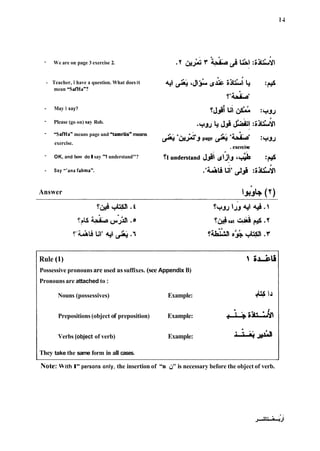
- We are on page 3 exercise
- Teacher, I have a question. What does it
mean "SafHaW?
- May I say?
- Please (go on) saj Rob.
- "SafHaW means page and "tamriin"means
exercise.
- OK, and bow do I say "1 understand"?
- Say "'ana fahma".
Answer
Rule (1)
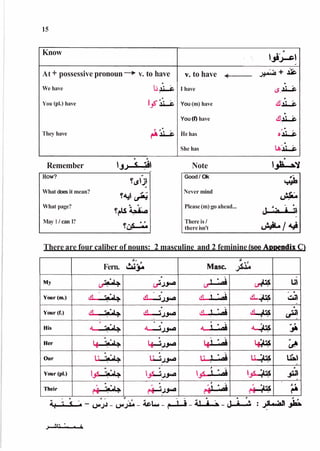
Possessive pronouns are used assuffixes. (see Appendix B)
Pronounsare attached to:
Nouns (possessives) Example: ¥A^
+ a
t -+ *&,
Prepositions (object of preposition) Example:
Verbs (object of verb) Example: &dn
They take the same form in all cases.
Note: W ith I" persons only, the insertion of "n d"is necessary before the object of verb.
Know
At + possessive pronoun-+ v. to have V.to have 4
- J^-a + aSe.
We have I have
You (pL) have You (m) have
You (f)have
They have He has
She has
Remember 1 . a Note 
$
a
#
How? ¥
w
.
Good I Ok
Wh
What does it mean? Never mind
What page? Please (m) go ahead...
May I I can I?
1 There is 1
thereisn't
There are four caliber of nouns: 2 masculine and 2 feminine(see Aooendix C
)
S#
> .'*
Fern. up
s
Masc. J&I*
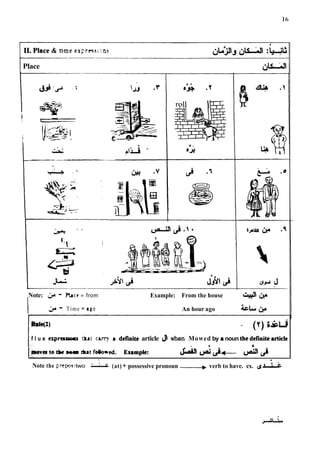
1Place
roll
I
Note: & - Place = from
& - Time = ago
Example: From the house
An hour ago
1-21 " (T) S
k
u
f l u e eiprosen All carq a defmite article $ when Mowed by anoun the defiite artkk
Note the prepoiltwo ' '- (at) + possessive pronoun -
+ verb to have. ex. <
J
.
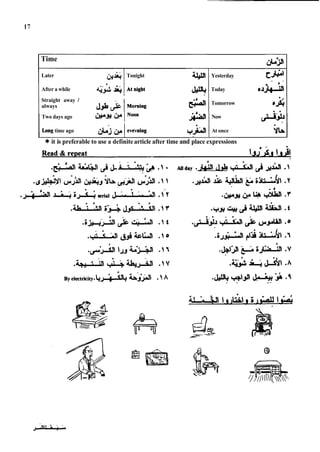
Time
Straight away 1
always la ^fC 1Morning
Later &&
?
After a while 4& &
Two days ago L ) * ~ * ! L ~ N ~
Tonight
Atnight
~ o n g
time ago (_l~4J 1evevning
Yesterday ~Jifl
- -
Today bAJi*-a
Tomorrow bJS(
Now
At once
*it is preferable to use a definitearticle after time and place expressions
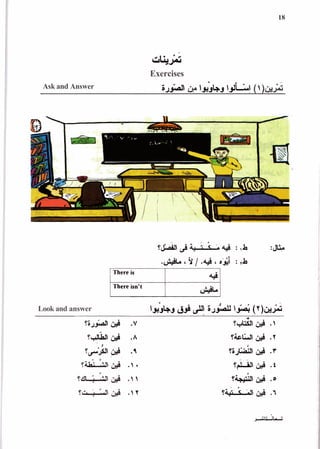
Exercises
Ask and Answer à ˆ & (>. J&J J~*L ()(^ti
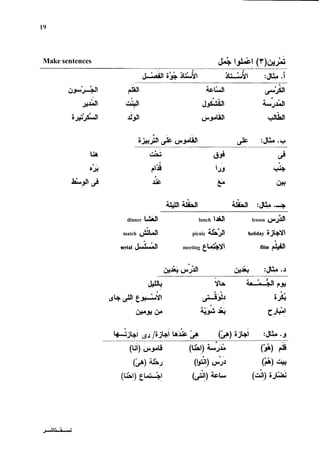
Look and answer
Make sentences
dinner LudU lesson
lunch a
picnic -UÈ
meeting c%'fl
a
match &L^
serial &LA
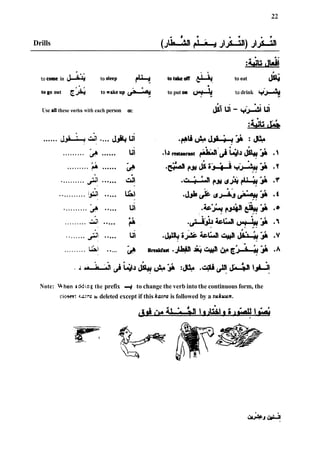
Verb:He says / to say
~ o t e
: hetitle verbis alwaysthe 3" penoii&mime
The pronominalalwaystakesa kasraexceptonly when thefollowingvowel isa Dmuna,
then in thiscase,ittakesa Damma too. Thefirst personsingularpronominalonly that
alwaystakesafatHa '
Drills
f
to c m c in J
* to sleep
Use d
lthese verbs with each person ex:
tot*oB t^ to eat
.
to put on
J- -Ã
to drink (^JJÑ
^"
Note: hen iddmg the prefix + to change the verb intothe continuous form, the
clow: usra is deleted except if this kasm is followed by a sukuun.
Memorize 
$
A

Months of the year
~ S J L J ~ ~
(M&U lil^c
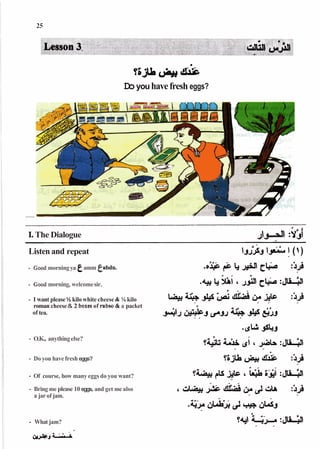
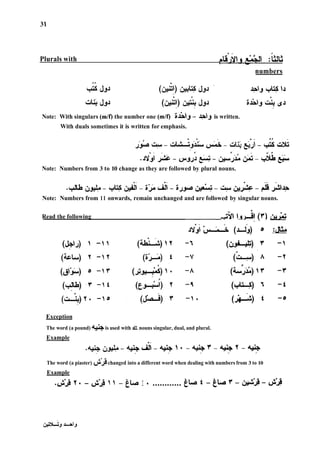
Doyouhavefresh eggs?
I*The Dialogue J
J
-
N :YJ!
Listen and repeat
- Goodmorningya amm e b d u .
- Good morning, welcomesir.
- I want please Vi kilo whitecheese & '/<kilo
roman cheese& 2 boxesof rabso&a packet
of tea.
- O.K., anythingelse?
- Do you have fresh eggs?
- Of course, how many eggs do you want?
- Bring me please 10 eggs, and get me also
a jarof jam.
- What jam?
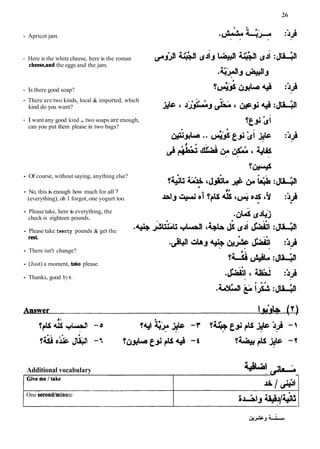
s
/UÈAÈ
- Apricot jam.
- Here is the white cheese, here is the roman
cbeese,and the eggs and the jam.
- Is there good soap?
- There are two kinds, local & imported, which
kind do you want?
- I want any good kind ..two soaps are enough,
can you put them please in two bags?
Of course, without saying, anything else?
.
No, this i
s enough how much for all ? ~f
(everything), oh I forgot, one yogurt too. ¥la.!
. +
id ftu~lli
'(JJU Ã ‡ J '9 :id
. .
Please take, here is everything, the
.(^ &j
check is eighteen pounds.
Please take twenty pounds & get the
.*. JSwu t r ' u '
^
l
a
, (JS &iJrtiC! :&3
rest
There isn't change?
(Just) a moment, take please.
Thanks, good bye.
Additional vocabulary &
G
I
-J
One second/minute
27
Know
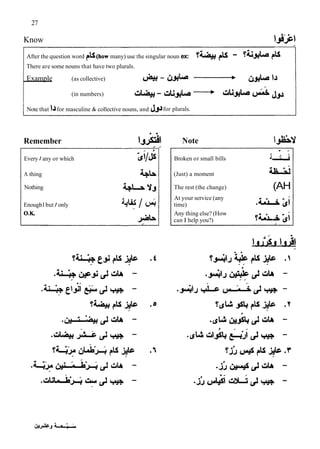
After the question word pu(how many) use the singular noun ex: ?& - Y&L
p
u
There are some nouns that have two plurals.
Example (as collective) &-(Â¥iu~---- &&41.1
(in numbers) &G+$
- d
i
s
h - JJJ
1 Note that bfor masculine & collective nouns, and for plurals.
Remember
-
Every 1any or which
A thing *
Nothing
Enough1but I only '^/&
O.K.
u
-
a
h
Note J^
* .
Broken or small bills <Â¥
(Just) a moment
The rest (the change) (AH
At your service (any
time)
Any thing else? (How
can I help you?) ?<Au 'lt
2s
O .
#
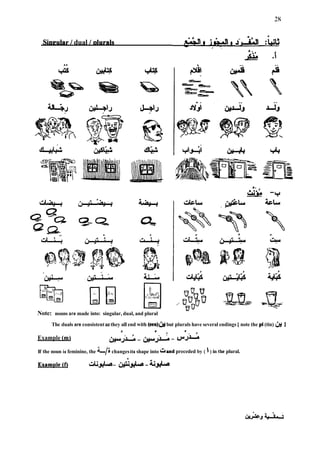
Sinpular/ dual / plurals . Ã ~*>-m
:b%
Note: nouns are made into: singular, dual, and plural
The duals are consistentasthey all end with (em)& but plurals have several endings { note the pi (tin) (*y 1
9
* I
Ã
Example (m) +id - +&.-
If the noun is feminine, the ^-/Ã changesita shape into and preceded by ( 1) in the plural.
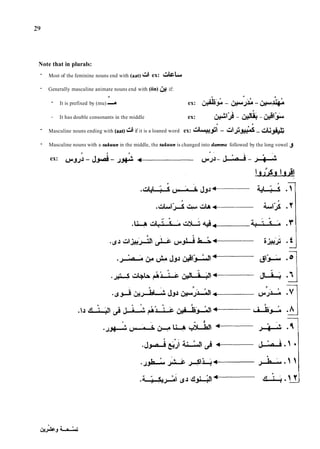
Note that in plurals:
- Most of the feminine nouns end with (aat) ex: ÇÑJIf
- Generally masculine animate nouns end with (iin) & if:
7
- It is prefixed by (mu) Â
em.- f
ex: &- - &,&
- It has double consonants in the middle ex:
n f
- Masculine nouns ending with (aat) if it is a loaned word ex: a
&
$
 - - a G N
--
- Masculine nouns with a sukuun in the middle, the sukuun is changed into damma followed by the long vowel J
0 ,
ex: wJJi- ~ p a i
- J&I
4
- ~ J J -J
-
~
I - j-2
/
i-iLu>u
Exercises
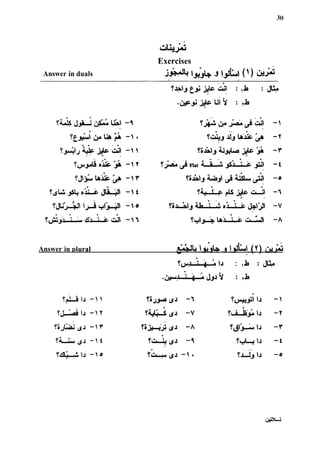
Answer in duals J.È-! 3 ( I ) &i-J-"
Answer in olural
?w<&all : ,L : &
Plurals with
numbers
Note: With singulars (mlf) the number one (mlf) Ã
ˆ
L
l- +i
is written.
With duals sometimes it is written for emphasis.
Note: Numbers from 3 to 10 change as they are followed by plural nouns.
Note: Numbers from 11 onwards, remain unchanged and are followed by singular nouns.
-
Read the following ,a
- .g& (Y) i-n>u
Exception
The word (a pound) ais used with all nouns singular, dual, and plural.
Example
a.
The word (a piaster) $3changed into a different word when dealing with numbers from 3 to 10
Example
&'JS Y b - *'j ^ -kt^I * ............
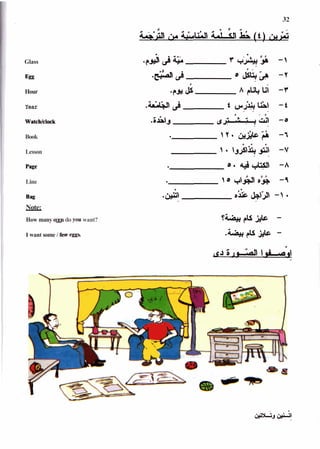
Glass
Egg
Hour
Year
Watchklock
Book
Lesson
Line
Bag
Note:
-
How many eggsdo yam want?
I want some / f
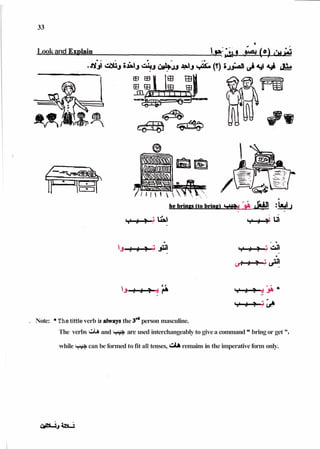
Lookand Exohin k^&km#
-*È &u&l
- '
. Note: *The tittle verb isalwaysthe 3d person masculine.
The verbs <-AAand <f4^ are used interchangeably to givea command "bringor get ",
while fc?^can beformed tofit all tenses, <-^Aremains in the imperativeform only.
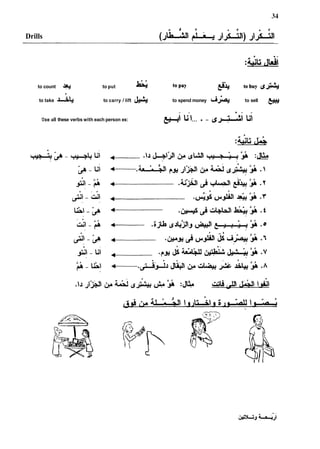
Drills
to count ¥IX to put Ki to P ~ Y to buy&^^
f
*
to take ^Ñ&& to carry 1lift (J-j*^ to spend money (Ñl>>-fl to sell
< .
- 0 - /
Use all these verbs with each person ex: & 6... . - &J&i
6
1
Memorize $iJ
AJu;, AM^ J,^i
4 Seasons of the year
This bridge is "asr inniil" ....very
old.
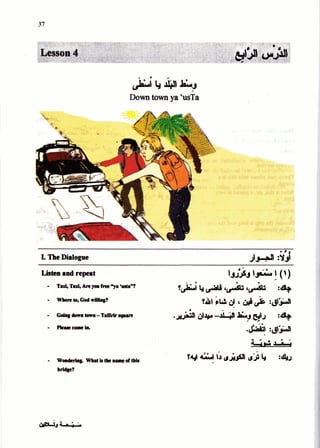
Ohh...it is very crowded.
Yes, Cairo is crowded generally, and
specially down town.
Thanks God, here is good (to be
dropped) on the right, at this corner,
please.
At your service.
Thank you, please take this is a
pound.
What is this, sir, a pound is very
little.
Why so?
Becausethe trip is long and the gaz
(oil) is expensive.
Here it is, half a pound over, happy?
Thanks, good bye.
Answer bib(7)
Know
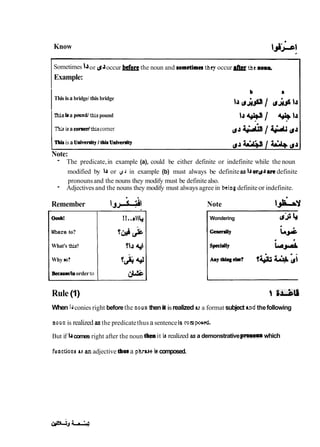
Sometimes or &A occur hforq the noun and sometima they occur the nmm.
Example:
Thisisa bridge/ this bridge
Thislia pound1thispound
Thb isa cornedthiscorner
1T U ~
is a universityI t ~ i
univerttt; i)~w/ifc
Note:
- The predicate,in example (a), could be either definite or indefinite while the noun
modified by h or j-l in example (b) must always be definiteas b o r ~ J a r e
definite
pronounsand the nouns they modify must be definitealso.
- Adjectives and the nouns they modify must always agree in beingdefiniteor indefinite.
o a
Remember
Oooh!
Where to?
What's this?
Why so?
Becauselinorderto
Note 
.
^
-
d
Wondering tf'Ji 4
4
Rule(1) 1 Sbu
When bconies right beforethe noaa then &isrealized ua format subject çnthefollowing
noanis realized asthe predicatethus a sentenceis compoçed
But if Idcomes right after the noun it isrealized as a demonstrativepromotanwhich
faactionsçan adjective thai a phnueiscomposed.
1
1
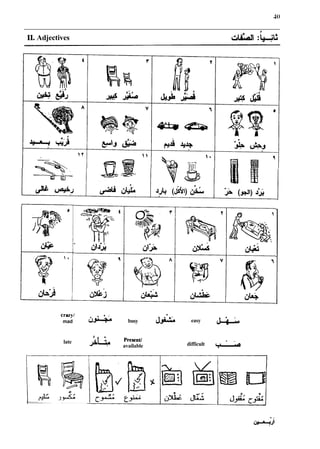
. Adjectives &A :
'
@
crazy/
d
J
& busy
mad easy J  : u
late Present/
available difficult L
.
* '
.
q
Exercises
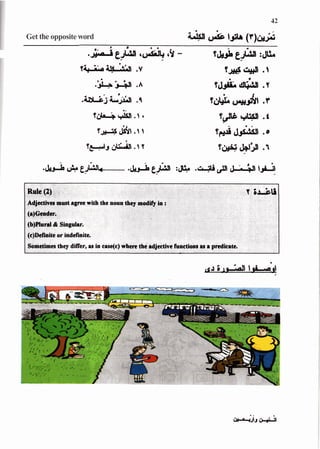
Get the opposite word
Put the suitableword qA,&l@&(t) (^u
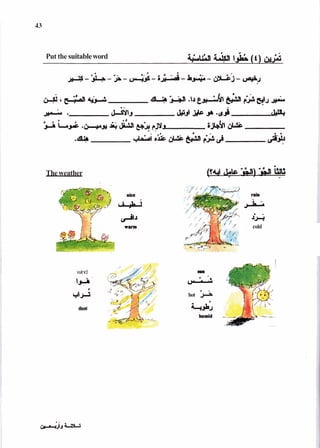
Theweather
wind
dot
hot JÑ
cold
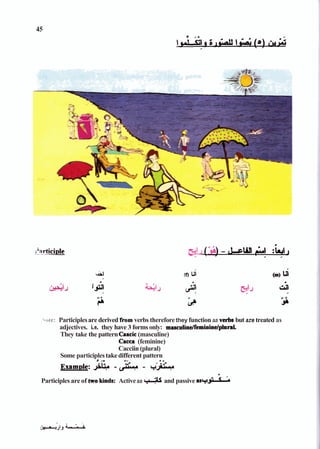
vote: Participlesare derivedfrom verbs thereforethey function as verbs but are treated as
adjectives. Le. they have 3 forms only: mascuJindfeminindpluraL
They take the patternCaacic(masculine)
Cacca (feminine)
Cacciin (plural)
Some participlestakedifferent pattern
s ,
* Â
¥
I Â.
- b a
*
Emm~le:
& -&+a - 9
-
Â
Participles are of two h d s : Activeas t4 and passive a
s
+
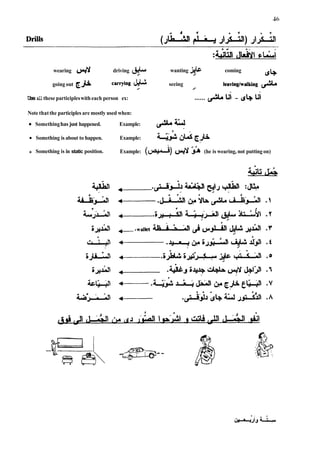
$
&
wearing MY driving (UA-
^
going out GJA carrying J
^
Â¥-
Use all these participleswith each person ex:
Note thatthe participles are mostly used when:
Somethinghas just happened. Example:
Something is about to happen. Example:
wanting J^C. coming
/ ^4
seeing
/
a Something is in static position. Example: (d)
3 (he is wearing, not putting on)
Fill in the blanks
f ft
-9 &> . c3$
. && night life (
k
J
. . .
Memorize .
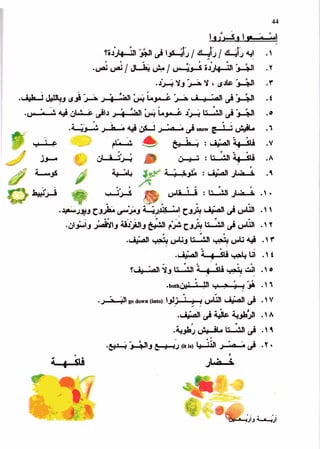
The colors ern.) (Y<!l d t & )
f t .
Lesson 5 U+W
Review lessons1 - 4
Respond to the following a
yfc ).9& O)
7ui.lt.i (>. I&.^ J^r4- *'
?& homework *Jl! (J.M?(-l"o
Form questions d J &i && ( Y )
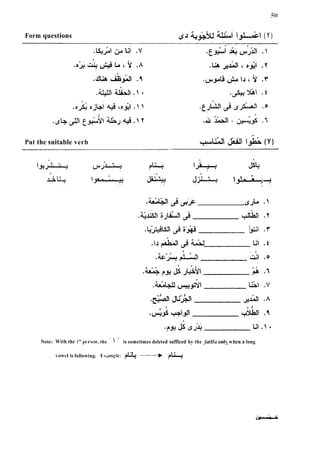
'54.,Ji p,^A
Put the suitable verb J*ill^aa.(Y)
Note: With the 1" pcrion, the ' is sometimes deleted sufficed by the fafHa onlywhen a long
~ w c l
is following. Example: Ã
‘
Ã
‘
Ã
‘ $+
51
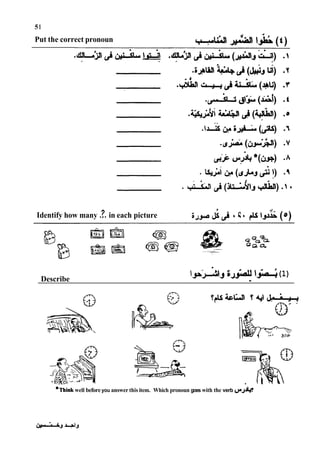
Put the correct pronoun
9
Identify how many .?.
in each picture ÈJJ& JS yi 4 a-
<? 4 +S i
s( 0 )
1^-1^.^11^ (1)
Describe .
~ h i n k
well beforeyou answer this item. Which pronoun goes with the verb o
"J&?
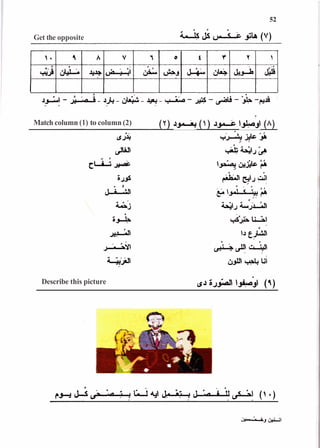
Get the opposite
Match column (1) to column (2) (T) J^-J~ (1) ~^t-fr
bh$(A)
Describe this picture
Unit (2)
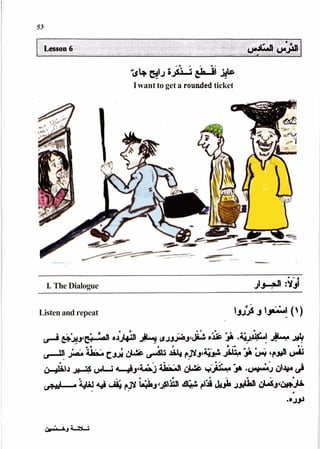
Iwant to get a roundedticket
I. The Dialogue
Listenand repeat
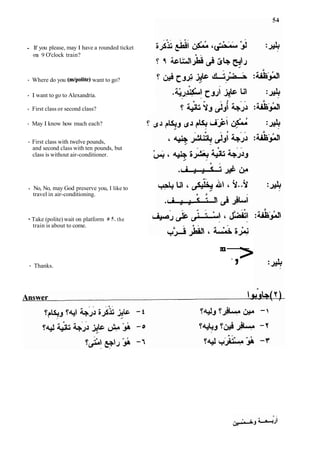
- If you please, may I have a rounded ticket
on 9 O'clock train?
- Where do you (mtpolite) want to go?
- I want to go to Alexandria.
- First class or second class?
- May I know how much each?
- First class with twelve pounds,
and second class with ten pounds, but
class is without air-conditioner.
- No, No, may God preserve you, I like to
travel in air-conditioning.
- Take (polite) wait on platform # 5. the
train is about to come.
- Thanks.
m
u
-
*,>
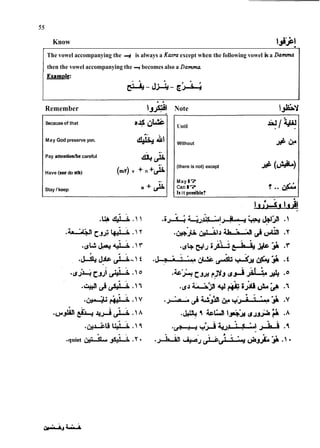
Know .Af-1
r
.
The vowel accompanying the 4 is always a Kasra except when the following vowel is a Damma
1 then the vowel accompanying the Ñ becomes also a Damma.
Remember dB
Note ^
Becauseof that iJ$ ~~
May God preserve yon. A
Pay attentionhe careful 4s
Have (me do sth) (mil) v + n +&
Stay 1keep
Until
Without &c^
(there is not) except J^ (
a
)
MayI?
CanI?
b it nossible?
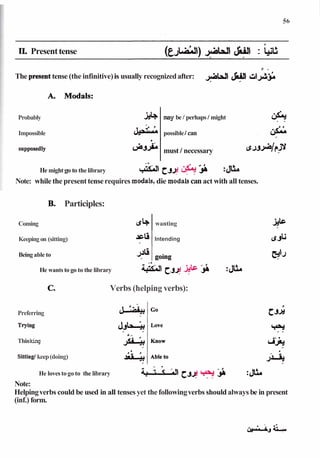
II. Presenttense (ÂjLAtfl)
. ^AJI JStiA : LUG
! Â ¥
The present tense (the infinitive)is usually recognizedafter: J*am
Jtil) &I$.&
Probably
Impossible
supposedly
may be / perhaps / might
possible/ can
must 1necessary
He mightgo to the library v&i&c~f&!J*
. . . :&
Note: while the present tenserequires modab,die modalscan act with all tenses.
Be Participles:
Coming
Keepingon (sitting)
Being able to
He wants to go to the library
Preferring
Trying
Thinking
Sitting/keep(doing)
?li 1Intending
If^
Verbs (helping verbs):
wanting
He lovestogo to the library
Note:
Helpingverbs could be used in all tenses yet thefollowingverbs shouldalways be in present
(inf.) form.
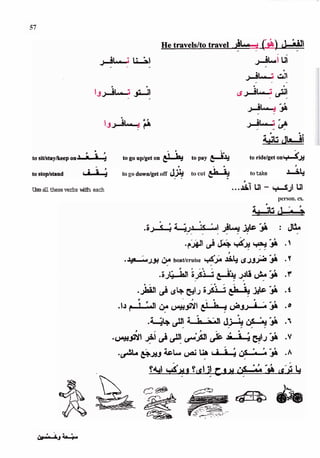
Usea
l
ltheseverbs w
i
t
h each
to go downlgetoff to cut e$J
. . totake
.
person. ex.
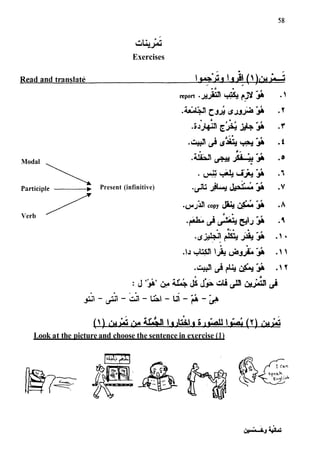
Exercises
.i-i.jJl^^AyL&& .t
,&,,AU--j >JÃ * 9
Modal * u

.
.L>"^Li-J*-!JÃ .'l
participle -
-
+ Present (infinitive) .&jLsj(Ja-iai'JÃ .V
-O-J'^lcopy(JU.l(JS.Mjà .A
Verb 5
.(-i"yiy-Â¥"@JJ .'
Look at the picture and choose the sentence in exercise (1)
59
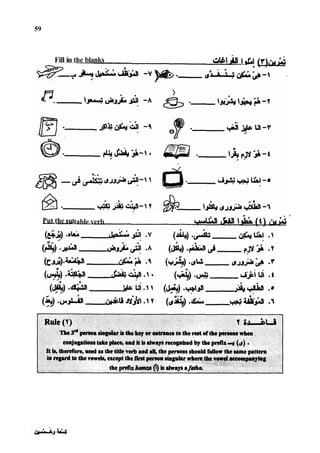
Fill in the blanks -&I(
Y
)
&
&
. ^
. /
Put the sui
-
, 'table verb i ^ - a ~ i a i & ^ ) ~ * &
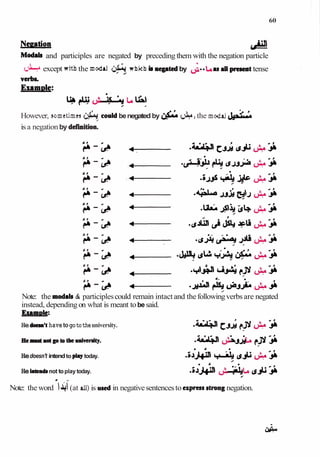
Mod& and participles are negated by precedingthem with the negation particle
U&->except witb the modd Li&^whicb bnegatedby
a
' ,aaall pmwt tense
' ^
verbs.
However, sometimes &
,c o d benegated by &&,the modd
isa negationby definition.
Note: the modab & participlescould remain intactand thefollowingverbsare negated
instead, dependingon what is meant tobe said.
-
HedoeÑ' havetogototheuniversity.
Heuuteotgototheooiversity.
Hedoesn't intendto playtoday.
HeiataMbnot toplay today.
Note: theword 1
4(at all) is usedin negativesentencesto expressstrongnegation.
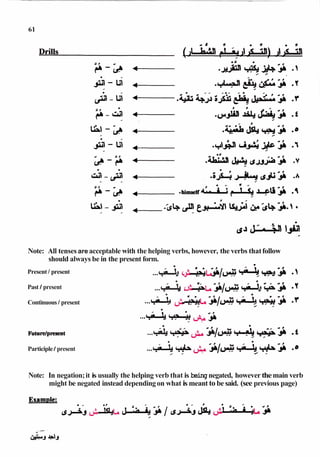
Futudpresent
Participle/ present
Note: All tenses are acceptable with the helping verbs, however, the verbs thatfollow
should always be in the present form.
Present / present ...(aJ
d &&G/& (^i
A JÃ 0 
Past / present ...&, . s&43/d
b G J
M *+ 3
Continuous / present -&
M -^L,J*/UÇ"&+J
H *^
-
-
d
l
^ *p
..& ^ (^k 3/& 4 JÃ
.a.
# -*Â
Note: In negation;it is usually the helping verb that is being negated, howeverthemain verb
might be negated instead dependingon what is meant to be said. (see previous page)
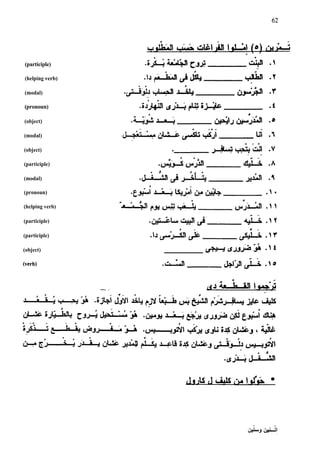
(participle)
(helping verb)
(modal)
(pronoun)
(object)
(modal)
(object)
(participle)
(modal)
(pronoun)
.. . d
(helping verb)
(participle)
(participle)
(object) &
i
- i£J& A
4^,
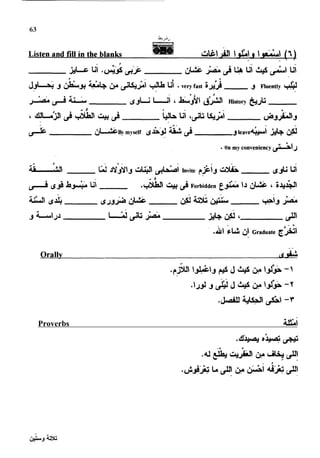
Proverbs
&
e
&
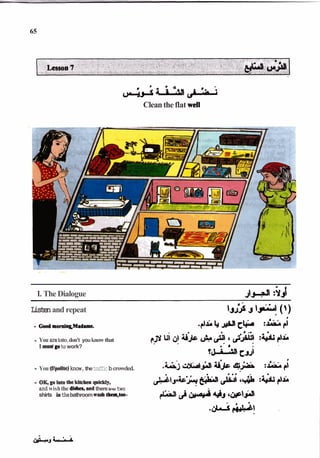
Cleantheflat well
I. The Dialogue J>AÃ :%
p
-
-
-
Listenand repeat
- You arelate,don't youknowthat
Imustgoto work?
- You (Upolhe)know,thetraffic bcrowded.
- OK,goIntothekHcheaqriddy,
and wishthe d b k , mdthereire two
shirts inthebathroomwuh the&too-
By the way. There isn't washing soap
(Detergent)
Ohh.. OK go to the grocery and bring a
box of Persil and also buy two (face)
soaps.
All right, anything else?
No, when you (F)
go, take the clothes to
the iron man, but put them in a nylon
bag first Come straight away and
don't be late
When I finish, (do) I cook something?
No, it is important to have the flat well
cleaned, especially the sitting and bedroom.
Be (you f) sure Madame, it will become (very clean) .&nub '?L
~1
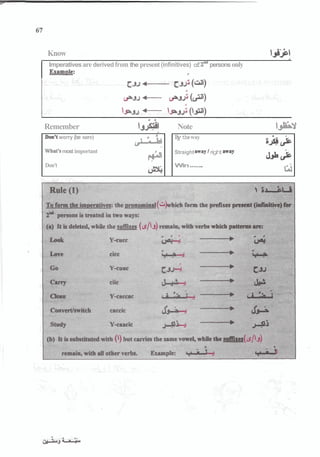
Know ,
r *
Imperativesarederivedfrom the present(infinitives) of2"*personsonly
l5mnQk: ?
Remember ijifiil Note ^i
.
.
Dm3worry (be sure)
4
What's most important
fÇ-
Don't
us^
B
ytheway
g
J
^
Straight-
Y 1right away
Win.
.
.
.
.
-
~ihyfe
Cd
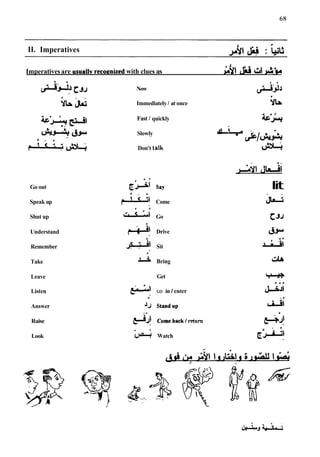
II. Imperatives Al JÇ : USU
&l iiri
0 Â
(Â¥J>m-^Ã
ft Ã
Imperativesare usuallv reco~nized
with clues as
yi-i'+ c
3
-
1 Now &J
il& &
i Immediately 1 at once ¥^la
is*- 5^ Fast 1 quickly a
s
&
.
b '$t i &/&
Slowly
Don't talk us^
Go out
Speak up
Shut up
Understand
Remember
Take
Leave
Listen
Answer
Raise
Look
Say
Come
Go
Drive
Sit
Bring
Get
GO in 1enter
f
Â¥^
Standup
.-a
G
-
1
1
Come back / return
U^Ñ Watch
l
i
t
Jl*-i
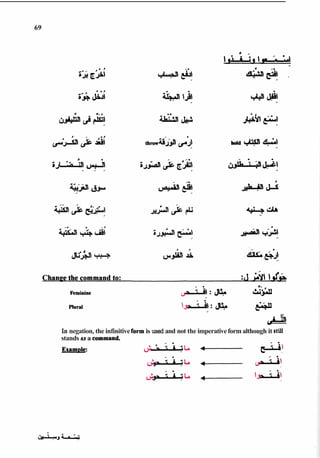
Innegation, the infinitiveform is used and not the imperativeformalthough it still
stands asa command.
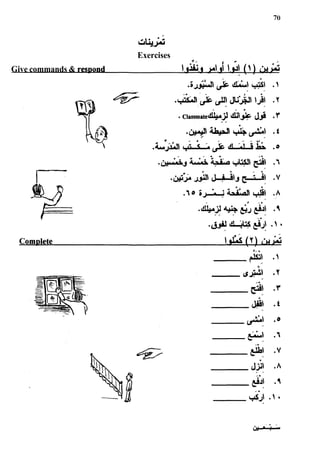
Exercises
Give commands & res~ond
Put the o~oosite
in the ern~tv
soace
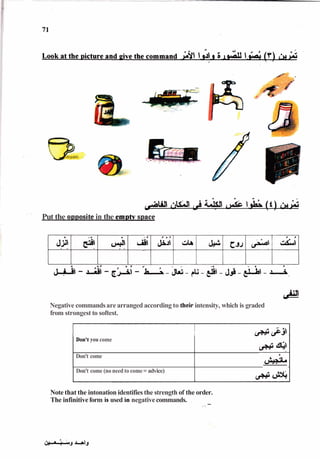
Negative commandsarearranged according to theirintensity, which is graded
from strongest to softest.
Don't youcome
Don't come
Note that the intonation identifies the strength of the order.
The infinitiveform i
sused i
n negativecommands. . .
,..,-
Don't come (no needto come=advice)
-
-
&&
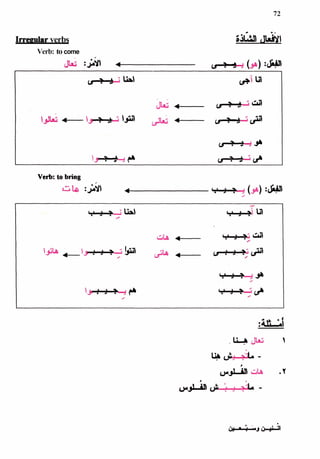
Irredar verbs
Verb: to come
Note:
b
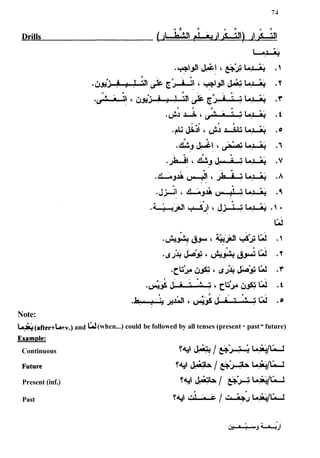
& (after+bv.) and (when...)could be followed by all tenses (present - past -future)
Example:
Continuous
Present (inf.)
Past
Memorize 
$ a
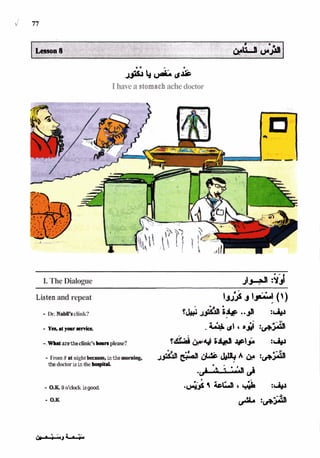
I havea stomachachedoctor
I. The Dialogue
Listenand repeat
- Dr. NabB's clink?
-.Whataretheclinic'sboon please?
- From8 a
tnight because,inthemoroing,
thedoctorisinthe hospital.
- O.K.9 o'clock isgood.
- 0
.
K
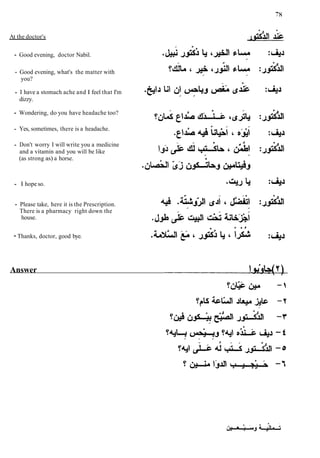
At the doctor's
Good evening, doctor Nabil.
Good evening, what's the matter with
you?
I have a stomach ache and I feel that I'm
dizzy.
Wondering, do you have headache too?
Yes, sometimes, there is a headache.
Don't worry I will write you a medicine
and a vitamin and you will be like
(as strong as) a horse.
I hope so.
Please take, here it is the Prescription.
There is a pharmacy right down the
house.
s> a >
- Thanks, doctor, good bye. .<Lç5lul
{-a i J & J ~ i s :&J
Answer
Know 1
3
9
.
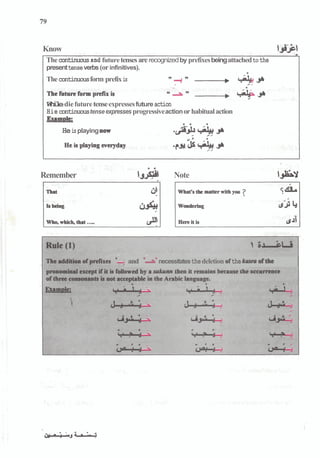
Thecontinuoususd futuretensesarerecognizedby prefixesbeingattachedtothe
presenttenseverbs(orinfinitives).
Thecontinuousform prefixis
0 r
W
h
i
l
ediefuturetenseexpressesfutureaction
Hiecontinuoustenseexpresses progressiveactionorhabitualaction
Exxmnlft:
HeisplayingBOW
Remember 1AÈS Note
and Ñ necessitatesthedeletion ofthe ofthe I
0 .
W>
& J
&
 &G
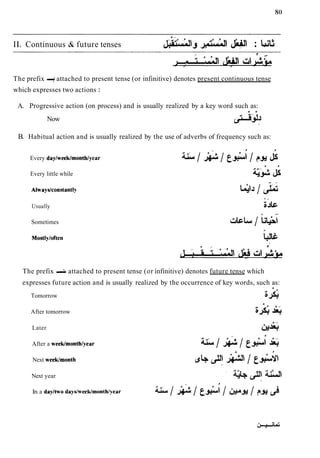
11. Continuous & future tenses , . ..
The prefix Ñ attached to present tense (or infinitive) denotes present continuous tense
which expresses two actions :
A. Progressive action (on process) and is usually realized by a key word such as:
Now
B. Habitual action and is usually realized by the use of adverbs of frequency such as:
Every day/weeklmonth/year
Every little while
Alwaydconstantly
Usually
Sometimes
Mostlyloften
The prefix Ñ attached to present tense (or infinitive) denotes future tense which
expresses future action and is usually realized by the occurrence of key words, such as:
Tomorrow
After tomorrow
Later
After a weeklmonthlyear
Next weeklmonth
Next year
In a dayltwo days/weeWmonth/year
,
&LA>
Exercises
Â¥ ,
WULul.&a .-&
p) ¡.
Put the suitable oronoun
' IÇLcl. ii^lol] I& ( Y
Look at the nicture& make sentences JAÈ .
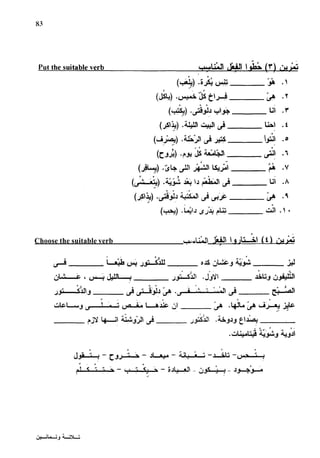
Choose the suitable verb +&A
/  r
Nepation (^1

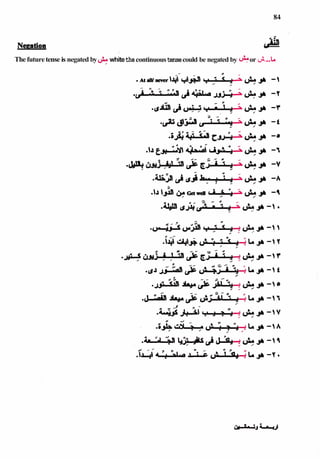
Thefuturetense is negated by whitethecontinuoustensecould be negated by or &...L
Drills ( J U ~ A ~ , '
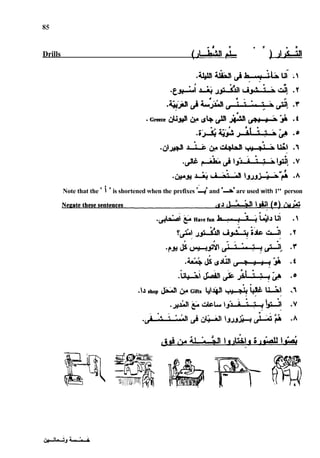
Note that the '  'is shortened when the prefixes '2
and "A'
are used with 1" person
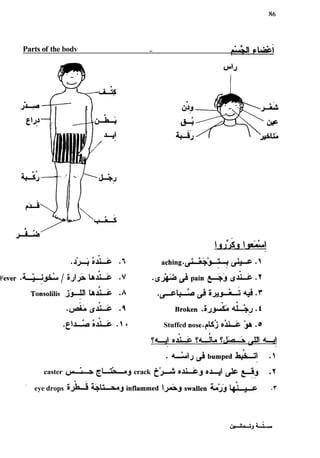
Parts of the bodv -.
Stuffed nose.$> o'& 3 - 0
0
caster ~y . .
'v fflÑtÈÑ
crack cOJÑ&¥^^-^ b^Ñ &G g3.'f
/.
' eye drops ~ $ 2 9 h k 3inflammed !$3 swaNen G
> ~ L G
.Y
illnesses iA )$I
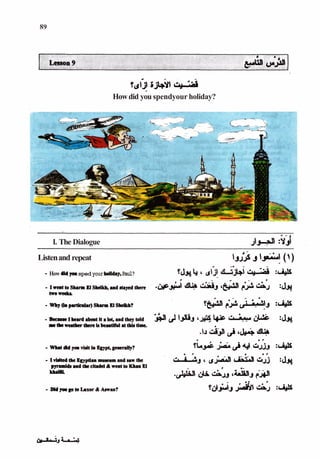
Howdid you spendyour holiday?
I. The Dialogue
Listenand repeat h3,> '&I (I)
-How did ywsped yourholiday,Paul?
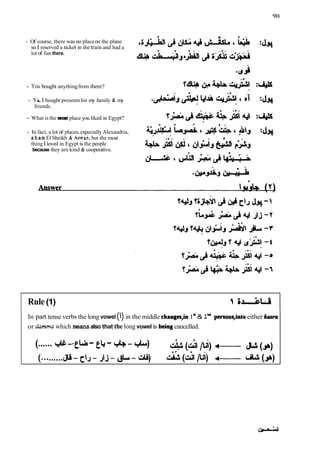
- Of course, there was no placeon the plane
so I reserved a ticket in the train and had a
lot of fun there.
- You bought anythingfrom there?
- Y
a
,I bought presentsfor my family & my
friends.
- What is the moat place you liked in Egypt?
- In fact, a lot of places,especiallyAlexandria,
sham El Sheikh & Aswan, but the most
thingI loved in Egypt is the people
because they are kind & cooperative.
Rule(1) 3 S ^ Ã ‘ f r
In part tenseverbs the long vowel (1) in the middle changei,in 1
" & 2"' persous,into either Iwsra
or danunawhich meansalso that thelong vowel is being cancelled.
(......^--*^a
- ^- ^-^L.) &(i-ul- /U)<
Ã
‘
à JLt (JÈ
(......,..&-~~-^j-^jL.-&) &(&/6) 4
-
, a(&)
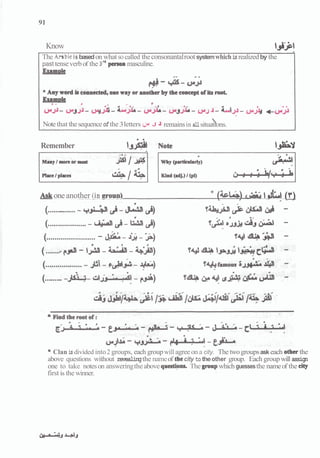
Know
The Arabicis basedon whatso called theconsonantalrootsystemwhichisrealizedby the
past tenseverbof the 3**
penon masculine.
I
i
i
a
M
l
& --
*^-s'a-u->i
* A n y w ~ d i s c o m ~ o n e w a ~ o r u M k e r ~ q r ~ ~ ~ n ~ o f i d
root.
Examolg
J
*- ' 0 J ..
* t
à ‘ e a ~ ~ - t W J ~ ---U-~-~J"JJL-wJ~-<

Notethat thesequenceof the3letters t>" J remainsin allsituations.
Remember
* f<cL^ <
Ask oneanother (in PTOUD)
- - &I&
( Y l
. -
* Clan isdivided into2 groups, each groupwill agreeon a city. Thetwogroupsask each otherthe
above questions without revealingthe nameof thecity totheother group. Each groupwill assign
one to take noteson answeringtheabove questions. The groupwhichguessesthe nameof the city
first is thewinner. .
.
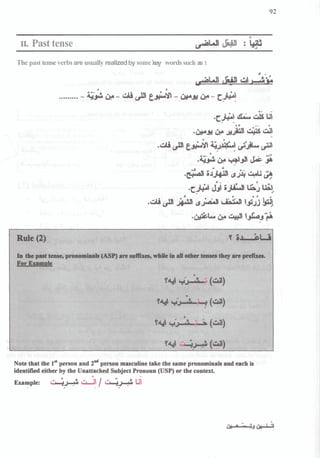
IL Past tense ,-iiimj
i
M :Ye
The past tense verbs are usually realizedby somekey wordssuch as :
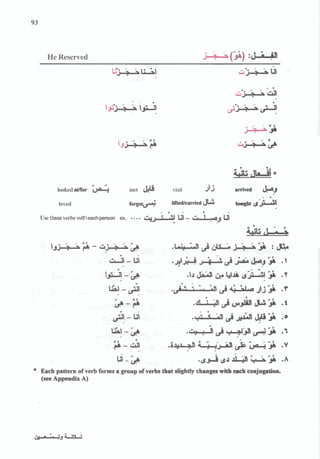
He Reserved -A(3)
: d a f t
looked attfor -
& met J@ visit 32
loved forgot& liftedtorried-
 *
*
Usetheseverbswitheachperson ex. L ~ J ~ G - & & & ~ u
. *
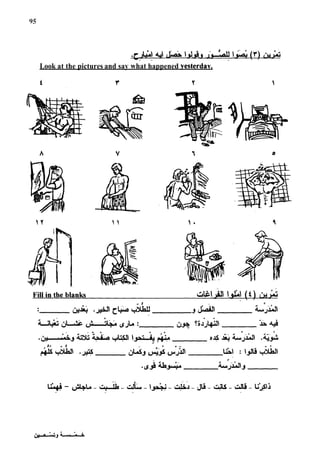
Look at the pictures and say what happened yesterday.
**& hj ( 0 ) &
O . .
. .
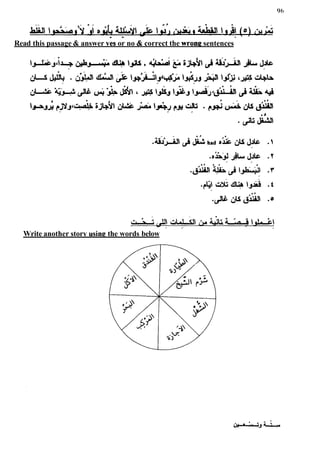
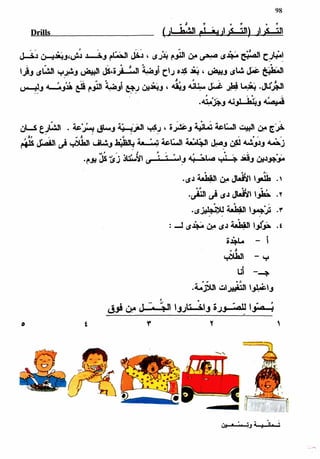
Read this passage & answer ves or no & correct the wronp sentences
Write another story us in^ the words below
Negation /^a
-
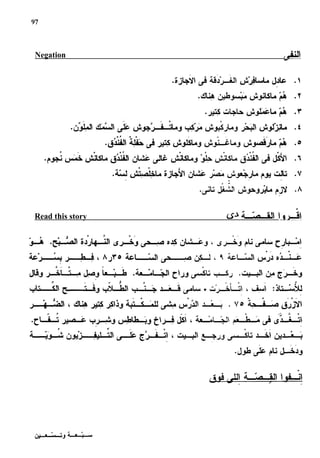
Read this story GJ- .9A
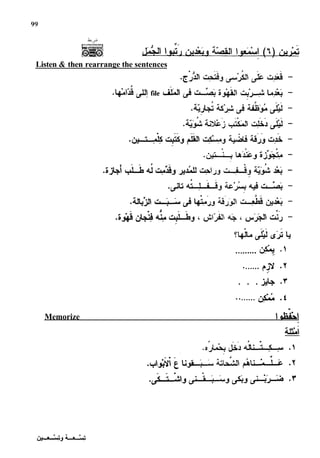
Listen & then rearrange the sentences
......... QLu * 
a...... fy .
1
. . . 34 .Y
*.....a (ISA. .t
.
Memorize 1 Ç^
J
-
SJ-M,
Â
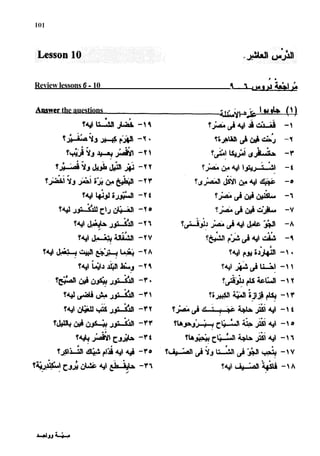
Review lessons 6 -10 f - 7 tw>a<aÈ
nswerthe auestions u,
I
-
&
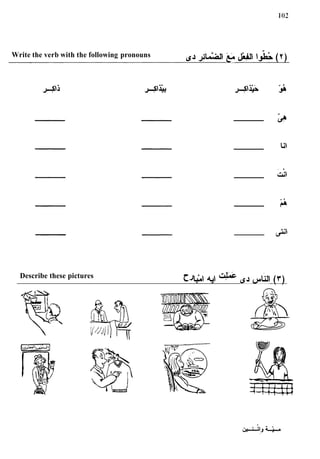
Write the verb with the following pronouns & $L^l@ lJ*U &( T )
Describe these pictures CJ&a j ^ J W b (r)
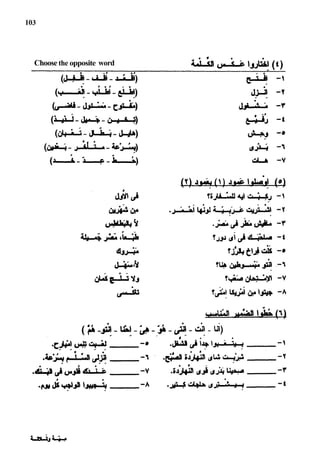
Choose the opposite word
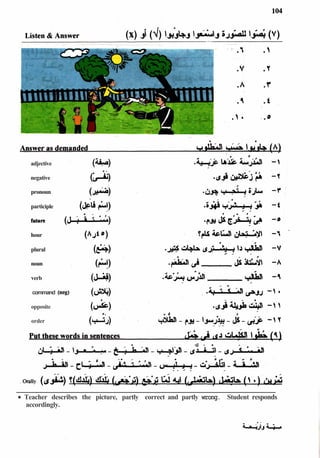
adjective
negative
pronoun
participle
future
hour
plural
noun
verb
command (neg)
opposite
order
Teacher describes the picture, partly correct and partly wrong. Student responds
accordingly.
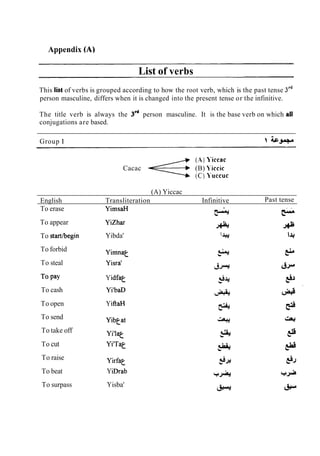
Appendix (A)
List of verbs
This list of verbs is grouped according to how the root verb, which is the past tense 3*
person masculine, differs when it is changed into the present tense or the infinitive.
The title verb is always the 3* person masculine. It is the base verb on which all
conjugations are based.
Group 1 h+
(-4)J'iccac
Cacac (B) Yiccic
( C )1-uccuc
(A) Yiccac
English Transliteration Infinitive Past tense
To erase YimsaJ3
+ F
To appear YiZhar
A &
Yibda'
To starthegin I* 1
4
To forbid Yimnat
To steal Yisra'
TOP Y Yidfat
To cash YitbaD
To open YifiaH
To send
To take off Yi'lat
To cut Yi'Tat
To raise Yirfat
To beat YiDrab
To surpass Yisba'
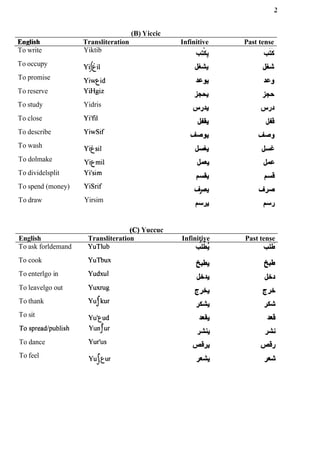
(B) Yiccic
Enxlish Transliteration Infinitive Past tense
To write
To occupy
To promise
To reserve
To study
To close
To describe
To wash
To dolmake
To dividelsplit
To spend (money)
To draw
Yiktib
~ & i l
Yiwtid
YBgiz
Yidris
Yi'fil
YiwSif
Yicsil
Yitmil
Yi'sim
YiSrif
Yirsim
(C)Yuccuc
English Transliteration Infinitive Past tense
To ask forldemand YuTlub & &
'
To cook YuTbux
To enterlgo in Yudxul
* e
&4 &J
To leavelgo out Y u m g
CAI c
s
To thank ~ u J k u r
S Y sf
To sit
To dance
To feel
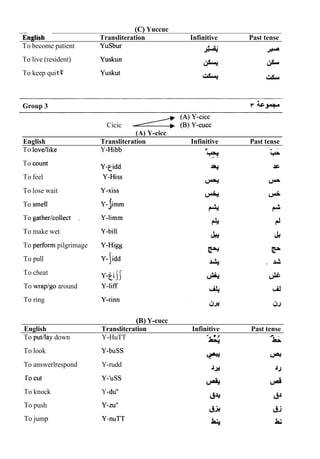
Group 2 y h + l
cicic +g~~~~~
uccuc
(A) Yiccac
English Transliteration Infinitive Past tense
To hearllisten to
To drink
To ride
To amve
To know
TO succeed
To fail
To get tired
To play
To have breakfast
To get bored
To understand
To win
To lose
To laugh
, To be able to
To prefer
To returdcome back
To ascendgo up
Yismat
Yi] rab
Yirkab
YiwSal
Yitrat'
YingaH
YistaT
Yittab
Yiltab
Yiffar
Yizha'
Yifham
Yiksab
Yiksar
YDHak
Yi'dar
YifDal
Yirgat
YiTlat
(B) Yiccic
English Transliteration Infinitive Past tense
To wearlput on Yilbis
A 4
To descendlgo down Yinzil
To hold Yimsik
To go farlgo away
(C) Yuccuc
%nglish Transliteration Infinitive Past tense
To become patient YuSbur 9 J >
J+'+ w
To live (resident) Yuskun
* i
+
To keep quict Yuskut
w *
Group 3 LW
;-cicc
Cicic -cucc
(A) Y-cicc
English Transliteration Infinitive Past tense
To lovellike Y-Hibb
To count
To feel
To lose wait
To smell
To gatherlcollect ,
To make wet
To pedorm pilgrimage
To pull
To cheat
To wraplgo around
To ring
(B) Y-cucc
English Transliteration Infinitive Past tense
To putlkq down Y-HuTT
To look , Y-buss
To answerlrespond Y-rudd
ro cut Y-IUSS
To knock Y-dul'
To push Y-zul*
To jump Y-nuTT
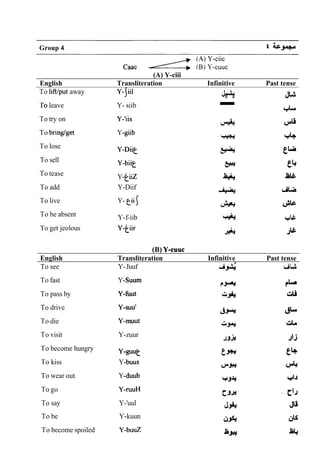
Group 4 i ^c'w^
(A) Y-ciii
English Transliteration Infinitive Past tense
To liftlput away Y-(iil JJ>UU
* * JU
To leave Y- siib
- +
To try on Y-'iis
To bringlget Y-giib
To lose Y-Diic
To sell Y-biit
To tease Y-f-iiZ
To add Y-Diif
To live Y- tii(
&b
To be absent Y-f-iib '-Y*^ +
l
&
To get jeolous Y-@ir
^ 9
(B) Y-cuuc
English Transliteration Infinitive Past tense
To see Y-Juuf & LiLu
To fast Y-Suum
^^-^ ?h
To pass by Y-hut &J^ &li
To drive
To die
To visit Y-zuur
JJA JÈ
To become hungry
y-guut
To kiss Y-buus
To wear out Y-duub
To go Y-ruuH
To say Y-'uul
To be Y-kuun
To become spoiled Y-buuZ
To taste Y-dud
L^ &
To get up Y-'uum
^ t^
To swim Y-pum ^ alfr
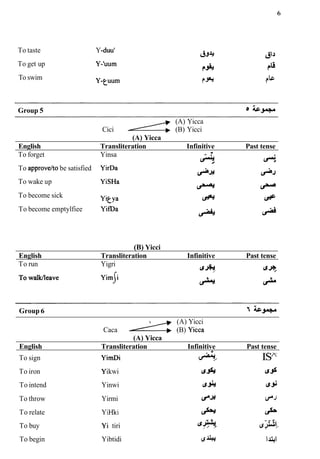
Group 5 oh+
(A) Yicca
Cici -
4
(B) Yicci
(A) Yicca
English Transliteration Infinitive Past tense
To forget Yinsa 0
A
, ^Â¥
To approvelto be satisfied YirDa
^~rf t^Ã
To wake up YiSHa
IS9^ i
f
^
To become sick Yitya & &
To become emptylfiee YifDa
^ ^
(B) Yicci
English Transliteration Infinitive Past tense
To run Yigri 0
&J^. &J*
P
Group 6 ^^Â¥J^
(A) Yicci
Caca (B) Yicca
(A) Yicca
English Transliteration Infinitive Past tense
/ - ' -
To sign YirnDi &
, IS^
To iron Yikwi d 0
To intend Yinwi i
s
& &
$
To throw Yirmi ^Â¥ (JO
To relate YiHki A *
0 -0
To buy Yi tiri ~f$+&W,
To begin Yibtidi && ^
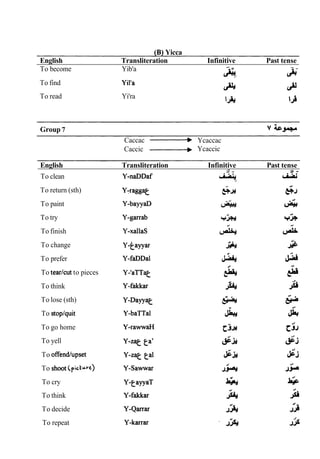
(BlYicca
English Transliteration Infinitive Past tense
To become Yib'a d
A, 'A-
To find Yil'a
^
To read Yi'ra
y"
A ^
Group 7 v A
^
-
Caccac Ã
‘
Ã
‘
Ã
‘
Ã
‘ Ycaccac
Caccic .
-
^ Ycaccic
To clean
To return (sth)
To paint
To try
To finish
To change
To prefer
To tearlcut to pieces
To think
To lose (sth)
To stoplquit
To go home
To yell
To offendlupset
To s h o o ~ ~ k t ~ ' - ~ )
To cry
To think
To decide
To repeat
English Transliteration Infinitive Past tense
^ -
Y-naDDaf
? :
^L^&
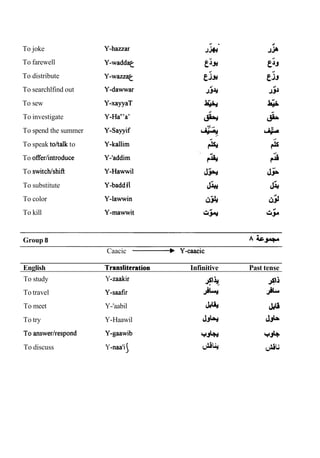
To joke
To farewell
To distribute
To searchlfind out
To sew
To investigate
To spend the summer
To speak toltalk to
To offedintroduce
To switchlshift
To substitute
To color
To kill
Group 8 A L J - ~ - .
Caacic Ã
‘
Ã
‘
Ã
‘
à Y-caacic
English rans slit era ti on Infinitive Past tense
To study Y-zaakir $4, @
To travel Y-saafir A^, J
L
To meet Y-'aabil &
To try Y-Haawil ~h &
To discuss Y-naatiJ d
u
( &U
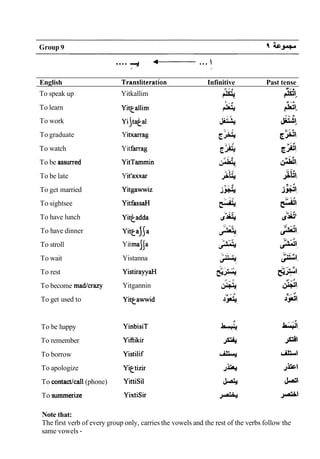
Group 9 ^&J-*^>
English rans slit era ti on Infinitive Past tense
To speak up
To learn
To work
To graduate
To watch
To be assurred
To be late
To get married
To sightsee
To have lunch
To have dinner
To stroll
To wait
To rest
To become mad/crazy
To get used to
To be happy
To remember
To borrow
To apologize
To contact/call(phone)
To summerize
Yitkallim
Yitcallim
yijta@
Yitxarrag
Yitfarrag
YitTamrnin
Yit'axxar
Yitgawwiz
YitfassaH
Yitf-adda
~ i t e a f i a
Yitma&
Yistanna
YistirayyaH
Yitgannin
Yiteawwid
YinbisiT
Yiftikir
Yistilif
Yttizir
YittiSil
YixtiSir
Note that:
The first verb of every group only, carries the vowels and the rest of the verbs follow the
same vowels
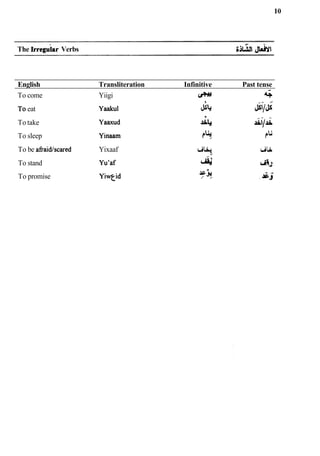
The 1rregular Verbs i& &I
English Transliteration Infinitive Past tense
To come Yiigi (J^JJ <a.
TO eat yaakul JSU &(bi
To take Yaaxud J&i/i
To sleep Yimam f^, iH
To be afraidscared Yixaaf dLj d
L
&
4
Yu'af 4
To stand 4
/ y
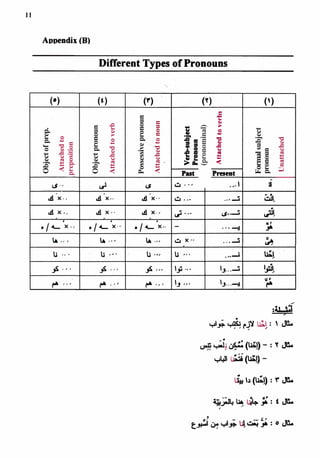
To promise Y i ~ i d ^Â¥ .&
Object
of
prep.
&
:
Attached
to
preposition
Object
pronounr
.
9
.
.
Attached
to
verb
Possessive
pronoun
In
Attached
to
noun
(pronominal)
Formal
subject
pronoun-
i
,
I
Unattached
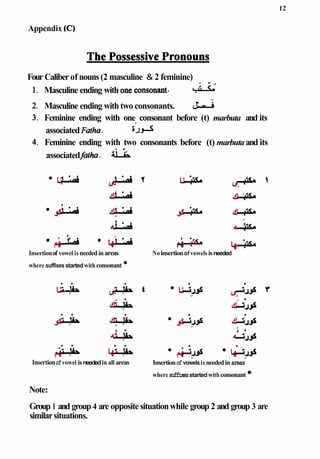
Appendix (C)
Four Caliberof nouns (2 masculine & 2 feminine)
Masculine ending with oneconsonant- s
Masculine ending with two consonants.
Feminine ending with one consonant before (t) marbuta and its
associatedFatha. GJ-S
Feminine ending with two consonants before (t) marbuta and its
y -ia>
associatedfatha.
rt-^ Q
*
Noinsertionof vowelsisneeded
Insertionof vowel is neededinareas
where suffixesstartedwithconsonant *
Insertionof vowel isneededin all areas Insertionof vowelsis neededin areas
wheresuffixesstartedwithconsonant
Note:
Group 1 and group4 are opposite situationwhile group 2 and group 3 are
similarsituations.
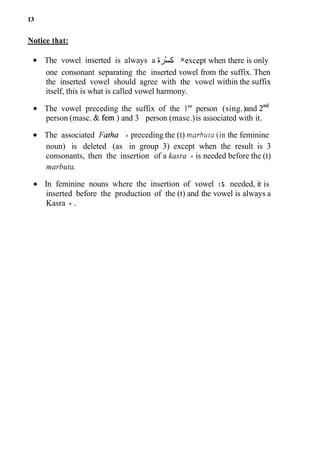
13
Notice that:
The vowel inserted is always a SJÑ xexcept when there is only
one consonant separating the inserted vowel from the suffix. Then
the inserted vowel should agree with the vowel within the suffix
itself, this is what is called vowel harmony.
The vowel preceding the suffix of the 1" person (sing.)and 2nd
person (masc. & fern.)and 3 person (masc.)is associated with it.
The associated Fatha 'x preceding the (t) marbuta (in the feminine
noun) is deleted (as in group 3) except when the result is 3
consonants, then the insertion of a kasra x is needed before the (t)
marbuta.
In feminine nouns where the insertion of vowel is needed, it is
inserted before the production of the (t) and the vowel is always a
Kasra x .
Survival Arabic
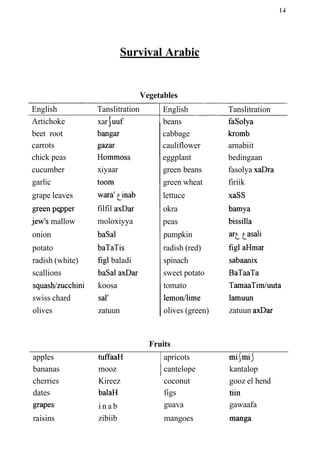
Vegetables
-
English Tanslitration
xarjuuf
Artichoke
beet root
carrots
chick peas
cucumber
garlic
grape leaves
green pepper
Jew's mallow
onion
potato
radish (white)
scallions
squash/zucchini
swiss chard
olives
bangar
gzar
Hommoss
xiyaar
toom
warattinab
filfil axDar
moloxiyya
basal
baTaTis
figl baladi
basal axDar
koosa
salt
zatuun
English Tanslitration
beans
cabbage
cauliflower
eggplant
green beans
green wheat
lettuce
okra
peas
pumpkin
radish (red)
spinach
sweet potato
tomato
lemon/lime
olives (green)
Fruits
fasolya
kromb
arnabiit
bedingaan
fasolya xaDra
firiik
xaSS
bamya
bissilla
as? tasali
figl aHmar
sabaanix
BaTaaTa
TamaaTimIuuta
lamuun
zatuun axDar
bananas mooz 1cantelope kantalop
apples tuffaaH
cherries Kireez
dates balaH
apricots m i b i J
raisins
i n a b
zibiib
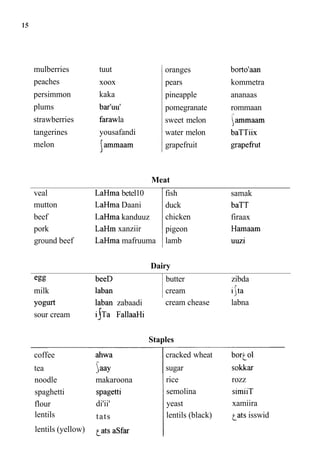
coconut gooz el hend
figs tiin
guava gawaafa
mangoes manga
mulberries tuut
peaches xoox
persimmon kaka
plums bar'uut
strawberries farawla
tangerines yousafandi
melon farnmaam
oranges bortotaan
pears kommetra
pineapple ananaas
pomegranate rommaan
sweet melon [ammaam
water melon baTTiix
grapefruit grapefrut
Meat
veal LaHma betel10
mutton LaHma Daani
beef LaHma kanduuz
pork LaHm xanziir
ground beef LaHma mafruuma
fish samak
duck baTT
chicken firaax
pigeon Hamaam
lamb uuzi
YOW* laban zabaadi
sour cream i ~ a
FallaaHi
Dairy
cream chease labna
egg beeD
milk laban
Staples
butter zibda
cream i(ta
coffee ahwa
tea a a ~
noodle makaroona
spaghetti spagetti
flour di'ii'
lentils tats
lentils (yellow) tats asfar
cracked wheat borcol
sugar sokkar
rice rozz
semolina simiiT
yeast xamiira
lentils (black) tats isswid
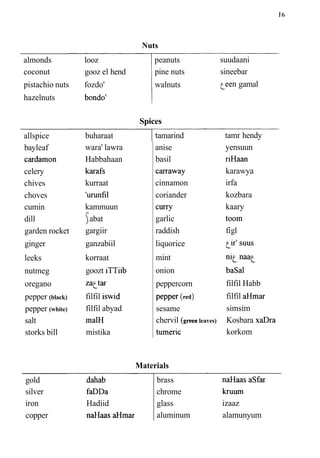
Nuts
almonds looz
coconut gooz el hend
pistachio nuts fozdo'
hazelnuts bondo'
allspice
bayleaf
cardamon
celery
chives
choves
cumin
dill
garden rocket
ginger
leeks
nutmeg
oregano
pepper (black)
pepper (white)
salt
storks bill
buharaat
wara' lawra
Habbahaan
karats
kurraat
unmfil
kammuun
abat
gargiir
ganzabiil
korraat
goozt iTTiib
zattas
filfil iswid
filfil abyad
malH
mistika
peanuts suudaani
pine nuts sineebar
walnuts teen gamal
Spices
tamarind
anise
basil
carraway
cinnamon
coriander
curry
garlic
raddish
liquorice
mint
onion
peppercorn
pepper (red)
sesame
chervil (green leaves)
tumeric
Materials
tamr hendy
yensuun
riHaan
karawya
irfa
kozbara
kaary
toom
figl
i r ' suus
nit naaf
basal
filfil Habb
filfil aHmar
simsim
Kosbara xaDra
korkom
gold dahab
silver faDDa
iron Hadiid
copper naHaas aHmar
brass naHaas asfar
chrome h u m
glass izaaz
aluminum alamunyum
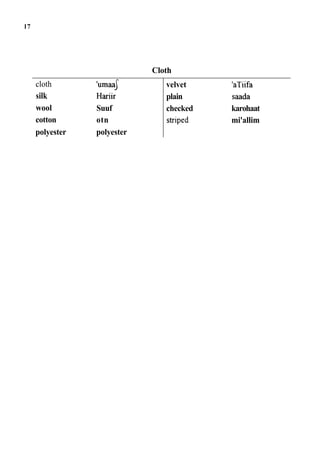
Cloth
cloth 'umaas
silk Hariir
wool Suuf
cotton otn
polyester polyester
velvet aTiifa
plain saada
checked karohaat
stnped mi'allim
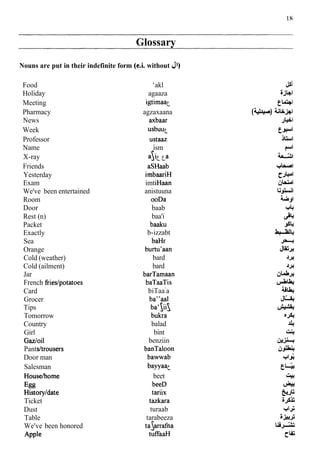
Glossary
Nouns are put in their indefinite form (e.i. without J1)
Food
Holiday
Meeting
Pharmacy
News
Week
Professor
Name
X-ray
Friends
Yesterday
Exam
We've been entertained
Room
Door
Rest (n)
Packet
Exactly
Sea
Orange
Cold (weather)
Cold (ailment)
Jar
French frieslpotatoes
Card
Grocer
Tips
Tomorrow
Country
Girl
Gadoil
Pants/trousers
Door man
Salesman
House/home
Egg
Historyldate
Ticket
Dust
Table
We've been honored
'akl
agaaza
agzaxaana
axbaar
ism
asi t f-a
aSHaab
imbaariH
imtiHaan
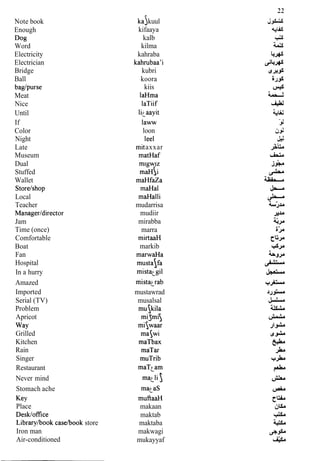
anistuuna
ooDa
baab
baa'i
baaku
b-izzabt
baHr
burtu'aan
bard
bard
barTamaan
baTaaTis
biTaa
7
a
bukra
balad
bint
benziin
banTaloon
bawwab
beet
beeD
tariix
tazkara
turaab
tarabeeza
a jarrafna
tuffaaH
"iW
(JAU
feu"
tl&lJ
43
iA3
u 9
tit;
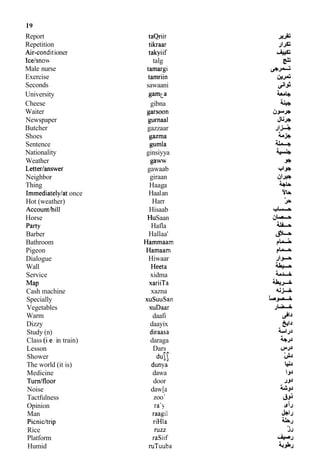
Report
Repetition
Air-conditioner
Icelsnow
Male nurse
Exercise
Seconds
University
Cheese
Waiter
Newspaper
Butcher
Shoes
Sentence
Nationality
Weather
Letterlanswer
Neighbor
Thing
Immediatelylat once
Hot (weather)
Accounthill
Horse
Party
Barber
Bathroom
Pigeon
Dialogue
Wall
Service
Map
Cash machine
Specially
Vegetables
Warm
Dizzy
Study (n)
Class (i.e.in train)
Lesson
Shower
The world (it is)
Medicine
Turdfloor
Noise
Tactfulness
Opinion
Man
Picnicltrip
Rice
Platform
Humid
tikraar
takyiif
talg
tamargi
sawaani
gibna
garsoon
gurnaal
gazzaar
gazma
ginsiyya
ga
-
gawaab
giraan
Haaga
Haalan
Harr
Hisaab
HuSaan
Hafla
Hallaa'
Hammaam
Hamaam
Hiwaar
Heeta
xidma
xariiTa
xazna
xuSuuSan
xuDaar
daafi
daayix
diraasa
daraga
Dars
d"S s
dawa
door
daw[a
zoo
ray
raagil
rHIa
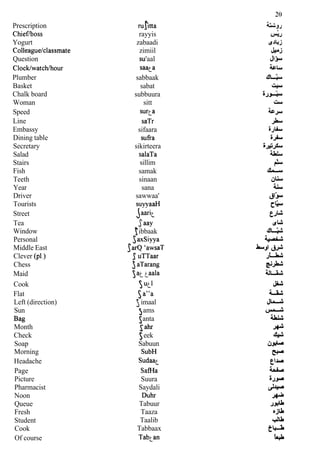
Prescription
Chieflboss
Yogurt
Colleaguelclassmate
Question
Clock/watch/hour
Plumber
Basket
Chalk board
Woman
Speed
Line
Embassy
Dining table
Secretary
Salad
Stairs
Fish
Teeth
Year
Driver
Tourists
Street
Tea
Window
Personal
Middle East
Clever (pi.)
Chess
Maid
Cook
Flat
Left (direction)
Sun
Bag
Month
Check
Soap
Morning
Headache
Page
Picture
Pharmacist
Noon
Queue
Fresh
Student
Cook
Of course
ruritta
rayyis
zabaadi
zimiil
su'aal
saaca
sabbaak
sabat
subbuura
sitt
surca
saTr
sifaara
sufra
sikirteera
salaTa
sillim
samak
sinaan
sana
sawwaa'
suyyaaH
Jsari;_
Jsay
ibbaak
a"a
imaal
 ams
4
Santa
^
5eek
Sabuun
SubH
Sudaat
SafHa
Suura
Saydali
Duhr
Tabuur
Taaza
Taalib
Tabbaax
Tabtan
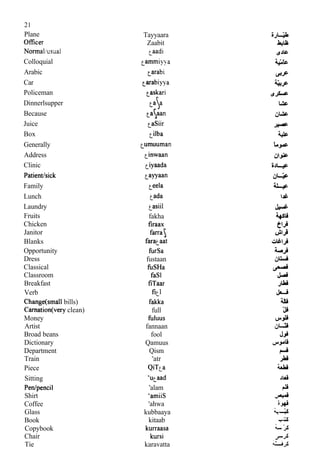
21
Plane
Officer
Normal~usual
Colloquial
Arabic
Car
Policeman
Dinnerlsupper
Because
Juice
Box
Generally
Address
Clinic
Patientlsick
Family
Lunch
Laundry
Fruits
Chicken
Janitor
Blanks
Opportunity
Dress
Classical
Classroom
Breakfast
Verb
Change(smal1bills)
Camation(very clean)
Money
Artist
Broad beans
Dictionary
Department
Train
Piece
Sitting
Penlpencil
Shirt
Coffee
Glass
Book
Copybook
Chair
Tie
Tayyaara
Zaabit
kasiil
fakha
firaax
farra
farakaat
furSa
fustaan
foSHa
faS1
fiTaar
fakka
full
fuluus
fannaan
fool
Qamuus
Qism
'atr
QiTta
'utaad
'alam
'amiis
'ahwa
kubbaaya
kitaab
kurraasa
kursi
karavatta
Note book
Enough
Dog
Word
Electricity
Electrician
Bridge
Ball
baglpurse
Meat
Nice
Until
If
Color
Night
Late
Museum
Dual
Stuffed
Wallet
Storelshop
Local
Teacher
Managerldirector
Jam
Time (once)
Comfortable
Boat
Fan
Hospital
In a hurry
Amazed
Imported
Serial (TV)
Problem
Apricot
Way
Grilled
Kitchen
Rain
Singer
Restaurant
Never mind
Stomach ache
Key
Place
Desk/office
Librarylbook casehook store
Iron man
Air-conditioned
kaJkuul
kifaaya
kalb
kilma
kahraba
kahrubaa'i
kubri
koora
kiis
l a m a
laTiif
litaayit
l a w
loon
lee1
mitaxxar
matHaf
maHfaZa
maHal
maHalli
mudarrisa
mudiir
mirabba
marra
mirtaaH
markib
marwaHa
mstafa
mistatgil
mustawrad
musalsal
muftaaH
makaan
maktab
maktaba
makwagi
mukayyaf
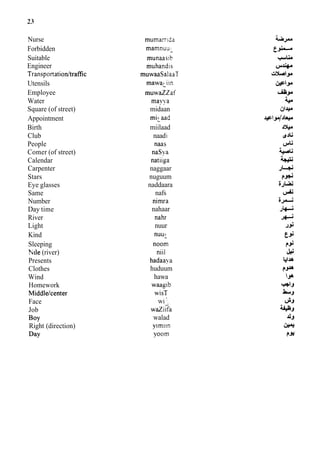
Nurse
Forbidden
Suitable
Engineer
Transportatiodtraffic
Utensils
Employee
Water
Square (of street)
Appointment
Birth
Club
People
Comer (of street)
Calendar
Carpenter
Stars
Eye glasses
Same
Number
Day time
River
Light
Kind
Sleeping
ISlle (river)
Presents
Clothes
Wind
Homework
Middlekenter
Face
Job
BOY
Right (direction)
Day
mumamda
mamnuu;
-
munaasib
muhandis
muwaaSalaaT
mawaLiin
muwaZZaf
mayya
midaan
micaad
miilaad
naadi
naas
naSya
natiiga
naggaar
nuguum
naddaara
nafs
nirnra
nahaar
nahr
nuur
noom
niil
hadaaya
huduum
hawa
walad
^ / V * '  O :^+I^.
.. - -.
I. S.B. N. 977 - 19 - 7930 - 2 +
a
*
'+l yliJWl
*
^
I ^
ancient Egyptian are the masters of the written word
had an impactonthe flourishmentof civilizationin the
word

--------Egyptian Colloquial-----------------------------------------------------------

  • 2.
  • 3.
  • 4.
    A writer's prayer God,I have knowledge, So will you show me now How to use it wisely And find a way somehow To make the world I live in A little better place.. And make life with its problems A bit easier to face.. Grant me faith and courage And put purpose in my days.. And show me how to serve Thee In the most effective ways So all my education, My knowledge and my skill, May find their true fulfillment As I learn to do Thy Will And may I ever be aware In everything I do That knowledge come from learning.. And wisdom comes from you. Anonymous
  • 5.
    Acknowledgements I would liketo express my deepest gratitude to all who supported and encouragedme throughout the completion of this book. I would like to express my deepest appreciation to Dr. El SaidBadawi, chairman and director of the Arabic Language Institute (ALI)at the American University for his supportive guidance, valuable remarks and great assistance. Thank you. I would like to sincerely thank Dr. David Wilmsen, director of the Arabic Language Division (ALD) in the Center for Adults and Continuing Education (CACE) at the American University, for his wise comments and valuable remarks. Thank you. I owe a special debt and gratitude to Dr. Richard Cahill, director of the Middle East Studies Program (MESP), for his worthy advice, support and great help. Thank you. Special thanks and gratitude owed to my dear friend Mohamed Eid for his insightful comments and constructive criticism which guided me in writing this book. Thank you. Due thanks are conveyed to Dalia Samir for her forbearance and generosity in time and effort in writing down the book. Thank you. My warmest gratitude and appreciation go to the members of my family especially my brother Mamdouh, my daughter Noha and my son in law Mohamed who spared no effort, and supported me with inexhaustible patience and indispensable inspiration which helped me pass this book into light. Thank you. Last, but not least. many thanks go to my dear students, at the American University (AUC) and the Middle East Studies Program (MESP), who were the subjects upon whom I exercised and experienced this book. Their remarks and feedback were greatly useful and beneficial. Thank you.
  • 6.
    INTRODUCTION Arabic is oneof the major languages in the world. It is widely spread on two continents. It is the official language of about 22 countries with a total population of about 120 millions which places it among the top ten tongues of the planet in regard to the number of speakers. Arabic belongs to the Semitic family of languages and the term Arabic is used to describe two different classes or forms of the same language. The first is jGHa or the 'pure' language, and it involves two levels, the Classical Arabic which is the language of the 'Kur'aan' the holy book of Islam, and the Modem Standard Arabic or the Modem Literary Arabic. The second 1.s the ? m ~ ~ ~ a . . . which is the colloquial or the common language, and it is of three levels. the Educated Spoken Arabic, the Enlightened Spoken Arabic, and the Illiterate Spoken Arabic. The main object of this book is to introduce the Educated Spoken Arabic or Language which takes the two features of both fuSHa and ^amrniyyaand which is a kind of reduced fuSHa and standardized colloquial. It is the spoken Arabic of Egypt which aims to provide easy access to the Arabic which Egyptians, particularly the educated of Cairo and Alexandria, learn in the house and use in everyday life. Thus this course is based on a functional approach yet the essential rules of grammar, which only without which communication may fail, will be provided. The main emphasis though will be on conversational pieces with vocabulary expressions and some idiomatic formulas that are commonly used in everyday life. In other words, the language itself will be presented not theories about it. The main concern is to ensure that learners can speak and understand the language in the shortest time available and in the simplest way possible. In short, the focus will be on fluency rather than accuracy. The explanation, rules, and instructions are also provided in English to ensure full understanding. Also a good amount of drills & exercises are provided to guarantee reinforcement.
  • 7.
    This book consistsof: First: Preliminary stage involving 4 stages. Second: Two units, each unit consists of 5 lessons one of which is a review for the 4 previous lessons. Third: Appendices A, B, C Fourth: Glossary Fifth: Useful vocabulary for survi~al Arabic The preliminary stage consists of the very basic rules that any beginner should be familiarized with, as an introductory stage that is essential to Arabic language learning. This section is sequenced according to students' level. The teacher begins with stage 1 if the students ha-eno idea about the Arabic language script. The teacher may move to stage 2 if the students know the Alphabets well but do not know how to read or wnte. The teacher may, as well, move directly to stage 3 if the students know the basic rules of the Arabic script and can fairly read or write. Stage 4 is a continuum of stage 3. Each lesson begins with a picture, which illustrates the main objective of the lesson. In order to help students develop the language as fast as possible and to acquire native like pronunciation and intonation, a tape is also provided together with flashcards to challenge the students and enhance their listening comprehension. Reading comprehension and creating conversational skits are also reinforced. As the colloquial is basically the spoken language, listening and speaking are the two skills of the language that are intensively emphasized. Reading and writing are only used as a guide for students on learning the language and implementing their assignments. Some appendices are also added at the end for further instruction. A Glossary is also provided. A group of useful vocabulary words, which non-native speakers may need, to survive with Arabic at the very beginning.
  • 8.
    Table Of Contents Page I.Introduction L + & II. Table of contents +a 111. Preliminary stages I JÈ Stage 1 Alphabets & numbers ......................................................... 1 Stage 2 Consonants & vwels ......................................................... V Stage 3 Masculine & feminine ........................................................1 1 Stage 4 Sentences & phrases ......................................................... 1V IV. Unit one Lesson 1 f Dialogue: Pleased to meet you. 5 6 &A Nationalities Occupations Verbs: present /present continuous Lesson 2 Dialogue: Sorry I am late. Time & place expressions The clock Verbs: present /present continuous
  • 9.
    Lesson 3 Dialogue: Doyouhave fresh eggs? % j & & I ...d u Singulars, duals & plurals Plurals with numbers Verbs: present /present continuous Lesson 4 Adjectives and Colors The weather The participles Lesson 5 Review V. Unit Two Lesson 6 Dialogue: I want to get a ticket The verb: Exercises Proverbs Lesson 7 Dialogue: The verb: Exercises Proverbs Lesson 8 Dialogue: The verb: Proverbs Present tense Clean theflat well Imperative tense e 0 I have a stomach ache doctor s . 3 4 A k Continuous &future tense
  • 10.
    VII Lesson 9 ..........Af Dialogue: How did you spend your holiday? T& gjbv ( - 4 The verb: Past tense Exercises Proverbs Lesson 10 Review VI. Appendices Appendix A List of verbs Appendix B Different kinds of pronouns Appendix C Possessive pronouns VII. Glossary VIII. Survival Arabic
  • 11.
  • 12.
    -uwl& . . - ! I 9&if1& a - .. d li 2 1 y 9 f Sounds that Change in Shiftins È_ from FuSHa to tammiya ^ is- (glottal stop)
  • 13.
    The following t^letiÇtitbe~~neflofçIltbelettenoftheArd>kah)habeLmtrunKterati iaintroducedi nt batqpto helphpronunciation. Thesound oftheletter iaourmainconcern. Name 1 ~ ~ b i ~ I Transliteration of letter . FQXBL 'alf/hamza 64 I/& thaa'haa' 1 I - I - Taa' 1 A I * T laam J 1 miim ? m noun (¥ n baa' h Guideto Pronunciation Meaning I pronunciation . answer aid food big bint giri table tasriiHa dressingtable think e a r e a r a gossip - gid s"=a shoes ' noequivalent Eafla Pam' no eauivalent xariita man deer 1 diib 1 wolf I there 6akar masculine rest m a picnic zero zibuun customer , , semi I simm I poison , I I Sunday Sabuun I -P I I I I Duck Dahr 1 back 1 I I Tough Taaza fresh I noequivalent I f - I . .ye I noequivalent 1 Aarb 1 ww 1 I 7 I fool I fuul I beans I I come I Qamaus dictionary , , kettle I kitaab 1 book 1 b 1 laHma 1 . meat I moon I mum I r a z e r 1 never nimra number wasp 1 walad I boy I
  • 14.
    Note: - ' isalso called a glottalstop and it should precedeall vowels when they occurat the 1 beginning of the word. In Arabic it may appear anywherein the word beginning, ! middleor end, or even, doubled. Example: *akl - baypi - badd - rn 8 and A are produced in modern standard Arabic only i-e.FuSHa (&/A) . . * H ,i ,c,t,have no equivalent i n English (21~) . 4 f One dupe to describe one sound. The idea of combiningtwo letten to describeone sound does not exist in Arabic. Ex. ch / sh / th (2) . 4 3 S, D, Tand Z have no exact equivalent in ~ n ~ l i s h b u t they are the emphatic (velarized) version of the n o d s, d, t and z (d/&h/b) / (&/i.~/b). How to produce the non-equivalent sounds * H sounds like a very emphatic h. (just imagineyou haveswalloweda spoonful of the hottest c h i imaginable) (0. * x more guttural than its Scotch or German cousin (it is always better to exaggerate rather than underemphasize the guttural aspect) (^)ex. Van Gogh. * (peculiarity of the Semiticlanguage)= to gag. constrictingthe musclesof the larynx so that the How of air through the throat is choked off (the voiced version of H ) . * it is the sound produced when gargling (similar to the very strongly rolled Parisian r). How to oroducethe Semi-eauivalent sounds To produce the glottalstop hawa '('19, a complete closureof the vocal cords is required, wherecompression of air is composed then a sudden blow of the air is produced. The Q (J)islike the normal K except that it is produced when the tongueis very far back in the throat roof of the mouth. The r0)Bmore rolled than in English. The 1(J)u not rolled asit is in English. The'a' sound, that is used as a vowel, is sometimesvelarized due to word context, as in: Arabic faar (mouse) faas (axe) English 'ann 'and
  • 15.
    Greeting Formulas A. SabaaHiheer B. SabaaH innuur A. misaa' ilxeer B. misaa' innuur A. izzayyak / izzayyik B. kwayyis / kwayyisa Wamdu li Ilaah A. tiSbaH(i) tala xeer B. w inta / inti min ahlu ahlan ahlan (w sahlan) ahlan w sahlan ahlan biik / biiki sqiida saciida sqiida satiida ( m q a ssalaama) Allah yisallimak / ik Hamdillah tala ssalaama Allah yisallimak 1ik Kull sana w Inta(i) tayyib(a) w inta(i) tayyiba(a) Good morning Good morning Good evening Good evening How are you (m/f) Good (df) Thanks be to God Good night (m/f) and you (df) too Hi Hi (weicome) welcome welcomed by you (df) Hello Hello (welcome) Good bye Good bye (with safety) May God preserve you (m/f) Thanks be to God for preservation (said on: arrival from travelling, recovered from sickness saved from bad event ex. accident) Many happy returns you, too
  • 16.
    Common Phrases andExpressions A. mabruuk B. AUaah yibaarik fiik / fiiki A. ukran B. tafwan A. aasif 1'asfa B. matlil A. min faDIak I ik A. law samaHt ( i ) a a y i z (a) I mi[ taayiz (a) taarif (a) / m$ taarif (a) faahim (a) / mi faahim (a) saakin (a) 1mil saakin (a) mumkin / mil mumkin mumkin? fii / mafiif and! / ma^andiiJ L Congratulations (may it blessed) May God bless you ( d o Thanks welcome Sorry Never mind Excuse me (said on dismissing oneself) You may (go on) Take what you (m/f) asked for Take what I am offering If you please / excuse me If you please I excuse me If God wills Thanks be to God I want (f) /1don't want (f) I know (f) 11don't know (f) I understand (f) 11don't understand (f) I live....(f) 11don't live.......(f) Possible I impossible May I? Can I? There is / there isn't I have /1don't have aywa la' bass kifaaya ~ a ~ ~ i b h a ai Kamaan taani SaHH maZbuuT talaT sawa fwa?Ya WaYYa Yes Enough/bui/only Enough OK Also/ too Agaidmore Right Correct Wrong Together Little by little means Tabcan O f fcourse fitIan True abadan Never giddan/awi/xaalis Very (neg+ xaalis =never) dayman Always/ail the time mi kida? Isn't it so? mi mq'uul Incredible/ its crazy bi [wee! Slowly kalaam faaqNonsense yaxsaara What a pity winta(i) maalakfik none of your(m/f) business maalakfik What is the matter with u mafii muikila No problem
  • 17.
    I. Question words? Res:ana ......................... Inta ismak/ inti ismik What isyourname? ^ Res:ana ismi ......................... y* Whereareyonfiom? Res: ana min ......................... Inti mida/iti h a 1 feen? 1 y.yi ~heredo you live? ......................... R e s :ana saakinlsaknafi emta? lob gect/iti geeti ?& Whendidyoucome? R e s :ana get ......................... t )j )HOWdidYOU C O ~ ? Res: ana geet ......................... bit! @ndak/inti ( i k ) F I Res:ana tandi ......................... izaazit ilmayya t lam? Howmuchisthe 1 ^(^ battle ofwater? Res:izaazit ilmayya b ......................... intaliinti him pq R e s :ana hina Pa aan ......................... I Ã ‘ Ã ‘ Ã ‘ Ã ‘ into/intifi 1, a ? 1 door yrf Whichfloorareyouin? R e s :ana f- iddwr ......................... 1 1 . YesNoquestions? t s l ~ 9 . - ^ l a . * inta Taalib? Res: aywa, anaTaalib. / la9 , ma 111)T d b . inti T d b a ? Ra:aywa, a m TaaIiba. / I*', am mi^~aaliba. N0k Y M oquestionsand theiranswersare identified by intonation only. Thequestion hasa risingpitch w h i t eits answerhasa falling pitch. - * .
  • 18.
    I. Numbers - - &Y . - -- Teens Units I - 1 I - - A itneen talatiin Y 4 >r I I , - i I arbiciin t à ArbaFtaajar 1 f I *arbaca f I 4 xamsiin i ~amastaafar 1 9 1I xamsa I o I I 0 à I I 1 tamaniin I A . ~amantaakr 1 tamanya i I I I 1 pound gineeh I I I I -- ^ 1 quarter of a pound I ~ u b p gineeh(iamsa w cilriin id -S'4 & , 1 = & 2 7 0 I half a pound nuSS gineeh (x&siin ir7) 1 Note: The word k kmeans piaster, is used from # 3-10 13 piasters / 10 piasters New Vocabulary ;+A+ n i l * - Transliteration I fakka I II the rest (moneyor otherwise) ilbaa'i I 1how much (money) Bikaam the check / bill 1account IlHisaab I
  • 19.
    L A & * * *Lid& The Arabic Alphabet Note: The red line represents the iine on / under which the part of the letter should go.
  • 20.
    Characteristics of theArabic Al~habet 1. Many letters have the same shapes and the distinction is made only by the use of dots. j J i A - A - A + A A + There is a great conformity in shape bemeen the letter when it appears at the beginning and when it appears at the h d , when it appears at the beginning(or in the middle) the bottom part only is deleted. Most of the letters have 3forms, differing according to their location in the word, i.e. how they are joined with the other letters 4. A repeated consonant is not written twice, rather a'cgJdy*is put on the letter instead. 4 5. There are 6 letters that cannot be connected to the following letters, but could be connected to the preceding ones only.
  • 21.
    9 6. The Arabiclanguage makes a clear distinction between masculineand feminine g e n k The feminine nouns are identified by the ("t" ~ b u u t a ~ l j) at the end. 7. There is a letter that takes different shapes, even when it is in the same l o c a h (hanua"s").(glottd stop) 4 (A)$$ ( . 3 ) k J + 8. There are four letters that are velarued (emphatic sounds) and they correspond to their non-velarized (non-emphatic sounds), such as: Emphaticsounds Non-emphaticsounds 9. There arc 28 sounds (letters) in the Arabic language, 2 of which are considered semi- vowels becausethey can take both roles (consonant and vowel). Ifthese two sounds are produced then they are consonants and not vowels. 10. In almost all camsthe d is read i in colloquial, except for a few words such as: - - taQ"ir J + & Qur9aan Qamuus ppu il Qaahira g J h u Qim dL, Q- JA Qaanuun - u QmD &A 1 1 . The when i s followed by "dip appears as such y,or if hand written. 12.' P, j,v are loaned letters and written as such d c ac +
  • 22.
    General Rules forthe Arabic Script 1. There is a great deal of conformity between the letter and its sound. Almost wery word is written as it is pronounced. There is no opposition to be mentioned (whiie in English such opposition may occur; i.e. beard, heard, bird). 2. Each letter should be emphasized or pronounced cIear!y. The notion of ueating" letters does not exist in the Arabic language, example: doing doin'. 3. There is no capital letter. 4. There is no verb "to be3 in Arabic ex. (idare)only the infinitive f m i s 4 and the past tense (waslwere). 5. Writing is from right to left: the opposite of all Latin languages. 6. The Arabic letters are characterized by having ligatures that aiiow for connecting them together and therefore, from this point, there are no clear cut differences between the written words and the printed ones. 7. The occurrence of 3 consonants is not allowed by any means. Any circumstances that may result with three consonants (as in the addition of suffies and prcfues), a vowel must be inserted right before the sufix or right after the pmfk This inserted vowd is in most cases the "i" sound. i.e. kusra. - 8. Arabic language writing depends mainly on the cursive connecting system. 9. What usuaily appears in writing is the consonants and the longvow&. Tl~eshort vowels appear only in the Qur'aan, dictionaries and primmy text books. 10. Punctuation is not consistent and most writings neglect its us&The full stop appears mainly to separate paragraphs. The most commoniy used on- arc the full stop, comma and question mark.
  • 23.
    Consonantsand Vowels -- - TheArabic language has 28 consonants (or sounds) 2 of which aresemi- consonan- - - These consonants may occur in the three positignsbeginning, middleand/or end.
  • 24.
    the n Y 4 Y! Y Y YY T t Yo Y 1 YV Y A Note: In this stage, focusing should only be on the shape of the letter as it appears in each location (beginning, middle and end). Reading or meaning is not necessary in this stage. All letters at the beginning or middle,are supposed to be written on the line except for 3 -> J they go down the line no matter what their position is. Letters that have upper and bottom parts. t f / u / & S / d / f t / D " u^/& L ~ / CC E This bottom part is lifted up on the line when they occur at the beginningor middle and bottom part appears again only when they occur at the end. Note: The upper pages (11&12) are repeated again. Pleasesee end of the book to see how they can be used to help in reading. y^-VsÑ^ u ^-à J-i f- d - " ' 4-4- J-à (J-à (^^ & A m A 6 <>-L-^ L J-A-J ^ J-Ç- t f d OA-^j 1J-p >-È- U^JJ 4^-S <>-+-à e-i-  ?* JÈÑ ? -  d d 4 J <* d Ñf J J t F Q k I rn  h w Y
  • 25.
    1 1 . Vowels is'&u-B<J& .Y (A)Short Vowels I^J-tH (I) Thereare3short vowels:FatUq Kiwa and l-bma theF d a hexpressed by x (correspondingtoa sound) TheL-- - JSexpressed by x (correspondingtoi sound) the Damma is expressed by x (correspondingto u sound) Note: that xreferato any letterorsound. Every letterorconsonantmust haveoneof theseshort vow& t-il~>'(~arakant). Example: ^ È + (ba bi bu) .- If any of the ktters does not have any of these vowels that means it is a novowel situation and theletterappearswith a --£>J on top of i t 0 the Sukuunisexpressed by x Example: 4 These short vow& dukare not part of thew o r d structureTheyappear the letteraswith the. and D~maorudertbektteraswiththe~ Read: A repeated consonantIs not written twice, rather a Jadda r instead. Thus the Jadda indicates 2 consonants, the first consonant always takes a "sukuun" sound and thenone of the 3 with the second consonant. If the short vn-1 kasra is*required a it is put under it. . ", > $ -? E~arnpIe:-~,~~ l-C,, . '
  • 26.
    (B) Long Vowels Therearc3long vow&: '@f ~wa'and The 'oSf (corresponding to aa sound) The y^ The- (correspondingto ii sound) (corresponding to uu sound) They are p u t of theword structureand therefore they appear within the word itself. They are only used to extend the produced period of the short vowel. Each short vowel has its counterpart long vowd. that is, if fatffashould be extended or made longer it should be followed by a long vowel or m o ~ ( and the only possiblemaA/ is " similarly the fawn, takes iff à ‘ and the flaimfatakes 4 Example: Read: (c) Semi vowels (baa bii buu) Like in English y ( if/ +and w (3)are Semi vowels. If they areproduced then they are consonants. - . Emimple: & Example: yam wind If they are not produced then they are vowels. . Example: <ijl J*- Example: ke Y belo w Note: Eachsound (letter)has twooptions in regard to vowel production. For example: Short vow& Long vowels bf4 . 4. but -A b i à ‘ bit - bU * I 4 book 4Aà -& j)'j b a 4 bard & b e Ñ bat  ^ b 0 9 4 boss 04 b.44 4 bar AL b ii à ‘ beer JM b uu J* boot ^Â¥ b" 4 band 4 4 bee à ‘ bait "*à b 00 3 4 boat <*-44
  • 27.
    Masculine and Feminine InArabic, it is a major factor to make a distinction between masculine and feminine words. I. The Indefinite words -- -- Each word indicates one item only. There is no indefinite article ( ~ n & i h dan). Example: a student (one student only/ masculine) a word & (one word only1feminine) Rule (2) t SAJ^A Arabic has no verb to be Eventually, a and & are respectively masculine and feminine(demonstrative pronoun) i.e. English, this Example: This is a book. This is a picture. Note: The STRESS is usually on the next to the last syllableof the word, unless it is attracted by either a longvowel or two consonants at the end. I Example: A long vowel si/kir/teer I Two consonants at the end fdtirt
  • 28.
  • 29.
  • 30.
    Example: cilba (a box) cilbitmirabb;(a box of jam) cilbit mirabbit tuffaaH (a box of jam of apple) Exception: Some feminine words do not end with "t" marbuta 3Ã / a Example: sun w L A ground d hand 4 (feminine by definition) Note: head 0"b girl '-"-( 0 woman CL+M AH non- animate plurals (fern. & mas.) are referred to as if4/ &J n * Example: J^s - b L - o-J> - y " l j - 4 All animate plurals (fern. & mas.) are referred to as &A - Ã 0 fl * Example: - - (>-& - 4- @&(people) * T encouragesS to guess the singular of these plurals.
  • 31.
    Exercises L WJ ~ Read & say "da"or "di" '&A' Y~'hn >dJ 1.j ( , - - - - - What ? ^ Who? ^ Look at the picture & ask
  • 32.
    - 2 . Thedefinite words ii*i-~Ll~ Ç^ .Y All previously mentioned indefinite' words can be made definite by theaddition of the . article & K U J i e 13) 6 ftJL^u If thearticle isattachedtothe beginnimgof the ww& itmakes it definiteand the ', - - . inthiscue,bcalled'^iUJUirniIOamariyYam Example: I If the word b~withoneoftheco0901@writtenbelowinred~the ofthe lUWte Wick isauimitetedwithit. botherm¥nk,theJisReflectedçdt Note: the iflcould work both sides influenced by the fuSHa Exercises - & L d
  • 33.
    Exercises (*uiL>Ñ 4 Lf l + I ncn I*& ( I ) Write "c"for sentence and "&"for phrase à r^, <,h-Ja & , n&^ 4~0.g e A SJ^*+ .T * 9 <AJ-^l ¥Lut^J.r '-+,&.I. ~*--~JÈJ .t & & . I .o à & & * J L J . I Y &Laid.7 Note: Genderagreement between the noun and its adjective. New Vocabulary $*A(, d l * . . angry (L)& cheap (<-)~w.J responsible (4-)J^È difficult (*-)+ easy (*-)J*à Clever Tallllong tired happy busy
  • 34.
    ... Rule ( 8) . . . The addition of a suffix(in this u s e the <Ñ/Ãnet . . . . ~ vowel (usually aA<wo) forexampl Read and negate b$J 134 (y) (issue - 1 &&A * V (+$4 . I (u)-jL&J . A (sJL^~MJ~) y&i~-iij ~ i .T (4) 9 ^wAa^J1 - 4 (^a) ++un .Y (i&) JjÇ &.ia~ . 1 . (U) J&&^ .à (u.^.~) uJ;& . I (&d) &&id .@ (i&Jl) & - &A . I 7 (J^) && a . Check the mentioned sentence - - sJ&-fl i G f l I&* ( ) Â¥ A--4 &a *>l 4 ) ^La. I,oak and make sentences w bwjÃ̂ J b 4( q w Â¥Theteacher mentions one ofthe mteaces in each item andthe studentsidentifk it.
  • 35.
    Listen and repeat1 ~ 3 ~ ( 0 ) New Vocabulary Short (*)a Red Big Little/small Green Blue Yellow White Black (S) ^ (L) ( > & Expensive Note: ~9 (light),&& (dark) and fi&*(bright)aresaid onlyfor coion.
  • 39.
  • 40.
    Pleasedto meetyou I. TheDialogue J J ~ 3 Listenand repeat - Goodevening. - Iam Add aodhe b Farid - you're welcomed, whereareyoufrom? - IamAmericanbutsheisfrom Germany. Yourare Egypt- aren't you?
  • 41.
    - What areyou doing in Egypt? - I am a *dent, I am ahdyingArabica t the ~3 L^J& 'VsÑI 13 AmericanUniversity,and she isalso a student ' &¥^ 4*~t&1 What do you do? f . - I am a professorin the Egyptian University. v ^ ~ s i is~^s dJU^I h i 0 - and Iam an employee in the Canadian Embassy. f - Pleased to meet you. .iJJLu G J i - I ' m more pleased,good bye .irffiCuit p ' L L l ul this (isa) university
  • 42.
    3 Know they f* a k am Remember l a & & Note Who? f^ramwhere? Where? When? ^
  • 43.
  • 44.
  • 45.
    &.# A .ui^ + $ u. * . .w-!i> i i & a .7 . ~ , ^ ~ J J à ˆ o r .& ^4 % .t à .4_J^&<&JAà J*U .a / J J S S J) living &s /Â¥ 3 . I .L$J&~L~ & .v J&lJJJbJ'i h - . .-~^JSy*^1*-^^-'1^ .' .&^diaLiiy~^J~t-.tllyi~fl-.~* .. Fill in the ID & a # a h u h 4 f l. &I (Y) 4 . Fill in the blanks
  • 46.
  • 47.
  • 48.
    Verb:He studies(to study) w* Note:Wealways refer to 3" penon masculineasour-bastverb. (See AppendixA) T ochangeintocontinuousform attach 4 to theprewt prefix. Example: o à § * . T ochangei n t ofutureformattach tothe pruent p d i Fumpk: wJ-^ -
  • 49.
    Drills t o sp W a + a ] to read ^ ^ t o /^ towork ' J u 0 Uue allthew verb8 with each person ex: Note that the 4 is the variable that alwayschangesaccordingto person.
  • 50.
    Memorize &b d Days of the week (t41 p * ; iJlm&) Ft&$l 1Tlurwiay 4 1Sunday Friday Saturday Monday Tuesday Wednesday Next week / last week ^ i y f f l s , ^ / i s b y f f l ~ & ~ ~
  • 52.
    Sorry, <amlate I. TheDialogue - Nevermindthist i m e ,pleuecome in. Keem,thereisaplacethere,behindRob. - HereisOK,infrontof thechalkboard. Thanks - Ok, whereis yourbook,Keem? ' - Oh, Iforgot,the bookisnot insidethebag. - Comebeddeme,Keem.
  • 53.
    - We areon page 3 exercise - Teacher, I have a question. What does it mean "SafHaW? - May I say? - Please (go on) saj Rob. - "SafHaW means page and "tamriin"means exercise. - OK, and bow do I say "1 understand"? - Say "'ana fahma". Answer Rule (1) Possessive pronouns are used assuffixes. (see Appendix B) Pronounsare attached to: Nouns (possessives) Example: ¥A^ + a t -+ *&, Prepositions (object of preposition) Example: Verbs (object of verb) Example: &dn They take the same form in all cases. Note: W ith I" persons only, the insertion of "n d"is necessary before the object of verb.
  • 54.
    Know At + possessivepronoun-+ v. to have V.to have 4 - J^-a + aSe. We have I have You (pL) have You (m) have You (f)have They have He has She has Remember 1 . a Note $ a # How? ¥ w . Good I Ok Wh What does it mean? Never mind What page? Please (m) go ahead... May I I can I? 1 There is 1 thereisn't There are four caliber of nouns: 2 masculine and 2 feminine(see Aooendix C ) S# > .'* Fern. up s Masc. J&I*
  • 55.
    1Place roll I Note: & -Place = from & - Time = ago Example: From the house An hour ago 1-21 " (T) S k u f l u e eiprosen All carq a defmite article $ when Mowed by anoun the defiite artkk Note the prepoiltwo ' '- (at) + possessive pronoun - + verb to have. ex. < J .
  • 56.
    Time Straight away 1 alwaysla ^fC 1Morning Later && ? After a while 4& & Two days ago L ) * ~ * ! L ~ N ~ Tonight Atnight ~ o n g time ago (_l~4J 1evevning Yesterday ~Jifl - - Today bAJi*-a Tomorrow bJS( Now At once *it is preferable to use a definitearticle after time and place expressions
  • 57.
    Exercises Ask and Answerà ˆ & (>. J&J J~*L ()(^ti Look and answer
  • 58.
    Make sentences dinner LudUlesson lunch a picnic -UÈ meeting c%'fl a match &L^ serial &LA
  • 60.
    Verb:He says /to say ~ o t e : hetitle verbis alwaysthe 3" penoii&mime The pronominalalwaystakesa kasraexceptonly when thefollowingvowel isa Dmuna, then in thiscase,ittakesa Damma too. Thefirst personsingularpronominalonly that alwaystakesafatHa '
  • 61.
    Drills f to c mc in J * to sleep Use d lthese verbs with each person ex: tot*oB t^ to eat . to put on J- -à to drink (^JJÑ ^" Note: hen iddmg the prefix + to change the verb intothe continuous form, the clow: usra is deleted except if this kasm is followed by a sukuun.
  • 62.
  • 64.
    ~ S JL J ~ ~ (M&U lil^c Doyouhavefresh eggs? I*The Dialogue J J - N :YJ! Listen and repeat - Goodmorningya amm e b d u . - Good morning, welcomesir. - I want please Vi kilo whitecheese & '/<kilo roman cheese& 2 boxesof rabso&a packet of tea. - O.K., anythingelse? - Do you have fresh eggs? - Of course, how many eggs do you want? - Bring me please 10 eggs, and get me also a jarof jam. - What jam? s /UÈAÈ
  • 65.
    - Apricot jam. -Here is the white cheese, here is the roman cbeese,and the eggs and the jam. - Is there good soap? - There are two kinds, local & imported, which kind do you want? - I want any good kind ..two soaps are enough, can you put them please in two bags? Of course, without saying, anything else? . No, this i s enough how much for all ? ~f (everything), oh I forgot, one yogurt too. Â¥la.! . + id ftu~lli '(JJU à ‡ J '9 :id . . Please take, here is everything, the .(^ &j check is eighteen pounds. Please take twenty pounds & get the .*. JSwu t r ' u ' ^ l a , (JS &iJrtiC! :&3 rest There isn't change? (Just) a moment, take please. Thanks, good bye. Additional vocabulary & G I -J One second/minute
  • 66.
    27 Know After the questionword pu(how many) use the singular noun ex: ?& - Y&L p u There are some nouns that have two plurals. Example (as collective) &-(Â¥iu~---- &&41.1 (in numbers) &G+$ - d i s h - JJJ 1 Note that bfor masculine & collective nouns, and for plurals. Remember - Every 1any or which A thing * Nothing Enough1but I only '^/& O.K. u - a h Note J^ * . Broken or small bills <Â¥ (Just) a moment The rest (the change) (AH At your service (any time) Any thing else? (How can I help you?) ?<Au 'lt
  • 67.
    2s O . # Sinpular/ dual/ plurals . Ã ~*>-m :b% Note: nouns are made into: singular, dual, and plural The duals are consistentasthey all end with (em)& but plurals have several endings { note the pi (tin) (*y 1 9 * I Ã Example (m) +id - +&.- If the noun is feminine, the ^-/Ã changesita shape into and preceded by ( 1) in the plural.
  • 68.
    Note that inplurals: - Most of the feminine nouns end with (aat) ex: ÇÑJIf - Generally masculine animate nouns end with (iin) & if: 7 - It is prefixed by (mu)  em.- f ex: &- - &,& - It has double consonants in the middle ex: n f - Masculine nouns ending with (aat) if it is a loaned word ex: a & $ - - a G N -- - Masculine nouns with a sukuun in the middle, the sukuun is changed into damma followed by the long vowel J 0 , ex: wJJi- ~ p a i - J&I 4 - ~ J J -J - ~ I - j-2
  • 69.
    / i-iLu>u Exercises Answer in dualsJ.È-! 3 ( I ) &i-J-" Answer in olural ?w<&all : ,L : &
  • 70.
    Plurals with numbers Note: Withsingulars (mlf) the number one (mlf) Ã ˆ L l- +i is written. With duals sometimes it is written for emphasis. Note: Numbers from 3 to 10 change as they are followed by plural nouns. Note: Numbers from 11 onwards, remain unchanged and are followed by singular nouns. - Read the following ,a - .g& (Y) i-n>u Exception The word (a pound) ais used with all nouns singular, dual, and plural. Example a. The word (a piaster) $3changed into a different word when dealing with numbers from 3 to 10 Example &'JS Y b - *'j ^ -kt^I * ............
  • 71.
  • 72.
    Lookand Exohin k^&km# -*È&u&l - ' . Note: *The tittle verb isalwaysthe 3d person masculine. The verbs <-AAand <f4^ are used interchangeably to givea command "bringor get ", while fc?^can beformed tofit all tenses, <-^Aremains in the imperativeform only.
  • 73.
    Drills to count ¥IXto put Ki to P ~ Y to buy&^^ f * to take ^Ñ&& to carry 1lift (J-j*^ to spend money (Ñl>>-fl to sell < . - 0 - / Use all these verbs with each person ex: & 6... . - &J&i 6 1
  • 74.
    Memorize $iJ AJu;, AM^J,^i 4 Seasons of the year
  • 77.
    This bridge is"asr inniil" ....very old. Ohh...it is very crowded. Yes, Cairo is crowded generally, and specially down town. Thanks God, here is good (to be dropped) on the right, at this corner, please. At your service. Thank you, please take this is a pound. What is this, sir, a pound is very little. Why so? Becausethe trip is long and the gaz (oil) is expensive. Here it is, half a pound over, happy? Thanks, good bye. Answer bib(7)
  • 78.
    Know Sometimes or &Aoccur hforq the noun and sometima they occur the nmm. Example: Thisisa bridge/ this bridge Thislia pound1thispound Thb isa cornedthiscorner 1T U ~ is a universityI t ~ i univerttt; i)~w/ifc Note: - The predicate,in example (a), could be either definite or indefinite while the noun modified by h or j-l in example (b) must always be definiteas b o r ~ J a r e definite pronounsand the nouns they modify must be definitealso. - Adjectives and the nouns they modify must always agree in beingdefiniteor indefinite. o a Remember Oooh! Where to? What's this? Why so? Becauselinorderto Note . ^ - d Wondering tf'Ji 4 4 Rule(1) 1 Sbu When bconies right beforethe noaa then &isrealized ua format subject çnthefollowing noanis realized asthe predicatethus a sentenceis compoçed But if Idcomes right after the noun it isrealized as a demonstrativepromotanwhich faactionsçan adjective thai a phnueiscomposed.
  • 79.
    1 1 . Adjectives &A: ' @ crazy/ d J & busy mad easy J : u late Present/ available difficult L . * ' . q
  • 80.
  • 81.
  • 82.
    Put the suitablewordqA,&l@&(t) (^u Theweather wind dot hot JÑ cold
  • 84.
    vote: Participlesare derivedfromverbs thereforethey function as verbs but are treated as adjectives. Le. they have 3 forms only: mascuJindfeminindpluraL They take the patternCaacic(masculine) Cacca (feminine) Cacciin (plural) Some participlestakedifferent pattern s , * Â ¥ I Â. - b a * Emm~le: & -&+a - 9 - Â Participles are of two h d s : Activeas t4 and passive a s + $ &
  • 85.
    wearing MY driving(UA- ^ going out GJA carrying J ^ ¥- Use all these participleswith each person ex: Note thatthe participles are mostly used when: Somethinghas just happened. Example: Something is about to happen. Example: wanting J^C. coming / ^4 seeing / a Something is in static position. Example: (d) 3 (he is wearing, not putting on)
  • 86.
    Fill in theblanks f ft -9 &> . c3$ . && night life ( k J . . . Memorize . The colors ern.) (Y<!l d t & ) f t .
  • 88.
    Lesson 5 U+W Reviewlessons1 - 4 Respond to the following a yfc ).9& O) 7ui.lt.i (>. I&.^ J^r4- *' ?& homework *Jl! (J.M?(-l"o
  • 89.
    Form questions dJ &i && ( Y ) '54.,Ji p,^A Put the suitable verb J*ill^aa.(Y) Note: With the 1" pcrion, the ' is sometimes deleted sufficed by the fafHa onlywhen a long ~ w c l is following. Example: Ã ‘ Ã ‘ Ã ‘ $+
  • 90.
    51 Put the correctpronoun 9 Identify how many .?. in each picture ÈJJ& JS yi 4 a- <? 4 +S i s( 0 ) 1^-1^.^11^ (1) Describe . ~ h i n k well beforeyou answer this item. Which pronoun goes with the verb o "J&?
  • 91.
    Get the opposite Matchcolumn (1) to column (2) (T) J^-J~ (1) ~^t-fr bh$(A) Describe this picture
  • 92.
  • 93.
    Iwant to geta roundedticket I. The Dialogue Listenand repeat
  • 94.
    - If youplease, may I have a rounded ticket on 9 O'clock train? - Where do you (mtpolite) want to go? - I want to go to Alexandria. - First class or second class? - May I know how much each? - First class with twelve pounds, and second class with ten pounds, but class is without air-conditioner. - No, No, may God preserve you, I like to travel in air-conditioning. - Take (polite) wait on platform # 5. the train is about to come. - Thanks. m u - *,>
  • 95.
    Know .Af-1 r . The vowelaccompanying the 4 is always a Kasra except when the following vowel is a Damma 1 then the vowel accompanying the Ñ becomes also a Damma. Remember dB Note ^ Becauseof that iJ$ ~~ May God preserve yon. A Pay attentionhe careful 4s Have (me do sth) (mil) v + n +& Stay 1keep Until Without &c^ (there is not) except J^ ( a ) MayI? CanI? b it nossible?
  • 96.
    II. Presenttense (ÂjLAtfl) .^AJI JStiA : LUG ! Â ¥ The present tense (the infinitive)is usually recognizedafter: J*am Jtil) &I$.& Probably Impossible supposedly may be / perhaps / might possible/ can must 1necessary He mightgo to the library v&i&c~f&!J* . . . :& Note: while the present tenserequires modab,die modalscan act with all tenses. Be Participles: Coming Keepingon (sitting) Being able to He wants to go to the library Preferring Trying Thinking Sitting/keep(doing) ?li 1Intending If^ Verbs (helping verbs): wanting He lovestogo to the library Note: Helpingverbs could be used in all tenses yet thefollowingverbs shouldalways be in present (inf.) form.
  • 97.
    Usea l ltheseverbs w i t h each togo downlgetoff to cut e$J . . totake . person. ex.
  • 98.
    Exercises .i-i.jJl^^AyL&& .t ,&,,AU--j >JÃ* 9 Modal * u . .L>"^Li-J*-!Jà .'l participle - - + Present (infinitive) .&jLsj(Ja-iai'Jà .V -O-J'^lcopy(JU.l(JS.Mjà .A Verb 5 .(-i"yiy-Â¥"@JJ .' Look at the picture and choose the sentence in exercise (1)
  • 99.
    59 Fill in theblanks -&I( Y ) & & . ^ . / Put the sui - , 'table verb i ^ - a ~ i a i & ^ ) ~ * &
  • 100.
    Mod& and participlesare negated by precedingthem with the negation particle U&->except witb the modd Li&^whicb bnegatedby a ' ,aaall pmwt tense ' ^ verbs. However, sometimes & ,c o d benegated by &&,the modd isa negationby definition. Note: the modab & participlescould remain intactand thefollowingverbsare negated instead, dependingon what is meant tobe said. - HedoeÑ' havetogototheuniversity. Heuuteotgototheooiversity. Hedoesn't intendto playtoday. HeiataMbnot toplay today. Note: theword 1 4(at all) is usedin negativesentencesto expressstrongnegation.
  • 101.
    Futudpresent Participle/ present Note: Alltenses are acceptable with the helping verbs, however, the verbs thatfollow should always be in the present form. Present / present ...(aJ d &&G/& (^i A Jà 0 Past / present ...&, . s&43/d b G J M *+ 3 Continuous / present -& M -^L,J*/UÇ"&+J H *^ - - d l ^ *p ..& ^ (^k 3/& 4 Jà .a. # -* Note: In negation;it is usually the helping verb that is being negated, howeverthemain verb might be negated instead dependingon what is meant to be said. (see previous page)
  • 102.
  • 103.
  • 105.
    & e & Cleantheflat well I. TheDialogue J>AÃ :% p - - - Listenand repeat - You arelate,don't youknowthat Imustgoto work? - You (Upolhe)know,thetraffic bcrowded. - OK,goIntothekHcheaqriddy, and wishthe d b k , mdthereire two shirts inthebathroomwuh the&too-
  • 106.
    By the way.There isn't washing soap (Detergent) Ohh.. OK go to the grocery and bring a box of Persil and also buy two (face) soaps. All right, anything else? No, when you (F) go, take the clothes to the iron man, but put them in a nylon bag first Come straight away and don't be late When I finish, (do) I cook something? No, it is important to have the flat well cleaned, especially the sitting and bedroom. Be (you f) sure Madame, it will become (very clean) .&nub '?L ~1
  • 107.
    Know , r * Imperativesarederivedfromthe present(infinitives) of2"*personsonly l5mnQk: ? Remember ijifiil Note ^i . . Dm3worry (be sure) 4 What's most important fÇ- Don't us^ B ytheway g J ^ Straight- Y 1right away Win. . . . . - ~ihyfe Cd
  • 108.
    II. Imperatives AlJÇ : USU &l iiri 0  (¥J>m-^à ft à Imperativesare usuallv reco~nized with clues as yi-i'+ c 3 - 1 Now &J il& & i Immediately 1 at once ¥^la is*- 5^ Fast 1 quickly a s & . b '$t i &/& Slowly Don't talk us^ Go out Speak up Shut up Understand Remember Take Leave Listen Answer Raise Look Say Come Go Drive Sit Bring Get GO in 1enter f ¥^ Standup .-a G - 1 1 Come back / return U^Ñ Watch l i t Jl*-i
  • 109.
    Innegation, the infinitiveformis used and not the imperativeformalthough it still stands asa command.
  • 110.
  • 111.
    Put the o~oosite inthe ern~tv soace Negative commandsarearranged according to theirintensity, which is graded from strongest to softest. Don't youcome Don't come Note that the intonation identifies the strength of the order. The infinitiveform i sused i n negativecommands. . . ,..,- Don't come (no needto come=advice) - - &&
  • 112.
  • 114.
    Note: b & (after+bv.) and(when...)could be followed by all tenses (present - past -future) Example: Continuous Present (inf.) Past
  • 115.
  • 117.
    I havea stomachachedoctor I.The Dialogue Listenand repeat - Dr. NabB's clink? -.Whataretheclinic'sboon please? - From8 a tnight because,inthemoroing, thedoctorisinthe hospital. - O.K.9 o'clock isgood. - 0 . K
  • 118.
    At the doctor's Goodevening, doctor Nabil. Good evening, what's the matter with you? I have a stomach ache and I feel that I'm dizzy. Wondering, do you have headache too? Yes, sometimes, there is a headache. Don't worry I will write you a medicine and a vitamin and you will be like (as strong as) a horse. I hope so. Please take, here it is the Prescription. There is a pharmacy right down the house. s> a > - Thanks, doctor, good bye. .<Lç5lul {-a i J & J ~ i s :&J Answer
  • 119.
    Know 1 3 9 . Thecontinuoususd futuretensesarerecognizedbyprefixesbeingattachedtothe presenttenseverbs(orinfinitives). Thecontinuousform prefixis 0 r W h i l ediefuturetenseexpressesfutureaction Hiecontinuoustenseexpresses progressiveactionorhabitualaction Exxmnlft: HeisplayingBOW Remember 1AÈS Note and Ñ necessitatesthedeletion ofthe ofthe I
  • 120.
    0 . W> & J & &G 11. Continuous & future tenses , . .. The prefix Ñ attached to present tense (or infinitive) denotes present continuous tense which expresses two actions : A. Progressive action (on process) and is usually realized by a key word such as: Now B. Habitual action and is usually realized by the use of adverbs of frequency such as: Every day/weeklmonth/year Every little while Alwaydconstantly Usually Sometimes Mostlyloften The prefix Ñ attached to present tense (or infinitive) denotes future tense which expresses future action and is usually realized by the occurrence of key words, such as: Tomorrow After tomorrow Later After a weeklmonthlyear Next weeklmonth Next year In a dayltwo days/weeWmonth/year
  • 122.
    , &LA> Exercises ¥ , WULul.&a .-& p)¡. Put the suitable oronoun ' IÇLcl. ii^lol] I& ( Y Look at the nicture& make sentences JAÈ .
  • 123.
    Choose the suitableverb +&A / r
  • 124.
    Nepation (^1 Thefuturetense isnegated by whitethecontinuoustensecould be negated by or &...L
  • 125.
    Drills ( JU ~ A ~ , ' Note that the ' 'is shortened when the prefixes '2 and "A' are used with 1" person
  • 126.
    Parts of thebodv -. Stuffed nose.$> o'& 3 - 0 0 caster ~y . . 'v fflÑtÈÑ crack cOJÑ&¥^^-^ b^Ñ &G g3.'f /. ' eye drops ~ $ 2 9 h k 3inflammed !$3 swaNen G > ~ L G .Y
  • 127.
  • 129.
    Howdid you spendyourholiday? I. The Dialogue Listenand repeat h3,> '&I (I) -How did ywsped yourholiday,Paul?
  • 130.
    - Of course,there was no placeon the plane so I reserved a ticket in the train and had a lot of fun there. - You bought anythingfrom there? - Y a ,I bought presentsfor my family & my friends. - What is the moat place you liked in Egypt? - In fact, a lot of places,especiallyAlexandria, sham El Sheikh & Aswan, but the most thingI loved in Egypt is the people because they are kind & cooperative. Rule(1) 3 S ^ à ‘ f r In part tenseverbs the long vowel (1) in the middle changei,in 1 " & 2"' persous,into either Iwsra or danunawhich meansalso that thelong vowel is being cancelled. (......^--*^a - ^- ^-^L.) &(i-ul- /U)< à ‘ à JLt (JÈ (......,..&-~~-^j-^jL.-&) &(&/6) 4 - , a(&)
  • 131.
    Know The Arabicis basedonwhatso called theconsonantalrootsystemwhichisrealizedby the past tenseverbof the 3** penon masculine. I i i a M l & -- *^-s'a-u->i * A n y w ~ d i s c o m ~ o n e w a ~ o r u M k e r ~ q r ~ ~ ~ n ~ o f i d root. Examolg J *- ' 0 J .. * t à ‘ e a ~ ~ - t W J ~ ---U-~-~J"JJL-wJ~-< Notethat thesequenceof the3letters t>" J remainsin allsituations. Remember * f<cL^ < Ask oneanother (in PTOUD) - - &I& ( Y l . - * Clan isdivided into2 groups, each groupwill agreeon a city. Thetwogroupsask each otherthe above questions without revealingthe nameof thecity totheother group. Each groupwill assign one to take noteson answeringtheabove questions. The groupwhichguessesthe nameof the city first is thewinner. . .
  • 132.
    IL Past tense,-iiimj i M :Ye The past tense verbs are usually realizedby somekey wordssuch as :
  • 133.
    He Reserved -A(3) :d a f t looked attfor - & met J@ visit 32 loved forgot& liftedtorried- Â * * Usetheseverbswitheachperson ex. L ~ J ~ G - & & & ~ u . *
  • 135.
    Look at thepictures and say what happened yesterday.
  • 136.
    **& hj (0 ) & O . . . . Read this passage & answer ves or no & correct the wronp sentences Write another story us in^ the words below
  • 137.
  • 139.
    Listen & thenrearrange the sentences ......... QLu * a...... fy . 1 . . . 34 .Y *.....a (ISA. .t . Memorize 1 Ç^ J - SJ-M,
  • 141.
     Review lessons 6-10 f - 7 tw>a<aÈ nswerthe auestions u, I - &
  • 142.
    Write the verbwith the following pronouns & $L^l@ lJ*U &( T ) Describe these pictures CJ&a j ^ J W b (r)
  • 143.
  • 144.
    adjective negative pronoun participle future hour plural noun verb command (neg) opposite order Teacher describesthe picture, partly correct and partly wrong. Student responds accordingly.
  • 145.
    Appendix (A) List ofverbs This list of verbs is grouped according to how the root verb, which is the past tense 3* person masculine, differs when it is changed into the present tense or the infinitive. The title verb is always the 3* person masculine. It is the base verb on which all conjugations are based. Group 1 h+ (-4)J'iccac Cacac (B) Yiccic ( C )1-uccuc (A) Yiccac English Transliteration Infinitive Past tense To erase YimsaJ3 + F To appear YiZhar A & Yibda' To starthegin I* 1 4 To forbid Yimnat To steal Yisra' TOP Y Yidfat To cash YitbaD To open YifiaH To send To take off Yi'lat To cut Yi'Tat To raise Yirfat To beat YiDrab To surpass Yisba'
  • 146.
    (B) Yiccic Enxlish TransliterationInfinitive Past tense To write To occupy To promise To reserve To study To close To describe To wash To dolmake To dividelsplit To spend (money) To draw Yiktib ~ & i l Yiwtid YBgiz Yidris Yi'fil YiwSif Yicsil Yitmil Yi'sim YiSrif Yirsim (C)Yuccuc English Transliteration Infinitive Past tense To ask forldemand YuTlub & & ' To cook YuTbux To enterlgo in Yudxul * e &4 &J To leavelgo out Y u m g CAI c s To thank ~ u J k u r S Y sf To sit To dance To feel
  • 147.
    Group 2 yh + l cicic +g~~~~~ uccuc (A) Yiccac English Transliteration Infinitive Past tense To hearllisten to To drink To ride To amve To know TO succeed To fail To get tired To play To have breakfast To get bored To understand To win To lose To laugh , To be able to To prefer To returdcome back To ascendgo up Yismat Yi] rab Yirkab YiwSal Yitrat' YingaH YistaT Yittab Yiltab Yiffar Yizha' Yifham Yiksab Yiksar YDHak Yi'dar YifDal Yirgat YiTlat (B) Yiccic English Transliteration Infinitive Past tense To wearlput on Yilbis A 4 To descendlgo down Yinzil To hold Yimsik To go farlgo away
  • 148.
    (C) Yuccuc %nglish TransliterationInfinitive Past tense To become patient YuSbur 9 J > J+'+ w To live (resident) Yuskun * i + To keep quict Yuskut w * Group 3 LW ;-cicc Cicic -cucc (A) Y-cicc English Transliteration Infinitive Past tense To lovellike Y-Hibb To count To feel To lose wait To smell To gatherlcollect , To make wet To pedorm pilgrimage To pull To cheat To wraplgo around To ring (B) Y-cucc English Transliteration Infinitive Past tense To putlkq down Y-HuTT To look , Y-buss To answerlrespond Y-rudd ro cut Y-IUSS To knock Y-dul' To push Y-zul* To jump Y-nuTT
  • 149.
    Group 4 i^c'w^ (A) Y-ciii English Transliteration Infinitive Past tense To liftlput away Y-(iil JJ>UU * * JU To leave Y- siib - + To try on Y-'iis To bringlget Y-giib To lose Y-Diic To sell Y-biit To tease Y-f-iiZ To add Y-Diif To live Y- tii( &b To be absent Y-f-iib '-Y*^ + l & To get jeolous Y-@ir ^ 9 (B) Y-cuuc English Transliteration Infinitive Past tense To see Y-Juuf & LiLu To fast Y-Suum ^^-^ ?h To pass by Y-hut &J^ &li To drive To die To visit Y-zuur JJA JÈ To become hungry y-guut To kiss Y-buus To wear out Y-duub To go Y-ruuH To say Y-'uul To be Y-kuun To become spoiled Y-buuZ
  • 150.
    To taste Y-dud L^& To get up Y-'uum ^ t^ To swim Y-pum ^ alfr Group 5 oh+ (A) Yicca Cici - 4 (B) Yicci (A) Yicca English Transliteration Infinitive Past tense To forget Yinsa 0 A , ^Â¥ To approvelto be satisfied YirDa ^~rf t^Ã To wake up YiSHa IS9^ i f ^ To become sick Yitya & & To become emptylfiee YifDa ^ ^ (B) Yicci English Transliteration Infinitive Past tense To run Yigri 0 &J^. &J* P Group 6 ^^Â¥J^ (A) Yicci Caca (B) Yicca (A) Yicca English Transliteration Infinitive Past tense / - ' - To sign YirnDi & , IS^ To iron Yikwi d 0 To intend Yinwi i s & & $ To throw Yirmi ^Â¥ (JO To relate YiHki A * 0 -0 To buy Yi tiri ~f$+&W, To begin Yibtidi && ^
  • 151.
    (BlYicca English Transliteration InfinitivePast tense To become Yib'a d A, 'A- To find Yil'a ^ To read Yi'ra y" A ^ Group 7 v A ^ - Caccac à ‘ à ‘ à ‘ à ‘ Ycaccac Caccic . - ^ Ycaccic To clean To return (sth) To paint To try To finish To change To prefer To tearlcut to pieces To think To lose (sth) To stoplquit To go home To yell To offendlupset To s h o o ~ ~ k t ~ ' - ~ ) To cry To think To decide To repeat English Transliteration Infinitive Past tense ^ - Y-naDDaf ? : ^L^&
  • 152.
    To joke To farewell Todistribute To searchlfind out To sew To investigate To spend the summer To speak toltalk to To offedintroduce To switchlshift To substitute To color To kill Group 8 A L J - ~ - . Caacic à ‘ à ‘ à ‘ à Y-caacic English rans slit era ti on Infinitive Past tense To study Y-zaakir $4, @ To travel Y-saafir A^, J L To meet Y-'aabil & To try Y-Haawil ~h & To discuss Y-naatiJ d u ( &U
  • 153.
    Group 9 ^&J-*^> Englishrans slit era ti on Infinitive Past tense To speak up To learn To work To graduate To watch To be assurred To be late To get married To sightsee To have lunch To have dinner To stroll To wait To rest To become mad/crazy To get used to To be happy To remember To borrow To apologize To contact/call(phone) To summerize Yitkallim Yitcallim yijta@ Yitxarrag Yitfarrag YitTamrnin Yit'axxar Yitgawwiz YitfassaH Yitf-adda ~ i t e a f i a Yitma& Yistanna YistirayyaH Yitgannin Yiteawwid YinbisiT Yiftikir Yistilif Yttizir YittiSil YixtiSir Note that: The first verb of every group only, carries the vowels and the rest of the verbs follow the same vowels
  • 154.
    The 1rregular Verbsi& &I English Transliteration Infinitive Past tense To come Yiigi (J^JJ <a. TO eat yaakul JSU &(bi To take Yaaxud J&i/i To sleep Yimam f^, iH To be afraidscared Yixaaf dLj d L & 4 Yu'af 4 To stand 4 / y To promise Y i ~ i d ^Â¥ .&
  • 155.
  • 156.
    Appendix (C) Four Caliberofnouns (2 masculine & 2 feminine) Masculine ending with oneconsonant- s Masculine ending with two consonants. Feminine ending with one consonant before (t) marbuta and its associatedFatha. GJ-S Feminine ending with two consonants before (t) marbuta and its y -ia> associatedfatha. rt-^ Q * Noinsertionof vowelsisneeded Insertionof vowel is neededinareas where suffixesstartedwithconsonant * Insertionof vowel isneededin all areas Insertionof vowelsis neededin areas wheresuffixesstartedwithconsonant Note: Group 1 and group4 are opposite situationwhile group 2 and group 3 are similarsituations.
  • 157.
    13 Notice that: The vowelinserted is always a SJÑ xexcept when there is only one consonant separating the inserted vowel from the suffix. Then the inserted vowel should agree with the vowel within the suffix itself, this is what is called vowel harmony. The vowel preceding the suffix of the 1" person (sing.)and 2nd person (masc. & fern.)and 3 person (masc.)is associated with it. The associated Fatha 'x preceding the (t) marbuta (in the feminine noun) is deleted (as in group 3) except when the result is 3 consonants, then the insertion of a kasra x is needed before the (t) marbuta. In feminine nouns where the insertion of vowel is needed, it is inserted before the production of the (t) and the vowel is always a Kasra x .
  • 158.
    Survival Arabic Vegetables - English Tanslitration xarjuuf Artichoke beetroot carrots chick peas cucumber garlic grape leaves green pepper Jew's mallow onion potato radish (white) scallions squash/zucchini swiss chard olives bangar gzar Hommoss xiyaar toom warattinab filfil axDar moloxiyya basal baTaTis figl baladi basal axDar koosa salt zatuun English Tanslitration beans cabbage cauliflower eggplant green beans green wheat lettuce okra peas pumpkin radish (red) spinach sweet potato tomato lemon/lime olives (green) Fruits fasolya kromb arnabiit bedingaan fasolya xaDra firiik xaSS bamya bissilla as? tasali figl aHmar sabaanix BaTaaTa TamaaTimIuuta lamuun zatuun axDar bananas mooz 1cantelope kantalop apples tuffaaH cherries Kireez dates balaH apricots m i b i J raisins i n a b zibiib coconut gooz el hend figs tiin guava gawaafa mangoes manga
  • 159.
    mulberries tuut peaches xoox persimmonkaka plums bar'uut strawberries farawla tangerines yousafandi melon farnmaam oranges bortotaan pears kommetra pineapple ananaas pomegranate rommaan sweet melon [ammaam water melon baTTiix grapefruit grapefrut Meat veal LaHma betel10 mutton LaHma Daani beef LaHma kanduuz pork LaHm xanziir ground beef LaHma mafruuma fish samak duck baTT chicken firaax pigeon Hamaam lamb uuzi YOW* laban zabaadi sour cream i ~ a FallaaHi Dairy cream chease labna egg beeD milk laban Staples butter zibda cream i(ta coffee ahwa tea a a ~ noodle makaroona spaghetti spagetti flour di'ii' lentils tats lentils (yellow) tats asfar cracked wheat borcol sugar sokkar rice rozz semolina simiiT yeast xamiira lentils (black) tats isswid
  • 160.
    Nuts almonds looz coconut goozel hend pistachio nuts fozdo' hazelnuts bondo' allspice bayleaf cardamon celery chives choves cumin dill garden rocket ginger leeks nutmeg oregano pepper (black) pepper (white) salt storks bill buharaat wara' lawra Habbahaan karats kurraat unmfil kammuun abat gargiir ganzabiil korraat goozt iTTiib zattas filfil iswid filfil abyad malH mistika peanuts suudaani pine nuts sineebar walnuts teen gamal Spices tamarind anise basil carraway cinnamon coriander curry garlic raddish liquorice mint onion peppercorn pepper (red) sesame chervil (green leaves) tumeric Materials tamr hendy yensuun riHaan karawya irfa kozbara kaary toom figl i r ' suus nit naaf basal filfil Habb filfil aHmar simsim Kosbara xaDra korkom gold dahab silver faDDa iron Hadiid copper naHaas aHmar brass naHaas asfar chrome h u m glass izaaz aluminum alamunyum
  • 161.
    Cloth cloth 'umaas silk Hariir woolSuuf cotton otn polyester polyester velvet aTiifa plain saada checked karohaat stnped mi'allim
  • 162.
    Glossary Nouns are putin their indefinite form (e.i. without J1) Food Holiday Meeting Pharmacy News Week Professor Name X-ray Friends Yesterday Exam We've been entertained Room Door Rest (n) Packet Exactly Sea Orange Cold (weather) Cold (ailment) Jar French frieslpotatoes Card Grocer Tips Tomorrow Country Girl Gadoil Pants/trousers Door man Salesman House/home Egg Historyldate Ticket Dust Table We've been honored 'akl agaaza agzaxaana axbaar ism asi t f-a aSHaab imbaariH imtiHaan anistuuna ooDa baab baa'i baaku b-izzabt baHr burtu'aan bard bard barTamaan baTaaTis biTaa 7 a bukra balad bint benziin banTaloon bawwab beet beeD tariix tazkara turaab tarabeeza a jarrafna tuffaaH "iW (JAU feu" tl&lJ 43 iA3 u 9 tit;
  • 163.
    Report Repetition Air-conditioner Icelsnow Male nurse Exercise Seconds University Cheese Waiter Newspaper Butcher Shoes Sentence Nationality Weather Letterlanswer Neighbor Thing Immediatelylat once Hot(weather) Accounthill Horse Party Barber Bathroom Pigeon Dialogue Wall Service Map Cash machine Specially Vegetables Warm Dizzy Study (n) Class (i.e.in train) Lesson Shower The world (it is) Medicine Turdfloor Noise Tactfulness Opinion Man Picnicltrip Rice Platform Humid tikraar takyiif talg tamargi sawaani gibna garsoon gurnaal gazzaar gazma ginsiyya ga - gawaab giraan Haaga Haalan Harr Hisaab HuSaan Hafla Hallaa' Hammaam Hamaam Hiwaar Heeta xidma xariiTa xazna xuSuuSan xuDaar daafi daayix diraasa daraga Dars d"S s dawa door daw[a zoo ray raagil rHIa
  • 164.
    Prescription Chieflboss Yogurt Colleaguelclassmate Question Clock/watch/hour Plumber Basket Chalk board Woman Speed Line Embassy Dining table Secretary Salad Stairs Fish Teeth Year Driver Tourists Street Tea Window Personal MiddleEast Clever (pi.) Chess Maid Cook Flat Left (direction) Sun Bag Month Check Soap Morning Headache Page Picture Pharmacist Noon Queue Fresh Student Cook Of course ruritta rayyis zabaadi zimiil su'aal saaca sabbaak sabat subbuura sitt surca saTr sifaara sufra sikirteera salaTa sillim samak sinaan sana sawwaa' suyyaaH Jsari;_ Jsay ibbaak a"a imaal ams 4 Santa ^ 5eek Sabuun SubH Sudaat SafHa Suura Saydali Duhr Tabuur Taaza Taalib Tabbaax Tabtan
  • 165.
  • 166.
    Note book Enough Dog Word Electricity Electrician Bridge Ball baglpurse Meat Nice Until If Color Night Late Museum Dual Stuffed Wallet Storelshop Local Teacher Managerldirector Jam Time (once) Comfortable Boat Fan Hospital Ina hurry Amazed Imported Serial (TV) Problem Apricot Way Grilled Kitchen Rain Singer Restaurant Never mind Stomach ache Key Place Desk/office Librarylbook casehook store Iron man Air-conditioned kaJkuul kifaaya kalb kilma kahraba kahrubaa'i kubri koora kiis l a m a laTiif litaayit l a w loon lee1 mitaxxar matHaf maHfaZa maHal maHalli mudarrisa mudiir mirabba marra mirtaaH markib marwaHa mstafa mistatgil mustawrad musalsal muftaaH makaan maktab maktaba makwagi mukayyaf
  • 167.
    Nurse Forbidden Suitable Engineer Transportatiodtraffic Utensils Employee Water Square (of street) Appointment Birth Club People Comer(of street) Calendar Carpenter Stars Eye glasses Same Number Day time River Light Kind Sleeping ISlle (river) Presents Clothes Wind Homework Middlekenter Face Job BOY Right (direction) Day mumamda mamnuu; - munaasib muhandis muwaaSalaaT mawaLiin muwaZZaf mayya midaan micaad miilaad naadi naas naSya natiiga naggaar nuguum naddaara nafs nirnra nahaar nahr nuur noom niil hadaaya huduum hawa walad
  • 168.
    ^ / V* ' O :^+I^. .. - -. I. S.B. N. 977 - 19 - 7930 - 2 + a *
  • 171.
    '+l yliJWl * ^ I ^ ancientEgyptian are the masters of the written word had an impactonthe flourishmentof civilizationin the word